Preparation is the key to success in any interview. In this post, we’ll explore crucial Aircraft Systems Design interview questions and equip you with strategies to craft impactful answers. Whether you’re a beginner or a pro, these tips will elevate your preparation.
Questions Asked in Aircraft Systems Design Interview
Q 1. Explain the principles of flight control systems.
Flight control systems are the nervous system of an aircraft, allowing pilots to maneuver the aircraft. They translate pilot inputs (from the control column, rudder pedals, and throttle) into precise movements of the control surfaces (ailerons, elevators, rudder, and flaps). The core principle lies in manipulating airflow around the aircraft to generate the desired forces and moments – lift, drag, pitch, roll, and yaw.
- Roll: Controlled by ailerons, which move differentially (one up, one down) to create a rolling moment.
- Pitch: Controlled by elevators on the horizontal stabilizer, which move up or down to change the aircraft’s angle of attack and thus its pitch attitude.
- Yaw: Controlled by the rudder, located on the vertical stabilizer, which deflects to create a yawing moment, turning the aircraft’s nose left or right.
Modern flight control systems often incorporate sophisticated technologies like fly-by-wire, which uses electronic signals instead of direct mechanical linkages, offering enhanced stability, performance, and safety features such as preventing stalls or exceeding structural limits.
Q 2. Describe different types of hydraulic systems used in aircraft.
Aircraft hydraulic systems are crucial for providing the power needed to operate flight control surfaces, landing gear, brakes, and other heavy-duty systems. Several types exist, each with specific advantages and disadvantages:
- Conventional Hydraulic Systems: These utilize a single, high-pressure hydraulic fluid system. They are relatively simple and reliable but can be susceptible to leaks and require significant maintenance.
- Dual Hydraulic Systems: Employ two independent hydraulic systems, offering redundancy and increased safety. If one system fails, the other can still operate critical functions. This is common in large aircraft.
- Triplex Hydraulic Systems: Feature three independent hydraulic systems, maximizing redundancy and safety. This configuration offers the highest level of safety for critical systems.
- Electro-hydrostatic Actuators (EHAs): These systems use electric motors to drive hydraulic pumps, offering precise control and the potential for weight savings compared to purely hydraulic systems. They are becoming increasingly prevalent in modern aircraft.
The choice of hydraulic system depends heavily on the aircraft’s size, complexity, and safety requirements. Larger aircraft generally use dual or triplex systems for enhanced safety, while smaller aircraft might utilize simpler, conventional systems.
Q 3. What are the key considerations for designing an aircraft electrical power system?
Designing an aircraft electrical power system involves careful consideration of several key factors to ensure reliable operation and safety:
- Power Generation: The system needs to generate enough power to meet the needs of all onboard equipment, including flight instruments, communication systems, lighting, and other essential systems. This usually involves generators driven by the aircraft’s engines, or possibly auxiliary power units (APUs) for ground operation.
- Power Distribution: The electrical power needs to be efficiently distributed throughout the aircraft using a network of wires and bus bars. This network must be designed to minimize voltage drop and ensure that critical systems receive power even in case of failures.
- Redundancy and Fail-safety: The system must have backup power sources and redundant circuitry to ensure continued operation in case of failures. This is critical for safety-critical systems. For example, multiple generators and batteries may be utilized.
- Weight and Space Constraints: Aircraft have strict weight and space limitations, so the electrical power system must be optimized for minimum weight and size.
- Environmental Factors: The system must be able to withstand extreme temperatures, vibrations, and other harsh environmental conditions encountered during flight.
A well-designed electrical power system is essential for ensuring the safe and reliable operation of the aircraft. It is a complex undertaking requiring expertise in electrical engineering and aircraft systems integration.
Q 4. How do environmental control systems maintain cabin pressure and temperature?
Environmental control systems (ECS) maintain a comfortable and safe cabin environment for passengers and crew, primarily by regulating cabin pressure and temperature.
Cabin Pressure: The ECS uses bleed air from the engines (or an APU) to pressurize the cabin. This bleed air is compressed, cooled, and regulated to maintain a pressure altitude significantly lower than the aircraft’s actual altitude, mitigating the effects of hypoxia and preventing decompression sickness at high altitudes. Pressure relief valves automatically release excess pressure to prevent over-pressurization. Think of it like a giant, sophisticated balloon that constantly regulates internal pressure.
Cabin Temperature: The ECS uses air conditioning and heating systems to regulate temperature. Cool air is provided by air cycle machines which use the bleed air to cool the cabin. Supplementary electric heaters may be used to increase cabin temperature, especially during descent or in colder climates. The system monitors cabin temperature and automatically adjusts airflow and heating/cooling based on set points.
A properly functioning ECS is critical for passenger comfort and safety, particularly at high altitudes where the outside environment is extremely harsh.
Q 5. Explain the operation of a fuel system, including fuel pumps and tanks.
The aircraft fuel system is responsible for storing, transferring, and supplying fuel to the engines. It comprises several key components:
- Fuel Tanks: These are integral or auxiliary tanks located in the wings or fuselage, holding the aircraft’s fuel supply. The location and design are chosen to optimize weight distribution and minimize fuel sloshing during flight.
- Fuel Pumps: Electric or engine-driven pumps transfer fuel from the tanks to the engines. Boost pumps provide additional pressure for starting engines and ensuring a continuous fuel flow.
- Fuel Lines and Valves: A network of lines and valves controls the flow of fuel throughout the system, allowing fuel to be selected from different tanks and routed to the engines. These lines and valves must withstand high pressures and be leak-proof.
- Fuel Gauges and Indicators: These provide pilots with information on the quantity of fuel remaining in each tank, which is essential for safe flight planning.
- Fuel Filters: These remove contaminants from the fuel to prevent engine damage.
The fuel system is designed with redundancy to ensure continuous fuel supply to the engines, even in case of component failures. For example, multiple pumps may be used in larger aircraft, ensuring that even if one pump fails, another can continue to deliver fuel.
Q 6. Describe the function and components of a typical landing gear system.
The landing gear system is critical for safe take-off and landing. Its primary functions are to support the aircraft on the ground, enable taxiing, and absorb the impact forces during landing. A typical system includes:
- Wheels and Tires: Provide contact with the ground and support the aircraft’s weight.
- Landing Gear Struts: These struts absorb impact forces during landing, providing shock absorption and reducing the impact on the aircraft’s structure. Hydraulic shock absorbers are commonly used.
- Brakes: Allow the pilot to control the aircraft’s speed during taxiing and landing. These are usually hydraulically actuated.
- Retraction Mechanism: A system of hydraulic actuators and linkages that allows the landing gear to be retracted into the aircraft’s wings or fuselage during flight to improve aerodynamics.
- Steering Mechanism: Enables the pilot to steer the aircraft on the ground by turning the nose wheel or main landing gear.
- Indicator Lights: Inform the pilot about the landing gear position (extended or retracted), crucial to prevent accidents during landing.
The landing gear design varies significantly based on the aircraft type and size. Larger aircraft often have more complex systems with multiple wheels and more robust shock absorption capabilities.
Q 7. What are the safety considerations in aircraft systems design?
Safety is paramount in aircraft systems design. Several key considerations must be addressed:
- Redundancy and Fail-Safety: Critical systems must have redundant components or backup systems to ensure continued operation in case of failures. This is crucial for flight controls, hydraulics, electrical power, and other essential systems. The philosophy is often ‘fail-operational’ or ‘fail-passive’ rather than ‘fail-dangerous’.
- Fault Tolerance: Systems should be designed to tolerate minor failures without causing major disruptions or endangering the aircraft. This involves using robust components, implementing checks and monitoring, and designing for graceful degradation.
- Human Factors: The design should be user-friendly and intuitive to minimize pilot errors. Clear displays, easy-to-operate controls, and effective feedback are essential.
- Materials Selection: Materials must meet stringent strength, durability, and fire-resistance requirements. This is particularly critical for critical components that directly affect structural integrity or fire safety.
- Certification and Standards: Aircraft systems must meet rigorous certification standards set by aviation authorities (like the FAA or EASA) to ensure compliance with safety regulations.
- Testing and Validation: Extensive testing and validation are crucial to ensure that systems perform as intended under all operating conditions. This includes various stress tests, environmental tests, and functional tests.
By addressing these considerations, aircraft designers strive to create systems that are highly reliable, safe, and robust, minimizing the risk of accidents and ensuring the safety of passengers and crew.
Q 8. Explain the role of redundancy and fail-safe mechanisms.
Redundancy and fail-safe mechanisms are crucial in aircraft systems design to ensure safety and reliability. Redundancy means having multiple systems or components performing the same function. If one fails, others take over seamlessly, preventing catastrophic failures. Fail-safe mechanisms are designed to automatically switch to a safe state or mitigate the impact of a component failure. Think of it like having backup systems in place – if your primary braking system fails, a secondary system kicks in.
For example, in flight control systems, multiple independent flight computers might control the actuators. If one computer fails, others continue to provide control inputs. Fail-safe mechanisms might include automatic disengagement of faulty components or the activation of emergency systems. Consider the ‘fly-by-wire’ systems in modern aircraft which heavily rely on multiple redundant computers and fail-safe mechanisms to ensure safe flight even in the event of significant system failures.
- Redundancy Example: Triple Modular Redundancy (TMR) uses three identical systems, with a majority vote deciding the correct output, thus ensuring operation even with one system failure.
- Fail-safe Example: An engine fire suppression system automatically activates upon detecting an abnormally high temperature, preventing engine failure and potential catastrophe.
Q 9. How are aircraft systems integrated and tested?
Aircraft systems integration and testing is a complex process that involves meticulous planning, collaboration, and rigorous testing. It begins with defining system architectures, interfaces, and functional requirements, and then proceeds through several phases:
- System Design and Integration: This involves defining interfaces between different systems (e.g., avionics, flight controls, propulsion), ensuring compatibility and data exchange using standardized protocols like ARINC.
- Hardware-in-the-loop (HIL) Simulation: This involves testing the integrated system using realistic simulated environments. This allows testing of system behavior under various conditions (normal and fault) without risking damage to physical hardware.
- Software-in-the-loop (SIL) Simulation: Software components are tested individually before integration. This stage typically uses model-based design and verification techniques.
- System-level Testing: This combines both hardware and software in various configurations for comprehensive testing under various operating conditions, environmental stresses, and potential failure scenarios.
- Flight Testing: Once all ground-based testing is completed, a rigorous series of flight tests is conducted to validate performance and safety in actual flight conditions.
Throughout this process, tools like MATLAB/Simulink and specialized aviation certification software are utilized for modeling, simulation, and testing verification. Traceability matrices are maintained to track the requirements, design, implementation, and testing phases, fulfilling the stringent requirements of certification standards.
Q 10. What are the challenges of designing systems for different aircraft types?
Designing systems for different aircraft types presents unique challenges due to variations in size, mission profile, and operational environment.
- Size and Weight: A large airliner requires significantly more powerful and complex systems than a small general aviation aircraft. Weight and space constraints are critical factors in design decisions.
- Mission Profile: A fighter jet demands high-performance, highly responsive flight controls, while a cargo plane prioritizes robustness and reliability for long-haul flights.
- Operational Environment: Aircraft operating in extreme weather conditions (e.g., arctic or desert) require specialized systems to withstand harsh temperatures and other environmental challenges.
- Regulatory Compliance: Different aircraft types fall under different certification categories, demanding varying levels of system redundancy and safety assurance.
For example, a high-altitude research aircraft might need specialized oxygen systems and pressure regulation, which aren’t necessary in a low-altitude aircraft. Similarly, a commercial airliner’s flight control systems will be far more complex and redundant than those in a small private aircraft.
Q 11. Describe your experience with systems modeling and simulation.
I have extensive experience in systems modeling and simulation, primarily using MATLAB/Simulink and specialized aviation simulation tools. I’ve developed models of various aircraft systems, including flight control systems, engine control units, and environmental control systems. My work involved creating high-fidelity models that accurately represent the system’s dynamic behavior under different operating conditions and fault scenarios.
For instance, I created a Simulink model of a fly-by-wire flight control system to analyze the impact of different control algorithms and sensor failures. This allowed us to identify potential issues and improve the system’s robustness before physical implementation. I have also utilized these models for HIL testing, which reduced the reliance on extensive and expensive physical flight testing. My experience includes creating and validating these models against real-world flight data, ensuring accuracy and reliability of the simulations.
Q 12. Explain your understanding of DO-178C (Software Considerations in Airborne Systems and Equipment Certification).
DO-178C is a critical standard in aircraft software development and certification. It outlines the software development lifecycle processes and verification methods required to ensure the safety and reliability of airborne software. The standard defines different software levels based on the severity of potential failures, with higher levels demanding more rigorous verification and validation processes.
My understanding encompasses the entire DO-178C lifecycle, including requirements analysis, design, coding, testing, and verification. I have experience working with different software development methodologies to ensure compliance, such as model-based design, formal methods, and static code analysis. Compliance with DO-178C requires meticulous documentation and traceability to ensure every aspect of the software development process meets the required safety integrity levels. Failure to comply can lead to significant delays and even rejection of the aircraft certification.
Q 13. How do you ensure compliance with relevant aviation regulations?
Ensuring compliance with aviation regulations is paramount in aircraft systems design. This involves a deep understanding of regulations from organizations like the FAA (Federal Aviation Administration) and EASA (European Union Aviation Safety Agency). These regulations cover various aspects of aircraft design, including safety, performance, and environmental impact.
My approach involves proactive compliance throughout the entire design process. This begins with identifying applicable regulations early in the design phase. Next, I work with a team to integrate regulatory compliance into every stage of development, from initial requirements gathering to final testing and certification. This often requires meticulous documentation, rigorous testing, and collaboration with certification authorities throughout the entire lifecycle. The goal is to ensure that the design not only meets but exceeds the required standards, contributing to safe and reliable aircraft operation.
Q 14. What is your experience with different types of sensors and actuators?
I have worked with a wide range of sensors and actuators, encompassing various technologies and applications in aircraft systems.
- Sensors: This includes inertial measurement units (IMUs) providing attitude and rate information, air data systems measuring airspeed, altitude, and temperature, GPS receivers for navigation, and various other sensors like angle of attack sensors, and pressure sensors. I understand the importance of sensor accuracy, reliability, and redundancy in critical systems.
- Actuators: I’ve worked with various types of actuators, including hydraulic, electric, and electromechanical actuators, used in flight control surfaces, engine control systems, and landing gear deployment. Understanding actuator characteristics, such as response time, force/torque capabilities, and failure modes, is vital for system design.
A practical example is my involvement in designing a system using GPS and IMU data to create a more robust and accurate navigation system, capable of handling GPS signal loss or degradation. The selection of specific sensors and actuators always involves trade-offs between performance, cost, weight, and reliability – a key consideration in aerospace design.
Q 15. Describe your experience with troubleshooting aircraft systems.
Troubleshooting aircraft systems requires a systematic and methodical approach, combining in-depth knowledge of the system architecture with strong analytical skills. My experience spans various systems, from flight controls and avionics to environmental control and hydraulics. I typically begin by gathering data – this could involve reviewing flight data recorders (FDR), quick access recorders (QAR), maintenance logs, and interviewing pilots or maintenance personnel. Then, I use diagnostic tools, both built-in and external, to pinpoint the malfunction. For example, if a hydraulic leak is suspected, I might use pressure gauges and dye penetrant testing. Once a potential fault is identified, I rigorously verify it before recommending repairs or modifications. A key aspect is understanding the potential cascading effects of a failure; a seemingly minor issue in one system could impact others. One memorable instance involved a seemingly simple sensor malfunction that, upon further investigation, revealed a compromised wiring harness affecting multiple systems. The methodical process of elimination, leveraging my understanding of system interdependencies, was crucial in resolving that issue efficiently and safely.
Career Expert Tips:
- Ace those interviews! Prepare effectively by reviewing the Top 50 Most Common Interview Questions on ResumeGemini.
- Navigate your job search with confidence! Explore a wide range of Career Tips on ResumeGemini. Learn about common challenges and recommendations to overcome them.
- Craft the perfect resume! Master the Art of Resume Writing with ResumeGemini’s guide. Showcase your unique qualifications and achievements effectively.
- Don’t miss out on holiday savings! Build your dream resume with ResumeGemini’s ATS optimized templates.
Q 16. How do you approach the design of a new aircraft system?
Designing a new aircraft system is an iterative process that begins with a clear definition of requirements. This involves careful consideration of the system’s intended function, performance goals, safety standards, and certification requirements. I typically follow a structured approach, starting with a system architecture design. This involves breaking down the complex system into smaller, manageable subsystems with clearly defined interfaces. Next, component selection is crucial, considering factors like reliability, weight, cost, and availability. This often involves trade-off analysis. For instance, a lighter component might be preferable for fuel efficiency, but it could come at the cost of increased maintenance or lower reliability. Following component selection, detailed design, simulation, and testing phases are essential. Simulation helps validate design choices and anticipate potential problems before physical prototyping. Throughout the design process, regular reviews and collaboration with other engineering teams are crucial to ensure seamless integration of the new system within the aircraft.
Q 17. Explain your understanding of Human Factors in aircraft design.
Human Factors are paramount in aircraft design, recognizing that the aircraft is ultimately operated by humans. Neglecting human factors can lead to errors, accidents, and compromised safety. My understanding encompasses several key areas: Ergonomics focuses on designing cockpits and controls for optimal human interaction – comfortable seating, intuitive placement of controls, and minimizing workload. Workloads need to be carefully analyzed to prevent pilot fatigue and errors. Situational Awareness is vital; the design should support the pilot’s ability to perceive, understand, and project the aircraft’s status and environment. Human-Computer Interaction (HCI) is critical in designing effective and intuitive interfaces for modern flight decks, integrating digital displays, automation systems, and other advanced technologies. One example I can share is the redesign of a control panel, where a cluttered layout was simplified, reducing errors and improving pilot response times. Effective Human Factors integration demands collaboration with psychologists and human factors specialists throughout the design lifecycle.
Q 18. Describe your experience with system-level testing and validation.
System-level testing and validation are critical for ensuring the safety and reliability of aircraft systems. My experience involves various testing methodologies, from unit testing of individual components to integrated system testing, culminating in flight testing. Unit testing focuses on verifying individual components meet their specifications. Integration testing involves combining multiple components to verify their interaction. System-level testing assesses the overall system functionality and performance, often using simulation tools to create realistic scenarios. This includes environmental testing (temperature, pressure, humidity), vibration testing, and electromagnetic compatibility (EMC) testing. Validation involves demonstrating that the system meets the pre-defined requirements and regulations. Rigorous documentation is essential throughout this process, including test plans, procedures, results, and any necessary deviation reports. Flight testing is the ultimate validation, involving real-world scenarios and pilot feedback. Data analysis plays a vital role, enabling identification of areas for improvement and ensuring the system’s robustness and reliability.
Q 19. What are some common failure modes in aircraft systems?
Aircraft systems are susceptible to a range of failure modes. Some common ones include:
- Mechanical failures: Fatigue, wear and tear, corrosion, and manufacturing defects can affect mechanical components like actuators, pumps, and linkages.
- Electrical failures: Short circuits, open circuits, component failures (e.g., sensors, relays), and wiring harness damage are prevalent in electrical systems.
- Hydraulic failures: Leaks, blockages, and pump failures are common in hydraulic systems, impacting flight controls and other systems.
- Software failures: Software bugs, memory errors, and data corruption can compromise the functionality of computerized systems.
- Environmental failures: Extreme temperatures, humidity, and pressure can degrade components and affect system performance.
Understanding these failure modes is key to implementing robust design features such as redundancy, fault tolerance, and built-in test equipment (BITE) to mitigate risk.
Q 20. How do you balance performance, weight, and cost in system design?
Balancing performance, weight, and cost is a constant challenge in aircraft system design, often described as the ‘design triangle.’ Improving one aspect usually compromises another. For example, using high-performance materials might enhance performance but increase cost and weight. This requires careful trade-off analysis. I typically use methods such as:
- Weight optimization: Employing lightweight materials, optimizing component design, and minimizing redundancy where possible.
- Cost optimization: Selecting cost-effective components, simplifying designs, and streamlining manufacturing processes.
- Performance optimization: Focusing on critical performance parameters, using modeling and simulation to explore design options, and evaluating potential impacts on other aspects.
The process often involves iterative design refinements, evaluating different design options and their trade-offs against performance, weight, and cost targets. This might involve creating a weighted scoring system, prioritizing aspects based on the aircraft’s specific mission requirements.
Q 21. Explain your experience with different types of aircraft communication systems.
My experience encompasses several types of aircraft communication systems, including:
- Very High Frequency (VHF) communication: Used for short-range voice communication with air traffic control (ATC) and other aircraft. I have worked with systems incorporating features like automatic dependent surveillance-broadcast (ADS-B) for improved situational awareness.
- High Frequency (HF) communication: Employed for long-range communication, particularly over oceans where VHF range is limited. I’ve been involved in projects addressing the challenges of HF propagation and interference.
- Satellite communication: Used for global communication, especially in areas with limited ground-based infrastructure. I’ve worked with integrating satellite communication systems to facilitate data transmission, navigation, and emergency communications.
- Data Link Communications: Systems like Automatic Dependent Surveillance-Contract (ADSC) and Controller-Pilot Data Link Communications (CPDLC) enhance efficiency and safety by exchanging data electronically between aircraft and ATC. My expertise extends to the design and integration of these systems, ensuring seamless operation and compatibility with existing infrastructure.
These systems must meet stringent reliability and safety requirements, and I have a deep understanding of their certification procedures and operational considerations.
Q 22. Describe your experience with the design and implementation of flight management systems.
My experience with Flight Management Systems (FMS) spans over ten years, encompassing design, implementation, and testing across various aircraft platforms. I’ve worked extensively on the core functionalities of an FMS, including navigation, flight planning, performance calculations, and communication with Air Traffic Control (ATC). I’m proficient in using and integrating different navigation sensors such as GPS, inertial navigation systems (INS), and radio navigation aids (VOR/DME, ILS).
For example, on a recent project involving a regional jet, I was instrumental in designing a new FMS architecture that improved the system’s reliability and reduced computational load. This involved optimizing algorithms for trajectory prediction and fuel management, resulting in a significant reduction in fuel consumption and improved flight efficiency. Another crucial aspect of my work involves ensuring the seamless integration of the FMS with other aircraft systems like the autopilot, the autothrottle, and the Electronic Flight Instrument System (EFIS).
I’m also familiar with the complexities of software development lifecycle (SDLC) applied to FMS, including requirements gathering, design, coding, testing (unit, integration, and system), and certification according to DO-178C.
Q 23. How familiar are you with different types of flight data recorders and their functions?
My familiarity with Flight Data Recorders (FDRs) extends to various types, including Cockpit Voice Recorders (CVRs) and Flight Data Acquisition Units (FDAUs). I understand the importance of these devices in accident investigation and flight safety. I’m knowledgeable about the data they capture – parameters like airspeed, altitude, heading, engine performance, and cockpit conversations. This data is critical for understanding the sequence of events leading up to an incident and identifying potential safety hazards.
I’ve worked with both older analog FDRs and newer solid-state recorders capable of storing vast amounts of data. Solid-state FDRs offer significant advantages, including higher data recording capacity, improved data integrity, and the ability to store data for longer periods. I understand the different data formats and the methods used for data retrieval and analysis. The process of recovering data from damaged recorders in accident investigations is a challenging yet crucial area I am well-versed in. Additionally, I’m familiar with the regulatory requirements surrounding FDR installation, maintenance, and data retrieval.
Q 24. What is your experience with the design and implementation of ice protection systems?
My experience with ice protection systems encompasses the design and implementation of both pneumatic and thermal de-icing/anti-icing systems. I have worked on aircraft ranging from small turboprops to large commercial airliners. For pneumatic systems, I understand the design of boots, their inflation cycles, and their impact on aircraft performance. For thermal systems, I am familiar with the design and integration of electrical heating elements in airfoils and other critical areas like pitot tubes and probes.
A key aspect of my work in this area involves optimizing the system’s effectiveness while minimizing weight and power consumption. This requires careful consideration of factors such as the type and amount of ice accretion expected in different operating conditions, the aircraft’s aerodynamic characteristics, and the power limitations of the aircraft. The integration of ice protection systems with other aircraft systems is also critical and requires meticulous attention to detail. I’ve also worked with advanced ice detection sensors, enabling the system to automatically activate when icing conditions are detected.
Safety is paramount, and my work includes ensuring the system complies with all relevant regulations and standards, such as those set forth by certification authorities.
Q 25. Explain your knowledge of different types of propulsion systems (turbojet, turbofan, etc.).
My knowledge of propulsion systems covers a wide range, including turbojet, turbofan, turboprop, and even some experience with hybrid-electric propulsion concepts. I understand the fundamental principles of operation for each type and the design considerations that differentiate them. For example, turbojets are simple and efficient at high altitudes but are less fuel-efficient at lower altitudes compared to turbofans. Turbofans, by contrast, use a fan to increase the airflow to the core engine, boosting efficiency at lower altitudes and reducing noise. Turboprops are particularly suitable for slower, shorter-range aircraft, maximizing propeller efficiency.
My experience includes working on the integration of these propulsion systems within the complete aircraft design, considering factors such as engine placement, nacelle design, thrust reverser systems, and the impact of engine performance on aircraft flight characteristics. I’m also familiar with the regulatory aspects of engine certification and maintenance. The environmental impact of propulsion systems is also a significant consideration, and I’ve worked on projects that sought to minimize emissions through improved engine design and operational optimization. Furthermore, my understanding extends to the various engine controls and monitoring systems crucial for safe and efficient operation.
Q 26. How do you handle conflicting requirements in aircraft system design?
Handling conflicting requirements is an inherent part of aircraft system design. It often involves trade-offs between performance, cost, weight, safety, and maintainability. My approach is systematic and collaborative. First, I clearly define all requirements and their priorities, often using a weighted scoring system to quantify the importance of each. Then, I identify the conflicts and analyze their root causes. This process often involves discussions with stakeholders from various engineering disciplines to ensure a holistic understanding.
Next, I explore possible solutions and evaluate their impact on the overall design. This might involve proposing alternative design approaches, identifying areas where compromises can be made, or developing innovative solutions to resolve conflicts creatively. For instance, a conflict might arise between the desired range of an aircraft and its payload capacity. To resolve this, we may need to explore solutions such as using lighter-weight materials or optimizing the aircraft’s aerodynamic design. This often involves iterative design cycles with analysis and simulation to verify the feasibility and effectiveness of proposed solutions. Documentation is vital throughout this process to ensure traceability and accountability.
Q 27. Describe your experience with system lifecycle management.
My experience with system lifecycle management (SLM) is extensive, encompassing all phases from initial concept and requirements definition through design, development, testing, certification, production, operation, and finally, disposal or decommissioning. I understand the importance of adhering to established standards and processes throughout the entire lifecycle. This involves the use of tools such as configuration management systems to track changes and maintain version control, and defect tracking systems to manage issues efficiently.
In my experience, successful SLM relies heavily on effective communication and collaboration among various teams and stakeholders. I’ve actively participated in creating and maintaining SLM plans and procedures for large-scale aircraft system projects. This includes developing and using work breakdown structures (WBS) to define project tasks and manage their execution. I’m also familiar with various lifecycle models, such as Waterfall and Agile, and have adapted them to specific projects based on the nature of the system and organizational requirements. Effective SLM is crucial not only for timely completion and efficient resource management but also for ensuring safety and regulatory compliance.
Key Topics to Learn for Aircraft Systems Design Interview
- Aerodynamics and Flight Mechanics: Understanding lift, drag, thrust, and weight; analyzing aircraft performance and stability; applying theoretical knowledge to practical design challenges.
- Propulsion Systems: Jet engines (turbojets, turbofans, turboprops), propeller systems; understanding thermodynamic cycles and performance characteristics; troubleshooting and maintenance considerations.
- Flight Control Systems: Hydraulic, mechanical, and fly-by-wire systems; understanding control surface design and actuation; analyzing stability augmentation systems and flight control laws.
- Avionics and Navigation Systems: GPS, INS, air data systems; understanding communication systems (VHF, HF, satellite); integrating various systems for optimal performance and safety.
- Environmental Control Systems: Cabin pressurization, air conditioning, and heating; understanding the impact of altitude and environmental conditions on passenger comfort and safety; designing efficient and reliable systems.
- Structural Design and Materials: Understanding stress analysis, fatigue, and failure mechanisms; selecting appropriate materials for different aircraft components; applying Finite Element Analysis (FEA) techniques.
- Systems Integration and Testing: Understanding the complexities of integrating different aircraft systems; developing and executing testing procedures to verify system functionality and safety; troubleshooting system failures and identifying root causes.
- Aircraft Performance and Optimization: Analyzing fuel efficiency, range, and payload capacity; applying optimization techniques to improve aircraft performance; understanding the trade-offs between different design choices.
Next Steps
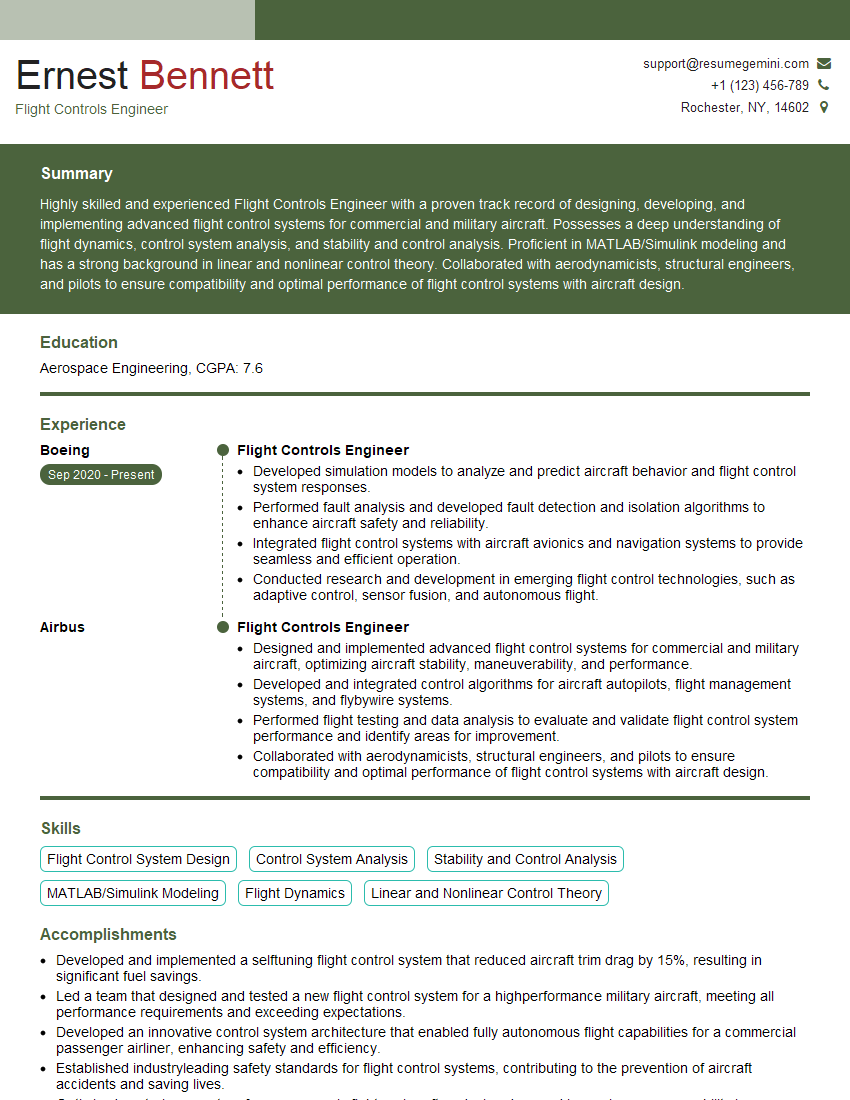
Mastering Aircraft Systems Design is crucial for a rewarding and successful career in the aerospace industry, opening doors to exciting opportunities for innovation and leadership. A strong understanding of these systems will set you apart from other candidates and demonstrate your expertise. To maximize your job prospects, creating an ATS-friendly resume is essential. This ensures your application is efficiently screened by Applicant Tracking Systems used by most companies. We highly recommend using ResumeGemini, a trusted resource for building professional and effective resumes. ResumeGemini offers examples of resumes tailored to Aircraft Systems Design, providing you with templates and guidance to create a winning application that showcases your skills and experience effectively.
Explore more articles
Users Rating of Our Blogs
Share Your Experience
We value your feedback! Please rate our content and share your thoughts (optional).
What Readers Say About Our Blog
Really detailed insights and content, thank you for writing this detailed article.
IT gave me an insight and words to use and be able to think of examples