The thought of an interview can be nerve-wracking, but the right preparation can make all the difference. Explore this comprehensive guide to Artistic Illustration interview questions and gain the confidence you need to showcase your abilities and secure the role.
Questions Asked in Artistic Illustration Interview
Q 1. Describe your experience with different illustration styles (e.g., realism, cartoon, vector).
My experience spans a wide range of illustration styles, each demanding a unique approach and skillset. Realism, for instance, requires meticulous attention to detail, accurate anatomy, and masterful use of light and shadow to create a hyper-realistic representation. I’ve worked on projects requiring photorealistic portraits and product renderings, employing techniques like detailed texture mapping and subtle color gradations. In contrast, cartoon illustration allows for more stylistic freedom and exaggeration. I’ve developed characters and environments using simplified forms, bold outlines, and expressive features, often emphasizing humor or a specific emotional tone. My work in this style has included children’s book illustrations and animated character designs. Finally, vector illustration provides scalability and clean lines, perfect for logos, icons, and graphic design elements. I’ve created numerous vector-based logos and infographics, leveraging software capabilities for precise scaling and editing without loss of quality. Each style demands a different approach – realism demands precision, cartoon demands expression, and vector demands precision and scalability.
Q 2. What software programs are you proficient in (e.g., Photoshop, Illustrator, Procreate)?
My proficiency lies in a diverse suite of industry-standard software. Adobe Photoshop is my primary tool for raster-based illustrations, particularly those requiring photo manipulation, detailed painting, and complex texturing. Adobe Illustrator is my go-to for vector work, ensuring crisp lines, scalability, and efficient design for logos, icons, and infographics. Procreate, on the iPad, offers a mobile and intuitive experience for sketching, painting, and quick concept development, especially useful for on-the-go ideation and client presentations. I also have experience with other relevant software, like Clip Studio Paint and Affinity Designer, allowing me to adapt to various project requirements and client preferences.
Q 3. Explain your process for creating a digital illustration from concept to final product.
My digital illustration process is iterative and involves several key stages. It begins with conceptualization, where I gather reference material, brainstorm ideas, and sketch out rough compositions. This often involves creating several thumbnails to explore different layout options. Next, I refine my sketch, adding details and solidifying the composition in a cleaner line art stage. This refined sketch then serves as the foundation for the digital painting phase. I carefully select colors based on my understanding of color theory (explained further in a later answer), paying close attention to light, shadow, and mood. This stage involves layering, blending, and refining details until I reach a level of satisfaction. Once the painting is complete, I perform a final quality check, ensuring sharp lines, consistent color, and appropriate file format before delivering the final artwork.
Q 4. How do you manage revisions and client feedback effectively?
Managing revisions and client feedback is crucial. I always maintain open communication throughout the process. I provide regular updates and seek feedback at key milestones, ensuring the project aligns with the client’s vision. When receiving feedback, I carefully review each comment, clarifying anything unclear. I document all changes, ensuring a clear track record. For significant revisions, I might create multiple versions allowing the client to compare and choose their preference. This organized approach ensures client satisfaction and avoids unnecessary back-and-forth, keeping the project on track and within the agreed-upon timeline.
Q 5. Describe your approach to color theory and its application in your work.
Color theory is fundamental to my illustrative work. My approach involves considering the emotional impact, aesthetic harmony, and overall mood. I utilize the color wheel to understand relationships between colors: complementary colors create contrast and visual interest (e.g., blue and orange), analogous colors create harmony and fluidity (e.g., blues and greens), and triadic colors offer a vibrant and balanced palette (e.g., red, yellow, blue). I also consider factors like temperature (warm vs. cool), saturation, and value (lightness vs. darkness) to achieve the desired effect. For instance, a dark, desaturated palette might evoke a somber mood, while a bright, saturated palette could convey energy and excitement. Understanding these principles allows me to create visually appealing and emotionally resonant illustrations.
Q 6. How do you handle deadlines and manage time effectively on large projects?
Managing deadlines on large projects requires meticulous planning and effective time management. I begin by breaking down the project into smaller, manageable tasks, creating a detailed schedule with realistic deadlines for each stage. I utilize project management tools to track progress and identify potential bottlenecks. Regular self-assessment allows me to adjust my schedule as needed. I also prioritize tasks based on urgency and importance, focusing on critical elements first. Open communication with the client about potential delays or challenges is crucial, ensuring transparency and proactive problem-solving. This proactive approach prevents last-minute rushes and ensures high-quality work, delivered on time.
Q 7. Explain your understanding of composition and its importance in illustration.
Composition is the art of arranging elements within an illustration to create visual harmony and guide the viewer’s eye. A well-composed illustration is engaging and tells a story effectively. I use various techniques, including the rule of thirds, leading lines, and focal points, to create visually appealing compositions. The rule of thirds involves dividing the image into nine equal parts and placing key elements along these lines or at their intersections. Leading lines draw the viewer’s eye towards the focal point. A clear focal point, the central element of interest, draws attention and helps convey the main message of the illustration. Understanding composition principles is crucial for creating compelling and effective visuals; it’s the underlying structure that determines the success of any illustration.
Q 8. Describe your experience working with different mediums (e.g., traditional vs. digital).
My experience spans both traditional and digital mediums, each offering unique advantages. Traditional methods, like watercolor and ink, allow for a spontaneous, unpredictable quality that’s difficult to replicate digitally. The physical interaction with the materials informs the final piece in a very tangible way; the texture of the paper, the flow of the paint, all contribute to the aesthetic. For example, I recently completed a series of botanical illustrations using watercolor, where the delicate layering and unpredictable blooms of the colors became integral to the overall mood and feel.
Digitally, I primarily use Procreate and Photoshop. These platforms offer incredible precision and control, perfect for intricate details and complex compositions. The ability to easily undo mistakes, experiment with layers, and utilize digital brushes adds a level of flexibility absent in traditional work. For instance, a recent children’s book project benefited significantly from digital tools; I could seamlessly integrate photographic elements with my illustrations, creating a cohesive and visually engaging narrative.
Ultimately, I believe a strong illustrator should be proficient in both. The skills complement each other, allowing for a broader range of creative expression and adaptability to various project needs.
Q 9. How do you incorporate storytelling into your illustrations?
Storytelling is at the heart of effective illustration. It’s not just about creating a visually appealing image; it’s about conveying a narrative, evoking emotion, and engaging the viewer. I achieve this through several methods. Firstly, composition plays a crucial role. The placement of elements within the frame, the use of leading lines, and the overall balance create a visual narrative flow. For example, in an illustration depicting a journey, I might use a winding path leading the viewer’s eye towards a distant horizon, creating a sense of anticipation and exploration.
Secondly, character design and body language are essential. I aim to imbue my characters with personality through their expressions, postures, and even the details of their clothing. The subtle tilt of a head, the set of a jaw, can communicate volumes. Finally, color palettes are powerful tools for emotional conveyance. Warm colors can suggest happiness and excitement, while cool colors might evoke feelings of calmness or melancholy. I carefully consider the psychological impact of color choices to enhance the story’s emotional resonance.
Q 10. What are your strengths and weaknesses as an artistic illustrator?
My strengths lie in my ability to create visually compelling narratives, a strong understanding of color theory and composition, and my versatility across various mediums. I’m also adept at collaborating with clients to bring their visions to life, efficiently delivering high-quality work within deadlines. However, I’m always striving to improve. One area I’m actively developing is my skill in dynamic figure drawing; while I can render figures effectively, mastering the fluidity and energy of movement is an ongoing pursuit. I actively seek out workshops and tutorials to refine this aspect of my illustration style.
Q 11. How do you stay updated with current trends and techniques in illustration?
Staying current is paramount in the ever-evolving field of illustration. I actively engage in several practices: I regularly browse online portfolios, art blogs, and social media platforms such as Instagram and ArtStation to see what other illustrators are creating and experimenting with. Attending industry conferences and workshops provides direct exposure to new techniques and technologies; learning from experts and networking with colleagues is invaluable. Finally, I subscribe to relevant online magazines and publications, providing insights into current trends in different sectors of illustration. This combination ensures I remain informed about cutting-edge styles and technologies.
Q 12. Show me an example of a project where you overcame a challenging technical hurdle.
In a recent project depicting a fantastical underwater scene, I faced the challenge of realistically rendering light refraction and the subtle nuances of underwater color shifts. Initially, my attempts felt flat and unconvincing. To overcome this, I researched scientific papers on underwater optics and light dispersion. I experimented with various layering techniques in Photoshop, carefully adjusting opacity and blending modes to mimic the way light bends and scatters in water. I also studied underwater photography to better understand the tonal shifts and color gradients. The final result was a dramatically improved illustration, effectively conveying the depth and luminosity of the underwater environment. The challenge spurred significant learning and broadened my understanding of light and color manipulation in digital art.
Q 13. How do you approach creating illustrations for different target audiences?
Adapting my style to different audiences is crucial. For children’s books, illustrations must be clear, simple, and engaging, prioritizing bold colors and easily recognizable characters. I employ a more whimsical and playful style, focusing on clear storytelling. Conversely, for adult audiences, I might adopt a more sophisticated style, incorporating more complex compositions, subtler color palettes, and nuanced details. In projects targeting a specific age group, I might also adjust the level of detail and complexity accordingly to match their visual comprehension level and interests. In essence, understanding the target audience’s age, interests, and cultural background informs my artistic choices to maximize engagement.
Q 14. How do you maintain consistency in style across multiple projects?
Maintaining stylistic consistency across projects is crucial for establishing a recognizable brand. I achieve this through several strategies. First, I maintain a consistent color palette across my work, utilizing a set of core colors that are frequently revisited and adjusted for subtle variations, rather than wildly changing between projects. Second, I develop a core set of stylistic elements, such as my signature line weight or character design choices, and use them as foundations for subsequent projects. Finally, I regularly review my past work and identify elements that resonate strongly with my personal aesthetic; this ensures that new projects align with my established artistic identity without stagnating creatively.
Q 15. Describe your process for creating character designs.
My character design process is iterative and involves several key stages. It begins with conceptualization, where I brainstorm ideas based on provided briefs or my own inspiration. This often involves sketching thumbnails to explore different poses, expressions, and overall aesthetics. Then comes the design development phase, where I refine my chosen sketch, focusing on anatomy, clothing, and personality traits. I use references extensively here, studying real-life people and other art to achieve accuracy and believability. Next is line art – creating clean, polished outlines of the character. Following this, I add color, experimenting with palettes and shading techniques to establish mood and visual appeal. Finally, there’s detailing and refinement, where I add final touches like textures and subtle shading to bring the character to life. For example, while designing a mischievous goblin for a children’s book, I started with rough sketches of various postures – hunched, upright, wielding a small weapon – before settling on a playful, slightly chubby design with oversized ears and mismatched clothes. This process helped solidify the character’s personality before moving to the more refined stages.
Career Expert Tips:
- Ace those interviews! Prepare effectively by reviewing the Top 50 Most Common Interview Questions on ResumeGemini.
- Navigate your job search with confidence! Explore a wide range of Career Tips on ResumeGemini. Learn about common challenges and recommendations to overcome them.
- Craft the perfect resume! Master the Art of Resume Writing with ResumeGemini’s guide. Showcase your unique qualifications and achievements effectively.
- Don’t miss out on holiday savings! Build your dream resume with ResumeGemini’s ATS optimized templates.
Q 16. Explain your understanding of perspective and its application in illustration.
Perspective is the art of representing three-dimensional objects on a two-dimensional surface, creating the illusion of depth and space. Understanding perspective is crucial in illustration as it gives drawings realism and believability. There are several types of perspective, including one-point, two-point, and three-point. One-point perspective uses a single vanishing point on the horizon line, creating a sense of depth when depicting objects receding into the distance, often seen in roads or railway tracks converging on the horizon. Two-point perspective utilizes two vanishing points on the horizon, ideal for showing objects from a corner view. Three-point perspective introduces a third vanishing point either above or below the horizon to emphasize height or downward-looking views. Applying perspective correctly requires careful observation of angles and proportions. For instance, when drawing a cityscape, accurately placing vanishing points allows buildings to appear to recede into the distance, creating a realistic urban environment. Without proper perspective, the cityscape would look flat and unconvincing. I often use a light sketch of the perspective lines before starting my detailed drawing to ensure accuracy.
Q 17. How do you handle copyright and intellectual property issues?
Copyright and intellectual property are paramount. I always ensure that I only use my own original work or material that I have the legal right to use. When using references, I’m mindful of avoiding direct copying and instead use them for inspiration and studying form. If I’m commissioned to create artwork based on pre-existing characters or settings, I work closely with the client to ensure I have clear legal permission and guidelines to avoid infringement. If I’m uncertain about the copyright status of something, I will thoroughly research it or avoid using it entirely. I always get contracts in writing for commercial projects specifying usage rights and ownership to avoid future complications. I also clearly mark my own work with a copyright symbol and other identifying marks to safeguard my creative rights.
Q 18. What are your preferred methods for presenting and showcasing your portfolio?
My portfolio is presented both digitally and physically. My online portfolio is hosted on a professional website, featuring high-resolution images of my best works, categorized by style and project type. The site showcases my versatility and skill set. Each piece includes a brief description outlining my role, the project’s context, and any relevant techniques used. A physical portfolio is also prepared for in-person meetings; it contains a curated selection of prints, allowing potential clients to experience the artwork’s texture and detail. I keep both my online and physical portfolio updated regularly and tailored to the type of clients I want to attract. This ensures my work is always fresh and relevant to the industry trends.
Q 19. How do you collaborate effectively with designers, writers, and other team members?
Effective collaboration hinges on clear communication and mutual respect. I begin by understanding everyone’s roles and contributions to a project. This might involve regular check-ins, brainstorming sessions, and detailed briefings. Open and honest feedback is vital; I’m always receptive to constructive criticism from designers, writers, and other team members, viewing it as an opportunity for improvement. When working remotely, I use digital collaboration tools such as shared cloud storage and project management software to ensure everyone stays on the same page. A willingness to compromise and adapt to changing project needs is also critical. For example, in a recent project involving a children’s book, collaborating closely with the author allowed me to incorporate their vision for character designs effectively, resulting in a cohesive final product.
Q 20. How do you ensure the quality of your illustrations meets the required standards?
Maintaining illustration quality involves several steps. Firstly, I meticulously plan each piece; detailed sketches and thorough research help establish a solid foundation. I use high-quality materials and software, maintaining a consistent workflow to minimize errors. Regular self-critique, employing techniques like stepping away from a piece for a while and then returning with fresh eyes, helps me identify areas for improvement. I also seek feedback from trusted peers or mentors, incorporating constructive criticism to enhance my work. Finally, I meticulously check for technical errors, such as color balance and line inconsistencies, before submitting a final product. The process often involves multiple revisions until the illustrations completely meet my own high standards and the expectations of the clients.
Q 21. Explain your understanding of typography and how it enhances your illustrations.
Typography plays a crucial role in enhancing illustrations, adding visual interest and conveying information effectively. The font choice influences the overall mood and style. A playful script font might suit a whimsical children’s illustration, while a bold sans-serif font could be more appropriate for a gritty graphic novel. Font size, weight, and spacing also influence readability and visual impact. For example, using a large, bold headline emphasizes key information, while smaller text provides additional detail. I often work closely with designers or clients to select fonts that complement the illustration style and convey the intended message. The skillful placement and integration of typography can elevate an illustration from simple artwork to a visually compelling and informative piece. For instance, when creating a poster, the fonts I choose help reinforce the poster’s message and contribute to its overall visual appeal.
Q 22. Discuss your experience with different printing methods and their impact on illustrations.
My experience spans various printing methods, each impacting illustrations differently. Understanding these impacts is crucial for achieving the desired visual outcome.
Offset Printing: Excellent for large-scale projects needing high-quality color reproduction and fine detail. However, it involves a more complex process and higher setup costs. For illustrations, this is ideal for posters, art books, or magazine spreads where vibrant colors and sharp lines are paramount. I’ve used this for a series of botanical illustrations, and the rich color saturation was truly remarkable.
Digital Printing: Offers versatility and cost-effectiveness, especially for smaller runs or proofing. It’s faster and more adaptable to changes, making it suitable for prototyping or personalized prints. I often use digital printing for client presentations or limited edition prints, where quick turnaround is critical.
Screen Printing: A technique that uses stencils to apply ink onto a surface. It’s perfect for creating bold, graphic illustrations with a distinct tactile quality, often seen in posters and apparel. I’ve used it for creating limited-edition prints with textured inks, adding another layer of artistic expression.
Giclée Printing: A high-quality inkjet printing method that utilizes archival inks, making it ideal for fine art reproduction. The color accuracy and detail make it a preferred choice for preserving the nuances of an illustration. I’ve used this for producing museum-quality prints of my landscape illustrations, ensuring longevity and fidelity to the original artwork.
Choosing the right method depends on the project’s scale, budget, desired aesthetic, and longevity requirements. Careful consideration of these factors is essential to ensuring the final printed piece accurately reflects the artist’s vision.
Q 23. How familiar are you with vector graphics and raster graphics?
I’m highly proficient in both vector and raster graphics. Understanding their strengths and weaknesses is essential for creating effective illustrations.
Raster graphics (like JPEGs and PNGs) are composed of pixels. They are excellent for photorealistic illustrations and detailed work, but scaling them up can lead to pixelation. Think of a high-resolution photograph – it’s a raster image.
Vector graphics (like SVGs and AI files) are made of mathematical equations defining lines and curves. They can be scaled to any size without losing quality, making them ideal for logos, illustrations intended for multiple uses (web, print, etc.), and artwork requiring clean lines and sharp edges. A company logo is a perfect example of where vector graphics shine.
I often use both in my workflow. For example, I might create detailed elements in raster format, then import them into a vector program to manipulate and combine them into a larger piece. The choice between the two depends entirely on the project’s needs and the desired aesthetic.
Q 24. Explain how you create texture and depth in your illustrations.
Creating texture and depth in my illustrations involves a multi-faceted approach, combining various techniques to achieve a realistic or stylized effect.
Value and Light: Careful manipulation of light and shadow is crucial. I use varying levels of contrast to create a sense of form and volume. Think of how light falling on a sphere creates highlights and shadows, defining its roundness. I apply this principle to all my subjects, paying close attention to the light source and its impact on the forms.
Layering: Overlapping elements and using transparent layers allows me to build up depth and complexity. For instance, a distant mountain range might be subtly layered behind a foreground element like trees, establishing a sense of space.
Texture Brushes and Techniques: I use custom brushes or digital techniques to simulate different textures such as rough fabric, smooth skin, or weathered wood. This adds visual richness and authenticity to the piece.
Perspective and Composition: Using perspective principles (one-point, two-point, etc.) helps to create a sense of space and depth. Careful composition, placing elements strategically within the frame, guides the viewer’s eye and enhances the overall depth perception.
Often I experiment with different techniques, combining traditional approaches with digital methods to create the desired level of texture and depth. It’s a continuous process of refining my skills and exploring new approaches.
Q 25. Describe a time you had to adapt your illustration style to meet specific client requirements.
I once worked on a children’s book project where the client initially wanted a highly realistic style. However, after seeing my portfolio, they were drawn to my more whimsical, illustrative style. The challenge was to adapt my signature style to align with the target audience while maintaining the book’s narrative integrity.
My solution was to present multiple sketches showcasing a gradual shift in style. I started with a more realistic approach, then progressively incorporated my signature elements – such as exaggerated features and brighter colors – while still retaining a level of clarity and simplicity appropriate for a children’s book. The client appreciated this iterative approach, and the final illustrations were a successful blend of my style and their initial vision.
Q 26. How do you resolve creative differences with clients?
Resolving creative differences involves open communication and mutual respect. I believe in collaborative problem-solving. My approach involves:
Active Listening: Understanding the client’s concerns and perspective is paramount. I ask clarifying questions and ensure I fully grasp their vision.
Presenting Options: Instead of imposing my ideas, I present a range of options that address their concerns while incorporating elements of my artistic style. I often use mood boards or sketches to visually communicate these alternatives.
Compromise and Iteration: Finding a middle ground often involves compromise. We might refine certain elements iteratively, incorporating feedback and making adjustments until we’re both satisfied. This process strengthens the client relationship and leads to a more successful outcome.
Documentation: Maintaining clear written communication, including revisions and agreed-upon changes, is crucial. This prevents misunderstandings and ensures a smooth workflow.
Ultimately, the goal is to create an illustration that meets the client’s needs while also reflecting my artistic integrity. This often results in stronger, more creative outcomes than a purely client-dictated approach.
Q 27. What is your experience with creating storyboards for animation or film?
I have extensive experience in creating storyboards for animation and film. Storyboarding is a crucial pre-production step, translating the script’s narrative into visual form.
My process typically involves:
Script Analysis: Carefully reviewing the script to identify key scenes, emotional beats, and action sequences.
Sketching Thumbnails: Creating quick, rough sketches to capture the essence of each scene, focusing on composition and camera angles. This helps visualize the flow and pacing of the story.
Detailed Storyboards: Developing the chosen thumbnails into more detailed drawings, adding character details, setting elements, and dialogue.
Panel Layout and Timing: Determining the number of panels per scene and considering the timing for each scene’s duration.
Collaboration: Working closely with the director, writers, and animators to refine the storyboards and ensure they align with the overall vision.
I use a variety of software and traditional media to create storyboards, adapting my approach depending on the project’s requirements and style. My focus is always on clear storytelling, ensuring each panel effectively conveys the narrative’s emotional impact and visual momentum.
Q 28. Describe your process for creating and managing a personal brand as an artist.
Building a personal brand as an artist requires a multifaceted approach, encompassing self-promotion, portfolio management, and community engagement.
Defining My Style and Niche: Identifying my unique artistic style and target audience is fundamental. Understanding my strengths and what differentiates me from other artists is crucial for establishing a distinct brand identity. For me, this is about combining whimsical elements with strong narrative components in my work.
Building an Online Presence: Maintaining an updated and professional website and social media presence is essential for showcasing my work and connecting with potential clients. High-quality images, consistent branding, and engaging content are key.
Networking and Collaboration: Actively engaging with other artists and professionals within the industry through attending events, participating in online forums, and collaborating on projects expands my network and exposure.
Portfolio Management: Continuously refining my portfolio to showcase my best work and highlight my versatility and skills. It’s a living document that evolves with my artistic development.
Consistent Branding: Maintaining consistent branding across all platforms, including logo, color palette, and visual style, creates a cohesive and recognizable brand identity.
Building a brand takes time and effort. It’s an ongoing process of self-promotion, networking, and consistently creating high-quality work that aligns with my artistic vision and target audience. It’s about building trust and credibility within my artistic community.
Key Topics to Learn for Artistic Illustration Interview
- Visual Communication & Storytelling: Understanding how to effectively communicate ideas and narratives through your artwork. Consider the role of composition, color theory, and visual metaphors.
- Digital Painting & Drawing Techniques: Proficiency in software like Photoshop, Procreate, or Illustrator. Be prepared to discuss your workflow, preferred tools, and problem-solving approaches when facing technical challenges.
- Traditional Art Skills: Demonstrate your understanding of foundational art principles like perspective, anatomy, and value. Discuss how these skills inform your digital work and enhance your artistic expression.
- Style & Portfolio Development: Articulate your artistic style and its evolution. Be ready to discuss your portfolio choices and explain the creative process behind your key pieces.
- Client Collaboration & Project Management: Discuss your experience working with clients or collaborators, emphasizing your communication skills and ability to manage projects effectively. Highlight your ability to understand and meet briefs.
- Art History & Influences: Demonstrate an understanding of artistic movements and influences that have shaped your style and approach. This showcases your broader artistic awareness.
- Software Proficiency & Workflow: Discuss your experience with relevant software, your preferred workflow, and how you approach different project requirements. Be prepared to demonstrate technical problem-solving skills.
Next Steps
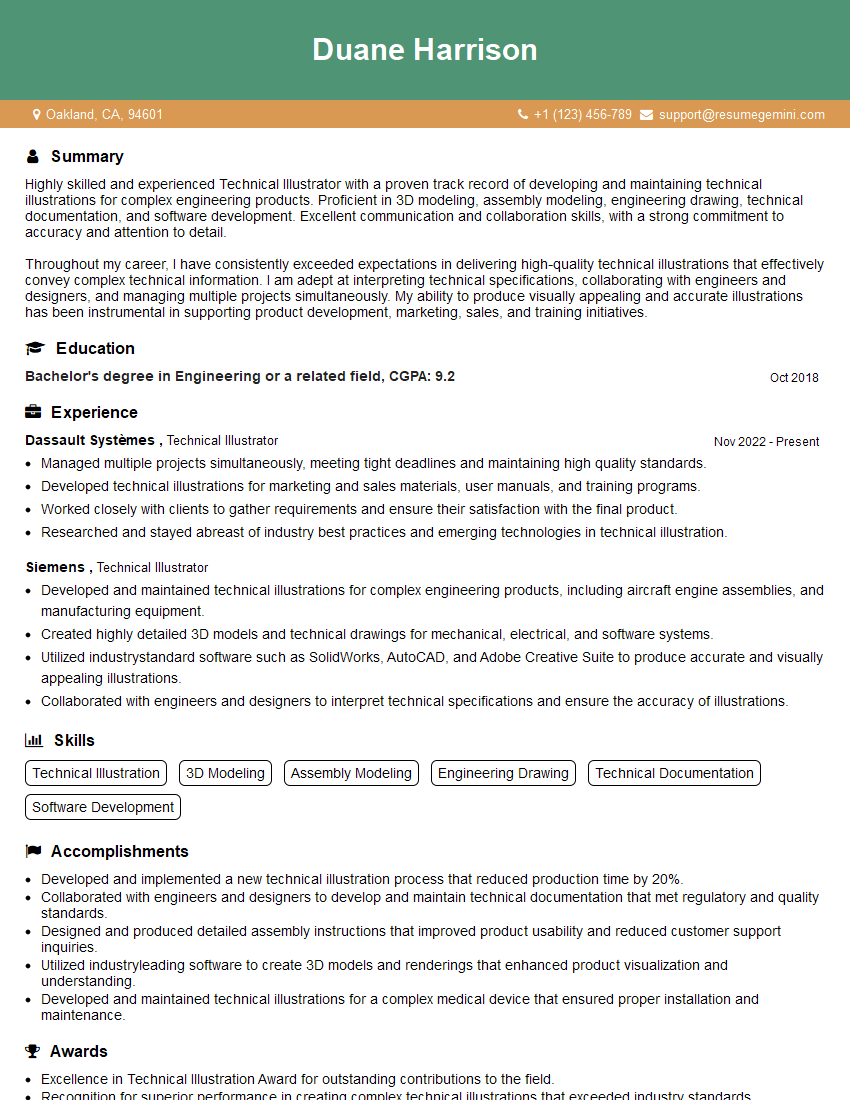
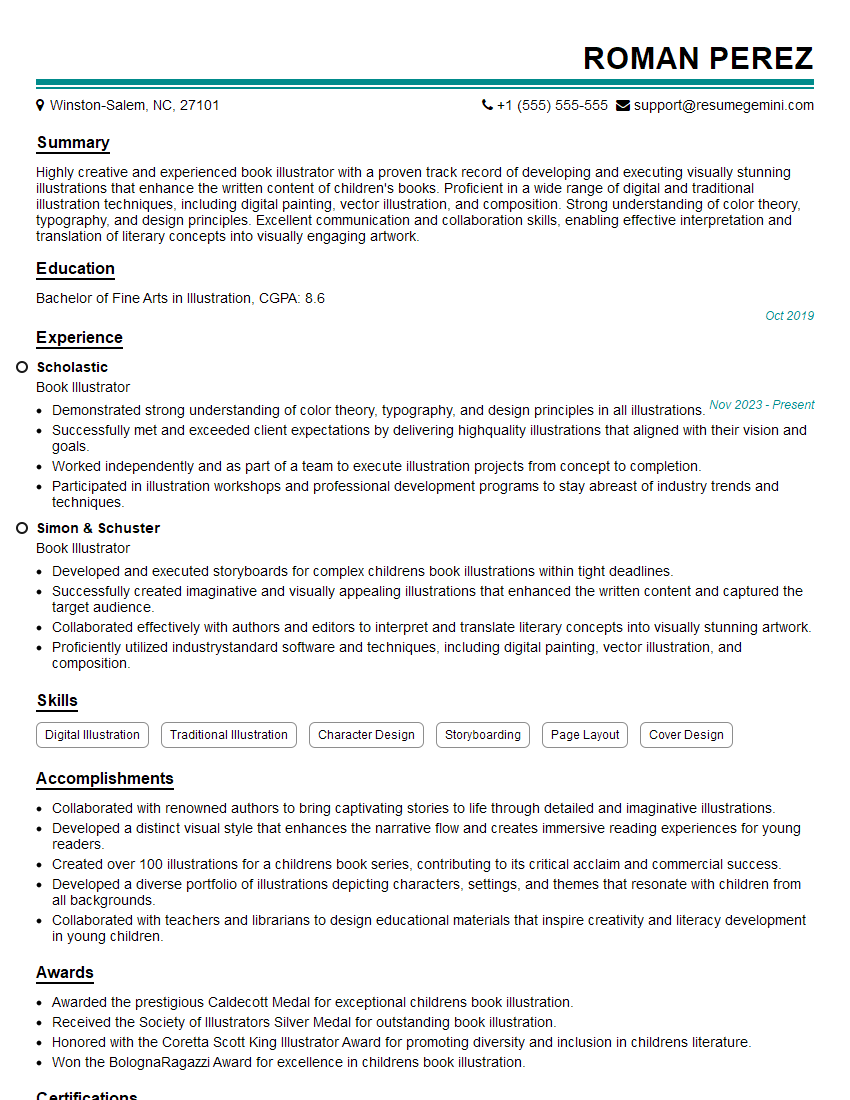
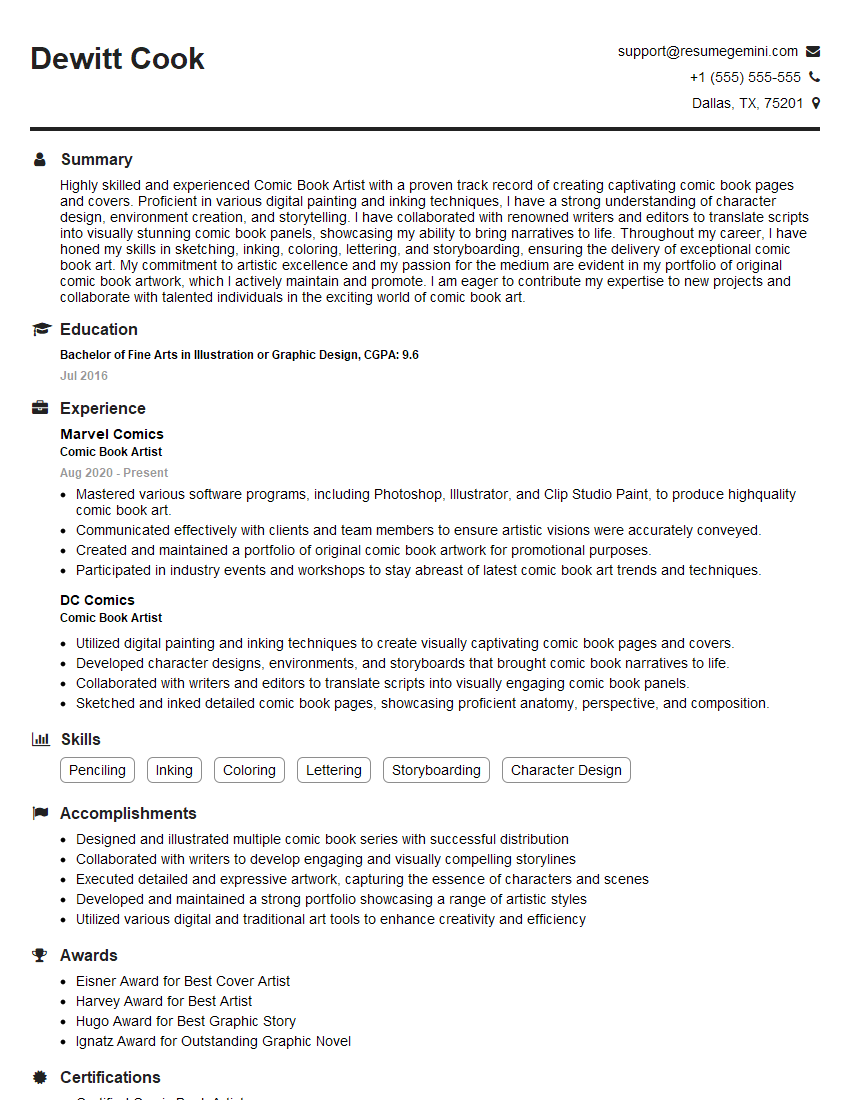
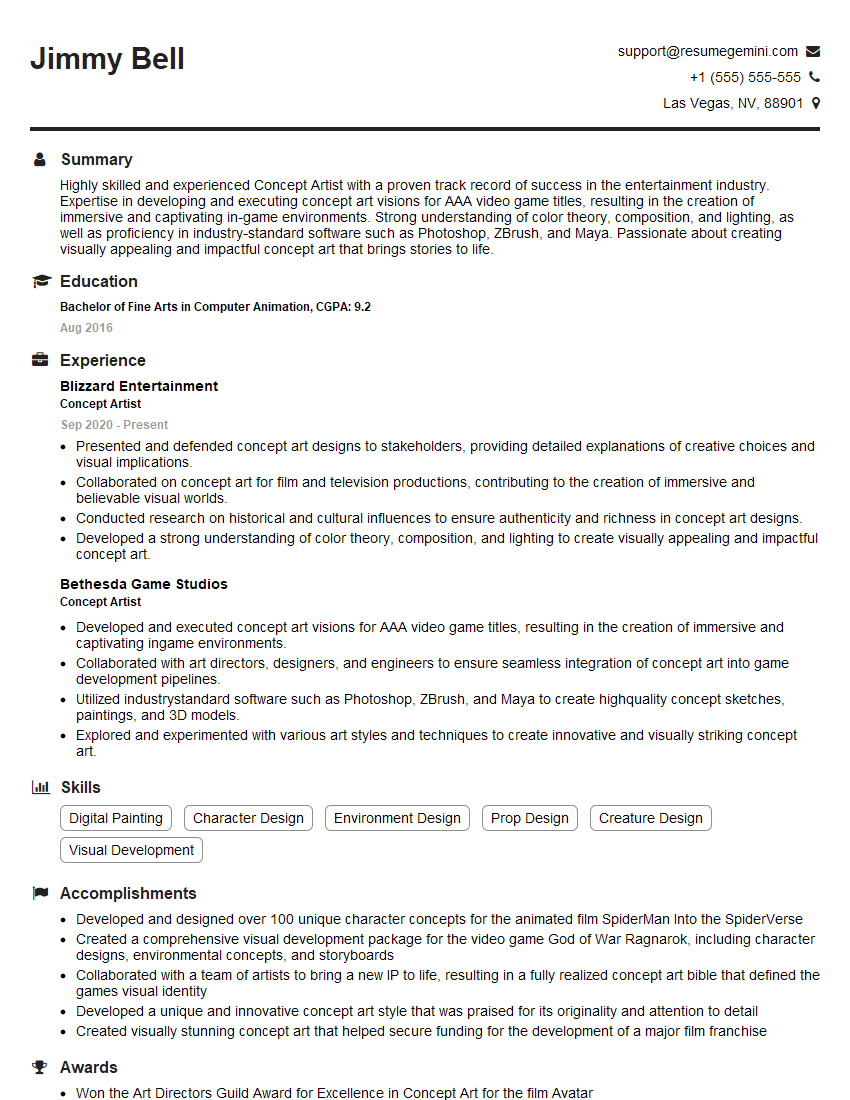
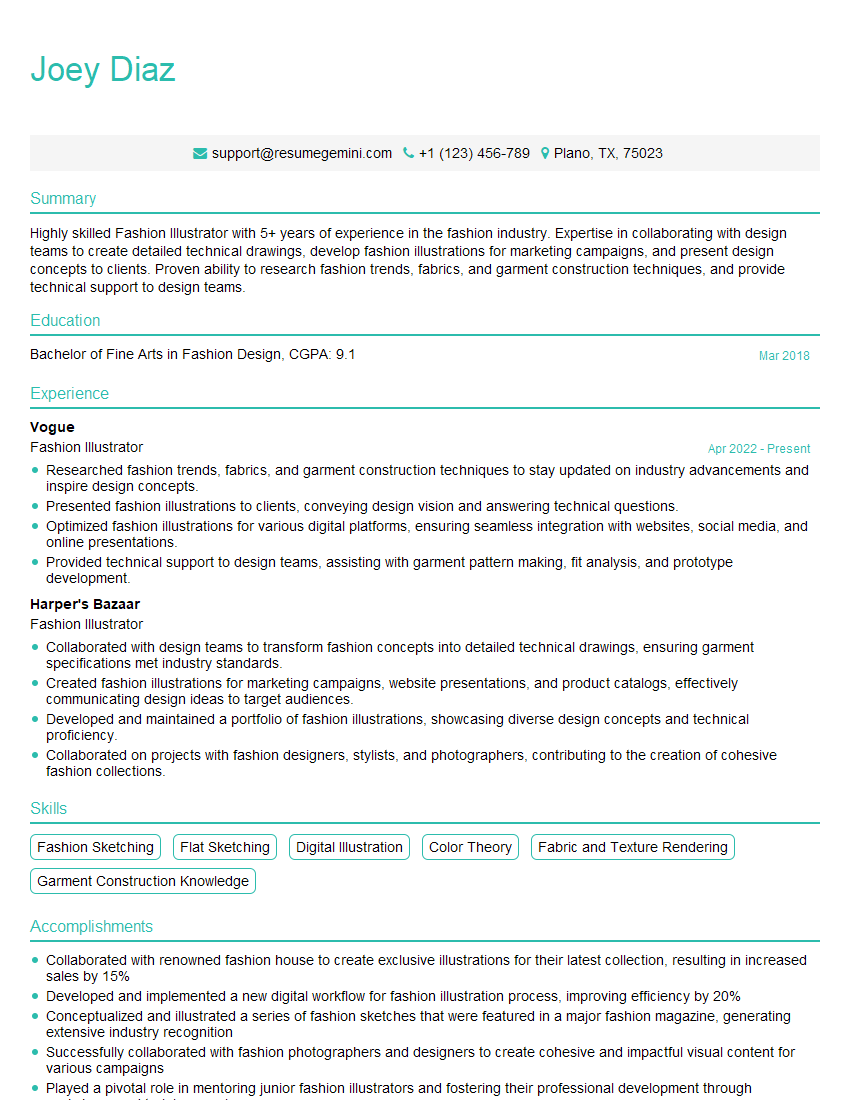
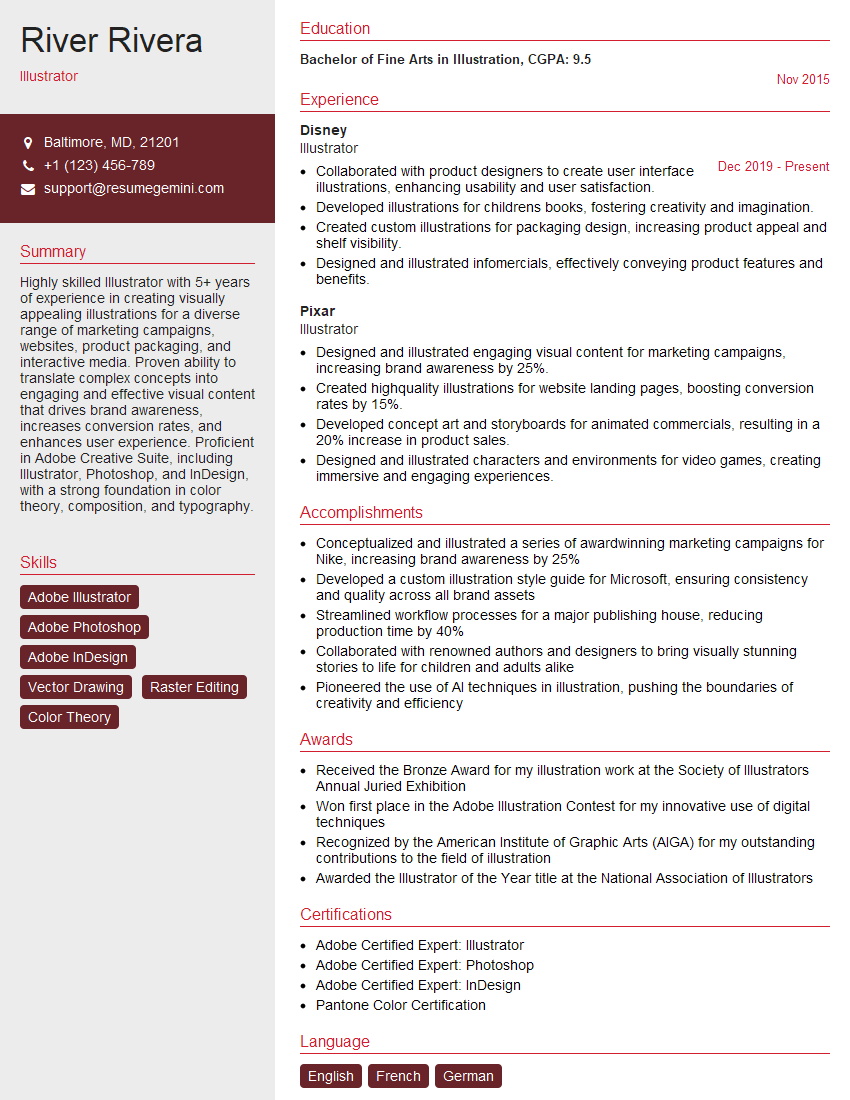
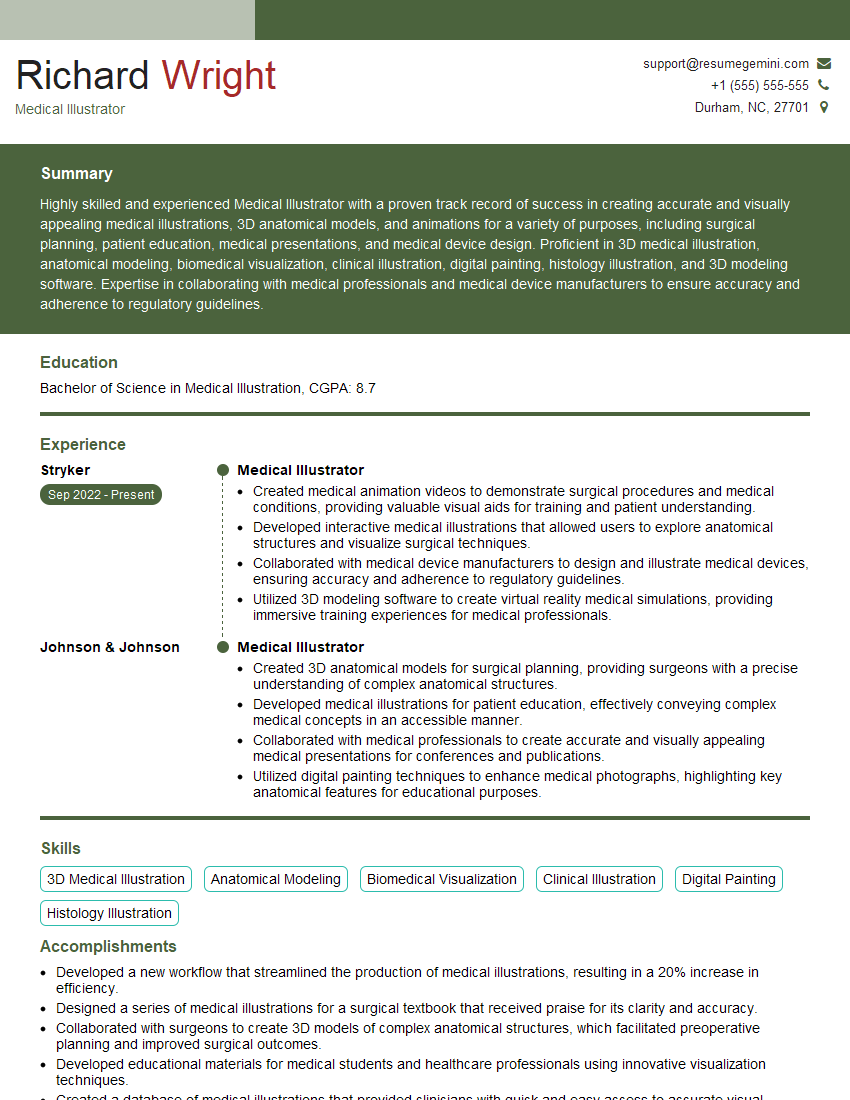
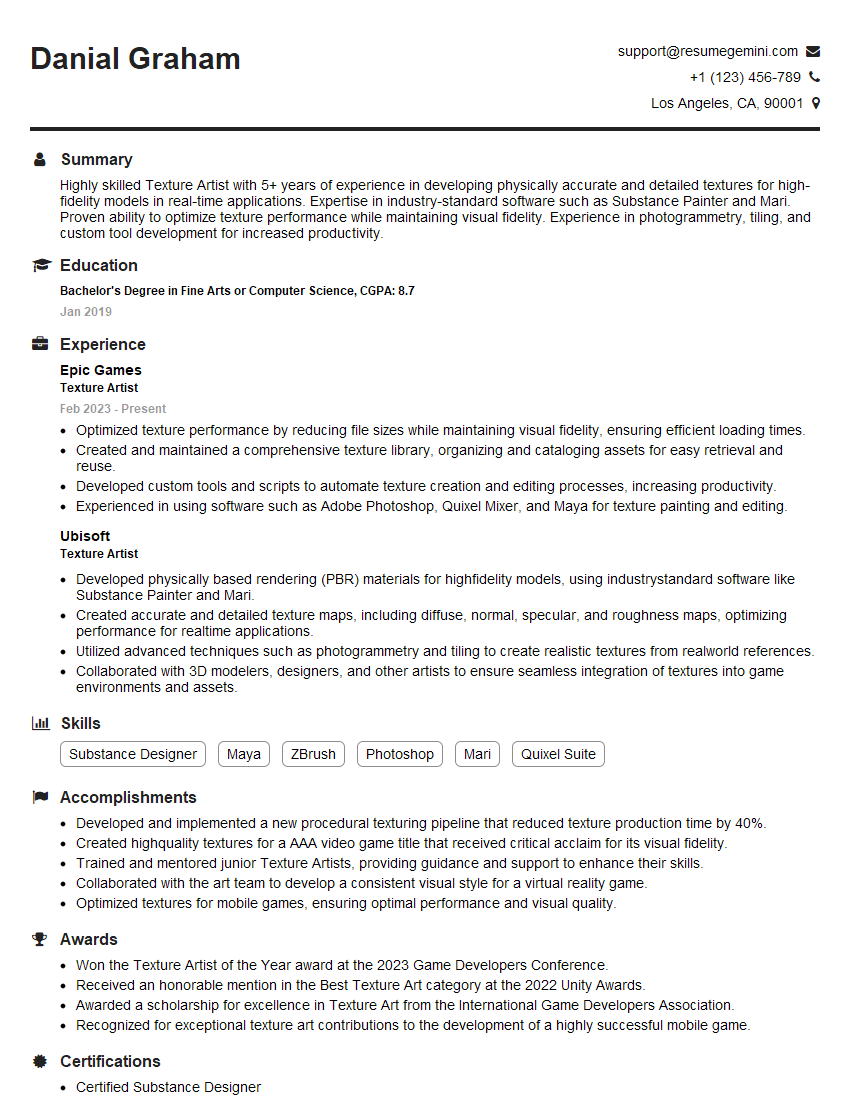
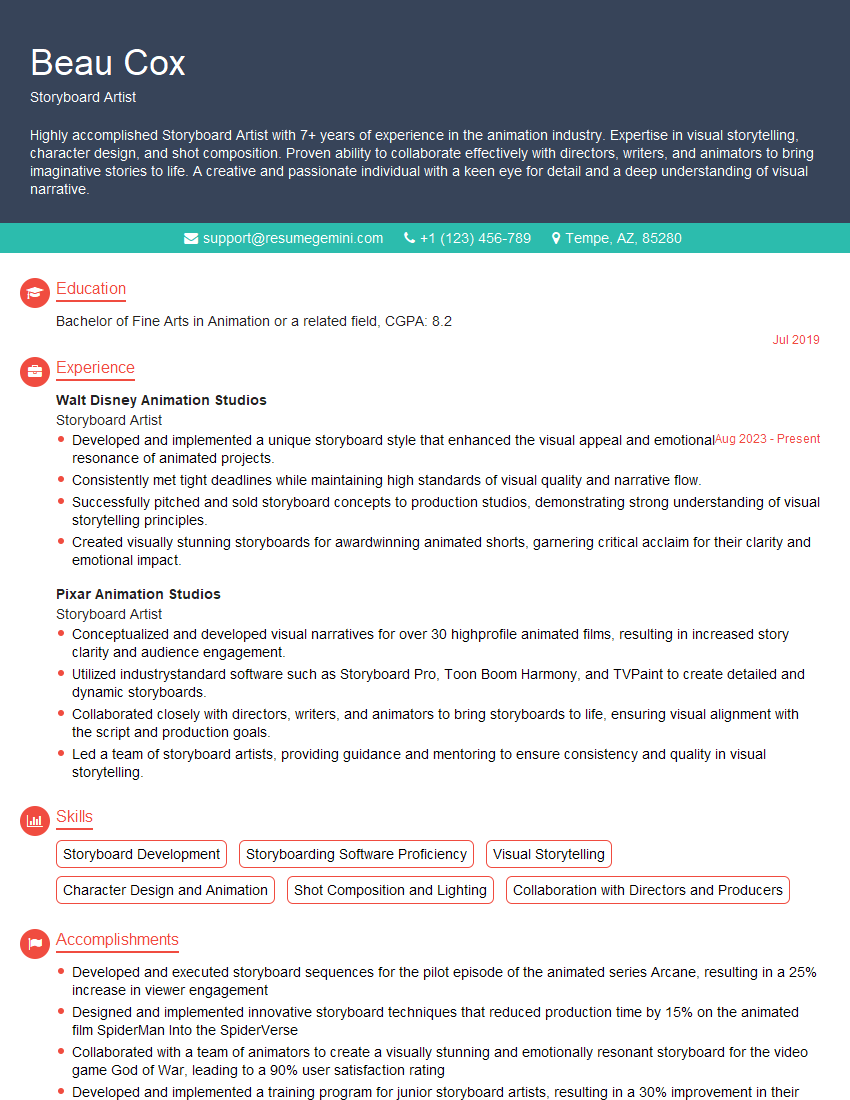
Mastering Artistic Illustration opens doors to a dynamic and fulfilling career, offering opportunities in various creative fields. To maximize your job prospects, crafting a strong, ATS-friendly resume is crucial. This ensures your application gets noticed by recruiters and hiring managers. ResumeGemini is a trusted resource to help you build a professional and impactful resume that showcases your unique skills and experience. We provide examples of resumes tailored specifically to Artistic Illustration to help you get started.
Explore more articles
Users Rating of Our Blogs
Share Your Experience
We value your feedback! Please rate our content and share your thoughts (optional).
What Readers Say About Our Blog
Really detailed insights and content, thank you for writing this detailed article.
IT gave me an insight and words to use and be able to think of examples