Are you ready to stand out in your next interview? Understanding and preparing for Automotive Terminology interview questions is a game-changer. In this blog, we’ve compiled key questions and expert advice to help you showcase your skills with confidence and precision. Let’s get started on your journey to acing the interview.
Questions Asked in Automotive Terminology Interview
Q 1. Define ‘torque’ and explain its significance in automotive engineering.
Torque, in automotive engineering, is the rotational force that an engine produces. Think of it like this: power is how quickly you can get to a certain speed, while torque is how much you can *pull* once you’re there. A higher torque engine can more easily move heavy loads or accelerate quickly from a standstill, even if it has lower horsepower. It’s measured in Newton-meters (Nm) or pound-feet (lb-ft).
Its significance is paramount. The engine’s torque output directly influences a vehicle’s acceleration, towing capacity, and overall drivability. For instance, a pickup truck needs high torque to tow heavy trailers, while a sports car might prioritize high horsepower but still benefits from sufficient torque for rapid acceleration. Engine designers meticulously balance torque and horsepower curves to optimize performance for the intended application of the vehicle.
Q 2. What is the difference between a ‘CVT’ and a ‘DCT’ transmission?
Both CVTs (Continuously Variable Transmissions) and DCTs (Dual-Clutch Transmissions) are automated transmissions designed to improve fuel efficiency and performance, but they achieve this in different ways.
- CVT: A CVT uses a system of pulleys and a belt to seamlessly change gear ratios. Think of it like a continuously adjustable bicycle gear system. This allows for optimal engine speed for any given situation, maximizing efficiency but potentially resulting in a less engaging driving experience for some drivers due to the lack of distinct gear changes. Examples include transmissions used in many Nissan and Honda vehicles.
- DCT: A DCT uses two separate clutches, one for odd-numbered gears and one for even-numbered gears. This allows for extremely fast gear changes because while one clutch is engaging the next gear, the other is already pre-selected and ready to engage. This leads to sportier acceleration and performance compared to traditional automatics, but can be slightly less fuel-efficient at low speeds due to the mechanical complexity. Examples include some Volkswagen Group and Porsche models.
Q 3. Explain the function of an ‘ECU’ in a modern vehicle.
The Electronic Control Unit (ECU) is the ‘brain’ of a modern vehicle. It’s a powerful microcomputer that manages various electronic systems within the car, acting as a central processing unit. It receives inputs from numerous sensors throughout the vehicle and uses pre-programmed algorithms to control outputs, adjusting engine timing, fuel injection, transmission shifting, braking systems, and more.
Imagine it as an air traffic control tower for your car, constantly monitoring and adjusting various systems to ensure optimal performance, safety, and efficiency. For example, it monitors engine temperature, adjusts fuel mixture based on oxygen sensor readings and throttle position, and controls the ignition timing for best power output and emission control. Modern ECUs also interact with advanced driver-assistance systems (ADAS) and infotainment systems.
Q 4. Describe the various types of ‘braking systems’ used in automobiles.
Automobiles employ several types of braking systems to bring the vehicle to a stop safely and efficiently. These include:
- Hydraulic Braking System: The most common type, using brake fluid pressure to actuate the brakes. A driver’s foot pressure on the brake pedal is amplified by a master cylinder, pushing brake fluid to calipers or wheel cylinders, causing friction to slow the vehicle.
- Anti-lock Braking System (ABS): An advanced safety feature preventing wheel lockup during hard braking (explained in more detail in the next question).
- Electronic Stability Control (ESC): This system works in conjunction with ABS to prevent loss of traction and maintain vehicle stability during cornering and emergency maneuvers.
- Brake Assist System: Detects emergency braking situations and boosts brake pressure to help the driver stop more quickly.
- Regenerative Braking (in hybrid and electric vehicles): Uses the electric motor to slow the vehicle, converting kinetic energy into electricity which is stored in the battery.
Q 5. What is the meaning of ‘ABS’ and how does it function?
ABS stands for Anti-lock Braking System. It’s a crucial safety feature that prevents the wheels from locking up during hard braking. Wheel lockup reduces steering control and increases stopping distance on many surfaces. ABS uses wheel speed sensors to monitor each wheel’s rotational speed. If a wheel starts to lock up, the ABS module rapidly pumps the brakes, releasing and re-applying pressure to maintain wheel rotation, allowing the driver to steer around obstacles while braking.
Imagine driving on ice. Without ABS, hard braking could lock your wheels, causing a skid and loss of control. With ABS, the system prevents this, allowing you to maintain steering control while still achieving maximum braking performance.
Q 6. What are the key components of a ‘suspension system’?
A suspension system’s primary function is to connect the vehicle’s chassis to its wheels, absorbing shocks and vibrations from the road surface to provide a comfortable and controlled ride. Key components include:
- Springs (coil springs, leaf springs, torsion bars): These absorb the impact of bumps and irregularities.
- Dampers (shock absorbers): These control the movement of the springs, preventing excessive bouncing and ensuring stability.
- Control Arms/A-arms/Other linkages: These connect the wheels to the chassis, guiding their movement.
- Bushings: These provide a controlled amount of flexibility within the suspension joints, reducing noise and vibration.
- Sway bars (anti-roll bars): These help to reduce body roll during cornering.
Q 7. Explain the concept of ‘engine displacement’ and its impact on performance.
Engine displacement refers to the total volume of cylinders in an engine. It’s usually expressed in liters (L) or cubic centimeters (cc). For example, a 2.0L engine has a total cylinder volume of 2 liters. Displacement is a significant factor influencing an engine’s power potential, although not the sole determinant.
Larger displacement generally means more power potential, as there’s more space for the combustion of fuel and air. However, other factors like the engine’s design, efficiency, and forced induction (turbocharging or supercharging) have a significant impact on actual performance. A larger displacement engine might be less fuel-efficient than a smaller, more technologically advanced engine with similar power output.
Q 8. What is ‘horsepower’ and how is it measured?
Horsepower (hp) is a unit of measurement of power, specifically the rate at which work is done. In the automotive world, it represents the engine’s ability to perform work, essentially how quickly it can accelerate a vehicle. Think of it like this: a more powerful engine (higher horsepower) can move a car faster and more easily up a hill than a less powerful engine.
It’s measured using a dynamometer, a device that measures the torque (rotational force) produced by the engine at various speeds. The horsepower is then calculated using a formula that takes into account the torque and the rotational speed. The standard formula is:
Horsepower = (Torque x RPM) / 5252where RPM is revolutions per minute. Different dynamometer types exist, each with its own calibration and methodology, ensuring accurate measurements. The resulting horsepower figure is a key specification when comparing the performance capabilities of different vehicles.
Q 9. What is the significance of ‘fuel efficiency’ ratings?
Fuel efficiency ratings, typically expressed in miles per gallon (mpg) or liters per 100 kilometers (L/100km), are crucial indicators of a vehicle’s fuel consumption. They tell you how many miles (or kilometers) a vehicle can travel on a single gallon (or liter) of fuel. Higher ratings indicate better fuel efficiency, meaning the car travels further on less fuel.
These ratings are significant for several reasons:
- Cost Savings: Higher fuel efficiency translates directly to lower fuel costs for the owner over the vehicle’s lifespan.
- Environmental Impact: Better fuel efficiency means less fuel is burned, reducing greenhouse gas emissions and contributing to a smaller carbon footprint.
- Vehicle Selection: Fuel efficiency ratings are a major factor for consumers when choosing a new vehicle, influencing buying decisions based on long-term operating costs and environmental concerns.
Government agencies and independent organizations conduct standardized tests to determine these ratings under controlled conditions, ensuring consistent and comparable results across different vehicle models.
Q 10. Describe the different types of ‘fuel injection systems’.
Fuel injection systems precisely meter and deliver fuel into the engine’s combustion chamber. They’ve largely replaced carburetors due to improved efficiency and emission control. There are several types:
- Single-Point Injection (SPI): A single injector sprays fuel into the intake manifold before the air enters the cylinders. This is a simpler and less expensive system, but less precise than multi-point systems.
- Multi-Point Injection (MPI): Also known as port fuel injection, each cylinder has its own injector, spraying fuel directly into the intake port. This offers better fuel atomization and more precise control, leading to improved fuel economy and reduced emissions.
- Direct Injection (DI): Fuel is sprayed directly into the combustion chamber, rather than the intake port. This provides even more precise control over the air-fuel mixture, enabling higher compression ratios and better fuel efficiency. DI systems are commonly found in modern gasoline and diesel engines.
The choice of fuel injection system depends on factors like engine design, performance goals, emission regulations, and cost considerations.
Q 11. Explain the function of a ‘catalytic converter’.
A catalytic converter is an exhaust emission control device that converts harmful pollutants from the engine exhaust into less harmful substances. It’s a crucial part of modern vehicles for meeting emission standards.
Located in the exhaust system, it contains a catalyst (typically platinum, palladium, and rhodium) that facilitates chemical reactions. These reactions transform pollutants like carbon monoxide (CO), hydrocarbons (HC), and nitrogen oxides (NOx) into less harmful substances such as carbon dioxide (CO2), water (H2O), and nitrogen (N2). Essentially, it cleans the exhaust gases before they’re released into the atmosphere.
Without a functioning catalytic converter, vehicles would release significantly more harmful pollutants into the environment, contributing to air pollution and harming public health. Regular maintenance and monitoring of the catalytic converter’s efficiency are crucial for its proper functioning and environmental responsibility.
Q 12. What is the difference between ‘FWD’ and ‘RWD’ drivetrains?
FWD and RWD refer to the drivetrain configuration of a vehicle, indicating which wheels receive power from the engine.
- FWD (Front-Wheel Drive): The engine powers the front wheels. This is common in smaller, more fuel-efficient cars and is generally less expensive to manufacture. The weight distribution is often biased towards the front, which can affect handling, especially in adverse conditions.
- RWD (Rear-Wheel Drive): The engine powers the rear wheels. This configuration is often favored in performance cars and trucks due to better weight distribution and handling characteristics. It generally provides a more balanced driving experience, especially during acceleration and cornering. However, it can sometimes be less fuel-efficient than FWD.
The choice between FWD and RWD depends on factors such as vehicle type, intended use, performance requirements, and cost considerations. Each configuration offers unique advantages and disadvantages in terms of handling, fuel efficiency, and manufacturing costs.
Q 13. What is ‘AWD’ and when is it beneficial?
AWD (All-Wheel Drive) means that power from the engine is distributed to all four wheels. Unlike 4WD (Four-Wheel Drive), which usually involves a more robust system often with a low-range gear for off-road use, AWD systems are generally designed for improved traction and stability in various driving conditions, rather than off-road capability.
AWD is beneficial in situations with poor traction, such as snow, ice, or rain. By distributing power to all four wheels, it significantly enhances grip and stability, reducing the risk of skidding or losing control. While it adds complexity and usually some weight to the vehicle, making it slightly less fuel-efficient, the added safety and control are often worth the trade-off for drivers in regions with challenging weather conditions.
Q 14. Explain the concept of ‘tire pressure monitoring systems (TPMS)’.
A Tire Pressure Monitoring System (TPMS) is a safety feature that monitors the air pressure in each tire of a vehicle and alerts the driver if the pressure drops below a pre-set level.
TPMS uses sensors located inside the tire or near the valve stem to measure pressure. This data is then transmitted wirelessly to a receiver in the vehicle, typically displaying the pressure of each tire on the dashboard. If the pressure in a tire falls below a certain threshold, a warning light illuminates on the dashboard, alerting the driver to a potential problem.
Low tire pressure can lead to reduced fuel efficiency, poor handling, tire damage, and even accidents. TPMS helps prevent these problems by providing early warning of pressure issues, allowing the driver to take corrective action before it becomes a safety hazard. It’s a vital safety system that contributes to improved vehicle safety and fuel economy.
Q 15. Describe the various types of ‘steering systems’.
Steering systems are responsible for directing the vehicle’s wheels, allowing the driver to control the direction of travel. There are several types, each with its own advantages and disadvantages.
- Rack and Pinion: This is the most common type found in modern passenger cars. A pinion gear rotates, moving a rack which is connected to the tie rods, thus turning the wheels. It’s simple, efficient, and provides good steering feel.
- Recirculating Ball: This older system uses a recirculating ball nut to translate rotational motion into linear motion. It’s more robust than rack and pinion but offers slightly less precise steering feel and is less efficient.
- Power Steering: This isn’t a type of steering system per se, but rather an assistance system. Hydraulic, electric, and electro-hydraulic power steering systems boost the driver’s input, making steering easier, especially at low speeds. Imagine trying to steer a large ship without an engine – power steering provides that assistance.
- Electronic Power Steering (EPS): A modern variation of power steering using an electric motor. EPS offers benefits such as improved fuel efficiency and the ability to integrate driver-assistance features like lane keeping assist.
- Steering by Wire (SbW): This system replaces the traditional mechanical linkage with an electronic control system. It allows for features like variable steering ratios and improved safety, but it’s currently less common due to increased complexity and potential reliability concerns.
The choice of steering system depends on factors such as vehicle type, cost, performance requirements, and desired features.
Career Expert Tips:
- Ace those interviews! Prepare effectively by reviewing the Top 50 Most Common Interview Questions on ResumeGemini.
- Navigate your job search with confidence! Explore a wide range of Career Tips on ResumeGemini. Learn about common challenges and recommendations to overcome them.
- Craft the perfect resume! Master the Art of Resume Writing with ResumeGemini’s guide. Showcase your unique qualifications and achievements effectively.
- Don’t miss out on holiday savings! Build your dream resume with ResumeGemini’s ATS optimized templates.
Q 16. What are the key components of an ‘airbag system’?
An airbag system is a crucial safety feature designed to mitigate injuries in a collision. Its key components work together in a complex sequence to deploy the airbag quickly and effectively.
- Crash Sensor(s): These sensors detect a sudden deceleration, indicating a collision. They send a signal to the airbag control module.
- Airbag Control Module (ACM): The ‘brain’ of the system, this electronic control unit processes the signals from the crash sensors and determines whether to deploy the airbags based on the severity of the impact. It also controls the timing and deployment sequence.
- Inflator: This contains a chemical propellant that rapidly generates nitrogen gas to inflate the airbag within milliseconds.
- Airbag(s): These are nylon bags that inflate to cushion the occupants from impact. Different types of airbags, including frontal, side, and curtain airbags, are designed to protect different body regions.
- Wiring Harness: This connects all components of the system to the ACM and ensures reliable communication.
Consider it like a well-orchestrated play: The sensors are the audience noticing the event, the ACM is the director calling the shots, the inflator is the stagehand preparing the scene, and the airbags are the actors taking center stage for protection.
Q 17. Explain the meaning of ‘ISO 26262’ in the context of automotive safety.
ISO 26262 is an international standard that specifies the functional safety requirements for electrical/electronic (E/E) systems in passenger vehicles. It’s a crucial standard defining how automotive manufacturers must design, develop, and verify safety-critical systems to minimize the risk of accidents caused by E/E system failures. Think of it as a detailed recipe for building safe and reliable car electronics.
The standard uses a risk-based approach, categorizing automotive systems based on the potential severity of a failure. Higher Automotive Safety Integrity Levels (ASILs) – ranging from A to D (D being the most critical) – demand more rigorous development processes and testing. A higher ASIL level implies higher safety requirements, meaning more thorough verification and validation processes are necessary to ensure that the probability of hazardous failures is minimized.
For example, an engine control unit (ECU) would likely have a higher ASIL than a window motor controller, as a failure in the ECU could have far more serious consequences.
Q 18. What is ‘CAN bus’ and what is its role in a modern vehicle?
CAN bus, or Controller Area Network bus, is a robust vehicle communication network that enables different electronic control units (ECUs) within a vehicle to communicate with each other. It’s like the nervous system of a modern car, allowing different parts to talk and coordinate.
Imagine a car with dozens of ECUs managing everything from the engine to the infotainment system. The CAN bus allows these ECUs to share data efficiently, enabling features such as:
- Centralized Diagnostics: ECUs can report their status and any errors to a central diagnostic system.
- Integrated Systems: Allows for coordinated control of various systems, such as the engine, transmission, and braking system.
- Improved Performance: Data sharing can lead to optimized engine performance and improved fuel economy.
- Advanced Driver-Assistance Systems (ADAS): The CAN bus is vital for ADAS features like adaptive cruise control and lane departure warning.
The CAN bus uses a specific protocol that allows multiple ECUs to transmit and receive data simultaneously over a single wire. This is a highly efficient system vital for modern vehicles’ complex functionality.
Q 19. What is ‘lean manufacturing’ and its significance in automotive production?
Lean manufacturing is a systematic method for minimizing waste and maximizing efficiency in production processes. In the automotive industry, this translates to producing high-quality vehicles at the lowest possible cost while meeting customer demand. The core principle is to eliminate any activity that doesn’t add value to the final product.
Key elements of lean manufacturing include:
- Just-in-Time (JIT) Inventory: Parts are delivered to the assembly line only when needed, minimizing storage space and waste.
- Kaizen (Continuous Improvement): A philosophy of constant improvement through small, incremental changes.
- Value Stream Mapping: Analyzing the entire production process to identify and eliminate waste.
- Jidoka (Automation with a Human Touch): Automating processes to improve quality and consistency but maintaining human oversight.
- Poka-Yoke (Error-Proofing): Designing processes to prevent defects from occurring in the first place.
Imagine an assembly line where each station only receives the necessary parts at the exact time required. No wasted space storing excess parts, no delays due to missing components, and a focus on consistently producing high-quality vehicles – that’s lean manufacturing in action.
Q 20. Describe the function of a ‘differential’.
A differential is a gear mechanism that allows the wheels on an axle to rotate at different speeds. This is crucial for vehicles navigating turns, as the outer wheel needs to travel a greater distance than the inner wheel.
Without a differential, both wheels would rotate at the same speed, causing tire slippage and making turning difficult. The differential ensures that each wheel can rotate independently, maintaining traction and preventing damage. Think of it as a smart gear system allowing the wheels to adapt to different speeds during turns.
The differential is composed of several gears working in harmony, including:
- Ring Gear: Connected to the axle.
- Pinion Gear: Receives drive from the transmission.
- Side Gears: Allow for differential speeds between the wheels.
Different types of differentials, such as open, limited-slip, and locking differentials, offer varying levels of traction control based on the vehicle’s intended use and driving conditions.
Q 21. What are common causes of ‘engine knocking’?
Engine knocking, also known as detonation, is an abnormal combustion event that creates a sharp, metallic pinging or knocking sound from the engine. It can cause serious damage to engine components if left unchecked.
Common causes include:
- Low-Octane Fuel: Using fuel with a lower octane rating than recommended by the manufacturer. Octane rating indicates the fuel’s resistance to premature ignition. Low-octane fuel is more prone to auto-ignition.
- Ignition Timing Issues: Incorrectly advanced ignition timing can lead to premature combustion and knocking.
- Carbon Buildup: Accumulation of carbon deposits on piston crowns and valves can cause hot spots that trigger premature ignition.
- Lean Air-Fuel Mixture: A lean mixture (too much air and not enough fuel) can raise combustion temperatures, increasing the likelihood of knocking.
- Mechanical Issues: Worn pistons, rings, or valves can contribute to knocking.
Imagine the controlled explosion in a cylinder becoming an uncontrolled blast – that’s essentially what knocking is. Addressing the root cause is crucial to prevent engine damage.
Q 22. Explain the concept of ‘regenerative braking’.
Regenerative braking is a system that recovers kinetic energy during vehicle deceleration and converts it into electrical energy, which is then stored in the vehicle’s battery. Think of it like a reverse process of acceleration. Instead of using energy to speed up, regenerative braking uses the energy of slowing down to recharge the battery.
Here’s how it works: When the driver releases the accelerator pedal or applies the brakes, the electric motor acts as a generator. It resists the rotation of the wheels, slowing the vehicle down and simultaneously generating electricity. This electricity is fed back into the battery, extending the vehicle’s range, particularly beneficial in electric and hybrid vehicles.
For example, in a hybrid vehicle, regenerative braking supplements the traditional friction braking system, reducing wear on brake pads and improving fuel efficiency. In pure electric vehicles, it is a crucial component for maximizing range and minimizing reliance on the main battery power.
Q 23. What is the difference between ‘static’ and ‘dynamic’ vehicle testing?
Static vehicle testing involves evaluating the vehicle’s characteristics while it remains stationary. This contrasts with dynamic testing, which assesses the vehicle’s performance during movement.
- Static testing often focuses on measurements like dimensions, weight distribution, suspension compliance, and leak checks. Think of a technician measuring the vehicle’s height and wheel alignment in a garage.
- Dynamic testing, on the other hand, covers aspects like acceleration, braking, handling, stability, and noise levels under various driving conditions. This involves test tracks and specialized equipment to gather data on vehicle performance while driving.
Imagine building a house: static testing would be equivalent to checking the foundation and wall strength before occupancy; dynamic testing would be simulating an earthquake or wind pressure to assess the structural integrity under stress.
Q 24. Explain the role of ‘sensors’ in modern automotive systems.
Sensors are the nervous system of a modern vehicle, constantly gathering data about its internal and external environment. They provide the critical information that enables various advanced safety and performance features. They’re used extensively in areas like engine management, driver-assistance systems, and infotainment.
- Examples include speed sensors, acceleration sensors (accelerometers), position sensors (for throttle position, steering angle), temperature sensors, pressure sensors (for tire pressure, brake pressure), and various proximity sensors (ultrasonic, radar, lidar) for parking assistance and advanced driver-assistance systems (ADAS).
These sensors feed data to the vehicle’s electronic control units (ECUs), which process the information and take appropriate actions, such as adjusting fuel injection, deploying airbags, or activating the anti-lock braking system (ABS).
Q 25. What is ‘over-the-air’ (OTA) software updates and its implications?
Over-the-air (OTA) software updates allow automakers to remotely update a vehicle’s software via a wireless connection, similar to how you update apps on your smartphone. This eliminates the need for physical visits to the dealership.
Implications of OTA updates are significant:
- Improved safety: Addressing security vulnerabilities and deploying bug fixes quickly enhances vehicle safety.
- Enhanced features: Adding or improving features like navigation, infotainment, and driver-assistance systems increases the vehicle’s value and capability over its lifespan.
- Reduced costs: Eliminating dealer visits for software updates saves time and money for both the manufacturer and the customer.
- Customization: OTA updates can offer personalized user experiences tailored to individual driving preferences.
However, potential challenges include ensuring secure updates to prevent hacking and guaranteeing seamless updates for all vehicle variants.
Q 26. Describe the concept of ‘vehicle-to-everything’ (V2X) communication.
Vehicle-to-everything (V2X) communication refers to the wireless exchange of information between vehicles and other entities in the transportation ecosystem, including other vehicles (V2V), infrastructure (V2I), pedestrians (V2P), and networks (V2N).
Imagine a connected world where vehicles can communicate with traffic signals, road infrastructure, and even other vehicles to prevent accidents and enhance traffic flow. This is the promise of V2X communication. For example:
- V2I: A vehicle approaching an intersection receives an alert from the traffic signal about upcoming red light and adjusts speed accordingly.
- V2V: One vehicle warns another vehicle about an obstacle ahead, providing advanced warning time for the driver to react.
V2X communication relies on various communication technologies such as Dedicated Short-Range Communications (DSRC) and Cellular V2X (C-V2X).
Q 27. What is ‘autonomous driving’ and its current technological challenges?
Autonomous driving refers to the ability of a vehicle to navigate and operate without human intervention. It ranges from driver-assistance systems like adaptive cruise control to fully self-driving vehicles that can handle all driving tasks in all conditions.
Current technological challenges include:
- Sensor fusion and perception: Reliable data integration from diverse sensors (cameras, lidar, radar) in complex environments is crucial for accurate perception of surroundings.
- Decision-making and planning: Developing algorithms that can make safe and efficient driving decisions in unpredictable situations remains challenging.
- Robustness and safety: Ensuring the autonomous system can handle unexpected events and edge cases is paramount for public safety.
- Ethical considerations: Defining the moral and ethical implications of autonomous vehicles in accident scenarios presents significant hurdles.
- Legal and regulatory frameworks: Establishing clear regulations for the testing, deployment, and liability of autonomous vehicles is crucial for widespread adoption.
Q 28. Explain the meaning of ‘connected car’ technology.
A connected car refers to a vehicle equipped with technologies that allow it to connect to the internet and exchange data. This connectivity enables a range of features that enhance convenience, safety, and entertainment.
Imagine having real-time traffic updates displayed on your car’s navigation system or receiving automatic emergency notifications if your vehicle is involved in a collision. These are examples of the benefits of connected car technology. It uses various communication technologies, such as cellular networks, Wi-Fi, and satellite systems.
Features enabled by connected car technology include:
- Infotainment: Access to music streaming, online navigation, and apps.
- Safety: Emergency services notification, remote diagnostics, and advanced driver-assistance systems.
- Remote vehicle control: Remote locking/unlocking, engine start/stop, and vehicle tracking.
- Over-the-air updates: Remote software updates for improved features and security.
Key Topics to Learn for Automotive Terminology Interview
- Engine Systems: Understanding internal combustion engines (ICE), their components (e.g., cylinder head, crankshaft, pistons), and operating principles. Practical application: Troubleshooting engine malfunctions based on diagnostic codes.
- Transmission Systems: Knowledge of manual, automatic, CVT, and dual-clutch transmissions; their functionalities and maintenance. Practical application: Explaining the advantages and disadvantages of different transmission types for specific vehicle applications.
- Chassis and Suspension: Familiarization with various suspension systems (e.g., MacPherson strut, double wishbone), steering mechanisms, braking systems (ABS, ESP), and their impact on vehicle handling and safety. Practical application: Analyzing suspension geometry and its effect on tire wear.
- Electrical and Electronic Systems: Understanding automotive electrical architecture, sensors, actuators, control units (ECUs), and communication protocols (e.g., CAN bus). Practical application: Diagnosing electrical faults using diagnostic tools.
- Vehicle Safety Systems: Knowledge of advanced driver-assistance systems (ADAS), such as lane departure warning, adaptive cruise control, and autonomous emergency braking. Practical application: Describing the functionality and limitations of various safety features.
- Automotive Manufacturing Processes: Understanding the stages involved in vehicle manufacturing, from design and engineering to assembly and quality control. Practical application: Evaluating the efficiency and effectiveness of different manufacturing techniques.
- Emissions and Environmental Regulations: Knowledge of emission control systems (e.g., catalytic converters, particulate filters), relevant environmental regulations (e.g., CAFE standards), and their impact on vehicle design and development. Practical application: Discussing strategies for reducing vehicle emissions.
Next Steps
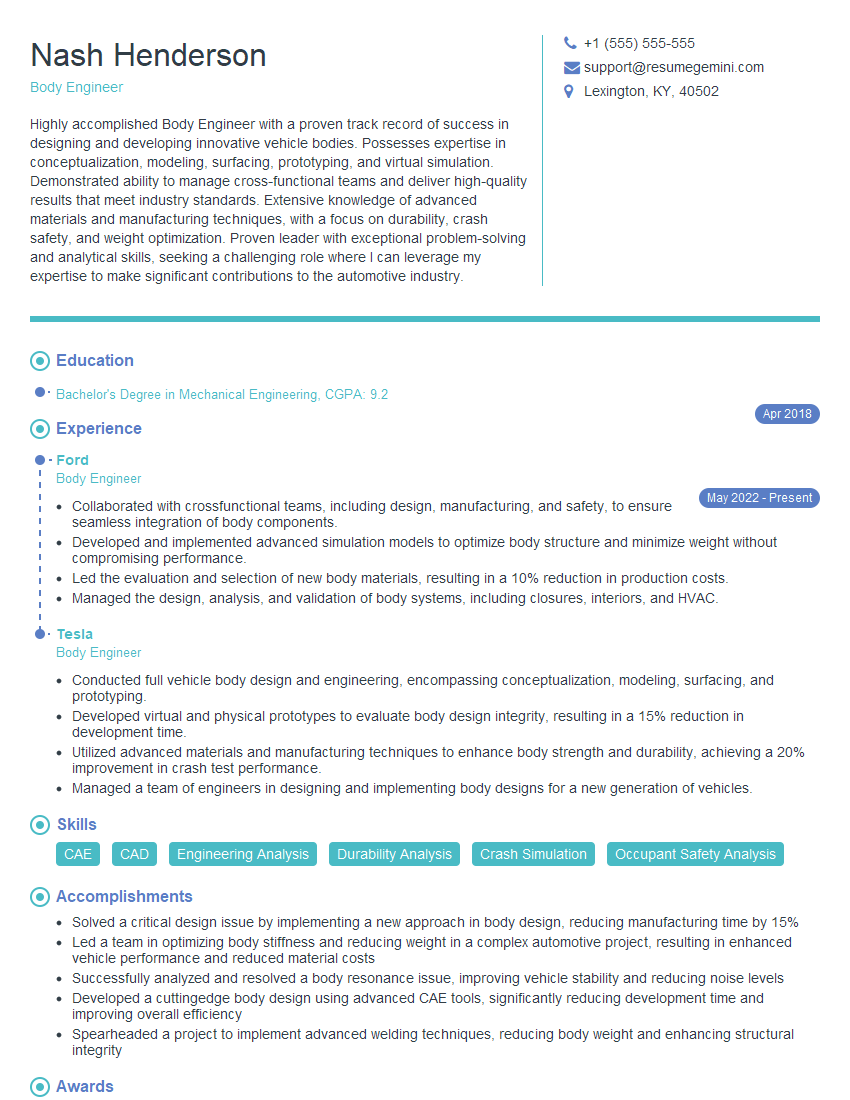
Mastering automotive terminology is crucial for career advancement in this dynamic industry. A strong understanding of these concepts will significantly enhance your interview performance and open doors to exciting opportunities. Building an ATS-friendly resume is equally important for maximizing your job prospects. This ensures your qualifications are effectively communicated to potential employers. To help you create a professional and impactful resume, we recommend using ResumeGemini. ResumeGemini provides a user-friendly platform to build a compelling resume, and we offer examples of resumes tailored specifically to the Automotive Terminology field to guide you through the process.
Explore more articles
Users Rating of Our Blogs
Share Your Experience
We value your feedback! Please rate our content and share your thoughts (optional).
What Readers Say About Our Blog
Really detailed insights and content, thank you for writing this detailed article.
IT gave me an insight and words to use and be able to think of examples