Are you ready to stand out in your next interview? Understanding and preparing for Avionics Systems Diagnostics interview questions is a game-changer. In this blog, we’ve compiled key questions and expert advice to help you showcase your skills with confidence and precision. Let’s get started on your journey to acing the interview.
Questions Asked in Avionics Systems Diagnostics Interview
Q 1. Explain the difference between fault isolation and fault diagnosis in avionics systems.
Fault isolation and fault diagnosis are distinct but related processes in avionics systems troubleshooting. Fault isolation pinpoints the location of a malfunction, while fault diagnosis determines the root cause of that malfunction.
Think of it like this: imagine your car won’t start. Fault isolation would narrow it down to either the battery, the starter motor, or the ignition system. Fault diagnosis would then investigate the specific problem within the identified area – a dead battery, a faulty starter solenoid, or a malfunctioning ignition switch.
In avionics, fault isolation often relies on built-in test equipment (BITE) and system monitoring data to identify a faulty Line Replaceable Unit (LRU) or a specific wire. Diagnosis then involves further investigation, potentially including detailed circuit analysis, software debugging, or even component-level testing to determine the precise reason for the failure.
Q 2. Describe your experience with using built-in test equipment (BITE) for avionics troubleshooting.
My experience with BITE is extensive. I’ve used it extensively across various aircraft platforms, from troubleshooting simple sensor failures to resolving complex network communication issues. BITE systems provide crucial first-line diagnostics, often indicating the faulty LRU with a specific fault code. For example, a BITE system might report “Error Code 12 – Air Data Computer (ADC) – Invalid Altitude Data.” This immediately points me to the ADC as the likely source of the problem, allowing for swift replacement or deeper investigation.
However, I’m aware of the limitations of BITE. It may only highlight a broad issue and doesn’t always pinpoint the exact root cause. Therefore, I always supplement BITE data with other diagnostic tools and techniques, such as using a multimeter to test voltage and continuity, reading relevant log files to understand system events, and referring to wiring diagrams to trace signals.
One memorable instance involved a faulty flight control computer. The BITE indicated a general failure, but by cross-referencing this with sensor data, I tracked the issue down to a specific sensor input failing intermittently causing the computer to flag the fault. This illustrates how BITE, combined with deeper investigative skills is crucial in the rapid resolution of faults.
Q 3. How do you troubleshoot intermittent faults in avionics systems?
Intermittent faults are notoriously challenging to troubleshoot in avionics due to their unpredictable nature. They appear and disappear without a consistent pattern, making diagnosis difficult. My approach involves a systematic strategy:
- Detailed Logging: I employ advanced data logging techniques to capture extensive system data during the periods where the fault is expected to occur. This includes parameters from affected subsystems and other relevant data channels.
- Environmental Factors: I consider environmental conditions that might trigger the fault, such as temperature, humidity, vibration, or power fluctuations. I might introduce simulated stress conditions to replicate the problem.
- Stress Testing: I perform comprehensive stress tests on the suspect components, running them through various operating modes and conditions to provoke the fault.
- Signal Tracing: Using oscilloscopes and logic analyzers, I meticulously trace signals in the affected circuits to identify unexpected behavior or voltage drops.
- Hardware Inspection: A thorough visual inspection for signs of damage (e.g., loose connections, cracked solder joints) is critical.
Troubleshooting intermittent faults often requires patience and methodical investigation. Sometimes, simply observing the system over an extended period under various operating conditions is the key to uncovering the pattern behind the intermittent failure.
Q 4. What are the common causes of communication errors in avionics networks?
Communication errors in avionics networks are common and stem from various sources. Some prominent causes include:
- Hardware Failures: Faulty transceivers, damaged cables, or connector problems can disrupt communication. This includes problems with physical media (fibres or wires).
- Software Glitches: Bugs in the software controlling the communication protocols can lead to data corruption, packet loss, or timing errors.
- Electromagnetic Interference (EMI): External electromagnetic fields can interfere with signal transmission, causing data corruption or signal loss.
- Protocol Violations: Incorrect data framing, addressing, or checksums can result in communication errors.
- Network Congestion: High network traffic can overload the system, causing delays, dropped packets, and other communication problems.
- Timing Issues: Asynchronous communication can lead to timing-related errors, especially in critical real-time systems.
Identifying the root cause requires using network analyzers, protocol decoding tools, and careful examination of system logs to pinpoint the precise nature and location of the communication breakdown.
Q 5. Explain your experience with different avionics communication protocols (e.g., ARINC 429, AFDX).
My experience encompasses various avionics communication protocols. I’m proficient in both ARINC 429 and AFDX (Avionics Full Duplex Switched Ethernet).
ARINC 429: I’ve worked extensively with this older, widely used protocol, characterized by its simplicity and relative ease of troubleshooting. I’m skilled in identifying and resolving issues related to data word formats, label codes, and signal integrity. Troubleshooting often involves checking signal levels, using logic analyzers to capture data, and confirming the proper functioning of the associated hardware.
AFDX: I have significant experience with AFDX, a high-speed, switched Ethernet network crucial in modern aircraft. Troubleshooting AFDX networks involves understanding Ethernet switching principles, using network monitoring tools to analyze traffic flow, identifying congested links and prioritizing traffic. The sophisticated nature of AFDX requires advanced diagnostic capabilities for isolating packet loss, latency issues, and other network-related problems.
In both cases, understanding the underlying protocol specifications is essential. I have used tools such as network analyzers, protocol decoders, and specialized test equipment to effectively analyze and troubleshoot problems within these networks.
Q 6. Describe your experience with troubleshooting problems related to sensors and actuators.
Troubleshooting sensor and actuator problems is a frequent part of my work. The approach involves a combination of techniques:
- Calibration and Testing: I perform calibration checks to ensure sensors provide accurate readings and actuators respond correctly. This frequently involves specialized test equipment to stimulate sensors and measure their output.
- Signal Analysis: I use oscilloscopes and data loggers to capture sensor signals and actuator control signals to identify unexpected behavior, noise, or drift.
- Wiring Integrity: I check wiring for continuity, shorts, and open circuits, which can disrupt signal paths and cause malfunctions.
- Power Supply: I verify that sensors and actuators receive the correct voltage and current. A faulty power supply can be a common underlying problem.
- Software Checks: Actuator control logic in software is examined to ensure correct data processing and output.
For example, a faulty airspeed sensor might provide erroneous readings, leading to inaccurate flight instruments. Troubleshooting involves checking the sensor’s calibration, inspecting wiring and connectors, and verifying power supply voltage. Similarly, an actuator malfunction, such as a stuck rudder, could be due to mechanical issues, electrical faults, or problems with the control system.
Q 7. How do you utilize schematics, wiring diagrams, and technical manuals for diagnostics?
Schematics, wiring diagrams, and technical manuals are indispensable tools for avionics diagnostics. They provide the necessary information to understand the system’s architecture, signal paths, and component interconnections.
Schematics: I use schematics to understand the electrical circuits, trace signal paths, and identify potential points of failure. Schematics show the logical connection of components, aiding in identifying the source of electrical issues.
Wiring Diagrams: Wiring diagrams map the physical connections within the system, showing how components are interconnected using cables and connectors. They are essential for tracing signals and locating specific wires during troubleshooting. They are vital for locating a physical fault from its logical schematic location.
Technical Manuals: Technical manuals provide crucial information about system specifications, fault codes, maintenance procedures, and component details. They are an invaluable resource for understanding system operation and interpreting diagnostic data.
I’ve relied on these resources countless times to solve complex diagnostic problems. For instance, a seemingly inexplicable fault in a flight control system was resolved by carefully tracing a signal path on a wiring diagram that revealed a poorly connected wire causing intermittent signal interruptions.
Q 8. What is your experience with using diagnostic software and tools?
My experience with avionics diagnostic software and tools is extensive. I’m proficient in using a range of industry-standard tools, including built-in test equipment (BITE), ground support equipment (GSE) like Aircraft Communication Addressing and Reporting System (ACARS) diagnostic systems, and specialized software packages. For example, I’ve worked extensively with integrated modular avionics (IMA) diagnostic software, which allows for deep analysis of multiple systems within a single platform. This includes experience with both proprietary manufacturer tools and open-architecture solutions. I understand how to interpret diagnostic messages, fault codes, and data logs to pinpoint the root cause of malfunctions. My skills encompass both hardware-level diagnostics, using tools like oscilloscopes and multimeters, and software-level diagnostics, using debuggers and logic analyzers to track data flow and identify software bugs. I’m familiar with both embedded and networked systems diagnostics, dealing with the complexities of CAN bus, ARINC 429, and Ethernet communication protocols.
Q 9. Describe a challenging avionics diagnostic problem you solved and how you approached it.
One particularly challenging problem involved an intermittent failure in the aircraft’s air data computer (ADC). The problem was that the aircraft’s airspeed indicator would sporadically show incorrect readings, posing a significant safety risk. The initial diagnostics using BITE pointed towards the ADC itself, but replacing the unit didn’t resolve the issue. This suggested a more complex problem. My approach involved systematically investigating each possible cause. I carefully reviewed the ADC’s inputs – primarily pitot and static ports – to ensure accurate readings. I then examined the ADC’s power supply and grounding. Eventually, I discovered a loose connection in the wiring harness feeding the ADC, causing intermittent signal loss. This loose connection wasn’t detected by initial diagnostic tests, highlighting the need for methodical troubleshooting. A simple resoldering fixed the problem, and a thorough post-repair test confirmed the resolution. This case demonstrated the importance of not only using advanced diagnostic tools but also maintaining a fundamental understanding of basic electrical principles.
Q 10. How do you prioritize tasks when multiple avionics systems are malfunctioning?
Prioritizing tasks when multiple avionics systems malfunction is critical for safety and efficient problem-solving. I utilize a risk-based prioritization approach. I follow a structured process, starting with a quick assessment to determine the severity of each malfunction. A hierarchical structure using a weighted system is used, considering factors like impact on flight safety, regulatory compliance, and mission impact. For example, a complete loss of navigation would be prioritized higher than a minor display glitch. I use a matrix system, where I list all affected systems along with their level of criticality (critical, major, minor). Systems deemed critical are addressed first and then I proceed to those with major and then minor. Detailed documentation is kept at each step of the process to enable easy traceability.
Q 11. What safety precautions do you take when diagnosing avionics systems?
Safety is paramount when diagnosing avionics systems. I adhere strictly to established safety procedures and guidelines, including:
- Lockout/Tagout Procedures: Ensuring power is disconnected and locked out before accessing any hardware.
- Grounding and Bonding: Utilizing proper grounding techniques to prevent electrostatic discharge (ESD) damage.
- Use of Personal Protective Equipment (PPE): Wearing appropriate PPE, such as safety glasses and anti-static wrist straps.
- Following Manufacturer’s Guidelines: Adhering precisely to the manufacturer’s maintenance manuals and diagnostic procedures.
- Double Checking Work: Thoroughly verifying all repairs and adjustments before restoring power.
- Documentation: Maintaining comprehensive records of all procedures undertaken and findings discovered.
In addition, I work closely with other maintenance personnel to ensure that there is always a safety net in place for tasks that may be considered riskier.
Q 12. Explain your experience with fault tree analysis (FTA) or other diagnostic methods.
I have significant experience with Fault Tree Analysis (FTA) and other diagnostic methods. FTA is a powerful tool for identifying potential system failures and their causes. It uses a top-down, deductive approach, starting with an undesired event (e.g., loss of communication) and working backward to identify the contributing factors. I’ve used FTA extensively to analyze complex avionics system failures, creating diagrams that visually represent the relationships between different components and their potential points of failure. Beyond FTA, I’m also proficient in other methods, such as:
- Fishbone Diagrams (Ishikawa diagrams): For brainstorming potential causes of a problem.
- 5 Whys Analysis: A simple yet effective technique for drilling down to the root cause of a problem by repeatedly asking ‘why’.
- Data-driven diagnostics: Utilizing flight data recorders (FDR) and quick access recorders (QAR) data to identify trends and patterns that might indicate developing faults.
These techniques help me to move beyond simple symptom identification and focus on the underlying reasons for failures to prevent future recurrences.
Q 13. How do you document your diagnostic procedures and findings?
Meticulous documentation is essential in avionics diagnostics. I use a combination of methods for documenting my procedures and findings. This involves:
- Detailed work orders: Containing complete descriptions of the problem, diagnostic steps taken, parts replaced, and any other relevant information.
- Diagnostic logs: Recording all data captured from BITE, GSE, or other diagnostic tools.
- Photographs and videos: Documenting the physical state of the system, including any visible damage or unusual findings.
- Schematic diagrams: Illustrating circuit paths and interconnections, making it easier to track signal flows.
- Fault tree diagrams or other analysis charts: Visual representation of the fault analysis process.
All documentation is stored securely and complies with regulatory requirements and company procedures ensuring traceability and accountability.
Q 14. What is your experience with different types of avionics hardware (e.g., computers, displays, GPS)?
My experience encompasses a broad range of avionics hardware. I have worked with various types of avionics computers, from older, dedicated systems to modern, high-performance integrated modular avionics (IMA) platforms. I’m familiar with different display technologies, including CRTs, LCDs, and advanced head-up displays (HUDs). My experience includes working with various navigation systems, including GPS receivers, inertial navigation systems (INS), and air data computers (ADC). I also possess a strong understanding of communication systems, including VHF radios, transponders, and data links. I am familiar with the operational principles of each and can troubleshoot most hardware-related issues. I’m also experienced with various sensors and actuators used in flight control systems, engine management, and environmental control systems. This ensures a holistic approach to system diagnostics, ensuring any hardware limitations or deficiencies aren’t overlooked.
Q 15. What are the common causes of failures in avionics power systems?
Failures in avionics power systems are multifaceted and can stem from various sources. Think of an airplane’s electrical system like a complex city grid – a failure in one part can cascade and impact the whole. Common causes include:
- Component failures: This includes things like failing batteries, damaged wires, malfunctioning generators, or failing power distribution units (PDUs). Imagine a blown fuse in your home – it’s a small component but can stop your appliances from working.
- Environmental factors: Extreme temperatures, vibration, and humidity can degrade components over time, leading to failures. This is like the wear and tear on your car battery in extreme heat or cold.
- Transient events: Spikes in voltage or electromagnetic interference (EMI) can damage sensitive electronic components. Imagine a sudden power surge frying your computer.
- Human error: Incorrect installation, maintenance, or operation can also contribute to failures. This is similar to improperly connecting wires in your home circuit.
- Aging and wear-out: Components have a finite lifespan, and as they age, their performance degrades, leading to eventual failure. Like any aging machine, airplane components need regular maintenance and replacement.
Diagnosing these failures often involves a systematic approach, using tools like multimeters, oscilloscopes, and specialized test equipment to pinpoint the exact location and cause of the problem. Understanding the system architecture, schematics, and relevant documentation is crucial for effective troubleshooting.
Career Expert Tips:
- Ace those interviews! Prepare effectively by reviewing the Top 50 Most Common Interview Questions on ResumeGemini.
- Navigate your job search with confidence! Explore a wide range of Career Tips on ResumeGemini. Learn about common challenges and recommendations to overcome them.
- Craft the perfect resume! Master the Art of Resume Writing with ResumeGemini’s guide. Showcase your unique qualifications and achievements effectively.
- Don’t miss out on holiday savings! Build your dream resume with ResumeGemini’s ATS optimized templates.
Q 16. Explain your familiarity with avionics regulations and certifications (e.g., FAA, EASA).
I’m thoroughly familiar with both FAA (Federal Aviation Administration) and EASA (European Union Aviation Safety Agency) regulations and certifications pertaining to avionics systems. My experience includes working with DO-160 (Environmental Conditions and Test Procedures for Airborne Equipment), DO-254 (Design Assurance Guidance for Airborne Electronic Hardware), and DO-178C (Software Considerations in Airborne Systems and Equipment Certification). I understand the rigorous requirements for safety, reliability, and maintainability that these regulations enforce.
I’ve directly participated in projects requiring certification, which involved meticulous documentation, rigorous testing, and thorough traceability throughout the entire design and development lifecycle. This included creating and reviewing certification plans, conducting design reviews, participating in audits, and generating evidence to demonstrate compliance with applicable standards. I understand the importance of maintaining detailed records for traceability and compliance, and I am proficient in utilizing industry-standard tools and methods to achieve certification.
Q 17. How do you handle situations where you cannot identify the root cause of an avionics malfunction?
When faced with an unidentified root cause, a systematic and methodical approach is essential. I would begin by expanding the scope of my investigation:
- Thorough data review: Re-examine all collected data, including flight data recorders (FDRs), quick access recorders (QARs), and any other available diagnostic logs. Often, a clue missed initially might reveal itself upon closer inspection.
- Consult relevant documentation: Review maintenance logs, schematics, technical manuals, and any relevant service bulletins for similar reported issues.
- Engage subject matter experts: Collaborate with colleagues, manufacturers, or other experts to brainstorm potential causes and share knowledge. A fresh perspective can often highlight overlooked possibilities.
- Fault isolation techniques: Employ more sophisticated diagnostics, such as signal tracing, component substitution, or specialized testing equipment to isolate the faulty component or area.
- Failure Mode and Effects Analysis (FMEA): Conduct a detailed FMEA to identify all potential failure modes and their associated effects on the system. This can help prioritize further investigations.
- Consider environmental factors: Assess if environmental conditions, such as extreme temperatures or unusual atmospheric effects, might have contributed to the malfunction.
If the root cause remains elusive, a decision may need to be made to replace components based on probability and safety considerations. It is always prioritized to ensure safety and airworthiness before making this decision. Thorough documentation of all steps, findings, and decisions is critical.
Q 18. Describe your understanding of avionics redundancy and fail-operational systems.
Avionics redundancy and fail-operational systems are critical for flight safety. Redundancy means having multiple systems or components perform the same function. If one fails, another takes over seamlessly. Fail-operational systems, on the other hand, can continue to operate even with a partial failure, though often with reduced functionality. Think of it as having a backup generator for your home – if the main power fails, the backup kicks in.
For example, a flight control system might have triple redundancy, where three separate computers independently calculate control commands. If one computer fails, the others continue to operate, ensuring safe flight. Fail-operational systems might have degraded performance in a failure scenario (like a slightly reduced response time), but they prevent complete system failure. This requires careful design and testing to ensure the system can safely handle failures and maintain a safe level of functionality.
Understanding the level of redundancy and the fail-operational capabilities of each system is paramount during diagnostics. It dictates the acceptable level of degradation and the necessary steps to mitigate risk.
Q 19. How do you ensure accurate and reliable data logging during diagnostics?
Accurate and reliable data logging is essential during diagnostics. Data integrity is crucial for effective troubleshooting and post-incident analysis. We achieve this by:
- Using calibrated equipment: Employing properly calibrated data acquisition systems and sensors ensures the accuracy and reliability of collected data.
- Proper data storage: Secure and appropriate storage solutions are used to prevent data loss or corruption.
- Data timestamping: All data points should be accurately timestamped to establish a clear timeline of events.
- Data redundancy: Redundant data logging systems can prevent data loss in case of a primary system failure.
- Data validation: The collected data undergoes validation checks to ensure its consistency and coherence, often using cross-referencing with other data sources. For example, comparing sensor readings with expected values or comparing them to other redundant sensors.
- Data security: Appropriate security measures are in place to prevent unauthorized access or modification of the logged data.
The choice of logging system is dependent on the specific application. Some systems use onboard data recorders (ODRs), while others rely on more specialized test equipment. Regardless of the method, maintaining high standards for data integrity ensures effective troubleshooting and informed decision-making.
Q 20. What is your experience with using oscilloscopes and other test equipment for avionics diagnostics?
I have extensive experience using oscilloscopes and other test equipment for avionics diagnostics. Oscilloscopes are indispensable for analyzing analog and digital signals, identifying signal integrity issues, and pinpointing intermittent faults. My experience encompasses various types of oscilloscopes, from basic models to high-bandwidth digital storage oscilloscopes (DSOs). I know how to use their various features including triggering, measurement functions, and data analysis tools.
Beyond oscilloscopes, I’m proficient with multimeters for voltage, current, and resistance measurements; logic analyzers for analyzing digital signals; spectrum analyzers for identifying EMI; and specialized avionics test sets. I understand the importance of proper grounding and shielding techniques when using test equipment to avoid introducing noise or damaging sensitive components. I’m also familiar with using and interpreting data from more advanced diagnostic tools like built-in test equipment (BITE) and ground support equipment (GSE).
Q 21. Describe your experience with troubleshooting problems related to flight control systems.
Troubleshooting flight control systems demands a high level of precision and caution. These systems are critical for safety, and any error could have severe consequences. My experience includes working on various flight control systems, including those based on both analog and digital technologies.
The approach I use is systematic: It begins by reviewing the flight data recorder and flight control computer logs for any anomalies. Then I carefully examine the relevant schematics and wiring diagrams. Using specialized test equipment, I isolate any faulty components, evaluating sensors (such as accelerometers, gyroscopes, and air data computers), actuators (such as servo-valves and hydraulic pumps), and control computers. I understand the importance of understanding the redundancy and fail-operational capabilities of the system, taking great care not to compromise safety during the diagnostics process. When addressing faults, I also consider the impact on the aircraft’s overall controllability and stability, to ensure the safety of the aircraft.
The process often involves verifying sensor data accuracy, checking actuator response times, and testing the integrity of the control computer’s algorithms. This may require specialized software and simulation tools, and a deep understanding of control theory and flight dynamics. The entire diagnostic process is meticulously documented, ensuring transparency and supporting any subsequent corrective actions.
Q 22. How do you stay current with advances in avionics technology and diagnostics?
Staying current in the rapidly evolving field of avionics requires a multi-pronged approach. I actively participate in professional organizations like the IEEE Aerospace and Electronic Systems Society, attending conferences and webinars to learn about the latest advancements in technologies like Artificial Intelligence (AI) for predictive maintenance and the integration of new communication protocols.
Furthermore, I regularly read industry publications such as Aviation Week & Space Technology and peer-reviewed journals to stay informed about research breakthroughs and emerging trends. I also actively engage in online communities and forums dedicated to avionics, participating in discussions and sharing knowledge with other professionals. Finally, I make it a point to explore new tools and software released by avionics manufacturers, keeping my skills up-to-date with practical applications.
For example, recently I completed an online course on the latest developments in fault-tolerant flight control systems, directly applicable to my current projects involving the diagnostic systems of next-generation aircraft.
Q 23. Explain your understanding of Human-Machine Interface (HMI) design in the context of avionics.
Human-Machine Interface (HMI) design in avionics is critical for pilot safety and operational efficiency. It’s all about creating a clear and intuitive interface between the pilot and the aircraft’s systems. Poor HMI design can lead to errors, delays, and even accidents. Think of it as the cockpit’s user experience (UX) – it needs to be intuitive and easily understood under pressure.
Effective HMI design in avionics adheres to strict standards and guidelines, prioritizing clarity, consistency, and minimizing cognitive load. This includes careful selection of displays, controls, and alerts. For example, critical information should be prominently displayed using clear symbology, while less important data can be relegated to secondary displays or accessed through menus. The use of color, fonts, and layout all play a crucial role in creating an effective HMI. Furthermore, the design must account for variations in lighting conditions and pilot workload.
In my experience, I’ve worked on projects involving the redesign of a legacy system, replacing outdated CRT displays with modern LCD screens and implementing intuitive touch-based controls. This involved extensive user testing and iterative design improvements to ensure optimal usability and safety.
Q 24. What is your experience with avionics data buses and their troubleshooting?
Avionics data buses, like ARINC 429 and AFDX (Avionics Full-Duplex Switched Ethernet), are the nervous system of modern aircraft, enabling communication between various systems. Troubleshooting these buses requires a systematic and methodical approach. My experience involves using a combination of hardware and software tools to identify and resolve issues.
Hardware tools include bus analyzers that capture and decode data traffic, allowing me to examine message content and timing for anomalies. Software tools involve specialized diagnostic software provided by the aircraft manufacturer or independent vendors. These tools allow for remote monitoring, testing of individual components, and even simulated fault injection to verify the effectiveness of diagnostic routines.
A common troubleshooting scenario involves a system malfunction, perhaps an instrument failure. I would begin by examining the relevant data bus traffic using a bus analyzer to see if messages are being transmitted correctly and received by the appropriate systems. If a problem is detected, further investigation using diagnostic software and potentially specialized test equipment might be required to pinpoint the faulty component. This might involve isolating the problem to a specific wire, connector, or even a software bug within a Line Replaceable Unit (LRU).
Q 25. Explain your understanding of electromagnetic interference (EMI) and its impact on avionics.
Electromagnetic Interference (EMI) is a significant concern in avionics, as it can disrupt the operation of sensitive electronic systems, potentially leading to malfunctions or even catastrophic failures. EMI is essentially unwanted electromagnetic energy that interferes with the intended signal. Sources of EMI in aircraft include high-power electrical equipment (motors, generators), radio transmitters, and lightning strikes.
The impact of EMI can range from minor glitches to complete system failures. For instance, EMI could corrupt data transmitted over a data bus, leading to erroneous readings on an instrument panel or a failure of a critical flight control system. To mitigate EMI, various techniques are employed, including shielding, grounding, filtering, and careful design of circuits to minimize susceptibility to interference. Compliance with standards like DO-160, which specifies environmental conditions including electromagnetic compatibility (EMC) requirements, is crucial.
In my work, I’ve been involved in designing and testing EMI shielding for avionics systems. This involves using computational electromagnetic (CEM) simulations to predict the effectiveness of different shielding designs before conducting physical tests to validate the results and ensure compliance with relevant standards.
Q 26. Describe your experience with using simulation tools for avionics diagnostics.
Simulation tools are indispensable for avionics diagnostics. They provide a safe and controlled environment for testing diagnostic algorithms and procedures without risking damage to real hardware. These tools range from high-fidelity simulations of entire aircraft systems to more focused simulations of specific components or subsystems.
I’ve extensively used tools like MATLAB/Simulink and specialized avionics simulation platforms to create realistic models of aircraft systems. These models allow me to inject faults, test diagnostic algorithms, and analyze their performance under various conditions. For instance, I recently used a simulation to test a new fault detection and isolation (FDI) algorithm for a flight control system. The simulation accurately modeled the system’s dynamics and allowed us to identify and correct shortcomings in the algorithm before deploying it on real hardware.
Simulation also offers the advantage of cost savings; troubleshooting complex systems in a simulated environment is considerably less expensive than performing the same tasks on real aircraft. Furthermore, simulations can be used for training purposes, allowing technicians to practice diagnostic procedures before working on real-world systems.
Q 27. How do you collaborate with other engineers and technicians during avionics troubleshooting?
Effective collaboration is essential in avionics troubleshooting, as it often requires expertise from various disciplines. My approach involves open communication, clear documentation, and a structured problem-solving methodology.
I begin by clearly defining the problem and gathering all relevant information. This involves discussions with pilots (if applicable) to understand the circumstances of the malfunction, reviewing system logs and historical data, and consulting with other engineers and technicians specializing in different aspects of the aircraft systems. For example, if we’re troubleshooting a problem with a flight control system, I would collaborate closely with software engineers, electrical engineers, and mechanical engineers to ensure a comprehensive investigation.
We use collaborative tools like shared documents and project management software to track progress, share findings, and ensure everyone stays informed. Regular meetings and technical discussions are held to review progress, resolve conflicts, and make key decisions. A structured approach, combined with clear communication and mutual respect, ensures efficient and effective teamwork in troubleshooting complex avionics problems.
Key Topics to Learn for Avionics Systems Diagnostics Interview
- System Architecture: Understand the interconnectedness of various avionics systems (navigation, communication, flight control) and how their diagnostics interact.
- Fault Detection and Isolation (FDI): Learn different FDI techniques, including built-in test equipment (BITE) analysis, sensor data fusion, and anomaly detection algorithms. Practical application: Explain how you would troubleshoot a discrepancy between GPS and inertial navigation system data.
- Data Bus Communication: Master protocols like ARINC 429, ARINC 629, and AFDX, including their functionalities and diagnostic capabilities. Practical application: Describe how you would diagnose a data communication error on an AFDX network.
- Sensor and Actuator Diagnostics: Gain proficiency in understanding the principles of operation and failure modes of various avionics sensors (e.g., GPS, air data, inertial measurement units) and actuators. Practical application: Explain how to diagnose a faulty airspeed indicator.
- Integrated Modular Avionics (IMA): Familiarize yourself with the architecture and diagnostic challenges of IMA systems, focusing on the advantages and disadvantages compared to traditional architectures.
- Troubleshooting and Repair Techniques: Develop a systematic approach to troubleshooting avionics system failures, including the use of schematics, diagnostic manuals, and test equipment. Practical application: Outline your approach to isolating a fault in a complex avionics system.
- Safety and Certification Standards: Understand relevant safety standards (e.g., DO-178C, DO-254) and their implications for avionics diagnostics.
- Aircraft Specific Systems: Research the specific avionics systems used in aircraft relevant to the jobs you are applying for. The deeper your understanding of the specifics, the better prepared you’ll be.
Next Steps
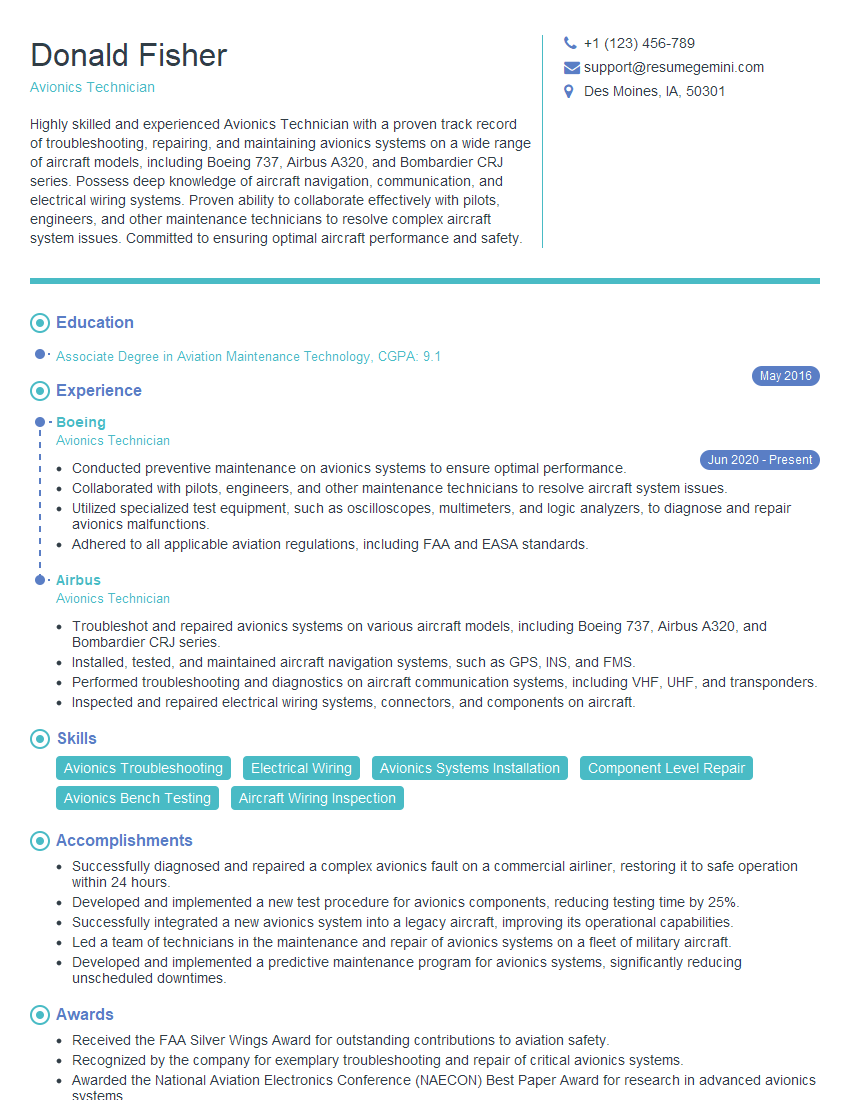
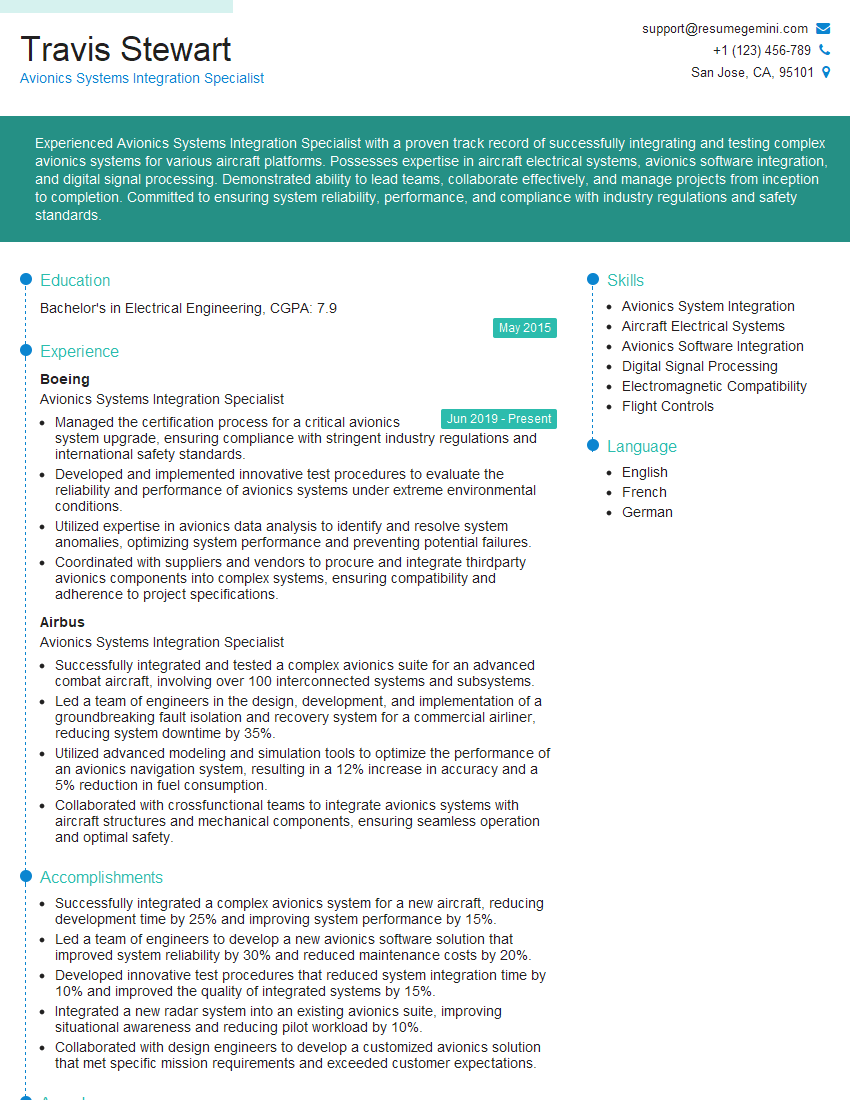
Mastering Avionics Systems Diagnostics is crucial for a successful and rewarding career in the aerospace industry. It demonstrates a strong technical foundation and problem-solving skills highly valued by employers. To significantly boost your job prospects, crafting an ATS-friendly resume is paramount. ResumeGemini is a trusted resource that can help you build a professional and effective resume that highlights your skills and experience. They provide examples of resumes tailored to Avionics Systems Diagnostics to help guide you. Investing time in building a strong resume will greatly increase your chances of securing an interview.
Explore more articles
Users Rating of Our Blogs
Share Your Experience
We value your feedback! Please rate our content and share your thoughts (optional).
What Readers Say About Our Blog
Really detailed insights and content, thank you for writing this detailed article.
IT gave me an insight and words to use and be able to think of examples