Unlock your full potential by mastering the most common Bodywork and paint repair interview questions. This blog offers a deep dive into the critical topics, ensuring you’re not only prepared to answer but to excel. With these insights, you’ll approach your interview with clarity and confidence.
Questions Asked in Bodywork and paint repair Interview
Q 1. Describe your experience with different types of auto body damage repairs (e.g., dents, scratches, rust).
My experience encompasses a wide range of auto body damage repairs. I’ve handled everything from minor scratches and dents to extensive collision damage involving major structural components and rust repair. For dents, I’m proficient in techniques like paintless dent repair (PDR) for smaller imperfections, and traditional methods involving body filler and sanding for more significant damage. Scratches, depending on depth, might require just polishing, touch-up paint, or a complete repaint of the affected area. Rust repair is a complex process often requiring cutting out the affected metal, fabricating a replacement piece, and welding it in place before priming and painting. I’ve worked on various vehicle makes and models, ensuring each repair meets the highest quality standards.
For example, I recently repaired a significant dent on a classic car’s fender. PDR wasn’t an option due to the extent of the damage. My process involved carefully assessing the dent’s depth and location, then using specialized tools to pull out the metal. After that, I applied body filler, sanded it smooth, primed the area, and finally applied color-matched paint and clear coat. The end result was indistinguishable from the original surface.
- PDR (Paintless Dent Repair): Ideal for minor dents without paint damage.
- Body Filler: Used to fill larger dents and imperfections before sanding.
- Rust Repair: Involves cutting out rusted metal, welding in a replacement, and preparing the area for paint.
Q 2. Explain your process for color matching automotive paint.
Color matching is crucial for a seamless repair. My process begins with identifying the vehicle’s original paint code, typically found on a sticker inside the driver’s side door jamb. I then use a spectrophotometer, a device that measures the color’s spectral reflectance. This provides a precise digital representation of the paint’s color, which is used to create a custom paint mix. In some cases, I might need to mix several shades to achieve the perfect match, taking into account factors like fading and sun damage. I always test the mixed paint on an inconspicuous area before applying it to the damaged part. This allows me to fine-tune the color and ensure a perfect match.
For instance, I once worked on a car with a rare, custom paint job. The paint code wasn’t readily available. I carefully examined the original paint for variations and subtleties. I mixed several shades multiple times, testing each on a hidden panel before achieving the nearly perfect match. Even subtle variations in light can alter how the paint looks, so I made sure the conditions were consistent for each color assessment.
Q 3. What types of paint systems are you familiar with (e.g., water-based, urethane)?
I’m experienced with various paint systems, including water-based and urethane paints. Water-based paints are environmentally friendly, requiring less hazardous waste disposal. Urethane paints, though containing isocyanates, offer exceptional durability, scratch resistance, and a deep, lustrous finish. They are frequently used for automotive applications due to their resilience. My experience also includes working with single-stage paints (which provide both color and clear coat in one application), and two-stage systems (a color coat followed by a clear coat for extra protection and shine).
The choice of paint system depends on several factors, including the customer’s budget, the vehicle’s age, and the desired level of durability. Water-based paints are often suitable for less demanding applications, while urethane paints are the preferred choice for high-quality, long-lasting finishes.
Q 4. How do you prepare a vehicle’s surface before painting?
Surface preparation is paramount for a high-quality paint job. It’s a meticulous process involving several steps. First, the damaged area is thoroughly cleaned to remove dirt, grease, and debris. Next, any existing rust or damaged metal is removed and repaired. Then, the surface is sanded using progressively finer grit sandpaper to create a smooth, even surface for the primer to adhere to. Masking is then carefully applied to protect the surrounding areas. After the damaged area is prepped and masked, the appropriate primer is applied to ensure the new paint adheres properly to the substrate. This often involves multiple coats followed by thorough sanding to ensure a flawless surface.
Think of it like preparing a canvas for a painting – you need a smooth, clean surface for the paint to adhere correctly. Otherwise, the paint job will not last, and imperfections will show through.
Q 5. What safety measures do you take when working with automotive paint and chemicals?
Safety is my top priority. When working with automotive paints and chemicals, I always wear appropriate personal protective equipment (PPE), including respirators, safety glasses, gloves, and coveralls. I work in a well-ventilated area or use a spray booth with appropriate ventilation systems to minimize inhalation of hazardous fumes. I meticulously follow the manufacturer’s instructions for each product, paying close attention to safety data sheets (SDS) for handling and disposal procedures. Proper disposal of hazardous waste is also critical, and I adhere strictly to all relevant environmental regulations. I regularly inspect my equipment to ensure it’s functioning safely. I also maintain a clean and organized workspace to prevent accidents.
Q 6. Describe your experience with using different body repair tools and equipment.
I’m proficient in using a wide array of body repair tools and equipment. This includes various types of welders (MIG, TIG, spot welders), body hammers and dollies for dent removal, air sanders and various grits of sandpaper for surface preparation, measuring tools for precise alignments, and specialized paint spray guns. I regularly calibrate and maintain my equipment to ensure accuracy and performance. I am also trained in the proper use of all tools and ensure all safety precautions are followed.
For instance, I use a laser measuring tool to ensure precise alignment of panels after a collision repair. This guarantees a perfect fit and avoids future issues.
Q 7. Explain your experience with metal finishing techniques.
Metal finishing is a crucial aspect of bodywork. My experience includes techniques like metal straightening (using hammers and dollies), metal finishing (using various abrasives and sanding techniques), and welding (MIG and TIG welding for structural repairs). I carefully prepare the metal by removing rust and cleaning it thoroughly. Then, I might use a combination of techniques to restore the metal’s shape and finish. The final result needs to be perfectly smooth and even before any paint or primer is applied.
One challenging project involved a vehicle with significant frame damage. Precise measurements and careful welding techniques were critical to restoring the frame to its original dimensions and strength, ensuring both structural integrity and aesthetic perfection.
Q 8. How do you identify and repair different types of body damage?
Identifying and repairing body damage starts with a thorough assessment. I begin by visually inspecting the area for the type and extent of damage. This could range from minor scratches and dents to major collision damage involving structural components.
- Minor Scratches: These often require only cleaning, polishing, and potentially touch-up paint.
- Dents: Depending on size and severity, dents can be repaired using paintless dent repair (PDR) techniques or traditional methods involving body filler. PDR is less invasive and preserves the original paint, while body filler is used for more significant damage before repainting.
- Collision Damage: This often involves straightening bent metal, replacing damaged panels, welding, and extensive body filler application. Accurate measurements and precise alignment are crucial.
- Rust: Rust requires thorough removal, often involving sanding, wire brushing, and the application of rust converters before repair and painting. Failing to remove all rust will lead to its return.
After assessing the damage, I choose the appropriate repair method, ensuring I select the most effective and cost-efficient solution. For example, a small dent might be effectively repaired with PDR, avoiding the need for painting, while a significant collision necessitates panel replacement and complete repainting.
Q 9. What is your experience with fiberglass or plastic repair?
I have extensive experience with fiberglass and plastic repair, common in automotive and marine applications. These materials require specialized techniques due to their flexibility and susceptibility to cracking.
- Fiberglass Repair: Often involves cutting out damaged sections, constructing a replacement using fiberglass mat and resin, shaping and sanding the repair, and then priming and painting.
- Plastic Repair: Can involve plastic welding, using heat to melt and fuse broken pieces, or filling cracks and holes with specialized plastic fillers. Proper preparation is key; the plastic must be thoroughly cleaned and prepared before repair. The type of plastic is important, and appropriate filler and techniques must be selected.
One challenging aspect is color matching – achieving a seamless blend with the surrounding surface. Careful sanding, priming, and multiple layers of paint are often necessary. I always test my color match in an inconspicuous area before proceeding to the main repair area. For instance, I once repaired a cracked bumper on a classic car, using a combination of plastic welding and filler to perfectly restore its shape and seamlessly match the original paint.
Q 10. What is your process for applying and blending automotive paint?
Applying and blending automotive paint is a meticulous process requiring precision and skill. It starts with proper surface preparation, involving thorough cleaning, sanding, and priming. The primer provides a uniform surface for the paint to adhere to.
- Base Coat Application: I typically use a spray gun, applying thin, even coats of base coat paint, ensuring complete coverage and avoiding runs or sags. Multiple coats might be necessary, allowing each coat to flash off (partially dry) before applying the next.
- Clear Coat Application: A clear coat is applied over the base coat to provide protection and enhance the paint’s shine and durability. Similar to the base coat, thin, even coats are applied, allowing each to flash off before the next.
- Blending: This is the most critical step. I carefully blend the new paint into the surrounding original paint, feathering the edges to create a seamless transition. This requires careful control of the spray gun and often involves multiple passes, gradually reducing the paint application at the edges. The goal is a completely invisible repair.
The entire process often requires many hours of work and attention to detail. For example, repainting a door requires precise masking to avoid overspray and ensuring a perfect match with the vehicle’s existing paint.
Q 11. How do you ensure a quality paint finish?
Ensuring a quality paint finish involves attention to detail at every stage of the process.
- Surface Preparation: Thorough cleaning, sanding, and priming are crucial for optimal adhesion and a smooth finish.
- Proper Paint Application: Using the correct paint type, application techniques, and maintaining the correct spray gun settings (air pressure, paint viscosity) are vital.
- Environmental Control: Temperature, humidity, and dust levels affect paint application; a controlled environment is ideal.
- Careful Sanding and Buffing: After the paint has cured, meticulous sanding and buffing are often necessary to achieve a flawless finish, removing imperfections and restoring the paint’s shine. Using different grades of sandpaper is important to refine the surface and achieve smoothness. This can be followed by polishing and waxing.
Quality control checks are essential throughout the process. This might involve inspecting the paint for runs, sags, or orange peel, and addressing them before proceeding to the next stage. For instance, I might use fine-grit sandpaper to carefully level any imperfections and then apply additional clear coat as necessary before buffing to a high gloss finish.
Q 12. Explain your understanding of different paint application techniques (e.g., spray gun, airbrush).
Various paint application techniques exist, each with its advantages and disadvantages.
- Spray Gun: The most common method for automotive painting, providing efficient coverage and control over paint application. Different spray gun types offer varying levels of atomization and fan pattern control. This offers flexibility in achieving a smooth and even finish.
- Airbrush: Used for smaller, more detailed work, such as intricate designs or touch-ups. The airbrush’s fine control allows for precision and creating delicate effects.
- Rollers and Brushes: While less common in professional automotive painting, rollers and brushes may be used for specific tasks, such as applying primer in hard-to-reach areas.
Choosing the right technique depends on the size and complexity of the job, and the desired finish. For example, a spray gun is ideal for large panel repainting, while an airbrush is better suited for fine detailing or blending.
Q 13. How do you troubleshoot common problems during the painting process?
Troubleshooting during painting involves identifying the root cause and implementing the appropriate corrective action.
- Runs and Sags: These typically occur due to excessive paint application or incorrect spray gun settings (too high paint viscosity, too low air pressure). The solution often involves sanding and repainting the affected area.
- Orange Peel: A textured appearance, usually caused by improper spray gun technique, too high air pressure, or too much distance between the gun and the surface. Sanding and buffing can often address this.
- Dust Nibs: Small dust particles embedded in the wet paint. These require careful sanding and polishing to remove.
- Poor Adhesion: Usually caused by insufficient surface preparation or contamination. Remediation requires proper cleaning and prepping before repainting.
Systematic troubleshooting is key – identifying the problem, researching the potential causes, and implementing corrective steps. For instance, if I encounter runs, I’ll adjust the spray gun settings, use thinner coats, and ensure the surface is properly cleaned and prepared before the second coat.
Q 14. Describe your experience with estimating repair costs.
Estimating repair costs requires a thorough understanding of labor rates, material costs, and the complexity of the repair. I meticulously assess the damage, considering all aspects of the process.
- Labor Costs: This is based on the estimated time required for each step, from preparation to finishing. Factors such as damage extent and complexity greatly influence labor estimates.
- Material Costs: Includes the cost of paint, primer, body filler, sandpaper, and other materials needed for the repair. I usually factor in a slight margin for unexpected needs.
- Complexity: More complex repairs requiring panel replacement, welding, or extensive bodywork will have higher labor costs.
I usually create a detailed breakdown of costs, including labor, materials, and any other potential expenses. For example, when providing estimates, I detail specific items like the number of paint coats, types of filler, and sanding materials used. Transparency and clarity in cost estimates helps clients understand the pricing and build trust.
Q 15. What is your experience with using a computerized estimating system?
I have extensive experience with computerized estimating systems, having utilized several industry-standard programs like Audatex and Mitchell. My proficiency extends beyond simply inputting data; I understand how to effectively leverage these systems to accurately assess damage, generate comprehensive repair plans, and ensure fair and accurate cost estimations for both the client and the insurance company. For example, I recently used Audatex to estimate the repair costs for a vehicle involved in a significant collision. The system’s detailed damage reporting features allowed me to accurately capture the extent of the damage to the body panels, interior components, and mechanical systems. This enabled me to present a clear, detailed estimate that secured approval from the insurance adjuster without delay.
I am also adept at navigating the complexities of supplemental estimating, ensuring all necessary parts and labor hours are accounted for, including those frequently missed in initial assessments such as blending and refinishing. This contributes to minimizing any potential disputes and keeps the repair process running smoothly. Finally, I’m comfortable generating reports and providing detailed explanations to both clients and insurance adjusters, ensuring transparency and understanding throughout the entire process.
Career Expert Tips:
- Ace those interviews! Prepare effectively by reviewing the Top 50 Most Common Interview Questions on ResumeGemini.
- Navigate your job search with confidence! Explore a wide range of Career Tips on ResumeGemini. Learn about common challenges and recommendations to overcome them.
- Craft the perfect resume! Master the Art of Resume Writing with ResumeGemini’s guide. Showcase your unique qualifications and achievements effectively.
- Don’t miss out on holiday savings! Build your dream resume with ResumeGemini’s ATS optimized templates.
Q 16. How do you maintain a clean and organized work area?
Maintaining a clean and organized work area is paramount for efficiency and safety. Think of it like a surgeon preparing for an operation – a cluttered space increases the risk of errors and delays. My approach involves a multi-pronged strategy. First, I utilize a designated space for each type of tool and material, employing clearly labelled containers and shelves. This allows for quick and easy access, preventing wasted time searching for parts. Second, I follow a strict ‘clean-as-you-go’ policy. This means immediately cleaning up spills, disposing of waste, and putting tools back in their designated places after each step of the repair process. Third, I regularly perform a thorough deep clean of the entire workspace, including floor sweeping, equipment maintenance, and an organized storage of less frequently used materials. This ensures a consistently safe and productive work environment, reducing the risk of accidents and improving overall workflow efficiency.
Q 17. How do you handle difficult customers or challenging situations?
Handling difficult customers or challenging situations requires patience, empathy, and strong communication skills. My approach prioritizes active listening and understanding the customer’s concerns. I always try to put myself in their shoes, acknowledging their frustration and validating their feelings. I then clearly explain the repair process, outlining the steps involved and addressing any questions or concerns transparently. For example, if a customer is unhappy with the initial estimate, I review the damage assessment meticulously, providing a detailed explanation of each line item and justifying the necessary repair procedures. If the customer remains unsatisfied, I explore alternative solutions, while always remaining professional and respectful. Escalation to a supervisor is a final resort; I believe open and honest communication is often the most effective way to resolve most issues and maintain positive customer relationships.
Q 18. What is your experience with different types of body fillers?
My experience with body fillers is extensive, encompassing various types for diverse applications. I’m proficient with polyester fillers, which offer excellent strength and adhesion for larger repairs. For smaller imperfections or fine finishing, I prefer epoxy fillers known for their superior smoothness and ease of sanding. I also utilize lightweight fillers where weight reduction is a factor, and specialized fillers designed for specific materials like aluminum or plastics. The choice of filler depends heavily on the nature and extent of the damage. For instance, I use polyester filler for repairing significant dents, while a lightweight filler would be preferred when working on a classic car where weight is a major concern. Knowing the properties of each filler—its workability, drying time, and final finish—is critical for achieving optimal results. Beyond the material itself, preparing the surface correctly before applying filler is critical for a seamless and durable repair, ensuring proper adhesion and a flawless finish.
Q 19. Describe your process for repairing damaged body panels.
Repairing damaged body panels is a methodical process that requires precision and attention to detail. It typically involves these steps: 1. Assessment and Planning: Thorough inspection of the damage to determine its extent and plan the necessary repairs. 2. Damage Removal: Removing any loose or damaged parts, such as rust or broken components. 3. Panel Preparation: Preparing the affected area for repair by cleaning, sanding, and applying appropriate primers. 4. Filling and Shaping: Applying the chosen body filler to fill the damaged area, carefully shaping it with specialized tools to match the original contours. 5. Sanding and Refinishing: Sanding the filler smooth and then applying primer and paint to match the original vehicle color and finish. 6. Quality Control: Inspecting the repaired panel for flaws and imperfections before finalizing the repair. Throughout this process, meticulous attention to detail is vital for ensuring a structurally sound and aesthetically pleasing repair.
Q 20. Explain your experience with using a measuring device to align panels.
I have significant experience using various measuring devices, including laser measuring tools and panel alignment systems, to precisely align body panels. These tools are essential for ensuring accurate and consistent repair work. Laser measuring tools allow for precise measurements, providing data that is crucial when pulling damaged panels back into alignment. Advanced systems provide digital readouts, often indicating discrepancies in millimeters, ensuring the precision required for a high-quality repair. For example, in repairing a collision-damaged door, I use a laser measuring tool to assess the panel alignment relative to the adjacent bodywork. By meticulously aligning the door to its correct position, I then use clamps and other straightening equipment to meticulously repair the damage and maintain factory specifications, resulting in a smooth, perfectly aligned panel. Without these tools, aligning panels would be a lengthy and imprecise process with a high risk of producing subpar results.
Q 21. How do you ensure the proper curing of the paint?
Ensuring proper paint curing is crucial for durability and longevity. This involves understanding the specific requirements of the paint system being used, including drying times, temperature and humidity levels, and the use of appropriate curing equipment. I follow the manufacturer’s instructions meticulously, paying close attention to temperature and humidity, which can significantly affect the curing process. For example, I use a designated curing chamber with controlled temperature and humidity to accelerate the curing process, and to ensure consistent results, minimizing the risk of issues like fisheyes or orange peel. Also, I carefully monitor the paint’s appearance, ensuring proper leveling and sheen. Inadequate curing leads to weakened paint, susceptibility to chipping, and an overall poor finish. By following this process precisely, I guarantee the highest quality paint finish, giving customers a long-lasting, durable repair.
Q 22. What are the signs of a bad paint job?
A bad paint job is like a poorly constructed house – the flaws are immediately noticeable. Several signs indicate subpar work. Uneven color or texture is a major red flag; you should see a smooth, consistent finish. Orange peel (a textured surface resembling an orange peel) is common in amateur work and results from improper spray techniques or incorrect gun settings. Runs, sags, or drips indicate an excess of paint applied too quickly. Overspray, where paint lands on unintended areas, is another clear sign of carelessness. Finally, poor edge work, where the paint doesn’t blend seamlessly with the surrounding area, shows a lack of attention to detail. If you see any of these, the paint job likely needs professional attention.
Q 23. Describe your experience with different types of automotive primers.
My experience with automotive primers is extensive, encompassing various types for different applications. Epoxy primers offer excellent adhesion and corrosion resistance, making them ideal for bare metal or heavily rusted areas. They require careful surface preparation to ensure a strong bond. I’ve also used urethane primers, known for their durability and smooth finish. These are often chosen for their buildable nature, allowing for the filling of minor imperfections before topcoating. Self-etching primers are invaluable for galvanized metal or aluminum, providing the necessary bite for paint adherence. Lastly, I regularly use high-build primers to fill larger imperfections or level out surfaces before final sanding and painting. The choice of primer depends critically on the substrate (the surface being painted) and the desired final result.
Q 24. How do you repair minor scratches and dents without repainting the entire panel?
Repairing minor scratches and dents without repainting the whole panel involves a multi-step process. For minor scratches, a touch-up pen containing matching paint can often suffice. For deeper scratches or minor dents, I typically begin by cleaning the area thoroughly. Next, I’ll use a polishing compound to carefully remove the scratch or level the dent’s surface. For dents, I might utilize a PDR (Paintless Dent Repair) technique involving specialized tools to gently push the dent out from the back. Following this, I’ll carefully blend the repaired area with the surrounding paint using a buffer and progressively finer grades of polishing compound. This minimizes the visibility of the repair. The goal is to make the repair virtually invisible. The process requires patience and precision.
Q 25. What is your experience with using a sanding block and sandpaper?
The sanding block and sandpaper are indispensable tools in my arsenal. I use various grits, starting with coarser grits (e.g., 80-grit) for aggressive removal of material, followed by progressively finer grits (e.g., 180, 320, 400, and even higher for final sanding) to achieve a smooth finish. The sanding block ensures even pressure and prevents creating uneven surfaces or sanding through the paint. I often use flexible blocks for contoured areas. Wet sanding, using sandpaper and water, is employed for finer sanding stages, minimizing dust and preventing overheating. The key is to always move the sandpaper in a consistent direction and overlap passes to avoid sanding marks. Proper technique with sanding blocks is crucial for ensuring a flawless finish.
Q 26. What safety precautions do you take when working with welding equipment?
Safety is paramount when working with welding equipment. I always wear a proper welding helmet with appropriate shade lenses to protect my eyes from intense UV radiation and bright light. Heavy-duty welding gloves protect my hands from burns and sparks. A fire extinguisher, rated for flammable materials, is always close at hand. The work area should be well-ventilated to remove hazardous fumes produced during welding. Proper clothing – long sleeves, pants, and closed-toe shoes – is essential to prevent burns and protect against sparks. Furthermore, I ensure that the welding area is clear of flammable materials. I always check the equipment for any faults before I begin.
Q 27. How do you stay updated on the latest technologies and techniques in auto body repair?
Staying updated is crucial in this ever-evolving field. I subscribe to industry journals and attend workshops and seminars offered by manufacturers of automotive paints and repair equipment. Online forums and training videos provide access to the latest techniques and best practices. Manufacturers often provide detailed instructions and training materials with their products. Networking with other professionals and attending industry events allows me to learn about new technologies and share experiences. Continuous learning is not only beneficial for career advancement but also for ensuring the highest quality work.
Q 28. What is your preferred method for removing rust from a vehicle’s body?
My preferred method for rust removal depends on the severity and location of the rust. For surface rust, wire brushing, followed by chemical rust removal and a thorough cleaning, often suffices. For more extensive rust, I might use a combination of grinding tools, such as rotary wire brushes or angle grinders with appropriate attachments, and chemical rust converters to neutralize the rust and prevent further corrosion. In severe cases, where the metal is severely compromised, rust removal might necessitate cutting out the affected area and welding in a replacement panel. The key is to remove all traces of rust to prevent recurrence and ensure the longevity of the repair. Each method requires careful consideration, to choose the method that is least invasive while effectively removing the rust.
Key Topics to Learn for Bodywork and Paint Repair Interview
- Damage Assessment and Estimation: Understanding different types of vehicle damage (dents, scratches, rust), assessing repair costs, and accurately estimating repair time.
- Metal Repair Techniques: Practical application of techniques like dent pulling, panel beating, welding (MIG, TIG), and filler application for restoring damaged body panels. Understanding the importance of proper metal preparation for optimal paint adhesion.
- Paint Preparation and Application: Mastering processes like sanding, priming, and applying multiple coats of paint (basecoat, clear coat). Knowledge of different paint systems and their application methods (spray gun techniques, etc.). Understanding color matching and blending.
- Surface Finishing and Detailing: Techniques for achieving a flawless finish, including wet sanding, buffing, and polishing. Understanding the use of various compounds and polishes. Attention to detail in final inspection.
- Tools and Equipment: Familiarity with common bodywork and paint repair tools (e.g., welders, sanders, spray guns, measuring tools) and their proper use and maintenance. Understanding safety procedures associated with each tool.
- Repair Procedures for Specific Damage: Understanding repair strategies for common damage types, including bumper repairs, fender repairs, and major collision damage. Knowledge of structural repairs and their importance in vehicle safety.
- Color Theory and Matching: Understanding color mixing, adjusting paint for proper color matches, and techniques for blending colors seamlessly for a professional finish.
- Problem-Solving and Troubleshooting: Demonstrating the ability to identify and solve problems during the repair process, adapting techniques based on specific challenges encountered.
Next Steps
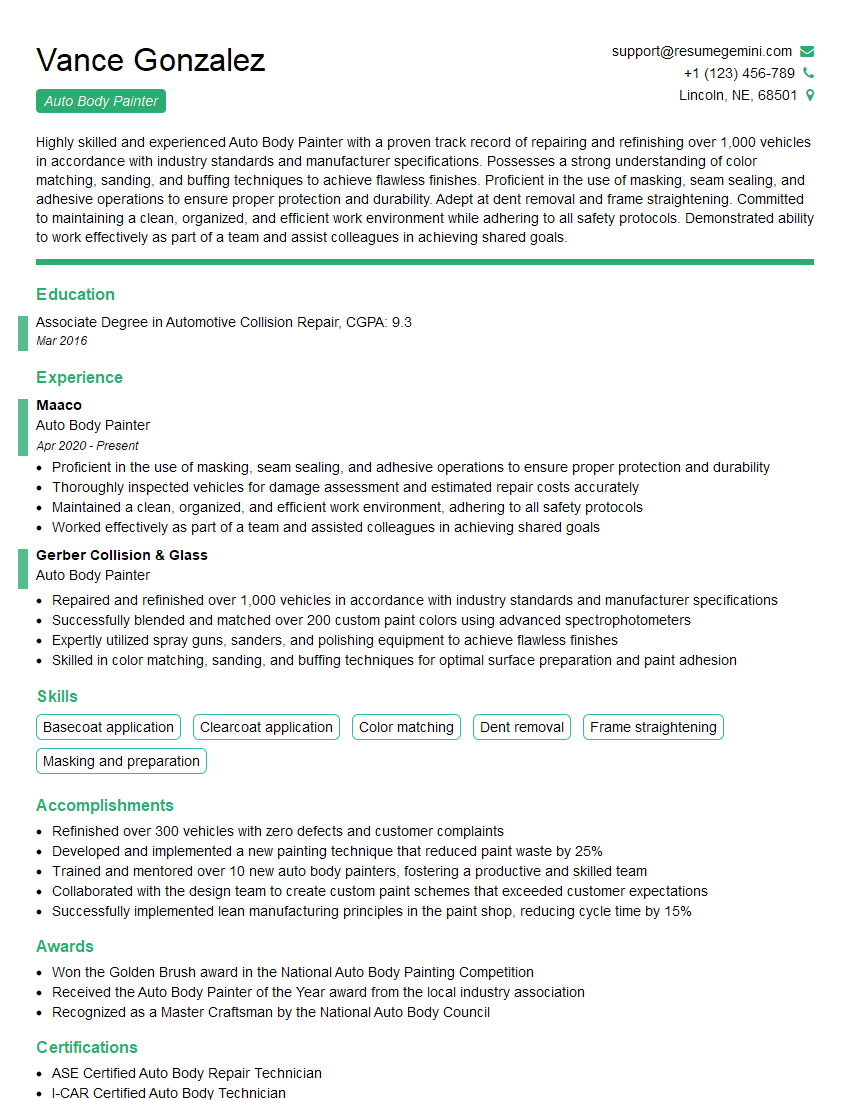
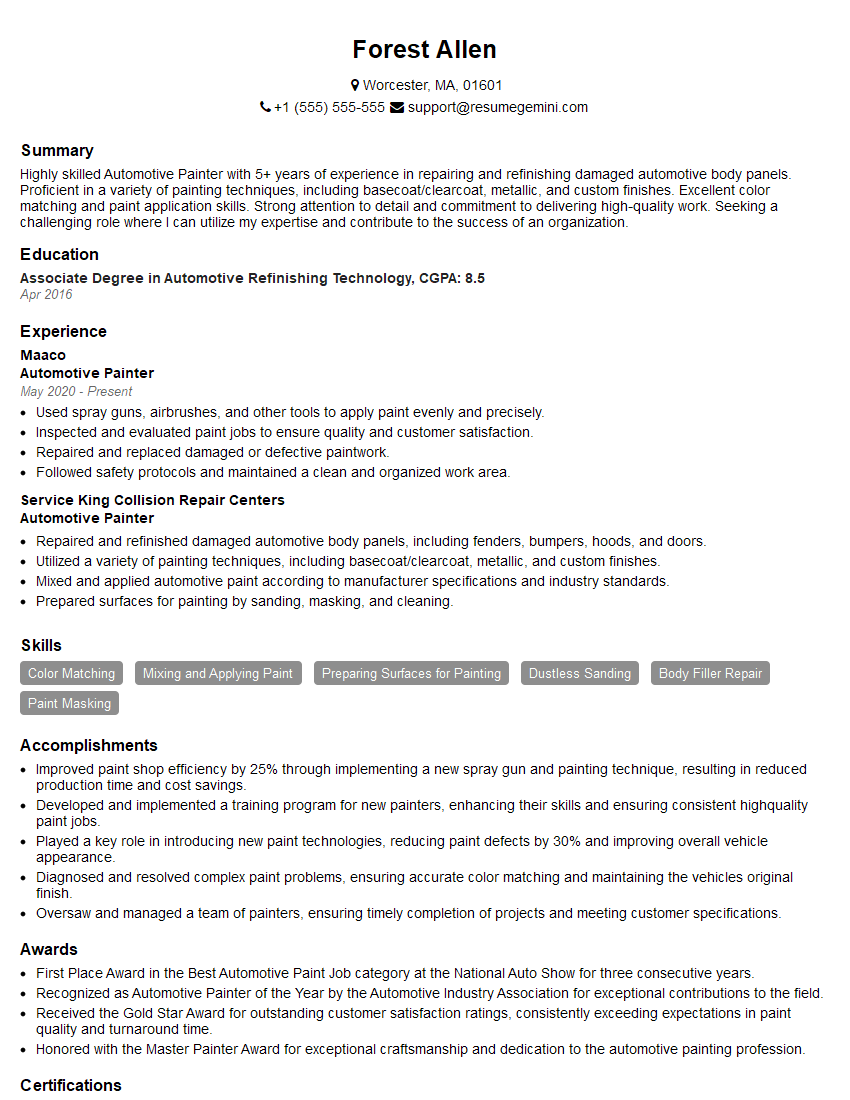
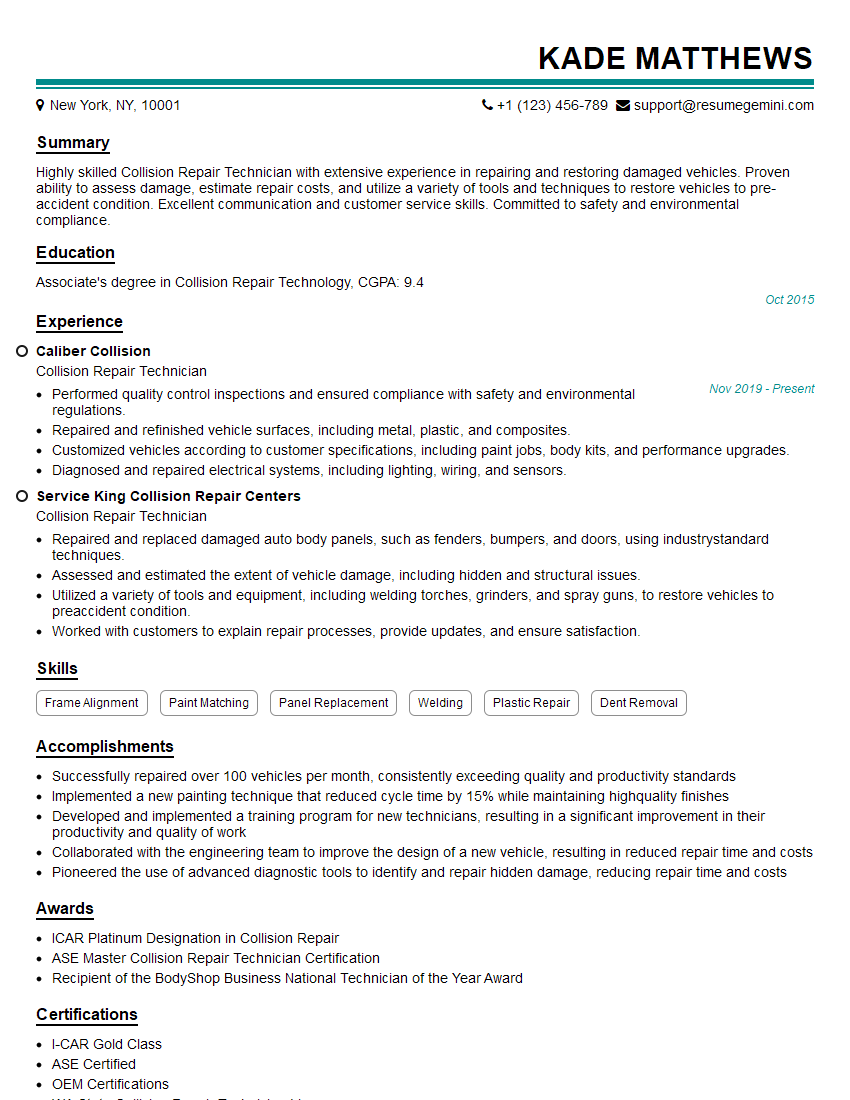
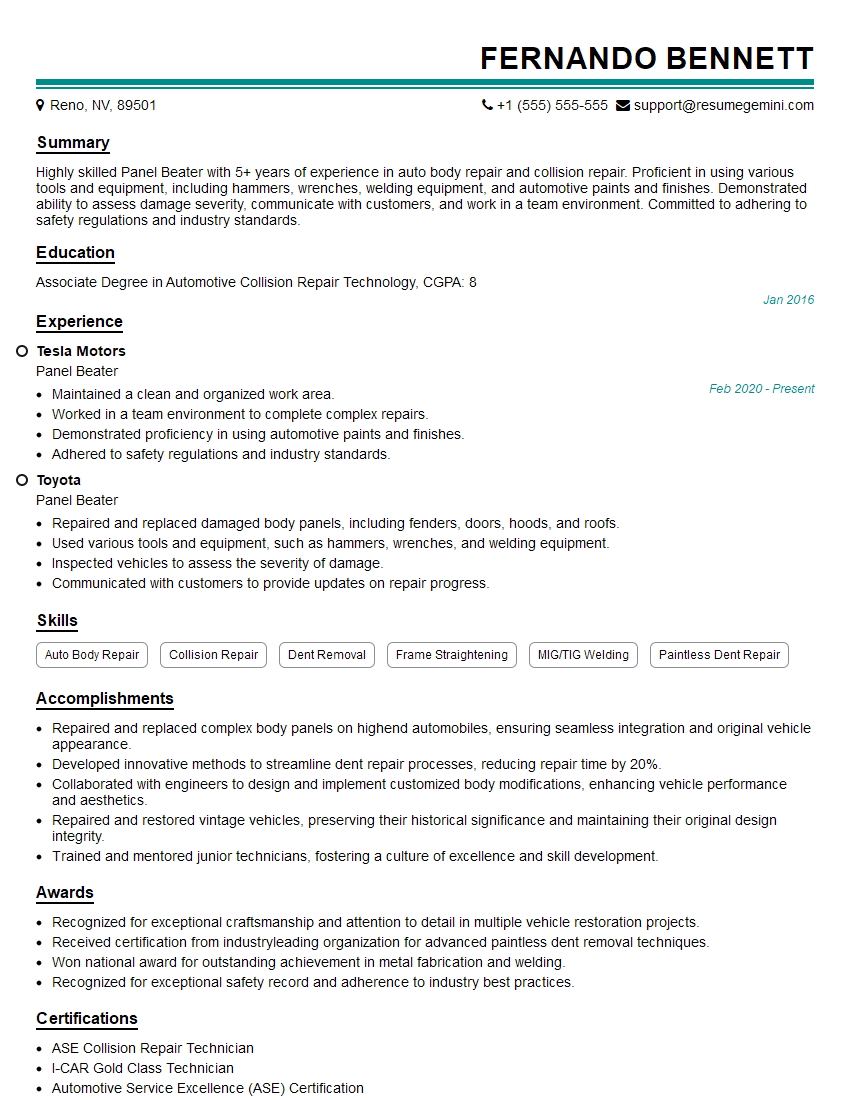
Mastering bodywork and paint repair skills opens doors to a rewarding career with excellent growth potential. Advancement opportunities include specializing in specific areas, leading teams, or even starting your own business. To maximize your job prospects, it’s crucial to have a professional and ATS-friendly resume that highlights your skills and experience effectively. ResumeGemini is a trusted resource that can help you build a standout resume tailored to the automotive industry. Examples of resumes tailored to bodywork and paint repair are available, showcasing how to best present your qualifications to potential employers.
Explore more articles
Users Rating of Our Blogs
Share Your Experience
We value your feedback! Please rate our content and share your thoughts (optional).
What Readers Say About Our Blog
Really detailed insights and content, thank you for writing this detailed article.
IT gave me an insight and words to use and be able to think of examples