The thought of an interview can be nerve-wracking, but the right preparation can make all the difference. Explore this comprehensive guide to Business Continuity and Disaster Recovery (BCDR) interview questions and gain the confidence you need to showcase your abilities and secure the role.
Questions Asked in Business Continuity and Disaster Recovery (BCDR) Interview
Q 1. Explain the difference between Business Continuity and Disaster Recovery.
While both Business Continuity (BC) and Disaster Recovery (DR) aim to minimize disruption from incidents, they have distinct focuses. Think of it like this: BC is the overarching strategy to keep the entire business running, while DR focuses on restoring specific IT systems and data after a disaster.
Business Continuity encompasses all aspects of keeping the business operational during and after any disruptive event – whether it’s a natural disaster, cyberattack, pandemic, or even a major supplier issue. It addresses all business functions, not just IT. It’s about maintaining essential operations, even if at a reduced capacity. A key goal is to minimize the impact on revenue, reputation, and customer relationships.
Disaster Recovery, on the other hand, is a subset of BC. It specifically targets the recovery of IT systems, applications, and data. The DR plan outlines procedures for restoring IT infrastructure and getting systems back online after an outage. It’s a critical component of BC, but it doesn’t address the broader business implications like supply chain disruptions or workforce availability.
Q 2. What are the key components of a Business Continuity Plan (BCP)?
A robust Business Continuity Plan (BCP) has several key components working together to ensure business resilience.
- Business Impact Analysis (BIA): This identifies critical business functions, their dependencies, and the potential impact of disruptions. It’s the foundation of the entire BCP.
- Recovery Strategies: These detail how each critical function will be maintained or restored. This might include alternative work locations, backup systems, or outsourcing.
- Communication Plan: This outlines how information will be communicated internally and externally before, during, and after an incident. It’s vital for keeping stakeholders informed and managing reputation.
- Resource Allocation: This specifies the resources (financial, personnel, technological) needed to implement the recovery strategies.
- Testing and Training: Regular testing and training are crucial to ensure the BCP is effective and employees know what to do in a crisis. Drills and simulations help uncover weaknesses and refine procedures.
- Recovery Metrics: These define the recovery time objectives (RTOs) and recovery point objectives (RPOs) to guide the recovery efforts.
A well-structured BCP is a living document, regularly reviewed and updated to reflect changes in the business environment and technology.
Q 3. Describe your experience in developing a Disaster Recovery Plan (DRP).
In my previous role at [Previous Company Name], I led the development and implementation of a Disaster Recovery Plan (DRP) for their core e-commerce platform. The process started with a thorough BIA, identifying critical applications and data. We determined that an RTO of 4 hours and an RPO of 8 hours were acceptable for the primary e-commerce application.
To achieve these objectives, we implemented a geographically diverse infrastructure using cloud-based services. We also established a robust backup and replication strategy, ensuring data backups were stored offsite in a separate region. We developed detailed step-by-step recovery procedures, documented responsibilities, and conducted regular tabletop exercises and full-scale disaster recovery tests. These tests involved simulating various failure scenarios, such as data center outages and cyberattacks. Feedback from these tests informed iterative improvements to the DRP, ensuring its effectiveness. This collaborative approach with various IT teams across the business ensured all aspects of the system were considered to ensure a cohesive plan.
Q 4. What are the different types of recovery time objectives (RTOs) and recovery point objectives (RPOs)?
Recovery Time Objective (RTO) defines the maximum tolerable downtime for a system or application after a disaster. It’s expressed in a timeframe (e.g., 4 hours, 24 hours, 72 hours). Different business functions will have different RTOs, depending on their criticality. For example, a payment processing system might have an RTO of minutes, while a marketing campaign might have a higher tolerance.
Recovery Point Objective (RPO) specifies the maximum acceptable data loss in the event of a disaster. It represents the point in time to which systems need to be recovered. It’s also expressed as a timeframe (e.g., 1 hour, 24 hours, 7 days). A lower RPO means less data is lost, but usually requires more frequent backups and potentially more expensive infrastructure.
Examples:
- RTO: High (hours-days), Medium (minutes-hours), Low (seconds-minutes)
- RPO: High (days-weeks), Medium (hours-days), Low (minutes-hours)
Q 5. How do you prioritize business functions during a disaster?
Prioritizing business functions during a disaster is crucial for efficient resource allocation and minimizing losses. This is driven by the Business Impact Analysis (BIA). The BIA identifies critical business functions based on factors like their contribution to revenue, legal and regulatory compliance, safety and security, and reputational impact.
A common prioritization method uses a matrix that considers the impact of downtime and the likelihood of occurrence for different functions. Functions with high impact and high likelihood are prioritized first. For instance, in a financial institution, transaction processing would likely be prioritized over less critical functions like marketing emails.
The prioritization also considers dependencies. If function A is necessary for function B, and B is critical, A must be recovered first. Clear communication regarding priorities is critical to ensure coordination between various teams.
Q 6. What is a Business Impact Analysis (BIA) and how is it conducted?
A Business Impact Analysis (BIA) is a systematic process to identify and assess the potential impact of disruptions on business operations. It’s the cornerstone of any effective BCDR plan. The BIA helps determine which functions are critical and how much downtime they can tolerate.
Conducting a BIA involves several steps:
- Identify Critical Business Functions: List the essential functions necessary for the business to operate. This requires close collaboration with various departments.
- Determine Resource Dependencies: Identify the resources (people, systems, data, suppliers) each function relies on.
- Estimate Potential Impacts: Assess the financial, operational, and reputational consequences of downtime for each function. This often involves quantitative and qualitative analysis.
- Determine Recovery Time Objectives (RTOs) and Recovery Point Objectives (RPOs): Define acceptable levels of downtime and data loss for each function.
- Document Findings: Create a comprehensive report detailing the results of the BIA, including prioritization of functions based on their criticality.
The BIA is not a one-time event; it should be updated regularly to reflect changes in the business and technology landscape.
Q 7. What are the key metrics used to measure the effectiveness of a BCDR program?
Measuring the effectiveness of a BCDR program is essential to ensure it continues to meet its objectives. Key metrics include:
- Recovery Time: The actual time it took to recover systems and functions compared to the RTOs.
- Recovery Point: The amount of data loss incurred during a disruption compared to the RPOs.
- Downtime Costs: The financial impact of the disruption, including lost revenue, operational expenses, and fines.
- Business Continuity Exercise Effectiveness: A measure of how well the plan performed during simulations and tests.
- Employee Preparedness and Training Completion Rates: This shows how well employees are trained and prepared to respond to a disruption.
- Plan Update Frequency: This reflects the maintenance and relevance of the plan to current business operations and technologies.
- Feedback from Business Units on Plan Effectiveness: Continuous improvement comes from feedback and regular review.
These metrics, when tracked over time, show trends and help identify areas for improvement in the BCDR program. Regular reporting and review against these metrics ensure that the program remains effective and aligned with business needs.
Q 8. Explain the concept of failover and failback in a disaster recovery scenario.
Failover and failback are critical components of disaster recovery. Failover is the process of switching over to a secondary system or location when the primary system fails. Think of it like having a backup generator kick in when the power goes out. Failback, on the other hand, is the process of returning operations to the primary system once it’s been restored and deemed stable. It’s like switching back to the main power source after the generator has served its purpose.
For example, imagine a company’s primary database server crashes. Their failover plan might involve instantly switching to a replicated database server in a geographically separate data center. This ensures minimal downtime. Once the primary server is repaired and tested, the failback process begins, transferring operations back to the primary server to optimize performance and resource utilization.
A successful failover and failback requires rigorous testing and a well-defined plan. The plan should detail the steps involved, including network configurations, data synchronization, and application restarts. It should also specify roles and responsibilities for each team member involved in the process.
Q 9. What are some common threats and vulnerabilities that impact Business Continuity?
Business continuity faces numerous threats. Natural disasters like earthquakes, floods, and hurricanes can cause widespread damage and disruption. Cyberattacks, including ransomware and denial-of-service attacks, can cripple operations and steal sensitive data. Internal threats, such as human error or malicious insider activity, can also pose significant risks. Other vulnerabilities include power outages, hardware failures, software bugs, and supply chain disruptions. In addition, pandemics and other unforeseen global events can significantly impact a business’s ability to operate normally.
For example, a ransomware attack could encrypt a company’s critical data, making it inaccessible. A major power outage could halt production in a manufacturing plant. A pandemic could force widespread employee absences impacting productivity and service delivery. Identifying and mitigating these threats requires a robust risk assessment and a multi-layered approach to security and resilience.
Q 10. How do you ensure the regular testing and maintenance of a BCDR plan?
Regular testing and maintenance are paramount to ensuring the effectiveness of a BCDR plan. This involves both planned and unplanned drills. Planned drills simulate different disaster scenarios, allowing teams to practice their response procedures and identify areas for improvement. These drills can range from tabletop exercises to full-scale simulations. Unplanned drills help gauge the readiness of the systems, and they can be as simple as randomly shutting down a server and testing the recovery process.
Maintenance involves regular updates to the plan itself, ensuring it reflects current systems, procedures, and contact information. It also encompasses routine checks on backup systems, testing data recovery, and ensuring that recovery infrastructure remains operational. Documentation is crucial, keeping track of all tests, updates, and any lessons learned. This allows for continuous improvement and ensures the plan remains effective and up-to-date.
Q 11. Describe your experience with different disaster recovery strategies (e.g., hot site, cold site, warm site).
I have extensive experience with various disaster recovery strategies. A hot site is a fully equipped backup facility that can take over operations immediately. It’s like a mirror image of the primary site, always ready to go. A cold site, on the other hand, is a basic facility that requires significant setup before becoming operational. It’s more of a shell, ready to be furnished with equipment and systems. A warm site represents a middle ground, offering pre-configured systems and some data but requiring additional setup time for full operation.
In one project, we implemented a hot site for a financial institution to ensure near-zero downtime in case of a major incident. For a smaller client, a warm site solution was more cost-effective. The choice depends heavily on factors such as recovery time objectives (RTOs) – how quickly the business needs to be operational – and recovery point objectives (RPOs) – how much data loss is acceptable, along with budget constraints.
Q 12. How do you manage communication during a disaster or crisis?
Effective communication is critical during a disaster. We use a multi-channel approach, combining various methods to ensure everyone is informed. This includes pre-defined communication trees, mass notification systems (SMS, email), and conference calls. A dedicated communication team is established to manage information flow, addressing internal stakeholders, customers, and potentially regulatory bodies. Transparency is key; we provide regular updates, acknowledging challenges while highlighting progress. A central communication hub, perhaps a dedicated website or intranet page, keeps everyone informed of the current situation and the recovery plan’s status.
In a previous crisis, we used a combination of SMS alerts for immediate updates, email for more detailed information, and a dedicated website to keep the public informed. This ensured consistent and timely communication throughout the incident and aided in minimizing panic and confusion.
Q 13. What is your experience with data backup and recovery processes?
My experience encompasses various data backup and recovery processes, including full backups, incremental backups, differential backups, and mirroring. I’m familiar with both on-site and off-site backup solutions, using various technologies such as tape libraries, cloud storage, and network-attached storage (NAS). The process always begins with a thorough assessment of the critical data, determining the appropriate backup strategy based on RPOs and RTOs.
For example, a financial institution requires stringent RPOs and RTOs, necessitating frequent backups and a robust recovery plan. Conversely, a less critical application might tolerate a longer recovery time, allowing for a less frequent backup schedule. The choice of backup method, storage location, and recovery procedures must be tailored to each organization’s unique requirements and risk profile.
Q 14. How do you ensure the security of backup data?
Data security is paramount in backup and recovery. We utilize encryption both in transit and at rest, protecting data from unauthorized access. Access control mechanisms, including role-based access control (RBAC), restrict access to authorized personnel only. Regular security audits and vulnerability scans help identify and address potential weaknesses. Off-site backups are stored in secure facilities with physical and environmental controls. We also employ data immutability techniques for critical data, ensuring that it cannot be altered or deleted even by authorized personnel, thereby enhancing protection against ransomware attacks.
In addition to technical safeguards, we implement robust policies and procedures, including regular employee training on data security best practices. We comply with all relevant data privacy regulations, such as GDPR and CCPA, ensuring responsible handling and protection of sensitive information.
Q 15. What is your experience with business continuity frameworks like NIST or ISO 22301?
Throughout my career, I’ve extensively utilized and implemented both NIST (National Institute of Standards and Technology) and ISO 22301 frameworks for Business Continuity Management (BCM). NIST offers a comprehensive set of guidelines and standards, particularly valuable for understanding risk management and implementing security controls that contribute to business resilience. I’ve used NIST’s Special Publication 800-34, Recommendation for Security Considerations in the System Development Life Cycle, to integrate security into all phases of our BCDR planning. This ensures that our systems are not only recoverable but also secure post-disaster.
ISO 22301, on the other hand, provides a more internationally recognized and certified standard specifically for BCM. I’ve led teams through ISO 22301 certification processes, focusing on establishing a robust BCM system that includes business impact analysis, risk assessment, and recovery strategies. This certification ensures our BCDR plan aligns with international best practices and demonstrates a commitment to organizational resilience. I’m proficient in both frameworks and adept at tailoring their application to fit the specific needs and context of any organization.
For example, in a recent project, we leveraged NIST’s risk assessment methodology to identify critical business functions, then used ISO 22301’s framework to develop recovery time objectives (RTOs) and recovery point objectives (RPOs) for each, ensuring compliance and effective mitigation.
Career Expert Tips:
- Ace those interviews! Prepare effectively by reviewing the Top 50 Most Common Interview Questions on ResumeGemini.
- Navigate your job search with confidence! Explore a wide range of Career Tips on ResumeGemini. Learn about common challenges and recommendations to overcome them.
- Craft the perfect resume! Master the Art of Resume Writing with ResumeGemini’s guide. Showcase your unique qualifications and achievements effectively.
- Don’t miss out on holiday savings! Build your dream resume with ResumeGemini’s ATS optimized templates.
Q 16. How do you incorporate regulatory compliance into a BCDR plan?
Regulatory compliance is paramount when developing a BCDR plan. It’s not simply a checklist but an integral part of the strategy. The specific regulations depend heavily on the industry and geographic location. For example, HIPAA for healthcare, PCI DSS for financial institutions, and GDPR for organizations handling EU citizen data, all have strict requirements related to data security and business continuity.
My approach involves a thorough analysis of all applicable regulations, mapping them to our critical business functions and processes. This process ensures that our BCDR plan is designed to meet all legal and contractual obligations. We create specific control measures within the plan directly addressing each regulatory requirement. For instance, if a regulation demands specific data backup and recovery procedures, these are explicitly documented and tested as part of our plan. Regular audits and reviews are implemented to ensure ongoing compliance and to adapt to changing regulations.
Imagine a bank needing to comply with PCI DSS. We would incorporate detailed procedures for cardholder data protection, including encryption, access control, and incident response plans, all within the BCDR framework to ensure compliance and minimize operational disruptions in case of an incident.
Q 17. Describe your experience with various BCDR technologies and tools.
My experience encompasses a wide array of BCDR technologies and tools, spanning various aspects of planning, implementation, and testing. These include:
- Replication technologies: I’ve worked with various replication solutions, such as VMware vSphere Replication, Zerto, and Veeam, for ensuring near real-time data replication to secondary sites for rapid recovery.
- Cloud-based DRaaS (Disaster Recovery as a Service): I’ve implemented and managed DRaaS solutions from providers like AWS, Azure, and Google Cloud, offering scalable and cost-effective disaster recovery capabilities.
- Backup and recovery software: I’m proficient in using backup and recovery solutions such as CommVault, Rubrik, and Acronis, ensuring robust data protection and quick restoration.
- High-availability solutions: I have experience deploying and managing high-availability clusters and solutions using technologies like VMware HA, Microsoft Failover Clustering, and load balancing technologies to maintain system uptime.
- BCDR planning and management software: I’ve utilized specialized software such as Continuity Manager, to streamline the BCDR planning, testing, and documentation processes.
My expertise extends beyond individual tools to encompass the effective integration and orchestration of these technologies to create a holistic and robust BCDR solution tailored to specific organizational needs.
Q 18. How do you handle the ethical considerations during a disaster recovery scenario?
Ethical considerations are central to BCDR planning and execution. Prioritizing ethical conduct during a disaster is crucial, and this often involves difficult decisions.
My approach includes establishing clear ethical guidelines within the BCDR plan itself. This involves defining protocols for data handling, prioritizing stakeholders, and ensuring fairness in resource allocation during a crisis. For instance, determining which customer data to prioritize during a recovery effort must consider factors beyond mere criticality. Ethical guidelines help navigate such scenarios.
Transparency and communication are key. Keeping all relevant stakeholders informed is vital, even if the news is difficult. Maintaining a clear chain of communication ensures decisions are made transparently and accountability is maintained. For example, during a data breach, clear communication with customers about how their data was compromised and what steps are being taken is crucial for maintaining trust and ethical integrity.
Q 19. How do you measure the effectiveness of your BCDR plan post-incident?
Measuring the effectiveness of a BCDR plan is crucial for continuous improvement. Post-incident analysis is vital, allowing us to evaluate what worked, what didn’t, and where improvements can be made.
We use several key metrics:
- Recovery Time Objective (RTO) and Recovery Point Objective (RPO) attainment: Did we meet our predetermined goals for restoring systems and data? Any deviation requires investigation.
- Downtime analysis: How long were critical systems unavailable? Detailed analysis helps identify bottlenecks and areas for improvement.
- Data loss assessment: How much data was lost, if any? This helps refine backup and recovery strategies.
- Stakeholder satisfaction: Feedback from affected parties highlights areas where communication, support, or processes could be enhanced.
- Cost analysis: Comparing the actual cost of recovery with the budgeted amount reveals areas of inefficiency.
By meticulously analyzing these metrics and using this data for improvement, we strengthen our BCDR plan, enhancing its effectiveness for future incidents.
Q 20. Describe a time when your BCDR plan was successfully executed or when it needed improvement.
In a previous role, we faced a significant server failure impacting our core e-commerce platform. Our BCDR plan, thankfully, worked flawlessly. We had implemented a geographically redundant data center and automated failover procedures. Within 20 minutes, the e-commerce site was fully operational on the backup servers in a different location. Our RTO and RPO goals were not only met, but significantly exceeded.
However, there was a minor hiccup in communication; the initial alert system was somewhat ambiguous. This incident highlighted the need for clearer and more detailed communication protocols. As a result, we implemented a refined alert system with detailed escalation paths and improved communication templates. This experience demonstrated the criticality of regular drills and communication testing. The incident and resulting improvements drastically strengthened our BCDR posture.
Q 21. How do you ensure business continuity during a pandemic or other large-scale event?
Ensuring business continuity during a pandemic or large-scale event like a natural disaster requires a multifaceted approach. A robust BCDR plan must account for various scenarios and challenges, including:
- Remote work capabilities: Providing employees with the necessary tools and secure access to work remotely is paramount.
- Communication protocols: Establishing clear communication channels to keep employees, customers, and partners informed is critical.
- Supply chain resilience: Assessing and diversifying supply chains to mitigate disruptions is crucial.
- Contingency plans for critical infrastructure: Having backup plans for power, internet access, and other essentials is vital.
- Employee well-being: Prioritizing employee safety and mental health during crises is essential.
For example, during the COVID-19 pandemic, we successfully transitioned almost our entire workforce to remote work within a week. We proactively implemented enhanced security measures for remote access and communication, along with regular employee check-ins to support their mental health and wellbeing. Adaptability and flexibility are key to navigating unforeseen events effectively.
Q 22. What is your experience with supply chain disruptions and their impact on business continuity?
Supply chain disruptions, whether due to natural disasters, pandemics, geopolitical instability, or even unexpected demand surges, can cripple a business. My experience shows that their impact on business continuity is multifaceted and far-reaching. It’s not just about the direct impact on production but also the ripple effect across the entire value chain.
For example, a company relying on a single supplier in a disaster-prone region could face complete production halts if that supplier is impacted. This can lead to lost revenue, unmet customer orders, damaged reputation, and even legal repercussions. To mitigate this, I’ve worked with organizations to develop strategies involving diversified sourcing, strategic inventory management, building strong relationships with multiple suppliers, and implementing robust risk assessment processes to proactively identify and address potential disruptions. One specific project involved a pharmaceutical company where we implemented a real-time supply chain monitoring system, enabling them to predict and adapt to potential shortages caused by raw material scarcity.
Beyond supplier issues, disruptions can also affect logistics (transportation, warehousing), impacting timely delivery of goods. This necessitates incorporating contingency plans for alternative shipping routes, transportation modes, and warehousing facilities into BCDR strategies.
Q 23. How do you involve stakeholders in the development and maintenance of a BCDR plan?
Stakeholder involvement is crucial for a successful BCDR plan. It’s not just a document created in a vacuum; it needs buy-in and active participation from all levels and departments. My approach focuses on a collaborative, iterative process.
- Identification & Engagement: I begin by identifying key stakeholders – from executive management and IT to operations, legal, and even external partners. This involves meetings and surveys to understand their roles, responsibilities, and concerns regarding business continuity.
- Joint Planning Workshops: We conduct workshops to collaboratively develop the plan, involving interactive sessions to define critical business functions, identify potential threats, and develop recovery strategies. This collaborative approach ensures that everyone understands the plan and their roles within it.
- Regular Communication & Updates: Once the plan is developed, it’s not a ‘set-it-and-forget-it’ document. Regular communication and updates are essential. This includes newsletters, training sessions, and periodic plan reviews to ensure it remains relevant and effective.
- Feedback Mechanisms: Establishing clear channels for feedback is vital. This ensures that stakeholders feel heard and that the plan evolves to meet changing needs and reflects actual experiences.
Imagine a scenario where the sales team wasn’t involved in a BCDR plan. They might not understand how to handle customer inquiries during an outage, leading to lost opportunities and damage to the company’s reputation. Involving them ensures everyone is prepared for disruptions.
Q 24. What is your experience with third-party vendor management in the context of BCDR?
Third-party vendor management is paramount in BCDR. Organizations increasingly rely on external vendors for critical services, from cloud infrastructure and software applications to logistics and payment processing. A failure by a vendor can have a cascading effect on your business continuity.
My experience involves establishing robust vendor management programs that include:
- Due Diligence: Thoroughly assessing vendors’ BCDR capabilities, including their plans, certifications (like ISO 22301), and recovery time objectives (RTOs) and recovery point objectives (RPOs).
- Contractual Agreements: Incorporating strong service level agreements (SLAs) that define vendor responsibilities during disruptions and specify penalties for non-compliance.
- Regular Audits and Reviews: Conducting periodic audits to ensure vendors are meeting their obligations and maintaining their BCDR preparedness.
- Communication & Collaboration: Establishing clear communication channels and collaborative mechanisms to manage risks and coordinate responses during incidents.
For instance, if your payment gateway experiences an outage, it directly impacts your revenue stream. A well-managed vendor relationship ensures contingency plans are in place to minimize disruption in such scenarios.
Q 25. How do you balance the cost of BCDR with its effectiveness?
Balancing the cost of BCDR with its effectiveness is a critical aspect. It’s about finding the optimal level of investment that protects the organization without being overly burdensome.
My approach focuses on a risk-based approach:
- Risk Assessment: Conducting a thorough risk assessment to identify critical business functions, potential threats, and their likelihood and impact. This helps prioritize areas needing the most robust protection.
- Cost-Benefit Analysis: Evaluating the potential financial losses associated with disruptions (lost revenue, fines, reputational damage) against the cost of implementing different BCDR measures. This helps make data-driven decisions about investments.
- Phased Implementation: Implementing BCDR in phases, starting with critical functions and gradually expanding to less critical ones, allows for controlled investment and iterative improvement.
- Leveraging Technology: Employing cost-effective technologies, such as cloud-based solutions, can significantly reduce upfront infrastructure costs while providing scalable and reliable backup and recovery capabilities.
A simple analogy is home insurance. While it costs money, the potential cost of rebuilding your home after a disaster far outweighs the premium. Similarly, a well-planned BCDR program can save an organization significantly more than its initial cost.
Q 26. What are some emerging trends in Business Continuity and Disaster Recovery?
The landscape of BCDR is constantly evolving. Some key emerging trends include:
- Increased reliance on cloud technologies: Cloud-based solutions offer scalable, cost-effective, and geographically diverse disaster recovery options.
- Artificial intelligence (AI) and machine learning (ML) in BCDR: AI/ML is used for predictive analytics, enabling proactive risk identification and automated responses to incidents.
- Focus on resilience, not just recovery: The shift is towards building resilient organizations that can withstand disruptions and adapt quickly, rather than just recovering from them.
- Cybersecurity integration: BCDR plans are increasingly integrated with cybersecurity strategies, recognizing that cyberattacks are a major disruption vector.
- Automation: Automating recovery processes through orchestration and automation tools reduces recovery time and human error.
For instance, the use of AI in predicting supply chain disruptions, allowing proactive mitigation measures, or using automated failover systems in cloud environments, dramatically increases the speed and efficiency of recovery efforts.
Q 27. Describe your approach to conducting a tabletop exercise or simulation.
Tabletop exercises are crucial for testing and refining a BCDR plan. My approach involves a structured and realistic simulation.
- Scenario Development: We create realistic scenarios based on identified threats and risks, focusing on plausible events rather than improbable ones. This could range from a natural disaster to a cyberattack or a major supplier failure.
- Team Briefing: Before the exercise, we brief participants on the scenario and their roles within the incident response team.
- Exercise Facilitation: During the exercise, I facilitate the simulation, injecting new information and challenges as the scenario unfolds. This encourages critical thinking and adaptive problem-solving.
- Documentation and Debriefing: The entire exercise is meticulously documented, followed by a debriefing session to analyze the responses, identify strengths and weaknesses, and refine the plan based on lessons learned.
- Action Planning: Based on the debriefing, we develop a concrete action plan to address identified gaps and improve the plan’s effectiveness.
A well-conducted tabletop exercise isn’t about finding fault; it’s about identifying areas for improvement and making the plan more robust. It’s a learning opportunity to ensure everyone is prepared to respond effectively to a crisis.
Q 28. Explain your understanding of cloud-based disaster recovery solutions.
Cloud-based disaster recovery solutions offer significant advantages in terms of scalability, cost-effectiveness, and resilience. They provide a variety of options depending on the organization’s needs and budget.
- Cloud Backup and Replication: Regularly backing up critical data and applications to a cloud provider’s infrastructure, enabling quick recovery in case of a disaster. This often involves replication to multiple geographic regions for enhanced resilience.
- Disaster Recovery as a Service (DRaaS): A comprehensive service that provides virtualized infrastructure and recovery capabilities in the cloud, often incorporating automated failover and failback mechanisms.
- Cloud-Based Virtual Machines (VMs): Creating and maintaining VMs in the cloud as a ready-to-use backup environment, enabling a swift transition in case of an outage. This can be configured with automated failover capabilities.
- Hybrid Cloud Approaches: Combining on-premise infrastructure with cloud-based DR solutions, providing a flexible and cost-optimized approach.
The choice of cloud-based solution depends on various factors, such as recovery time objectives (RTOs), recovery point objectives (RPOs), budget constraints, and the nature of the critical business applications. For example, a financial institution with stringent RTO/RPO requirements might opt for a dedicated DRaaS solution, while a smaller business might choose a more basic cloud backup and replication strategy.
Key Topics to Learn for Business Continuity and Disaster Recovery (BCDR) Interview
- Business Impact Analysis (BIA): Understanding how to identify critical business functions and their dependencies to determine recovery time objectives (RTOs) and recovery point objectives (RPOs).
- Risk Assessment and Management: Identifying potential threats and vulnerabilities, analyzing their impact, and implementing mitigation strategies. Practical application: Conducting a risk assessment for a hypothetical scenario (e.g., power outage at a data center).
- Disaster Recovery Planning (DRP): Developing comprehensive plans for restoring IT systems and business operations after a disaster. This includes outlining procedures, testing strategies, and communication protocols.
- Business Continuity Planning (BCP): Creating strategies to maintain essential business functions during and after disruptions. Consider practical scenarios like a pandemic or natural disaster affecting operations.
- Recovery Strategies: Exploring various recovery options, such as hot sites, cold sites, warm sites, and cloud-based solutions. Compare the advantages and disadvantages of each approach for different scenarios.
- Data Backup and Recovery: Understanding different backup methods (full, incremental, differential), backup storage options, and recovery procedures. Practical application: Designing a robust backup and recovery strategy for a specific system.
- Testing and Exercises: The importance of regularly testing and updating BCDR plans through tabletop exercises, simulations, and full-scale drills. This demonstrates practical knowledge of plan effectiveness and areas for improvement.
- Communication and Collaboration: Highlighting the crucial role of communication plans in coordinating responses during and after an incident. This includes internal and external stakeholders.
- Compliance and Regulations: Familiarity with relevant industry regulations and compliance standards related to data protection, privacy, and business continuity.
- Incident Management: Understanding the process of identifying, responding to, and resolving incidents, including escalation procedures and post-incident reviews.
Next Steps
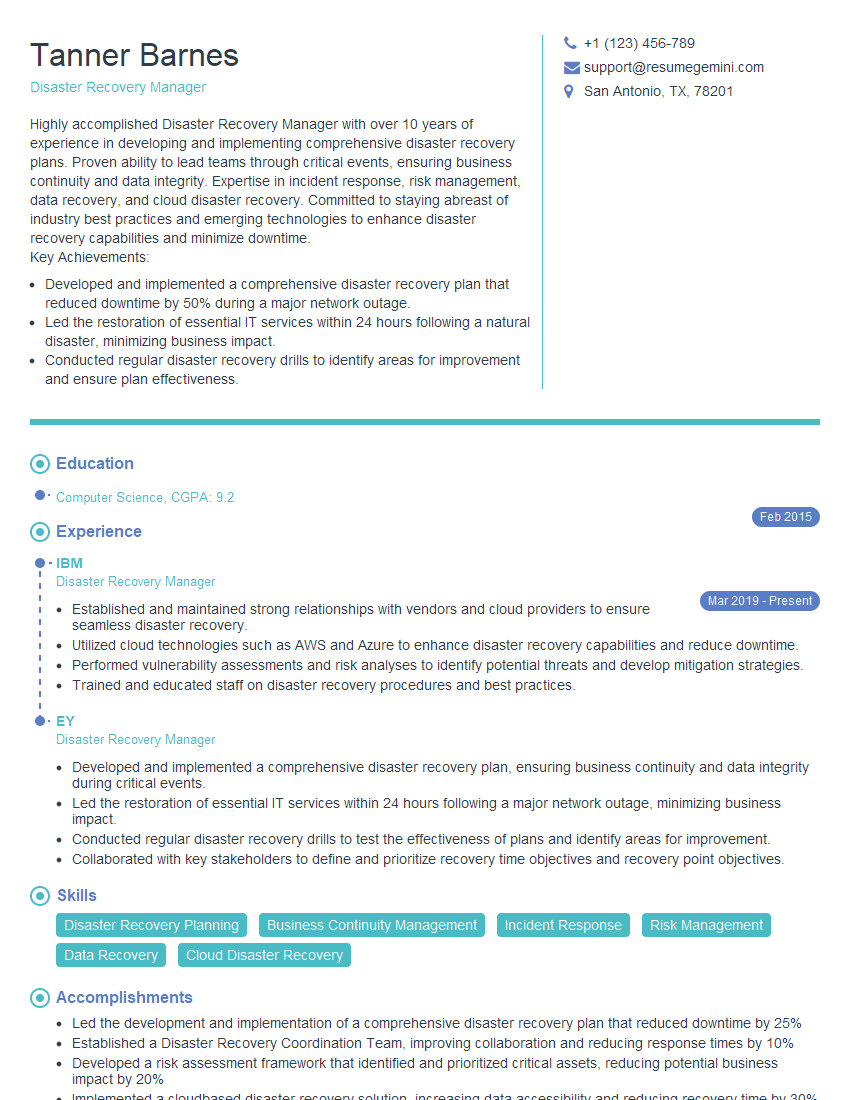
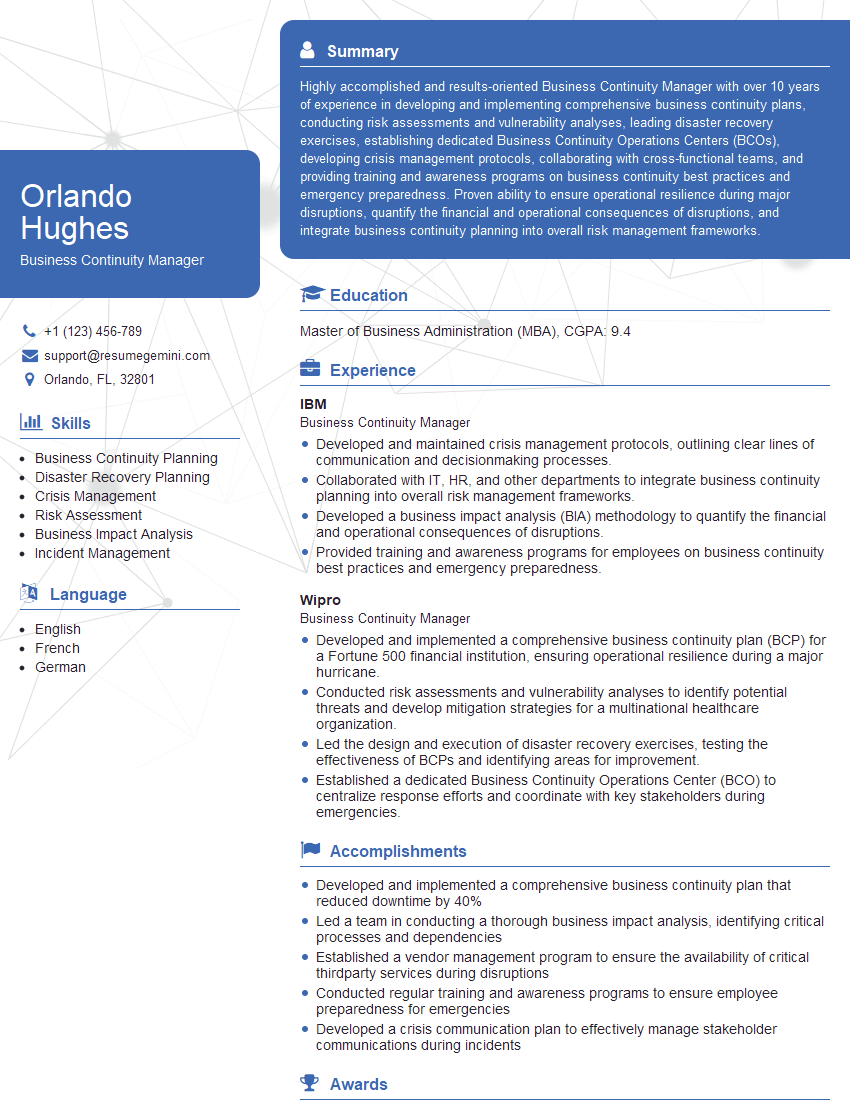
Mastering Business Continuity and Disaster Recovery (BCDR) is highly valuable, opening doors to rewarding and impactful roles within any organization. A strong understanding of these concepts significantly enhances your career prospects and demonstrates your ability to handle critical situations effectively. To further strengthen your job application, creating an ATS-friendly resume is crucial. ResumeGemini is a trusted resource to help you build a professional and impactful resume that highlights your BCDR expertise. Examples of resumes tailored to Business Continuity and Disaster Recovery (BCDR) roles are available to guide you. Take the next step towards your dream job – craft a compelling resume that showcases your skills and experience effectively.
Explore more articles
Users Rating of Our Blogs
Share Your Experience
We value your feedback! Please rate our content and share your thoughts (optional).
What Readers Say About Our Blog
Really detailed insights and content, thank you for writing this detailed article.
IT gave me an insight and words to use and be able to think of examples