The thought of an interview can be nerve-wracking, but the right preparation can make all the difference. Explore this comprehensive guide to Cataloging and Archival Techniques interview questions and gain the confidence you need to showcase your abilities and secure the role.
Questions Asked in Cataloging and Archival Techniques Interview
Q 1. Explain the difference between Dublin Core and MARC.
Dublin Core and MARC are both metadata schemas used to describe resources, but they differ significantly in scope and complexity. Think of Dublin Core as a quick summary, and MARC as a detailed, comprehensive catalog record.
Dublin Core is a simple, highly interoperable metadata element set. It provides a basic framework for describing resources with fifteen elements, such as title, creator, subject, and date. Its simplicity makes it ideal for quick indexing and searching across diverse platforms and systems. It’s like writing a short abstract of a research paper – it gives you the essential information.
MARC (Machine-Readable Cataloging), on the other hand, is a much more extensive and complex standard. It’s designed for detailed bibliographic description and is commonly used in library catalogs. MARC records use a specific coding scheme (a tagging system) to represent various aspects of a resource, leading to more detailed and structured descriptions. Imagine it as the complete research paper itself – every detail is included.
In essence, Dublin Core is suitable for quick descriptive summaries for broad audiences, while MARC is used for detailed bibliographic control within a specific system, like a library catalog.
Q 2. Describe your experience with various metadata schemas (e.g., MODS, PREMIS).
My experience encompasses a wide range of metadata schemas, including MODS, PREMIS, and Dublin Core. I’ve used them for various projects, from digitizing historical manuscripts to managing born-digital archives.
MODS (Metadata Object Description Schema) is particularly useful for describing complex resources like books, journals, and audiovisual materials. Its richer structure compared to Dublin Core allows for more granular control over metadata, making it ideal for archival contexts. For example, I’ve successfully used MODS to create detailed metadata records for a collection of historical photographs, including information on the photographer, the subjects depicted, and the photographic process used.
PREMIS (Preservation Metadata Implementation Strategy) is essential for managing digital preservation. I’ve leveraged PREMIS to track the integrity of digital objects over time, including details on file formats, checksums, and preservation actions. This is crucial for ensuring the long-term accessibility of digital archives. For instance, I used PREMIS to monitor the condition of a digital audio archive, recording all migrations and format changes.
I’m also proficient in adapting and combining different schemas to best suit the specific requirements of a project. Often, a hybrid approach incorporating elements from multiple schemas provides the optimal solution.
Q 3. How do you handle conflicting metadata records?
Handling conflicting metadata records requires a careful and systematic approach. It’s akin to detective work – you need to identify the source of the conflict and determine the most accurate and authoritative information.
My process typically involves the following steps:
- Identify the conflict: Compare the conflicting metadata records, noting the discrepancies in specific fields (e.g., title, date, creator).
- Investigate the sources: Trace the origin of each record to determine their reliability. Consider the provenance, authority, and potential biases of the sources.
- Resolve the conflict: Based on my investigation, I make a decision on which metadata element to retain or how to reconcile the differences. This may involve prioritizing authoritative sources, combining information, or creating notes explaining the discrepancies.
- Document the decision-making process: It’s crucial to document the reasons for selecting a specific metadata element. This provides transparency and aids future researchers and catalogers.
- Standardize metadata: Consistent application of metadata standards helps prevent future conflicts.
If conflicts persist despite thorough investigation, I’ll consult with colleagues and experts to achieve consensus on the best approach. Maintaining a clear record of these decisions is critical for the integrity of the archive.
Q 4. What are the key principles of archival preservation?
Archival preservation hinges on several key principles, all aimed at ensuring the long-term survival and accessibility of materials. These can be categorized as:
- Environmental Control: Maintaining stable temperature and humidity levels is critical to preventing deterioration. Think of it like preserving a delicate painting – you need the right environment to prevent fading and damage.
- Access Control: Limiting access to minimize handling and damage is essential. This includes using protective enclosures and controlling the number of people who can handle the materials.
- Disaster Preparedness: Having a plan to address potential disasters (fire, flood, etc.) is crucial. This includes having backups, emergency storage, and recovery procedures.
- Preservation Metadata: Accurate and comprehensive metadata is crucial for finding and understanding the materials and tracking their condition over time. This ensures that the information is readily available even if the original material is damaged.
- Format Management: For digital materials, this means choosing stable file formats and regularly migrating them to newer formats as technology changes. It’s like regularly updating your computer’s operating system to ensure compatibility with the newest software.
All these principles work in concert to ensure that archival materials remain accessible and usable for generations to come.
Q 5. Explain the different methods for digitizing archival materials.
Digitizing archival materials requires careful consideration of the materials’ fragility and the desired quality of the digital copy. Several methods exist:
- High-resolution scanning: This is commonly used for documents, photographs, and artwork. The quality of the scan depends on the scanner’s resolution and the condition of the original material.
- Digital photography: Similar to scanning, digital photography is used to capture images of three-dimensional objects or fragile materials that cannot be scanned. Careful lighting and camera settings are essential to ensure high-quality images.
- Audio and video capture: Specialized equipment is used to capture audio and video recordings, ensuring accurate reproduction of the original material. The process often involves noise reduction and other post-processing steps.
The chosen method depends on the nature of the material and available resources. Regardless of the method, maintaining a high level of quality and accuracy during digitization is paramount. This includes rigorous quality control checks and thorough metadata recording of the digitization process itself.
Q 6. How do you ensure the long-term accessibility of digital archives?
Ensuring long-term accessibility of digital archives involves a multi-faceted approach, focusing on technological and organizational strategies. It’s like building a sturdy house – you need a solid foundation and ongoing maintenance.
Technological strategies include:
- Choosing stable file formats: Using formats that are less likely to become obsolete (e.g., TIFF for images, PDF/A for documents).
- Regular file format migration: Migrating files to newer, supported formats as technology advances to maintain accessibility.
- Using checksums: Generating checksums (digital fingerprints) to ensure data integrity and detect corruption.
- Employing preservation metadata: Recording detailed metadata about files, formats, and preservation actions.
Organizational strategies include:
- Developing a preservation plan: Defining clear procedures for managing digital assets.
- Building a robust storage infrastructure: Utilizing reliable storage systems with redundant backups.
- Establishing a preservation budget: Allocating resources to cover migration, storage, and maintenance costs.
- Collaborating with preservation organizations: Leveraging expertise and resources available from professional organizations.
A successful long-term accessibility plan combines technological solutions with strong organizational policies and a proactive approach to managing change.
Q 7. Describe your experience with archival storage and management systems.
My experience with archival storage and management systems includes working with both physical and digital repositories. For physical archives, I’ve used various storage solutions, including climate-controlled vaults and specialized shelving systems designed to protect materials from damage. Efficient organization within these systems, including detailed inventory and finding aids, is critical for easy retrieval. I’ve managed archives using both custom-designed database systems and commercial library management software (e.g., Koha, Evergreen).
For digital archives, my experience includes working with content management systems (CMS), digital asset management (DAM) systems, and specialized archival storage solutions. I’ve used systems that support versioning, metadata management, access control, and data integrity checks. I’ve been involved in the design, implementation, and maintenance of such systems. Factors like scalability, security, and interoperability are crucial considerations when selecting or designing these systems. The choice depends heavily on the archive’s size, budget, and technical capabilities. For large-scale digital repositories, cloud-based storage solutions with robust security features often provide an optimal solution.
Q 8. What are the ethical considerations in managing archival materials?
Ethical considerations in archival management are paramount, ensuring the responsible stewardship of cultural heritage. They encompass several key areas: Respect for provenance, meaning maintaining the original order and context of materials; intellectual property rights, acknowledging and respecting copyright and other ownership claims; privacy rights, protecting the personal information of individuals within the archives; access and use, balancing public access with preservation needs and potential harm to materials or individuals; and cultural sensitivity, recognizing and respecting the cultural values and beliefs associated with the materials. For example, working with Indigenous archives requires meticulous attention to community protocols and consent, potentially involving repatriation of materials.
- Provenance: Imagine a collection of family letters; maintaining their chronological order is crucial to understanding the family’s history.
- Privacy: Redacting personal information in medical records before making them accessible to researchers is a key responsibility.
Q 9. How do you assess the authenticity and integrity of archival materials?
Assessing authenticity and integrity involves a multifaceted approach combining visual inspection, technical analysis, and contextual examination. Visual inspection involves checking for physical alterations, such as tears, additions, or erasures. Technical analysis might include examining the material’s composition (paper type, ink, etc.), employing techniques like carbon dating or spectroscopy to verify age and origin. Contextual examination analyzes the materials within their historical setting, comparing them against other known documents and verifying their provenance. Inconsistencies in handwriting, anachronisms (out-of-place details), or conflicting narratives would raise red flags. For instance, a supposedly 18th-century letter written on 20th-century paper is clearly suspect.
A multi-pronged approach is essential. Combining visual inspection revealing unusual ink with technical analysis confirming its chemical composition, alongside contextual analysis comparing the letter’s style with other known correspondence from that period would build a more comprehensive assessment of its authenticity.
Q 10. Explain your understanding of intellectual property rights in relation to archives.
Intellectual property rights (IPR) in archives are complex. Copyright law, for example, protects creators’ works (text, images, etc.) for a certain period. Archives must respect copyright restrictions, obtaining permission before reproducing or distributing copyrighted materials. Other IPR issues include ownership of materials, particularly in cases of donation or acquisition. Clear documentation of ownership and permissions is crucial. Fair use is also relevant: archival use for research, education, or preservation may fall under fair use provisions. However, it’s crucial to understand the nuances of fair use before utilizing materials. An example is a researcher needing to quote a copyrighted letter in a scholarly publication; this might be permissible under fair use if properly cited. However, reproducing the letter in its entirety and selling it as a commercial product is a copyright violation.
Q 11. What experience do you have with controlled vocabularies and thesauri?
Controlled vocabularies and thesauri are essential for consistent and accurate indexing and retrieval of archival materials. I have extensive experience using them to create standardized subject headings and controlled terms. These tools ensure that different researchers use the same terms when searching the archive, improving search accuracy. For example, the Library of Congress Subject Headings (LCSH) is a widely used controlled vocabulary; ensuring consistent use of a term like “World War II” rather than variations such as “Second World War” or “WWII” across the archive’s catalog.
My experience includes developing and maintaining custom thesauri for specialized collections, requiring careful consideration of the unique terminology and subject matter. This involves analyzing the collection’s content, identifying key concepts, and establishing relationships between terms using a hierarchical structure. This structured approach ensures consistent and efficient retrieval of relevant materials. I am also proficient in using various database management systems to implement and manage these controlled vocabularies.
Q 12. Describe your approach to managing born-digital archives.
Managing born-digital archives presents unique challenges due to rapid technological change and the potential for data loss or degradation. My approach involves a multi-pronged strategy: preservation planning, defining long-term preservation goals and strategies; format migration, migrating data to new, less vulnerable formats as needed; emulation, simulating older software and hardware environments to access legacy formats; metadata creation and maintenance, meticulously documenting the data, its creation context, and its evolution; and security and access management, establishing appropriate security measures and access control policies.
For example, migrating data from obsolete floppy disks to more stable formats like hard drives or cloud storage, alongside rigorous metadata documenting the original format, storage method, and file types is crucial.
Q 13. How do you handle metadata migration and updating?
Metadata migration and updating require careful planning and execution to ensure data accuracy and consistency. This involves analyzing the existing metadata schema, identifying areas for improvement or change, and developing a migration strategy. This might involve using scripts or specialized software to automate the process, ensuring minimal data loss and maintaining integrity. Validation is crucial at each step. Manual review may be necessary for complex cases or for resolving inconsistencies. It’s like updating an old address book; you need to ensure all the information remains accurate and consistent, and account for changes in format.
For example, moving from a simple spreadsheet-based metadata system to a more robust database system necessitates careful mapping of fields to maintain data integrity. This may involve scripting to handle data transformations or manual review to resolve complex issues.
Q 14. Explain your experience with database management systems relevant to archives.
I possess extensive experience with various database management systems (DBMS) relevant to archives, including relational databases like MySQL and PostgreSQL, as well as specialized archival systems like ArchivesSpace and EAD (Encoded Archival Description). My skills encompass database design, data modeling, query creation, data import/export, and system administration. I understand the importance of data normalization and relational database design principles to create efficient and scalable systems. My experience includes developing custom database solutions for managing metadata and providing robust search functionalities. For example, I’ve worked on projects where custom database solutions were built to manage complex metadata schemas for large digital collections, ensuring efficient search and retrieval.
Q 15. How do you prioritize tasks when dealing with a large volume of archival materials?
Prioritizing tasks with a large volume of archival materials requires a strategic approach. I typically begin by assessing the collection’s overall condition and identifying any materials at immediate risk, such as those experiencing significant deterioration. Then, I employ a tiered system.
- Tier 1: Urgent tasks – This includes emergency preservation needs (e.g., water-damaged materials), materials needing immediate attention to prevent further deterioration, and those with imminent legal or ethical obligations (e.g., materials subject to a legal hold).
- Tier 2: High-priority tasks – This focuses on materials crucial for access and research, such as frequently requested collections or those integral to ongoing projects. Processing these materials will streamline research and provide immediate value.
- Tier 3: Medium-priority tasks – These are materials important for long-term preservation and access but don’t require immediate attention. This could include routine maintenance, basic cataloging, or the processing of less frequently requested materials.
- Tier 4: Low-priority tasks – This category includes materials that are less critical for immediate access and require longer-term processing. This may involve items that require extensive conservation treatment or those awaiting further assessment.
Using project management tools and regularly reviewing progress ensures that tasks are completed efficiently and effectively, adapting to changing priorities as needed. For example, if a sudden influx of materials needing urgent preservation arrives, I would reassess the task list and prioritize those materials above others.
Career Expert Tips:
- Ace those interviews! Prepare effectively by reviewing the Top 50 Most Common Interview Questions on ResumeGemini.
- Navigate your job search with confidence! Explore a wide range of Career Tips on ResumeGemini. Learn about common challenges and recommendations to overcome them.
- Craft the perfect resume! Master the Art of Resume Writing with ResumeGemini’s guide. Showcase your unique qualifications and achievements effectively.
- Don’t miss out on holiday savings! Build your dream resume with ResumeGemini’s ATS optimized templates.
Q 16. Describe your experience with disaster preparedness and recovery for archives.
Disaster preparedness is paramount in archival work. My experience includes developing and implementing comprehensive disaster preparedness plans, encompassing preventative measures and recovery strategies. This involves:
- Risk assessment: Identifying potential threats such as fire, flood, pests, and theft.
- Environmental monitoring: Implementing systems to monitor temperature, humidity, and air quality to prevent deterioration.
- Emergency procedures: Establishing clear protocols for responding to various disaster scenarios, including evacuation plans, salvage procedures, and communication strategies. This might involve assigning roles and responsibilities to team members or creating emergency contact lists.
- Security systems: Installing security systems such as fire alarms, sprinkler systems, and intrusion detection systems.
- Preservation planning: Developing strategies for preserving materials before, during, and after a disaster. This includes having emergency supplies on hand, such as archival-grade boxes, acid-free paper, and appropriate cleaning materials.
- Recovery procedures: Establishing a structured approach to recovery, including salvage, cleaning, and stabilization of damaged materials. This could involve partnering with professional conservationists for significant damage.
In a previous role, I successfully implemented a plan that mitigated the damage from a minor flood by quickly relocating at-risk materials to a safe location. The established procedures ensured a smooth and efficient recovery process, minimizing the loss of archival materials.
Q 17. What are your preferred methods for finding and retrieving archival information?
Finding and retrieving archival information relies heavily on effective cataloging and the use of finding aids. My preferred methods are multifaceted and leverage both digital and physical tools.
- Catalogs and Databases: I utilize various library and archival cataloging systems (e.g., ArchivesSpace, CONTENTdm) to search for materials using keywords, subject headings, and other metadata.
- Finding Aids: I extensively use finding aids (online or physical) which provide detailed descriptions of collections, including their arrangement and content. They are essential for navigating complex archives.
- Controlled Vocabularies: I rely on standardized subject headings and controlled vocabularies (e.g., Library of Congress Subject Headings) to ensure consistency and facilitate effective searching.
- Digital Asset Management Systems (DAMS): For digital archives, I use DAMS to search for and retrieve digital objects through metadata and keyword searches. This often involves browsing through digital folders and file systems.
- Physical Examination: When necessary, I also conduct a physical examination of materials to locate specific items. This can be especially helpful when dealing with materials not yet fully cataloged or when searching for specific items within a collection.
For example, searching for letters written by a specific author in a large collection would involve utilizing the database to initially identify the collection, and then consulting the finding aid for more specific information about its arrangement and the location of the letters within the collection. I would then either physically locate the letters in the archive or access digital surrogates if available.
Q 18. How do you create and maintain finding aids?
Creating and maintaining finding aids is a crucial aspect of archival work. The process typically begins with a thorough understanding of the collection’s content, context, and arrangement. I use a structured approach:
- Collection Analysis: Carefully examine the collection to understand its scope, content, organization, and any unique characteristics.
- Descriptive Standards: Adhere to relevant archival description standards (e.g., DACS, RDA) to ensure consistency and interoperability.
- Data Entry: Accurate and detailed data entry is critical. I typically create finding aids using specialized software or databases such as ArchivesSpace.
- Metadata Creation: Develop clear and concise metadata for each item or collection, including descriptive, administrative, and structural metadata. Examples include title, creator, date, scope and content notes, and access restrictions.
- Regular Updates: Finding aids must be regularly updated to reflect changes in the collection, such as additions or changes in access restrictions. Any errors or inaccuracies need to be corrected immediately.
- Quality Control: Thorough review and quality control are necessary to ensure accuracy and usability. I often involve colleagues in the review process to guarantee the finding aid’s comprehensiveness and ease of use.
For instance, if a new collection of photographs is added, I would create a new finding aid that details the collection’s contents, arrangement, and any relevant contextual information. I would also ensure the finding aid adheres to relevant standards and integrates seamlessly with the existing archival system.
Q 19. Explain your understanding of archival appraisal and selection.
Archival appraisal and selection is the process of evaluating archival materials to determine their value and selecting those worthy of preservation. It is a crucial step in managing archival resources and ensuring that limited resources are directed to materials of enduring value.
The process typically involves:
- Identifying Appraisal Criteria: Establishing clear criteria to guide the evaluation. These criteria might focus on the materials’ historical significance, authenticity, uniqueness, research value, and potential to inform scholarly interpretations. Different institutions will have different criteria.
- Analyzing the Materials: Conducting a thorough analysis of the materials to assess their value against the established criteria.
- Contextual Research: Understanding the context surrounding the materials is essential. This requires research to ascertain their historical relevance, provenance, and relationship to broader narratives.
- Selection Decisions: Making informed decisions about which materials should be preserved and which may be discarded, transferred, or otherwise managed. This often involves balancing the desire to preserve everything with the realities of limited resources and storage space.
- Documentation: Meticulously documenting the appraisal process and justifying the selection decisions to ensure transparency and accountability. Appraisal reports need to be created explaining the decision-making process for future reference.
In practice, this might involve evaluating a collection of personal papers to determine which letters, diaries, or photographs are historically significant and deserve preservation, while others of less value might be weeded from the collection. This process requires a deep understanding of history and an ability to weigh historical significance against practicality.
Q 20. How do you collaborate with other departments or stakeholders?
Collaboration is essential in archival work. I regularly collaborate with various departments and stakeholders, including:
- Researchers: Assisting researchers in locating and accessing materials; answering their queries; providing guidance on archival research methodologies.
- Conservators: Working closely with conservators to plan and implement preservation strategies for fragile materials. This may include determining treatment methods, selecting appropriate storage environments, and developing preservation plans.
- IT Staff: Collaborating on the development and maintenance of digital archives, databases, and online finding aids. This includes providing data and specifications for new database designs.
- Donors: Communicating with donors regarding the accession process, appraisal of materials, and the establishment of appropriate access conditions.
- Administrators: Working with administrative staff to secure funding, manage budgets, and plan long-term strategic goals for the archives.
For example, I recently collaborated with a university’s history department on a research project, assisting them in accessing relevant archival materials and providing context and background information to assist their research. This involved meetings and constant communication to ensure they had everything they needed to accomplish their research goals.
Q 21. Describe your experience with different archival arrangement and description standards.
I have extensive experience with various archival arrangement and description standards, including:
- Describing Archives: A Content Standard (DACS): This standard provides guidelines for creating consistent and comprehensive descriptions of archival materials, ensuring findability and access. I’ve used DACS extensively for creating metadata for various collections.
- Resource Description and Access (RDA): While primarily used for library materials, RDA’s principles are applicable to archives, particularly regarding descriptive metadata. I adapt RDA’s principles when creating descriptive metadata, prioritizing accuracy and consistency.
- Encoded Archival Description (EAD): This XML-based standard is widely used for creating and sharing finding aids online. I have experience creating and maintaining EAD-encoded finding aids for online access.
- ISAD(G): This is the International Standard Archival Description, providing a general framework for the description of archival materials. It provides general principles for describing archival material in a consistent way, even though many different descriptive standards are used in practice.
My experience includes adapting these standards to different archival contexts and collections. For instance, when working with a collection of maps, I would tailor the descriptive metadata to emphasize cartographic features and spatial information, using relevant controlled vocabularies and adapting existing standards for use with the material.
Q 22. How do you handle requests for access to restricted archival materials?
Handling requests for restricted archival materials requires a careful and methodical approach, balancing preservation with access. It begins with a clear understanding of the restrictions themselves – are they based on copyright, donor stipulations, the sensitivity of the content, or legal requirements? Each case is unique and requires careful consideration.
My process usually involves:
- Verification of the researcher’s identity and affiliation: This ensures legitimacy and helps track access.
- Review of the request against the restrictions: This involves meticulously checking the collection’s finding aid, any accompanying documentation about restrictions, and potentially consulting with legal counsel if necessary.
- Determining the level of access granted: Based on the restrictions, I might grant full access, partial access (allowing viewing but not copying), or deny access altogether. If partial access is granted, this must be documented.
- Providing access under controlled conditions: This might involve providing the materials in a controlled reading room, limiting the duration of access, or requiring the presence of an archivist.
- Meticulous record-keeping: Detailed logs are maintained for every access request, noting the date, the researcher’s identity, the materials accessed, and any conditions placed on the access. This documentation is crucial for accountability and audit purposes.
For example, I once handled a request for access to a collection of personal letters containing sensitive medical information. After careful review, I granted access only to authorized researchers under strict conditions, requiring them to sign a confidentiality agreement and use only non-reproducible materials in a controlled environment.
Q 23. Explain your experience with archival preservation techniques, such as encapsulation or environmental control.
Archival preservation is all about mitigating deterioration and ensuring the longevity of materials. It encompasses a wide range of techniques, and my experience includes both environmental control and encapsulation. Environmental control involves managing factors like temperature, humidity, and light exposure, which are major culprits in material degradation. I’ve worked with climate-controlled repositories and implemented monitoring systems to ensure stable conditions. Encapsulation involves physically protecting items using various methods.
For example, I’ve utilized archival-quality boxes, folders, and enclosures to house fragile documents, photographs, and other materials. Choosing the right materials is critical; acid-free materials are essential to avoid further deterioration. I’ve also worked with more specialized encapsulation methods like Mylar sleeves for maps and plans or custom-made containers for oversized or unusually shaped objects.
Think of it like storing precious artwork: you wouldn’t leave it in direct sunlight or a damp room. Similarly, archives require careful consideration of the environment and appropriate protective measures. I’ve also implemented disaster preparedness plans which involve regular inspections, routine cleaning and maintenance, along with emergency protocols in case of fire, flood, or other events.
Q 24. What is your approach to managing metadata quality control?
Metadata quality control is paramount. Inaccurate or incomplete metadata renders archival materials practically invisible, defeating the purpose of preservation and access. My approach centers on a multi-stage process.
- Standardization: Employing controlled vocabularies (like subject headings and classification systems) ensures consistency and searchability. I use established standards like Dublin Core and Resource Description and Access (RDA) whenever possible.
- Authority Control: This involves creating and maintaining lists of standardized terms to ensure consistency in describing similar items (e.g., always using “World War II” rather than variations).
- Regular Audits and Reviews: Metadata isn’t set in stone. Regular audits, both automated and manual, are critical to catch inconsistencies, outdated information, and missing elements. This might involve using data quality assessment tools to identify problematic records.
- Training and Documentation: Providing thorough training to staff on proper metadata creation and maintenance ensures high quality from the beginning.
- Schema Validation: Using tools and validation processes to ensure that the metadata conforms to the chosen metadata schema.
For instance, if I notice inconsistencies in the subject headings assigned to photographs, I’d initiate a review and update process using controlled vocabularies to ensure consistency across the entire collection.
Q 25. How do you deal with incomplete or damaged archival materials?
Dealing with incomplete or damaged archival materials necessitates a balanced approach prioritizing preservation and access. My strategy involves:
- Assessment and Documentation: First, carefully document the nature and extent of the damage. This includes taking photographs or digital scans, noting the type of damage (e.g., tears, water damage, missing sections), and assessing the material’s fragility.
- Stabilization and Repair: Depending on the damage, I might employ various preservation techniques. This could range from simple repairs like mending tears to more complex processes like deacidification. I always ensure that any repairs are reversible and use archival-quality materials.
- Digitization: If significant damage hinders access, digitization can be a solution. High-resolution scanning can create a digital surrogate, ensuring the information remains accessible while preserving the original.
- Gap Filling: If textual material is missing, I might research to find missing sections. This is often combined with explanatory notes in the description, acknowledging the gaps.
- Careful Handling and Storage: Even after repair, damaged materials require extra care in handling and storage to prevent further deterioration. They may need individual protective enclosures and special handling procedures.
For example, I once worked with a collection of water-damaged diaries. After stabilizing the pages, I carefully digitized them to ensure access while protecting the originals. I also documented the damage in the item’s description to inform future researchers.
Q 26. Describe your experience with creating and maintaining digital preservation policies.
Creating and maintaining digital preservation policies is critical given the volatile nature of digital formats. My approach involves establishing a framework that addresses the entire lifecycle of digital objects, from ingest to long-term access.
- Format Selection: Choosing stable, well-documented file formats that are likely to remain accessible in the future (e.g., TIFF, PDF/A).
- Metadata Standards: Using standardized metadata schemas (like Dublin Core or PREMIS) to ensure discoverability and interoperability.
- Storage Strategies: Employing a multi-tiered storage approach, combining active, near-line, and off-site storage to balance access with security and longevity. I typically recommend a cloud-based solution or a robust on-site system.
- Migration Planning: Developing a plan for migrating data from obsolete formats to newer ones as technology evolves. This includes setting schedules and testing procedures.
- Disaster Recovery: Having a comprehensive plan in place to handle potential data loss from hardware failures or disasters.
- Access Policies: Clearly defining policies that determine who has access to the digital archives.
For instance, I’ve developed a policy that mandates the use of TIFF for image files, PDF/A for documents, and regular audits of digital assets to identify and address issues before they become significant problems. We have backup procedures on a separate physical server and a remote cloud solution.
Q 27. What strategies do you use to ensure the discoverability of archival materials?
Ensuring the discoverability of archival materials is key to their value. My strategies combine robust metadata practices with intelligent access systems.
- Comprehensive Metadata: This is the cornerstone of discoverability. I emphasize rich metadata including descriptive, structural, administrative, and technical metadata to ensure that the materials can be retrieved through a variety of search parameters.
- Controlled Vocabularies: Employing standardized subject headings and classification systems makes it easier to search and retrieve materials.
- Finding Aids: Creating detailed finding aids that act as detailed guides for navigating the collections. These can be simple spreadsheets, HTML documents, or even more complex database-driven systems.
- Online Catalogs and Databases: Utilizing online catalogs and databases to provide researchers with searchable access to descriptions of archival materials. These need to be user-friendly and intuitive.
- Digital Object Identifiers (DOIs): Assigning DOIs to digital objects for persistent identification and citation.
I once worked on a project where we implemented a new online catalog that included keyword searching, advanced search filters, and a faceted navigation system to increase discoverability. The system has greatly improved the discoverability of our collection and increased user satisfaction.
Q 28. Explain your understanding of data migration strategies for archival materials.
Data migration strategies for archival materials are essential to ensuring long-term access. My understanding encompasses various aspects.
- Needs Assessment: First, I evaluate the current storage system, its limitations, and the future needs of the archive. This includes understanding the format, volume and access patterns of the data.
- Format Migration: Planning for the conversion of files from obsolete or vulnerable formats to current and stable formats. This requires careful consideration of the software and technical expertise required.
- Storage Migration: Shifting data to new storage media or platforms as existing technologies become obsolete or insufficient. This often involves cloud storage, distributed systems, or alternative physical locations.
- Testing and Validation: Rigorous testing is vital to ensure data integrity during migration. This would include checksum comparisons and verification to ensure no data loss.
- Documentation: Thoroughly documenting all steps in the process to provide an audit trail and allow for future reproduction.
- Phased Approach: Migrating data in phases, allowing for thorough testing and validation before moving larger volumes of data. This helps in managing any issues encountered.
For instance, I developed a plan to migrate our legacy digital photographs from outdated proprietary formats to TIFF using a phased approach. This plan involved rigorous testing, quality assurance steps, and comprehensive documentation of the process for the future reference and audit trail.
Key Topics to Learn for Cataloging and Archival Techniques Interview
- Metadata Standards and Schemas: Understanding and applying standards like Dublin Core, MARC, and Encoded Archival Description (EAD). Consider the nuances of choosing the appropriate schema for different archival materials.
- Descriptive Cataloging: Mastering the principles of creating accurate and consistent descriptions of archival materials, including physical description, intellectual access points, and provenance information. Practice applying these principles to diverse materials.
- Authority Control: Understanding the importance of establishing and maintaining controlled vocabularies for consistent access to information. Explore techniques for identifying and resolving authority conflicts.
- Archival Arrangement and Description: Learning the principles of organizing and describing archival collections based on provenance and context. Consider practical applications like creating finding aids and developing effective arrangement systems.
- Digital Archiving and Preservation: Understanding the unique challenges of managing digital materials, including file formats, preservation strategies, and metadata best practices. Explore different digital preservation methods.
- Preservation Techniques: Familiarize yourself with environmental control, handling procedures, and preservation strategies for different types of archival materials (paper, photographs, audio-visual materials, etc.). Consider ethical considerations in preservation.
- Copyright and Intellectual Property: Understanding legal frameworks surrounding archival materials and ensuring compliance with copyright and intellectual property laws. Explore best practices for documenting and managing intellectual property rights.
- Database Management and Retrieval Systems: Gaining proficiency in using archival databases and retrieval systems to efficiently manage and access archival materials. Familiarize yourself with common database software.
- Problem-solving and Critical Thinking: Develop your ability to analyze complex archival situations, identify challenges, and propose effective solutions. Consider examples of common problems encountered in cataloging and archival work.
Next Steps
Mastering Cataloging and Archival Techniques is crucial for a successful and rewarding career in archives, libraries, museums, and other information-related fields. It demonstrates your commitment to preserving cultural heritage and ensuring access to valuable information. To significantly boost your job prospects, invest time in creating a strong, ATS-friendly resume that effectively highlights your skills and experience. ResumeGemini is a trusted resource that can help you build a professional resume tailored to the specific demands of this competitive field. Examples of resumes tailored to Cataloging and Archival Techniques are available to guide you.

Knowledge Manager Resume Sample
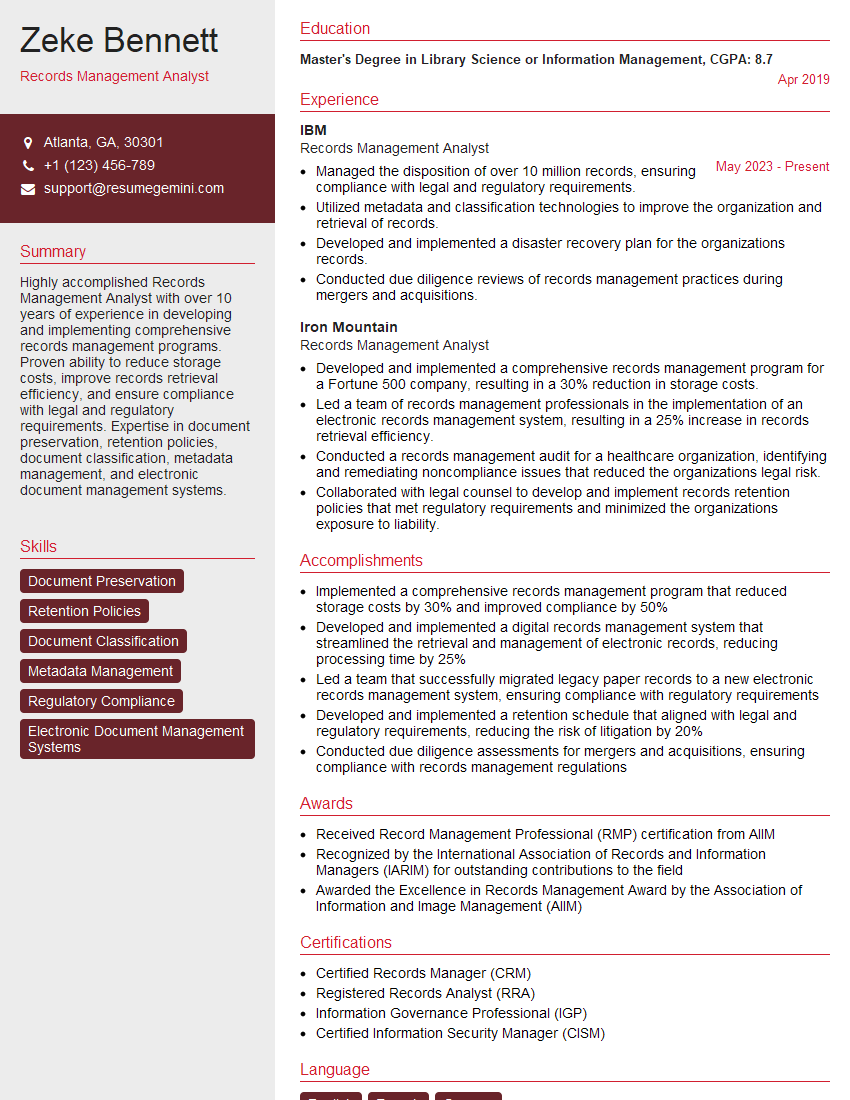
Records Management Analyst Resume Sample
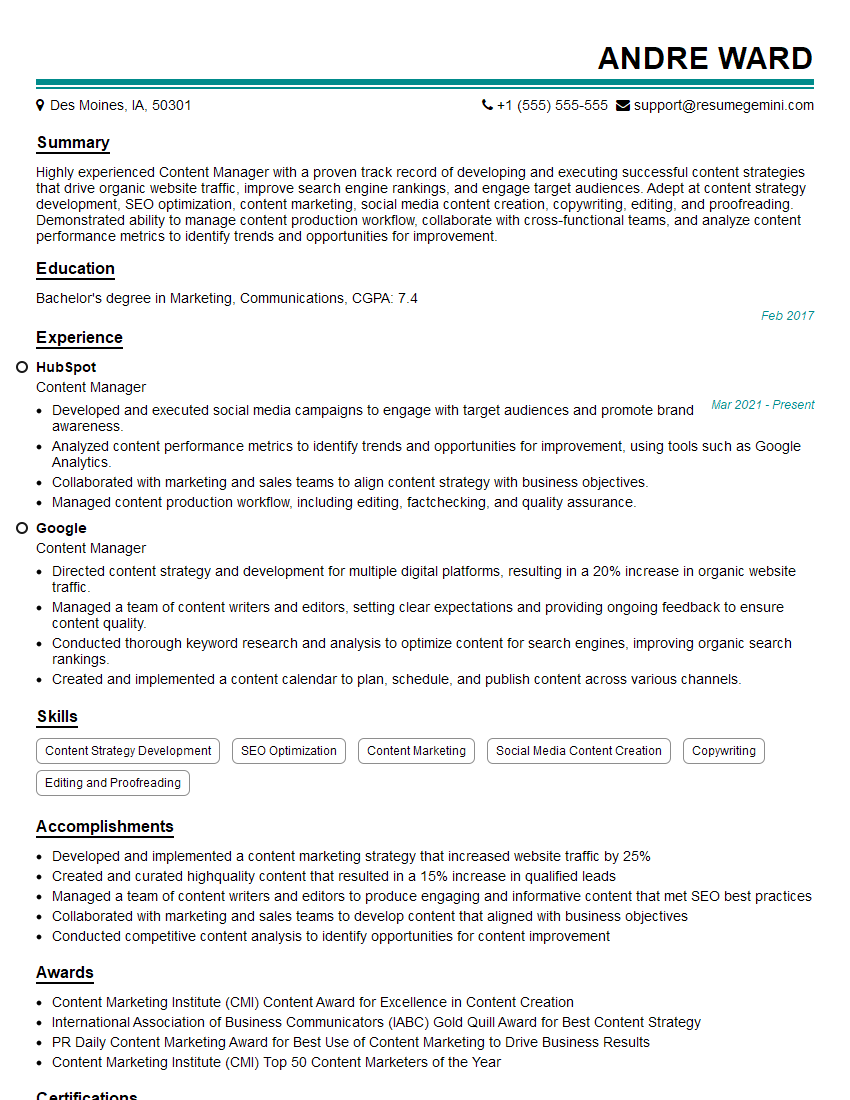
Content Manager Resume Sample

Information Architect Resume Sample
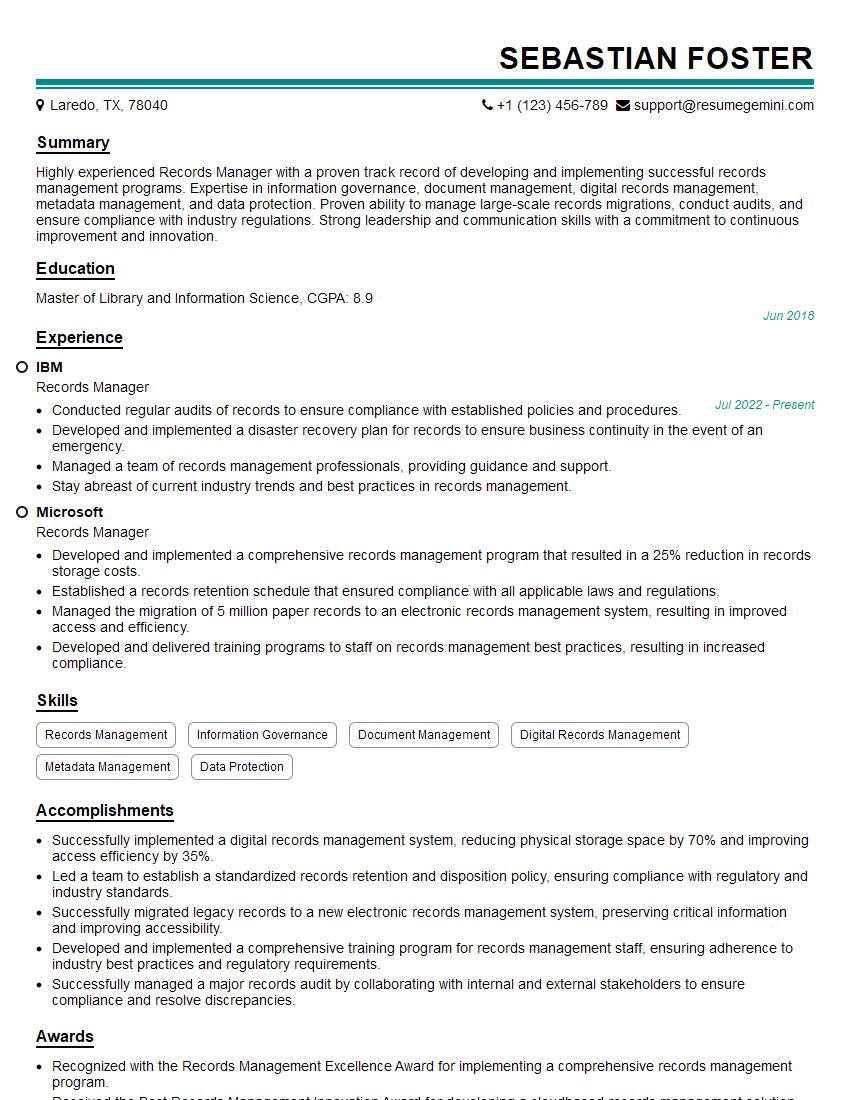
Records Manager Resume Sample
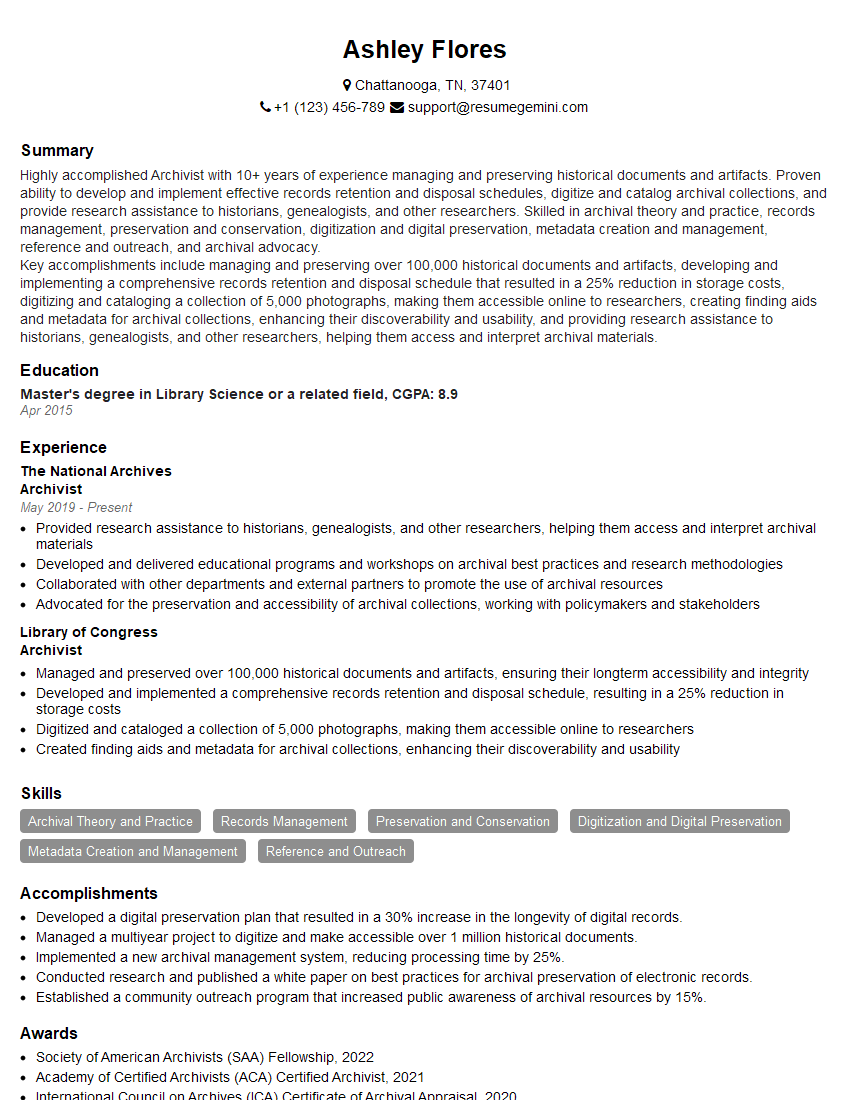
Archivist Resume Sample
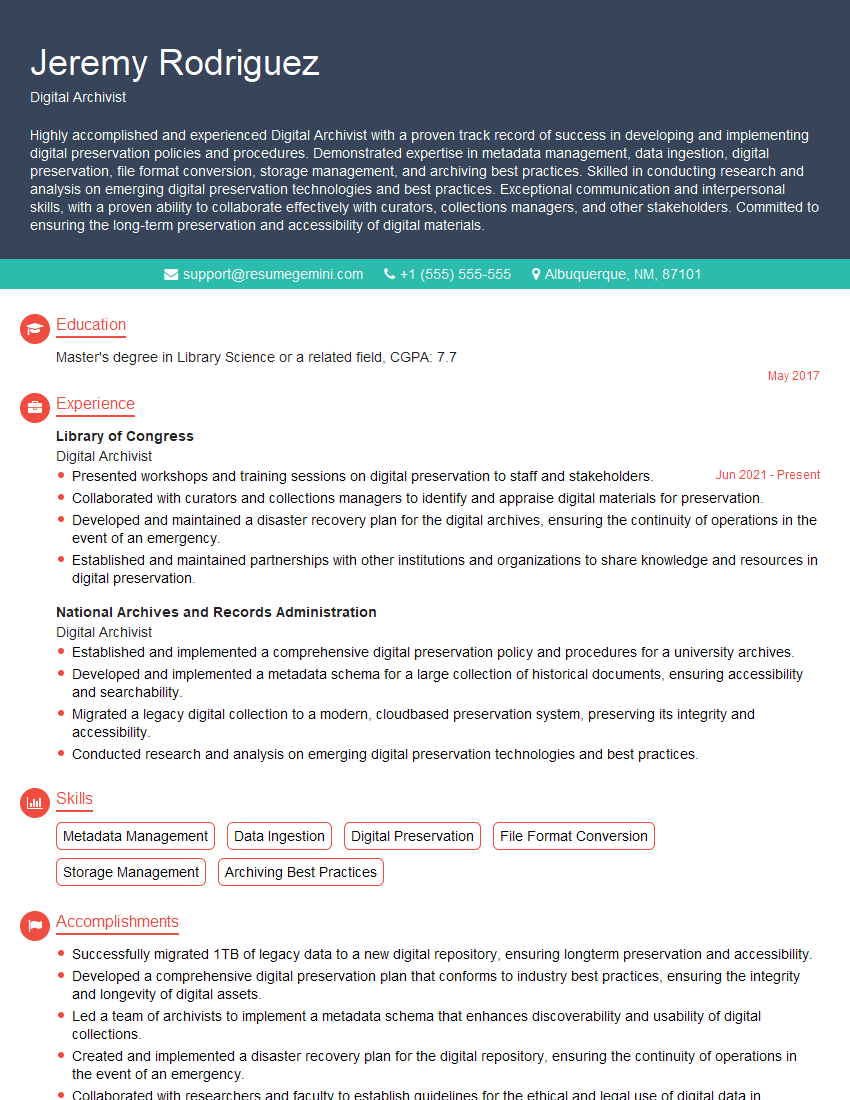
Digital Archivist Resume Sample
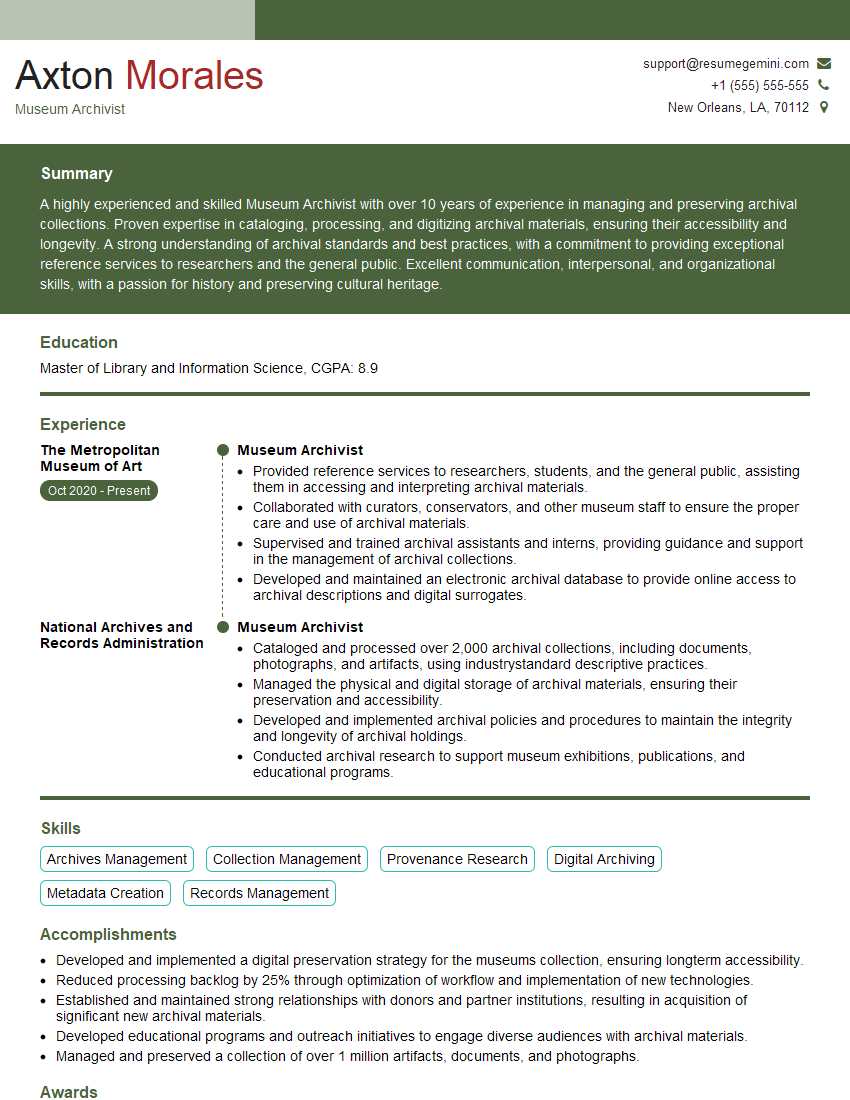
Museum Archivist Resume Sample
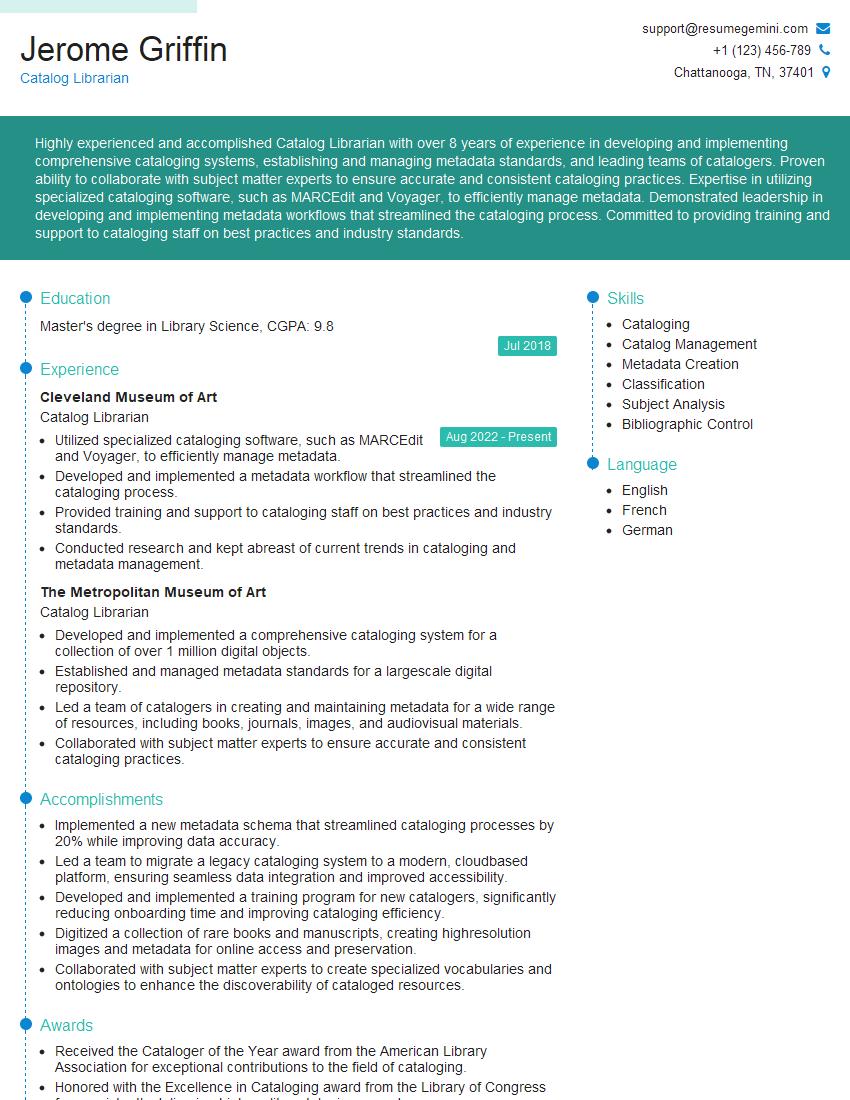
Catalog Librarian Resume Sample
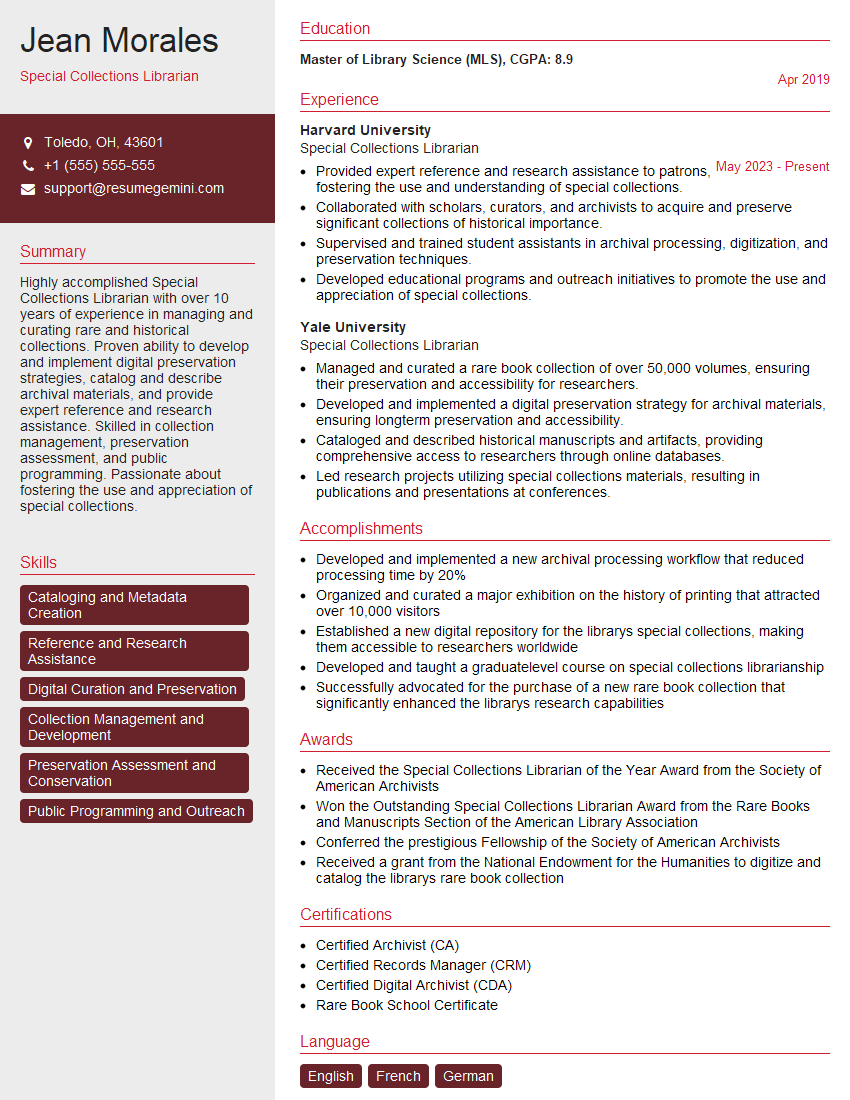
Special Collections Librarian Resume Sample
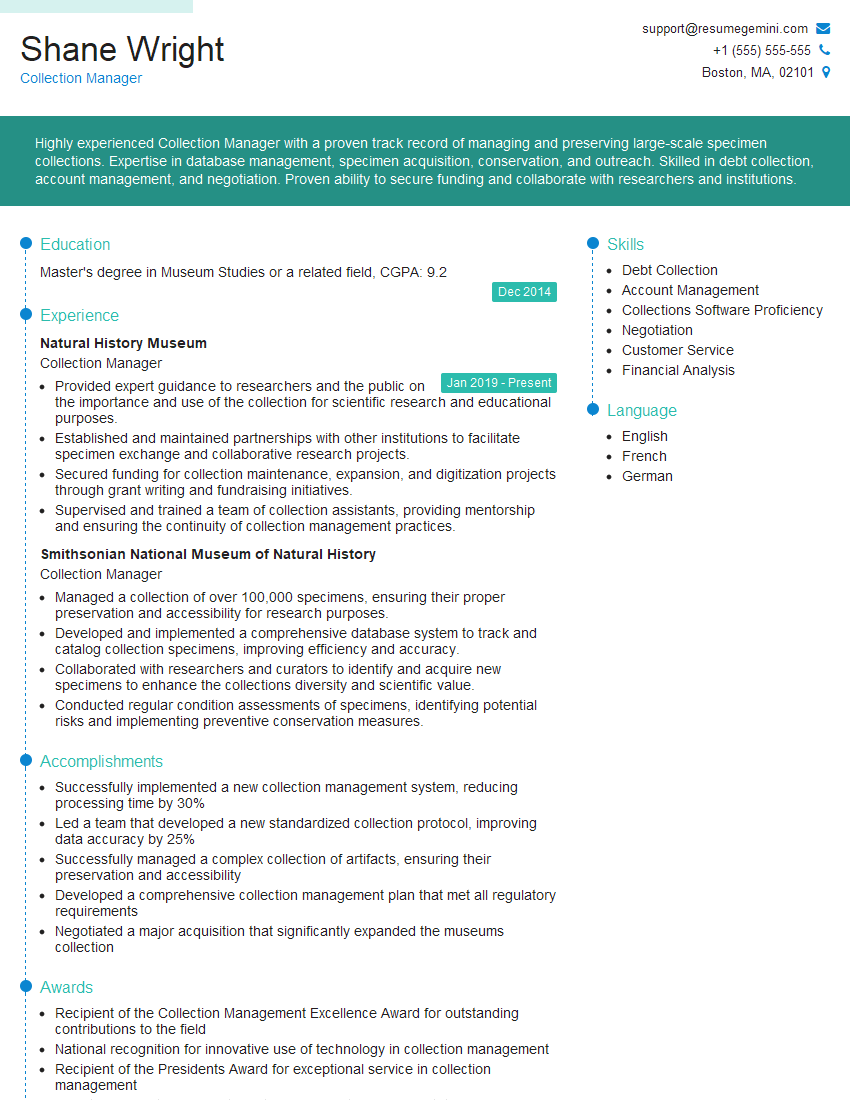
Collection Manager Resume Sample
Explore more articles
Users Rating of Our Blogs
Share Your Experience
We value your feedback! Please rate our content and share your thoughts (optional).
What Readers Say About Our Blog
Really detailed insights and content, thank you for writing this detailed article.
IT gave me an insight and words to use and be able to think of examples