Interviews are opportunities to demonstrate your expertise, and this guide is here to help you shine. Explore the essential Claims Processing and Reporting interview questions that employers frequently ask, paired with strategies for crafting responses that set you apart from the competition.
Questions Asked in Claims Processing and Reporting Interview
Q 1. Explain the claims processing lifecycle.
The claims processing lifecycle is a structured sequence of steps involved in handling a claim from its inception to its final resolution. Think of it like a carefully orchestrated relay race, where each team member (department or individual) plays a crucial role in getting the claim across the finish line.
- Claim Intake and Registration: This initial stage involves receiving the claim (e.g., electronically or via mail), verifying the claimant’s identity and eligibility, and assigning a unique claim number.
- Data Validation and Verification: Here, the accuracy and completeness of the claim information are checked. This includes verifying medical codes in healthcare claims or confirming vehicle damage details in auto claims. Inconsistent or missing data may trigger a request for additional information.
- Claims Adjudication: This is the core of the process where the claim is evaluated for coverage and benefits. This step involves reviewing supporting documentation, determining the amount payable, and applying any applicable deductibles, co-pays, or limitations. This stage often employs sophisticated rules engines and automated systems to accelerate the process and minimize human error.
- Payment Processing: Once the claim is approved, the payment is processed. This can involve direct deposit, check issuance, or other electronic payment methods.
- Claim Closure and Reporting: The final step involves recording the final claim status, updating databases, and generating reports for analysis and compliance. The entire process is carefully documented to meet legal and regulatory requirements.
For example, in a healthcare claims scenario, a patient’s claim might go through several stages of review by different specialists (medical coders, nurses, physicians) before final approval for reimbursement by an insurance company. Each step is meticulously documented, ensuring transparency and accountability.
Q 2. Describe your experience with different types of claims (e.g., auto, health, workers’ compensation).
My experience spans across various claim types, providing me with a comprehensive understanding of their unique challenges and intricacies.
- Auto Claims: I’ve handled numerous auto claims, focusing on damage assessment, liability determination, and settlement negotiations. I’m proficient in evaluating repair estimates, negotiating with repair shops, and managing communication with claimants and insurance adjusters. One memorable case involved a complex multi-vehicle accident requiring detailed accident reconstruction analysis.
- Health Claims: My work with health claims has sharpened my expertise in medical coding, billing procedures, and regulatory compliance (e.g., HIPAA). I’m comfortable navigating intricate medical terminology and procedures, accurately interpreting medical documentation, and ensuring claims adhere to payer guidelines. I’ve managed high-volume claims processing, using advanced analytics to identify patterns and potential fraud.
- Workers’ Compensation Claims: I have extensive experience processing workers’ compensation claims, which involve a greater focus on injury assessment, medical treatment authorization, and compliance with state-specific regulations. My background includes understanding the complexities of lost wages, medical expenses, and return-to-work programs. One crucial aspect involves ensuring claims are managed appropriately to minimize long-term costs and optimize outcomes for injured workers.
This varied experience allows me to seamlessly adapt my approach based on the specific requirements of different claim types. I’m adept at identifying nuances and applying best practices to ensure accurate and timely claim resolution.
Q 3. How do you prioritize claims for processing?
Prioritizing claims involves a multi-faceted approach that balances urgency, regulatory requirements, and business objectives. It’s not just about speed; it’s about ensuring efficiency and fairness.
- Urgency and Time Sensitivity: Claims with critical time constraints, such as those involving life-threatening injuries or significant financial losses, receive top priority. Examples include emergency room claims in healthcare or claims involving severe vehicle damage.
- Regulatory Compliance: Claims requiring immediate attention due to legal or regulatory deadlines are also prioritized. This might include claims subject to specific reporting requirements or those involving potential litigation.
- Claim Complexity: Complex claims requiring extensive investigation, expert opinions, or legal counsel may be prioritized based on the potential cost or impact of delay. These might include claims with disputed liability or multiple parties involved.
- Claim Value: High-value claims are typically prioritized as they represent significant financial exposure. However, the priority isn’t solely determined by the dollar amount; other factors are weighed as well.
- First-In, First-Out (FIFO): While not always the primary method, FIFO can be applied alongside other prioritization criteria to ensure fairness and prevent backlog.
A well-designed claims processing system often incorporates a sophisticated workflow management system to automate many aspects of prioritization, ensuring that claims are addressed appropriately and efficiently.
Q 4. What software or systems have you used for claims processing?
Throughout my career, I have gained extensive experience using various software and systems for claims processing. My proficiency ranges from legacy systems to the most advanced modern platforms.
- Guidewire ClaimCenter: A comprehensive claims management system widely used in the P&C insurance industry. I’m proficient in using its features for claim intake, processing, and reporting.
- Facets: This is a prominent claims management system often used in the healthcare industry, facilitating efficient handling of medical claims.
- Other specialized systems: I’ve worked with various other proprietary and industry-specific claims processing platforms, providing diverse experience in system navigation and data management.
- Data analytics tools (e.g., SQL, Tableau): My expertise extends to data analysis tools that enable me to extract, analyze, and report on claims data for performance monitoring and improvement initiatives.
My experience with multiple systems allows me to adapt quickly to new technologies and learn new platforms, ensuring that I can leverage the best tools available to optimize claims handling efficiency.
Q 5. How do you handle complex or disputed claims?
Complex or disputed claims require a methodical and thorough approach, combining analytical skills with strong communication and negotiation abilities. My strategy involves:
- Thorough Investigation: A detailed investigation is critical to gather all necessary information. This may involve contacting witnesses, reviewing medical records, obtaining expert opinions, and analyzing various documents.
- Documentation: Meticulous record-keeping is crucial. This ensures transparency, accountability, and a clear audit trail. Every step, decision, and communication is carefully documented.
- Communication and Negotiation: Effective communication with all stakeholders (claimants, providers, legal representatives) is essential to reach a mutually agreeable resolution. I use active listening and clear, concise communication to build trust and foster collaboration.
- Escalation and Mediation: If necessary, I escalate the claim to senior management or utilize external mediation services to reach a fair and timely resolution. This ensures a structured approach to resolve intractable disputes.
- Legal Counsel: In complex cases with potential legal ramifications, I work closely with legal counsel to ensure compliance and protect the organization’s interests. This step might involve reviewing legal documentation, preparing for potential litigation, or consulting with experts.
Handling disputed claims requires patience, diplomacy, and a strong understanding of legal and regulatory frameworks. The goal is always to find a resolution that is fair, equitable, and compliant.
Q 6. What is your experience with claims audits and quality control?
Claims audits and quality control are essential for maintaining the accuracy, efficiency, and compliance of the claims processing function. My experience includes:
- Pre-payment Audits: I’ve conducted pre-payment audits to ensure the accuracy of claim information before payment is processed. This helps identify errors or inconsistencies early on.
- Post-payment Audits: I’ve performed post-payment audits to identify any trends or anomalies that may indicate processing errors or potential fraud. This often includes using data analysis tools to detect unusual patterns.
- Compliance Audits: I’ve conducted compliance audits to ensure adherence to relevant regulations and internal policies. This involves reviewing claim files for adherence to legal and regulatory standards.
- Quality Control Measures: I’m familiar with implementing and monitoring quality control measures, such as random sampling, exception reporting, and key performance indicator (KPI) tracking, to ensure the accuracy of the claims processing process.
- Corrective Actions: I’ve been actively involved in implementing corrective actions based on audit findings. This can range from retraining staff to adjusting internal processes to prevent recurring errors.
My focus in audits is not just to identify errors but also to understand the root causes of those errors and implement preventive measures to improve overall process quality.
Q 7. Describe your experience with claims reporting and analysis.
Claims reporting and analysis are crucial for monitoring performance, identifying trends, and making data-driven decisions. My experience involves:
- Report Generation: I can generate various reports using data from claims management systems and other data sources. This can include reports on claim volume, processing times, cost trends, and key performance indicators.
- Data Analysis: I’m proficient in analyzing claims data to identify trends, patterns, and anomalies. This may involve using statistical methods to identify areas for improvement or potential fraud.
- Performance Monitoring: I use claims data to monitor the performance of the claims processing function and identify areas needing improvement. This includes tracking key metrics such as cycle time, accuracy rates, and cost per claim.
- Regulatory Reporting: I’m familiar with preparing reports for regulatory agencies as required by industry standards and local laws. This ensures compliance and transparency.
- Predictive Modeling: I’ve used claims data to build predictive models to forecast future claim volumes, costs, and other key metrics. This helps in resource allocation and strategic planning.
My reporting and analysis skills enable me to provide valuable insights to management, helping them to optimize the claims process, reduce costs, and improve customer satisfaction. I am adept at presenting complex data in a clear and understandable manner using both visual aids and narrative explanations.
Q 8. How do you identify and prevent fraudulent claims?
Fraudulent claims detection and prevention is a crucial aspect of claims processing. It involves a multi-layered approach combining proactive measures and reactive investigations. Proactive measures include implementing robust data analytics to identify patterns suggestive of fraud, such as unusually high claim frequency from a single provider or suspiciously similar claims across multiple policies. We also employ sophisticated algorithms that flag potentially fraudulent claims based on pre-defined risk factors.
Reactive measures involve thorough investigations of flagged claims. This might involve verifying the claimant’s identity, reviewing medical records for consistency, and comparing the claim details against other available data. For example, we might cross-reference a claim for a car accident with police reports to verify the accident details. In cases of suspected fraud, we collaborate with external investigators and, if necessary, pursue legal action.
We also educate our employees and stakeholders on fraud prevention techniques, encouraging them to report suspicious activities. This proactive approach ensures early detection and minimizes losses.
Q 9. How do you ensure compliance with regulatory requirements in claims processing?
Compliance with regulatory requirements is paramount in claims processing. This involves adhering to a complex network of federal and state regulations, varying by insurance type and jurisdiction. We maintain a comprehensive compliance program that includes regular internal audits, staff training, and the implementation of robust internal controls. For example, we strictly adhere to HIPAA regulations when handling health information and ensure that all claims documentation is properly stored and secured according to relevant regulations.
We stay abreast of changes in regulations through continuous monitoring of regulatory updates and actively participate in industry associations and training programs. Our compliance efforts ensure that our claims processing practices are transparent, ethical, and fully compliant with all applicable laws and regulations. Failure to comply can lead to significant penalties and reputational damage.
Q 10. What is your experience with different claim investigation techniques?
My experience encompasses a wide range of claim investigation techniques, including:
- On-site inspections: Personally visiting accident scenes or medical facilities to gather evidence and assess damage.
- Witness interviews: Gathering statements from individuals who may have witnessed the event.
- Document review: Thoroughly examining medical records, police reports, and other supporting documentation for inconsistencies or discrepancies.
- Expert consultations: Engaging independent experts, such as medical professionals or engineers, to provide specialized assessments.
- Data analysis: Using statistical methods to identify patterns of fraudulent claims or inconsistencies within the claim data.
I’ve successfully employed these techniques in a variety of scenarios, from investigating minor property damage claims to complex liability cases involving significant bodily injury. Adapting my approach based on the specifics of each case is crucial for efficient and effective investigation.
Q 11. How do you handle high-volume claims processing?
Handling high-volume claims processing requires a strategic approach combining technology and efficient workflows. We utilize automated claims processing systems that streamline tasks such as data entry, eligibility verification, and benefit calculation. These systems incorporate sophisticated rules engines that automatically identify and flag claims requiring further review.
We also employ a well-defined routing system that distributes claims efficiently among adjusters based on their expertise and workload. This ensures timely processing without overwhelming individual staff members. Regular performance monitoring and process optimization are crucial for maintaining efficiency and accuracy even during peak periods. For example, identifying and addressing bottlenecks in the claims processing workflow through process mapping and automation can significantly improve processing times.
Q 12. Describe your experience with claims reserves and estimations.
Claims reserving is the process of estimating the ultimate cost of settling claims. Accurate reserving is critical for financial planning and solvency. My experience involves developing and utilizing various reserving techniques, including:
- Case reserves: Estimating the cost of individual claims based on the severity of the injury or damage.
- Bulk reserves: Estimating the overall cost of a group of similar claims.
- Statistical modeling: Using statistical techniques to predict the ultimate cost of claims based on historical data.
I am proficient in using various software and statistical tools to perform accurate reserving. Regular monitoring and adjustments to reserves are crucial to reflect new information and changing claim patterns. Inaccurate reserving can lead to significant financial risks for the company.
Q 13. How do you communicate effectively with claimants, policyholders and other stakeholders?
Effective communication is central to successful claims processing. I prioritize clear, concise, and empathetic communication with claimants, policyholders, and other stakeholders. This includes providing regular updates on the status of their claims, explaining complex procedures in simple terms, and addressing their concerns promptly and professionally. I utilize various communication channels, such as email, phone, and even video conferencing, adapting my approach to suit the individual’s preferences and needs.
Building rapport and trust is vital. Active listening, acknowledging their emotions, and demonstrating empathy go a long way in maintaining positive relationships. In challenging situations, I focus on de-escalation techniques and problem-solving to reach mutually acceptable resolutions.
Q 14. What metrics do you use to track claims processing performance?
We utilize a range of key performance indicators (KPIs) to track claims processing performance. These include:
- Average processing time: The average time taken to process a claim from inception to settlement.
- Claim cycle time: Time from reporting to closure.
- Claim denial rate: The percentage of claims denied.
- Claim settlement cost: Average cost to settle claims.
- Customer satisfaction: Measured through surveys and feedback.
- Fraud detection rate: Percentage of fraudulent claims identified.
Regular monitoring of these metrics allows us to identify areas for improvement and ensure that we are consistently meeting our service level agreements. Data-driven analysis and process improvement initiatives are continuously implemented based on these KPIs to enhance efficiency and effectiveness.
Q 15. How do you handle claims denials and appeals?
Handling claims denials and appeals requires a systematic approach. First, I meticulously review the denial reason provided by the payer. This often involves understanding complex medical coding, policy exclusions, and contractual agreements. Common denial reasons include missing documentation, incorrect coding (e.g., using the wrong ICD-10 or CPT code), or the service not being medically necessary.
Once the reason is identified, I determine if the denial is justified. If it’s a simple error, such as missing paperwork, I immediately take corrective action, resubmitting the claim with the necessary documentation. I utilize a detailed tracking system to monitor the resubmission and follow-up timelines.
However, if the denial is due to a more complex issue, such as a dispute over medical necessity, I build a robust appeal. This involves gathering supporting medical records, physician statements, and any relevant clinical guidelines to support the claim’s legitimacy. The appeal is carefully constructed to address the payer’s specific concerns, providing a clear and persuasive argument for reimbursement. This often includes referencing specific sections of the payer’s own policy or guidelines. For instance, if a denial cites lack of medical necessity, I’ll provide detailed documentation demonstrating how the service met the established criteria. Each payer has its own specific appeal process and timelines, which I meticulously follow. I consider the appeals process an iterative problem-solving exercise, constantly refining my strategy based on feedback and past experience.
Career Expert Tips:
- Ace those interviews! Prepare effectively by reviewing the Top 50 Most Common Interview Questions on ResumeGemini.
- Navigate your job search with confidence! Explore a wide range of Career Tips on ResumeGemini. Learn about common challenges and recommendations to overcome them.
- Craft the perfect resume! Master the Art of Resume Writing with ResumeGemini’s guide. Showcase your unique qualifications and achievements effectively.
- Don’t miss out on holiday savings! Build your dream resume with ResumeGemini’s ATS optimized templates.
Q 16. Explain your understanding of indemnity and subrogation.
Indemnity and subrogation are key concepts in claims processing. Indemnity refers to the insurer’s responsibility to compensate the insured for covered losses. Think of it as the promise to make the insured ‘whole’ again after an accident or illness. For example, if someone has collision insurance and their car is totaled, indemnity means the insurance company will pay them the actual cash value of the car, minus any deductible.
Subrogation, on the other hand, is the insurer’s right to recover funds from a third party responsible for the insured’s loss. This is essentially the insurer stepping into the shoes of the insured to pursue reimbursement. Imagine a scenario where an insured’s car is damaged due to another driver’s negligence. After compensating the insured, the insurance company can then pursue legal action against the at-fault driver to recover the amount paid. Subrogation protects the insurance company from bearing unnecessary financial burdens and helps to keep premiums lower. Successful subrogation often involves collaboration with legal professionals.
Q 17. What is your experience with claims documentation and record-keeping?
My experience with claims documentation and record-keeping is extensive. I’ve worked with both paper-based and electronic systems, ensuring that all claims documentation is complete, accurate, and adheres to all relevant legal and regulatory requirements. This involves meticulous organization of medical records, billing codes, patient information, and correspondence with payers.
I understand the importance of maintaining a clear audit trail, including dates, timestamps, and the names of all individuals involved in processing each claim. This is crucial for compliance audits, appeals processes, and demonstrating accountability. For example, in my previous role, I implemented a new electronic filing system that reduced processing time by 25% and enhanced our ability to quickly locate and access critical information. I am proficient in maintaining compliance with HIPAA regulations related to Protected Health Information (PHI) throughout the entire claims lifecycle.
Q 18. How do you stay up-to-date on changes in claims processing regulations and best practices?
Staying current on claims processing regulations and best practices is paramount. I regularly subscribe to industry journals and publications, such as those from the American Health Information Management Association (AHIMA) and attend webinars and conferences to keep abreast of changes in coding, regulations (e.g., HIPAA updates), and payer policies. I actively participate in professional development opportunities to stay ahead of the curve.
Furthermore, I maintain a network of colleagues in the field to share updates and best practices. I also utilize online resources such as the Centers for Medicare & Medicaid Services (CMS) website for the most up-to-date information on regulations and guidelines. Continuous learning ensures that I maintain efficiency and accuracy in my work and help my organization stay compliant.
Q 19. Describe your experience working with different insurance carriers or payers.
I have extensive experience working with a wide variety of insurance carriers and payers, including Medicare, Medicaid, commercial insurers (e.g., Blue Cross Blue Shield, UnitedHealthcare), and managed care organizations (MCOs). Each payer has its own unique requirements, claim forms, and processing timelines. For example, Medicare claims require specific coding and documentation to ensure proper reimbursement, while commercial payers may have different criteria for medical necessity.
My experience has enabled me to develop a strong understanding of these variations and adapt my approach accordingly. I’ve developed strong relationships with payer representatives to facilitate timely claim resolution and address any issues that arise. This includes knowing which payers utilize specific claim submission portals or electronic data interchange (EDI) systems.
Q 20. How do you handle stressful situations and tight deadlines in claims processing?
Claims processing often involves tight deadlines and high-pressure situations. I’m adept at prioritizing tasks, managing my time effectively, and maintaining accuracy under pressure. I utilize project management techniques, like breaking down large tasks into smaller, manageable steps and setting realistic goals.
I also value teamwork and collaboration. When faced with a particularly challenging situation or an impending deadline, I work closely with my colleagues to ensure that we are all on the same page and supporting each other. Clear communication and proactive problem-solving are key to navigating these situations efficiently and effectively. For example, if a large volume of claims needs processing before a deadline, I’ll work with the team to identify bottlenecks, streamline workflows, and redistribute tasks as needed.
Q 21. Explain your experience with claims management systems and data analysis.
I’m proficient in using various claims management systems, including both proprietary software and cloud-based solutions. My experience encompasses data entry, claim tracking, reporting, and analysis. I am adept at extracting and interpreting data to identify trends, patterns, and areas for improvement. For instance, I’ve used data analysis to identify common reasons for claims denials and then implemented process changes to reduce denial rates.
My skills in data analysis extend to generating reports for management on key performance indicators (KPIs), such as claims processing time, denial rates, and reimbursement levels. These reports provide valuable insights into the efficiency and effectiveness of the claims processing workflow. I have also used data to support claims audits and identify potential areas of fraud or abuse. Proficiency in SQL or other data querying languages is incredibly valuable in this role, enabling efficient extraction and manipulation of complex claims data.
Q 22. What is your experience with claims automation and technology?
My experience with claims automation and technology spans over eight years, encompassing various platforms and methodologies. I’ve worked extensively with systems ranging from simple automated workflows for basic claim data entry to sophisticated AI-powered solutions capable of fraud detection and predictive analytics. For instance, in my previous role, we implemented a new claims management system that reduced processing time by 40% through automation of routine tasks like eligibility verification and benefit calculation. This involved not just the technical implementation but also significant process re-engineering and user training. I’m proficient in several industry-standard software solutions including Guidewire, ClaimCenter, and other related platforms. My expertise also extends to integrating various systems to ensure seamless data flow and reporting.
Moreover, I have experience with robotic process automation (RPA) tools to automate repetitive, manual tasks such as data extraction from various sources and claim status updates, significantly improving efficiency and reducing human error.
Q 23. How do you identify and resolve discrepancies in claims data?
Identifying and resolving discrepancies in claims data is a core part of my role. I approach this systematically, utilizing a combination of automated checks and manual review. My process typically begins with data validation using predefined rules and algorithms. For example, we might flag a claim if the billed amount significantly exceeds the pre-authorized amount or if there are inconsistencies between the provider’s information and our database. These automated checks help to pinpoint potential issues quickly.
When discrepancies arise, I employ a methodical investigative approach. This may involve verifying information with providers, reviewing medical records, and comparing claims data to policy details. In complex cases, I may use data analytics techniques to identify patterns or trends that could explain the discrepancy. For instance, I recently uncovered a billing error impacting hundreds of claims by identifying a correlation between specific CPT codes and unusually high charges through data analysis. Ultimately, the goal is to accurately resolve the discrepancy while ensuring compliance with regulations and maintaining strong relationships with our providers.
Q 24. Describe your problem-solving skills when faced with a complex claim.
My approach to solving complex claims involves a structured, analytical, and collaborative process. I start by thoroughly understanding the specifics of the claim, including the nature of the loss, relevant policy details, and all supporting documentation. This often involves actively communicating with stakeholders to gather all the necessary information.
Next, I break down the problem into smaller, manageable components, identifying the key issues requiring resolution. I develop hypotheses about potential causes and systematically test these hypotheses using available data and resources. This might involve analyzing medical records for a more accurate diagnosis, investigating potential fraud, or clarifying conflicting information with involved parties. For example, one particularly complex case involved a claim with multiple conflicting diagnoses and extensive medical documentation. Through meticulous review and consultation with medical experts, I was able to resolve the discrepancies and ensure a fair settlement.
Finally, I document each step of the process, ensuring transparency and accountability. Effective communication is crucial throughout this entire process, keeping all stakeholders informed of progress and any decisions made.
Q 25. What is your experience with claims reconciliation and payment processing?
Claims reconciliation and payment processing are critical aspects of claims handling. My experience includes the full cycle, from verifying claim information against policy details to ensuring accurate payment disbursement. I am adept at using various reconciliation tools and techniques to identify and resolve payment discrepancies. For instance, I’ve used automated reconciliation software to match payments with claims, flagging any mismatches for further investigation.
I understand the importance of accurate and timely payment processing to maintain provider relationships and ensure smooth claim resolution. My experience also includes working with various payment methods and ensuring compliance with payment regulations. In managing payments, I’ve always prioritized security, ensuring adherence to established security protocols and procedures to mitigate risks of fraud and financial loss. I’m comfortable working with various reporting tools to track payment status and identify potential delays or problems.
Q 26. How do you utilize data analytics to improve claims processing efficiency?
Data analytics plays a crucial role in improving claims processing efficiency. I use data analysis techniques to identify bottlenecks in the claims process, understand patterns of claims, and predict future trends. This could involve analyzing data on claim processing times, denial rates, and average claim costs. For example, by analyzing claim processing times, I can identify specific stages where delays often occur and design solutions to address those bottlenecks.
I use various analytical tools, including SQL, Excel, and specialized claims analytics software, to analyze large datasets. My analysis often leads to actionable insights, such as identifying areas for automation, refining claim review processes, and improving communication with providers. For example, through data analysis, I discovered a high correlation between certain diagnostic codes and claim denials. This enabled us to develop more specific training materials for claim examiners, resulting in a significant reduction in denial rates.
Q 27. How do you collaborate with other departments (e.g., underwriting, legal) in handling claims?
Collaboration with other departments, such as underwriting and legal, is essential for effective claims handling. I regularly communicate with underwriters to clarify policy details or resolve coverage disputes. For example, if a claim involves ambiguous policy language, I will work with underwriters to obtain a clear interpretation. With the legal department, I collaborate when claims involve legal issues, such as litigation or potential fraud.
Effective collaboration relies on clear communication and a shared understanding of goals. I use various communication tools, including emails, meetings, and collaborative platforms, to ensure seamless information flow. My focus is on fostering positive working relationships with other departments, promoting a collaborative environment and ensuring a unified approach to handling complex cases. For instance, I regularly participate in cross-departmental meetings to discuss trends and identify opportunities for process improvement. Maintaining strong interdepartmental relationships ensures swift, accurate, and efficient claim resolution.
Q 28. Describe your experience with reporting on key claims performance indicators (KPIs).
I have extensive experience in reporting on key claims performance indicators (KPIs). This includes developing and maintaining reports on metrics such as claim processing time, denial rates, average claim costs, and reserve adequacy. I use various reporting tools, including SQL, Excel, and dedicated claims management system reporting modules, to generate these reports.
These reports provide crucial insights into the efficiency and effectiveness of the claims process. For example, monitoring claim processing time helps us identify areas for improvement, while tracking denial rates allows us to pinpoint weaknesses in our claim review processes. I tailor my reports to the specific needs of the audience, whether it’s senior management, claim examiners, or regulatory bodies. I utilize data visualization techniques to present the data clearly and concisely, making it easy for stakeholders to understand key trends and identify areas needing attention. For example, I might create a dashboard showing key KPIs with interactive charts and graphs to provide immediate insights into the overall claims performance.
Key Topics to Learn for Claims Processing and Reporting Interview
- Claims Intake and Triage: Understanding the initial steps of receiving, reviewing, and categorizing claims based on urgency and type. Practical application: Prioritizing claims based on policy stipulations and regulatory deadlines.
- Data Entry and Validation: Accurately entering claim information into designated systems while ensuring data integrity and adherence to company protocols. Practical application: Identifying and resolving data discrepancies using appropriate validation techniques.
- Claims Adjudication and Payment Processing: Applying company policies and procedures to determine eligibility, coverage, and appropriate payment amounts. Practical application: Troubleshooting complex claim scenarios and applying problem-solving skills to resolve discrepancies.
- Regulatory Compliance and HIPAA: Demonstrating a solid understanding of relevant laws and regulations governing claims handling and data privacy. Practical application: Ensuring compliance with all applicable regulations during the entire claims processing cycle.
- Claims Reporting and Analytics: Generating accurate and timely reports on key performance indicators (KPIs) related to claims processing. Practical application: Analyzing claims data to identify trends, areas for improvement, and potential fraud.
- Software Proficiency: Familiarity with various claims processing software and systems, including knowledge of databases and reporting tools. Practical application: Efficiently navigating and utilizing claim processing software to improve speed and accuracy.
- Problem-Solving and Decision-Making: Demonstrating the ability to handle ambiguous situations, resolve conflicts, and make informed decisions based on available information and company policy. Practical application: Developing and implementing solutions to improve the efficiency and accuracy of the claims processing workflow.
Next Steps
Mastering Claims Processing and Reporting is crucial for career advancement within the insurance and healthcare industries. These skills are highly sought after, leading to increased job opportunities and higher earning potential. To stand out from other candidates, a well-crafted, ATS-friendly resume is essential. Building a compelling resume that highlights your skills and experience is key to securing your dream job. ResumeGemini is a trusted resource to help you build a professional and effective resume. We provide examples of resumes tailored to Claims Processing and Reporting to give you a head start. Take the next step towards your career success today!
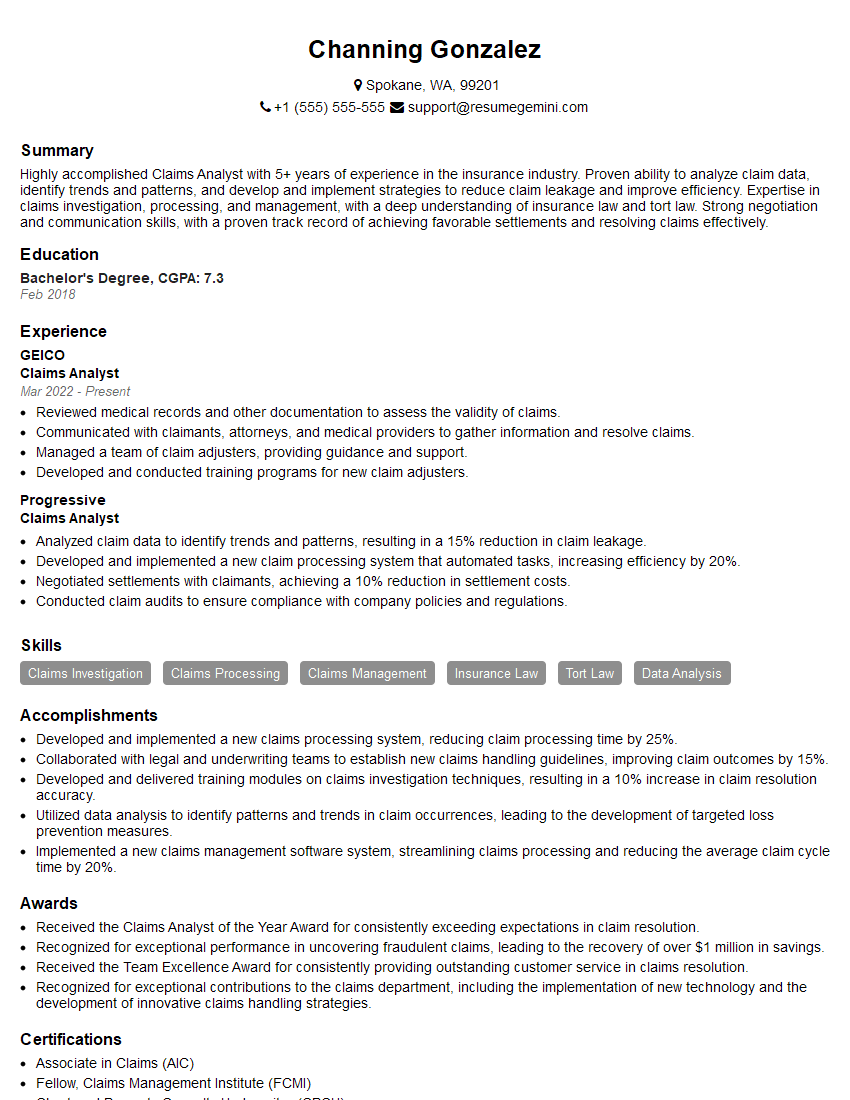
Claims Analyst Resume Sample
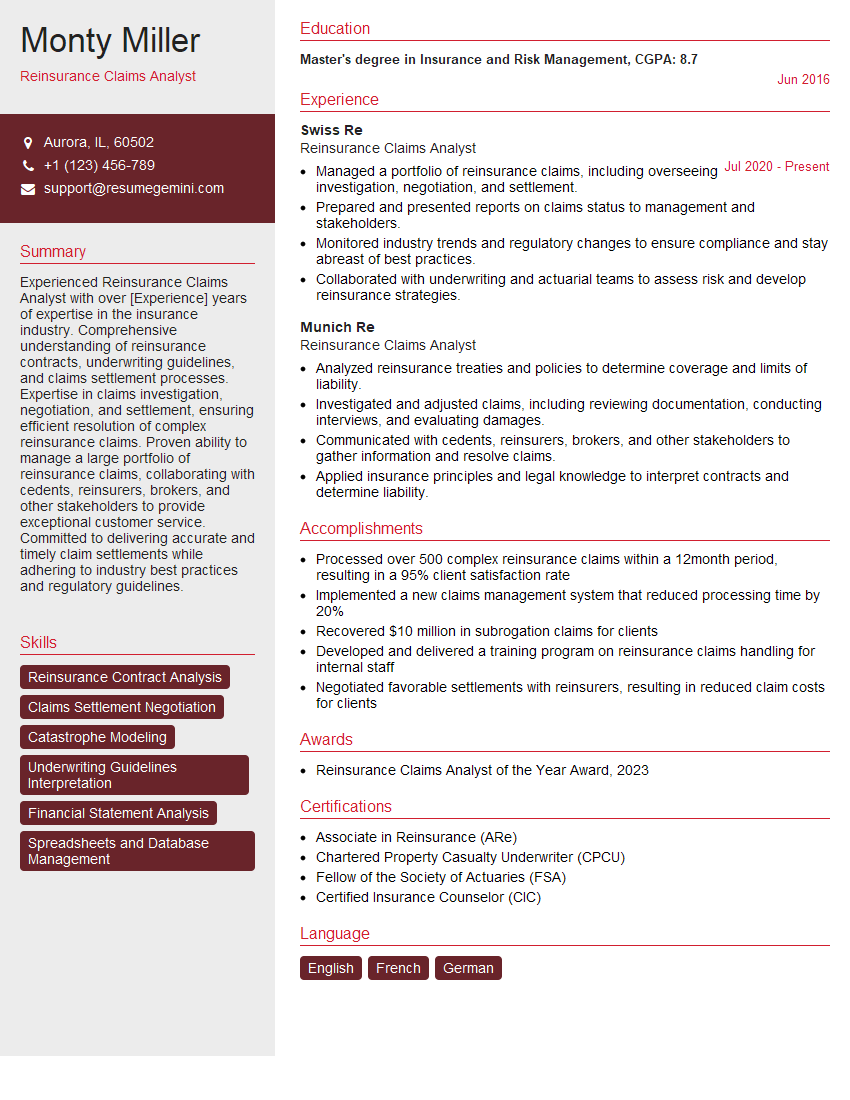
Reinsurance Claims Analyst Resume Sample
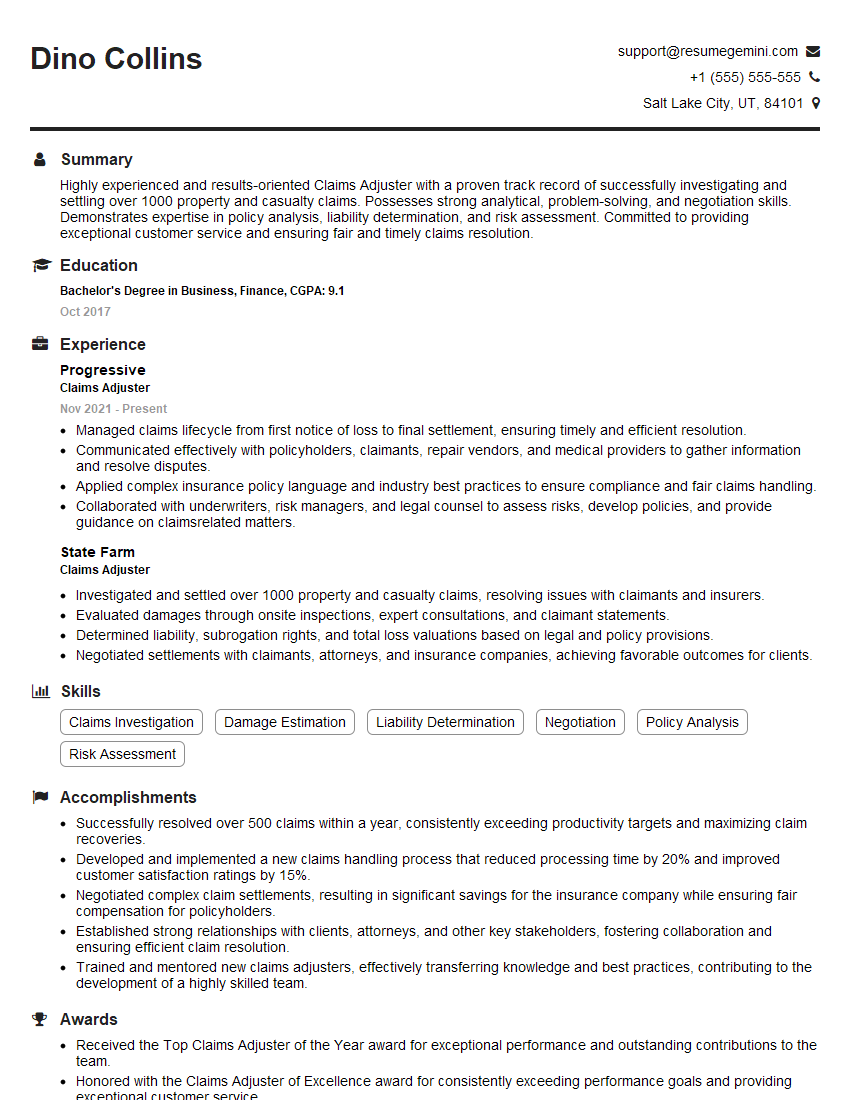
Claims Adjuster Resume Sample
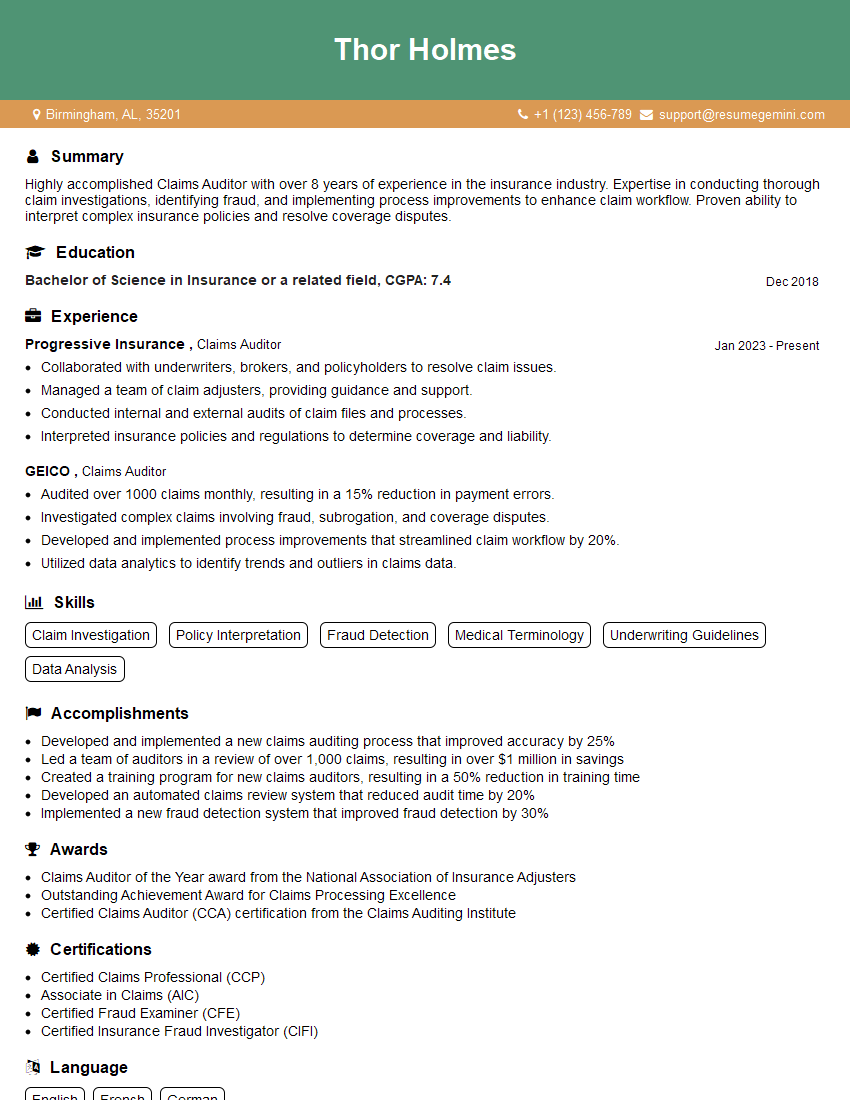
Claims Auditor Resume Sample
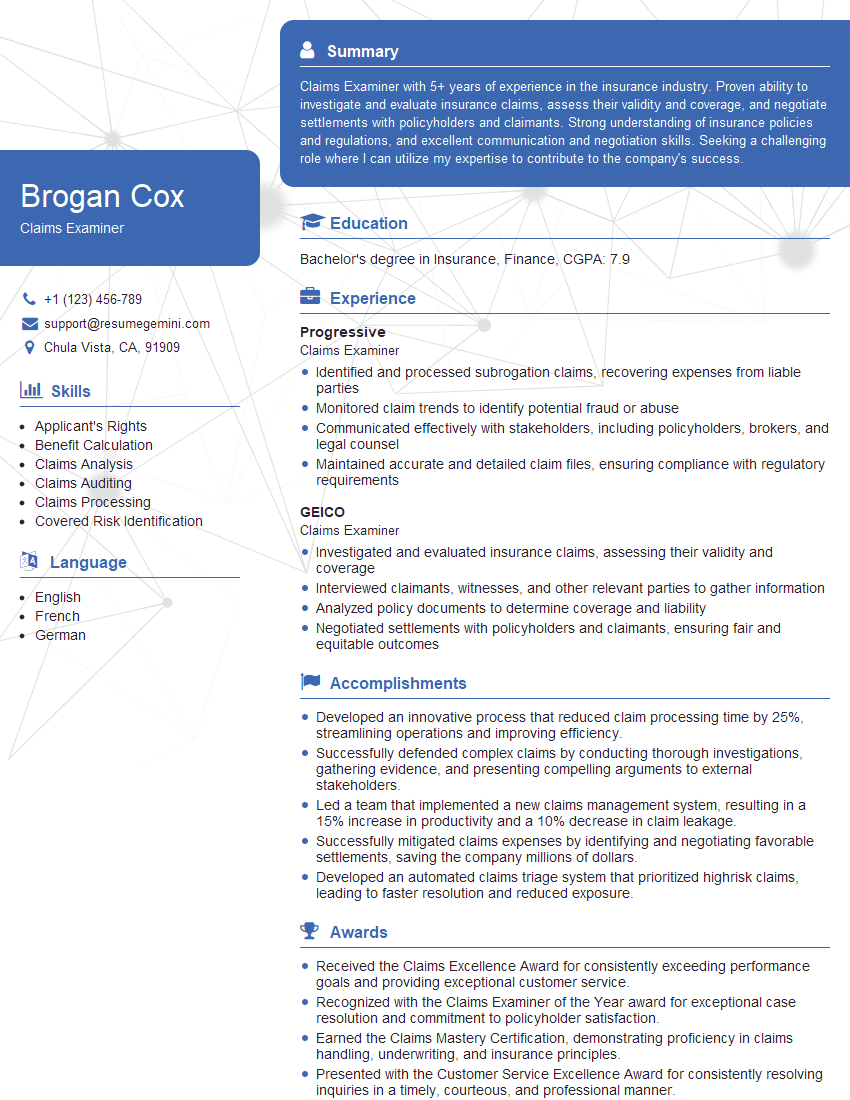
Claims Examiner Resume Sample
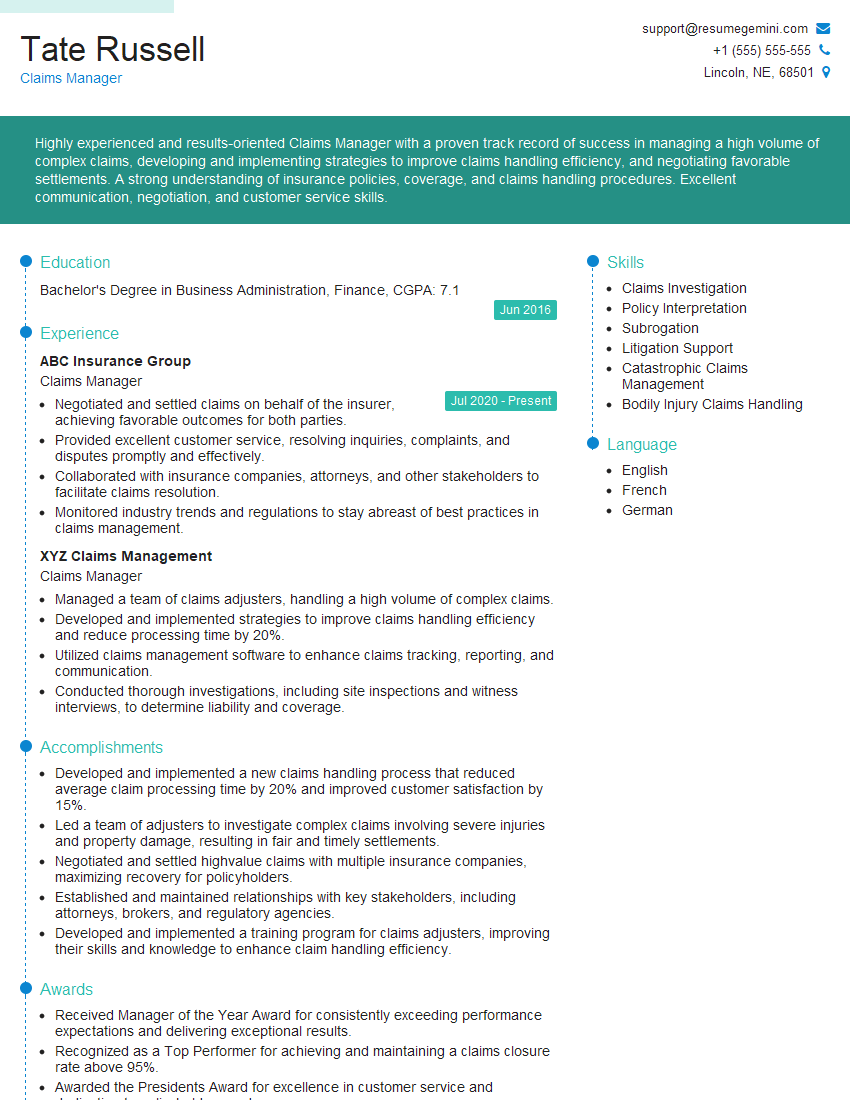
Claims Manager Resume Sample
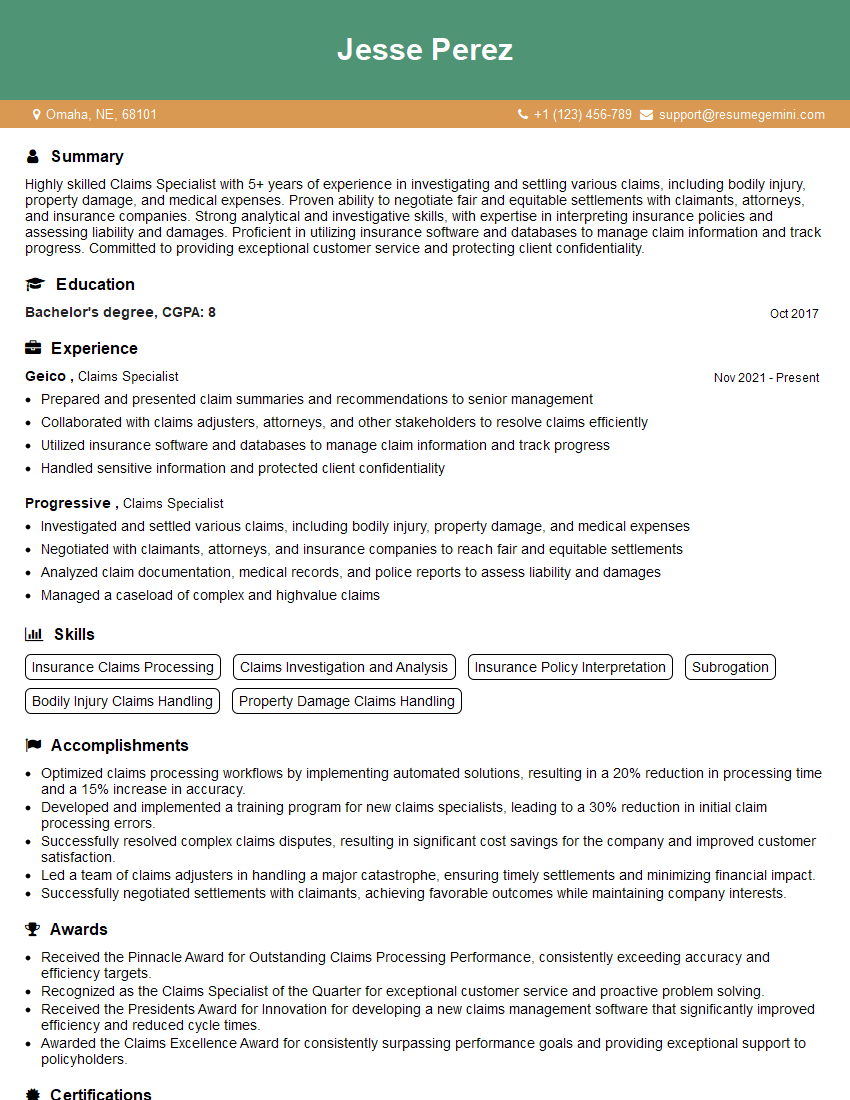
Claims Specialist Resume Sample
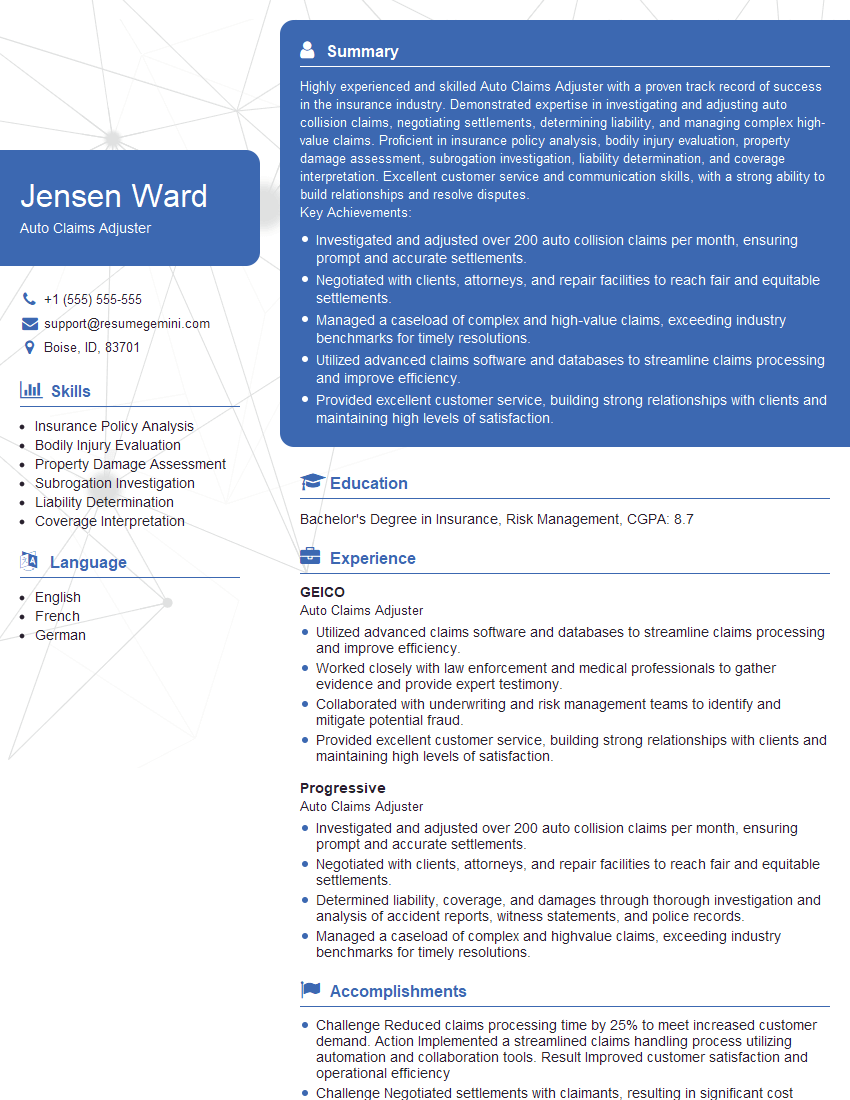
Auto Claims Adjuster Resume Sample

Claims Processor Resume Sample
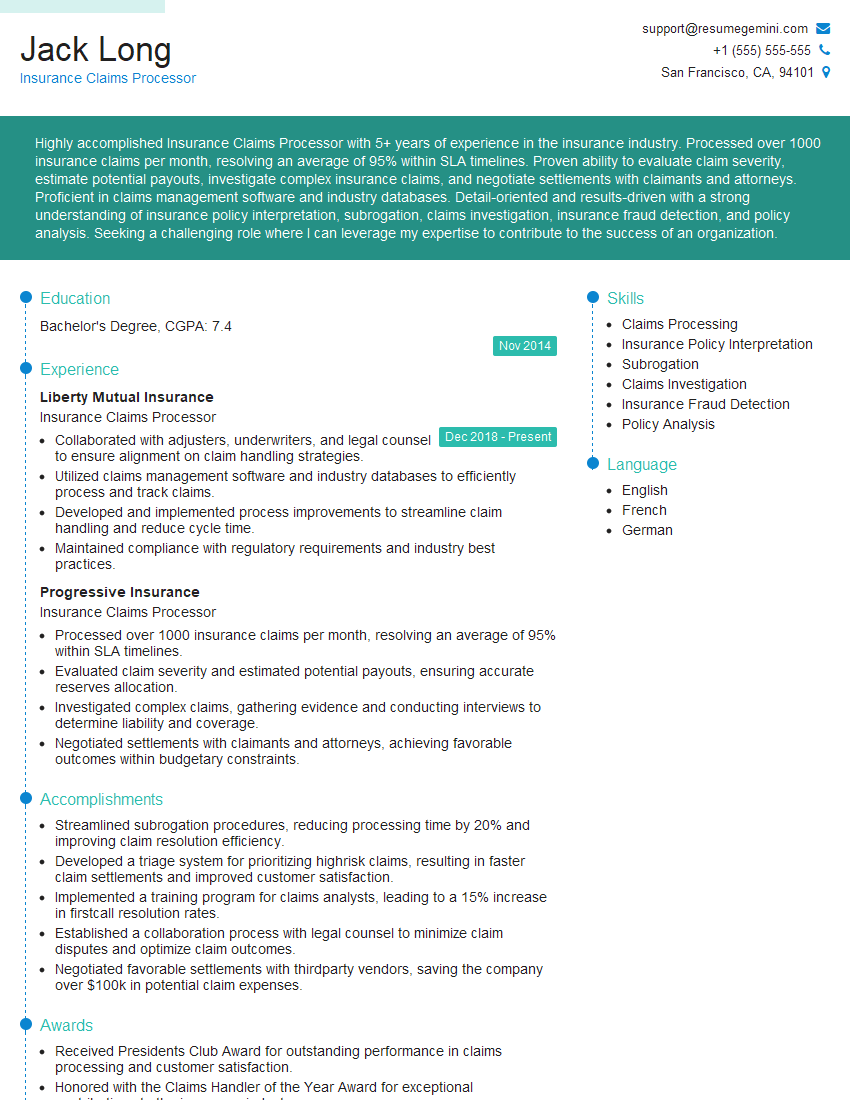
Insurance Claims Processor Resume Sample
Explore more articles
Users Rating of Our Blogs
Share Your Experience
We value your feedback! Please rate our content and share your thoughts (optional).
What Readers Say About Our Blog
Really detailed insights and content, thank you for writing this detailed article.
IT gave me an insight and words to use and be able to think of examples