Every successful interview starts with knowing what to expect. In this blog, we’ll take you through the top Color Space Management interview questions, breaking them down with expert tips to help you deliver impactful answers. Step into your next interview fully prepared and ready to succeed.
Questions Asked in Color Space Management Interview
Q 1. Explain the difference between RGB and CMYK color spaces.
RGB and CMYK are two fundamental color spaces used in different contexts. RGB (Red, Green, Blue) is an additive color model, primarily used for displays like monitors and screens. It works by combining varying intensities of red, green, and blue light to create a wide range of colors. Think of shining a red, green, and blue flashlight onto a white wall – where they overlap, you get different colors. The more light, the brighter the color.
CMYK (Cyan, Magenta, Yellow, Key/Black) is a subtractive color model, mainly used in printing. It works by subtracting colors from white light. Cyan, magenta, and yellow inks absorb certain wavelengths of light, leaving the complementary color behind. Black ink (K) is added to improve the depth and richness of dark colors. Imagine starting with a white sheet of paper and applying colored inks – the more ink, the darker the resulting color.
The key difference lies in their nature: RGB adds light to create color, while CMYK subtracts light. This means a color that looks great on your screen might not print exactly the same way due to the fundamental differences between the models.
Q 2. What is a color profile (ICC profile) and its importance in color management?
A color profile, also known as an ICC (International Color Consortium) profile, is a set of data that describes the color characteristics of a specific device or output medium, such as a monitor, printer, or scanner. This data includes the gamut (range of reproducible colors) and the transformation functions needed to accurately translate colors between different devices and color spaces.
The importance of ICC profiles in color management is paramount. Without them, colors will be inconsistent across different devices. A photo that looks vibrant on your monitor might print dull or distorted. ICC profiles ensure that colors are translated accurately, maintaining the visual intent throughout the workflow. Imagine trying to paint a picture using paints of different qualities – some might be more vibrant than others, skewing your final result. ICC profiles act as a translator, ensuring that everyone “speaks the same color language”.
Q 3. Describe the process of color gamut mapping.
Color gamut mapping is the process of translating colors from a source color space (e.g., a wide-gamut image) to a destination color space (e.g., a printer’s limited gamut) where the destination gamut is smaller than the source gamut. Not all colors in the source image can be reproduced accurately in the destination space. Therefore, gamut mapping algorithms are employed to find the closest possible matches, while minimizing color shifts and artifacts.
Several strategies exist for gamut mapping. Simple methods such as clipping (discarding out-of-gamut colors) or scaling (proportionally adjusting the colors) are simple but can lead to noticeable shifts. More sophisticated techniques like perceptual mapping use complex algorithms that consider human visual perception to produce the most visually acceptable results. The best method depends on the image and the desired level of accuracy, often involving compromises.
For example, converting an image with a large sRGB gamut to a smaller Adobe RGB gamut involves deciding how to deal with the colors that fall outside of the Adobe RGB gamut. Methods will attempt to maintain overall color appearance and prevent jarring shifts.
Q 4. How does color management software work?
Color management software acts as a central hub for color transformation and consistency. It uses ICC profiles to translate colors between different devices and color spaces. The software essentially acts as a sophisticated translator, understanding the individual characteristics of each device and applying the necessary transformations to ensure accurate color representation.
Typically, the software will analyze the color of the source image, use the ICC profiles of the source and destination devices to identify color differences, and then apply a transformation matrix to convert the source colors to the destination colors. This involves complex mathematical calculations designed to maintain visual fidelity as much as possible. Many professional image editing software packages incorporate sophisticated color management engines that allow you to specify the intended output, manage profiles, and monitor color transformations during the editing process.
Q 5. Explain the concept of color space conversion and its challenges.
Color space conversion is the process of transforming color data from one color space (e.g., RGB) to another (e.g., CMYK). This is necessary when transferring images between devices or workflows that use different color spaces. For example, converting an image from the RGB color space of your monitor to the CMYK color space required for printing.
The challenges of color space conversion stem from the fact that different color spaces have different gamuts and perceptual characteristics. Not all colors in one space can be accurately represented in another. This leads to potential color shifts and inaccuracies. Additionally, the conversion process can be computationally intensive, especially for high-resolution images, and the resulting image might lose some detail or have visible artifacts if the conversion algorithm isn’t sophisticated enough.
To minimize these issues, careful selection of conversion algorithms and appropriate color profile management are vital. High-quality algorithms attempt to preserve perceptual uniformity, minimizing noticeable differences and maintaining overall image appearance.
Q 6. What are the different types of color spaces and when would you use each?
Several color spaces exist, each designed for specific applications. Here are a few common examples:
- sRGB: A standard RGB color space for web and general-purpose displays. It’s a relatively small gamut but is widely compatible.
- Adobe RGB: A wider gamut RGB color space often used in photography and professional printing. Offers a broader range of colors than sRGB.
- ProPhoto RGB: An extremely wide-gamut RGB color space offering the largest range of colors, often used in high-end image editing and archiving.
- CMYK: As previously discussed, a subtractive color space used for printing.
- Lab: A device-independent color space representing colors perceptually uniformly. Useful for color comparisons and adjustments.
The choice of color space depends on the workflow. sRGB is suitable for web design and general displays, while Adobe RGB or ProPhoto RGB are preferable for professional applications where wider color gamuts are essential. CMYK is necessary for printing, and Lab is used for colorimetric analysis and comparisons.
Q 7. Describe the relationship between spectral data and color appearance.
Spectral data refers to the detailed measurement of light’s intensity at different wavelengths. This data directly reflects the physical properties of light that contribute to the color we perceive. Color appearance, on the other hand, is our subjective experience of color, which is influenced not only by the spectral power distribution of light but also by factors like viewing conditions (ambient lighting, surrounding colors), individual differences in vision, and the properties of the device used to display or reproduce the color.
The relationship between spectral data and color appearance is complex. While spectral data provides a fundamental description of light, it doesn’t fully predict color appearance. Two lights with different spectral distributions can appear the same color under certain conditions (metamerism). Color appearance models attempt to bridge the gap between spectral data and the perceived color, taking into account these influencing factors. These models employ sophisticated mathematical functions to predict color appearance based on spectral data and viewing conditions.
Q 8. Explain the concept of color temperature and its relevance.
Color temperature describes the apparent color of a light source, measured in Kelvin (K). Imagine heating a piece of metal; as it gets hotter, it glows first red, then orange, yellow, and eventually white-blue. This change in color corresponds to a shift in color temperature. Lower Kelvin values (e.g., 2700K) represent warmer colors like candlelight, while higher values (e.g., 6500K) represent cooler colors like daylight.
Its relevance is crucial in color management because different light sources cast different colored lights. A photograph taken under a warm incandescent light will appear different under cool fluorescent lighting. Accurate color reproduction requires accounting for the color temperature of the light source during image capture, editing, and display.
For instance, a photographer needs to use a white balance setting on their camera to compensate for the color temperature of the ambient light. This ensures that white objects appear white in the final image, irrespective of the lighting condition.
Q 9. How do you manage color consistency across different devices and platforms?
Managing color consistency across various devices and platforms hinges on a robust color management system (CMS). This involves using standardized color spaces like sRGB or Adobe RGB, which define a common language for color representation, irrespective of the device.
The key steps are:
- Profile Creation: Each device (monitor, printer, scanner) needs a color profile – a data file describing its color capabilities. This profile acts as a translator, mapping device-dependent colors to the chosen standardized color space.
- Profile Embedding: When saving images or documents, embed the color profile. This ensures that the intended colors are interpreted correctly by devices equipped with CMS.
- Soft Proofing: Before printing, use soft proofing tools to preview the image on screen as it would appear on the printed medium. This allows for adjustments to ensure color accuracy.
- Calibration and Profiling: Regularly calibrate monitors and printers to maintain consistent color reproduction. This involves using a colorimeter or spectrophotometer to measure the device’s color output and generate a new color profile.
For example, a graphic designer working on a project for both web and print must use a color space compatible with both mediums (like sRGB for web and Adobe RGB for print) and employ soft proofing to minimize discrepancies between the on-screen preview and the final print.
Q 10. What are common color management workflows in print and digital media?
Color management workflows differ slightly between print and digital media, but share fundamental principles.
Print Media Workflow:
- Image Acquisition: Capture images with accurate white balance, using a color-managed scanner or camera.
- Image Editing: Use a color-managed editing application (like Adobe Photoshop) that allows for profile assignment and soft proofing.
- Proofing: Create soft proofs and, if possible, hard proofs (test prints) on the target printer.
- Output: Send the color-managed file to the printer, ensuring that the printer driver is configured correctly with the appropriate color profile.
Digital Media Workflow:
- Image Creation/Editing: Use a color-managed application that supports the target color space (like sRGB for web).
- Optimization: Optimize images for web use to reduce file size without significant color loss.
- Web Design: Ensure the web browser correctly interprets the color information and the website is designed to be consistent across different browsers and devices.
Both workflows necessitate consistent use of color profiles and soft proofing for optimal results.
Q 11. What is a colorimetric analysis and how is it used?
Colorimetric analysis is the scientific measurement and analysis of colors. It uses specialized instruments like spectrophotometers to objectively quantify the spectral reflectance or transmittance of a material. This data provides precise color information, unlike subjective visual assessment.
In practice, it’s used for:
- Quality Control: Comparing the color of a printed product to the target color specifications, ensuring consistency across batches.
- Color Matching: Determining the precise color formulations required to reproduce a specific color on a particular substrate (e.g., paper, fabric).
- Color Profile Creation: Measuring the color output of a device to create accurate color profiles, essential for consistent color reproduction.
- Forensic Analysis: In some fields like art conservation or crime investigation, colorimetric analysis helps verify authenticity or analyze evidence.
For example, a paint manufacturer uses colorimetric analysis to ensure the consistency of a particular shade of paint across production runs, by comparing the spectrophotometer readings to the standard color specifications.
Q 12. How do you address color inconsistencies during printing?
Addressing color inconsistencies during printing often involves a multi-pronged approach:
- Proper Color Profile Management: Ensure correct color profiles are embedded in the image file and properly assigned to the printer driver.
- Calibration and Profiling: Regularly calibrate the printer and generate a new color profile. An out-of-calibration printer is the most common cause of color inconsistencies.
- Printer Settings: Review printer settings to verify the correct paper type, ink levels, and color management options are selected.
- Test Prints/Proofs: Conduct test prints before a large production run to identify potential color issues and make necessary adjustments. Hard proofs are particularly valuable in print.
- Colorimetric Analysis: Use a spectrophotometer to measure color deviations and provide objective data for color correction.
- Substrate Considerations: Understand the color characteristics of the printing substrate; Different types of paper absorb inks differently, affecting the final color.
For instance, if prints appear too dark or too saturated, this could suggest an ink level problem or mismatched color profiles. Careful analysis and recalibration will solve this issue.
Q 13. Describe the difference between device-dependent and device-independent color spaces.
The core difference lies in how color is represented and interpreted.
Device-dependent color spaces are defined by the specific characteristics of a particular device (e.g., a printer or monitor). Colors are represented numerically in relation to that device’s color gamut—the range of colors it can reproduce. These spaces are not interchangeable between devices. For example, a specific RGB value in one monitor’s color space might represent a different color on another monitor, even with the same RGB values.
Device-independent color spaces aim to provide a device-neutral representation of color. They define colors based on standardized models, such as CIELAB (L*a*b*), allowing for consistent color representation regardless of the device used. CIELAB describes colors using three components: L* for lightness, a* for red-green, and b* for yellow-blue. A color defined in CIELAB can then be translated to the appropriate device-dependent color space through a color profile.
Think of it like translating languages. A device-independent space is like English—a common language to which other languages can be translated. Device-dependent spaces are different languages, each with its unique vocabulary and grammar.
Q 14. What are some common color management tools and software?
Several tools and software facilitate color management:
- Adobe Color Engine: Used in Adobe Creative Suite applications (Photoshop, Illustrator, InDesign), it provides core color management functionality.
- ColorSync (macOS): Apple’s built-in color management system provides color profile management and calibration for macOS devices.
- X-Rite i1Display Studio: This device combines hardware (a colorimeter) and software for monitor calibration and profiling.
- Datacolor SpyderX Pro: Similar to X-Rite’s offering, it enables precise monitor calibration and profile creation.
- Color management software for printers (e.g., Epson Color Calibration Utility): Printer manufacturers often provide their own software for managing color aspects specific to their printers.
Choosing a tool depends on the specific needs, from basic monitor calibration to advanced profiling for professional printing. The choice often involves balancing cost and functionality.
Q 15. Explain the concept of Delta E and its significance in color accuracy.
Delta E, often written as ΔE, quantifies the perceived difference between two colors. It’s not a single number, but rather a family of formulas, with ΔE 2000 being the most widely accepted for its improved accuracy in representing human perception. A lower ΔE value indicates a smaller perceived color difference – a ΔE of 0 means the colors are identical. In the context of color accuracy, ΔE is crucial because it provides a measurable metric to assess how closely a reproduced color matches its intended counterpart. For instance, a ΔE of less than 1 is generally considered imperceptible to the human eye, while a ΔE of 3 or more is noticeable and may be unacceptable depending on the application.
Think of it like measuring the distance between two points on a map. A smaller ΔE is like a shorter distance, implying a better match. In printing, a high ΔE between the digital design and the final print indicates a color reproduction error that needs correction.
Career Expert Tips:
- Ace those interviews! Prepare effectively by reviewing the Top 50 Most Common Interview Questions on ResumeGemini.
- Navigate your job search with confidence! Explore a wide range of Career Tips on ResumeGemini. Learn about common challenges and recommendations to overcome them.
- Craft the perfect resume! Master the Art of Resume Writing with ResumeGemini’s guide. Showcase your unique qualifications and achievements effectively.
- Don’t miss out on holiday savings! Build your dream resume with ResumeGemini’s ATS optimized templates.
Q 16. How do you calibrate monitors and printers for accurate color reproduction?
Calibrating monitors and printers is essential for accurate color reproduction. For monitors, we use a colorimeter or spectrophotometer (like the X-Rite i1Display Pro) along with calibration software (like X-Rite i1Profiler or Datacolor SpyderX). These tools measure the monitor’s color output and then create a profile that instructs the operating system to adjust the color settings for accurate representation. This involves adjusting brightness, contrast, white balance, and gamma. This creates a consistent viewing experience across different systems and prevents unexpected color shifts.
Printer calibration is a bit more complex, involving creating color profiles for different paper types and inks. We use a spectrophotometer to scan color targets (printed patches of known color values), and software analyzes these scans to generate a profile that helps the printer accurately reproduce colors on that specific paper. Regular cleaning and maintenance of the printer head is also crucial to ensure consistent ink application.
Calibration needs to be performed periodically, typically every few months or whenever a significant change in environment (such as ambient lighting) occurs.
Q 17. What is the difference between absolute and relative colorimetry?
Absolute colorimetry and relative colorimetry differ in how they measure and define color. Absolute colorimetry aims to measure the spectral power distribution (SPD) of a light source directly, providing an objective and absolute measurement of color. It’s independent of the measuring instrument and relies on a standardized reference white. Think of it as a precise, objective measurement using a standardized scale.
Relative colorimetry, on the other hand, compares the color of a sample to a reference white measured at the same time. It focuses on the difference rather than the absolute value of the color. Relative measurements depend on the reference and may vary based on the measuring instrument. It’s like measuring the height of someone relative to another person, rather than using a fixed benchmark like sea level.
Absolute colorimetry is used in scientific applications demanding high precision. Relative colorimetry is more common in commercial applications like proofing systems, where comparing a sample to a reference is sufficient.
Q 18. Describe the CIE color system and its importance in color science.
The CIE (Commission Internationale de l’Éclairage) color system is the foundation of color science. It provides a standardized way to define and measure colors. The CIE 1931 XYZ color space is a crucial part, representing colors as three coordinates (X, Y, Z), derived from the tristimulus values of human color perception. These values represent the relative amounts of three primary colors (not necessarily red, green, and blue) needed to match a given color. The CIE system also includes other color spaces like L*a*b* (CIELAB) which better represents how humans perceive color differences.
The importance of the CIE system lies in its universality; it allows color communication across different devices and industries. Designers in different parts of the world can use the CIE system to ensure consistent color reproduction, regardless of the devices used for production.
Q 19. Explain the concept of metamerism.
Metamerism is a phenomenon where two colors appear identical under one light source but different under another. This happens because the spectral power distributions of the two colors are different, but their perceived color matches under certain lighting conditions. The human eye integrates the light and perceives a specific color, while not accurately measuring the spectral components separately.
Imagine two shirts: one is a mix of dyes that appear blue under fluorescent lights but looks greenish under incandescent light, and another is a single dye that looks blue under both conditions. Under fluorescent lights, these two shirts will appear nearly identical, but under incandescent, their differences will be apparent. This is a common challenge in color matching, especially for textiles and printing, as the final color appearance is dependent on the lighting condition it is viewed under.
Q 20. How do you handle color differences between different printing presses?
Handling color differences between printing presses involves several strategies. Firstly, robust color management is crucial, employing standardized color spaces like CIELAB to ensure consistent color definitions across presses. Secondly, maintaining strict control over ink formulation and application is vital. This includes consistent ink mixing, precise press calibration, and regular maintenance. Thirdly, using spectrophotometric measurements and color profiling for each press is key; a separate color profile needs to be created for each press to manage the variances between the devices. This helps to compensate for the minor differences inherent to each machine.
Furthermore, pre-press proofing plays a critical role. Accurate soft and hard proofing provide a final check for color consistency before large-scale production. By using the same color profile and lighting environment for both proofing and printing, we can minimize unexpected color discrepancies. Regular quality checks throughout the printing process help to immediately detect and correct any deviations.
Q 21. Discuss your experience with specific color management software (e.g., Adobe Color Engine, X-Rite i1Profiler).
I have extensive experience with both Adobe Color Engine and X-Rite i1Profiler. Adobe Color Engine is embedded within Adobe Creative Suite applications and acts as a powerful color management system, handling color conversions and profile management seamlessly within the creative workflow. Its strength lies in its integration with other Adobe products and its ease of use for designers. I’ve used it extensively to manage color across multiple projects, from print to web design.
X-Rite i1Profiler, on the other hand, is a hardware and software solution for creating custom color profiles. It provides more control and accuracy in calibration and profiling, especially for monitors and printers. I have used it to create custom profiles for a range of devices, ensuring accurate color reproduction in a variety of professional printing situations, leading to reduced waste and improved client satisfaction. I find the combination of these tools incredibly effective; i1Profiler’s precise measurements empower the accuracy of Adobe Color Engine’s color management system.
Q 22. What strategies would you implement to maintain color consistency in a large-scale project?
Maintaining color consistency across a large-scale project requires a robust, multi-faceted approach. Think of it like orchestrating a symphony – each instrument (device, software) needs to play in harmony. The core strategy is establishing a central, controlled color workflow. This starts with defining a specific color space, like Adobe RGB or sRGB, depending on the project’s intended output (print, web, etc.).
Profile all devices: Every monitor, printer, and scanner needs a color profile – a mathematical description of how that device reproduces color. This allows software to translate colors accurately between devices.
Standardized software: Utilize color-managed software throughout the pipeline. Photoshop, Illustrator, InDesign – these should all be properly configured to use the chosen color space and manage profiles.
Soft proofing: Regularly check how your work will appear on different output devices using soft proofing, which simulates the printing or display process on screen.
Color communication: Employ a structured system for color communication, including color libraries or naming conventions, to prevent ambiguity.
Regular calibration & profiling: Periodically calibrate your monitors and re-profile devices. Color shifts gradually occur due to device aging and environmental factors.
Collaboration & training: Ensure all team members understand and follow the established color workflow. Training is crucial for consistent results.
For instance, in a large-scale architectural visualization project, establishing a consistent workflow involving sRGB for web presentation and a wider-gamut color space like Adobe RGB for high-resolution print outputs is vital to guarantee accurate color reproduction across all mediums.
Q 23. How do you handle color inconsistencies due to different light sources?
Different light sources significantly impact how colors appear. Imagine looking at a painting under incandescent light versus daylight – the colors will shift. We address this by using color management techniques that account for these variations.
Specify lighting conditions: When capturing images or designing, define the intended viewing conditions. This often means setting a standard white point (e.g., D65, which simulates average daylight).
Colorimetric rendering intent: When converting between color spaces, using a colorimetric rendering intent (like relative colorimetric) helps to maintain the relative color differences, even if the absolute colors might shift slightly due to the different light source.
Monitor calibration: Calibrating your monitor ensures that it accurately renders colors under controlled lighting conditions. This involves using a colorimeter to measure the output of your monitor and then adjusting its settings.
Profile-based corrections: Color profiles, as mentioned, can compensate for changes in lighting conditions. Some advanced software solutions even permit you to input information about your specific viewing environment.
For example, a photographer shooting products for an e-commerce website would need to control the lighting conditions during the photoshoot and use a calibrated monitor to ensure that the online presentation of the products accurately reflects the actual colors.
Q 24. Describe your approach to troubleshooting color reproduction issues.
Troubleshooting color reproduction issues is a systematic process. It’s like being a detective, following clues to find the source of the problem.
Isolate the problem: Determine where the color discrepancy occurs: in the source image, during image editing, during printing, or on the display device. This involves careful comparison of the files throughout the workflow.
Check color spaces & profiles: Verify that all devices and software are using consistent and correctly assigned color spaces and profiles. A mismatch here is a common culprit.
Examine color settings: Check for any unusual or conflicting color settings in your software. For instance, a wrong rendering intent can severely affect the colors.
Assess the output device: If the problem is with the output, check device calibration, ensure ink/toner levels, and examine the device’s color profile.
Test with a known good image: Try processing a test image with known accurate color information to see if the issue persists. This helps distinguish between a problem in the source material and a problem in the workflow.
Analyze color differences: Use a color difference formula like Delta E to quantify the difference between expected and actual colors. This helps to pinpoint the extent of the problem.
For example, if printed colors are duller than expected, the problem might lie in an incorrect print profile, insufficient ink levels, or the printer needing calibration.
Q 25. What are the limitations of current color management technologies?
While color management has advanced significantly, limitations remain:
Device limitations: Not all devices can reproduce the entire visible color gamut. This leads to compromises, especially when working with wide-gamut images.
Subjectivity of perception: Color perception is subjective; what one person sees as accurate, another might perceive differently. This makes achieving a universally ‘perfect’ color reproduction challenging.
Metamerism: Two colors that appear identical under one light source may appear different under another. Color management tries to mitigate but cannot fully eliminate this phenomenon.
Profile inaccuracies: Color profiles are approximations; they’re not perfect representations of a device’s color capabilities, leading to minor discrepancies.
Computational cost: Advanced color management algorithms can be computationally expensive, slowing down processing times, especially in high-resolution workflows.
For instance, printing a vibrant image with a wide gamut of colors on a standard CMYK printer will inevitably result in some color loss because the printer’s capabilities are limited.
Q 26. How do you stay up-to-date with the latest advances in color management?
Staying current in color management requires a proactive approach. It’s a dynamic field!
Professional organizations: Joining organizations like the International Color Consortium (ICC) provides access to cutting-edge research, updates on standards, and networking opportunities.
Conferences & workshops: Attending industry events offers direct exposure to the latest technologies and best practices.
Trade publications & journals: Regularly reading specialized publications keeps me informed about developments and new techniques.
Online resources: Reliable online forums and communities dedicated to color management provide valuable insights and discussions.
Hands-on experimentation: Experimenting with new software and hardware helps me understand the practical implications of new advancements.
For example, I recently attended a seminar on the latest developments in HDR imaging, which significantly enhanced my understanding of wide color gamut management and the challenges in high dynamic range reproduction.
Q 27. What is your understanding of color vision deficiency and how it impacts color management?
Color vision deficiency (CVD), often referred to as color blindness, affects a significant portion of the population. It’s crucial to consider CVD when managing color, as individuals with CVD experience colors differently. Imagine looking at a website designed with color alone for navigation – someone with CVD may not be able to use it effectively.
Accessibility guidelines: Following accessibility guidelines like WCAG (Web Content Accessibility Guidelines) is paramount. These guidelines specify how to ensure sufficient color contrast for readability and avoid relying solely on color for conveying information.
Color contrast checkers: Using tools that analyze color contrast can help ensure sufficient readability for people with CVD.
Simulation tools: Software exists that simulates how colors appear to individuals with different forms of CVD. Using these tools during the design process allows for early detection and correction of potential accessibility issues.
Alternative cues: Using patterns, textures, or other visual cues alongside color can help convey information effectively to everyone.
For example, when designing a data visualization, relying solely on color-coding different data points can be problematic. Instead, utilizing different shapes or patterns alongside color ensures everyone can understand the data.
Q 28. Explain the differences between different color rendering intents (e.g., perceptual, absolute, relative colorimetric).
Color rendering intents define how a color management system handles color conversions between different color spaces. They’re crucial because a direct conversion often leads to color shifts. Think of them as different strategies for translating between languages – each has its strengths and weaknesses.
Perceptual: This intent aims to preserve the overall visual appearance of an image. It prioritizes the visual relationship between colors, even if some absolute color values change. It’s often used for images intended for print, where the goal is a visually pleasing representation.
Absolute Colorimetric: This intent attempts to map colors from the source color space to the destination color space as accurately as possible. It prioritizes absolute color accuracy but may clip colors outside the destination gamut. This is useful when absolute color accuracy is critical, such as in scientific visualization.
Relative Colorimetric: Similar to absolute colorimetric, it prioritizes absolute color accuracy but preserves the relative color differences between colors. Any colors outside the destination gamut are mapped to the closest representable color within the gamut. This is a good compromise between accuracy and preserving relationships.
For example, if you are printing a photograph, perceptual rendering intent is suitable as the primary goal is a visually appealing output. On the other hand, for color-critical applications like medical imaging, absolute colorimetric might be preferable.
Key Topics to Learn for Color Space Management Interview
- Color Models: Understand the differences and relationships between RGB, CMYK, LAB, and other relevant color spaces. Be prepared to discuss their strengths and weaknesses in various applications.
- Color Transformations: Master the principles and practical methods of converting between different color spaces. This includes understanding the potential for color shifts and how to minimize them.
- Color Profiles (ICC Profiles): Explain the role of ICC profiles in maintaining color accuracy across different devices and workflows. Be ready to discuss profile embedding, linking, and management.
- Gamma Correction: Understand the concept of gamma and its impact on color representation. Be able to explain how gamma correction affects image display and reproduction.
- Color Management Workflows: Describe effective color management strategies for different applications, such as print production, web design, and video editing. Discuss the importance of calibration and profiling.
- Color Gamuts and Color Space Limitations: Discuss the concept of color gamuts and how they impact color reproduction. Be prepared to explain how to manage color outside of a device’s gamut.
- Practical Applications: Be prepared to discuss real-world applications of color space management, such as digital asset management, prepress workflows, and color-critical industries (photography, printing, etc.).
- Troubleshooting Color Issues: Practice diagnosing and resolving common color-related problems, such as color mismatches and inaccurate color reproduction.
Next Steps
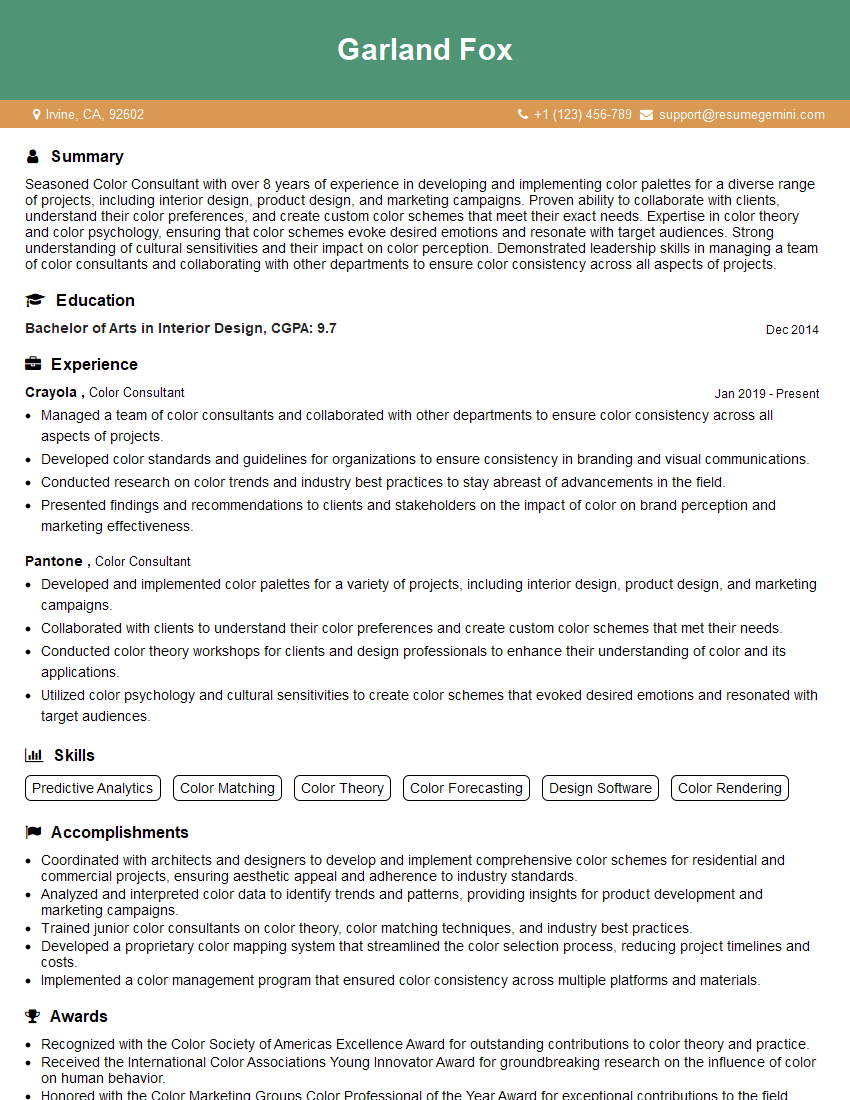
Mastering Color Space Management is crucial for career advancement in many creative and technical fields. A strong understanding of these concepts will significantly enhance your problem-solving abilities and make you a valuable asset to any team. To maximize your job prospects, focus on crafting a compelling and ATS-friendly resume that highlights your skills and experience. ResumeGemini is a trusted resource that can help you build a professional resume that showcases your expertise effectively. Examples of resumes tailored to Color Space Management are available to help you get started.

Explore more articles
Users Rating of Our Blogs
Share Your Experience
We value your feedback! Please rate our content and share your thoughts (optional).
What Readers Say About Our Blog
Really detailed insights and content, thank you for writing this detailed article.
IT gave me an insight and words to use and be able to think of examples