Cracking a skill-specific interview, like one for Computational Fluid Dynamics (CFD) modeling, requires understanding the nuances of the role. In this blog, we present the questions you’re most likely to encounter, along with insights into how to answer them effectively. Let’s ensure you’re ready to make a strong impression.
Questions Asked in Computational Fluid Dynamics (CFD) modeling Interview
Q 1. Explain the finite volume method in CFD.
The Finite Volume Method (FVM) is a powerful numerical technique used in CFD to solve partial differential equations (PDEs) that govern fluid flow. Unlike the Finite Element Method (FEM) which works with elements, or the Finite Difference Method (FDM) which uses grid points, FVM works by dividing the computational domain into a collection of discrete control volumes. Each control volume surrounds a grid point (node).
Imagine dividing a cake into many small pieces. Each piece is a control volume. We then apply the conservation principle (like conservation of mass, momentum, or energy) to each of these pieces. This means that whatever flows into a control volume, minus what flows out, must equal the change within the control volume. This principle is expressed mathematically as integral equations, which are then approximated using numerical integration techniques.
The process involves:
- Discretization: Dividing the computational domain into control volumes.
- Integration: Integrating the governing equations over each control volume.
- Approximation: Approximating the resulting integrals using numerical methods. This often involves using values at the control volume faces and calculating fluxes between them.
- Solution: Solving the system of algebraic equations to obtain the solution at each grid point.
A key advantage of FVM is its inherent conservation property. Because the method works with control volumes, the conserved quantities are naturally conserved across the entire domain. This makes it particularly well-suited for problems involving shocks or discontinuities. For example, simulating the flow around an aircraft wing, accurately predicting the lift and drag forces requires careful consideration of conservation and FVM excels in this.
Q 2. Describe the differences between laminar and turbulent flow.
Laminar and turbulent flow describe two fundamentally different flow regimes characterized by the nature of fluid motion. Imagine a river:
Laminar flow is characterized by smooth, layered, and predictable fluid motion. Think of a slow-moving, clear stream where you can easily see individual layers of water flowing smoothly over each other. In laminar flow, fluid particles move in well-defined paths, with little mixing between layers. The governing equations are relatively simple to solve in this case.
Turbulent flow, on the other hand, is chaotic and unpredictable. Picture a fast-flowing, white-water rapids. The flow is full of eddies, vortices, and random fluctuations. In turbulent flow, fluid particles mix vigorously, and the flow patterns are highly irregular and difficult to predict precisely. The governing equations become more complex, requiring advanced modeling techniques.
The key difference lies in the Reynolds number (Re), a dimensionless quantity that relates inertial forces to viscous forces. A low Reynolds number indicates laminar flow, while a high Reynolds number indicates turbulent flow. The transition from laminar to turbulent flow is often gradual and depends on various factors, including geometry, surface roughness, and the fluid properties.
Q 3. What are the different turbulence models used in CFD and their applications?
Several turbulence models are used in CFD to account for the complexity of turbulent flows. These models are necessary because directly simulating turbulent flows using Direct Numerical Simulation (DNS) is computationally prohibitive for most engineering applications. Turbulence models approximate the effects of turbulence without explicitly resolving all the small scales. The choice of model depends on the specific application and the desired accuracy.
Here are some common turbulence models:
- k-ε model: A two-equation model that solves for the turbulent kinetic energy (k) and its dissipation rate (ε). It’s widely used due to its relative simplicity and robustness, particularly for high Reynolds number flows. It’s good for applications involving boundary layers and jets.
- k-ω SST model: A hybrid model that combines the strengths of the k-ε and k-ω models. It provides improved accuracy near walls and is better suited for flows with adverse pressure gradients and separation. This makes it useful for aerodynamic simulations.
- Reynolds Stress Models (RSM): These models solve for the Reynolds stress tensor directly. They are more complex than two-equation models but can provide greater accuracy for complex flows with strong anisotropy (different turbulence intensities in different directions), like swirling flows.
- Large Eddy Simulation (LES): This approach directly simulates the larger, energy-containing eddies, while modeling the smaller, dissipative scales. LES is computationally more demanding than RANS (Reynolds-Averaged Navier-Stokes) models but provides more accurate predictions of unsteady turbulent phenomena.
- Detached Eddy Simulation (DES): A hybrid approach that combines RANS and LES techniques. It uses RANS in regions of attached flow and LES in regions of separated flow, offering a good balance between accuracy and computational cost. This is often advantageous in simulations where both attached and separated flows exist.
The choice of the turbulence model is critical and often requires experience and careful validation against experimental data.
Q 4. How do you handle boundary conditions in a CFD simulation?
Boundary conditions are essential in CFD simulations. They specify the values of the flow variables (velocity, pressure, temperature, etc.) at the boundaries of the computational domain. Correct boundary conditions are critical for obtaining accurate and physically meaningful results. Incorrect conditions can lead to completely wrong solutions.
Here are some common boundary conditions:
- Inlet: Specifies the velocity, pressure, or temperature at the inlet of the domain. For example, you could specify a uniform velocity profile for a simple inlet or a more complex profile for a turbulent inlet.
- Outlet: Specifies a pressure or a static pressure condition at the outlet. The choice depends on the specific flow situation.
- Wall: Defines the conditions at solid surfaces. Common wall boundary conditions include no-slip (velocity is zero at the wall), adiabatic (no heat transfer), or isothermal (constant temperature).
- Symmetry: Used to reduce the computational domain by exploiting symmetry in the geometry and flow. This reduces computational cost.
- Periodic: Used for flows with repeating patterns, like in simulations of a turbine blade. This condition helps to represent the infinite repetition of the pattern.
Properly defining boundary conditions often requires a deep understanding of the physics of the problem, and is an iterative process where choices are checked and refined for better results. For example, specifying the wrong inlet velocity profile for a turbulent pipe flow could lead to inaccurate predictions of pressure drop and velocity profile throughout the pipe.
Q 5. Explain the concept of mesh independence in CFD.
Mesh independence refers to the situation where the solution of a CFD simulation becomes independent of the mesh resolution. In simpler terms, it means that further refinement of the mesh (increasing the number of elements) doesn’t significantly change the results. This is a crucial aspect of CFD validation, ensuring that the obtained results are reliable and not artifacts of the numerical discretization.
Achieving mesh independence involves progressively refining the mesh and comparing the results. If the key results (e.g., lift coefficient, drag coefficient, pressure drop) remain relatively constant as the mesh is refined, then mesh independence is achieved. A common approach is to run simulations with different mesh sizes, plotting the key parameters against some mesh characteristic like element size or the number of elements. When these values converge or the change is within a specified tolerance, the mesh can be considered adequate for the desired level of accuracy.
Failure to achieve mesh independence can lead to inaccurate and unreliable results. A poorly resolved mesh may not capture important flow features, leading to significant errors in the solution. Conversely, an excessively fine mesh can lead to increased computational costs without any significant improvement in accuracy.
Q 6. What are the advantages and disadvantages of structured and unstructured meshes?
Structured and unstructured meshes are two fundamental approaches to discretizing the computational domain in CFD. The choice between them involves trade-offs.
Structured meshes are highly ordered, with elements arranged in a regular pattern. Think of a grid of squares or hexahedra. They are relatively simple to generate and are easy to manage. They’re efficient for simple geometries and offer good quality in terms of element aspect ratio (the ratio of the longest to shortest edge). This is efficient for computation.
Unstructured meshes are more flexible and can adapt to complex geometries, with elements of varying shapes and sizes. Imagine fitting together irregularly shaped jigsaw pieces. They are well-suited for complex domains with curved boundaries or intricate features. The flexibility is great for modeling irregular objects, such as cars or airplanes. However, they can be more challenging to generate and manage. They are generally less computationally efficient.
Here’s a summary of their advantages and disadvantages:
- Structured Meshes:
- Advantages: Simple to generate, efficient, good element quality.
- Disadvantages: Difficult to adapt to complex geometries.
- Unstructured Meshes:
- Advantages: Flexible, adaptable to complex geometries.
- Disadvantages: More complex to generate, less efficient, potential for poor element quality in certain regions.
The optimal choice depends on the geometry and the complexity of the flow field. Simple geometries often benefit from structured meshes, while complex geometries may necessitate the use of unstructured meshes. Hybrid meshes which combine both structured and unstructured elements are also commonly used to leverage the advantages of both.
Q 7. How do you validate your CFD results?
Validating CFD results is crucial for ensuring the accuracy and reliability of the simulations. This involves comparing the CFD predictions with experimental data or other reliable computational results. A thorough validation process is essential to build confidence in the simulation results.
Several approaches are used for validation:
- Comparison with Experimental Data: This is the most rigorous approach. Ideally, the experimental data should be obtained from carefully designed and well-controlled experiments that mimic the conditions of the CFD simulation. The comparison should cover multiple parameters and flow features. If there is good agreement between the simulation and experimental data, the simulation’s accuracy is validated.
- Comparison with Analytical Solutions: For simple flow problems, analytical solutions may exist. Comparing the CFD results with these solutions provides a way to validate the accuracy of the numerical methods used. This is especially useful for identifying and debugging numerical issues.
- Grid Convergence Studies: As discussed earlier, demonstrating mesh independence helps to ensure that the results are not significantly affected by the mesh resolution. This is an important aspect of validation.
- Comparison with Other CFD Simulations: Comparing results with simulations performed using different codes or turbulence models can help identify potential errors or biases. This cross-checking provides a wider perspective on the accuracy and reliability.
During validation, it’s important to quantify the discrepancies between the CFD predictions and the validation data. This helps to establish the uncertainty in the CFD results and to identify potential sources of error. A well-documented validation process is key, clearly indicating the methods used, assumptions made and uncertainties identified.
For example, in aerodynamic simulations, validating lift and drag coefficients against wind tunnel experimental data is a standard practice. Discrepancies could arise due to inaccurate turbulence modeling, boundary condition errors or geometric inaccuracies. Identifying these sources of discrepancies helps to improve the simulation setup and achieve more accurate predictions.
Q 8. Describe different types of solvers used in CFD.
CFD solvers are the heart of any simulation, responsible for solving the governing equations of fluid motion. They broadly fall into two categories: implicit and explicit solvers.
- Implicit Solvers: These solvers solve for all unknowns simultaneously, typically using iterative methods like the Gauss-Seidel or conjugate gradient methods. They are generally more stable and can handle larger time steps, making them suitable for steady-state simulations and complex geometries. However, each iteration is computationally more expensive.
- Explicit Solvers: These solvers solve for unknowns sequentially, calculating the solution at one time step based on the solution from the previous time step. They are easier to implement and parallelize, but require smaller time steps for stability, making them more suitable for transient simulations with potentially less computational cost per iteration.
Beyond this fundamental classification, there are various specialized solvers like pressure-based solvers (often used with SIMPLE, PISO algorithms) that focus on solving pressure first, and density-based solvers (frequently used in compressible flows) which focus on solving the density equation. The choice of solver heavily depends on the specific problem, computational resources, and desired accuracy.
For example, simulating the flow around an airplane wing at a steady cruise condition might benefit from an implicit pressure-based solver, while simulating a shock wave propagating through a gas would likely require an explicit density-based solver.
Q 9. Explain the concept of convergence in CFD simulations.
Convergence in CFD refers to the state where the solution no longer changes significantly with further iterations. Think of it like finding the bottom of a valley: you keep taking steps downhill until you reach a point where you’re essentially flat.
In CFD, we iteratively solve the governing equations, and convergence is achieved when the residuals (the difference between the left and right-hand sides of the equations) fall below a specified tolerance. This indicates that the solution has stabilized and is approaching a steady-state or a consistent solution for transient cases.
Several factors affect convergence, including the mesh quality (a poorly refined mesh can hinder convergence), the solver settings (incorrect relaxation factors can lead to divergence), and the boundary conditions (incorrect or inconsistent boundary conditions can prevent convergence).
Monitoring convergence is crucial. Residual plots are standard tools; a successful convergence typically shows a steady decrease in residuals over iterations, eventually plateauing below the defined tolerance. If residuals oscillate wildly or fail to decrease, it indicates problems requiring investigation—mesh refinement, changes in solver parameters, or a re-examination of the problem setup.
Q 10. How do you handle multiphase flows in CFD?
Multiphase flows involve the interaction of two or more immiscible fluids. Modeling these requires specific techniques beyond single-phase simulations. Common approaches include:
- Volume of Fluid (VOF): This method tracks the fraction of each phase within each computational cell. It’s a good choice for free surface flows like water sloshing in a tank or bubble dynamics. The interface between phases is captured implicitly.
- Level Set Method: This technique uses a level set function to implicitly represent the interface between phases. It’s well-suited for problems involving complex topological changes, such as bubble breakup and coalescence, but can be computationally more expensive than VOF.
- Eulerian-Eulerian Approach: This approach treats each phase as an interpenetrating continuum, often used for dispersed flows like bubbly flows or fluidized beds. It requires modeling interphase momentum, mass, and energy transfer.
- Eulerian-Lagrangian Approach: This combines Eulerian treatment for the continuous phase and Lagrangian tracking for dispersed phases. This is effective for modeling particle-laden flows, spray combustion, etc.
The choice of method depends strongly on the specific multiphase flow characteristics. For instance, simulating the flow of oil and water in a pipeline might be best addressed with VOF, while modeling the combustion of fuel droplets in an engine might be more efficiently handled using the Eulerian-Lagrangian approach.
Q 11. What are the different types of numerical schemes used in CFD?
Numerical schemes are the mathematical algorithms used to discretize the governing equations in CFD, transforming them into a system of algebraic equations that can be solved by the computer. The choice of scheme significantly influences accuracy, stability, and computational cost.
- Spatial Discretization Schemes: These discretize the spatial derivatives in the governing equations.
- Finite Difference Method (FDM): Approximates derivatives using differences between values at neighboring grid points. Simple but limited to structured meshes.
- Finite Volume Method (FVM): Integrates the governing equations over control volumes, conserving quantities like mass and momentum. Very popular due to its flexibility and conservation properties.
- Finite Element Method (FEM): Divides the domain into elements and approximates the solution within each element using basis functions. Well-suited for complex geometries but often more computationally expensive.
- Temporal Discretization Schemes: These discretize the time derivatives.
- Explicit Schemes: Calculate the solution at the next time step explicitly based on the current time step values (e.g., forward Euler). Simple but require small time steps for stability.
- Implicit Schemes: Solve for the solution at the next time step implicitly, requiring the solution of a system of equations (e.g., backward Euler). More stable but more computationally expensive per time step.
Consider simulating a shock wave. A higher-order spatial scheme might be crucial for capturing the sharp gradients accurately, while an implicit time-marching scheme would be necessary for stability due to the steep changes in flow variables.
Q 12. Explain the concept of Reynolds number and its significance.
The Reynolds number (Re) is a dimensionless quantity that characterizes the ratio of inertial forces to viscous forces in a fluid flow. It’s defined as:
Re = (ρVL)/μ
where:
- ρ is the fluid density
- V is a characteristic velocity
- L is a characteristic length
- μ is the dynamic viscosity
The Reynolds number dictates whether a flow is laminar (smooth, predictable) or turbulent (chaotic, unpredictable).
- Low Re (Re < ~2300): Typically laminar flow; viscous forces dominate.
- High Re (Re > ~4000): Typically turbulent flow; inertial forces dominate.
- Transitional Re (~2300 < Re < ~4000): Flow is in a transition region between laminar and turbulent.
Understanding the Reynolds number is essential for choosing appropriate turbulence models and determining the overall flow behavior. For example, designing a pipe system for efficient fluid transport requires knowing whether the flow will be laminar or turbulent, heavily influenced by the Reynolds number and consequently, the appropriate friction factors and pressure drops.
Q 13. How do you choose an appropriate turbulence model for a specific application?
Choosing a turbulence model depends heavily on the specific application, considering factors like the Reynolds number, flow complexity, and computational resources. There’s no one-size-fits-all answer.
- RANS (Reynolds-Averaged Navier-Stokes) Models: These models solve time-averaged equations, modeling the turbulent fluctuations. Popular choices include:
- k-ε model: Relatively simple and computationally inexpensive, suitable for many engineering applications.
- k-ω SST model: Improves near-wall accuracy compared to the k-ε model, better for flows with adverse pressure gradients.
- Reynolds Stress Models (RSM): More complex and computationally expensive, providing better accuracy for complex flows, but require significantly more computational resources.
- LES (Large Eddy Simulation): Resolves the large-scale turbulent structures directly, modeling only the smaller scales. More accurate than RANS but significantly more computationally demanding.
- DNS (Direct Numerical Simulation): Resolves all turbulent scales, providing the most accurate results, but computationally very expensive and generally limited to low Reynolds number flows.
For example, simulating flow over an airfoil at high Reynolds numbers might use a k-ω SST model for a good balance of accuracy and computational cost. For a more complex flow with separation and recirculation, an RSM might be preferred for better accuracy. If resolving all turbulent scales is crucial (perhaps for fundamental research), and computational resources are abundant, then DNS would be a viable option. However, for most engineering applications, RANS models provide a reasonable compromise between accuracy and computational cost.
Q 14. Describe the process of setting up a CFD simulation from start to finish.
Setting up a CFD simulation is a systematic process:
- Problem Definition: Clearly define the problem, including the geometry, fluid properties, boundary conditions (inlet velocity, pressure, temperature, etc.), and desired outputs (forces, pressure drops, velocities, etc.).
- Geometry Creation and Meshing: Create a geometric representation of the problem domain using CAD software. Then generate a mesh—a grid of computational cells—dividing the domain. Mesh quality is crucial for accuracy and convergence. Refine the mesh in regions of high gradients.
- Solver Selection: Choose an appropriate solver based on the flow characteristics (e.g., compressible or incompressible, steady or unsteady, laminar or turbulent).
- Boundary and Initial Conditions: Define appropriate boundary conditions at all boundaries of the computational domain, reflecting the physical conditions of the problem. Set suitable initial conditions if simulating transient flows.
- Turbulence Modeling (if applicable): If simulating turbulent flows, select a suitable turbulence model based on the Reynolds number, flow complexity, and computational resources.
- Numerical Scheme Selection: Select appropriate spatial and temporal discretization schemes to balance accuracy and stability.
- Solution Setup and Monitoring: Start the simulation, carefully monitoring convergence. Check residuals and other solution parameters to ensure the solution is accurate and reliable.
- Post-processing and Visualization: Once the solution has converged, analyze the results using post-processing tools. Visualize the results using contour plots, vector plots, streamlines, and other visualization techniques to gain insights into the flow field.
- Validation and Verification: Compare the results with experimental data (if available) or other simulations to validate the accuracy of the simulation. Ensure the simulation is numerically consistent through mesh refinement studies (verification).
Imagine simulating blood flow in an artery: You’d start by creating a realistic 3D model of the artery, mesh it finely to capture the complex geometry, select a suitable solver for incompressible flow, define realistic boundary conditions at the inlet and outlet, and use an appropriate turbulence model to account for the pulsatile nature of blood flow. Finally, you would analyze the results to understand blood flow patterns and pressure distributions.
Q 15. Explain the importance of mesh quality in CFD simulations.
Mesh quality is paramount in CFD simulations because it directly impacts the accuracy, convergence, and efficiency of the solution. Think of it like building a house: a poorly constructed foundation (mesh) will lead to a shaky and unreliable structure (simulation results). A high-quality mesh ensures that the numerical approximation of the governing equations is accurate. This means elements should be appropriately sized to capture important flow features (e.g., finer mesh near boundaries or regions of high gradients). Skewness, aspect ratio, and orthogonality of the mesh elements also play a crucial role.
- Skewness: Measures how much an element deviates from an ideal shape (e.g., a triangle deviating from equilateral). High skewness can lead to inaccurate results and slow convergence.
- Aspect Ratio: The ratio of the longest side to the shortest side of an element. A highly stretched element (large aspect ratio) can cause inaccuracies.
- Orthogonality: Ideally, element edges should be perpendicular to each other. Non-orthogonal elements can result in inaccurate gradients and slower convergence.
In practice, I carefully assess mesh quality metrics and refine the mesh iteratively until the desired level of accuracy is achieved. I often use mesh independence studies to ensure that the results are not significantly affected by the mesh resolution.
Career Expert Tips:
- Ace those interviews! Prepare effectively by reviewing the Top 50 Most Common Interview Questions on ResumeGemini.
- Navigate your job search with confidence! Explore a wide range of Career Tips on ResumeGemini. Learn about common challenges and recommendations to overcome them.
- Craft the perfect resume! Master the Art of Resume Writing with ResumeGemini’s guide. Showcase your unique qualifications and achievements effectively.
- Don’t miss out on holiday savings! Build your dream resume with ResumeGemini’s ATS optimized templates.
Q 16. How do you deal with numerical instability in CFD simulations?
Numerical instability in CFD simulations manifests as oscillations, divergence, or non-physical solutions. It’s like trying to balance a ball on a knife’s edge – it’s inherently unstable. Several strategies can mitigate instability:
- Reduce Time Step Size (Explicit Solvers): For explicit methods, a smaller time step ensures that the solution remains stable by limiting the influence of each time increment. It’s a fundamental aspect of the Courant-Friedrichs-Lewy (CFL) condition, which essentially sets an upper limit on the time step for stability.
- Employ Implicit Solvers: Implicit solvers are generally more stable than explicit methods, particularly for steady-state problems, because they solve for all unknowns simultaneously, implicitly coupling them through the equations. This helps dampen oscillations and promote stability.
- Artificial Viscosity/Dissipation: Adding artificial viscosity can smooth out sharp gradients that might trigger instability. It’s like adding a bit of friction to damp oscillations, but it can reduce accuracy if overdone. This needs careful calibration.
- Adaptive Mesh Refinement (AMR): AMR dynamically refines the mesh in regions where large gradients or instability occurs. This focuses computational resources where they’re needed most, improving accuracy and stability while controlling computational cost.
- Upwind Schemes: These numerical schemes are specifically designed to handle convection terms and reduce numerical diffusion and oscillations.
- Relaxation Techniques: Under-relaxation factors help smooth transitions between iterations, leading to more stable convergence.
The choice of the best strategy depends on the specific problem and solver. Often, a combination of these techniques is employed.
Q 17. What are the limitations of CFD simulations?
CFD simulations, while powerful, have inherent limitations:
- Turbulence Modeling: Accurately simulating turbulence requires computationally expensive methods, and simplified turbulence models often introduce inaccuracies. It’s like trying to predict the exact behavior of a swirling cloud of dust – complex and highly unpredictable.
- Mesh Dependence: Results can be sensitive to mesh quality. Obtaining mesh-independent results often requires significant computational resources and careful mesh refinement studies.
- Model Simplifications: CFD often relies on simplified models of physical phenomena (e.g., viscosity, heat transfer). These simplifications can introduce errors if the model doesn’t accurately reflect reality.
- Computational Cost: High-fidelity CFD simulations for complex geometries and flow conditions can be very computationally intensive, requiring significant computing power and time.
- Boundary Conditions: The accuracy of the simulation heavily depends on the appropriateness and accuracy of the boundary conditions. Incorrect boundary conditions lead to erroneous results.
It is crucial to be aware of these limitations and interpret results critically, understanding their potential sources of error.
Q 18. How do you interpret and present your CFD results?
Interpreting and presenting CFD results is a critical step. It’s not enough to just get numbers; you need to translate them into meaningful insights. I typically follow these steps:
- Visualizations: I use contour plots, streamlines, velocity vectors, and other visualizations to understand the flow patterns, pressure distributions, temperature fields, and other relevant quantities. These visuals make complex data much easier to understand.
- Quantitative Analysis: I extract quantitative data such as drag coefficients, lift coefficients, pressure drops, heat transfer rates, and other key performance indicators (KPIs) relevant to the problem. I perform statistical analysis where necessary.
- Mesh Independence Study: I demonstrate that the results are not significantly influenced by the mesh resolution. This ensures the reliability of the findings.
- Validation and Verification: Whenever possible, I compare my results with experimental data or other reliable sources to validate the simulation’s accuracy and reliability. Verification involves checking for numerical accuracy and solution convergence.
- Clear and Concise Reporting: I prepare detailed reports that present the methodology, results, and conclusions clearly and concisely. The reports include relevant figures, tables, and discussions of the uncertainties involved.
The goal is to communicate the key findings effectively to both technical and non-technical audiences.
Q 19. What software packages are you familiar with for CFD analysis?
I’m proficient in several CFD software packages, including ANSYS Fluent, OpenFOAM, and COMSOL Multiphysics. My experience encompasses a wide range of applications, from simple simulations to complex, multiphysics problems. I am also familiar with pre- and post-processing tools such as Pointwise and Tecplot.
My choice of software depends on the specific requirements of the project. For example, OpenFOAM offers a highly flexible and customizable open-source environment, ideal for complex or specialized applications. ANSYS Fluent is a powerful commercial solver with a vast range of built-in features and functionalities. COMSOL excels in multiphysics simulations, where coupled phenomena are involved. This versatility allows me to select the optimal tool for the task at hand.
Q 20. Describe your experience with mesh generation techniques.
Mesh generation is crucial for successful CFD simulations. A poor-quality mesh can lead to inaccurate results or even simulation failure. My experience encompasses various meshing techniques, including:
- Structured Meshing: I utilize structured meshing for simple geometries where a regular grid can be readily defined. It is computationally efficient but less adaptable to complex shapes.
- Unstructured Meshing: This is my go-to method for complex geometries because it can adapt to intricate shapes. I am experienced with generating tetrahedral, hexahedral, and hybrid meshes using both automated and manual meshing approaches.
- Hybrid Meshing: This technique often combines the strengths of structured and unstructured meshes. This approach is frequently necessary in cases where regions of high gradient require fine unstructured grids, while simpler areas can be handled with computationally efficient structured grids.
- Boundary Layer Meshing: I meticulously generate boundary layers near walls to resolve the viscous sublayer accurately, capturing the crucial boundary layer gradients which are essential for accurate predictions of quantities such as drag and heat transfer.
I regularly employ mesh refinement strategies, such as adaptive mesh refinement (AMR), to ensure accuracy and efficiency. My approach always involves a careful balance between mesh resolution and computational cost.
Q 21. Explain your understanding of different solution methods (e.g., implicit, explicit).
CFD solvers use different solution methods to solve the governing equations. The choice between implicit and explicit methods significantly impacts stability, computational cost, and accuracy.
- Explicit Methods: In explicit methods, the solution at the next time step is calculated directly from the solution at the current time step. Think of it as taking small, independent steps. They are relatively simple to implement but can be computationally expensive for steady-state problems and require small time steps to maintain stability (following the CFL condition). Common examples include explicit Euler and Runge-Kutta methods.
- Implicit Methods: Implicit methods solve for all unknowns simultaneously, coupling them through the equations. This requires solving a system of equations at each time step, which is computationally more expensive per step than explicit methods, but often allows for larger time steps and improved stability, especially for steady-state problems. Examples include implicit Euler and backward differentiation formulas (BDF).
The selection between explicit and implicit methods depends on the specific problem. For transient problems with complex flow features requiring high accuracy, explicit methods with smaller time steps might be necessary. For steady-state problems or situations where stability is a major concern, implicit methods are often preferred despite their higher computational cost per time step.
Q 22. How do you handle complex geometries in CFD simulations?
Handling complex geometries in CFD is crucial for accurate simulations. Real-world objects rarely have simple shapes. We employ several techniques, depending on the complexity and the chosen solver. For relatively simple geometries with minor complexities, we can use structured meshes with mesh refinement in critical areas. Imagine trying to model airflow around a car – a structured mesh might be fine for the overall body, but we’d need to refine the mesh around the wheels and mirrors for accurate results.
However, for truly complex geometries like internal combustion engines or aircraft components, unstructured meshes are essential. These meshes adapt to the shape, creating elements of varying size and shape. This flexibility allows for accurate resolution in intricate regions without the need for excessive computational resources. Popular meshing tools like ANSYS Meshing or Pointwise are utilized for this purpose. For particularly challenging geometries, hybrid meshes combining structured and unstructured elements are often the most effective approach.
Another key aspect is mesh independence studies. We systematically refine the mesh to ensure our results are not overly influenced by the mesh resolution. This involves running the simulation with progressively finer meshes and checking if the key results converge. Once convergence is achieved, we have confidence that the mesh is sufficiently fine to capture the relevant flow features accurately.
Q 23. Describe your experience with post-processing and visualization techniques.
Post-processing and visualization are as critical as the simulation itself. They allow us to interpret the vast amount of data generated. My experience involves using various commercial and open-source software packages. For example, I’m proficient with ANSYS CFD-Post and ParaView. These tools allow for detailed analysis of velocity fields, pressure distributions, temperature contours, and other relevant parameters.
Visualizations like streamlines, contour plots, and vector plots help understand the flow patterns. For instance, visualizing streamlines can help identify flow separation or recirculation zones, crucial in aerodynamic designs. Similarly, contour plots of pressure help identify high-pressure regions, which is essential in optimizing designs for reduced drag or improved lift. I also frequently use animation techniques to capture the temporal evolution of flow phenomena, which provides deeper insight into transient processes. Beyond simple visualizations, I perform quantitative analysis using tools within these post-processing packages to extract specific data like forces, moments, and heat transfer rates, essential for design validation and optimization.
Q 24. What are some common sources of error in CFD simulations?
Errors in CFD simulations can stem from many sources. One significant source is numerical errors. These arise from the approximations inherent in the numerical schemes used to solve the governing equations. For example, truncation errors occur because we can only approximate derivatives using a finite number of grid points. Discretization errors relate to the size and shape of the mesh elements used in the simulation. A poorly designed mesh, with elements that are too large or poorly shaped, introduces significant errors.
Another source of error lies in the modeling assumptions. We often simplify the physical reality. For instance, using a turbulence model is an approximation of the complex turbulent flow; the choice of the model significantly affects the accuracy. Similarly, we may simplify the fluid properties (e.g., assuming constant viscosity or density) which might not always reflect reality. Finally, boundary conditions play a vital role. Incorrect specification of inlet velocities, outlet pressures, or wall conditions can lead to completely inaccurate results. A thorough understanding of the limitations of the models and the careful consideration of the boundary conditions are crucial for mitigating these errors.
Q 25. How do you ensure the accuracy of your CFD results?
Ensuring accuracy is a multi-faceted process. First, we perform mesh independence studies, as discussed earlier. Second, we validate our model against experimental data or analytical solutions where available. Comparing the simulated results with known results gives us a measure of the model’s accuracy. If experimental data is unavailable, we can perform benchmark tests against well-established simulations or theoretical solutions. This allows us to evaluate the accuracy of our chosen numerical methods and models.
Third, a rigorous uncertainty analysis is essential. We estimate the uncertainty associated with input parameters, boundary conditions, and the numerical schemes used. This helps us quantify the reliability of the results and understand the range of possible outcomes. Fourth, I carefully document all aspects of the simulation, including the mesh, governing equations, boundary conditions, solution methods, and post-processing techniques, so others can easily review the work and identify potential sources of error.
Q 26. Explain your experience with CFD for heat transfer applications.
I have extensive experience with CFD for heat transfer applications. This involves solving the energy equation in conjunction with the Navier-Stokes equations. I’ve worked on a variety of problems, including heat sink design, electronic cooling, and thermal management in buildings. For example, in designing a heat sink for a CPU, I used CFD to model the airflow and heat transfer around the heat sink fins to optimize its design for maximum efficiency.
In such cases, I use appropriate turbulence models that consider the influence of turbulence on heat transfer, such as the k-ε model or k-ω SST model. The choice of the model depends on the flow regime and the level of accuracy required. I also consider radiation effects when appropriate, especially in high-temperature applications. Implementing appropriate radiation models, like the Discrete Ordinates Method (DOM), ensures a more accurate prediction of heat transfer within the system. Furthermore, selecting appropriate boundary conditions for heat flux or temperature is essential for accurate simulation results.
Q 27. Describe your experience with coupled simulations (e.g., fluid-structure interaction).
My experience with coupled simulations, particularly fluid-structure interaction (FSI), involves using specialized software capable of handling the coupling between the fluid and solid domains. FSI simulations are computationally demanding but essential when fluid flow significantly affects the structure’s deformation, or vice-versa. For example, simulating the flutter of aircraft wings requires coupled simulations, where the aerodynamic forces from the airflow induce structural deformation, influencing the airflow in turn.
Typically, I use techniques like partitioned or monolithic coupling approaches. In a partitioned approach, separate solvers for the fluid and structural domains exchange information iteratively. In a monolithic approach, both systems are solved simultaneously using a single solver. The choice of method depends on the complexity of the problem and the available software. I’ve used commercial software packages like ANSYS Fluent and LS-DYNA, which are well-suited for such coupled simulations. For accurate FSI results, the mesh needs to be carefully refined near the fluid-structure interface to accurately capture the interaction between the two domains. Furthermore, an appropriate time stepping scheme is chosen to capture the transient nature of the fluid-structure interaction.
Q 28. What are your strengths and weaknesses in performing CFD analyses?
My strengths include a strong foundation in fluid mechanics, thermodynamics, and numerical methods, as well as significant experience with various commercial CFD software packages. I’m adept at mesh generation, simulation setup, and post-processing, and I excel at problem-solving and troubleshooting complex simulations. I thrive in collaborative environments and readily share my knowledge with colleagues.
My weakness, perhaps, is staying fully up-to-date with all the latest advancements in specific niche areas of CFD. The field is constantly evolving, with new techniques and software emerging frequently. To mitigate this, I dedicate time to continuous professional development through attending conferences, reading research papers, and actively engaging in online forums and communities dedicated to CFD.
Key Topics to Learn for Computational Fluid Dynamics (CFD) Modeling Interview
- Governing Equations: Understanding the Navier-Stokes equations, continuity equation, and energy equation. Explore their derivation and limitations.
- Numerical Methods: Familiarity with Finite Volume Method (FVM), Finite Element Method (FEM), and Finite Difference Method (FDM). Understand their strengths and weaknesses for different applications.
- Turbulence Modeling: Grasping concepts like Reynolds-Averaged Navier-Stokes (RANS) equations and different turbulence models (k-ε, k-ω SST). Know when to apply each model.
- Mesh Generation and Refinement: Understanding the importance of mesh quality on solution accuracy. Experience with meshing software and techniques for adaptive mesh refinement is valuable.
- Boundary Conditions: Properly defining inlet, outlet, wall, and symmetry boundary conditions. Understanding their impact on the simulation results.
- Validation and Verification: Knowing the difference between validation (comparing with experimental data) and verification (assessing numerical accuracy). Understanding grid independence studies.
- Software Proficiency: Demonstrate experience with popular CFD software packages like ANSYS Fluent, OpenFOAM, or COMSOL Multiphysics. Highlight your skills in pre-processing, solving, and post-processing.
- Practical Applications: Be prepared to discuss your experience with CFD applications in areas such as aerodynamics, heat transfer, multiphase flow, or combustion, relating theoretical concepts to real-world problems.
- Problem-Solving and Troubleshooting: Showcase your ability to diagnose and resolve common CFD simulation issues, such as convergence problems or inaccurate results. Discuss your approach to debugging and iterative refinement.
Next Steps
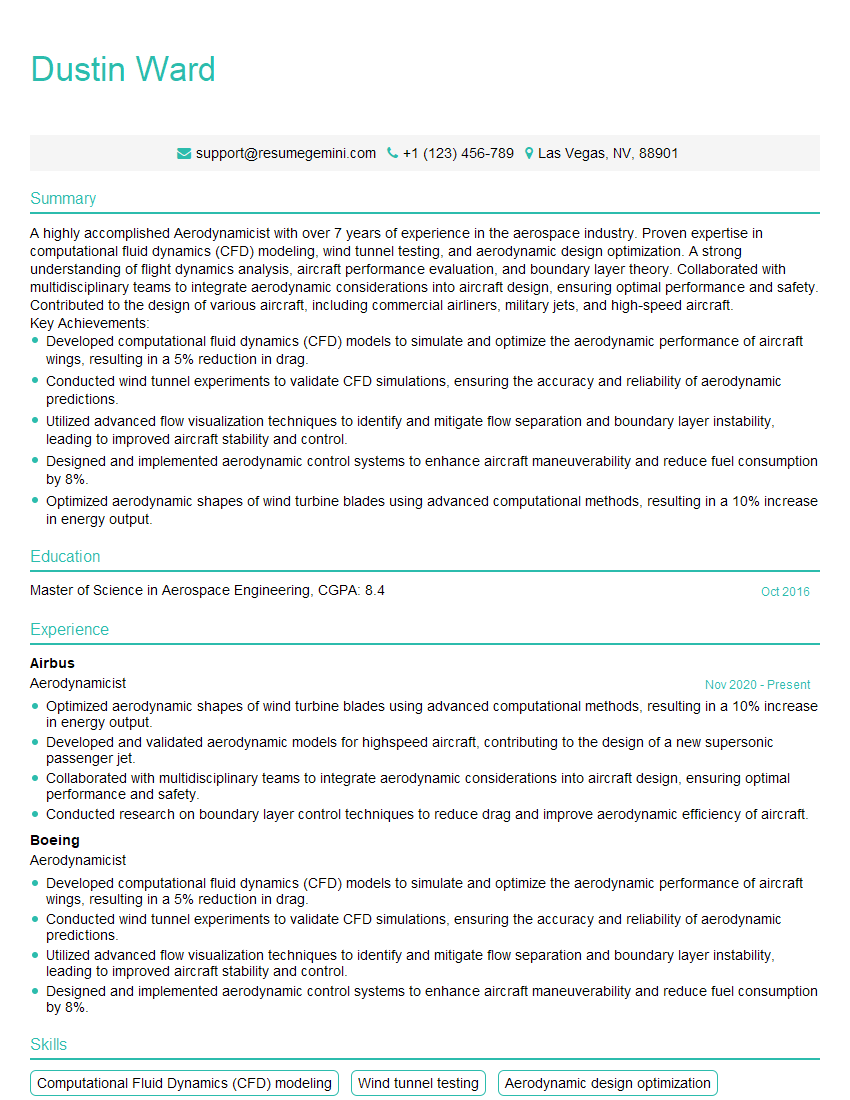
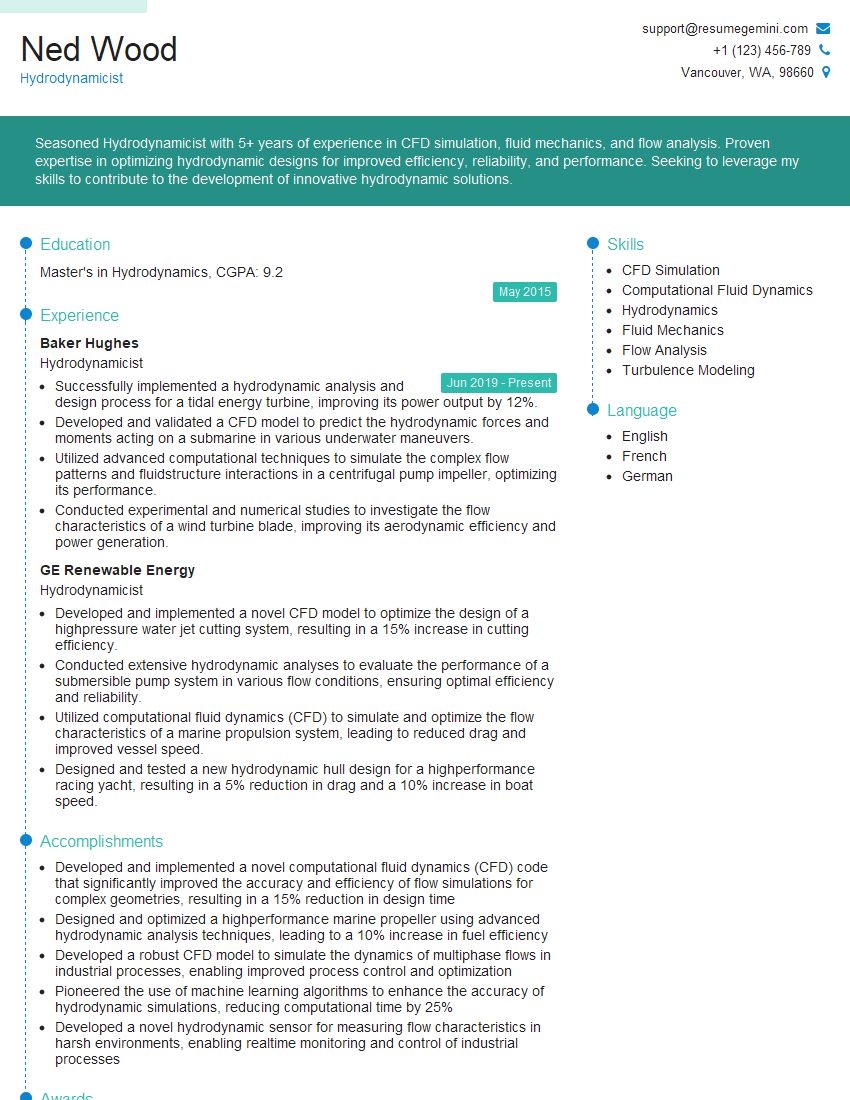
Mastering Computational Fluid Dynamics (CFD) modeling opens doors to exciting career opportunities in various industries. A strong understanding of CFD principles and practical experience is highly sought after. To maximize your job prospects, creating a compelling and ATS-friendly resume is crucial. ResumeGemini is a trusted resource that can help you build a professional and effective resume tailored to the CFD industry. Examples of resumes specifically designed for Computational Fluid Dynamics (CFD) modeling professionals are available to guide you. Invest time in crafting a standout resume—it’s your first impression and a key to unlocking your career potential.
Explore more articles
Users Rating of Our Blogs
Share Your Experience
We value your feedback! Please rate our content and share your thoughts (optional).
What Readers Say About Our Blog
Really detailed insights and content, thank you for writing this detailed article.
IT gave me an insight and words to use and be able to think of examples