The thought of an interview can be nerve-wracking, but the right preparation can make all the difference. Explore this comprehensive guide to Computerized Control Systems interview questions and gain the confidence you need to showcase your abilities and secure the role.
Questions Asked in Computerized Control Systems Interview
Q 1. Explain the difference between open-loop and closed-loop control systems.
The core difference between open-loop and closed-loop control systems lies in their feedback mechanisms. An open-loop system operates based solely on pre-programmed instructions without considering the actual output. Think of a toaster: you set the time, and it runs for that duration regardless of whether the bread is toasted perfectly. The system has no way of knowing if the desired result was achieved.
In contrast, a closed-loop system, also known as a feedback control system, continuously monitors the output and adjusts its input to maintain a desired setpoint. Imagine a thermostat controlling room temperature. It measures the current temperature, compares it to the setpoint, and adjusts the heating/cooling accordingly. This feedback loop ensures the system reaches and maintains the target temperature accurately.
- Open-loop Example: A simple motor running at a fixed speed without any speed feedback.
- Closed-loop Example: A robotic arm precisely positioning an object, using sensors to monitor position and adjust accordingly.
Open-loop systems are simpler and cheaper but less accurate and robust to disturbances. Closed-loop systems are more complex but offer superior precision and stability.
Q 2. Describe the role of a PID controller and its tuning parameters.
A Proportional-Integral-Derivative (PID) controller is the workhorse of many control systems. It uses three terms to manipulate the control variable to minimize the error between the desired setpoint and the actual process variable.
- Proportional (P): This term provides a control action proportional to the error. A larger error leads to a larger control action. Think of it as a quick response to the difference between the desired and actual values.
- Integral (I): This term addresses persistent errors. It accumulates the error over time, ensuring that even slow-changing errors are eventually corrected. This is like making sure you reach the destination eventually, even if there are slight deviations along the way.
- Derivative (D): This term anticipates future error by considering the rate of change of the error. It prevents overshoot and oscillations by slowing down the control action when the system is approaching the setpoint. This is like applying the brakes as you approach your destination to avoid overshooting.
The tuning parameters, Kp (proportional gain), Ki (integral gain), and Kd (derivative gain), determine the controller’s response. Finding the optimal values is crucial for system performance. Too high gains can lead to oscillations or instability, while too low gains result in slow response and persistent errors. Various tuning methods exist, including Ziegler-Nichols and trial-and-error, often assisted by software tools.
For example, in a temperature control system, a high Kp might cause the heater to cycle on and off rapidly, while a high Ki might lead to overshooting the setpoint. Carefully tuning these parameters is crucial for achieving stable and efficient control.
Q 3. What are the advantages and disadvantages of using a PLC versus a microcontroller?
Both PLCs (Programmable Logic Controllers) and microcontrollers are used in control systems, but they differ significantly in their capabilities and applications. A PLC is designed for industrial automation, emphasizing ruggedness, reliability, and extensive I/O capabilities. They excel in harsh environments and handling numerous sensors and actuators. They typically have a simpler programming environment focusing on logic and control.
A microcontroller is a smaller, more general-purpose device suitable for embedded applications. It often requires more in-depth programming knowledge and offers greater flexibility in terms of hardware and software customization. Their I/O capabilities are generally less extensive than PLCs.
- PLC Advantages: Robustness, extensive I/O, easy programming for industrial applications, proven reliability.
- PLC Disadvantages: Higher cost, less flexible than microcontrollers, less power efficient.
- Microcontroller Advantages: Lower cost, more versatile, lower power consumption, more processing power.
- Microcontroller Disadvantages: Requires more programming expertise, less robust in harsh environments, less extensive I/O.
In essence, choosing between a PLC and a microcontroller depends on the application. A large-scale industrial process would likely benefit from a PLC, while a small, embedded system might better utilize a microcontroller.
Q 4. Explain the function of a SCADA system and its key components.
A Supervisory Control and Data Acquisition (SCADA) system is a software and hardware system used to monitor and control industrial processes, such as power grids, pipelines, or manufacturing plants. It gathers data from various sources, displays it for human operators, and allows for remote control of equipment.
Key components include:
- Human-Machine Interface (HMI): This is the operator’s interface, displaying real-time data and allowing control actions.
- Supervisory system: This software layer manages data from various sources and provides high-level control strategies.
- RTUs (Remote Terminal Units) or PLCs: These are the physical devices that collect data from sensors and actuators in the field.
- Communication network: This connects all the components, often using various protocols such as Modbus, Profibus, or Ethernet.
- Databases: Store historical data for analysis and reporting.
Think of SCADA as the central nervous system of a large industrial operation. It monitors the health and performance of the system, providing critical information for operators and allowing them to intervene if necessary. For example, a SCADA system for a water treatment plant would monitor water levels, chemical dosages, and pump performance, allowing operators to adjust operations remotely to maintain water quality.
Q 5. How do you troubleshoot a malfunctioning control system?
Troubleshooting a malfunctioning control system is a systematic process. It requires a structured approach to identify the root cause of the problem. Here’s a framework:
- Safety First: Prioritize safety. De-energize equipment if necessary before proceeding.
- Gather Information: Collect as much information as possible. What is the symptom? When did it start? What changes were made recently? Are there any error messages?
- Check the Obvious: Begin with simple checks: power supply, wiring connections, sensor readings, and actuator status. Often the problem is straightforward.
- Systematic Testing: If the problem is not apparent, conduct systematic tests. Isolate sections of the system and test individual components. This might involve using diagnostic tools or temporarily bypassing parts of the system.
- Use Diagnostic Tools: Utilize diagnostic software, multimeters, oscilloscopes, and other tools to gain insights into system behavior.
- Review System Logs: Check system logs for error messages or unusual events. These logs often provide valuable clues.
- Consult Documentation: Refer to the system documentation, schematics, and programming code.
- Seek Expert Assistance: If the problem persists, consult with experienced technicians or engineers.
For instance, if a motor fails to start, you might check the power supply, motor fuses, control signals, and the motor itself. Using a multimeter to test voltage and continuity can quickly identify the faulty component.
Q 6. What are some common communication protocols used in industrial control systems?
Industrial control systems utilize a variety of communication protocols to exchange data between devices. The choice of protocol depends on factors such as speed, reliability, distance, and cost.
- Modbus: A widely used serial communication protocol known for its simplicity and robustness. Common in PLCs and RTUs.
- Profibus: A fieldbus protocol developed by Siemens, often used in complex industrial automation systems. Offers high speed and deterministic communication.
- Ethernet/IP: An industrial Ethernet-based protocol offering high bandwidth and sophisticated features. Widely adopted in modern control systems.
- Profinet: Another industrial Ethernet protocol from Siemens providing high performance and real-time capabilities.
- CAN bus (Controller Area Network): A robust and reliable protocol used in automotive and other industries, offering deterministic real-time communication.
- HART (Highway Addressable Remote Transducer): A protocol for communicating with smart field devices like sensors and actuators.
The selection of the most suitable protocol is critical for a system’s performance and interoperability. For instance, a system requiring fast data transfer might use Ethernet/IP, while a simpler system might utilize Modbus.
Q 7. Describe your experience with different types of sensors and actuators.
My experience encompasses a broad range of sensors and actuators used in various control systems. I’ve worked with:
- Sensors: Temperature sensors (thermocouples, RTDs, thermistors), pressure sensors (strain gauge, piezoresistive), flow sensors (rotameters, ultrasonic), level sensors (capacitive, ultrasonic, float switches), proximity sensors (inductive, capacitive), photoelectric sensors, and position sensors (encoders, potentiometers).
- Actuators: Electric motors (AC, DC, servo), pneumatic actuators (cylinders, valves), hydraulic actuators (cylinders, valves), solenoid valves, and stepper motors.
In a previous project involving a robotic arm, I used encoders for precise position feedback and servo motors for accurate and controlled movement. In another project focusing on temperature control in a chemical reactor, I integrated RTDs as temperature sensors and a proportional valve for precise control of heating fluid flow.
Understanding the characteristics and limitations of each sensor and actuator is vital for effective system design. For example, choosing a suitable sensor for a particular application involves considering factors like accuracy, response time, operating range, and environmental conditions.
Q 8. Explain the concept of control system stability and how to analyze it.
Control system stability refers to the system’s ability to maintain a desired equilibrium or setpoint after a disturbance. An unstable system will oscillate wildly or diverge from its setpoint, potentially causing damage or malfunction. Analyzing stability involves determining if the system’s response to disturbances remains bounded. We use several methods for this analysis:
- Root Locus Analysis: This graphical method plots the roots of the characteristic equation of the system as a gain parameter changes. If any roots lie in the right-half of the s-plane (for continuous-time systems) or outside the unit circle (for discrete-time systems), the system is unstable.
- Bode Plots and Nyquist Plots: These frequency-response methods graphically represent the system’s gain and phase shift as a function of frequency. Stability can be assessed by examining the gain and phase margins. A sufficient gain margin ensures that the system remains stable even with gain variations, while a sufficient phase margin indicates robustness against phase shifts.
- Routh-Hurwitz Criterion: This algebraic method uses a table constructed from the coefficients of the characteristic equation to determine the number of roots with positive real parts. No positive real roots indicate stability.
- State-Space Analysis: This method represents the system using state variables and matrices. Eigenvalues of the system matrix determine stability; eigenvalues with positive real parts indicate instability.
For example, consider a simple temperature control system. If the heating element overshoots repeatedly, leading to large temperature swings, the system is likely unstable. Conversely, a stable system will smoothly reach and maintain the desired temperature.
Q 9. What are the safety considerations in designing and implementing control systems?
Safety is paramount in control system design and implementation. Neglecting safety can lead to catastrophic consequences. Key considerations include:
- Fail-safe mechanisms: Systems should be designed to gracefully fail to a safe state in case of component failure. This might involve automatic shutdown, switching to backup systems, or implementing interlocks.
- Redundancy: Critical components should be duplicated or triplicated to provide backup in case of failures. This improves system reliability and availability.
- Emergency stops (ESTOPs): Easily accessible and reliable emergency stops are essential for quickly halting the system in dangerous situations.
- Safety instrumented systems (SIS): These independent systems monitor critical parameters and intervene to prevent hazardous situations. They are typically designed according to stringent safety standards like IEC 61508.
- Risk assessment and mitigation: A thorough hazard and operability (HAZOP) study or similar risk assessment should be conducted to identify potential hazards and implement appropriate safety measures.
- Regular testing and maintenance: Periodic testing and maintenance are crucial to ensure that safety systems remain functional and reliable.
For example, in a robotic arm controlling a nuclear reactor, multiple layers of safety systems are crucial. A single point of failure could have disastrous consequences.
Q 10. How do you handle complex control system designs involving multiple loops?
Handling complex control systems with multiple loops requires a structured approach. One common technique is to decouple the loops as much as possible. This means designing the controllers to minimize the interaction between different control loops. Consider these strategies:
- Decentralized control: This approach uses separate controllers for each loop, simplifying the design and making it easier to tune individual controllers. However, it might not achieve optimal overall performance if the loops are strongly interacting.
- Hierarchical control: This organizes the control system into layers, with higher-level controllers managing the overall behavior and lower-level controllers handling individual loops. This approach provides a clear structure for complex systems.
- Model Predictive Control (MPC): MPC is particularly suitable for handling multiple interacting loops. It uses a model of the system to predict future behavior and optimize the control actions to achieve the desired performance while satisfying constraints.
- Proper loop tuning and interaction analysis: Careful tuning of individual controllers is essential. Analyzing the interactions between loops using tools like Relative Gain Array (RGA) helps determine the optimal pairing of controlled and manipulated variables.
For instance, a chemical process might involve controlling temperature, pressure, and flow rates in multiple interconnected reactors. Decentralized control might handle individual reactors, while a higher-level controller optimizes the overall process parameters.
Q 11. Describe your experience with different programming languages used in control systems (e.g., Ladder Logic, Structured Text).
I have extensive experience with various programming languages used in control systems. My expertise includes:
- Ladder Logic (LD): I’m proficient in designing and implementing control logic using Ladder Logic, commonly used in Programmable Logic Controllers (PLCs). I understand the use of timers, counters, and various logic gates to create robust and efficient control programs. I have experience with several PLC brands and their specific LD dialects.
- Structured Text (ST): I utilize Structured Text for more complex control algorithms and mathematical calculations, offering better readability and maintainability than LD for intricate tasks. I can implement advanced control strategies, like PID controllers and state machines, using ST.
- Function Block Diagram (FBD): I also use FBD, a graphical programming language well-suited for visualizing control logic and data flow, particularly useful for complex systems with many interconnections.
- C/C++: For high-performance control applications or embedded systems, I leverage my expertise in C and C++ to develop efficient and real-time code. This is especially valuable in situations requiring fast response times or significant computational power.
In my previous role, I used ST to implement a sophisticated adaptive control algorithm for a complex robotic system, improving its performance significantly compared to the previous PID-based approach.
Q 12. What is your experience with HMI design and development?
My HMI (Human-Machine Interface) design and development experience spans various platforms and technologies. I am adept at creating user-friendly interfaces that effectively communicate process information to operators and enable them to efficiently manage the control system. My experience includes:
- SCADA systems: I’ve worked with several SCADA platforms, developing HMIs for various industrial processes, integrating data from PLCs and other field devices.
- Industrial Panel PCs: I am experienced in designing and implementing HMIs on industrial panel PCs, ensuring that the interfaces are robust and reliable in harsh industrial environments.
- User Interface Design Principles: My designs prioritize clear, concise information presentation, intuitive navigation, and efficient interaction. I consider human factors and ergonomics to ensure optimal user experience and minimize operator errors.
- Data Visualization Techniques: I utilize appropriate data visualization techniques (charts, graphs, trend displays) to effectively present process data to operators, enabling efficient monitoring and control.
- Alarm Management: I implement effective alarm management systems to ensure that operators are alerted to critical situations in a timely manner, minimizing the risk of accidents.
In a recent project, I designed an HMI for a water treatment plant, improving operator efficiency and reducing alarm fatigue through a redesigned alarm system and improved data visualization.
Q 13. Explain your understanding of different control system architectures (e.g., centralized, decentralized).
Control system architectures describe how the different components of a system are organized and interact. The two main architectures are:
- Centralized Control: In this architecture, a single central controller manages all aspects of the system. This approach simplifies coordination but can be a single point of failure and may become overly complex for large systems.
- Decentralized Control: This architecture distributes control among multiple controllers, each responsible for a specific part of the system. This enhances reliability as a failure in one part doesn’t necessarily affect the entire system. It also allows for modularity and scalability. However, coordination between controllers becomes more challenging.
- Distributed Control Systems (DCS): DCS combines features of both centralized and decentralized architectures. Multiple controllers communicate over a network, allowing for both localized and global control strategies. This offers a balance between robustness and flexibility.
The choice of architecture depends on the specific application’s requirements. A small, simple system might benefit from a centralized approach, while a large, complex system like a power plant might require a DCS architecture for better reliability and maintainability.
Q 14. How do you perform control system simulations and modeling?
Control system simulations and modeling are crucial for design, analysis, and testing before physical implementation. This avoids costly errors and ensures optimal performance. I use various tools and techniques:
- MATLAB/Simulink: This widely used platform provides a comprehensive environment for modeling, simulating, and analyzing control systems. It allows for the creation of block diagrams, the implementation of various control algorithms, and the analysis of system response to different inputs and disturbances.
- Software Development Kits (SDKs) from PLC vendors: Many PLC manufacturers provide SDKs that allow for simulating the control logic on a PC before deploying it to the physical PLC. This helps verify the functionality and identify potential issues early on.
- Specialized simulation software: Industry-specific simulation packages are available for modeling specific processes, such as chemical reactors or power systems. These often incorporate detailed physical models of the processes.
- Model identification techniques: These are used to create mathematical models from experimental data. System identification allows for the creation of accurate models when detailed knowledge of the system’s dynamics is limited.
For instance, before deploying a new control strategy to a robotic arm in a manufacturing environment, I would simulate its performance in Simulink using a detailed model of the robot’s dynamics and the surrounding environment. This ensures the control strategy behaves as intended before putting it into production.
Q 15. Describe your experience with control system testing and validation methods.
Control system testing and validation are crucial for ensuring a system functions as designed, is safe, and meets performance requirements. My experience encompasses a range of methods, from unit testing individual components to comprehensive system-level validation. This includes:
- Unit Testing: Verifying the functionality of individual modules, like a PID controller or a sensor interface, using simulated inputs and comparing outputs to expected values. For example, I’ve used automated testing frameworks to exhaustively test a temperature controller’s response to various setpoints and disturbances.
- Integration Testing: Testing the interactions between different modules after they’ve been individually tested. This helps identify integration issues, ensuring seamless communication and data flow. In one project, we used a hardware-in-the-loop (HIL) simulation to test the integration between a PLC, a robotic arm, and a vision system.
- System Testing: Testing the entire system as a whole under realistic operating conditions. This may involve simulated scenarios or even on-site testing with real-world equipment. We often use test plans that systematically cover various operating modes and edge cases.
- Validation: Demonstrating that the system meets the specified requirements. This involves comparing the system’s performance against predetermined acceptance criteria, often involving rigorous documentation and reporting.
- Factory Acceptance Testing (FAT) and Site Acceptance Testing (SAT): I have extensive experience conducting both FAT at the vendor’s facility and SAT at the client’s site to ensure the system functions correctly in its intended environment before commissioning. This often involves collaboration with client personnel and meticulous documentation.
Throughout these processes, I employ various tools and techniques, including automated testing scripts, data logging and analysis, and fault injection to identify weaknesses and improve robustness.
Career Expert Tips:
- Ace those interviews! Prepare effectively by reviewing the Top 50 Most Common Interview Questions on ResumeGemini.
- Navigate your job search with confidence! Explore a wide range of Career Tips on ResumeGemini. Learn about common challenges and recommendations to overcome them.
- Craft the perfect resume! Master the Art of Resume Writing with ResumeGemini’s guide. Showcase your unique qualifications and achievements effectively.
- Don’t miss out on holiday savings! Build your dream resume with ResumeGemini’s ATS optimized templates.
Q 16. What is your experience with industrial communication networks (e.g., Profibus, Ethernet/IP)?
Industrial communication networks are the backbone of modern control systems, enabling seamless data exchange between various devices. My experience spans several prominent networks, including:
- Profibus: I’ve worked extensively with Profibus DP and Profibus PA, implementing and troubleshooting fieldbus networks for various industrial applications, including process control and automation in manufacturing plants. Understanding the intricacies of master/slave communication, cyclic and acyclic data exchange, and error handling is crucial.
- Ethernet/IP: I’m proficient in configuring and troubleshooting Ethernet/IP networks, leveraging their advantages of high bandwidth and flexibility in industrial automation settings. I’ve used this technology in projects involving large-scale SCADA systems and robotic control systems.
My expertise extends to network design, device configuration, troubleshooting network issues (e.g., communication errors, addressing conflicts), and selecting the appropriate network topology and components based on the specific needs of the application. For instance, I once resolved a production bottleneck caused by a faulty network switch on an Ethernet/IP network by isolating the issue, replacing the component, and implementing network monitoring tools to prevent future occurrences.
Q 17. Explain your understanding of cybersecurity risks in industrial control systems.
Cybersecurity in industrial control systems (ICS) is paramount due to the potential consequences of successful attacks. These systems are often less secure than IT networks, making them vulnerable to various threats. My understanding of these risks encompasses:
- Malware and Viruses: Malicious software can compromise PLC programs, disrupt operations, and even cause physical damage to equipment. Implementing robust antivirus and intrusion detection systems is vital.
- Unauthorized Access: Gaining unauthorized access to ICS networks can allow attackers to manipulate processes, steal data, or cause system failures. Strong authentication and access control mechanisms are essential.
- Denial-of-Service (DoS) Attacks: These attacks overwhelm network resources, causing system outages. Redundancy and robust network design can help mitigate these risks.
- Phishing and Social Engineering: Manipulating human operators to gain access or information. Security awareness training is crucial to preventing these attacks.
Mitigating these risks requires a layered approach incorporating network segmentation, firewalls, intrusion detection and prevention systems, secure remote access solutions (e.g., VPNs), and regular security audits. I’ve been involved in implementing and maintaining these security measures in several industrial settings, emphasizing a defense-in-depth strategy to protect critical infrastructure.
Q 18. How do you handle system integration challenges in complex control systems?
System integration in complex control systems presents numerous challenges, including interoperability issues, communication protocols, and data inconsistencies. My approach to handling these challenges involves:
- Requirement Analysis and Planning: Thorough upfront planning is critical. This involves a detailed understanding of each system component and its interface requirements. Proper documentation and use-case scenarios are essential.
- Interface Definition and Design: Clearly defining the interfaces between different systems, including communication protocols, data formats, and timing constraints. Standardized communication protocols are preferred to simplify integration.
- Testing and Verification: Rigorous testing is crucial to ensure seamless interaction and data consistency between systems. This may involve simulated testing and on-site testing.
- Configuration Management: A well-defined configuration management process is important to track changes, maintain version control, and facilitate troubleshooting. This often involves using version control systems and detailed documentation.
- Iterative Approach: Adopting an iterative approach allows for incremental integration and testing, making it easier to identify and resolve issues early on.
For example, in one project involving integrating a new process control system into an existing production line, I used a phased approach, integrating individual modules incrementally, testing each phase thoroughly before proceeding to the next, ensuring minimal disruption to production.
Q 19. Describe your experience with different types of control valves and their applications.
Control valves are essential components in process control systems, regulating the flow of fluids or gases. My experience includes various types:
- Globe Valves: Commonly used for regulating flow in various applications. They offer good control characteristics and are relatively easy to maintain.
- Ball Valves: Used for on/off control or quick opening/closing actions. They are less suitable for precise flow control.
- Butterfly Valves: Suitable for large flows and on/off or throttling applications. They offer good flow control at higher flow rates.
- Diaphragm Valves: Ideal for applications with corrosive or abrasive fluids. The diaphragm isolates the valve mechanism from the process fluid.
The selection of a specific valve depends on factors such as the fluid properties, flow rate, pressure, required control accuracy, and cost considerations. For instance, in a high-pressure, high-temperature application involving corrosive chemicals, I would specify a diaphragm valve with appropriate materials of construction. Conversely, for a low-pressure air application requiring precise flow control, a globe valve with a suitable actuator would be more appropriate.
Q 20. What is your experience with data acquisition and logging in control systems?
Data acquisition and logging are crucial for monitoring, analyzing, and optimizing control systems. My experience involves:
- Data Acquisition Systems (DAS): I’ve worked with various DAS, including hardware and software solutions, to acquire data from various sensors and actuators. This involves configuring the DAS to sample data at appropriate rates and formats.
- Data Logging and Storage: Implementing strategies for efficiently storing and managing large volumes of data. This may involve using databases, cloud storage, or specialized data historians.
- Data Analysis and Visualization: Using various tools and techniques to analyze logged data, identifying trends, detecting anomalies, and optimizing control system performance. This often involves using software packages like MATLAB or specialized SCADA software.
In a recent project, we implemented a sophisticated data logging system to monitor the performance of a large-scale water treatment plant. The system continuously logged data from various sensors and actuators, providing real-time insights into plant operation. This data was then used to optimize control strategies, improve efficiency, and ensure compliance with regulatory requirements. The system incorporated features such as data archiving, alarm generation, and report generation.
Q 21. Explain your understanding of different types of control algorithms (e.g., feedforward, feedback).
Control algorithms are the core of any control system, defining how the system responds to inputs and achieves its objectives. My understanding encompasses various types:
- Feedback Control: This is the most common type, using measurements of the controlled variable to adjust the manipulated variable. A classic example is a thermostat, which measures the room temperature and adjusts the heating or cooling accordingly. PID (Proportional-Integral-Derivative) controllers are a widely used feedback control algorithm.
- Feedforward Control: This anticipates disturbances before they affect the controlled variable, using a model of the system to predict its response and adjust the manipulated variable proactively. For example, in a process involving a known heat source, a feedforward controller could adjust cooling based on the expected heat input, minimizing temperature deviations.
- Combined Feedforward and Feedback Control: This approach combines the advantages of both feedforward and feedback control. The feedforward component handles predictable disturbances, while the feedback component handles unexpected disturbances and ensures stability. This is often the most robust and effective approach.
The choice of control algorithm depends heavily on the specific application and its characteristics. Factors like the system dynamics, the nature of disturbances, and the required level of control accuracy influence the selection. I’ve successfully designed and implemented various control algorithms for diverse applications, always carefully considering the trade-offs between performance, complexity, and robustness.
Q 22. How do you design a control system for a specific application?
Designing a control system is akin to building a blueprint for a well-orchestrated dance. It begins with a thorough understanding of the application’s needs. We start by defining the system’s objectives – what exactly needs to be controlled? What are the desired outcomes? For example, are we aiming to regulate the temperature of a chemical reactor, control the speed of a robotic arm, or manage the flow of traffic?
Next, we identify the controlled variables (what we are trying to influence), the manipulated variables (what we can adjust to influence the controlled variables), and the disturbances (unwanted influences affecting the controlled variables). We then develop a mathematical model of the system, often using differential equations, to capture its behavior. This model helps predict how the system will respond to changes in the manipulated variables.
The choice of controller type depends on the model and system requirements. Common choices include Proportional-Integral-Derivative (PID) controllers (excellent for many industrial processes), model predictive control (MPC) for complex, multivariable systems, and fuzzy logic controllers for systems with imprecise or uncertain models. Once the controller is selected, we design its parameters to ensure stable and optimal performance. This often involves simulation and tuning using techniques like Ziegler-Nichols. Finally, we implement the controller using hardware (PLCs, microcontrollers) and software, incorporating safety and reliability features. We rigorously test the system to verify that it meets specifications before deployment.
For instance, in designing a temperature control system for a greenhouse, the controlled variable would be the temperature inside the greenhouse, the manipulated variable would be the heating/cooling system’s power, and disturbances might include external temperature fluctuations and sunlight intensity. A PID controller, for example, would be well-suited for this task.
Q 23. Describe your experience with fault detection and diagnosis in control systems.
Fault detection and diagnosis (FDD) is crucial for ensuring the safety and reliability of control systems. My experience involves leveraging both model-based and data-driven techniques. Model-based approaches utilize the system’s mathematical model to identify deviations from expected behavior. This can include analytical redundancy, where multiple sensors provide redundant measurements, and model-based fault isolation, where differences between measured and predicted values pinpoint the faulty component.
Data-driven techniques, on the other hand, rely on analyzing historical data to identify patterns associated with faults. These methods, often employing machine learning algorithms like neural networks or support vector machines, can be particularly effective in complex systems where a precise model is difficult to obtain.
I’ve worked on projects involving the implementation of FDD systems using both techniques. In one instance, I implemented a model-based approach to detect sensor failures in a robotic arm control system. Using analytical redundancy, we were able to identify and isolate faulty sensors, preventing inaccurate robot movements. In another project, I used a data-driven approach to predict equipment malfunctions in a chemical process plant, enabling proactive maintenance and reducing downtime.
Q 24. What is your experience with predictive maintenance in control systems?
Predictive maintenance (PdM) revolutionizes how we approach maintenance in control systems, shifting from reactive to proactive strategies. It uses data analysis and machine learning to anticipate equipment failures, allowing for timely interventions before they disrupt operations. My experience with PdM involves utilizing sensor data, operational logs, and historical maintenance records to develop predictive models.
These models are typically trained using machine learning algorithms, such as regression models, support vector machines, or recurrent neural networks, depending on the nature of the data and the desired predictive capability. Key metrics often analyzed include vibration levels, temperature, pressure, and power consumption. Anomalies in these metrics, detected through statistical process control (SPC) or other anomaly detection algorithms, can signal potential equipment failures.
For example, I was involved in a project implementing PdM for a large-scale wind turbine farm. By analyzing sensor data on blade vibration and gearbox temperature, we developed a model that accurately predicted gearbox failures weeks in advance, allowing for scheduled maintenance and preventing costly emergency repairs.
Q 25. Explain your understanding of the different types of control system architectures (e.g., hierarchical, distributed).
Control system architectures are broadly categorized into centralized, decentralized, distributed, and hierarchical structures. A centralized system has a single controller managing all aspects of the process. This approach is simple but suffers from single points of failure and scalability limitations. Decentralized systems distribute control among multiple independent controllers, each responsible for a specific part of the process. This improves robustness but can lead to coordination problems.
Distributed control systems (DCS) are similar to decentralized systems, but they include communication networks to facilitate coordination and information sharing between controllers. This enhances flexibility and scalability. Finally, hierarchical systems organize controllers into multiple layers, with higher layers supervising lower layers. This structure is suitable for complex systems requiring different levels of control autonomy.
Imagine a smart building’s climate control: a centralized system would have one controller for the whole building, a decentralized system would have separate controllers for each floor or zone, a distributed system would have interconnected controllers for each zone communicating across a network, and a hierarchical system would have a master controller overseeing individual floor controllers.
Q 26. How do you ensure the reliability and maintainability of a control system?
Reliability and maintainability are paramount in control systems. To ensure these qualities, we employ various strategies throughout the system’s lifecycle, starting from design. Robust designs incorporate redundancy, fault tolerance, and self-diagnostic capabilities. For example, using dual processors or redundant sensors allows the system to continue functioning even if one component fails.
Modular designs enhance maintainability by simplifying component replacement and upgrades. Standard interfaces and well-documented code facilitate troubleshooting and repairs. Thorough testing, including simulations and hardware-in-the-loop testing, verifies the system’s resilience to faults. Regular maintenance schedules, incorporating preventive and predictive maintenance strategies, prolong the system’s lifespan and minimize downtime. Well-defined operational procedures and comprehensive documentation enable efficient problem resolution.
Furthermore, the use of modern software development practices, such as version control, code reviews, and automated testing, enhances code quality and reduces the likelihood of errors. Security measures, including access control and intrusion detection, protect the system from unauthorized access and cyberattacks.
Q 27. What is your experience with using real-time operating systems (RTOS) in control systems?
Real-time operating systems (RTOS) are essential for control systems demanding precise timing and deterministic behavior. Unlike general-purpose operating systems, RTOS prioritize tasks based on deadlines, ensuring that critical control actions are executed promptly. My experience involves working with various RTOS, including VxWorks, FreeRTOS, and QNX. These systems offer features like task scheduling, interrupt handling, and inter-process communication (IPC) specifically designed for real-time applications.
The choice of RTOS depends on the specific application requirements – factors like the number of tasks, memory constraints, and the required level of determinism. For example, VxWorks is often chosen for demanding aerospace or industrial applications, while FreeRTOS is a popular choice for resource-constrained embedded systems. I’ve used RTOS to implement tasks such as sensor data acquisition, control algorithm execution, and actuator control in various industrial applications, ensuring accurate timing and preventing missed deadlines.
Consider a robotic surgery system: the RTOS is critical to guarantee that the robot’s actions precisely follow the surgeon’s commands within strict time constraints. A delay could have disastrous consequences.
Q 28. Describe a challenging control system project you worked on and how you overcame the challenges.
One particularly challenging project involved designing and implementing a control system for a highly dynamic, non-linear chemical reactor. The challenge arose from the reactor’s complex behavior, significant process variations, and stringent safety requirements. The system needed to maintain precise temperature and pressure control while preventing runaway reactions and ensuring operator safety.
Initially, a simple PID controller proved inadequate due to the reactor’s nonlinear dynamics. We addressed this by implementing a model predictive control (MPC) strategy, which used a detailed process model to predict future behavior and optimize control actions over a finite horizon. The development of an accurate process model was itself a considerable challenge, requiring extensive experimentation and data analysis. We used a combination of first-principles modeling and system identification techniques to create a reasonably accurate model.
Furthermore, safety was paramount. We incorporated multiple layers of safety mechanisms, including emergency shutdown systems, pressure relief valves, and sophisticated alarm systems. Rigorous testing, including simulations and hardware-in-the-loop testing, was crucial to verify the system’s stability and safety. The successful implementation of the MPC-based control system, coupled with the integrated safety measures, resulted in significantly improved control performance and enhanced safety operations.
Key Topics to Learn for Computerized Control Systems Interview
- Control System Fundamentals: Understanding open-loop vs. closed-loop systems, feedback mechanisms, and system stability. Explore different types of controllers (PID, etc.) and their tuning methods.
- Modeling and Simulation: Gain proficiency in creating mathematical models of control systems using tools like MATLAB/Simulink. Practice simulating system behavior and analyzing responses to various inputs.
- Hardware Components: Familiarize yourself with sensors, actuators, and programmable logic controllers (PLCs). Understand their functionality and integration within a control system architecture.
- Process Control: Explore applications in industrial automation, focusing on areas like temperature control, flow control, and level control. Be ready to discuss practical examples and challenges.
- Advanced Control Techniques: Consider researching topics such as adaptive control, predictive control, and optimal control. These demonstrate advanced knowledge and problem-solving abilities.
- Troubleshooting and Debugging: Develop your ability to diagnose faults within a control system. Be prepared to discuss methodologies for identifying and resolving issues in real-world scenarios.
- Data Acquisition and Analysis: Understand how data is collected and analyzed from control systems. Be familiar with data logging, visualization, and interpretation for performance evaluation and optimization.
Next Steps
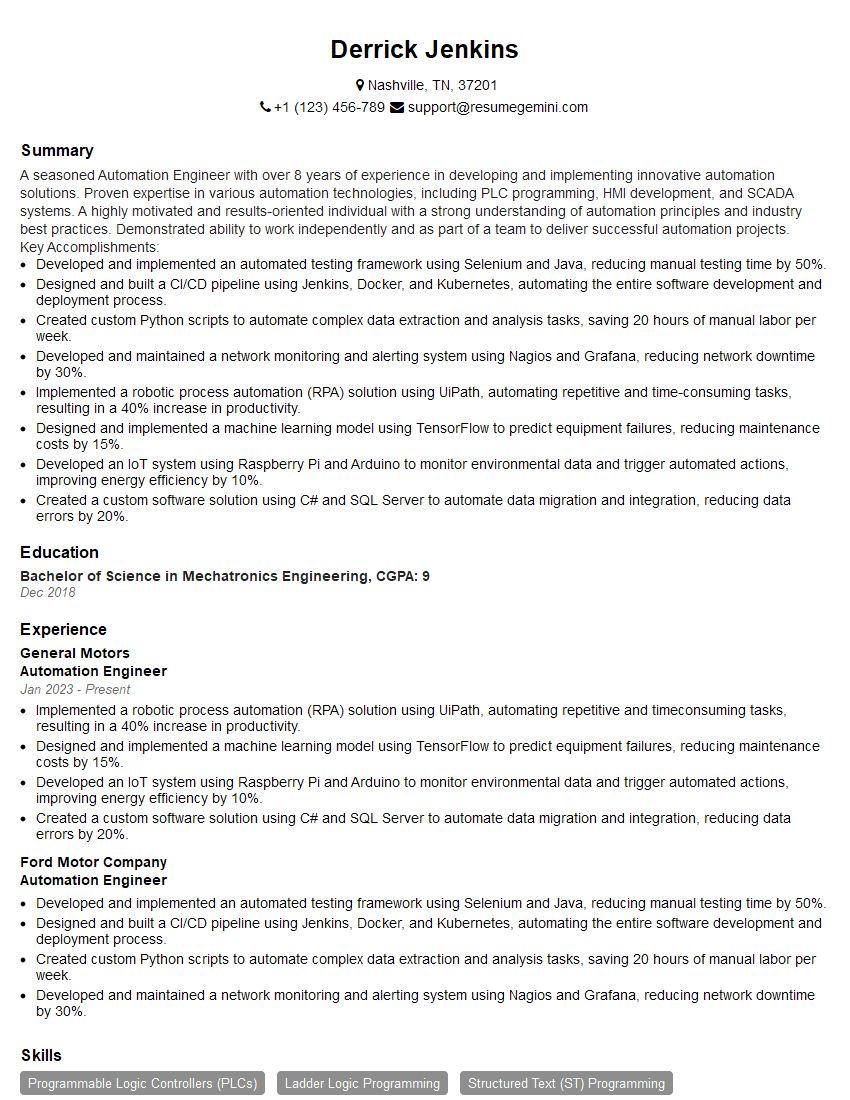
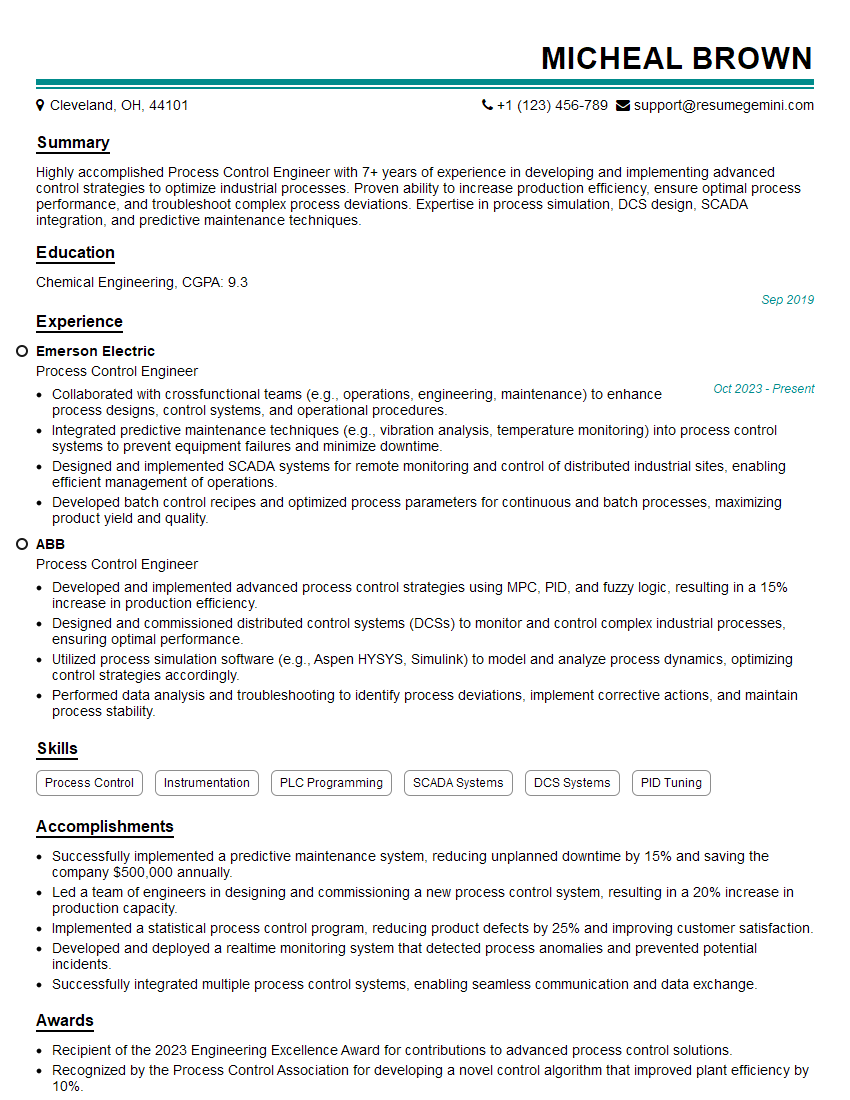
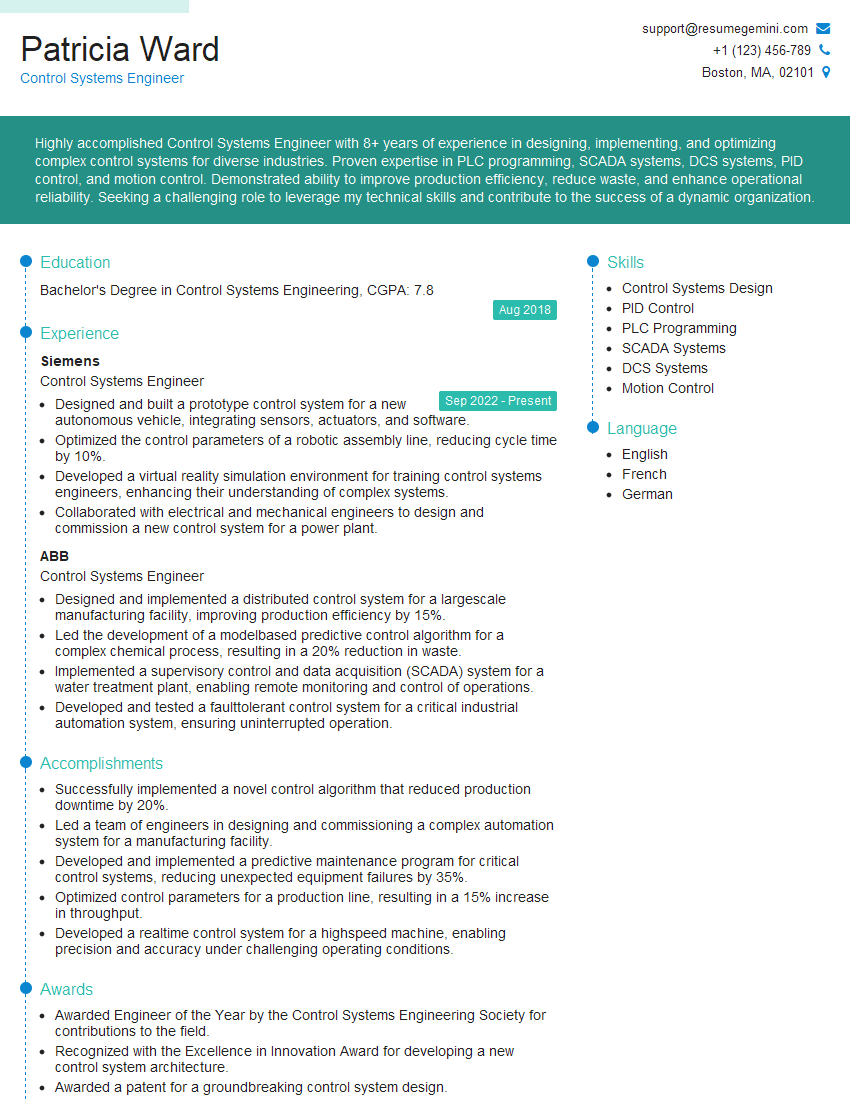
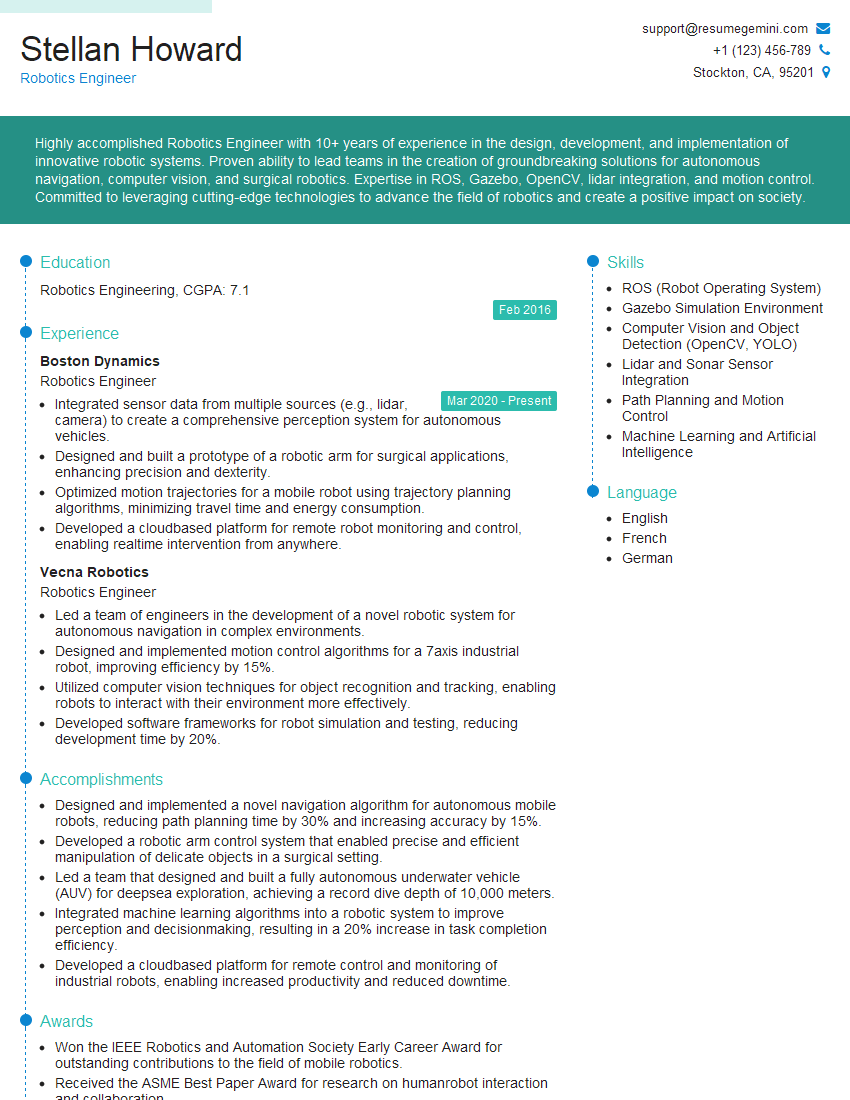
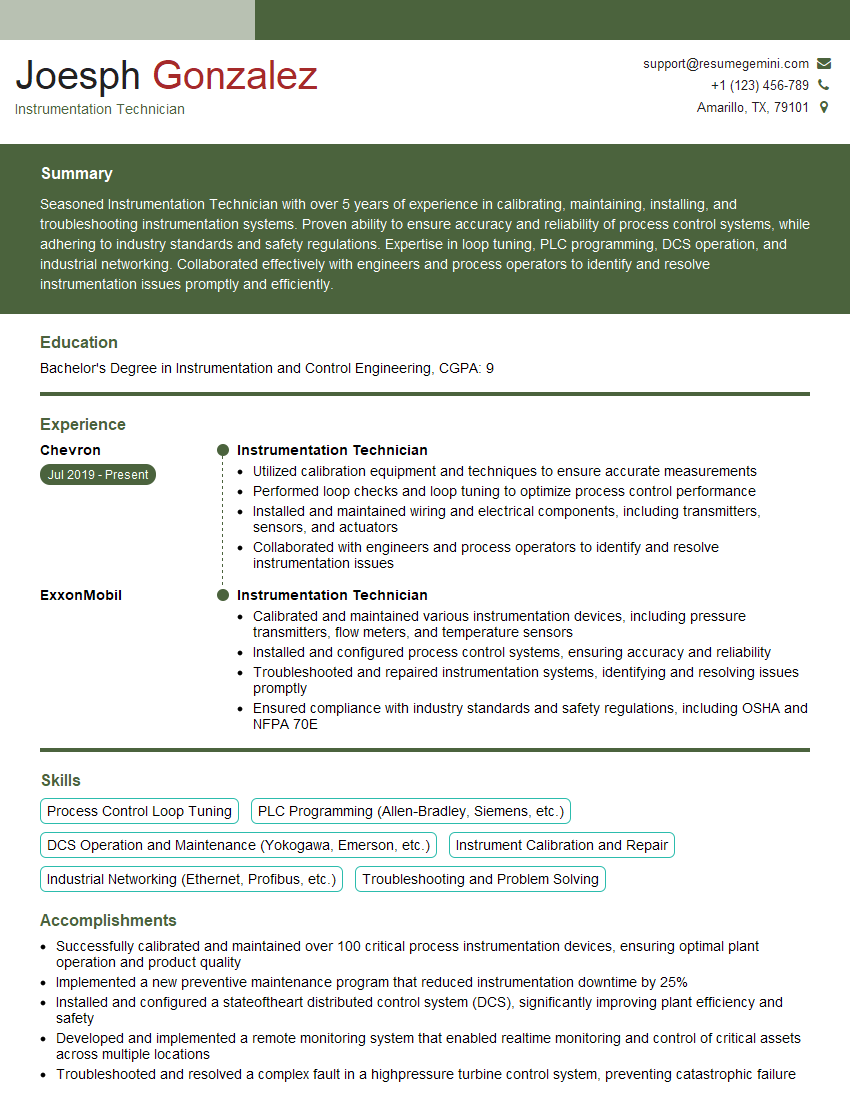
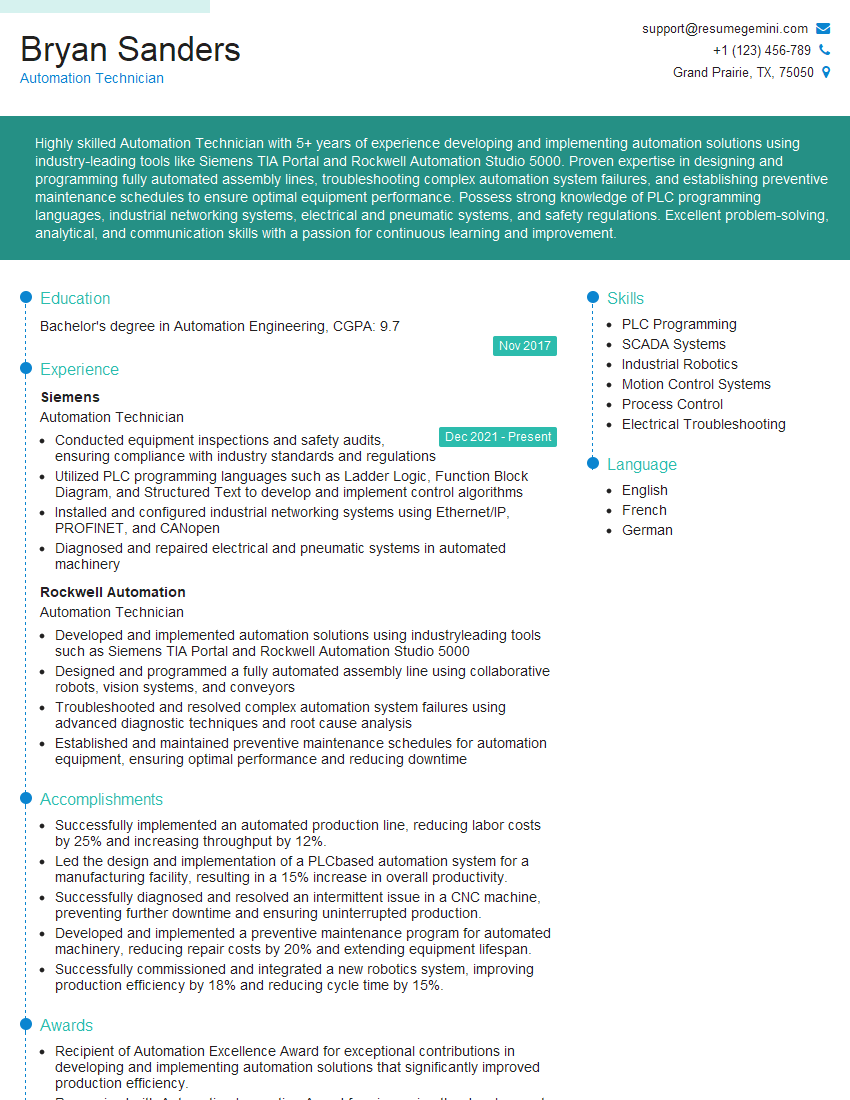
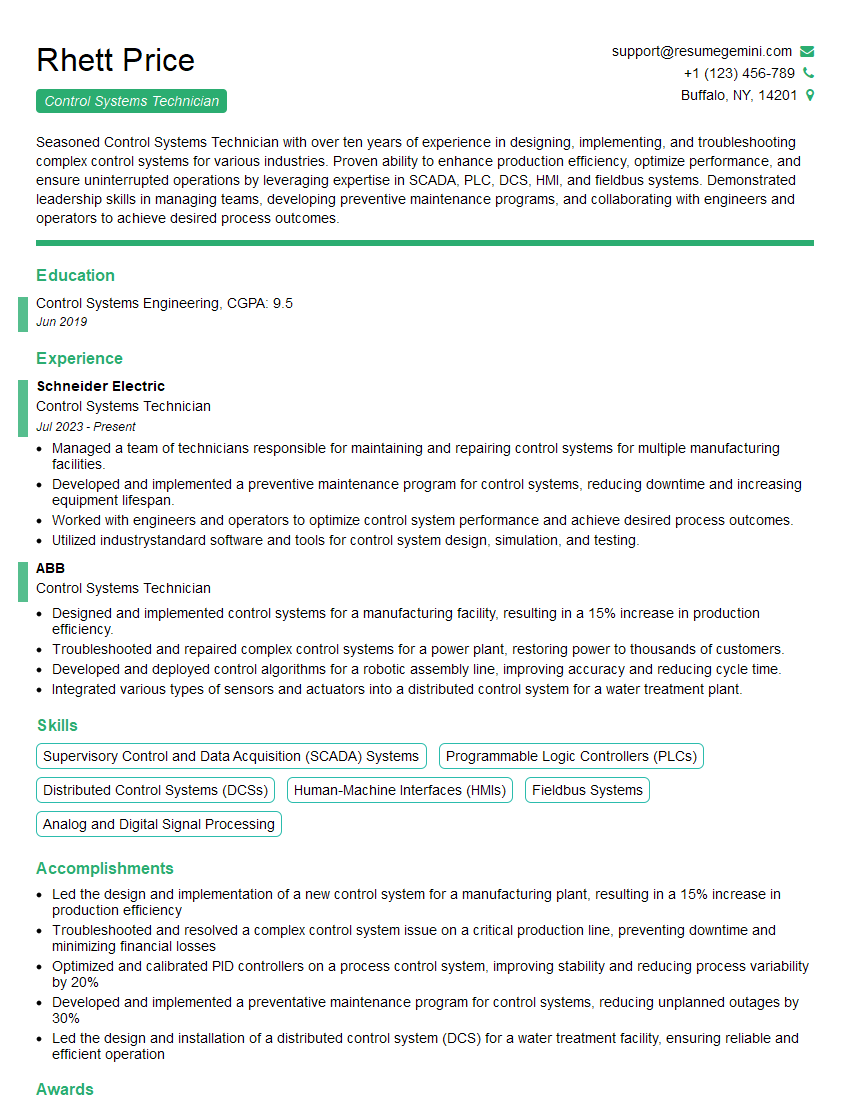
Mastering Computerized Control Systems opens doors to exciting and rewarding careers in diverse industries. A strong understanding of these principles is crucial for success in roles demanding automation expertise, problem-solving skills, and technical innovation. To significantly boost your job prospects, it’s vital to create a resume that is not only impressive but also easily parsed by Applicant Tracking Systems (ATS). ResumeGemini is a trusted resource to help you build a professional and ATS-friendly resume that showcases your skills and experience effectively. We provide examples of resumes tailored to Computerized Control Systems professionals to help guide you.
Explore more articles
Users Rating of Our Blogs
Share Your Experience
We value your feedback! Please rate our content and share your thoughts (optional).
What Readers Say About Our Blog
Really detailed insights and content, thank you for writing this detailed article.
IT gave me an insight and words to use and be able to think of examples