The right preparation can turn an interview into an opportunity to showcase your expertise. This guide to Control System Simulation interview questions is your ultimate resource, providing key insights and tips to help you ace your responses and stand out as a top candidate.
Questions Asked in Control System Simulation Interview
Q 1. Explain the difference between open-loop and closed-loop control systems.
The core difference between open-loop and closed-loop control systems lies in their feedback mechanisms. An open-loop system operates without feedback; the output is solely determined by the input. Think of a toaster: you set the time (input), and it toasts for that duration regardless of whether the bread is actually toasted. The system doesn’t check if the bread is done.
In contrast, a closed-loop system, also known as a feedback control system, uses feedback from the output to adjust the input and achieve the desired outcome. Imagine a thermostat controlling room temperature. The thermostat (controller) measures the room’s temperature (output), compares it to the setpoint (desired temperature), and adjusts the heating/cooling system (input) accordingly. It continuously monitors and corrects for deviations.
Example: A simple open-loop system is a conveyor belt moving at a fixed speed. A closed-loop system could be a robot arm positioning a part with feedback from sensors ensuring accurate placement.
Q 2. Describe the concept of stability in control systems.
Stability in a control system refers to its ability to maintain a desired equilibrium or setpoint. A stable system will return to its equilibrium point after being disturbed. Think of a ball resting in a bowl – a small push will cause it to oscillate, but it eventually settles back to the bottom (equilibrium). An unstable system, on the other hand, will diverge from its equilibrium point after any disturbance, like a ball balanced on top of a hill – any small push will send it rolling away.
Stability is crucial because unstable systems can lead to oscillations, overshoots, and even catastrophic failure. Ensuring stability is a fundamental goal in control system design.
Q 3. What are the common methods for analyzing the stability of a linear system?
Several methods analyze the stability of a linear system. These methods often involve examining the system’s characteristic equation or transfer function.
- Routh-Hurwitz Criterion: A purely algebraic method that determines stability by analyzing the coefficients of the characteristic polynomial. It doesn’t require plotting but is limited to polynomial equations.
- Root Locus Method: A graphical technique that shows how the roots of the characteristic equation move as a system parameter (e.g., gain) varies. It’s valuable for understanding the effect of parameter changes on stability and performance.
- Nyquist Stability Criterion: A frequency-domain method that examines the system’s frequency response to determine stability. We’ll discuss this in detail in the next question.
- Bode Plot Analysis: Another frequency-domain method; it’s visually intuitive, utilizing gain and phase plots to assess stability margins (discussed later).
The choice of method depends on the system’s complexity and the information required.
Q 4. Explain the Nyquist stability criterion.
The Nyquist stability criterion is a powerful frequency-domain method for assessing the stability of a closed-loop system. It uses the Nyquist plot, which is a polar plot of the system’s open-loop transfer function as frequency varies from -∞ to +∞.
The criterion states that the number of unstable closed-loop poles (i.e., poles in the right-half s-plane, indicating instability) is equal to the number of clockwise encirclements of the -1 point by the Nyquist plot of the open-loop transfer function. If the Nyquist plot doesn’t encircle the -1 point, the closed-loop system is stable.
Example: If the Nyquist plot encircles the -1 point twice clockwise, the closed-loop system will have two unstable poles. Conversely, if the plot doesn’t encircle -1, the system is stable.
This method is particularly useful for systems with time delays or non-minimum phase characteristics (where the transfer function has zeros in the right-half plane), cases where other methods might be less effective.
Q 5. What is the Bode plot and how is it used in control system analysis?
A Bode plot is a graphical representation of the frequency response of a system. It consists of two plots: a magnitude plot (showing the gain in decibels (dB) versus frequency in logarithmic scale) and a phase plot (showing the phase shift in degrees versus frequency in logarithmic scale).
Bode plots are used to analyze system stability, bandwidth, gain margin, phase margin, and other performance characteristics. The slopes of the magnitude plot are indicative of the system order, while the phase plot shows how much the system’s output lags behind the input at various frequencies.
Application: Analyzing Bode plots allows engineers to determine the system’s frequency response, identify resonant frequencies, and assess stability margins. For instance, a steep phase drop near the gain crossover frequency (where gain is 0 dB) suggests a low phase margin, potentially leading to instability.
Q 6. Describe the Root Locus method and its applications.
The root locus method is a graphical technique used to analyze the effect of varying a system parameter, typically the gain (K), on the closed-loop poles of a system. It plots the locations of the closed-loop poles as the gain varies from 0 to ∞.
The root locus shows how the poles move in the complex s-plane, providing insights into stability and transient response. For instance, poles in the left-half plane represent stability, while poles in the right-half plane indicate instability. The damping ratio and natural frequency can also be determined from the pole locations, allowing engineers to design controllers that achieve the desired performance.
Applications: The root locus is useful for designing controllers (like Proportional-Integral-Derivative (PID) controllers), assessing stability, and understanding the impact of parameter variations on system behavior. It’s particularly beneficial when dealing with systems described by transfer functions.
Q 7. Explain the concept of gain margin and phase margin.
Gain margin and phase margin are important metrics derived from the Bode plot that quantify the stability robustness of a closed-loop control system. They indicate how much the system’s gain or phase can be changed before it becomes unstable.
Gain margin is the amount of gain increase (in dB) that can be applied to the system before it becomes unstable. It’s determined at the phase crossover frequency (where the phase is -180°). A higher gain margin indicates greater stability.
Phase margin is the amount of additional phase lag (in degrees) that can be added to the system before it becomes unstable. It’s determined at the gain crossover frequency (where the gain is 0 dB). A higher phase margin also signifies better stability.
Practical implications: These margins provide a safety factor. Sufficiently high gain and phase margins ensure the system remains stable even with uncertainties in the plant model or external disturbances. Typically, design specifications call for minimum gain and phase margins (e.g., 6 dB and 45 degrees respectively).
Q 8. What is a PID controller and how does it work?
A PID controller, short for Proportional-Integral-Derivative controller, is a widely used feedback control loop mechanism. It’s essentially a three-term controller that uses feedback from a measured process variable to calculate an output value that will bring the process to a desired setpoint. Imagine you’re trying to maintain a specific temperature in a room. The PID controller continuously monitors the actual temperature and adjusts the heating or cooling system accordingly.
Proportional (P) term: This term reacts to the current error (difference between the setpoint and the measured value). A larger error leads to a larger corrective action. Think of it as a quick response to the temperature difference – a larger difference means a more powerful adjustment to the heating/cooling.
Integral (I) term: This term addresses persistent errors. If there’s a constant difference between the setpoint and the measured value (e.g., the room is always slightly colder than desired), the integral term accumulates this error over time and applies a corrective action to eliminate the steady-state error. It’s like remembering past mistakes and slowly adjusting to correct them.
Derivative (D) term: This term anticipates future error based on the rate of change of the error. If the temperature is changing rapidly, the derivative term helps prevent overshoot by predicting where the temperature will be heading and applying a counteracting force. It’s like anticipating the future and avoiding over-correction.
The output of the PID controller is the sum of these three terms: Output = Kp * error + Ki * integral(error) + Kd * derivative(error), where Kp, Ki, and Kd are the proportional, integral, and derivative gains, respectively, which are constants that need to be tuned.
Q 9. How do you tune a PID controller?
PID controller tuning is the process of adjusting the Kp, Ki, and Kd gains to achieve optimal performance. The goal is to find the balance between speed of response, minimal overshoot, and stability. Tuning can be done through various methods, including trial and error, systematic methods like Ziegler-Nichols, and using optimization algorithms. It often involves observing the system’s response to different gain settings and iteratively adjusting them until the desired behavior is achieved. Too low gains lead to slow response, while too high gains may lead to instability (oscillations or even runaway).
Factors influencing tuning include the system’s dynamics, its inherent delays, and noise in the measurements. Real-world tuning often involves balancing multiple objectives, such as minimizing settling time, reducing overshoot, and maintaining robustness to disturbances.
Q 10. Explain the Ziegler-Nichols method for PID tuning.
The Ziegler-Nichols method is a simple yet effective empirical tuning method. It requires finding the ultimate gain (Ku) and the ultimate period (Pu) of the system. This is done by manually increasing the proportional gain (Kp) until the system starts to oscillate continuously. Ku is the value of Kp at which sustained oscillations occur, and Pu is the period of these oscillations.
Once Ku and Pu are obtained, the PID gains are calculated using the following formulas:
Kp = 0.6 * KuKi = 1.2 * Ku / PuKd = 0.075 * Ku * Pu
This method provides a starting point for tuning and often requires further fine-tuning based on the system’s response. It’s relatively easy to implement but may not be optimal for all systems, particularly those with significant nonlinearities or delays.
Q 11. What are some common control system design techniques?
Several control system design techniques exist, each with its strengths and weaknesses. Some common ones include:
Classical Control Design: This approach uses frequency-domain analysis (Bode plots, Nyquist plots) and root locus methods to design controllers based on the transfer function of the system. It’s intuitive and provides good insight into the system’s behavior, but can be challenging for complex systems.
State-Space Design: This method uses state-space representation to model the system and design controllers based on the system’s state variables. It’s powerful for handling multiple inputs and outputs and can accommodate complex systems, but can be mathematically more intensive.
Optimal Control: This aims to find the controller that minimizes a cost function, often involving trade-offs between performance and control effort. Linear Quadratic Regulator (LQR) is a popular optimal control technique.
Robust Control: This focuses on designing controllers that perform well despite uncertainties in the system model. H-infinity control and µ-synthesis are robust control methods.
Adaptive Control: This involves controllers that automatically adjust their parameters in response to changes in the system dynamics. This is crucial when dealing with systems whose characteristics vary over time.
Q 12. Describe state-space representation of a control system.
State-space representation describes a system using a set of first-order differential equations. It’s particularly useful for systems with multiple inputs and outputs. The representation takes the form:
ẋ = Ax + Buy = Cx + Du
where:
xis the state vector (a vector containing the system’s state variables).uis the input vector (a vector containing the system’s input signals).yis the output vector (a vector containing the system’s output signals).Ais the system matrix (describes the system’s dynamics).Bis the input matrix (maps the inputs to the state variables).Cis the output matrix (maps the state variables to the outputs).Dis the direct transmission matrix (maps the inputs directly to the outputs – often zero).
This representation allows for a systematic analysis and design of control systems using linear algebra techniques.
Q 13. How do you solve for the eigenvalues and eigenvectors of a system matrix?
Eigenvalues and eigenvectors are fundamental to understanding the system’s behavior in state-space. Eigenvalues (λ) of the system matrix (A) represent the system’s natural frequencies or modes of oscillation. Eigenvectors (v) are associated with each eigenvalue and represent the direction of the system’s response to that mode. They are found by solving the characteristic equation:
det(A - λI) = 0
where I is the identity matrix. This equation yields a polynomial whose roots are the eigenvalues. For each eigenvalue, the corresponding eigenvector is found by solving:
(A - λI)v = 0
Solving these equations, often using numerical methods in software like MATLAB or Python (with libraries like NumPy and SciPy), gives the eigenvalues and eigenvectors. The eigenvalues determine the stability of the system; eigenvalues with positive real parts indicate instability, while those with negative real parts indicate stability.
Q 14. Explain the concept of controllability and observability.
Controllability and observability are crucial concepts in control system design. They determine whether we can effectively control or monitor the system’s behavior.
Controllability: A system is controllable if it’s possible to steer the system from any initial state to any desired state in a finite time using only the available control inputs. If a system is uncontrollable, there are states that cannot be reached through the control inputs. Mathematical tests, often involving the controllability matrix, are used to check for controllability.
Observability: A system is observable if it’s possible to determine the system’s state from the available output measurements. If a system is unobservable, there are states that cannot be inferred from the outputs, regardless of the length of observation. Similar to controllability, mathematical tests, involving the observability matrix, determine observability.
Both concepts are essential for designing effective controllers. Uncontrollable modes cannot be influenced by the controller, while unobservable modes may lead to poor performance or instability. Therefore, controllability and observability analysis is a crucial step in control system design.
Q 15. What is Kalman filtering and its applications?
Kalman filtering is a powerful algorithm used to estimate the state of a dynamic system from a series of noisy measurements. Think of it like trying to track a moving object – you have imperfect sensor readings (noisy measurements) that don’t give you the object’s exact position and velocity. The Kalman filter cleverly combines these noisy measurements with a model of how the object moves (its dynamics) to produce a much more accurate estimate of its current state.
It works by predicting the next state based on the model and then updating this prediction using the new measurement. This prediction-correction cycle iteratively refines the estimate. The key is that it uses statistical methods (specifically, Gaussian distributions) to weigh the confidence in the prediction versus the confidence in the measurement, giving more weight to the more reliable source.
- Applications: Kalman filtering is widely used in many fields, including:
- Navigation systems (GPS): Combines data from multiple sources (GPS satellites, accelerometers, gyroscopes) to accurately determine position and velocity, even with noisy signals.
- Robotics: Estimates robot pose (position and orientation) and velocity, crucial for precise movement and control.
- Computer vision: Tracks moving objects in video sequences, compensating for camera jitter and other noise.
- Financial modeling: Predicts stock prices or other financial time series.
- Weather forecasting: Assimilates weather data from various sources to create more accurate forecasts.
Career Expert Tips:
- Ace those interviews! Prepare effectively by reviewing the Top 50 Most Common Interview Questions on ResumeGemini.
- Navigate your job search with confidence! Explore a wide range of Career Tips on ResumeGemini. Learn about common challenges and recommendations to overcome them.
- Craft the perfect resume! Master the Art of Resume Writing with ResumeGemini’s guide. Showcase your unique qualifications and achievements effectively.
- Don’t miss out on holiday savings! Build your dream resume with ResumeGemini’s ATS optimized templates.
Q 16. What are the advantages and disadvantages of using Simulink for control system simulation?
Simulink, a graphical programming environment within MATLAB, is a widely used tool for control system simulation. It offers many advantages, but also has some drawbacks.
- Advantages:
- Visual and intuitive: Simulink’s block diagram interface makes it easy to model complex systems visually, making it accessible to users with varying levels of programming experience.
- Extensive libraries: It provides a vast library of pre-built blocks for various components, speeding up the modeling process. You can easily incorporate sensors, actuators, controllers, and various signal processing blocks.
- Powerful simulation capabilities: Simulink supports different solvers, allowing you to choose the most appropriate one based on the system’s characteristics (e.g., stiff or non-stiff systems). It handles continuous, discrete, and hybrid systems efficiently.
- Integration with MATLAB: Seamlessly integrates with MATLAB, enabling advanced analysis and post-processing of simulation results.
- Disadvantages:
- Cost: MATLAB and Simulink are expensive software packages, making them inaccessible to some users.
- Complexity: While intuitive for simple systems, modeling highly complex systems in Simulink can become cumbersome and require significant expertise.
- Debugging: Debugging complex models in Simulink can be challenging, requiring careful examination of signal flows and block parameters.
- Limited real-time capabilities: While Simulink supports real-time simulation, setting it up can be complex, often requiring specialized hardware and expertise.
Q 17. How do you model nonlinearities in a control system simulation?
Nonlinearities are deviations from linear behavior in a system. They are ubiquitous in real-world systems and often significantly impact performance. Modeling them accurately is crucial for realistic simulations.
Several methods exist for handling nonlinearities:
- Lookup tables: For systems with well-defined input-output relationships that can be measured or derived experimentally, a lookup table can approximate the nonlinearity. This is straightforward to implement in Simulink using a lookup table block.
- Piecewise linear approximation: Breaking down the nonlinearity into several linear segments can simplify the model. This is relatively simple to implement but may lose accuracy if the nonlinearities are significant or rapid.
- Polynomial approximation: Using polynomial functions (e.g., Taylor series expansion) can accurately represent many smooth nonlinearities. The order of the polynomial influences the accuracy and complexity.
- Nonlinear blocks in Simulink: Simulink offers dedicated blocks for various common nonlinearities, such as saturation, dead zone, and hysteresis blocks. These are easy to integrate directly into your model.
- State-space representation: For more complex nonlinearities, a nonlinear state-space model can be used. This requires more mathematical modeling but offers high accuracy.
Example: Consider a motor with saturation. A saturation block in Simulink can effectively model the limitation on the motor’s torque output, accurately representing the nonlinear behavior when the input exceeds a certain value.
Q 18. Explain the concept of model order reduction.
Model order reduction (MOR) is a technique used to simplify complex dynamic systems by reducing the number of states (or order) in the model. Imagine trying to simulate the flight of a plane – you have thousands of interconnected parts. Simulating all of them in detail would be incredibly computationally expensive and time-consuming. MOR allows you to create a much smaller, more manageable model that still captures the essential dynamics of the original system.
This simplification is done while attempting to preserve certain crucial characteristics like frequency response or input-output behavior. This makes the model faster to simulate, analyze, and control, making real-time control applications more feasible. Several techniques are available, including:
- Balanced truncation: This method identifies and removes states that contribute the least to the input-output behavior. It’s known for preserving stability and accuracy.
- Singular perturbation approximation: Suitable for systems with widely separated time scales. It separates fast and slow dynamics and simplifies the model by ignoring the fast ones.
- Krylov subspace methods: These methods project the original high-order system onto a lower-dimensional subspace that captures the most important dynamics.
Q 19. Describe different types of system identification techniques.
System identification is the process of determining a mathematical model for a dynamic system based on experimental data. It’s like being a detective – you observe the system’s behavior and try to deduce the underlying mathematical rules governing it.
Several techniques exist:
- Non-parametric methods: These methods don’t explicitly estimate a model structure, but rather describe the system’s input-output relationship directly. Examples include frequency response functions (FRFs) estimated from frequency-domain data.
- Parametric methods: These methods assume a specific model structure (e.g., ARX, ARMAX, state-space) and estimate the parameters of that structure. They require selecting a suitable model structure based on prior knowledge or trial and error.
- Prediction error methods: These iterative methods minimize the difference between the model output and the actual system output, progressively refining the model parameters until a satisfactory fit is achieved.
- Subspace methods: These methods use linear algebra techniques to directly estimate the state-space model parameters from input-output data. They are particularly useful for high-order systems.
The choice of method depends on several factors, including data quality, prior knowledge about the system, and computational resources. Often, a combination of methods may be employed.
Q 20. What are some common challenges in control system simulation?
Control system simulation, while incredibly powerful, faces several challenges:
- Model accuracy: Real-world systems are often highly complex, and creating accurate models that capture all relevant dynamics can be difficult. Simplifications and assumptions are often necessary, which can limit the accuracy of the simulation.
- Computational cost: Simulating complex systems, especially those with many states or nonlinear components, can be computationally expensive, requiring significant computing power and time. This is where model order reduction techniques become very useful.
- Uncertainty and noise: Real-world systems are inherently noisy and subject to uncertainties. Accurately incorporating these aspects into the simulation is crucial for achieving realistic results. This often requires employing techniques like stochastic modeling and robust control design.
- Validation and verification: Ensuring the simulation model accurately represents the real system is essential. This requires comparing simulation results with experimental data and identifying discrepancies. This is also a very challenging task.
- Software and hardware limitations: The available software and hardware can constrain the complexity and scope of the simulations. For example, real-time simulation often requires specialized hardware.
Q 21. How do you handle uncertainties in control system models?
Uncertainties are unavoidable in real-world control systems. They can stem from inaccurate model parameters, environmental disturbances, or sensor noise. Handling these uncertainties is crucial for designing robust control systems that function reliably even under unexpected conditions.
Several methods exist:
- Stochastic modeling: Modeling uncertain parameters as random variables with known probability distributions allows for evaluating the system’s behavior under different scenarios. Monte Carlo simulations are often used in this context.
- Robust control design: Methods like H-infinity control or μ-synthesis design controllers that guarantee stability and performance even in the presence of uncertainties. These methods usually involve optimizing the control system for the worst-case scenario within a defined uncertainty region.
- Adaptive control: This approach involves designing controllers that continuously adapt to changes in the system’s dynamics or environment. The controller estimates the uncertainties online and adjusts its parameters accordingly.
- Fuzzy logic control: This method allows for incorporating expert knowledge and linguistic descriptions of uncertain behavior, which is helpful for modelling systems with poorly understood uncertainties.
The choice of method depends on the nature of the uncertainty, the available information, and the desired level of robustness.
Q 22. Explain the concept of robust control design.
Robust control design focuses on creating control systems that perform reliably despite uncertainties and disturbances. Think of it like building a ship that can withstand storms – you wouldn’t design it only for calm seas! In control systems, these uncertainties could stem from variations in plant parameters (the system being controlled), external noise, or even unmodeled dynamics. A robust controller ensures the system remains stable and meets performance specifications even when things don’t go exactly as planned.
Robustness is achieved through various techniques, including:
- H-infinity control: Minimizes the worst-case effects of disturbances and uncertainties.
- μ-synthesis: Handles uncertainties described by complex, interconnected models.
- Linear Parameter-Varying (LPV) control: Deals with systems whose parameters change over time.
- Adaptive control: Continuously adjusts the controller based on feedback from the system, automatically compensating for changes.
For instance, a robust controller for a robotic arm might ensure precise movements even if the arm’s weight slightly varies or if there are external forces acting on it. It’s a crucial aspect of designing dependable and reliable control systems in real-world applications.
Q 23. Describe your experience with different simulation software packages (e.g., MATLAB/Simulink, Python with control libraries).
My experience encompasses a range of simulation software packages, primarily MATLAB/Simulink and Python with its control libraries (like Control Systems Library). MATLAB/Simulink is my go-to for complex, large-scale simulations, particularly for projects requiring extensive model building and analysis. Its graphical interface makes it very user-friendly for visualizing system behavior and implementing various control strategies. I’ve extensively used it for developing and testing controllers for aerospace and robotics applications.
Python, combined with libraries like SciPy and NumPy, offers a powerful alternative, especially for rapid prototyping and leveraging the vast ecosystem of data science and machine learning tools. I’ve used this approach when dealing with data-driven model identification and control design. The ability to easily integrate with other Python libraries provides significant flexibility. A recent project involved using Python for real-time control of a small drone, where the speed of prototyping offered by Python was crucial.
In essence, my choice of software depends on the specific project requirements. I’m comfortable and proficient in both environments.
Q 24. How do you validate the results of a control system simulation?
Validating simulation results is paramount to ensure they accurately reflect the real-world system’s behavior. This involves a multi-pronged approach:
- Comparison with analytical results: If analytical solutions are available for simplified versions of the system, comparing simulation results with these solutions serves as a valuable check.
- Experimental verification: The most reliable method involves comparing simulation outputs with data from experiments on a physical prototype or a scaled-down model. This directly assesses the simulation’s accuracy.
- Sensitivity analysis: This helps understand how sensitive the simulation results are to changes in model parameters. A robust simulation should exhibit reasonable changes in output with reasonable parameter variations.
- Code review and testing: Thoroughly reviewing the simulation code for errors and using appropriate testing techniques can identify potential inaccuracies before running extensive simulations.
For example, in simulating a temperature control system, I would compare the simulation’s predicted temperature response to the actual temperature measurements obtained from a physical test setup. Any discrepancies would trigger a thorough investigation of the model and simulation parameters.
Q 25. Describe a project where you used control system simulation to solve a problem.
In a recent project, we were tasked with designing a control system for a highly sensitive optical positioning stage used in semiconductor manufacturing. Precise positioning is critical for maintaining the quality of the manufactured chips. The challenge was to overcome significant vibrations and disturbances present in the manufacturing environment.
Using Simulink, I developed a detailed model of the positioning stage, including the motor dynamics, the mechanical structure, and the sensor characteristics. Through extensive simulations, we evaluated various control strategies – PID, LQR, and H-infinity control. We incorporated models of different vibration sources and disturbances to assess the robustness of each controller. The H-infinity controller demonstrated superior robustness and was selected for implementation. The simulation results provided critical insights into the controller’s performance and highlighted areas for improvement, leading to a final design that significantly reduced positioning errors and improved overall process stability.
Q 26. How do you ensure the accuracy and reliability of a control system simulation?
Ensuring accuracy and reliability requires meticulous attention to detail throughout the simulation process:
- Model fidelity: The accuracy of the simulation heavily relies on the accuracy of the mathematical model representing the physical system. This requires careful selection of model parameters and validation against experimental data.
- Numerical methods: The choice of numerical integration methods significantly impacts simulation accuracy. Using appropriate methods and carefully selecting the integration step size are essential.
- Verification and validation: As mentioned earlier, a rigorous verification and validation plan, involving code reviews, unit testing, and experimental validation, is indispensable.
- Uncertainty quantification: Incorporating uncertainty into the model through techniques like Monte Carlo simulations provides a realistic representation of the system’s behavior under varying conditions.
For instance, in a flight control simulation, we need to carefully model aerodynamic forces and moments. Incorrect modeling can lead to inaccurate predictions of aircraft behavior. Rigorous validation against flight test data becomes crucial.
Q 27. Explain your experience with hardware-in-the-loop (HIL) simulation.
I have extensive experience with Hardware-in-the-Loop (HIL) simulation. HIL simulation involves connecting a real-time simulator to a physical hardware component or a prototype of the control system. This allows for testing the controller’s performance under realistic conditions. The simulator generates signals that mimic the behavior of the plant (the system being controlled), and the controller’s response is tested in real-time. This provides a crucial bridge between the simulation environment and the physical world.
In one project, we used HIL simulation to test the flight control system of a small unmanned aerial vehicle (UAV). The real-time simulator replicated the UAV’s dynamics, sensor readings, and various environmental factors, while the actual flight controller was tested in a safe and controlled environment. This approach helped us detect and resolve unexpected interactions between the controller and the physical hardware before deploying the system in the field. This significantly reduced the risk of unexpected behavior and failures.
Q 28. How do you troubleshoot and debug problems encountered during control system simulation?
Troubleshooting simulation problems is a common task. My approach involves a systematic process:
- Reproduce the error: First, I systematically attempt to reproduce the error. This often involves simplifying the simulation model, focusing on the specific component or sub-system where the problem occurs.
- Inspect the simulation results: Carefully review simulation data (time-domain responses, frequency responses, etc.) to pinpoint the problematic behavior.
- Debug the code: Using debuggers, print statements, or visualization tools, I trace the code execution, isolating the source of errors. This may involve checking the accuracy of the mathematical model, verifying the proper use of numerical integration techniques, or even scrutinizing the data structures.
- Simplify the model: Reducing complexity by progressively removing components from the simulation can aid in pinpointing the source of the problem.
- Compare with simplified cases: Running the simulation with simplified models (e.g., linear models instead of nonlinear models) can facilitate error detection.
If the problem is in the model itself (e.g., an incorrect parameter value), I would validate the model against experimental data or theoretical analysis. Through this methodical approach, I’ve successfully resolved various simulation issues, ranging from simple coding errors to more complex modeling inaccuracies.
Key Topics to Learn for Control System Simulation Interview
- Modeling and Analysis Techniques: Understand and apply various modeling methods like transfer functions, state-space representations, and block diagrams. Practice analyzing system stability, transient response, and frequency response.
- Simulation Software Proficiency: Gain hands-on experience with industry-standard simulation tools like MATLAB/Simulink, Python with control libraries (e.g., Control Systems Toolbox), or similar software. Be prepared to discuss your experience with specific tools and their applications.
- Control Design and Implementation: Familiarize yourself with different control strategies (PID, lead-lag compensators, state-feedback, etc.) and their tuning methods. Understand how to implement these controllers in a simulation environment and analyze their performance.
- Linear and Non-linear Systems: Grasp the differences between linear and non-linear systems and the implications for simulation and control design. Be ready to discuss techniques for handling non-linearity.
- Discrete-Time Systems: Understand the concepts of sampling, quantization, and z-transforms. Be prepared to discuss the differences between continuous-time and discrete-time system simulation.
- Practical Applications and Case Studies: Explore real-world applications of control system simulation in areas like robotics, automotive, aerospace, or process control. Be ready to discuss specific examples and challenges.
- Troubleshooting and Debugging: Develop your skills in identifying and resolving common issues encountered during simulation, such as instability, unexpected behavior, or convergence problems.
Next Steps
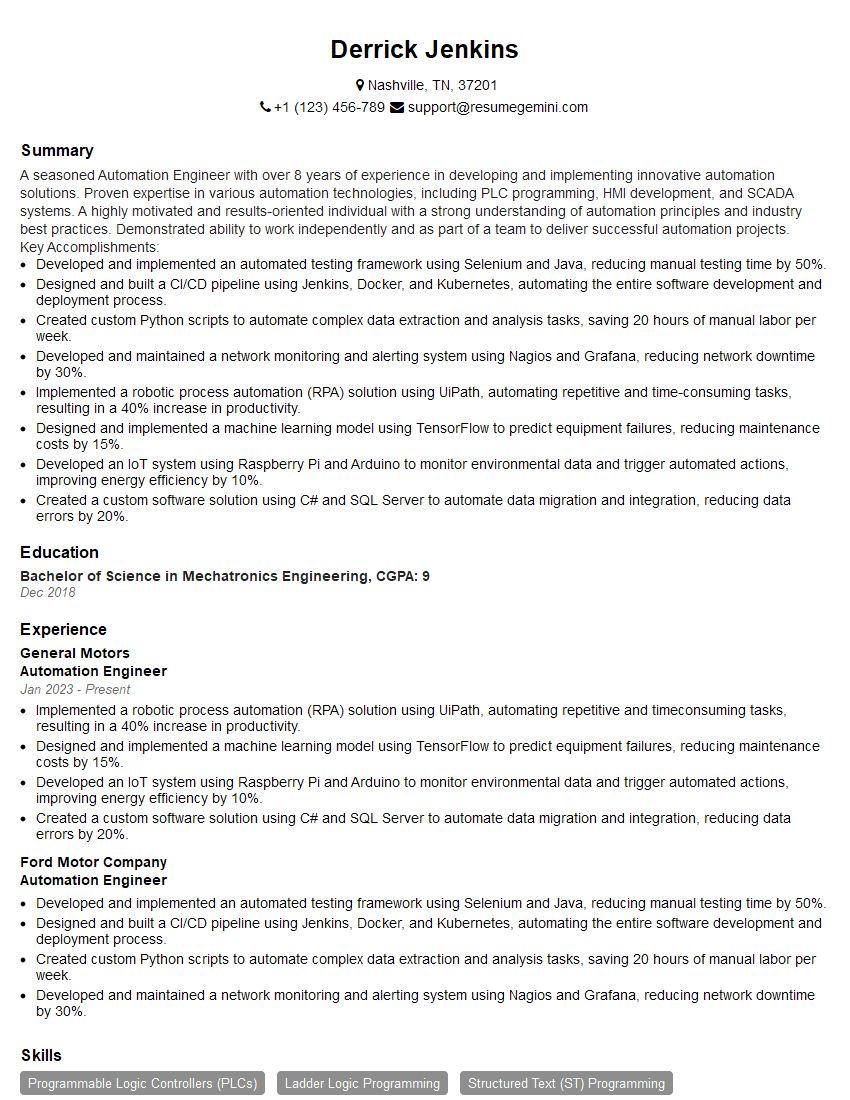
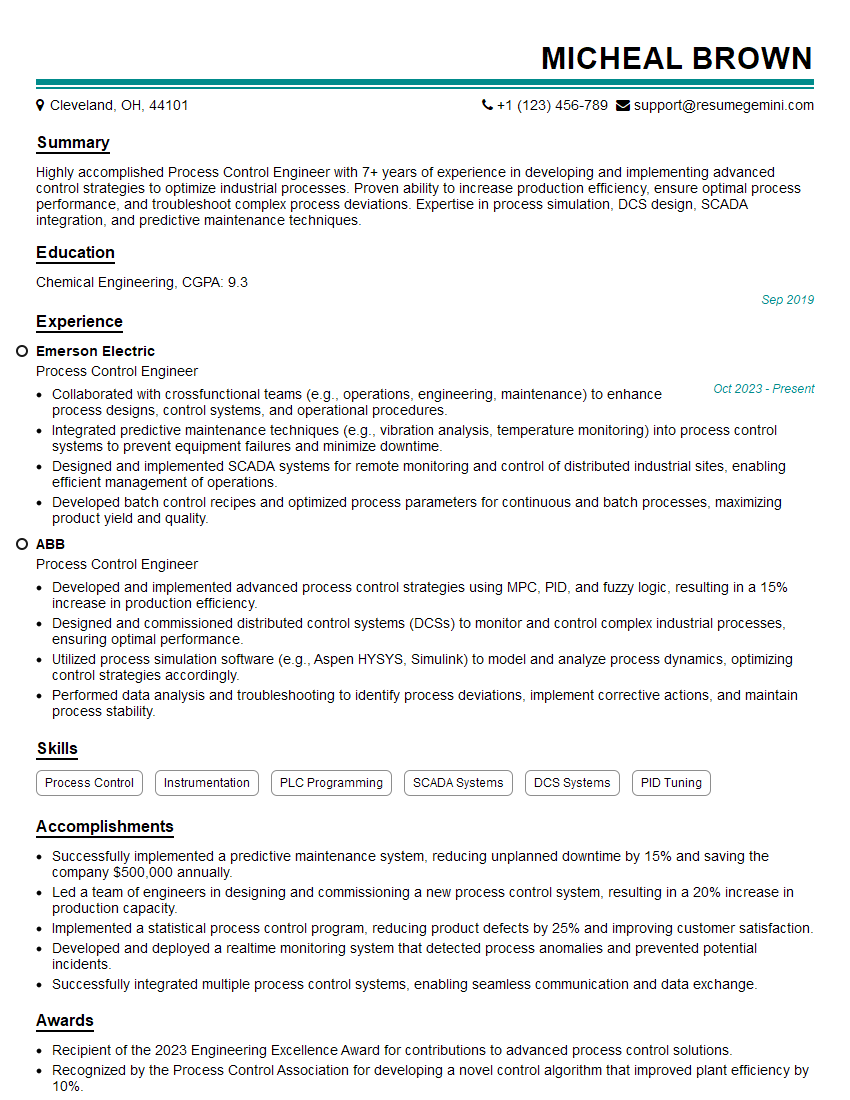
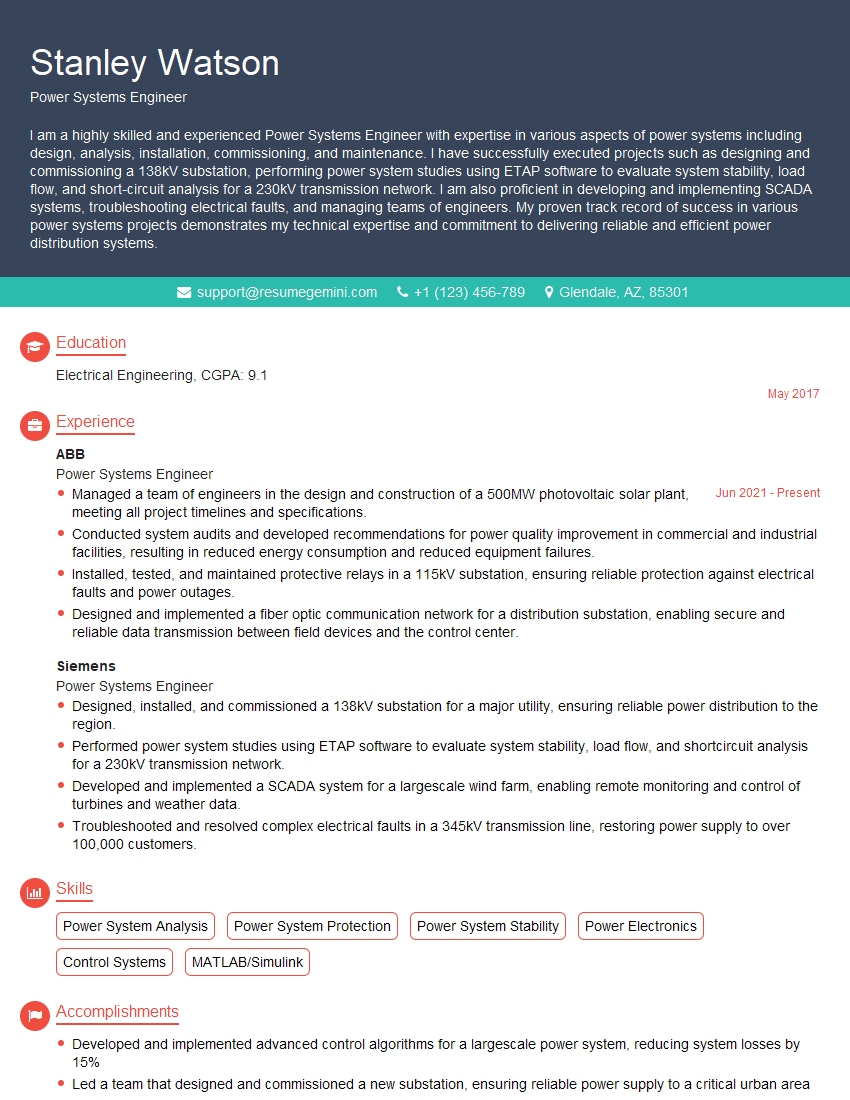
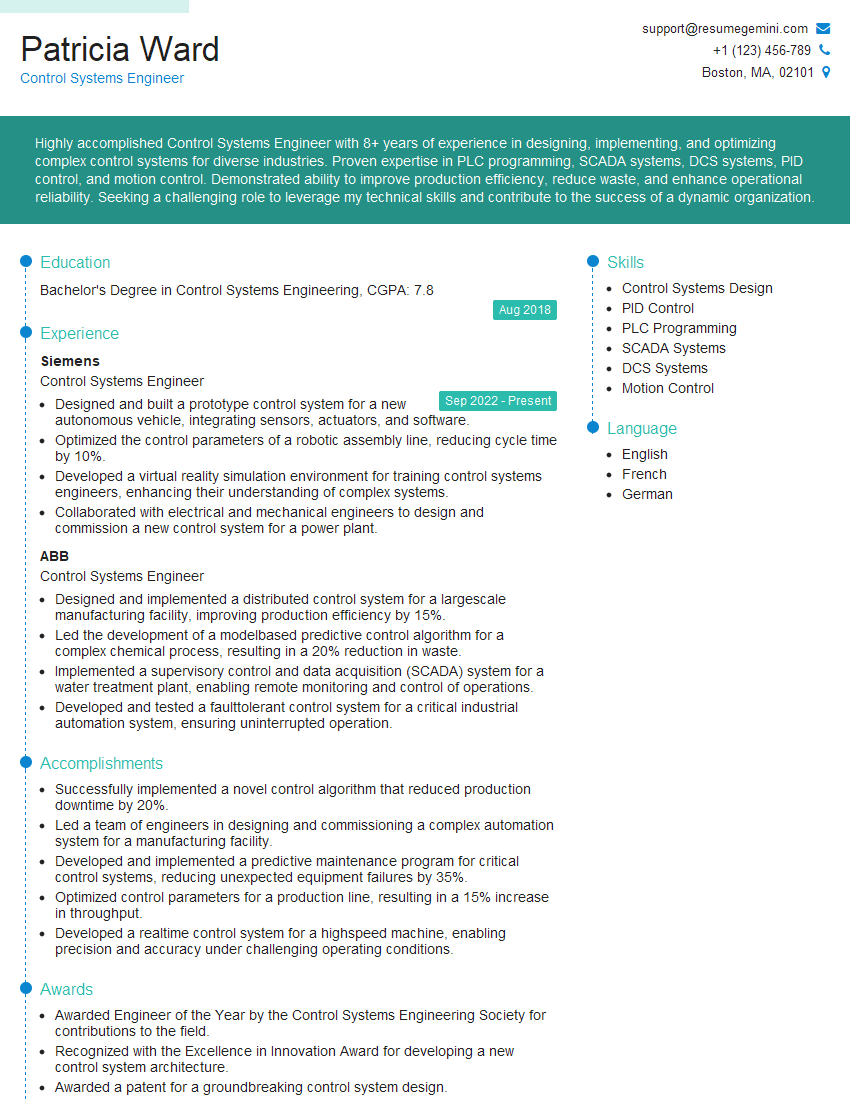
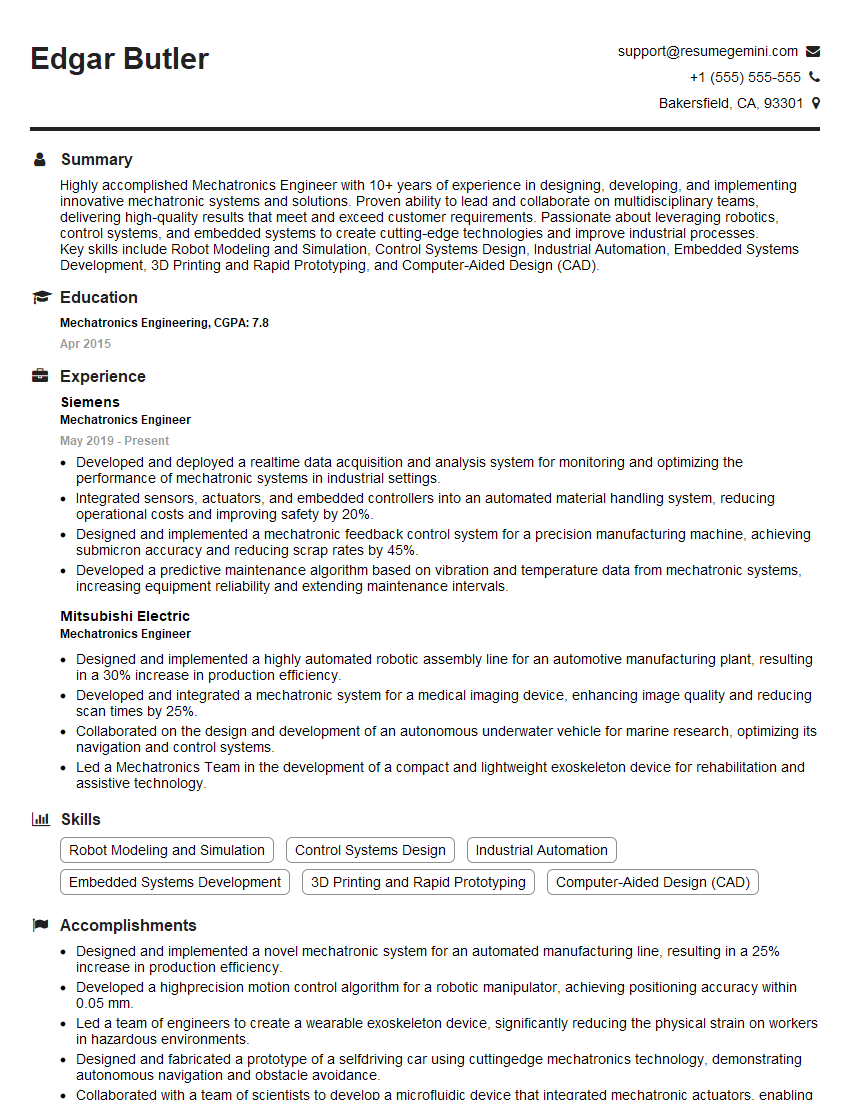
Mastering control system simulation is crucial for a successful career in engineering and related fields. Proficiency in this area demonstrates a strong understanding of theoretical concepts and their practical application, making you a highly valuable asset to any team. To maximize your job prospects, it’s essential to create a compelling and ATS-friendly resume that effectively highlights your skills and experience. ResumeGemini is a trusted resource that can help you build a professional and impactful resume tailored to your specific skills and experience in control system simulation. Examples of resumes tailored to Control System Simulation are available to help you get started.


Explore more articles
Users Rating of Our Blogs
Share Your Experience
We value your feedback! Please rate our content and share your thoughts (optional).
What Readers Say About Our Blog
Really detailed insights and content, thank you for writing this detailed article.
IT gave me an insight and words to use and be able to think of examples