Feeling uncertain about what to expect in your upcoming interview? We’ve got you covered! This blog highlights the most important Custom Clearance and Import/Export Regulations interview questions and provides actionable advice to help you stand out as the ideal candidate. Let’s pave the way for your success.
Questions Asked in Custom Clearance and Import/Export Regulations Interview
Q 1. Explain the difference between Incoterms rules CFR and CIF.
Both CFR (Cost and Freight) and CIF (Cost, Insurance, and Freight) are Incoterms rules that define the responsibilities of buyers and sellers in international trade. The key difference lies in who is responsible for insuring the goods during shipment.
CFR: Under CFR, the seller is responsible for delivering the goods to the named port of destination and paying for the freight. However, the buyer is responsible for obtaining cargo insurance. Think of it like this: the seller gets the goods onto the ship, but the buyer needs to protect their investment from potential losses during transit.
CIF: With CIF, the seller’s responsibilities are broader. In addition to delivering the goods to the named port of destination and paying for the freight, the seller is also responsible for obtaining and paying for cargo insurance. This means the seller bears the risk until the goods arrive at the designated port.
Example: Imagine exporting furniture. Using CFR, the seller handles shipping the furniture to the port in the buyer’s country. The buyer then arranges and pays for the insurance to cover any damage or loss during transit. With CIF, the seller would handle both the shipping and the insurance, providing more peace of mind for the buyer but also incurring extra costs.
Q 2. What are the Harmonized System (HS) codes, and why are they important?
The Harmonized System (HS) codes are a standardized system of names and numbers used to classify traded products. They are a six-digit code, internationally recognized and used by customs authorities worldwide to identify goods for tariff classification, trade statistics, and regulatory purposes.
Importance: HS codes are crucial because they determine:
- Tariffs and Duties: The HS code dictates the applicable import duties, taxes, and other fees a product will incur.
- Trade Statistics: Governments use HS codes to track the volume and value of goods imported and exported.
- Regulatory Compliance: Certain products might have specific regulations or restrictions based on their HS code, impacting their import/export.
- Accurate Documentation: Accurate HS codes are essential for smooth customs clearance and to avoid delays or penalties.
Example: If you’re importing furniture, the specific type of furniture (e.g., wooden chairs, metal desks) will determine its HS code, which, in turn, determines the tariff rate imposed by the importing country. Misclassifying the HS code can lead to significant financial penalties and delays.
Q 3. Describe the process of filing a customs entry.
Filing a customs entry involves submitting documentation to the customs authority of the importing country to declare the goods and pay any applicable duties and taxes. It’s a crucial step for legal entry of goods into a country.
Process:
- Data Preparation: Gather all necessary documents (discussed later) and accurately complete the customs entry form. This often involves using specific software or online portals.
- Entry Filing: Submit the completed entry form and supporting documents electronically or physically, depending on the country’s requirements.
- Customs Review: Customs authorities review the documentation to verify accuracy and compliance with regulations.
- Duty and Tax Payment: Pay applicable import duties, taxes, and other fees. Methods for payment vary by country.
- Examination (if necessary): Customs may conduct a physical examination of the goods to ensure that they match the declaration.
- Release of Goods: Once the customs clearance process is complete, the goods are released for delivery.
The specific process may vary slightly depending on the country and type of goods being imported, but the core steps remain the same.
Q 4. What are the main documents required for customs clearance?
The required documents for customs clearance vary depending on the country, product, and mode of transportation, but some common ones include:
- Commercial Invoice: A detailed invoice from the seller to the buyer, specifying the goods, quantity, value, and other relevant information.
- Packing List: A list detailing the contents of each package.
- Bill of Lading (for sea freight) or Air Waybill (for air freight): Documents issued by the carrier confirming the shipment.
- Certificate of Origin: A document stating the origin of the goods, which can be crucial for preferential tariffs under trade agreements.
- Import License or Permit (if required): Some goods require specific licenses or permits before import.
- HS Code Classification: The Harmonized System code for the goods.
- Proof of Payment: Documentation showing that duties and taxes have been paid.
It’s crucial to ensure all necessary documentation is accurate and complete to avoid delays or rejection of the entry.
Q 5. How do you handle customs audits and inspections?
Customs audits and inspections are routine procedures conducted by customs authorities to verify the accuracy and compliance of import/export declarations.
Handling Customs Audits and Inspections:
- Maintain Accurate Records: Keep meticulous records of all import/export transactions, including invoices, packing lists, certificates, and other relevant documentation.
- Cooperate Fully: Cooperate fully with the customs officials conducting the audit or inspection. Provide all requested documents promptly and professionally.
- Internal Audit: Implement an internal audit system to ensure compliance and identify potential issues proactively.
- Seek Professional Advice: If you encounter complex issues or require assistance, consult with a customs broker or legal professional.
- Address Discrepancies: If discrepancies are found, work with customs officials to resolve them, providing necessary explanations and supporting evidence.
Proactive compliance and well-maintained records are your best defense during customs audits and inspections. Remember, transparency and cooperation are key to a smooth process.
Q 6. Explain the concept of ‘Free Trade Agreements’ and their impact on import/export operations.
Free Trade Agreements (FTAs) are treaties between two or more countries that reduce or eliminate tariffs, quotas, and other trade barriers on goods and services traded between the member countries. They aim to stimulate economic growth by fostering increased trade and investment.
Impact on Import/Export Operations:
- Reduced Costs: Eliminating or reducing tariffs significantly lowers the cost of importing and exporting goods, increasing competitiveness.
- Simplified Procedures: FTAs often streamline customs procedures, making it easier and faster to import and export goods.
- Increased Market Access: FTAs provide greater access to new markets for businesses, expanding their reach and potential sales.
- Enhanced Supply Chains: Businesses can benefit from more efficient and diversified supply chains by sourcing from or selling to FTA partner countries.
Example: A US company exporting goods to Mexico under the USMCA (United States-Mexico-Canada Agreement) will benefit from reduced or eliminated tariffs compared to exporting to a non-FTA partner country. This makes the US product more competitive in the Mexican market.
Q 7. What are the common challenges faced in international shipping and how can they be mitigated?
International shipping presents several challenges:
- Delays: Port congestion, customs delays, and unforeseen logistical issues can lead to significant shipping delays.
- Damage and Loss: Goods can be damaged or lost during transit due to accidents, mishandling, or theft.
- Documentation Errors: Inaccurate or incomplete documentation can result in delays, fines, or rejection of goods by customs.
- Compliance Issues: Navigating different regulations, import restrictions, and licensing requirements in various countries can be complex.
- Cost Fluctuations: Shipping costs can be volatile due to fuel prices, currency exchange rates, and market demand.
Mitigation Strategies:
- Careful Planning: Thorough planning and attention to detail in the shipping process are crucial.
- Reliable Partners: Collaborate with reputable freight forwarders, customs brokers, and insurance providers.
- Accurate Documentation: Ensure all documents are accurate, complete, and compliant with regulations.
- Insurance: Obtain adequate cargo insurance to protect against loss or damage.
- Risk Management: Develop and implement a comprehensive risk management strategy to identify and mitigate potential issues.
- Technology: Utilize technology such as tracking systems to monitor shipments in real-time.
Proactive measures and collaboration with experienced professionals can minimize the impact of these challenges.
Q 8. How do you determine the correct tariff classification for a product?
Accurately classifying a product under the Harmonized System (HS) code is crucial for determining the correct import duties and taxes. It’s like finding the precise address for a package – the wrong code leads to delays and potential penalties. The process involves a detailed examination of the product’s description, materials, and intended use. We start by consulting the HS Nomenclature, a detailed, internationally standardized classification system. This involves carefully reading the descriptions and interpreting any exclusions or notes. For example, a seemingly simple item like a ‘wooden chair’ might have different HS codes depending on whether it’s antique, handcrafted, or mass-produced from different types of wood. If there’s ambiguity, we’ll refer to binding rulings, which are official interpretations from customs authorities, or seek expert advice. It often requires a thorough understanding of technical specifications and industry standards to ensure complete accuracy.
Let’s say we’re classifying a leather handbag. We’d start by looking at the general HS chapter relating to travel goods. Then we’d drill down to more specific headings based on the material (leather) and the construction. Finally, we’d arrive at a six- or ten-digit HS code that precisely defines that particular type of leather handbag. It’s a meticulous process, but essential for compliant import/export operations.
Q 9. What are the regulations surrounding the export of controlled goods?
Exporting controlled goods involves navigating a complex web of national and international regulations designed to prevent the proliferation of weapons, drugs, and other sensitive materials. This process requires meticulous documentation and adherence to strict licensing and permit requirements. The regulations vary considerably depending on the specific goods, the destination country, and the exporter’s location. For example, dual-use goods—items with both civilian and military applications—are subject to particularly stringent controls. These controls often involve obtaining export licenses, which may involve background checks, end-user assurances, and a detailed description of the intended use. Failure to comply can lead to hefty fines, legal action, and reputational damage. It is imperative that exporters understand the relevant regulations thoroughly before undertaking any shipments of such products. Furthermore, the exporter is responsible for ensuring that the end-user does not misuse the goods, requiring due diligence in verifying the buyer’s identity and intended application. This frequently involves working with government agencies and specialists to navigate the complex permit and licensing processes.
Q 10. Describe your experience with different customs procedures (e.g., drawback, bonded warehouse).
I’ve extensive experience across various customs procedures, most notably drawback and bonded warehouse operations. Drawback refers to the refund of duties paid on imported goods that are subsequently exported or used in the manufacture of exported goods. Imagine importing raw materials to produce a final product for export; drawback allows for the recovery of import taxes paid on those raw materials. This requires precise record-keeping and documentation to substantiate the claim for refund. Bonded warehouses, on the other hand, provide a secure environment for storing imported goods temporarily without paying duties until they are released for domestic consumption or re-exported. This facility is often utilized to defer payment of duties, improve cash flow, or take advantage of changing market conditions before releasing the goods into the local market. I’ve successfully managed both processes, ensuring compliance with all relevant regulations, and optimizing financial benefits for my clients. In one instance, I helped a client streamline their drawback process, reducing their processing time by 40% by implementing a more efficient documentation system and proactively engaging with customs authorities.
Q 11. How do you manage discrepancies between commercial invoices and customs declarations?
Discrepancies between commercial invoices and customs declarations are a common challenge in international trade. These discrepancies can arise from simple errors (such as typos or unit mismatches) or more intentional attempts at avoiding duties. My approach involves a thorough reconciliation process to identify and resolve these differences. This starts with a careful comparison of both documents, line by line, checking quantities, descriptions, values, and HS codes. If minor discrepancies are discovered, I’ll attempt to resolve them through direct communication with both the supplier and the importer to obtain supporting evidence and correct the inaccuracies. For more significant discrepancies, a more detailed investigation may be necessary, possibly involving contacting the customs authorities to clarify the requirements or justify the differences. It’s essential to maintain meticulous records of all communications and supporting documentation to resolve any customs queries efficiently. Transparency and clear communication with all stakeholders are key to mitigating potential delays and penalties.
Q 12. Explain your experience with managing customs duties and taxes.
Managing customs duties and taxes is a core aspect of my role, and it requires a strong understanding of international trade laws, and local regulations. This involves calculating the correct duties and taxes based on the HS code, country of origin, and value of the goods. I’m experienced in using various customs software and databases to determine the appropriate rates and processes involved. Beyond calculation, my work includes preparing and submitting accurate customs declarations, ensuring all payments are made promptly and correctly. This often involves coordinating with freight forwarders and other intermediaries to facilitate timely and accurate payments. I’ve also handled situations involving duty deferment schemes and tax exemptions, requiring an understanding of the specific criteria and regulations to ensure eligibility. For instance, I once successfully negotiated a reduced duty rate for a client by demonstrating the specific characteristics of their imported goods, which fell under a special tariff category.
Q 13. How familiar are you with the different types of import licenses and permits?
My familiarity with import licenses and permits is extensive. I understand the different types, such as import licenses for controlled goods, sanitary and phytosanitary (SPS) certificates for agricultural products, and various permits for restricted items like pharmaceuticals or hazardous materials. Each type has its specific requirements, which depend on the product, the origin country, and the importing country’s regulations. For instance, importing certain agricultural products necessitates a phytosanitary certificate verifying that the goods are free from pests and diseases. Similarly, importing pharmaceuticals may require proof of compliance with local health and safety regulations. I ensure that clients obtain the necessary licenses and permits well in advance of the shipment to avoid delays and penalties. My experience involves guiding clients through the application process, helping gather required documentation, and liaising with government agencies to secure timely approval. Staying updated on the changes and requirements for these licenses and permits is an ongoing process.
Q 14. How do you stay updated on changes in import/export regulations?
Staying updated on changes in import/export regulations is paramount. I use a multi-pronged approach to ensure I remain informed. This includes subscribing to relevant newsletters and journals published by organizations like the World Trade Organization (WTO) and national customs agencies. I actively participate in industry conferences and webinars to learn about updates from customs authorities and industry experts. Furthermore, I maintain a network of contacts within the customs brokerage and international trade community, allowing for the rapid sharing of relevant information. Regularly reviewing government websites and utilizing online legal databases is vital. Finally, I’m adept at utilizing specialized software and databases that provide updates on regulations and compliance. The key is to be proactive, not reactive, ensuring that I’m ahead of any changes before they impact my clients’ businesses.
Q 15. What is your experience with customs brokerage software?
My experience with customs brokerage software spans over eight years, encompassing various platforms such as Descartes Global Logistics Network, and ABI (Automated Broker Interface) systems. I’m proficient in using these systems to manage all aspects of customs clearance, from entry filing and documentation to tracking shipments and generating reports. I’ve utilized these systems to streamline processes, reduce manual errors, and improve the efficiency of our customs clearance operations. For example, I’ve used Descartes to automate the process of generating and submitting entry summaries, significantly reducing processing time and improving accuracy compared to manual entry. My expertise extends to leveraging the software’s reporting capabilities to analyze trends, identify areas for improvement, and ensure compliance with evolving regulations.
Career Expert Tips:
- Ace those interviews! Prepare effectively by reviewing the Top 50 Most Common Interview Questions on ResumeGemini.
- Navigate your job search with confidence! Explore a wide range of Career Tips on ResumeGemini. Learn about common challenges and recommendations to overcome them.
- Craft the perfect resume! Master the Art of Resume Writing with ResumeGemini’s guide. Showcase your unique qualifications and achievements effectively.
- Don’t miss out on holiday savings! Build your dream resume with ResumeGemini’s ATS optimized templates.
Q 16. Describe a time you had to resolve a complex customs issue. What was your approach?
One time, a shipment of high-value medical equipment was delayed due to an incorrect Harmonized System (HS) code classification on the import documentation. This misclassification resulted in significantly higher duties and taxes, and threatened to delay the critical delivery to a hospital. My approach involved several steps. First, I thoroughly reviewed the product specifications and the relevant HS code guidelines provided by the World Customs Organization (WCO). I then contacted the supplier to confirm the product’s precise specifications and manufacturing details. Based on this information, I identified the correct HS code. Next, I prepared a detailed justification for the code correction, including technical documentation, supplier confirmation, and comparisons between the originally declared code and the corrected code. Finally, I submitted this justification to the customs authorities, accompanied by an amended entry. Through detailed analysis and clear communication, I successfully secured the correct HS classification, avoiding substantial financial penalties and ensuring timely delivery.
Q 17. How do you ensure compliance with all relevant import/export regulations?
Ensuring compliance is paramount. My approach is multifaceted. Firstly, I maintain a thorough understanding of all applicable regulations, including those of the importing and exporting countries, as well as international trade agreements like NAFTA/USMCA or the EU’s GSP. This includes regularly reviewing updates and changes published by relevant authorities. Secondly, I implement robust internal controls and procedures, ensuring every shipment is meticulously documented and reviewed against regulatory guidelines before submission. We utilize a combination of internal checklists, software alerts, and regular audits to detect and prevent compliance issues. Finally, proactive communication with customs authorities is vital. Establishing strong relationships allows for quick resolution of uncertainties and helps to stay updated on any regulatory changes that may affect our operations. Think of it like being a diligent detective: constantly investigating, gathering evidence, and ensuring everything aligns perfectly with the law.
Q 18. What is your understanding of the different modes of transport (sea, air, land)?
My understanding of different modes of transport encompasses their unique regulations and challenges.
- Sea Freight: This is cost-effective for large volumes, but transit times are longer and subject to potential port congestion and weather delays. Documentation like Bills of Lading are crucial.
- Air Freight: Offers faster transit times, ideal for time-sensitive goods, but is generally more expensive. Air Waybills are the primary documentation.
- Land Freight: Often used for shorter distances, typically involving trucks or trains. It can be subject to border crossing complexities and varying regulations across different countries. Documentation might include CMR notes for road transport.
Q 19. Explain the importance of accurate documentation in international trade.
Accurate documentation is the cornerstone of successful international trade. Inaccurate or incomplete documentation leads to delays, penalties, and even the seizure of goods. Think of it as the blueprint for the entire process. Accurate documentation includes but is not limited to: commercial invoices, packing lists, certificates of origin, bills of lading, and any other certificates required by the importing country (e.g., sanitary certificates for food products). Each document must be meticulously prepared and accurate to avoid any discrepancies that may cause delays or lead to rejection by customs. For example, a discrepancy in the quantity declared on the commercial invoice versus the packing list can result in lengthy investigations and potential fines. Imagine trying to build a house with inaccurate blueprints—the result would be disastrous. Similarly, incorrect documentation in international trade can lead to significant complications and financial losses.
Q 20. How would you handle a shipment delay due to customs issues?
Handling shipment delays requires a proactive and systematic approach. The first step is to identify the root cause of the delay. Is it due to customs issues (incorrect documentation, missing permits, etc.)? Or is it related to logistical factors (port congestion, carrier issues)? Once the cause is identified, I communicate directly with the customs authorities, the carrier, and the client, providing regular updates and explaining the situation. If the delay stems from customs issues, I work to resolve them promptly, perhaps by providing additional documentation or addressing any discrepancies. If the delay is logistical, I explore alternative solutions, such as expediting the shipment or finding alternative routes. Throughout the process, transparency and proactive communication with all stakeholders are critical to mitigating the impact of the delay and maintaining positive relationships.
Q 21. What is your experience with various payment methods in international trade?
My experience with various international payment methods is extensive. I am familiar with Letters of Credit (LCs), which provide a secure payment mechanism for both buyers and sellers. I also have experience with Documentary Collections, a simpler method involving the use of a collecting bank. I understand the nuances of different types of LCs, including Irrevocable and Confirmed LCs, and how to ensure compliance with the terms and conditions. Additionally, I’m proficient with other payment methods such as wire transfers and escrow services. The choice of payment method is crucial, as it influences the level of risk for both parties. For example, an LC offers greater protection to the buyer, whereas a wire transfer carries more risk for the buyer, as payment is made before receipt of goods. My expertise lies in recommending and managing the most suitable payment method based on the transaction’s specifics and the risk tolerance of both parties.
Q 22. Explain your understanding of letters of credit.
A letter of credit (LC) is a financial instrument issued by a bank on behalf of a buyer (importer) promising to pay a seller (exporter) a specified amount of money upon fulfillment of certain conditions. It essentially acts as a guarantee of payment, mitigating risks for both parties involved in international trade. Think of it as a secure payment method for international transactions.
How it works: The importer applies to their bank (issuing bank) for an LC. The issuing bank verifies the importer’s creditworthiness and, if approved, issues the LC to the exporter’s bank (advising bank). The LC outlines the terms of the sale, including the amount, shipping details, and required documents. The exporter ships the goods, presents the necessary documents (bill of lading, commercial invoice, etc.) to their bank, and upon verification of these documents, the advising bank releases the funds to the exporter.
Example: Imagine a US company importing textiles from Bangladesh. The US company requests an LC from their bank. The LC specifies that payment will be released only after the Bangladeshi supplier provides proof of shipment and other documents verifying the quality and quantity of the textiles. This safeguards the US company from paying for goods that are not shipped or don’t meet specifications. Conversely, the Bangladeshi supplier is assured of payment if they fulfill their contractual obligations.
Q 23. How do you assess and mitigate risks associated with international trade?
Assessing and mitigating risks in international trade requires a multifaceted approach. I use a framework focusing on identifying potential threats, analyzing their likelihood and impact, and developing strategies to minimize them.
- Political Risks: These include government instability, trade wars, sanctions, and changes in import/export regulations. Mitigation strategies include diversification of sourcing, political risk insurance, and thorough due diligence on trading partners.
- Financial Risks: These include currency fluctuations, payment defaults, and credit risks. Mitigation involves using letters of credit, hedging currency exchange rates, and conducting thorough credit checks on buyers.
- Operational Risks: These include delays in shipping, damage to goods during transit, logistical bottlenecks, and port congestion. Mitigation requires careful selection of reliable freight forwarders, insurance coverage (cargo insurance, delay insurance), and robust tracking systems.
- Legal Risks: These encompass contract disputes, intellectual property infringement, and compliance issues. Mitigation includes using standardized contracts, seeking legal counsel, and ensuring strict adherence to all relevant regulations and laws.
For example, a recent project involved a shipment of delicate electronics. To mitigate damage risk, we ensured the goods were appropriately packaged and insured. We also worked closely with our logistics partners to select the optimal shipping route, minimizing the chance of delays or damage.
Q 24. What are your experience with different types of insurance used in international shipping?
My experience spans various international shipping insurance types, catering to diverse client needs and cargo characteristics. The choice of insurance depends on the value of the goods, mode of transport, and inherent risks.
- Cargo Insurance (Marine Cargo Insurance): This covers loss or damage to goods during transit, encompassing all modes of transportation – sea, air, and land. It can be Institute Cargo Clauses (ICC) A, B, or C, with A offering the broadest coverage and C the most limited.
- Delay Insurance: Covers financial losses incurred due to delays in shipment beyond the control of the exporter or importer. This is crucial for time-sensitive goods.
- Liability Insurance: Protects against claims for damage or injury caused by the goods being shipped. This is particularly relevant for hazardous materials.
- All Risks Coverage: This provides the most comprehensive coverage, protecting against a wide range of perils, including theft, fire, accidents, and even strikes.
In one instance, we insured a client’s high-value pharmaceutical shipment with All Risks coverage due to the temperature sensitivity and potential financial implications of any damage. This ensured complete protection against any unforeseen events during transit.
Q 25. How do you handle rejected shipments due to customs compliance issues?
Handling rejected shipments due to customs compliance issues requires a systematic approach focusing on identifying the root cause, rectifying the problem, and minimizing further disruptions.
- Identify the reason for rejection: Determine precisely why customs authorities rejected the shipment. Common reasons include incorrect documentation, insufficient information, non-compliance with import regulations, or prohibited goods.
- Gather supporting documentation: Gather all necessary documents to address the rejection, including the original documentation, proof of compliance with regulations, certificates of origin, and any required permits or licenses.
- Amend or provide missing documentation: Correct or supplement the documentation as per customs requirements. This may involve correcting errors, providing additional information, or securing the necessary permits or licenses.
- Communicate with customs authorities: Maintain open communication with customs officials, proactively addressing their concerns and requesting clarifications as needed.
- Consider disposal or return: If rectification is not feasible or cost-effective, assess the options of disposal or return of the goods to the origin country.
A recent case involved a shipment rejected due to missing documentation. We promptly provided the necessary certificates of origin and commercial invoices and resolved the issue within two days, avoiding significant delays and financial losses.
Q 26. What is your experience with managing and tracking international shipments?
I have extensive experience in managing and tracking international shipments, leveraging various tools and techniques to ensure timely and efficient delivery.
- Freight Forwarder Relationships: I maintain strong relationships with reliable freight forwarders who provide regular shipment updates and proactive communication.
- Shipment Tracking Systems: I utilize advanced shipment tracking systems to monitor the location and status of goods in real-time, providing visibility throughout the entire supply chain. These systems often integrate with customs systems for seamless tracking.
- Data Analysis: I use data analytics to identify potential delays and bottlenecks, proactively addressing issues and optimizing transit times. This may include analyzing historical shipment data to identify common problem areas.
- Documentation Management: I maintain a comprehensive system for managing all shipment documentation, including bills of lading, commercial invoices, packing lists, and customs declarations. Digital systems enable efficient organization and easy access.
For instance, in a recent project involving multiple shipments to various global locations, I used a centralized tracking system to monitor all shipments, enabling us to identify and resolve a potential delay in one shipment before it impacted the others.
Q 27. Describe your proficiency with import/export related software and systems.
I’m proficient in various import/export related software and systems, including:
- Customs brokerage software: I’m experienced with software platforms like [mention specific software names if comfortable, otherwise remove this line] used for filing customs entries, generating documentation, and tracking shipments.
- Cargo tracking and management systems: I’m skilled in using various tracking and management systems to monitor shipments, manage documentation, and communicate with stakeholders.
- Enterprise Resource Planning (ERP) systems: I’ve worked with ERP systems integrated with logistics modules for efficient inventory management and order fulfillment.
- Electronic Data Interchange (EDI): I have experience using EDI for electronic exchange of information with customs authorities and trading partners, streamlining data transfer and reducing errors.
This expertise enables efficient data management, accurate record-keeping, and seamless communication with all stakeholders involved in the international trade process. For example, the use of EDI significantly reduced the time required for customs clearance in a particular project, resulting in reduced delays and costs.
Key Topics to Learn for Custom Clearance and Import/Export Regulations Interview
- Harmonized System (HS) Codes: Understanding how HS codes classify goods and impact duties and taxes. Practical application: Accurately classifying products to ensure compliant documentation.
- Import/Export Documentation: Mastering the preparation and accurate completion of all necessary documentation, including commercial invoices, packing lists, certificates of origin, and bills of lading. Practical application: Identifying and correcting potential errors in documentation to avoid delays and penalties.
- Customs Procedures: Familiarizing yourself with various customs procedures like entry, clearance, and examination processes. Practical application: Selecting the most efficient customs procedure based on the specific shipment and regulations.
- Trade Regulations and Compliance: Understanding relevant international trade agreements, sanctions, and embargoes. Practical application: Identifying potential compliance risks and implementing mitigation strategies.
- Customs Valuation: Knowing how customs value goods and how it impacts duty calculations. Practical application: Negotiating with customs authorities on valuation disputes.
- Free Trade Agreements (FTAs): Understanding the benefits and implications of FTAs on import/export processes. Practical application: Leveraging FTAs to reduce tariffs and streamline trade.
- Risk Management and Security: Developing strategies to mitigate risks related to customs compliance, security, and fraud. Practical application: Implementing procedures to identify and address potential security breaches.
- Technology and Automation in Customs: Understanding the role of technology (e.g., Automated Commercial Environment (ACE)) in streamlining customs processes. Practical application: Utilizing customs software and systems to enhance efficiency.
Next Steps
Mastering Custom Clearance and Import/Export Regulations is crucial for a successful and rewarding career in international trade. A strong understanding of these regulations will open doors to more challenging and higher-paying roles. To maximize your job prospects, crafting a compelling and ATS-friendly resume is essential. ResumeGemini is a trusted resource that can help you build a professional resume tailored to the specific requirements of this field. Examples of resumes specifically designed for Custom Clearance and Import/Export Regulations roles are available to help you create a winning application.
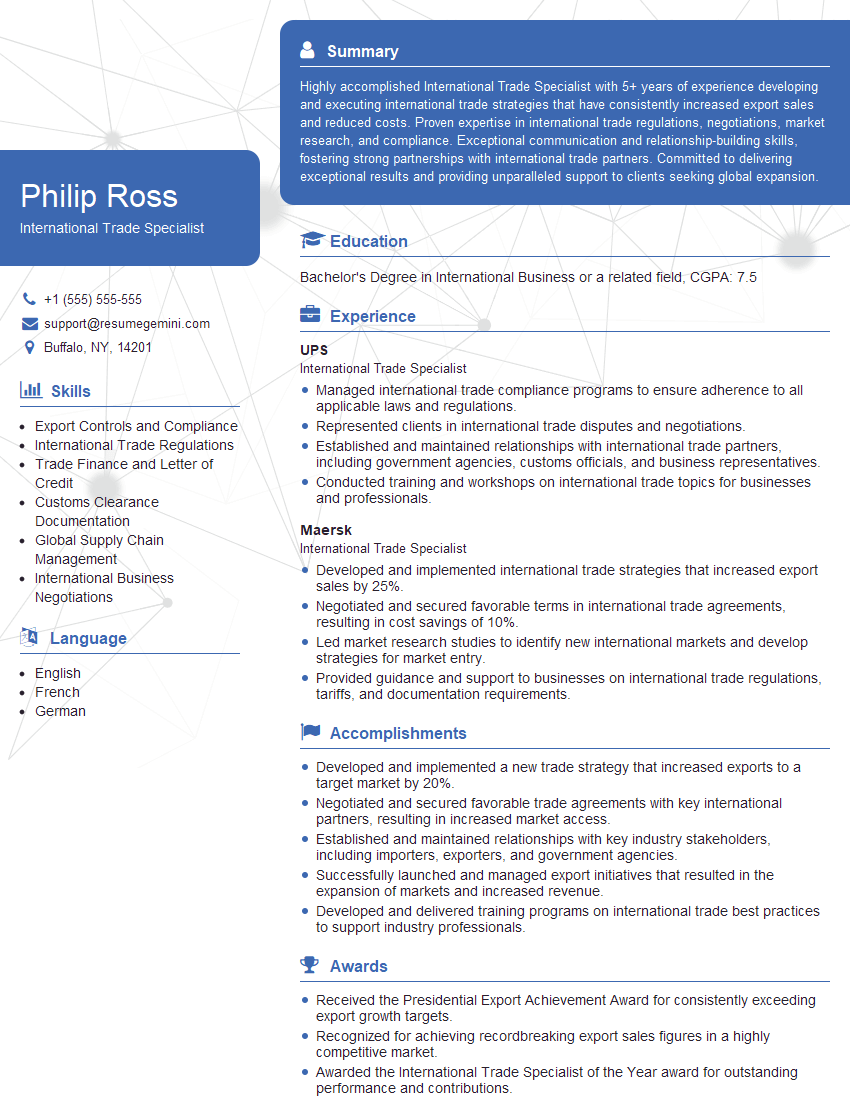
International Trade Specialist Resume Sample
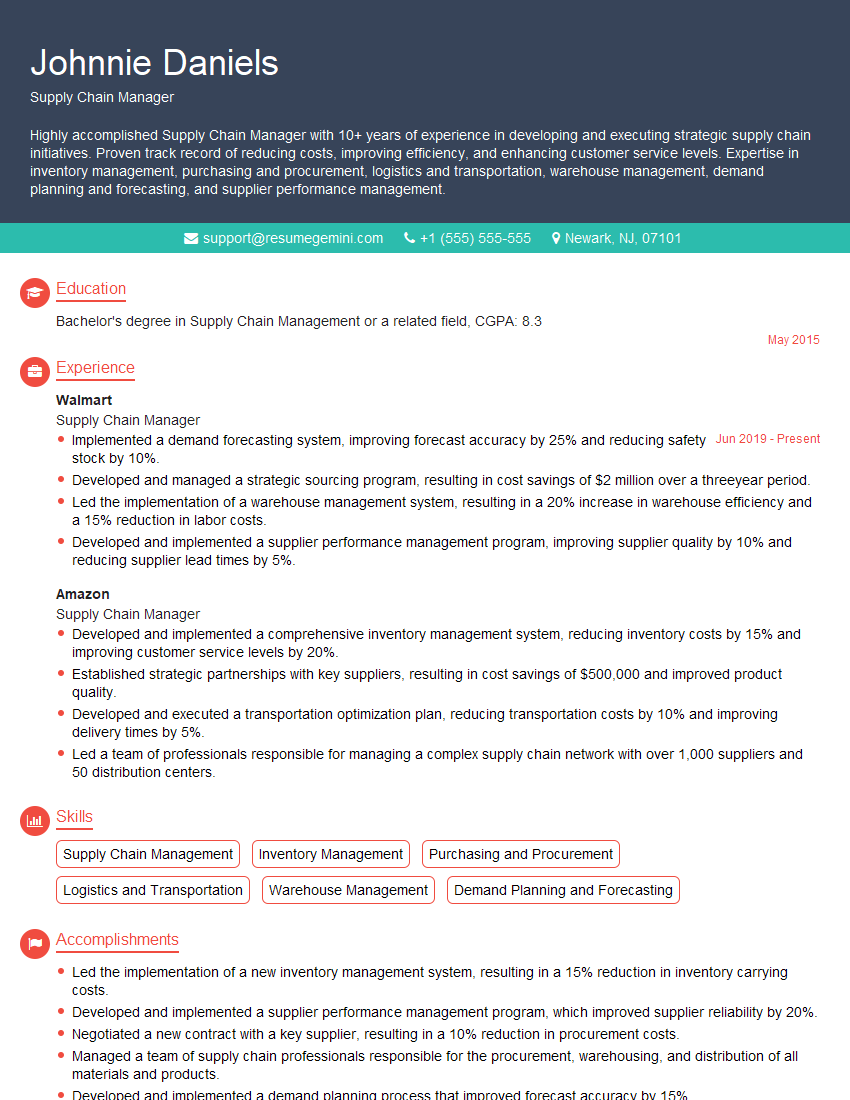
Supply Chain Manager Resume Sample
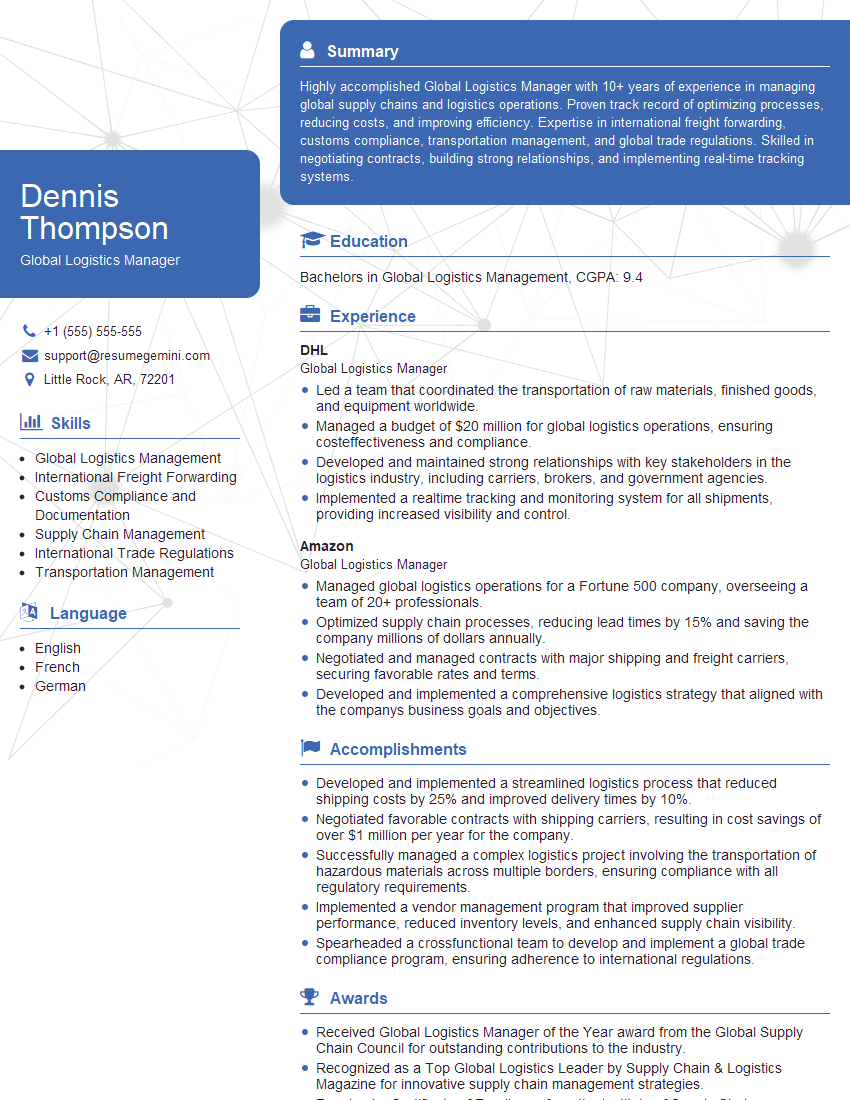
Global Logistics Manager Resume Sample
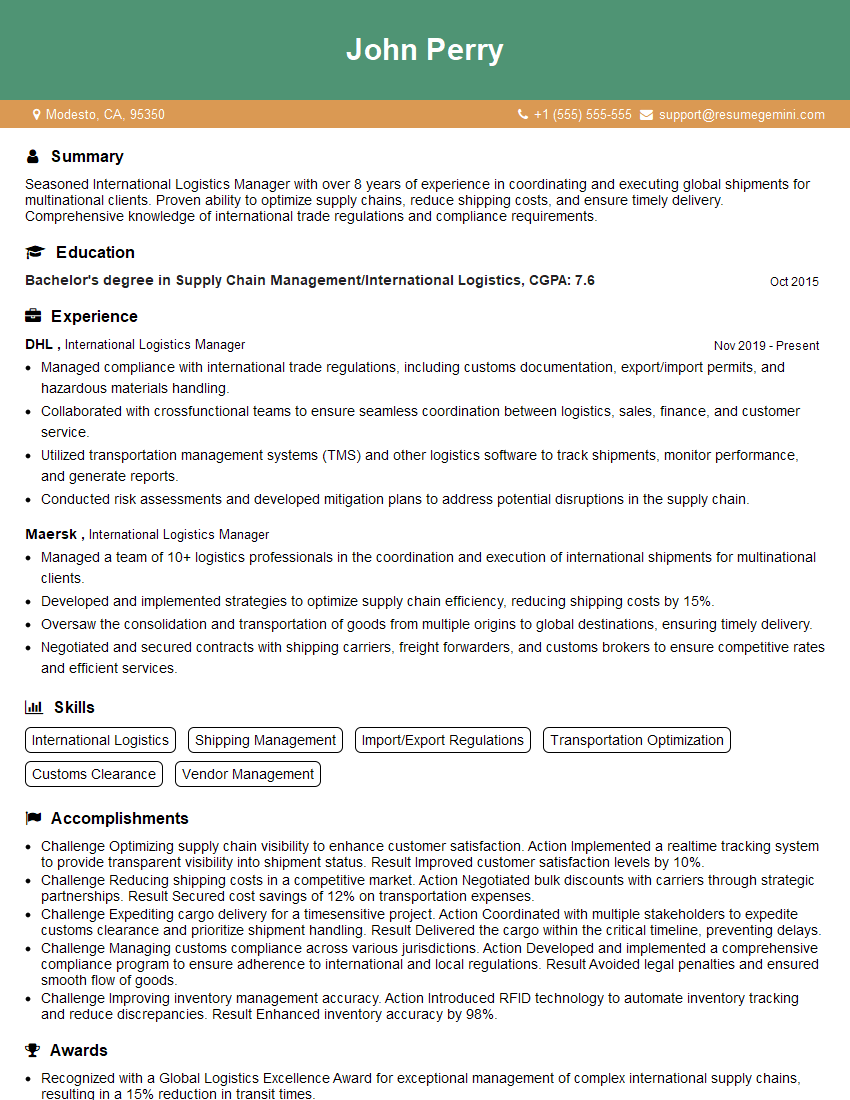
International Logistics Manager Resume Sample
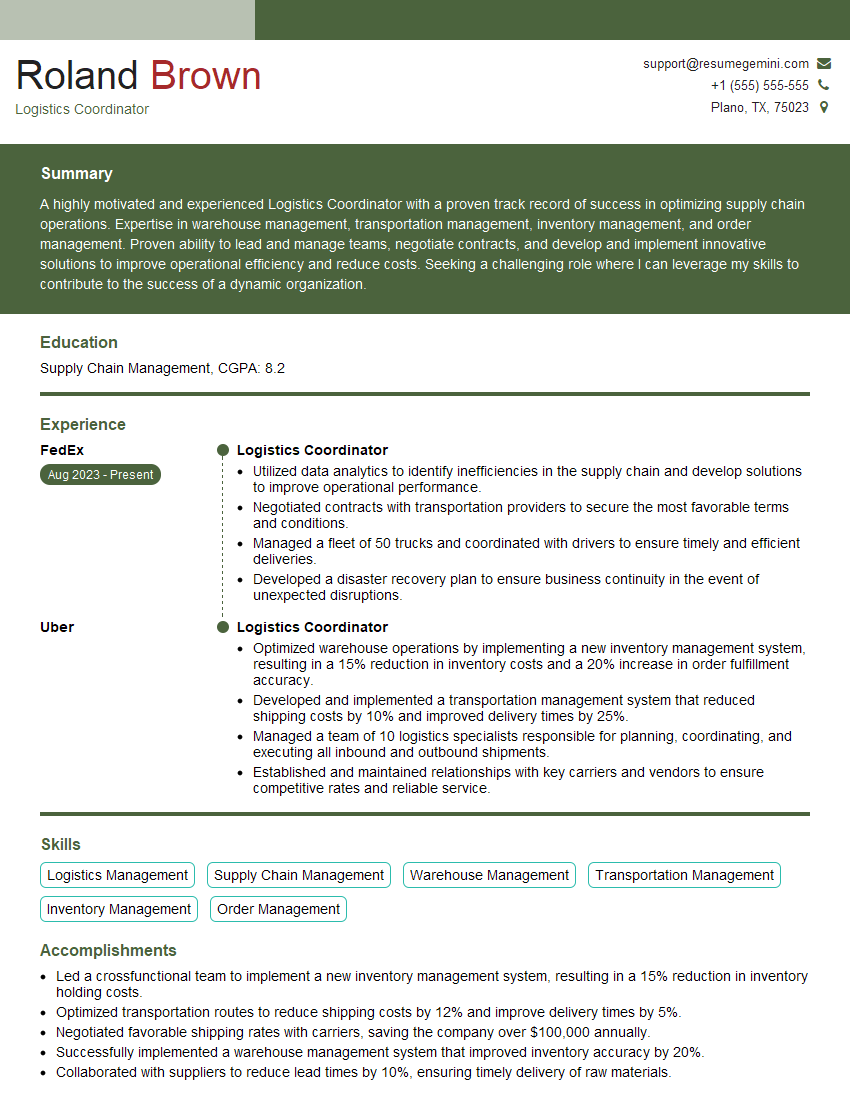
Logistics Coordinator Resume Sample
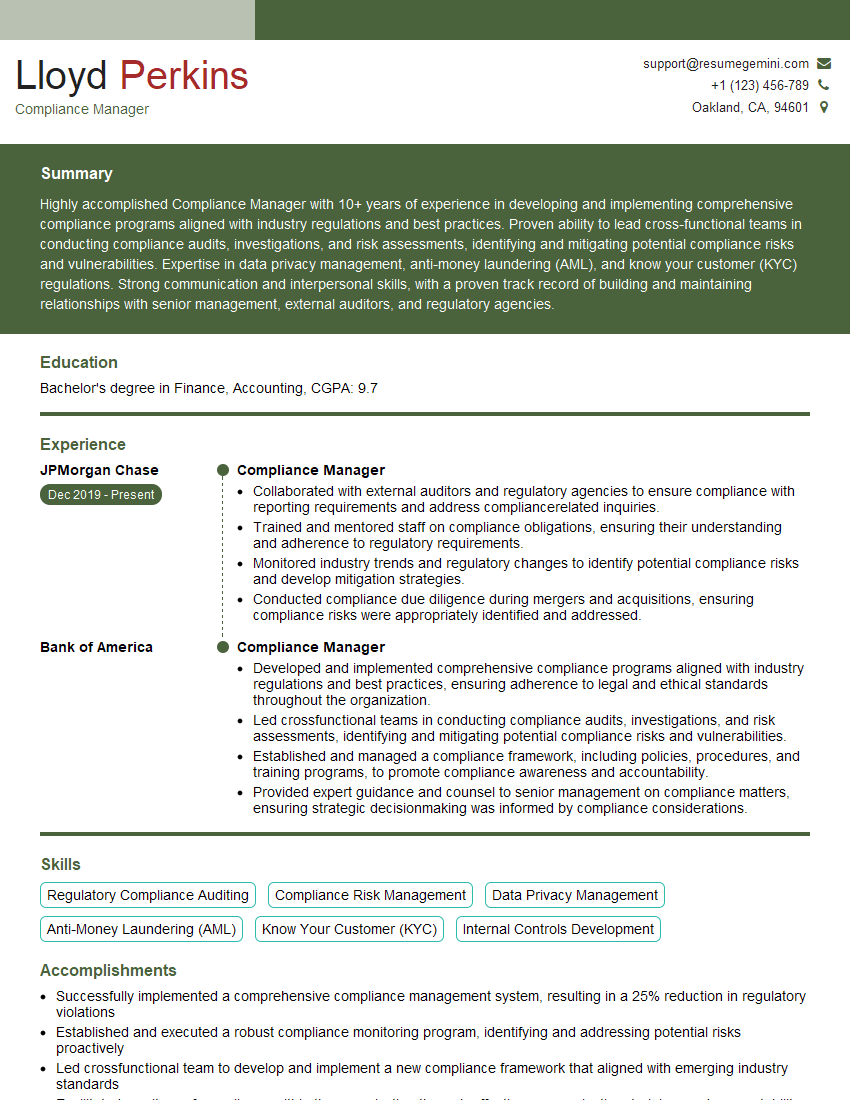
Compliance Manager Resume Sample
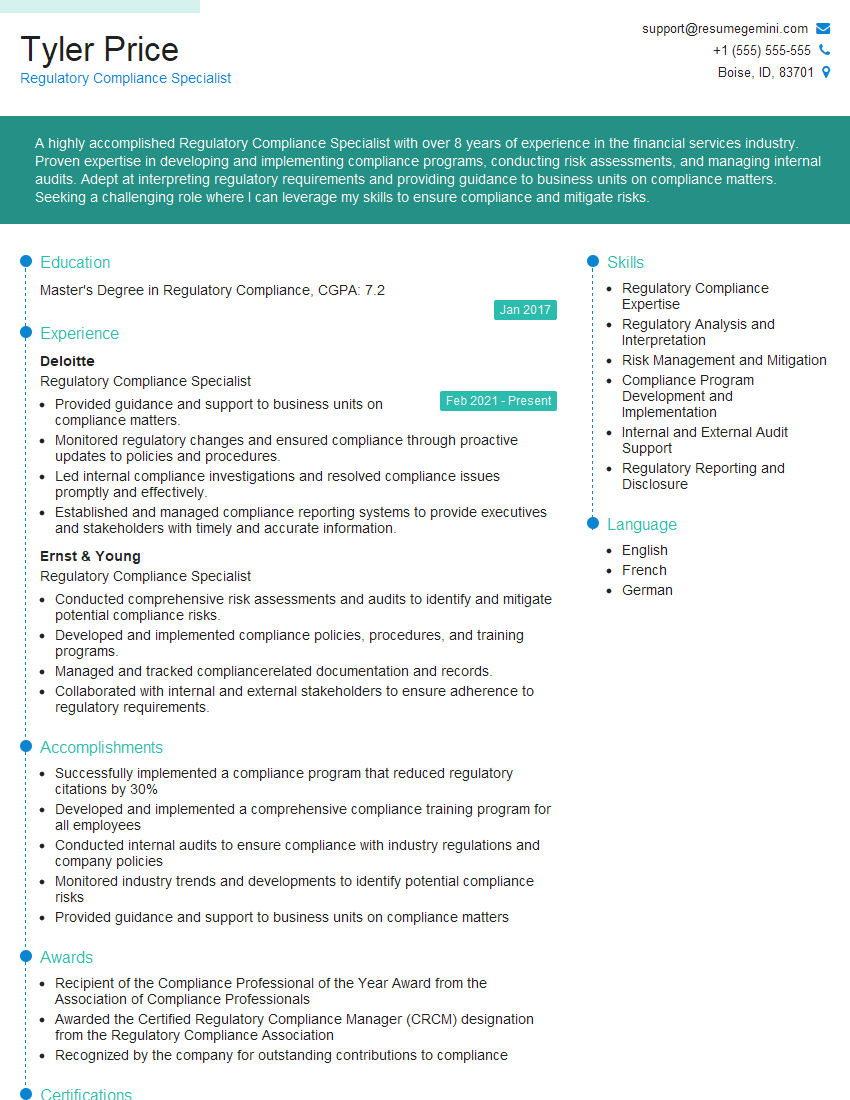
Regulatory Compliance Specialist Resume Sample
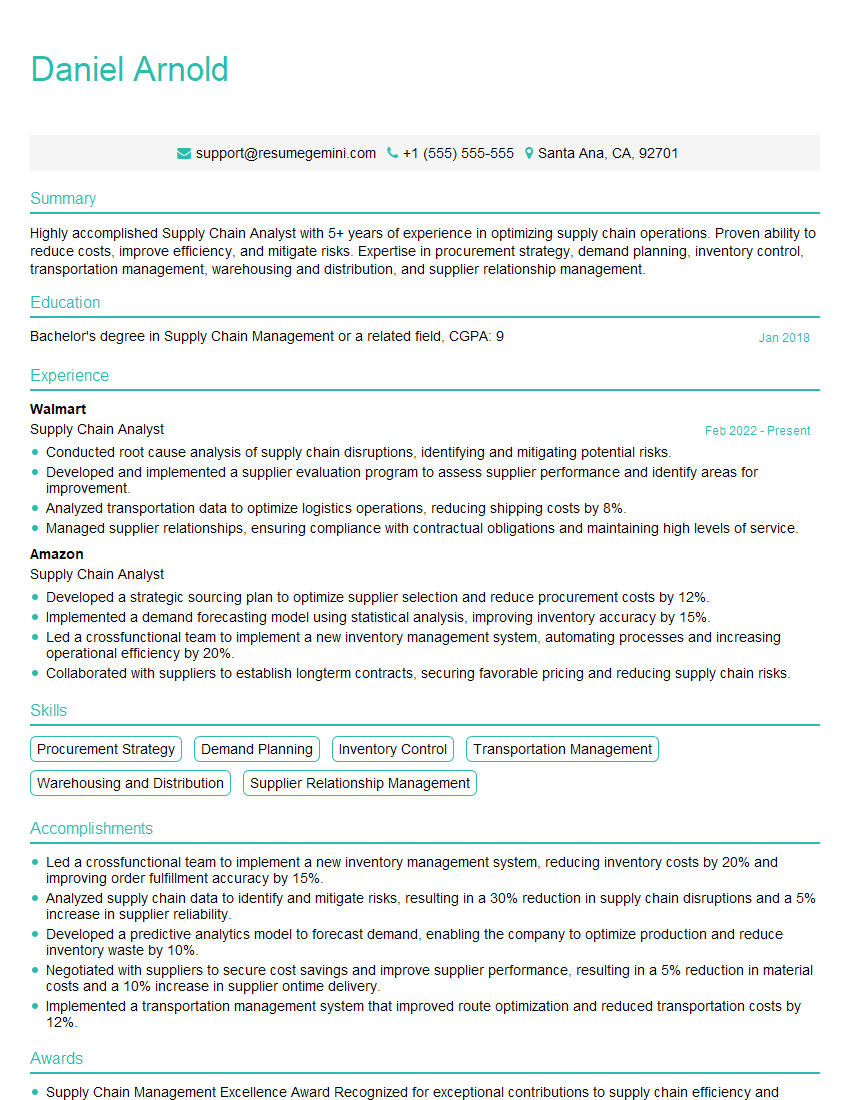
Supply Chain Analyst Resume Sample
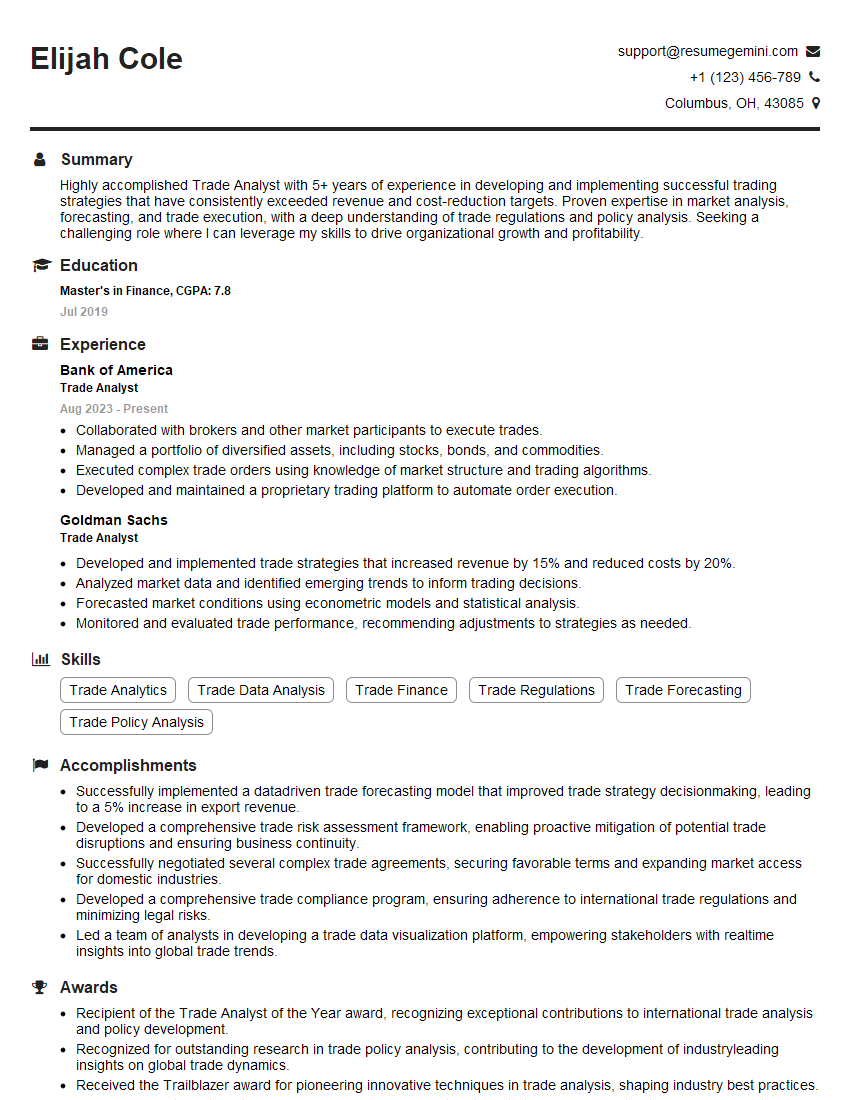
Trade Analyst Resume Sample
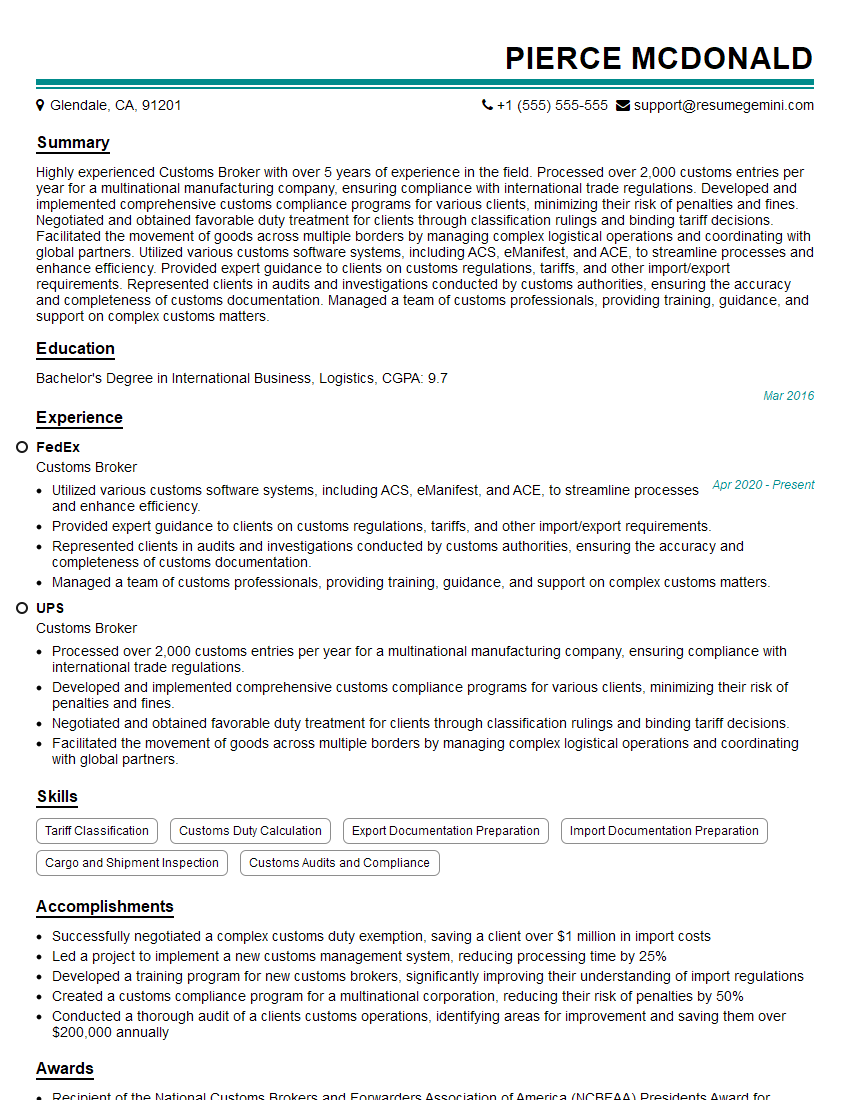
Customs Broker Resume Sample
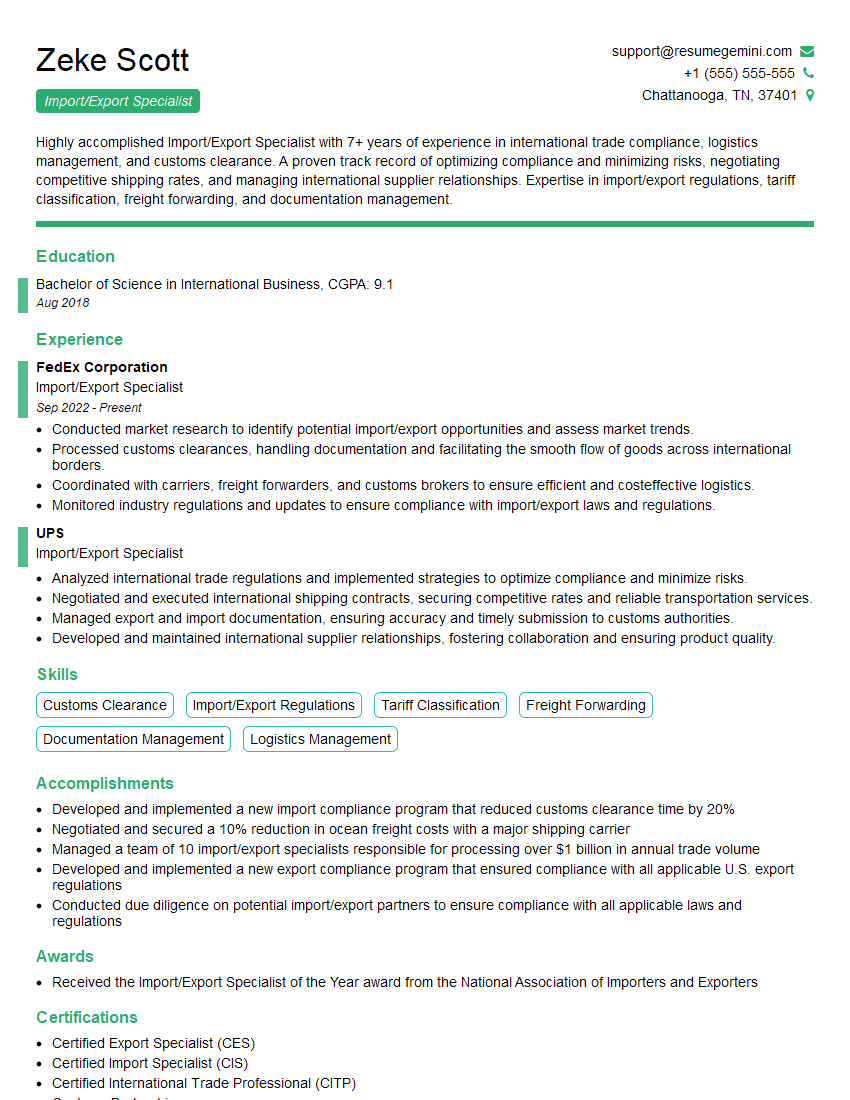
Import/Export Specialist Resume Sample
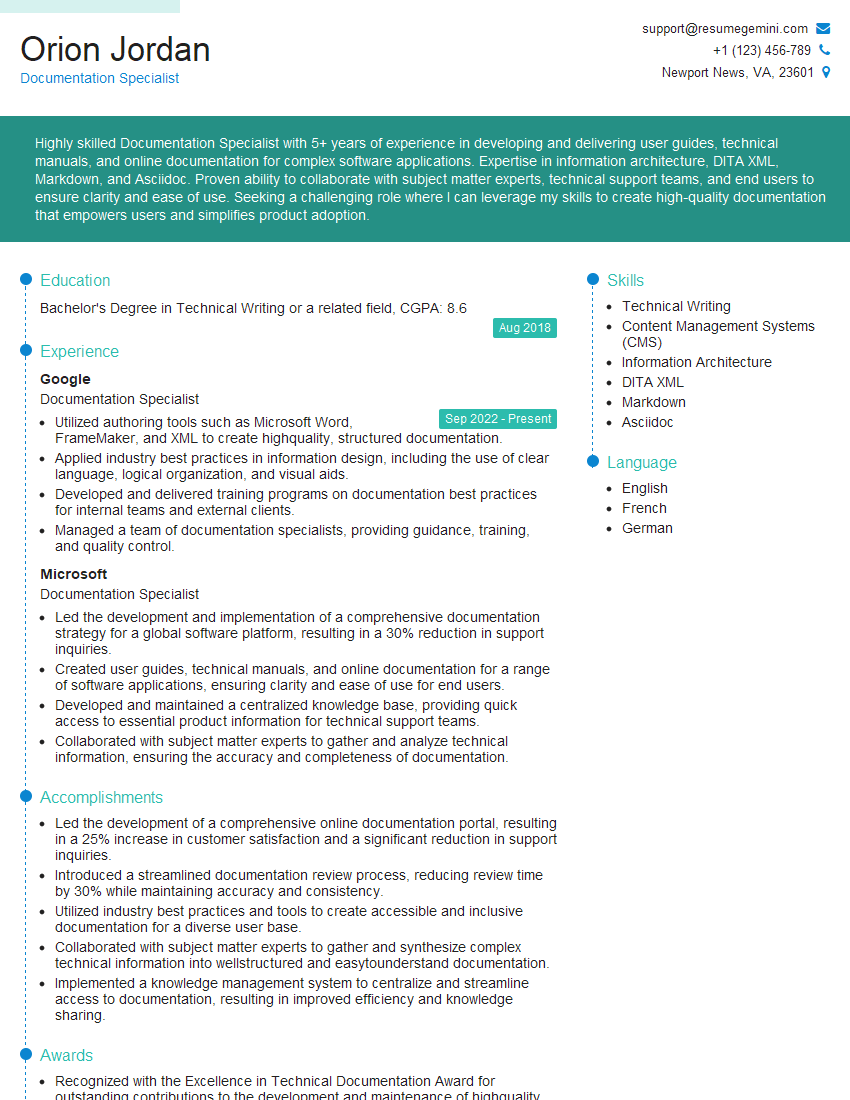
Documentation Specialist Resume Sample
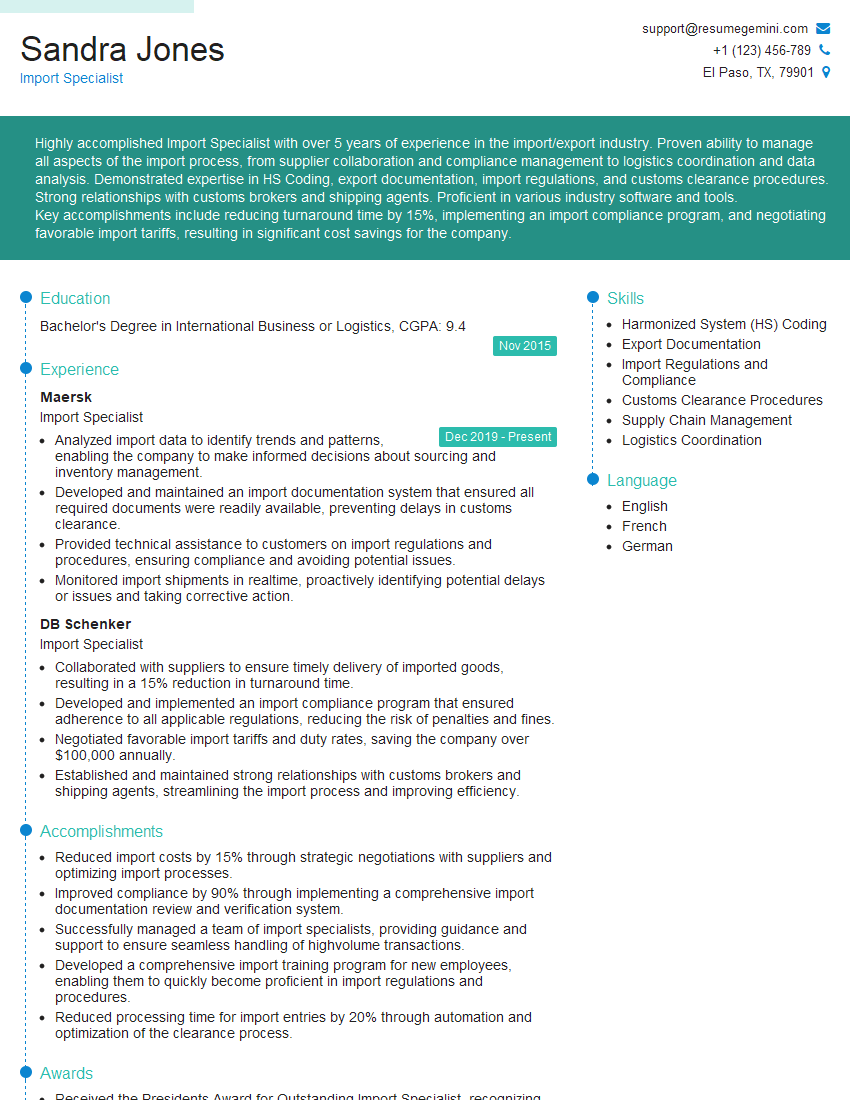
Import Specialist Resume Sample
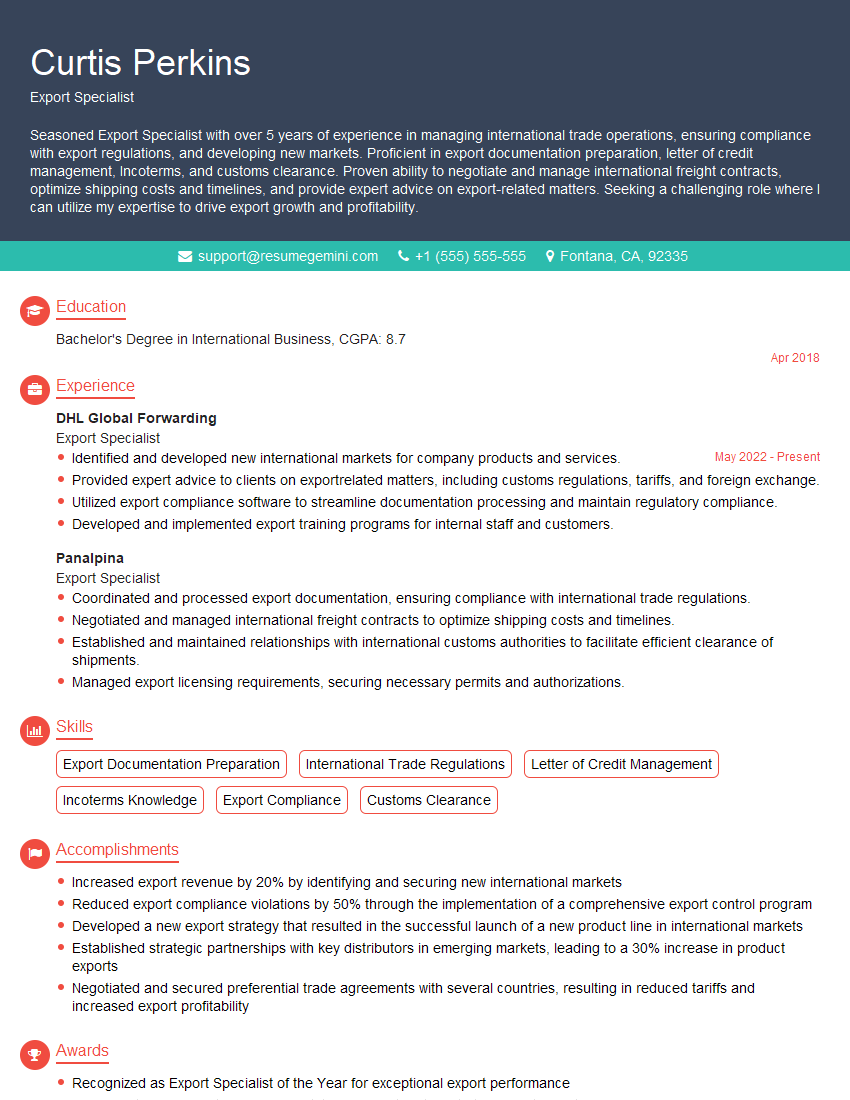
Export Specialist Resume Sample
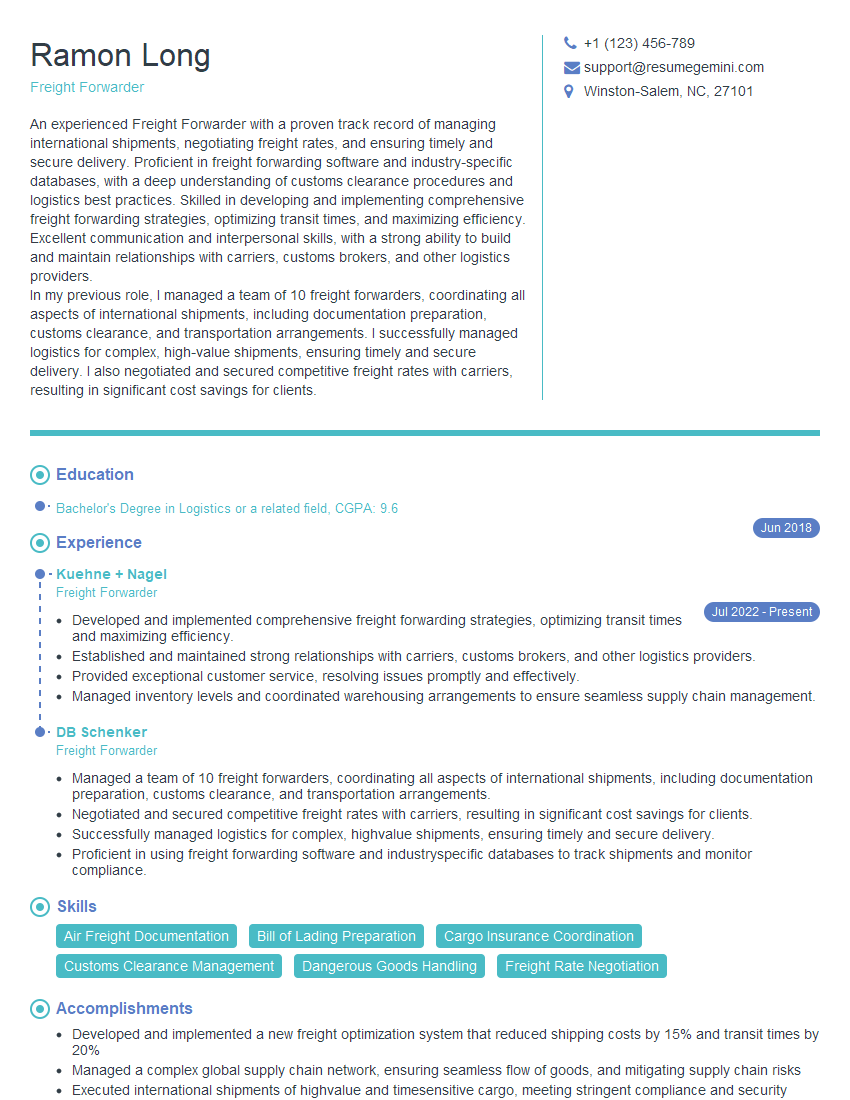
Freight Forwarder Resume Sample
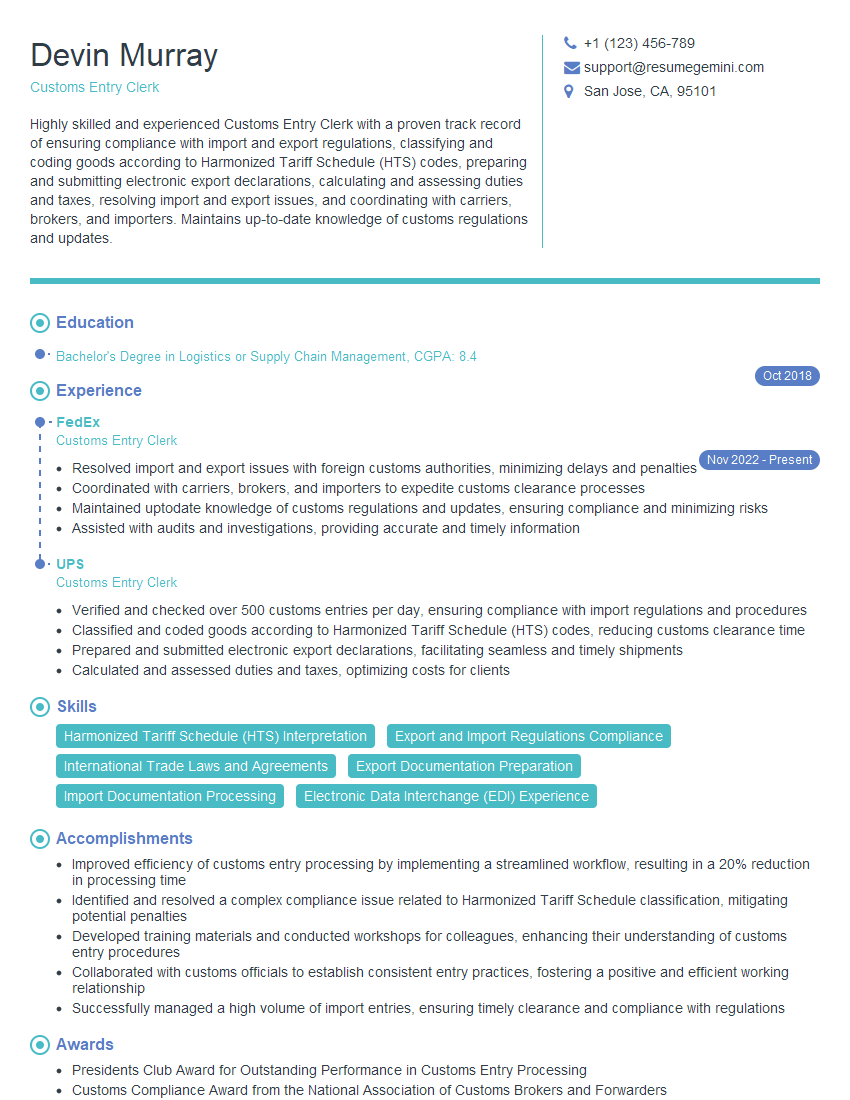
Customs Entry Clerk Resume Sample
- International Trade Specialist
- Supply Chain Manager
- Global Logistics Manager
- International Logistics Manager
- Logistics Coordinator
- Compliance Manager
- Regulatory Compliance Specialist
- Supply Chain Analyst
- Trade Analyst
- Customs Broker
- Import/Export Specialist
- Documentation Specialist
- Import Specialist
- Export Specialist
- Freight Forwarder
- Customs Entry Clerk
Explore more articles
Users Rating of Our Blogs
Share Your Experience
We value your feedback! Please rate our content and share your thoughts (optional).
What Readers Say About Our Blog
Really detailed insights and content, thank you for writing this detailed article.
IT gave me an insight and words to use and be able to think of examples