Interviews are more than just a Q&A session—they’re a chance to prove your worth. This blog dives into essential Data Acquisition System interview questions and expert tips to help you align your answers with what hiring managers are looking for. Start preparing to shine!
Questions Asked in Data Acquisition System Interview
Q 1. Explain the different types of data acquisition systems.
Data Acquisition Systems (DAS) come in various forms, categorized primarily by their application and scale. Think of them as tools to translate the real world – temperature, pressure, voltage, etc. – into digital data a computer can understand.
- Standalone DAS: These are self-contained units with integrated sensors, signal conditioning, and data storage. They are ideal for simple applications requiring minimal processing, like logging temperature in a greenhouse.
- Modular DAS: Offering greater flexibility, these systems allow users to choose and combine different modules for signal conditioning, A/D conversion, and data storage based on specific needs. Imagine building a system to monitor multiple parameters in a manufacturing process, each requiring different signal conditioning.
- Software-defined DAS: These leverage programmable hardware and software to customize the system’s functionality, offering maximum flexibility and scalability for complex applications, such as research experiments requiring intricate data handling.
- Embedded DAS: Often integrated directly into a device or machine, these systems acquire data for specific operational purposes, providing real-time feedback or control. Examples include monitoring engine parameters in a vehicle or managing sensor data in a smart home appliance.
Q 2. Describe the key components of a typical data acquisition system.
A typical DAS comprises several key components working in concert. Consider it like an orchestra where each section plays a crucial role.
- Sensors: These are the ‘ears and eyes’ of the system, converting physical phenomena into measurable signals (e.g., thermocouples for temperature, strain gauges for pressure).
- Signal Conditioning: This stage prepares the sensor signals for accurate conversion. Think of it as a ‘sound engineer’ refining the raw sounds before they reach the recording equipment.
- Analog-to-Digital Converter (ADC): The heart of the DAS, this component converts the analog sensor signals into digital data that a computer can process. This is the crucial step in making the physical world understandable to the digital realm.
- Data Acquisition Hardware: This includes the physical components like the ADC, multiplexers (for selecting multiple signals), and interfaces (connecting the system to a computer).
- Data Acquisition Software: This provides the user interface, data logging, and analysis capabilities. It’s the ‘conductor’ of the system, managing the data and providing meaningful insights.
- Computer/Processor: This is the ‘brains’ of the operation, storing, processing, and analyzing the acquired data.
Q 3. What are the common signal conditioning techniques used in data acquisition?
Signal conditioning is essential for ensuring the accuracy and reliability of the acquired data. It’s like prepping ingredients before cooking – improves the final dish.
- Amplification: Weak signals from sensors are amplified to improve their signal-to-noise ratio.
- Filtering: Removes unwanted noise and interference from the signals, using techniques like low-pass, high-pass, or band-pass filtering.
- Linearization: Corrects non-linear sensor responses, transforming them into a linear output for easier processing.
- Isolation: Protects the DAS from ground loops and voltage spikes that could damage components or introduce errors.
- Shielding: Reduces electromagnetic interference (EMI) by shielding the signal wires and components.
Q 4. Explain the concept of sampling rate and its impact on data accuracy.
Sampling rate refers to how often the ADC measures and converts the analog signal into a digital value. Think of taking snapshots of a moving object – higher frequency snapshots capture more detail.
The Nyquist-Shannon sampling theorem states that the sampling rate must be at least twice the highest frequency component present in the signal to avoid aliasing. Aliasing introduces errors, essentially misrepresenting the signal. A too-low sampling rate will miss crucial information, leading to inaccurate representation.
For example, if you are measuring a 1 kHz signal, you need at least a 2 kHz sampling rate. Using a lower sampling rate would result in an inaccurate, lower-frequency representation of the signal.
Q 5. How do you handle noise in a data acquisition system?
Noise is unavoidable in data acquisition, like static on a radio. Mitigation involves various strategies.
- Hardware Techniques: Shielding, grounding, and using differential amplifiers help reduce noise at the source.
- Software Techniques: Digital filtering (like averaging, smoothing, or using more advanced filters like Kalman filters) removes noise in the processed data.
- Signal Averaging: Repeatedly measuring the signal and averaging the results reduces random noise components.
Selecting appropriate sensors and signal conditioning techniques is crucial in minimizing noise from the start. For instance, using shielded cables and proper grounding can drastically improve signal quality.
Q 6. What are the different types of analog-to-digital converters (ADCs)?
ADCs are classified based on their architecture and conversion techniques. Each has strengths and weaknesses depending on the application.
- Successive Approximation ADC: A common and relatively fast type, it converts the analog voltage by successively comparing it to a series of reference voltages.
- Flash ADC: Extremely fast but expensive and power-hungry, it uses a network of comparators to simultaneously compare the input voltage to multiple reference voltages.
- Sigma-Delta ADC: Offers high resolution at lower speeds, using oversampling and digital filtering to achieve high accuracy.
- Integrating ADC: These ADCs provide excellent noise rejection but are relatively slow. They integrate the input signal over a specific time period before converting it.
Q 7. Describe the process of calibrating a data acquisition system.
Calibration ensures the DAS provides accurate and reliable measurements. It’s like regularly checking the accuracy of a scale.
The process involves comparing the DAS output to known standards under controlled conditions. This usually includes:
- Establishing a baseline: Measure the output with known input values (e.g., applying known voltages or temperatures to the input).
- Creating a calibration curve: This curve plots the relationship between the known input and the measured output. This curve compensates for any non-linearities or offsets.
- Applying calibration corrections: Software algorithms use the calibration curve to correct the raw data obtained during measurements.
Calibration is crucial for maintaining accuracy and traceability of results, especially in applications requiring high precision, like medical devices or industrial control systems.
Q 8. Explain the concept of data logging and its importance in data acquisition.
Data logging is the automated process of recording measurements over time. Think of it like a diligent note-taker for your sensors. In data acquisition (DAQ), it’s crucial because it allows us to collect vast amounts of data, far exceeding what a human could manually record. This data forms the basis for analysis, identifying trends, patterns, and anomalies that might otherwise go unnoticed. For example, a geologist might log seismic activity to predict earthquakes, or a manufacturing plant might log machine performance to prevent breakdowns and optimize production.
Its importance lies in its ability to provide:
- Historical Data: Tracking changes over time, allowing for analysis of long-term trends.
- Anomaly Detection: Identifying unusual events or deviations from normal operation.
- Process Optimization: Understanding system behavior to improve efficiency and performance.
- Improved Decision Making: Providing objective data for better, data-driven decisions.
Q 9. What are some common data acquisition software packages?
Many software packages exist for data acquisition, each with its own strengths and weaknesses. The choice often depends on the application, budget, and required features. Some popular examples include:
- LabVIEW (National Instruments): A graphical programming environment widely used in research and industry, offering extensive DAQ capabilities and strong community support.
- DASYLab: A popular tool for building DAQ applications with a user-friendly interface, suitable for various applications ranging from simple logging to complex process control.
- Python with libraries like PyVISA and PyDAQmx: Python’s versatility and its numerous libraries provide powerful and flexible DAQ solutions, especially for users comfortable with programming.
- MATLAB with Data Acquisition Toolbox: MATLAB’s powerful numerical computing capabilities combined with its DAQ toolbox make it suitable for complex data analysis and signal processing tasks.
- Specialized software from hardware vendors: Many hardware manufacturers (e.g., NI, Agilent, Yokogawa) provide their own proprietary software tailored to their specific equipment.
Q 10. How do you ensure data integrity in a data acquisition system?
Ensuring data integrity in a DAQ system is paramount. Compromised data can lead to flawed conclusions and costly mistakes. Here’s a multi-pronged approach:
- Calibration and Verification: Regularly calibrate sensors and instruments to ensure accuracy. Verify the system’s performance with known inputs.
- Redundancy and Cross-checking: Employ redundant sensors or measurement techniques to compare results and detect inconsistencies.
- Data Validation: Implement checks within the software to detect and flag improbable or impossible values (e.g., negative temperature readings from a non-cryogenic system).
- Error Handling: The software should gracefully handle errors, logging details of any failures or anomalies encountered.
- Secure Storage: Store data in a secure location with backups to prevent data loss or unauthorized access.
- Data Logging Practices: Implement proper timestamping and clear identification of data sources to maintain traceability.
- Metadata Management: Meticulously document all aspects of the system, including sensor specifications, calibration details, and experimental setup. This is crucial for reproducibility and future analysis.
For instance, in a weather station, redundant temperature sensors and a robust data logging system with error checks ensure accurate, reliable data, even in harsh conditions.
Q 11. Explain the difference between real-time and non-real-time data acquisition.
The key difference lies in the timing of data processing and application. Imagine a security camera system:
- Real-time data acquisition involves immediate processing and action based on incoming data. Think of a real-time security system that immediately triggers an alarm if it detects motion. The data is processed as it arrives, with minimal delay.
- Non-real-time data acquisition collects data, but the processing and analysis occur later. This is like recording a video from the security camera and reviewing it later to identify any suspicious activity. The system may store the data for later analysis, allowing for offline processing and visualization.
Real-time systems often require faster hardware and more sophisticated software than non-real-time systems, as they need to respond to events as they happen. The choice between real-time and non-real-time acquisition depends on the application’s requirements. For example, monitoring a nuclear reactor requires real-time processing for immediate safety interventions; analyzing long-term weather patterns allows for non-real-time analysis.
Q 12. Describe different data acquisition system architectures.
DAQ system architectures vary widely depending on the application. Some common architectures include:
- Centralized Architecture: All data acquisition hardware is connected to a central computer for processing and storage. This is simple to implement but can be a bottleneck if the system scales significantly.
- Distributed Architecture: Data acquisition is distributed among multiple computers or processors. This improves scalability and resilience, enabling parallel processing of data streams from numerous sensors.
- Client-Server Architecture: One or more client devices gather data and send it to a central server for storage, analysis, and visualization. This is especially useful in networked systems, allowing remote monitoring and control.
- Embedded Systems: DAQ systems are embedded directly within the device being monitored, often processing data locally before transmitting a summary or relevant information. This minimizes communication overhead and improves real-time responsiveness.
The choice of architecture is driven by factors such as the number of sensors, required processing power, geographic distribution, and real-time requirements.
Q 13. What are some common communication protocols used in data acquisition?
Many communication protocols are used in DAQ systems, depending on factors such as speed, distance, and cost. Here are some common ones:
- RS-232: A serial communication standard often used for short-distance, low-speed data transmission. It’s simple and inexpensive but limited in speed and distance.
- RS-485: A robust serial communication standard suitable for longer distances and noisy environments. It supports multi-drop configurations, meaning multiple devices can share the same communication line.
- USB: A widely used high-speed serial bus, offering plug-and-play functionality and high bandwidth. It’s particularly convenient for connecting many devices to a computer.
- Ethernet: A high-speed network protocol offering robust data transfer over long distances. Ideal for networked DAQ systems with high bandwidth requirements.
- GPIB (IEEE-488): A parallel communication bus commonly used in instrumentation and test systems. It provides high data transfer rates and allows for talker/listener communication between devices.
- Modbus: A widely adopted industrial communication protocol used in many industrial control systems and SCADA applications.
Q 14. How do you troubleshoot problems in a data acquisition system?
Troubleshooting a DAQ system requires a systematic approach. Here’s a methodology:
- Identify the Problem: Clearly define the symptoms. Is there a sensor malfunction? Is the data inaccurate? Is there a communication issue?
- Check Connections: Inspect all hardware connections, ensuring proper cabling and power supply. Look for loose connections, broken wires, or faulty connectors.
- Test Individual Components: Isolate each component (sensors, signal conditioners, data logger) and test its functionality independently to pinpoint the faulty part.
- Review Software Configuration: Check the DAQ software’s settings, including sampling rates, trigger conditions, and data filtering. Errors in configuration can lead to inaccurate or incomplete data.
- Examine Data Logs: Analyze the recorded data for inconsistencies, errors, or anomalies. This often provides clues about the source of the problem.
- Consult Documentation: Review the documentation for the hardware and software to understand their specifications, limitations, and troubleshooting procedures.
- Seek Expert Assistance: If the problem persists, consult with technical support or experienced DAQ engineers for further assistance.
For example, if a temperature sensor is consistently reading low, you might first check the sensor’s calibration, then its wiring, and finally, consider the possibility of a sensor fault.
Q 15. Explain the concept of data synchronization in a multi-channel data acquisition system.
Data synchronization in a multi-channel data acquisition system ensures that data from different channels are accurately aligned in time. Imagine you’re recording a concert with multiple microphones – you need all the audio tracks to line up perfectly, or the recording will be a mess. Similarly, in a multi-channel system, each channel might be sampling data at slightly different rates or have different latencies. Synchronization techniques are crucial for accurate analysis and interpretation of the combined data.
Several methods achieve this. Hardware synchronization utilizes a common clock signal distributed to all channels, guaranteeing near-simultaneous sampling. This is often preferred for high-speed applications where precise timing is critical. Software synchronization involves timestamping each data point from each channel and then aligning the data based on these timestamps during post-processing. This approach offers flexibility but can introduce minor inaccuracies if the timestamps aren’t perfectly precise.
For example, consider a system monitoring vibrations in a machine. Multiple accelerometers at different locations will be recording data. If the system isn’t synchronized, you might wrongly correlate a vibration at point A with a completely unrelated event at point B, leading to faulty conclusions about the machine’s health.
Career Expert Tips:
- Ace those interviews! Prepare effectively by reviewing the Top 50 Most Common Interview Questions on ResumeGemini.
- Navigate your job search with confidence! Explore a wide range of Career Tips on ResumeGemini. Learn about common challenges and recommendations to overcome them.
- Craft the perfect resume! Master the Art of Resume Writing with ResumeGemini’s guide. Showcase your unique qualifications and achievements effectively.
- Don’t miss out on holiday savings! Build your dream resume with ResumeGemini’s ATS optimized templates.
Q 16. What are the challenges associated with high-speed data acquisition?
High-speed data acquisition presents numerous challenges. The primary challenge is the sheer volume of data generated. This necessitates high-bandwidth data transfer paths, fast processing units, and efficient data storage solutions to avoid data loss or significant delays. Consider a high-speed camera capturing images at 1000 frames per second; processing and storing this massive data stream requires considerable resources.
- Data throughput limitations: Analog-to-digital converters (ADCs) and other components may not be fast enough to handle the high sample rates.
- Latency: Delays in data transfer and processing can lead to inaccurate results, especially in time-critical applications.
- Jitter: Variations in the timing of data acquisition can introduce noise and errors.
- Data storage and processing: Storing and processing terabytes of data per day demands powerful computing infrastructure.
- Cost: High-speed DAQ systems tend to be expensive.
Overcoming these challenges often involves using specialized high-speed ADCs, parallel data acquisition techniques, efficient data compression algorithms, and powerful processing hardware.
Q 17. How do you select appropriate sensors for a data acquisition application?
Selecting appropriate sensors is paramount to successful data acquisition. The choice depends entirely on the application’s specific requirements and the physical parameters you need to measure. It’s like choosing the right tools for a job; you wouldn’t use a hammer to screw in a screw.
The selection process involves:
- Identifying the measurand: What exactly are you trying to measure? (e.g., temperature, pressure, acceleration).
- Defining measurement range and accuracy: What’s the expected range of values, and how precise do the measurements need to be?
- Considering environmental factors: Will the sensor be exposed to harsh conditions (e.g., high temperature, humidity, vibration)?
- Evaluating sensor specifications: Review the sensor’s datasheet to ensure it meets the required specifications (accuracy, resolution, bandwidth, linearity, etc.).
- Checking compatibility: Ensure the sensor’s output signal is compatible with your data acquisition system.
For instance, if you’re measuring the temperature of a furnace, you’d choose a high-temperature thermocouple or RTD sensor. For precise pressure measurements in a vacuum chamber, you’d need a high-accuracy pressure transducer. Always carefully consider the sensor’s specifications and limitations to avoid errors and ensure reliable data acquisition.
Q 18. Explain the importance of grounding and shielding in data acquisition.
Grounding and shielding are crucial for minimizing noise and interference in data acquisition systems. Think of it like building a house – a good foundation (grounding) and strong walls (shielding) protect the structure from external factors. Without proper grounding and shielding, your measurements can be corrupted by electromagnetic interference (EMI) from nearby equipment or power lines, leading to inaccurate and unreliable results.
Grounding establishes a common reference point for electrical signals, reducing ground loops and preventing voltage differences that can introduce noise. It’s essential to have a clean, low-impedance ground connection throughout the entire system.
Shielding protects the signal wires from external electromagnetic fields. Shielded cables have a conductive layer (often braided copper) surrounding the signal wires, acting as a Faraday cage to reduce EMI. Shielding should be properly grounded to be effective.
Failing to properly ground and shield a system can result in noisy signals, inaccurate measurements, and even damage to sensitive equipment. For example, a poorly grounded ECG (electrocardiogram) machine might pick up interference from nearby electrical devices, making it difficult to interpret the heart signals accurately.
Q 19. What are the considerations for data storage and management in a data acquisition system?
Data storage and management in a data acquisition system are critical for efficient data analysis and archiving. The volume of data generated can be immense, requiring careful planning for storage and retrieval. Consider the needs of a wind farm monitoring system – thousands of sensors are collecting data continuously.
Key considerations include:
- Storage capacity: The system needs sufficient storage capacity to accommodate the expected volume of data.
- Data format: A standard and efficient data format (e.g., HDF5, NetCDF) should be chosen for easy storage, access, and analysis.
- Data compression: Compression techniques can reduce storage requirements, but they should not compromise data integrity.
- Data organization: Data should be organized logically and consistently to facilitate retrieval and analysis. Metadata (information about the data) is essential here.
- Data backup and archiving: A robust backup and archiving strategy is vital to protect against data loss.
- Data security: Access control and security measures should be in place to prevent unauthorized access or modification.
Using a database management system (DBMS) can help streamline data storage, organization, and retrieval. It allows for efficient querying and analysis of large datasets.
Q 20. How do you ensure the security of data acquired from a system?
Ensuring the security of acquired data is vital, particularly in applications where sensitive information is involved (e.g., medical data, financial transactions). Security breaches can lead to significant consequences, from data corruption to legal ramifications.
Data security measures include:
- Access control: Restricting access to the data acquisition system and stored data to authorized personnel only.
- Data encryption: Encrypting the data both during transmission and at rest to prevent unauthorized access.
- Network security: Implementing firewalls and intrusion detection systems to protect the system from network attacks.
- Regular security audits: Performing regular audits to identify and address security vulnerabilities.
- User authentication: Strong password policies and multi-factor authentication to prevent unauthorized logins.
- Data integrity checks: Implementing mechanisms to verify the integrity of the data and detect any tampering.
For example, in a medical device, ensuring data security is critical for patient privacy and the integrity of the diagnosis.
Q 21. Describe your experience with different data acquisition hardware.
Throughout my career, I’ve worked extensively with various data acquisition hardware, ranging from simple standalone devices to complex, multi-channel systems. My experience includes using National Instruments (NI) data acquisition (DAQ) devices, such as the NI cDAQ-9178 chassis with various C Series modules. These modules offer flexibility, allowing for simultaneous acquisition of various signal types (analog, digital, counter/timer).
I’ve also utilized data acquisition boards from other manufacturers like Measurement Computing, primarily focusing on their USB-based DAQ devices for smaller-scale applications requiring less channels and data rate. Additionally, I’ve worked with embedded systems where the DAQ functionality was integrated directly onto the microcontroller using its built-in ADCs. The selection of hardware was always driven by the specifics of the project including the number of channels, required sample rate, signal type and budget.
My experience spans applications from environmental monitoring where accuracy and long-term stability were crucial to high-speed vibration analysis which demands high sample rates and precise synchronization. This varied experience allows me to select the most appropriate hardware and software tools for any given data acquisition challenge.
Q 22. What programming languages are you proficient in for data acquisition applications?
My proficiency in programming languages for data acquisition spans several key areas. I’m highly experienced with Python, leveraging its extensive libraries like numpy, scipy, and pandas for data manipulation, analysis, and visualization. Python’s versatility makes it ideal for both data acquisition control and post-processing. I also have significant expertise in C/C++, crucial for low-level programming and real-time control, especially when interacting directly with hardware and embedded systems. Furthermore, I’m comfortable with LabVIEW, a graphical programming environment particularly well-suited for designing and implementing data acquisition systems, especially in instrumentation and automation contexts. Finally, I have experience using MATLAB for advanced signal processing and analysis of acquired data.
For instance, in a recent project involving high-speed sensor data acquisition, I used C++ for real-time data capturing due to its speed and efficiency, then switched to Python with pandas to efficiently manage and analyze the large datasets generated.
Q 23. How familiar are you with different data formats used in data acquisition?
Data acquisition systems employ a variety of data formats, each with its strengths and weaknesses. I’m familiar with several common ones. Binary formats are efficient for storage and transmission, but require specific software for interpretation. Common examples include raw binary data or custom binary file formats tailored to a specific sensor or instrument. I have extensive experience working with these, often writing custom parsers for efficiency. Text-based formats like CSV (Comma Separated Values) or TSV (Tab Separated Values) are human-readable and easily processed by spreadsheet software and scripting languages. They are less efficient in terms of storage space but offer convenient data exchange. HDF5 (Hierarchical Data Format version 5) is a powerful format ideal for managing very large, complex datasets, commonly used in scientific applications where metadata and data organization are crucial. It supports efficient data access and compression, which is vital when dealing with high-volume data acquisition. I also have experience with specialized formats like those used by specific instrument manufacturers or those dictated by specific industry standards. My experience includes converting between these formats to ensure data compatibility and usability across different systems and software.
Q 24. Explain your experience with real-time operating systems (RTOS) in data acquisition.
Real-Time Operating Systems (RTOS) are essential in data acquisition when dealing with time-critical applications requiring precise timing and deterministic behavior. I’ve worked extensively with RTOS like VxWorks and FreeRTOS. These systems guarantee timely execution of tasks, critical for applications needing synchronized data capture from multiple sources or immediate responses to sensor readings. In one project, using FreeRTOS, we developed a system for acquiring high-frequency data from multiple accelerometers on a moving platform. The deterministic nature of FreeRTOS was critical to ensuring data integrity and accurate synchronization, enabling us to precisely reconstruct the platform’s movements. Understanding RTOS scheduling algorithms, interrupt handling, and memory management is paramount; I’m proficient in all these aspects and can tailor the RTOS configuration to meet specific application needs, such as minimizing latency or optimizing resource utilization.
Q 25. Describe your experience with designing and implementing data acquisition systems.
My experience encompasses the entire lifecycle of data acquisition system design and implementation, from initial requirements gathering to deployment and maintenance. I’ve led teams in designing systems for various applications, including environmental monitoring, industrial process control, and scientific research. This includes selecting appropriate hardware components (sensors, analog-to-digital converters (ADCs), data loggers, communication interfaces), designing the data flow architecture, developing the firmware or software for data acquisition and control, and implementing data validation and error handling mechanisms. For example, in an environmental monitoring project, I designed a system using wireless sensor networks to acquire data from remote locations. This involved selecting low-power sensors, designing a robust communication protocol, and developing algorithms to handle data transmission errors. Furthermore, the system included a cloud-based component for data storage, processing and visualization.
Q 26. How do you handle large volumes of data acquired from a system?
Handling large volumes of data effectively requires a strategic approach. My strategy involves several key steps. First, data compression techniques, such as lossless compression (e.g., gzip) or more advanced algorithms, reduce storage space and transmission bandwidth requirements. Second, employing efficient data structures (e.g., HDF5) optimized for fast data access and retrieval is crucial. Third, I often implement data streaming and buffering techniques; data is processed in chunks or streams, rather than loading everything into memory at once. This prevents memory overload and allows for real-time processing. Fourth, database technologies like PostgreSQL or MongoDB are used for structured or unstructured data storage and retrieval, providing indexing and efficient querying capabilities. Finally, distributing data processing using techniques like parallel processing and cloud computing improves speed and scalability. In a recent project involving terabytes of sensor data, we successfully implemented a distributed processing pipeline using Apache Spark, allowing for real-time data analysis and visualization.
Q 27. Explain your experience with different data analysis techniques.
My experience with data analysis techniques spans a broad range. Signal processing techniques, such as filtering, Fourier transforms, and wavelet analysis, are commonly applied to clean up noisy data and extract relevant features. Statistical analysis provides insights into data distributions, correlations, and trends. I use various statistical methods, including regression analysis, hypothesis testing, and time series analysis. Machine learning algorithms, such as supervised and unsupervised learning techniques, are employed for pattern recognition, anomaly detection, and predictive modeling, extracting valuable information from complex datasets. For instance, in a project analyzing sensor data from a manufacturing process, I used machine learning to predict equipment failures before they occurred, significantly reducing downtime. Furthermore, data visualization plays a crucial role; tools such as matplotlib, seaborn, and interactive dashboards are used to effectively communicate insights and findings.
Q 28. Describe your experience with cloud-based data acquisition systems.
Cloud-based data acquisition systems offer scalability, accessibility, and remote management capabilities. I have experience designing and implementing systems using cloud platforms like AWS (Amazon Web Services) and Azure. This includes setting up cloud infrastructure, configuring data storage services (e.g., S3, Azure Blob Storage), implementing secure data transfer protocols, and developing cloud-based data processing pipelines. For instance, in a project requiring remote monitoring of several environmental sensors, we used AWS IoT Core to securely collect data from remote sensors, then stored the data in AWS S3 for long-term archiving and analysis. Using AWS Lambda, we triggered data processing jobs automatically upon new data arrival. This architecture provided scalability and allowed for cost-effective data management. Security is paramount in cloud-based systems. I have expertise implementing security measures such as encryption, access control lists, and secure communication protocols to protect sensitive data.
Key Topics to Learn for Data Acquisition System Interview
- Sensors and Transducers: Understanding various sensor types (temperature, pressure, acceleration, etc.), their operating principles, and signal conditioning techniques. Consider practical applications like choosing the right sensor for a specific application and dealing with sensor noise.
- Signal Conditioning: Mastering amplification, filtering, and analog-to-digital conversion (ADC). Explore real-world scenarios involving noise reduction, signal amplification for weak signals, and selecting appropriate ADC resolution and sampling rates.
- Data Acquisition Hardware: Familiarize yourself with different DAQ architectures, including single-board DAQ devices, modular DAQ systems, and embedded systems. Think about the trade-offs between cost, performance, and flexibility in selecting the right hardware for a project.
- Data Acquisition Software: Gain proficiency in using DAQ software packages and programming languages (e.g., LabVIEW, Python with libraries like PyDAQmx) for data acquisition, processing, and analysis. Practice designing user interfaces and automating data logging processes.
- Data Communication Protocols: Understand common communication protocols used in DAQ systems (e.g., RS-232, RS-485, Ethernet, USB, Wireless) and their respective advantages and limitations. Consider scenarios involving communication protocol selection and troubleshooting communication errors.
- Data Storage and Management: Learn about different methods for storing and managing large datasets acquired from DAQ systems, including databases, cloud storage, and file systems. Discuss strategies for data organization, version control, and data security.
- Real-time Systems and Embedded Systems: Explore the principles of real-time data acquisition and processing, including timing constraints and scheduling algorithms. Consider designing data acquisition systems for embedded applications with limited resources.
- Troubleshooting and Calibration: Develop your skills in identifying and resolving common issues in DAQ systems, including hardware malfunctions, software bugs, and inaccurate measurements. Understand the importance of sensor calibration and data validation.
Next Steps
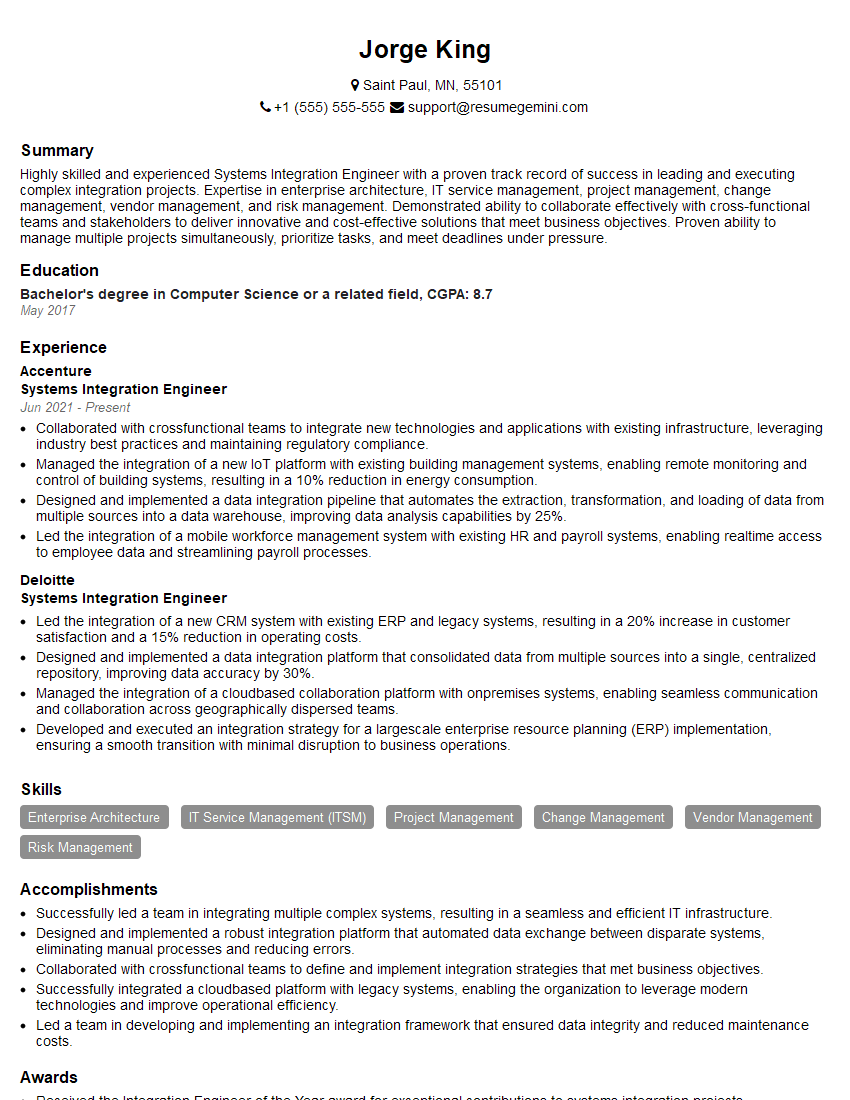
Mastering Data Acquisition Systems opens doors to exciting careers in diverse fields, offering opportunities for innovation and problem-solving. To maximize your job prospects, building an ATS-friendly resume is crucial. ResumeGemini can help you create a compelling and effective resume that showcases your skills and experience. ResumeGemini provides examples of resumes tailored to Data Acquisition System roles, giving you a head start in crafting a professional document that will impress potential employers. Take the next step towards your dream career today!
Explore more articles
Users Rating of Our Blogs
Share Your Experience
We value your feedback! Please rate our content and share your thoughts (optional).
What Readers Say About Our Blog
Really detailed insights and content, thank you for writing this detailed article.
IT gave me an insight and words to use and be able to think of examples