Every successful interview starts with knowing what to expect. In this blog, we’ll take you through the top Design for Reliability and Maintainability interview questions, breaking them down with expert tips to help you deliver impactful answers. Step into your next interview fully prepared and ready to succeed.
Questions Asked in Design for Reliability and Maintainability Interview
Q 1. Explain the difference between reliability and maintainability.
Reliability and maintainability are both crucial aspects of product design, but they focus on different aspects of a system’s lifecycle. Reliability refers to the probability that a system will perform its intended function without failure for a specified period under stated conditions. Think of it as the system’s ability to *do its job* without breaking down. Maintainability, on the other hand, focuses on the ease and speed with which a system can be restored to operational status after a failure. This encompasses aspects like ease of repair, access to components, availability of spare parts, and the time it takes to fix it. Essentially, reliability is about *preventing* failure, while maintainability is about *recovering* from failure efficiently.
Imagine a car: Reliability is the likelihood it will start and drive reliably for, say, 100,000 miles without major issues. Maintainability is how easy it is to fix a flat tire, replace a broken headlight, or perform routine maintenance like an oil change. A highly reliable car might still need maintenance, and a highly maintainable car might still experience occasional breakdowns.
Q 2. Describe your experience with Failure Modes and Effects Analysis (FMEA).
I have extensive experience conducting Failure Modes and Effects Analysis (FMEA). In my previous role at [Company Name], I led FMEA teams for the design of [Product Name], systematically identifying potential failure modes across all system components. This involved using a structured approach to:
- Identifying potential failure modes: We brainstormed possible ways each component could fail, considering factors like wear and tear, environmental conditions, and manufacturing defects.
- Assessing the severity of each failure: We rated the severity of each failure mode on a scale, considering its impact on safety, performance, and cost.
- Determining the probability of each failure: We estimated the likelihood of each failure mode occurring, based on historical data, testing, and expert judgment.
- Identifying the detection mechanisms: We looked at how likely each failure would be detected before it caused significant problems. This includes built-in safety features, testing procedures, and operator training.
- Developing risk mitigation strategies: Based on the severity, probability, and detection, we prioritized actions to reduce the risk of each failure. This might involve redesigning components, improving manufacturing processes, or implementing additional testing.
The FMEA process allowed us to proactively address potential problems, improving the overall reliability and safety of the [Product Name]. For example, an FMEA on the [Specific Component] identified a potential for overheating, leading us to implement a revised cooling system, significantly reducing the risk of failure.
Q 3. How do you calculate Mean Time Between Failures (MTBF)?
Mean Time Between Failures (MTBF) is a key metric indicating the average time a system operates before experiencing a failure. It’s calculated by dividing the total operating time of a system by the number of failures observed during that time. The formula is:
MTBF = Total operating time / Number of failuresFor example, if a system operates for 10,000 hours and experiences 2 failures during that time, the MTBF is 5,000 hours (10,000 hours / 2 failures). It’s crucial to note that MTBF is an average and doesn’t predict individual failure times. A high MTBF generally indicates high reliability. However, it should always be considered in context with the operational conditions and system usage.
Accurate calculation requires comprehensive data collection of operational hours and failures. Data can be sourced from field performance data, accelerated life testing, or historical records. If the failure data does not follow an exponential distribution, more sophisticated statistical methods might be necessary.
Q 4. What are some common reliability testing methods?
Several methods are used for reliability testing, each with its strengths and weaknesses:
- Accelerated Life Testing (ALT): This involves subjecting components or systems to more stressful conditions (higher temperature, voltage, vibration) than normally encountered to accelerate the aging process and observe failures in a shorter time. This is efficient but requires careful extrapolation to normal operating conditions.
- Environmental Stress Screening (ESS): This involves exposing components to various environmental stresses (temperature cycling, vibration, humidity) to identify and eliminate early failures before deployment.
- Highly Accelerated Life Testing (HALT): This pushes components to their limits to identify failure modes and design weaknesses quickly. It’s often used early in the design process for rapid prototyping.
- Failure-in-Time Testing: This involves running systems or components continuously until a predetermined number of failures occur. It’s useful for estimating failure rates.
- Burn-in Testing: This involves operating components at their normal stress level for an extended period, often at elevated temperatures, to eliminate infant mortality and improve long-term reliability.
The choice of method depends on factors like the product’s complexity, testing time constraints, and available resources. Often, a combination of techniques is utilized for a thorough reliability assessment.
Q 5. Explain the concept of Mean Time To Repair (MTTR).
Mean Time To Repair (MTTR) is the average time it takes to repair a failed system or component and restore it to operational status. It’s a crucial maintainability metric, indicating how quickly a system can be brought back online after a failure. A low MTTR is desirable as it minimizes downtime and operational disruptions. The formula is similar to MTBF:
MTTR = Total repair time / Number of repairsFor example, if five repairs took a total of 25 hours, the MTTR is 5 hours (25 hours / 5 repairs). MTTR is influenced by factors such as the complexity of the repair, the availability of spare parts, the skill level of maintenance personnel, and the design for maintainability of the system itself. Reducing MTTR often involves improved system design (modular design, easy access to components), enhanced diagnostic tools, and improved training for maintenance personnel.
Q 6. How do you use reliability block diagrams?
Reliability Block Diagrams (RBDs) are graphical representations of a system’s reliability. They show how the reliability of individual components contributes to the overall system reliability. Each component is represented by a block, and the connections between blocks represent the system architecture. Using RBDs, we can model different system configurations (series, parallel, or a combination) and calculate the overall system reliability based on the reliability of individual components.
For example, in a series system, a failure in any component causes the entire system to fail. The overall system reliability is the product of the individual component reliabilities. In a parallel system, the system fails only if all components fail. RBDs help identify critical components whose failure has the most significant impact on system reliability. This information can guide design decisions, allowing for the prioritization of higher-reliability components in critical sections or the addition of redundancy to improve the overall system robustness.
Software tools can assist in the analysis of complex RBDs, allowing for quick recalculation of system reliability if the component reliability changes.
Q 7. What are some key metrics used to measure reliability and maintainability?
Several key metrics are used to measure reliability and maintainability:
- MTBF (Mean Time Between Failures): Average time between failures.
- MTTR (Mean Time To Repair): Average time to repair a failure.
- Availability: The percentage of time a system is operational. Often calculated as: Availability = MTBF / (MTBF + MTTR)
- Failure Rate: The number of failures per unit time.
- Mean Time To Failure (MTTF): Average time until a system fails (usually applies to non-repairable systems).
- Downtime: The total time a system is not operational.
- Mean Time To Diagnose (MTTD): Average time to identify a failure.
- Maintainability Index: A dimensionless metric representing the maintainability of a system.
These metrics provide valuable insights into system performance, enabling informed decisions to improve reliability and maintainability. Effective monitoring and tracking of these metrics are crucial for continuous improvement and optimization.
Q 8. Describe your experience with Fault Tree Analysis (FTA).
Fault Tree Analysis (FTA) is a top-down, deductive reasoning technique used to analyze the causes of system failures. It starts with a specific undesirable event, called the ‘top event,’ and works backward to identify the various combinations of lower-level events that could lead to that top event. Think of it like tracing the branches of an upside-down tree, where each branch represents a possible failure mode.
In my experience, I’ve used FTA extensively in various projects, from analyzing the potential failures of a complex aerospace system to identifying vulnerabilities in a manufacturing process. For example, in one project involving an automated guided vehicle (AGV) system, we used FTA to determine the root causes of potential AGV collisions. The top event was ‘AGV Collision.’ We then systematically identified contributing factors, such as sensor failure, software glitches, communication network issues, and even human error during programming or maintenance. Each of these factors was further broken down into more basic events until we reached the level of individual component failures. This allowed us to identify critical components that required more rigorous testing or design improvements. The FTA results are typically presented in a graphical tree format, which makes it easy to visualize the various failure pathways and prioritize mitigation efforts.
Q 9. How do you incorporate reliability considerations into the design process?
Reliability considerations should be integrated into the design process from the very beginning, not as an afterthought. This proactive approach, often termed ‘Design for Reliability’ (DfR), significantly reduces costs and improves the overall product quality. It involves a structured process.
- Early Failure Mode and Effects Analysis (FMEA): Identify potential failure modes, their effects, and their likelihood early in the design phase. This allows for proactive mitigation strategies.
- Reliability-Based Design: Selecting components and materials with known high reliability characteristics. This might involve using derating techniques, where components are operated well below their rated capacity to extend lifespan.
- Redundancy and Fault Tolerance: Incorporating backup systems or components to ensure system functionality even in case of single-point failures. Think of a backup power supply in a critical system or redundant sensors in an aircraft.
- Robust Design: Designing the system to be less sensitive to variations in environmental conditions or manufacturing tolerances. This often involves statistical methods to optimize design parameters.
- Simulation and Modeling: Using simulations to predict system behavior under various stress conditions and identify potential weaknesses before physical prototyping. This is particularly helpful for complex systems.
For example, in a telecommunications project, we used a robust design approach to minimize signal degradation due to environmental factors. Through simulations, we tested the system’s tolerance to temperature variations and electromagnetic interference, and adjusted the design parameters to ensure reliable signal transmission even under challenging conditions.
Q 10. Explain the concept of Availability.
Availability refers to the probability that a system will be operational and performing its intended function at a given point in time. It’s a key metric in assessing system reliability and performance, particularly for critical systems where downtime is costly or dangerous. Availability is often expressed as a percentage or a fraction.
The formula for availability (A) is often represented as:
A = MTBF / (MTBF + MTTR)Where:
- MTBF (Mean Time Between Failures): The average time a system operates before it fails.
- MTTR (Mean Time To Repair): The average time it takes to repair a failed system and restore its functionality.
A high MTBF and a low MTTR lead to high availability. Consider a hospital’s life support system; high availability is paramount. Design choices like redundant components and quick repair procedures directly impact availability.
Q 11. How do you perform a root cause analysis for a system failure?
Root Cause Analysis (RCA) is a systematic process to identify the fundamental causes of a system failure, going beyond just identifying the symptoms. It aims to prevent similar failures in the future. Various methods exist, but a common approach involves these steps:
- Data Collection: Gather detailed information about the failure, including timelines, witness accounts, system logs, and any available diagnostic data.
- Timeline Creation: Develop a chronological sequence of events leading to the failure.
- ‘5 Whys’ Analysis: Repeatedly ask ‘Why?’ to delve deeper into the causes of the failure, eventually uncovering the root cause. This can be especially useful for simpler failures.
- Fishbone Diagram (Ishikawa Diagram): A visual tool to brainstorm and organize potential root causes categorized into different categories (e.g., materials, methods, manpower, machinery, environment).
- Fault Tree Analysis (FTA): As described earlier, a powerful technique to systematically trace back the various failure paths.
- Corrective Actions: Based on the identified root cause(s), implement actions to prevent recurrence. This could involve design changes, process improvements, training, or procedural updates.
For instance, if a server consistently crashes, a simple ‘5 Whys’ approach might uncover the root cause: Why did the server crash? (Overheating). Why did it overheat? (Insufficient cooling). Why was the cooling insufficient? (Faulty fan). Why was the fan faulty? (Lack of preventive maintenance). The root cause, therefore, is inadequate maintenance.
Q 12. What is the difference between preventive and corrective maintenance?
Preventive maintenance is proactive; it’s scheduled maintenance performed to prevent failures before they occur. Think of it as routine checkups. Corrective maintenance, on the other hand, is reactive; it’s performed after a failure has occurred to restore the system to its operational state. It’s like fixing a broken appliance.
Examples of preventive maintenance include regular lubrication of machinery, scheduled software updates, and periodic inspections of safety systems. Corrective maintenance might involve replacing a failed component, repairing a damaged circuit board, or debugging a software bug. While corrective maintenance is essential, a robust preventive maintenance program significantly reduces the frequency and severity of failures, thereby minimizing downtime and improving overall system availability.
Q 13. How do you measure and improve maintainability?
Maintainability refers to the ease with which a system can be maintained, including tasks such as troubleshooting, repair, and modification. It’s crucial for minimizing downtime and cost. Measuring and improving maintainability involves several metrics and strategies:
- Mean Time To Repair (MTTR): As discussed earlier, a lower MTTR indicates better maintainability.
- Mean Time To Diagnose (MTTD): The average time to identify the cause of a failure. Reducing MTTD improves efficiency.
- Repair Cost: The cost associated with repairs, including labor, parts, and downtime.
- Maintainability Index: A quantitative measure often expressed as a percentage, reflecting the ease of maintenance.
- Modular Design: Designing the system with easily replaceable modules simplifies troubleshooting and repair. This allows for quicker repairs and reduces the need for highly skilled technicians.
- Diagnostics: Implementing built-in diagnostic tools to speed up fault identification.
- Documentation: Clear and comprehensive documentation, including repair manuals and schematics, significantly enhances maintainability.
For example, consider a modular computer system. The modular design allows for easy replacement of failed components, minimizing downtime and repair costs compared to a system where replacing a single component necessitates replacing the entire unit.
Q 14. Describe your experience with reliability growth testing.
Reliability growth testing is a process used to systematically improve the reliability of a system during its development and testing phases. It involves iterative testing, failure analysis, and design improvements. The goal is to identify and eliminate failure modes, thereby increasing the system’s reliability over time.
In my experience, we’ve employed various reliability growth models like the Duane model, which tracks the failure rate over time. By plotting the cumulative failures against the cumulative test time, we can observe whether the failure rate is decreasing, indicating reliability growth. This testing process often involves:
- Planned Testing: A structured testing program with carefully defined test conditions and duration.
- Failure Data Collection: Meticulously documenting all failures, including their causes, and associated test parameters.
- Design Improvements: Implementing design changes and corrective actions based on failure analysis to address identified weaknesses.
- Statistical Analysis: Applying statistical methods to track reliability growth and predict future reliability.
For a software application, we might use reliability growth testing to identify and fix bugs during the beta testing phase. By tracking the number of bugs reported and fixed over time, we can quantify the reliability improvement and determine when the software is ready for release.
Q 15. What are some common causes of equipment failures?
Equipment failures stem from a variety of sources, broadly categorized into design flaws, manufacturing defects, and operational issues.
- Design flaws: These include inadequate material selection leading to premature wear or fatigue, insufficient safety margins against expected stresses, and poor component integration resulting in vibration or stress concentration. For instance, using a material with insufficient corrosion resistance in a humid environment could lead to rapid degradation.
- Manufacturing defects: Imperfect welds, cracks, or dimensional inaccuracies introduced during manufacturing can significantly impact equipment reliability. A poorly calibrated machine might produce components outside the required tolerances.
- Operational issues: Improper use, inadequate maintenance, environmental factors (extreme temperature, humidity, or vibration), and operator error can also contribute to failures. Overloading a motor beyond its rated capacity, for instance, will lead to overheating and eventual burnout.
Identifying the root cause of a failure involves meticulous investigation, often employing techniques like Failure Mode and Effects Analysis (FMEA) and root cause analysis (RCA) methodologies.
Career Expert Tips:
- Ace those interviews! Prepare effectively by reviewing the Top 50 Most Common Interview Questions on ResumeGemini.
- Navigate your job search with confidence! Explore a wide range of Career Tips on ResumeGemini. Learn about common challenges and recommendations to overcome them.
- Craft the perfect resume! Master the Art of Resume Writing with ResumeGemini’s guide. Showcase your unique qualifications and achievements effectively.
- Don’t miss out on holiday savings! Build your dream resume with ResumeGemini’s ATS optimized templates.
Q 16. Explain the concept of redundancy in improving system reliability.
Redundancy is a cornerstone of reliable system design. It involves incorporating backup components or systems that can take over if a primary component fails. Imagine a redundant power supply in a server room – if the main power supply fails, the backup instantly takes over, preventing downtime.
- Active redundancy: All components operate simultaneously; one is the primary, and the others are standby. This offers the fastest failover but requires more power and resources.
- Passive redundancy: Backup components are inactive until the primary unit fails. This is more cost-effective in terms of power and resources, but the failover time is longer.
- N-modular redundancy (NMR): Multiple identical units operate in parallel, with a voting mechanism to determine the correct output. This is highly reliable but complex and expensive.
The choice of redundancy strategy depends on the criticality of the system, the cost of downtime, and the overall system architecture. A simple example of redundancy is a dual-channel braking system in a car: if one channel fails, the other will continue to function.
Q 17. How do you balance cost, reliability, and maintainability?
Balancing cost, reliability, and maintainability requires a careful trade-off. It’s a multi-criteria decision-making problem that often involves prioritizing based on specific project goals and risk tolerance.
- Cost optimization: Minimizing costs can involve using less expensive materials or simpler designs, but these can reduce reliability and increase the maintenance burden. For instance, opting for cheaper bearings might result in more frequent replacements.
- Reliability enhancement: Improving reliability can involve using high-quality components, implementing redundancy, and incorporating robust design features. This inevitably raises the initial cost.
- Maintainability improvements: Designing for ease of maintenance translates to increased accessibility for repairs and reduced downtime. This is achievable through modular design, standardized components, and diagnostic features. The upfront investment can still be high, but over the lifecycle it can save money.
Techniques like Design for Six Sigma (DFSS) and Value Engineering are employed to find the optimal balance. This often involves cost-benefit analysis, assessing the cost of failures versus the cost of preventative measures.
Q 18. How do you use statistical methods in reliability analysis?
Statistical methods are indispensable in reliability analysis, enabling us to quantify and manage risk. Key methods include:
- Reliability prediction: Using historical data or component reliability data from manufacturers, we estimate the probability of failure over a specific period. For example, using a part’s Mean Time Between Failures (MTBF) to predict the overall system MTBF.
- Survival analysis (Weibull, Exponential): These statistical distributions model the time to failure of components or systems. They allow us to estimate parameters such as the failure rate and the characteristic life of a product.
- Hypothesis testing: We use statistical tests to determine if observed failure rates significantly deviate from expected rates or to compare the reliability of different designs.
- Regression analysis: This can reveal relationships between design parameters (material properties, stress levels) and the observed failure rate. This allows for optimization of the design for increased reliability.
Software like Minitab or R are commonly employed for these analyses. The results help inform design decisions and establish reliability targets.
Q 19. Describe your experience with Weibull analysis.
Weibull analysis is a powerful statistical tool for modeling failure data, particularly in the case of complex systems where multiple failure mechanisms are at play. It’s characterized by its flexibility in handling various failure distributions, ranging from early life failures to wear-out failures.
In my experience, I’ve utilized Weibull analysis extensively for:
- Estimating the characteristic life of components: The Weibull analysis helps identify the time at which a certain percentage of components are likely to have failed (e.g., the B10 life, representing the time by which 10% of the components will have failed).
- Determining the shape parameter (β): This parameter indicates the type of failure distribution. A β < 1 suggests infant mortality failures, β = 1 indicates a constant failure rate, and β > 1 suggests wear-out failures.
- Comparing the reliability of different designs or materials: By fitting Weibull distributions to failure data from different designs, we can statistically compare their reliability and choose the superior one.
Software packages such as Weibull++ are invaluable in performing these analyses. The output informs design choices and enables prediction of future failures, supporting proactive maintenance strategies.
Q 20. How do you assess the risk associated with different design choices?
Risk assessment is critical in design choices. It involves identifying potential hazards, analyzing their likelihood and severity, and establishing mitigation strategies. A formal approach, such as Failure Mode and Effects Analysis (FMEA), is frequently employed.
In an FMEA, we:
- Identify potential failure modes: List all possible ways a component or system can fail.
- Assess the severity of each failure: Rate the impact of each failure on the overall system (e.g., catastrophic, critical, minor).
- Determine the probability of occurrence: Estimate the likelihood of each failure mode occurring (e.g., high, medium, low).
- Evaluate the detectability: Assess the likelihood of detecting the failure before it causes significant damage (e.g., high, medium, low).
- Calculate the Risk Priority Number (RPN): Multiply the severity, probability, and detectability ratings to obtain an RPN, which helps prioritize mitigation efforts.
- Implement mitigation strategies: Develop and implement strategies to reduce the risk, such as design changes, improved manufacturing processes, or enhanced testing procedures.
This methodical approach helps make informed design choices by balancing the benefits of a design with its associated risks. The risk assessment may also inform the level of redundancy needed.
Q 21. How do you define and manage reliability targets?
Defining and managing reliability targets is essential for ensuring that a system meets its intended performance requirements. The targets should be:
- Specific: Clearly state the desired level of reliability (e.g., MTBF, failure rate).
- Measurable: Use quantifiable metrics to track progress toward the target.
- Achievable: Set realistic targets based on available resources, technology, and historical data.
- Relevant: The reliability targets should align with the overall project goals and user needs.
- Time-bound: Specify a timeframe for achieving the target.
These targets are established through a combination of factors, including:
- Customer requirements: The level of reliability expected by the customer.
- Regulatory requirements: Industry standards or legal mandates.
- Risk assessment: The acceptable level of risk based on the potential consequences of failure.
- Cost considerations: The balance between achieving high reliability and managing costs.
Throughout the design and development process, regular monitoring and testing are required to ensure progress towards meeting the established reliability targets. Regular feedback is vital to adjust the targets or design parameters if needed.
Q 22. What software tools have you used for reliability analysis?
Throughout my career, I’ve utilized several software tools for reliability analysis, each suited to different needs. For instance, I’ve extensively used ReliaSoft Weibull++ for analyzing failure data and performing reliability predictions using various statistical distributions like Weibull, exponential, and normal. This software is invaluable for tasks such as estimating Mean Time Between Failures (MTBF) and performing accelerated life testing analysis. Another tool I’m proficient with is MATLAB, particularly its Simulink toolbox, which allows for the creation and analysis of complex system models. This is particularly helpful in simulating the behavior of systems under various stress conditions and identifying potential weak points before they manifest in real-world operation. For fault tree analysis (FTA) and Failure Mode and Effects Analysis (FMEA), I frequently employ specialized software such as Isograph Reliability Workbench. Finally, I’m comfortable using spreadsheet software like Microsoft Excel for simpler reliability calculations and data management. The choice of software depends heavily on the complexity of the system, the type of analysis required, and the available data.
Q 23. Explain your experience with design reviews and their impact on reliability.
Design reviews are critical for proactive reliability improvement. My experience encompasses leading and participating in various design reviews, from preliminary design reviews (PDRs) to critical design reviews (CDRs) and even post-implementation reviews. These reviews aren’t merely formalities; they’re structured sessions focusing on identifying and mitigating potential reliability risks early in the design process. For example, in a recent project involving a complex electromechanical system, the design review highlighted a potential weakness in the thermal management system. By proactively addressing this during the design phase, we avoided costly redesigns and potential field failures later. The impact is multifaceted: improved reliability by catching errors early, reduced development costs by avoiding costly rework, and increased confidence in the final product’s performance. I always ensure the review process is well-defined, involving participants from diverse engineering disciplines and utilizing checklists and predefined criteria to systematically assess the design against reliability requirements. The documented findings and recommendations from these reviews form a crucial part of the product’s reliability assurance plan.
Q 24. How do you ensure effective communication and collaboration within a reliability team?
Effective communication and collaboration are paramount for any reliability team. I’ve found that a combination of strategies fosters a productive environment. First, we establish clear roles and responsibilities within the team. Secondly, we utilize collaborative tools like shared project management platforms (e.g., Jira, Asana) to track tasks, share documents, and facilitate discussions. This ensures everyone is on the same page and progress can be easily monitored. Regular team meetings, both formal and informal, are essential for knowledge sharing and problem-solving. We often use visual aids like diagrams and charts during meetings to clarify complex issues. Furthermore, I emphasize open communication, encouraging team members to freely express their ideas and concerns, regardless of their seniority. This fosters a culture of trust and mutual respect. Finally, a clear and concise reporting structure, with regular updates to stakeholders, ensures everyone understands the team’s progress and any challenges encountered. Think of it as a well-oiled machine – each part needs to communicate effectively to ensure smooth operation.
Q 25. Describe a time you had to troubleshoot a complex system failure.
In a previous project involving a high-speed data acquisition system, we encountered a recurring system crash. Initial troubleshooting pointed towards software bugs, but after exhaustive software testing, the issue persisted. We employed a systematic approach: We started by meticulously documenting all reported incidents, noting the circumstances under which the crashes occurred. We then created detailed system logs and analyzed them using specialized tools. This process revealed a correlation between the crashes and specific hardware components under heavy load. Further investigation identified a heat dissipation problem within the power supply unit, causing it to overheat and fail. Once we replaced the power supply with a unit with better thermal management, the system crashes completely disappeared. This experience highlighted the importance of a structured approach to troubleshooting, incorporating meticulous data collection, thorough analysis, and the careful consideration of both hardware and software as potential failure points. It also stressed the value of careful component selection and system-level design for thermal management in high-performance applications.
Q 26. How do you plan for and manage obsolescence in a system?
Managing obsolescence is a crucial aspect of long-term system reliability. We use a multi-pronged approach. First, during the design phase, we prioritize the selection of components with long life cycles and readily available replacements. This involves close collaboration with suppliers to understand their product roadmaps and potential obsolescence timelines. Secondly, we create a comprehensive parts list detailing all critical components, including their part numbers, manufacturers, and expected end-of-life dates. This is regularly updated throughout the system’s lifecycle. Thirdly, we actively monitor the status of components on this list, proactively identifying parts nearing obsolescence. When obsolescence is anticipated, we begin the process of finding suitable replacements, ensuring that the replacement parts meet or exceed the original specifications regarding reliability and functionality. This might involve design modifications or extensive testing to validate the replacement’s performance. Finally, we maintain a robust inventory management system to ensure sufficient stock of critical components, minimizing the impact of potential shortages. This proactive approach helps us avoid disruptive and costly replacements late in a system’s lifecycle.
Q 27. How do you evaluate the effectiveness of maintenance procedures?
Evaluating the effectiveness of maintenance procedures is crucial for maintaining system reliability. We use a combination of quantitative and qualitative methods. Quantitatively, we track key performance indicators (KPIs) such as Mean Time To Repair (MTTR), Mean Time Between Failures (MTBF), and maintenance downtime. A reduction in MTTR and an increase in MTBF indicate effective maintenance procedures. We also analyze maintenance logs to identify recurring issues or potential areas for process improvement. Qualitatively, we conduct regular audits of maintenance processes, ensuring compliance with established procedures and identifying any areas needing improvement. We also collect feedback from maintenance personnel regarding the clarity, efficiency, and effectiveness of the procedures. Regular training and updates for maintenance staff, along with the use of standardized tools and equipment, further contribute to the success of this process. The data and feedback gathered inform adjustments to the maintenance procedures, creating a continuous improvement cycle. This iterative approach helps to optimize maintenance effectiveness and minimize the impact of unforeseen issues.
Q 28. What are your strategies for managing and mitigating reliability risks throughout the product lifecycle?
Managing and mitigating reliability risks throughout the product lifecycle requires a proactive and structured approach. We incorporate reliability considerations into every stage, starting with requirements definition. This includes defining clear reliability targets, performing preliminary hazard analysis (PHA), and conducting Failure Mode, Effects, and Criticality Analysis (FMECA). During the design phase, we utilize design reviews to identify and mitigate potential reliability issues early. We employ techniques like redundancy, derating components, and robust design principles to increase system robustness. Throughout the manufacturing and testing phases, rigorous quality control measures ensure that components meet reliability specifications. Post-launch, we actively monitor field performance using data from various sources such as warranty claims, customer feedback, and field service reports. This data feeds back into continuous improvement efforts, allowing us to refine our designs, maintenance procedures, and overall reliability management strategies. This iterative process ensures that we are constantly learning and improving our ability to manage and mitigate reliability risks, ultimately delivering more reliable and robust products to our customers. The key is a holistic approach spanning all phases, from concept to post-market surveillance.
Key Topics to Learn for Design for Reliability and Maintainability Interview
Acing your Design for Reliability and Maintainability (DRM) interview requires a deep understanding of both theoretical foundations and practical applications. This isn’t just about memorizing definitions; it’s about demonstrating your ability to solve real-world problems.
- Reliability Analysis Techniques: Familiarize yourself with methods like Failure Modes and Effects Analysis (FMEA), Fault Tree Analysis (FTA), and Reliability Block Diagrams (RBD). Understand how to apply these to assess system reliability and identify potential weaknesses.
- Maintainability Design Principles: Explore concepts like modular design, accessibility for maintenance, and diagnostics. Be prepared to discuss how these principles lead to easier and faster repairs and reduce downtime.
- Preventive Maintenance Strategies: Understand different preventive maintenance approaches, their trade-offs, and how to select the optimal strategy based on system characteristics and operational constraints.
- Life Cycle Cost Analysis: Learn how to evaluate the overall cost of ownership, considering factors like initial design, manufacturing, operation, maintenance, and disposal. This demonstrates your understanding of the long-term implications of design choices.
- Data Analysis for Reliability Improvement: Practice interpreting reliability data, identifying trends, and using this information to drive design improvements and predict future performance.
- Human Factors in Reliability and Maintainability: Understand the role of human error in system failures and how to design systems to minimize human error. This includes designing user-friendly interfaces and clear maintenance procedures.
- Standards and Regulations: Be aware of relevant industry standards and regulations that impact reliability and maintainability. This shows you understand the regulatory landscape.
Next Steps
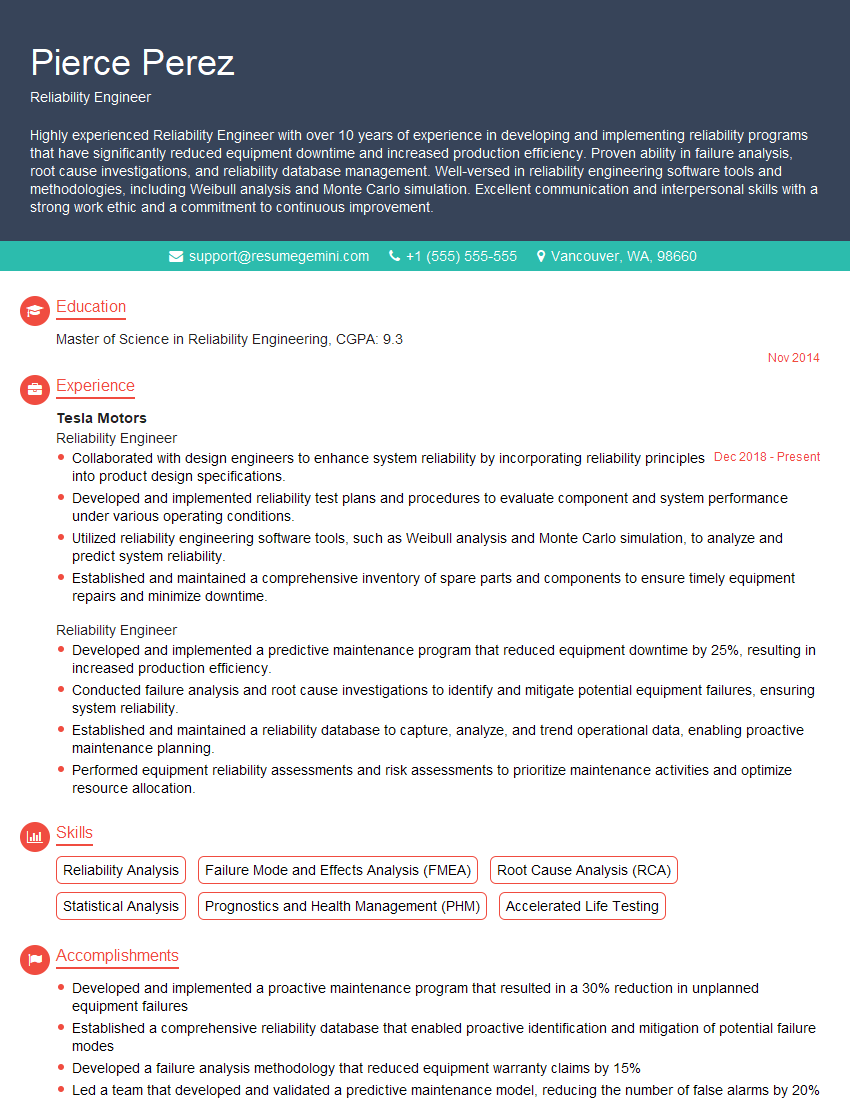
Mastering Design for Reliability and Maintainability opens doors to exciting career opportunities and showcases your commitment to building robust and efficient systems. To maximize your job prospects, a strong, ATS-friendly resume is crucial. This is where ResumeGemini can help. ResumeGemini provides a powerful platform for crafting professional resumes that highlight your skills and experience effectively. We offer examples of resumes tailored to Design for Reliability and Maintainability to give you a head start. Invest in your future; build a resume that reflects your expertise and helps you land your dream job.

Explore more articles
Users Rating of Our Blogs
Share Your Experience
We value your feedback! Please rate our content and share your thoughts (optional).
What Readers Say About Our Blog
Really detailed insights and content, thank you for writing this detailed article.
IT gave me an insight and words to use and be able to think of examples