Interviews are more than just a Q&A session—they’re a chance to prove your worth. This blog dives into essential Die Design and Drafting interview questions and expert tips to help you align your answers with what hiring managers are looking for. Start preparing to shine!
Questions Asked in Die Design and Drafting Interview
Q 1. Explain the difference between progressive and compound dies.
Progressive and compound dies are both used in stamping operations to create multiple features on a workpiece, but they differ significantly in their approach. Think of it like this: a progressive die is like an assembly line, performing multiple operations sequentially on a single strip of material as it moves through the die. A compound die, on the other hand, performs multiple operations simultaneously within a single station.
Progressive Die: A series of stations, each performing a different operation (blanking, piercing, bending, etc.), are integrated into a single die. The workpiece moves from station to station, undergoing progressive transformations. This is ideal for high-volume production of identical parts because it’s very efficient. Imagine making a complex part like a small gear – each step in the gear’s creation would happen in a different station of the progressive die.
Compound Die: Multiple operations are performed in a single stroke, all within the same station. This is suitable for parts requiring fewer operations or where a sequential process isn’t advantageous. For instance, if you need to blank a shape and pierce a hole in the center in one hit, a compound die would be more efficient. The simultaneous actions happen within that single die station.
The key difference boils down to efficiency and complexity. Progressive dies excel in high-volume production of complex parts; compound dies are better for simpler parts or when the sequential nature of a progressive die isn’t needed.
Q 2. Describe your experience with various die materials (e.g., steel, carbide).
My experience encompasses a wide range of die materials, each with its own strengths and weaknesses. I’ve worked extensively with various grades of tool steel, including high-speed steel (HSS), cold work tool steel, and hot work tool steel. I’m also experienced with carbide, particularly cemented tungsten carbide.
Tool Steels: Offer a good balance of toughness, wear resistance, and machinability. Different grades are chosen depending on the application. For example, HSS is often used for less demanding applications, while higher-grade cold work tool steels are better suited for high-precision, high-volume operations. Hot work tool steels can withstand higher temperatures found in hot stamping applications.
Carbide: Provides exceptional wear resistance, far surpassing tool steels. It’s particularly useful in high-speed, high-volume applications where tool life is critical and the parts being stamped are extremely hard or abrasive. However, carbide is significantly more brittle than steel, making it more prone to chipping or cracking under impact.
I’ve also worked with other materials, such as aluminum bronze for specific applications demanding high corrosion resistance. The selection of material is often a trade-off between cost, wear resistance, toughness, and ease of machining.
Q 3. How do you select appropriate die materials based on application requirements?
Material selection for die components is a critical decision heavily influenced by application requirements. It’s a multi-faceted process considering factors like:
Material Properties of the Workpiece: Harder materials necessitate die materials with higher wear resistance. Stamping stainless steel, for example, requires a much harder die material than stamping mild steel.
Production Volume: High-volume applications justify the higher cost of materials like carbide, prioritizing extended tool life and reduced downtime. Lower volumes might make the cost of carbide less justifiable, leading to the selection of high-quality tool steel.
Operating Conditions: Temperature plays a significant role. Hot stamping demands materials with high hot hardness, whereas cold stamping requires high cold hardness. The lubrication used during the stamping process also influences material choice.
Die Complexity: Simple dies might permit using less expensive materials. Complex dies, with many intricate features, often require higher-grade materials to maintain dimensional accuracy.
The selection is often iterative, involving material property analysis and potentially FEA (Finite Element Analysis) to predict and mitigate potential failure points. The goal is always to select the most cost-effective material that meets all the performance requirements of the die.
Q 4. What CAD software are you proficient in (e.g., AutoCAD, SolidWorks, Creo)?
I’m proficient in several CAD software packages commonly used in die design, including:
AutoCAD: For 2D drafting and detailing, particularly for generating detailed shop drawings and annotations.
SolidWorks: For 3D modeling, providing the flexibility to create and analyze complex die designs, perform simulations, and generate detailed manufacturing drawings. This is my primary tool for designing dies.
Creo Parametric: Also experienced with Creo for 3D modeling and design, particularly useful for its surface modeling capabilities that are excellent for complex curved shapes.
My expertise extends beyond just the software itself to the creation of robust, manufacturable designs. This includes a deep understanding of GD&T (Geometric Dimensioning and Tolerancing), crucial for ensuring the final die meets precise specifications.
Q 5. Describe your experience with die design software and simulation tools.
Beyond general CAD software, I’m adept at using specialized die design software and simulation tools. This experience allows me to create more robust and efficient dies, minimizing the chances of failure and reducing lead times.
AutoForm: I use AutoForm extensively for simulating the stamping process, predicting springback, wrinkling, and other potential issues. This allows for iterative design refinement before manufacturing, leading to better quality and cost savings.
Other Simulation Tools: I have experience with other FEA software packages like ANSYS and Abaqus for stress analysis of critical die components. This ensures the structural integrity of the die under operating conditions, predicting potential failure points before manufacturing and implementing preventative measures.
These simulation tools are integral to my design process, as they allow for validation of designs and optimization of die geometry for improved performance and longevity.
Q 6. Explain the process of designing a blanking die.
Designing a blanking die involves a systematic approach. Blanking is a shearing operation that separates a workpiece from a sheet metal blank, creating the desired shape. The process starts with a thorough understanding of the part requirements, including material properties, dimensions, tolerances, and quantities.
Part Definition and Analysis: Begin with the part drawing, ensuring clarity on dimensions, tolerances, and material. Analyze the part’s geometry for potential challenges (sharp corners, deep draws, etc.).
Die Design: Using CAD software (SolidWorks is my preferred choice), create the punch and die geometry. This includes designing the punch, die, stripper plate, and blank holder (if needed). The clearance between the punch and die is critical and needs careful calculation to avoid burrs or tearing.
Material Selection: Choose appropriate die materials based on material properties of the workpiece, production volume, and cost considerations (as discussed in previous answers).
Simulation and Optimization: Use simulation software (like AutoForm) to predict and mitigate potential issues such as springback and wrinkling. This iterative step refines the geometry for optimal performance.
Drawing Generation: Produce detailed manufacturing drawings, including dimensions, tolerances, and material specifications. These drawings serve as blueprints for manufacturing the die.
This detailed approach ensures the blanking die is both functional and efficient, producing parts that meet the specified quality and tolerance requirements. The design will also consider the manufacturing processes, ensuring that the die can be effectively produced and maintained.
Q 7. How do you calculate die stresses and optimize for strength and durability?
Calculating die stresses and optimizing for strength and durability requires a blend of engineering principles and simulation techniques.
Finite Element Analysis (FEA): This is the cornerstone of stress analysis. FEA software (like ANSYS or Abaqus) models the die’s geometry and material properties, simulating the forces and stresses during operation. This allows for precise identification of high-stress areas. I would define critical zones and evaluate potential failures through this simulation.
Material Selection: The choice of material greatly influences stress levels. Higher strength materials reduce stress, but may increase manufacturing cost. Finding the optimal balance is key.
Geometry Optimization: FEA results often guide geometric changes to redistribute stress. This could involve adding fillets to reduce stress concentrations, modifying the die’s overall shape for better force distribution, or altering the thickness of various die components.
Empirical Formulas and Rules of Thumb: While FEA is crucial, experienced die designers also rely on empirically derived formulas and industry best practices. These provide initial estimates of stress levels and guide initial design choices.
The goal is to design a die that can withstand the stresses of operation without premature failure, ensuring maximum lifespan and production efficiency. The iterative process involves refinement based on FEA results and practical experience to arrive at the optimal design.
Q 8. How do you ensure proper clearance and tolerances in your die designs?
Ensuring proper clearance and tolerances in die designs is crucial for successful part production. It prevents part defects, die damage, and ensures smooth operation. This is achieved through a combination of careful calculations, software simulations, and adherence to industry best practices.
Clearance: This refers to the space between moving parts of the die. Insufficient clearance leads to friction, binding, and breakage. We determine clearances based on the material being processed, the die’s geometry, and the desired production speed. For instance, a die cutting sheet metal will require different clearances compared to a die forging a solid block. We typically use tolerance analysis software to simulate the various motions and ensure adequate space between punch and die components. A common method involves adding a small percentage (e.g., 0.1-0.5mm) to the theoretical minimum, depending on the application and material properties.
Tolerances: These define the acceptable variation in the dimensions of the final part and the die components. Tight tolerances demand higher precision in manufacturing, increasing the cost. We carefully balance part functionality with manufacturing feasibility. For example, specifying a 0.01mm tolerance on a critical dimension may be cost-prohibitive. Dimensioning and tolerancing is crucial, using GD&T (Geometric Dimensioning and Tolerancing) symbols to clearly communicate the allowed variations. The use of a tolerance stack-up analysis helps to prevent cumulative errors that might lead to non-functional components.
Practical Example: In a progressive die for a car part, we’d ensure sufficient clearance between the punches and the die cavity to avoid interference and wear, even considering thermal expansion during the stamping process. We’d also specify tight tolerances on critical dimensions to ensure the final part meets its functional requirements. The tolerances on non-critical features can be more relaxed, thereby reducing manufacturing costs.
Q 9. Describe your experience with designing for various manufacturing processes (e.g., stamping, forging).
My experience spans various manufacturing processes, including stamping, forging, and some exposure to casting. Each process demands a unique design approach.
Stamping: I’ve designed numerous progressive dies, transfer dies, and single-stage dies for various sheet metal materials. This involves optimizing blank size, designing appropriate punch and die geometries for shearing, bending, and forming operations, and considering factors like springback and material flow. We’d consider using advanced stamping software for simulating the forming process to predict part geometry and identify potential problems. For example, in a deep drawing operation, we would carefully design the die radius to prevent wrinkling or tearing of the material.
Forging: My work in forging has focused on designing closed-die forging tools. This involves a different set of considerations. The focus is on designing the die cavity to accurately shape the workpiece while considering material flow, flash formation, and die filling. Finite Element Analysis (FEA) plays a critical role here to simulate the material flow and stress distribution within the forging process. This helps in optimizing the die design for efficiency and minimizing defects. One project involved designing forging dies for a complex turbine blade, which required detailed FEA analysis to ensure proper material filling and minimal defects.
Casting: I have a basic understanding of casting die designs. This involved creating patterns for sand casting. Although not my primary expertise, I have enough knowledge to work collaboratively with casting engineers to ensure die compatibility within the overall process.
Q 10. How do you handle design changes and revisions during the die design process?
Handling design changes and revisions efficiently is vital. We employ a structured approach leveraging revision control systems and clear communication channels.
Revision Control: I utilize CAD software’s version control features to track all changes. This allows easy rollback to previous versions if needed and ensures that everyone is working with the most up-to-date design. Each revision is meticulously documented, explaining the reason for the change and its impact.
Communication: Clear and consistent communication with the manufacturing team, clients, and other stakeholders is essential. We hold regular meetings to discuss design updates, address concerns, and incorporate feedback. This collaborative approach ensures that all parties are aligned and any issues are identified and resolved promptly.
Example: During a die design for a complex electronic component, a change request came in to reduce the overall part size. Instead of starting from scratch, we utilized the existing design, made the necessary adjustments in the CAD model and ran the relevant simulations again. We then documented the changes in a revision log, highlighting the impact on tolerances and functionality. This efficient process prevented delays and unnecessary costs.
Q 11. Explain your experience with die tryout and troubleshooting.
Die tryout and troubleshooting are critical phases to ensure the die functions as intended. My experience includes preparing for tryout, running tests, analyzing results, and implementing corrective actions.
Tryout Preparation: Before tryout, I collaborate with the manufacturing team to create a detailed tryout plan. This includes outlining specific tests, required materials, safety procedures, and data collection methods.
Troubleshooting: During the tryout, various issues can arise, such as improper part formation, die breakage, or excessive wear. My approach to troubleshooting involves systematically analyzing the problem. This includes examining the produced parts for defects, inspecting the die for damage, reviewing the process parameters, and consulting relevant design documentation. Root cause analysis is used to determine the underlying problem and a solution is designed and implemented. This often involves making minor adjustments to the die’s geometry, adjusting process parameters (e.g., pressure, speed), or changing the material.
Example: During the tryout of a progressive die for a connector, we observed cracking on the final formed part. By carefully analyzing the part and the die, I determined that the material flow was compromised due to a slightly undersized punch radius. This was corrected by adjusting the punch radius based on further simulations, and the corrected design produced satisfactory parts.
Q 12. How do you ensure that your die designs meet all relevant safety standards?
Safety is paramount in die design. I ensure compliance with relevant safety standards such as OSHA (Occupational Safety and Health Administration) and ANSI (American National Standards Institute) guidelines.
Design for Safety: Safety considerations are integrated into the design process from the start. This includes designing robust die structures to prevent breakage and incorporating safety features to minimize the risk of injury. Examples include incorporating guards to prevent access to moving parts, using ejection mechanisms to safely remove parts from the die, and designing dies to minimize pinch points.
Material Selection: The selection of materials for the die components is crucial for safety. Materials must be selected based on their strength, durability, and resistance to wear and tear. We consider the stress and strain on each component to ensure that it can withstand the forces involved in the manufacturing process.
Risk Assessment: A thorough risk assessment is conducted to identify potential hazards during the die’s operation. This assessment helps us implement appropriate safety measures, including training for personnel, use of personal protective equipment, and establishment of safe work practices.
Documentation: All safety-related aspects of the die design, including safety features, risk assessments, and operating procedures, are meticulously documented for reference by the operators. Regular review of these documents is essential.
Q 13. Describe your experience with GD&T (Geometric Dimensioning and Tolerancing).
GD&T (Geometric Dimensioning and Tolerancing) is essential for communicating precise design intent and ensuring part functionality. I have extensive experience applying GD&T to die designs.
Application: I use GD&T symbols to specify tolerances on critical dimensions, including features like position, form, orientation, and runout. This is far more informative than simply stating numerical tolerances. For example, specifying a positional tolerance ensures that features are located correctly relative to each other, whereas a form tolerance specifies the allowable deviation from ideal geometric shapes like straightness or flatness.
Software Integration: Most modern CAD software packages support GD&T, allowing for clear and precise communication throughout the design and manufacturing process. I leverage this functionality to create accurate and unambiguous drawings and models.
Example: In a die design for a precision connector, we use GD&T to specify tight tolerances on the position of the mating features. This ensures that the connector parts assemble correctly and provide a reliable electrical connection. The use of GD&T also facilitates better communication between the design team, manufacturers, and quality control.
Tolerance Stack-Up Analysis: This is particularly important to ensure that all tolerances, as specified, can be accommodated in the process. Using simulation techniques, we can analyze the accumulated tolerance and adjust as required. This helps to prevent assembly issues and ensure the final part meets its functional requirements.
Q 14. How do you manage project timelines and budgets for die design projects?
Managing project timelines and budgets effectively requires a structured approach.
Project Planning: At the outset, I create a detailed project plan outlining all tasks, deliverables, milestones, and resource requirements (including personnel, software, and materials). This plan is then used to create a realistic schedule and budget, and to monitor progress throughout the project.
Resource Allocation: I carefully allocate resources based on task priorities and complexity. This involves identifying potential bottlenecks and addressing them proactively. A careful estimate of time is made for each task based on historical data and experience.
Monitoring and Control: We use project management tools to track progress, manage risks, and identify any deviations from the plan. Regular progress reports are generated to keep stakeholders informed and to make necessary adjustments as the project progresses. This allows us to stay on track with the planned schedule and budget.
Contingency Planning: It’s essential to account for unexpected delays or cost overruns. A contingency plan should be in place to address such scenarios, allowing for efficient redirection of resources or time as needed. This often involves including a buffer in both the timeline and budget.
Example: For a recent automotive die project, the detailed project plan allowed us to predict challenges early and assign extra time for complex parts of the design. Through rigorous monitoring, we managed to complete the project on time and within budget despite facing material supply issues towards the end of the project.
Q 15. Explain your process for creating detailed drawings and specifications for dies.
Creating detailed die drawings and specifications is a multi-step process that requires meticulous attention to detail. It begins with a thorough understanding of the part’s geometry and the required material properties. I start by analyzing the part design, identifying critical dimensions and tolerances, and determining the necessary features for proper material flow and part ejection.
- 3D Modeling: I utilize CAD software (such as SolidWorks or AutoCAD) to create a 3D model of the die. This allows for visualization and analysis of the die’s functionality before manufacturing. I pay close attention to creating realistic representations of features like punches, dies, stripper plates, and guide pins.
- 2D Detail Drawings: From the 3D model, I generate detailed 2D drawings which include orthographic projections, sectional views, and detailed dimensions and tolerances. These drawings clearly specify material selection, surface finishes, and heat treatments.
- Bill of Materials (BOM): A comprehensive BOM is generated, listing all components required for die construction, including materials, fasteners, and standard components. This ensures that the manufacturing process has all the necessary materials available.
- Specifications Document: I compile a separate document outlining the die’s specifications, including its intended use, operating parameters (e.g., tonnage, speed), and maintenance requirements. This document serves as a reference for both the manufacturing team and the end user.
For instance, in a recent project involving a progressive die for a complex automotive part, I used SolidWorks to design the die, ensuring precise alignment of all stations to minimize scrap and maximize efficiency. The resulting drawings clearly communicated all dimensions and tolerances, leading to a smooth manufacturing process.
Career Expert Tips:
- Ace those interviews! Prepare effectively by reviewing the Top 50 Most Common Interview Questions on ResumeGemini.
- Navigate your job search with confidence! Explore a wide range of Career Tips on ResumeGemini. Learn about common challenges and recommendations to overcome them.
- Craft the perfect resume! Master the Art of Resume Writing with ResumeGemini’s guide. Showcase your unique qualifications and achievements effectively.
- Don’t miss out on holiday savings! Build your dream resume with ResumeGemini’s ATS optimized templates.
Q 16. Describe your experience with different types of die coatings and their applications.
Die coatings play a crucial role in extending die life, improving surface finish, and reducing friction during stamping operations. My experience encompasses several coating types, each with specific applications:
- Chromium Plating: Offers excellent wear resistance, corrosion protection, and a high-quality surface finish. It’s commonly used on punches and dies in high-volume production runs where durability is paramount. However, it can be brittle and prone to cracking under high stress.
- Titanium Nitride (TiN) Coatings: These provide exceptional hardness and wear resistance, along with reduced friction. They are ideal for applications requiring high precision and minimal material build-up on the stamped part. I’ve used TiN coatings on dies for electronic components and precision parts requiring a very fine surface finish.
- DLC (Diamond-Like Carbon) Coatings: Offer a combination of hardness, low friction, and chemical inertness. They are excellent for stamping challenging materials and are particularly useful in reducing wear on punches and dies in applications involving high temperatures or aggressive chemicals. I applied DLC coatings to a project involving the stamping of stainless steel, significantly improving die life compared to conventional coatings.
- Nickel Plating: Provides good corrosion resistance and is often used as an underlayer for other coatings, like chromium. It’s typically less expensive than other coatings.
The choice of coating depends heavily on the material being stamped, the production volume, and the desired surface finish of the final part. Careful consideration of these factors is crucial for selecting the optimal coating and maximizing the lifespan and performance of the die.
Q 17. How do you incorporate manufacturability considerations into your die designs?
Incorporating manufacturability into die designs is essential for ensuring efficient and cost-effective production. This involves considering factors like:
- Material Selection: Choosing readily available and easily machinable materials is vital. While high-strength steels might be ideal for performance, their machinability and cost should be weighed against alternatives.
- Design Simplification: Avoiding complex geometries and intricate features reduces manufacturing time and cost. Whenever possible, I simplify designs without compromising functionality.
- Standard Components: Utilizing standard components (e.g., bushings, ejector pins) reduces lead times and avoids the need for custom manufacturing, saving time and money.
- Tooling Accessibility: Designing dies with easy access for maintenance and repair is crucial. This minimizes downtime and reduces overall costs.
- Manufacturing Processes: I am deeply familiar with various manufacturing processes like EDM (Electrical Discharge Machining), wire EDM, and CNC machining, and I ensure the design is compatible with the chosen process to maximize efficiency.
For instance, in a recent project, I replaced a complex, difficult-to-manufacture component with a simpler design using readily available standard parts, resulting in a 20% reduction in manufacturing costs and a shorter lead time.
Q 18. How do you handle design conflicts or disagreements with other team members?
Design conflicts are inevitable in collaborative projects. My approach is always to focus on open communication and a collaborative problem-solving mindset. I believe in:
- Open Dialogue: Clearly articulating my design rationale and actively listening to the perspectives of other team members are paramount. This includes identifying the root cause of the disagreement, not just the symptoms.
- Data-Driven Decision Making: Presenting data, such as FEA results or manufacturing cost estimates, helps to support my design choices and facilitate constructive discussion.
- Compromise and Collaboration: Finding a solution that satisfies all stakeholders often involves compromise. However, this compromise shouldn’t compromise the quality or functionality of the die.
- Documentation: All decisions and agreements are thoroughly documented to avoid future misunderstandings.
In one instance, a disagreement arose regarding the material choice for a specific die component. By presenting data showing the cost-effectiveness and performance benefits of my proposed material, I was able to reach a consensus with the team, leading to a successful project.
Q 19. Describe your experience with using FEA (Finite Element Analysis) in die design.
FEA (Finite Element Analysis) is an indispensable tool in modern die design. I use FEA software to simulate the stresses and strains within the die under various loading conditions. This allows for the identification and mitigation of potential failure points before manufacturing begins. My experience includes using ANSYS and ABAQUS.
- Stress Analysis: FEA helps in determining the stresses within the die components, identifying areas prone to fracture or yielding. This allows for optimization of the die’s geometry and material selection to prevent premature failure.
- Deformation Analysis: FEA can predict the deformation of the die under load, helping to ensure that the die maintains its accuracy and dimensional stability throughout its lifespan.
- Optimization: FEA results guide design optimization, allowing for adjustments to the die’s geometry or material selection to improve its performance and lifespan.
For example, in a project involving a large press die, FEA helped identify a potential stress concentration in a critical component. By modifying the design based on the FEA results, I was able to prevent a potential failure during operation.
Q 20. How do you ensure the accuracy and precision of your die designs?
Ensuring accuracy and precision in die designs is crucial for the success of the stamping process. My approach incorporates several key steps:
- Precise Dimensioning and Tolerancing: Using GD&T (Geometric Dimensioning and Tolerancing) principles, I specify precise dimensions and tolerances on all drawings, minimizing ambiguity and ensuring consistency in manufacturing.
- Rigorous Design Reviews: Formal design reviews with cross-functional teams are conducted to catch errors and omissions early in the design process.
- Verification and Validation: I employ various methods, including physical prototyping and digital simulations (FEA), to verify the accuracy of the design and validate its performance before manufacturing.
- Use of Advanced CAD Software: Using advanced features in CAD software (e.g., interference checks, automated dimensioning) helps minimize errors and inconsistencies in the design.
- Manufacturing Process Consideration: Detailed consideration of manufacturing processes and tolerances inherent in each method ensures the final product aligns with the design intent.
For instance, in a recent project, employing thorough GD&T ensured consistent manufacturing, reducing scrap rates and improving overall efficiency. The design review process identified a critical oversight that, had it gone undetected, could have led to major production delays.
Q 21. How do you deal with unexpected problems or challenges during the die design process?
Unexpected problems and challenges are part and parcel of die design. My approach involves a systematic problem-solving methodology:
- Problem Identification: The first step is accurately defining the problem, gathering all relevant information, and analyzing the root cause. This includes reviewing design documents, manufacturing reports, and conducting on-site inspections if necessary.
- Solution Brainstorming: Involving relevant stakeholders, I brainstorm potential solutions, considering various approaches and evaluating their feasibility and impact.
- Solution Evaluation and Selection: A cost-benefit analysis of the proposed solutions is performed to select the most effective and efficient solution.
- Implementation and Verification: The chosen solution is implemented, followed by thorough testing and verification to ensure its effectiveness and to prevent recurrence of the problem.
- Documentation and Lessons Learned: The entire problem-solving process is documented, including the root cause, the solution implemented, and lessons learned. This allows for continuous improvement and prevents similar issues in future projects.
For example, during a die tryout, an unexpected issue arose with part ejection. Through systematic investigation, we discovered a design flaw in the ejector mechanism. By modifying the ejector system based on this analysis, we successfully resolved the problem and prevented future occurrences.
Q 22. Explain your understanding of die life and factors influencing it.
Die life refers to the number of parts a stamping die can produce before it requires maintenance, repair, or replacement. It’s a crucial factor in determining the overall cost-effectiveness of a stamping operation. A longer die life translates to lower production costs per part.
Several factors significantly influence die life. These can be broadly categorized into material selection, design considerations, and operational practices.
- Material Selection: The choice of materials for the die components (punches, dies, stripper plates, etc.) is paramount. Using high-strength, wear-resistant materials like tool steel (e.g., D2, A2, O1) extends die life. Hard chrome plating can further enhance the lifespan of critical components. Incorrect material selection, leading to premature wear or breakage, can drastically shorten the die life.
- Design Considerations: A well-designed die minimizes stress concentrations and wear points. This includes proper clearance between punches and dies, adequate support for the die components, and the use of appropriate material thicknesses to avoid bending or deflection under load. Poor design is often the leading cause of short die life. For example, insufficient support for a punch can lead to premature breakage.
- Operational Practices: Proper lubrication, maintaining the correct press tonnage, and regular die maintenance significantly impact die life. Using the wrong lubricant or excessive press tonnage will accelerate wear. Regular inspection for cracks, wear, and damage allows for preventative maintenance, preventing catastrophic failures and extending the die’s lifespan.
Think of it like a car engine: using high-quality materials (like forged components), proper design (optimal combustion chamber shape), and regular maintenance (oil changes, tune-ups) will dramatically extend its lifespan. Similarly, careful selection and design of a die, combined with good operating practices, will extend its productive life.
Q 23. Describe your experience with designing dies for high-volume production.
I have extensive experience designing dies for high-volume production, primarily in the automotive and consumer electronics sectors. This involves a different approach than designing for low-volume or prototype production. The focus shifts from rapid prototyping to maximizing efficiency and minimizing downtime. Key aspects include:
- Robust Design: High-volume production demands incredibly robust dies capable of withstanding millions of cycles without failure. This necessitates meticulous design to withstand stress and wear, including features like robust support structures and wear-resistant coatings.
- Optimized Tooling: Efficiency is paramount. This involves optimizing the die design to minimize the number of strokes per part, using progressive dies whenever feasible, and incorporating features for quick changeover.
- Preventive Maintenance Strategies: High-volume production requires proactive maintenance planning to minimize downtime. Designs should incorporate easy-access features for maintenance and replacement of critical components.
- Material Selection: Long-life materials and coatings are crucial. In high-volume production, even minor improvements in die life can result in significant cost savings.
For instance, in a project involving the production of millions of small metal clips for car interiors, we optimized a progressive die to reduce the number of operations while ensuring accuracy. This led to a considerable increase in production speed and a significant reduction in overall cost per part. The design incorporated hardened steel components with wear-resistant coatings to ensure a long die life.
Q 24. How familiar are you with different types of die constructions (e.g., single-action, double-action)?
I’m very familiar with various die constructions, including single-action, double-action, and progressive dies. Each type has specific applications and advantages.
- Single-action dies: These are the simplest type, performing one operation per stroke of the press. They are suitable for simple shapes and low-volume production. They’re easy to design and manufacture but less efficient for complex parts.
- Double-action dies: These perform two operations simultaneously in a single stroke, typically a blank and a draw operation. They are used for producing deep-drawn parts, offering increased efficiency over single-action dies in such cases. Designing these requires a deep understanding of material flow and forming limitations.
- Progressive dies: These are the most complex but also the most efficient for high-volume production. Multiple operations are performed sequentially in a single pass through the die, significantly increasing production speed. Designing progressive dies demands careful planning of the sequence of operations, precise part registration, and attention to material flow to ensure accurate part production.
The choice of die construction depends heavily on the part’s complexity, production volume, and cost considerations. A simple part might only need a single-action die, while a complex part requiring multiple operations would benefit from a progressive die. My experience encompasses all these types, allowing me to make informed decisions based on project requirements.
Q 25. What are your strategies for reducing die costs while maintaining quality?
Reducing die costs without compromising quality is a constant challenge. My strategies focus on:
- Optimized Design: Minimizing the number of components and operations reduces material costs and manufacturing time. Clever design can often eliminate the need for complex tooling.
- Standard Component Usage: Using readily available standard components instead of custom-made ones significantly reduces lead times and costs. This necessitates creative design to adapt standard components to the specific needs of the project.
- Material Selection: While using high-quality materials is crucial for die life, careful selection can balance durability and cost. Understanding material properties and their impact on die life is essential.
- Finite Element Analysis (FEA): FEA simulations can help optimize designs by identifying potential stress concentrations and areas prone to failure, allowing for adjustments that minimize material usage without compromising strength.
- Modular Design: Creating modular die components allows for easier replacement and repair, reducing downtime and overall maintenance costs.
For example, in one project, we used a combination of standard components and optimized die design to reduce the overall die cost by 20% without impacting the quality or die life. This involved carefully analyzing the part geometry to determine the optimal sequence of operations and select the most appropriate standard components.
Q 26. Explain your experience with designing progressive dies with multiple operations.
Designing progressive dies with multiple operations requires meticulous planning and a deep understanding of material flow, part registration, and tooling interactions. My experience encompasses various aspects, including:
- Sequence Optimization: Determining the optimal sequence of operations is critical to minimizing the overall die size, reducing scrap, and maximizing efficiency. This involves careful consideration of material flow and potential interferences between operations.
- Strip Layout Design: Efficient strip layout is crucial for minimizing material waste. This is done using specialized software and often involves iterative design refinement.
- Die Component Design: Each operation in the progressive die necessitates designing specific punches, dies, and other components that interact precisely to achieve the desired result. Precise tolerances are essential.
- Part Registration: Ensuring accurate part registration throughout the multiple operations is paramount to prevent misalignment and scrap. This is achieved through the use of precise guide pins and bushings.
- Safety Features: Incorporating safety features to prevent operator injury is critical, especially in high-speed progressive dies. This might include features like ejection mechanisms to prevent parts from getting stuck in the die.
For example, I designed a progressive die with seven operations for a complex automotive part. The design incorporated multiple piercing, blanking, and forming operations to produce the finished part in a single pass. Careful planning of the operation sequence and strip layout minimized material waste and maximized production efficiency.
Q 27. How do you ensure the dimensional accuracy of the final product using your die design?
Dimensional accuracy is crucial in die design. My approach involves several strategies to ensure the final product meets specifications:
- Precise CAD Modeling: Utilizing precise CAD software (e.g., AutoCAD, SolidWorks) and employing detailed 3D modeling allows for accurate simulation and verification of the die design before manufacturing.
- Tolerance Analysis: A thorough tolerance analysis identifies potential sources of dimensional variations and helps to set appropriate tolerances for each die component. This minimizes cumulative errors.
- Die Tryout and Verification: After manufacturing, rigorous tryouts and testing are essential. This includes dimensional checks of the stamped parts using measuring equipment (e.g., CMM, calipers) to validate the die’s performance and identify any necessary adjustments.
- Material Selection and Control: Using materials with stable dimensions and consistent properties contributes to the overall accuracy of the final product. Controlling the material’s temperature and humidity during the stamping process also plays a significant role.
- Regular Maintenance: Maintaining the die to prevent wear and tear is crucial for maintaining dimensional accuracy. Regular inspection and replacement of worn components prevent dimensional drift over time.
For instance, in a project involving the production of precision components for medical devices, we employed a combination of rigorous CAD modeling, tolerance analysis, and CMM inspections to ensure the final parts met stringent dimensional tolerances. The use of high-quality materials and regular maintenance further ensured consistent accuracy throughout the production run.
Q 28. Describe a situation where you had to overcome a challenging aspect of a die design project.
One challenging project involved designing a progressive die for a part with a very intricate geometry and tight tolerances. The initial design faced difficulties with part ejection and material flow leading to significant scrap. The problem stemmed from insufficient consideration of material springback during the forming operations.
To overcome this challenge, we employed a multi-faceted approach:
- FEA Simulation: We used FEA to model the material flow and predict springback during forming. This allowed us to refine the die design to compensate for these effects.
- Material Testing: We conducted extensive material testing to accurately characterize the material’s springback properties, ensuring the simulation results were realistic.
- Iterative Design Refinements: Based on the FEA results and material testing, we made several iterations of the die design. Each iteration incorporated modifications to improve material flow and part ejection.
- Improved Ejection System: The original ejection system proved insufficient, so we developed a new system with a more robust design to ensure complete and consistent part ejection.
Through this iterative process, we successfully eliminated the ejection issues and significantly reduced the scrap rate. This project highlighted the importance of thorough analysis, iterative design, and the use of advanced simulation techniques in resolving complex die design challenges.
Key Topics to Learn for Die Design and Drafting Interview
- Die Design Fundamentals: Understanding fundamental principles of die design, including material selection, tolerance analysis, and manufacturing processes.
- Drafting Techniques and Software Proficiency: Demonstrate expertise in CAD software (e.g., AutoCAD, SolidWorks) and 2D/3D drafting techniques for creating detailed die drawings and specifications.
- Progressive Die Design: Knowledge of progressive die design principles, including strip layout, blank development, and punch and die design considerations. Be prepared to discuss practical applications and troubleshooting common issues.
- Die Construction and Manufacturing: Familiarity with various die construction methods, materials, and manufacturing processes (e.g., EDM, grinding, polishing).
- Tooling Design and Selection: Ability to select appropriate tooling based on material properties, part geometry, and production volume. This includes understanding the interplay between tooling design and die performance.
- Problem-Solving and Troubleshooting: Be ready to discuss your approach to identifying and resolving design and manufacturing challenges, including examples from your past experiences.
- GD&T (Geometric Dimensioning and Tolerancing): Understanding and applying GD&T principles to ensure precise part dimensions and functionality.
- Die Cost Estimation and Optimization: Discuss your experience or knowledge of estimating die costs and identifying opportunities for cost optimization within design parameters.
Next Steps
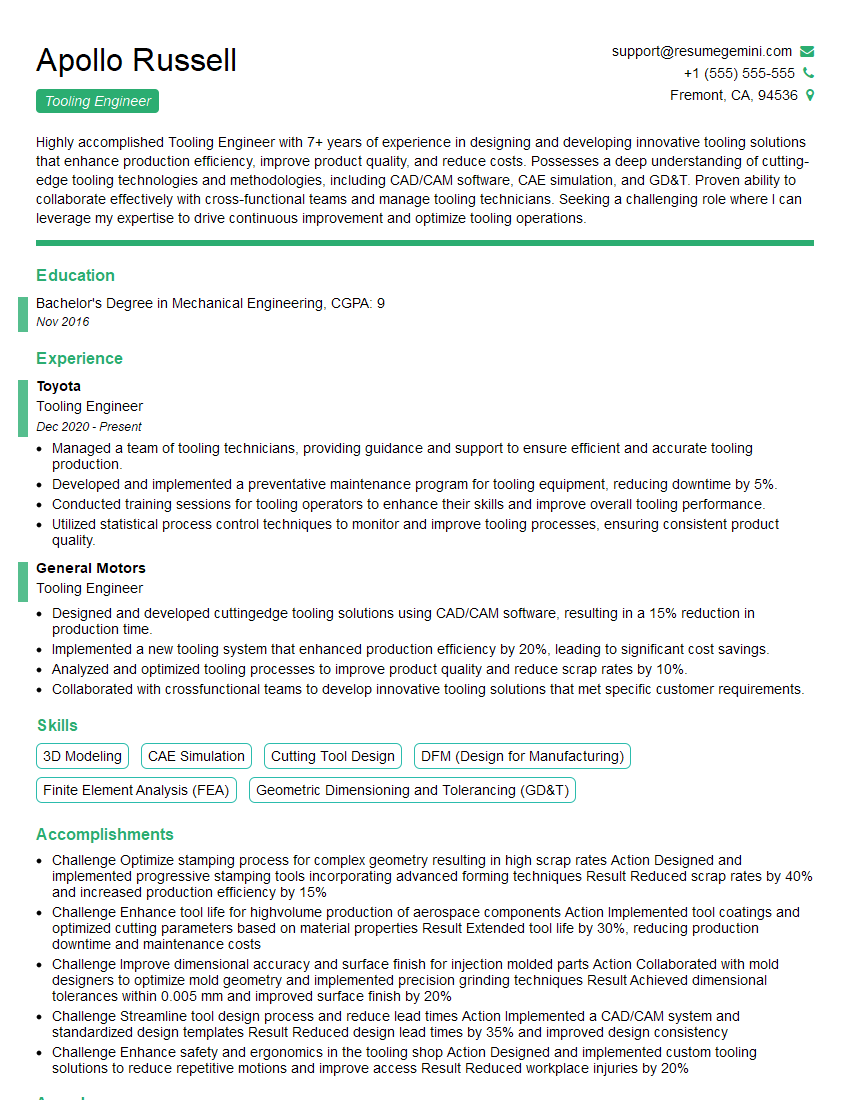
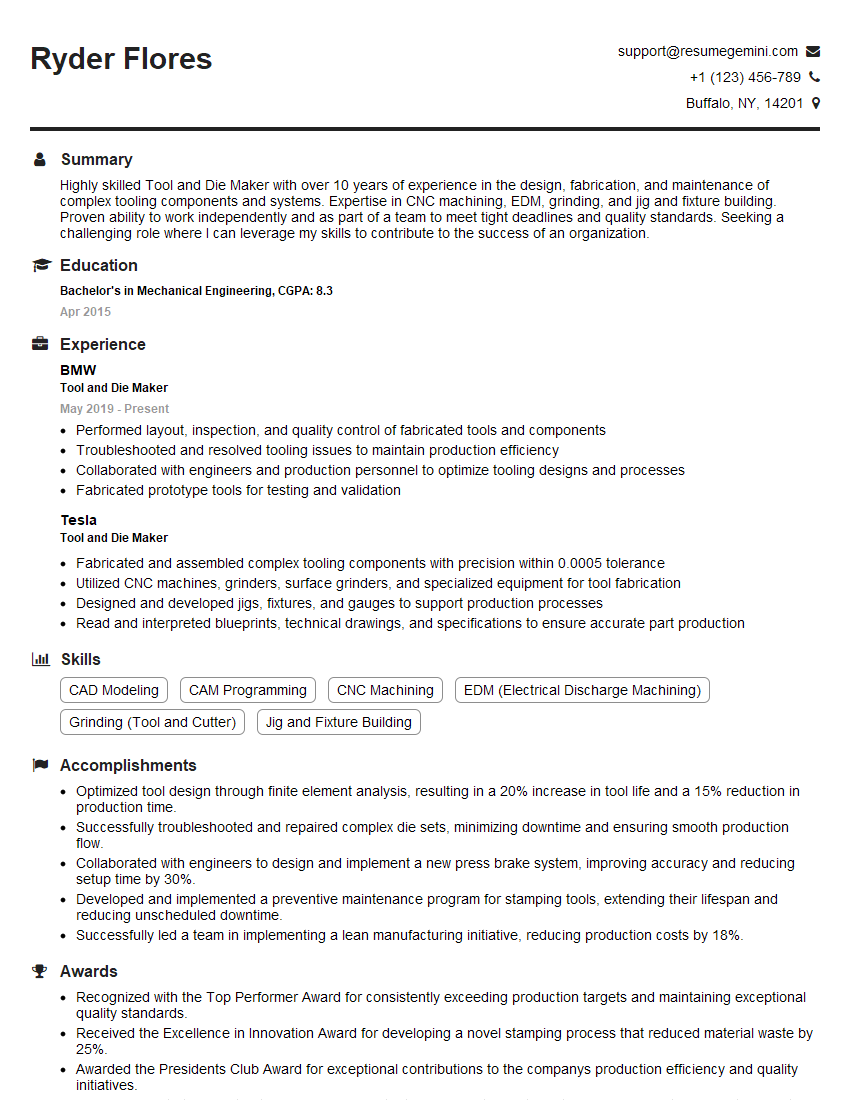
Mastering Die Design and Drafting opens doors to exciting career opportunities in manufacturing, automotive, aerospace, and many other industries. Your expertise in creating efficient and cost-effective dies is highly valued. To maximize your chances of landing your dream job, creating a strong, ATS-friendly resume is crucial. ResumeGemini is a trusted resource that can help you build a professional and impactful resume tailored to showcase your skills. We provide examples of resumes specifically designed for Die Design and Drafting professionals to guide you. Take the next step towards your career success today!

Explore more articles
Users Rating of Our Blogs
Share Your Experience
We value your feedback! Please rate our content and share your thoughts (optional).
What Readers Say About Our Blog
Really detailed insights and content, thank you for writing this detailed article.
IT gave me an insight and words to use and be able to think of examples