Cracking a skill-specific interview, like one for Digital Color Correction, requires understanding the nuances of the role. In this blog, we present the questions you’re most likely to encounter, along with insights into how to answer them effectively. Let’s ensure you’re ready to make a strong impression.
Questions Asked in Digital Color Correction Interview
Q 1. Explain the difference between color correction and color grading.
Color correction and color grading are often confused, but they are distinct processes. Think of it like this: color correction is fixing imperfections, while color grading is adding a stylistic look.
Color correction aims to achieve color accuracy and consistency. It involves fixing issues like white balance, color casts, and exposure inconsistencies to match a realistic representation of the scene. For instance, if a scene is too blue due to an overcast day, color correction would neutralize that blue tint to restore the true colors.
Color grading, on the other hand, is a creative process used to establish a specific mood, style, or visual tone. It involves adjusting saturation, contrast, and color hues to create a desired aesthetic. A film noir might use a dark, desaturated color grade, while a vibrant summer scene would benefit from a more saturated and lively palette.
In essence, you typically perform color correction *before* color grading, ensuring a solid foundation for creative choices.
Q 2. Describe your workflow for color correcting a scene with mixed lighting.
My workflow for color correcting a scene with mixed lighting begins with a careful assessment of the footage. Mixed lighting presents challenges because different areas of the frame might have wildly varying color temperatures and exposures.
- Separate the footage into regions based on lighting: I use masking techniques and selection tools in my editing software (like DaVinci Resolve or Adobe Premiere Pro) to isolate areas illuminated by different light sources. This allows for more targeted adjustments.
- Primary color correction: I tackle white balance first, often using a white or gray reference point in the scene. This may involve adjusting the color temperature and tint separately for each lighting region. I then address exposure inconsistencies between areas using curves or exposure tools. The goal is to make the lighting generally consistent.
- Secondary color correction: Once the primary adjustments are complete, I meticulously work on fine-tuning individual color channels and regions. This involves using color wheels or secondary color correctors to address subtle shifts and achieve a balanced look.
- Fine-tuning & finishing touches: Finally, I perform final checks for consistency across all regions. This may involve more subtle adjustments to contrast, saturation and even minor sharpening to enhance detail.
This meticulous approach ensures that each region’s colors are appropriately adjusted for a realistic and visually appealing result, despite the inconsistent lighting. It’s a bit like painting – you’d carefully blend and correct the shades individually to create a cohesive image.
Q 3. How do you handle color casts in footage?
Color casts, that unwanted color tint on your footage (e.g., an orange cast from tungsten lighting), are handled primarily through white balance correction and secondary color adjustments.
- White Balance: If the cast is pervasive, I adjust the white balance of the clip. Most editing software provides tools to pick a reference point in the image (like a neutral-colored object) and automatically adjust the overall color temperature and tint. This is your first line of defense.
- Color Wheels & Curves: For more nuanced control or where white balance correction is insufficient, I use color wheels or curves. I’ll identify the opposite color on the color wheel of the unwanted cast (e.g., cyan to counteract orange) and reduce its intensity to neutralize the cast. Curves offer a more granular, precision-based correction.
- Selective Color Correction: For localized color casts, I utilize masks to isolate the affected area and apply the necessary color correction only to that part of the image. This preserves the correct colors in other parts of the frame.
The key is to use a combination of tools to achieve a natural-looking result. Over-correcting can lead to unnatural colors, so a subtle approach is often best.
Q 4. What are the advantages and disadvantages of different color spaces (e.g., Rec.709, DCI-P3, Adobe RGB)?
Different color spaces define the range of colors that can be displayed or reproduced. Choosing the right one depends on the intended output and workflow.
- Rec.709: This is the standard for HDTV and the internet. It has a relatively small gamut (range of colors), making it safe and widely compatible but limiting vibrant colors.
- DCI-P3: Used in digital cinema, this offers a wider gamut than Rec.709, resulting in more vivid and saturated colors. However, it’s less universally compatible.
- Adobe RGB: Designed for print, this has a wider gamut than Rec.709 and offers better color reproduction for print media. It’s less suitable for screen displays.
Advantages and Disadvantages:
- Wider Gamut (DCI-P3, Adobe RGB): Advantage: Richer colors. Disadvantage: Limited compatibility; may lead to color clipping (loss of information) when outputting to Rec.709.
- Narrower Gamut (Rec.709): Advantage: Wide compatibility. Disadvantage: Less vibrant colors.
I typically work in a wider gamut space (like DCI-P3) during the color grading process to preserve the full range of colors, and then convert to Rec.709 for final output to ensure compatibility with most displays.
Q 5. Explain your understanding of white balance and how you achieve it.
White balance refers to the process of neutralizing color casts to achieve accurate representation of white. It’s crucial because different light sources (daylight, tungsten, fluorescent) emit light with varying color temperatures, leading to color casts in your footage.
Achieving White Balance:
- In-Camera: Most cameras allow you to set white balance during shooting using presets (daylight, shade, tungsten, etc.) or by selecting a white or gray object in the scene for automatic adjustment.
- In Post-Production: If in-camera white balance isn’t accurate, you can correct it during post-production using software tools. Many provide automatic white balance tools based on a selected region, or manual adjustments using color temperature and tint controls. This is done by using a white or neutral gray area within the image as reference to adjust the overall color temperature of the scene.
Accurate white balance is fundamental; it sets the foundation for all subsequent color corrections, ensuring all colors are portrayed accurately.
Q 6. How do you approach correcting skin tones in different lighting conditions?
Correcting skin tones across varying lighting conditions requires a delicate touch and understanding of how light interacts with skin. It’s not simply about making all skin tones the same color.
- Identify the light source: Different lighting (warm tungsten, cool daylight) will affect skin tone differently. Understanding the light source helps in determining the appropriate color correction.
- Targeted adjustments: I often use selective color correction tools (masks and brushes) to make adjustments to only the skin tones. This avoids affecting other elements of the scene unintentionally.
- Highlight and shadow adjustments: Skin tones have subtle variations in highlights and shadows. Correcting these independently through tools like curves or highlight/shadow controls helps maintain realism.
- Color Temperature and Tint: Subtle adjustments to color temperature and tint can be necessary to counteract the effects of warm or cool lighting affecting skin tone.
The goal is to achieve natural-looking skin tones consistent with the lighting in the scene, avoiding an overly uniform or artificial look. Each face reacts to lighting uniquely and capturing these nuances is key.
Q 7. Describe your experience with color management systems (CMS).
Color management systems (CMS) are crucial for ensuring color consistency across different devices and stages of the workflow. They work by assigning profiles to each device (monitor, printer, camera) specifying its color characteristics. This allows the CMS to translate the color data accurately between devices.
My Experience: I’ve extensively used CMS in my workflow, primarily within editing software like DaVinci Resolve and Adobe Premiere Pro, and also profile-checking my displays (using a colorimeter). It’s essential to make sure my monitor accurately represents the colors I’m correcting and grading. Without a properly calibrated monitor, the work I do in post can be significantly skewed, resulting in inconsistent and unexpected results when the footage is viewed on other devices or formats.
Effective CMS prevents color shifts and ensures that what you see on your screen closely matches the final output. This is especially vital when collaborating with other professionals who may use different equipment.
Q 8. What is gamma correction, and why is it important?
Gamma correction is a crucial process in digital image processing that adjusts the brightness levels to account for how human perception of light intensity differs from a device’s linear response. Essentially, our eyes don’t perceive brightness linearly; a small change in a dark area feels much more significant than the same change in a bright area. Gamma correction ‘compensates’ for this non-linearity. A typical gamma value is 2.2, meaning the output intensity is raised to the power of 2.2. This ensures that images appear correctly on a monitor, rather than appearing too dark or too bright.
Without gamma correction, images would appear too dark on most display devices. Consider a simple example: if you have a grayscale image and want to display it on a screen, a linear representation would appear very dark. Gamma correction transforms this linear data into a non-linear representation that appears much brighter and truer to what our eyes expect.
Q 9. Explain your familiarity with different color grading software (e.g., DaVinci Resolve, Baselight, Assimilate Scratch).
I’m proficient in several leading color grading software packages, including DaVinci Resolve, Baselight, and Assimilate Scratch. My experience spans various versions and features. DaVinci Resolve is my primary tool, renowned for its powerful node-based workflow, extensive color science tools, and vast array of plugins. I frequently use its primary and secondary color correction tools, along with its advanced features like tracking, keyframing, and color matching. Baselight is another favorite, excelling in its precision and robust features tailored towards high-end feature film work. The ability to handle incredibly high dynamic range (HDR) footage with Baselight is invaluable. Assimilate Scratch, while less frequently used, offers a unique and powerful alternative particularly suitable for complex VFX integrated color grading.
My familiarity extends beyond the core features; I am adept at optimizing each application for specific project needs – optimizing for speed in a fast-turnaround project, or maximizing creative possibilities for a feature film.
Q 10. How do you handle color inconsistencies between different cameras or shots?
Color inconsistencies between cameras or shots are a common challenge in post-production. I address this using a multi-faceted approach. First, I meticulously analyze the footage, noting the dominant color temperatures and exposure variations between the various shots. Tools like waveform monitors and vectorscopes are essential for this process. I then leverage color matching techniques within my chosen software. This often involves using features like color wheels, curves, and LUTs (Look-Up Tables) to bring individual shots into a cohesive color palette.
For more significant inconsistencies, I might employ a combination of techniques including using a reference shot (the ‘master’ shot), which has a target color range, and matching everything else to it. If there’s camera-to-camera variation due to white balance differences, I’ll correct the white balance individually before attempting a global match. In complex cases, I may need to utilize more advanced techniques like color tracking and power windows to isolate specific areas for adjustment.
Q 11. Describe your process for creating a color LUT.
Creating a color LUT (Look-Up Table) is a powerful way to standardize the color grading of a project or even create a unique stylistic look. My process begins by grading a representative shot from my footage. I choose a shot that is representative of the overall tonal range and color characteristics of the project. I carefully adjust the color, contrast, and saturation, paying close attention to detail and subtle nuances.
Once I’ve achieved the desired look, I save this graded shot’s color information as a LUT. I can then apply this LUT to the rest of the footage, ensuring a consistent aesthetic. The advantage is it drastically accelerates the workflow – especially when there are thousands of frames. However, it is important to note that I often make small adjustments afterward to personalize the look, rather than blindly accepting the LUT’s interpretation. Software like DaVinci Resolve provides robust options for creating and using various LUT formats (such as .cube and .3dl).
Q 12. How do you work with clients or directors to achieve their desired look?
Collaboration is key in achieving a client’s or director’s vision. I start by having detailed discussions to understand their expectations, referencing mood boards, example footage, or specific color palettes. Throughout the process, I provide regular updates and feedback, sharing intermediate color grades. It’s vital to foster open communication. I use visual aids such as stills and short videos to demonstrate the effects of different color choices, and I am always happy to explain the technical aspects in a clear, simple manner so the client understands the options and how they will appear. A collaborative approach builds trust and helps ensure the final product meets their creative goals. I always iterate on feedback rather than present a finished product.
For example, on a recent project involving a period drama, the director wanted a specific nostalgic feel, using references from classic films. We discussed the overall color tone, saturation levels, and even the grain structure to achieve this. Open discussion was vital to translate that vision into reality.
Q 13. What are some common color grading techniques you use?
My color grading technique repertoire is extensive, ranging from subtle enhancements to dramatic stylistic choices. Common techniques include:
- Primary Color Correction: Adjusting the overall brightness (lift, gamma, gain), contrast and color balance to establish a neutral foundation. This involves using scopes (waveform, vectorscope, histogram) to analyze the footage meticulously.
- Secondary Color Correction: Precisely adjusting specific color ranges to enhance specific elements within the image using tools like curves and power windows. I may use this to correct skin tones or enhance specific colours.
- Color Grading with Curves: Creating non-linear adjustments to modify brightness, contrast, and color levels selectively. For example, using an S-curve can enhance contrast and depth.
- LUT Application: Applying pre-made or custom LUTs to instantly establish a mood or consistent look across multiple shots.
- Color Mixing and Saturation Adjustments: Refining the overall color saturation to create a specific atmosphere, or blending colors to achieve a more stylized look.
Q 14. Explain your understanding of color theory.
A strong understanding of color theory is foundational to effective color grading. I have a solid grasp of the color wheel, including additive and subtractive color mixing, and understand the relationships between hue, saturation, and brightness (HSB). This enables me to predict the effects of different color combinations and strategically manipulate them to create specific moods and aesthetics. For example, knowing that complementary colors create high contrast helps me design color palettes that are both visually striking and convey emotion effectively. Furthermore, understanding color temperature – specifically how cool and warm colors can impact the overall mood – is crucial for establishing a cohesive tone in a project.
Consider a scene set at sunset: I wouldn’t use cool, bluish tones; instead, I’d utilize warm oranges and reds to convey the warmth and time of day. Conversely, a scene set in a cold winter forest might use more cool, desaturated colors to enhance the sense of isolation and bleakness.
Q 15. How do you manage large color projects efficiently?
Managing large color projects efficiently involves a strategic approach that prioritizes organization, collaboration, and the right tools. Think of it like conducting an orchestra – each instrument (scene, shot) needs to be in harmony with the overall composition (film/project).
- Project Management Software: I utilize project management tools to meticulously track assets, deadlines, and revisions. This keeps everything organized and ensures everyone is on the same page, much like a conductor’s score.
- Color Pipelines and Automation: I leverage color pipelines (series of color correction steps) and automation tools to streamline repetitive tasks. This is like having a team of skilled assistants who can handle the more mundane aspects, freeing me to focus on creative problem-solving.
- Collaboration and Communication: Clear and consistent communication with the director, cinematographer, and other stakeholders is crucial. Regular feedback sessions and version control help ensure everyone is aligned with the overall vision.
- Organized File Structure: A well-structured file system prevents chaos. I use a naming convention that is both logical and easily searchable – this is as important as a clearly labeled instrument case in an orchestra.
- Reference Images and Look Development: Creating reference images and a detailed look development document ensures visual consistency across the entire project. Think of it as establishing a clear musical theme that the entire orchestra follows.
Career Expert Tips:
- Ace those interviews! Prepare effectively by reviewing the Top 50 Most Common Interview Questions on ResumeGemini.
- Navigate your job search with confidence! Explore a wide range of Career Tips on ResumeGemini. Learn about common challenges and recommendations to overcome them.
- Craft the perfect resume! Master the Art of Resume Writing with ResumeGemini’s guide. Showcase your unique qualifications and achievements effectively.
- Don’t miss out on holiday savings! Build your dream resume with ResumeGemini’s ATS optimized templates.
Q 16. Describe your experience with HDR color grading.
HDR color grading presents unique challenges and opportunities. The expanded dynamic range allows for a much wider spectrum of luminance and color information compared to SDR (Standard Dynamic Range). It’s like moving from a black and white photograph to a vibrant, detailed high-resolution image.
My experience includes working with HDR formats such as Dolby Vision and HDR10. I’m proficient in utilizing HDR-capable software and understanding the nuances of tone mapping, which is the process of translating the high-dynamic-range image into a displayable range for different HDR devices. I focus on maximizing the details in both the highlights and shadows, creating an image that is both visually stunning and naturally realistic.
For example, in a sunset scene, I carefully manage the extreme highlights of the sun without losing detail in the clouds and surrounding environment. Simultaneously, I ensure the shadows retain depth and information, preventing a muddy or flat look.
Q 17. How do you handle color grading for different output formats?
Color grading for different output formats requires a nuanced understanding of each format’s limitations and capabilities. It’s like tailoring a suit – you wouldn’t use the same pattern for a tuxedo and a casual blazer.
- Understanding Color Spaces: I have experience with various color spaces like Rec.709 (for standard definition), Rec.2020 (for HDR), and DCI-P3 (for digital cinema). Each space defines a different range of colors that can be displayed.
- Output Specific Settings: The settings in my grading software are adjusted based on the final output destination (e.g., streaming platform, theatrical release, broadcast television). For example, a streaming platform might have specific requirements regarding the peak brightness and contrast range.
- LUTs (Look-Up Tables): I often use LUTs to translate the color grade between color spaces. A LUT essentially acts as a translation guide, ensuring the colors remain as close to the original intent as possible when transitioning from one format to another. It is similar to using a musical transcription to adapt a piece for different instruments.
Q 18. What are some common color problems and how do you solve them?
Common color problems are like recurring motifs in a poorly composed symphony – they detract from the overall beauty. I address them systematically.
- Color Casts: An unwanted color tint (e.g., a green cast) can be corrected by adjusting the white balance or using color correction tools. This is akin to fine-tuning the pitch of individual instruments.
- Exposure Issues: Under- or overexposed areas can be fixed through careful adjustments to the exposure, highlights, and shadows. It’s like adjusting the volume of different sections of the orchestra.
- Skin Tone Issues: Inaccurate skin tones need delicate correction to ensure they appear natural and realistic. This requires careful attention to detail and a nuanced understanding of color science.
- Color Bleeding: Color bleeding occurs when colors spill into adjacent areas. This is often addressed by using masking techniques to isolate the affected areas and apply corrections.
My approach involves a combination of technical skills and artistic judgment. I always prioritize a natural and pleasing look, keeping the overall artistic vision in mind.
Q 19. How do you ensure color consistency across a project?
Maintaining color consistency across a large project is akin to maintaining a consistent color palette throughout a painting. It requires meticulous planning and execution.
- Reference Footage and Shots: I establish a reference shot early in the project to serve as a color benchmark for the remainder of the shots. This acts as our anchor point.
- Color Management System (CMS): A robust CMS is crucial. It ensures accurate color representation from acquisition to final output.
- LUTs and Profiles: Using consistent LUTs and color profiles across the entire project helps maintain uniformity. This ensures that the colors remain true, regardless of the specific software or hardware used.
- Regular Checkpoints: I frequently review and compare shots to maintain consistent color throughout the project. This helps catch inconsistencies early, preventing extensive rework later. This is like conducting regular rehearsals for the orchestra.
Q 20. Explain your experience with color profiling and calibration.
Color profiling and calibration are essential for accurate color representation. They are the foundation upon which consistent and reliable color work is built. Think of them as the tuning of the individual instruments before the orchestra begins to play.
My experience encompasses profiling various monitors and projectors using colorimeters and software like X-Rite i1Display Studio. I’m familiar with different ICC (International Color Consortium) profiles and their application. I also understand the importance of regular calibration to maintain the accuracy of my display devices and ensure my color decisions translate accurately to the final output.
For instance, I’ve worked on projects where ensuring the color on a large cinema screen matched the color on a smaller monitor during post-production was crucial. This involved meticulous calibration and profiling to ensure the color accuracy on both displays were as close as possible.
Q 21. How do you troubleshoot technical issues related to color?
Troubleshooting color-related technical issues requires a methodical approach. It’s like diagnosing a problem in a complex machine – you need to identify the source of the malfunction before fixing it.
- Software Settings: I start by verifying the settings within my color grading software, ensuring that the color space, gamma, and other relevant parameters are correctly configured.
- Hardware Issues: I check for potential issues with my monitor’s calibration and the graphics card’s capabilities. Sometimes the problem isn’t in the software but in the hardware.
- File Format and Compression: Issues could stem from the source footage. I verify that the file format and compression haven’t caused color artifacts.
- Workflow Analysis: I examine my entire workflow, looking for inconsistencies or potential errors in the color management process.
I systematically isolate the potential problem areas, testing and verifying each step of the process. This methodical approach helps me pinpoint and resolve technical problems efficiently, ensuring a smooth and efficient post-production process.
Q 22. Describe your understanding of color spaces and their transformations.
Color spaces are mathematical models that describe the range of colors that can be represented. Think of them as different languages for describing color. Common spaces include RGB (Red, Green, Blue), used for displays, and XYZ, a device-independent space useful for calculations. Transformations involve converting between these spaces, for example, converting an image from its camera’s RGB space to a standardized space like DCI-P3 for film production or Rec.709 for HDTV. This is crucial because different devices display or capture color differently. A color that looks accurate on one monitor might look dull or oversaturated on another. Transformations ensure consistency across the workflow.
For instance, converting from a camera’s native RGB to a wider gamut space like Adobe RGB allows for more color information to be preserved before final output. Conversely, converting from a wide gamut space to Rec.709 ensures accurate display on standard televisions. These transformations are often handled by color management systems (CMS) within software like DaVinci Resolve or Adobe Premiere Pro.
- RGB: Additive color model used for screens; each color channel (R, G, B) has a value from 0 to 255 (or 0 to 1).
- XYZ: Device-independent space serving as a reference for other color spaces.
- CMYK: Subtractive color model used for printing; uses Cyan, Magenta, Yellow, and Key (Black).
- Lab: Perceptually uniform space, meaning equal numerical changes represent similar perceived changes in color.
Q 23. How familiar are you with various color grading workflows?
I’m highly familiar with various color grading workflows, from simple log-to-linear transformations to complex multi-stage processes involving LUTs (Look-Up Tables), custom curves, and secondary grading. I’ve worked extensively with both ACES (Academy Color Encoding System), a high-dynamic-range color workflow ideal for long-term archival and color consistency across different projects, and traditional workflows tailored to specific deliverables. My experience encompasses projects ranging from feature films and commercials to documentaries and music videos, each requiring nuanced adjustments based on stylistic choices and technical considerations.
My workflow typically involves:
- Log to Linear Conversion: Converting the log-encoded footage from the camera to a linear space for accurate color manipulation.
- Primary Grading: Adjusting the overall tone, contrast, and color balance of the image.
- Secondary Grading: Targeting specific areas of the image with selective color adjustments, using masks and other tools.
- Color Space Conversion: Transforming to the appropriate output color space.
- LUT Application: Applying Look-Up Tables for consistent look or stylistic choices.
I adapt my workflow to the project’s specific needs, prioritizing efficiency while maintaining creative freedom.
Q 24. Explain your experience using scopes (vectorscopes, waveforms, parade) for analysis and correction.
Scopes are indispensable tools for me. They provide a quantitative view of the image’s color and luminance information, allowing for precise and informed adjustments. I frequently use:
- Vectorscopes: To analyze color saturation and hue, ensuring accurate skin tones and vibrant colors without clipping. I use this to identify color casts and correct them precisely.
- Waveforms (Parades): To assess luminance levels, avoiding crushed blacks or blown highlights, ensuring appropriate dynamic range. A waveform helps me ensure the brightest and darkest parts of the image aren’t losing detail.
- Parade R/G/B: To examine the individual red, green, and blue channels. This lets me observe color balance and identify any channel imbalance that might be affecting the overall image quality. For example, if one color channel is too bright or too dark compared to the others, it can significantly affect the overall image.
For example, a vectorscope showing a significant cluster of points in the green area indicates a strong green cast that needs correcting. By observing waveforms, I can identify areas of the image with clipped highlights (pure white) or crushed shadows (pure black) which are a loss of details.
Q 25. How do you balance creative artistic decisions with technical accuracy in color grading?
Balancing creative artistic decisions with technical accuracy is a core aspect of color grading. It’s a delicate dance. Technical accuracy ensures the image looks realistic and consistent, while artistic choices drive the mood and style. For instance, maintaining accurate skin tones is technically crucial, but artistically, I might choose to subtly shift them to enhance a character’s mood or create a specific atmosphere. I approach this by:
- Establishing a Reference: Starting with a technically accurate base grade—ensuring correct exposure, white balance, and color balance.
- Iterative Refinement: Applying artistic choices progressively, frequently checking scopes to ensure technical accuracy isn’t compromised.
- Communication: Clearly discussing creative goals with the client or director, establishing shared understanding and expectations.
- Testing and Iteration: Working through different looks and approaches, testing on various output devices to maintain consistency.
Essentially, technical accuracy provides a solid foundation upon which creative expression is built. It is not a conflict but a collaborative process.
Q 26. How do you handle feedback from clients or directors regarding color?
Handling feedback is crucial. I approach it collaboratively, prioritizing clear communication and a shared understanding of the goals. I always start by actively listening, asking clarifying questions, and seeking to understand the director or client’s vision. I then translate their feedback into actionable steps, often showing them the adjustments I’m making in real-time. I may demonstrate how specific adjustments affect the image using scopes to illustrate the impact of color changes. If there’s a discrepancy between their feedback and my technical understanding, I will explain the technical constraints and suggest alternative approaches to achieve a similar effect. Ultimately, my goal is to refine the color grade to meet the artistic vision while maintaining technical excellence.
For instance, if a client wants “more warmth,” I’ll subtly adjust the color temperature, perhaps adding a touch of orange or red, demonstrating the change using a vectorscope to show the effect on hue and saturation.
Q 27. Describe your experience with collaborating with other post-production professionals.
Collaboration is essential in post-production. I’ve worked extensively with editors, VFX artists, and sound designers. Open communication and shared understanding of the project’s aesthetic goals are crucial. With editors, I often work closely to establish cuts and scenes before beginning the color grading process. I share my progress with VFX artists to ensure the color grade complements the visual effects and vice versa. This collaborative process ensures that the final product is a cohesive and visually stunning result. Often, I will provide a pre-grade for review, to make sure we are all on the same page before finalizing the grade. Effective communication and mutual respect are central to successful collaboration.
Q 28. What are some of the challenges you have faced in digital color correction, and how did you overcome them?
One major challenge I’ve faced is working with footage from diverse sources with varying color profiles and dynamic ranges. This can lead to inconsistencies and difficulties in achieving a unified look. To overcome this, I carefully analyze the footage, identify the inconsistencies, and apply appropriate color transformations and grading techniques to harmonize the disparate elements. Using tools like ACES helps immensely in managing this sort of color workflow.
Another challenge is dealing with difficult lighting conditions, such as mixed lighting temperatures or inconsistent exposure in a scene. In such cases, I use masks and secondary grading to selectively correct colors and adjust exposure on a per-area basis, ensuring a balanced and pleasing visual result. Careful use of scopes is necessary to detect and correct these issues.
Finally, maintaining consistency across various output formats (web, cinema, television) often presents a challenge. Understanding and using appropriate color spaces and output transforms is crucial to handle this. This requires a deep understanding of color science and a meticulous workflow to ensure consistent color reproduction across all media.
Key Topics to Learn for Digital Color Correction Interview
- Color Spaces and Gamuts: Understanding different color spaces (sRGB, Adobe RGB, Rec.709, etc.) and their gamuts is fundamental. Learn how to manage color accurately across different platforms and workflows.
- Colorimetry and Color Science: Grasping the basic principles of colorimetry will allow you to make informed decisions about color correction techniques. This includes understanding concepts like white balance, color temperature, and color constancy.
- Workflows and Software Proficiency: Demonstrate familiarity with industry-standard software like DaVinci Resolve, Adobe Premiere Pro, or Autodesk Flame. Be prepared to discuss your workflow and preferred methods for achieving specific color correction results.
- Color Grading Techniques: Mastering techniques like primary and secondary color correction, using curves, lift/gamma/gain, and color wheels is crucial. Practice applying these techniques to various types of footage (e.g., skin tones, landscapes, etc.).
- LUTs (Look-Up Tables): Understand how LUTs work, how to create and apply them, and their role in maintaining color consistency across projects. Be able to discuss the advantages and disadvantages of using LUTs.
- Color Management and Calibration: Explain the importance of proper monitor calibration and color management profiles for accurate color representation throughout the post-production process.
- Problem-Solving and Troubleshooting: Be ready to discuss how you approach common color correction challenges, such as fixing color casts, dealing with difficult lighting conditions, and achieving a consistent look across different shots.
- Collaboration and Communication: Highlight your ability to effectively collaborate with directors, cinematographers, and other team members to achieve a shared creative vision.
Next Steps
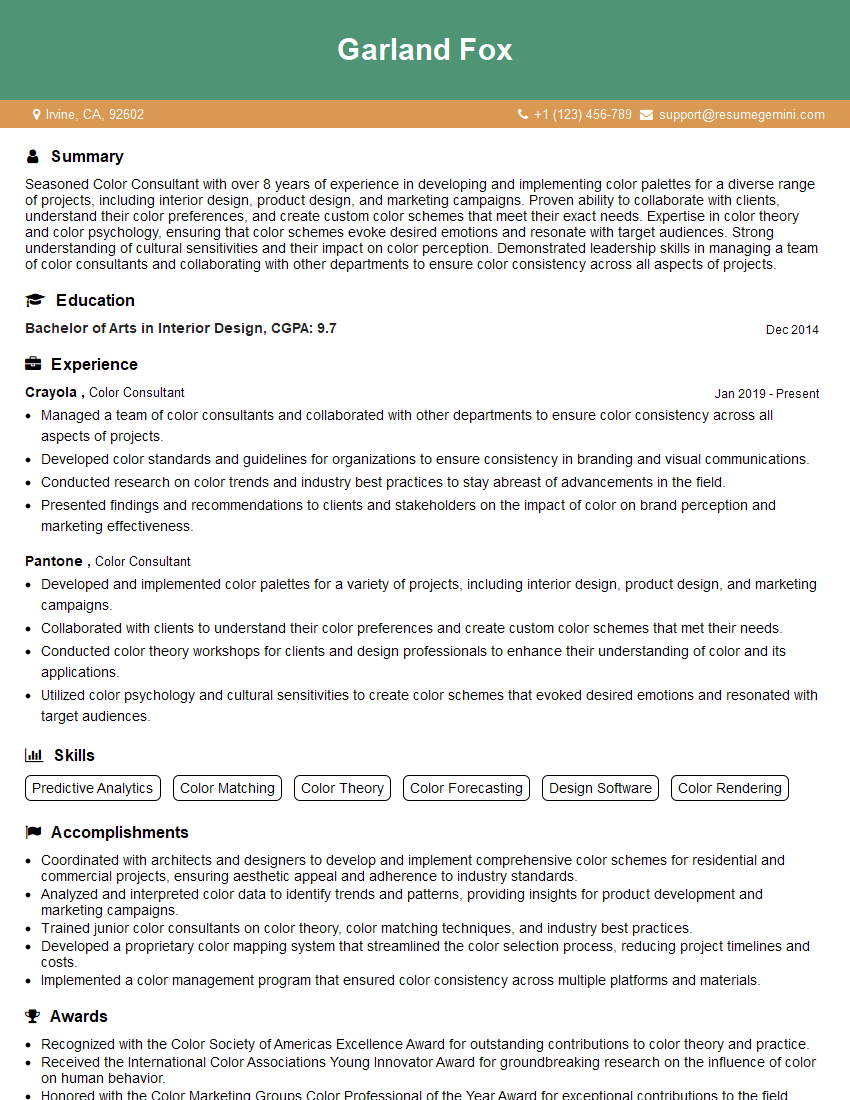
Mastering digital color correction is vital for career advancement in the film, television, and advertising industries. It opens doors to higher-paying roles and more creative control. To maximize your job prospects, create an ATS-friendly resume that showcases your skills and experience effectively. ResumeGemini is a trusted resource to help you build a professional and impactful resume that stands out. Examples of resumes tailored to Digital Color Correction professionals are available to guide you. Invest time in crafting a strong resume—it’s your first impression on potential employers.
Explore more articles
Users Rating of Our Blogs
Share Your Experience
We value your feedback! Please rate our content and share your thoughts (optional).
What Readers Say About Our Blog
Really detailed insights and content, thank you for writing this detailed article.
IT gave me an insight and words to use and be able to think of examples