Interviews are opportunities to demonstrate your expertise, and this guide is here to help you shine. Explore the essential Easement and Right-of-Way Surveying interview questions that employers frequently ask, paired with strategies for crafting responses that set you apart from the competition.
Questions Asked in Easement and Right-of-Way Surveying Interview
Q 1. Explain the difference between an easement and a right-of-way.
While the terms ‘easement’ and ‘right-of-way’ are often used interchangeably, there’s a subtle but important distinction. An easement is a non-possessory right to use another person’s land for a specific purpose. Think of it as a limited privilege, not ownership. For example, an easement might grant someone the right to cross your property to access their own landlocked parcel. A right-of-way, on the other hand, is a broader term that encompasses easements but also includes rights granted by public authorities, such as roadways, utility corridors, or pathways. Essentially, a right-of-way is a path or area legally designated for passage or use. All easements are rights-of-way, but not all rights-of-way are easements.
Imagine this: You own a house, and your neighbor needs to run a utility line across a small strip of your yard. That’s an easement – they have the right to use that strip for utilities, but they don’t own it. A city street, however, is a right-of-way; it’s a publicly owned area for public use.
Q 2. Describe the process of researching and identifying existing easements and rights-of-way.
Researching easements and rights-of-way is a crucial first step in any land survey. It involves a systematic approach combining several resources. We begin by searching the land records at the county recorder’s office. This involves reviewing deeds, plats, and any recorded easements or right-of-way documents. We look for legal descriptions, maps, and any relevant agreements.
Next, we examine title insurance commitments. These documents summarize the property’s ownership history, including any encumbrances such as easements. We also utilize GIS (Geographic Information Systems) data provided by municipalities and utilities, providing an overview of existing infrastructure and potentially recorded easements. Finally, we conduct field research, physically inspecting the property to identify any visible evidence of easements – like existing utility lines, fences marking boundaries, or worn paths indicating continuous usage. This visual inspection helps to correlate our research findings with physical reality.
Q 3. How do you ensure accuracy in the location and description of easements and rights-of-way?
Accuracy is paramount in easement and right-of-way surveying. We employ several techniques to guarantee precision. First, we use high-accuracy GPS equipment and total stations for precise location measurements. These instruments allow us to pinpoint the boundaries and dimensions of easements to within a fraction of an inch. Secondly, we meticulously tie our survey points to established benchmarks and control points, ensuring our data is georeferenced and accurately integrated within the larger coordinate system. We perform rigorous quality control checks throughout the survey process, cross-referencing our data with multiple sources to identify any inconsistencies. Thirdly, detailed field notes and photographs document all aspects of the survey, creating a complete and auditable record. Finally, we use specialized software to create accurate maps and legal descriptions of the easements, minimizing errors and providing clarity.
Q 4. What are the common legal descriptions used for easements and rights-of-way?
Legal descriptions for easements and rights-of-way vary depending on the jurisdiction but often utilize metes and bounds descriptions, lot and block references, or government lot descriptions.
- Metes and bounds uses distances and directions to define the boundaries of a parcel. For example:
“Beginning at the iron pin at the northeast corner of Section 10; thence South 80 degrees East 200 feet to a point; thence North 10 degrees East 150 feet to a point…” - Lot and block references use a plat map showing subdivided land; this system typically uses lot and block numbers within a recorded subdivision. For example:
“Lot 7, Block 3, Sunny Acres Subdivision, as recorded in Plat Book 2, Page 10, County Recorder’s Office.” - Government lot descriptions are primarily used for federally surveyed land and refer to specific sections, townships, and ranges.
The choice of description depends on how the property is defined in the original deed or recorded document.
Q 5. Explain the importance of proper boundary surveying in relation to easements and rights-of-way.
Proper boundary surveying is fundamental to accurately defining and locating easements and rights-of-way. Easements are always tied to specific boundaries. If the boundary is incorrect, the location of the easement will also be incorrect, leading to potential legal disputes. For example, an easement may be described as ‘running along the south boundary line of the property.’ An inaccurate boundary survey means the easement itself is misplaced. Therefore, we start with a thorough boundary survey to establish the precise location of the property lines before we locate and define the easement. This ensures that the easement is correctly placed relative to the property boundaries, preventing future conflicts and ensuring everyone’s rights are respected.
Q 6. How do you handle conflicting easements or overlapping rights-of-way?
Conflicting easements or overlapping rights-of-way are common challenges. Resolving these requires careful analysis of all relevant documents, including deeds, plats, and any recorded agreements. We prioritize the order of recording, as the first recorded easement generally takes precedence, provided it’s valid and properly documented. We also consider the specific terms of each easement, including its purpose, extent, and limitations. In cases of true conflict, a legal interpretation might be necessary, potentially requiring mediation or litigation to determine which easement takes priority or how to reconcile the overlapping claims. A thorough understanding of legal principles and precedence is critical in navigating these situations.
Q 7. Describe your experience with various types of surveys used in easement and right-of-way determination.
My experience encompasses a wide range of surveying techniques relevant to easement and right-of-way determination. I’m proficient in boundary surveys, using both traditional methods (tape and compass) and modern GPS and robotic total station technology for superior accuracy. I’ve conducted ALTA/ACSM land title surveys, which provide comprehensive information about the property boundaries and any encumbrances, including easements, for use by title insurance companies. I also have extensive experience in topographic surveys, creating detailed maps that show the terrain features and assist in the visual representation of easements. Furthermore, I utilize photogrammetry and LiDAR in certain projects to create three-dimensional models for a comprehensive visual analysis. The choice of survey method depends on the project’s scope, complexity, and the client’s specific requirements.
Q 8. How do you incorporate GIS technology into your easement and right-of-way surveys?
GIS technology is absolutely crucial for modern easement and right-of-way surveying. It allows us to efficiently manage, analyze, and visualize spatial data related to property boundaries, easements, and other infrastructure. Think of it as a powerful map-based database.
For instance, I use GIS to create accurate maps showing the location and extent of easements, overlaying them with existing infrastructure like utilities or buildings. This helps identify potential conflicts before construction begins. I also utilize GIS for data analysis; for example, calculating the total area of an easement or determining the proximity of an easement to a sensitive environmental area. Furthermore, GIS facilitates the creation of professional reports and presentations that are visually compelling and easy for clients to understand.
A specific example would be using ArcGIS Pro to create a map showing multiple overlapping easements on a single property. By assigning different symbology (e.g., colors, line styles) to each easement, we can clearly visualize their spatial relationships and potential conflicts. Then, we can utilize geoprocessing tools to perform spatial analysis (e.g., buffer analysis) to determine the proximity of the easements to existing structures, roads, or environmental features. This information becomes crucial for planning and decision-making.
Q 9. What software and hardware are you proficient in using for ROW surveying?
My proficiency spans a range of software and hardware commonly used in ROW surveying. On the software side, I’m highly proficient in ArcGIS Pro, AutoCAD Civil 3D, and Trimble Business Center. These allow me to perform tasks from data collection and processing to map creation and report generation. I also have experience with various GIS data formats such as Shapefiles, Geodatabases, and CAD files.
In terms of hardware, I’m adept at using robotic total stations (like Leica TS16), GNSS receivers (like Trimble R10), and data collectors. I understand the importance of proper equipment calibration and maintenance to ensure data accuracy and reliability. For example, using a robotic total station allows for increased efficiency in fieldwork, especially in challenging terrain. The GNSS receiver ensures accurate positioning, crucial for determining the exact location of boundaries and easements.
Q 10. Explain your experience with legal descriptions and title searches related to easements.
Understanding legal descriptions and conducting thorough title searches are fundamental aspects of my work. Legal descriptions, often complex and using metes and bounds or lot and block systems, define the precise location and boundaries of a property, including any easements. A title search helps identify all recorded interests in the property, including easements, encumbrances, and ownership details.
I’ve worked extensively with various types of legal descriptions, interpreting them to accurately locate easements on the ground. If inconsistencies arise, I utilize my understanding of land surveying principles and historical records to resolve them. For example, I might consult old maps, deeds, or court documents to clarify ambiguous descriptions. My experience also includes identifying easements that are implied but not explicitly stated in legal documents, requiring a thorough understanding of legal precedents and property law.
Q 11. How do you deal with discrepancies between field data and existing records?
Discrepancies between field data and existing records are common challenges. When such discrepancies occur, a systematic approach is necessary. First, I carefully review the field data, checking for any errors in data collection or processing. Next, I thoroughly examine the existing records, comparing them to any available historical maps or documents. If the discrepancy persists, a site visit might be required to verify the ground conditions.
For example, I might find that a recorded easement location differs slightly from what’s found on the ground. In this case, I would investigate the reasons for the difference. Maybe there was a mistake in the original survey, or perhaps ground conditions have changed over time. I would thoroughly document all findings, including supporting evidence, and propose a solution, potentially involving a detailed analysis and a consultation with relevant stakeholders to agree on the best path forward, which might involve a re-survey or a legal interpretation.
Q 12. Describe your experience with preparing legal and technical reports for easements.
Preparing legal and technical reports is a crucial part of my job. These reports must be clear, concise, and accurate, providing all relevant information to clients, legal professionals, and engineers. I create reports that include detailed maps, survey data, legal descriptions, and analysis of the easement.
My reports are formatted to meet specific legal requirements and industry standards. They include a clear summary of the findings, detailed methodology, and a discussion of any potential issues or ambiguities. For example, a report for an easement might include a detailed map showing the easement location, boundaries, and any encroachments. It might also include an analysis of the easement’s legal description, identifying any potential conflicts or ambiguities, and a discussion of its implications for future land use. The report would also explicitly state any assumptions or limitations of the survey.
Q 13. How do you communicate effectively with clients, engineers, and legal professionals regarding easements?
Effective communication is paramount in easement surveying. I emphasize clear and concise communication with all stakeholders, adapting my communication style to their level of expertise. With clients, I focus on explaining complex concepts in easily understandable terms. With engineers, I use more technical language and data-driven discussions. And with legal professionals, I ensure that the legal aspects of the easement are thoroughly addressed.
I regularly use various communication methods – formal reports, presentations, site visits, and informal discussions – to ensure everyone is informed and understands the survey results. For example, if a client has concerns about an easement’s impact on their property, I would provide a clear explanation of the easement’s rights and limitations, along with visual aids such as maps and diagrams. I’d also be readily available to answer any questions they may have.
Q 14. What are the common challenges you face in easement and right-of-way surveying?
Easement and right-of-way surveying presents various challenges. One common difficulty is dealing with unclear or conflicting legal descriptions. These can be ambiguous or outdated, making it difficult to determine the precise location and extent of an easement. Another challenge is locating evidence of easements on the ground, particularly older ones where physical markers might have been lost or destroyed. This requires thorough research and potentially innovative approaches to locate evidence.
Environmental factors also pose challenges, particularly in densely vegetated areas or areas with difficult terrain. Access restrictions and conflicting rights of other parties can also complicate the survey process. Managing stakeholder expectations and addressing potential conflicts between different interests can be complex and requires careful negotiation and communication. Finally, keeping up with evolving technologies and regulations is an ongoing challenge, requiring continuous professional development.
Q 15. Describe your experience with different types of easement agreements.
My experience encompasses a wide range of easement agreements, each with unique characteristics and implications for surveying. These include:
- Utility Easements: These grant access for things like power lines, pipelines, and telecommunications infrastructure. The surveying here focuses on precise location and dimensioning to ensure proper clearance and avoid conflicts with other structures or land uses. For instance, I’ve worked on projects where we needed to verify the easement width to ensure a new building wouldn’t encroach on a buried gas line.
- Access Easements: These provide a right of way for access to a property that’s landlocked or otherwise difficult to reach. My work in this area has involved establishing clear boundaries, ensuring sufficient width for vehicular access, and potentially incorporating provisions for maintenance and repair. One memorable project involved establishing a legal access point through a neighboring property to reach a secluded cabin.
- Drainage Easements: These easements grant rights to manage water flow across a property. Surveys for drainage easements often involve topographical analysis and hydrological modeling to ensure efficient and safe water management. I’ve worked on projects that required meticulous measurements of slopes and elevations to prevent flooding or erosion.
- Conservation Easements: These are designed to protect environmentally sensitive areas. The surveying process emphasizes meticulous boundary definition, often involving detailed vegetation mapping and habitat assessment. We collaborate closely with environmental agencies to ensure compliance with regulations.
Understanding the specific terms and conditions of each easement agreement is crucial for accurate and legally sound surveys. I always review the legal documentation thoroughly before beginning field work.
Career Expert Tips:
- Ace those interviews! Prepare effectively by reviewing the Top 50 Most Common Interview Questions on ResumeGemini.
- Navigate your job search with confidence! Explore a wide range of Career Tips on ResumeGemini. Learn about common challenges and recommendations to overcome them.
- Craft the perfect resume! Master the Art of Resume Writing with ResumeGemini’s guide. Showcase your unique qualifications and achievements effectively.
- Don’t miss out on holiday savings! Build your dream resume with ResumeGemini’s ATS optimized templates.
Q 16. How do you ensure the accuracy and completeness of your survey data?
Accuracy and completeness are paramount in easement and right-of-way surveying. We achieve this through a multi-pronged approach:
- Rigorous Field Procedures: We employ precise surveying techniques, regularly calibrating our equipment and implementing quality control checks at every stage of data collection. This includes redundant measurements and independent verification of critical points.
- Advanced Technology: We utilize cutting-edge GPS technologies, total stations, and robotic total stations, providing high-accuracy positioning and data capture. These tools allow for rapid data collection and minimize human error. For example, Real-Time Kinematic (RTK) GPS allows for centimeter-level accuracy in determining coordinates.
- Data Processing and Analysis: Sophisticated software packages are used to process raw survey data, applying necessary corrections for atmospheric conditions and instrument limitations. Data is rigorously checked for outliers and inconsistencies before being integrated into the final deliverables.
- Thorough Documentation: Comprehensive field notes, sketches, and digital records are meticulously maintained, providing a complete audit trail of the survey process. This detailed documentation is essential for ensuring the accuracy and defensibility of our work.
Think of it like building a house; you wouldn’t build without blueprints and rigorous inspections at every stage. Similarly, our meticulous approach guarantees a precise and reliable representation of the easement or right-of-way.
Q 17. How do you handle difficult terrain or environmental conditions during a survey?
Difficult terrain and environmental conditions pose significant challenges, but we have strategies to overcome them:
- Adaptable Equipment and Techniques: We utilize specialized equipment like drones for inaccessible areas, and employ various survey techniques—such as traversing or triangulation—to navigate challenging topography.
- Safety First: Safety is our top priority. We adhere to strict safety protocols, utilizing appropriate personal protective equipment (PPE) and employing risk assessments to mitigate potential hazards.
- Environmental Awareness: We are mindful of the environmental impact of our work and adhere to all relevant regulations and best practices to minimize disruption to the natural environment. This often involves carefully planning our access routes and using environmentally friendly equipment.
- Contingency Planning: We develop contingency plans to address potential delays or challenges caused by inclement weather or unforeseen circumstances. This might involve delaying fieldwork or employing alternative survey methods.
For example, in a recent project involving a steep, heavily wooded area, we used a drone equipped with a high-resolution camera to capture aerial imagery, significantly accelerating data collection and minimizing the need for dangerous fieldwork.
Q 18. Explain your experience with the use of GPS, total stations, and other survey equipment.
I have extensive experience with a range of survey equipment, including:
- GPS (Global Positioning System): I’m proficient in using various GPS receivers, including RTK (Real-Time Kinematic) systems, which provide highly accurate positioning data. This is essential for establishing control points and accurately mapping easements and rights-of-way.
- Total Stations: I’m experienced in operating total stations for precise distance and angle measurements. This equipment is crucial for detailed boundary surveys and the creation of accurate topographic maps.
- Robotic Total Stations: These automated systems enhance efficiency and accuracy. They allow for single-person operation and reduce the time required for data collection in the field.
- Leveling Instruments: I use these to establish accurate elevations, which are critical in drainage easement surveys and other projects requiring precise vertical control.
My proficiency extends beyond basic operation; I also understand the principles of instrument calibration, error analysis, and data processing. This ensures the highest quality and accuracy in our survey results.
Q 19. How do you manage your time and resources effectively during a survey?
Effective time and resource management is vital in surveying. We achieve this through:
- Careful Planning and Scheduling: We develop detailed project plans that include realistic timelines, resource allocation, and contingency plans to account for potential delays.
- Efficient Field Procedures: We utilize streamlined workflows and employ efficient data collection methods to minimize time spent in the field. This includes pre-planning access routes and coordinating with landowners.
- Technology Optimization: We leverage technology to enhance efficiency, such as using data-processing software to automate tasks and reduce manual data entry.
- Teamwork and Communication: Effective communication within the survey team and with clients is essential for managing expectations and ensuring the project stays on schedule.
For example, in a recent large-scale project, we used project management software to track progress, allocate tasks, and maintain accurate records, ensuring that we completed the project on time and within budget.
Q 20. Describe your experience in using various mapping software to manage ROW data.
I’m proficient in several mapping software packages commonly used for managing ROW data, including:
- AutoCAD Civil 3D: I use this software for creating detailed digital terrain models (DTMs), designing alignments, and producing final survey deliverables, such as plans and profiles.
- ArcGIS: This geographic information system (GIS) software is essential for managing spatial data, integrating diverse data sources, and performing spatial analysis. I use it to manage ROW data, analyze encroachment, and create maps for various purposes.
- MicroStation: This CAD software is used for drafting and design, providing a platform to create precise drawings and maps of easements and rights-of-way.
My skills extend beyond basic data input; I can create custom scripts and automate tasks within these systems to enhance efficiency and consistency. Understanding these software packages allows me to create informative and visually appealing maps and documentation that clearly communicate the information contained within the survey data.
Q 21. How do you handle potential encroachments on easements and rights-of-way?
Encroachments on easements and rights-of-way are a serious concern. My approach to handling them involves:
- Precise Boundary Determination: Accurate identification of the easement boundaries is paramount. We use high-precision survey techniques and review legal descriptions to precisely define the extent of the right-of-way.
- Documentation and Reporting: Any potential encroachment is meticulously documented with photographs, measurements, and detailed descriptions. This information is presented in a clear and concise report for the client.
- Legal Consultation: We advise clients on the legal implications of the encroachment and recommend courses of action, which may involve legal consultation and potentially negotiation or litigation.
- Coordination with Stakeholders: We coordinate with relevant parties, such as landowners, utility companies, and government agencies, to resolve encroachment issues in a fair and efficient manner.
A recent case involved a building encroaching on a utility easement. We carefully documented the encroachment, and this evidence was vital in negotiating a resolution that avoided costly legal action.
Q 22. Explain your understanding of relevant laws and regulations related to easements and ROWs.
Understanding the legal framework governing easements and rights-of-way (ROWs) is crucial for accurate and legally sound surveying. This involves familiarity with both federal and state laws, as well as local ordinances. At the federal level, laws like the National Environmental Policy Act (NEPA) influence ROW projects by requiring environmental impact assessments. State laws vary considerably; for example, some states have specific statutes outlining the procedures for establishing and maintaining easements, including requirements for proper documentation and notice to landowners. Local regulations might address zoning, building codes, and other factors that impact ROW usage. I’m particularly familiar with the nuances of [State Name] law, which requires [specific legal requirement, e.g., registered land surveyors to certify easement documents]. Furthermore, understanding case law related to easement interpretation and disputes is equally important. For instance, I’ve worked on a case where a dispute arose over the interpretation of an ambiguous easement description, requiring careful analysis of historical documents and on-site investigation to determine the true location and extent of the easement. This highlighted the necessity of meticulous documentation and clear communication in all stages of an easement survey.
Q 23. How do you ensure compliance with safety regulations during field surveys?
Safety is paramount in field surveying. Before any fieldwork begins, I conduct a thorough site assessment identifying potential hazards, such as uneven terrain, underground utilities, traffic, and weather conditions. We develop a site-specific safety plan that includes appropriate personal protective equipment (PPE), such as hard hats, high-visibility vests, safety glasses, and steel-toed boots. We also establish clear communication protocols among team members and utilize traffic control measures when working near roads or busy areas. For instance, on a recent project near a busy highway, we coordinated with traffic management personnel to ensure the safety of our crew and the traveling public. Regular safety briefings are essential to reinforce safe work practices and address any emerging concerns. Beyond standard safety measures, I’m trained in [mention specific safety training, e.g., OSHA 10-hour construction safety training] and routinely implement best practices to minimize risks.
Q 24. Describe your experience in performing boundary surveys to support easement identification.
Boundary surveys are fundamental to identifying easements, as easements are always tied to a specific parcel of land. My experience involves meticulously reviewing deed descriptions, title records, and other legal documents to establish the property boundaries. I use various surveying techniques, including GPS, total station surveying, and conventional methods, to mark the boundary lines on the ground. Accurate boundary determination is critical; an error could lead to disputes or encroachments. For example, I worked on a project where a previously unrecorded easement was discovered during a boundary survey, leading to significant changes in the project design and avoiding a costly legal battle. Understanding the historical context of a property, including past surveys and any evidence of prior use, can be vital in identifying and resolving boundary ambiguities. I am proficient in using Geographic Information Systems (GIS) software to analyze spatial data and create detailed boundary maps for easement identification and documentation.
Q 25. How familiar are you with different coordinate systems used in surveying?
I am highly proficient in various coordinate systems, including State Plane Coordinate Systems (SPCS), Universal Transverse Mercator (UTM), and Geographic Coordinate Systems (GCS), such as latitude and longitude. The choice of coordinate system depends on the project’s geographic location and scale. For instance, SPCS is generally preferred for local projects due to its lower distortion, while UTM is better suited for larger areas spanning multiple states. I understand the importance of coordinate system transformations and have experience using software like AutoCAD Civil 3D and ArcGIS to convert coordinates between different systems and ensure data compatibility. Understanding datums, such as NAD83 and NAD27, and their implications for accuracy is also crucial for reliable surveying work. Inaccurate coordinate transformations can lead to significant errors in easement location and potentially affect land ownership.
Q 26. Explain your understanding of the importance of data quality control in ROW surveying.
Data quality control (QC) is indispensable in ROW surveying. Inaccurate data can lead to costly errors, legal disputes, and project delays. My QC process begins with thorough instrument calibration and regular field checks. I employ rigorous data processing techniques, including error detection and adjustment, to ensure the accuracy and reliability of surveyed data. I utilize software tools with built-in QC features to identify and rectify potential anomalies. Regular field notes are meticulously documented. For instance, I have implemented a system of peer review, where another surveyor independently verifies a portion of my work, acting as a crucial check for potential errors. This ensures that our delivered work meets stringent accuracy standards. Detailed documentation of all processes and methodology is crucial for transparency and accountability. Ultimately, the goal is to deliver data that is not only accurate but also defensible in a legal context.
Q 27. How do you prioritize tasks in a busy work environment?
In a busy environment, effective prioritization is key to maintaining productivity and meeting deadlines. I use a combination of techniques to manage my workload. Firstly, I create a prioritized task list using methods like the Eisenhower Matrix (urgent/important), assigning deadlines and allocating time for each task. Secondly, I frequently communicate with my team and project managers to understand changing priorities and adjust my task list accordingly. Thirdly, I break down large tasks into smaller, more manageable components to enhance focus and prevent feeling overwhelmed. For example, when working on a large-scale project with multiple concurrent tasks, I dedicate specific blocks of time to different tasks, allowing for focused work and minimizing context switching. This structured approach ensures that urgent matters are handled promptly while still making progress on long-term goals.
Q 28. Describe your experience working on large-scale easement and right-of-way projects.
I possess extensive experience in large-scale easement and right-of-way projects, including [mention specific examples, e.g., pipeline corridors, highway expansions, utility line installations]. These projects often involve complex data management, coordination with multiple stakeholders (landowners, engineers, contractors), and adherence to strict deadlines. My experience includes managing teams, overseeing data collection and processing, and preparing comprehensive reports for clients. For instance, on a recent project involving a 100-mile pipeline corridor, I was responsible for coordinating a team of surveyors to accurately locate and document existing easements along the entire route. Efficient data management and communication were critical to the success of this project. I utilize advanced surveying equipment and software to streamline data collection and analysis, resulting in timely and accurate deliverables. My experience working on such large-scale projects has honed my skills in project management, problem-solving, and collaboration, enabling me to consistently deliver high-quality results.
Key Topics to Learn for Easement and Right-of-Way Surveying Interview
- Legal Descriptions and Boundary Determination: Understanding how to interpret legal descriptions and accurately determine property boundaries, including the impact of easements and right-of-ways.
- Easement Types and Attributes: Familiarize yourself with different types of easements (e.g., access, utility, drainage) and their legal characteristics, including their extent and limitations.
- Right-of-Way Acquisition and Negotiation: Grasp the process of acquiring right-of-way for projects, including negotiations with landowners and legal considerations.
- Survey Data Collection and Analysis: Mastering techniques for collecting accurate survey data (GPS, total station) and analyzing it to accurately depict easements and right-of-ways on plans.
- Preparation of Plans and Reports: Understanding the requirements for preparing clear, concise, and legally defensible plans and reports documenting easement and right-of-way information.
- Accuracy and Precision in Surveying: Demonstrate a strong understanding of surveying principles and the importance of accuracy and precision in this specialized field.
- Conflict Resolution and Problem Solving: Be prepared to discuss approaches to resolving discrepancies in property lines or easement interpretations. Consider scenarios involving conflicting easements or boundary disputes.
- Relevant Software and Technology: Familiarity with relevant surveying software (AutoCAD, Civil 3D etc.) and other technologies used in easement and right-of-way surveying is beneficial.
- Professional Ethics and Standards: Understand the ethical considerations and professional standards governing surveying practices.
Next Steps
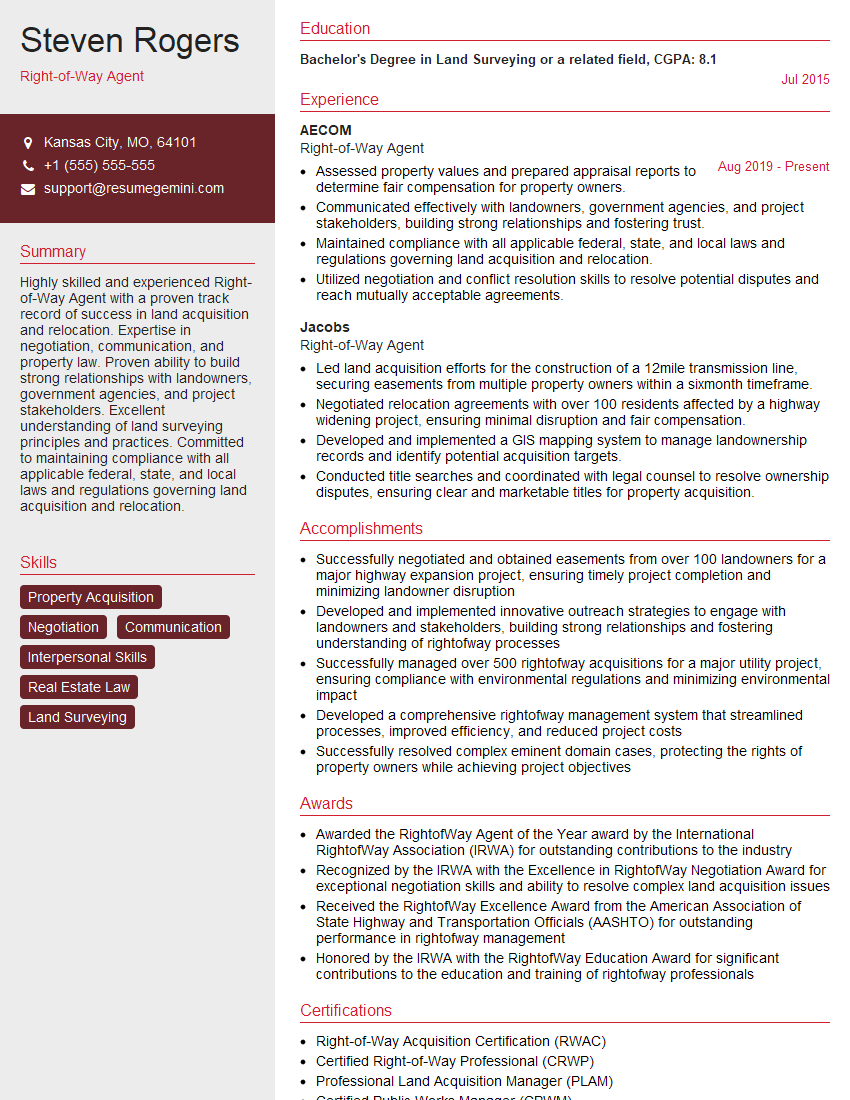
Mastering Easement and Right-of-Way Surveying opens doors to exciting career opportunities in land development, infrastructure projects, and environmental consulting. To maximize your job prospects, invest time in creating a strong, ATS-friendly resume that highlights your skills and experience effectively. ResumeGemini is a trusted resource to help you build a professional and impactful resume that showcases your expertise. Examples of resumes tailored to Easement and Right-of-Way Surveying are available to help guide you.
Explore more articles
Users Rating of Our Blogs
Share Your Experience
We value your feedback! Please rate our content and share your thoughts (optional).
What Readers Say About Our Blog
Really detailed insights and content, thank you for writing this detailed article.
IT gave me an insight and words to use and be able to think of examples