Cracking a skill-specific interview, like one for Editorial Cartooning, requires understanding the nuances of the role. In this blog, we present the questions you’re most likely to encounter, along with insights into how to answer them effectively. Let’s ensure you’re ready to make a strong impression.
Questions Asked in Editorial Cartooning Interview
Q 1. Describe your process for developing an editorial cartoon from concept to final artwork.
Creating an editorial cartoon is a multi-stage process that blends creativity with keen observation. It begins with identifying a relevant and timely news event or social issue. I then brainstorm various visual metaphors and symbolic representations that can encapsulate the essence of the story. This often involves sketching several thumbnail ideas, exploring different angles and characterizations. Once a promising concept emerges, I refine the sketch, adding detail and expression to the characters and background. This refined sketch acts as a blueprint for the final artwork. Next comes inking, where I use a pen and ink to solidify the lines and add depth and texture. Finally, I scan the inked artwork into a digital format where I can add color digitally, refining elements such as shading, highlights, and text if needed, to create the final impactful image. It’s a lot like sculpting, starting with a rough idea and gradually refining it until it clearly communicates the intended message.
For example, if I were illustrating a story about political gridlock, I might sketch several options: two politicians locked in a stalemate, a donkey and an elephant tied together, or a metaphorical wall separating two groups. After selecting the best concept, I’d add details to strengthen the visual storytelling – expressions, body language, and environmental cues that emphasize the central theme.
Q 2. How do you balance humor and social commentary in your cartoons?
Balancing humor and social commentary is the delicate art of editorial cartooning. The humor acts as a vehicle to engage the reader and make a potentially serious subject more accessible. It shouldn’t overshadow the core message, though. Instead, the humor should amplify the commentary, making the criticism sharper and more memorable. This is achieved by using satire, irony, exaggeration, and visual puns. For example, a cartoon depicting a politician with an oversized wallet might satirize their perceived greed, making a poignant point about corruption in a light-hearted way.
Think of it as a tightrope walk – you need enough humor to grab attention, but not so much that it dilutes the seriousness of the underlying message. The goal is to make people think, but also to make them *want* to think.
Q 3. Explain your understanding of the ethical considerations in editorial cartooning.
Ethical considerations in editorial cartooning are paramount. Accuracy is key; distorting facts or creating false narratives is unacceptable. Respect for individuals is crucial – even when satirizing them, the cartoon should avoid personal attacks or the promotion of harmful stereotypes. Fair representation is also vital; avoiding biased or one-sided depictions is essential, even when advocating a particular viewpoint. It’s about using humor and satire responsibly to promote critical thinking and not to incite hatred or prejudice. It’s a matter of responsible social commentary.
For instance, while a cartoon might criticize a political figure’s policies, it should avoid depicting them in a demeaning or personally offensive manner. The focus should remain on the issue, not on attacking the individual’s character.
Q 4. How do you research and stay informed on current events to inform your work?
Staying informed is fundamental to effective editorial cartooning. I regularly consume news from a variety of sources – newspapers, magazines, television, and reputable online outlets. I’m mindful of bias and strive to consume a range of perspectives to develop a well-rounded understanding. I also actively engage in conversations with diverse individuals to broaden my perspective and understanding of the nuances of different viewpoints. Attending press conferences, interviews, and public events offer valuable insights and help capture the spirit of the time.
For example, before creating a cartoon on climate change, I would research scientific reports, government policies, and diverse public opinions on the subject. This thorough research enables me to create a cartoon that is both informed and insightful.
Q 5. How do you adapt your style to different publication styles or audiences?
Adapting to different publications and audiences requires a versatile approach. A cartoon for a national newspaper will differ from one for a local community paper or an online platform. The style, tone, and level of detail need to be adjusted according to the publication’s target demographic and editorial style. National publications might require a more concise and broadly appealing style, while a local paper might allow for greater detail and a focus on local issues. Understanding the audience is vital in determining the approach.
For instance, a cartoon for a children’s magazine would use simpler imagery and more straightforward humor than a cartoon for a sophisticated political magazine.
Q 6. Discuss your experience with different cartooning techniques and styles.
My experience spans various techniques and styles in cartooning. I’m proficient in traditional methods like pen and ink, which allow for intricate detail and expressive linework. I’ve also embraced digital tools, which enable rapid prototyping, color experimentation, and efficient workflow. I’ve explored various styles, from the clean, minimalist aesthetic of certain political cartoonists to more expressive, almost caricaturistic styles. The choice of style depends largely on the message, publication, and target audience.
For example, a cartoon on a light-hearted topic might be done in a whimsical, almost child-like style, whereas a cartoon on a serious political topic might be created with a more formal and sophisticated style.
Q 7. How do you handle criticism of your work?
Handling criticism is an integral part of the process. Constructive criticism can be invaluable for improvement, offering insights into areas where the work might fall short. I view criticism as an opportunity to learn and refine my skills. However, it’s crucial to differentiate between constructive feedback and personal attacks. Sometimes, you’ll receive criticism that is unfair or based on misunderstanding. In such cases, it’s important to maintain perspective, analyze the feedback objectively, and focus on refining my work in future projects. Ultimately, the goal is to use every experience to hone the craft.
Learning to discern constructive criticism from personal attacks is essential. While personal attacks should be ignored, thoughtful critique can help to improve future work.
Q 8. What software and tools are you proficient in for creating editorial cartoons?
My digital arsenal for crafting editorial cartoons is quite extensive. I’m highly proficient in Adobe Photoshop, which is my primary tool for illustration, image manipulation, and color correction. I also utilize Adobe Illustrator for vector-based artwork, allowing for clean lines and scalable images, perfect for print and online use. For sketching and initial ideation, I often use a digital drawing tablet and software like Procreate or Autodesk Sketchbook. Finally, I’m comfortable with various file formats, ensuring seamless integration with different publication workflows. My skillset ensures I can efficiently produce high-quality cartoons across various platforms.
- Adobe Photoshop: For digital painting, image editing, and detailed rendering.
- Adobe Illustrator: For vector graphics, ensuring crisp lines and scalability.
- Procreate/Autodesk Sketchbook: For sketching and quick concept development.
Q 9. How do you manage deadlines and time constraints in a fast-paced news environment?
Deadlines in this field are incredibly tight, often requiring same-day turnaround. My approach involves a combination of efficient workflow and proactive planning. I start by carefully analyzing the news, prioritizing stories that lend themselves to visual satire. I then rapidly sketch multiple concepts, focusing on clarity and impact. Once the chosen sketch is finalized, I move directly to the digital phase, streamlining the process by focusing on essential elements and avoiding unnecessary details. Prioritization is key – I ensure the core message is strong even if minor details need to be sacrificed for time. Experience has taught me to anticipate potential delays and build in buffer time whenever possible.
Q 10. Give an example of a time you had to quickly adapt your cartoon to a breaking news story.
During the initial days of the pandemic, the news cycle was overwhelmingly focused on the rapid spread of COVID-19. I had a cartoon scheduled for the next day’s publication, originally focusing on a different, less urgent topic. However, the gravity of the situation demanded an immediate shift. I scrapped the initial concept and quickly sketched a cartoon depicting a microscopic virus overpowering a globe, illustrating the pandemic’s global impact. The change was made within hours. This required dropping details, but the essence of the critical message was preserved and effectively communicated, showcasing adaptability as a crucial skill in my profession.
Q 11. How do you ensure your cartoons are both visually appealing and effectively communicate your message?
Balancing visual appeal with effective communication is central to editorial cartooning. Strong visuals grab attention, while clear messaging ensures the point is understood. I achieve this by utilizing a combination of techniques. First, I focus on simple, bold imagery. Overly complex designs can distract from the message. Second, I use strong visual metaphors and symbolism; a single image can convey a complex idea more effectively than lengthy text. Finally, I pay close attention to color palettes and composition to enhance impact and create visual harmony. Think of it like telling a story – the visual elements need to work together to support the narrative and provoke a reaction.
Q 12. Describe your experience working with editors or art directors.
Collaboration with editors and art directors is fundamental to my work. They provide valuable context and feedback, ensuring the cartoon aligns with the publication’s editorial voice and target audience. I typically receive briefings outlining the news story and desired tone. I present initial sketches and receive feedback on the conceptual direction and visual execution before proceeding to final artwork. This iterative process allows for constructive criticism and ensures a final product that meets the publication’s requirements and my artistic vision. This collaborative spirit ensures the cartoon resonates with readers while fulfilling its journalistic purpose.
Q 13. How do you incorporate visual metaphors and symbolism into your cartoons?
Visual metaphors and symbolism are the lifeblood of editorial cartooning. For example, depicting a politician as a puppet can instantly convey a message about their lack of autonomy or manipulation by external forces. Similarly, using a scale to weigh competing interests or employing national emblems to represent countries allows for immediate comprehension of complex issues. I constantly strive for visuals that are easily understandable and universally relatable, regardless of the audience’s prior knowledge of the subject matter. The effectiveness of this technique lies in its economy of expression: a single image can convey a multifaceted narrative effectively.
Q 14. Explain your understanding of visual rhetoric and its application to editorial cartoons.
Visual rhetoric is the art of using images to persuade or convey a message. In editorial cartooning, it’s about strategically employing visual elements to create a specific response in the viewer. This includes understanding the power of symbolism, color psychology, composition, and caricature to elicit emotional responses and shape opinion. For example, the use of exaggerated features in a caricature can instantly convey a character’s flaws or strengths, instantly shaping the viewer’s perception. A skillful cartoonist manipulates these elements to create a powerful, often satirical, commentary on current events, making it a potent form of visual communication.
Q 15. How do you balance creativity with the need to maintain clarity and impact?
Balancing creativity and clarity in editorial cartooning is a delicate act, akin to walking a tightrope. The goal is to communicate a complex idea succinctly and memorably. Creativity provides the engaging visual language, while clarity ensures the message is readily understood. Impact stems from the successful marriage of the two.
For instance, I might use a humorous visual metaphor to represent a complex political issue. Instead of simply depicting politicians arguing, I might show them as children fighting over a toy representing a national budget, instantly conveying the immaturity and squabbling inherent in the situation. The creativity lies in the choice of metaphor, while clarity comes from its immediate recognizability and relation to the core issue.
- Simplicity: Avoid overcrowding the cartoon with too many details. Focus on a single, powerful visual message.
- Symbolism: Employ universally understood symbols and visual metaphors to convey complex ideas quickly.
- Strong Composition: Use a visually appealing layout that guides the reader’s eye to the main point.
Career Expert Tips:
- Ace those interviews! Prepare effectively by reviewing the Top 50 Most Common Interview Questions on ResumeGemini.
- Navigate your job search with confidence! Explore a wide range of Career Tips on ResumeGemini. Learn about common challenges and recommendations to overcome them.
- Craft the perfect resume! Master the Art of Resume Writing with ResumeGemini’s guide. Showcase your unique qualifications and achievements effectively.
- Don’t miss out on holiday savings! Build your dream resume with ResumeGemini’s ATS optimized templates.
Q 16. What are your strengths and weaknesses as an editorial cartoonist?
My strengths lie in my ability to distill complex political and social issues into simple, memorable visuals. I’m adept at using satire and irony to engage readers, and I pride myself on my ability to create cartoons that are both funny and thought-provoking. My style is versatile enough to adapt to different publications and audiences.
However, a weakness I’m constantly working on is the pressure of immediacy. News cycles are fast-paced, and sometimes the need to produce a cartoon quickly can compromise the level of polish and detail I’d like to achieve. Finding the right balance between speed and quality is an ongoing process.
Q 17. Describe a time your work faced significant challenges, and how did you overcome it?
One particularly challenging experience involved a cartoon I created about a sensitive social issue that was misinterpreted by a significant portion of the audience. My intention was to satirize a specific aspect of the problem, but the visual language, unintentionally, conveyed a different message altogether. This led to a considerable backlash, including negative feedback and accusations of promoting the opposite viewpoint.
To overcome this, I responded directly to the criticism, explaining my intent and acknowledging the misinterpretation. I published a follow-up piece elaborating on the cartoon’s meaning and addressing the concerns raised by the readers. This transparency, combined with a sincere effort to clarify the intended message, ultimately helped alleviate much of the negativity and fostered a constructive dialogue.
Q 18. What is your approach to using visual humor to engage an audience?
My approach to visual humor centers around creating relatable situations that resonate with the audience’s experiences. This often involves using exaggeration, irony, and absurdity. I aim for humor that is both clever and accessible, avoiding inside jokes or overly niche references that might alienate readers.
For example, I might portray politicians as puppets controlled by powerful lobbyists, using the familiar imagery of puppetry to highlight the influence of special interests on political decisions. The humor arises from the incongruity of the situation and the subtle commentary on power dynamics. It’s about finding that sweet spot between laughter and a poignant message.
Q 19. How familiar are you with current trends in political cartooning and satire?
I’m very familiar with current trends in political cartooning and satire. There’s a growing emphasis on using digital tools and animation, and many cartoonists are exploring new platforms like social media to reach wider audiences. The use of memes and internet culture is also increasingly prevalent, with cartoonists incorporating these elements into their work to enhance its relevance and appeal. Furthermore, there’s a noticeable increase in cartoons addressing social justice issues and systemic inequalities.
One notable trend is the rise of visually simpler, more direct cartoons on social media—quick, impactful sketches reacting to daily events. This contrasts with traditional, more detailed newspaper cartoons that often take longer to produce.
Q 20. What publications or cartoonists do you admire and why?
I greatly admire the works of Herblock (Herbert L. Block) for his powerful and incisive commentary during pivotal moments in American history. His ability to capture the essence of complex political events in a single, impactful image is truly remarkable. Similarly, I’m inspired by the work of Pat Oliphant for his ability to create cartoons that are both witty and profoundly insightful. His understanding of political dynamics and his mastery of visual storytelling are exceptional. Finally, the sharp social commentary and distinct style of R. Crumb is an influence. While stylistically different from my work, his fearless approach to challenging societal norms is commendable.
Q 21. How would you approach creating a cartoon on a complex political issue?
Approaching a complex political issue requires a multi-step process. First, thorough research is crucial. Understanding the nuances of the issue, the different perspectives involved, and the historical context is paramount. Next, I’d identify the core message I want to convey, simplifying it to its most essential element. Then, I’d brainstorm various visual metaphors and symbolic representations that could effectively communicate this message in a concise and memorable way.
For example, tackling climate change might involve depicting the Earth as a patient in intensive care, surrounded by alarming medical equipment representing pollution levels, illustrating the urgency of the situation. It’s important to be mindful of potential biases and strive for a balanced representation, even if that means highlighting the complexities of the problem.
Q 22. How do you incorporate feedback to improve your work?
Feedback is crucial in editorial cartooning, as it helps refine the message and impact. I actively seek feedback from editors, colleagues, and even readers. I find it helpful to categorize feedback into two types: constructive criticism focusing on the cartoon’s effectiveness in conveying the message, and technical feedback on the artwork itself. For example, an editor might suggest sharpening the satire by making a character’s expression more exaggerated, while a colleague might point out a slight anatomical inaccuracy in a figure. I treat all feedback as valuable, but I weigh it against my artistic vision and the overall editorial intent. I keep a running log of feedback received on each cartoon, noting both the source and the specific points raised. This helps me identify recurring themes and areas for improvement in my future work. I don’t always implement every suggestion, but I always consider it carefully, particularly when the feedback comes from experienced professionals. Over time, this iterative process has honed my ability to create cartoons that are both visually engaging and impactful.
Q 23. What is your workflow for creating a single cartoon?
My workflow is a blend of creative brainstorming and meticulous execution. It usually starts with identifying a news story or current event that lends itself to visual satire. This involves reading widely and staying informed on current affairs. Next comes the ideation phase where I sketch various ideas, experimenting with different visual metaphors and characterizations to effectively communicate the intended message. Once I’ve chosen a direction, I create a more detailed sketch, often incorporating annotations to guide the digital painting process. The digital painting stage involves refining the sketch, adding color, texture, and fine details. This is where I pay close attention to visual storytelling, using composition, line weight, and color palettes to create a powerful visual narrative. Finally, I carefully review the cartoon for any inconsistencies or areas that could be improved before delivering the final version. This might involve minor adjustments to shading or expression. I often revisit earlier sketches or thumbnails to ensure the final product remains consistent with my initial vision and communicates the message effectively. Think of it as a sculptor refining their work from a rough block of clay into a finished masterpiece.
Q 24. How would you explain a cartoon to someone who doesn’t understand its message?
Explaining a cartoon’s message to someone who doesn’t understand it requires a multi-faceted approach. First, I’d discuss the context: what current event or issue the cartoon references. Then, I would break down the visual elements, identifying the key characters and symbols and explaining their significance. For instance, if the cartoon uses a common symbol like a donkey for a specific political party, I’d explicitly state that. I would explain the visual metaphors employed, emphasizing how the visual elements work together to create a satirical commentary. The key is to avoid jargon and make sure the explanation is clear and easily understandable, regardless of the audience’s familiarity with political satire or editorial cartoons. It’s like explaining a complex joke – you need to unpack all the components and reveal the punchline with careful explanation. A good example is explaining the symbolism used by famous cartoonists like Herblock or Oliphant, where even seemingly simple imagery contains layers of meaning related to a specific historical event.
Q 25. What makes a good editorial cartoon stand out?
A good editorial cartoon stands out through a compelling combination of visual wit, sharp satire, and effective communication. It’s not just about drawing; it’s about capturing the essence of a complex issue in a single, memorable image. The most impactful cartoons are concise and thought-provoking. They possess a strong visual punchline that immediately grabs the viewer’s attention. They use clever symbolism and metaphors to make their point without being overly didactic. The cartoon’s style, while subjective, should complement the message. A cartoon about a serious political issue might benefit from a more serious style, while a cartoon about a lighter topic might be better suited to a more whimsical style. Ultimately, a truly successful cartoon will stick in the viewer’s mind long after they’ve seen it, prompting them to think critically about the issue at hand. Consider the work of Pulitzer Prize winners; their impact stems from this powerful combination of visual storytelling and biting social commentary.
Q 26. What software are you proficient in for creating cartoons?
I’m proficient in a variety of software applications for creating editorial cartoons. My primary tools include Adobe Photoshop and Illustrator. Photoshop’s powerful painting and image-manipulation capabilities are invaluable for creating detailed illustrations and digitally painting my cartoons. Illustrator’s vector-based tools are extremely useful for creating clean lines, consistent lettering, and scalable artwork for different print or online formats. I also utilize Adobe InDesign for page layout when preparing my cartoons for publication. Knowing how to seamlessly integrate these tools allows for efficient workflow and flexibility in terms of artistic style and final output. While traditional drawing skills form the foundation of my work, digital tools greatly enhance both the precision and speed of my creative process.
Q 27. How do you handle copyright and intellectual property issues?
Copyright and intellectual property are paramount in editorial cartooning. I carefully ensure that any imagery or text I use that is not my own is either in the public domain or appropriately licensed. I avoid using copyrighted material without permission. When I create a cartoon, I retain the copyright unless I specifically assign it to a client or publication. I usually work with clear contracts that outline ownership and usage rights, preventing future conflicts. This involves clearly defining the scope of license, specifying where the work can be used, and potentially including terms for potential future usage. Understanding copyright law is essential to protect both my work and the reputation of the publications I work with. I often consult legal advice, particularly when dealing with complex licensing agreements. Protecting the integrity of my work and adhering to copyright law is a non-negotiable aspect of my professional practice.
Q 28. Describe your experience collaborating with other artists or writers.
Collaboration has been a significant part of my career. I’ve worked with editors on numerous occasions, refining concepts, and ensuring the cartoon aligns perfectly with the publication’s editorial stance. This collaborative process involves exchanging ideas, feedback, and revisions until we arrive at a final piece that meets both editorial and artistic standards. I’ve also collaborated with writers who provide the text for accompanying articles or features. In these cases, we work together to ensure that the cartoon complements the written piece, enhancing the overall impact on the reader. This shared creative process allows for fresh perspectives and strengthens the overall quality of the work. It’s like a team effort – everyone’s contribution is vital to achieve the desired outcome. A memorable instance involved working with a writer on a piece concerning environmental issues; integrating his detailed research and my visual skills resulted in a cartoon that resonated with a wider audience than either of us could have achieved alone. This collaborative approach is invaluable in enhancing the message’s reach and clarity.
Key Topics to Learn for Editorial Cartooning Interview
- Visual Communication & Storytelling: Understanding how to convey complex ideas and narratives concisely and effectively through visual metaphors and symbolism.
- Political & Social Commentary: Analyzing current events and social issues to identify key themes and create impactful cartoons that resonate with the audience.
- Character Design & Composition: Developing memorable and expressive characters, and mastering principles of visual composition to create balanced and engaging cartoons.
- Style & Technique: Exploring different cartooning styles and techniques, understanding their strengths and limitations, and developing a personal style that aligns with your artistic vision.
- Humor & Satire: Mastering the art of satire and using humor effectively to critique and comment on social and political issues. Understanding different forms of humor and their application.
- Software Proficiency: Demonstrating familiarity with relevant software like Adobe Photoshop, Illustrator, or similar digital art tools, and showcasing your workflow.
- Ethical Considerations: Understanding the ethical responsibilities of an editorial cartoonist, including avoiding stereotypes, misinformation, and harmful generalizations.
- Understanding your Audience: Analyzing different target audiences and adapting your style and message to resonate effectively with them.
- Portfolio Development & Presentation: Effectively showcasing your best work, explaining your creative process, and articulating the impact of your cartoons.
- Adaptability & Problem-Solving: Demonstrating the ability to adapt your style to different publications and deadlines, and overcome creative challenges efficiently.
Next Steps
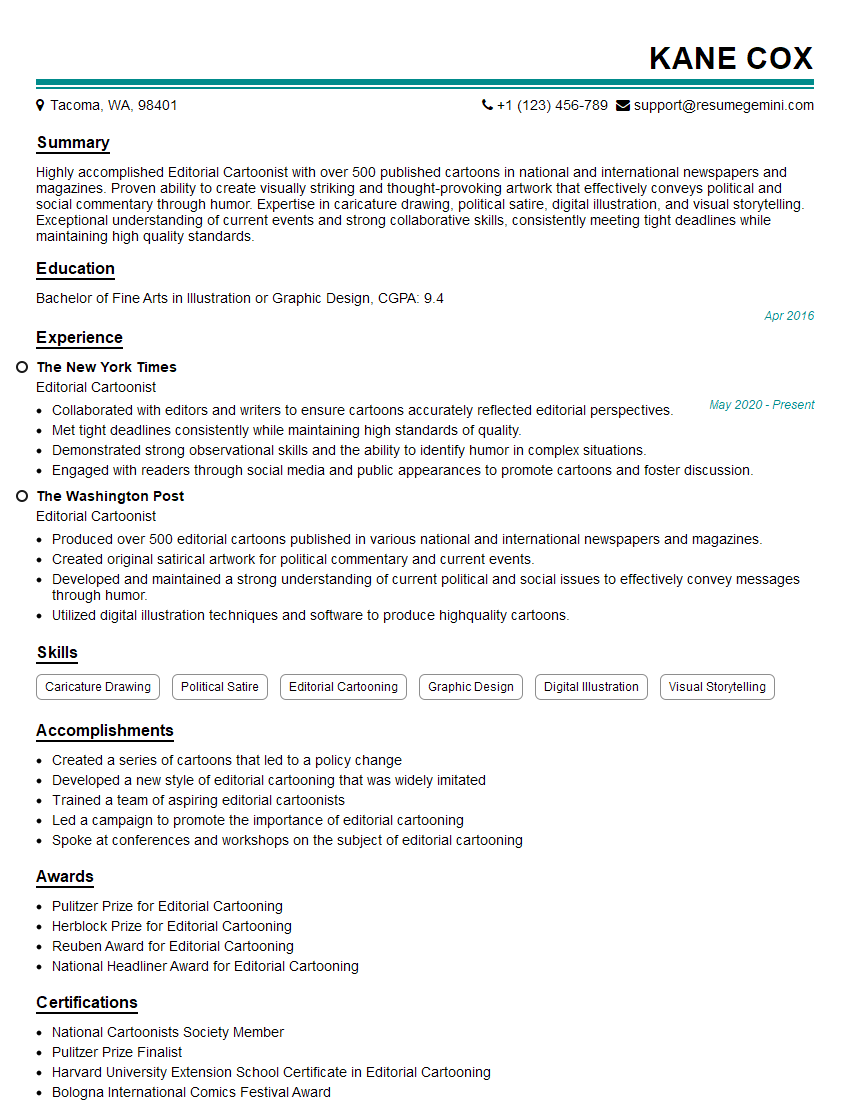
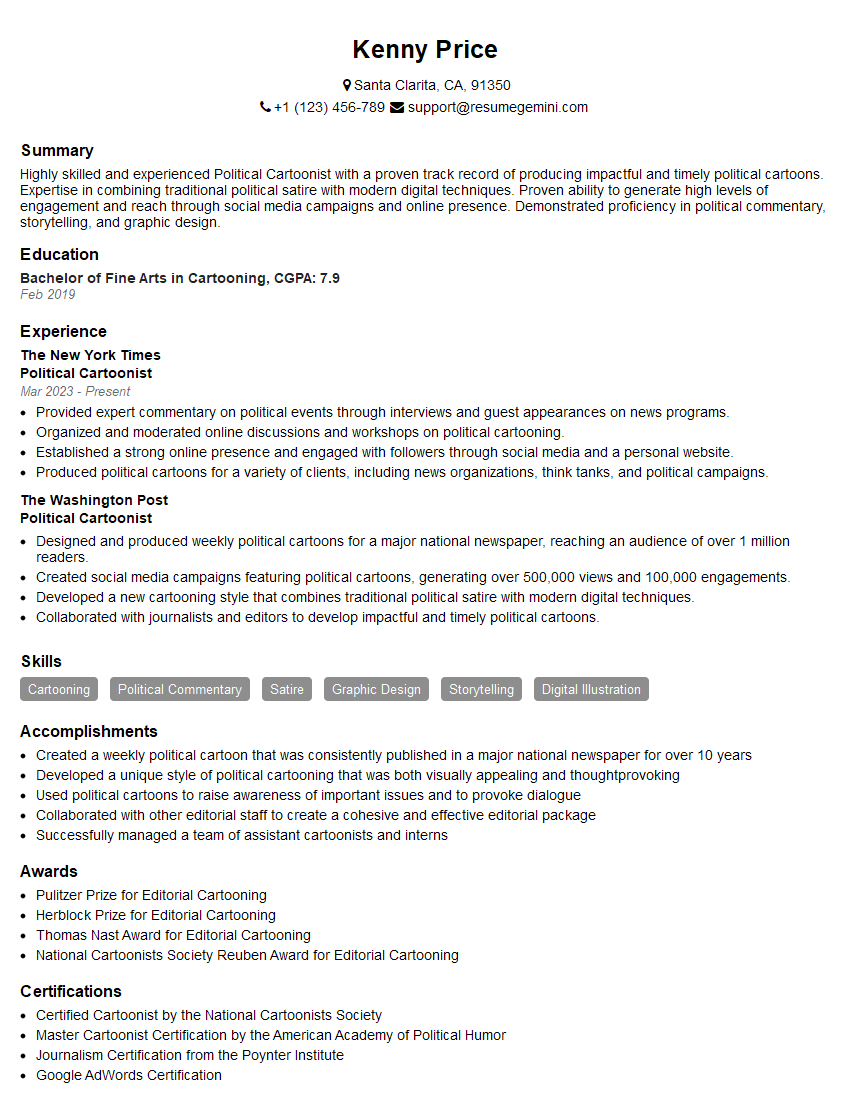
Mastering editorial cartooning opens doors to a fulfilling career that combines creativity, social commentary, and impactful communication. To maximize your job prospects, creating a strong, ATS-friendly resume is crucial. ResumeGemini is a trusted resource to help you build a professional and effective resume that highlights your skills and experience. Examples of resumes tailored specifically to Editorial Cartooning are available to guide you through the process.
Explore more articles
Users Rating of Our Blogs
Share Your Experience
We value your feedback! Please rate our content and share your thoughts (optional).
What Readers Say About Our Blog
Really detailed insights and content, thank you for writing this detailed article.
IT gave me an insight and words to use and be able to think of examples