Every successful interview starts with knowing what to expect. In this blog, we’ll take you through the top Engine and Mechanical Systems interview questions, breaking them down with expert tips to help you deliver impactful answers. Step into your next interview fully prepared and ready to succeed.
Questions Asked in Engine and Mechanical Systems Interview
Q 1. Explain the four-stroke engine cycle.
The four-stroke engine cycle is the fundamental process by which internal combustion engines convert fuel into mechanical energy. It’s a cyclical process consisting of four distinct strokes, each driven by the movement of the piston within the cylinder. Think of it like a piston rhythmically pumping air and fuel through a series of carefully orchestrated stages.
- Intake Stroke: The piston moves downward, drawing a mixture of air and fuel into the cylinder. This is like inhaling – bringing in the ingredients for combustion.
- Compression Stroke: The piston moves upward, compressing the air-fuel mixture. This increases the temperature and pressure, making combustion more efficient. Imagine squeezing a balloon – building up potential energy.
- Power Stroke: The spark plug ignites the compressed air-fuel mixture, causing a rapid expansion of gases. This forceful expansion pushes the piston downward, generating the power that turns the crankshaft and ultimately drives the vehicle. This is the ‘bang’ that provides the mechanical work.
- Exhaust Stroke: The piston moves upward again, pushing the spent exhaust gases out of the cylinder through the exhaust valve. This is like exhaling – clearing out the waste products.
This cycle repeats continuously, each stroke contributing to the engine’s overall power output. The timing of these strokes is precisely controlled by the camshaft, ensuring the valves open and close at the correct moments.
Q 2. What are the different types of combustion engines?
Combustion engines are broadly categorized based on their fuel source, combustion cycle, and design. Here are some key types:
- Spark-Ignition (SI) Engines: These engines use a spark plug to ignite a pre-mixed air-fuel mixture. Gasoline engines in cars are a prime example. They’re known for their relatively high power-to-weight ratio but can be less fuel-efficient than some other types.
- Compression-Ignition (CI) Engines: Also known as diesel engines, these engines ignite the fuel by compressing it to a high temperature and pressure. They’re typically more fuel-efficient and produce higher torque than gasoline engines, but they tend to be noisier and have higher emissions.
- Two-Stroke Engines: These engines complete the four-stroke process in two piston strokes using a separate port for intake and exhaust. They are often found in smaller engines like those in chainsaws or motorbikes. Their simplicity means less moving parts but can be less efficient and cleaner than four-stroke engines.
- Rotary Engines: These use a rotating triangular rotor instead of reciprocating pistons. They are known for their smooth operation and high power-to-weight ratio, but they are complex and have a shorter lifespan than many piston engines.
The choice of engine type depends on factors like application, desired performance, fuel economy requirements, and emission regulations.
Q 3. Describe the function of a turbocharger.
A turbocharger is a device that increases the power output of an internal combustion engine by forcing more air into the combustion chamber. It does this by using the energy from the engine’s exhaust gases to drive a turbine, which in turn compresses the intake air. Think of it as a forced-air system, but using waste energy to power the process.
The exhaust gases spin a turbine connected to a compressor. This compressor takes the air drawn into the engine and increases its pressure before it enters the combustion chamber. The higher pressure air contains more oxygen, allowing for more fuel to be burned, leading to a significant increase in power. This process is remarkably efficient as it uses waste energy that would otherwise be lost.
Turbochargers are commonly found in modern cars, trucks, and other vehicles, contributing to enhanced performance and fuel efficiency when carefully designed and controlled.
Q 4. Explain the difference between a supercharger and a turbocharger.
Both superchargers and turbochargers are used to increase the power output of an engine by forcing more air into the combustion chamber, but they differ significantly in how they achieve this. The key difference lies in the power source:
- Supercharger: A supercharger is mechanically driven by the engine’s crankshaft. This means it’s directly powered by the engine itself, consuming some of the engine’s power. Think of it like a secondary pump directly connected to the engine’s power source.
- Turbocharger: A turbocharger uses the energy from the engine’s exhaust gases to drive its turbine. This means it uses otherwise wasted energy to increase power, leading to improved efficiency compared to a supercharger. It’s like using waste energy to create additional energy.
Therefore, superchargers provide consistent boost across the engine’s RPM range but reduce the overall engine power due to the mechanical drive. Turbochargers offer more significant power increases but can have a lag before boost kicks in, as they need sufficient exhaust gas flow to spin the turbine.
Q 5. What is the role of the crankshaft in an engine?
The crankshaft is a crucial component of an engine, responsible for converting the reciprocating linear motion of the pistons into rotational motion. This rotational motion is what ultimately drives the vehicle’s wheels or other machinery. Imagine it as a transformative intermediary.
As the pistons move up and down in the cylinders, they push on connecting rods attached to the crankshaft. The crankshaft, with its offset throw, converts this linear motion into a rotating movement. The crankshaft’s rotation is transferred through the transmission to the wheels, providing the power needed to propel the vehicle. The design of the crankshaft – its number of throws, material, and balance – is critical for engine performance, reliability, and smoothness of operation.
Q 6. How does a catalytic converter work?
A catalytic converter is an emission control device used in automobiles to reduce harmful pollutants in the exhaust gases before they are released into the atmosphere. It employs a chemical process to convert toxic gases into less harmful substances. It’s essentially a purifier for the exhaust.
The converter contains a catalyst, usually platinum, palladium, and rhodium, coated on a ceramic honeycomb structure. As the exhaust gases pass through this structure, the catalyst facilitates chemical reactions that convert harmful pollutants like carbon monoxide (CO), unburned hydrocarbons (HC), and nitrogen oxides (NOx) into less harmful substances such as carbon dioxide (CO2), water (H2O), and nitrogen (N2).
The high temperatures of the exhaust gases are essential for these chemical reactions to occur efficiently. The honeycomb structure maximizes the surface area of the catalyst, enhancing the efficiency of the conversion process. This is a critical component of modern vehicles’ efforts to reduce environmental impact.
Q 7. What is the purpose of engine oil?
Engine oil plays a vital role in maintaining the health and performance of an internal combustion engine. It acts as a lubricant, coolant, and cleaner, protecting various engine components from wear and tear. It’s essentially the lifeblood of the engine.
Its primary function is lubrication. Engine oil reduces friction between moving parts such as pistons, cylinders, bearings, and camshafts, preventing wear and reducing energy loss. It also acts as a coolant, absorbing and dissipating heat generated during combustion, preventing overheating. Furthermore, engine oil helps to keep the engine clean by suspending and carrying away contaminants, preventing sludge buildup and maintaining engine efficiency.
The type and quality of engine oil are critical factors in engine longevity. Using the correct oil viscosity and meeting the manufacturer’s specifications are crucial for optimal engine performance and lifespan. Regular oil changes are essential to maintain its effectiveness and prevent premature engine wear.
Q 8. Explain the concept of engine cooling systems.
Engine cooling systems are crucial for maintaining the optimal operating temperature of an internal combustion engine. If an engine gets too hot, it can lead to severe damage, including warping of cylinder heads, piston seizures, and premature wear. The system works by dissipating the heat generated during combustion. Think of it like the radiator in your car – it’s the engine’s sweat glands!
The system typically involves a coolant (often a mixture of water and antifreeze), a pump to circulate the coolant, a radiator to release heat to the atmosphere, a thermostat to regulate coolant flow, and various hoses and sensors to monitor and control the process.
Q 9. Describe different types of engine cooling systems.
There are two primary types of engine cooling systems:
- Liquid Cooling: This is the most common type, using a coolant (like water and antifreeze) circulated through passages within the engine block and cylinder head. The heated coolant then flows to a radiator where a fan and airflow help dissipate the heat. This is incredibly efficient and reliable. My own classic car utilizes a liquid-cooled system, and its consistent performance over the years is a testament to its effectiveness.
- Air Cooling: In this system, fins are cast into the engine block and cylinder head to increase the surface area exposed to the air. As air flows over these fins, heat is dissipated. This system is simpler, with fewer components, but less effective at cooling, especially under high loads. Air-cooled engines are often found in motorcycles and some smaller engines.
Some engines also utilize a combination of both liquid and air cooling for optimal thermal management.
Q 10. What are the common causes of engine knocking?
Engine knocking, also known as detonation, is a harsh, rattling sound coming from the engine. It occurs when the air-fuel mixture in the cylinder ignites prematurely, before the spark plug fires. This uncontrolled explosion creates high pressure and can severely damage engine components.
- Low-octane fuel: Using fuel with a lower octane rating than recommended for your engine is a common cause. Lower octane fuel is more prone to premature ignition.
- Ignition timing: If the ignition timing is advanced too far, it can lead to knocking. This means the spark plug fires too early.
- Carbon buildup: Deposits of carbon on the piston crown and combustion chamber can increase the temperature and promote premature ignition.
- Lean air-fuel mixture: A mixture with too little fuel relative to air will burn hotter and increases the chances of detonation.
- Engine overheating: High engine temperatures increase the likelihood of knocking.
Imagine it like lighting a firework too early – instead of a controlled burn, you get a chaotic explosion.
Q 11. How do you diagnose an engine misfire?
Diagnosing an engine misfire, where one or more cylinders fail to ignite properly, involves a systematic approach. The symptoms can range from rough running and reduced power to a noticeable shaking or sputtering of the engine.
- Check Engine Light (CEL): The first step is to check for a CEL. The code stored by the car’s computer will often pinpoint the specific cylinder experiencing the misfire.
- Visual Inspection: Inspect spark plug wires, spark plugs, and ignition coils for any visible damage or wear. A cracked spark plug wire, for instance, can cause a misfire.
- Compression Test: This test measures the pressure within each cylinder during the compression stroke. Low compression in a cylinder indicates a problem like a worn piston ring or a damaged valve.
- Fuel Injector Test: Use a fuel pressure gauge to check fuel delivery and a noid light to verify injector activation. A faulty injector can prevent proper fuel delivery.
- Data Scan Tool: A more advanced scan tool can provide detailed information on misfire counts per cylinder, allowing precise localization of the issue.
Troubleshooting a misfire is like detective work. You systematically eliminate possibilities until you find the culprit.
Q 12. Explain the function of a fuel injector.
A fuel injector’s primary function is to precisely meter and deliver fuel into the engine’s combustion chamber. It’s essentially a tiny, high-pressure valve that opens and closes rapidly, spraying a fine mist of fuel. The timing and duration of this injection are precisely controlled by the engine’s computer (ECU), ensuring optimal combustion for power and efficiency.
Imagine it as a very precise spray bottle, delivering the exact amount of fuel at precisely the right moment. The precision of this delivery is vital for efficient combustion.
Q 13. What are the different types of fuel injection systems?
Fuel injection systems are categorized mainly into two types:
- Port Fuel Injection (PFI): In PFI, the fuel injectors are located in the intake manifold, spraying fuel directly into the intake ports just before it enters the combustion chamber. This system is simpler and generally less expensive than direct injection.
- Direct Fuel Injection (DI): In DI, the injectors are mounted directly into the combustion chamber, spraying fuel directly onto the piston or into the cylinder. This allows for more precise fuel control, leading to better efficiency and power, but it’s generally more complex and costly.
There are also variations within each type, such as multi-port fuel injection where multiple injectors per cylinder are used.
Q 14. Describe the operation of a transmission system.
A transmission system’s role is to manage the power transfer from the engine to the wheels, allowing for efficient operation across different speeds and loads. It acts like a gearbox, changing the gear ratio to match the engine’s speed to the driving conditions.
The transmission system can be:
- Manual: The driver manually selects the gear ratio using a clutch and shifter. This provides more control but requires driver skill and engagement.
- Automatic: An automatic transmission uses a complex system of clutches, planetary gears, and hydraulic controls to automatically select the appropriate gear ratio based on driving conditions. This offers convenience and ease of use.
- Continuously Variable Transmission (CVT): A CVT uses belts and pulleys to provide a continuous range of gear ratios, resulting in smooth acceleration and potentially better fuel efficiency.
Think of a bicycle’s gears – they allow you to pedal efficiently on uphill climbs and maintain speed on flat ground. The transmission system in a vehicle performs a similar function, adapting to changing demands on the engine.
Q 15. What is the difference between manual and automatic transmissions?
The core difference between manual and automatic transmissions lies in how the driver selects gears. In a manual transmission, the driver physically selects the gear using a clutch pedal and a gear stick, directly engaging the desired gear ratio. This provides greater control and potentially better fuel efficiency, especially for experienced drivers who can optimize gear selection. However, it requires more driver skill and attention, and can be more tiring in heavy traffic.
An automatic transmission, on the other hand, automatically selects gears based on engine speed, throttle position, and other factors. It uses a sophisticated system of hydraulics or electronics to smoothly shift between gears without driver intervention. Automatic transmissions offer convenience and ease of use, especially in stop-and-go traffic, but typically offer slightly lower fuel economy and may not provide the same level of control as a manual.
Think of it like this: a manual transmission is like a bicycle – you have complete control over the gears, but require more effort. An automatic transmission is more like an electric scooter – easier to use, but you have less control.
Career Expert Tips:
- Ace those interviews! Prepare effectively by reviewing the Top 50 Most Common Interview Questions on ResumeGemini.
- Navigate your job search with confidence! Explore a wide range of Career Tips on ResumeGemini. Learn about common challenges and recommendations to overcome them.
- Craft the perfect resume! Master the Art of Resume Writing with ResumeGemini’s guide. Showcase your unique qualifications and achievements effectively.
- Don’t miss out on holiday savings! Build your dream resume with ResumeGemini’s ATS optimized templates.
Q 16. Explain the principles of thermodynamics related to engine operation.
Engine operation fundamentally relies on the principles of thermodynamics, particularly the first and second laws. The first law, the law of conservation of energy, states that energy cannot be created or destroyed, only transformed. In an engine, the chemical energy stored in fuel is converted into heat energy during combustion, which is then transformed into mechanical work that turns the crankshaft. Some energy is inevitably lost as heat to the surroundings.
The second law dictates that the total entropy of an isolated system can only increase over time. This means that during the combustion process, some energy is inherently lost as unusable heat, limiting the engine’s efficiency. Engineers constantly strive to minimize these losses through efficient design and advanced technologies.
For example, the Carnot cycle, a theoretical thermodynamic cycle, provides a benchmark for the maximum possible efficiency of a heat engine operating between two temperature reservoirs. Real-world engines, however, always fall short of this ideal efficiency due to factors like friction and heat losses.
Q 17. How does engine braking work?
Engine braking, also known as compression braking or exhaust braking, uses the engine itself to slow down the vehicle. It doesn’t rely on the friction brakes, reducing wear and tear on those components. The principle is simple: by closing the throttle, the engine’s momentum is used to compress the air-fuel mixture in the cylinders. This compression creates resistance, slowing the engine’s rotational speed and thereby slowing the vehicle.
In some vehicles, especially larger trucks and buses, engine braking systems are significantly enhanced through mechanisms like exhaust brakes which use valves to restrict exhaust flow, creating additional back pressure and increasing the braking effect. In many modern vehicles, engine braking is also enhanced by sophisticated electronic control systems which modulate the fuel injection and ignition timing to maximize the braking effect.
Imagine trying to stop a bicycle by pedaling backward – that resistance against the motion is analogous to engine braking.
Q 18. What is the significance of engine efficiency?
Engine efficiency is crucial for several reasons. Primarily, it determines the amount of usable mechanical work produced per unit of fuel consumed. A more efficient engine delivers more power for the same amount of fuel, leading to better fuel economy and reduced running costs. This translates to lower operational expenses for vehicles and machinery.
Moreover, higher efficiency directly impacts environmental impact. By consuming less fuel, a more efficient engine produces fewer greenhouse gas emissions and contributes less to air pollution. The pursuit of higher engine efficiency is a key driver of innovation in automotive and power generation industries. Factors such as reduced friction, improved combustion, and optimized valve timing all play a significant role in enhancing efficiency.
Q 19. Explain the concept of valve timing.
Valve timing refers to the precise timing of when the intake and exhaust valves in an engine open and close relative to the piston’s position. This is critical for optimal engine performance. Precise timing ensures that the intake valve opens at the right moment to allow fresh air-fuel mixture to enter the cylinder, while the exhaust valve opens at the right moment to allow spent gases to exit. Improper valve timing can lead to incomplete combustion, reduced power, poor fuel economy, and increased emissions.
Valve timing is controlled by the camshaft, which is a rotating shaft with lobes that push on the valves’ actuators (either directly or via rocker arms). The camshaft’s profile determines when and how long each valve stays open. Modern engines often employ variable valve timing (VVT) systems which adjust the valve timing dynamically based on engine speed and load, optimizing performance across a wider range of operating conditions.
Think of valve timing as the choreography of a perfectly orchestrated dance. Each movement (opening and closing of valves) must be precisely timed to ensure a harmonious and efficient result.
Q 20. Describe the different types of engine valves.
Engine valves are broadly categorized into:
- Poppet valves: These are the most common type, consisting of a mushroom-shaped valve head that sits on a valve seat. They are simple, reliable, and widely used in internal combustion engines.
- Rotary valves: These use a rotating drum with ports to control the intake and exhaust flows. They are less common than poppet valves but can offer some advantages in terms of compactness and high-speed operation. They were notably used in some early engines and are still found in specific niche applications.
Beyond these basic types, there are variations in valve materials (e.g., steel, titanium), valve stem designs, and valve actuation mechanisms (e.g., hydraulic lifters, mechanical tappets). The choice of valve type and design depends on factors such as engine speed, power output, and operating conditions.
Q 21. What are the different types of lubrication systems?
Lubrication systems are vital for engine health, reducing friction and wear between moving parts. Several types exist:
- Splash lubrication: A simple system where the crankshaft dips into an oil sump, splashing oil onto other engine components. It’s suitable for low-speed, low-power engines but less effective at higher speeds.
- Pressure lubrication: A more sophisticated system using an oil pump to force oil under pressure to critical components. This ensures adequate lubrication even at high speeds and loads. Most modern engines use this system, often supplemented with oil filters and coolers for optimal performance.
- Dry sump lubrication: This system uses a separate oil tank and pump, drawing oil from the engine and returning it to the tank. It’s used in high-performance engines where oil sloshing can be detrimental.
The choice of lubrication system depends on the engine’s design, operating conditions, and performance requirements. Proper lubrication is essential to extend engine lifespan and prevent catastrophic failures.
Q 22. Explain the concept of engine balancing.
Engine balancing is the process of minimizing vibrations caused by the reciprocating and rotating parts of an internal combustion engine. These vibrations, if left unchecked, can lead to discomfort for the driver and passengers, premature wear and tear on engine components, and even structural damage to the vehicle. The goal is to distribute the inertial forces generated during engine operation as evenly as possible, resulting in smoother operation and increased longevity.
This is achieved through several methods. Static balancing focuses on the distribution of weight around the crankshaft’s axis, ensuring that the center of gravity aligns with the axis of rotation. Dynamic balancing considers not only the weight distribution but also the centrifugal forces generated by the rotating parts. It’s more complex and crucial for high-speed engines. Think of it like spinning a coin – static balance ensures it won’t tilt while resting, dynamic balance ensures it spins smoothly without wobbling.
In practice, balancing involves careful weight adjustments. This may involve adding or removing material from the crankshaft, connecting rods, or pistons. Advanced techniques utilize computer simulations to optimize the balancing process for maximum effectiveness.
Q 23. Describe the role of sensors in engine management systems.
Sensors are the eyes and ears of an engine management system. They continuously monitor various engine parameters and provide crucial data to the Engine Control Unit (ECU). This feedback allows the ECU to make precise adjustments to optimize engine performance, fuel efficiency, and emissions. Without sensors, the ECU would operate blindly, significantly reducing engine efficiency and potentially causing damage.
- Air Flow Sensor (MAF): Measures the amount of air entering the engine, crucial for fuel injection calculations.
- Crankshaft Position Sensor (CKP): Detects the crankshaft’s rotational position, allowing precise timing of fuel injection and ignition.
- Oxygen Sensor (O2): Monitors the oxygen content in the exhaust gases, enabling closed-loop control of the air-fuel mixture.
- Throttle Position Sensor (TPS): Measures the throttle plate’s position, indicating the driver’s demand for power.
- Coolant Temperature Sensor (CTS): Measures engine coolant temperature to regulate fuel mixture and prevent overheating.
Each sensor’s data is vital for the ECU’s decision-making process, contributing to a safe and efficient engine operation.
Q 24. How does an engine control unit (ECU) work?
The Engine Control Unit (ECU) is the brain of the modern engine. It’s a sophisticated microcomputer that receives data from various sensors, processes this information according to pre-programmed algorithms, and sends signals to actuators (components that control engine functions) to regulate the engine’s operation.
The ECU’s functions include:
- Fuel Injection Control: Determining the amount and timing of fuel injection based on engine load, speed, and air-fuel ratio.
- Ignition Timing Control: Optimizing the spark timing for maximum efficiency and minimal emissions.
- Air-Fuel Ratio Control: Maintaining the ideal air-fuel mixture for optimal combustion.
- Emissions Control: Regulating exhaust emissions to meet environmental standards.
- Engine Diagnostics: Monitoring engine performance and identifying potential problems using diagnostic trouble codes (DTCs).
The ECU utilizes complex algorithms and control strategies, often employing feedback loops to constantly adjust engine parameters in real-time. Imagine a chef adjusting seasoning based on taste – the ECU does the same, but for engine performance, using sensor data as its feedback mechanism.
Q 25. Explain the concept of engine mapping.
Engine mapping is a three-dimensional representation of how an engine responds to changes in various parameters, typically fuel, air and ignition timing. This creates a table of data, showing how different combinations of these affect engine performance (power and torque) and emissions. Each cell in the table contains data points indicating the desired fuel injection pulse width, ignition timing, and other parameters to optimize power output and efficiency at specific operating conditions.
An engine map is created through extensive testing on an engine dynamometer. Engineers systematically vary fuel delivery, ignition timing, and other engine parameters while measuring torque output, emissions, and other relevant data. The resulting data is used to create a map that dictates the ECU’s responses at various engine speeds and loads. This map allows the ECU to efficiently control the engine under varying conditions, optimizing performance, fuel economy and emissions. A poorly calibrated engine map can lead to poor performance, excessive emissions, or engine damage.
Think of it as a recipe: the ingredients are the inputs (air, fuel), the cooking instructions are the mapping (ignition timing, fuel injection timing etc.), and the result is the output (power, torque, emissions).
Q 26. Describe different types of engine testing procedures.
Engine testing procedures are crucial for verifying performance, durability, and reliability. Several types of testing are commonly employed:
- Dynamometer Testing: This involves mounting the engine on a dynamometer, a device that measures the engine’s torque and power output under controlled conditions. This allows for precise evaluation of performance across a range of engine speeds and loads.
- Endurance Testing: This assesses the engine’s ability to withstand prolonged operation under various conditions, including high loads, temperatures, and speeds. This helps identify potential weaknesses and areas for improvement in terms of engine durability.
- Emissions Testing: This measures the engine’s emissions of pollutants like hydrocarbons, carbon monoxide, and nitrogen oxides. It’s crucial for ensuring compliance with environmental regulations.
- Component Testing: Individual engine components (e.g., injectors, sensors) are tested to ensure they meet specifications. This isolates failures and improves reliability.
- Thermal Testing: This evaluates engine performance under extreme temperature variations to find its optimal performance range and durability.
The choice of testing procedure depends on the specific goals and requirements of the testing. For instance, a new engine design would undergo rigorous endurance and emissions testing before being released to the market.
Q 27. What are the common failure modes of engine components?
Engine components are subject to various failure modes due to wear, tear, and other factors. Some common failure modes include:
- Wear and Tear: This leads to gradual degradation of components such as piston rings, bearings, and valve seals, leading to reduced efficiency and performance.
- Fatigue Failure: Repeated stress and strain can cause cracks or fractures in components, particularly in high-stress areas like the crankshaft or connecting rods.
- Lubrication Failure: Insufficient or contaminated lubrication can lead to excessive wear, overheating, and seizing of engine components.
- Corrosion: Exposure to moisture, chemicals, and high temperatures can cause corrosion of metal components, especially in the exhaust system and cooling system.
- Overheating: Excessive temperatures can cause damage to gaskets, cylinder head, piston rings, and even piston warping.
- Sensor Failures: Malfunctioning sensors provide inaccurate data to the ECU, leading to improper fuel injection, ignition timing, and other issues.
Understanding these common failure modes is crucial for preventative maintenance and timely troubleshooting.
Q 28. How do you approach troubleshooting engine problems?
Troubleshooting engine problems requires a systematic and logical approach. I typically follow these steps:
- Gather Information: Start by listening to the engine, noting any unusual sounds (knocking, ticking, whining). Observe any visible signs of leaks or damage. Obtain information from the driver about the symptoms (e.g., loss of power, rough idling, overheating).
- Check for Diagnostic Trouble Codes (DTCs): Use a scan tool to read any DTCs stored in the ECU’s memory. These codes provide clues to the potential source of the problem.
- Visual Inspection: Inspect the engine for obvious issues like leaks, loose connections, or damaged components.
- Sensor Checks: Verify the functionality of relevant sensors using a multimeter or scan tool. Replace any faulty sensors.
- Data Logging: Utilize a scan tool to monitor engine parameters during operation. This can reveal inconsistencies that may indicate a problem.
- Component Testing: If necessary, conduct more thorough testing of individual components, such as compression testing, leak down testing, or injector flow testing.
- Repair/Replacement: Based on the diagnosis, repair or replace the faulty components.
- Verification: After repairs, conduct a test drive or dynamometer test to verify that the problem has been resolved.
This structured approach ensures a thorough investigation and minimizes the time and effort required to identify and fix the engine problem. It’s like solving a puzzle – by following a methodical process, you are more likely to arrive at the correct solution.
Key Topics to Learn for Engine and Mechanical Systems Interview
- Internal Combustion Engines: Understand the different types (Otto, Diesel, Wankel), their operating cycles, and efficiency considerations. Explore practical applications like automotive engines, power generators, and marine propulsion systems.
- Thermodynamics and Heat Transfer: Master fundamental concepts like energy balance, entropy, and heat transfer mechanisms (conduction, convection, radiation). Apply these principles to analyze engine performance and cooling systems.
- Fluid Mechanics: Develop a strong understanding of fluid flow, pressure, and viscosity. Apply this knowledge to analyze lubrication systems, fuel delivery systems, and cooling system performance.
- Materials Science: Familiarize yourself with the properties of various engineering materials used in engine and mechanical systems (e.g., metals, polymers, composites). Understand material selection criteria for different components based on stress, temperature, and wear resistance.
- Vibration and Noise Control: Learn about vibration analysis techniques and noise reduction strategies. Understand how to mitigate vibrations and noise in engine systems to improve performance and user experience.
- Design and Manufacturing Processes: Familiarize yourself with common design methodologies (CAD/CAM) and manufacturing processes (casting, machining, welding) used in the creation of engine and mechanical components.
- Control Systems: Understand the basics of engine control systems, including sensors, actuators, and control algorithms. Learn how these systems optimize engine performance and emissions.
- Failure Analysis and Troubleshooting: Develop problem-solving skills to diagnose and resolve mechanical failures in engine and mechanical systems. This includes root cause analysis and preventative maintenance strategies.
Next Steps
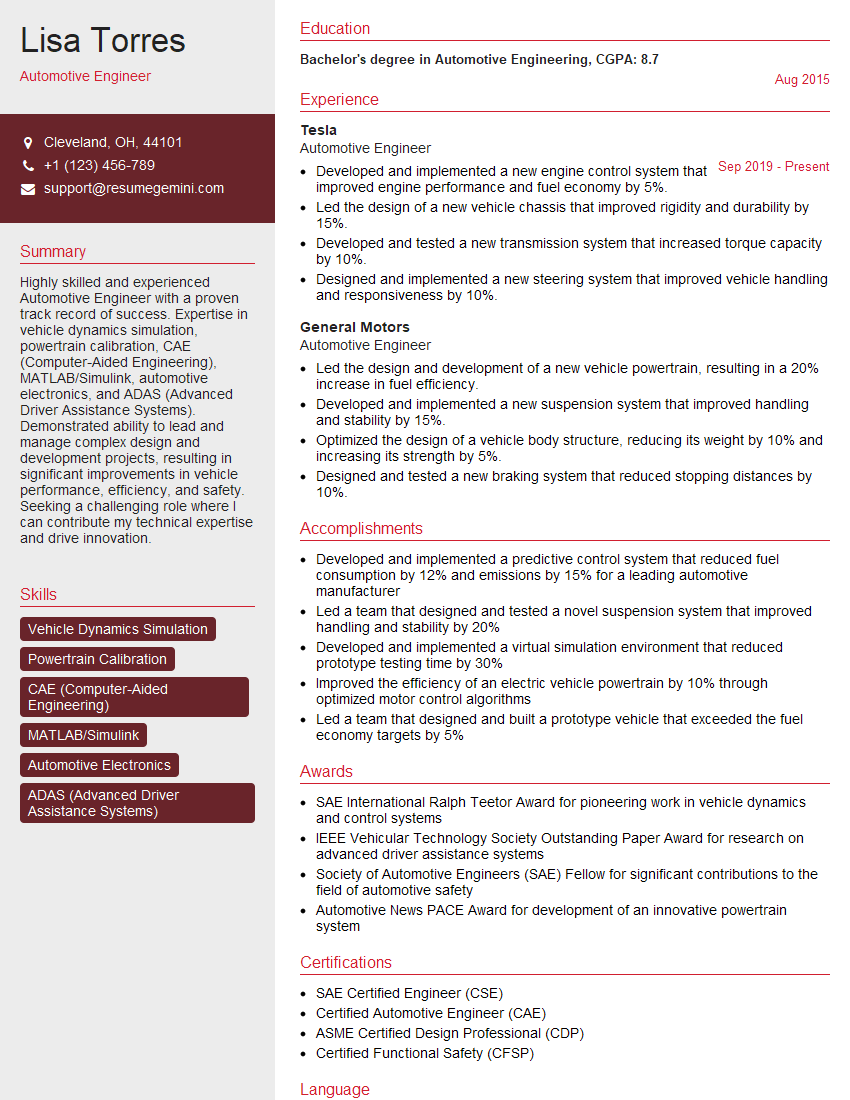
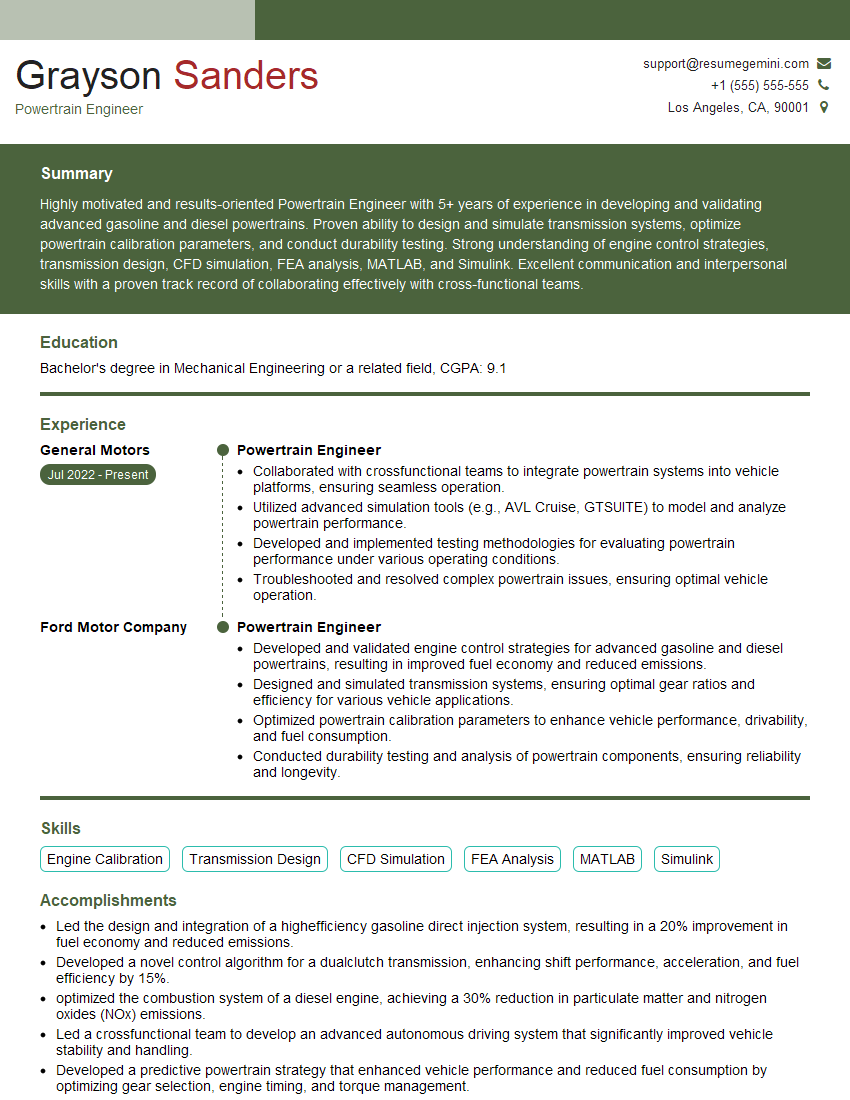
Mastering Engine and Mechanical Systems principles is crucial for a successful and rewarding career in engineering. A strong understanding of these concepts opens doors to exciting opportunities in various industries. To maximize your job prospects, create a professional and ATS-friendly resume that highlights your skills and experience effectively. ResumeGemini is a trusted resource to help you build a compelling resume that showcases your qualifications. We provide examples of resumes tailored to Engine and Mechanical Systems to guide you in crafting a winning application. Take the next step towards your dream career today!
Explore more articles
Users Rating of Our Blogs
Share Your Experience
We value your feedback! Please rate our content and share your thoughts (optional).
What Readers Say About Our Blog
Really detailed insights and content, thank you for writing this detailed article.
IT gave me an insight and words to use and be able to think of examples