Interviews are opportunities to demonstrate your expertise, and this guide is here to help you shine. Explore the essential Excellent understanding of comic book genres and conventions interview questions that employers frequently ask, paired with strategies for crafting responses that set you apart from the competition.
Questions Asked in Excellent understanding of comic book genres and conventions Interview
Q 1. Explain the key differences between superhero comics and manga.
Superhero comics and manga, while both sequential art forms, differ significantly in their stylistic conventions, narrative approaches, and target audiences. Superhero comics, largely originating in the US, often feature characters with extraordinary abilities battling villains within a predominantly Western cultural context. They tend towards serialized storytelling with ongoing storylines spanning years, featuring a strong emphasis on action, dramatic confrontations, and clear-cut morality. Think of the archetypal ‘good versus evil’ struggle seen in titles like Superman or Spider-Man.
Manga, originating in Japan, encompasses a far broader range of genres beyond superheroes, including romance, horror, comedy, and slice-of-life narratives. The art style is distinct, utilizing dynamic panel layouts, expressive character designs, and a unique visual language including ‘speed lines’ and ‘sweat drops’ that convey emotion and action differently than Western comics. Narrative structures vary greatly; some are serialized like superhero comics, while others are self-contained stories. Furthermore, manga often explores more complex themes and moral ambiguities, frequently engaging with social commentary and exploring characters’ internal struggles in greater depth than many mainstream superhero titles.
In short: Superhero comics often prioritize action and clear-cut morality within a defined superhero mythos, while manga offers a diverse range of genres, styles, and narrative approaches, often delving into more nuanced thematic territory.
Q 2. Describe the evolution of a specific comic book genre (e.g., horror, sci-fi) over time.
Let’s trace the evolution of horror comics. Early horror comics, emerging in the 1950s, were often sensationalistic, focusing on gruesome violence and monster mayhem. Titles like Tales from the Crypt employed lurid imagery and simplistic plots to shock and entertain. This era was marked by a strong focus on exploitation, fueled by a post-war fascination with the macabre and anxieties surrounding the Cold War.
The Comics Code Authority (CCA), established in 1954, significantly impacted horror comics. Its strict guidelines led to a decline in explicit violence and supernatural themes. While some publishers adapted, others ceased publication or shifted to more subtle forms of horror. This period saw a greater emphasis on psychological horror and suspense, explored more through suggestive imagery and narrative tension.
By the 1970s, the CCA’s influence waned, allowing for a resurgence of darker and more mature horror comics. This era witnessed the rise of creators like Stephen King who, through his comic book adaptations and influence, brought a more literary style of horror to the medium. Modern horror comics have embraced diverse subgenres, from cosmic horror (think Something is Killing the Children) to psychological thrillers (Sweet Tooth) and gothic horror (Locke & Key), illustrating a significant maturation in the genre’s thematic range and artistic sophistication.
Q 3. Name three influential comic book artists and explain their unique styles.
Three influential comic book artists whose unique styles have shaped the medium are Jack Kirby, Will Eisner, and Frank Miller.
- Jack Kirby: Known as the ‘King of Comics,’ Kirby’s style is instantly recognizable by its dynamic energy and powerful, almost exaggerated figure work. His layouts were often chaotic yet brilliantly effective in conveying the sheer scope and intensity of superhero battles. He employed bold lines, detailed backgrounds, and dynamic perspectives that created a sense of raw power and movement. His work on The Fantastic Four and Captain America profoundly impacted the visual language of superhero comics.
- Will Eisner: A pioneer of sequential art, Eisner championed the use of comics for storytelling beyond superhero narratives. His style was simpler, more realistic in portraying human emotions, and grounded in everyday life. He focused on clarity and strong narrative structure, often using a conversational style and incorporating elements of documentary storytelling in works like A Contract with God.
- Frank Miller: Miller revolutionized superhero comics with his gritty, dark, and noir-influenced style, seen in his work on The Dark Knight Returns. He utilized stark blacks and whites, detailed cross-hatching, and a sense of brutal realism that challenged the traditional heroic ideals. His style profoundly impacted the superhero genre by exploring darker, more morally ambiguous themes and characters.
Q 4. Compare and contrast the narrative structures of different comic book genres.
Comic book narrative structures vary widely depending on the genre. Superhero comics often follow a three-act structure: exposition, rising action, and climax, with a clear resolution. This structure reinforces the ‘good versus evil’ dynamic and provides a satisfying sense of closure, even within ongoing series. Detective comics, conversely, tend towards a more mystery-driven structure, often building suspense through clues, red herrings, and unexpected twists. The narrative progresses through investigation, leading to a resolution that unravels the mystery.
Horror comics might build tension slowly, employing escalating suspense and unexpected scares. They might focus on atmosphere and psychological horror over action, creating a sense of dread and unease. Slice-of-life comics often focus on character development and everyday events, employing a more episodic narrative structure. Each chapter or issue might be a complete story, or they could contribute to an overarching arc. Sci-fi comics can utilize various structures, ranging from linear narratives charting a specific journey, to branching timelines exploring alternate realities, or even a non-linear approach jumping through time.
In essence, the narrative structure is a crucial tool that shapes the reader’s experience, enhancing the emotional impact and thematic resonance of each genre.
Q 5. Discuss the role of symbolism and allegory in comic books.
Symbolism and allegory are powerful tools used in comic books to add layers of meaning and depth. Symbolism uses images or objects to represent abstract ideas or emotions. For instance, a recurring motif of a broken mirror in a superhero comic could symbolize the hero’s fractured psyche or a shattered sense of identity. In Watchmen, the use of the owl symbolizes the omnipresent observation of government power and the ever-present threat of surveillance.
Allegory employs extended metaphors, presenting characters or situations that represent broader societal or political issues. For example, Animal Farm, adapted into comics, allegorically depicts the Russian Revolution, using animals to represent historical figures and political ideologies. Many dystopian comics utilize allegory to warn about potential dangers of unchecked technological advancement or oppressive regimes. The careful deployment of symbolism and allegory allows creators to create more complex and resonant stories that go beyond surface-level entertainment.
Q 6. How do different panel layouts impact storytelling in comics?
Panel layouts are fundamental to pacing and storytelling in comics. The size, shape, and arrangement of panels influence the reader’s experience. A large, full-page panel can create a sense of grandeur or emphasize the importance of a moment. Smaller panels create a faster pace, suggesting action or urgency. A series of small panels arranged in a row might create a sense of rapid movement, whereas a series of close-up panels can build tension and focus on a character’s emotional state.
Unusual panel shapes, like circular or triangular panels, can draw attention and disrupt the flow, adding emphasis or a stylistic choice. The gutter (the space between panels) also plays a significant role; a wide gutter creates a greater sense of time passing or a break in action, while a narrow gutter implies continuity or a rapid succession of events. Masterful use of panel layouts is crucial for creating a dynamic reading experience and conveying the nuances of the narrative.
Q 7. What are some common tropes and clichés in comic books, and how can they be subverted?
Common tropes and clichés in comic books include the ‘chosen one’ prophecy, the ‘damsel in distress,’ the origin story revealing a tragic backstory, and the ‘deus ex machina’ resolution. While these tropes can be effective in familiarizing the audience with certain archetypes, they can also become predictable and stale if not handled creatively.
Subverting these tropes involves challenging audience expectations. For example, a ‘chosen one’ story could present a reluctant or flawed hero questioning their destiny. The ‘damsel in distress’ could become an empowered character who actively participates in their own rescue or even saves the hero. Origin stories can be presented in a non-linear fashion or reveal unexpected complexities in the hero’s past. A ‘deus ex machina’ ending can be avoided by creating a more organic and satisfying resolution that stems logically from the story’s internal logic and character development. Clever subversion of tropes keeps storytelling fresh and engages readers by providing unique interpretations of familiar archetypes and narrative structures.
Q 8. Explain the significance of the ‘Inks’ stage in comic book production.
Inking in comic book production is the crucial stage where the pencil artwork is refined and given its final visual form. Think of it as adding depth, definition, and personality to the initial sketch. The inker traces over the penciler’s work, adding line weight, texture, and shading, transforming a somewhat flat image into a dynamic and visually compelling one.
The inker’s choices significantly impact the final look and feel. A heavy, bold ink style might create a dark and gritty atmosphere, suitable for a crime thriller. A lighter, more delicate ink style might be better suited for a whimsical fantasy comic. Consider the difference between the stark, inky lines of Frank Miller’s Sin City and the more fluid and expressive style of Jack Kirby’s work on Marvel’s Fantastic Four – both iconic, but vastly different in their approach to inking.
Inking also adds crucial details like cross-hatching for shading, defining textures (like fur or metal), and creating visual interest in areas that might otherwise be bland in the pencils. The inker might even slightly alter the pencil work to enhance the storytelling or add their own unique flair while staying true to the original vision.
Q 9. Discuss the importance of lettering and its impact on readability.
Lettering in comics is far more than just writing words; it’s a fundamental part of the visual storytelling. It’s the bridge between the art and the narrative, directly impacting readability and the overall emotional impact of the scene. Poor lettering can ruin even the most stunning artwork, making the comic difficult and frustrating to read.
Key considerations include font choice, size, placement, and style. A bold, sans-serif font might be suitable for action-packed scenes, while a more delicate, serif font might be better for quieter, introspective moments. The size needs to be legible, and the placement shouldn’t obscure important artwork. Letterers often use different styles, such as using sound effects creatively as visual storytelling elements (e.g., ‘BAM!’, ‘WHOOSH!’).
Imagine a scene with a character whispering a secret. Small, delicate lettering, placed close to the character’s mouth, would reinforce this. Contrast that with a loud, explosive scene where larger, bolder letters are used, even breaking free from the traditional word balloon structure to enhance the dramatic effect. The letterer’s skill lies in using these elements to contribute seamlessly to the emotional tone and flow of the narrative.
Q 10. Describe the process of developing a comic book character.
Developing a compelling comic book character is a multifaceted process that begins with a strong core concept and extends to intricate detail. It involves crafting a believable individual with a unique personality, backstory, motivations, and flaws.
The process often starts with brainstorming core concepts: What are their powers (if any)? What’s their personality like? What is their biggest fear? What is their ultimate goal? What is their tragic flaw? Think of iconic characters like Batman (driven by vengeance and loss), Spider-Man (struggling with responsibility and personal life), or Wonder Woman (championing justice and truth). Each possesses a compelling core concept that drives their actions and shapes their stories.
Next, fleshing out the backstory is crucial. What events shaped their personality? What are their relationships like? What are their motivations and beliefs? A detailed backstory makes them feel more real and relatable. Finally, the visual design completes the process, ensuring the character’s appearance reflects their personality and role in the story. Costume design, physical features, and even their posture contribute to the overall impression.
Think about creating a character sheet, outlining all this information, much like a detailed character profile in a role-playing game.
Q 11. What are the key elements of a compelling comic book plot?
A compelling comic book plot needs a strong foundation of engaging elements to keep readers hooked. These include a clear premise, relatable characters with clear motivations, a well-defined conflict, escalating stakes, and a satisfying resolution (though not necessarily a happy one!).
- Premise: A compelling hook that grabs the reader’s attention from the start. What’s the central idea? What’s at stake?
- Conflict: This is the driving force of the plot, providing obstacles and challenges for the characters to overcome. This conflict could be internal, external, or a combination of both.
- Rising Action: The events leading up to the climax, gradually increasing tension and stakes.
- Climax: The turning point of the story, where the conflict reaches its peak.
- Falling Action: The events following the climax, where the consequences of the conflict are explored.
- Resolution: The conclusion of the story, where loose ends are tied up, and the reader feels a sense of closure (even if bittersweet).
A good plot often includes subplots to add depth and complexity, keeping the narrative unpredictable and engaging. Think of the intricate storylines in works like Watchmen or Saga, which cleverly weave multiple plotlines together to create a rich and satisfying reading experience.
Q 12. Explain the differences between different types of comic book publishing (e.g., independent vs. mainstream).
The comic book publishing world is broadly divided into mainstream and independent publishers, each with its own characteristics.
Mainstream Publishers: These are the large companies like Marvel and DC Comics, possessing significant resources, established distribution networks, and a wide reach. They often produce high-volume titles with established characters and storylines, focusing on superhero genres and often aiming for mass market appeal. Their creative process can be more structured, with editors closely guiding creators to maintain consistency across various titles and characters.
Independent Publishers: These are smaller companies and individual creators with greater creative freedom. They tend to publish a wider range of genres and styles, often exploring more mature themes and unconventional narratives. They typically rely on smaller distribution networks and often engage directly with their fanbase. While they may lack the extensive resources of mainstream publishers, they enjoy greater creative independence and a more direct relationship with their readers.
The key difference boils down to scale, resources, and creative control. Mainstream publishers offer larger audiences and more financial security, but with stricter editorial control. Independent publishers offer greater creative freedom but typically face more challenges in distribution and financial stability.
Q 13. How do you identify and analyze target audiences for specific comic book genres?
Identifying and analyzing target audiences for specific comic book genres requires a deep understanding of demographics, psychographics, and reading habits.
Demographics: This involves looking at age, gender, location, income level, etc. For instance, superhero comics typically attract a broader demographic, including younger readers, while more mature titles might target older readers with an interest in complex narratives or specific themes.
Psychographics: This looks at readers’ values, interests, lifestyles, and attitudes. For example, a horror comic would target readers who enjoy thrills, suspense, and darker themes. Similarly, a slice-of-life comic would appeal to readers interested in character-driven stories with relatable themes and settings.
Reading Habits: Understanding how people consume comics is important. Do they prefer physical copies or digital formats? How much time do they dedicate to reading? What platforms do they use to discover new comics? Analyzing this data can help to tailor marketing strategies and content creation.
Market research, reader feedback, social media engagement, and sales data provide valuable insights to aid the process. Combining demographic, psychographic, and reading habit data allows publishers to create targeted marketing campaigns and comic book content that resonates effectively with their specific audience.
Q 14. Discuss the impact of digital publishing on the comic book industry.
Digital publishing has revolutionized the comic book industry, impacting creation, distribution, and consumption significantly.
Creation: Digital tools have streamlined the creation process, allowing for easier collaboration, digital inking and coloring, and faster production cycles. Creators can utilize software like Clip Studio Paint or Adobe Photoshop for efficient workflow.
Distribution: Digital platforms like ComiXology, Kindle, and apps provide direct access to a global audience, eliminating the need for physical distribution networks. This has empowered independent creators and small publishers, giving them broader reach than ever before.
Consumption: Readers can access comics anytime, anywhere, through tablets, smartphones, and computers. This convenience has increased accessibility and expanded the readership. Digital platforms offer features like interactive elements, zoom capabilities, and reader-friendly interfaces.
However, challenges persist, including piracy, pricing strategies, and the ongoing debate about the preservation of physical collections and the tactile experience of reading a printed comic. Despite these, digital publishing has undeniably broadened the reach of comic books, fostered new creative opportunities, and dramatically altered the industry landscape.
Q 15. What are some ethical considerations in comic book creation and publishing?
Ethical considerations in comic book creation and publishing are multifaceted, encompassing representation, plagiarism, and responsible content.
- Representation: It’s crucial to avoid harmful stereotypes and ensure diverse representation of genders, races, ethnicities, sexual orientations, and abilities. For example, a story featuring only white, male superheroes would lack representation and fail to reflect the rich tapestry of society. Positive representation requires careful thought and research, avoiding tokenism and ensuring characters feel authentic.
- Plagiarism: Directly copying storylines, artwork, or characters without proper attribution is unethical and illegal. This includes not only blatant copying but also uncredited inspiration that closely mirrors existing works. It’s crucial to ensure originality or, if using inspiration, to clearly cite sources.
- Responsible Content: Creators should be mindful of the potential impact of their work, avoiding glorification of violence, hate speech, or harmful behaviors. While exploring dark themes is acceptable, it’s important to handle them responsibly and thoughtfully, perhaps offering a counterpoint or exploring the consequences of such actions. A strong sense of social responsibility guides ethical decision-making.
Ultimately, ethical creation stems from a commitment to respectful storytelling that reflects and enriches society.
Career Expert Tips:
- Ace those interviews! Prepare effectively by reviewing the Top 50 Most Common Interview Questions on ResumeGemini.
- Navigate your job search with confidence! Explore a wide range of Career Tips on ResumeGemini. Learn about common challenges and recommendations to overcome them.
- Craft the perfect resume! Master the Art of Resume Writing with ResumeGemini’s guide. Showcase your unique qualifications and achievements effectively.
- Don’t miss out on holiday savings! Build your dream resume with ResumeGemini’s ATS optimized templates.
Q 16. How do you stay current with trends and innovations in the comic book industry?
Staying current in the dynamic comic book industry requires a multi-pronged approach.
- Industry Publications: I regularly read trade publications like The Hollywood Reporter and Publishers Weekly which often cover comic book news and trends. These offer insights into industry shifts and successful strategies.
- Comic Conventions: Attending conventions like San Diego Comic-Con and New York Comic Con is vital. These events offer networking opportunities, provide exposure to new creators and trends, and allow for direct engagement with publishers and fans.
- Social Media and Online Communities: I actively participate in relevant online communities and follow key industry influencers on platforms like Twitter and Instagram. These platforms provide immediate updates, discussions of new releases, and insights from other creators.
- Competitor Analysis: Analyzing successful comics – their storytelling techniques, marketing strategies, and art styles – helps identify trends and effective approaches. This includes studying both independent and mainstream titles.
This combination of active engagement and continuous learning keeps me informed about the latest innovations and trends.
Q 17. Describe your experience with different comic book creation software.
My experience spans several comic book creation software packages, each with its strengths and weaknesses.
- Clip Studio Paint: This is my primary tool, offering a comprehensive suite of features perfect for both illustration and page layout. Its intuitive brush engine and robust layer system are invaluable for detailed artwork and complex compositions.
- Adobe Photoshop: I use Photoshop primarily for digital painting, utilizing its powerful tools for color correction and retouching. It excels in creating highly polished artwork.
- Comic Life: This software is great for quickly creating simple comics, especially for personal projects or early prototypes. Its user-friendly interface makes it ideal for beginners or those needing a quick solution.
The choice of software depends on the project’s complexity, personal preference, and desired level of control. I often use a combination of these programs to optimize workflow.
Q 18. How do you handle creative differences with collaborators in a comic book project?
Creative differences are inevitable in collaborative projects. Open communication and a collaborative spirit are paramount.
- Establish Clear Expectations: Before starting, I ensure that all collaborators understand the project’s goals, their individual roles, and the overall vision. This prevents misunderstandings later.
- Regular Feedback Sessions: Consistent communication, including regular feedback sessions and critiques, are crucial. This allows us to address concerns early and find mutually agreeable solutions.
- Compromise and Collaboration: Sometimes, compromise is necessary. It’s important to be receptive to others’ ideas, even if they differ from your own, and to find creative solutions that incorporate elements from everyone’s perspectives.
- Mediation (If Necessary): If disagreements persist despite efforts at communication and compromise, a neutral third party mediator might be helpful to facilitate productive discussions.
Ultimately, respecting the contributions of each team member and valuing diverse perspectives leads to a richer and more successful outcome.
Q 19. Explain your understanding of copyright and intellectual property in comics.
Copyright and intellectual property in comics are crucial for protecting creators’ work.
- Copyright: Copyright automatically protects original creative works, including comic book scripts, artwork, and character designs, from the moment they are fixed in a tangible form (e.g., written or drawn). It grants the creator exclusive rights to reproduce, distribute, display, and create derivative works. This protection typically lasts for the life of the author plus 70 years.
- Trademarks: Trademarks protect brand names and logos associated with comic books and characters, preventing others from using similar marks that might cause confusion. For example, the name “Superman” and the Superman logo are registered trademarks.
- Work-for-hire Agreements: When creators work for a publisher, work-for-hire agreements often assign copyright to the publisher, though specific terms can vary. It’s crucial for creators to understand these agreements thoroughly before signing.
Understanding these legal aspects is vital for both creators and publishers to ensure proper attribution and prevent infringement.
Q 20. What are some strategies for effective comic book marketing and promotion?
Effective comic book marketing and promotion require a strategic approach combining various channels.
- Social Media Marketing: Building a strong online presence is crucial. This includes engaging with fans on platforms like Twitter, Instagram, and Facebook, using visually appealing content, and running targeted ads to reach potential readers.
- Publicity and Media Outreach: Securing reviews in relevant publications and websites, and engaging in interviews and podcasts, can significantly increase visibility.
- Comic Conventions and Events: Participating in comic conventions offers direct engagement with fans, providing opportunities to sell comics, build relationships, and network with industry professionals.
- Email Marketing: Building an email list allows for direct communication with interested readers, providing updates on new releases and exclusive content.
- Website and Online Store: A professional website serves as a central hub for information about the comic, providing easy access to purchase options and additional content.
A well-rounded strategy encompassing these elements increases the chances of success. Consistent engagement and a deep understanding of the target audience are crucial.
Q 21. Discuss the impact of social media on the comic book industry.
Social media has fundamentally reshaped the comic book industry, impacting both creators and publishers.
- Direct Fan Engagement: Creators can now connect directly with their audience, fostering stronger relationships and gaining immediate feedback. This allows for greater transparency and a more intimate connection with readers.
- Marketing and Promotion: Social media provides powerful tools for marketing and promotion, allowing creators and publishers to reach wider audiences at a lower cost compared to traditional methods.
- Crowdfunding and Indie Publishing: Platforms like Kickstarter and Indiegogo have enabled independent creators to bypass traditional publishers and directly fund their projects, empowering a new wave of creators.
- Community Building: Social media platforms facilitate the formation of strong online communities around specific comics, characters, and creators, encouraging discussion and fan engagement.
- Challenges: While social media offers many benefits, it also presents challenges, such as managing negative feedback, dealing with online harassment, and ensuring authentic engagement.
Social media is an indispensable tool in the modern comic book industry, offering unprecedented opportunities but also requiring careful navigation and strategic engagement.
Q 22. Explain the different types of comic book printing and binding.
Comic book printing and binding encompasses several methods, each with its own advantages and disadvantages. The choice depends on factors like budget, desired quality, and print run size.
- Printing Methods: Offset printing is the industry standard for larger print runs due to its cost-effectiveness and high-quality results. Digital printing is ideal for smaller runs and allows for greater flexibility and faster turnaround times. However, the quality might not match offset at very high resolutions. There’s also web printing, which prints continuously from large rolls of paper, offering high speed for mass production, but requiring specialized equipment.
- Binding Methods: Perfect binding is common for trade paperbacks and graphic novels, where pages are glued together along the spine. Saddle-stitch binding is used for magazines and shorter comics, where pages are folded and stapled along the spine. Case binding, a more robust method, involves gluing pages together into sections (signatures) before attaching them to a cover board, resulting in a more durable book, often seen in high-end graphic novels or collected editions. Wire-O binding, using metal wire to hold the pages, is less common in mainstream comics but can be seen in art books or special editions.
For instance, a small independent creator might opt for digital printing and saddle-stitch binding for a self-published mini-series, whereas a major publisher would likely use offset printing and perfect binding for a mass-market trade paperback.
Q 23. How do you approach adapting a script into a visual format in a comic book?
Adapting a comic book script to a visual format is a collaborative process that requires a deep understanding of both storytelling and visual design. It’s not simply translating words onto panels; it’s about creating a synergistic experience.
- Storyboarding: I begin by creating rough storyboards, outlining the flow of the narrative through thumbnail sketches. This helps visualize the pacing and composition of each page.
- Panel Layout and Composition: The panel layout itself is crucial for storytelling. I consider panel size, shape, and arrangement to guide the reader’s eye and emphasize key moments. A large panel might be used for a dramatic moment, while smaller panels could create a sense of urgency or chaos.
- Character Design and Visual Style: The visual style needs to be coherent and consistent throughout the comic. Character designs must be engaging and expressive, reflecting their personalities and roles. I collaborate closely with the writer to ensure the visual elements enhance the script’s themes and mood.
- Dialogue and Narrative Integration: I ensure that dialogue and captions complement the artwork seamlessly, without overwhelming the visual flow. The layout needs to guide the reader’s attention to what is most important.
Imagine a tense scene: small, angled panels might build suspense, while a full-bleed panel could showcase a surprising revelation.
Q 24. Describe your experience with different comic book distribution models.
Comic book distribution has evolved significantly. The traditional model relied heavily on direct market distribution through comic book shops. This offers a dedicated audience but limits reach. Today, a multi-pronged approach is crucial.
- Direct Market: This remains a vital channel, connecting with passionate readers. It involves working with distributors to get books into independent comic shops.
- Indirect Market: This encompasses bookstores, newsstands, and other retail outlets, reaching a broader audience beyond the dedicated comic fan base.
- Digital Distribution: Platforms like Comixology and digital bookstores provide access to a global audience. This allows for instant purchase and delivery, reaching readers otherwise difficult to reach.
- Self-Publishing and Online Platforms: Independent creators are increasingly using self-publishing options like Kickstarter, Gumroad, and their own websites, offering direct engagement with their readership and bypassing traditional publishers.
For instance, a large publisher might leverage all channels, while a smaller publisher might focus on the direct market and digital distribution initially.
Q 25. How do you ensure visual consistency and quality control in a comic book production?
Maintaining visual consistency and quality control is paramount in comic book production. It’s a process that requires careful planning and thorough collaboration.
- Style Guides: Creating a comprehensive style guide outlining character designs, color palettes, and overall visual style ensures consistency across the entire series or project. This acts as a reference point for all involved artists.
- Feedback and Revision Processes: Regular feedback sessions between the artist, writer, editor, and colorist are vital for identifying inconsistencies and making necessary revisions early in the process.
- Digital Asset Management: Using digital asset management systems (DAM) to organize and maintain high-resolution files ensures consistency and prevents version control issues. This is crucial for larger projects.
- Color Management: Careful calibration of monitors and use of industry-standard color profiles help maintain color accuracy throughout the production pipeline, preventing unexpected color shifts in the final print.
A failure to maintain visual consistency, such as changes in character designs without proper explanation, can disrupt the reader’s experience and immersion in the story.
Q 26. What are some of the most influential comic book creators and why?
Many creators have profoundly impacted the comic book industry. Their influence extends beyond their individual works, shaping the medium’s artistic and narrative conventions.
- Jack Kirby: A pivotal figure known for his dynamic art style, iconic characters (like the Fantastic Four and many Marvel heroes), and groundbreaking storytelling techniques. His influence on the superhero genre is immeasurable.
- Will Eisner: A pioneer of sequential art, Eisner’s work, particularly ‘The Spirit’, revolutionized the use of visual storytelling. He’s credited with contributing greatly to the medium’s artistic and literary development.
- Stan Lee and Steve Ditko: The creative partnership behind Spider-Man and many other influential Marvel characters. Their work helped to redefine the superhero genre, incorporating relatable characters and everyday themes.
- Alan Moore: Known for his complex and mature storytelling in works like ‘Watchmen’ and ‘V for Vendetta’, Moore pushed the boundaries of comic book narratives and explored darker, more complex themes.
These are just a few examples, and the impact of these creators is evident in the work of countless artists and writers who followed in their footsteps.
Q 27. Discuss the role of color theory in comic book design.
Color theory plays a crucial role in establishing the mood, atmosphere, and visual impact of a comic book. The strategic use of color can enhance storytelling, character development, and overall aesthetic appeal.
- Color Palettes: Choosing color palettes that complement the story’s themes is vital. Warm colors can evoke feelings of comfort and excitement, while cool colors might suggest coldness or melancholy.
- Color Contrast: Effective use of contrast helps to emphasize key elements, guide the reader’s eye, and create visual interest. This includes not just contrast between colors but also values (light and dark) and saturation.
- Color Symbolism: Certain colors carry cultural and psychological connotations that can be used to enhance character representation and symbolic storytelling. For example, red might represent danger or passion, while blue might suggest calmness or sadness.
- Color Separation: For print, understanding color separation (CMYK for four-color printing) is crucial to ensure accurate reproduction of colors in the final product.
Consider a scene set in a dark, mysterious forest. A predominantly dark color palette with limited pops of light could heighten the sense of unease and suspense.
Q 28. What are your thoughts on the future of the comic book industry?
The future of the comic book industry is dynamic and exciting, shaped by several converging factors. Digital distribution has opened new avenues, while physical comics remain a significant aspect.
- Increased Accessibility: Digital platforms and subscription services will continue to increase accessibility to a wider audience, expanding the reach of independent creators and smaller publishers.
- Hybrid Models: We’ll see more hybrid models combining digital and physical releases, creating a synergy between both mediums.
- Creative Innovation: Experimentation with formats, storytelling techniques, and visual styles will push the boundaries of what comics can be.
- Growing Diversity and Representation: A greater emphasis on diverse voices and perspectives will lead to richer, more inclusive storytelling.
- Potential Challenges: The industry faces challenges like maintaining a balance between print and digital, managing piracy, and keeping up with evolving consumer preferences.
The industry will likely see a continued blend of established giants and emerging independent creators, resulting in a diverse and vibrant landscape.
Key Topics to Learn for Excellent Understanding of Comic Book Genres and Conventions Interview
- Genre Identification and Analysis: Develop a deep understanding of various comic book genres (superhero, horror, sci-fi, slice-of-life, etc.), including their defining characteristics, tropes, and target audiences. Be prepared to discuss the evolution of these genres and their influences on each other.
- Narrative Structure and Storytelling Techniques: Analyze different narrative structures used in comics (linear, non-linear, episodic, serialized), and understand how panel layouts, pacing, and visual storytelling contribute to the overall narrative. Consider the use of symbolism, metaphor, and foreshadowing.
- Character Development and Archetypes: Discuss common character archetypes in comics and how they are utilized to create compelling and relatable characters. Analyze character motivations, relationships, and arcs across different storylines.
- Visual Language and Aesthetics: Understand the role of visual elements – art style, color palettes, lettering – in conveying mood, tone, and narrative information. Be able to discuss the impact of different artistic choices on the reader’s experience.
- Industry History and Context: Familiarize yourself with key moments in comic book history, influential creators, and the evolution of the industry. Understand the impact of different publishers and their distinct styles.
- Critical Analysis and Interpretation: Practice analyzing comics critically, considering themes, messages, and social commentary. Be ready to articulate your interpretations and support them with evidence from the text.
- Practical Application: Be prepared to discuss how your understanding of comic book genres and conventions informs your creative process, whether in writing, art, or other related fields. Consider examples from your portfolio or past projects.
Next Steps
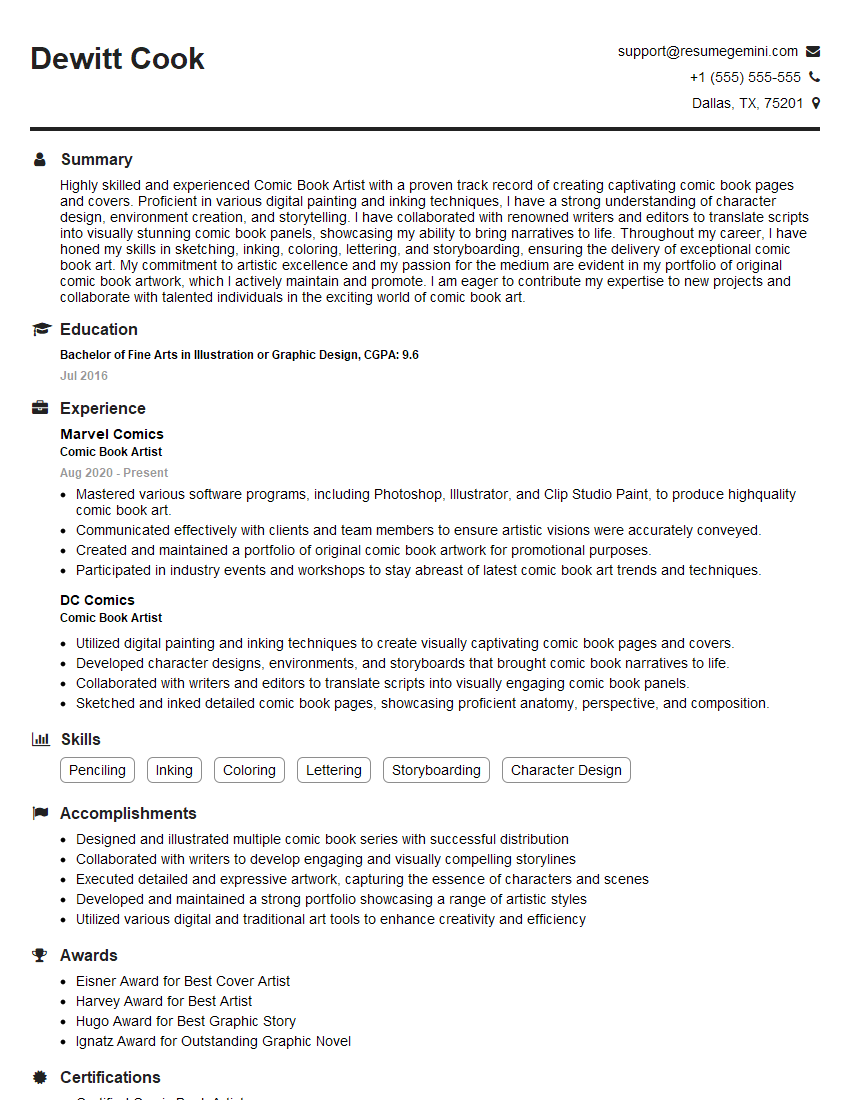
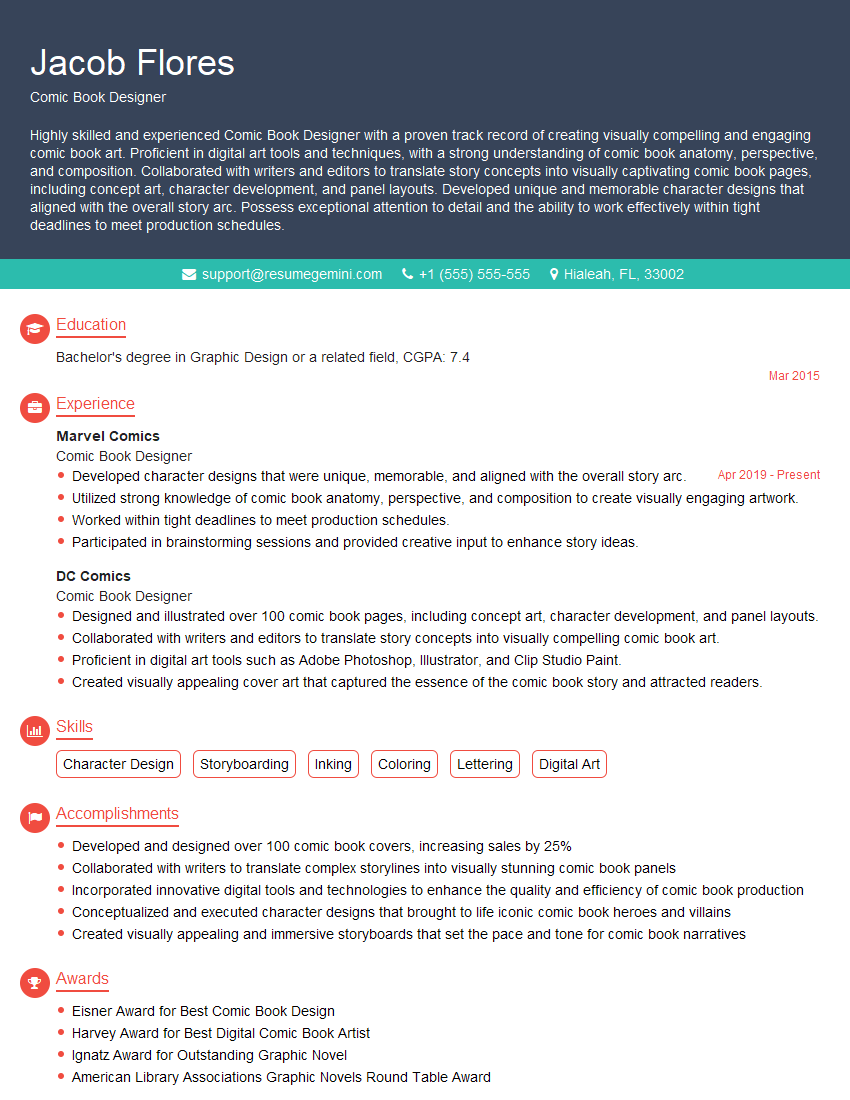
Mastering an excellent understanding of comic book genres and conventions is crucial for career advancement in the creative industries, opening doors to roles in writing, editing, art, publishing, and beyond. A strong resume is your key to unlocking these opportunities. Create an ATS-friendly resume that effectively highlights your skills and experience. ResumeGemini is a trusted resource that can help you build a professional, impactful resume tailored to the specific requirements of your target roles. Examples of resumes tailored to showcasing expertise in comic book genres and conventions are available to help guide your creation process.
Explore more articles
Users Rating of Our Blogs
Share Your Experience
We value your feedback! Please rate our content and share your thoughts (optional).
What Readers Say About Our Blog
Really detailed insights and content, thank you for writing this detailed article.
IT gave me an insight and words to use and be able to think of examples