Interviews are more than just a Q&A session—they’re a chance to prove your worth. This blog dives into essential Executing trades using electronic trading platforms interview questions and expert tips to help you align your answers with what hiring managers are looking for. Start preparing to shine!
Questions Asked in Executing trades using electronic trading platforms Interview
Q 1. Explain the difference between market orders and limit orders.
The core difference between market and limit orders lies in how they’re executed. A market order is an instruction to buy or sell an asset at the best available price immediately. Think of it like shouting your order in a crowded auction – you get the best price available at that exact moment, but you have no control over the final price.
A limit order, on the other hand, lets you specify the maximum price you’re willing to pay (for a buy order) or the minimum price you’re willing to accept (for a sell order). It’s like setting a reserve price at an auction – your order will only be executed if the market price reaches your specified limit. This gives you price certainty but doesn’t guarantee execution.
Example: Let’s say a stock is trading at $100. A market order to buy 100 shares will execute at the current best offer price (which might be $100 or slightly higher). A limit order to buy 100 shares at $98 will only execute if the price drops to $98 or lower. If the price stays above $98, your order remains unfilled.
Q 2. Describe your experience with various order types (e.g., stop-loss, stop-limit).
My experience encompasses a wide range of order types beyond market and limit orders. I’ve extensively used stop-loss orders to mitigate risk. These orders automatically trigger a market order to sell an asset when it falls below a specified price, limiting potential losses. Imagine it as a safety net – it protects you from significant losses if the market turns against you.
Stop-limit orders provide a similar function but add an extra layer of control. They trigger a limit order when the asset’s price reaches a certain level, allowing you to specify both the trigger price and the price at which you want to execute the trade. This offers more control than a stop-loss order but might lead to an unfilled order if the price doesn’t reach your limit price quickly enough after the trigger point.
I’ve also worked with more sophisticated orders like trailing stop orders, which adjust the stop price as the asset’s price moves in your favor, locking in profits while minimizing potential losses. I’ve found that mastering these various order types is crucial for effective risk management and achieving desired trading outcomes.
Q 3. What are the benefits and drawbacks of algorithmic trading?
Algorithmic trading, or automated trading, offers several advantages. It enables high-frequency trading, executing thousands of orders per second, taking advantage of very small price discrepancies. It also allows for the implementation of complex trading strategies that would be impossible for a human trader to execute manually, providing greater precision and speed. Furthermore, it eliminates emotional biases that can affect human decision-making.
However, there are significant drawbacks. Algorithmic trading can amplify market volatility, particularly during periods of high uncertainty. A ‘flash crash’ can be exacerbated by algorithms reacting rapidly and identically to market changes. Additionally, the complexity of algorithms can make it difficult to identify and correct errors. Unexpected market events or flaws in the algorithm’s logic can lead to significant losses. Finally, it requires substantial upfront investment in technology and expertise.
Q 4. How do you manage risk when executing trades electronically?
Managing risk in electronic trading is paramount. My approach is multi-faceted. Firstly, I employ position sizing – determining the appropriate amount to invest in each trade based on my risk tolerance and the volatility of the asset. This prevents any single trade from causing substantial losses.
Secondly, I utilize stop-loss orders and other risk management tools as previously discussed to set limits on potential losses. Thirdly, I constantly monitor market conditions and adjust my strategies as needed. Diversification across different asset classes and regions helps reduce the impact of any single market event.
Finally, thorough backtesting and paper trading are crucial before deploying any algorithmic trading strategy. This allows me to test my strategies against historical data and identify potential weaknesses before risking real capital. This rigorous approach ensures that my trading strategies are robust and capable of withstanding market fluctuations.
Q 5. Explain your understanding of market microstructure.
Market microstructure is the study of the mechanics of how markets actually work – the detailed inner workings of trading systems. This includes aspects like the order book (a list of buy and sell orders), the speed of execution, the role of market makers, and the impact of trading technology. Understanding market microstructure helps me anticipate how orders will be filled and how market dynamics can affect my trading strategies.
For example, knowing the depth and liquidity of the order book can help determine the best way to execute large orders without significantly impacting the price. Awareness of the various trading venues and their specific characteristics helps optimize trade execution. A deep understanding of market microstructure is essential for effective and efficient trading in today’s electronic markets.
Q 6. Describe your experience with different electronic trading platforms (e.g., Bloomberg, Reuters).
I have extensive experience with a variety of electronic trading platforms, including Bloomberg Terminal and Refinitiv Eikon (formerly Reuters Eikon). Bloomberg’s depth of data and analytical tools is invaluable for market research and risk management. Refinitiv Eikon offers strong order management capabilities and is particularly useful for accessing a wide range of market data. My proficiency extends to customizing these platforms to meet specific trading needs, streamlining workflows, and integrating them with other systems. I’m also comfortable using other platforms as needed, and I adapt quickly to new technologies in the constantly evolving trading landscape.
Q 7. How do you handle trade errors or discrepancies?
Handling trade errors or discrepancies involves a systematic approach. First, I carefully review the trade details, comparing them to my original order and the trade confirmation. I then check the platform’s logs for any errors or discrepancies. If the error is on the platform’s side, I immediately contact their support team, documenting all interactions and obtaining a resolution. For discrepancies due to human error (e.g., incorrect order entry), I take immediate corrective action to mitigate any potential losses, adhering strictly to company and regulatory protocols.
Documentation is crucial at every step. I maintain meticulous records of all trades, including order details, confirmations, and any communication with support teams. This detailed record-keeping assists in dispute resolution and helps prevent future errors. In cases of significant errors, I escalate the issue to my supervisor and comply with all internal reporting procedures.
Q 8. Explain the concept of slippage and how to mitigate it.
Slippage refers to the difference between the expected price of a trade and the actual execution price. Imagine you’re trying to buy apples at $1 each, but by the time your order goes through, the price has jumped to $1.05. That $0.05 difference is slippage. It’s a common occurrence in fast-moving markets, especially for larger orders.
Several factors contribute to slippage, including:
- Market Volatility: Rapid price changes can lead to significant slippage.
- Order Size: Large orders can move the market, resulting in an unfavorable execution price.
- Liquidity: Low liquidity (few buyers or sellers) makes it harder to fill orders quickly at the desired price.
- Order Type: Market orders, which execute immediately at the best available price, are more susceptible to slippage than limit orders (which only execute at a specified price or better).
Mitigating slippage involves strategies like:
- Using Limit Orders: This allows you to control the maximum price you’re willing to pay or receive.
- Breaking Down Large Orders: Executing a large order in smaller tranches reduces its market impact.
- Employing Algorithmic Trading: Sophisticated algorithms can analyze market conditions and optimize order execution to minimize slippage.
- Choosing Liquid Markets: Trading in highly liquid markets ensures that your orders can be filled quickly and efficiently.
- Monitoring Market Depth: Understanding the available bid and ask sizes helps anticipate potential slippage.
For instance, I once managed a large institutional order. To mitigate slippage, we used a sophisticated VWAP (Volume Weighted Average Price) algorithm to spread the order throughout the day, ensuring execution near the average price, minimizing the impact on the market.
Q 9. What is latency and how does it impact trading?
Latency refers to the delay between the initiation of an action and its execution. In electronic trading, this delay is the time it takes for an order to travel from your trading platform to the exchange and back. Even fractions of a second can be critical.
Latency impacts trading significantly because in high-frequency trading (HFT) environments, milliseconds can mean the difference between profit and loss. High latency can lead to:
- Missed Opportunities: Orders may not execute at the desired price due to delays.
- Increased Slippage: Delayed orders are more likely to experience price changes during execution.
- Order Rejection: Extremely high latency could cause orders to be rejected by the exchange.
- Adverse Selection: A slower trader might be executing trades at worse prices than those available to faster traders.
Minimizing latency requires a focus on infrastructure: co-location of servers near the exchange, high-speed network connections, optimized trading software, and efficient order routing protocols are crucial. I’ve personally worked with firms optimizing their infrastructure to reduce latency by microseconds, leading to noticeable improvements in trading performance.
Q 10. How do you ensure regulatory compliance in electronic trading?
Regulatory compliance in electronic trading is paramount and involves adhering to a complex web of rules and regulations set by various authorities like the SEC (Securities and Exchange Commission) in the US, or the FCA (Financial Conduct Authority) in the UK, depending on the jurisdiction. These regulations are designed to protect investors and maintain market integrity.
Ensuring compliance involves several key steps:
- Know Your Regulations: Thorough understanding of relevant rules and guidelines is essential. This includes best execution obligations, trade reporting requirements, and market manipulation regulations.
- Implementing Robust Internal Controls: This includes establishing clear procedures for order management, trade execution, and record-keeping. Regular audits and internal reviews are critical.
- Using Approved Trading Platforms: Trading platforms must meet regulatory standards and undergo regular security audits.
- Maintaining Accurate Records: Meticulous record-keeping is crucial for demonstrating compliance. This includes audit trails of all trades, communications, and system activity.
- Employing Trade Surveillance Systems: Advanced systems monitor trading activity for potential violations, such as insider trading or market manipulation.
- Regular Training and Awareness Programs: All personnel involved in trading must be adequately trained on regulatory requirements and compliance procedures.
A failure to comply can result in significant financial penalties and reputational damage. In my experience, proactive compliance is not merely a regulatory obligation but a key component of risk management and a cornerstone of a successful trading operation.
Q 11. Describe your experience with trade surveillance and compliance.
My experience with trade surveillance and compliance is extensive. I’ve been involved in designing and implementing trade surveillance systems for several financial institutions. This includes setting up algorithms to detect suspicious trading patterns such as wash trades, layering, or spoofing, in accordance with regulations and market best practices.
My responsibilities included:
- Developing and Implementing Surveillance Rules: I worked to create and maintain rules that flag potentially problematic trading activities, based on factors like trade volume, frequency, and price movement.
- Monitoring and Investigating Alerts: This involved reviewing alerts generated by the surveillance systems, investigating suspicious activity, and preparing reports for senior management and regulatory bodies.
- Maintaining Audit Trails: Ensuring the accurate recording and retention of all trading activity and surveillance data was paramount. We implemented robust data archiving and retrieval systems.
- Staying Current on Regulatory Changes: The regulatory landscape is constantly evolving; staying up-to-date on changes and updating our surveillance procedures was a continuous process.
In one specific instance, our surveillance system flagged a series of unusual trades. After a thorough investigation, we discovered a minor software glitch that needed fixing. This incident highlighted the importance of proactive surveillance and the value of a robust compliance program. It prevented a potentially significant regulatory issue.
Q 12. Explain your understanding of different trading strategies.
My understanding of trading strategies encompasses a wide range, from simple to sophisticated approaches. They can be broadly categorized as:
- Passive Strategies: These strategies aim to minimize risk and generate consistent returns. Examples include buy-and-hold, dollar-cost averaging, and index fund investing.
- Active Strategies: These strategies aim to actively beat the market by identifying undervalued assets or exploiting market inefficiencies. Examples include momentum trading, mean reversion, arbitrage, and statistical arbitrage.
- Quantitative Strategies: These strategies use mathematical models and algorithms to identify trading opportunities. High-frequency trading (HFT) is a prime example.
- Algorithmic Strategies: These strategies employ pre-programmed instructions to execute trades automatically, based on specific parameters. They can be used to implement various trading strategies, including passive and active ones.
The choice of strategy depends on various factors including risk tolerance, investment goals, market conditions, and available resources. For example, a risk-averse investor might prefer a passive buy-and-hold strategy, whereas a more aggressive investor might choose an active momentum trading strategy. My experience includes implementing and optimizing various algorithmic strategies for different asset classes.
Q 13. How do you monitor and evaluate trading performance?
Monitoring and evaluating trading performance is crucial for continuous improvement and risk management. Key metrics include:
- Return on Investment (ROI): Measures the profitability of a trade or a series of trades.
- Sharpe Ratio: Measures risk-adjusted returns, considering the volatility of returns.
- Sortino Ratio: Similar to the Sharpe ratio, but only considers downside risk.
- Maximum Drawdown: The largest peak-to-trough decline during a specific period.
- Win Rate: The percentage of trades that resulted in a profit.
- Average Trade Profit/Loss: The average profit or loss per trade.
In addition to quantitative metrics, qualitative factors such as trade execution speed, slippage, and compliance adherence are also considered. We regularly use performance attribution analysis to understand the factors driving both positive and negative results. Data visualization tools and dashboards are essential for monitoring performance in real-time and identifying potential issues promptly. Regular performance reviews and backtesting help us refine our strategies and improve overall results. A recent analysis showed us the impact of market timing on our strategy and guided us to adjust our entry and exit points, ultimately improving our returns.
Q 14. Describe your experience with order routing and execution algorithms.
Order routing and execution algorithms are at the heart of efficient and effective electronic trading. Order routing refers to the process of selecting the most suitable exchange or trading venue to execute an order. Execution algorithms, on the other hand, define the rules and strategies used to execute the order at the optimal price and time.
My experience encompasses working with various order routing and execution algorithms, including:
- Smart Order Routers: These systems analyze market conditions and select the best exchange based on price, liquidity, and speed.
- VWAP (Volume Weighted Average Price) Algorithms: These algorithms aim to execute an order at the average price over a specific period.
- TWAP (Time Weighted Average Price) Algorithms: These algorithms execute orders evenly over a specified time period.
- Implementation Shortfall Algorithms: These algorithms are used to measure the difference between the expected and achieved execution price.
The selection of a suitable algorithm depends on the specific trading strategy, order size, and market conditions. I’ve been involved in designing and implementing custom algorithms to optimize execution based on specific market dynamics. For instance, I helped develop an algorithm that prioritized liquidity when trading illiquid assets, resulting in significantly improved execution prices.
Q 15. How do you handle large order execution to minimize market impact?
Executing large orders without significantly impacting the market price requires a strategic approach. Think of it like filling a very large water bottle – you wouldn’t dump the entire contents at once; you’d pour it slowly to avoid splashing. We use techniques like algorithmic trading and order splitting to minimize market impact.
Algorithmic trading uses sophisticated computer programs to break down large orders into smaller pieces and execute them over time, often reacting to changes in market depth and liquidity. For instance, a VWAP (Volume Weighted Average Price) algorithm aims to execute the order at the average price throughout the day, minimizing price slippage. A smart order router will also dynamically choose the best venue (exchange, dark pool etc.) for each smaller order piece.
Order splitting involves dividing a large order into smaller child orders to be executed at different times or on different exchanges, reducing the immediate pressure on the order book. The timing and size of these child orders can be adjusted dynamically based on market conditions. For example, if the market is highly volatile, we might opt for a slower, more cautious approach, while in a calmer market we might execute more aggressively.
Careful monitoring of order book activity and market depth is crucial. We use sophisticated analytics tools and real-time market data to understand market sentiment and liquidity, optimizing execution strategies accordingly. Finally, post-trade analysis helps us fine-tune our algorithms and strategies for future large-order executions.
Career Expert Tips:
- Ace those interviews! Prepare effectively by reviewing the Top 50 Most Common Interview Questions on ResumeGemini.
- Navigate your job search with confidence! Explore a wide range of Career Tips on ResumeGemini. Learn about common challenges and recommendations to overcome them.
- Craft the perfect resume! Master the Art of Resume Writing with ResumeGemini’s guide. Showcase your unique qualifications and achievements effectively.
- Don’t miss out on holiday savings! Build your dream resume with ResumeGemini’s ATS optimized templates.
Q 16. What are some common challenges in electronic trading?
Electronic trading, while incredibly efficient, presents several challenges. One major hurdle is connectivity and latency. Even tiny delays in receiving or sending data can lead to missed opportunities or suboptimal execution prices. Imagine trying to play a fast-paced video game with a lagging internet connection – the experience is significantly impacted.
Another issue is market data quality and accuracy. Inaccurate or delayed data can lead to flawed trading decisions. This is further complicated by the constant evolution of regulations and compliance requirements. Keeping up with these changes and ensuring compliance requires ongoing effort and expertise.
Algorithmic trading risks are also significant. While algorithms can automate many processes and reduce human error, poorly designed or tested algorithms can lead to significant losses. Robust backtesting and continuous monitoring are essential to mitigate these risks.
Finally, market manipulation and spoofing are ongoing concerns. These fraudulent activities can artificially distort market prices, impacting the fairness and efficiency of the electronic trading environment.
Q 17. Explain your experience with backtesting trading strategies.
Backtesting is an essential part of my workflow. It’s essentially a simulation of a trading strategy on historical data to evaluate its performance. Imagine trying out a new recipe – you’d probably test it out on a small scale before committing to a large batch. Backtesting serves a similar purpose.
My experience involves using various backtesting platforms and programming languages (such as Python with libraries like backtrader or zipline) to develop and test different trading strategies. This process includes carefully selecting historical data, defining clear evaluation metrics (like Sharpe ratio, maximum drawdown, etc.), and conducting thorough sensitivity analysis. This helps to understand how the strategy performs under different market conditions.
A key aspect is ensuring the backtesting process accurately reflects real-world market dynamics. For example, it’s crucial to account for slippage (the difference between the expected and executed price), commissions, and any other transaction costs to avoid overly optimistic results.
I’ve used backtesting to refine multiple strategies, identifying their strengths and weaknesses and optimizing their parameters for optimal performance. This iterative process of testing, refinement, and re-testing is crucial to developing robust and profitable trading strategies.
Q 18. How do you stay up-to-date with market trends and technological advancements in electronic trading?
Staying current in the fast-paced world of electronic trading demands continuous learning. I leverage multiple resources to remain informed on market trends and technological advancements.
Firstly, I actively follow financial news sources, industry publications, and research reports. This helps me understand emerging market trends and regulatory changes. I regularly attend industry conferences and webinars to network with peers and learn about new technologies and strategies.
Secondly, I engage in continuous professional development. This includes online courses, workshops, and certifications to enhance my skills in areas such as algorithmic trading, machine learning, and data science. These are all crucial for staying ahead in this rapidly evolving field.
Finally, I actively participate in online forums and communities dedicated to electronic trading. This facilitates knowledge sharing and collaborative problem-solving. It allows me to learn from the experiences of others and stay updated on the latest developments.
Q 19. Describe your experience with different order management systems (OMS).
My experience encompasses various Order Management Systems (OMS), each with its unique strengths and weaknesses. An OMS is essentially the central nervous system of a trading operation, managing the entire order lifecycle from creation to execution and settlement.
I’ve worked with both proprietary and third-party OMS platforms. Proprietary systems offer tailored functionalities but require significant internal resources for development and maintenance. Third-party systems offer readily available functionalities, often integrating with various exchanges and other trading platforms, saving time and development costs.
Key functionalities I’ve utilized include order routing, pre-trade compliance checks, trade allocation, and post-trade reporting. I’m proficient in configuring and customizing these functionalities to meet specific trading needs, ensuring smooth and efficient order execution. For example, I have experience configuring algorithms for specific order routing logic based on market conditions and liquidity.
My understanding extends beyond simple order entry and execution; I can effectively manage complex trade workflows, including handling order cancellations, amendments, and exceptions. I understand and can troubleshoot connectivity issues, data feeds, and system performance to ensure seamless operations.
Q 20. How do you prioritize and manage multiple trades simultaneously?
Managing multiple trades simultaneously requires a systematic approach. Think of it like an air traffic controller managing numerous flights – precision, organization, and quick decision-making are paramount.
My process relies heavily on utilizing the OMS’s capabilities for order prioritization and monitoring. I establish clear priorities based on factors like urgency, risk tolerance, and profit potential. For instance, orders with tight deadlines or high volatility might receive higher priority.
Real-time monitoring is essential. I use dashboards and alerts to track the status of each trade, instantly identifying and addressing any potential issues. For example, if an order is experiencing significant slippage, I may intervene by adjusting the order parameters or cancelling it.
Effective communication is also crucial, especially when working as part of a team. Clear communication with colleagues ensures everyone is aware of the status of different trades and potential conflicts.
Automation plays a vital role in handling volume and complexity. Algorithmic strategies and automated workflows reduce manual intervention and enhance efficiency while adhering to pre-defined risk parameters.
Q 21. What is your experience with dark pools and alternative trading systems?
Dark pools and alternative trading systems (ATS) offer an alternative to traditional lit exchanges, providing anonymity and potentially better execution for large orders. Imagine a secret, off-market auction – that’s essentially what dark pools are.
My experience includes working with various dark pools and ATS. I understand their unique characteristics, including their liquidity profiles, trading rules, and access requirements. The choice of venue depends heavily on the specific order characteristics, market conditions, and the client’s needs. For instance, a large block trade might be better suited for a dark pool to avoid revealing intentions to the wider market.
I’m familiar with the benefits and drawbacks of these venues. While dark pools can offer better price execution for large trades, they come with the trade-off of reduced price transparency and the potential for information leakage. Navigating the regulatory landscape associated with dark pools and ATS is also crucial.
I assess the suitability of dark pools and ATS for each trade considering factors such as order size, desired execution speed, price sensitivity, and regulatory compliance. This ensures optimal execution while mitigating potential risks.
Q 22. Explain your understanding of trade lifecycle management.
Trade lifecycle management (TLM) encompasses all the stages involved in executing a trade, from order generation to settlement. Think of it like a relay race: each stage needs to be completed smoothly for the race—or the trade—to succeed.
- Order Generation: This is where the trade begins. It involves determining the asset, quantity, price, and order type (market, limit, stop-loss, etc.). For example, I might generate an order to buy 100 shares of AAPL at a limit price of $175.
- Order Routing and Execution: The order is then routed to the appropriate exchange or trading venue, where it’s matched with a counterparty. This is where speed and efficiency are crucial, especially in high-frequency trading.
- Trade Confirmation and Allocation: Once executed, the trade needs to be confirmed. This involves checking the details against the original order and allocating the trade to the relevant accounts.
- Settlement: This is the final stage, where the actual transfer of assets and funds takes place. This requires careful coordination between parties and adherence to regulatory guidelines.
- Post-Trade Analysis: After settlement, the trade is analyzed to evaluate performance, identify areas for improvement, and assess risk. This might involve comparing execution prices to benchmarks, measuring slippage, or evaluating overall trade profitability.
Effective TLM requires robust technology, clear processes, and experienced personnel to minimize errors and ensure timely and accurate execution of trades. I’ve consistently implemented and optimized TLM processes in high-volume trading environments, resulting in improved efficiency and reduced risk.
Q 23. How do you identify and address potential conflicts of interest?
Conflicts of interest are a serious concern in trading. My approach is proactive, involving strict adherence to regulatory guidelines and a clear understanding of potential conflicts. I always prioritize the client’s best interests.
- Disclosure: Any potential conflicts, no matter how minor, are immediately disclosed to the relevant parties. For example, if I have personal holdings in a company whose stock I’m trading for a client, I’ll disclose that to ensure transparency.
- Chinese Walls: I work within a framework of ‘Chinese walls,’ which are information barriers designed to prevent the flow of confidential information between different teams. This helps maintain objectivity and prevents trading decisions being influenced by conflicting information.
- Independent Verification: Significant trades are often reviewed by a second party to ensure compliance and to minimize the chance of unintentional errors or conflicts.
- Regular Training: Continuous training and education on ethical conduct and conflict-of-interest management are crucial for maintaining the highest standards of professional behavior.
My experience shows that proactive conflict-of-interest management not only protects the firm and its clients but also builds trust and confidence.
Q 24. What are your preferred performance metrics for evaluating electronic trading success?
Evaluating electronic trading success requires a multi-faceted approach, focusing on both quantitative and qualitative metrics.
- Execution Quality: This includes measuring slippage (the difference between the expected price and the actual execution price), market impact (how much the trade moves the market), and trade speed.
- Transaction Costs: This metric measures the total cost of executing a trade, including commissions, fees, and slippage. Lower transaction costs indicate greater efficiency.
- Order Fill Rate: This measures the percentage of orders successfully filled. A high fill rate shows that the trading strategy is effectively executing trades.
- Portfolio Turnover Rate: This metric is important for understanding the volume of trading activity and is related to the frequency of buying and selling.
- Risk-Adjusted Return: This takes into account both profit and the associated risk. A higher Sharpe Ratio, for example, indicates better risk-adjusted returns.
I use a combination of these metrics to develop a comprehensive picture of trading performance. I also regularly review trading algorithms and strategies to identify areas for improvement and optimization.
Q 25. How do you interpret and utilize market data to inform trading decisions?
Market data is the lifeblood of trading decisions. I utilize various data sources, including real-time market prices, order book data, news feeds, and economic indicators to form a comprehensive view of the market.
- Technical Analysis: I use charts and technical indicators (like moving averages, RSI, MACD) to identify trends, support and resistance levels, and potential trading opportunities.
- Fundamental Analysis: I incorporate news, financial reports, and company performance data to understand the underlying value of assets.
- Sentiment Analysis: I monitor social media, news sentiment, and other sources to gauge market sentiment and anticipate potential price movements.
- Algorithmic Analysis: I use quantitative models and algorithms to analyze massive datasets, identify patterns, and generate trading signals.
For example, if I observe a significant increase in trading volume combined with a positive news announcement for a particular stock, I might interpret this as a bullish signal and consider a long position. The combination of various data points, coupled with my experience, allows me to make informed and well-reasoned trading decisions.
Q 26. Describe your experience with different types of trading venues (exchanges, OTC).
I have extensive experience trading on various venues, including exchanges and over-the-counter (OTC) markets. Each has its own characteristics and advantages.
- Exchanges: Exchanges like the NYSE, NASDAQ, and LSE offer standardized trading and high liquidity. They are typically regulated, which provides transparency and minimizes counterparty risk. However, they might have stricter rules on order types and trading times.
- OTC Markets: OTC markets offer greater flexibility in terms of trade size, pricing, and execution. They are suitable for less liquid assets, but they also come with increased counterparty risk and less transparency. I have experience navigating the complexities of OTC trading, including due diligence and counterparty risk management.
The choice of venue depends on the specific asset, trading strategy, and risk tolerance. I can seamlessly adapt my trading approach to different venues and utilize their unique features to optimize execution.
Q 27. What is your experience with using API’s for trading?
I have extensive experience using APIs (Application Programming Interfaces) for algorithmic trading. APIs allow for automated trading and integration with various data sources and trading platforms.
- Algorithmic Trading: APIs are essential for building and deploying algorithmic trading strategies. I’ve built and deployed algorithms using languages such as Python and C++, interacting with APIs from various brokers and exchanges.
- Data Integration: APIs allow me to seamlessly integrate various data sources, including market data, news feeds, and alternative data, into my trading strategies.
- Backtesting and Optimization: APIs facilitate backtesting and optimization of trading algorithms using historical data, enabling efficient strategy development and refinement.
For example, I’ve used the Interactive Brokers API to build a high-frequency trading algorithm that automatically executes trades based on pre-defined parameters. Understanding API functionality is essential for modern, efficient trading.
# Example Python code snippet (Illustrative): import ibapi # ... API connection and order placement code ...
Q 28. How do you manage your stress levels during periods of high trading activity?
High-volume trading can be incredibly stressful. I’ve developed several strategies to manage stress effectively and maintain peak performance.
- Structured Approach: I follow a disciplined approach to trading, relying on well-defined strategies and risk management protocols. This reduces the emotional component of decision-making.
- Regular Breaks: I take regular breaks throughout the day to avoid burnout. Even short breaks can help clear the mind and improve focus.
- Physical Exercise and Mindfulness: Regular exercise and mindfulness techniques, like meditation, are essential for maintaining mental and physical well-being. They help manage stress levels outside of the trading environment.
- Healthy Lifestyle: Maintaining a healthy lifestyle through proper nutrition and sleep is critical for managing stress and optimizing cognitive function.
- Teamwork and Support: Working in a supportive team environment is important. Open communication and collaboration with colleagues can help alleviate stress and provide perspective.
My experience has shown that prioritizing well-being is not a luxury but a necessity for long-term success in high-pressure environments. Maintaining a healthy balance between work and personal life is key.
Key Topics to Learn for Executing Trades using Electronic Trading Platforms Interview
- Order Types and Execution: Understanding market orders, limit orders, stop orders, and their practical implications in different market conditions. This includes analyzing order book dynamics and their effect on execution.
- Algorithmic Trading Strategies: Familiarize yourself with basic algorithmic trading strategies like VWAP (Volume Weighted Average Price) and TWAP (Time Weighted Average Price) execution, and their advantages and disadvantages. Be prepared to discuss how these strategies are implemented on electronic platforms.
- Risk Management in Electronic Trading: Discuss techniques for managing risk, including position sizing, stop-loss orders, and the importance of monitoring real-time market data to identify and mitigate potential losses.
- Electronic Trading Platforms & Their Features: Gain a thorough understanding of the functionalities of various electronic trading platforms. This includes order entry systems, trade confirmations, reporting tools, and their impact on trading efficiency.
- Market Data and Analytics: Explain how to interpret market data, including price charts, volume, and order book information, to inform trading decisions and evaluate the performance of executed trades. This includes understanding different chart patterns and technical indicators.
- Trade Reporting and Reconciliation: Understand the process of trade reconciliation, ensuring accuracy and identifying any discrepancies between the trading platform and internal records.
- Regulatory Compliance: Demonstrate awareness of relevant regulations and compliance requirements related to electronic trading, including best execution obligations and record-keeping practices.
- Troubleshooting and Problem-solving: Be prepared to discuss how you would troubleshoot common issues encountered during electronic trading, such as order entry failures or connectivity problems.
Next Steps
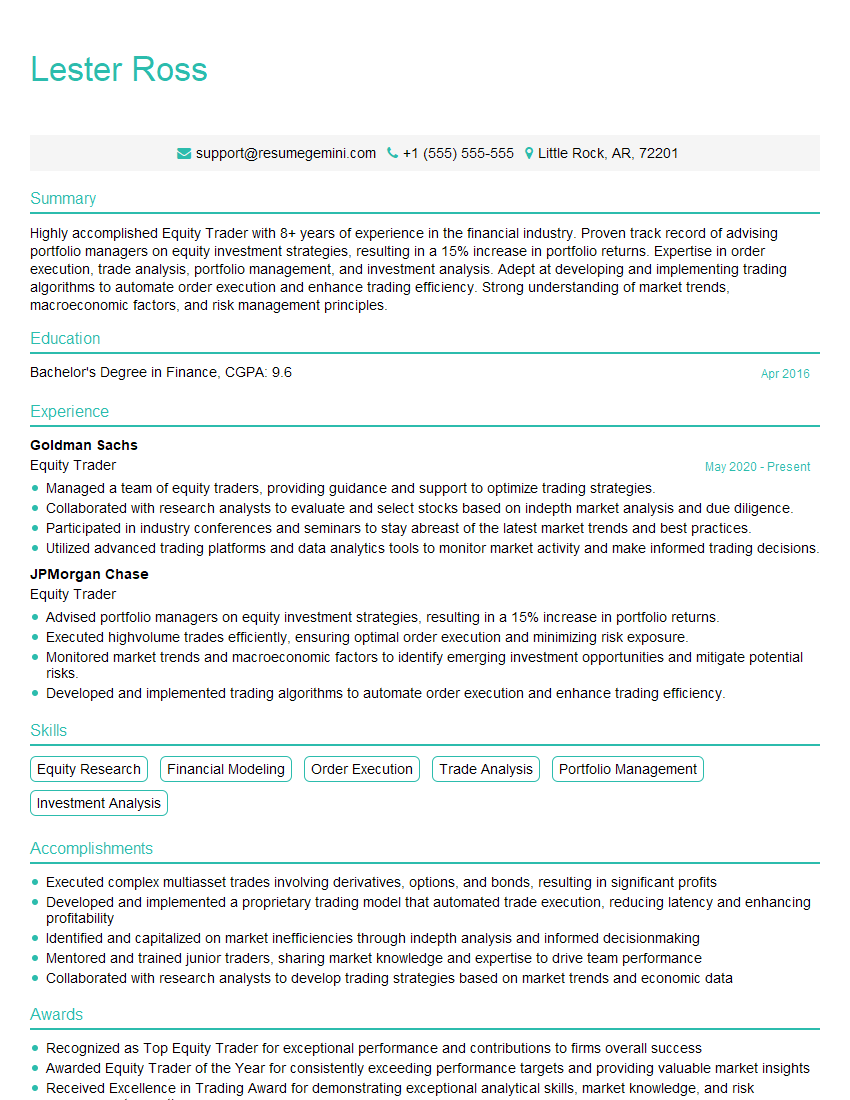
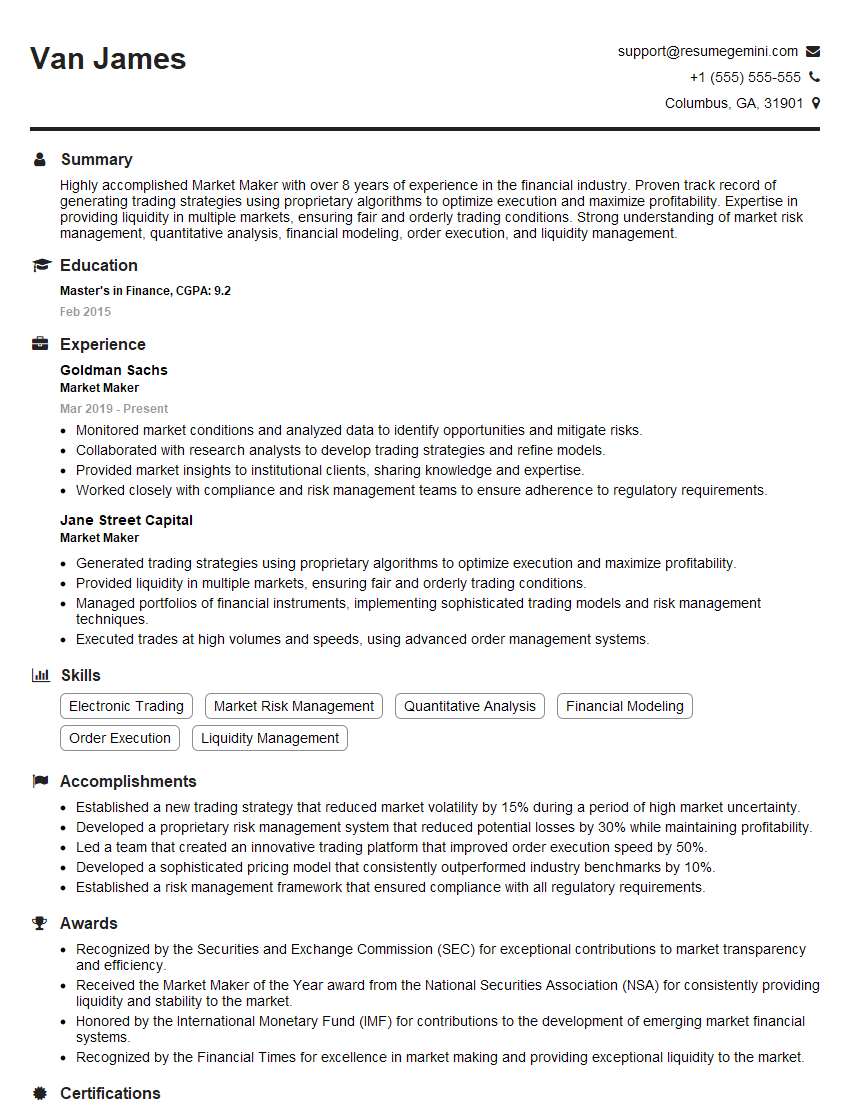
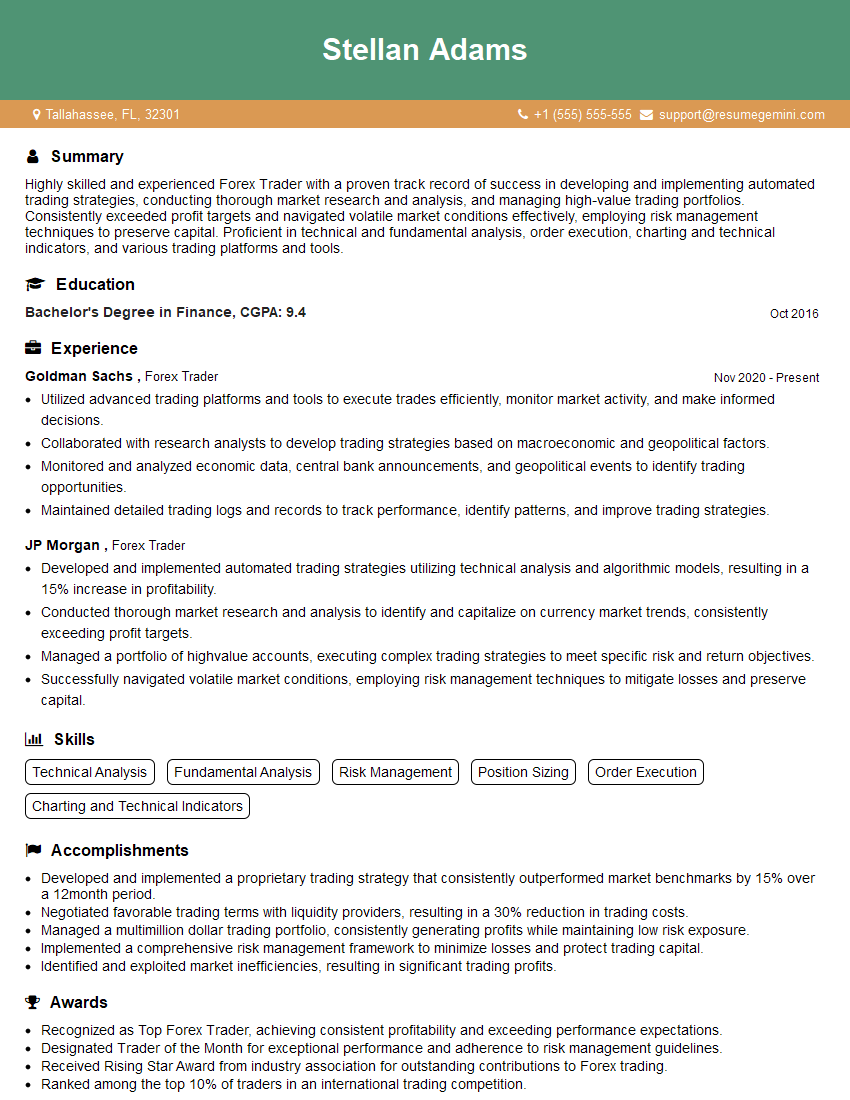
Mastering the execution of trades using electronic trading platforms is crucial for career advancement in the dynamic financial markets. It opens doors to specialized roles and demonstrates a high level of proficiency in a highly sought-after skillset. To maximize your job prospects, create an ATS-friendly resume that highlights your key skills and experience. ResumeGemini is a trusted resource that can help you build a professional and impactful resume. We provide examples of resumes tailored to Executing Trades using Electronic Trading Platforms to help guide you through the process. Take the next step toward your dream career today!
Explore more articles
Users Rating of Our Blogs
Share Your Experience
We value your feedback! Please rate our content and share your thoughts (optional).
What Readers Say About Our Blog
I Redesigned Spongebob Squarepants and his main characters of my artwork.
https://www.deviantart.com/reimaginesponge/art/Redesigned-Spongebob-characters-1223583608
IT gave me an insight and words to use and be able to think of examples
Hi, I’m Jay, we have a few potential clients that are interested in your services, thought you might be a good fit. I’d love to talk about the details, when do you have time to talk?
Best,
Jay
Founder | CEO