Preparation is the key to success in any interview. In this post, we’ll explore crucial Experience in creating graphic novels and webcomics interview questions and equip you with strategies to craft impactful answers. Whether you’re a beginner or a pro, these tips will elevate your preparation.
Questions Asked in Experience in creating graphic novels and webcomics Interview
Q 1. Describe your process for developing a compelling narrative structure in a graphic novel.
Crafting a compelling narrative structure in a graphic novel is like building a house: you need a solid foundation, a well-defined framework, and attention to detail. It starts with a strong premise – a core idea or conflict that will drive the story. Then, I meticulously outline the plot using various methods, from traditional three-act structures to more experimental approaches like the Hero’s Journey or even non-linear narratives.
I break down the story into individual chapters or sequences, focusing on pacing and creating satisfying cliffhangers to keep the reader engaged. Each scene should have a purpose, contributing to the overall plot or character development. Visual storytelling plays a huge role here; I plan panels and layouts to emphasize crucial moments and to guide the reader’s eye. For instance, a dramatic reveal might be given a double-page spread, while quieter moments may be presented in smaller, more intimate panels. Finally, I always reread and revise, ensuring the flow is smooth and the narrative arc is satisfying.
In my graphic novel, “Echoes of the City,” I employed a non-linear narrative, jumping between timelines to unravel the mystery. This required a careful structuring of chapters and a consistent visual language to clearly indicate the time shifts using color palettes and panel arrangements.
Q 2. Explain your approach to character design and how it contributes to storytelling.
Character design isn’t just about aesthetics; it’s about instantly communicating personality, backstory, and even thematic elements. I begin with a core concept – what makes this character tick? What are their flaws and strengths? I then sketch multiple designs, experimenting with body language, clothing styles, facial features, and hairstyles to find the visual embodiment of their inner self.
For example, a character might have sharp angles in their design to reflect their aggressive personality, while a more rounded design might suggest gentleness. Clothing choices can also communicate socioeconomic status, cultural background, and even their occupation. Consider a detective with rumpled clothing and a perpetually tired expression versus a glamorous socialite in elegant attire. These visual cues instantly communicate volumes without a single word of dialogue.
In my webcomic, “Starfall Chronicles,” each character’s design reflects their unique power and place in the story’s cosmology. The main character’s flowing, ethereal clothes signify her connection to magic, while the villain’s sharp, armored design highlights his aggression and militaristic approach.
Q 3. How do you balance visual storytelling with dialogue and narration in your work?
Balancing visual storytelling with dialogue and narration is crucial. I strive for a symbiotic relationship where visuals and text work together to enhance the story. Dialogue often drives the immediate action, revealing character personalities and relationships. Narration provides context, background information, and emotional depth, often filling in gaps the visuals can’t communicate as efficiently. The key is to know when to let the images speak for themselves and when to utilize text to enhance or clarify.
Too much dialogue can slow down the pace, while too much reliance on visuals can leave the reader confused. I use a strategy I call ‘show, don’t tell.’ Where possible, I try to convey information visually, using expressions, body language, setting details, and symbolic imagery. I only use dialogue or narration when it adds crucial emotional weight, exposition, or character development that the art alone cannot convey effectively. Think of it like a musical score: some parts are best left for the instruments, others require the vocalists to bring out the emotion.
Q 4. Discuss your experience with different inking techniques and their effects on visual style.
My inking style often depends on the project’s overall aesthetic. I’ve experimented with various techniques, from clean, precise lines achieved with fineliners and dip pens, to rougher, more expressive styles using brush pens and even digital tools that mimic traditional brushstrokes.
Fine liners provide sharp, detailed lines ideal for precise anatomy and intricate backgrounds. Brush pens allow for more fluid, dynamic lines that convey movement and emotion. Digital inking gives me the flexibility to adjust lines easily and experiment with various styles. For example, a historical fantasy comic might call for precise pen work, while a more modern, gritty urban story might lend itself to rougher, textured brush strokes. The choice of ink technique directly impacts the mood and overall aesthetic of the comic.
In one project, I used a combination of fine-liner inking for the background architecture and brush pen inking for the character’s dynamic poses and expressive hair to create a visual contrast that reflected the story’s juxtaposition of rigid societal structures and the characters’ rebellious spirits.
Q 5. What software and hardware do you use for creating your comics, and why?
My digital workflow revolves around a combination of software and hardware chosen for their efficiency and effectiveness. For sketching and initial layouts, I use a Wacom Intuos Pro tablet and Clip Studio Paint. Clip Studio Paint’s powerful brush engine and intuitive interface make it perfect for both digital painting and inking. The Wacom tablet provides a natural feel akin to traditional drawing, but with the advantage of unlimited undo and easy digital color correction.
For more complex tasks, such as digital painting or color grading, I occasionally use Photoshop. The high resolution and color accuracy of my monitor are crucial for ensuring the final artwork looks crisp and vibrant. I frequently back up my work on external hard drives and cloud storage, to protect against data loss. While I appreciate the tactile feel of traditional tools, the efficiency and flexibility of digital tools are essential for managing the complexities of a graphic novel’s production.
Q 6. How do you manage deadlines and workload in a fast-paced project environment?
Managing deadlines and workload in a fast-paced environment requires meticulous planning and discipline. I start by creating a detailed project schedule, breaking down the entire project into manageable tasks with assigned deadlines. This schedule is then broken down further into smaller daily or weekly goals. This helps me visualize progress and stay accountable.
I use project management tools, like Trello or Asana, to track my progress, manage revisions, and communicate with collaborators. Effective time management is key; I use techniques like the Pomodoro Technique to maintain focus and avoid burnout. Prioritization is also important; I focus on the most crucial tasks first, ensuring core elements of the project are completed on time. Open communication with clients or editors is also essential for managing expectations and addressing potential roadblocks proactively.
When facing tight deadlines, I might adjust my workflow to focus on the most impactful pages first, or seek additional assistance from other artists if the scope allows. Flexibility is crucial; sometimes, minor adjustments to the schedule are necessary to accommodate unforeseen challenges.
Q 7. Describe your experience with color theory and its application in comic book art.
Color theory is fundamental to creating evocative and effective comic book art. Understanding color relationships – such as complementary colors, analogous colors, and triadic color harmonies – allows me to evoke specific emotions and moods in the reader. For instance, warm colors like reds and oranges can create a sense of energy and excitement, while cool colors like blues and greens can create a sense of calm or melancholy.
Color palettes are meticulously planned to reflect the story’s tone and atmosphere. A horror comic might utilize a dark, desaturated palette with splashes of crimson, while a romantic story might rely on soft pastels and warm hues. The contrast between colors can also create visual tension and drama; a stark contrast between a dark, shadowed character and a brightly lit background might signify a character’s isolation or internal conflict. Additionally, color can be used to symbolically represent characters or thematic elements throughout a story. For example, a recurring color might become associated with a specific character or significant event.
In my work, I often use color to emphasize mood shifts within a scene. A sudden change from warm to cool colors could signify a change in the characters’ emotional state or a shift in the narrative’s pacing. I find that a deep understanding of color theory is essential to create a visual narrative that truly resonates with the reader.
Q 8. Explain your process for creating dynamic action sequences in your comics.
Creating dynamic action sequences in comics requires a blend of visual storytelling and understanding of motion. It’s not just about drawing fast-moving figures; it’s about conveying the energy, impact, and narrative flow of the scene. My process starts with a strong understanding of the scene’s purpose within the narrative. What emotion should the reader feel? What information needs to be conveyed?
I then break down the sequence into key poses and frames, almost like a storyboard. Think of it as capturing the highlights of a movie fight scene. I focus on clear visual indicators of movement – motion lines, blurred backgrounds, dynamic angles, and exaggerated poses. For instance, a punch might be shown in multiple frames, each slightly different, to emphasize its power and speed. The use of panel borders, sizes, and shapes also greatly influence pacing. A series of smaller panels might create a sense of rapid movement, whereas larger panels could highlight a powerful impact.
Finally, I pay close attention to the character’s expressions and body language. Even in the midst of chaos, their reactions need to be clear and communicate their experience. A successful action sequence is not just visually impressive but also emotionally engaging and narratively impactful.
Q 9. How do you collaborate effectively with writers, editors, and other team members?
Collaboration is essential in comics. My approach focuses on clear communication and mutual respect. Early on, I work closely with the writer to understand the story’s nuances and the intended emotional impact of each scene. We often create visual mood boards or share references to ensure we’re both on the same page regarding character design, setting, and overall style.
With editors, the feedback process is crucial. I value constructive criticism and view it as an opportunity for improvement. I’m open to suggestions and incorporate feedback into my work, always prioritizing narrative clarity and visual effectiveness. I also utilize version control systems for sharing and tracking revisions. With other team members, like colorists and letterers, I maintain open communication, providing them with clear guidelines and specifications to ensure the final product remains cohesive and professional.
Q 10. Discuss your understanding of different comic book page layouts and their impact on pacing.
Comic book page layouts are fundamental to pacing and storytelling. Different layouts create different rhythms and guide the reader’s eye through the panels. A simple 3x2 grid can create a sense of steady progression, whereas a more dynamic layout using varying panel sizes and shapes can enhance dramatic tension or emphasize a specific moment.
For instance, a large panel followed by a series of smaller panels can create a sense of impact followed by rapid action. Similarly, using gutter space (the space between panels) effectively can influence pacing. Wide gutters can slow things down, giving the reader time to process information, while narrow gutters can speed things up. Understanding how panel placement, shape, size, and gutters interact is crucial for controlling the narrative flow and emotional impact of the comic.
I often experiment with different layouts – from traditional grids to more unconventional approaches – to find what best serves the story. For example, a chase scene might use a rapid-fire sequence of smaller panels, while a moment of reflection might be presented in a larger, more immersive panel.
Q 11. What are some common challenges you face when creating graphic novels or webcomics?
Creating graphic novels and webcomics presents unique challenges. Time management is a major hurdle, especially for long-form projects. Balancing the creative process with deadlines can be demanding. Another challenge is maintaining visual consistency throughout the project, particularly if it spans months or even years. My style might evolve subtly over time, so consistent referencing of earlier work and maintaining a detailed style guide is essential.
Furthermore, self-promotion and audience engagement, especially for self-published works, requires significant effort. Marketing, building an online presence, and interacting with readers can be time-consuming but absolutely crucial for success. Finally, balancing the artistic vision with the financial realities of creating comics is often a delicate act. Resource management, budgeting, and potentially seeking funding can be challenging aspects of the process.
Q 12. How do you ensure visual consistency throughout a long-form comic project?
Maintaining visual consistency in a long-form project is paramount. I address this through meticulous planning and consistent referencing. Before I begin, I create a detailed style guide that includes character designs, setting details, color palettes, and even examples of common visual elements like backgrounds and textures. I regularly refer back to this style guide throughout the process, ensuring that my drawings remain consistent in terms of style, proportions, and details.
I also use digital tools and techniques to enhance consistency. For example, creating custom brushes and textures in my drawing software helps me achieve a unified look. Regularly reviewing completed pages against the style guide and earlier work ensures any deviations are identified and corrected. Working digitally also allows for easier corrections and adjustments to ensure uniformity throughout the project.
Q 13. Describe your experience with self-publishing or traditional publishing routes.
I have experience with both self-publishing and traditional publishing. Self-publishing offers complete creative control but requires significant effort in marketing, distribution, and handling all aspects of production. It’s a learning curve, but it allows for greater flexibility and a larger share of the profits. I’ve used platforms like Kickstarter successfully to fund projects and build community interest before release.
Traditional publishing, on the other hand, offers the advantage of established distribution networks and marketing support from the publisher. However, it often involves relinquishing some creative control and accepting a smaller share of the profits. The process is also more structured and can be slower due to the involvement of multiple parties. The best route depends heavily on individual goals, resources, and risk tolerance.
Q 14. How do you adapt your style to meet the specific requirements of a project?
Adapting my style to meet project requirements is a crucial skill. My core style might be relatively consistent, but I’m adaptable and comfortable altering aspects of it to match a project’s specific needs. This involves understanding the target audience, the story’s genre, and the overall aesthetic direction. If a project requires a more realistic style, I’ll adjust my techniques and focus on details and accurate anatomy. If it demands a more cartoony style, I’ll embrace exaggeration and simplification.
Close collaboration with the client or writer is key to this adaptation process. We might discuss reference images, style guides of other works, or examine existing comics that share a similar aesthetic. Open communication and a willingness to experiment with different approaches are essential in creating a final product that aligns with the project’s vision while still showcasing my personal artistic capabilities.
Q 15. What are your strengths and weaknesses as a comic book artist/writer?
My greatest strength lies in crafting compelling narratives with visually engaging artwork. I excel at developing complex characters with relatable motivations and weaving intricate plotlines that keep readers hooked. I’m also proficient in various art styles, allowing me to adapt to different genres and target audiences. However, like any artist, I have areas for improvement. Time management, particularly balancing writing and illustrating, can sometimes be challenging. I’m actively working on refining my organizational skills and project planning to better manage my workload and meet deadlines consistently.
Career Expert Tips:
- Ace those interviews! Prepare effectively by reviewing the Top 50 Most Common Interview Questions on ResumeGemini.
- Navigate your job search with confidence! Explore a wide range of Career Tips on ResumeGemini. Learn about common challenges and recommendations to overcome them.
- Craft the perfect resume! Master the Art of Resume Writing with ResumeGemini’s guide. Showcase your unique qualifications and achievements effectively.
- Don’t miss out on holiday savings! Build your dream resume with ResumeGemini’s ATS optimized templates.
Q 16. How do you incorporate feedback from editors and other professionals into your work?
I view feedback as an invaluable tool for growth. I actively solicit input from editors and other professionals throughout the entire creative process. I find it’s most effective to receive feedback in stages. For instance, I’ll share initial story outlines for plot critiques, then rough sketches for visual feedback before moving into final artwork. I carefully consider every piece of feedback, weighing its merit against my artistic vision. Sometimes, feedback leads to significant changes; other times, it’s about subtle adjustments that refine the final product. For example, an editor might suggest altering a character’s personality to better fit the narrative arc, or a colorist might recommend palette tweaks to enhance the emotional impact of a scene. Documenting all feedback and revisions is crucial for maintaining a clear record of the creative process.
Q 17. Explain your familiarity with different printing processes and their impact on the final product.
My experience encompasses various printing methods, including offset printing, digital printing, and print-on-demand services. Offset printing, ideal for large print runs, offers vibrant colors and high-quality reproduction, but it comes with higher upfront costs. Digital printing is cost-effective for smaller runs but may not achieve the same color vibrancy. Print-on-demand provides flexibility for independent creators, handling smaller orders and eliminating the need for large upfront investments, although the per-unit cost is generally higher. The choice of printing process directly impacts the final product’s quality, cost, and turnaround time. For instance, the paper stock selected for offset printing will affect the overall feel and texture of the comic. With digital printing, the resolution of the artwork is critical to avoid pixelation. Understanding these nuances ensures the final product meets the desired aesthetic and budgetary requirements.
Q 18. How do you maintain creative inspiration and avoid burnout?
Maintaining creative inspiration and avoiding burnout requires a multifaceted approach. I regularly engage in activities outside of comics, such as exploring museums, reading widely (both fiction and non-fiction), attending workshops, and interacting with other artists. This cross-pollination of ideas fosters fresh perspectives and prevents creative stagnation. I also prioritize self-care—ensuring adequate sleep, regular exercise, and time for relaxation are crucial. Setting realistic deadlines and breaking down larger projects into smaller, manageable tasks helps prevent overwhelming feelings. Finally, stepping away from the project entirely for a period of time—a mental break—can provide valuable distance and allow for a fresh perspective before returning to work.
Q 19. Describe your experience with creating storyboards and their role in the comic creation process.
Storyboarding is an integral part of my workflow. I create detailed storyboards before beginning the actual artwork, essentially creating a visual roadmap of the comic’s narrative. Each storyboard panel outlines the scene’s composition, character placement, and key actions. They’re akin to a shot list in filmmaking. This process allows me to visualize the pacing and flow of the story, experiment with different panel layouts, and refine the narrative before investing time in the final artwork. For example, I might use storyboards to test the effectiveness of a suspenseful scene, adjusting the panel sizes and camera angles to maximize dramatic effect. Storyboarding helps catch potential plot holes or pacing issues early on, saving time and effort later in the production phase. I often use digital tools like Photoshop or dedicated storyboard software to create my boards.
Q 20. How do you research and develop accurate historical or fictional settings for your comics?
Thorough research is paramount to accurately depict historical or fictional settings. For historical settings, I begin by consulting primary and secondary sources—historical texts, images, maps, and even relevant artifacts. I meticulously document my findings, creating detailed notes and sketches to inform the visual elements of the comic. For fictional settings, the level of detail can be adjusted to better fit the story; the focus on creating a consistent and believable atmosphere remains unchanged. The depth of research required will depend upon the specifics of the story. Creating accurate representations of the era, fashion, architecture, weapons and other period details greatly enhances the reader’s immersion in the story.
Q 21. What are your strategies for marketing and promoting your graphic novels or webcomics?
Marketing and promotion are essential for reaching a wider audience. My strategy includes leveraging social media platforms like Instagram, Twitter, and Facebook to showcase artwork, share behind-the-scenes content, and interact with potential readers. I attend comic conventions to connect with fans directly and sell my work. Utilizing online platforms like webcomics sites and crowdfunding campaigns has also been highly effective in gaining visibility. Building an email list allows me to directly contact readers with updates and promotions. Creating engaging content is vital, and engaging with fans to build a community around my work has proven to be invaluable in driving long-term success. A consistent and dedicated strategy will make the difference between limited success and widespread recognition.
Q 22. Describe your experience with using social media to build a fanbase for your work.
Building a fanbase for my graphic novels and webcomics relies heavily on a multi-platform social media strategy. It’s not just about posting finished artwork; it’s about creating a community. I utilize platforms like Twitter, Instagram, and Tumblr, tailoring my content to each platform’s audience. On Instagram, I focus on visually appealing panels and behind-the-scenes glimpses of my creative process. Twitter allows for more direct interaction with fans, responding to comments and engaging in discussions. Tumblr offers a more relaxed space for sharing sketches, WIPs (work in progress), and longer-form reflections on my creative journey. Crucially, I actively participate in relevant hashtags and engage with other creators in my genre, fostering a collaborative and supportive online space. Consistent posting, responding to comments, and running occasional contests or giveaways are all vital in keeping my audience engaged and growing. A well-designed website also serves as a central hub, directing fans to other platforms and providing a place to purchase my work.
Q 23. How do you understand the nuances of panel layout in creating tension, suspense and pacing?
Panel layout is the backbone of storytelling in comics. It’s about manipulating the reader’s eye movement and controlling the pacing of the narrative. To create tension, I might use smaller panels, quick cuts, and close-ups of characters’ faces to heighten the sense of urgency and anticipation. For suspense, I’d utilize larger panels with a wider angle, perhaps showing the character’s environment or an ominous background, building a sense of foreboding. Pacing is controlled through the size, number, and arrangement of panels. A series of small, fast-paced panels creates a frenetic energy, while larger, slower panels allow for reflection and emotional impact. For example, a fight scene might use a rapid sequence of small panels to emphasize the speed and intensity, while a quiet, contemplative moment might be shown in a single, large, full-page panel. Mastering panel layout is crucial in setting the mood and guiding the reader through the emotional arc of the story.
Q 24. Discuss your understanding of visual hierarchy and its importance in comic storytelling.
Visual hierarchy is the arrangement of visual elements to guide the reader’s eye through the page. It’s about prioritizing information and creating a clear path for understanding the narrative. In comics, this involves using size, contrast, color, and placement to emphasize certain elements over others. For instance, a larger character might be the focal point of a panel, while smaller figures in the background offer context. Bright, saturated colors can draw attention, while muted tones can create a sense of calm or mystery. Careful placement of elements, such as strategically positioning speech bubbles or sound effects, also contributes to the overall visual hierarchy. Ignoring visual hierarchy can lead to confusing or cluttered pages, making it difficult for the reader to follow the story. It’s about ensuring the reader’s eye naturally flows through the panel and page in a way that enhances the storytelling, not detracts from it.
Q 25. How familiar are you with different printing techniques, such as offset printing and digital printing?
I’m familiar with both offset and digital printing techniques. Offset printing offers higher-quality results, particularly for large print runs, due to its ability to reproduce fine details and vibrant colors accurately. This is typically ideal for graphic novels. However, it comes with higher setup costs, making it less viable for smaller projects. Digital printing, on the other hand, is more cost-effective for smaller print runs and allows for greater flexibility in terms of design and print-on-demand options. It’s perfectly suitable for webcomics and smaller-scale projects. The choice between the two depends largely on the project’s budget, print run size, and desired quality. I would consult with a printer to determine the best approach for a given project, carefully considering the trade-off between cost and quality.
Q 26. Explain your process for creating expressive and nuanced character faces.
Creating expressive character faces requires a deep understanding of anatomy and human emotion. I start by studying references – photographs, videos, even mirror studies – to understand how muscles move and how subtle changes in facial features can convey a wide range of emotions. I then simplify these observations into a stylized approach appropriate for my chosen art style. I pay close attention to the eyes, which are the windows to the soul; even slight changes in eyebrow position, the shape of the mouth, and the subtle lines around the eyes can greatly impact the expression. I also consider the context of the scene, ensuring the character’s facial expression is consistent with their emotional state and the narrative. Practicing is essential. I frequently sketch different expressions to expand my repertoire and refine my techniques. It’s a continuous learning process, constantly refining my ability to capture nuanced emotions with economy of line and form.
Q 27. What steps do you take to ensure the accessibility of your comic work for a wider audience?
Accessibility is paramount. I incorporate several strategies to ensure my work is inclusive for a wider audience. This includes using sufficient color contrast between text and background to aid readers with visual impairments. I utilize clear, easy-to-read fonts and appropriate font sizes. For readers with dyslexia or other reading challenges, I consider using sans-serif fonts known for their readability. I also pay attention to alternative text descriptions for images in digital formats (webcomics) to make the content accessible to screen readers. Providing transcripts for dialogue and descriptions of visual elements in the accompanying text improves inclusivity. Furthermore, I carefully consider the color palette to be mindful of readers with colorblindness. While I can’t eliminate all barriers, I strive to create an enjoyable and accessible reading experience for everyone.
Q 28. Describe your process for incorporating sound effects into your graphic narratives.
Incorporating sound effects is a vital part of enhancing the storytelling experience. I approach it as another visual element, treating sound effects as part of the overall design. I consider the weight and intensity of the sound – a gentle whisper might be represented by a small, delicate font, while a powerful explosion might use a large, bold, and often jagged font. I experiment with different fonts, sizes, and styles to find the perfect visual representation for the specific sound. Placement is equally crucial; the visual sound effect should be integrated seamlessly into the panel, reflecting its source and the action in the scene. I might use color and shading to enhance the visual impact of the sound effect, aligning it with the overall color scheme of the panel. The key is balance; using sound effects sparingly to emphasize crucial moments ensures they don’t overwhelm the visual narrative.
Key Topics to Learn for Experience in creating graphic novels and webcomics Interview
- Storytelling and Narrative Structure: Understanding plot development, character arcs, pacing, and effective use of visual storytelling techniques in both long-form (graphic novels) and serialized (webcomics) formats.
- Character Design and Development: Creating compelling and believable characters, including visual design, personality traits, and motivations. Discuss how you approach creating consistent character designs across multiple pages or chapters.
- Visual Communication and Layout: Mastering paneling techniques, visual flow, and the use of visual metaphors to enhance storytelling. Explain your process for creating engaging page layouts.
- Software Proficiency: Demonstrating expertise in relevant software (e.g., Adobe Photoshop, Clip Studio Paint, Procreate). Be prepared to discuss your workflow and the specific tools you utilize.
- Worldbuilding and Setting Design: Creating believable and engaging worlds, environments, and props. Explain your approach to consistency and detail in your visual world-building.
- Collaboration and Workflow: Discussing experiences working with writers, editors, letterers, and colorists. Highlight your communication and teamwork skills.
- Production and Publishing: Understanding the process of creating, editing, and publishing graphic novels and webcomics, including self-publishing options and working with publishers.
- Marketing and Promotion: Demonstrate awareness of strategies for promoting your work, building an audience, and engaging with readers online.
- Problem-Solving and Adaptability: Discuss how you overcome creative challenges, meet deadlines, and adjust to changing project requirements.
Next Steps
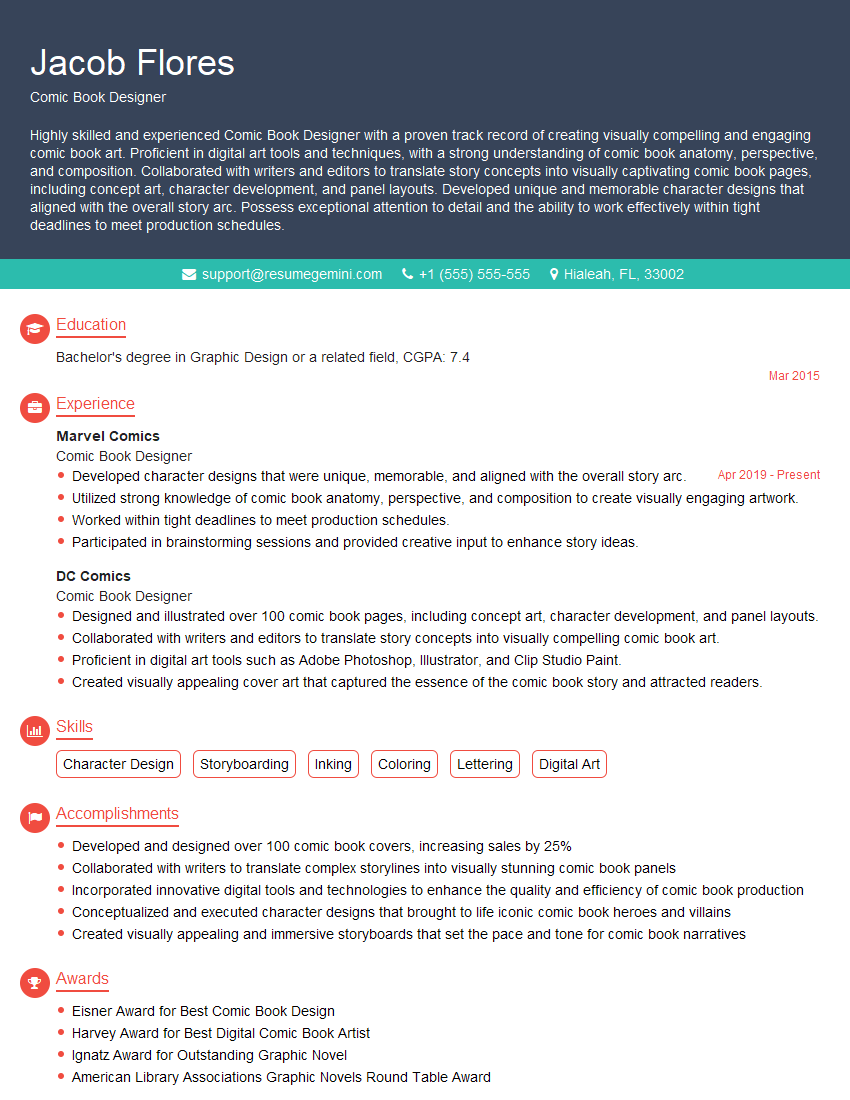
Mastering the art of creating graphic novels and webcomics opens doors to exciting career opportunities in publishing, animation, game design, and more. A strong resume showcasing your skills and experience is crucial for landing your dream job. Creating an ATS-friendly resume that highlights your key achievements and technical abilities is essential for getting noticed by potential employers. ResumeGemini is a trusted resource that can help you build a professional and impactful resume tailored to the specific requirements of the graphic novel and webcomics industry. Examples of resumes tailored to this field are available to help you get started.
Explore more articles
Users Rating of Our Blogs
Share Your Experience
We value your feedback! Please rate our content and share your thoughts (optional).
What Readers Say About Our Blog
Really detailed insights and content, thank you for writing this detailed article.
IT gave me an insight and words to use and be able to think of examples