Feeling uncertain about what to expect in your upcoming interview? We’ve got you covered! This blog highlights the most important Expertise in Data Manipulation interview questions and provides actionable advice to help you stand out as the ideal candidate. Let’s pave the way for your success.
Questions Asked in Expertise in Data Manipulation Interview
Q 1. Explain the difference between INNER JOIN, LEFT JOIN, and RIGHT JOIN.
SQL joins combine rows from two or more tables based on a related column between them. Let’s differentiate the three main types:
- INNER JOIN: Returns rows only when there is a match in both tables. Think of it like finding the intersection of two sets. If a row in one table doesn’t have a corresponding match in the other, it’s excluded from the result.
- LEFT (OUTER) JOIN: Returns all rows from the left table (the one specified before
LEFT JOIN), even if there’s no match in the right table. For rows in the left table without a match in the right, the columns from the right table will haveNULLvalues. - RIGHT (OUTER) JOIN: Similar to
LEFT JOIN, but it returns all rows from the right table (specified afterRIGHT JOIN), and fills inNULLvalues for unmatched rows in the left table.
Example: Imagine you have two tables: Customers (CustomerID, Name) and Orders (OrderID, CustomerID, OrderDate).
An INNER JOIN would only show customers who have placed orders. A LEFT JOIN would show all customers, including those without orders (their order details would be NULL). A RIGHT JOIN (less commonly used) would show all orders, even if the customer information is missing (customer details would be NULL).
--Example SQL using INNER JOIN
SELECT Customers.Name, Orders.OrderDate
FROM Customers
INNER JOIN Orders ON Customers.CustomerID = Orders.CustomerID;
Q 2. How would you handle missing values in a dataset?
Handling missing values, or missing data, is crucial for data integrity and accurate analysis. Ignoring them can lead to biased results. The approach depends on the context and the amount of missing data. Here’s a breakdown:
- Deletion: If the missing data is minimal and random, you can remove rows or columns with missing values. However, this can lead to information loss if a significant portion of data is removed.
- Imputation: This involves filling in the missing values with estimated ones. Common methods include:
- Mean/Median/Mode Imputation: Replacing missing values with the mean (average), median (middle value), or mode (most frequent value) of the respective column. Simple, but can distort the distribution if many values are missing.
- K-Nearest Neighbors (KNN) Imputation: Finds the ‘k’ most similar data points based on other features and uses their values to estimate the missing value. More sophisticated, capturing relationships between variables.
- Multiple Imputation: Creates multiple plausible imputed datasets, accounting for uncertainty in the imputed values. This gives you a more robust analysis.
Choosing a method: The best approach depends on the nature of the missing data (Missing Completely at Random (MCAR), Missing at Random (MAR), Missing Not at Random (MNAR)), the amount of missing data, and the impact on the analysis. It’s often wise to try several methods and compare the results.
Q 3. Describe different methods for data cleaning.
Data cleaning is the process of identifying and correcting (or removing) inaccurate, incomplete, irrelevant, duplicated, or inconsistent data. It’s a crucial step before analysis. Key methods include:
- Handling Missing Values (as discussed above): Imputation or deletion.
- Detecting and Removing Duplicates: Identifying and removing identical or near-identical rows. This often requires considering fuzzy matching for slightly different entries.
- Smoothing Noisy Data: Dealing with outliers or erroneous values. Techniques include binning (grouping values into intervals), regression (fitting a line to the data), or outlier analysis.
- Resolving inconsistencies: Standardizing data formats, correcting spelling errors, and ensuring consistent units of measurement. This might involve using data dictionaries or reference tables.
- Data Transformation: Changing data types or formats to make it suitable for analysis (discussed further in the next answer).
Example: Imagine a dataset with inconsistent date formats (dd/mm/yyyy, mm/dd/yyyy). Data cleaning would involve standardizing all dates to a single format.
Q 4. What are some common data transformation techniques?
Data transformation techniques alter the format or structure of data to make it more suitable for analysis or modeling. Common techniques include:
- Scaling/Normalization: Transforms numerical features to a similar range (e.g., 0-1 or -1 to 1). Common methods include Min-Max scaling and Z-score standardization. This is essential for algorithms sensitive to feature scaling (like KNN or some neural networks).
- Log Transformation: Applies a logarithmic function to reduce the impact of outliers and make skewed data more normally distributed. Useful for variables with a wide range of values.
- One-Hot Encoding: Converts categorical variables (e.g., colors: red, green, blue) into numerical representations. Each category gets its own binary column (0 or 1).
- Binning: Groups continuous variables into discrete intervals (bins). Useful for creating histograms or simplifying analysis.
- Feature Engineering: Creating new features from existing ones. This can significantly improve model performance. Examples include extracting dates from timestamps, calculating ratios, or creating interaction terms.
Example: Transforming house prices (highly skewed) using a log transformation to improve model fitting. Or encoding colors into numerical representation using one-hot encoding.
Q 5. Explain the concept of normalization in databases.
Database normalization is a systematic approach to organizing data to reduce redundancy and improve data integrity. It involves dividing larger tables into smaller ones and defining relationships between them. The goal is to isolate data so that additions, deletions, and modifications of a field can be made in just one table and then propagated through the rest of the database via the defined relationships.
Normal Forms: Normalization is achieved through a series of normal forms (1NF, 2NF, 3NF, BCNF, etc.). Each normal form addresses specific types of redundancy. For example:
- 1NF (First Normal Form): Eliminates repeating groups of data within a table. Each column should contain only atomic values (indivisible values).
- 2NF (Second Normal Form): Builds upon 1NF by eliminating redundant data that depends on only part of the primary key (in tables with composite keys).
- 3NF (Third Normal Form): Eliminates transitive dependencies. This means that no non-key attribute should depend on another non-key attribute.
Benefits: Normalization reduces data redundancy, improves data integrity, saves storage space, and simplifies data modification and querying. However, excessive normalization can lead to complex database structures and slower query performance. Finding the right balance is key.
Q 6. How do you identify and handle outliers in a dataset?
Outliers are data points that significantly deviate from the rest of the data. Identifying and handling them is crucial because they can skew statistical analyses and distort model results. Here’s a common approach:
- Identification:
- Visual Inspection: Box plots, scatter plots, and histograms can visually reveal outliers.
- Statistical Methods: Z-scores or IQR (Interquartile Range) methods can identify data points outside a defined range (e.g., more than 3 standard deviations from the mean or 1.5 times the IQR above the third quartile).
- Handling:
- Removal: If outliers are due to errors or are clearly irrelevant, they can be removed. However, be cautious as this can introduce bias.
- Transformation: Apply data transformations like log transformations to reduce the impact of outliers.
- Winsorization/Trimming: Replace outliers with less extreme values (e.g., the highest/lowest values within a certain percentile).
- Robust Statistical Methods: Use statistical methods less sensitive to outliers (e.g., median instead of mean).
Important Note: Always investigate the cause of outliers. They might indicate errors in data collection, genuine extreme values, or important insights. Blindly removing them without understanding can lead to misleading conclusions.
Q 7. What are your preferred methods for data validation?
Data validation ensures data accuracy and consistency. My preferred methods involve a multi-pronged approach:
- Schema Validation: Using schema definitions (e.g., XML Schema, JSON Schema) to verify that the data conforms to the expected structure and data types. This is a crucial first step.
- Data Type Validation: Checking that data values match the expected data types (integer, string, date, etc.). This often involves using type checking in your programming language.
- Range and Value Checks: Verifying that values fall within acceptable ranges or are part of a predefined set of valid values. For instance, ensuring that an age is above 0 or a country code is valid.
- Consistency Checks: Checking for inconsistencies between related data fields. For example, ensuring that a customer’s address matches their billing address.
- Cross-referencing: Comparing data against other sources (e.g., a reference table) to identify inconsistencies or errors.
- Using Constraints in Databases: Defining constraints such as unique keys, foreign keys, and check constraints in databases to enforce data integrity.
- Unit Testing and Integration Testing (for code): When data processing is part of a larger software system, unit and integration tests should be implemented to ensure data transformation and validation functions work as expected.
Example: In a customer registration form, validating that the email address has a valid format, the postal code exists, and the age is within a reasonable range.
Q 8. Describe your experience with SQL and NoSQL databases.
My experience spans both SQL and NoSQL databases. SQL databases, like PostgreSQL and MySQL, are relational, meaning data is organized into tables with structured relationships. I’m proficient in writing complex queries involving joins, subqueries, aggregations (COUNT, SUM, AVG), and window functions to extract insights from structured data. For instance, I’ve used SQL extensively to analyze sales data, optimizing queries for performance in large datasets. NoSQL databases, such as MongoDB and Cassandra, offer flexibility with schema-less designs, ideal for handling semi-structured or unstructured data like JSON documents. My experience here involves designing schemas, optimizing queries using indexes, and leveraging NoSQL’s strengths in handling large volumes of rapidly changing data, like social media feeds. The choice between SQL and NoSQL depends heavily on the specific application; I’m adept at selecting the right tool for the right job.
Q 9. Explain your understanding of data warehousing concepts.
Data warehousing is all about consolidating data from various sources into a central repository for analysis and reporting. Think of it as a giant, organized library for your data. It involves several key concepts: Extraction, Transformation, and Loading (ETL), which we’ll discuss later; schema design, typically using a star or snowflake schema for efficient querying; and dimensional modeling, focusing on facts (e.g., sales) and dimensions (e.g., time, product, customer) to enable comprehensive analysis. I’ve worked on data warehouses using tools like AWS Redshift and Snowflake, designing dimensional models to facilitate business intelligence (BI) reporting and analytical dashboards. For example, in a previous role, I built a data warehouse that integrated marketing campaign data, sales data, and customer data to provide a 360-degree view of customer behavior, enabling targeted marketing campaigns and improved sales forecasting.
Q 10. How do you handle large datasets that don’t fit into memory?
Handling datasets too large for memory requires strategies focused on processing data in chunks or using distributed computing. Techniques include:
- Chunking: Processing the data in smaller, manageable parts. I frequently use this with SQL queries, reading data in batches using
LIMITandOFFSETclauses. - Sampling: Analyzing a representative subset of the data to derive insights. This is useful for exploratory analysis and model building when dealing with extremely large datasets.
- Distributed Computing Frameworks: Utilizing frameworks like Hadoop or Spark, which distribute the processing workload across multiple machines. For example, I’ve used Spark to perform large-scale machine learning tasks on petabyte-sized datasets.
The choice of method depends on the specific task, data format, and available resources. Often, a combination of these techniques is necessary for optimal performance.
Q 11. Describe your experience with ETL processes.
ETL (Extract, Transform, Load) processes are crucial for populating data warehouses and other analytical systems. The ‘Extract’ phase involves pulling data from various sources—databases, flat files, APIs, etc. The ‘Transform’ phase is where the magic happens: data cleaning, standardization, and enrichment occur. This could involve handling missing values, correcting inconsistencies, and adding calculated fields. Finally, the ‘Load’ phase involves inserting the transformed data into the target system (like a data warehouse). I’ve used a variety of ETL tools, including Informatica PowerCenter and Apache Kafka, to build robust and efficient pipelines. A recent project involved building an ETL pipeline that consolidated data from multiple CRM systems, cleaned and standardized customer information, and loaded it into a marketing analytics platform. This improved the accuracy and consistency of our customer segmentation and marketing campaign targeting.
Q 12. What are some common challenges in data manipulation and how have you overcome them?
Data manipulation presents several challenges:
- Data Quality Issues: Inconsistent formats, missing values, and inaccuracies are common. I address this with data profiling, validation rules, and cleaning scripts.
- Data Volume and Velocity: Large and rapidly changing datasets require efficient processing techniques like those discussed earlier.
- Data Integration Complexity: Combining data from disparate sources often involves schema conflicts and data type mismatches, which I handle using data transformation techniques and ETL processes.
- Performance Bottlenecks: Inefficient queries or algorithms can significantly impact processing time. I overcome this through query optimization, indexing, and choosing appropriate data structures.
For example, I once resolved a performance issue in a large-scale ETL process by identifying and optimizing a poorly performing SQL query, reducing processing time by over 80%.
Q 13. How do you ensure data quality during the manipulation process?
Ensuring data quality is paramount. My approach involves a multi-layered strategy:
- Data Profiling: Understanding data characteristics, including data types, distributions, and missing values, to identify potential problems.
- Data Validation: Implementing rules to check for data consistency and accuracy during the ETL process. This includes constraints, checks, and assertions.
- Data Cleansing: Addressing inconsistencies, errors, and missing values through data transformations and cleaning techniques.
- Data Monitoring: Continuously monitoring data quality metrics after the data is loaded to detect and address emerging issues.
I also advocate for a culture of data quality within the team, emphasizing the importance of accuracy and consistency throughout the data lifecycle.
Q 14. Explain your understanding of data types and their implications.
Understanding data types is critical for effective data manipulation. Different data types have implications for storage, processing, and analysis. For instance:
- Numeric types (INT, FLOAT, DOUBLE): Used for numerical data. Choosing the right precision and scale is essential for accuracy and storage efficiency.
- String types (VARCHAR, TEXT): Used for textual data. Understanding character sets and encoding is crucial for avoiding issues.
- Date and Time types (DATE, TIMESTAMP): Used for date and time information. Proper handling of time zones is essential for accurate analysis.
- Boolean types (BOOLEAN): Used for true/false values.
Mismatched data types can lead to errors, inefficient queries, and incorrect analysis results. For example, trying to perform arithmetic operations on a string column would lead to errors. I always meticulously check and convert data types as needed during the transformation phase of ETL to ensure seamless and accurate analysis.
Q 15. How familiar are you with different data formats (CSV, JSON, XML)?
I’m highly proficient in working with various data formats, including CSV, JSON, and XML. Each has its strengths and weaknesses, and understanding their nuances is crucial for efficient data manipulation.
CSV (Comma Separated Values): This is a simple, widely-used format for storing tabular data. It’s easy to read and write, making it ideal for quick data exchange and import/export operations. Think of it like a spreadsheet saved as a text file. However, it lacks the self-describing nature of other formats and can be prone to errors if the data contains commas within fields.
JSON (JavaScript Object Notation): JSON is a lightweight, human-readable format that’s become extremely popular for web applications and APIs. Its hierarchical structure using key-value pairs makes it easy to represent complex data structures. It’s superior to CSV when dealing with nested or structured data. For example, representing customer data with addresses and order history is much more natural in JSON.
XML (Extensible Markup Language): XML is a more verbose, self-describing format that uses tags to define data elements. It’s highly flexible and supports complex data structures, but it’s more complex to parse than JSON or CSV. XML is often used in situations where strict data validation and schema enforcement are important, such as in configuration files or data exchange between different systems. Think of it as a more formal and structured version of JSON.
In my experience, choosing the right format depends heavily on the context – the size of the data, its complexity, and how it will be used. For instance, CSV might be suitable for a quick analysis of a small dataset, while JSON is better for web services and large, structured datasets. XML shines when data integrity and schema validation are paramount.
Career Expert Tips:
- Ace those interviews! Prepare effectively by reviewing the Top 50 Most Common Interview Questions on ResumeGemini.
- Navigate your job search with confidence! Explore a wide range of Career Tips on ResumeGemini. Learn about common challenges and recommendations to overcome them.
- Craft the perfect resume! Master the Art of Resume Writing with ResumeGemini’s guide. Showcase your unique qualifications and achievements effectively.
- Don’t miss out on holiday savings! Build your dream resume with ResumeGemini’s ATS optimized templates.
Q 16. What are your experiences with data visualization tools?
I have extensive experience with several data visualization tools, tailoring my choice to the specific needs of the project. Effective visualization is crucial for uncovering insights and communicating findings clearly.
Tableau: I frequently use Tableau for its user-friendly interface and powerful interactive dashboards. It excels at creating visually appealing and insightful reports from diverse data sources. For example, I’ve used it to create interactive sales dashboards showing trends over time, broken down by region and product category.
Power BI: Similar to Tableau, Power BI is a robust tool for data visualization and business intelligence. Its strong integration with Microsoft products makes it a valuable asset in many corporate environments. I’ve leveraged its capabilities to generate interactive reports displaying key performance indicators (KPIs).
Matplotlib and Seaborn (Python): For more customized and programmatic visualizations, I rely on Python libraries like Matplotlib and Seaborn. They offer fine-grained control over the plotting process and are ideal for creating publication-quality figures. I’ve used them extensively to generate graphs and charts for scientific publications and presentations.
My selection of a tool depends on factors such as the data volume, the complexity of the analysis, the need for interactive features, and the target audience of the visualization. For quick exploration of data, I might opt for a spreadsheet program’s built-in charting tools, while for complex analyses requiring deep customization, I’d favor Matplotlib and Seaborn.
Q 17. Describe your experience with scripting languages like Python or R for data manipulation.
Python is my primary scripting language for data manipulation, due to its versatility and extensive libraries designed for data science. R is another powerful option, but I find Python’s broader ecosystem more suitable for the types of projects I’ve undertaken.
Pandas: This is my go-to library for data manipulation in Python. Its DataFrame structure allows for efficient handling of tabular data, enabling easy data cleaning, transformation, and analysis. For example, I’ve used Pandas to clean messy datasets, handling missing values, converting data types, and merging datasets from different sources.
NumPy: NumPy provides powerful array-handling capabilities that underpin many data science tasks. It’s crucial for numerical computation and is often used in conjunction with Pandas for efficient data manipulation and analysis.
Scikit-learn: For tasks involving machine learning, I leverage Scikit-learn, which provides a wide range of algorithms for classification, regression, and clustering. I’ve used it to build predictive models and perform data analysis tasks.
In a recent project, I used Pandas to clean and transform a large CSV dataset, NumPy for efficient numerical operations, and Scikit-learn to build a machine learning model to predict customer churn. The combination of these libraries allowed me to tackle the project effectively and efficiently.
Q 18. How do you optimize SQL queries for performance?
Optimizing SQL queries is crucial for maintaining database performance. Slow queries can severely impact application responsiveness and user experience. My approach involves a combination of techniques:
Indexing: Creating appropriate indexes on frequently queried columns dramatically speeds up data retrieval. Imagine an index in a book – it allows you to quickly locate specific information without reading the entire book.
Query Rewriting: Sometimes, a poorly written query can be significantly improved through rewriting. This may involve using JOINs efficiently, avoiding subqueries where possible, and optimizing the use of WHERE clauses.
Using EXPLAIN PLAN: Most database systems offer tools like
EXPLAIN PLANto analyze the execution plan of a query. This helps identify bottlenecks and areas for improvement.Data Partitioning: For very large tables, partitioning can drastically improve query performance by dividing the data into smaller, more manageable chunks.
Avoiding SELECT *: Selecting only the necessary columns instead of all columns (
SELECT *) reduces the amount of data transferred, improving performance.
For instance, in a project involving a large e-commerce database, I significantly improved query performance by adding indexes on customer ID and product ID, rewriting queries to use efficient JOINs, and partitioning the order table by date. These optimizations reduced query execution time by several orders of magnitude.
Q 19. What are your experiences with different database management systems (DBMS)?
My experience encompasses several DBMS systems, each with its own strengths and weaknesses. The choice depends heavily on the specific project requirements.
PostgreSQL: I’ve worked extensively with PostgreSQL, appreciating its robustness, open-source nature, and advanced features such as JSON support and powerful extensions.
MySQL: MySQL is a widely used, relatively easy-to-manage relational database system, ideal for many applications, especially those requiring good scalability and performance.
SQL Server: My experience includes SQL Server, a powerful commercial database system well-suited for enterprise-level applications. Its features like stored procedures and advanced security options make it a strong choice for complex systems.
MongoDB (NoSQL): For projects involving unstructured or semi-structured data, I’ve used MongoDB, a NoSQL database that offers flexibility and scalability.
The choice of database often depends on factors such as the type of data, scalability requirements, cost considerations, and the existing infrastructure. For a project requiring high transaction volume and complex relationships, I might choose PostgreSQL or SQL Server, while for a project involving large volumes of unstructured data, MongoDB would be more suitable.
Q 20. Explain your understanding of ACID properties in database transactions.
ACID properties are fundamental to ensuring data integrity in database transactions. They stand for Atomicity, Consistency, Isolation, and Durability. These properties guarantee that transactions are processed reliably and maintain data consistency even in the face of errors or concurrency.
Atomicity: A transaction is treated as a single, indivisible unit. Either all operations within the transaction succeed, or none do. It’s like an all-or-nothing approach. This prevents partial updates that could leave the database in an inconsistent state.
Consistency: A transaction must maintain the database’s consistency constraints. It should transition the database from one valid state to another, adhering to all rules and constraints defined on the data.
Isolation: Concurrent transactions should be isolated from each other. Each transaction should appear as if it were the only transaction executing. This prevents data conflicts and ensures that each transaction sees a consistent view of the data.
Durability: Once a transaction is committed, the changes are permanent and survive even system failures. The changes are written to persistent storage, protecting against data loss.
Imagine transferring money between bank accounts. ACID properties ensure that either both accounts are updated correctly, or neither is. If the system fails midway, the transaction will not be partially completed, preventing inconsistencies in account balances. These properties are vital for maintaining data integrity and consistency in critical applications.
Q 21. How do you deal with data inconsistencies and duplicates?
Data inconsistencies and duplicates are common challenges in data manipulation. My approach to handling them involves a combination of techniques:
Data Profiling: I begin by profiling the data to understand its structure, identify inconsistencies, and locate duplicates. Tools and techniques for data profiling can help visualize data quality issues.
Data Cleaning: Based on the profiling results, I clean the data, correcting inconsistencies and removing or consolidating duplicates. This might involve correcting spelling errors, standardizing data formats, and resolving conflicting values.
Deduplication Techniques: For duplicate removal, I might use techniques such as grouping rows based on unique identifiers and selecting only one row from each group. SQL provides powerful features like
ROW_NUMBER()andPARTITION BYfor this purpose. For example, I might useROW_NUMBER() OVER (PARTITION BY email ORDER BY date)to assign a unique rank to each email address, and then filter for rows with rank=1 to get only one record per email.Data Validation: Implementing data validation rules helps prevent inconsistencies and duplicates from arising in the future. This can involve constraints at the database level or validation within data processing pipelines.
In a real-world scenario, I encountered duplicate customer records in a marketing database. I used SQL’s ROW_NUMBER() function to identify and remove the duplicates, retaining only the most recent record for each customer. This cleaning step was crucial for ensuring data accuracy and improving the effectiveness of our marketing campaigns.
Q 22. Describe your experience with data profiling techniques.
Data profiling is the process of analyzing data to understand its characteristics, such as data types, data quality, and distribution. It’s like taking a detailed inventory of your data before you start working with it. This ensures you know what you’re dealing with and can choose the right tools and techniques for manipulation.
My experience involves using various techniques, including:
- Data discovery: Using tools to automatically scan datasets and identify data types, missing values, and unique values. For example, I’ve used Python libraries like Pandas and data profiling tools like Great Expectations to assess the structure and content of large datasets.
- Statistical analysis: Calculating descriptive statistics (mean, median, standard deviation) to understand the distribution and central tendency of numerical data. This helps identify outliers or unexpected patterns. For instance, discovering unexpectedly high values in a sales dataset might highlight a data entry error or potential fraud.
- Data quality checks: Identifying inconsistencies, duplicates, and missing values. This often involves defining rules based on business knowledge and using data validation techniques to flag potential issues.
- Data visualization: Creating histograms, box plots, and other visualizations to gain a visual understanding of the data distribution and identify potential anomalies. A simple histogram can quickly show skewed data or significant outliers.
These techniques help me to identify potential data quality issues early in the project lifecycle, which saves time and resources down the line by preventing errors and ensuring better data analysis results.
Q 23. Explain your experience with data governance and compliance regulations.
Data governance refers to the policies, processes, and controls that ensure the quality, security, and availability of data. Compliance regulations dictate how organizations must handle data to adhere to legal and industry standards. My experience includes working with regulations like GDPR (General Data Protection Regulation) and CCPA (California Consumer Privacy Act).
My approach involves:
- Implementing data access controls: Restricting data access based on roles and responsibilities to comply with data privacy regulations. This usually involves working with database administrators to set up appropriate access permissions.
- Data masking and anonymization: Protecting sensitive data by replacing it with fake data or anonymizing it while preserving the data’s structure. I’ve used techniques like data perturbation and generalization to protect PII (Personally Identifiable Information).
- Data lineage tracking: Maintaining a record of data’s origin, transformations, and usage to comply with auditing requirements. Tools and processes are used to track data movements throughout the entire lifecycle.
- Data retention policies: Managing the storage and deletion of data to comply with legal requirements. This often involves working with IT and legal teams to ensure data is archived or deleted according to established policies.
I understand that data governance and compliance are crucial for maintaining trust and avoiding legal penalties. I actively work to integrate these considerations into every stage of the data manipulation process.
Q 24. What techniques do you use to ensure data security during manipulation?
Data security during manipulation is paramount. My approach involves multiple layers of protection:
- Data encryption: Encrypting data both at rest and in transit using strong encryption algorithms. This protects data even if a breach occurs.
- Access control: Implementing robust access control mechanisms to restrict access to sensitive data based on roles and responsibilities. I utilize role-based access control (RBAC) principles.
- Data loss prevention (DLP): Using DLP tools to monitor and prevent sensitive data from leaving the organization’s controlled environment. DLP helps prevent accidental or malicious data leakage.
- Regular security audits: Conducting regular security audits to identify and address vulnerabilities. These assessments help detect and mitigate potential security risks.
- Secure coding practices: Following secure coding principles to prevent vulnerabilities from being introduced into data manipulation scripts or applications. This reduces risks from injection attacks and other common vulnerabilities.
I treat data security as an ongoing process that requires vigilance and adaptation to emerging threats. It’s not a one-time fix, but a continuous commitment to protect the data’s integrity and confidentiality.
Q 25. How do you communicate complex data manipulation processes to non-technical audiences?
Communicating complex data manipulation processes to non-technical audiences requires translating technical jargon into plain language and using visuals to aid understanding. I typically use analogies, metaphors, and storytelling to illustrate concepts.
My approach involves:
- Using clear and concise language: Avoiding technical terms or explaining them in simple terms. For example, instead of ‘regression analysis,’ I might say ‘finding patterns and relationships in the data’.
- Visualizations: Creating charts, graphs, and dashboards to represent data and findings in an accessible way. Visuals communicate data much more effectively than lengthy explanations.
- Storytelling: Framing the data manipulation process as a story with a beginning, middle, and end, highlighting key steps and results. This makes the information more engaging and memorable.
- Focus on the business impact: Emphasizing the implications of the data analysis and its relevance to the business goals. This helps non-technical stakeholders understand the value and importance of the work.
The goal is to ensure that everyone, regardless of their technical expertise, understands the purpose, process, and outcomes of the data manipulation.
Q 26. Describe a time you had to deal with a particularly messy or challenging dataset. What was your approach?
I once worked with a dataset containing customer transaction data from multiple sources, each with inconsistent formatting, missing values, and duplicate entries. It was a true ‘messy’ dataset.
My approach involved a systematic process:
- Data profiling: I started by profiling the data to understand its structure, quality, and inconsistencies using tools like Pandas and Great Expectations. This gave me a clear picture of the challenges I faced.
- Data cleaning: I addressed missing values using imputation techniques (filling in missing values based on statistical methods or other data points) and dealt with inconsistent formatting by standardizing data types and units. For instance, I corrected inconsistencies in date formats and currency symbols.
- Deduplication: I identified and removed duplicate records using various techniques based on unique identifiers and fuzzy matching.
- Data transformation: I transformed the data into a consistent format suitable for analysis. This involved creating new variables and aggregating data to answer specific business questions.
- Validation: After cleaning and transformation, I validated the data to ensure its accuracy and consistency. I performed checks to make sure my transformations were correct and the results were sensible.
This methodical approach ensured that the data was cleaned, transformed, and ready for analysis. The key was breaking down the problem into smaller, manageable steps and applying the appropriate tools and techniques at each stage.
Q 27. Explain your experience with version control systems for data projects.
Version control systems (VCS) are essential for managing changes to data and code. They are like a time machine for your data projects, allowing you to track changes, revert to previous versions, and collaborate effectively with others.
My experience includes using Git for managing data projects. I use Git to:
- Track changes: Git allows me to track every change made to the data and associated code, making it easy to identify who made a change and when.
- Branching and merging: I use branching to work on multiple features or bug fixes concurrently without affecting the main codebase. Merging allows me to integrate these changes smoothly.
- Collaboration: Git facilitates collaboration by allowing multiple developers to work on the same project simultaneously. This is crucial when working on large data projects.
- Rollback: If errors occur, Git allows me to easily revert to previous versions of the data and code, minimizing the impact of mistakes.
Using a VCS like Git for data projects promotes reproducibility, collaboration, and error mitigation, ensuring the integrity and traceability of data transformations.
Q 28. How do you stay up-to-date with the latest trends and technologies in data manipulation?
Staying up-to-date in the rapidly evolving field of data manipulation requires continuous learning. My approach involves a multi-pronged strategy:
- Online courses and tutorials: I regularly take online courses on platforms like Coursera, edX, and DataCamp to learn new techniques and technologies. These courses often cover new tools and techniques, and I’ve found many helpful tutorials on YouTube.
- Conferences and workshops: Attending conferences and workshops allows me to network with other professionals and learn about the latest trends and innovations in the field. The discussions and presentations often offer insights into new technologies and approaches.
- Industry publications and blogs: I follow industry publications and blogs that discuss the latest developments in data manipulation. This helps me stay informed about new tools, techniques, and best practices.
- Open-source contributions: Contributing to open-source projects allows me to gain practical experience and learn from other developers. It’s a hands-on way to learn about new technologies and frameworks.
- Experimentation and practice: I actively experiment with new tools and techniques on personal projects. Hands-on experience is invaluable for solidifying my understanding.
Continuous learning is crucial in this dynamic field, and I’m committed to keeping my skills sharp and relevant.
Key Topics to Learn for Expertise in Data Manipulation Interview
- Data Wrangling & Cleaning: Understanding techniques to handle missing values, outliers, and inconsistent data formats. Practical application: Real-world datasets often require significant cleaning before analysis.
- Data Transformation & Feature Engineering: Mastering techniques like scaling, normalization, encoding categorical variables, and creating new features from existing ones. Practical application: Improves model performance and interpretability in machine learning projects.
- Data Aggregation & Summarization: Proficiency in using aggregate functions (SUM, AVG, COUNT, etc.) and grouping data to derive meaningful insights. Practical application: Creating insightful dashboards and reports from large datasets.
- Data Visualization: Ability to effectively communicate data insights through appropriate charts and graphs. Practical application: Presenting findings clearly and concisely to both technical and non-technical audiences.
- Relational Databases (SQL): Understanding database structures, writing efficient queries (SELECT, JOIN, WHERE, etc.), and optimizing database performance. Practical application: Extracting and manipulating data from relational databases efficiently.
- NoSQL Databases: Familiarity with NoSQL database concepts and querying (e.g., MongoDB, Cassandra). Practical application: Working with large-scale, unstructured or semi-structured datasets.
- Data Manipulation Libraries (Python/R): Proficiency in using libraries like Pandas (Python) or dplyr (R) for data manipulation tasks. Practical application: Streamlining data cleaning, transformation, and analysis processes.
- Data Validation & Integrity: Understanding how to ensure data accuracy and consistency throughout the data lifecycle. Practical application: Preventing errors and maintaining the reliability of data-driven decisions.
Next Steps
Mastering data manipulation is crucial for a successful career in data science, analytics, and related fields. It opens doors to diverse and high-demand roles. To significantly boost your job prospects, create a resume that effectively showcases your skills using Applicant Tracking System (ATS) friendly keywords and formatting. ResumeGemini is a trusted resource to help you build a professional and impactful resume. We provide examples of resumes tailored to highlight Expertise in Data Manipulation to help you get started. Take the next step in your career journey today!
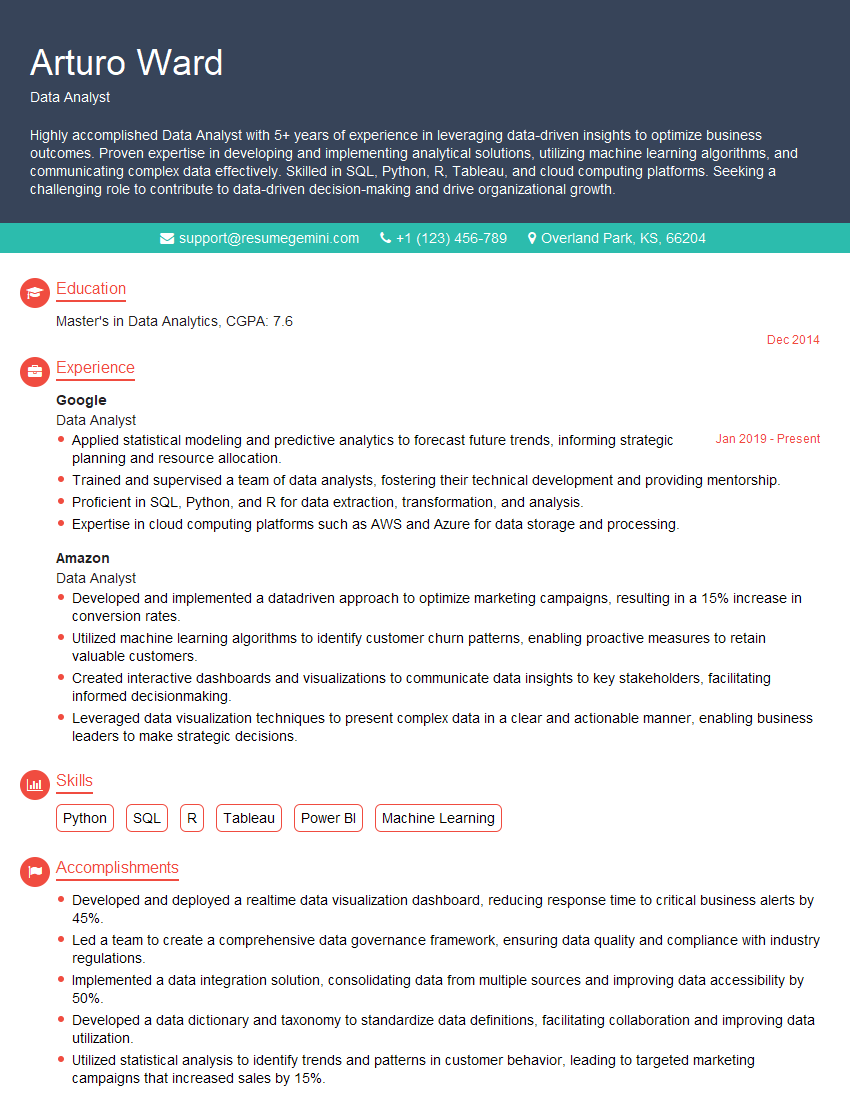
Data Analyst Resume Sample
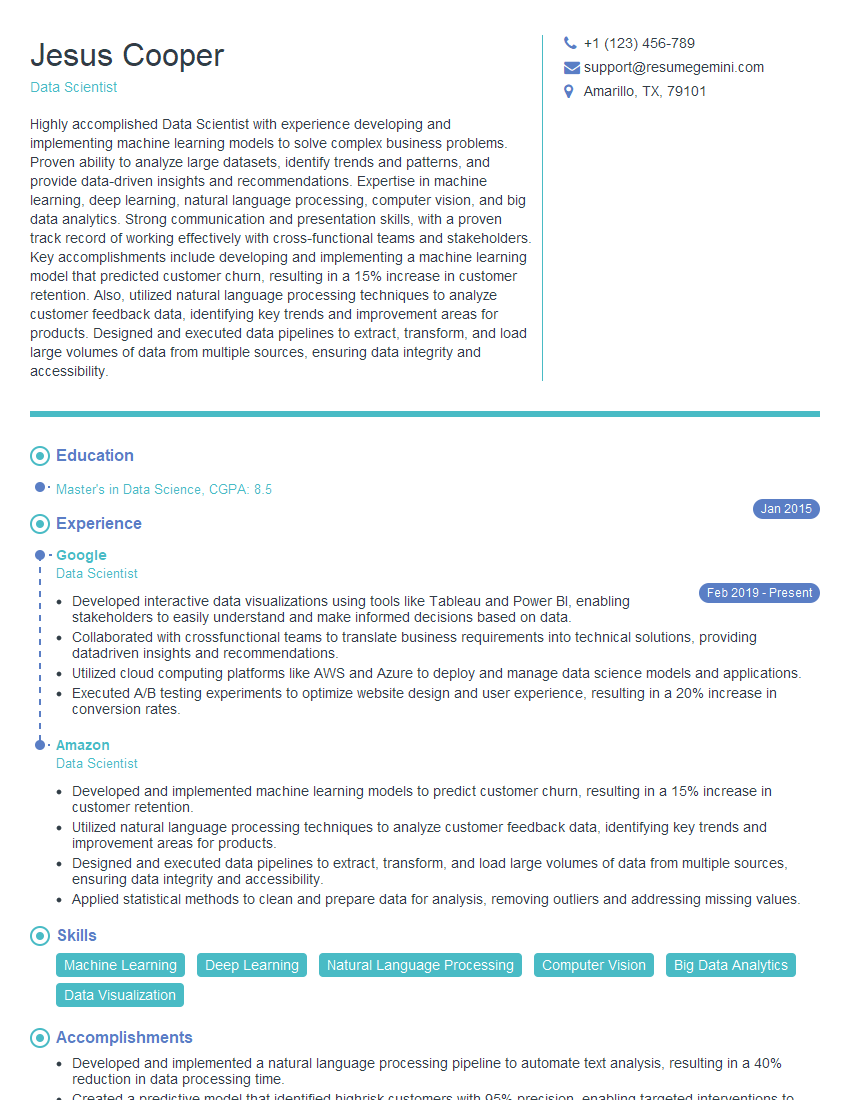
Data Scientist Resume Sample
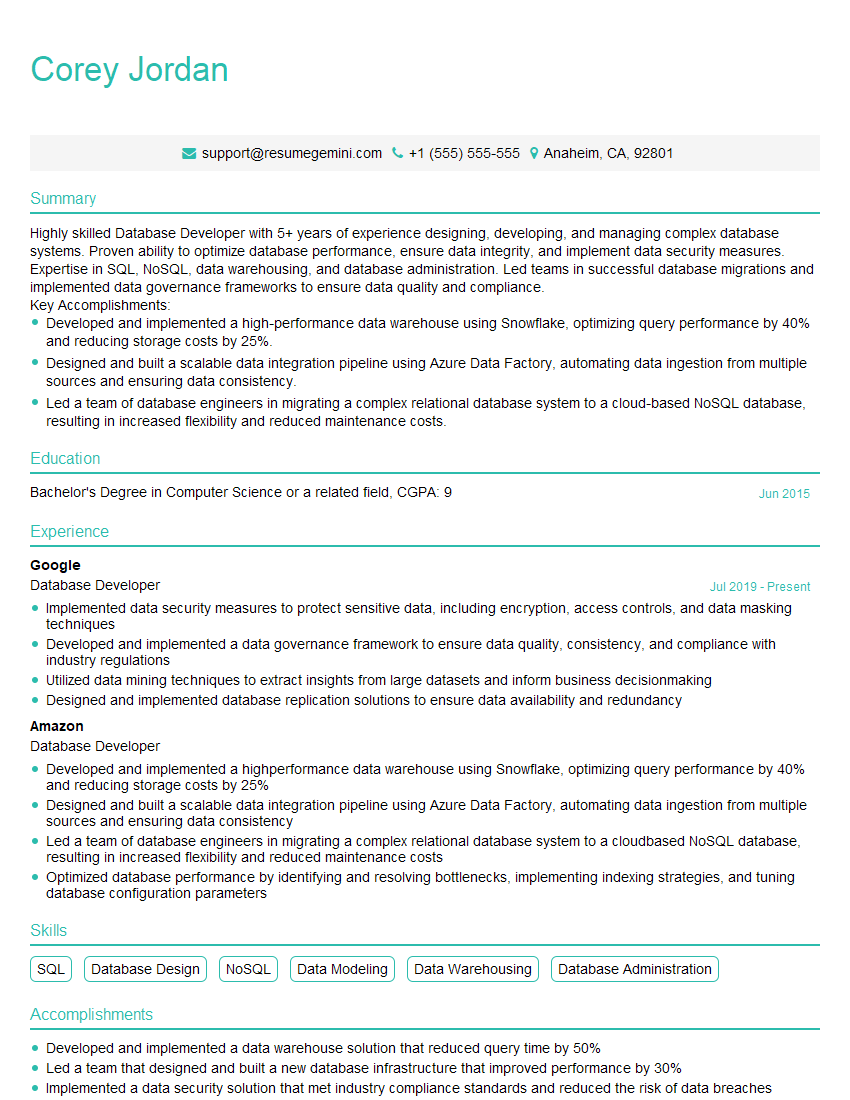
Database Developer Resume Sample
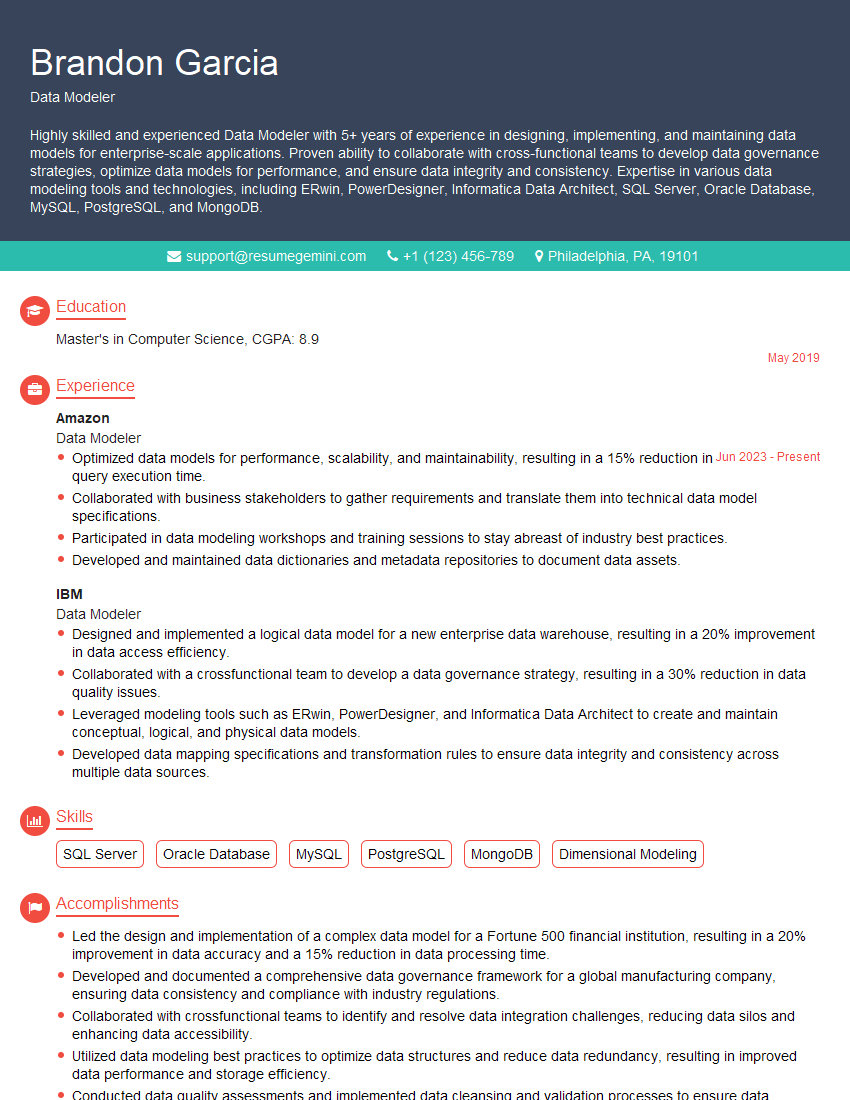
Data Modeler Resume Sample
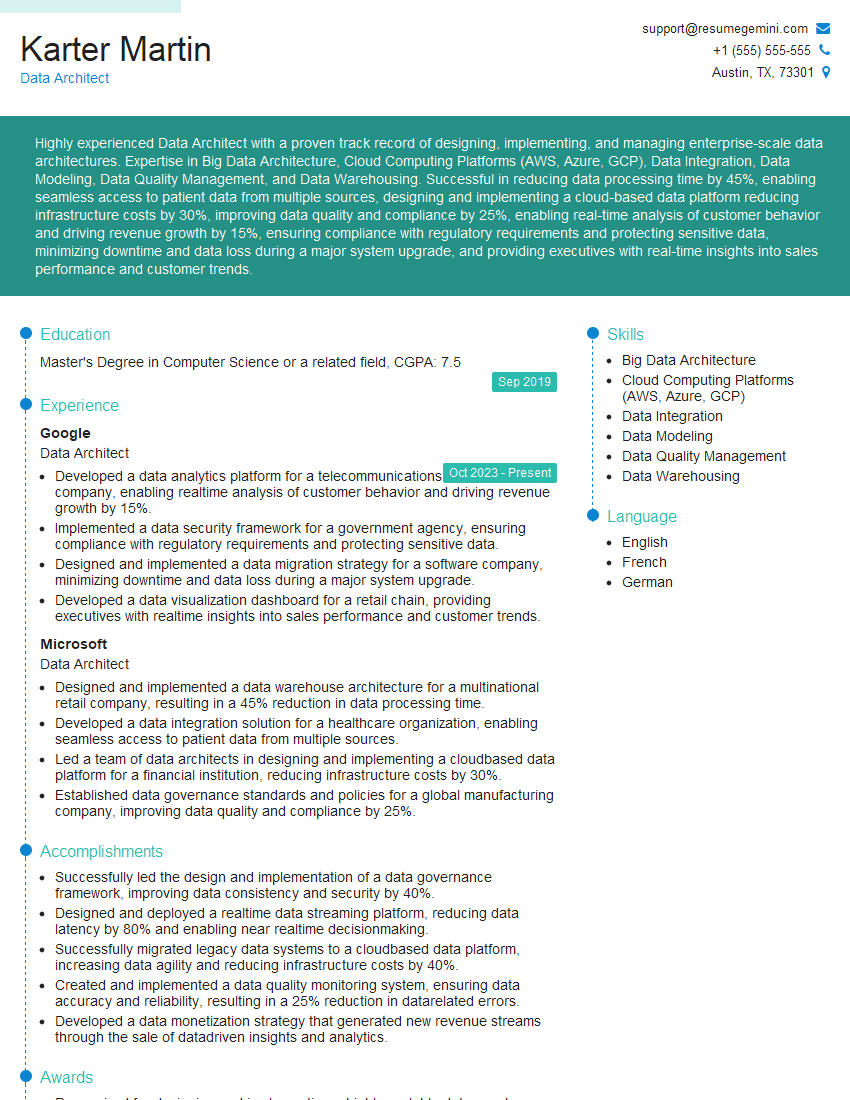
Data Architect Resume Sample
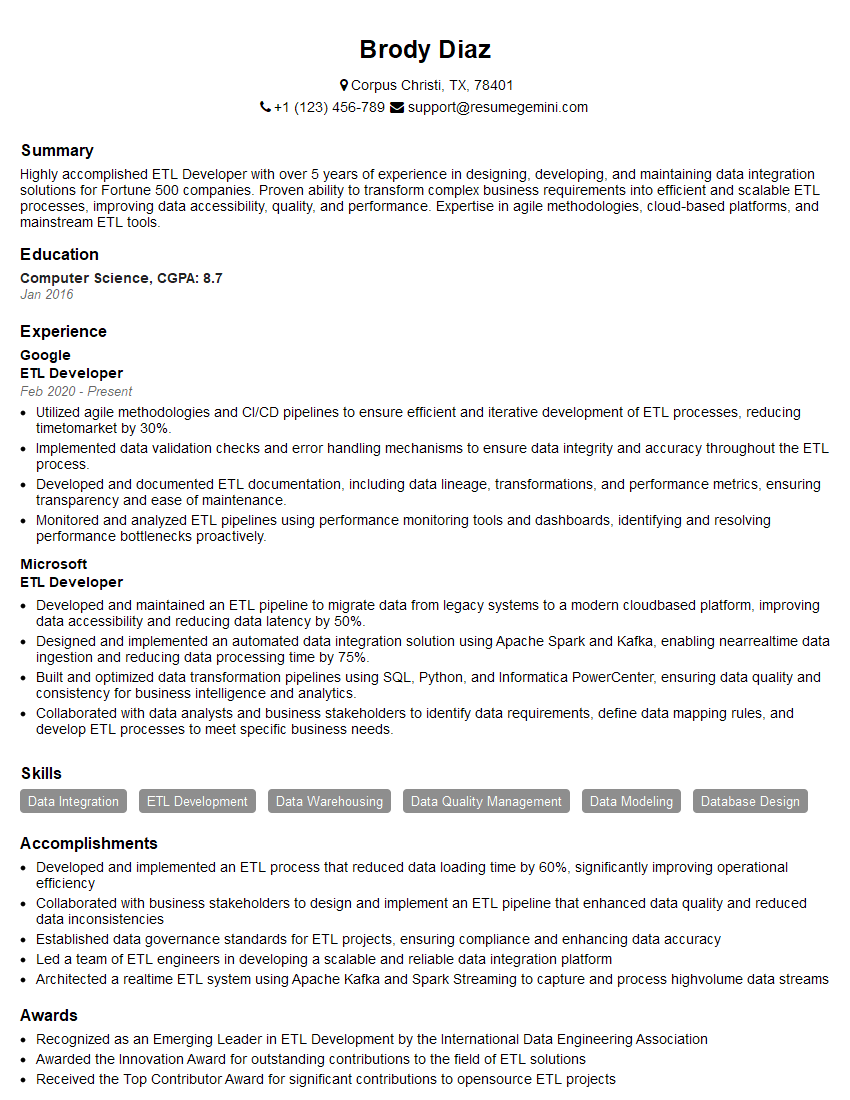
ETL Developer Resume Sample
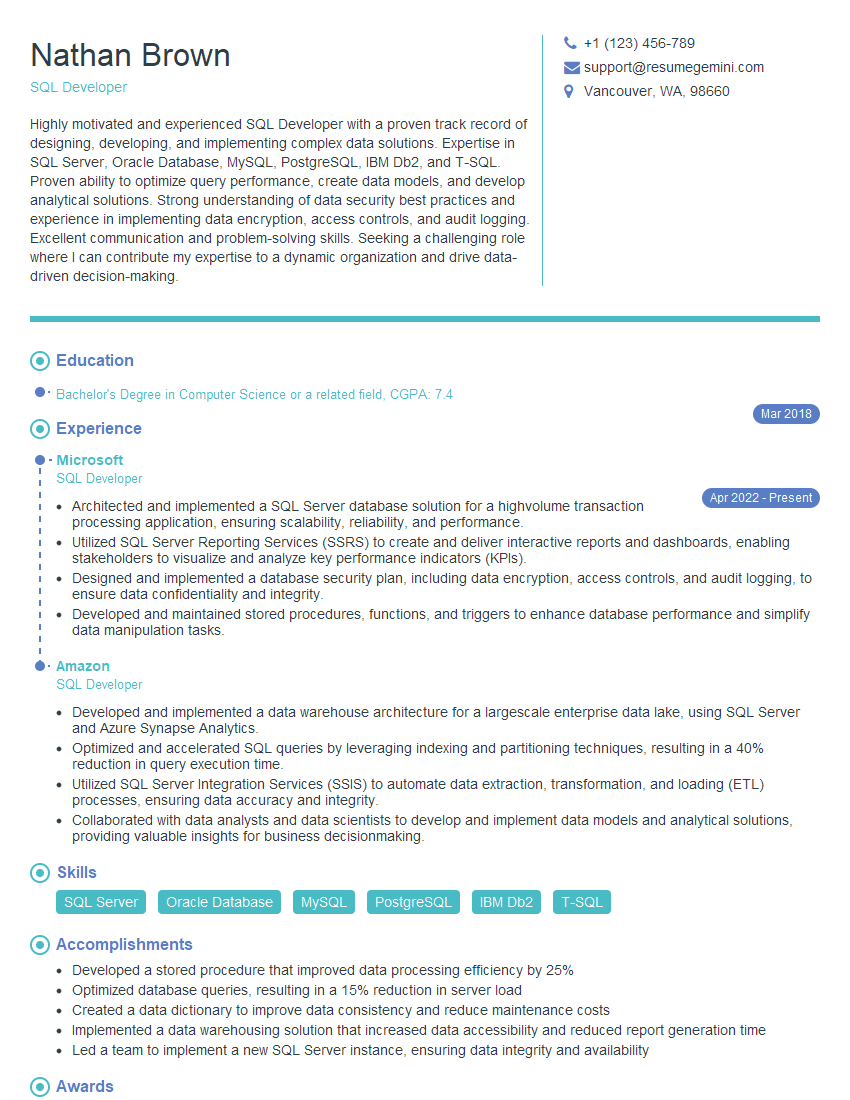
SQL Developer Resume Sample
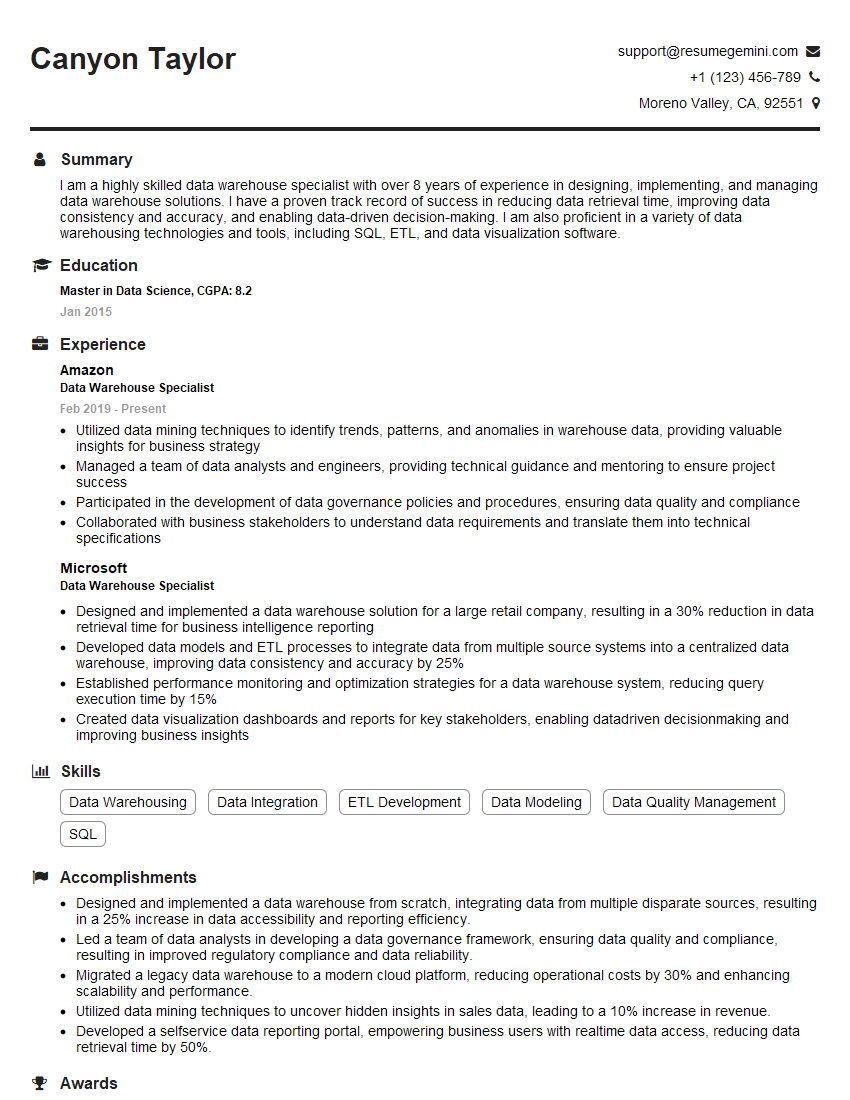
Data Warehouse Specialist Resume Sample
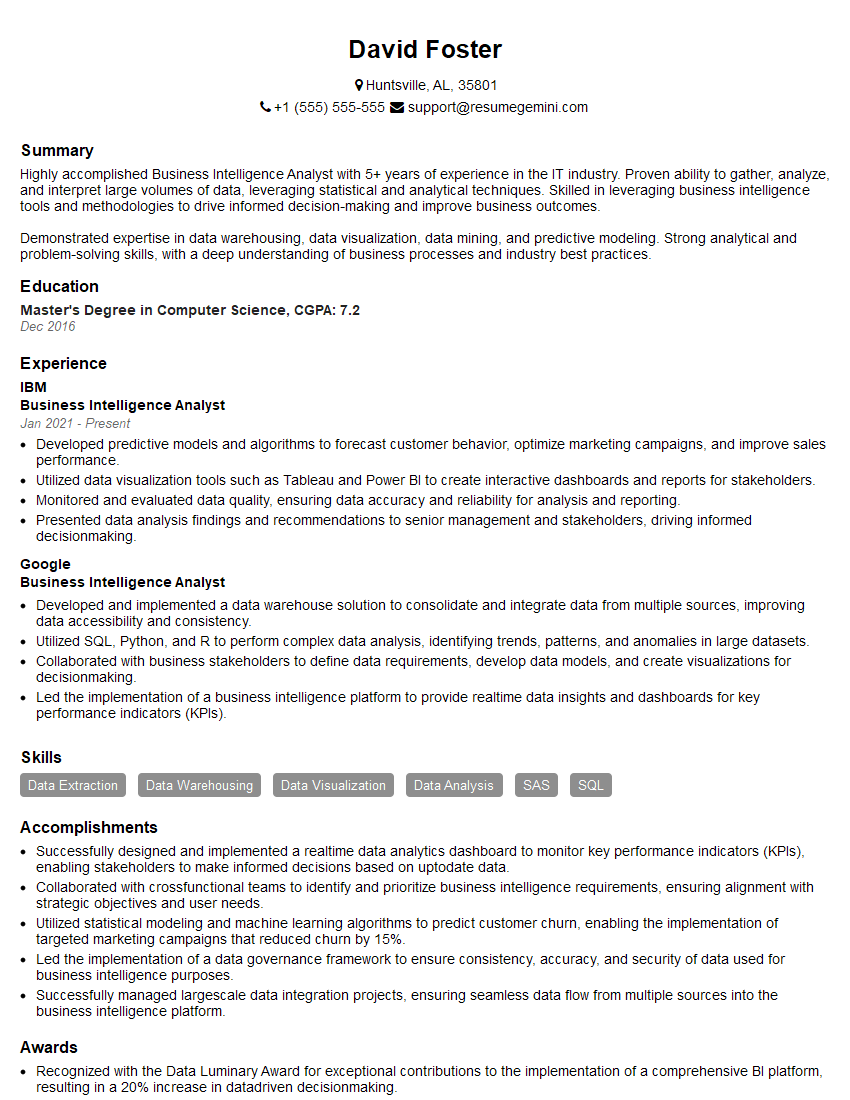
Business Intelligence Analyst Resume Sample
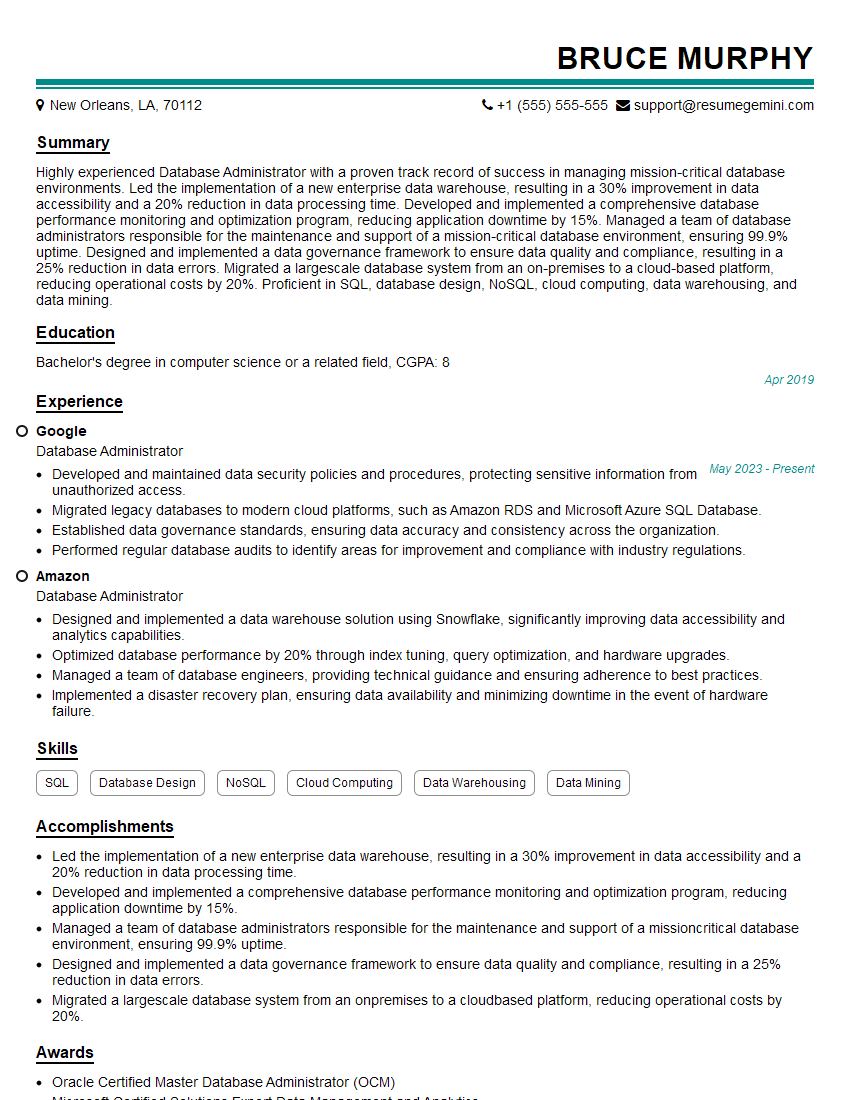
Database Administrator Resume Sample
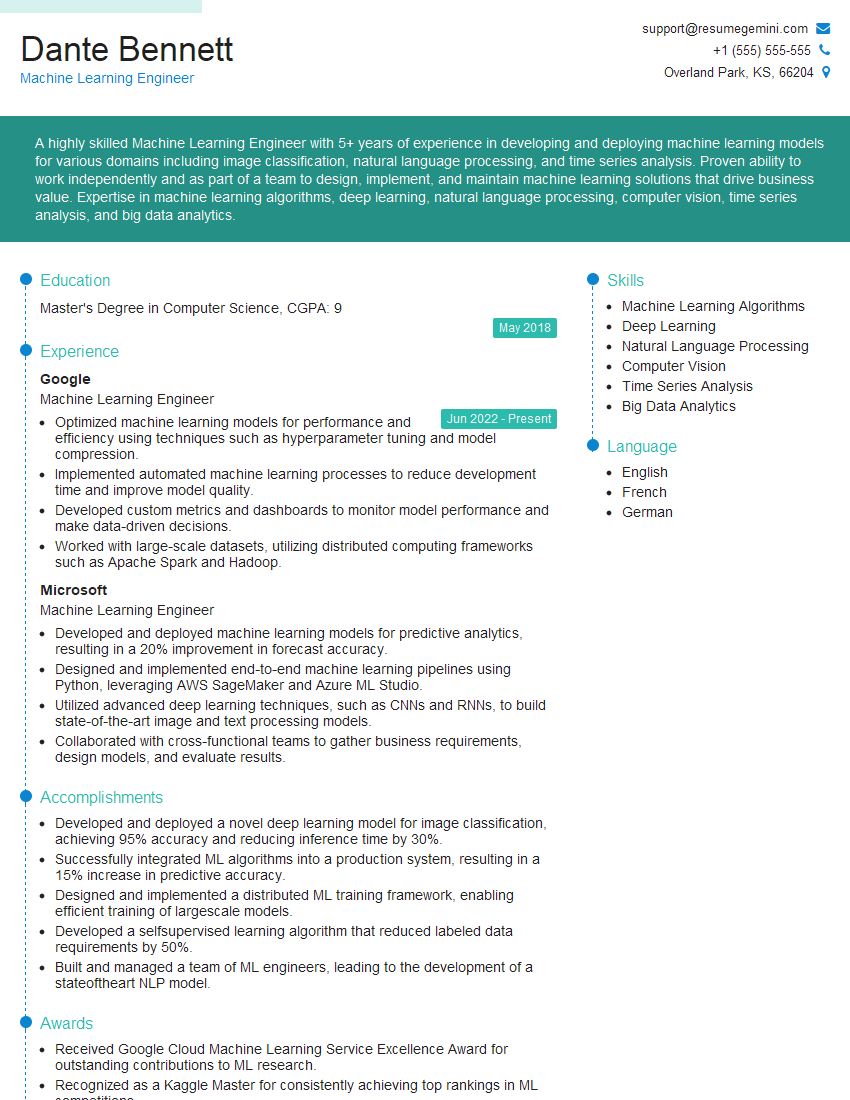
Machine Learning Engineer Resume Sample
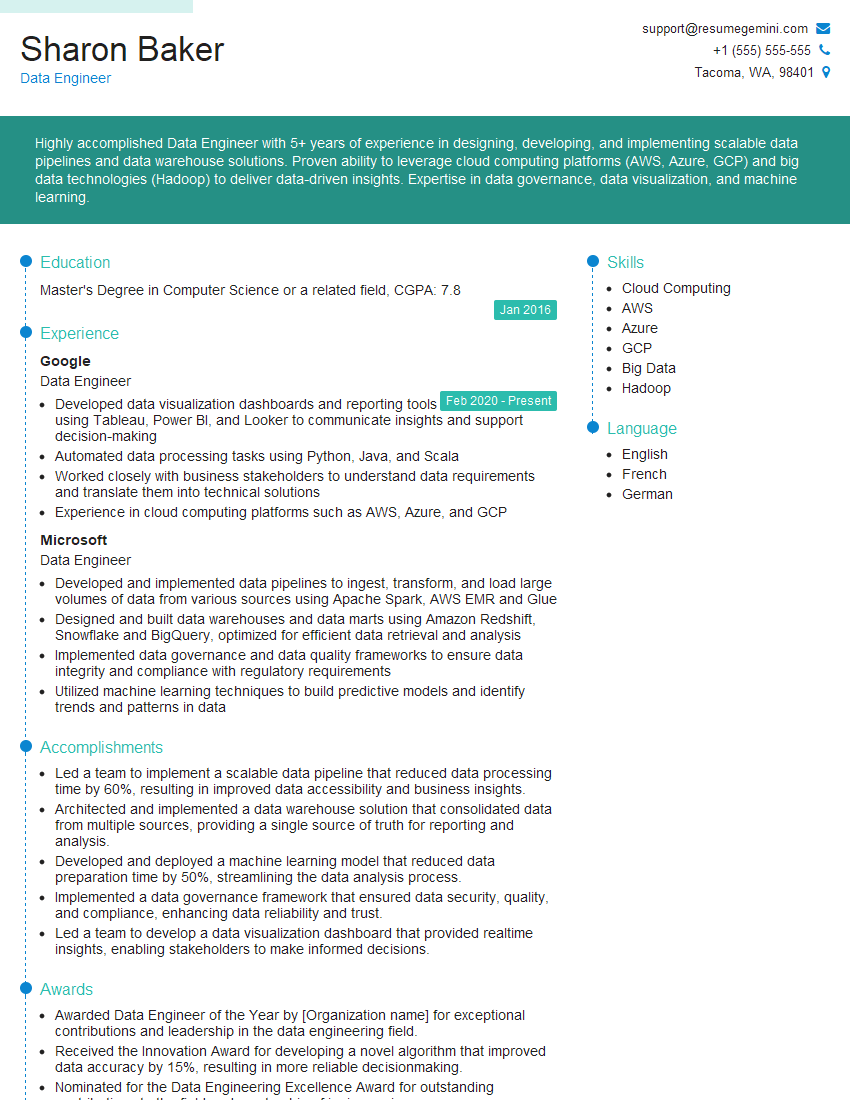
Data Engineer Resume Sample
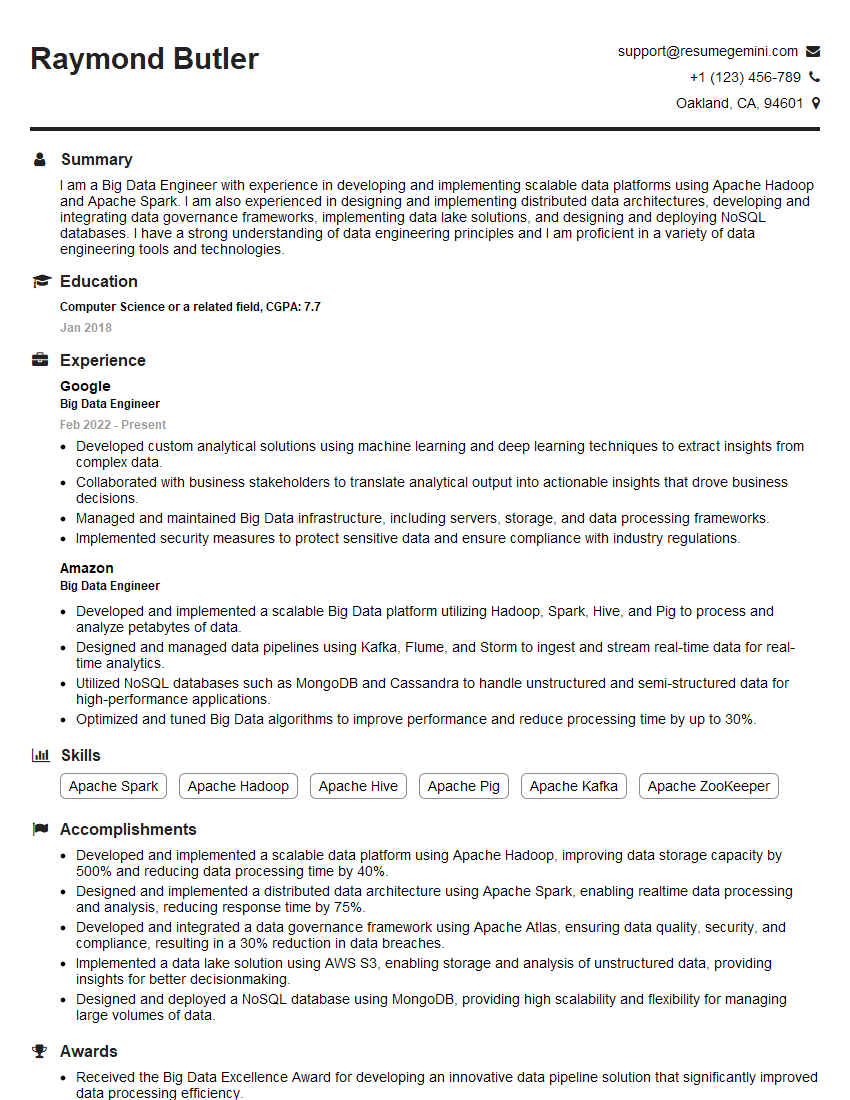
Big Data Engineer Resume Sample
Explore more articles
Users Rating of Our Blogs
Share Your Experience
We value your feedback! Please rate our content and share your thoughts (optional).
What Readers Say About Our Blog
Really detailed insights and content, thank you for writing this detailed article.
IT gave me an insight and words to use and be able to think of examples