Cracking a skill-specific interview, like one for Flight test planning and execution, requires understanding the nuances of the role. In this blog, we present the questions you’re most likely to encounter, along with insights into how to answer them effectively. Let’s ensure you’re ready to make a strong impression.
Questions Asked in Flight test planning and execution Interview
Q 1. Describe the flight test planning process.
Flight test planning is a meticulous process that ensures a safe and efficient test campaign. It’s like meticulously planning a complex expedition – you need to know your destination (test objectives), the terrain (aircraft capabilities and limitations), and the resources (personnel, equipment, budget). The process typically starts with defining clear objectives, which dictate the scope and duration of the test program. This is followed by the development of a comprehensive test plan outlining the test procedures, instrumentation requirements, data acquisition strategy, and safety procedures. A critical component is risk assessment and mitigation planning, which is crucial for identifying and addressing potential hazards.
- Defining Test Objectives: What specific performance characteristics need to be evaluated? Examples include stall speed, climb rate, handling qualities, or system functionality.
- Developing a Test Plan: This document outlines each test point, the procedures to be followed, expected results, and contingency plans.
- Resource Allocation: This includes budgeting for personnel (pilots, engineers, technicians), equipment (sensors, data acquisition systems), and facilities.
- Risk Assessment and Mitigation: Identifying potential hazards (e.g., engine failure, loss of control) and developing strategies to minimize the likelihood or impact of these risks.
- Test Readiness Review: A formal meeting to review the test plan, assess readiness, and obtain approval before commencing flight testing.
Q 2. What are the key stages of flight test execution?
Flight test execution is a dynamic process that involves several key stages. Think of it as a relay race, where each team member (stage) plays a crucial role in successfully completing the overall objective.
- Pre-flight Preparations: This includes thorough aircraft inspection, instrumentation checks, and briefing of the flight crew and ground support team. It’s like preparing a spaceship for launch – every detail matters.
- Flight Execution: This is where the test maneuvers are performed according to the plan. The pilot meticulously executes the pre-defined test points, while the flight test engineers monitor the data acquisition system. This is the ‘launch’ phase.
- Data Acquisition: Specialized sensors and data acquisition systems continuously record numerous parameters, such as airspeed, altitude, acceleration, engine parameters, etc. This is the data collection phase.
- Post-flight Analysis: Once the flight is completed, engineers download, process, and analyze the recorded data to evaluate the aircraft performance against the test objectives. This is the ‘data analysis’ phase, crucial to determine success or areas needing further testing.
- Reporting: A formal report is generated summarizing the flight test results, any anomalies encountered, and recommendations for further testing or design modifications. The results are communicated to relevant stakeholders, much like a mission debrief.
Q 3. Explain the importance of risk assessment in flight test planning.
Risk assessment is paramount in flight test planning. It’s akin to preparing for a mountain climb – you wouldn’t attempt Everest without assessing the potential hazards (weather, terrain, altitude sickness). A comprehensive risk assessment identifies potential hazards associated with the test program, such as:
- Aircraft-related risks: Engine failure, structural failure, control system malfunction.
- Environmental risks: Adverse weather conditions (e.g., turbulence, icing), high altitude operation.
- Human factors risks: Pilot error, inadequate training, communication breakdown.
For each identified hazard, the likelihood and severity are evaluated. Then, mitigation strategies are implemented to reduce the risk, such as implementing redundant systems, developing emergency procedures, or providing additional pilot training. The goal isn’t to eliminate risk entirely (that’s impossible), but to manage it to an acceptable level.
Q 4. How do you manage unforeseen issues during flight testing?
Unforeseen issues are inevitable in flight testing. The key is to have robust contingency plans. Imagine a film production – unexpected weather could derail the shoot. Similarly, we have well-defined protocols. If a problem arises, the first priority is safety. The flight crew will execute the appropriate emergency procedures. Simultaneously, the ground support team will assess the situation and communicate with the flight crew to determine the best course of action. This might involve aborting the flight, modifying the test plan, or implementing alternative procedures. Post-flight analysis will thoroughly investigate the incident to understand its root cause and prevent recurrence. A comprehensive debriefing with all personnel involved is essential for documenting the issue, identifying lessons learned, and refining procedures.
Q 5. What are the different types of flight test instrumentation?
Flight test instrumentation is crucial for collecting accurate data during the tests. Think of it as a doctor’s toolkit – different instruments measure different vital signs. The types of instrumentation used depend on the specific test objectives. Common types include:
- Pressure transducers: Measure airspeed, altitude, and pressure.
- Accelerometers: Measure acceleration and g-forces.
- Rate gyros: Measure angular rates (pitch, roll, yaw).
- Temperature sensors: Measure temperatures in various parts of the aircraft.
- Strain gauges: Measure stresses and strains in structural components.
- GPS receivers: Provide precise position and velocity data.
- Engine parameters sensors: Measure engine speed, thrust, fuel flow, and temperature.
Data is usually recorded using a sophisticated data acquisition system (DAS) which multiplexes the signals from different sensors and transmits them to a ground station for later analysis.
Q 6. Describe your experience with data acquisition and analysis in flight testing.
My experience with data acquisition and analysis in flight testing spans many years and involves various aircraft types. I’m proficient in using several DAS (Data Acquisition Systems) such as Honeywell's DAS and National Instruments' systems. I’m involved in every aspect from sensor calibration and pre-flight checks to data processing and analysis using specialized software, such as MATLAB and LabVIEW. Data processing involves filtering, noise reduction, and unit conversion. We utilize statistical methods to determine the accuracy of the measurements and to evaluate trends within the data. I’ve also developed custom algorithms for specific analysis tasks. A recent project involved analyzing flight data to optimize the aircraft’s flight control system leading to significant improvement in handling qualities.
Q 7. How do you ensure the safety of flight test personnel and assets?
Safety is the absolute top priority in flight testing. It’s like climbing a mountain – safety protocols are paramount. We implement numerous measures to ensure the safety of personnel and assets:
- Comprehensive risk assessment and mitigation: As previously discussed, this involves identifying and addressing potential hazards.
- Emergency procedures: Developing and practicing emergency procedures for various scenarios (e.g., engine failure, loss of control).
- Pilot training: Pilots receive extensive training on the aircraft and the test procedures.
- Ground support team: A well-trained and equipped ground support team monitors the flight and provides support.
- Flight safety review boards: Formal reviews of the test plan and flight safety procedures are conducted.
- Emergency response plan: A comprehensive emergency response plan is in place to handle unforeseen events.
- Regular maintenance and inspections: The aircraft undergoes thorough maintenance and inspections before each flight.
Adherence to stringent safety regulations and best practices are strictly followed. We continuously strive for improvement in safety protocols through lessons learned from past experiences and industry best practices. Regular training and safety briefings ensure every team member is aware of and understands their responsibilities.
Q 8. What are some common flight test anomalies and how are they handled?
Flight test anomalies are unexpected events or behaviors during a test flight that deviate from the planned parameters. These can range from minor issues to major safety concerns. Handling them effectively requires a calm, methodical approach, prioritizing safety above all else.
- Example 1: Unexpected High Vibration: If excessive vibration is detected, the pilot might immediately reduce power and return to base. Post-flight investigation could involve detailed analysis of sensor data, inspections of the aircraft structure, and possibly even wind tunnel testing to pinpoint the source.
- Example 2: System Malfunction: A malfunctioning flight control system might trigger an automated shutdown or require the pilot to take manual control. This necessitates a thorough investigation into the system’s electronics, hydraulics, or software, potentially leading to design modifications and retesting.
- Example 3: Unforeseen Weather: Encountering unexpected severe weather might necessitate aborting the test and returning to base. This highlights the importance of thorough pre-flight weather briefings and contingency planning.
The handling process typically involves immediate action to ensure safety (e.g., aborting the flight, deploying emergency systems), followed by a detailed investigation to determine the root cause, implement corrective actions, and update the test plan if necessary.
Q 9. Explain your experience with flight test reports and documentation.
My experience with flight test reports and documentation is extensive. I’ve been involved in every stage, from initial report planning and template creation to data analysis, report writing, and archiving. I understand the importance of clear, concise, and accurate documentation that adheres to industry standards and regulatory requirements.
I’ve worked with various report formats, including those required by regulatory bodies like the FAA (Federal Aviation Administration) or EASA (European Union Aviation Safety Agency). This includes generating reports that incorporate raw data, processed data (e.g., graphs, charts), analysis of flight test data, and conclusions drawn from the data and any observed anomalies. I am proficient in using specialized software for data acquisition, processing, and visualization.
One key aspect I emphasize is traceability – ensuring that all data points back to the raw measurement source. This ensures the integrity and replicability of our findings. I’ve successfully managed large volumes of data, ensuring effective organization and version control to maintain the integrity of the documentation throughout the lifecycle of the project.
Q 10. How do you ensure compliance with regulations during flight testing?
Ensuring compliance with regulations during flight testing is paramount. It involves a multi-faceted approach that begins even before the first flight.
- Pre-flight Planning and Approvals: This involves meticulous planning, obtaining necessary permits and approvals from regulatory bodies, and ensuring that all test procedures comply with relevant regulations (e.g., FAA regulations, Airworthiness Directives).
- Safety Protocols: Strict adherence to safety protocols, including emergency procedures, communication protocols, and pilot training, is crucial. Regular safety reviews and audits are conducted to identify potential hazards and mitigate risks.
- Data Integrity: Ensuring the integrity and accuracy of all collected data is critical for compliance. This involves calibrating instruments, using appropriate data acquisition systems, and adhering to data management protocols.
- Post-flight Reporting: Detailed post-flight reports must be meticulously documented and submitted to regulatory bodies as required. These reports summarize the test flights, highlight any deviations from the plan, and address any anomalies discovered during testing.
Non-compliance can result in significant penalties, delays, and even grounding of aircraft. I always ensure that our procedures are legally sound and are executed flawlessly, preventing any potential conflicts with regulatory requirements.
Q 11. Describe your experience with flight test simulations.
My experience with flight test simulations is extensive, ranging from using high-fidelity simulators for pilot training to using software-in-the-loop simulations for validating control laws and other aircraft systems. These simulations play a crucial role in reducing the risk and cost associated with flight testing.
I’ve utilized various simulation tools and techniques, from basic flight mechanics models to sophisticated six-degree-of-freedom simulations that incorporate environmental effects (wind, turbulence) and detailed aircraft models. These simulations allow us to test different flight scenarios, analyze aircraft performance, and evaluate the effectiveness of control systems – all before the aircraft even takes to the skies. For instance, I once used a high-fidelity simulator to replicate a challenging landing scenario, allowing our pilots to practice and perfect their approach before the actual flight test.
By using simulations, we can identify potential problems early in the development cycle, reducing costly modifications during physical flight testing and enhancing safety by allowing pilots to practice critical maneuvers in a safe environment.
Q 12. What are the key performance indicators (KPIs) for a successful flight test program?
Key Performance Indicators (KPIs) for a successful flight test program are multifaceted and focus on safety, efficiency, and achieving the test objectives. Some critical KPIs include:
- Safety: Zero serious incidents or accidents during the testing phase.
- On-time completion: Meeting the planned schedule and delivering results within the allocated timeframe.
- Within-budget execution: Managing resources effectively and staying within the designated budget constraints.
- Data Quality: High-quality, accurate, and reliable data gathered during the test flights.
- Test Objective Achievement: Successfully completing all planned test points and achieving the program objectives.
- Regulatory Compliance: Adhering to all applicable regulations and standards throughout the testing process.
Regular monitoring of these KPIs allows for proactive adjustments to the test plan, ensuring the overall success and efficiency of the program. For example, if data quality is consistently poor, we might revisit our data acquisition techniques or invest in higher-quality equipment.
Q 13. How do you manage a flight test budget and schedule?
Managing a flight test budget and schedule requires meticulous planning and robust tracking systems. I employ a multi-step approach:
- Detailed Budget Planning: Creating a comprehensive budget that includes all aspects of the flight test program, such as personnel costs, aircraft rental, instrumentation, data analysis, travel, and contingency funds.
- Schedule Development: Developing a realistic schedule that accounts for all testing phases, potential delays, and weather contingencies. This includes defining clear milestones and assigning responsibilities.
- Regular Monitoring and Reporting: Closely monitoring the actual expenditure against the budget and tracking progress against the schedule. Regular reports are generated to highlight any variances and potential issues.
- Risk Management: Identifying and mitigating potential risks that could impact the budget or schedule. This involves developing contingency plans for unforeseen events, such as equipment failure or unfavorable weather conditions.
- Resource Allocation: Effectively allocating resources (personnel, equipment, facilities) to maximize efficiency and minimize costs.
Effective budget and schedule management is crucial for the success of any flight test program. Using project management software and regular review meetings ensures we stay on track and address any challenges promptly.
Q 14. What are your experiences with different flight test methodologies?
My experience encompasses various flight test methodologies, each with its strengths and weaknesses depending on the specific aircraft, objectives, and resources.
- Developmental Flight Testing: This is iterative, focusing on gradually expanding the flight envelope and verifying the aircraft’s performance against design specifications. It often includes incremental testing of systems and subsystems.
- Acceptance Flight Testing: This verifies that the aircraft meets all the defined acceptance criteria before delivery to the customer or service entry. It’s more focused and targeted than developmental testing.
- Certification Flight Testing: This is a rigorous process demonstrating compliance with airworthiness regulations to obtain certification from regulatory bodies like the FAA or EASA. It involves rigorous documentation and testing to ensure safety and reliability.
- Operational Flight Testing: This focuses on evaluating the aircraft’s performance in its intended operational environment. It might involve testing the aircraft in diverse conditions, examining its handling qualities under operational stress, and evaluating the logistics of maintenance.
Selecting the appropriate methodology requires careful consideration of the aircraft’s maturity level, regulatory requirements, and overall program goals. For example, a newly designed aircraft will require a more extensive developmental flight test program, whereas an already certified aircraft undergoing minor modifications might necessitate a more concise acceptance flight test program.
Q 15. How do you communicate effectively with pilots and engineers during flight testing?
Effective communication during flight testing is paramount for a successful mission. It’s a multi-faceted process involving clear, concise messaging tailored to the audience. With pilots, I focus on direct, unambiguous instructions regarding flight maneuvers and data acquisition. This means pre-flight briefings outlining the test objectives, procedures, and potential risks. During the flight, communication relies on precise terminology, avoiding jargon, and providing regular updates on test progress and any anomalies. Post-flight, debriefings are crucial for gathering pilot feedback on aircraft handling, system performance, and any unexpected occurrences. With engineers, my communication emphasizes technical details, sharing raw data, preliminary analysis, and problem-solving discussions. This could involve presenting data visualizations, explaining test results, and collaboratively identifying areas needing further investigation. I always prioritize active listening, ensuring everyone feels heard and understood.
For instance, during a recent test involving a new autopilot system, I had to clearly explain to the pilot the specific flight profile and the critical data points needed. Post-flight, I engaged with the engineers, presenting the flight data and working with them to analyze discrepancies between expected and observed performance.
Career Expert Tips:
- Ace those interviews! Prepare effectively by reviewing the Top 50 Most Common Interview Questions on ResumeGemini.
- Navigate your job search with confidence! Explore a wide range of Career Tips on ResumeGemini. Learn about common challenges and recommendations to overcome them.
- Craft the perfect resume! Master the Art of Resume Writing with ResumeGemini’s guide. Showcase your unique qualifications and achievements effectively.
- Don’t miss out on holiday savings! Build your dream resume with ResumeGemini’s ATS optimized templates.
Q 16. Describe a time when you had to troubleshoot a technical problem during flight testing.
During a high-altitude test of a new sensor system, we encountered an unexpected data dropout after reaching a certain altitude. Initially, we suspected a sensor malfunction. However, after reviewing telemetry data from multiple sources, we discovered a correlation between the data dropouts and the aircraft exceeding a certain airspeed. The problem wasn’t the sensor itself, but a software limitation in its data acquisition and processing module that wasn’t handling high dynamic pressure correctly.
Our troubleshooting involved a systematic approach. First, we reviewed the flight parameters and compared them against expected values. This led to identifying the correlation with airspeed. Second, we examined the sensor’s raw data to verify its integrity prior to the data processing step. Lastly, we collaborated with the software engineers to analyze the code responsible for data acquisition and handling at higher speeds. The solution was a software update that increased the sampling rate and improved buffering capacity to handle the higher data influx at those speeds. This experience highlighted the importance of multi-disciplinary teamwork and a thorough, data-driven approach to troubleshooting.
Q 17. What software and tools are you proficient in for flight test data analysis?
My proficiency in flight test data analysis spans a variety of software and tools. I’m expert in using MATLAB for data processing, signal analysis, and visualization. For larger datasets and collaborative analysis, I utilize Python with libraries like Pandas, NumPy, and SciPy for statistical analysis and data manipulation. I’m also proficient in using specialized flight test analysis software like Flight Test Engineering (FTE) and similar industry-standard tools. Furthermore, I have experience with database management systems (DBMS) like SQL for storing, querying, and retrieving large volumes of flight test data. My tools extend beyond software to include specialized hardware like oscilloscopes and data acquisition units for on-site data validation and troubleshooting.
For example, I often use MATLAB to generate plots to visually compare different flight test parameters, such as airspeed and angle of attack, to identify trends and anomalies. Then, I’ll use Python to run statistical analysis to find out the reliability of the test data and eliminate outliers from the data sets before preparing the final report.
Q 18. How do you manage stakeholder expectations during flight testing?
Managing stakeholder expectations in flight testing requires proactive communication and transparent reporting. It begins with clearly defining objectives, timelines, and potential risks at the project’s outset. Regular updates, using a combination of formal presentations and informal communication channels, are essential. These updates should highlight progress, milestones achieved, challenges encountered, and potential impact on the schedule or budget. I create realistic expectations by emphasizing the iterative nature of flight testing and acknowledging the possibility of unexpected issues and delays. Visual aids like Gantt charts, progress reports, and data visualizations are extremely useful for illustrating progress and managing expectations. Addressing concerns promptly and transparently builds trust and enhances stakeholder confidence. Active listening and feedback mechanisms are critical for ensuring that concerns are addressed and expectations are managed effectively.
For example, during a recent project, I used a project management tool to track progress and provide weekly updates to stakeholders. This transparency allowed them to manage their expectations proactively and understand the testing progress before any delays happened.
Q 19. What is your experience with flight test data reduction and reporting?
My experience in flight test data reduction and reporting encompasses the entire process, from raw data acquisition to the generation of concise, informative reports. This involves calibrating sensor data, applying corrections for environmental factors, filtering noise, and extracting relevant parameters. I’m experienced in using statistical methods to analyze data and identify trends and outliers. The goal is to transform raw data into meaningful information that supports conclusions and recommendations. Data visualization plays a crucial role, using charts, graphs, and tables to present complex data in a clear and understandable way. Final reports should not just present data, they should also interpret the findings, highlight any anomalies, draw conclusions, and suggest further testing or modifications as needed. Quality assurance is integrated throughout the process, ensuring data accuracy and report integrity. I ensure data traceability and maintain clear documentation of all processing steps.
Q 20. Describe your understanding of flight envelope protection.
Flight envelope protection is a critical aspect of flight testing, referring to the procedures and systems in place to prevent exceeding the aircraft’s operational limits. This involves understanding the aircraft’s certified flight envelope – its boundaries of safe operation in terms of speed, altitude, angle of attack, load factor, and other relevant parameters. Flight envelope protection strategies include software and hardware limitations built into the aircraft itself (such as electronic flight envelope protection systems) as well as procedural limitations imposed through detailed test plans. The test plan will define limits and establish procedures to avoid going beyond these limits. Pilots are trained to recognize approaching limits and take corrective actions. Real-time monitoring of flight parameters is vital, with automated warnings triggered if an operational limit is approached. A critical component involves the use of safety pilots who constantly monitor and are ready to intervene if the aircraft’s operational limitations are in danger of being exceeded. These measures minimize the risk of exceeding operational limits and safeguard the aircraft and crew during flight testing.
Q 21. How do you ensure data integrity during flight testing?
Ensuring data integrity during flight testing is crucial for drawing valid conclusions. This involves a multi-layered approach starting from the data acquisition phase. Firstly, regular calibration of sensors and instrumentation is critical to maintaining accuracy. Secondly, data validation is performed in real-time during flight, checking for sensor anomalies, inconsistencies, or data dropouts. Thirdly, data is rigorously checked for errors after the flight by comparing different data sources and performing plausibility checks. Furthermore, a robust data management system with appropriate version control and metadata tracking is necessary to ensure traceability and prevent accidental modifications. Data security is also important, particularly for sensitive test data, employing encryption and access controls to prevent unauthorized modification or disclosure. This comprehensive approach builds confidence in the integrity of the data and supports accurate and reliable conclusions from the flight test program. Proper documentation, including test plans, calibration records, and data processing logs, is vital for maintaining a clear audit trail of the entire data handling process.
Q 22. What is your familiarity with different types of aircraft and their unique testing requirements?
My experience encompasses a wide range of aircraft, from small, single-engine propeller aircraft to large, complex jetliners and even unmanned aerial vehicles (UAVs). Each type presents unique challenges and necessitates a tailored testing approach. For instance, testing a small propeller aircraft might focus on basic flight characteristics and handling qualities, while testing a large jetliner would involve a far more extensive program encompassing high-speed flight, systems integration, and certification compliance. UAV testing often involves autonomous flight capabilities and specialized sensor integration. I’ve worked on projects involving both fixed-wing and rotary-wing aircraft, understanding the different aerodynamic considerations and flight control complexities involved. Specifically, I have experience with testing modifications on existing airframes which demands an understanding of the aircraft’s initial design and flight envelope.
- Small Propeller Aircraft: Focus on basic flight characteristics, handling qualities, and engine performance.
- Large Jetliners: Extensive testing including high-speed flight, systems integration, and certification compliance with regulations like FAA or EASA.
- UAVs: Autonomous flight capabilities, specialized sensor integration, and communication system testing.
Q 23. Describe your experience with test planning tools and software.
I’m proficient in several test planning tools and software, including specialized flight test management systems like TestPoint and FlightAware, as well as general-purpose project management software such as Microsoft Project and Jira. My expertise extends to using these tools to create detailed test plans, schedule flight tests, manage resources, and track progress. For example, I’ve utilized TestPoint to meticulously plan complex flight test campaigns, defining individual test points, assigning resources, and tracking the completion status of each test. This software facilitates integration with data acquisition systems, allowing real-time data monitoring and analysis during flight tests. Further, I’m familiar with utilizing spreadsheets and databases to manage and analyze large datasets generated during flight testing.
Beyond software, I’m adept at developing and utilizing custom scripts and tools in languages like Python for data processing and visualization, significantly enhancing the efficiency of post-flight analysis and reporting.
Q 24. How do you prioritize tasks during a busy flight test program?
Prioritizing tasks in a busy flight test program requires a structured approach. I typically employ a risk-based prioritization method, combining urgency and impact analysis. This involves identifying critical test objectives, potential risks, and their consequences. For instance, testing critical safety systems will often take precedence over less crucial aspects, even if the latter might seem more urgent in terms of schedule. I also consider resource availability, weather conditions, and regulatory deadlines when assigning priorities. I use tools like Gantt charts and critical path analysis to visualize dependencies and optimize the overall schedule. A clear communication plan to the team is paramount to keeping everyone informed of changes and priorities.
Think of it like a surgeon performing an operation; the most critical steps require immediate attention and precision, and the order of procedures is carefully planned to minimize risks.
Q 25. What’s your approach to resolving conflicts within the flight test team?
Conflict resolution within the flight test team is crucial for a successful program. My approach is based on open communication, active listening, and collaborative problem-solving. I encourage team members to openly express their concerns and perspectives. I facilitate constructive dialogue, focusing on finding common ground and mutually acceptable solutions. When necessary, I mediate discussions, ensuring all viewpoints are considered and a fair resolution is reached that aligns with the program’s overall objectives. I always prioritize maintaining strong working relationships within the team. Documenting decisions and rationale is crucial in case of future issues.
For example, a disagreement on a test procedure might be resolved by reviewing the test plan, relevant documentation and exploring alternative methods acceptable to everyone involved. Ultimately the aim is finding the most effective and safest method to achieve the program’s goals.
Q 26. Describe your experience with post-flight data analysis and reporting.
Post-flight data analysis and reporting is a critical component of the flight test process. My experience includes reviewing large datasets from various sensors, identifying anomalies, and generating comprehensive reports. This involves using specialized software for data reduction, filtering, and visualization. I’m proficient in creating various types of reports, including summary reports for management, detailed technical reports for engineers, and presentations for stakeholders. Data analysis may involve statistical methods, trend analysis, and comparison with predicted data. This enables us to validate design performance, identify areas for improvement, and make recommendations for future flight tests. For example, during a stall test, I’d analyze accelerometer data to determine the exact stall speed and compare it to the predicted value.
Software such as MATLAB and Python libraries like SciPy and NumPy are critical for efficient analysis. Clear and concise reporting, avoiding overly technical jargon is very important so the information is readily understood by all stakeholders.
Q 27. How do you identify and mitigate risks associated with specific flight test maneuvers?
Identifying and mitigating risks associated with flight test maneuvers is paramount. My approach involves a systematic risk assessment process, identifying potential hazards, analyzing their likelihood and severity, and implementing appropriate mitigation strategies. This involves reviewing the test plan, considering environmental factors, and assessing aircraft limitations. For example, during high-speed maneuvers, we would consider potential structural limitations, aerodynamic instability risks, and potential loss of control scenarios. Risk mitigation strategies may include modifying the test procedure, adding safety margins, or implementing emergency procedures. Detailed simulations and wind tunnel tests can also significantly enhance our understanding of aircraft behaviors under extreme conditions.
A structured HAZOP (Hazard and Operability Study) analysis is a valuable tool in this process, identifying potential issues proactively.
Q 28. What are your experiences with different types of flight test sensors and their applications?
I have extensive experience with a variety of flight test sensors and their applications. This ranges from standard sensors such as accelerometers, gyroscopes, and air data systems to more specialized equipment like GPS, radar altimeters, and various types of strain gauges. The choice of sensors heavily depends on the test objectives. For instance, testing handling qualities may require high-precision accelerometers, while evaluating engine performance might demand detailed measurements of fuel flow and exhaust gas temperature. I also understand how to integrate and calibrate these sensors to ensure accurate and reliable data collection. Moreover, I’m familiar with the limitations of each sensor and how to account for potential errors or biases in the data analysis process.
For instance, understanding the differences between different types of GPS sensors (e.g., single-frequency vs. dual-frequency) and their potential for error is critical for accurately interpreting the location data acquired during testing. Proper calibration and data validation are critical steps in ensuring the integrity of the data.
Key Topics to Learn for Flight Test Planning and Execution Interview
- Flight Test Objectives & Requirements Definition: Understanding how to translate high-level goals into specific, measurable, achievable, relevant, and time-bound (SMART) test objectives. This includes defining success criteria and risk mitigation strategies.
- Test Plan Development: Creating comprehensive test plans encompassing test scenarios, timelines, resource allocation (personnel, equipment, facilities), and safety considerations. Practical application includes developing detailed schedules and contingency plans.
- Data Acquisition and Management: Understanding various data acquisition systems and their integration, data quality control, and methods for data analysis and interpretation. This includes familiarity with different sensor technologies and data processing techniques.
- Flight Test Execution & Monitoring: Managing real-time aspects of the flight test, including communication protocols, monitoring flight parameters, and making informed decisions during flight operations based on real-time data.
- Risk Assessment and Mitigation: Identifying and evaluating potential hazards associated with flight testing, developing mitigation strategies, and ensuring compliance with safety regulations. This involves practical application of risk management frameworks.
- Post-Flight Analysis & Reporting: Analyzing collected data, drawing conclusions, generating comprehensive reports, and presenting findings to stakeholders. This involves proficiency in data visualization and effective communication of technical information.
- Flight Test Instrumentation and Sensors: Deep understanding of various sensors (accelerometers, pressure sensors, GPS, etc.) their capabilities, limitations and integration into the test aircraft.
- Regulatory Compliance: Familiarity with relevant aviation regulations and standards governing flight testing. Understanding certification processes and documentation requirements.
Next Steps
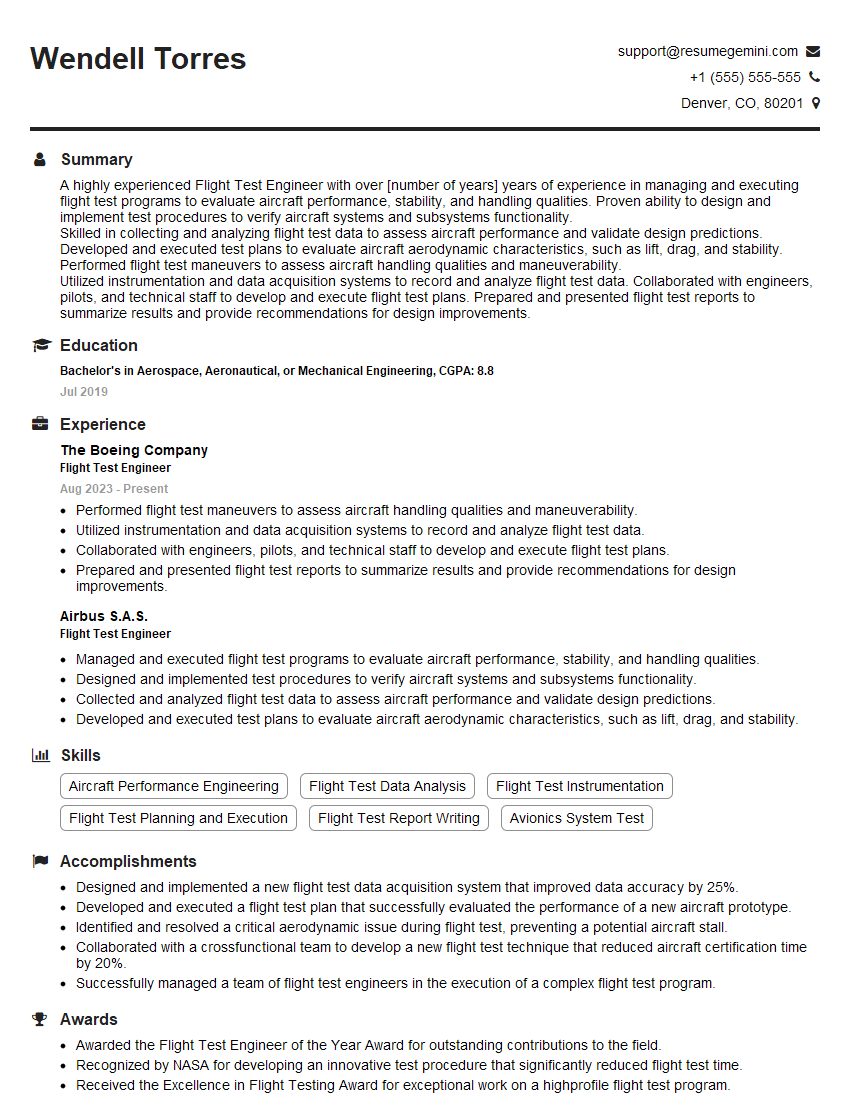
Mastering flight test planning and execution is crucial for career advancement in the aerospace industry, opening doors to leadership roles and specialized expertise. A strong resume is essential for showcasing your skills and experience to potential employers. Building an ATS-friendly resume significantly increases your chances of getting noticed. We strongly recommend using ResumeGemini to craft a compelling and effective resume. ResumeGemini offers a user-friendly platform and provides examples of resumes tailored to Flight Test Planning and Execution, helping you present your qualifications in the best possible light.
Explore more articles
Users Rating of Our Blogs
Share Your Experience
We value your feedback! Please rate our content and share your thoughts (optional).
What Readers Say About Our Blog
Really detailed insights and content, thank you for writing this detailed article.
IT gave me an insight and words to use and be able to think of examples