Feeling uncertain about what to expect in your upcoming interview? We’ve got you covered! This blog highlights the most important Flight Testing interview questions and provides actionable advice to help you stand out as the ideal candidate. Let’s pave the way for your success.
Questions Asked in Flight Testing Interview
Q 1. Explain the flight test phases and their objectives.
Flight testing is typically divided into distinct phases, each with specific objectives. Think of it like building a house – you wouldn’t put on the roof before the walls! These phases ensure a systematic approach to verifying aircraft performance and safety.
- Phase 1: First Flight and Initial Flight Testing: This phase focuses on verifying basic aircraft functionality – does it fly? Are the controls responsive? We check for basic stability and controllability. This is a crucial step, often involving short flights to assess basic systems.
- Phase 2: Envelop Expansion: Here, we systematically explore the aircraft’s operational limits. Think of it as pushing the boundaries safely, gradually increasing speed, altitude, and angles of attack to map the aircraft’s performance. We’re looking for unexpected behavior or limitations.
- Phase 3: Performance and Systems Testing: This phase delves into the detailed measurements of performance parameters like speed, rate of climb, fuel consumption, and the proper functioning of all onboard systems. This often involves extensive flight testing across a range of conditions.
- Phase 4: Special Missions Testing (if applicable): Depending on the aircraft’s purpose, this might include testing capabilities such as weapons delivery (for military aircraft) or specific payload handling (for cargo planes). This phase is tailored to the aircraft’s unique role.
- Phase 5: Certification Testing: This final phase involves rigorous testing to meet regulatory requirements for airworthiness certification. It is crucial for demonstrating that the aircraft is safe and meets all design specifications, leading to its approval for commercial operation.
Each phase builds upon the previous one, ensuring a comprehensive evaluation of the aircraft.
Q 2. Describe the different types of flight tests (e.g., functional, performance, handling qualities).
Flight testing encompasses various types, each addressing specific aircraft characteristics. It’s like getting a complete medical checkup – you’d test different systems individually.
- Functional Testing: This focuses on verifying the correct operation of individual systems like the flight controls, landing gear, engines, and avionics. Think of testing each component separately to ensure it works as designed.
- Performance Testing: This involves measuring key performance parameters such as maximum speed, rate of climb, range, and fuel consumption under various flight conditions. It’s like a stress test for the aircraft, pushing it to its limits to see its true capabilities.
- Handling Qualities Testing: This assesses how the aircraft responds to pilot inputs, focusing on its maneuverability, stability, and responsiveness. It’s like a driving test, evaluating how easy and safe the aircraft is to handle.
- Stability and Control Testing: This is a crucial subset of handling qualities, focusing on how well the aircraft maintains its attitude and trajectory with minimal pilot input. Think of it as assessing how well the aircraft naturally ‘flies’ itself.
- Aerodynamic Testing: This aims to understand the aircraft’s aerodynamic characteristics, like lift, drag, and moment coefficients, under different flight conditions. It’s the detailed study of how air interacts with the aircraft.
Q 3. What are the key performance parameters measured during flight testing?
Numerous parameters are meticulously measured during flight testing. It’s like taking vital signs for the aircraft.
- Airspeed: Measured using various sensors, this is crucial for performance calculations.
- Altitude: Determined using barometric and GPS sensors.
- Angle of Attack (AOA): The angle between the wing and the oncoming airflow, critical for understanding lift and drag.
- Rate of Climb/Descent: Indicates the aircraft’s vertical speed.
- Acceleration: Measures changes in speed.
- Engine Parameters: Thrust, fuel flow, temperature, and pressure are all monitored.
- Flight Control Positions: Measurements of the pilot’s inputs to the flight controls.
- Structural Loads: Measurements of stresses on the aircraft’s structure.
- Aerodynamic Coefficients: Calculated values representing the aircraft’s interaction with the air.
These parameters are essential for validating the aircraft’s design and performance against predictions.
Q 4. How do you ensure flight test safety?
Flight test safety is paramount – it’s the top priority. We utilize a multi-layered approach.
- Thorough Pre-flight Planning: This includes detailed risk assessments, contingency plans, and thorough checks of the aircraft and its systems. It’s like meticulously preparing for a challenging mountain climb.
- Experienced Flight Test Personnel: Highly skilled pilots, engineers, and flight test engineers form the team. They have years of experience and rigorous training.
- Emergency Procedures: Well-defined emergency procedures are in place, covering various potential scenarios, including engine failure and emergency landings.
- Communication Systems: Reliable communication is maintained throughout the flight, ensuring constant contact between the test aircraft and ground support.
- Data Monitoring: Real-time monitoring of flight parameters allows for immediate detection and response to any anomalies during the flight.
- Safety Equipment: The aircraft is equipped with redundant systems and safety devices, providing additional layers of protection.
Safety is not just a checklist, it’s a mindset ingrained in every aspect of flight testing.
Q 5. Explain the role of instrumentation in flight testing.
Instrumentation is the backbone of flight testing. It’s the eyes and ears of the test team, providing the crucial data needed for analysis.
Sensors are strategically placed throughout the aircraft to measure a wide range of parameters. Think of it as a network of highly specialized medical sensors on a patient.
- Pressure Sensors: Measure airspeed, altitude, and angle of attack.
- Accelerometers: Measure aircraft accelerations.
- Gyroscopes: Measure aircraft attitude (pitch, roll, yaw).
- Temperature Sensors: Monitor temperatures of various components.
- Strain Gauges: Measure structural loads.
- GPS Receivers: Provide precise position and velocity data.
This data is then recorded and processed to provide a detailed understanding of the aircraft’s performance and behavior.
Q 6. Describe your experience with flight test data acquisition systems.
My experience with flight test data acquisition systems (DAS) spans various platforms and technologies. I’ve worked with both analog and digital systems, from older, dedicated DAS units to modern, integrated systems using high-speed data buses. For example, I’ve extensively utilized systems based on the ARINC 429 standard for high-speed data transmission, and also worked with systems incorporating advanced signal conditioning and processing techniques to improve data quality. I am proficient in configuring, calibrating, and troubleshooting these systems. I have experience with various software tools for data visualization and analysis, including specialized flight test data analysis software. A key aspect of my experience is ensuring data integrity and traceability throughout the acquisition process – any data error can significantly impact the analysis.
One project involved integrating a new sensor suite into a legacy DAS, requiring careful consideration of data compatibility, timing, and signal integrity. This needed careful planning and testing to ensure smooth operation and accurate data collection.
Q 7. How do you analyze flight test data?
Flight test data analysis is a complex process, involving several stages. Think of it as solving a detective case using all available evidence.
- Data Validation: We first check for errors or inconsistencies in the data. This often involves comparing data from multiple sensors and checking for plausibility.
- Data Reduction and Processing: Raw data needs to be processed and converted into meaningful engineering units. Calibration and correction factors are applied to improve accuracy.
- Statistical Analysis: Statistical methods are used to analyze trends, identify outliers, and assess the significance of the results. This ensures findings are reliable.
- Correlation with Predictions: Flight test results are compared with pre-flight predictions (often derived from simulations) to identify discrepancies and validate the aircraft’s design.
- Report Generation: A comprehensive report is generated, summarizing the results, identifying any anomalies, and providing recommendations for design improvements or further testing. It’s like writing up the final report after completing the investigation.
Various software tools are used to facilitate this process, enabling visualization and in-depth analysis. Experience and knowledge of flight mechanics are crucial to interpret the data correctly and draw valid conclusions.
Q 8. What software tools are you proficient in for flight test data analysis?
My proficiency in flight test data analysis software spans several industry-standard tools. I’m highly experienced with MATLAB, a powerful environment for data manipulation, analysis, and visualization. I utilize its signal processing toolbox extensively for tasks like filtering noisy sensor data, performing frequency analysis to identify vibrations, and generating informative plots for trend identification. I’m also proficient in Python, leveraging libraries like NumPy and SciPy for numerical computations and data analysis. For more sophisticated statistical analysis and model fitting, I use R, and its statistical packages. Finally, I have experience with specialized flight test data acquisition and processing software like NI DIAdem, which is crucial for managing large datasets and ensuring data integrity. For instance, during a recent project involving a high-speed aircraft, MATLAB’s signal processing capabilities were instrumental in identifying and correcting for sensor drift in the air data system, ultimately leading to a more accurate aerodynamic model.
Q 9. Explain the concept of flight envelope.
The flight envelope defines the operational limits of an aircraft. It’s a multi-dimensional space encompassing all possible combinations of airspeed, altitude, angle of attack, and other critical flight parameters within which the aircraft is designed to operate safely. Think of it as a boundary – exceeding any limit risks structural damage, loss of control, or stall. For example, the lower limit might be defined by the stall speed at a given altitude, while the upper limit could be the maximum Mach number or structural limit load. Flight testing is crucial for defining and verifying this envelope precisely. We meticulously collect data during test flights to map out the boundaries of this envelope, ensuring that the aircraft remains within safe operating parameters under all anticipated conditions. This information is critical for pilots, engineers, and airworthiness certification authorities.
Q 10. How do you handle discrepancies or anomalies during flight testing?
Handling discrepancies or anomalies during flight testing requires a systematic and methodical approach. The first step is always safety – if an anomaly poses an immediate threat, the test is aborted. Once the aircraft is safe, we conduct a thorough investigation. This starts with reviewing the telemetry data, identifying precisely when the anomaly occurred, and examining all associated parameters. Next, we cross-reference this data with pre-flight checks, checklists, and any environmental factors. For example, a sudden change in airspeed might be explained by unexpected wind shear. If the data doesn’t provide an obvious answer, we might resort to further analysis using specialized tools and techniques. Finally, we document all findings and their impact on the flight test program, and determine the best course of action; which might include further testing or modifications to the aircraft or flight test plan. In one instance, a unexpected high vibration was discovered. By meticulously analyzing the data across multiple sensors, we traced the issue to a loose component in the engine, preventing a potentially catastrophic failure.
Q 11. Describe your experience with flight test reporting and documentation.
Flight test reporting and documentation are paramount for ensuring transparency, traceability, and compliance. My experience involves generating comprehensive reports that meticulously detail every aspect of the flight test program, from planning and execution to data analysis and conclusions. These reports generally include a detailed description of the test objectives, methodology, procedures followed, flight data, analysis of results, and conclusions drawn. The documentation typically follows a standardized format, often adhering to industry regulations and requirements. We use a combination of textual descriptions, tables, and graphs to present the data in a clear and concise manner. Detailed logs are maintained throughout the process, recording all activities, changes, and any issues encountered. This thorough record-keeping is crucial for future reference, facilitating efficient troubleshooting, and aiding in the design and certification of the aircraft.
Q 12. What are the challenges of conducting flight tests in various weather conditions?
Conducting flight tests in various weather conditions presents significant challenges. Extreme temperatures affect aircraft performance, particularly engine power and aerodynamic characteristics. High winds and turbulence make precise maneuvers difficult and can impact data accuracy. Precipitation, such as rain, snow, or ice, can obstruct sensors, compromise the structural integrity of the aircraft, and affect aerodynamic stability. Low visibility hinders the pilot’s ability to perform safe and accurate maneuvers. To mitigate these challenges, we rigorously analyze weather forecasts before each flight, selecting test days with suitable conditions, and incorporating safety margins into our flight plans. Additionally, we utilize specialized equipment, like de-icing systems, and implement rigorous data validation procedures to account for the effects of weather on our measurements. For example, wind shear correction algorithms are applied to the data to ensure the accuracy of aerodynamic measurements.
Q 13. Explain your understanding of flight mechanics and aerodynamics.
My understanding of flight mechanics and aerodynamics is fundamental to my work. Flight mechanics deals with the forces and moments acting on an aircraft, such as lift, drag, thrust, and weight, and how these forces influence its motion. Aerodynamics focuses on how air interacts with the aircraft’s surfaces, influencing those forces. This knowledge enables me to interpret flight test data correctly. For example, understanding the relationships between angle of attack, lift coefficient, and drag coefficient allows me to analyze the aircraft’s performance characteristics. I use this understanding to design tests, interpret results, and draw conclusions about aircraft performance and stability and control. A deep understanding of these concepts is essential for identifying anomalies in flight test data, evaluating the aircraft’s response to various flight conditions, and ultimately ensuring safe and reliable aircraft operation.
Q 14. How do you ensure the integrity of flight test data?
Ensuring the integrity of flight test data is paramount. This involves a multi-layered approach. Firstly, pre-flight checks and calibrations of all sensors and data acquisition systems are crucial. This ensures that the sensors are functioning correctly and that the data being collected is accurate and reliable. During the flight, real-time monitoring of data allows for immediate detection of anomalies. Post-flight, rigorous data validation procedures are performed. This includes checks for inconsistencies, outliers, and errors. Data quality is assessed through various statistical methods, and any identified issues are investigated and addressed. Data traceability and version control are also crucial, ensuring that all data is accurately documented, allowing for future reference and analysis. Finally, the use of redundancy, employing multiple sensors to measure the same parameter, enables cross-checking and validation of data. A robust quality control process is implemented throughout the entire flight test data lifecycle, ensuring the reliability and integrity of the data which forms the basis of all our analysis and conclusions.
Q 15. Describe your experience with different types of aircraft.
My flight test experience spans a diverse range of aircraft, from small, single-engine propeller aircraft like the Cessna 172, used extensively for initial flight training and basic handling qualities assessment, to large, complex multi-engine jets such as the Boeing 737 and Airbus A320, where I’ve been involved in certification testing and flight envelope expansion. I’ve also worked with military aircraft, including the F-16, focusing on performance testing and weapons systems integration. This varied experience has provided a comprehensive understanding of different flight control systems, aerodynamic characteristics, and systems integration challenges across various aircraft platforms.
- Cessna 172: Excellent platform for understanding fundamental flight mechanics and instrumentation.
- Boeing 737/Airbus A320: Exposed me to the intricacies of fly-by-wire systems and advanced avionics.
- F-16: Provided invaluable experience in high-performance flight testing and military-specific requirements.
Career Expert Tips:
- Ace those interviews! Prepare effectively by reviewing the Top 50 Most Common Interview Questions on ResumeGemini.
- Navigate your job search with confidence! Explore a wide range of Career Tips on ResumeGemini. Learn about common challenges and recommendations to overcome them.
- Craft the perfect resume! Master the Art of Resume Writing with ResumeGemini’s guide. Showcase your unique qualifications and achievements effectively.
- Don’t miss out on holiday savings! Build your dream resume with ResumeGemini’s ATS optimized templates.
Q 16. What is your experience with flight simulation and its role in flight test preparation?
Flight simulation plays a crucial role in flight test preparation, allowing us to rehearse complex maneuvers, evaluate system performance under various conditions, and identify potential issues before actual flight. I have extensive experience with various high-fidelity simulators, including those utilizing real-time, hardware-in-the-loop simulations. This enables us to test software updates and assess their impact on flight characteristics and systems behavior without the risks and costs associated with actual flight tests. For example, during the testing of a new autopilot mode, we extensively used simulation to refine the control algorithms, address unexpected behaviors, and optimize performance parameters, before conducting real-world flight tests.
Using simulation efficiently requires a thorough understanding of the simulator’s limitations and how closely it reflects the actual aircraft’s behavior. A good simulator should accurately replicate the aircraft’s aerodynamics, propulsion systems, flight control systems, and environmental factors. We validate simulation data against flight test data to ensure its accuracy. This iterative process ensures the safety and effectiveness of our flight test program.
Q 17. Explain your understanding of regulatory compliance in flight testing.
Regulatory compliance is paramount in flight testing. We must adhere to strict guidelines set by aviation authorities like the FAA (Federal Aviation Administration) in the US or EASA (European Union Aviation Safety Agency) in Europe. This includes meticulous documentation of all test activities, data acquisition, and analysis. We need to ensure our flight test program aligns with the applicable regulations, such as 14 CFR Part 25 (for transport category airplanes) and associated advisory circulars. These regulations cover aspects like flight safety, data accuracy, pilot qualifications, and aircraft certification standards.
Non-compliance can lead to serious consequences, including grounding of aircraft, delays in certification, and potential legal repercussions. Therefore, a thorough understanding of applicable regulations and their implementation is critical to successful and safe flight testing. We employ dedicated personnel to ensure that all procedures are compliant and properly documented.
Q 18. How do you manage risk during flight testing?
Risk management in flight testing is a systematic process that involves identifying, assessing, mitigating, and monitoring potential hazards. This starts with a thorough hazard analysis, often using techniques like Fault Tree Analysis (FTA) or Hazard and Operability studies (HAZOP). We identify potential risks throughout all phases of the test program, from planning to data analysis. The inherent risks of flight testing are mitigated through detailed planning, well-defined procedures, stringent pilot training, and the use of emergency procedures.
For example, during high-speed maneuvers, we might implement specific safety criteria, such as maximum airspeed limitations and defined recovery procedures. Regular safety reviews and briefings are vital throughout the program. Each test point is meticulously reviewed, and contingency plans are established to handle unforeseen situations. Detailed risk assessments are updated as new information becomes available or as the test program progresses.
Q 19. Describe your experience with troubleshooting flight test problems.
Troubleshooting flight test problems requires a systematic and methodical approach. It often involves combining engineering knowledge, flight test data analysis, and effective communication with the engineering team. I utilize a structured problem-solving methodology that starts with a thorough review of available data, including flight recorder data, sensor readings, and pilot reports. This allows me to isolate the potential source of the problem. Next, I’ll typically use a process of elimination, testing hypotheses based on the available data and often resorting to more detailed analysis.
For instance, if an unexpected aerodynamic instability is detected, we might review flight control system configurations, examine sensor calibrations, or investigate the possibility of a structural issue. In such cases, collaboration with engineers becomes critical to understanding the root cause and to determine appropriate corrective actions. This could involve ground tests, additional flight tests with modified configurations or further in-depth simulation. Effective communication throughout this process is crucial for efficient and timely resolution.
Q 20. What is your experience with flight test planning and scheduling?
Flight test planning and scheduling involves meticulous attention to detail and careful coordination across multiple teams. It starts with defining the overall test objectives and breaking down the program into smaller, manageable test points. Factors such as weather conditions, aircraft availability, pilot scheduling, and ground support resources are all carefully considered. We develop a detailed test plan that outlines the test sequence, test procedures, data acquisition plans, and safety requirements.
The scheduling process involves creating a timeline that accounts for all these factors and any potential contingencies. Software tools are commonly used for scheduling and tracking progress. Regular review meetings are held to assess progress, address issues, and adjust the schedule as needed. This collaborative approach ensures the efficient and timely execution of the flight test program while maintaining a strong emphasis on safety and regulatory compliance.
Q 21. How do you communicate technical information effectively to non-technical audiences?
Communicating complex technical information to non-technical audiences requires clear, concise language, avoiding unnecessary jargon. I employ several techniques to ensure effective communication. These include the use of visual aids, such as graphs, charts, and diagrams, and analogies to illustrate complex concepts. For example, when explaining aerodynamic principles to a non-engineer, I might use a simple analogy of an airplane wing acting like an upside-down airplane wing to explain lift. I always tailor my communication style to the audience’s level of understanding, emphasizing the key takeaways and avoiding overwhelming them with technical details.
Effective communication is also crucial in safety briefings and post-flight debriefings. Here, clear and precise communication can prevent misunderstandings, and it ensures that everyone involved understands the findings and the actions needed. Active listening and open communication are essential in this process. Written reports are structured similarly, employing clear language, visual aids and concise summaries of complex data.
Q 22. Describe your experience working in a team environment during flight testing.
Flight testing is inherently a team sport. Success relies heavily on seamless collaboration between engineers, pilots, technicians, and support staff. In my experience, effective teamwork involves clear communication, defined roles, and mutual respect.
For instance, during a recent campaign testing an advanced flight control system, I worked closely with the flight test pilot to refine the test matrix. The pilot provided invaluable real-time feedback on aircraft handling characteristics, while I ensured the data acquisition system accurately captured the relevant parameters. We iteratively adjusted the test plan based on these interactions. Additionally, I coordinated with the data analysis team to ensure timely processing and interpretation of the massive datasets we were generating. This collaborative effort ensured we achieved our test objectives efficiently and safely.
This collaborative approach also extends to conflict resolution. Occasionally, differing opinions arise regarding testing methodology or risk assessment. However, through open dialogue and reasoned debate, we were always able to reach consensus based on sound engineering principles and safety considerations. For example, a disagreement on the acceptable level of risk during a high-altitude test was resolved by conducting additional simulations and risk assessments before proceeding.
Q 23. How do you prioritize tasks during a flight test campaign?
Prioritizing tasks during a flight test campaign requires a structured approach. My method centers on a risk-based prioritization system that considers factors such as safety, schedule, budget, and technical feasibility. I utilize a combination of tools including project management software and Gantt charts to visualize the schedule and dependencies.
Firstly, safety-critical tasks, such as those related to system functionality affecting flight safety, always take precedence. Then, critical path tasks – those impacting the overall timeline – are prioritized. These might include specific flight tests that unlock subsequent phases of the program. Finally, other tasks are categorized and scheduled based on their importance and resource availability. This ensures the most critical activities happen first, while less important ones can be adjusted to accommodate schedule changes.
For example, during a recent campaign where we experienced unexpected delays in receiving a critical sensor, I immediately reassessed the task priorities, deferring less critical tests while focusing on rectifying the sensor issue. This helped mitigate the overall delay and maintain the overall project goals.
Q 24. Explain your approach to problem-solving in a high-pressure environment.
Problem-solving in the high-pressure environment of flight testing requires a systematic and calm approach. My strategy involves a five-step process: 1. Identify the problem – clearly define the issue and its impact. 2. Gather data – collect relevant information from multiple sources including flight data recorders, sensor logs, and pilot reports. 3. Analyze the data – identify patterns, anomalies, and potential causes. 4. Develop solutions – brainstorm potential solutions and evaluate their feasibility and effectiveness. 5. Implement and verify – implement the chosen solution and monitor its impact, making adjustments as needed.
For example, during a test flight, we experienced an unexpected anomaly in the aircraft’s autopilot system. Following this process, we identified the anomaly in the flight data, then pinpointed a faulty sensor through data analysis. We then developed a workaround involving manual control for that specific test, implemented it, and continued the testing campaign while ordering a replacement sensor. This prevented a major delay and ensured the continuation of the flight test schedule.
Maintaining composure under pressure is key; I use techniques like deep breathing and breaking complex problems into smaller, manageable parts.
Q 25. Describe your experience with budget management related to flight testing.
Budget management in flight testing involves meticulous planning and tracking of expenses. I’ve been involved in various aspects, from initial budgeting and resource allocation to cost control and reporting. This includes working with accounting and procurement departments to ensure adherence to allocated funds. I’m proficient in using budgeting software and creating detailed cost breakdowns for different testing phases.
A significant part of budget management is forecasting potential cost overruns and developing mitigation strategies. This often involves close collaboration with the project management team. For instance, during one project, we anticipated a potential cost overrun due to unforeseen maintenance requirements. By negotiating with vendors for better pricing and reallocating resources from less critical tasks, we successfully avoided exceeding our budget.
Regular monitoring and reporting are crucial. I create periodic reports that detail actual versus planned expenditure, highlighting potential issues early on, thus allowing for proactive adjustments. This transparency maintains clear visibility on financial health and provides for better financial control.
Q 26. What are your strengths and weaknesses as a flight test engineer?
My strengths as a flight test engineer lie in my analytical skills, attention to detail, and ability to work effectively under pressure. I’m adept at data analysis and problem-solving, essential for interpreting complex flight data and identifying potential issues. My strong organizational skills help me manage multiple tasks efficiently within a dynamic environment.
A weakness I’m actively working on is delegation. While I can handle a significant workload independently, I sometimes find it challenging to delegate tasks effectively. I’m improving this by actively involving team members in decision-making, fostering their skills, and trusting their abilities to contribute effectively to the project.
Q 27. Where do you see yourself in five years in the field of flight testing?
In five years, I envision myself in a leadership role within the field of flight testing, possibly as a lead flight test engineer or a project manager. I aim to contribute to the development and implementation of cutting-edge testing technologies, pushing boundaries in flight test methodologies and contributing to a more efficient and safe testing process.
My goal is to mentor and develop junior engineers, sharing my expertise and experience to nurture the next generation of flight test professionals. I also aspire to remain at the forefront of industry advancements and contribute to the advancement of safety and efficiency in flight testing through innovative practices and technical contributions.
Q 28. Describe a time you had to adapt to a changing situation during flight testing.
During a recent flight test campaign involving a new autonomous flight control system, we experienced unforeseen weather conditions that forced us to deviate significantly from the planned test schedule. The original plan included a series of high-altitude maneuvers dependent on clear skies and stable atmospheric conditions. Due to the weather, these maneuvers had to be postponed.
To adapt, I quickly collaborated with the meteorology team and flight operations to develop a revised test plan that accommodated the changes. We prioritized tests that could be conducted in the altered conditions. We re-sequenced flight tasks to make optimal use of available flight time windows. This involved creative re-scheduling of some ground tests and in-flight tests that were less sensitive to weather. The change required a significant realignment of resources and personnel, but through effective communication and flexibility, we managed to successfully complete the critical aspects of the testing campaign within a revised timeline.
Key Topics to Learn for Flight Testing Interview
- Flight Test Instrumentation and Data Acquisition: Understanding sensor types, data logging systems, and data processing techniques is crucial. Practical application includes analyzing sensor data to identify aircraft anomalies during flight tests.
- Aerodynamics and Flight Mechanics: A strong grasp of theoretical concepts like stability and control derivatives, performance calculations, and flight dynamics is essential. Practical application involves predicting aircraft behavior and interpreting flight test results.
- Flight Test Planning and Execution: This covers defining test objectives, designing test matrices, and executing safe and efficient flight tests. Practical application includes developing flight test plans and managing flight test resources.
- Data Analysis and Reporting: Proficiency in statistical analysis, data visualization, and report writing is critical for communicating flight test results effectively. Practical application involves creating comprehensive flight test reports for engineering teams.
- Flight Safety and Regulations: A deep understanding of flight safety procedures, regulations (e.g., FAA regulations), and risk management is paramount. Practical application includes ensuring compliance with all relevant regulations and mitigating risks during flight testing.
- Aircraft Systems and Subsystems: Familiarity with aircraft systems (e.g., flight controls, propulsion, avionics) is necessary for effective troubleshooting and data interpretation. Practical application involves diagnosing system malfunctions during flight tests.
- Problem-Solving and Troubleshooting: The ability to identify, analyze, and resolve problems during flight tests is crucial. This requires strong analytical skills and a systematic approach to problem-solving.
Next Steps
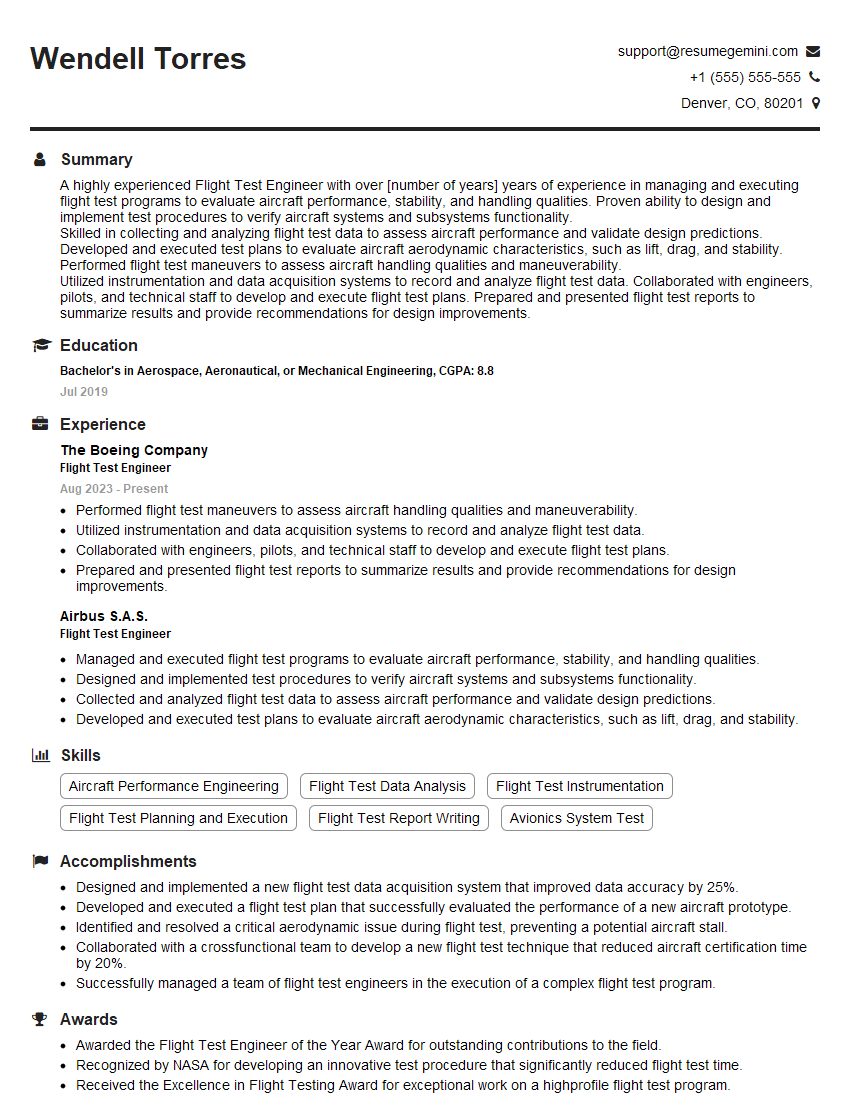
Mastering flight testing opens doors to exciting and challenging careers in aerospace engineering, offering opportunities for continuous learning and professional growth. To maximize your job prospects, it’s vital to present your skills and experience effectively. Creating an ATS-friendly resume is key to getting your application noticed by recruiters. We highly recommend using ResumeGemini to build a professional and impactful resume that showcases your qualifications. ResumeGemini provides examples of resumes tailored to Flight Testing, helping you create a document that stands out from the competition.
Explore more articles
Users Rating of Our Blogs
Share Your Experience
We value your feedback! Please rate our content and share your thoughts (optional).
What Readers Say About Our Blog
Really detailed insights and content, thank you for writing this detailed article.
IT gave me an insight and words to use and be able to think of examples