Unlock your full potential by mastering the most common Geodetic Data Acquisition interview questions. This blog offers a deep dive into the critical topics, ensuring you’re not only prepared to answer but to excel. With these insights, you’ll approach your interview with clarity and confidence.
Questions Asked in Geodetic Data Acquisition Interview
Q 1. Explain the difference between GPS and GNSS.
GPS, or Global Positioning System, refers to the specific satellite-based navigation system operated by the United States. GNSS, or Global Navigation Satellite System, is a broader term encompassing all global and regional satellite navigation systems, including GPS, GLONASS (Russia), Galileo (European Union), BeiDou (China), and others. Think of it like this: GPS is one brand of car, while GNSS is the category of all cars.
Using multiple GNSS constellations improves accuracy and reliability by providing more satellites to track, increasing the geometric strength of the solution and mitigating the effects of satellite outages or atmospheric disturbances. For example, relying solely on GPS might leave you vulnerable if a significant portion of the US satellite network is unavailable, but incorporating data from Galileo or BeiDou ensures redundancy and enhanced position fixing.
Q 2. Describe the various types of geodetic surveys.
Geodetic surveys encompass various types, each tailored to specific needs and scales. These include:
- Control Surveys: Establish a network of precisely positioned points, forming the foundation for other surveys. Imagine these as the cornerstones of a large map.
- Cadastral Surveys: Define property boundaries, crucial for land ownership and legal purposes. These are the lines that delineate your property from your neighbor’s.
- Topographic Surveys: Determine the Earth’s surface features, including elevation, contours, and vegetation, essential for mapping and engineering projects. Think of this as creating a detailed 3D model of a landscape.
- Engineering Surveys: Support construction, infrastructure projects, and other engineering tasks. For example, ensuring that buildings are constructed to the correct specifications and within the appropriate location.
- Hydrographic Surveys: Map bodies of water, measuring depth, currents, and seabed features. These are crucial for navigation and marine resource management.
- Photogrammetry and Lidar Surveys: These advanced techniques use remotely sensed data (images and laser scans) to create highly accurate 3D models of terrain.
The choice of survey type depends on the project objectives, required accuracy, and available resources.
Q 3. What are the common sources of error in geodetic data acquisition?
Geodetic data acquisition is susceptible to numerous errors, broadly categorized as:
- Atmospheric Effects: The ionosphere and troposphere delay GNSS signals, leading to positional errors. Think of the signal travelling through these atmospheric layers like light being bent through a prism.
- Multipath Errors: Signals reflecting off buildings or other surfaces reach the receiver at slightly different times, causing inaccuracies. This is like receiving an echo that slightly distorts the original signal.
- Satellite Clock and Ephemeris Errors: Imperfections in the satellite clocks and their orbital data affect position calculations. Regular updates and corrections help minimize this.
- Receiver Noise and Errors: Electronic noise within the receiver can introduce errors into the measurements. Higher quality receivers generally reduce this noise.
- Instrumental Errors: Faults within the GNSS receiver or other measuring equipment can cause systematic or random errors. Proper calibration and maintenance are vital here.
- Human Errors: Mistakes in data recording, processing, or equipment handling can introduce errors. Rigorous quality control procedures help minimize these errors.
Understanding and mitigating these errors is crucial for obtaining accurate and reliable geodetic data.
Q 4. How do you handle data outliers in a geodetic dataset?
Outliers in geodetic datasets can severely affect the accuracy of results. Handling them requires a careful approach. Common methods include:
- Visual Inspection: Plotting the data allows for quick identification of points that deviate significantly from the overall pattern. A simple scatter plot can quickly reveal an outlier.
- Statistical Analysis: Techniques like Grubbs’ test or the Chauvenet criterion help determine if a data point is statistically significant outlier. These tests use statistical thresholds to identify unusual data points.
- Robust Estimation Techniques: Methods like least-squares with robust weights or RANSAC (Random Sample Consensus) are less sensitive to outliers and can produce more reliable results. These methods either give less weight to outliers or find a fit that is not overly sensitive to unusual data points.
- Data Validation and Rechecking: Investigate the potential causes of the outlier. Was there a problem with the equipment? Was the data recorded incorrectly? If possible, re-measure the point. Sometimes, the outlier is actually a real feature.
The choice of method depends on the nature of the data and the desired level of accuracy. Often, a combination of these methods is employed.
Q 5. Explain the concept of datum transformation.
Datum transformation involves converting coordinates from one geodetic datum to another. A datum is a reference system that defines the shape and orientation of the Earth, along with its origin. Different countries or regions may use different datums, leading to discrepancies in coordinate values. For example, NAD83 is commonly used in North America while WGS84 is a global standard. Transformation is essential to integrate data from various sources or to correctly position data in a specific coordinate reference system.
Common transformation methods include Helmert transformations (7-parameter transformations) or more sophisticated techniques such as polynomial transformations. The choice of method depends on the accuracy requirements and the available control points. Software packages such as ArcGIS Pro or QGIS facilitate these transformations.
Q 6. What are the different coordinate systems used in geodetic surveying?
Geodetic surveying utilizes several coordinate systems:
- Geographic Coordinate System (GCS): Uses latitude and longitude to define a point on the Earth’s surface. This is a spherical coordinate system based on the Earth’s ellipsoid.
- Projected Coordinate System (PCS): Projects the Earth’s curved surface onto a plane, enabling the use of Cartesian coordinates (x, y). Common projections include UTM (Universal Transverse Mercator) and State Plane Coordinate Systems. These coordinate systems are planar and use meters or feet as units.
- Geocentric Coordinate System: Uses three-dimensional Cartesian coordinates (X, Y, Z) with the origin at the Earth’s center of mass. This system is useful for global positioning and satellite data.
Understanding these systems and their interrelationships is critical for accurate data processing and analysis. The choice of coordinate system should always be documented and appropriate for the scale and purpose of the survey.
Q 7. Describe your experience with different GNSS receivers and their capabilities.
Throughout my career, I’ve worked with various GNSS receivers, ranging from basic single-frequency receivers to advanced multi-frequency, multi-constellation receivers capable of real-time kinematic (RTK) positioning. For instance, I’ve used Trimble R10s, Leica GS18 I, and Topcon GR-3 receivers. These differ in their capabilities, such as the number of frequencies they can track (L1, L2, L5, etc.), the GNSS constellations they support (GPS, GLONASS, Galileo, BeiDou), the accuracy they can achieve (centimeter-level with RTK, meter-level with stand-alone operation), and their data logging capabilities. More advanced receivers offer features like built-in inertial measurement units (IMUs) for enhanced positioning in challenging environments or better signal tracking capabilities. For instance, the Trimble R10 with its advanced antenna design greatly improves signal reception and minimizes multipath errors in urban canyons or areas with dense vegetation.
My experience extends to using these receivers in different fieldwork settings and processing the collected data using various software packages such as Trimble Business Center, Leica Infinity, and others. Selection of the appropriate receiver depends critically on the project’s requirements for accuracy and speed of data acquisition, the environmental challenges, and budget constraints.
Q 8. How do you ensure the accuracy and precision of geodetic measurements?
Ensuring accuracy and precision in geodetic measurements is paramount. It’s like building a house – a tiny error in the foundation leads to significant problems later. We achieve this through a multi-pronged approach focusing on instrument calibration, meticulous observation techniques, and robust data processing.
- Instrument Calibration: Before any measurement campaign, all equipment (GNSS receivers, total stations, levels) undergoes rigorous calibration to verify their accuracy. This involves comparing their readings against known standards, identifying and correcting any systematic errors. For example, we might use a known baseline to check the accuracy of a total station.
- Observation Techniques: We employ best practices during data acquisition. This includes redundant measurements (repeating observations multiple times), careful centering over survey points, proper atmospheric correction procedures, and minimizing external influences like multipath. Think of it like taking multiple photos from different angles to get a better understanding of the object.
- Data Processing & Error Analysis: Advanced software packages are used to process the raw data, identifying and mitigating various errors. This involves applying corrections for atmospheric refraction, instrument biases, and other systematic errors. Statistical analysis is performed to determine the accuracy and precision of the results, ensuring they meet the project’s specifications.
Ultimately, the goal is to minimize both random errors (unpredictable variations) and systematic errors (consistent biases) to achieve the highest possible level of accuracy and precision.
Q 9. Explain the process of quality control and quality assurance in geodetic data acquisition.
Quality control (QC) and quality assurance (QA) are intertwined yet distinct processes. QA is the overarching strategy to ensure the project meets predefined quality standards, while QC involves specific checks at each stage to identify and correct errors. In geodetic data acquisition, this looks like:
- QA Planning: This starts before fieldwork begins, defining clear objectives, specifying accuracy requirements, selecting appropriate equipment, and developing a detailed QC plan. This plan outlines the procedures and acceptance criteria for each step.
- QC during Data Acquisition: This includes regular instrument checks, real-time data validation (e.g., checking for outliers in GNSS observations), and field notes meticulously recording environmental conditions and any potential sources of error. Imagine a construction site supervisor regularly inspecting the work of each team.
- Post-processing QC: This involves a thorough analysis of the processed data. We check for inconsistencies, outliers, and unexpected variations. We might use statistical tests to assess the quality of the adjusted coordinates, comparing them to the expected values and tolerances.
- Data Validation and Reporting: Final reports include a detailed assessment of the data quality, including accuracy estimates, error analysis, and a summary of any identified issues and how they were addressed. It’s like presenting a construction project report showing the success in meeting specifications.
These steps ensure that the final geodetic data is reliable and suitable for its intended purpose.
Q 10. Describe your experience with post-processing geodetic data.
My experience with post-processing geodetic data is extensive. It’s where the raw measurements are transformed into meaningful, accurate coordinates. This involves several key steps:
- Data Import and Pre-processing: Raw data from various instruments are imported into the chosen software package. Initial checks for data completeness and consistency are performed, removing any obviously erroneous data points.
- Atmospheric Correction: Models are applied to correct for atmospheric refraction, accounting for the bending of electromagnetic signals as they travel through the atmosphere. This is particularly critical for long distances and high precision applications.
- Coordinate Transformation: We use appropriate transformation parameters (e.g., Helmert transformations, seven-parameter transformations) to convert coordinates between different datums or coordinate systems. Imagine translating a map from one coordinate system to another.
- Error Analysis and Adjustment: Least squares adjustment techniques (e.g., network adjustment) are applied to obtain the best possible estimates of the coordinates, while simultaneously quantifying the uncertainties. This is like finding the optimal solution considering all the available measurements and their uncertainties.
- Quality Control Checks: Post-processing involves rigorous QC checks, comparing adjusted coordinates against known points and analyzing the residuals to identify any potential errors or inconsistencies.
I’ve worked with projects involving both terrestrial and GNSS data, and I’m comfortable using various software packages to manage this process, ensuring the highest data quality.
Q 11. How do you deal with multipath errors in GNSS measurements?
Multipath errors occur when GNSS signals reflect off surfaces before reaching the receiver, causing errors in the measured distance. Think of it like hearing an echo – the receiver ‘hears’ the original signal and its delayed reflection, leading to inaccurate positioning. We mitigate these errors using several strategies:
- Careful Antenna Placement: Placing the antenna in an open, unobstructed area minimizes reflections. Avoid placing it near buildings, trees, or other reflecting surfaces. The clearer the signal path, the better.
- Multipath Mitigation Techniques in Software: Advanced GNSS processing software incorporates algorithms specifically designed to identify and reduce the impact of multipath errors. These algorithms analyze the characteristics of the received signals to distinguish between direct and reflected signals.
- Using Multiple Frequencies: Using dual- or triple-frequency GNSS receivers provides additional information that allows the software to more effectively identify and reject multipath-affected signals. More frequencies provide more data points to filter out the erroneous signals.
- Data Filtering: Techniques like outlier rejection and weighted least squares adjustment can be used to downplay the effect of suspected multipath-contaminated observations. We are essentially filtering out those points that deviate significantly from the expected pattern.
A combination of these strategies greatly reduces the impact of multipath errors, improving the accuracy of GNSS measurements.
Q 12. Explain the concept of atmospheric refraction and its impact on geodetic measurements.
Atmospheric refraction is the bending of electromagnetic waves as they pass through the Earth’s atmosphere. The density of the atmosphere varies with altitude and temperature, causing the signals to be refracted – a bit like a straw appearing bent in a glass of water. This affects the speed of the signals and, consequently, the measured distances in geodetic measurements.
The impact is significant, especially for long distances. The refraction can cause errors in both distance and direction measurements. For instance, in GNSS measurements, refraction can lead to errors in position determination. In leveling, refraction causes errors in the height differences between points.
We account for atmospheric refraction using:
- Atmospheric Models: Several models (e.g., Saastamoinen model) are used to estimate the atmospheric refractive index based on atmospheric pressure, temperature, and humidity data collected at the measurement site. These models provide corrections to be applied to the raw measurements.
- Meteorological Data: Accurate meteorological data is crucial for applying appropriate corrections. We use weather stations or sensors to collect the necessary data during the measurement campaign. The more accurate the data, the better the correction.
- Software Corrections: Most geodetic processing software packages include modules that automatically apply atmospheric refraction corrections based on input meteorological data.
Ignoring atmospheric refraction can lead to significant errors, so accurate correction is vital for high-precision geodetic surveys.
Q 13. What software packages are you proficient in for geodetic data processing?
I’m proficient in several software packages for geodetic data processing. My expertise includes:
- Trimble Business Center (TBC): For GNSS data processing, including precise point positioning (PPP) and network RTK.
- Leica GeoOffice: For processing data from Leica total stations and levels, including network adjustments.
- OPUS (Online Positioning User Service): For post-processing GNSS data using the NGS’s online service.
- MATLAB: For advanced data analysis, algorithm development, and customized processing scripts.
- GIS Software (ArcGIS, QGIS): For data visualization, spatial analysis, and integration with other geospatial data.
My experience extends beyond simply using these tools – I understand the underlying mathematical models and algorithms, allowing me to effectively troubleshoot issues and adapt processing strategies to various project requirements.
Q 14. Describe your experience with different types of surveying equipment.
Throughout my career, I’ve gained hands-on experience with various surveying equipment:
- GNSS Receivers: I’m familiar with different types of receivers, from single-frequency to multi-frequency, and various antenna types. I understand the implications of different receiver technologies on accuracy and precision. I’ve worked with brands like Trimble, Leica, and Topcon.
- Total Stations: Extensive experience using robotic total stations for precise distance and angle measurements. I understand the importance of proper calibration and collimation procedures. I’ve worked with different brands like Leica, Sokkia, and Nikon.
- Levels: Proficient in using automatic and digital levels for precise elevation determination. I’m aware of the techniques for minimizing errors like collimation and curvature and refraction corrections.
- Other Equipment: My experience also includes working with other surveying tools like GPS accessories, data collectors, and software for data transfer and management.
This broad experience allows me to select and effectively utilize the most appropriate equipment for different projects, ensuring optimal results and efficiency.
Q 15. How do you perform a geodetic survey in challenging terrain?
Geodetic surveying in challenging terrain requires careful planning and the selection of appropriate techniques. Think of it like navigating a complex maze – you need a strategic approach. Obstacles like dense vegetation, steep slopes, and inaccessible areas demand adaptability. Instead of relying solely on traditional methods, we often incorporate techniques such as:
GNSS (Global Navigation Satellite Systems) with Real-Time Kinematic (RTK) capabilities: RTK provides centimeter-level accuracy, even in challenging environments. We use multiple base stations to overcome signal obstructions.
Terrestrial Laser Scanning (TLS): TLS allows for rapid data acquisition over large areas, even with limited accessibility. It’s like having a 3D camera that captures everything in its path, overcoming visibility challenges.
Drone-based Photogrammetry: Drones equipped with high-resolution cameras provide detailed imagery of inaccessible areas, allowing for the creation of accurate 3D models. It’s a safer and more efficient way to survey difficult terrains.
Inertial Measurement Units (IMUs) integrated with GNSS: IMUs provide continuous measurements of orientation and movement, improving the accuracy of GNSS in areas with poor satellite visibility.
The choice of method depends on the specific challenges, required accuracy, budget, and project timeline. For instance, a mountainous region might necessitate a combination of RTK GNSS and TLS, whereas a dense forest might favour drone photogrammetry.
Career Expert Tips:
- Ace those interviews! Prepare effectively by reviewing the Top 50 Most Common Interview Questions on ResumeGemini.
- Navigate your job search with confidence! Explore a wide range of Career Tips on ResumeGemini. Learn about common challenges and recommendations to overcome them.
- Craft the perfect resume! Master the Art of Resume Writing with ResumeGemini’s guide. Showcase your unique qualifications and achievements effectively.
- Don’t miss out on holiday savings! Build your dream resume with ResumeGemini’s ATS optimized templates.
Q 16. Explain the concept of geodetic leveling.
Geodetic leveling is a precise surveying technique used to determine the difference in elevation between points. Imagine it as meticulously measuring the height of steps on a grand staircase, ensuring each step’s height is accurately recorded. It’s crucial for establishing a precise vertical datum – a reference surface for elevations. This involves using a level instrument (an extremely precise spirit level) and leveling rods to measure the height difference between points along a line.
The process involves setting up the level instrument midway between two points, taking readings on the leveling rods placed at each point, and carefully accounting for instrument height. This is repeated along a series of points to establish a continuous elevation profile. The accuracy of geodetic leveling is paramount in applications requiring high vertical precision, such as large-scale infrastructure projects (dams, canals), monitoring of land subsidence, and creating detailed topographic maps. Careful consideration of factors like temperature, atmospheric refraction, and instrument calibration is essential for minimizing errors.
Q 17. What are the different types of surveying errors and how can they be mitigated?
Surveying errors can be broadly classified into systematic errors and random errors. Systematic errors follow a pattern and are often caused by instrument defects or environmental factors. Random errors are unpredictable and result from variations in observation conditions. For example:
Systematic errors: Instrument miscalibration (e.g., a level instrument not perfectly levelled), instrument collimation error (misalignment of optical components), atmospheric refraction (bending of light rays in the atmosphere).
Random errors: Errors in reading scales, variations in the observer’s precision, slight movements of the instrument or target.
Mitigation strategies:
Calibration and maintenance of instruments: Regular calibration and maintenance significantly reduce systematic errors.
Environmental corrections: Applying corrections for factors like temperature and atmospheric refraction minimizes their impact.
Redundant observations: Taking multiple measurements of the same quantity helps to identify and reduce random errors using statistical methods.
Least squares adjustment: A statistical technique used to minimize the overall error in a network of observations.
Careful observation techniques: Proper procedures, such as using appropriate targets and employing consistent observation techniques, minimize random errors.
By proactively addressing these errors, we ensure the accuracy and reliability of the final geodetic data.
Q 18. How do you plan and manage a geodetic surveying project?
Planning and managing a geodetic surveying project involves several key steps, akin to orchestrating a complex symphony. It begins with a thorough understanding of project requirements, including the objectives, required accuracy, and budget constraints. This leads to:
Project definition: Clearly defining the scope, objectives, and deliverables.
Data acquisition planning: Selecting appropriate surveying techniques, instruments, and personnel based on terrain, accuracy requirements, and budget.
Fieldwork planning: Designing efficient survey routes, scheduling fieldwork, and ensuring necessary logistical arrangements.
Quality control: Implementing procedures to monitor and ensure the quality of data throughout the project.
Data processing and analysis: Using appropriate software for data processing, adjustment, and analysis.
Reporting and dissemination: Preparing comprehensive reports and disseminating the results to stakeholders.
Resource management: Effective management of personnel, equipment, and budget throughout the project.
Utilizing project management software and employing a structured approach ensures that all phases are coordinated effectively and within the project’s constraints.
Q 19. Describe your experience with data visualization and presentation in geodetic projects.
Data visualization and presentation are crucial for communicating complex geodetic information effectively. Imagine trying to explain a complex landscape using only numbers; it wouldn’t be very clear! I utilize various tools and techniques to create compelling visuals:
GIS software (e.g., ArcGIS, QGIS): Creating maps, 3D models, and other visualizations that effectively communicate spatial data.
Specialized geodetic software: Processing and analyzing geodetic data and producing detailed reports and visualizations.
For example, I’ve used ArcGIS to create interactive maps showing the results of a deformation analysis, allowing stakeholders to easily understand ground movement. I also use presentation software (like PowerPoint) to create visually engaging presentations that effectively communicate complex geodetic concepts to non-technical audiences. Clarity and simplicity are key – using appropriate colors, legends, and scales to ensure the information is easily understood by all stakeholders.
Q 20. How do you ensure data security and integrity in geodetic data acquisition?
Data security and integrity are paramount in geodetic data acquisition. Consider the implications of compromised data—it could lead to costly errors in infrastructure projects or misinterpretations of environmental changes. We implement several measures:
Data encryption: Encrypting data both in transit and at rest using robust encryption algorithms.
Access control: Implementing strict access control measures to limit access to sensitive data to authorized personnel.
Data backups: Regularly backing up data to multiple secure locations to protect against data loss.
Data validation: Implementing procedures to validate the quality and accuracy of geodetic data at every step of the process.
Version control: Employing version control systems to track changes to the data and ensure traceability.
Adherence to relevant data security standards and best practices, and regular security audits ensure the long-term security and integrity of our geodetic data.
Q 21. Explain the role of geodetic data in infrastructure development.
Geodetic data is the foundational layer for all infrastructure development. It’s like the blueprint upon which we build. Accurate geodetic information provides the spatial framework for:
Precise positioning of infrastructure: Ensuring structures such as buildings, bridges, and roads are accurately located and aligned.
Infrastructure monitoring: Monitoring the stability and deformation of structures over time, aiding in preventative maintenance.
Land surveying and cadastral mapping: Defining land boundaries and ownership, essential for land management and development.
Environmental modeling: Providing the spatial reference for environmental models used to study and mitigate natural hazards.
Transportation planning: Designing efficient and safe transportation networks, considering terrain and other spatial factors.
In essence, without accurate geodetic data, large-scale infrastructure projects would be unreliable, inefficient, and potentially dangerous.
Q 22. Describe your experience with different types of geodetic coordinate systems (e.g., UTM, geographic).
Geodetic coordinate systems are fundamental to defining locations on the Earth’s surface. Two common types are Geographic Coordinate Systems (GCS) and Universal Transverse Mercator (UTM) coordinate systems. GCS uses latitude and longitude, measured from the Earth’s center, to define a point’s position on a spherical or ellipsoidal model of the Earth. Think of it like drawing lines of longitude and latitude on a globe. Latitude runs east-west, with the equator at 0 degrees, and longitude runs north-south, with the Prime Meridian at 0 degrees.
UTM, on the other hand, projects the Earth’s curved surface onto a series of flat, rectangular zones. Each zone uses a Cartesian coordinate system (Easting and Northing) making calculations for distances and areas simpler than using spherical coordinates. This is analogous to flattening a globe – you lose some accuracy, but gain ease of use for many applications. I’ve extensively used both GCS (primarily WGS84) and UTM in various projects, switching between them depending on the project’s requirements. For instance, global-scale analyses generally use GCS, while local-scale engineering projects benefit from the simplicity of UTM.
My experience also includes working with other coordinate systems like State Plane Coordinate Systems (SPCS), which are tailored to individual states or regions, providing high accuracy within their limited areas. Understanding the transformations between different coordinate systems, using tools like coordinate conversion software or scripts, is crucial for seamless data integration and analysis.
Q 23. How do you handle data discrepancies between different data sources?
Data discrepancies between different data sources are a common challenge in geodetic surveying. These discrepancies can stem from various sources, including differences in datum (the reference surface used for coordinates), measurement errors, differing coordinate systems, and even human error during data entry. My approach involves a multi-step process:
- Identify and document the discrepancies: This involves visually inspecting the data, using GIS software to overlay different datasets, and performing statistical analyses to quantify the differences.
- Analyze the sources of discrepancies: I investigate the metadata associated with each dataset to understand its acquisition methods, coordinate system, and datum. This helps to pinpoint the likely causes of the differences.
- Implement appropriate transformation or reconciliation techniques: Depending on the nature and magnitude of the discrepancies, different approaches might be used. These could involve datum transformations (e.g., using Helmert transformations), coordinate system conversions, or statistical methods like least squares adjustment to reconcile conflicting data points.
- Evaluate the quality of the reconciled data: After implementing corrections, I assess the accuracy and consistency of the resulting data using appropriate quality control measures.
For example, in a recent project involving integrating LiDAR data with cadastral survey data, I identified discrepancies due to different datums. Applying a rigorous datum transformation ensured the seamless integration of both datasets, resulting in a much more comprehensive and accurate spatial database. The choice of method depends heavily on the scale and nature of the project, along with the acceptable level of uncertainty.
Q 24. Explain your understanding of ellipsoid models and their application in geodetic surveying.
Ellipsoid models are mathematical representations of the Earth’s shape. Since the Earth isn’t perfectly spherical, we use ellipsoids to approximate its surface. They are defined by two parameters: the semi-major axis (a) and the flattening (f). These define the shape and size of the ellipsoid. The ellipsoid chosen for a project influences the accuracy of geodetic calculations. For instance, using a local ellipsoid tailored to a specific region will offer higher accuracy than a global ellipsoid like WGS84 for local-scale surveys within that region.
In geodetic surveying, the ellipsoid serves as the reference surface for height measurements (orthometric heights) and coordinates (geodetic latitude and longitude). Calculations like geodetic distances, azimuths, and transformations between coordinate systems all rely on the selected ellipsoid model. The choice of ellipsoid is critical and often dictated by the coordinate system in use. For example, the NAD83 (North American Datum of 1983) uses the GRS80 ellipsoid, while WGS84 uses its own, slightly different, ellipsoid. Understanding these differences and their implications on accuracy is crucial for proper project planning and execution. Ignoring these differences can lead to significant errors, particularly in large-scale projects.
Q 25. What are the ethical considerations in geodetic data acquisition?
Ethical considerations in geodetic data acquisition are paramount. They cover several key aspects:
- Data Integrity and Accuracy: Maintaining the highest standards of accuracy and precision in data acquisition and processing is crucial. This involves using calibrated instruments, following established procedures, and rigorously implementing quality control measures to avoid errors and ensure data reliability.
- Data Confidentiality and Security: Geospatial data often contains sensitive information, and it’s vital to protect its confidentiality. This includes securing data storage, limiting access to authorized personnel only, and complying with relevant data protection regulations.
- Transparency and Disclosure: Openness about data acquisition methods, limitations, and potential uncertainties is essential for building trust and enabling responsible use of the data. Clearly documenting all aspects of the data acquisition process is critical.
- Social and Environmental Impacts: Consideration should be given to the potential social and environmental consequences of data acquisition. This includes minimizing the impact on ecosystems, respecting community rights, and ensuring that data collection doesn’t unfairly target or disadvantage certain groups.
- Proper Attribution and Copyright: Always giving proper attribution to data sources and respecting intellectual property rights is essential. Using and distributing data in accordance with licenses and copyright regulations is crucial.
Ignoring these ethical considerations can lead to inaccurate results, data breaches, and reputational damage. Ethical data handling practices ensure the responsible and sustainable use of geodetic data for the benefit of all.
Q 26. Describe your experience with total station instruments and their operation.
Total stations are sophisticated electronic instruments used for precise distance and angle measurements in surveying. My experience with total stations spans various models and manufacturers. Operation typically involves setting up the instrument over a known point, leveling it precisely using built-in leveling screws and a compensator, and then taking measurements to other points. The instrument measures horizontal and vertical angles, along with the slope distance to the target. The internal computer then calculates coordinates of the target point, considering atmospheric conditions and instrument parameters.
I’m proficient in using different total station functionalities such as:
- Setting up and leveling the instrument: Ensuring accurate leveling is essential for precise measurements.
- Taking measurements: Accurately aiming the instrument at targets and recording measurements.
- Data processing and calculations: Using the total station’s internal software or external software packages to process raw data and calculate coordinates.
- Using various measurement modes: Different modes are available, including robotic total stations which can automatically track prisms, improving efficiency.
I’ve also experienced working with various accessories, including prisms, tripods, and data collectors. Regular maintenance and calibration are essential to maintain the accuracy of the instrument, and I always adhere to strict quality control procedures during data acquisition to ensure data integrity.
Q 27. How do you integrate geodetic data with other spatial datasets (e.g., GIS data)?
Integrating geodetic data with other spatial datasets, such as GIS data, is a crucial aspect of many projects. The key is ensuring compatibility in terms of coordinate systems, datums, and projections. This often involves a process of data transformation and projection.
The process typically involves:
- Defining the common spatial reference system: Selecting a suitable coordinate system and projection for the entire dataset.
- Transforming the geodetic data: Converting the geodetic data from its original coordinate system to the common spatial reference system. Tools such as GIS software (ArcGIS, QGIS) provide functionalities for performing this transformation using appropriate algorithms (e.g., Helmert transformations).
- Projecting other spatial datasets: Similarly, any other datasets (e.g., imagery, CAD drawings) need to be projected to the common spatial reference system.
- Data integration and analysis: Once all datasets are in the same spatial reference, they can be integrated using GIS software to perform various spatial analyses, such as overlay operations, buffer analysis, and spatial statistics.
For example, in a project involving developing a flood risk model, I integrated high-precision elevation data from LiDAR with hydrological models and land use data. Using a common coordinate system (UTM) and ensuring accurate projection was essential for obtaining reliable flood risk maps. The use of a GIS provided the tools and environment for this seamless integration.
Q 28. Describe a challenging geodetic project you worked on and how you overcame the challenges.
One challenging project involved establishing a precise control network for a large-scale infrastructure project in a mountainous region. The terrain was extremely rugged, with limited accessibility and significant vegetation cover. The challenge lay in establishing accurate ground control points (GCPs) with high precision despite the difficult conditions.
To overcome these challenges, we employed a multi-faceted approach:
- Careful planning and reconnaissance: Thorough reconnaissance of the area helped to identify suitable locations for GCPs that offered clear lines of sight between points, minimizing the effects of atmospheric refraction and other error sources.
- Use of advanced surveying techniques: We utilized GPS, total stations, and UAV-based photogrammetry for data acquisition. The combination of these methods allowed us to overcome the limitations of each individual technique. For example, we used GPS to establish a broader network of points which were then used to guide more precise local survey work using total stations.
- Rigorous data processing and quality control: Data processing involved rigorous least-squares adjustment to ensure internal consistency and optimal accuracy. We applied various quality control procedures, including outlier detection and error analysis, to identify and correct potential errors.
- Collaboration and teamwork: Successful completion of the project depended on close collaboration between the surveying team, the engineering team, and other stakeholders.
This project highlighted the importance of a well-planned approach, integrating various technologies, and meticulously processing data to achieve the desired accuracy in challenging environmental conditions. The final product, a highly accurate control network, was essential for the success of the infrastructure project.
Key Topics to Learn for Geodetic Data Acquisition Interview
- Global Navigation Satellite Systems (GNSS): Understanding the principles of GPS, GLONASS, Galileo, and BeiDou, including signal reception, error sources (atmospheric, multipath, etc.), and data processing techniques.
- Geodetic Surveying Techniques: Familiarize yourself with various surveying methods like Total Station surveying, leveling, and traditional triangulation. Understand their applications and limitations in different environments.
- Data Processing and Adjustment: Mastering techniques for processing raw GNSS and surveying data, including coordinate transformations, error analysis, and least-squares adjustment to achieve high-accuracy results. Be prepared to discuss software packages used in this process.
- Coordinate Systems and Datums: Demonstrate a solid understanding of different coordinate systems (geodetic, projected), datums, and their transformations. Be able to explain the importance of datum selection for specific applications.
- Geospatial Data Formats: Become familiar with common geospatial data formats like shapefiles, GeoTIFFs, and databases (e.g., PostGIS). Understand how data is stored and accessed in these formats.
- Quality Control and Assurance (QA/QC): Discuss procedures for ensuring the accuracy and reliability of geodetic data, including error detection, outlier removal, and data validation techniques.
- Practical Applications: Be ready to discuss real-world applications of geodetic data acquisition, such as mapping, land surveying, infrastructure development, environmental monitoring, and precision agriculture. Prepare examples from your experience or research.
- Problem-Solving Approaches: Be prepared to discuss how you approach challenges related to data acquisition, processing, and analysis. Highlight your problem-solving skills and ability to troubleshoot issues.
Next Steps
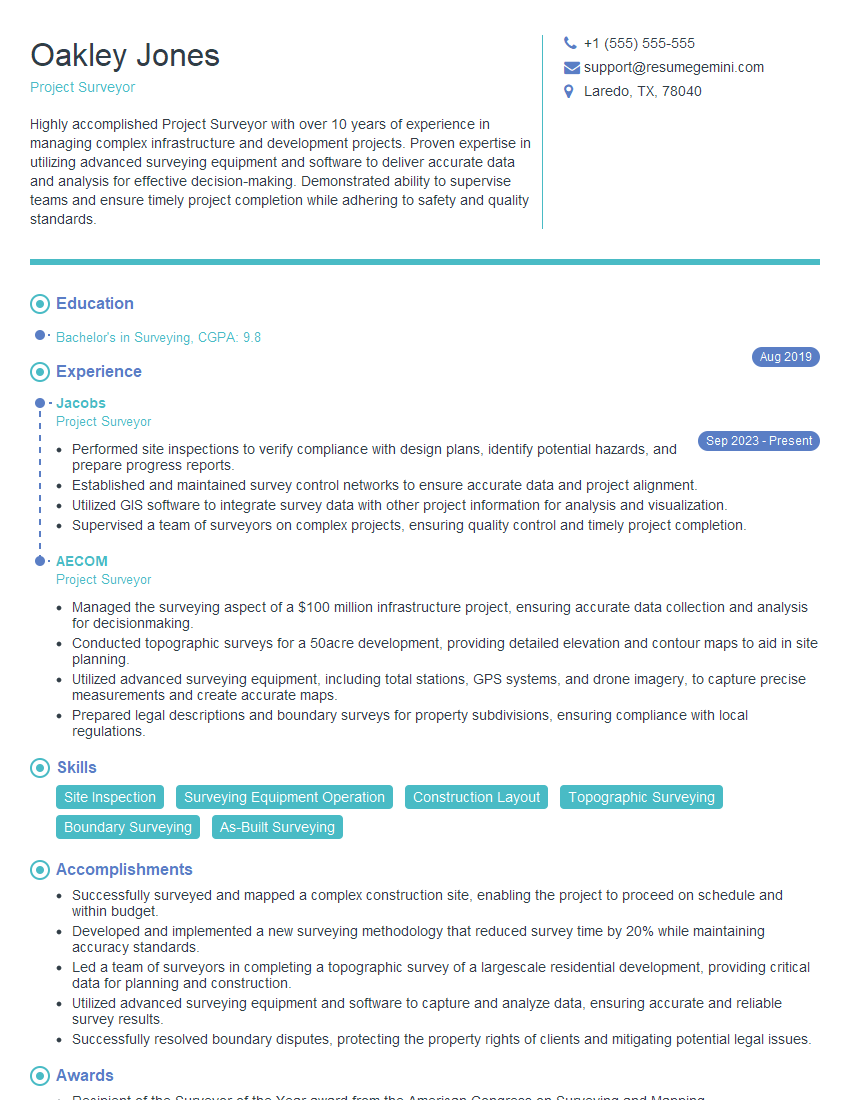
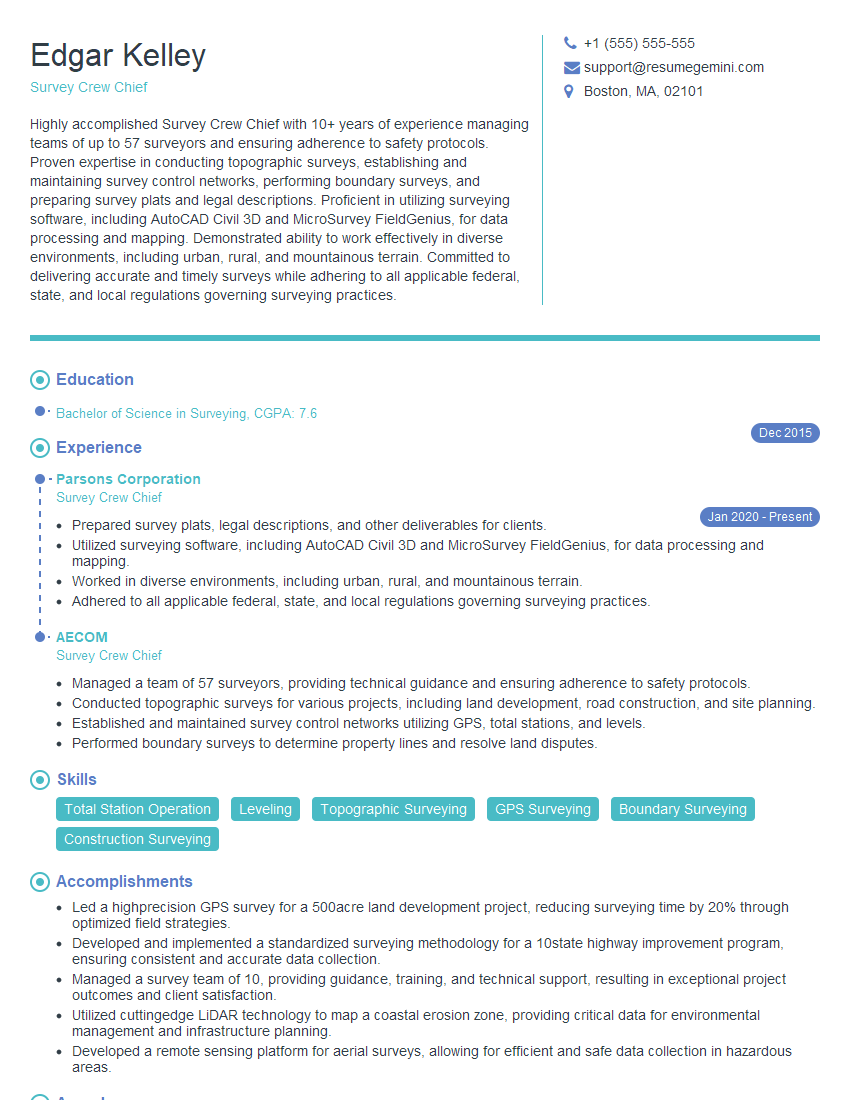
Mastering Geodetic Data Acquisition opens doors to exciting career opportunities in diverse fields, offering excellent growth potential. To maximize your job prospects, invest time in crafting a compelling and ATS-friendly resume that showcases your skills and experience effectively. ResumeGemini is a trusted resource that can help you build a professional and impactful resume. They even provide examples of resumes tailored to Geodetic Data Acquisition to help you get started. Take advantage of these resources and present yourself as the ideal candidate.





Explore more articles
Users Rating of Our Blogs
Share Your Experience
We value your feedback! Please rate our content and share your thoughts (optional).
What Readers Say About Our Blog
Really detailed insights and content, thank you for writing this detailed article.
IT gave me an insight and words to use and be able to think of examples