The thought of an interview can be nerve-wracking, but the right preparation can make all the difference. Explore this comprehensive guide to Geodetic Survey Planning and Execution interview questions and gain the confidence you need to showcase your abilities and secure the role.
Questions Asked in Geodetic Survey Planning and Execution Interview
Q 1. Explain the difference between geodetic and plane surveying.
The key difference between geodetic and plane surveying lies in how they handle the Earth’s curvature. Plane surveying assumes the Earth is flat over the survey area, making calculations simpler. This is accurate for small areas where the Earth’s curvature is negligible. Think of surveying a small city block – the curvature is insignificant. Geodetic surveying, on the other hand, explicitly accounts for the Earth’s curvature and uses a three-dimensional coordinate system to represent points on the Earth’s ellipsoidal surface. This is crucial for large-scale projects spanning vast distances, such as mapping entire countries or establishing national control networks, where ignoring the curvature introduces unacceptable errors.
Imagine trying to build a long, straight railway line. Plane surveying might work fine for a short section, but for a longer distance, the curvature of the earth would need to be considered, otherwise, the tracks may not meet at the expected endpoint. Geodetic surveying is essential for accurate positioning in such scenarios.
Q 2. Describe the various types of geodetic datums and their applications.
Geodetic datums are reference systems that define the shape and size of the Earth and provide a framework for expressing geographic coordinates (latitude, longitude, and height). Several types exist, each with specific applications:
- Horizontal Datums: These define the Earth’s shape and orientation. Examples include North American Datum of 1983 (NAD83), and World Geodetic System 1984 (WGS84). NAD83 is commonly used in North America, while WGS84 is widely adopted globally, especially in GPS applications. The choice depends on the region and the accuracy required.
- Vertical Datums: These define the height above a reference surface, typically mean sea level. National Geodetic Vertical Datum of 1929 (NGVD29) and North American Vertical Datum of 1988 (NAVD88) are examples. Inaccurate vertical datums can lead to significant issues in infrastructure projects like dam construction or pipeline laying.
- Geocentric Datums: These are three-dimensional datums that define the Earth’s origin at its center of mass. WGS84 is an example of a geocentric datum, making it suitable for global positioning systems.
The selection of a suitable datum is crucial. Using an inappropriate datum can lead to significant coordinate discrepancies, affecting the accuracy of maps, engineering projects, and other spatial applications. For instance, using different datums for mapping two adjacent areas can result in noticeable discrepancies at their boundary.
Q 3. How do you account for atmospheric refraction in geodetic measurements?
Atmospheric refraction bends light rays as they pass through the atmosphere. This affects geodetic measurements, particularly those involving electronic distance measurement (EDM) instruments or astronomical observations. To account for this, we use atmospheric models that estimate the refractive index of the air based on temperature, pressure, and humidity. These models allow us to correct the measured distances and angles.
Typically, we use meteorological instruments to measure temperature, pressure, and humidity at the time of measurement. This data is then input into refraction correction formulas to calculate the correction that needs to be applied to the raw measurement. The correction is usually a small fraction of the total measured distance, but neglecting it can accumulate to significant errors over longer distances. Sophisticated instruments often have built-in capabilities to correct for refraction using real-time atmospheric data.
Q 4. What are the common sources of error in GPS surveying, and how can they be mitigated?
GPS surveying, while incredibly accurate, is susceptible to various errors. These can be broadly classified into:
- Atmospheric Errors: Ionospheric and tropospheric delays affect signal propagation speed and can lead to positioning errors. Techniques like differential GPS (DGPS) and Real Time Kinematic (RTK) GPS mitigate these by using reference stations to correct for atmospheric effects.
- Multipath Errors: Signals reflecting off buildings or other surfaces can interfere with the direct signal, causing inaccurate measurements. Careful site selection and antenna placement minimize this. Using specialized antennas can also improve signal reception and reduce multipath errors.
- Satellite Geometry (GDOP): Poor satellite geometry results in weaker signal strength and increased position uncertainty. Longer observation times or using more satellites improve geometry.
- Receiver Errors: Instrument limitations, such as clock errors or noise in the receiver, contribute to errors. High-quality receivers and careful calibration minimize these.
- Orbital Errors: Inaccuracies in the satellite orbit data can affect positioning accuracy. Precise ephemeris data is essential to correct this.
Mitigation strategies involve using appropriate GPS techniques (DGPS, RTK, precise point positioning), careful site selection, high-quality receivers, post-processing with precise orbit data, and employing quality control procedures.
Q 5. Explain the concept of coordinate transformations in geodetic surveying.
Coordinate transformations are essential in geodetic surveying to convert coordinates from one datum or coordinate system to another. This is necessary because different projects or organizations might use different datums, and integrating data from various sources requires consistent coordinate systems. Transformations can involve changes in datum, projection (e.g., UTM to geographic coordinates), or both.
Common transformations include:
- Datum transformations (e.g., NAD83 to WGS84): These account for the differences in the size and orientation of different datums. Methods such as Helmert transformation (using seven parameters) are used to accurately convert coordinates between datums.
- Projection transformations (e.g., UTM to latitude/longitude): These convert coordinates between different map projections. This is often necessary when working with different map products.
Software packages provide tools for performing these transformations using appropriate parameters. Incorrect transformations can lead to significant positioning errors, especially in large-scale projects.
Q 6. Describe the process of establishing a geodetic control network.
Establishing a geodetic control network involves creating a framework of precisely located points, forming a basis for all subsequent surveys within a region. The process generally involves the following steps:
- Planning: Determining the required accuracy, the extent of the network, and the optimal locations for control points based on terrain, accessibility, and project needs.
- Field observations: Using high-precision GPS receivers or traditional geodetic techniques (trilateration, triangulation) to measure the coordinates of the control points. Careful attention is paid to quality control and data validation at this step.
- Data processing and adjustment: This involves analyzing the observed data, accounting for measurement errors, and using least-squares adjustment to obtain the most probable coordinates for the control points. This is where sophisticated software packages are essential.
- Network analysis: Assessing the strength and reliability of the network to ensure sufficient accuracy and redundancy. This might involve analyzing the geometry of the network and evaluating the influence of measurement errors.
- Documentation: Maintaining detailed records of the network, including the coordinates of control points, the observational data, and the adjustment results. This ensures the network’s integrity and usability in future projects.
A well-established control network forms the backbone of any large-scale geospatial project, ensuring consistency and accuracy of all subsequent surveys and mapping activities.
Q 7. What software packages are you familiar with for geodetic data processing?
I’m familiar with several software packages for geodetic data processing, including:
- GeoTIFF: For handling and processing geospatial raster data.
- ArcGIS: A comprehensive Geographic Information System (GIS) for spatial data management, analysis, and visualization.
- Global Mapper: A versatile software capable of processing a wide variety of geospatial data formats.
- LGO: specializes in precise GPS and GNSS data processing.
- Bernese GNSS Software: A powerful and widely used software package for precise GNSS data processing.
My experience extends to utilizing these software packages for tasks like coordinate transformations, network adjustments, data visualization, and error analysis. The specific choice of software depends on the project requirements, data formats, and the desired level of processing capabilities.
Q 8. How do you perform quality control and quality assurance (QC/QA) on geodetic survey data?
Quality Control (QC) and Quality Assurance (QA) in geodetic surveying are crucial for ensuring the accuracy and reliability of our data. It’s a multi-layered process starting even before fieldwork begins. We begin with meticulous planning, defining acceptable tolerances and error margins for each stage. This includes specifying the equipment to be used, the procedures to be followed, and the frequency of checks. During fieldwork, QC involves ongoing checks of instrument calibration, observation techniques, and data recording. For example, we regularly check the leveling of our total stations and perform redundant measurements. Post-processing QA involves rigorous analysis of the collected data using statistical methods and specialized software. This includes identifying and correcting gross errors, evaluating precision using measures like standard deviations, and comparing results against independent control points or known values. We also apply rigorous blunder detection techniques such as loop closures in leveling and analyzing residuals in GPS data. Finally, a comprehensive report is generated that details all QA/QC measures implemented and the results obtained. Discrepancies exceeding predefined limits trigger investigations and potential re-measurements to ensure the final product meets the specified accuracy standards.
Q 9. Explain the different types of leveling techniques used in geodetic surveying.
Leveling is a fundamental geodetic surveying technique used to determine the elevation difference between points. Several techniques exist, each with its own advantages and limitations:
- Precise Leveling (Spirit Leveling): This is the most accurate method, employing a precise level and leveling rods. It’s ideal for high-precision work such as establishing benchmarks or monitoring vertical movements. It involves setting up the level midway between two rods, reading both rod measurements, and repeating this process along a series of points. Loop closures and double-run leveling are often employed for error detection and correction.
- Trigonometric Leveling: This method uses angular measurements and distances to determine elevation differences. While less precise than spirit leveling, it’s suitable for long distances and challenging terrains where precise leveling is impractical. We use the trigonometric relationships and known distances, alongside measured vertical angles, to calculate elevation differences.
- GPS Leveling (or GNSS Leveling): This uses GPS or GNSS receivers to determine precise heights, leveraging the satellite network. It’s efficient over large areas but depends on the availability of satellites and atmospheric conditions. Careful consideration must be given to atmospheric corrections and multipath effects.
The choice of leveling technique depends on factors like required accuracy, project scale, terrain conditions, and available resources.
Q 10. How do you handle discrepancies between different survey data sets?
Discrepancies between survey datasets are inevitable, and resolving them requires a systematic approach. First, we thoroughly investigate the source of the discrepancy. This might involve reviewing field notes, instrument calibrations, and processing parameters. We look for potential errors in data collection, processing errors, or even errors in data entry. Next, we assess the reliability of each dataset. This considers factors such as the precision of the instruments used, the experience of the surveyor, and the overall quality of the field work. We may apply error propagation analysis to determine the possible error in each measurement. If the discrepancies are minor and within the acceptable limits of error, we might use weighted averaging techniques to combine the data. However, if the discrepancies are significant or unexplained, further investigation is warranted, possibly requiring re-measurements or recalculations. Finally, we document all discrepancies and resolutions in our survey report for transparency and traceability.
Q 11. Describe your experience with total station surveying.
I have extensive experience with total station surveying, having used various models for different applications, from construction layout to topographic mapping. My experience encompasses all aspects, from instrument setup and calibration to data collection, processing, and analysis. I’m proficient in using total stations for various tasks, including precise distance and angle measurements, stakeout, traversing, and 3D modeling. I’m also familiar with different measurement modes, such as robotic total stations and their advantages in efficiency and automation. One memorable project involved using a total station with robotic capabilities for a large-scale site survey in a challenging, densely wooded area. The robotic features allowed for significantly increased efficiency and reduced field time compared to traditional methods. I’m skilled in using various software packages for post-processing and creating deliverables such as contour maps and cross-sections.
Q 12. What are the key considerations when planning a large-scale geodetic survey project?
Planning a large-scale geodetic survey is a complex undertaking that requires careful consideration of numerous factors. First, we need to define the project objectives, required accuracy, and spatial extent. This dictates the appropriate techniques and equipment. Next, we conduct a thorough reconnaissance of the survey area to assess terrain conditions, accessibility, and potential challenges. This helps in planning the optimal survey strategy and logistics. We also need to identify and incorporate existing control points, where possible, to enhance accuracy and reduce fieldwork. A detailed survey design is essential, including the selection of control points, measurement techniques, and data processing methods. Resource allocation, including personnel, equipment, and budget, must be carefully planned and managed. Finally, a comprehensive quality control and quality assurance plan is vital to ensure the accuracy and reliability of the final product. Scheduling is crucial as well, particularly for long durations requiring various personnel or resources across varied locations.
Q 13. How do you manage and organize large geodetic datasets?
Managing large geodetic datasets efficiently requires a structured approach. We typically use a Geographic Information System (GIS) database to store and manage the data. This allows for efficient querying, analysis, and visualization. The data is organized using a hierarchical structure with clear naming conventions. This ensures data consistency and traceability across the entire dataset. Metadata is crucial, including information on data sources, processing methods, and quality control measures. Regular data backups and version control are essential to prevent data loss and ensure data integrity. We use various data analysis techniques, including spatial analysis, statistical analysis, and error propagation to extract meaningful information from the dataset. Additionally, implementing cloud-based storage and collaboration tools can significantly improve data accessibility and teamwork among survey teams.
Q 14. Explain your experience with different types of GPS receivers and their capabilities.
My experience encompasses various GPS/GNSS receiver types, from single-frequency receivers suitable for less demanding applications to high-precision multi-frequency receivers with advanced capabilities. I understand the capabilities and limitations of each type. Single-frequency receivers are economical but susceptible to multipath errors and atmospheric delays, limiting accuracy. Multi-frequency receivers, utilizing L1 and L2 or even L5 frequencies, significantly reduce these errors, offering better accuracy and reliability, especially in challenging environments. Real-time kinematic (RTK) GPS systems enable centimeter-level accuracy, vital for precise positioning tasks. Post-processed kinematic (PPK) GPS, involving post-processing with base station data, provides even greater accuracy but requires more time and expertise. I am also familiar with different receiver brands and their specific features and software. In one project, the use of a high-precision multi-frequency RTK GPS receiver was crucial in achieving the required centimeter-level accuracy for a precision agriculture application.
Q 15. How do you ensure the accuracy and precision of your geodetic measurements?
Ensuring accuracy and precision in geodetic measurements is paramount. It’s like baking a cake – you need the right ingredients (data) and the right recipe (methods) to get the perfect result. We achieve this through a multi-pronged approach:
- Careful instrument calibration: Before any survey, our equipment – theodolites, total stations, GNSS receivers – undergoes rigorous calibration to ensure they’re functioning within their specified tolerances. This is like calibrating your oven to ensure consistent baking temperatures. We maintain meticulous calibration logs.
- Redundant measurements: We don’t rely on a single measurement. We repeat observations multiple times from different setups, using different methods if possible. This helps identify and mitigate random errors. It’s like measuring the same ingredient several times to confirm its quantity.
- Robust data processing techniques: We use sophisticated software to process the raw data, employing least squares adjustment techniques to minimize errors. This software accounts for atmospheric conditions, instrument limitations, and other factors that might affect the measurements. This is like using a precise recipe that accounts for the ambient temperature and humidity in your baking.
- Quality control checks: Throughout the process, we conduct regular quality control checks to identify and correct any anomalies. This includes checking for gross errors, outliers, and inconsistencies in the data. Think of this as taste-testing the cake throughout the process to ensure it is developing correctly.
- Appropriate observation strategies: We carefully plan our observation strategies, considering factors like the terrain, visibility, and the required accuracy. This includes optimizing the network design and selecting appropriate control points.
By combining these approaches, we can significantly reduce both systematic and random errors, achieving the highest levels of accuracy and precision possible.
Career Expert Tips:
- Ace those interviews! Prepare effectively by reviewing the Top 50 Most Common Interview Questions on ResumeGemini.
- Navigate your job search with confidence! Explore a wide range of Career Tips on ResumeGemini. Learn about common challenges and recommendations to overcome them.
- Craft the perfect resume! Master the Art of Resume Writing with ResumeGemini’s guide. Showcase your unique qualifications and achievements effectively.
- Don’t miss out on holiday savings! Build your dream resume with ResumeGemini’s ATS optimized templates.
Q 16. Describe your experience with different coordinate systems (e.g., UTM, geographic).
I’m highly proficient in various coordinate systems. Geographic coordinates (latitude and longitude), based on the Earth’s ellipsoid, are essential for global positioning. However, for local surveying, projected coordinate systems like UTM (Universal Transverse Mercator) are often preferred because they use planar coordinates (Easting and Northing), simplifying calculations and avoiding distortions inherent in representing a spherical surface on a flat map.
My experience spans several applications: I’ve used UTM zones to define project boundaries in large-scale infrastructure projects, converting between UTM and geographic coordinates using appropriate datum transformations. I’ve also worked with state plane coordinate systems, which are optimized for specific regions within a country, offering higher accuracy for regional projects. Understanding the transformations between these systems, including datum shifts (e.g., NAD83 to NAD27), is critical for ensuring data compatibility and accuracy. I’m comfortable using software such as ArcGIS and AutoCAD to perform these coordinate transformations.
For instance, in a recent project involving the mapping of a large forest, we used UTM coordinates for efficient area calculations and boundary delineation. This was far more practical than using geographic coordinates that would have introduced considerable distortions given the size of the study area. The choice of coordinate system is always based on project requirements and accuracy needs.
Q 17. What is your experience with geodetic boundary surveying?
Geodetic boundary surveying is a specialized area requiring a high level of precision and legal understanding. It involves establishing and accurately defining property boundaries using geodetic principles and referencing them to a defined coordinate system. My experience includes:
- Researching and interpreting deeds and other legal documents: This is crucial for understanding the historical context of a boundary and potential ambiguities.
- Locating and identifying existing boundary markers: This often requires careful field work and the use of historical records and potentially even ground-penetrating radar if markers are lost or obscured.
- Employing various survey techniques: These can include precise traversing, GNSS measurements, and even traditional methods when necessary. I’m experienced in using various methodologies, selecting the most appropriate based on site conditions and accuracy requirements.
- Producing accurate boundary maps and legal descriptions: This documentation is crucial for resolving boundary disputes and for legal purposes. The final product needs to be unambiguous and defensible in court.
One notable project involved resolving a long-standing boundary dispute between two landowners. Through meticulous research of historical records, accurate field measurements, and the creation of a detailed report, I was able to provide a legally sound solution accepted by both parties. This experience highlighted the critical role that precision and legal expertise play in this type of surveying.
Q 18. How do you deal with obstacles or challenges during a geodetic survey?
Obstacles and challenges are inevitable in geodetic surveying. The key is having contingency plans and the ability to adapt. Here are some common challenges and how I address them:
- Obstructions (vegetation, buildings): We use techniques like reciprocal observations, employing multiple setups to overcome line-of-sight limitations. In extreme cases, we might need to clear vegetation or use alternative survey techniques like GPS-based methods.
- Difficult terrain (steep slopes, inaccessible areas): We select appropriate survey techniques and equipment, considering the terrain. This might involve using drones for aerial photography or employing specialized instruments that are portable and can handle difficult conditions. Safety is always paramount; risk assessments are carried out before commencing work in hazardous environments.
- Adverse weather conditions: We monitor weather forecasts and reschedule surveys if necessary. Atmospheric conditions can affect GNSS measurements, so we utilize various error correction models to mitigate these effects.
- Instrumentation failures: We always have backup equipment and carry out regular maintenance. Knowing how to troubleshoot equipment problems is crucial and I’m well-versed in this.
- Unforeseen circumstances: Flexibility is key. We adapt the survey plan based on what we encounter. Detailed documentation at every stage is crucial for transparency and to facilitate problem-solving.
Problem-solving is an integral part of geodetic surveying, and the ability to think creatively and make sound judgments in the face of unforeseen challenges is crucial for success.
Q 19. Explain your understanding of ellipsoids and their role in geodetic computations.
Ellipsoids are mathematical models approximating the Earth’s shape. They are crucial in geodetic computations because the Earth isn’t a perfect sphere; it bulges at the equator and is flattened at the poles. Therefore, a spherical model would introduce significant errors in large-scale projects.
An ellipsoid is defined by its semi-major and semi-minor axes, which determine its size and flattening. Different ellipsoids, like GRS80 or WGS84, exist, each providing a slightly different approximation of the Earth’s shape. The choice of ellipsoid depends on the region and the accuracy requirements of the project. The ellipsoid forms the basis for defining coordinate systems, and all geodetic computations—from calculating distances and areas to transforming coordinates—are referenced to a specific ellipsoid.
Imagine trying to draw a perfectly round circle on a football. You wouldn’t be able to do it perfectly, but you could try using an oval shape (the ellipsoid) to better approximate the actual shape. Similarly, the ellipsoid provides a better representation of Earth’s shape, allowing for more accurate geodetic calculations.
In practice, the ellipsoid’s parameters are incorporated into geodetic software and are fundamental in converting between geographic and projected coordinates and performing various geometric computations.
Q 20. Describe your experience with different survey techniques (e.g., triangulation, trilateration).
I have extensive experience with various survey techniques, both traditional and modern. Triangulation and trilateration are classical methods that, while less common in modern practice, are still valuable in certain situations.
- Triangulation: This method uses measured angles to determine the positions of points in a network. It’s particularly useful in areas where precise distance measurements are difficult. Think of it like solving a geometric puzzle using angles to determine distances.
- Trilateration: This method involves measuring distances between points to determine their positions. It’s very accurate but can be more time-consuming than triangulation, especially in complex terrain.
- Traversing: This method involves measuring both angles and distances to create a network of connected points. It’s a widely used technique offering high accuracy and flexibility.
- GNSS (Global Navigation Satellite Systems): This modern technique uses satellite signals to determine the precise location of points. It’s very efficient, particularly for large areas, but can be affected by atmospheric conditions and multipath errors.
- Total Station Surveying: This involves the use of electronic theodolites and distance measuring devices to perform highly precise measurements of angles and distances.
My experience includes using a combination of these techniques depending on the project’s requirements and the specific challenges encountered. For example, in a recent project involving topographic mapping of a hilly region, we used a combination of total station surveying and GNSS to create a highly accurate digital terrain model. In another project, involving the establishment of a control network for a large-scale cadastral survey, we utilized triangulation and precise leveling to ensure the integrity of the network.
Q 21. How familiar are you with the concepts of precision, accuracy, and reliability in surveying?
Precision, accuracy, and reliability are fundamental concepts in surveying. They are related but distinct:
- Precision: This refers to the repeatability of measurements. A high-precision measurement will yield similar results if repeated multiple times. Think of it as the consistency of your measurements. A very precise but inaccurate measurement might always be off by the same amount, but you’ll always get the same wrong answer.
- Accuracy: This refers to how close the measurements are to the true value. A high-accuracy measurement is close to the actual value being measured. High accuracy requires both high precision and the absence of systematic errors.
- Reliability: This refers to the overall trustworthiness of the data obtained. A reliable survey is one that produces consistent and accurate results, free of significant errors or biases. Reliability involves not only the precision and accuracy of the data but also the procedures, calibration, and validation methods used.
In practice, achieving high accuracy often requires a focus on precision and the careful mitigation of systematic errors. For instance, using calibrated instruments, proper surveying techniques, and rigorous data processing methods all contribute to greater reliability and accuracy. We document every step of the process, including calibration procedures, data processing techniques, and quality control checks, to ensure the reliability of our results.
Q 22. Explain the role of geodetic surveying in infrastructure development.
Geodetic surveying forms the foundational backbone of any significant infrastructure project. It provides the precise spatial information – the accurate location, elevation, and shape of the Earth’s surface – crucial for design, construction, and management. Think of it as the blueprint, but in three dimensions and far more accurate than a typical architectural plan.
- Design Phase: Accurate geodetic data is essential for designing roads, bridges, tunnels, buildings, and pipelines. Without it, designs wouldn’t align properly, leading to costly errors and potential safety hazards. For example, a slight miscalculation in the alignment of a tunnel could lead to structural problems or even collapse.
- Construction Phase: During construction, geodetic surveys guide machinery, ensure accurate placement of components, and monitor the progress of the project. Imagine building a skyscraper; each floor must be perfectly aligned with the previous one. Geodetic surveying ensures this precision.
- Maintenance and Monitoring: Post-construction, geodetic surveys monitor infrastructure for deformation or movement, alerting engineers to potential issues early on. This is particularly important for structures in areas prone to earthquakes or landslides. For instance, monitoring bridge movement over time helps predict potential failure points and allows for timely maintenance.
In essence, geodetic surveying minimizes risks, saves costs, and ensures the longevity and safety of infrastructure by providing the highest level of positional accuracy.
Q 23. What are the ethical considerations in geodetic surveying?
Ethical considerations in geodetic surveying are paramount, ensuring integrity and public trust. They encompass several key areas:
- Accuracy and Precision: Maintaining the highest standards of accuracy in data acquisition and processing is crucial. Compromising accuracy to save time or money is unethical and potentially dangerous. Imagine a bridge designed using inaccurate data – the consequences could be catastrophic.
- Data Integrity: Ensuring the integrity of geodetic data is essential. Manipulating or falsifying data is unethical and illegal. This includes proper documentation of all procedures and data sources.
- Client Confidentiality: Geodetic surveyors have access to sensitive information about their clients’ projects. Maintaining confidentiality is crucial and essential to upholding professional ethics.
- Environmental Impact: Geodetic surveys must minimize their environmental impact. Careful planning and execution are essential to avoid unnecessary disruption or damage to ecosystems.
- Professional Conduct: Maintaining professional conduct through honesty, transparency, and adherence to professional codes of conduct are paramount. This also includes acknowledging limitations and clearly communicating uncertainties in data.
Following ethical guidelines ensures that geodetic surveying contributes positively to society and avoids harming the environment or public safety.
Q 24. How do you communicate technical information to non-technical audiences?
Communicating complex technical information to non-technical audiences requires clear, concise, and relatable language. I avoid jargon whenever possible and use analogies to explain complex concepts.
- Visual Aids: Maps, diagrams, and 3D models are immensely helpful in conveying spatial information. A picture is worth a thousand words, especially when explaining complex geodetic concepts.
- Storytelling: Framing technical information within a compelling narrative makes it more engaging and memorable. Instead of just presenting data, I weave a story around it to make it relatable.
- Simplicity: I break down complex topics into smaller, easily digestible chunks. I focus on the key takeaways, avoiding unnecessary detail.
- Active Listening: Engaging with the audience and addressing their questions ensures understanding and demonstrates respect.
For example, when explaining coordinate systems to a lay audience, I might use the analogy of street addresses. Explaining the accuracy of GPS measurements might involve a comparison to measuring a room with a ruler versus a laser.
Q 25. Describe your experience using GIS software for visualization and analysis of geodetic data.
I have extensive experience using GIS software, primarily ArcGIS and QGIS, for visualization and analysis of geodetic data. My experience includes:
- Data Management: Importing, processing, and managing large geospatial datasets from various sources, including GPS, total stations, and LiDAR.
- Data Visualization: Creating maps and 3D models to visualize geodetic data and communicate findings effectively to clients and stakeholders.
- Spatial Analysis: Performing spatial analysis tasks such as terrain analysis, network analysis, and overlay analysis to extract meaningful insights from geodetic data.
- Geoprocessing: Automating geoprocessing tasks using scripting languages like Python to improve efficiency and accuracy.
A recent project involved using ArcGIS to analyze deformation data from a landslide-prone area. I used spatial analysis tools to identify areas at high risk and create visualizations to communicate the findings to local authorities.
Q 26. What is your experience with RTK GPS technology?
My experience with RTK GPS technology is substantial, encompassing both field operations and post-processing. RTK (Real-Time Kinematic) GPS provides centimeter-level accuracy, significantly improving the precision of geodetic surveys.
- Field Operations: I am proficient in setting up and operating RTK GPS receivers, including base station setup, rover operation, and data logging. I understand the importance of proper antenna placement and signal quality for optimal results.
- Post-processing: I am skilled in post-processing RTK data to further enhance accuracy and address potential errors. This includes using software to correct for atmospheric delays and other systematic errors.
- Troubleshooting: I am adept at diagnosing and resolving issues that can arise during RTK GPS operations, such as signal obstructions or receiver malfunctions. I understand the importance of quality control checks throughout the process.
For instance, during a recent land surveying project, RTK GPS was critical for accurately defining property boundaries, which needed to be precise to avoid disputes.
Q 27. How do you ensure the legal compliance of your geodetic surveys?
Ensuring legal compliance in geodetic surveys involves adhering to various regulations and standards, which vary by jurisdiction. This involves:
- Licensing and Certification: Maintaining valid professional licenses and certifications to practice geodetic surveying is paramount. This demonstrates competence and adherence to professional standards.
- Data Standards: Following established data standards and formats for data storage and exchange. This ensures interoperability and consistency across projects.
- Legal Frameworks: Understanding and complying with relevant laws and regulations regarding land surveying and geospatial data management. This often involves local, regional, and national regulations.
- Health and Safety Regulations: Adhering to all relevant health and safety regulations during field operations. This includes proper use of equipment and personal protective equipment.
- Data Ownership and Access: Understanding and complying with regulations regarding data ownership, access, and privacy. This involves the ethical and legal handling of client data.
Regular updates on legal changes and participation in professional development activities are essential to maintain legal compliance and best practice in geodetic surveying.
Key Topics to Learn for Geodetic Survey Planning and Execution Interview
- Survey Objectives and Scope Definition: Understanding client needs, defining project goals, and establishing clear deliverables are crucial for successful survey planning. Consider different types of surveys and their specific requirements.
- Data Acquisition Methods: Become proficient in various surveying techniques, including GNSS (GPS), total stations, leveling, and drone-based surveying. Practice explaining the advantages and disadvantages of each method and when they are most appropriately applied.
- Geodetic Datum and Coordinate Systems: Master the concepts of datums, projections, and coordinate transformations. Be prepared to discuss different coordinate systems and their applications in real-world projects.
- Error Analysis and Quality Control: Understand sources of error in geodetic surveying and the methods used for error detection, correction, and mitigation. Discuss quality assurance procedures and best practices.
- Survey Design and Planning: Learn how to plan a survey efficiently, considering factors like terrain, accessibility, budget, and timeline. Practice designing efficient survey networks and control points.
- Data Processing and Adjustment: Become familiar with software used for geodetic data processing and adjustment techniques. Understand the principles of least squares adjustment and its importance in ensuring accurate results.
- Reporting and Presentation: Practice creating clear and concise survey reports, including maps, diagrams, and tables. Be prepared to present your findings effectively to both technical and non-technical audiences.
- Legal and Ethical Considerations: Familiarize yourself with relevant legislation, regulations, and ethical considerations related to geodetic surveying and data handling.
- Health and Safety Procedures: Demonstrate an understanding of health and safety protocols relevant to geodetic survey fieldwork and equipment operation.
- Practical Problem Solving: Prepare for scenarios requiring on-the-spot solutions to common surveying challenges. Think about how you would approach unexpected obstacles or equipment malfunctions.
Next Steps
Mastering Geodetic Survey Planning and Execution is essential for career advancement in this field, opening doors to leadership roles and specialized projects. To maximize your job prospects, it’s crucial to create an ATS-friendly resume that effectively highlights your skills and experience. ResumeGemini is a trusted resource to help you build a professional and impactful resume. We offer examples of resumes tailored to Geodetic Survey Planning and Execution to help you get started. This will significantly improve your chances of landing your dream job.

Geospatial Analyst Resume Sample
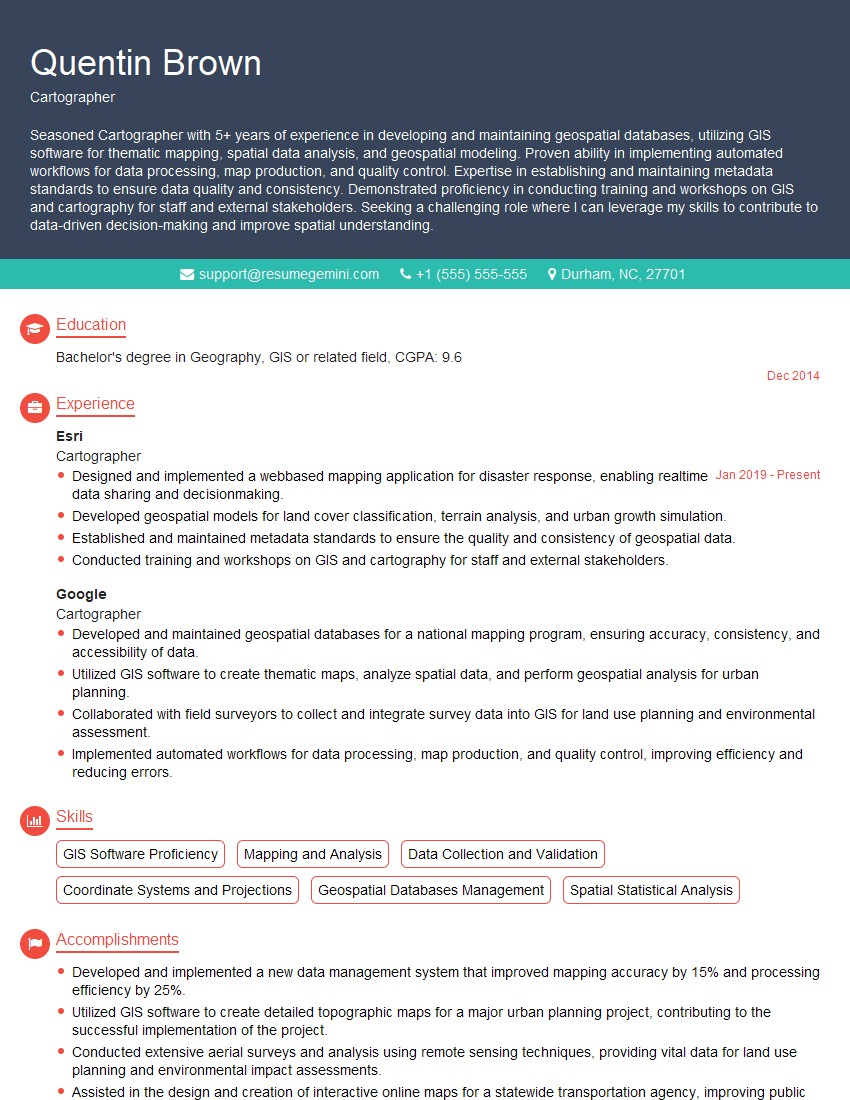
Cartographer Resume Sample

Photogrammetrist Resume Sample

Geodetic Surveyor Resume Sample
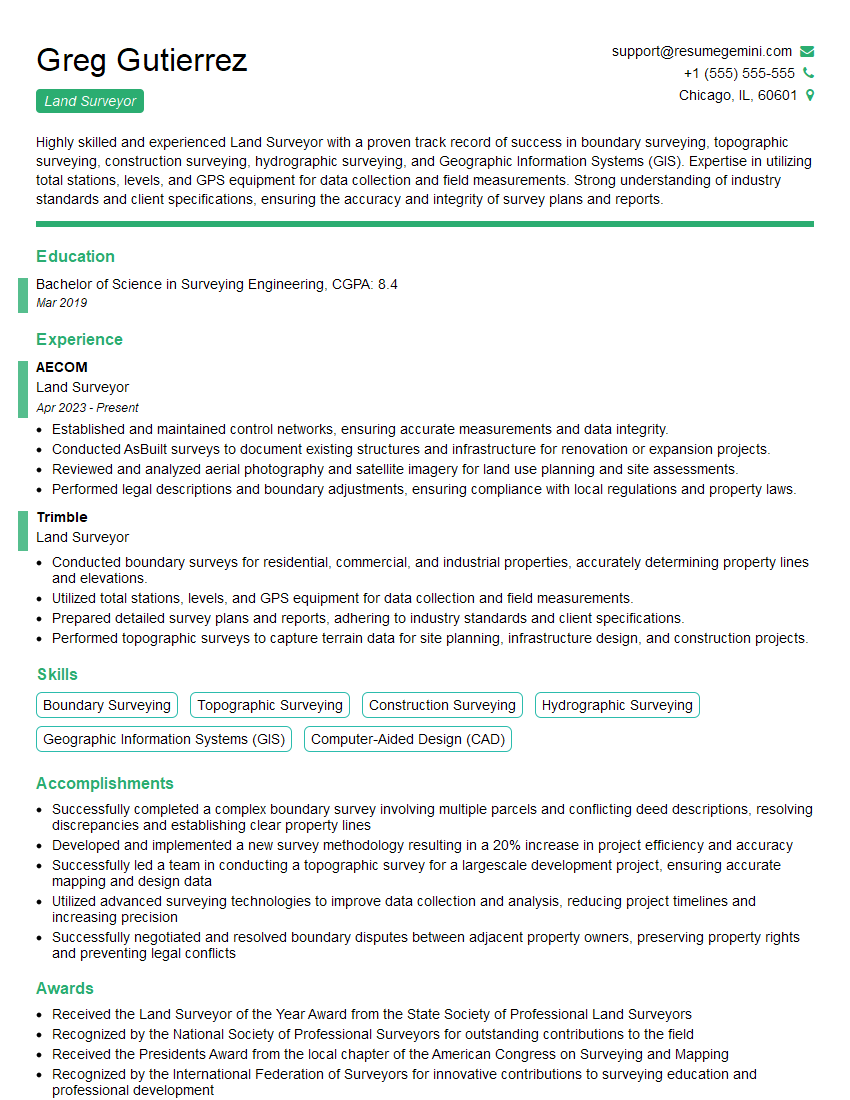
Land Surveyor Resume Sample
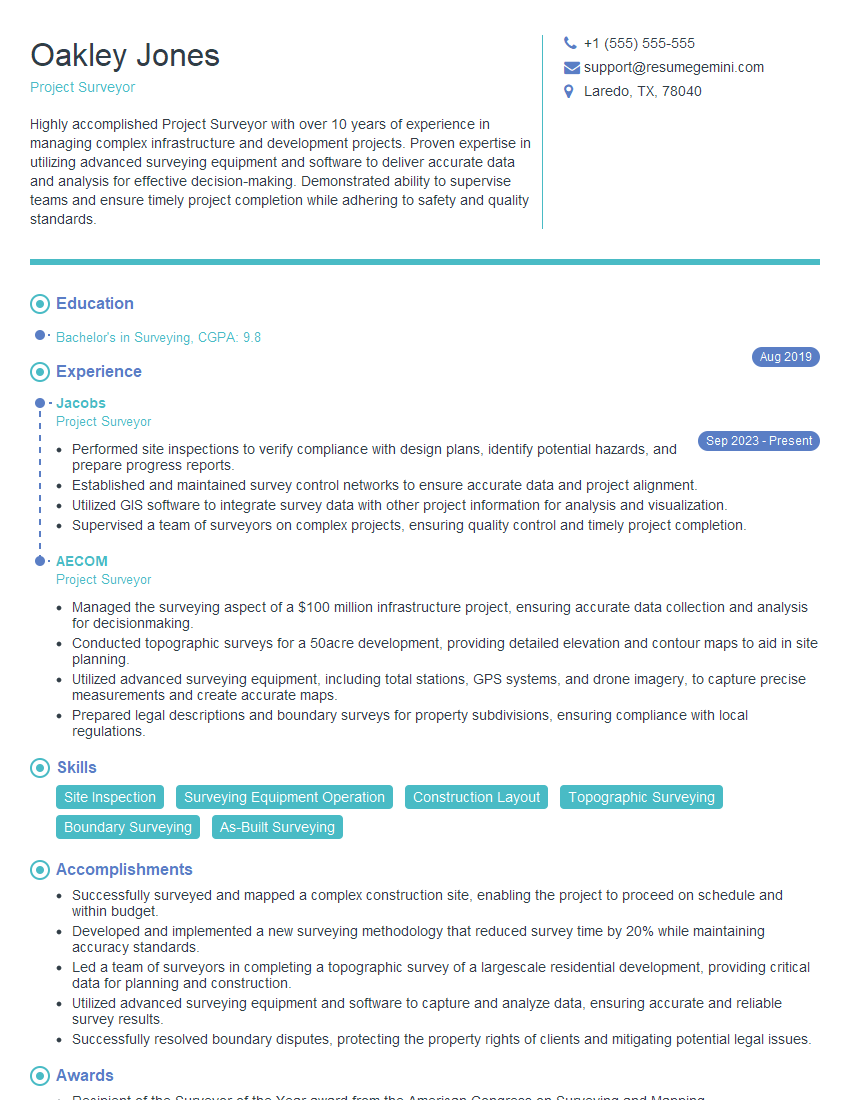
Project Surveyor Resume Sample

Survey Manager Resume Sample

Survey Party Chief Resume Sample

Surveying Technician Resume Sample
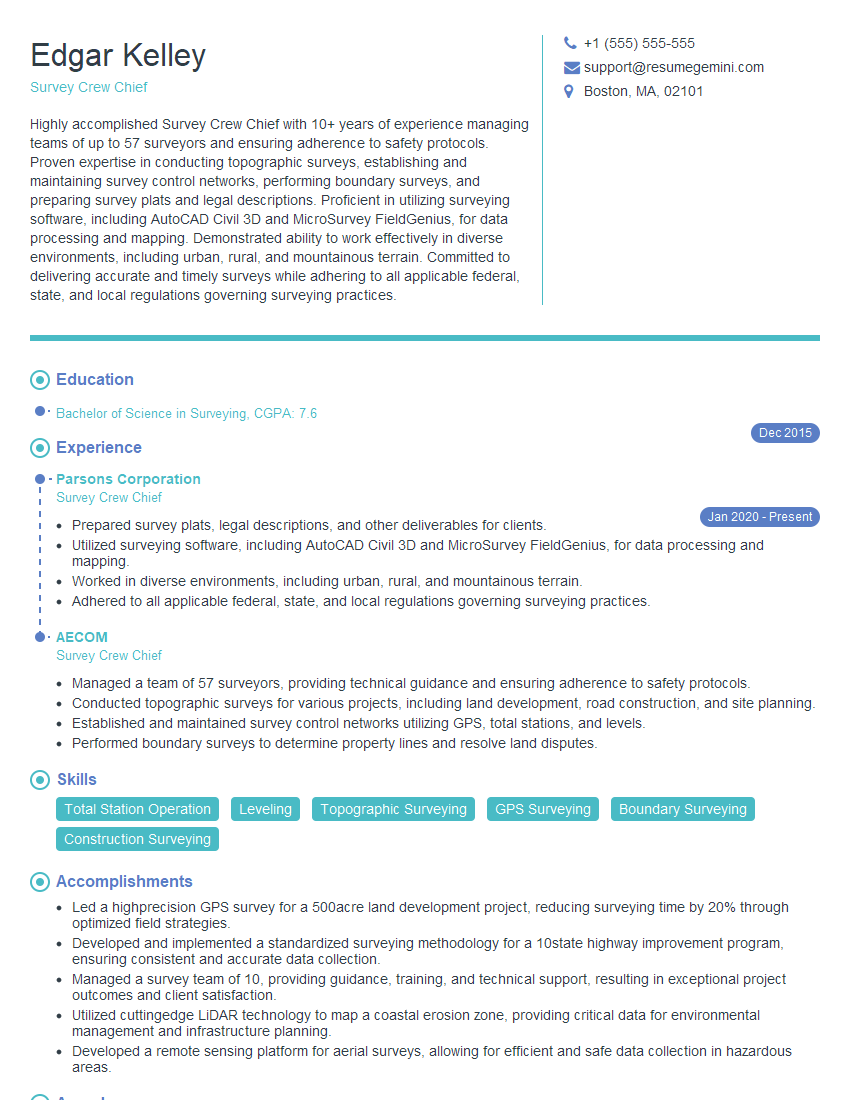
Survey Crew Chief Resume Sample
Explore more articles
Users Rating of Our Blogs
Share Your Experience
We value your feedback! Please rate our content and share your thoughts (optional).
What Readers Say About Our Blog
Really detailed insights and content, thank you for writing this detailed article.
IT gave me an insight and words to use and be able to think of examples