Feeling uncertain about what to expect in your upcoming interview? We’ve got you covered! This blog highlights the most important Geospatial Data Infrastructure Development interview questions and provides actionable advice to help you stand out as the ideal candidate. Let’s pave the way for your success.
Questions Asked in Geospatial Data Infrastructure Development Interview
Q 1. Explain the difference between vector and raster data models.
Vector and raster data models are two fundamental ways to represent geographic data in a GIS (Geographic Information System). Think of it like this: raster is like a photograph, and vector is like a drawing.
Raster data stores spatial data as a grid of cells or pixels, each containing a value representing a characteristic like temperature, elevation, or land cover. Each pixel has a defined spatial resolution (size). Examples include satellite imagery, aerial photography, and digital elevation models (DEMs).
- Advantages: Simple to understand and visualize, efficient for storing continuous data like elevation.
- Disadvantages: Data can be bulky, resolution limits detail, and analysis can be computationally intensive for very large datasets.
Vector data stores spatial data as points, lines, and polygons. Each feature has its own attributes associated with it. For example, a point might represent a well, a line a road, and a polygon a building. Attributes might include well depth, road name, or building ownership.
- Advantages: Precise representation of spatial features, smaller file sizes (compared to raster with the same level of detail), allows for more complex attribute analysis.
- Disadvantages: Can be more complex to create and edit than raster data, less suitable for representing continuous data.
In essence, the choice between vector and raster depends on the type of data and the intended analysis. A land-use map might be best represented as raster, while a road network is better suited to vector.
Q 2. Describe your experience with various spatial databases (e.g., PostGIS, Oracle Spatial, ArcGIS Server).
I have extensive experience working with various spatial databases, including PostGIS, Oracle Spatial, and ArcGIS Server. My experience spans from database design and implementation to data loading, query optimization, and spatial analysis.
PostGIS, an open-source extension to PostgreSQL, is my primary choice for many projects due to its flexibility, performance, and rich spatial functions. I’ve used it to build geospatial applications ranging from real-time location tracking to environmental modeling. For example, I built a system using PostGIS to manage and analyze a city’s stormwater network, optimizing drainage infrastructure based on rainfall data and elevation models.
Oracle Spatial is a robust commercial solution offering excellent performance for very large datasets. I’ve worked with Oracle Spatial in projects requiring high availability and scalability, often involving integrating geospatial data with enterprise systems. I implemented a national-scale land registry system using Oracle Spatial, focusing on data security and transaction management.
ArcGIS Server provides a powerful platform for deploying and serving geospatial data and services. I’ve leveraged its capabilities to build web map applications, providing accessible and interactive geospatial information to the public. One project involved creating a public-facing web map displaying real-time traffic conditions integrated with ArcGIS Server.
Each database has its own strengths and weaknesses, and my selection depends heavily on project requirements, budget constraints, and the team’s familiarity with specific technologies.
Q 3. How do you ensure data quality and accuracy in a geospatial database?
Ensuring data quality and accuracy in a geospatial database is paramount. It’s a multi-faceted process involving several key steps:
- Data Source Validation: Thoroughly assess the reliability and accuracy of the source data before incorporating it into the database. This includes understanding data collection methods, potential errors, and limitations.
- Data Cleaning and Preprocessing: This crucial step involves identifying and correcting errors such as outliers, inconsistencies, and missing values. Techniques include spatial and attribute validation rules and automated cleaning scripts.
- Data Transformation and Projection: Ensure all data is in a consistent coordinate system and projection suitable for analysis. Transformations can introduce errors if not handled correctly, so rigorous validation is necessary.
- Spatial Data Integrity Checks: Perform regular checks using spatial functions and validation rules to detect topological errors such as self-intersections, overlaps, and gaps in polygons.
- Metadata Management: Comprehensive metadata, describing data sources, collection methods, accuracy assessment, and other crucial information, is vital. This ensures traceability and allows for informed use of the data.
- Version Control: Implement version control for the database to track changes and revert to previous states if needed. This is crucial for auditing purposes.
- Regular Quality Assurance (QA) Testing: Routine testing using various methods, including visual inspection, spatial analysis, and statistical comparisons against reference data, is essential to maintain data quality over time.
By implementing a robust QA/QC strategy and addressing errors proactively, we can significantly improve the reliability and utility of the geospatial database.
Q 4. What are the key components of a robust geospatial data infrastructure?
A robust geospatial data infrastructure (GDI) is comprised of several key components working in synergy:
- Data Acquisition and Management: This involves planning, acquiring, and managing geospatial data from various sources, ensuring data quality and consistency.
- Data Storage and Access: Efficient storage and retrieval of geospatial data are crucial. This may involve using spatial databases, cloud storage, or other suitable solutions.
- Data Processing and Analysis: A well-designed GDI includes tools and resources to process, analyze, and interpret geospatial data for diverse applications.
- Data Dissemination and Sharing: The ability to easily share geospatial data and information internally and externally through web services, APIs, and other means.
- Metadata Management: Comprehensive metadata provides essential information about data sources, quality, and other attributes.
- Standards and Interoperability: Adherence to industry standards (e.g., OGC standards) is crucial for data exchange and interoperability between different systems.
- Governance and Security: Defining data ownership, access rights, and security protocols is essential to manage data effectively.
A well-designed GDI is crucial for decision-making, supporting various applications, and promoting informed planning and management in diverse fields such as urban planning, transportation, environmental management, and public health.
Q 5. Explain your understanding of geospatial metadata and its importance.
Geospatial metadata is descriptive information about geospatial data. Think of it as the ‘about’ section for your geographic data. It provides crucial details that aid in understanding, using, and managing the data effectively.
It includes information such as data source, date of acquisition, coordinate system, spatial resolution, accuracy, data quality, processing steps, and contact information. The importance of comprehensive metadata cannot be overstated. It facilitates:
- Data Discovery and Understanding: Metadata allows users to quickly understand the content, limitations, and suitability of the data for their specific needs.
- Data Quality Assessment: It provides crucial information to assess the quality and reliability of the geospatial data.
- Data Interoperability: Standardized metadata ensures data can be readily shared and used across different systems and organizations.
- Data Management and Archiving: Metadata supports effective data management and long-term archival, ensuring data remains accessible and useful over time.
- Data Reuse and Sharing: Detailed metadata promotes reuse and sharing of data, preventing duplication of effort and enhancing collaborative research and analysis.
Without proper metadata, geospatial data becomes difficult to find, understand, and use effectively. It’s a critical element of building a robust and sustainable geospatial data infrastructure.
Q 6. Describe your experience with data projection and coordinate systems.
Data projection and coordinate systems are fundamental concepts in geospatial data handling. A coordinate system defines the location of points on the Earth’s surface using latitude and longitude. However, representing the Earth’s spherical surface on a flat map requires a projection, which inevitably introduces distortion.
My experience encompasses working with various coordinate systems, such as geographic coordinate systems (GCS) like WGS84 and projected coordinate systems (PCS) such as UTM and State Plane. I’m proficient in using different map projections, understanding their strengths and weaknesses concerning preservation of area, shape, distance, and direction. For example, UTM is a good choice for preserving shapes and distances over relatively smaller areas, while equal-area projections (like Albers) are more suitable when area is paramount.
Understanding these concepts allows me to choose the most appropriate coordinate system and projection for a given project and to correctly transform data between different systems as needed.
Q 7. How do you handle data transformations and projections in your workflow?
Data transformations and projections are crucial steps in any geospatial workflow. I handle these using GIS software (such as ArcGIS Pro, QGIS) and specialized libraries within programming languages (Python with libraries like GDAL/OGR).
My workflow typically involves these steps:
- Identify Coordinate Systems: First, I determine the coordinate systems of the input and output data. This often requires examining metadata or using tools to identify the projection.
- Choose Appropriate Transformation: Selecting the correct transformation method depends on the coordinate systems involved and the desired accuracy. Options include datum transformations (e.g., NAD83 to WGS84) and map projections (e.g., converting latitude/longitude to UTM).
- Perform Transformation: I then use GIS software or programming libraries to perform the transformation. This involves using functions like
Projector equivalent commands that take the input data and the source and target coordinate systems as parameters. - Validate Results: After the transformation, I conduct thorough validation to ensure the accuracy of the results. This might involve comparing known points with their transformed equivalents or visual inspection of the transformed data.
For example, in a recent project involving integrating data from different sources with varying projections, I used Python with GDAL/OGR to reproject all datasets to a common UTM zone before performing spatial analysis. gdalwarp is a particularly useful command-line tool for this.
The selection of software and methods depends on the scale of the project, data volume, and required accuracy.
Q 8. Explain the concept of spatial indexing and its benefits.
Spatial indexing is like creating a detailed map of your map! Instead of searching through every single point, line, or polygon in a massive geospatial dataset to find what you need, spatial indexing structures the data to allow for quick and efficient retrieval. Think of it as creating an index in a book—you don’t read every word to find a specific topic; you use the index to pinpoint the relevant page.
There are several types of spatial indices, each with its strengths and weaknesses. R-trees and Quadtrees are popular choices. R-trees organize spatial objects into nested bounding boxes, while Quadtrees recursively subdivide space into quadrants. Choosing the right index depends on the data characteristics and query patterns.
Benefits:
- Speed: Significantly reduces search time, especially for large datasets.
- Efficiency: Minimizes the number of data objects that need to be examined.
- Scalability: Allows for efficient handling of growing datasets.
Example: Imagine a system for managing emergency services. Rapidly locating the nearest ambulance to an accident requires quick spatial querying. A spatial index on the location of ambulances dramatically speeds up this process, enabling quicker response times and potentially saving lives.
Q 9. What are your experiences with different geospatial data formats (e.g., Shapefile, GeoJSON, GeoTIFF)?
I have extensive experience with various geospatial data formats, each with its own strengths and weaknesses.
- Shapefiles: A widely used, albeit somewhat outdated, format. I’ve used them extensively in projects requiring simple vector data, like plotting boundaries or points. However, I’m aware of their limitations, particularly their inability to handle complex topology and their reliance on multiple files (.shp, .shx, .dbf, etc.).
- GeoJSON: A modern, text-based format that’s become a standard for web mapping applications. Its simplicity, flexibility, and support for various geometries (points, lines, polygons) make it ideal for data exchange and web services. I’ve extensively used GeoJSON in projects involving web map development and data sharing.
- GeoTIFF: A powerful format for raster data, like satellite imagery and elevation models. I’ve worked with GeoTIFF in projects requiring precise georeferencing and handling of raster datasets, often integrating them with vector data for analysis. The ability to embed metadata within the GeoTIFF file is extremely valuable for managing and understanding the data.
My experience spans using these formats with various GIS software and programming languages like Python, leveraging libraries such as GDAL and OGR to process and manipulate the data.
Q 10. Describe your experience with geoprocessing tools and techniques.
My geoprocessing experience encompasses a wide range of tools and techniques, from scripting in Python with libraries like GDAL/OGR and PostGIS to using dedicated GIS software such as ArcGIS Pro and QGIS.
I’m proficient in performing various geoprocessing tasks including:
- Spatial analysis: Buffering, overlay analysis (union, intersection, difference), proximity analysis, network analysis.
- Data conversion and transformation: Projecting data between different coordinate systems, reformatting data between different file types.
- Data cleaning and validation: Identifying and correcting inconsistencies and errors in geospatial data.
- Raster processing: Image classification, terrain analysis, mosaicking, and orthorectification.
For example, in a recent project, I used Python with GDAL to automate the processing of a large collection of satellite images, performing geometric corrections and creating a seamless mosaic for further analysis. In another project, I used ArcGIS Pro’s network analysis tools to optimize delivery routes for a logistics company.
Q 11. How do you ensure data interoperability within a geospatial infrastructure?
Data interoperability is crucial for any successful geospatial infrastructure. My approach involves a multi-faceted strategy:
- Standard Data Formats: Prioritizing open and widely-supported formats like GeoJSON, GeoTIFF, and WMS/WFS for data exchange. This minimizes compatibility issues.
- Metadata Standards: Implementing consistent metadata schemas (e.g., ISO 19115) to ensure data discoverability, understanding, and quality control.
- Coordinate System Management: Establishing a clear and consistent coordinate reference system (CRS) for all data to avoid projection inconsistencies.
- Data Transformation Tools: Utilizing tools and libraries (like GDAL/OGR) to facilitate data transformation between different formats and coordinate systems.
- Data Governance Policies: Establishing clear guidelines and policies for data acquisition, processing, and quality control to ensure data consistency and reliability.
For example, in a large-scale urban planning project, I ensured interoperability by creating a central geospatial database using PostGIS, which supported various data formats and projection systems. This allowed different teams to access and share data seamlessly.
Q 12. Explain your experience with cloud-based geospatial platforms (e.g., AWS, Azure, Google Cloud).
I have practical experience with cloud-based geospatial platforms like AWS, Azure, and Google Cloud. Each platform offers distinct advantages:
- AWS: I’ve used AWS services like S3 for data storage, EC2 for processing, and RDS for database management. The scalability and cost-effectiveness of AWS are particularly beneficial for handling large geospatial datasets and complex processing tasks.
- Azure: Azure’s strengths lie in its integration with other Microsoft services and its strong support for enterprise-level geospatial solutions. I’ve leveraged Azure services like Azure Blob Storage and Azure SQL Database for geospatial data management.
- Google Cloud: Google Cloud offers powerful geospatial analytics capabilities through its BigQuery and Earth Engine services. I have experience using Google Earth Engine for processing large satellite imagery datasets and performing analysis at scale.
My experience includes designing and deploying cloud-based geospatial applications, utilizing serverless functions for efficient processing, and implementing robust security measures to protect sensitive geospatial data.
Q 13. Describe your approach to designing and implementing a geospatial data model.
Designing a geospatial data model requires careful consideration of data requirements and the intended use cases. My approach involves a structured process:
- Requirements Gathering: Thoroughly understanding the project’s objectives, data needs, and the types of spatial analysis that will be performed.
- Entity Identification: Identifying the key geographic entities (e.g., buildings, roads, parcels) and their attributes.
- Relationship Definition: Defining the relationships between these entities (e.g., a road connects two intersections).
- Schema Design: Developing a relational or object-oriented schema to represent the entities, their attributes, and relationships. This often involves choosing appropriate spatial data types (e.g., points, lines, polygons).
- Data Modeling Tools: Utilizing tools like ER diagrams or UML diagrams to visualize the data model and ensure clarity and consistency.
- Implementation and Testing: Implementing the data model in a chosen database (e.g., PostGIS, Oracle Spatial) and thoroughly testing its functionality.
For example, when designing a data model for managing utilities infrastructure, I would carefully consider the relationships between pipelines, valves, and service connections, ensuring efficient querying and analysis for maintenance and emergency response.
Q 14. How do you manage large datasets in a geospatial environment?
Managing large geospatial datasets requires a strategic approach combining efficient data storage, processing, and querying techniques. My strategies include:
- Database Optimization: Using spatial databases (e.g., PostGIS) optimized for handling large spatial datasets, leveraging spatial indexing to speed up queries.
- Data Partitioning: Dividing large datasets into smaller, manageable chunks for easier processing and analysis. This can involve tiling raster data or partitioning vector data based on geographic boundaries.
- Cloud-based Solutions: Leveraging cloud storage services (e.g., AWS S3, Azure Blob Storage) for storing and managing large datasets, and cloud computing resources for parallel processing.
- Data Compression: Applying appropriate compression techniques to reduce storage space and improve processing efficiency.
- Data Streaming and Processing: Utilizing streaming technologies to process large datasets in a continuous and efficient manner without needing to load the entire dataset into memory.
For instance, when dealing with petabytes of satellite imagery, I’ve employed a combination of cloud storage, distributed processing frameworks like Hadoop or Spark, and data tiling strategies to efficiently manage and process this massive volume of data.
Q 15. What are the challenges in managing geospatial data security and access control?
Managing geospatial data security and access control presents unique challenges due to the sensitive nature of location-based information and the potential for misuse. Think of it like protecting a highly detailed map – you wouldn’t want just anyone to have access to all its information. The challenges stem from several factors:
- Data Confidentiality: Protecting sensitive data like addresses, demographics linked to locations, or critical infrastructure coordinates requires robust encryption and access control mechanisms. For example, a city’s emergency response system’s location data requires extremely high levels of security.
- Data Integrity: Preventing unauthorized modification or deletion of geospatial data is crucial. This involves implementing version control, audit trails, and strict access permissions to ensure data accuracy and reliability. Imagine the consequences of someone altering road network data in a navigation system.
- Data Availability: Ensuring that authorized users can access the data when needed, while preventing denial-of-service attacks, requires careful planning of infrastructure and redundancy. Think about a weather forecasting system that relies on real-time geospatial data – downtime is unacceptable.
- Scalability and Complexity: Managing security and access for large and complex geospatial datasets can be challenging. Implementing fine-grained access control across different user groups and data subsets requires sophisticated technologies and careful planning. A large national land registry system exemplifies this complexity.
- Compliance with Regulations: Geospatial data often falls under strict regulations like HIPAA (health data) or GDPR (personal data), demanding stringent security practices and compliance audits. Healthcare organizations using location data for patient monitoring are a prime example.
Effective solutions involve implementing a combination of technical measures (encryption, access control lists, firewalls) and organizational procedures (data governance policies, user training, regular security audits). A robust GIS security architecture is essential.
Career Expert Tips:
- Ace those interviews! Prepare effectively by reviewing the Top 50 Most Common Interview Questions on ResumeGemini.
- Navigate your job search with confidence! Explore a wide range of Career Tips on ResumeGemini. Learn about common challenges and recommendations to overcome them.
- Craft the perfect resume! Master the Art of Resume Writing with ResumeGemini’s guide. Showcase your unique qualifications and achievements effectively.
- Don’t miss out on holiday savings! Build your dream resume with ResumeGemini’s ATS optimized templates.
Q 16. Describe your experience with spatial analysis techniques.
My experience with spatial analysis encompasses a broad range of techniques, applied across various projects. I’m proficient in using tools like ArcGIS and QGIS to perform analyses such as:
- Spatial Interpolation: Estimating values at unsampled locations based on known data points, crucial for creating continuous surfaces from point data like elevation or pollution levels. I’ve used kriging and inverse distance weighting in projects involving environmental modeling.
- Overlay Analysis: Combining multiple spatial datasets to identify spatial relationships and patterns. For instance, overlaying land use maps with flood risk zones to assess vulnerability. This was key in a project assessing the impact of climate change on coastal communities.
- Network Analysis: Analyzing spatial networks like road networks or utility pipelines to solve problems like finding the shortest route or optimizing resource allocation. I leveraged Dijkstra’s algorithm in a project optimizing emergency service response times.
- Geostatistics: Analyzing spatial autocorrelation and modeling spatial variability. This is particularly useful when studying phenomena with spatial dependencies, like soil properties or disease outbreaks. I applied geostatistical methods in a study on the spread of invasive plant species.
- Spatial Regression: Investigating the relationships between spatial variables and other factors. For example, analyzing the relationship between crime rates and socioeconomic factors. This was used in a project understanding the drivers of urban sprawl.
I also have experience with scripting languages like Python with libraries like GeoPandas and Shapely to automate spatial analysis workflows and build custom tools for specific project needs.
Q 17. How do you handle data inconsistencies and errors in a geospatial database?
Handling data inconsistencies and errors in a geospatial database requires a systematic approach. Think of it like editing a complex map – you need to identify and correct inaccuracies to ensure its usability. My approach involves several steps:
- Data Cleaning and Validation: This includes checking for inconsistencies in data types, attribute values, and spatial geometries. I utilize tools and techniques to identify and flag errors, such as checking for duplicate records, null values, and spatial topology errors (e.g., overlapping polygons).
- Data Transformation: Data often needs to be transformed to fit the requirements of the database or analysis tasks. This might involve projecting data to a common coordinate system, standardizing attribute values, or generalizing geometries to reduce complexity.
- Spatial Data Editing: Correcting spatial errors through manual editing or automated tools. This involves fixing things like slivers, gaps, or overlaps in polygon geometries. I often use GIS software’s editing tools to correct these issues.
- Error Propagation Analysis: Understanding how errors in the input data can affect the results of analyses is vital. This involves evaluating the accuracy and precision of spatial data and adjusting analytical methods accordingly.
- Metadata Management: Documenting data quality issues and corrections using metadata standards ensures that the history and potential limitations of the data are well understood. This is crucial for transparency and reproducibility.
The specific techniques employed depend on the nature and source of the data. For example, aerial imagery requires different error correction approaches than data collected through GPS.
Q 18. Explain your experience with version control for geospatial data.
Version control is crucial for managing geospatial data, especially in collaborative projects. It’s like tracking changes to a document collaboratively; you want to know who made what changes, when, and the ability to revert to previous versions if needed. I’ve used several approaches:
- Geodatabases with versioning: ArcGIS geodatabases offer built-in versioning capabilities that allow multiple users to work on the same data simultaneously while tracking changes and resolving conflicts. I’ve successfully managed large-scale geospatial projects using this.
- Git with specialized extensions: While Git is not natively designed for geospatial data, extensions like Git LFS (Large File Storage) allow managing large raster and vector files effectively within a Git workflow. This has proved valuable in open-source projects and collaborative data sharing scenarios.
- PostGIS with versioning extensions: PostGIS, a PostgreSQL extension for spatial data, offers various extension capabilities for version control and supports sophisticated workflows. This is an excellent choice for managing very large and complex geospatial datasets.
Regardless of the chosen approach, a well-defined branching strategy is essential to manage different versions, features, and bug fixes. Regular backups are also a key part of maintaining data integrity and ensuring recoverability.
Q 19. Describe your understanding of open-source geospatial software.
My understanding of open-source geospatial software is extensive. I’m proficient in using several key tools like:
- QGIS: A powerful and versatile desktop GIS application, providing a wide range of functionalities similar to commercial software like ArcGIS, but free and open-source. I frequently use it for data processing, analysis, and visualization.
- PostGIS: An open-source spatial database extension for PostgreSQL, allowing the storage and management of geospatial data within a relational database. I often leverage it for efficient querying, spatial analysis within a database, and scalability.
- GDAL/OGR: A powerful library for reading and writing various geospatial data formats. This provides crucial interoperability and allows automation through scripting languages such as Python.
- GRASS GIS: A mature and powerful open-source GIS, particularly strong in raster data processing and environmental modeling. I have experience using this for specific niche applications.
The benefits of open-source software include cost savings, community support, flexibility, and the ability to customize functionalities to suit specific project needs. The open nature fosters collaboration and innovation.
Q 20. How do you ensure the scalability and performance of a geospatial data infrastructure?
Ensuring the scalability and performance of a geospatial data infrastructure is crucial, especially when dealing with large datasets and many users. It’s like designing a highway system – you need efficient roads to handle the traffic volume. My strategies involve:
- Database Optimization: Choosing the right database technology (e.g., PostGIS, SpatiaLite) with appropriate indexing and query optimization is paramount. This improves the speed and efficiency of data retrieval and analysis.
- Data Partitioning and Sharding: For very large datasets, partitioning (dividing data into smaller, manageable units) or sharding (distributing data across multiple database servers) improves performance and scalability. This is essential when dealing with petabyte-scale data.
- Caching Strategies: Implementing caching mechanisms at various levels (e.g., database, application server) reduces database load and improves response times, especially for frequently accessed data. This is very helpful in improving the performance of web mapping applications.
- Efficient Data Structures: Using appropriate data structures (e.g., R-trees, quadtrees) for spatial indexing can drastically improve the performance of spatial queries.
- Load Balancing and Clustering: Distributing workloads across multiple servers through load balancing and clustering ensures high availability and resilience, especially for high-traffic applications. This allows you to handle spikes in usage without performance degradation.
- Cloud-based solutions: Leveraging cloud platforms (e.g., AWS, Azure, Google Cloud) provides scalability and elasticity, allowing the infrastructure to adapt to changing demands.
Regular performance testing and monitoring are essential to identify bottlenecks and optimize the infrastructure over time.
Q 21. Explain your experience with geospatial data visualization and mapping.
My experience in geospatial data visualization and mapping spans various techniques and tools. It’s about translating complex spatial information into understandable visuals, much like creating a map that effectively communicates key insights. My expertise includes:
- Static Mapping: Creating high-quality maps using GIS software (ArcGIS, QGIS) for reports, presentations, and publications. I often integrate diverse data sources and customize map elements (symbols, legends, layouts) to enhance readability and informativeness.
- Interactive Web Mapping: Developing interactive web maps using frameworks like Leaflet, OpenLayers, and Mapbox GL JS. These allow users to explore data dynamically, zoom in/out, query features, and interact with the map. I’ve built several web maps for public engagement and data dissemination.
- 3D Visualization: Creating 3D models and visualizations using software like ArcGIS Pro or specialized 3D modeling tools. This provides a more immersive and intuitive understanding of complex spatial data, useful for tasks like urban planning or environmental impact assessment.
- Data Storytelling and Cartography Principles: I emphasize effective communication through visualization, adhering to cartographic principles such as map projections, symbolization, and labeling to create clear and accurate maps. The goal is always to effectively convey the information.
- Data Visualization Tools: I’m also proficient in using data visualization tools like Tableau and Power BI to create charts, graphs, and dashboards that integrate geospatial data with other types of data for a comprehensive overview.
The choice of visualization techniques depends heavily on the data, the target audience, and the specific message to be conveyed. I always strive to create clear, accurate, and engaging visuals.
Q 22. How do you plan and manage a geospatial data project?
Planning and managing a geospatial data project requires a structured approach. Think of it like building a house – you need a solid foundation, detailed blueprints, and a well-coordinated team. It starts with a thorough understanding of the project’s objectives, defining the scope, identifying data sources, and outlining the deliverables.
- Requirements Gathering: This involves understanding the client’s needs, identifying the specific geospatial data required, and defining the desired outputs (maps, analyses, reports, etc.).
- Data Acquisition and Processing: This step involves sourcing data from various sources (e.g., satellite imagery, LiDAR, GPS, census data), cleaning it, transforming it into the desired format, and projecting it to a common coordinate system.
- Database Design and Implementation: Selecting the appropriate database management system (DBMS), designing the schema, and implementing the database to store and manage the geospatial data efficiently. PostGIS, for example, is a popular extension for PostgreSQL that adds support for geospatial objects.
- Data Analysis and Visualization: This involves performing spatial analysis (e.g., overlay analysis, proximity analysis, buffer analysis) and creating visualizations (maps, charts, graphs) to communicate insights derived from the data.
- Quality Assurance and Control: Implementing rigorous quality checks throughout the project lifecycle to ensure data accuracy, consistency, and completeness. This includes metadata creation and maintenance.
- Project Management: Utilizing project management methodologies (e.g., Agile, Waterfall) to track progress, manage resources, and ensure timely delivery within budget.
For example, in a project involving urban planning, we would gather data on land use, population density, and infrastructure, process it to create a consistent dataset, and then use GIS software to model different urban development scenarios and assess their impact. This helps make informed decisions on things like traffic flow, public transportation, and resource allocation.
Q 23. What are the key performance indicators (KPIs) for evaluating a geospatial data infrastructure?
Key Performance Indicators (KPIs) for a geospatial data infrastructure focus on its usability, reliability, and efficiency. These KPIs can be categorized into several areas:
- Data Quality: Accuracy, completeness, consistency, and timeliness of the geospatial data. This can be measured using metrics like positional accuracy, attribute accuracy, and data update frequency.
- Data Accessibility and Usability: Ease of accessing, using, and sharing the data. This is assessed through metrics like response times for data queries, the number of users accessing the data, and user satisfaction surveys.
- System Performance: Efficiency of data processing, storage, and retrieval. KPIs include processing speed, storage capacity utilization, and system uptime.
- Data Security and Integrity: Protection of data from unauthorized access, modification, or deletion. This is measured using metrics like the number of security breaches, data loss rate, and compliance with security standards.
- Cost-Effectiveness: Cost of developing, maintaining, and operating the geospatial data infrastructure. KPIs include total cost of ownership, cost per data access, and return on investment.
For instance, a high percentage of inaccurate data points (low data quality) would negatively impact decision-making, while slow response times (low accessibility and usability) would hinder efficient analysis.
Q 24. Describe your experience with geospatial data warehousing and data lakes.
Geospatial data warehousing and data lakes represent different approaches to storing and managing large volumes of geospatial data. A geospatial data warehouse is a centralized repository of integrated, consistent, and historically relevant geospatial data, optimized for analytical processing. Think of it as a highly organized library, carefully curated for specific research questions. A geospatial data lake, on the other hand, is a raw, unstructured repository of diverse geospatial data in its native format. It’s like a vast warehouse, storing everything regardless of its structure or format.
My experience involves designing and implementing both. I’ve used geospatial data warehouses to support complex spatial analyses, where data consistency and efficient query performance are critical. For example, I worked on a project using a geospatial data warehouse built on PostgreSQL/PostGIS to analyze land-use change over several decades. This required integrating data from various sources, ensuring data consistency, and optimizing the database for complex spatial queries.
I’ve also utilized geospatial data lakes to store large, diverse datasets such as satellite imagery and sensor data, where the need for immediate structuring is less critical. Here, the focus was on cost-effective storage and easy access for exploratory data analysis.
Choosing between a data warehouse and a data lake depends on the specific needs of the project. Often, a hybrid approach, using both, provides the best solution. Data lakes can store the raw data, while a data warehouse holds processed and structured data for analysis.
Q 25. How do you stay up-to-date with the latest trends and technologies in geospatial data infrastructure?
Staying current in the dynamic field of geospatial data infrastructure requires a multifaceted approach. I actively engage in several strategies:
- Professional Organizations: Membership in organizations like the Urban & Regional Information Systems Association (URISA) and the Association for Geographic Information (AGI) provides access to conferences, publications, and networking opportunities.
- Conferences and Workshops: Attending industry events such as Esri User Conferences and international geomatics conferences allows exposure to new technologies, best practices, and emerging trends.
- Publications and Journals: Regularly reviewing peer-reviewed journals (e.g., International Journal of Geographical Information Science) and industry publications keeps me abreast of the latest research and developments.
- Online Courses and Tutorials: Utilizing online platforms like Coursera, edX, and Udemy for specialized training on new technologies (e.g., cloud-based GIS, machine learning for geospatial data).
- Open-Source Communities: Participating in open-source projects (e.g., contributing to PostGIS) and interacting with developers enables hands-on experience with new technologies and collaborative learning.
- Industry Blogs and Websites: Following reputable blogs and websites focused on geospatial technology keeps me informed about the latest news, product releases, and best practices.
This ongoing learning process is crucial for ensuring I remain proficient and adapt to the rapidly evolving landscape of this field.
Q 26. Describe a challenging geospatial data problem you solved and how you approached it.
One challenging project involved integrating disparate datasets for a large-scale environmental monitoring program. The datasets included satellite imagery, weather data, sensor readings from various environmental monitoring stations, and field survey data. The challenge was the inconsistency in data formats, coordinate systems, and temporal resolutions. Furthermore, there were significant data quality issues, including missing values and outliers.
My approach involved a multi-step process:
- Data Assessment and Cleaning: This involved a thorough assessment of each dataset, identifying inconsistencies, cleaning the data (handling missing values and outliers), and standardizing data formats. This stage utilized both automated scripts and manual review.
- Data Transformation and Projection: We transformed the data into a common spatial reference system and data format using GIS software. This ensured seamless integration and analysis.
- Database Design and Implementation: I designed and implemented a geospatial database using PostgreSQL/PostGIS to store and manage the integrated datasets efficiently. The schema was designed to support various spatial queries and analyses.
- Data Quality Control: Implemented various quality checks throughout the process to detect and address errors. This included validation routines and visual inspection of data.
- Data Integration and Analysis: The datasets were integrated and analyzed using GIS software and spatial statistical tools to generate visualizations and reports for environmental monitoring.
The result was a comprehensive and accurate dataset for environmental monitoring, which led to improved decision-making regarding environmental management and resource allocation.
Q 27. Explain your experience with integrating geospatial data with other data sources.
Integrating geospatial data with other data sources is fundamental to many geospatial projects. It often involves combining location-based information with demographic, economic, environmental, or social data. This integration allows for richer, more insightful analyses.
My experience includes various integration techniques:
- Spatial Joins: This involves linking geospatial features (e.g., points, polygons) based on their spatial relationship. For example, joining census data (containing demographic information for each census tract) with a polygon shapefile representing the census tract boundaries.
- Attribute Joins: This links tables based on a common attribute field. For instance, linking a table of building permits with a point layer representing building locations.
- Database Joins: This technique uses SQL joins to combine data from different tables within a database. This is very common when working with geospatial databases like PostGIS.
- API Integration: Utilizing APIs to retrieve data from external sources and integrate it with geospatial data. This might involve incorporating real-time traffic data, weather information, or social media data.
- Data Fusion Techniques: Employing advanced techniques like data fusion to combine data from multiple sources, potentially with differing qualities, to create a more complete and accurate dataset. This often requires careful consideration of data weighting and uncertainty management.
In a project involving transportation planning, for example, I integrated GPS data from buses with road network data and population density information to optimize bus routes and improve public transport efficiency. This involved spatial joins to link bus locations to road segments, and attribute joins to add population density information.
Key Topics to Learn for Geospatial Data Infrastructure Development Interview
- Data Modeling and Database Design: Understanding spatial data models (e.g., vector, raster), database management systems (e.g., PostGIS, Oracle Spatial), and schema design for optimal data storage and retrieval. Consider practical applications like designing a database for managing road networks or environmental monitoring data.
- Geospatial Data Standards and Interoperability: Familiarity with standards like GML, GeoJSON, and OGC services (WMS, WFS, WCS). Be prepared to discuss how these standards ensure data exchange and compatibility between different systems. Consider the challenges of integrating data from various sources with differing formats and projections.
- Spatial Analysis and Geoprocessing: Knowledge of common spatial analysis techniques (e.g., buffering, overlay, proximity analysis) and geoprocessing workflows using tools like ArcGIS, QGIS, or GDAL. Be ready to discuss how these techniques are applied to solve real-world problems in areas such as urban planning, environmental management, or disaster response.
- Cloud-Based Geospatial Solutions: Understanding cloud platforms (e.g., AWS, Azure, Google Cloud) and their role in hosting and processing geospatial data. Discuss the advantages and disadvantages of cloud-based solutions compared to on-premise infrastructure. Consider scalability and cost-effectiveness in your responses.
- API Development and Integration: Experience with developing or integrating APIs for accessing and manipulating geospatial data. This might involve using RESTful APIs, working with spatial libraries in various programming languages (Python, Java, etc.), or understanding the principles of web mapping APIs (e.g., Leaflet, Mapbox GL JS).
- Data Quality and Metadata Management: Discuss the importance of data quality assurance and control, metadata standards (e.g., ISO 19115), and the role of metadata in data discovery and usability. Consider how to address data inconsistencies and errors in a large geospatial dataset.
Next Steps
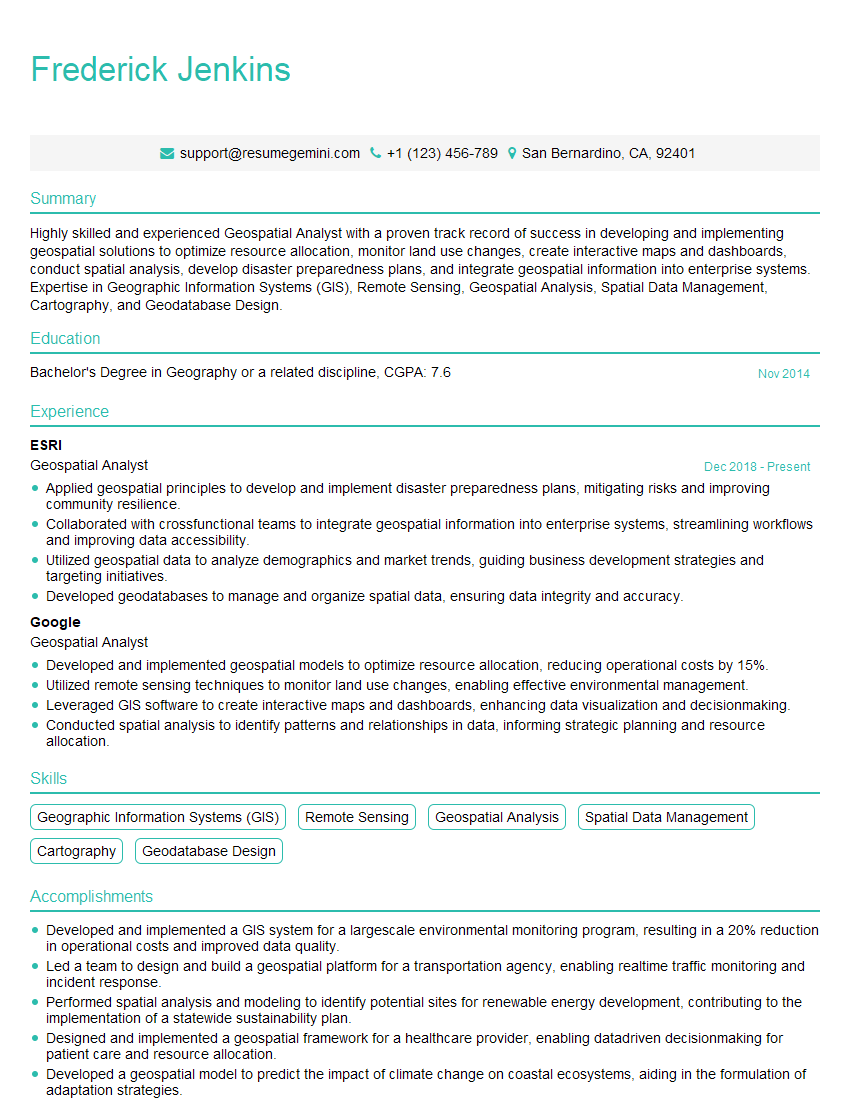
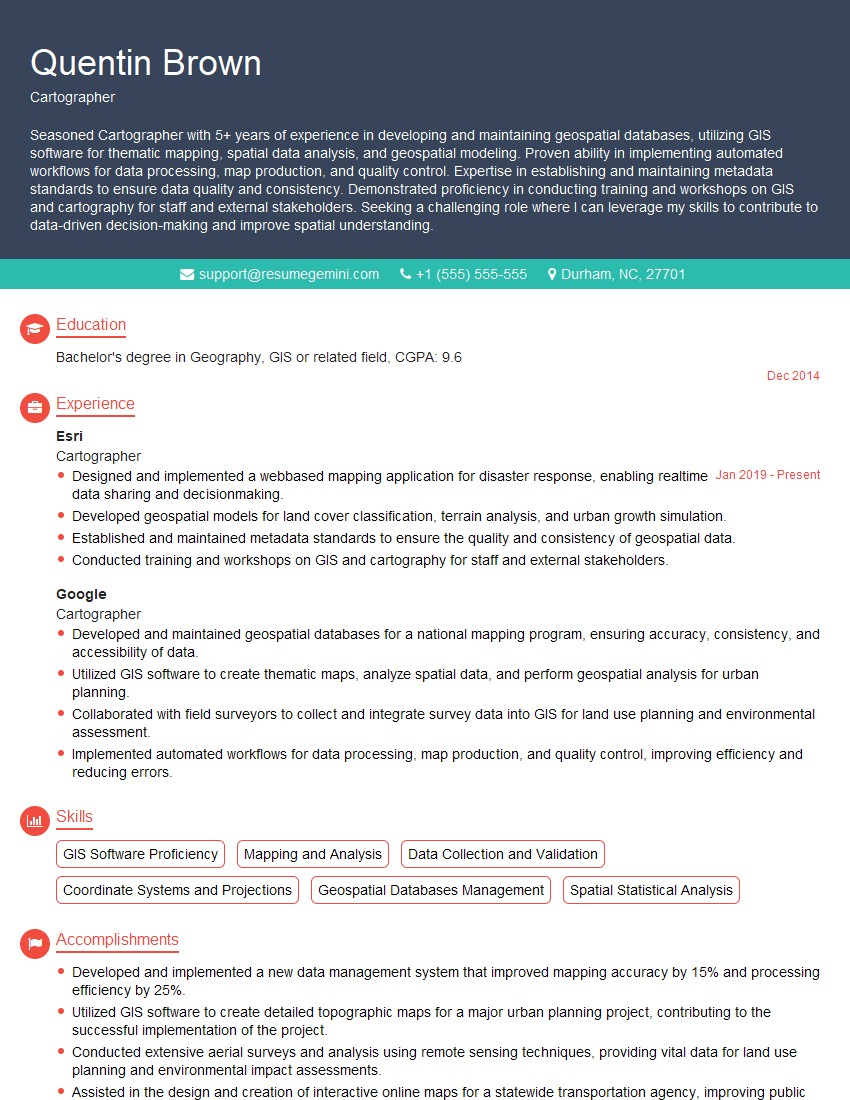
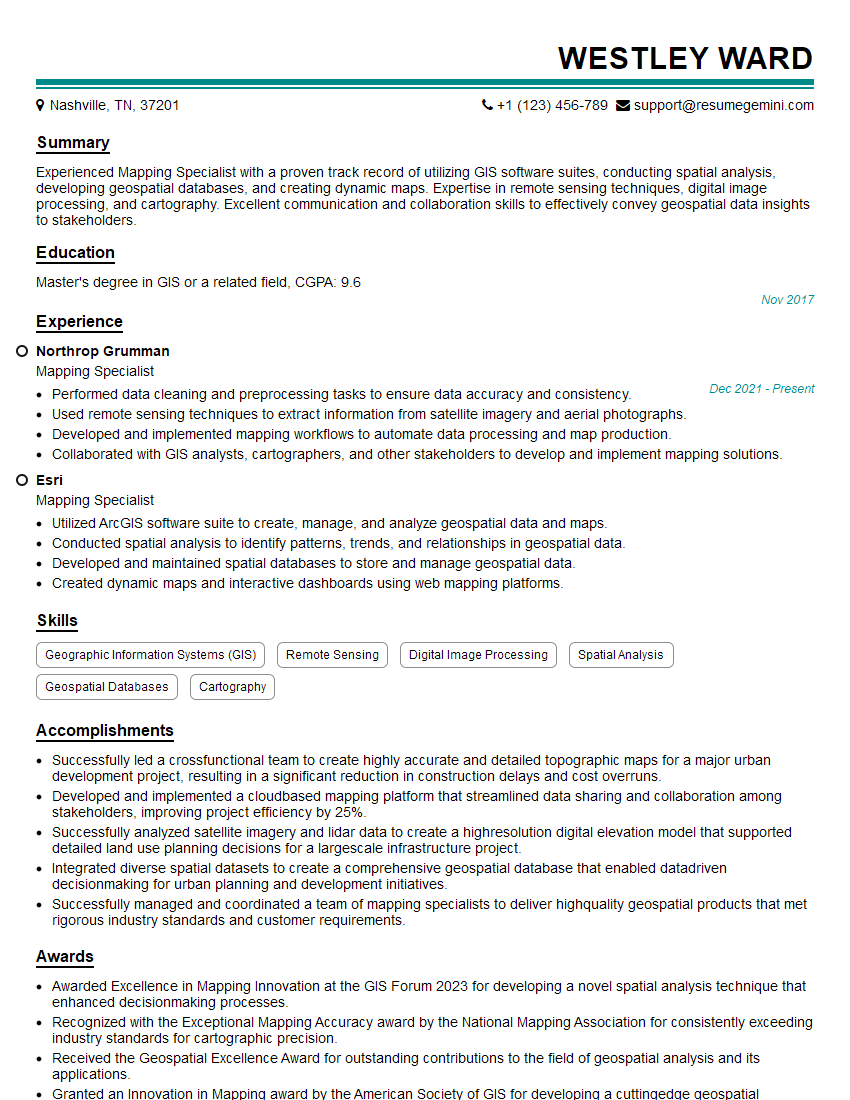
Mastering Geospatial Data Infrastructure Development opens doors to exciting and impactful careers in various sectors. To maximize your job prospects, crafting a strong, ATS-friendly resume is crucial. ResumeGemini is a trusted resource to help you build a professional and effective resume that highlights your skills and experience. Examples of resumes tailored to Geospatial Data Infrastructure Development are available, providing you with valuable templates and guidance to showcase your expertise effectively.
Explore more articles
Users Rating of Our Blogs
Share Your Experience
We value your feedback! Please rate our content and share your thoughts (optional).
What Readers Say About Our Blog
Really detailed insights and content, thank you for writing this detailed article.
IT gave me an insight and words to use and be able to think of examples