Preparation is the key to success in any interview. In this post, we’ll explore crucial Grain Arbitration interview questions and equip you with strategies to craft impactful answers. Whether you’re a beginner or a pro, these tips will elevate your preparation.
Questions Asked in Grain Arbitration Interview
Q 1. Explain the role of a grain arbitrator in resolving disputes.
A grain arbitrator acts as a neutral third party to resolve disputes arising from grain transactions. Think of them as a judge in a specialized court, but without the formal legal setting. Their role involves hearing evidence from both parties—the buyer and the seller—examining contracts, reviewing test results, and applying relevant industry standards and laws to reach a fair and legally sound resolution. They aim to prevent costly and time-consuming litigation by providing a quicker, more efficient, and often less expensive alternative.
For example, if a buyer claims that delivered grain was of inferior quality compared to what was specified in the contract, the arbitrator would hear arguments from both sides, examine the evidence (such as test reports and photographs), and determine whether the buyer is entitled to compensation or other remedies.
Q 2. Describe the different types of grain contracts and their implications in arbitration.
Grain contracts can vary significantly, impacting how disputes are arbitrated. Common types include:
- Spot Contracts: These involve immediate delivery and payment for a specific quantity of grain. Arbitration focuses on issues such as quantity, quality, and timely delivery.
- Forward Contracts: These involve the agreement to buy and sell grain at a future date and price. Arbitration may involve disputes concerning price adjustments, delivery timelines, and unforeseen market fluctuations.
- Futures Contracts: These are standardized contracts traded on exchanges. While arbitration isn’t typically used for standard futures contracts, disputes concerning specific contract terms or delivery of underlying grain may still arise and require arbitration.
The specific terms of each contract—including clauses regarding quality specifications, delivery terms, payment terms, and dispute resolution mechanisms—are crucial in the arbitration process. For instance, a contract specifying a specific acceptable level of moisture content will heavily influence the arbitrator’s decision in a dispute over grain quality.
Q 3. Outline the steps involved in a typical grain arbitration process.
A typical grain arbitration process generally involves these steps:
- Submission of the Dispute: Both parties formally submit their dispute to the chosen arbitration body, often following the rules of an established organization like the American Arbitration Association (AAA) or a relevant commodity exchange.
- Selection of an Arbitrator: The parties may agree on a single arbitrator or an arbitration panel. The arbitrator or panel will possess expertise in grain trading and relevant legal principles.
- Pre-Hearing Procedures: This phase involves the exchange of documents, witness lists, and other evidence. This can include sampling and testing of the disputed grain.
- Hearing: The arbitrator hears arguments and evidence presented by both parties. Witnesses may be called to testify, and relevant documentation is reviewed.
- Award: The arbitrator issues a written award, which is legally binding on both parties, outlining the decision and any remedies.
It’s important to note that the exact steps may vary based on the chosen arbitration rules and the specific circumstances of the dispute.
Q 4. What are the key legal principles governing grain arbitration?
Grain arbitration is governed by a mix of contract law, commercial law, and relevant industry standards. Key principles include:
- Contractual Obligations: The arbitrator’s primary task is to determine whether either party breached the terms of the contract. The terms of the contract itself take precedence.
- Good Faith and Fair Dealing: Both parties are expected to act honestly and fairly in their dealings.
- Applicable Laws: Relevant national or international laws, such as those pertaining to the sale of goods, will apply.
- Industry Standards: Standards set by organizations like the Grain Inspection, Packers and Stockyards Administration (GIPSA) or international standards will often influence the arbitrator’s interpretation of contract terms and assessment of quality.
For example, a contract may include a specific clause defining acceptable levels of foreign material. The arbitrator will refer to this clause as well as relevant industry standards when assessing whether the delivered grain meets the contract’s requirements.
Q 5. How do you determine the fair market value of damaged grain?
Determining the fair market value of damaged grain requires a careful evaluation of several factors. The arbitrator will typically consider:
- The grade and quality of the undamaged grain: The value of the grain before it was damaged serves as a baseline.
- The extent and nature of the damage: This involves assessing the percentage of damage, the type of damage (e.g., mold, insect infestation, heating), and its impact on marketability.
- Market prices at the time of the damage: The prevailing market prices for similar grain, taking into account any adjustments for quality, are considered.
- Mitigation of damages: The arbitrator may consider actions taken by the injured party to minimize losses (e.g., efforts to salvage damaged grain).
Often, expert witnesses, such as grain inspectors or market analysts, are used to provide evidence to support determining the appropriate reduction in value.
Q 6. Explain the concept of ‘quality degradation’ in grain and its impact on arbitration.
Quality degradation in grain refers to any deterioration in its quality after harvest. This can be caused by factors like improper storage, insect infestation, moisture damage, heating, or fungal growth. In arbitration, this impacts the case significantly, often resulting in disputes over whether the degradation occurred before or after the transfer of ownership.
If the degradation occurred *before* the buyer took possession, the seller might be liable for damages. If it occurred *after*, the buyer might be responsible for improper handling. Establishing the timeline and cause of degradation is crucial, often relying on detailed evidence such as storage conditions, temperature records, and grain inspection reports. Expert testimony and meticulous documentation are essential in proving when and how the quality declined.
Q 7. Describe different methods for sampling and analyzing grain samples.
Sampling and analyzing grain is critical in resolving disputes. Methods include:
- Sampling Techniques: Various methods ensure representative samples are collected, such as using probes, scoops, or mechanical samplers. The size and number of samples are crucial and dictated by standards.
- Laboratory Analysis: Samples undergo testing to determine various quality parameters, including moisture content, protein content, test weight, foreign material, damaged kernels, and the presence of mycotoxins (fungal toxins). Official government or independent labs typically perform these analyses.
- Documentation: All aspects of sampling and testing must be thoroughly documented, including the date, time, location, methods, and results. Chain of custody procedures are followed to ensure the integrity and validity of the samples.
For example, a dispute over moisture content might hinge on the precise methodology used in the laboratory testing and the chain of custody documentation, proving that the samples were indeed representative of the entire grain shipment.
Q 8. What are the standard grading systems used in grain trade, and how do they influence arbitration?
Standardized grading systems are crucial in the grain trade, providing a common language for buyers and sellers to assess quality. These systems define parameters for various grain characteristics like moisture content, protein level, damaged kernels, and foreign material. The most common systems vary depending on the grain type and region, but examples include the USDA standards for grain in the US, the Canadian Grain Commission standards, and various international standards like those set by the International Grains Council (IGC).
In arbitration, these grading systems are paramount. Disputes often arise from disagreements on the quality of the delivered grain compared to contract specifications. The arbitrator will rely heavily on the official grading reports, laboratory test results, and the specific grading standards referenced in the contract to determine if the delivered grain met the agreed-upon quality. For instance, a dispute over the protein content of a soybean shipment would involve a detailed comparison of the independent grading reports against the contract’s protein specification, with the relevant standard used as the reference point.
- Example: A contract specifies a minimum protein content of 35% according to USDA standards. If the independent grading shows 33%, the arbitration would center on whether the difference is significant enough to constitute a breach of contract, considering the accepted tolerance levels within the USDA grading system.
Q 9. How do you assess the credibility and validity of evidence presented in grain arbitration cases?
Assessing evidence credibility in grain arbitration requires a rigorous approach. I start by verifying the source and chain of custody of all presented documents and samples. This includes checking the credentials of the testing laboratories, confirming the integrity of sample collection and handling procedures, and examining the qualifications of any experts submitting reports. Inconsistent or incomplete data raises immediate concerns.
I critically analyze the methodologies used. Were the testing procedures appropriate and in line with internationally recognized standards? Were proper controls used? Were any biases identified? For example, a moisture reading from a poorly calibrated instrument would be deemed unreliable. I also cross-reference the evidence with other supporting documents like shipping manifests, photographs, and communications between parties. Contradictions or significant discrepancies weaken the case for one party.
In cases involving conflicting statements, I may seek clarification from the parties or additional expert opinions to resolve uncertainties. Ultimately, the weight given to a piece of evidence depends on its reliability, relevance to the dispute, and consistency with other evidence presented.
Q 10. Explain the significance of incoterms in grain contracts and their relevance to arbitration.
Incoterms (International Commercial Terms) are a set of standardized trade terms published by the International Chamber of Commerce (ICC). They clarify the responsibilities of the buyer and seller regarding delivery, risk transfer, and cost allocation in international trade. They are pivotal in grain contracts as they define crucial aspects like when ownership and risk of the grain transfer from seller to buyer. This is directly relevant to arbitration because disputes often center around who bears responsibility for losses or damages that occur during transit or handling.
For example, under CIF (Cost, Insurance, Freight), the seller is responsible for arranging shipment and insurance up to the named port of destination. If the grain is damaged during shipping, the question of liability would hinge on whether the seller procured adequate insurance and whether the damage was due to their negligence. A different Incoterm, like FOB (Free On Board), would allocate different responsibilities and therefore alter the focus of the arbitration. Understanding the specific Incoterm used in the contract is fundamental to determining each party’s obligations and resolving the dispute fairly.
Q 11. What are some common causes of disputes in the grain trade?
Disputes in the grain trade are common and can stem from various sources. Quality discrepancies are frequent: the delivered grain might not meet the contracted specifications regarding moisture, protein, or other parameters. Quantity disputes also occur; discrepancies can arise between the declared weight and the actual weight received. Timing issues can lead to disputes; delays in shipment, for example, can cause significant financial losses for the buyer.
Contractual ambiguities can fuel disputes. Unclear clauses regarding payment terms, delivery schedules, or dispute resolution mechanisms can lead to conflicting interpretations. Finally, force majeure situations, such as unforeseen events like extreme weather, war, or pandemics, often lead to disputes about contract performance.
- Example: A shipment of corn arrives with higher than acceptable moisture content, leading to a dispute on whether the seller must compensate the buyer for the resulting quality degradation and potential storage issues.
Q 12. How do you handle situations with conflicting expert opinions on grain quality?
Conflicting expert opinions on grain quality are often encountered in arbitration. My approach involves a careful and systematic evaluation of the different expert reports. I examine the qualifications, methodologies, and reasoning of each expert. I look for evidence of bias, inconsistency, or lack of transparency. I might seek further clarification or additional expert opinions to reconcile the discrepancies.
If the differences are irreconcilable based on solely scientific evidence, I assess the overall weight of evidence. This includes considering the reputation and track record of each expert, the consistency of their findings with other evidence, and the overall plausibility of their interpretations. Sometimes, I’ll need to rely on the specific contractual clauses for deciding the outcome, or seek the opinion of a third expert to review the conflicting opinions.
In short, resolving conflicts of expert opinions requires a careful weighing of credibility, methodology, and consistency with other facts.
Q 13. How do you apply international trade regulations in grain arbitration?
International trade regulations play a vital role in grain arbitration. These regulations, often embodied in conventions like the CISG (United Nations Convention on Contracts for the International Sale of Goods), provide a legal framework governing international commercial transactions. They influence the interpretation of contracts, the allocation of risk, and the determination of liability. Specific regulations related to food safety, sanitary and phytosanitary (SPS) measures, and customs procedures can also significantly impact disputes.
In arbitration, I consider the applicable international trade regulations as a primary source of law. This includes analyzing the contract’s governing law clause to determine which regulations apply, understanding the implications of these regulations on the contractual obligations, and assessing compliance with relevant international standards. For example, if a grain shipment is rejected due to non-compliance with SPS measures, the arbitrator would analyze the regulations to determine if the rejection was justified and what responsibilities each party held.
Q 14. Describe your experience with different arbitration bodies and their procedures.
Throughout my career, I’ve worked with numerous arbitration bodies, including the American Arbitration Association (AAA), the Grain and Feed Association (GFA), and various international arbitration centers. Each body has its own rules and procedures, but generally, the process involves the appointment of an arbitrator or arbitral tribunal, submission of evidence and arguments by the parties, hearings (often virtual now), and ultimately, a reasoned award.
The AAA tends to be more formal, with established procedural rules and experienced arbitrators. The GFA, specializing in agricultural disputes, offers a more industry-specific approach, with arbitrators often having extensive practical experience in the grain trade. International centers frequently operate under the UNCITRAL rules and often involve international arbitrators. The specific choice of arbitration body significantly impacts the costs, timelines, and procedural aspects of the dispute resolution.
My experience spans a variety of cases across different bodies, giving me a nuanced understanding of their strengths and differences. This experience allows me to tailor my approach to the specific rules and procedures of the chosen arbitration body, ensuring a fair and efficient process.
Q 15. What are the key challenges faced in international grain arbitration?
International grain arbitration presents unique challenges stemming from the inherent complexities of the commodity itself and the global nature of its trade. These challenges often involve:
- Jurisdictional Issues: Determining which country’s laws apply can be difficult when contracts involve parties from multiple nations. This often necessitates careful contract drafting and a thorough understanding of international trade law (e.g., CISG).
- Evidence Gathering: Obtaining and verifying evidence across borders can be time-consuming and expensive. Issues like language barriers, differing testing standards, and the perishable nature of grain add further complexity. Secure and verifiable chain-of-custody documentation is paramount.
- Differing Standards and Customs: Grain quality standards and trading practices vary significantly across regions. Arbitrators must possess a deep understanding of these differences to fairly assess claims involving quality disputes, weight discrepancies, or contamination issues.
- Expert Witness Testimony: Relying on expert witnesses to analyze test results, assess damage, and opine on market values adds another layer of complexity, requiring careful evaluation of witness credentials and methodologies.
- Enforcement of Awards: Enforcing an arbitration award internationally requires navigating various legal systems and conventions, including the New York Convention.
Successfully navigating these challenges requires meticulous attention to detail, a strong understanding of international law and grain trading practices, and effective communication with all parties involved.
Career Expert Tips:
- Ace those interviews! Prepare effectively by reviewing the Top 50 Most Common Interview Questions on ResumeGemini.
- Navigate your job search with confidence! Explore a wide range of Career Tips on ResumeGemini. Learn about common challenges and recommendations to overcome them.
- Craft the perfect resume! Master the Art of Resume Writing with ResumeGemini’s guide. Showcase your unique qualifications and achievements effectively.
- Don’t miss out on holiday savings! Build your dream resume with ResumeGemini’s ATS optimized templates.
Q 16. How do you manage time effectively during a complex grain arbitration case?
Managing time effectively in complex grain arbitration is crucial for cost efficiency and a timely resolution. My approach involves a structured, phased methodology:
- Initial Case Assessment: Thoroughly reviewing the contract, claims, and evidence to establish a clear understanding of the issues at stake and potential timelines.
- Scheduling and Deadlines: Developing a detailed timeline with clear deadlines for all procedural steps, including document production, expert witness reports, and hearing dates. This timeline is shared and agreed upon with all parties involved.
- Efficient Document Review: Using technology like document review software to streamline the process of analyzing large volumes of documentation.
- Prioritization of Tasks: Focusing on the most critical aspects of the case first, while ensuring that all necessary steps are addressed.
- Regular Communication: Maintaining open and proactive communication with all parties to ensure everyone is informed and deadlines are met.
- Contingency Planning: Accounting for potential delays or unforeseen circumstances by building buffer time into the timeline.
Time management is not just about efficiency; it’s about fairness and ensuring a just resolution within a reasonable timeframe. It requires proactive planning and consistent monitoring.
Q 17. Explain your approach to resolving disputes involving mycotoxins or other contaminants in grain.
Resolving disputes involving mycotoxins or other contaminants in grain requires a scientific and legal approach. My methodology involves:
- Independent Testing: Ensuring that all samples are analyzed by reputable, independent laboratories using internationally recognized methods. The testing protocol must be agreed upon by all parties to ensure objectivity.
- Chain of Custody: Verifying the chain of custody of samples from the point of collection to the laboratory, to ensure the integrity of the testing results.
- Interpretation of Results: Evaluating the test results in the context of relevant regulations and industry standards. This often necessitates expert consultation on mycotoxin levels and their impact on the grain’s quality and safety.
- Contractual Analysis: Examining the relevant contract to determine the agreed-upon quality specifications and the consequences of non-compliance. This includes carefully reviewing clauses regarding acceptance criteria, remedies for breach of contract, and dispute resolution mechanisms.
- Market Value Assessment: Determining the market value difference between the contaminated grain and grain conforming to the contract specifications. This often requires consulting market reports and expert testimony.
Ultimately, the goal is to fairly assess the impact of the contamination and determine a just and equitable remedy, which may include price adjustments, rejection of the goods, or other forms of compensation.
Q 18. How do you ensure impartiality and objectivity in your arbitration decisions?
Maintaining impartiality and objectivity is paramount in my arbitration practice. This is achieved through:
- Disclosure of Potential Conflicts: Proactively disclosing any potential conflicts of interest, no matter how seemingly insignificant, to ensure transparency and trust with all parties.
- Due Process: Providing a fair and equitable process for all parties, ensuring that each side has an opportunity to present its case and challenge opposing evidence.
- Impartial Evidence Evaluation: Carefully and critically evaluating all evidence presented, irrespective of its source, and relying on verifiable facts and reliable expert opinions.
- Applying Relevant Laws and Standards: Consistently applying relevant laws, regulations, and industry standards in a neutral and unbiased manner.
- Written Rationale: Providing a clear and detailed written rationale for every decision, outlining the facts, reasoning, and legal basis for the award. This ensures transparency and accountability.
My commitment to impartiality extends beyond procedural fairness; it’s a fundamental principle that guides every aspect of my work, fostering trust and confidence in the process.
Q 19. How familiar are you with the various methods of grain storage and their impact on quality?
I am very familiar with various grain storage methods and their impact on quality. My knowledge encompasses:
- On-farm Storage: This includes grain bins, silos, and other on-site storage structures. Factors influencing quality include aeration, temperature control, insect and rodent infestation, and moisture levels.
- Commercial Storage: This includes large-scale storage facilities using various technologies like aeration systems, climate control, and pest management. The quality of storage practices in these facilities is crucial to maintaining grain quality.
- Transportation and Handling: Grain quality can also be affected during transport and handling, including damage from rough handling, moisture absorption, and contamination.
Understanding these storage methods allows me to assess potential causes of grain quality issues, such as spoilage, insect damage, or mycotoxin contamination. This understanding is critical in evaluating claims related to quality, quantity, and condition of grain. For example, improper aeration in on-farm storage can lead to increased moisture content and mold growth, which I can address in arbitration proceedings by examining storage practices documented by the parties.
Q 20. What are your preferred resources for staying updated on grain standards and regulations?
Staying updated on grain standards and regulations is an ongoing process. My preferred resources include:
- International Organization for Standardization (ISO): For international standards related to grain quality and testing methods.
- Governmental Agencies: National and international agencies such as USDA (United States Department of Agriculture), and their counterparts in other countries, publish crucial information on grain quality standards, regulations, and trade practices.
- Industry Associations: Organizations like the Grain and Feed Association and other commodity-specific groups provide valuable information and insights into industry best practices.
- Scientific Journals and Publications: Staying abreast of scientific literature on grain storage, pest management, and quality control provides insights into evolving issues and new technologies.
- Legal Databases: Access to legal databases allows me to stay updated on case law and legislative developments affecting grain trade and arbitration.
A combination of these resources ensures I am informed on the latest standards, regulations, and scientific advancements in the field.
Q 21. Describe a situation where you had to handle a difficult or complex grain dispute.
I recently handled a complex dispute involving a shipment of soybeans from Brazil to Europe. The buyer claimed the soybeans were infested with insects, resulting in significant quality degradation and financial loss. The seller contested the claim, arguing that the infestation occurred after delivery.
The case presented several challenges: conflicting expert reports on the origin of the infestation, discrepancies in documentation, and questions of proper handling and storage throughout the supply chain. To resolve the dispute, I meticulously reviewed all evidence, including shipping documents, inspection reports, and expert testimony from entomologists and grain quality specialists.
I employed a multi-faceted approach: I examined the shipment’s handling procedures, including loading, transportation conditions, and unloading methods, comparing best practices against the actual procedures used. I also weighed the credibility of different expert opinions, evaluating their methodologies and experience. Ultimately, through careful analysis and consideration of all evidence, I was able to reach a fair and equitable award, outlining the responsibilities of each party based on the burden of proof and established practices within the grain trade.
The case highlighted the need for thorough documentation, clear contractual terms, and the importance of neutral, expert assessment in complex grain disputes. The result demonstrated the importance of a methodical, evidence-based approach to ensure impartiality and reach a just resolution.
Q 22. How do you ensure the confidentiality of information during grain arbitration proceedings?
Confidentiality is paramount in grain arbitration. We adhere to strict protocols to protect sensitive business information. This starts with confidentiality agreements signed by all parties involved. Information shared during the arbitration process, including documents, test results, and communication, is treated as strictly confidential. Arbitration hearings themselves are typically closed to the public, and any publicly available information is carefully anonymized to protect the identities and business interests of involved parties. Think of it like a doctor-patient relationship: what’s discussed stays within the confines of the arbitration process unless legally mandated otherwise. We also maintain secure digital storage and access controls for all documents involved.
For instance, if a dispute involves proprietary blending formulas or specific customer contracts, we take extreme care to redact or exclude such information from any publicly accessible summaries or decisions. We employ secure document management systems and restrict access to arbitration records only to authorized personnel.
Q 23. What are some strategies to mitigate risks associated with grain trading?
Mitigating risks in grain trading requires a multi-pronged approach. This includes robust contract drafting that clearly outlines quality specifications, delivery timelines, and payment terms, leaving no room for ambiguity. Thorough due diligence on counterparties, including credit checks and assessing their reputation within the industry, is critical. Diversification of suppliers and buyers can help limit exposure to single-point failures. Effective hedging strategies, using futures contracts or other financial instruments, can mitigate price volatility risks. Regular inspections and quality control measures throughout the supply chain help ensure the grain meets the agreed-upon standards. Lastly, comprehensive insurance coverage protects against unforeseen events like crop failure or damage during transport.
For example, a poor contract could leave you liable for losses due to a poorly defined ‘acceptable moisture content’. Similarly, trading with an unreliable counterparty could leave you with unsold grain and unpaid invoices. Insurance can cover you for a shipment lost at sea, or for a failed crop due to unexpected frost.
Q 24. Explain the importance of proper documentation in grain transactions and its relevance to arbitration.
Proper documentation is the cornerstone of successful grain transactions and is absolutely vital in arbitration. Detailed records serve as irrefutable proof in case of disputes. This includes contracts, bills of lading, inspection certificates, weight tickets, payment records, and any relevant correspondence. These documents provide clear evidence of the agreed-upon terms, the quality of the grain, the quantity delivered, and the payment schedule. Without comprehensive documentation, resolving disputes becomes significantly more difficult and may result in unfavorable outcomes. The arbitrator relies heavily on this evidence to reach a just and equitable decision.
Imagine a dispute over the weight of a grain shipment. Without accurate weight tickets and independent inspection reports, it would be impossible to determine the actual quantity and who is responsible for any discrepancies. Clear documentation eliminates this kind of ambiguity. The strength of a case in arbitration directly correlates with the quality and completeness of its documentation.
Q 25. How familiar are you with the use of technology (e.g., remote inspections, digital documentation) in grain arbitration?
Technology is rapidly transforming grain arbitration. Remote inspections, facilitated by high-resolution photography, videography, and drone technology, allow for efficient and cost-effective assessments of grain quality and quantity at various stages of the supply chain. Digital documentation, utilizing secure platforms and blockchain technology, improves transparency and reduces the risk of document falsification. I am very familiar with these technologies and regularly incorporate them into my work. Digital platforms provide secure access for all parties to share and review evidence, minimizing delays and improving the overall efficiency of the arbitration process.
For example, instead of physically traveling to a grain silo for an inspection, a high-resolution drone survey coupled with detailed images can provide the necessary visual evidence for an arbitrator to assess the state of the grain. The use of digital signatures on contracts adds an extra layer of security and authentication.
Q 26. How do you handle situations involving fraud or misrepresentation in grain transactions?
Handling fraud or misrepresentation requires a thorough investigation. We meticulously examine all available evidence, including contracts, communication records, and inspection reports, looking for inconsistencies or signs of manipulation. Expert witnesses, such as grain quality specialists or forensic accountants, may be called upon to provide their analysis. If sufficient evidence of fraud or misrepresentation exists, we work to establish the extent of the damage and pursue appropriate remedies, which may include financial compensation or legal action. We collaborate with law enforcement if criminal charges are warranted.
A clear example would be a situation where a seller knowingly sells grain of inferior quality while claiming it meets contract specifications. We would meticulously compare the contract specifications with the findings of independent quality assessments. Expert testimony would corroborate the facts, helping to build a case to recover losses.
Q 27. What is your experience with mediation or other alternative dispute resolution methods in the grain industry?
I have extensive experience with mediation and other alternative dispute resolution (ADR) methods in the grain industry. Mediation, often employed before formal arbitration, can be highly effective in facilitating a mutually agreeable solution. It provides a less adversarial environment where parties can directly discuss their concerns and work towards a compromise. In some cases, ADR techniques can prevent the need for costly and time-consuming arbitration. However, when mediation fails to resolve the dispute, formal arbitration becomes necessary, and my experience encompasses managing both processes seamlessly. The key is finding the appropriate balance between achieving a swift resolution while preserving the fairness of the outcome.
For example, a disagreement over delivery schedules might be more effectively and efficiently resolved through mediation, whereas a dispute about a fundamental breach of contract might require a more formal arbitration process.
Q 28. How do you handle pressure and conflicting demands during an arbitration process?
Arbitration frequently involves pressure from multiple sides and conflicting demands. Maintaining objectivity and impartiality is crucial. I manage this by strictly adhering to the established rules and procedures of the arbitration process. Thorough preparation, including a comprehensive review of all documentation and evidence, allows me to confidently address conflicting claims and expectations. Open communication with all parties, ensuring everyone understands the process and their rights, helps to mitigate misunderstandings and reduce tension. Finally, applying a rigorous and systematic approach to evidence evaluation, ensuring all arguments are considered fairly and equally, enables me to make well-reasoned decisions even under pressure.
Imagine one party claiming damages due to delayed delivery, while the other argues the delay was due to unforeseen circumstances beyond their control. I would carefully review weather reports, shipping records, and communication logs to assess the validity of each claim before reaching a conclusion.
Key Topics to Learn for Grain Arbitration Interview
- Understanding Grain Standards and Grades: Learn the intricacies of various grain types, their quality parameters (moisture content, protein levels, etc.), and how grading systems impact valuation and dispute resolution.
- Contract Interpretation and Analysis: Practice analyzing grain trade contracts, identifying key clauses related to quality specifications, delivery terms, payment conditions, and dispute resolution mechanisms.
- Dispute Resolution Processes: Familiarize yourself with the various methods of resolving grain disputes, including negotiation, mediation, and arbitration procedures. Understand the role of arbitrators and the legal framework governing these processes.
- Sampling and Inspection Techniques: Grasp the importance of proper sampling methods and understand how inspection reports are used to assess grain quality and resolve discrepancies.
- Valuation and Pricing Mechanisms: Develop a solid understanding of how grain prices are determined, the factors influencing price fluctuations, and the methods used to assess damages in cases of quality disputes.
- Risk Management in Grain Trading: Explore the various risks involved in grain trading (e.g., price volatility, quality issues, logistical challenges) and strategies employed to mitigate these risks.
- Legal and Regulatory Frameworks: Become familiar with relevant laws and regulations governing grain trade, including international trade agreements and national standards.
- Case Studies and Practical Applications: Study real-world examples of grain arbitration cases to understand how theoretical concepts are applied in practice and to develop your problem-solving skills.
Next Steps
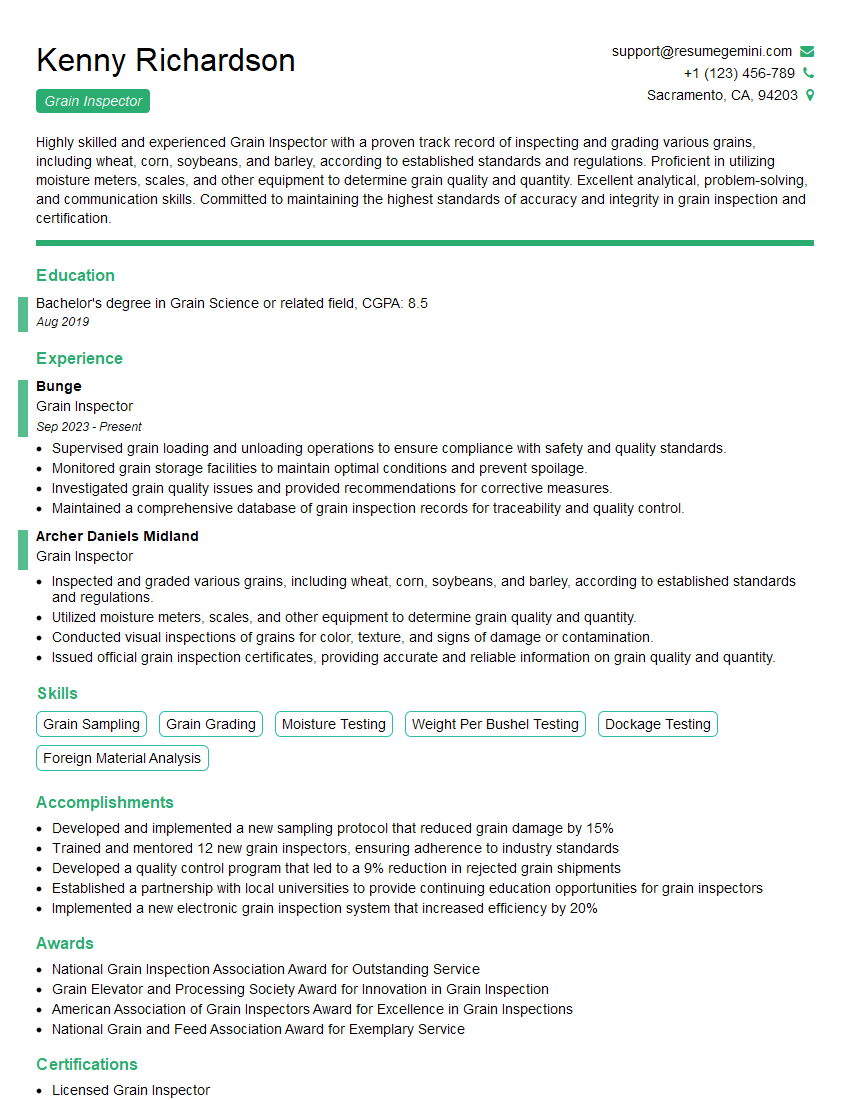
Mastering Grain Arbitration opens doors to exciting career opportunities within the agricultural commodities sector, offering a blend of legal, technical, and commercial expertise. To maximize your job prospects, creating a strong, ATS-friendly resume is crucial. ResumeGemini is a trusted resource to help you build a professional and impactful resume that highlights your skills and experience effectively. Examples of resumes tailored to Grain Arbitration are available to guide you, ensuring your application stands out.
Explore more articles
Users Rating of Our Blogs
Share Your Experience
We value your feedback! Please rate our content and share your thoughts (optional).
What Readers Say About Our Blog
Really detailed insights and content, thank you for writing this detailed article.
IT gave me an insight and words to use and be able to think of examples