Unlock your full potential by mastering the most common Historical and Cultural Music Knowledge interview questions. This blog offers a deep dive into the critical topics, ensuring you’re not only prepared to answer but to excel. With these insights, you’ll approach your interview with clarity and confidence.
Questions Asked in Historical and Cultural Music Knowledge Interview
Q 1. Define ‘tonality’ and its evolution across different historical periods.
Tonality refers to the organization of pitches around a central tone, or tonic, creating a sense of key and harmony. Think of it as the musical ‘gravitational pull’ that draws the listener’s ear towards a specific note. Its evolution is fascinating and reflects broader shifts in musical aesthetics.
Medieval Music (roughly 500-1400 AD): Early medieval music often lacked a strong sense of tonality as we understand it today. Modal systems, based on various scales, prevailed, creating a sense of ambiguity and fluidity that was different from later tonal structures.
Renaissance (1400-1600 AD): Tonality started to develop more strongly. Composers began to use a more defined sense of key, though the use of modal scales still persisted. We see a shift towards major and minor keys, but not with the same rigidity as later periods.
Baroque (1600-1750 AD): The Baroque period witnessed a significant strengthening of tonality. Major and minor scales became dominant, and the concept of functional harmony, where chords have specific roles within the key, became firmly established. This period produced complex and richly harmonized music.
Classical (1750-1820 AD): Tonality remains central, but with a focus on clarity and balance. Composers like Haydn, Mozart, and Beethoven perfected the use of functional harmony, creating a sense of structural elegance.
Romantic (1820-1900 AD): Romantic composers often pushed the boundaries of traditional tonality. While tonal structures were still present, they frequently used chromaticism (notes outside the key) and modulation (shifting keys) to create a more expressive and emotional effect.
20th and 21st Centuries: The 20th century saw a deliberate dismantling and reimagining of tonality. Attonality (absence of key) and atonality (avoidance of traditional harmonic relationships) became prominent in the works of composers such as Schoenberg, resulting in sounds that are often perceived as dissonant or unsettling. Post-tonal music explores many ways to organize sounds beyond the traditional key system.
Q 2. Compare and contrast the musical styles of the Baroque and Classical periods.
The Baroque and Classical periods, while both firmly tonal, represent distinct approaches to musical expression.
Baroque (1600-1750 AD): Baroque music is characterized by grandeur, ornamentation, and complex polyphony (multiple independent melodic lines sounding simultaneously). Think of the elaborate counterpoint in Bach’s fugues or the dramatic intensity of Handel’s operas. Ornamentation, such as trills and mordents, was integral to the style, adding a decorative layer to the music. Harmonic language was often rich and complex, featuring intricate chord progressions and frequent changes in texture. The basso continuo, a continuous bass line providing harmonic support, was a central feature.
Classical (1750-1820 AD): Classical music, exemplified by Haydn, Mozart, and Beethoven, emphasizes clarity, balance, and structural elegance. While tonality was still central, it was used in a more balanced and restrained way. Melody became more prominent, often supported by simpler harmonies. Form became highly structured, with genres such as the sonata form reaching a high point of sophistication. The overall effect is often one of greater simplicity and formal clarity in comparison to the often ornate Baroque style.
In essence, the Baroque is ornate and richly textured, while the Classical is balanced and structurally refined. Both periods, however, are rooted in the same essential tonal system.
Q 3. Explain the significance of the ‘Sprechstimme’ vocal technique in early 20th-century music.
Sprechstimme, German for ‘speech-song,’ is a vocal technique developed by Arnold Schoenberg in the early 20th century. It lies between speaking and singing. The singer uses the inflections and rhythms of speech, but the pitch is somewhat fixed and adheres to the notes indicated on the score, though not sung with a fully sustained tone.
Its significance lies in its role in bridging the gap between traditional vocal techniques and the atonal language of early 20th-century music. Because of its almost-spoken character, Sprechstimme avoids the traditional emphasis on sustained vocal tones and beautiful vocal lines. By employing this technique, Schoenberg sought to express the heightened emotional tension and often unsettling qualities of his atonal compositions in a highly expressive way. It remains a unique and powerful vocal technique, illustrating how 20th-century composers challenged traditional musical conventions.
A famous example is found in Schoenberg’s Pierrot Lunaire, which uses Sprechstimme extensively to create a dreamlike and unsettling atmosphere.
Q 4. Discuss the impact of patronage on the development of musical styles in the Renaissance.
Patronage was absolutely crucial to the development of Renaissance music. Composers relied heavily on the financial support of wealthy individuals, the Church, and nobility. This patronage system profoundly shaped the style and direction of musical composition.
Church patronage: The Catholic Church was the most significant patron, commissioning masses, motets, and other liturgical music. This led to the flourishing of polyphonic vocal music, such as the masses of Josquin des Prez, which reflected the Church’s aesthetic preferences and liturgical needs.
Noble patronage: Wealthy aristocrats also employed composers and musicians, often supporting the development of secular music like madrigals and chansons. The aristocratic courts fostered competition among composers, leading to innovation and refinement of musical styles. Different courts had different tastes, creating a diverse landscape of Renaissance musical styles.
Impact on style: The nature of patronage directly influenced the types of music composed. Church commissions led to a focus on sacred music with clear theological messages, while aristocratic patronage facilitated the growth of secular music reflecting courtly life and entertainment. The style of music also adapted to the preferences of individual patrons, sometimes producing remarkable individual expressions and sometimes more homogenous styles dictated by the demands of a particular patron.
In essence, the Renaissance musical landscape was profoundly shaped by the complex web of patron-composer relationships. The financial support ensured the creation of vast amounts of music, while the aesthetic preferences of patrons, whether religious or secular, shaped the style and direction of that music.
Q 5. Analyze the role of improvisation in jazz and its historical roots.
Improvisation is a cornerstone of jazz, giving it its unique spontaneity and dynamism. Its roots stretch back to various musical traditions, converging to create the jazz style.
West African musical traditions: Call-and-response patterns, rhythmic complexity, and the use of blues scales are all traceable to West African musical practices brought to the Americas through the transatlantic slave trade. These traditions provided a foundation for improvisational expression.
Blues and Ragtime: Blues and ragtime, both African American musical genres, incorporated improvisation. Blues musicians freely embellished melodies, exploring variations and nuances within the blues form. Ragtime pianists displayed virtuosity and improvisation within structured rhythmic frameworks.
Early Jazz: Early jazz styles such as New Orleans jazz heavily emphasized collective improvisation, where multiple musicians simultaneously improvise around a common theme. This led to the development of sophisticated improvisational techniques and a rich, dynamic musical texture.
Later Developments: As jazz evolved, different approaches to improvisation emerged. Bebop featured complex harmonies and rapid melodic improvisations, while later styles like free jazz pushed the boundaries of improvisation even further, often abandoning traditional harmonic structures altogether.
Improvisation in jazz isn’t just about spontaneous musical creation; it’s a highly skilled practice that requires deep understanding of musical theory, harmony, rhythm, and a unique sensitivity to the musical conversation taking place. It’s a dialogue between musicians, a creative interplay that continually redefines the music each time it’s performed.
Q 6. Describe the characteristics of Gregorian chant and its liturgical function.
Gregorian chant is a type of monophonic (single-line) vocal music that developed within the Roman Catholic Church during the medieval period. It’s characterized by its simplicity, its modal character, and its liturgical function.
Characteristics: Gregorian chant typically lacks a strong sense of major or minor tonality as we understand it today, instead using modal scales that give it a somewhat ambiguous, otherworldly quality. The melodies are mostly diatonic (using notes within the scale), often conjunct (moving between adjacent notes), and move relatively slowly. The text is typically Latin, and the music is unaccompanied.
Liturgical Function: Gregorian chant serves a central function in the Catholic Mass and other liturgical services. Different chants are associated with specific parts of the liturgy, for instance the Kyrie, Gloria, and Sanctus. The chants’ melodic and textual content helps to shape the religious experience. The chant’s unimpassioned character was suitable for the solemn religious context. The music helps to elevate the worshiper to the mystical experience of the divine.
The beauty of Gregorian chant lies in its simplicity and profound spirituality. It’s a direct and unadorned expression of faith, deeply connected to the rituals and traditions of the Catholic Church.
Q 7. Compare and contrast the musical aesthetics of the Romantic and 20th-century avant-garde movements.
The Romantic and 20th-century avant-garde movements represent contrasting aesthetic approaches to music, though they both reacted against earlier styles.
Romantic (1820-1900 AD): Romantic music is characterized by intense emotional expression, expansive forms, and a focus on individual expression. Composers like Beethoven, Schubert, Chopin, and Wagner explored a wide range of emotions, from passionate outbursts to delicate lyricism. Their music often features rich harmonies, dramatic contrasts, and a focus on expressive melody. Nationalistic elements and programmatic music (music telling a story) were also important features.
20th-Century Avant-Garde: 20th-century avant-garde movements, including Impressionism, Expressionism, Serialism, and Minimalism, often reacted against the emotional exuberance and perceived excesses of Romanticism. Many composers sought to experiment with new musical techniques, challenging traditional notions of harmony, melody, and form. Attonality and atonality, as seen in Schoenberg’s work, became significant departures from the tonal language of Romanticism. Other composers explored new sounds using extended instrumental techniques, electronic music, and prepared piano.
The contrast lies in their emphasis: Romanticism prioritizes emotional expression and lyrical beauty, while the avant-garde emphasizes innovation, experimentation, and a rejection of traditional forms. Both represent major shifts in musical aesthetics, reflecting the broader intellectual and cultural shifts of their respective eras.
Q 8. Explain the influence of African musical traditions on the development of blues and jazz.
The blues and jazz, cornerstones of American music, owe a significant debt to African musical traditions. This influence isn’t simply a matter of borrowing individual elements; it’s a fundamental shaping of musical structure, rhythm, and expression. African musical practices, brought to the Americas through the transatlantic slave trade, profoundly impacted the development of these genres.
Rhythm and Polyrhythms: African music often features complex polyrhythms – the simultaneous use of two or more contrasting rhythms. This is a defining characteristic of both blues and jazz, contributing to their distinctive groove and rhythmic complexity. Think of the syncopation in a blues shuffle or the intricate drum patterns in jazz.
Call and Response: The call-and-response vocal style, prevalent in many African musical cultures, is a cornerstone of blues and jazz improvisation. One musician (or vocal group) presents a musical idea (‘call’), and another responds (‘response’), creating a dynamic musical conversation.
Improvisation: African musical traditions often emphasized improvisation and individual expression. This emphasis on spontaneity and creativity is deeply ingrained in both blues and jazz, manifesting in the soulful improvisations of blues guitarists and the virtuosic solos of jazz musicians.
Blues Scales and Blue Notes: The characteristic ‘blue notes’ – slightly bent or flattened pitches – found in blues music are believed to have roots in African melodic practices. These notes create a distinctive emotional quality, often described as melancholic or soulful.
It’s crucial to understand that these influences weren’t simply copied; they were creatively adapted and transformed within the context of the American experience, resulting in unique musical expressions.
Q 9. Discuss the historical development of opera, including key composers and stylistic changes.
Opera’s history is a rich tapestry woven from diverse musical and theatrical threads. Its development spans centuries, marked by significant stylistic shifts and the contributions of groundbreaking composers.
Early Opera (Baroque Period): Opera emerged in Florence, Italy, around the late 16th and early 17th centuries, initially as a form of aristocratic entertainment. Early operas, like those by Claudio Monteverdi (L’Orfeo), were characterized by elaborate recitatives (speech-like singing) and arias (solo songs), with a focus on dramatic storytelling and mythological themes. The orchestra played a relatively modest role.
Classical Opera (18th Century): The 18th century saw the rise of Classical opera, epitomized by composers like Christoph Willibald Gluck. Gluck championed a more dramatic and unified style, emphasizing the integration of music and drama. His reforms laid the groundwork for the later development of opera seria (serious opera) and opera buffa (comic opera).
Romantic Opera (19th Century): The Romantic era brought immense expansion to the operatic repertoire. Composers like Rossini, Bellini, Donizetti, Verdi, and Wagner revolutionized the form. Romantic operas are characterized by larger orchestras, more emotionally charged melodies, and a greater focus on individual characters and their psychological depth. Wagner’s works, especially, pushed the boundaries of opera with his use of leitmotifs (recurring musical themes associated with characters or ideas).
20th and 21st Century Opera: The 20th and 21st centuries have witnessed a wide range of operatic styles, from the atonal works of composers like Schoenberg to the more accessible and eclectic compositions of later composers. Modern opera often explores diverse themes and incorporates elements of other musical genres.
Opera’s history is not merely a chronological progression; it’s a constant interplay of tradition and innovation, reflecting the changing tastes and social contexts of each era.
Q 10. Explain the concept of ‘musical nationalism’ and provide examples from different countries.
Musical nationalism is a cultural movement where composers consciously draw upon the musical traditions and folk idioms of their own nation to create a distinctive national style. It’s a way of expressing national identity and pride through music, often using folk melodies, rhythms, and harmonies to evoke a sense of place and cultural heritage.
Examples:
Russia: Mily Balakirev and the ‘Mighty Handful’ (a group of Russian composers) consciously sought to create a distinctly Russian musical style, drawing on Russian folk music and incorporating elements of Orthodox church music.
Czech Republic: Bedřich Smetana’s operas, such as Má vlast (My Homeland), are powerful examples of Czech musical nationalism, showcasing Czech folk melodies and evoking the spirit of the Czech landscape.
Norway: Edvard Grieg’s music, particularly his Peer Gynt suites, incorporated Norwegian folk melodies and harmonies to create a uniquely Norwegian musical character.
The rise of musical nationalism often coincides with periods of national awakening or independence movements. Music became a potent tool for fostering national unity and self-determination.
Q 11. Describe the evolution of musical notation systems throughout history.
The evolution of musical notation is a fascinating story reflecting humanity’s increasing desire to record and transmit musical ideas precisely. Early systems were rudimentary, gradually developing into the sophisticated system we use today.
Early Notation (Ancient Greece and Rome): Early notations were primarily symbolic, using letters or other signs to represent melodic contours, but lacking precision in rhythm and pitch. These systems provided a basic framework for transmitting musical ideas, but lacked the detail of later systems.
Medieval Notation (Neumes): In the medieval period, neumes – symbols indicating melodic direction and intervals – were used. Neumes provided more musical information than earlier notations, although their interpretation could be ambiguous, varying among different musical communities.
Staff Notation (11th Century): The development of the staff, with lines representing specific pitches, marked a pivotal moment. The addition of clefs indicated the pitch range, and the introduction of time signatures regulated rhythm, dramatically increasing the precision of notation.
Modern Notation (16th-18th Centuries): The system we use today gradually evolved over the following centuries, incorporating symbols for dynamics (loudness and softness), articulation (how notes are played), and expression.
The evolution of musical notation demonstrates a continual quest for accuracy and efficiency in capturing the nuances of musical performance.
Q 12. Analyze the use of counterpoint in the works of J.S. Bach.
J.S. Bach’s mastery of counterpoint is legendary. Counterpoint involves combining two or more independent melodic lines simultaneously, creating a rich and complex musical texture. Bach’s works are a testament to his unparalleled skill in weaving together multiple melodic lines, creating intricate harmonies, and maintaining a sense of balance and clarity.
Examples: Bach’s The Well-Tempered Clavier is a remarkable demonstration of counterpoint, with each prelude and fugue showcasing intricate contrapuntal textures. The fugues, in particular, are masterful examples of the technique, often featuring three or four independent melodic voices intertwining and developing against each other. His choral works, like the Mass in B Minor, also showcase elaborate and expressive use of counterpoint.
Techniques: Bach employed various counterpoint techniques, including imitation (where one melodic line imitates another), inversion (where a melodic line is played upside down), and augmentation/diminution (where a melodic line is played at a faster or slower tempo). He used these techniques to create both harmonic richness and melodic interest. His skill lay in balancing the independence of each voice with the overall coherence of the musical texture.
Bach’s use of counterpoint demonstrates not just technical prowess but also profound musical imagination and a deep understanding of harmonic principles. His compositions are a cornerstone in the study of counterpoint and continue to inspire composers and musicians today.
Q 13. Compare and contrast the musical styles of different regions of the world (e.g., African, Asian, Latin American).
Comparing and contrasting musical styles across different regions of the world reveals the vast diversity of human musical expression. While generalizations are necessary, it’s important to remember the vast internal diversity within each region.
African Music: Often characterized by complex polyrhythms, call-and-response vocals, improvisation, and a strong emphasis on percussion instruments. Different regions of Africa showcase immense stylistic variation, from the vocal polyphonies of South Africa to the intricate instrumental music of West Africa.
Asian Music: Encompasses a vast array of styles, including the modal music of India (raga), the pentatonic scales of much of East Asia, and the gamelan music of Indonesia. These styles often feature intricate melodic ornamentation, microtones (intervals smaller than a half step), and a deep connection to spiritual and philosophical traditions.
Latin American Music: A vibrant mix of Indigenous, European, and African influences, reflecting the complex history of the region. Styles range from the passionate rhythms of samba and tango to the Andean panpipes and the diverse folk traditions of Mexico.
These are just broad strokes; each region contains an enormous diversity of musical styles. Understanding these styles requires deeper exploration of individual traditions and cultures. The similarities and differences highlight the power of music to both reflect cultural identity and transcend geographical boundaries.
Q 14. Discuss the role of technology in the preservation and dissemination of historical musical recordings.
Technology plays a crucial role in the preservation and dissemination of historical musical recordings, enabling us to access and experience music from the past in ways unimaginable just a few decades ago. The challenge lies in balancing technological advancements with the need to maintain the integrity of these fragile recordings.
Digital Archiving: Digitalization allows for the preservation of recordings in a stable and accessible format, protecting them from deterioration. This involves transferring analog recordings (such as vinyl records or magnetic tapes) to digital formats. Sophisticated software enables noise reduction and restoration, improving the audio quality.
Online Databases and Streaming Services: The internet has revolutionized access to historical recordings. Online databases and streaming services allow researchers, musicians, and music lovers around the world to access a vast trove of historical material, increasing its accessibility and promoting further research and understanding.
Digital Restoration Techniques: Advanced techniques using artificial intelligence are being developed to restore damaged or deteriorated recordings, recovering sounds that were previously lost or unintelligible. This helps to enhance the listening experience and provides a more complete picture of the original performance.
However, challenges remain, including managing the long-term preservation of digital files, ensuring accuracy in restoration techniques, and addressing issues of copyright and access.
Q 15. Explain the challenges in accurately reconstructing historical musical performances.
Accurately reconstructing historical musical performances presents significant challenges due to the inherent limitations of surviving evidence. We rarely have recordings; instead, we rely on written scores (often incomplete or ambiguous), descriptions from diaries or letters (subjective and culturally influenced), and the occasional surviving instrument (which may be damaged or altered).
For instance, imagine trying to recreate a Renaissance banquet performance based solely on a fragmented score and a few lines in a nobleman’s diary describing the “joyful sounds.” The tempo, instrumentation, dynamics, and even the exact arrangement of the pieces remain largely unknown. Further complicating matters is the evolution of musical notation over time – interpreting early notation requires specialized knowledge and often involves educated guesswork.
Researchers must account for the cultural context of the music, understanding social norms and performance practices of the era. They often use comparative musicology, examining similar musical traditions from the same period to infer missing information. Technological advancements, such as digital audio workstations (DAWs) and sophisticated music analysis software, help, but the core problem remains – the gap between what we know and what we wish we knew about historical performances remains significant.
Career Expert Tips:
- Ace those interviews! Prepare effectively by reviewing the Top 50 Most Common Interview Questions on ResumeGemini.
- Navigate your job search with confidence! Explore a wide range of Career Tips on ResumeGemini. Learn about common challenges and recommendations to overcome them.
- Craft the perfect resume! Master the Art of Resume Writing with ResumeGemini’s guide. Showcase your unique qualifications and achievements effectively.
- Don’t miss out on holiday savings! Build your dream resume with ResumeGemini’s ATS optimized templates.
Q 16. Describe the different types of musical instruments used in different historical periods and cultures.
The types of musical instruments used vary dramatically across historical periods and cultures. In ancient civilizations, instruments were often made from natural materials like wood, bone, and animal hides. Examples include the ancient Egyptian sistrum (a percussion instrument), the Greek lyre (a stringed instrument), and various types of flutes and drums found across different cultures.
The medieval period saw the rise of instruments like the lute, viol, and portative organ in Europe, while different parts of Asia utilized instruments such as the gamelan (in Indonesia), the sitar (in India), and the koto (in Japan). The Renaissance brought about the development of more sophisticated instruments like the harpsichord and early forms of the violin family. The Baroque era was characterized by the development of the orchestra as we recognize it today, with instruments like the violin, cello, oboe, and harpsichord playing prominent roles. The Classical period saw refinement in instrument-making and standardization of orchestra sizes and compositions. The Romantic period, and subsequent eras, witnessed the ongoing evolution and innovation in instrument design and musical aesthetics.
Each culture has its unique instrument traditions. For example, the complex and nuanced sounds of gamelan music in Indonesia are intricately tied to their cultural identity, while traditional African instruments, such as the djembe drum and mbira, play integral roles in various ceremonies and social functions.
Q 17. Analyze the relationship between music and social change throughout history.
Music has always been intricately woven into the fabric of social change. Throughout history, music has served as a powerful tool for social commentary, mobilization, and resistance. It reflects the values, beliefs, and struggles of different societies.
For example, spirituals sung by enslaved people in America conveyed coded messages of hope and resistance, providing solace and fueling their fight for freedom. Protest songs, from the folk anthems of the American Civil Rights Movement to the punk rock of the anti-establishment movements, have often been vehicles for voicing dissent and mobilizing social change. Conversely, music can also be employed by those in power to enforce social norms or suppress dissent.
The rise of popular music in the 20th century exemplifies music’s role in shaping social trends and identities. Genres such as rock and roll, hip-hop, and electronic music not only reflected but actively shaped evolving social attitudes towards youth culture, race, and gender. Analyzing music’s relationship with social change requires careful consideration of its historical context, its cultural reception, and its impact on social movements and political ideologies.
Q 18. Explain the concept of ‘ethnomusicology’ and its methodologies.
Ethnomusicology is the study of music in its cultural context. Unlike traditional musicology, which often focuses on Western art music, ethnomusicology embraces a broader perspective, examining the music of diverse cultures around the world and its social, religious, and political functions. Ethnomusicologists employ various methodologies to gather and analyze data, including:
- Participant observation: Immersing oneself in a community to understand the social context of music-making.
- Interviews: Talking to musicians and community members about their musical practices and beliefs.
- Transcription and analysis: Notating and analyzing musical scores to understand formal structures and aesthetics.
- Sound recording and archival work: Documenting musical performances to preserve them for future generations.
Ethical considerations are central to ethnomusicological research, ensuring the respectful and responsible study of musical traditions. This often includes obtaining informed consent from participants, protecting the intellectual property rights of musicians and communities, and giving back to the communities studied.
Q 19. Discuss the ethical considerations involved in researching and preserving musical traditions.
Ethical considerations in researching and preserving musical traditions are paramount. Researchers must prioritize the well-being and rights of the communities they study. Key ethical principles include:
- Informed consent: Obtaining permission from individuals and communities before conducting research and using their music.
- Respect for intellectual property rights: Recognizing and protecting the ownership of musical works and traditions.
- Reciprocity and collaboration: Sharing research findings with communities and working in partnership with them.
- Avoiding exploitation: Ensuring that research does not benefit researchers at the expense of communities.
- Cultural sensitivity: Showing respect for diverse cultural beliefs and practices related to music.
Failing to adhere to these principles can result in the appropriation of cultural heritage, damaging relationships and hindering the preservation of musical traditions. Ethical practice requires ongoing reflection and critical engagement with the potential impact of research.
Q 20. Explain the impact of colonialism on the development of musical cultures.
Colonialism profoundly impacted the development of musical cultures worldwide. The imposition of European musical systems and aesthetic preferences often led to the suppression or marginalization of indigenous musical traditions. In many colonized regions, European musical forms were imposed as superior, leading to the decline of traditional musical practices. However, it’s crucial to avoid a simplistic narrative of total suppression; colonized peoples often adapted and incorporated elements of European music into their own traditions, creating hybrid forms.
For example, the development of Latin American classical music demonstrates a complex interplay between European and indigenous musical traditions. Similarly, the fusion of African rhythms and European harmonies in genres like Afro-Cuban music illustrates the complex ways in which musical traditions have been transformed in response to colonialism. Understanding the legacy of colonialism requires considering both the suppression of indigenous music and the creative processes through which colonized populations adapted and reshaped their musical heritages.
Q 21. Describe the role of music in religious ceremonies across different cultures and time periods.
Music plays a crucial role in religious ceremonies across diverse cultures and time periods. It enhances the spiritual experience, expressing devotion, awe, and reverence. The forms and functions of religious music vary enormously.
In many Christian traditions, hymns and choral music are central to worship, creating a sense of communal participation and fostering spiritual reflection. In Islam, the chanting of the Quran (recitation) holds immense spiritual significance, embodying devotion and piety. Buddhist chanting, with its focus on mantras and rhythmic vocalizations, aims to induce states of meditation and enlightenment. Indigenous religions often feature ritual music, often accompanied by traditional instruments, to invoke spirits, appease deities, or celebrate sacred events.
The specific forms of musical expression in religious settings reflect the particular beliefs and practices of each religious tradition. Studying the music of religious ceremonies offers valuable insight into the cultural values and spiritual practices of different communities throughout history.
Q 22. Analyze the use of musical symbolism in a specific historical context (e.g., Wagner’s operas).
Richard Wagner’s operas are masterful examples of musical symbolism, where musical motifs – recurring melodic fragments – represent specific characters, objects, or ideas, weaving a complex tapestry of meaning throughout the work. Think of it like a musical shorthand, creating deep emotional and dramatic impact.
For example, in Der Ring des Nibelungen, the ‘fate’ motif, a descending chromatic scale, is inextricably linked to the inescapable destiny of the characters. It appears in various forms and contexts, each time underscoring the impending doom or unavoidable consequences of their actions. This constant return of the motif subtly manipulates the audience’s emotional response, creating a sense of foreboding and inevitability.
Similarly, the ‘love’ theme, often associated with specific characters or relationships, contrasts dramatically with the ‘fate’ motif, highlighting the struggle between love and destiny. Wagner employs leitmotifs (leading motives) skillfully to build thematic unity and deepen the emotional impact of the narrative. He doesn’t just tell a story; he uses music to reveal the inner lives and interconnected fates of his characters, pushing the boundaries of operatic storytelling.
This intricate system of musical symbolism provides an unparalleled depth of meaning, creating an immersive experience for the listener that goes far beyond the literal narrative. It’s a powerful demonstration of music’s ability to convey complex ideas and emotions with remarkable subtlety and power.
Q 23. Discuss the impact of World War I on musical styles and composition.
World War I profoundly impacted musical styles and composition. The horrors of trench warfare and the widespread disillusionment of the time led to a rejection of the late Romantic era’s opulent and emotionally charged music. Think of it as a reaction against the excessive sentimentality that seemed out of sync with the brutal realities of war.
This resulted in several key developments. First, there was a rise of musical modernism, characterized by atonality (absence of a tonal center), experimentation with dissonance, and a move away from traditional forms. Composers like Igor Stravinsky, with his jarring rhythms and dissonant harmonies in works like The Rite of Spring, embodied this shift. The war’s brutality fostered a desire to break free from established conventions.
Secondly, we see a rise in expressionism, reflecting the emotional turmoil and psychological trauma of the war. Composers like Arnold Schoenberg explored atonal music, aiming to express the inner anxieties and emotional landscapes of the time in a way that traditional tonal music couldn’t.
Finally, the war also led to a growth in nationalistic musical styles. Composers in various countries sought to express their national identity and pride, often contrasting with the internationalist perspective of the pre-war era. This resulted in a diversity of styles reflecting the fractured political landscape of post-war Europe.
Q 24. Explain how music theory has changed over time.
Music theory has undergone a significant evolution over centuries, reflecting changes in musical practice and aesthetic preferences. Early music theory, often associated with ancient Greece, focused largely on mathematical ratios and the relationship between intervals and consonance. Think of it as a more scientific approach to understanding music’s structure.
The medieval and Renaissance periods saw the development of counterpoint, the art of combining independent melodic lines. This led to a more complex understanding of harmony and voice leading. The Baroque era brought the flourishing of figured bass, a shorthand notation that allowed composers to specify harmonies without writing out all the accompanying parts. This simplified the process of realizing harmonies.
The Classical period saw a focus on formal structures like sonata form and the standardization of notation. The Romantic era then witnessed a push toward greater expressive freedom, with composers often pushing the boundaries of traditional tonality. The 20th and 21st centuries have been characterized by a significant expansion of theoretical concepts, including atonality, serialism, and microtonality – a much broader range of expressive possibilities.
Essentially, music theory has moved from a primarily mathematical and prescriptive approach to a more descriptive and analytical one, reflecting the greater diversity and complexity of musical styles over time.
Q 25. How did the printing press affect the dissemination of music?
The invention of the printing press revolutionized the dissemination of music, impacting musical culture in profound ways. Before the printing press, music was primarily transmitted through handwritten manuscripts, a slow and laborious process limiting access to only the wealthy or those within close proximity to composers or scribes.
The printing press allowed for mass production of musical scores, making music readily available to a far wider audience. This led to a standardization of musical notation, increased accessibility to a wider range of compositions and a rise in amateur musicianship. Composers could reach a global audience far more efficiently than previously imaginable.
However, the printing press also presented challenges. The quality of printed music varied, and the ease of reproduction led to issues with copyright and piracy. Despite these challenges, the printing press undeniably fostered a period of unprecedented musical exchange and distribution, fundamentally altering the landscape of music history.
Q 26. What are some of the challenges in studying non-Western musical traditions?
Studying non-Western musical traditions presents unique challenges, stemming primarily from the inherent differences in musical systems and cultural contexts. Unlike Western music’s emphasis on written notation, many non-Western traditions rely heavily on oral transmission, making documentation and analysis more complex.
Firstly, the lack of standardized notation in some traditions makes accurate transcription and analysis difficult. This necessitates a deep engagement with the music’s performance practices and cultural context, often requiring extensive fieldwork and collaboration with local musicians. Understanding the context is crucial.
Secondly, imposing Western theoretical frameworks onto non-Western musical systems can be misleading and even culturally insensitive. Western music theory often prioritizes harmony and tonality, concepts that may not be central to other musical systems. A nuanced understanding requires developing appropriate analytical tools that are sensitive to the specific characteristics of each tradition. It’s vital to avoid applying a Eurocentric lens.
Finally, ethical considerations are paramount. Respectful engagement requires careful consideration of cultural sensitivities, obtaining informed consent, and acknowledging the contributions of local musicians and scholars.
Q 27. Describe the development of a specific musical instrument family (e.g., string instruments).
The development of the string instrument family spans millennia, reflecting technological innovations and evolving musical aesthetics. Early string instruments were often simple, rudimentary designs – think of the ancient lyre or the medieval vielle. These instruments laid the groundwork for more sophisticated designs, but their construction and playing techniques have evolved considerably over time.
The development of the bow significantly altered the capabilities of string instruments, allowing for a greater range of dynamics and expressive possibilities. The evolution of the bow itself is a fascinating story, improving in craftsmanship and efficiency over time. The emergence of the violin family – violin, viola, cello, and double bass – in the 16th and 17th centuries represents a significant milestone. These instruments, standardized in design and construction, became central to Western classical music and continue to hold that position.
The evolution of string instrument construction included innovations in materials (wood types, varnishes), design (body shape, f-holes), and techniques (intonation, bowing). These continuous refinements have profoundly impacted the instrument’s sound and playing characteristics, influencing musical styles and compositions through history. It’s a continuous story of refinement, reflecting both technological progress and artistic innovation.
Q 28. What are some of the key debates in music history scholarship today?
Current debates in music history scholarship are vibrant and multifaceted, reflecting the ever-evolving nature of the field. One major area of discussion centers on the issue of canon formation – how and why certain composers and works are considered ‘canonical’ while others are excluded. This involves critically examining historical biases and power structures that have shaped our understanding of music history.
Another significant debate revolves around the integration of diverse musical traditions into the narrative of music history. Scholars are increasingly challenging Eurocentric perspectives, advocating for a more inclusive and globally representative approach that acknowledges and celebrates non-Western musical cultures and their significance.
Furthermore, debates exist concerning the use of new technologies and methodologies in music history research. Digital humanities tools are transforming how scholars access, analyze, and interpret musical materials, leading to discussions about the implications of these technologies for our understanding of music history. The balance between traditional methods and technological advancements remains a topic of ongoing discourse.
These ongoing debates not only refine our understanding of music’s past but also shape how we approach the study of music today, promoting a more inclusive, nuanced, and technologically advanced field.
Key Topics to Learn for Historical and Cultural Music Knowledge Interview
- Major Historical Periods & Styles: Develop a strong understanding of the evolution of music across different eras (e.g., Baroque, Classical, Romantic, 20th Century), including key composers, stylistic characteristics, and influential works. Consider the social and political contexts that shaped musical trends.
- Cultural Influences on Music: Explore how cultural traditions, geographical locations, and societal factors have shaped musical expression. Analyze the impact of diverse musical forms (e.g., folk, jazz, world music) and their historical development.
- Musical Theory & Analysis: Brush up on fundamental musical concepts such as harmony, melody, rhythm, form, and texture. Practice analyzing musical scores and identifying stylistic features. This includes understanding different musical notations and terminology.
- Ethnomusicology & Music Sociology: Familiarize yourself with the study of music within its cultural context. This includes understanding different methodologies used in ethnomusicological research and the sociological impacts of music on society.
- Music History Research & Methodology: Develop skills in conducting historical music research, including source analysis, critical evaluation of historical accounts, and applying relevant historical methodologies.
- Practical Application: Be prepared to discuss how your knowledge of historical and cultural music informs your understanding of contemporary musical practices and trends. Consider examples from your own musical experiences or academic work.
Next Steps
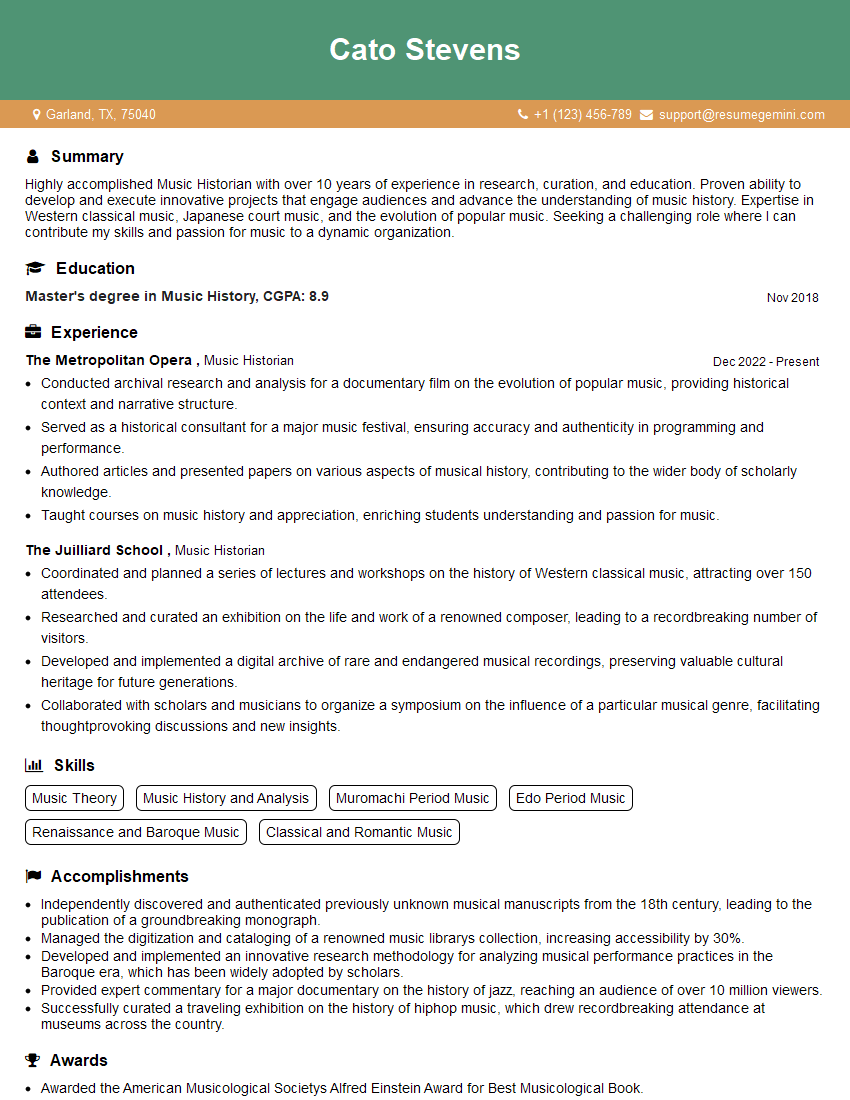
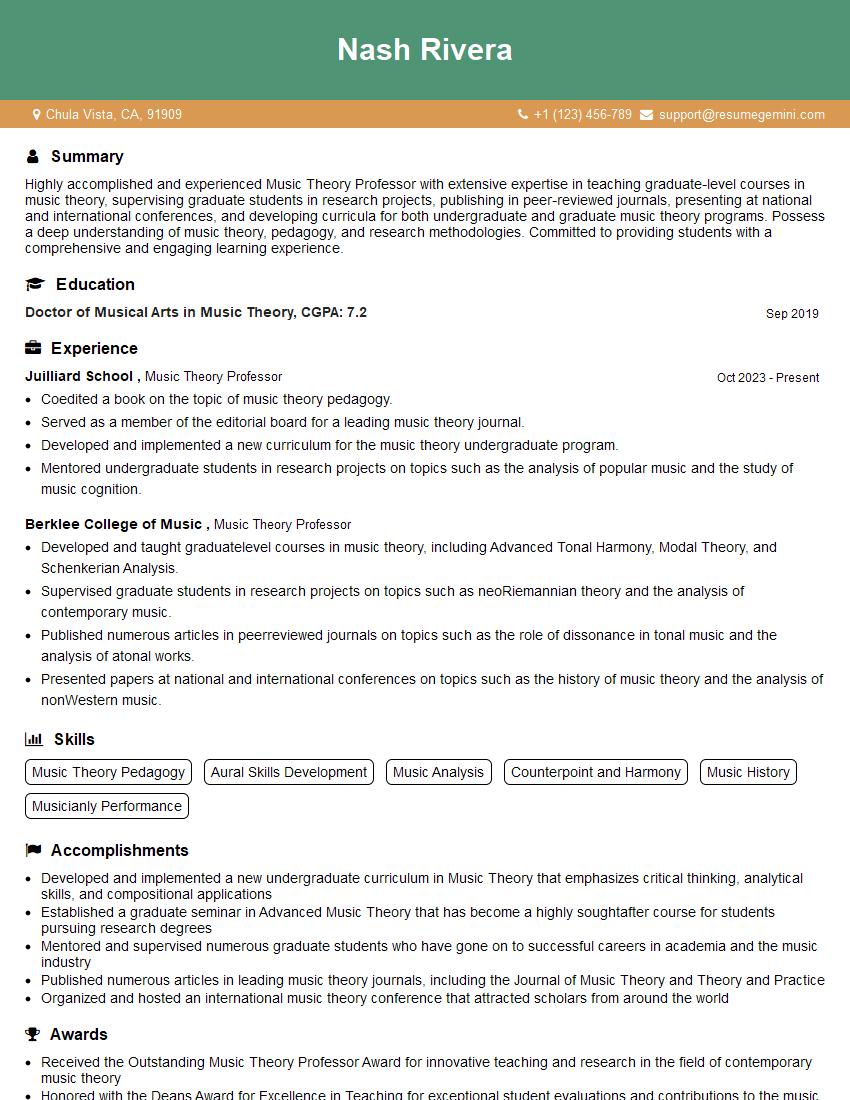
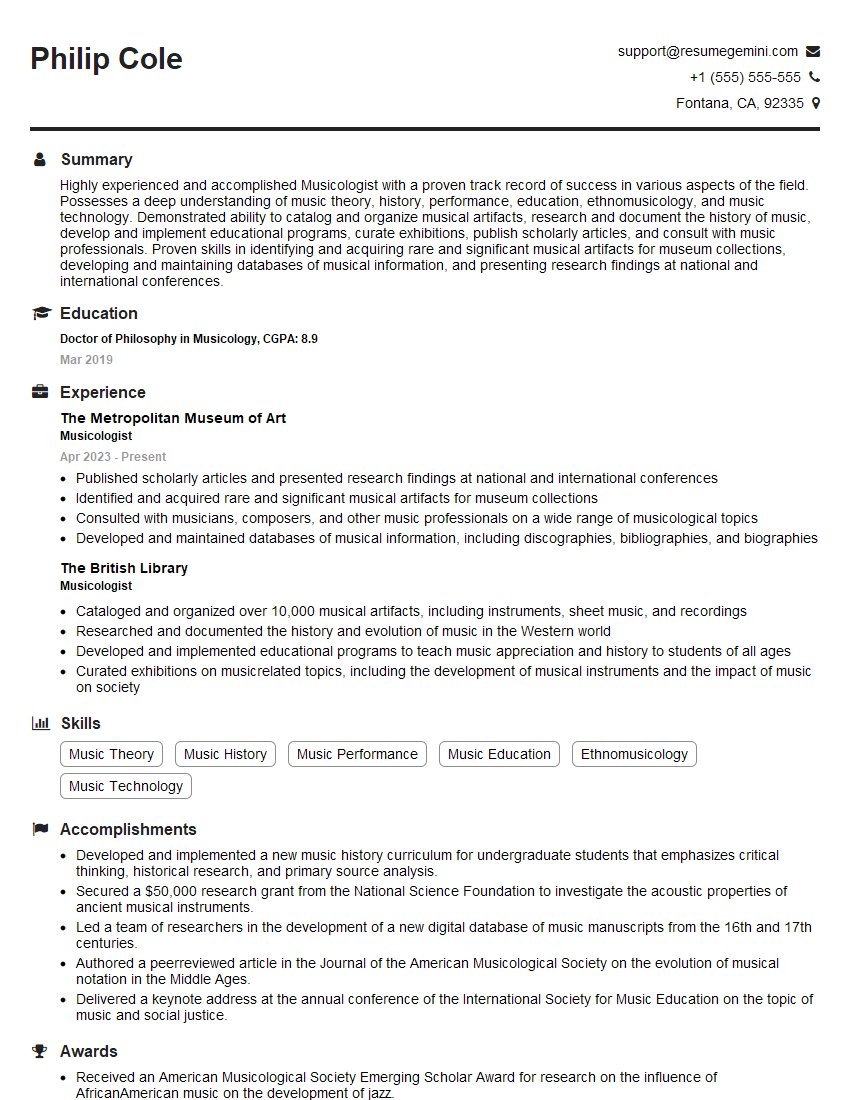
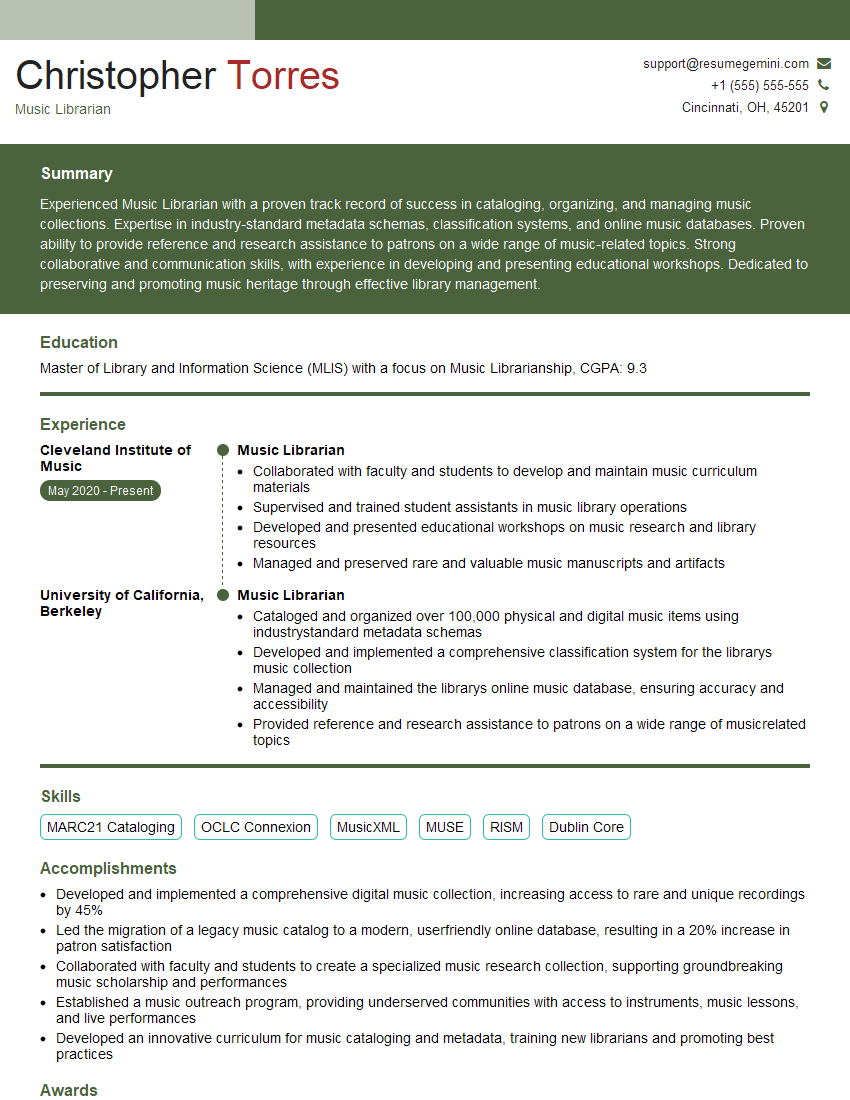
Mastering Historical and Cultural Music Knowledge is crucial for career advancement in fields like music education, musicology, music journalism, archiving, and curatorial roles. A strong understanding of these areas demonstrates a deep appreciation for the art form and its multifaceted influences. To significantly boost your job prospects, craft a compelling and ATS-friendly resume that showcases your skills and experience effectively. ResumeGemini is a trusted resource that can help you build a professional resume tailored to the specific requirements of your target roles. Examples of resumes tailored to Historical and Cultural Music Knowledge are available to help guide your resume creation process.


Explore more articles
Users Rating of Our Blogs
Share Your Experience
We value your feedback! Please rate our content and share your thoughts (optional).
What Readers Say About Our Blog
Really detailed insights and content, thank you for writing this detailed article.
IT gave me an insight and words to use and be able to think of examples