Are you ready to stand out in your next interview? Understanding and preparing for Instructional Planning and Execution interview questions is a game-changer. In this blog, we’ve compiled key questions and expert advice to help you showcase your skills with confidence and precision. Let’s get started on your journey to acing the interview.
Questions Asked in Instructional Planning and Execution Interview
Q 1. Describe your experience with the ADDIE model.
The ADDIE model is a widely used instructional design framework. It’s an acronym for Analysis, Design, Development, Implementation, and Evaluation. It’s a linear process, though in practice, there’s often iteration between stages.
- Analysis: This involves identifying the learning needs, target audience, and context. For example, if designing training for customer service representatives, this stage would involve analyzing call logs, surveys, and interviews to understand current performance and identify skill gaps.
- Design: Here, you develop the instructional strategy, learning objectives, assessment methods, and overall course structure. This is where you determine the best way to present the information – lectures, group activities, simulations, etc.
- Development: This is the creation of the actual training materials – presentations, handouts, online modules, videos, etc. This stage requires meticulous attention to detail and clarity.
- Implementation: This is the delivery of the training program. It’s crucial to ensure the training environment is conducive to learning and that participants have the necessary resources and support.
- Evaluation: This involves assessing the effectiveness of the training program. This could include measuring participant satisfaction, knowledge gained, and changes in on-the-job performance. This feedback is then used to improve the program for future iterations.
In my experience, I’ve used ADDIE to develop numerous training programs, from short online modules to extensive multi-day workshops. I’ve found its structured approach particularly helpful in large-scale projects, ensuring all aspects of the training are carefully considered.
Q 2. Explain the difference between instructional design and training development.
While the terms ‘instructional design’ and ‘training development’ are often used interchangeably, there’s a subtle but important distinction. Instructional design is the broader field encompassing the systematic process of creating learning experiences. It focuses on the principles of learning and how people learn best. It considers learning theories, learner characteristics, and the context of learning.
Training development is a more specific application of instructional design principles. It’s focused on creating training materials and programs to improve skills, knowledge, or behaviors for a specific job or task. Think of it as one component within the larger realm of instructional design.
An analogy would be architecture and construction. Instructional design is the architecture—planning the overall structure and functionality of a learning experience. Training development is the construction—building the actual training materials and delivering them.
Q 3. How do you assess the effectiveness of a training program?
Assessing the effectiveness of a training program is crucial. It’s not enough to simply deliver the training; you need to measure its impact. I typically use a multi-faceted approach, including:
- Kirkpatrick’s Four Levels of Evaluation: This model provides a structured framework. Level 1 (Reaction) measures participant satisfaction. Level 2 (Learning) assesses knowledge gained. Level 3 (Behavior) evaluates changes in on-the-job performance. Level 4 (Results) measures the impact of the training on organizational goals.
- Pre- and Post-Tests: These allow for a quantitative measurement of knowledge gained. The difference between pre- and post-test scores indicates the effectiveness of the training in improving knowledge.
- Observations and Performance Reviews: Direct observation of trainees in action, combined with performance reviews, can provide valuable insights into behavioral changes.
- Surveys and Feedback Forms: These help gather qualitative data on participants’ experiences and perspectives, providing valuable insights for program improvement.
- Return on Investment (ROI): Quantifying the financial benefits of the training program—such as improved productivity or reduced errors—demonstrates its value to the organization.
For instance, in a sales training program, I would measure improvements in sales figures, customer satisfaction scores, and individual sales representative performance following the training.
Q 4. What are some common challenges in instructional design, and how have you overcome them?
Instructional design presents several challenges. Some common ones include:
- Limited Budget and Resources: This often requires creative solutions and prioritization of resources. For example, instead of expensive video production, we might use screen recordings and readily available images.
- Time Constraints: Meeting tight deadlines requires efficient planning and potentially adjusting the scope of the project. Prioritizing key learning objectives and focusing on essential content can be vital here.
- Learner Diversity: Catering to learners with different learning styles and technological abilities requires a multi-modal approach to content delivery and assessment. For instance, I might include audio descriptions in videos for visually impaired learners.
- Maintaining Engagement: Keeping learners engaged, especially in long training programs, is crucial. Incorporating interactive elements, gamification techniques, and real-world examples helps to address this.
I’ve overcome these challenges by:
- Prioritizing: Focusing on the most critical learning objectives first.
- Collaboration: Working closely with subject matter experts and stakeholders to leverage their expertise and resources.
- Adaptability: Adjusting plans as needed based on feedback and changing circumstances.
- Creativity: Finding innovative and cost-effective solutions to constraints.
Q 5. What experience do you have with different learning theories (e.g., constructivism, cognitivism)?
My experience encompasses several learning theories, and I tailor my instructional design approach to suit the specific learning context and objectives.
- Constructivism: This theory emphasizes active learning and knowledge construction. I incorporate this by designing activities that encourage learners to explore, experiment, and build upon prior knowledge. For example, using collaborative projects and problem-solving scenarios.
- Cognitivism: This theory focuses on mental processes like memory, attention, and problem-solving. I apply this by structuring content logically, providing clear explanations and examples, and using visual aids to enhance understanding and memory retention. Techniques such as chunking information and using mnemonics can be employed.
- Behaviorism: This theory emphasizes reinforcement and feedback. I use this by providing clear expectations, regular feedback, and rewards to encourage desired behaviors. This is useful for skill-based training, where repetition and positive reinforcement are essential.
I often blend these theories to create a comprehensive learning experience, understanding that learners often utilize multiple cognitive processes during the learning process.
Q 6. Describe your process for developing learning objectives.
Developing clear, measurable, achievable, relevant, and time-bound (SMART) learning objectives is paramount. My process involves:
- Analyzing the Performance Gap: Identify the discrepancy between current performance and desired performance.
- Defining the Knowledge and Skills Needed: What knowledge, skills, and attitudes are required to bridge that gap?
- Writing Objectives: Using the SMART criteria, I craft objectives that specify what learners will be able to do after completing the training. For example, instead of saying “Understand marketing principles,” I would say “Given a case study, participants will be able to develop a marketing plan that includes target audience, pricing strategy, and promotional tactics with 80% accuracy.”
- Review and Refinement: I review the objectives with subject matter experts and stakeholders to ensure accuracy and alignment with overall training goals.
Using this approach ensures that objectives are directly measurable, guiding the design and evaluation of the training program and making sure the training effectively addresses the identified needs.
Q 7. How do you create engaging and effective eLearning content?
Creating engaging and effective eLearning content requires careful consideration of several factors:
- Microlearning: Breaking down content into short, focused modules helps maintain learner engagement and prevents cognitive overload. This makes it easier for learners to digest information and apply it effectively.
- Interactive Elements: Incorporating interactive exercises, quizzes, simulations, and branching scenarios keeps learners actively involved. This enhances knowledge retention and provides immediate feedback.
- Visual Appeal: Using high-quality visuals, such as images, videos, and animations, makes the content more engaging and memorable. This supports various learning styles and enhances comprehension.
- Accessibility: Ensuring the content is accessible to learners with disabilities (e.g., using captions, alternative text for images) is essential for inclusivity.
- Gamification: Incorporating game-like elements, such as points, badges, and leaderboards, can motivate learners and encourage participation. This adds a layer of fun and keeps learners engaged.
- Regular Feedback and Assessment: Providing regular feedback throughout the learning process and incorporating formative and summative assessments helps track progress and reinforce learning.
For instance, I might create a short eLearning module on data analysis, using interactive charts and graphs, allowing learners to practice data interpretation through quizzes. This combines microlearning with interactive elements, visuals, and regular assessments to create an engaging and effective learning experience.
Q 8. What software or tools are you proficient in for instructional design?
My proficiency in instructional design software spans a range of tools, catering to different stages of the design process. For authoring eLearning content, I’m highly skilled in Articulate Storyline 360 and Adobe Captivate, leveraging their capabilities for creating interactive modules, branching scenarios, and assessments. I use these tools to build engaging and visually appealing courses. For rapid prototyping and initial design exploration, I utilize tools like Miro and Figma, allowing for collaborative design sessions and quick iteration on design ideas. These tools enable me to visually map out learning journeys and create user flows. Finally, for managing the project and tracking progress, I rely on project management software such as Asana and Trello, which help in organizing tasks, timelines, and resources effectively.
Q 9. How do you ensure accessibility in your instructional materials?
Accessibility is paramount in my instructional design. I approach it through a multi-faceted strategy. Firstly, I adhere to WCAG (Web Content Accessibility Guidelines) throughout the design and development process. This includes using sufficient color contrast, providing alternative text for all images, ensuring keyboard navigation, and creating transcripts for audio and video content. Secondly, I incorporate diverse learning styles and modalities. This means offering materials in various formats such as text, audio, video, and interactive simulations, catering to learners with different preferences and abilities. Thirdly, I conduct usability testing with individuals representing diverse needs, including those with visual, auditory, cognitive, and motor impairments. This feedback directly informs design revisions to enhance accessibility. For example, in a recent project designing a safety training module, I ensured all videos had captions, and I provided a downloadable PDF version of the training materials for users who preferred not to use the online platform.
Q 10. Explain your experience with needs analysis and how you identify learning gaps.
Needs analysis is the cornerstone of effective instructional design. My approach involves a thorough investigation of the learners, the learning context, and the performance gap. I typically start with a detailed learner analysis, identifying their existing knowledge, skills, and attitudes. This involves reviewing existing documentation, conducting surveys and interviews, and observing learners in their work environments. Next, I analyze the learning context, including the available resources, time constraints, and technological infrastructure. Finally, I identify the performance gap by comparing the current level of performance with the desired performance. This involves analyzing performance data, conducting job task analysis, and identifying critical tasks. For example, in a project designing training for customer service representatives, I interviewed representatives, analyzed customer feedback data, and observed their interactions with customers to determine the areas needing improvement and tailor the training accordingly. The results revealed a need for enhanced conflict resolution skills and product knowledge, which were directly incorporated into the course design.
Q 11. How do you incorporate adult learning principles into your designs?
Adult learning principles, summarized by the acronym ANDRAGOGY, are central to my designs. I emphasize learner autonomy by providing choices and opportunities for self-directed learning. I leverage learners’ prior experiences by connecting new information to their existing knowledge and providing opportunities for them to share their expertise. I focus on relevance by demonstrating the practical application of the learning content to their jobs and lives. I create a collaborative learning environment fostering peer interaction and discussion. And finally, I use problem-centered learning approaches, focusing on real-world problems and challenges. For instance, in a leadership training program, I incorporated case studies based on real workplace situations, encouraging participants to collaboratively analyze and develop solutions. This approach was far more engaging and effective than traditional lecture-based methods.
Q 12. Describe your experience with different instructional methods (e.g., lectures, simulations, games).
My experience encompasses a variety of instructional methods, and I select the most appropriate ones based on learning objectives and learner characteristics. Lectures are used sparingly and primarily to introduce key concepts or provide context. I find simulations incredibly effective for practicing complex procedures or decision-making skills in a safe environment. Games and gamification can significantly boost engagement and motivation, especially when incorporated strategically to reinforce learning points or encourage healthy competition. I also frequently use case studies, discussions, group projects, and role-playing activities to promote active learning and collaborative knowledge building. The choice of method is never arbitrary; it’s always carefully considered to ensure maximal learner engagement and knowledge transfer. For instance, in a medical training program, we used high-fidelity simulations to allow trainees to practice emergency procedures without risk to patients.
Q 13. How do you evaluate the effectiveness of different learning activities?
Evaluating learning activities is crucial to ensure effectiveness. My approach uses a combination of formative and summative assessments. Formative assessments, conducted throughout the learning process, include quizzes, short assignments, and feedback sessions. These provide ongoing insights into learner progress and allow for adjustments to the instructional design. Summative assessments, such as tests, projects, and performance evaluations, are used to gauge the overall effectiveness of the learning experience after completion. Data gathered from these assessments informs the revision and improvement of the learning materials in future iterations. I also analyze learner feedback gathered through surveys and focus groups to understand their learning experience and identify areas for improvement. The data is analyzed quantitatively and qualitatively to obtain a complete picture of the effectiveness of the training.
Q 14. Describe your process for creating assessments.
Creating effective assessments starts with clearly defined learning objectives. Each assessment item should directly measure a specific learning outcome. I use a variety of assessment types, including multiple-choice questions, true/false questions, short-answer questions, essay questions, and performance-based assessments. The choice of assessment type depends on the complexity of the learning objective and the type of knowledge or skill being assessed. For example, a multiple-choice test might assess factual knowledge, while a performance-based assessment might evaluate practical skills. I always ensure that assessments are aligned with the learning objectives, are fair and unbiased, and provide valuable feedback to learners. Moreover, I employ techniques like Bloom’s Taxonomy to ensure that assessments challenge learners at various cognitive levels, moving beyond simple recall to higher-order thinking skills like analysis, synthesis, and evaluation. The design also incorporates strategies to minimize bias and ensure validity and reliability of the assessment instruments.
Q 15. How do you manage the budget and timeline for an instructional design project?
Managing the budget and timeline for an instructional design project requires a meticulous approach. It begins with a thorough needs analysis to accurately estimate the scope of work. This involves identifying all necessary resources, including personnel (instructional designers, subject matter experts, developers, etc.), software, hardware, and any third-party services. Then, I create a detailed project plan outlining tasks, dependencies, and deadlines, using tools like Gantt charts or project management software. This plan forms the basis of the budget, allowing for accurate cost estimation for each task. Regular progress monitoring is crucial; I use key performance indicators (KPIs) to track milestones, costs, and potential deviations from the plan. This allows for proactive adjustments, preventing cost overruns and delays. For example, if we discover unexpected challenges in developing a specific module, I immediately assess the impact on the timeline and budget, discuss potential solutions with the team, and revise the project plan accordingly. This proactive management ensures the project stays on track and within budget.
Career Expert Tips:
- Ace those interviews! Prepare effectively by reviewing the Top 50 Most Common Interview Questions on ResumeGemini.
- Navigate your job search with confidence! Explore a wide range of Career Tips on ResumeGemini. Learn about common challenges and recommendations to overcome them.
- Craft the perfect resume! Master the Art of Resume Writing with ResumeGemini’s guide. Showcase your unique qualifications and achievements effectively.
- Don’t miss out on holiday savings! Build your dream resume with ResumeGemini’s ATS optimized templates.
Q 16. How do you collaborate with subject matter experts (SMEs)?
Collaboration with Subject Matter Experts (SMEs) is paramount. I initiate collaboration early in the project by establishing clear communication channels and expectations. This involves regular meetings – in person or virtual – where I actively listen to the SME’s expertise, clarifying their input, and ensuring their knowledge is accurately captured. I use structured techniques like interviews, surveys, and document reviews to collect information efficiently. I present information in a digestible format using techniques like mind maps or flowcharts to gain quick SME buy-in and feedback. For instance, when designing training for a new software, I’ll conduct several sessions with the software developers, meticulously documenting features, workflows, and potential challenges. This collaborative approach fosters trust and ensures the final product aligns perfectly with the SME’s knowledge and expertise. I treat SMEs as partners in the process, valuing their feedback and incorporating their insights throughout the project lifecycle.
Q 17. How do you handle feedback and revisions during the instructional design process?
Handling feedback and revisions is an iterative process. I actively solicit feedback at various stages, using methods like reviews, user testing, and pilot programs. This allows for early identification and correction of issues. I use a structured feedback process, making sure feedback is documented, categorized, and prioritized. I then discuss the feedback with the relevant stakeholders, explaining the rationale behind any decisions made concerning incorporating or not incorporating certain suggestions. This helps manage expectations and maintain transparency. I create detailed revision trackers to manage changes and ensure all feedback is addressed. For example, after a pilot test, if learners identify difficulty with a specific section, I would revise the instructional materials, potentially adding more examples, simpler language, or interactive elements based on the feedback received.
Q 18. Explain your experience with rapid prototyping in instructional design.
Rapid prototyping is a cornerstone of my instructional design approach. I utilize low-fidelity prototypes like storyboards or paper prototypes early in the design process to quickly test concepts and gather feedback before investing significant resources in high-fidelity development. This allows for iterative improvement based on user input and significantly reduces the risk of costly redesigns later. For example, before building a fully interactive e-learning module, I might create a simple storyboard to visualize the flow of the lesson and test the sequence of activities. This storyboard then allows the SMEs and other stakeholders to easily provide feedback on the overall structure and content before any software development is started.
Q 19. Describe your understanding of Bloom’s Taxonomy and how it applies to instructional design.
Bloom’s Taxonomy is a crucial framework for designing learning objectives and assessing learning outcomes. It provides a hierarchical structure of cognitive skills, ranging from simple recall (remembering) to complex problem-solving (creating). I use it to ensure that learning activities are aligned with the desired learning outcomes. For instance, if the learning objective is for learners to ‘analyze’ data, I would design activities that require them to compare, contrast, and differentiate information. This ensures that the instructional design is purposeful and drives learners towards higher-order thinking. By carefully considering the cognitive level of each learning objective, I can develop assessment methods that accurately gauge the learners’ understanding at the appropriate level.
Q 20. How do you tailor your instructional design approach to different learning styles?
I tailor my instructional design to accommodate diverse learning styles using a multimodal approach. I incorporate visual, auditory, kinesthetic, and reading/writing learning preferences into the design. For example, I might use videos to cater to auditory learners, interactive simulations for kinesthetic learners, and text-based materials for reading/writing learners. Providing options allows learners to engage with the material in ways that best suit their individual preferences, resulting in improved comprehension and retention. I also employ strategies like chunking information, providing clear visual aids, and incorporating regular breaks to cater to varying attention spans and cognitive styles.
Q 21. What is your experience with instructional design for specific populations (e.g., diverse learners, employees)?
My experience includes designing instruction for diverse populations, including employees in corporate settings and learners with diverse learning needs. When designing for employees, I consider their prior knowledge, job roles, and learning context. I focus on making the learning relevant and practical to their work. This often involves real-world case studies or simulations to demonstrate the application of new skills or knowledge. In designing instruction for learners with diverse needs, I ensure accessibility by incorporating features like alternative text for images, captions for videos, and adjustable font sizes. I utilize universal design principles to ensure materials are usable and engaging for everyone. I also collaborate with specialists, like special education professionals, to get insights and ensure inclusivity. A recent project involved creating training materials for a company onboarding new employees from various cultural backgrounds. We used a multi-lingual approach, employed culturally sensitive visuals, and structured the learning to be inclusive of different learning styles.
Q 22. How do you measure the return on investment (ROI) of a training program?
Measuring the Return on Investment (ROI) of a training program requires a multifaceted approach that goes beyond simply tracking attendance. It involves quantifying the impact of the training on key performance indicators (KPIs). We need to define what success looks like before the training even begins.
- Pre-Training Assessment: Establish a baseline by measuring employee performance or knowledge levels relevant to the training objectives using tests, surveys, or observations. This provides a benchmark against which post-training improvements can be measured.
- Post-Training Evaluation: Use the same assessment methods to measure performance or knowledge after the training. The difference represents the immediate impact.
- Tracking Key Performance Indicators (KPIs): Identify KPIs directly linked to the training’s goals. This could include sales figures, customer satisfaction scores, error rates, productivity levels, or efficiency metrics. Monitor these KPIs for a period after the training to assess its long-term impact.
- Return on Investment (ROI) Calculation: A simple ROI calculation is:
(Return - Investment) / Investment * 100%. The ‘Return’ is the value generated by the improved performance, and the ‘Investment’ includes the costs of training materials, facilitator fees, employee time, and other resources. This calculation can be refined to include intangible benefits like improved morale or reduced employee turnover. - Qualitative Data Gathering: Incorporate qualitative feedback through surveys, focus groups, or interviews to gain insights into employee perceptions and experiences. This helps to understand the factors influencing the training’s success or failure, beyond the quantifiable metrics.
For example, if a sales training program cost $10,000 and resulted in a $30,000 increase in sales revenue, the ROI would be 200%. However, a complete picture requires evaluating both quantitative and qualitative results.
Q 23. Describe your experience with project management methodologies in the context of instructional design.
My experience with project management methodologies in instructional design is extensive. I’ve successfully employed both Agile and Waterfall methodologies, adapting my approach based on the project’s scope, complexity, and client needs.
- Waterfall: Ideal for projects with clearly defined requirements and minimal anticipated changes. In this approach, I meticulously plan each phase – analysis, design, development, implementation, and evaluation – in a sequential manner. This method ensures a structured and well-documented process, particularly beneficial for large-scale training projects.
- Agile: Better suited for projects requiring flexibility and iterative development. I use Agile methodologies for projects where requirements may evolve during the design process. This involves breaking down the project into smaller, manageable sprints, allowing for frequent feedback and adjustments based on stakeholder input. This is crucial when dealing with rapid technological advancements in instructional design.
Regardless of the methodology, I leverage project management tools such as Gantt charts, Kanban boards, and project management software to track progress, manage resources, and ensure timely completion. Effective communication and collaboration with stakeholders are critical throughout the entire process.
Q 24. What strategies do you employ for creating inclusive learning environments?
Creating inclusive learning environments is paramount to effective instruction. I employ several strategies to ensure all learners feel welcome, respected, and supported.
- Universal Design for Learning (UDL): I apply UDL principles to create flexible learning materials and activities that cater to diverse learning styles and needs. This involves providing multiple means of representation, action and expression, and engagement.
- Accessibility Considerations: I ensure all materials are accessible to learners with disabilities by adhering to WCAG guidelines. This includes using alt text for images, providing transcripts for videos, and using accessible fonts and color palettes.
- Culturally Responsive Teaching: I incorporate diverse perspectives and cultural contexts into the learning materials, ensuring representation and avoiding biases. This involves using examples and case studies that are relevant and relatable to a broad range of learners.
- Differentiated Instruction: I design learning activities that cater to different learning paces and preferences. This might involve providing tiered assignments, offering choice in activities, and providing individualized support as needed.
- Learner-Centered Approach: I prioritize learner needs and preferences by actively seeking feedback and adapting the learning experience accordingly. This creates a sense of ownership and encourages active participation.
For example, in a technical training program, I would provide videos with captions and transcripts, offer interactive simulations alongside traditional lectures, and incorporate diverse case studies to resonate with a broader audience.
Q 25. How do you stay up-to-date with the latest trends and technologies in instructional design?
Staying current in instructional design requires a proactive and multifaceted approach.
- Professional Development: I regularly attend conferences, workshops, and webinars focused on instructional design trends and technologies. This includes attending conferences like Learning Technologies or DevLearn.
- Industry Publications and Journals: I subscribe to relevant journals and online publications, such as eLearning Industry and Learning Solutions Magazine to stay informed about the latest research and best practices.
- Online Courses and Certifications: I actively pursue online courses and certifications on platforms like Coursera, edX, and Udemy to update my skills and knowledge in emerging technologies, such as virtual reality (VR) and augmented reality (AR) in learning.
- Networking: I actively engage in professional networks and communities, like the Association for Educational Communications and Technology (AECT), to exchange ideas and learn from other professionals in the field.
- Experimentation and Practice: I incorporate new technologies and approaches into my projects to gain practical experience and assess their effectiveness in real-world settings.
This continuous learning ensures that I remain at the forefront of the field and provide learners with the most effective and engaging learning experiences.
Q 26. How do you ensure the quality of your instructional materials?
Ensuring the quality of instructional materials is a critical aspect of my work. I employ a multi-stage quality assurance process.
- Peer Review: I leverage the expertise of colleagues through peer review to identify areas for improvement in content, design, and clarity.
- Subject Matter Expert (SME) Review: I involve SMEs to validate the accuracy and completeness of the content, ensuring it aligns with industry best practices and standards.
- Usability Testing: I conduct usability testing with a representative sample of learners to assess the effectiveness and ease of use of the learning materials. This may involve observing learners as they interact with the materials and gathering feedback through questionnaires or interviews.
- Cognitive Load Theory Principles: I apply principles of cognitive load theory to ensure that the information is presented in a way that minimizes cognitive overload and maximizes learning.
- Technical Review: I conduct a thorough technical review to ensure that the materials are free from technical errors and function correctly across different devices and browsers.
This rigorous quality assurance process guarantees that the final product meets the highest standards of quality, accuracy, and usability, leading to improved learner outcomes.
Q 27. Describe a time you had to adapt your instructional design plan due to unexpected challenges.
In one project, I was designing a blended learning program for a large corporation. The initial plan involved a significant amount of face-to-face training. However, due to an unexpected merger, the schedule was compressed, and many participants were relocated to different offices. Adapting the instructional design required immediate action.
I quickly transitioned a substantial portion of the face-to-face training to an online format, utilizing asynchronous learning modules and interactive online exercises. We leveraged existing learning management system (LMS) capabilities and developed new modules using rapid prototyping techniques. This required effective communication with stakeholders to manage expectations and secure their support for the revised plan. The success of this adaptation showcased my ability to be flexible and proactive in the face of unforeseen challenges, focusing on achieving the training objectives while prioritizing the learners’ experience.
Q 28. How do you use data and analytics to inform your instructional design decisions?
Data and analytics play a crucial role in informing my instructional design decisions. I leverage various data points throughout the entire instructional design process.
- Needs Assessment Data: I use data from needs assessments, such as surveys and interviews, to identify the knowledge gaps and learning objectives of the target audience. This data helps tailor the training to address specific needs.
- Learning Analytics: During and after the training, I track learner engagement and performance data from the LMS, such as time spent on modules, quiz scores, and completion rates. This helps identify areas where learners are struggling and informs revisions to the materials or instructional strategies.
- Performance Data: I track post-training performance data (KPIs) to assess the impact of the training on learners’ work performance. This data helps to demonstrate the ROI and makes a compelling case for future training initiatives.
- Feedback Data: I gather feedback from learners through surveys, focus groups, and informal channels. This data helps identify areas for improvement in the learning experience, including content, delivery methods, and overall design.
By analyzing this data, I can identify trends, patterns, and areas for improvement, leading to more effective and efficient instructional design. This data-driven approach ensures that the training program remains relevant, impactful, and aligned with organizational goals. For example, if learner engagement on a particular module is low, I might revise the content to make it more interactive or engaging.
Key Topics to Learn for Instructional Planning and Execution Interview
- Needs Assessment & Analysis: Understanding learner needs, identifying learning gaps, and defining learning objectives. Practical application: Designing a pre-assessment to gauge existing knowledge before curriculum development.
- Curriculum Design & Development: Creating a structured learning path, selecting appropriate instructional methods, and developing engaging learning materials. Practical application: Developing a lesson plan that incorporates diverse learning styles and assessment strategies.
- Instructional Strategies & Methodologies: Applying various teaching methods (e.g., collaborative learning, problem-based learning, gamification) to optimize learning outcomes. Practical application: Justifying the choice of a specific instructional strategy based on learner characteristics and learning objectives.
- Assessment & Evaluation: Designing formative and summative assessments to measure learner progress and the effectiveness of instruction. Practical application: Developing a rubric for assessing student projects or presentations.
- Technology Integration in Instruction: Utilizing educational technologies to enhance learning experiences and accessibility. Practical application: Describing how a specific technology tool can improve student engagement or learning outcomes.
- Instructional Materials Development: Creating clear, concise, and engaging learning materials such as presentations, handouts, videos, and online modules. Practical application: Explaining the principles of effective instructional design for digital learning environments.
- Differentiated Instruction: Adapting teaching methods and materials to meet the diverse needs of learners with varying backgrounds, learning styles, and abilities. Practical application: Describing strategies for addressing the needs of learners with different learning styles in a classroom setting.
Next Steps
Mastering Instructional Planning and Execution is crucial for career advancement in education and training. It demonstrates your ability to design effective learning experiences and achieve positive learning outcomes. To significantly boost your job prospects, focus on creating an ATS-friendly resume that highlights your relevant skills and accomplishments. We strongly recommend using ResumeGemini to build a professional and impactful resume. ResumeGemini provides you with the tools and resources necessary to create a winning resume, and examples of resumes tailored to Instructional Planning and Execution are available for your guidance.
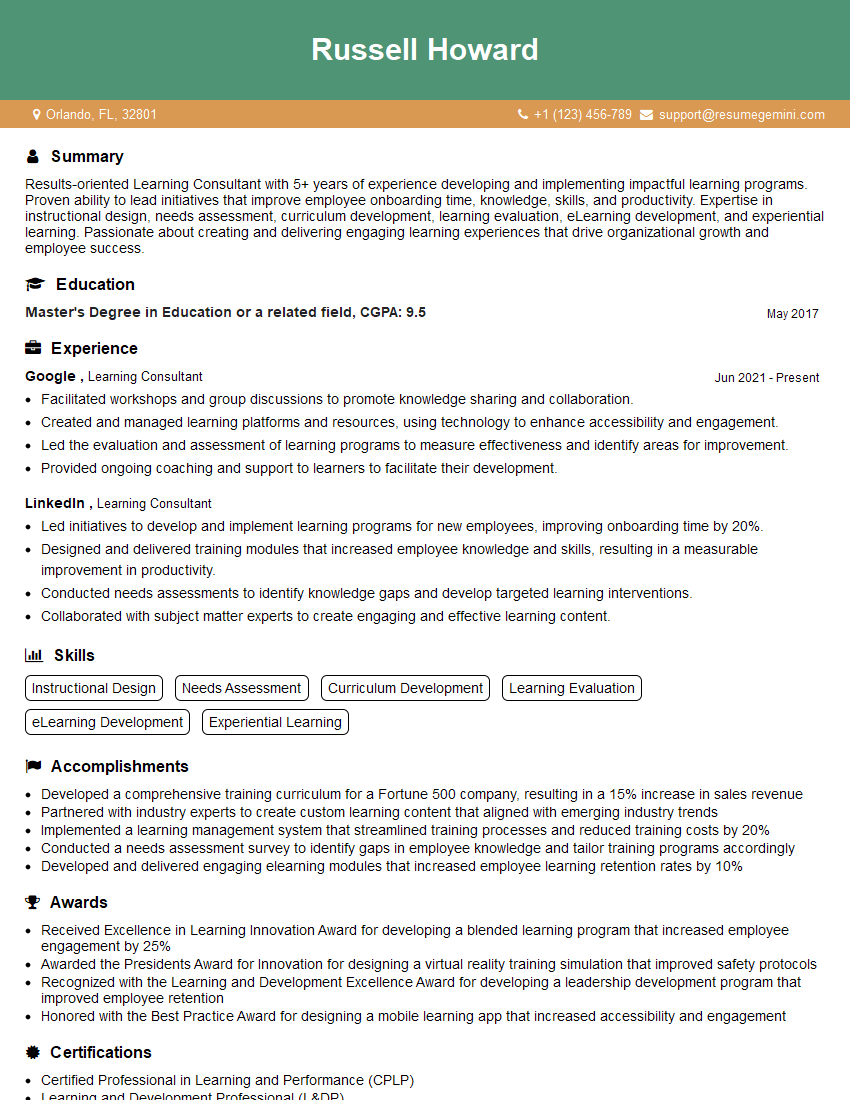
Learning Consultant Resume Sample
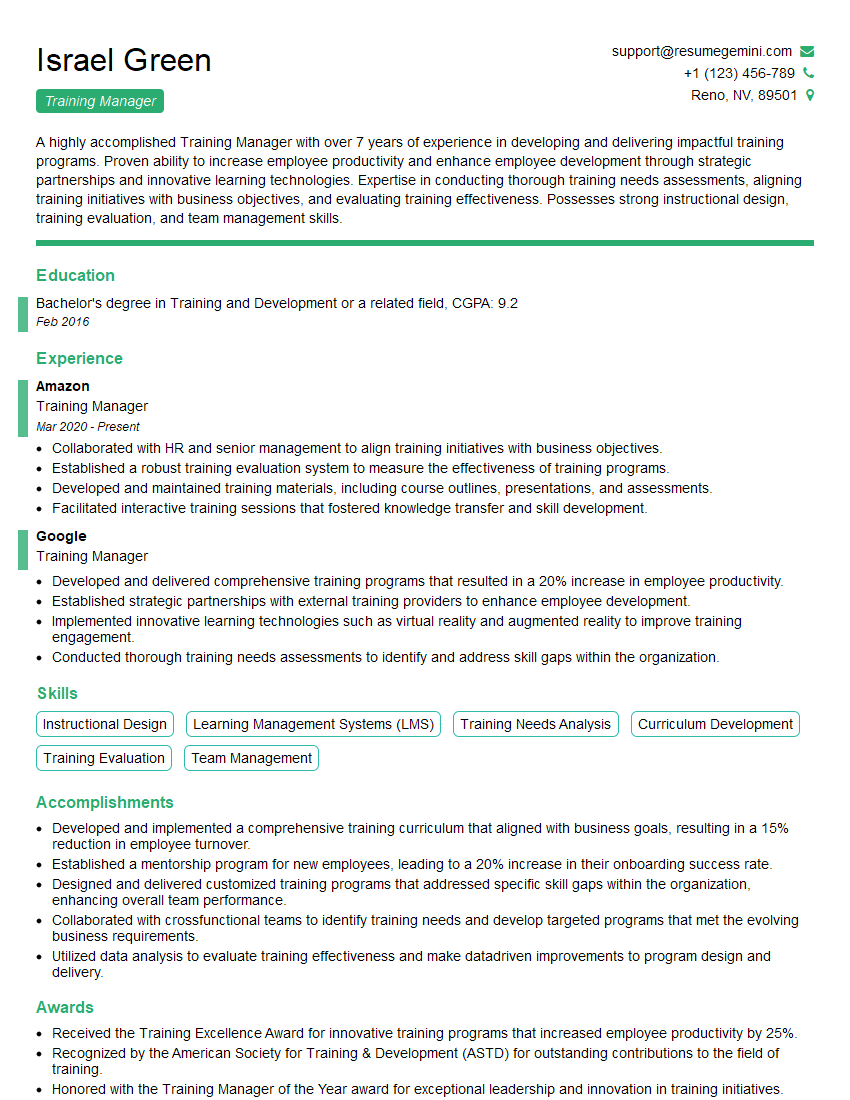
Training Manager Resume Sample
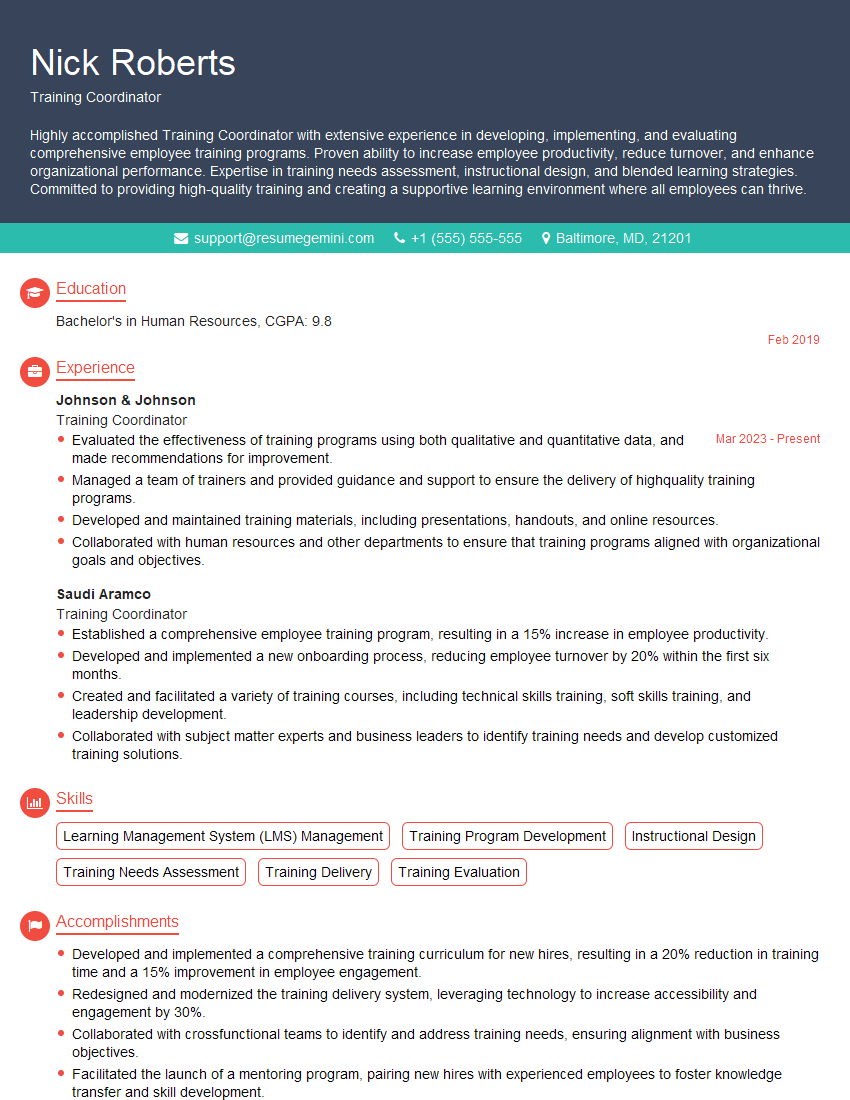
Training Coordinator Resume Sample
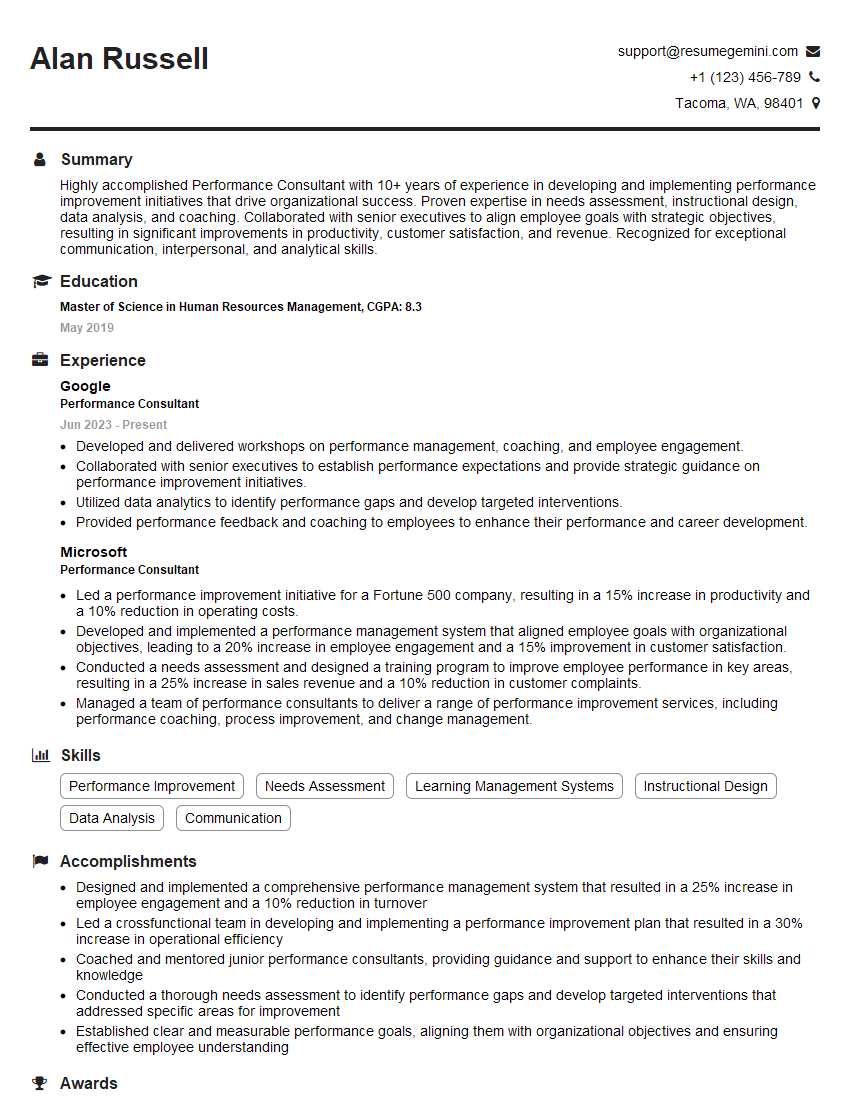
Performance Consultant Resume Sample
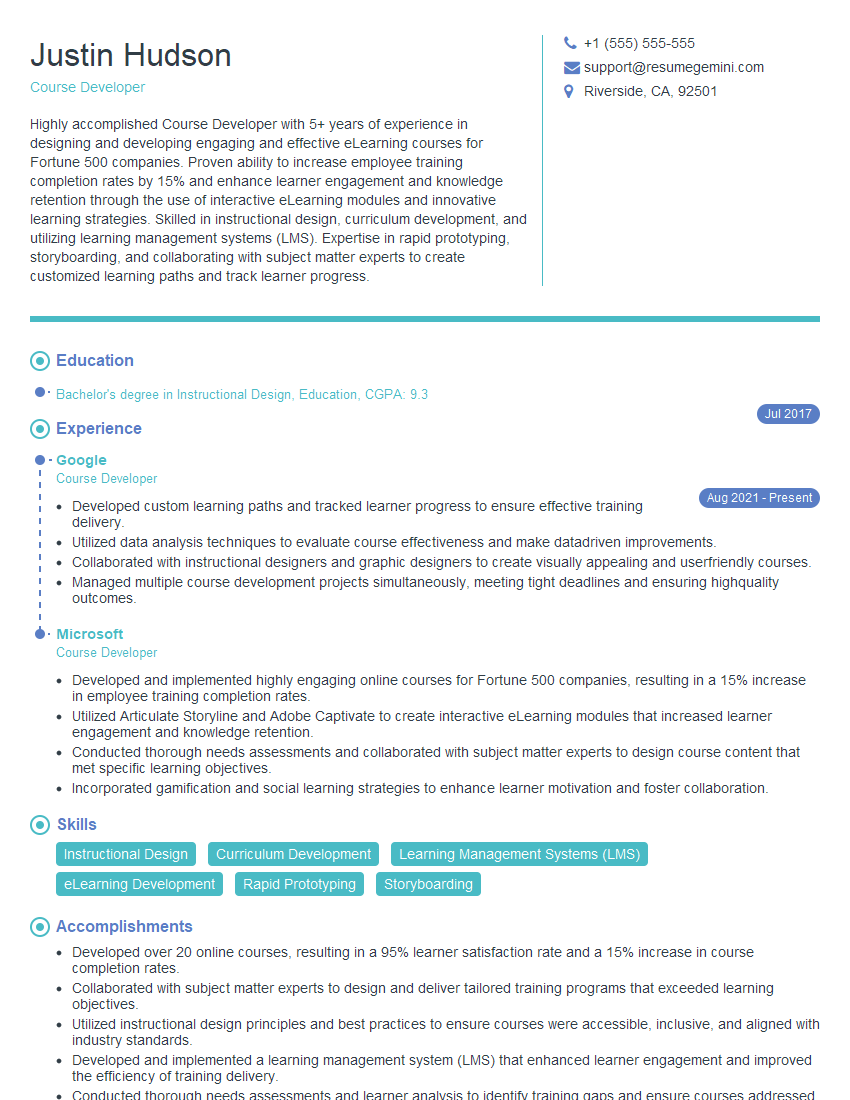
Course Developer Resume Sample

Curriculum Developer Resume Sample

Training Specialist Resume Sample
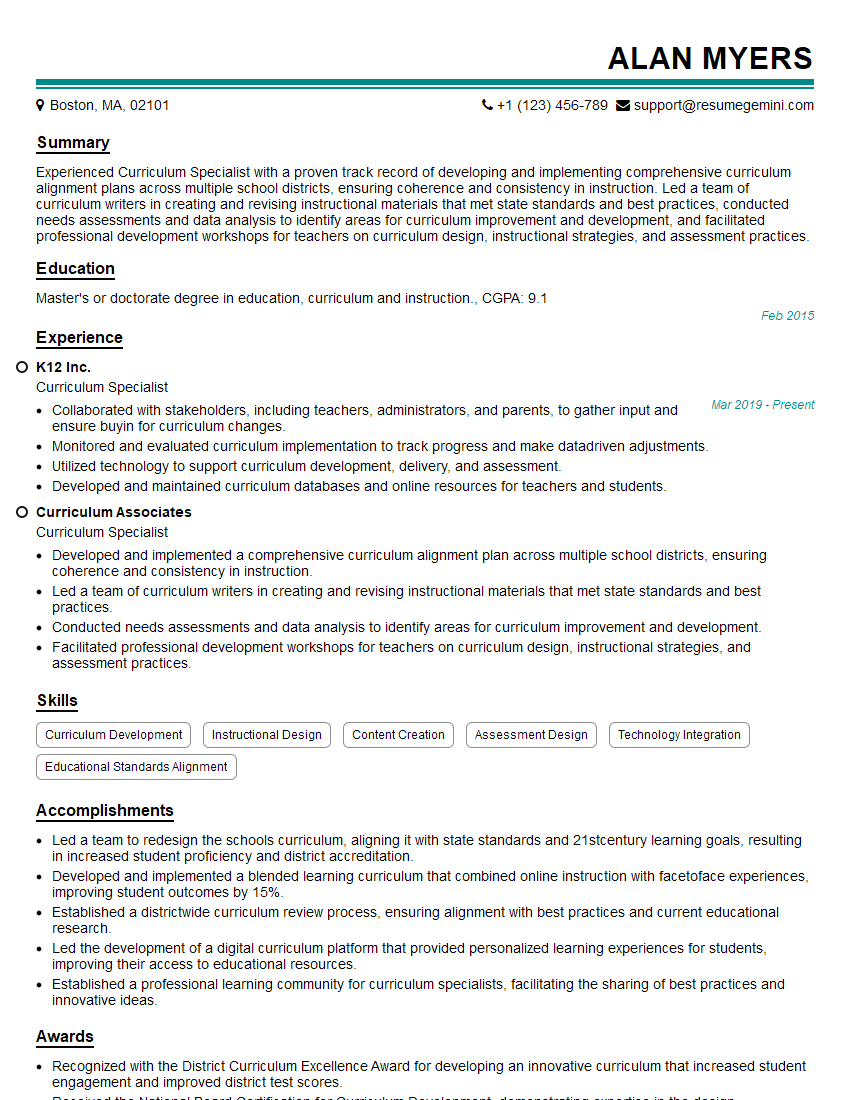
Curriculum Specialist Resume Sample
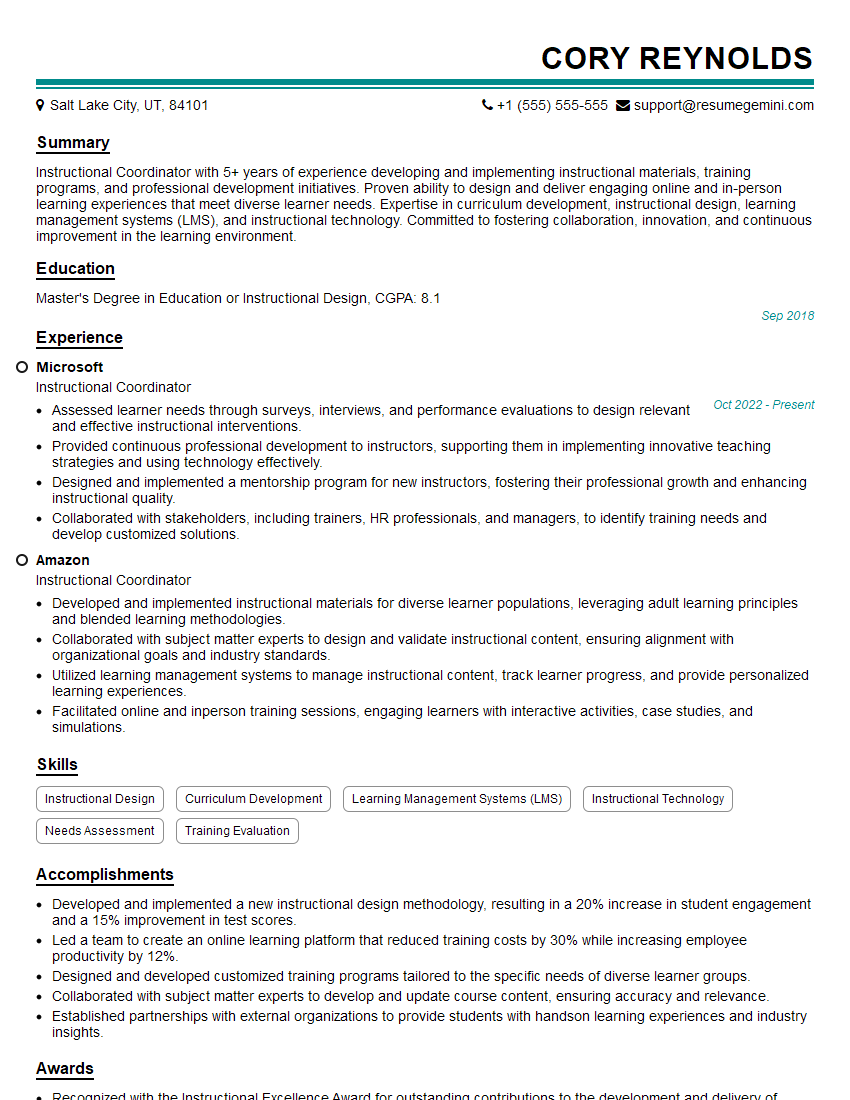
Instructional Coordinator Resume Sample
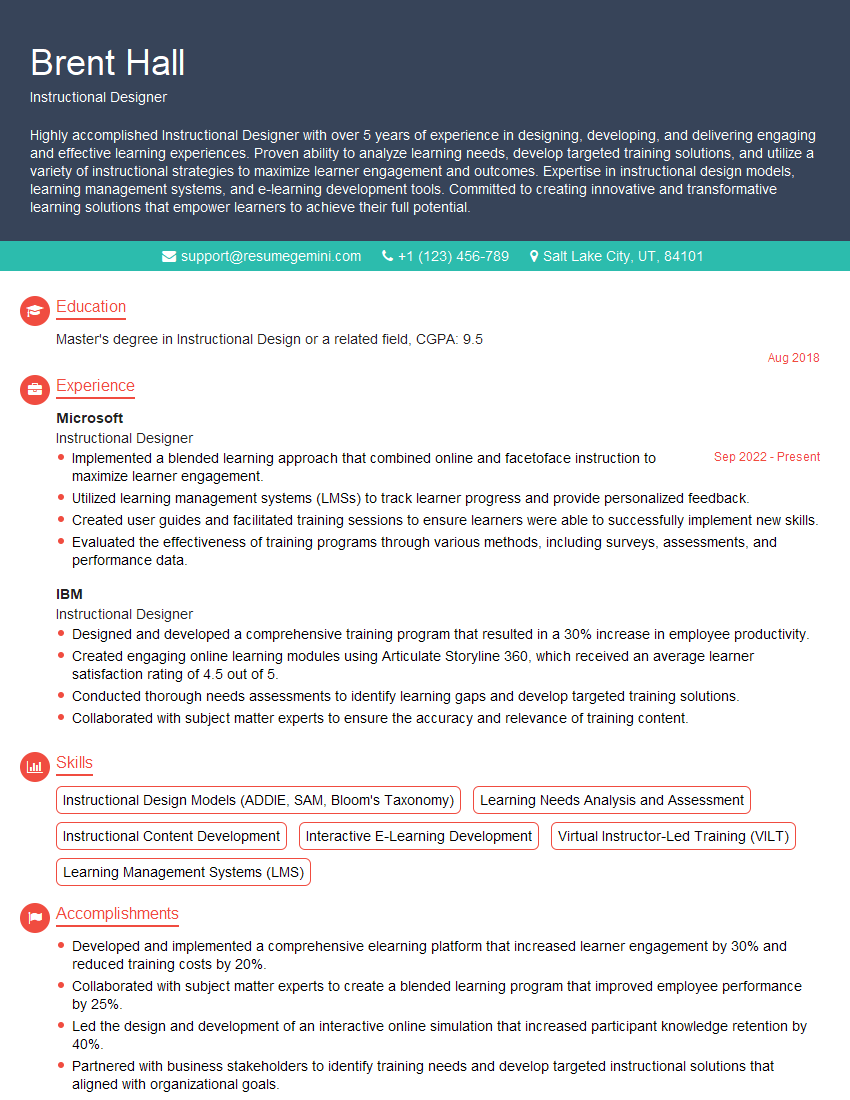
Instructional Designer Resume Sample

Educational Technologist Resume Sample
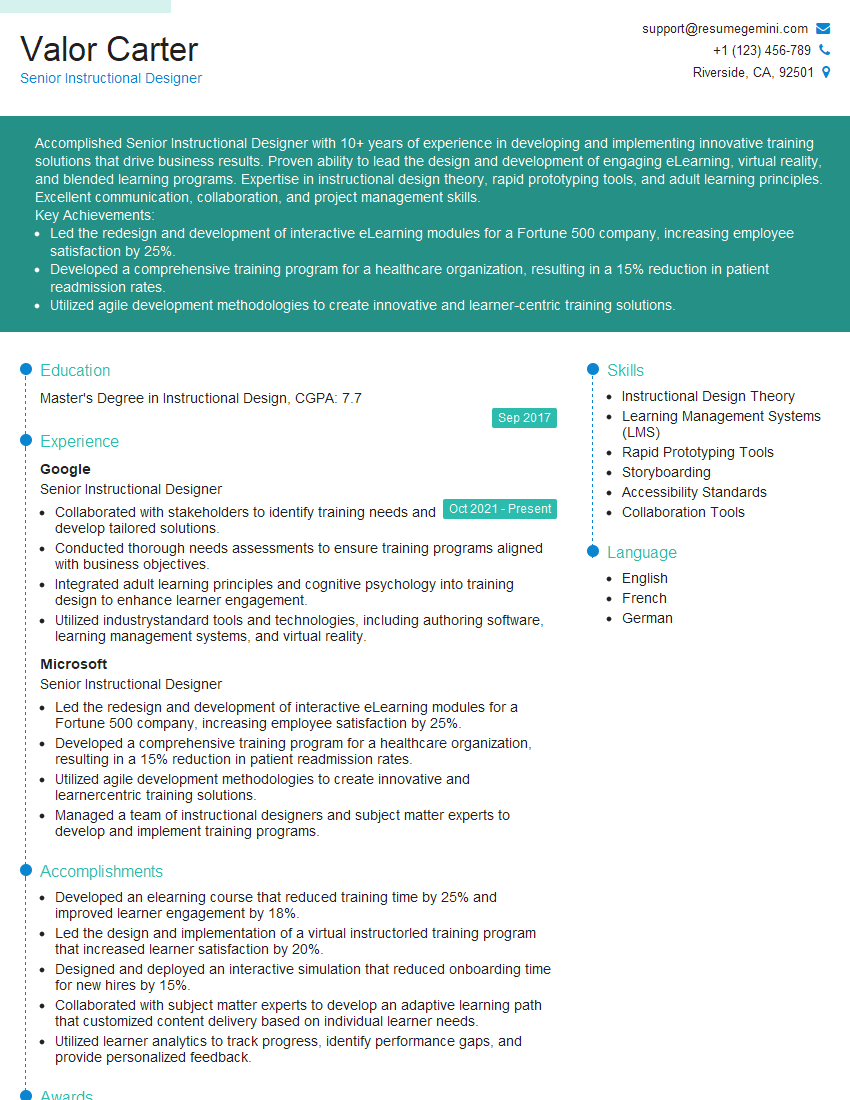
Senior Instructional Designer Resume Sample
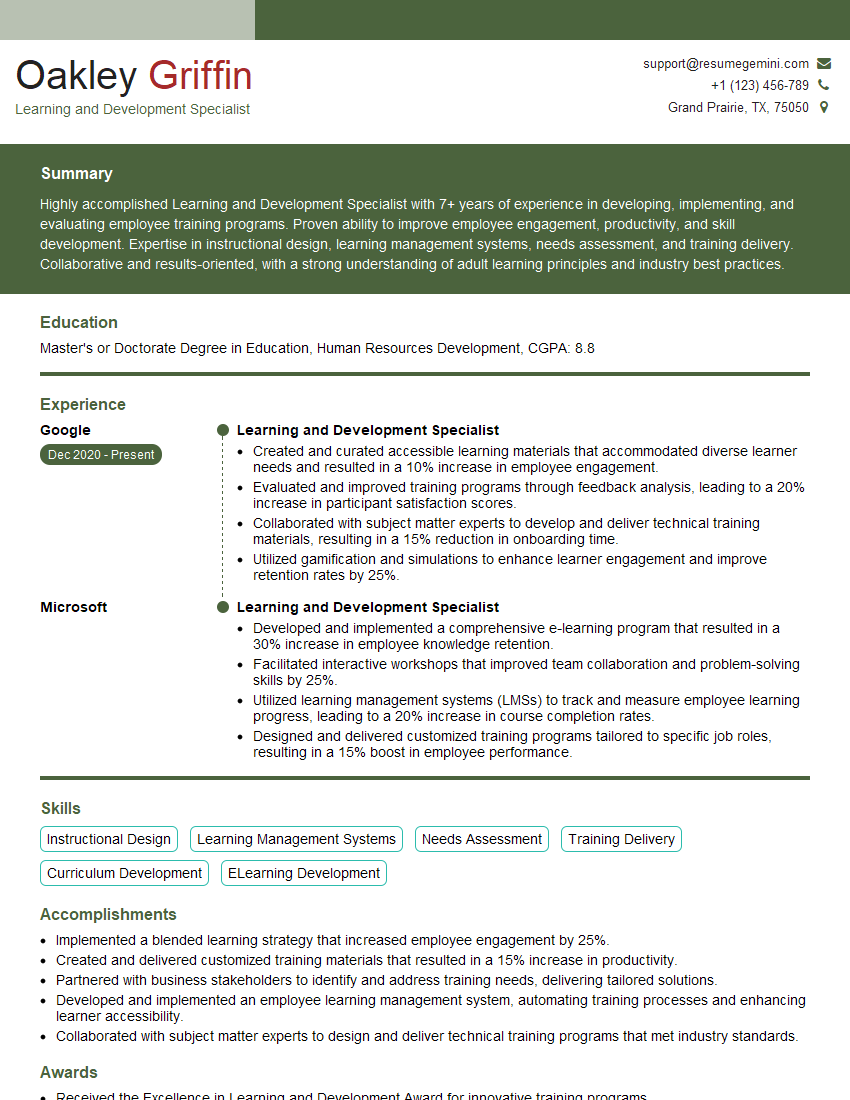
Learning and Development Specialist Resume Sample
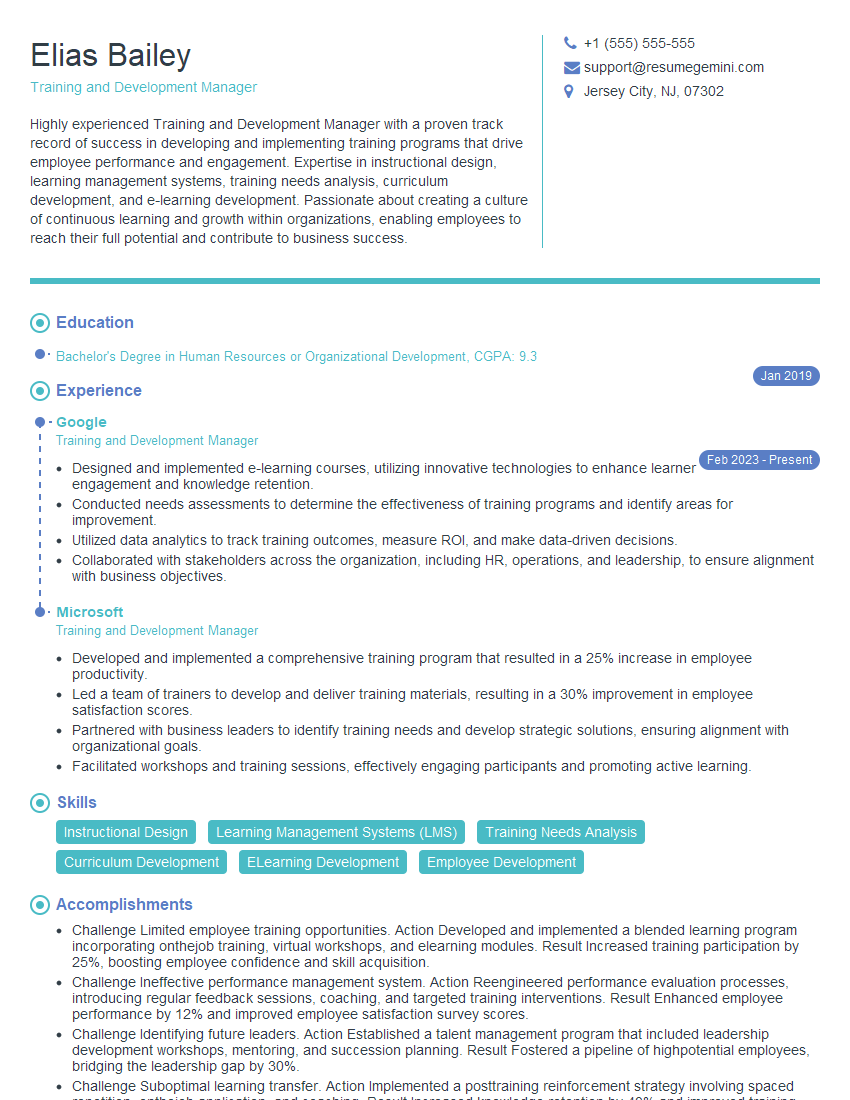
Training and Development Manager Resume Sample
- Learning Consultant
- Training Manager
- Training Coordinator
- Performance Consultant
- Course Developer
- Curriculum Developer
- Training Specialist
- Curriculum Specialist
- Instructional Coordinator
- Instructional Designer
- Educational Technologist
- Senior Instructional Designer
- Learning and Development Specialist
- Training and Development Manager
Explore more articles
Users Rating of Our Blogs
Share Your Experience
We value your feedback! Please rate our content and share your thoughts (optional).
What Readers Say About Our Blog
Really detailed insights and content, thank you for writing this detailed article.
IT gave me an insight and words to use and be able to think of examples