Unlock your full potential by mastering the most common Knotting Techniques interview questions. This blog offers a deep dive into the critical topics, ensuring you’re not only prepared to answer but to excel. With these insights, you’ll approach your interview with clarity and confidence.
Questions Asked in Knotting Techniques Interview
Q 1. Describe the differences between a bowline and a clove hitch.
The bowline and clove hitch, while both useful loops, differ significantly in their construction and applications. The bowline is a fundamental knot forming a closed loop at the end of a rope that will not slip. Think of it as a reliable ‘eye’ at the rope’s end, perfect for creating a strong loop that won’t tighten down and become difficult to untie. It’s famously known for its ease of tying and untying, even under load.
The clove hitch, on the other hand, is a temporary hitch used to secure a rope to a post, ring, or other object. It’s quick to tie and easy to adjust, but relies heavily on friction and is less secure than a bowline, especially under heavy load. It’s often used as a starting point for other knots or for temporary fastening. Imagine using it to quickly secure a rope to a tree branch while setting up a tent—it’s not meant for long-term, high-stress situations.
In essence, the bowline is a strong, permanent loop at the end of a rope, while the clove hitch is a temporary, adjustable fastening around an object. Choosing between them depends entirely on the specific application and the required level of security.
Q 2. Explain the advantages and disadvantages of using a figure-eight knot.
The figure-eight knot is a stopper knot, primarily used to prevent a rope from running through a device like a carabiner or pulley.
Advantages: It’s simple to tie and untie, even when under slight tension. Its shape distributes load evenly, preventing undue stress on any single point of the rope. It’s relatively small and compact, ideal for situations where space is limited.
Disadvantages: While it prevents slippage, it’s not as strong as some other stopper knots like the overhand on a bight. It can also be prone to unraveling if not tied tightly and correctly. Additionally, it’s not suitable for situations requiring extremely high strength or dynamic loading, such as rock climbing falls. Think of it as a good everyday stopper knot, not one for extreme situations.
Q 3. What is a prusik knot and how is it used in climbing?
A Prusik knot is a friction knot tied around a rope that allows movement in one direction but grips tightly when loaded in the opposite direction. This unique property makes it incredibly useful in climbing.
In climbing, Prusik knots are used for ascending ropes, creating self-belay systems, and establishing mid-climb anchors. Climbers often use multiple Prusik knots on a climbing rope to create a self-arresting system, allowing for controlled ascents and descents on a fixed rope. Its ability to grip and release makes it versatile and reliable for various climbing techniques.
The knot is typically tied using a thin cord or sling around a thicker rope. The friction between the cord and the main rope provides the gripping power. When tension is applied in the direction of the ascent, the knot tightens and grips. Releasing the tension allows the knot to slide down the rope. It’s crucial to use appropriately sized cord and to inspect the knot regularly for wear and tear.
Q 4. How would you tie a reliable knot for securing a heavy load?
Securing a heavy load requires a knot that is both strong and reliable under significant tension. My recommendation would be to use a combination of knots and techniques. I would start with a bowline on a bight to create a strong loop, this is then passed through a shackle or strong metal ring to connect to the load. The shackle provides a secure point for distributing the force.
This ensures even weight distribution and reduces the risk of the knot slipping or failing. Finally, I’d use a figure eight follow through or a clove hitch to secure the other end of the rope and keep it from running free. For extremely heavy loads a safety system using multiple ropes and knots is paramount. The specific knot choice would depend on the shape and weight of the load. It’s also crucial to use appropriate rope and hardware for the weight and use case.
Q 5. What safety precautions should be taken when working with heavy ropes?
Safety when working with heavy ropes is paramount. Here are some key precautions:
- Proper Training: Always receive proper training on knot tying, rope handling, and safety procedures before working with heavy ropes.
- Inspect Ropes Regularly: Carefully inspect ropes for any signs of wear, fraying, or damage before each use. Damaged ropes should be discarded.
- Use Appropriate PPE: Wear appropriate personal protective equipment (PPE), including gloves, eye protection, and sturdy footwear.
- Secure Work Area: Ensure the work area is clear of obstructions and that the rope is properly secured to avoid uncontrolled movement or slippage.
- Multiple Points of Attachment: When securing heavy loads, always use multiple points of attachment to distribute the weight and improve safety.
- Never Overload Ropes: Never exceed the working load limit of the rope. This information is usually printed on the rope.
- Use appropriate hardware: Ensure that any shackles, carabiners, or other hardware used with the rope have a working load limit that is significantly higher than the load you are handling.
Following these guidelines significantly reduces the risk of accidents and injury.
Q 6. Describe the process of inspecting a rope for wear and tear.
Inspecting a rope for wear and tear is a crucial step in ensuring safety. The inspection should be thorough and cover the entire length of the rope. Look for the following:
- Fraying: Check for any loose or broken fibers at the ends or along the rope’s length. Even small amounts of fraying can weaken the rope significantly.
- Cuts and Abrasions: Inspect for any cuts, gouges, or abrasions that could compromise the rope’s structural integrity. These are often caused by contact with sharp objects or rough surfaces.
- Kinks and Knots: Examine the rope for permanent kinks or knots, which concentrate stress and weaken the rope at those points. Kinks that don’t straighten out easily indicate serious damage.
- Stiffness and Color Change: Over time, ropes can become stiff or change color, indicating degradation due to age, UV exposure, or chemical damage.
- Burning or Melting: Check for any signs of burning, melting or other damage caused by heat.
If any of these issues are found, the rope should be replaced immediately. Don’t risk using a damaged rope – it could lead to serious injury or equipment failure.
Q 7. What are the key characteristics of a good knot?
A good knot possesses several key characteristics:
- Strength: It should be able to withstand the load it is intended to carry without failing or slipping.
- Ease of Tying and Untying: It should be relatively easy to tie and untie, even when under tension (unless it’s a permanent knot).
- Security: It should hold securely under load and not easily come undone.
- Simplicity: A simple knot is less prone to error and easier to inspect for correctness.
- Efficiency: It should use a minimal length of rope while maintaining strength and security.
- Small Size (Ideally): A smaller, compact knot reduces bulk and avoids unnecessary friction.
- Appropriate for the Task: The chosen knot should be suitable for the specific application and the type of rope being used.
Not all knots excel in every category. For example, some knots are incredibly strong but difficult to untie once loaded. The selection of an appropriate knot depends heavily on the specific needs of the task.
Q 8. Explain the concept of knot slippage and how to mitigate it.
Knot slippage occurs when a tied knot loosens or comes undone under load. Think of it like a poorly-fastened button – it might hold initially but fails under stress. This is a serious issue, especially in safety-critical applications.
Several factors contribute to slippage: improper knot tying, using the wrong type of knot for the task, using damaged or worn rope, and excessive load. Mitigating slippage involves:
- Choosing the right knot: Select a knot known for its holding power and suitability for the rope material and application. A bowline, for instance, is secure but not ideal for heavy loads.
- Proper knot execution: Ensure each turn and tuck is tight and secure. Loose loops or uneven tension are common culprits.
- Securing the knot: Once tied, firmly cinch the knot by pulling on the standing ends, ensuring the knot is snug against itself. A helpful technique is to use a half-hitch or another binding knot to further secure the primary knot.
- Using a stopper knot: A stopper knot, tied at the end of the rope, prevents the rope from running through the primary knot.
- Rope material and condition: Inspect the rope for any signs of wear, fraying, or damage. Damaged rope is more prone to slippage.
For example, in climbing, slippage could be catastrophic. A properly tied figure-eight knot secured with a half-hitch is vital to safety. In sailing, a poorly tied bowline could lead to the loss of a sail or even an accident.
Q 9. What type of knot would you use for joining two ropes of different diameters?
Joining ropes of different diameters requires a knot that can accommodate the disparity in size without compromising strength or creating excessive bulk. The best option is often a sheet bend. This knot is excellent for joining two ropes of differing sizes or materials, and it lies relatively flat, minimizing bulk.
To tie a sheet bend, form a bight (loop) in the larger rope. Pass the end of the smaller rope through the bight, around the standing part of the larger rope, and then back through the original loop. Tighten carefully. A properly tied sheet bend is very secure and strong.
Another viable option for lighter loads or temporary joins could be a fisherman’s knot, although a sheet bend is generally preferred for its superior strength and ease of tying.
Q 10. How do you determine the appropriate size and type of rope for a given task?
Choosing the right rope hinges on the specific task’s demands. You need to consider:
- Load-bearing capacity: Determine the maximum weight or force the rope will need to withstand. The rope’s strength must exceed this significantly to provide a safety margin.
- Rope diameter: Larger diameter ropes generally have higher strength but are less flexible. Balance strength with maneuverability.
- Rope material: Different materials (nylon, polypropylene, manila, etc.) offer varying strengths, stretches, and resistances to abrasion and environmental factors. Nylon is strong and elastic, while polypropylene floats.
- Application: The intended use dictates the rope type. Climbing ropes need high tensile strength and low elasticity, while sailing ropes need to withstand abrasion and UV exposure.
For instance, a heavy-duty nylon rope is suited for towing, while a thinner, more flexible polypropylene rope might be suitable for general-purpose tasks.
Q 11. Explain the importance of proper knot tying in a specific industry (e.g., maritime, climbing).
In the maritime industry, proper knot tying is paramount to safety. A sailor’s life often depends on the reliability of knots securing sails, mooring lines, and life-saving equipment. A poorly tied knot can lead to equipment failure, injury, or even death. Imagine a storm at sea; if a crucial knot fails, it can have devastating consequences for the crew and the vessel.
Consider a mooring line securing a boat to a dock. The knot must be strong enough to withstand the forces of wind, waves, and currents. Similarly, knots used to secure sails must hold firmly, even under stress. In this demanding environment, incorrect knot tying is unacceptable; it’s a matter of life and death.
Q 12. Describe the different types of knots used in marine applications.
Marine applications utilize various knots, each suited for specific tasks:
- Bowline: Forms a fixed loop that won’t slip, excellent for attaching a line to a ring or hook.
- Clove Hitch: Quick and easy temporary fastening around a post or object.
- Sheet Bend: Joins two ropes of different diameters.
- Figure Eight Knot: Used to prevent the end of a rope from running through a block or pulley.
- Reef Knot (Square Knot): Joins two ropes of similar diameter. Use with caution as it can come undone under load.
- Cleat Hitch: Secures a rope to a cleat, a fitting on a boat for securing lines.
The choice of knot depends on the application and the load involved. A bowline, for instance, is secure and reliable but might not be strong enough for heavy-duty tasks. Sailors need to be proficient in a range of knots to handle various situations.
Q 13. How do you adjust the tension in a knot once it’s tied?
Adjusting tension in a knot after it’s tied often involves tightening the knot further. This can be done by pulling on the standing parts of the rope (the parts not involved in the knot itself). For many knots, you’ll find that by pulling on both standing parts, you can snug the knot against itself. You might also need to reposition the knot slightly to reduce any slack. With some knots, like a bowline, it’s critical to make sure the loop is not twisted, as twisting can weaken the knot.
In some cases, using a half-hitch or a binding knot over the primary knot will help further secure it and make it tighter. The goal is to eliminate any slippage or slack, ensuring the knot is as secure as possible.
Q 14. What are some common mistakes to avoid when tying knots?
Several common mistakes can lead to unreliable knots:
- Insufficient tightening: Leaving slack in the knot’s loops is a significant error; it can weaken the knot considerably.
- Using the wrong knot: Employing an inappropriate knot for the task at hand will lead to failure.
- Over-tightening: While tightening is essential, over-tightening can damage the rope fibers and weaken the knot.
- Using damaged rope: A knot tied on worn or damaged rope is inherently less secure.
- Incorrect sequence of steps: Missing steps or performing them out of order can significantly weaken or compromise the knot.
- Not checking the knot: Inspecting the knot after tying is crucial to ensure it’s secure and properly formed.
Practicing proper knot-tying techniques and understanding the characteristics of different knots are vital to prevent these mistakes. Always double-check your work, especially in safety-critical scenarios.
Q 15. How can you quickly identify a poorly tied knot?
A poorly tied knot often exhibits several telltale signs. The most obvious is asymmetry; a properly tied knot should be balanced and symmetrical. Look for loose ends or sections that aren’t snug against the main body of the knot. If the knot is easily deformed or slips under slight tension, it’s a clear indicator of poor execution. Finally, compare the knot to a diagram or example of the intended knot type – discrepancies are a sure sign of improper tying. For example, a poorly tied bowline might have the running end not lying neatly in its designated loop, making it unstable and prone to failure.
Career Expert Tips:
- Ace those interviews! Prepare effectively by reviewing the Top 50 Most Common Interview Questions on ResumeGemini.
- Navigate your job search with confidence! Explore a wide range of Career Tips on ResumeGemini. Learn about common challenges and recommendations to overcome them.
- Craft the perfect resume! Master the Art of Resume Writing with ResumeGemini’s guide. Showcase your unique qualifications and achievements effectively.
- Don’t miss out on holiday savings! Build your dream resume with ResumeGemini’s ATS optimized templates.
Q 16. Describe the procedure for untying a complex or stubborn knot.
Untying a stubborn knot requires patience and the right techniques. First, assess the knot’s type and material. If it’s a complex knot, gently try to trace its path, identifying individual loops and wraps. Often, carefully working on the outermost wraps first, releasing one at a time, will gradually loosen the knot’s structure. Lubrication can help; a drop of oil or soapy water can reduce friction and aid in separating the fibers. For extremely difficult knots, using specialized tools like a knot-picking tool or a marlinspike can be effective. Remember, force is your enemy; persistent, gentle manipulation is key. For instance, a tightly bound clove hitch can be untied by slowly working on each turn, ensuring each coil is fully released before progressing to the next. Sometimes, cutting the knot may be the only safe option, especially if it compromises the integrity of a critical system.
Q 17. Explain the principles of friction in relation to knot tying.
Friction is paramount in knot tying. It’s the force resisting the movement of one rope strand against another, or against a surface. Friction is what holds a knot together under tension. A well-tied knot creates ample friction through multiple points of contact between its strands. Factors influencing friction include the rope material (rougher materials create more friction), the number of wraps and bends in the knot (more wraps mean more friction), and the nature of the surface against which the knot is working (rough surfaces increase friction). For instance, a simple overhand knot relies heavily on friction between the crossed strands to prevent slippage. Conversely, using a lubricated rope will significantly reduce friction and weaken the knot’s holding power.
Q 18. What is the impact of weather conditions on knot performance?
Weather conditions profoundly impact knot performance. Moisture can weaken the fibers of natural ropes, reducing their strength and making them more susceptible to slippage. Extreme temperatures can also affect synthetic ropes, altering their flexibility and strength. For instance, ice buildup can alter the shape of a knot, reducing its effectiveness and possibly causing failure. Exposure to UV radiation can degrade rope materials over time, weakening the fibers and compromising knot integrity. In snowy conditions, a previously reliable knot might require additional security measures, such as adding a backup knot or using a different knot design entirely.
Q 19. How do you determine the breaking strength of a knot?
Determining the breaking strength of a knot requires specialized equipment and procedures. A tensile testing machine is usually used to apply controlled force to the knotted rope until it breaks. The maximum force applied before failure is the breaking strength of the knot. It’s crucial to note that the breaking strength of a knot is always less than the breaking strength of the unknotted rope due to stress concentration at the knot’s points of contact. The percentage reduction in strength varies depending on the knot type and the rope material. For example, a bowline typically retains a significant percentage of the rope’s original strength, while a poorly tied knot can dramatically reduce it. This is why careful knot selection and precise tying are essential for safety.
Q 20. Describe different methods for securing a load using multiple ropes and knots.
Securing a load with multiple ropes and knots often involves combining different knot types for optimal load distribution and security. Common methods include using a series of clove hitches to secure a load to a ring or post, or employing a combination of a bowline and a figure eight for attaching ropes to different anchor points and distributing load evenly. A more sophisticated approach might involve a bridle system, where multiple ropes converge on a central point, ensuring that the load is evenly distributed. The choice of knot depends on the load’s weight, the ropes’ characteristics, and the environment. For heavy loads or critical situations, it’s essential to use redundant knots and to ensure that all knots are properly secured and checked for safety.
Q 21. What is the difference between a stopper knot and a binding knot?
Stopper knots and binding knots serve distinct purposes. A stopper knot prevents a rope from running through a system, such as an opening or a pulley. Examples include the overhand knot, the figure eight knot, and the clove hitch (used as a stopper). In contrast, a binding knot secures two or more ropes together, preventing them from separating. Examples include the square knot, the sheet bend, and the weaver’s knot. While some knots like the clove hitch can function as both a stopper and a binding knot, understanding their primary function is crucial for selecting the appropriate knot for a specific task. For instance, you might use a figure eight stopper knot to prevent a rope from slipping through a hole in a climbing harness while a square knot might be used to tie together two pieces of rope forming a longer length.
Q 22. How do you assess the safety of a knot after it has been subjected to stress?
Assessing the safety of a knot after stress involves a thorough visual inspection and, in critical applications, potentially destructive testing. First, I’d look for any signs of slippage, deformation, or fiber breakage. A slightly loosened knot might be easily re-tightened, but significant deformation or broken fibers are serious indicators of compromised integrity. I’d check for any unusual wear patterns or localized damage, indicating points of concentrated stress. For example, a bowline used to lift a heavy object might show flattening or abrasion on the standing part near the knot.
In high-stakes situations, such as climbing or rigging, a destructive test might be necessary. This involves applying increasing load until the knot fails, allowing analysis of the failure point and mode. This data helps determine the knot’s actual strength under load and its suitability for future applications. Understanding the type of load (static versus dynamic) and the material’s properties is crucial during this assessment.
Q 23. What are the advantages and disadvantages of different knot materials (e.g., nylon, polyester)?
Different knotting materials have distinct advantages and disadvantages. Nylon, for example, is known for its high strength-to-weight ratio, excellent abrasion resistance, and elasticity. This elasticity helps absorb shock loads, making it suitable for dynamic applications like climbing ropes. However, nylon can be prone to creep (gradual elongation under sustained load) and can degrade under prolonged exposure to UV radiation. Therefore, it’s less ideal for static applications where long-term load bearing is critical.
Polyester, on the other hand, offers superior strength and durability, minimal creep, and better UV resistance compared to nylon. This makes it a preferable material for static applications like mooring lines or safety harnesses. However, polyester generally lacks the elasticity of nylon, making it less suitable for applications involving shock loading where elasticity is a safety feature. Choosing the right material depends heavily on the intended use and the type of stress expected.
Q 24. Explain your experience with different types of rope construction.
My experience encompasses various rope constructions, each with unique properties. I’m familiar with three-strand twisted ropes, which are relatively inexpensive and easy to handle but can be prone to unraveling if cut. Braided ropes offer higher strength and abrasion resistance due to their interlocking structure; however, they are typically more expensive. I’ve also worked extensively with kernmantle ropes, which consist of a core (kern) and an outer sheath (mantle). This design offers excellent strength and flexibility and is common in climbing and rescue ropes. The specific construction impacts a rope’s strength, elasticity, abrasion resistance, and overall lifespan, influencing the knot choice and tying technique.
Understanding the construction is crucial when selecting appropriate knots. For instance, a knot that might be suitable for a three-strand rope could be less effective or even dangerous when used with a kernmantle rope because it might damage the core.
Q 25. Describe your experience in troubleshooting knot-related problems.
Troubleshooting knot-related problems often starts with a careful examination of the knot itself. Is the knot properly tied? Are there any signs of slippage, friction burns, or damage to the rope? I systematically check for inconsistencies that could be causing issues. For example, a poorly formed knot can lead to slippage or even breakage. A knot that’s too tight might damage the rope fibers. The environment also plays a role. Exposure to water, chemicals, or UV radiation can weaken rope and affect knot integrity.
Once the problem is identified, the solution could involve re-tying the knot correctly, choosing a more suitable knot for the application, replacing damaged rope, or adjusting the load distribution. Documentation and a methodical approach are key – documenting the problem, the troubleshooting steps, and the resolution is crucial for continuous improvement and safety.
Q 26. What knotting techniques are you most proficient in?
My expertise spans a wide range of knotting techniques, but I’m particularly proficient in the following: bowlines (for their versatility and ease of untying), clove hitches (for securing a rope to a ring or hook), figure-eight knots (for their secure, reliable nature, especially in climbing), and various stopper knots (for preventing ropes from running through systems).
Beyond these, I have extensive experience with more complex knots used in specialized applications, such as the Ashley stopper knot, various splicing techniques, and intricate rigging knots. My proficiency is not just limited to tying; it also includes understanding the applications, limitations, and appropriate rope types for each knot.
Q 27. How do you stay updated on new developments in knotting techniques?
Staying updated in the field of knotting requires a multi-faceted approach. I regularly attend conferences and workshops, network with other knotting experts, and actively participate in online forums and communities dedicated to this field. Reading relevant literature, including books, journals, and technical papers, is also essential. Furthermore, I actively seek opportunities for hands-on experience in various settings and continue to refine my skills through practice and experimentation.
Staying abreast of new materials, rope constructions, and safety standards is crucial for adapting techniques and ensuring the best practices are followed in my work.
Q 28. Describe a time when you had to solve a knot-related problem under pressure.
During a challenging rescue operation, a critical anchor point knot, a modified bowline, had unexpectedly loosened under significant load. This was a high-pressure situation, as the safety of a climber depended on the integrity of the anchor. Under pressure, I methodically assessed the situation – the rope showed no signs of damage, and the problem seemed to be with the knot itself. I realized that the initial knot, though seemingly secure, had been improperly loaded, creating a weak point.
Instead of attempting to re-tie the existing knot under load (which would have been risky), I quickly secured a secondary backup anchor using a different knotting technique, ensuring redundant safety. Once the climber was secured, I carefully untied the original knot, analyzing the issue, and then re-tied it correctly. This experience reinforced the importance of redundancy in critical systems and the need for a calm, methodical approach even under stress.
Key Topics to Learn for Knotting Techniques Interview
- Fundamental Knots: Mastering the theory and practical application of essential knots like the bowline, clove hitch, figure eight, and their variations. Understanding their strengths, weaknesses, and appropriate applications in different scenarios.
- Advanced Knotting: Exploring more complex knots and their specific uses, such as the carrick bend, sheet bend, and various splicing techniques. This includes understanding the mechanical properties influencing knot strength and security.
- Materials and Their Impact: Analyzing the influence of rope material (e.g., nylon, polyester, natural fibers) on knot performance, including friction, strength, and durability. Understanding how to select the appropriate knot and material for specific tasks.
- Knot Tying Techniques: Developing efficient and reliable methods for tying knots quickly and accurately under pressure, including considerations for hand positioning and proper tensioning.
- Troubleshooting and Problem Solving: Diagnosing and resolving common knot-related issues, such as loosening, slippage, and knot failure. Understanding the factors contributing to these problems and implementing preventative measures.
- Safety Considerations: Prioritizing safety during knot tying and application. Understanding potential hazards and implementing safe work practices to minimize risks.
- Specific Applications: Demonstrating knowledge of knotting techniques in various fields, such as sailing, climbing, fishing, search and rescue, or other relevant industry-specific applications.
Next Steps
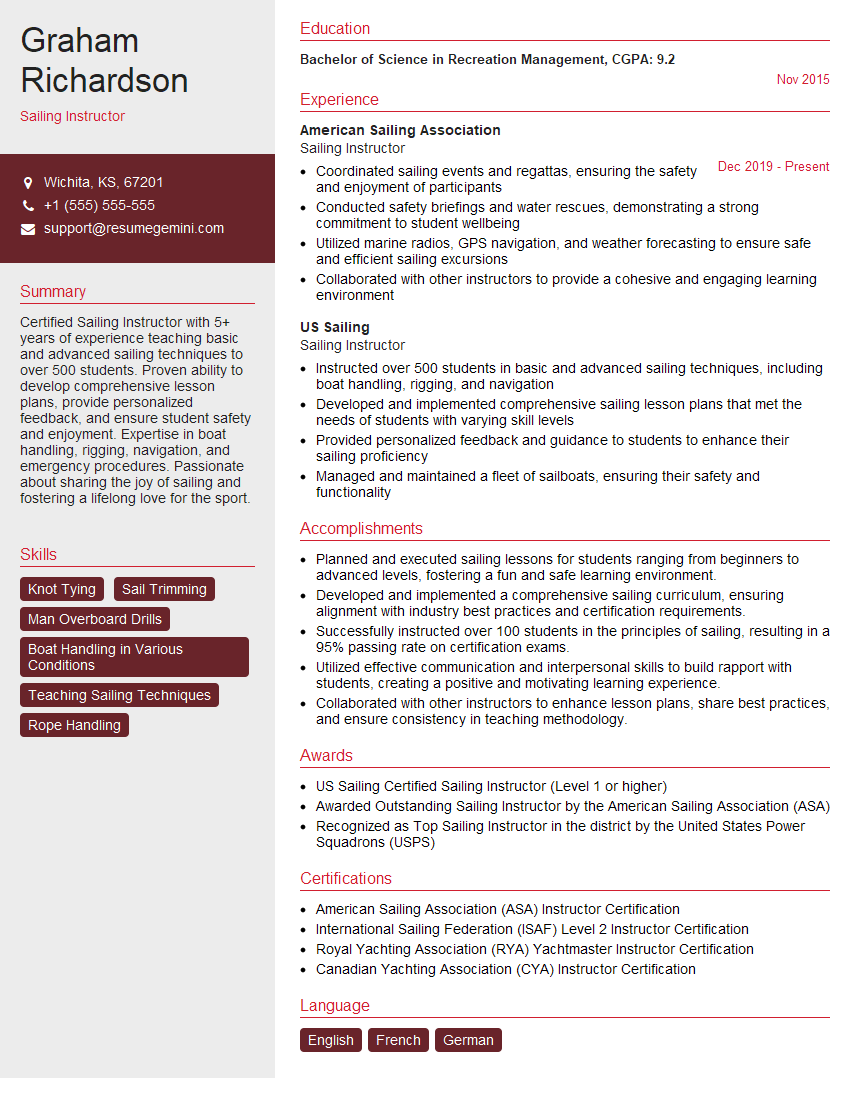
Mastering knotting techniques is crucial for career advancement in numerous fields, opening doors to specialized roles and higher earning potential. To maximize your job prospects, it’s essential to present your skills effectively. Creating an ATS-friendly resume is key to getting noticed by recruiters and landing interviews. We highly recommend using ResumeGemini, a trusted resource for building professional resumes, to craft a compelling document that showcases your knotting expertise. Examples of resumes tailored to Knotting Techniques are available to help guide your resume creation process.

Explore more articles
Users Rating of Our Blogs
Share Your Experience
We value your feedback! Please rate our content and share your thoughts (optional).
What Readers Say About Our Blog
Really detailed insights and content, thank you for writing this detailed article.
IT gave me an insight and words to use and be able to think of examples