Every successful interview starts with knowing what to expect. In this blog, we’ll take you through the top Knowledge of Finite Element Analysis (FEA) interview questions, breaking them down with expert tips to help you deliver impactful answers. Step into your next interview fully prepared and ready to succeed.
Questions Asked in Knowledge of Finite Element Analysis (FEA) Interview
Q 1. Explain the basic principles of the Finite Element Method (FEM).
The Finite Element Method (FEM) is a powerful numerical technique used to solve complex engineering and physics problems. Imagine trying to understand the stress in a complexly shaped car part. Instead of solving the problem analytically (which is often impossible), FEM divides the part into many smaller, simpler shapes called ‘finite elements’. Each element is governed by simple equations. FEM then assembles these equations for all elements, forming a large system of equations that represents the entire part. Solving this system gives us approximate solutions for variables like stress, displacement, and temperature at various points within the part. This approximation improves as we increase the number of elements (making them smaller).
In essence, FEM converts a continuous problem (like the stress distribution in a solid object) into a discrete problem (solving for values at specific nodes within each element), thereby making it solvable by computers. The method relies on approximating the solution within each element using interpolation functions, and then assembling the element-level equations to obtain a global solution.
Q 2. What are the different types of elements used in FEA?
FEA employs a variety of element types, chosen based on the problem’s geometry and nature. Common types include:
- Linear Elements: These are the simplest, using straight lines (in 2D) or triangles/tetrahedra (in 3D) to represent the element. They’re computationally inexpensive but less accurate for curved geometries.
- Quadratic Elements: These use curved lines/surfaces to better approximate curved geometries, offering increased accuracy compared to linear elements, at the cost of higher computational effort. Examples include quadrilaterals in 2D and hexahedra in 3D.
- Higher-Order Elements: These use even more complex shapes and higher-order polynomials for even better accuracy, but increase computational demands significantly.
- Beam Elements: These are specifically designed for slender structural members, considering bending and shear effects. They are efficient for analyzing beams and frames.
- Shell Elements: These model thin structures like plates and shells, considering their bending and membrane behavior. They are commonly used in automotive and aerospace industries.
- Solid Elements: These model three-dimensional structures and are suitable for a wide range of analyses, including stress, strain, and temperature calculations.
The choice of element type is a crucial decision that influences both the accuracy and computational cost of the analysis. A skilled engineer will carefully select the element type based on the specific requirements of the problem.
Q 3. Describe the process of mesh generation in FEA.
Mesh generation is the process of dividing the geometry of a part into a collection of discrete elements and nodes. Think of it like creating a digital mosaic of your part. This is a critical step in FEA, as the quality of the mesh directly impacts the accuracy and reliability of the results. Poor mesh quality can lead to inaccurate or even erroneous results.
The process typically involves these steps:
- Geometry Creation: The model geometry is created using CAD software or imported from other sources.
- Meshing Algorithm Selection: Various algorithms exist, including structured, unstructured, and adaptive meshing. Structured meshes are highly organized (like a grid), while unstructured meshes are more flexible but can be more challenging to control. Adaptive meshing refines the mesh automatically in areas of high gradients (like stress concentrations).
- Mesh Generation: The chosen algorithm automatically divides the geometry into elements. The user controls parameters such as element size, type, and quality.
- Mesh Quality Check: This crucial step verifies the mesh’s quality by assessing element shapes, aspect ratios, and other metrics. Poor quality elements can lead to inaccurate results.
Mesh generation software often offers tools to refine or adjust the mesh to improve quality and accuracy. Experienced engineers understand the importance of meshing and know how to optimize it for specific applications.
Q 4. What is mesh refinement and why is it important?
Mesh refinement refers to the process of reducing the element size in a mesh, thereby increasing the number of elements. This is analogous to increasing the resolution of an image – more pixels mean a clearer picture. It’s crucial because finer meshes provide more accurate solutions, especially in regions with high stress gradients or complex geometry.
Why is it important? Larger elements make crude approximations of the geometry and underlying physics. Refinement helps to capture these details more accurately. For example, a stress concentration in a small hole would be missed with a coarse mesh but clearly captured with a refined mesh in that area. However, refinement significantly increases computational cost and time. Therefore, a balance must be struck between accuracy and computational feasibility. Adaptive meshing techniques automate this process by selectively refining only critical areas.
Q 5. Explain the concept of convergence in FEA.
Convergence in FEA means that the solution obtained from the analysis approaches the true solution as the mesh is refined. Think of it like aiming for a target: the more precise your aim (finer mesh), the closer you get to the bullseye (true solution). We achieve convergence when further mesh refinement produces only negligible changes in the results.
Convergence studies are essential to validate the accuracy and reliability of FEA results. By progressively refining the mesh and observing the changes in key results (e.g., stress, displacement), we can determine whether the solution has converged to a stable and accurate value. Lack of convergence may indicate problems with the model, the mesh, or the analysis settings. Observing the rate of convergence also provides insights into the error associated with the chosen mesh size.
Q 6. What are boundary conditions and how do they affect the results?
Boundary conditions define the constraints and external influences applied to a model. These are essential in FEA because they dictate how the structure behaves under load. Think of them as the rules of the game. Without them, the analysis would be physically meaningless—a floating object would not experience meaningful stress under load.
Examples include:
- Fixed Supports: These constrain the displacement of nodes in specific directions, often representing welded or rigidly fixed connections.
- Loads: These represent forces or pressures applied to the model, such as gravity, pressure, or concentrated forces.
- Symmetry Conditions: These reduce the problem size by leveraging symmetry in the geometry and loads.
- Temperature Conditions: These set the temperature at specific points or surfaces.
Incorrect boundary conditions lead to completely erroneous results. For example, forgetting to apply a fixed support where a component is rigidly mounted will lead to unrealistic displacements and stresses. Careful consideration and accurate application of boundary conditions are crucial for obtaining reliable results.
Q 7. How do you handle non-linearity in FEA?
Nonlinearity in FEA arises when the material behavior, geometry, or boundary conditions are not linear. This means the response of the structure is not directly proportional to the applied loads. Imagine bending a flimsy plastic ruler—the relationship between the applied force and the deflection isn’t linear.
Handling nonlinearity is more complex than linear analysis. Common approaches include:
- Iterative Solution Methods: These methods solve the equations incrementally, adjusting the solution at each step based on the updated nonlinear behavior. Newton-Raphson is a commonly used iterative method.
- Nonlinear Material Models: These models accurately represent the material’s nonlinear behavior, such as plasticity or hyperelasticity, which are critical for analyzing materials that undergo significant deformation.
- Large Deformation Analysis: This considers changes in geometry during the deformation, crucial when displacements are significant compared to the structure’s dimensions.
- Contact Analysis: This deals with the interaction between different bodies, which inherently involves nonlinear behavior.
Nonlinear FEA requires more computational resources and expertise than linear analysis. Proper convergence checks are essential to ensure the accuracy and reliability of the results. Selecting appropriate nonlinear material models and solution techniques is critical for achieving accurate predictions of a structure’s nonlinear behavior.
Q 8. Explain different types of non-linearity (material, geometric, etc.).
Non-linearity in FEA signifies that the relationship between load and response isn’t linear. This means doubling the load doesn’t necessarily double the displacement or stress. There are several types:
- Material Non-linearity: This occurs when the material’s constitutive law (the relationship between stress and strain) is not linear. Think of a rubber band – stretching it a small amount requires little force, but stretching it further requires progressively more force. Common examples include plasticity (permanent deformation), hyperelasticity (large deformation of elastic materials), and viscoelasticity (time-dependent behavior).
- Geometric Non-linearity: This arises from large displacements or rotations where the geometry of the structure changes significantly under load, altering the stiffness matrix. Imagine a long, slender beam; a small deflection can significantly change its bending resistance. This type is especially important for problems with significant deflections compared to the structure’s dimensions.
- Contact Non-linearity: This emerges when two or more bodies come into contact. The contact area and forces are unknown initially, and change dynamically throughout the simulation. For instance, simulating a tire rolling on a road involves intricate contact mechanics.
In many real-world scenarios, you encounter a combination of these non-linearities. For instance, a car crash simulation would involve material nonlinearity (plastic deformation of the metal), geometric nonlinearity (large deformations), and contact nonlinearity (interaction between car parts and the ground).
Q 9. What are the different types of loading conditions in FEA?
FEA loading conditions represent the external forces and constraints applied to a structure. Common types include:
- Static Loads: Loads that are applied slowly and don’t change with time, leading to a static equilibrium state. Think of the weight of a bridge.
- Dynamic Loads: Loads that change with time, causing accelerations and vibrations. Examples include earthquake simulations or impact events. These often require time-stepping analysis techniques.
- Thermal Loads: Loads resulting from temperature changes. These can cause thermal stresses due to material expansion or contraction. Think of a turbine blade operating at high temperatures.
- Pressure Loads: Loads distributed over a surface, such as fluid pressure on a dam or air pressure on an aircraft wing.
- Concentrated Loads: Loads applied at a single point or a very small area, such as a point load on a beam.
- Body Loads: Loads distributed throughout the volume of the structure, such as gravity.
- Inertia Loads: Forces arising from acceleration, important in dynamic simulations.
The specific loading condition will depend entirely on the nature of the problem being studied. You would choose a static analysis for a bridge under its self-weight but a dynamic analysis for an earthquake.
Q 10. How do you choose the appropriate element type for a given problem?
Choosing the right element type is crucial for accuracy and efficiency. The selection depends on several factors:
- Geometry: Complex geometries might require shell or solid elements, while simpler geometries could use beam or truss elements.
- Material Properties: Isotropic materials (same properties in all directions) may be adequately modeled with simpler elements, whereas anisotropic materials (different properties in different directions) require more sophisticated elements.
- Stress Gradient: Areas with high stress gradients (rapid change in stress) need finer meshes with smaller elements for accurate results.
- Analysis Type: Linear static analysis may use simpler elements than nonlinear dynamic analysis.
For instance, a thin plate would benefit from using shell elements, which are computationally efficient and capture bending accurately. A thick block subjected to complex loading would require 3D solid elements to accurately capture the stress state.
Q 11. What are the advantages and disadvantages of different element types?
Different element types have trade-offs between accuracy, computational cost, and ease of use.
- Truss Elements: Simple, efficient for tension and compression in 1D members. They lack shear and bending stiffness, suitable only for simple structures.
- Beam Elements: Account for bending and shear in 1D members, better suited for beams and frames. More complex than truss elements.
- Shell Elements: Efficient for thin structures, capturing bending, membrane, and shear effects. Offer good balance between accuracy and computational cost.
- Solid Elements: Most general elements, can represent complex 3D stress states. Computationally expensive, especially for large models.
In summary: Truss and beam elements are computationally cheap but limited in application. Shell elements strike a balance. Solid elements are accurate but computationally expensive. The optimal choice depends on the specific problem, desired accuracy, and computational resources available.
Q 12. Explain the concept of stress and strain.
Stress and strain are fundamental concepts in mechanics describing how materials respond to forces.
- Stress (σ): Represents the internal force per unit area within a material. Imagine a tiny square inside a material; stress is the force acting on that square divided by its area. It’s measured in Pascals (Pa) or pounds per square inch (psi). Different types of stress exist (tensile, compressive, shear).
- Strain (ε): Represents the deformation of a material due to applied stress. It’s the ratio of change in length to original length (for tensile strain) or change in angle for shear strain. It’s dimensionless.
Consider stretching a rubber band: the force you apply creates tensile stress within the rubber, and the resulting elongation is strain. The relationship between stress and strain is defined by the material’s constitutive model (e.g., Hooke’s Law for linear elastic materials).
Q 13. What are different stress and strain tensors?
Stress and strain are often represented as tensors, capturing their multi-directional nature.
- Cauchy Stress Tensor: Describes stress at a point in terms of components acting on different planes. It’s a symmetric second-order tensor.
- Green-Lagrange Strain Tensor: A strain tensor used in large deformation analyses. It’s based on the change in lengths and angles in the deformed configuration relative to the original configuration.
- Engineering Stress and Strain: Simpler representation used in small deformation analyses. Engineering stress is simply force per unit area, and engineering strain is change in length over original length.
The choice of stress and strain tensors depends on the magnitude of the deformations. For small deformations, the simpler Engineering stress and strain are appropriate. For large deformations, the Green-Lagrange strain tensor is necessary.
Q 14. How do you interpret FEA results?
Interpreting FEA results requires careful examination of several output parameters. The process typically involves:
- Visual Inspection: Examining plots of stress, strain, and displacement contours to identify regions of high stress or large deformation. This provides a visual understanding of the overall behavior of the structure.
- Data Extraction: Using post-processing tools to extract numerical values of stress, strain, and displacement at specific points or locations. This helps in detailed quantitative analysis.
- Verification and Validation: Comparing the FEA results with experimental data or analytical solutions to validate the accuracy of the model. This is crucial to ensure the results are reliable.
- Failure Criteria: Checking the results against failure criteria (like von Mises stress or maximum shear stress) to determine if the structure is likely to fail under the given loading conditions. This informs design decisions.
It’s important to understand the limitations of FEA and to interpret the results in context. For example, a high stress concentration at a particular point may require design modifications to reduce stress or redesigning the geometry of the part to alleviate the stress concentration.
Q 15. Explain different post-processing techniques used in FEA.
Post-processing in FEA involves extracting meaningful information from the vast datasets generated during the simulation. It’s like analyzing the blueprints after a building is designed – you need to understand stresses, strains, displacements, and more to determine if the design is sound.
Visualization: This is the most common post-processing technique. Software packages allow you to visualize results as contour plots (showing stress distribution), deformed shapes (showing how the structure changes under load), and vector plots (showing the direction and magnitude of forces).
Data Extraction: You can extract specific data points, like the maximum stress at a particular location, or the average strain over a specific region. This data is crucial for design validation and optimization.
Animation: Animating the results over time, especially for dynamic analyses, provides a powerful visual representation of how the structure behaves under load. For example, you could see how a car chassis deforms during a crash test.
Report Generation: FEA software typically generates reports summarizing key results, including tables and charts. These reports are essential for documentation and communication.
Advanced Techniques: More advanced techniques include modal analysis (analyzing natural frequencies and vibration modes), harmonic analysis (analyzing responses to cyclical loading), and fatigue analysis (predicting component lifespan).
For example, in analyzing a bridge design, post-processing might involve creating a contour plot of stress distribution to identify areas of high stress concentration, followed by extracting the maximum stress value to ensure it’s below the material’s yield strength.
Career Expert Tips:
- Ace those interviews! Prepare effectively by reviewing the Top 50 Most Common Interview Questions on ResumeGemini.
- Navigate your job search with confidence! Explore a wide range of Career Tips on ResumeGemini. Learn about common challenges and recommendations to overcome them.
- Craft the perfect resume! Master the Art of Resume Writing with ResumeGemini’s guide. Showcase your unique qualifications and achievements effectively.
- Don’t miss out on holiday savings! Build your dream resume with ResumeGemini’s ATS optimized templates.
Q 16. What are the common sources of error in FEA?
Errors in FEA can stem from various sources, impacting the accuracy and reliability of the results. Think of it like baking a cake – if you use the wrong ingredients or follow the recipe incorrectly, the outcome won’t be ideal.
Meshing Errors: Poor mesh quality, such as excessively skewed or distorted elements, can lead to inaccurate results. Imagine trying to measure the area of a circle using oddly shaped tiles – you wouldn’t get an accurate result.
Material Model Errors: Using an inappropriate material model or incorrect material properties can significantly affect the simulation outcome. For instance, using a linear elastic model for a material that exhibits significant plastic deformation would be inaccurate.
Boundary Condition Errors: Incorrectly applying boundary conditions, such as supports or loads, can dramatically alter the results. Think of improperly supporting a shelf – it might collapse unexpectedly.
Geometric Simplifications: Simplifying complex geometries can introduce errors. The level of simplification needs to be carefully balanced with computational cost.
Solver Errors: Numerical errors during the solution process can occur, particularly in complex simulations. These are usually less significant with modern solvers but are always a consideration.
Addressing these errors requires careful model creation, mesh refinement, verification of material properties, and thorough review of boundary conditions.
Q 17. How do you validate FEA results?
Validating FEA results is crucial to ensure their reliability. It’s like testing a prototype before mass production; you want to ensure it functions as expected.
Comparison with Experimental Data: The most reliable validation method is comparing simulation results with experimental data from physical tests. This could involve testing a prototype or using existing data from similar structures.
Mesh Convergence Study: Refining the mesh to ensure the results don’t significantly change with increased mesh density helps demonstrate the accuracy of the mesh.
Benchmarking: Comparing results with established benchmarks or published solutions for similar problems provides another validation point.
Analytical Solutions: If an analytical solution exists for a simplified version of the problem, comparing the FEA results with this solution can offer validation.
Code Verification: Ensuring the FEA software is correctly implemented and free from bugs is crucial for reliable results. This may involve using standard verification problems.
A good validation plan typically involves a combination of these techniques. For instance, you might compare your FEA stress results with strain gauge data from a physical experiment and also perform a mesh convergence study to ensure accuracy.
Q 18. What are some common FEA software packages?
Many commercial and open-source FEA software packages are available, each with its strengths and weaknesses. Choosing the right one depends on the specific application and available resources.
ANSYS: A widely used, powerful, and versatile package known for its extensive capabilities.
Abaqus: Strong in nonlinear analysis, particularly for materials exhibiting complex behavior like plasticity and large deformations.
Nastran: Known for its efficiency in linear static and dynamic analysis and its extensive use in aerospace applications.
LS-DYNA: Specialized in explicit dynamics, making it ideal for impact and crash simulations.
OpenFOAM: A powerful open-source CFD (Computational Fluid Dynamics) software that also has FEA capabilities.
The choice often depends on factors like licensing costs, available expertise, and the specific needs of the project.
Q 19. Compare and contrast different FEA software packages (e.g., ANSYS, Abaqus, Nastran).
ANSYS, Abaqus, and Nastran are leading FEA packages, each with its own strengths and weaknesses.
ANSYS: Offers a broad range of capabilities, from linear to highly nonlinear analyses. It’s user-friendly, with a large user community and extensive documentation. However, it can be expensive.
Abaqus: Excels in nonlinear analysis, especially for complex material behavior. Its powerful solver can handle intricate geometries and boundary conditions, but it has a steeper learning curve than ANSYS.
Nastran: Efficient and robust for linear static and dynamic analyses, particularly in aerospace applications. It’s known for its computational speed but might lack some of the advanced nonlinear capabilities of ANSYS or Abaqus.
In essence, ANSYS is more versatile and user-friendly, Abaqus is powerful for nonlinear problems, and Nastran is efficient for linear applications. The best choice depends on the specific project requirements.
Q 20. Describe your experience with a specific FEA software package.
I have extensive experience with ANSYS Mechanical, using it for a variety of projects over the past [Number] years. My work involved simulating stress and deformation in various components, ranging from simple beams to complex assemblies. For example, I used ANSYS to model the stress distribution in a turbine blade under high centrifugal loads, optimizing the design to prevent failure. The project involved creating a detailed 3D model, defining material properties, applying appropriate boundary conditions (including contact definitions), meshing the model, running the analysis, and post-processing the results to visualize stress contours and identify critical areas. The results were crucial in validating the design and improving its performance and longevity. I’m proficient in all aspects of ANSYS, from pre-processing to post-processing, and adept at troubleshooting and resolving issues during the simulation process.
Q 21. How do you handle contact problems in FEA?
Contact problems are common in FEA and require careful modeling. They involve interactions between bodies, such as two parts in an assembly or a tire on the road. These interactions need to be defined precisely to get accurate results.
Contact Definitions: This involves specifying the contacting surfaces, defining the contact type (bonded, frictional, etc.), and setting parameters like friction coefficient. This step is crucial because it determines how the bodies interact during the simulation.
Meshing: The mesh needs to be fine enough near the contact region to capture the stress concentrations that are common in contact areas. A too-coarse mesh may lead to inaccurate or unstable results.
Contact Algorithms: Different algorithms exist for solving contact problems, each with its own advantages and limitations. Choosing the appropriate algorithm depends on the complexity of the contact and the type of analysis.
Convergence Issues: Contact problems can be notoriously difficult to converge, meaning the solution may not reach a stable state. Techniques like adjusting convergence parameters, using different contact algorithms, and mesh refinement are often required to address convergence problems.
For example, in simulating a bolted joint, accurate contact modeling is critical to correctly predict the stress distribution in the bolt and surrounding material. Ignoring or incorrectly modeling contact would lead to unreliable and potentially dangerous results.
Q 22. Explain the concept of modal analysis.
Modal analysis is a crucial technique in FEA used to determine the natural frequencies and mode shapes of a structure. Imagine a guitar string; when plucked, it vibrates at specific frequencies, each producing a unique pattern. These frequencies are the natural frequencies, and the vibration patterns are the mode shapes. In FEA, we use modal analysis to predict these natural frequencies and mode shapes for complex structures. This is vital because knowing these characteristics helps us avoid resonance – a phenomenon where external forces match a structure’s natural frequency, potentially leading to catastrophic failure.
The process involves solving the system’s eigenvalue problem, which results in a set of eigenvalues (natural frequencies) and eigenvectors (mode shapes). These are typically displayed graphically, allowing engineers to visualize how the structure would deform at each frequency. This helps in designing structures that avoid resonance with operating loads or external excitations. For example, in designing a tall building, modal analysis helps determine the natural frequencies and ensure they’re not close to frequencies of common external forces like wind or earthquakes.
Q 23. Explain the concept of harmonic analysis.
Harmonic analysis, in the context of FEA, focuses on the response of a structure to sinusoidal (cyclic) loads. Think of a washing machine during its spin cycle – the unbalanced load creates a repetitive force. Harmonic analysis helps predict how a structure will respond to such repetitive loading. This is particularly useful for analyzing structures subjected to rotating machinery, vibrations from nearby sources, or periodic operational loads.
Unlike modal analysis, which finds the structure’s inherent frequencies, harmonic analysis analyzes the structure’s response at specific excitation frequencies. The analysis calculates the amplitude and phase of the response at each frequency, allowing engineers to identify potential resonance issues and assess the fatigue life of components. For instance, designing a turbine blade requires harmonic analysis to determine its response to the engine’s rotational frequency and avoid potential fatigue failures.
Q 24. Explain the concept of transient analysis.
Transient analysis, also known as time-history analysis, simulates the response of a structure to time-varying loads. Imagine dropping a weight onto a beam; the load is not constant but changes rapidly as the weight impacts and the beam deforms. Transient analysis allows us to capture this dynamic behavior. It’s essential for analyzing events like impacts, explosions, or sudden changes in loads.
This type of analysis solves the equations of motion numerically, step-by-step, over a defined time interval. The results show the structure’s displacement, velocity, and acceleration at each time step, offering a comprehensive understanding of its dynamic response. Examples include analyzing a car crash impact, simulating the behavior of a building during an earthquake, or determining the structural response to a sudden pressure surge in a pipeline.
Q 25. How do you deal with model simplification in FEA?
Model simplification is crucial in FEA, as highly detailed models can be computationally expensive and time-consuming. The key is to balance accuracy with efficiency. Several techniques are employed:
- Mesh refinement: Using finer meshes in critical areas where high stress concentrations are expected and coarser meshes in less critical areas.
- Symmetry and boundary conditions: Leveraging symmetry to model only a portion of the structure, significantly reducing the problem size. Applying appropriate boundary conditions to represent constraints and supports accurately.
- Component mode synthesis (CMS): Breaking down a complex structure into smaller substructures, analyzing them individually, and then combining their results. This is particularly helpful for large assemblies.
- Model order reduction (MOR): Using techniques that reduce the number of degrees of freedom in the model, while still retaining sufficient accuracy. Methods like Krylov subspace methods are commonly used.
The choice of simplification technique depends on the specific problem and the desired level of accuracy. It requires careful consideration and often involves iterative refinement and validation.
Q 26. What are the limitations of FEA?
FEA, while a powerful tool, has limitations:
- Model accuracy relies on assumptions: The accuracy of FEA results depends heavily on the accuracy of the model, material properties, and boundary conditions. Inaccurate inputs lead to inaccurate outputs.
- Computational cost: Highly detailed models can be computationally expensive and require significant processing power and time.
- Limitations of element types: Different element types are better suited for different applications. Choosing the wrong element type can lead to inaccurate results.
- Ignoring nonlinearities: FEA can be challenging to apply to highly nonlinear problems, such as large deformations or material nonlinearities. Simplified models or specialized techniques are often needed.
- Difficulty in handling complex contact problems: Modeling contact between different parts can be complex and require specialized techniques and experience.
It’s crucial to understand these limitations and interpret the results carefully, considering their context and the assumptions made.
Q 27. Describe a challenging FEA problem you solved and how you approached it.
One challenging project involved analyzing the structural integrity of a complex aerospace component subjected to high-frequency vibrations and extreme temperatures. The component had intricate geometry, making meshing very difficult. The initial models exhibited mesh sensitivity, meaning the results varied significantly based on mesh density.
To address this, we implemented an adaptive mesh refinement strategy, focusing mesh density in areas experiencing high stress concentrations. We also used higher-order elements for improved accuracy. Furthermore, we incorporated material properties that varied with temperature, using experimental data to calibrate our model. This combination of techniques significantly improved the accuracy and consistency of the results, allowing for a reliable assessment of the component’s performance under extreme operating conditions. The project highlighted the importance of iterative model refinement, careful consideration of material properties, and the selection of appropriate element types for accurate and reliable results.
Q 28. How do you stay updated with the latest advancements in FEA?
Staying updated in the rapidly evolving field of FEA requires a multi-pronged approach:
- Professional conferences and seminars: Attending conferences and seminars provides opportunities to learn about the latest advancements and network with other experts.
- Industry journals and publications: Regularly reading relevant journals and publications keeps me abreast of the latest research and developments.
- Online courses and webinars: Taking online courses and attending webinars offered by reputable institutions and software vendors helps improve skills and knowledge.
- Software updates and training: Staying current with software updates and attending vendor-provided training sessions ensures proficiency in using the latest features and capabilities.
- Collaboration and networking: Actively engaging with colleagues and experts through discussions and collaborations provides valuable insights and new perspectives.
Continuous learning is vital for staying at the forefront of FEA advancements.
Key Topics to Learn for Knowledge of Finite Element Analysis (FEA) Interview
Ace your FEA interview by mastering these key areas. Remember, understanding the ‘why’ behind the techniques is as important as knowing the ‘how’.
- Fundamentals of FEA: Understand the basic principles – discretization, element types (e.g., beam, shell, solid), meshing strategies, and the finite element method itself. Explore the differences between various element formulations.
- Material Modeling: Gain a solid grasp of constitutive laws and their application in FEA. Be prepared to discuss linear and non-linear material behavior, including plasticity, viscoelasticity, and hyperelasticity. Understand how material properties influence simulation results.
- Boundary Conditions & Loads: Master the application of various boundary conditions (fixed supports, hinges, etc.) and load types (forces, pressures, moments, thermal loads). Be able to explain the implications of different loading scenarios.
- Software Proficiency: Demonstrate familiarity with at least one major FEA software package (e.g., ANSYS, Abaqus, Nastran). Highlight your experience with pre-processing, solving, and post-processing tasks.
- Error Analysis & Validation: Understand the sources of error in FEA simulations (mesh density, element type, material model assumptions). Know how to validate simulation results against experimental data or analytical solutions.
- Specific Applications: Prepare examples showcasing your FEA expertise in relevant areas such as structural analysis, heat transfer, fluid dynamics, or other fields pertinent to the job description. Be ready to discuss the challenges and solutions involved.
- Advanced Topics (depending on the role): Consider exploring topics like contact analysis, non-linear dynamics, fatigue analysis, or optimization techniques.
Next Steps
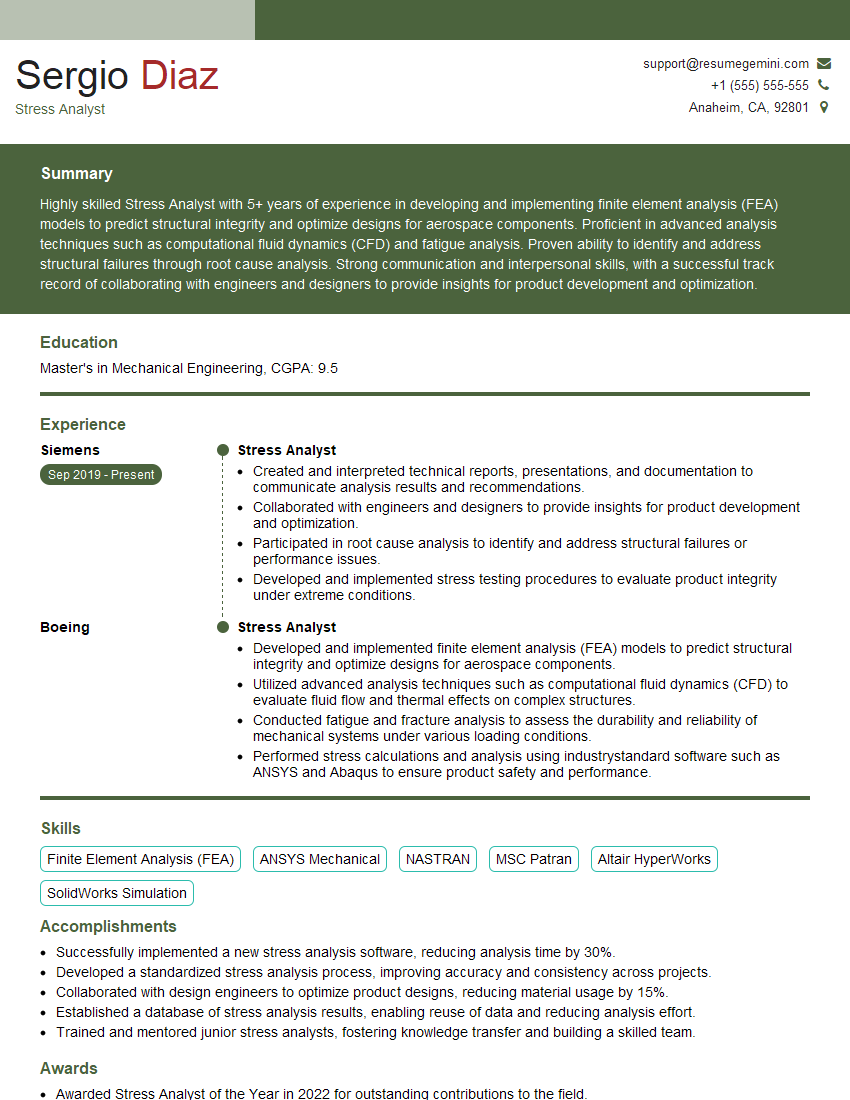
Mastering FEA opens doors to exciting career opportunities in engineering and beyond. A strong understanding of FEA showcases your analytical skills and problem-solving abilities, making you a highly sought-after candidate. To further enhance your job prospects, create an ATS-friendly resume that highlights your FEA skills effectively. ResumeGemini is a trusted resource that can help you build a professional and impactful resume tailored to your specific experience. Examples of resumes specifically designed for candidates with FEA expertise are available to help you get started.
Explore more articles
Users Rating of Our Blogs
Share Your Experience
We value your feedback! Please rate our content and share your thoughts (optional).
What Readers Say About Our Blog
Really detailed insights and content, thank you for writing this detailed article.
IT gave me an insight and words to use and be able to think of examples