The thought of an interview can be nerve-wracking, but the right preparation can make all the difference. Explore this comprehensive guide to Knowledge of Product Development interview questions and gain the confidence you need to showcase your abilities and secure the role.
Questions Asked in Knowledge of Product Development Interview
Q 1. Describe your experience with Agile development methodologies.
Agile development methodologies are iterative approaches to software development that prioritize flexibility, collaboration, and rapid delivery of value. My experience spans several years working on projects using Scrum and Kanban. In Scrum, I’ve participated in daily stand-ups, sprint planning, sprint reviews, and retrospectives. I’m proficient in using tools like Jira and Trello for task management and tracking progress. For example, on a recent project developing a mobile e-commerce application, we utilized Scrum to break down the development into two-week sprints. Each sprint focused on delivering a specific set of functionalities, allowing us to gather user feedback early and often. This iterative approach allowed us to adapt to changing requirements and deliver a high-quality product. With Kanban, I’ve focused on visualizing workflow, limiting work in progress, and continuously improving processes. I find that a hybrid approach, combining elements of both Scrum and Kanban, often yields the best results depending on the project’s complexity and team dynamics.
Q 2. Explain the difference between a Minimum Viable Product (MVP) and a Prototype.
A Minimum Viable Product (MVP) and a Prototype serve different purposes in the product development lifecycle. A prototype is a basic representation of a product used primarily for early feedback and testing. It focuses on demonstrating core functionalities or the overall user experience, often with limited features and potentially rough aesthetics. Think of a cardboard model of a new chair design – it shows the basic form and function but lacks the refined materials and finish of the final product. An MVP, on the other hand, is a version of the product with just enough features to attract early-adopter customers and validate a product idea. It’s a functional product ready for release, albeit with a minimal feature set. While a prototype might lack polish, an MVP needs to be usable and provide value to users. For instance, consider a new social media app: a prototype might showcase the basic user interface and registration flow, whereas an MVP would include user profiles, posting capabilities, and a basic newsfeed – enough functionality to attract users and gather real-world data.
Q 3. How do you prioritize features in a product backlog?
Prioritizing features in a product backlog involves a multi-faceted approach. I typically use a combination of techniques such as the MoSCoW method (Must have, Should have, Could have, Won’t have), value vs. effort matrix, and stakeholder prioritization. The MoSCoW method helps categorize features based on their importance. The value vs. effort matrix plots features based on their business value and the effort required to implement them, allowing for efficient prioritization of high-value, low-effort features. Stakeholder prioritization involves consolidating input from various stakeholders, assigning weights to their perspectives, and making objective decisions based on overall impact. For example, in a project involving multiple stakeholders with differing priorities, I’d use a weighted scoring system to combine their input, ensuring no single perspective dominates the decision-making process. This allows for a data-driven approach that balances the needs of different stakeholders.
Q 4. What metrics do you use to measure product success?
Measuring product success depends on the product’s goals and target metrics. However, some key metrics I consistently use include: Acquisition metrics (e.g., user acquisition cost, conversion rate), Engagement metrics (e.g., daily/monthly active users, session duration, feature usage), and Retention metrics (e.g., churn rate, customer lifetime value). In addition, business metrics like revenue, customer satisfaction (CSAT) scores, and Net Promoter Score (NPS) are crucial for evaluating overall success. For a SaaS product, focusing on monthly recurring revenue (MRR) and customer churn would be critical. In contrast, for a consumer app, daily active users and user engagement would be more important indicators of success. The choice of metrics should always be guided by the specific goals of the product and the phase of its lifecycle.
Q 5. Describe your process for conducting user research.
My user research process is iterative and involves several key stages: Planning and defining research objectives: Clearly articulating the research goals and questions is crucial. Choosing research methods: This depends on the research objectives and resources, and may include user interviews, surveys, usability testing, A/B testing, and ethnographic studies. Recruiting participants: Ensuring a representative sample of target users is crucial for accurate results. Data collection and analysis: Employing appropriate techniques to collect and analyze data objectively. Reporting and insights: Presenting findings in a clear and actionable format, highlighting key insights and recommendations. For example, when developing a new mobile banking app, we conducted user interviews to understand user pain points and preferences. We then used this information to design usability tests to evaluate different interface designs, identifying areas for improvement before the app’s launch. This iterative approach ensured the app met the needs of our target users.
Q 6. How do you handle conflicting priorities from different stakeholders?
Handling conflicting priorities from different stakeholders requires a structured approach. I start by facilitating open communication and understanding the underlying needs and motivations of each stakeholder. Then, I prioritize features based on a clear definition of success and business goals. Using data-driven decision-making, I present a rationale for prioritization based on the value proposition and potential impact. Finally, I involve stakeholders in the decision-making process as much as possible, ensuring transparency and buy-in. For instance, in a scenario where the marketing team wants a feature focused on promotion and the engineering team prefers a stability-focused fix, I would present data demonstrating the relative impact on conversion rates versus potential loss due to application downtime. This collaborative approach helps resolve conflict by basing decisions on concrete data and shared understanding.
Q 7. Explain your experience with A/B testing.
A/B testing is a crucial method for evaluating different versions of a product or feature. My experience includes designing and implementing A/B tests to compare variations in website design, email campaigns, and app functionalities. I’m proficient in using tools like Google Optimize or Optimizely. A typical process involves defining a clear hypothesis, designing test variations, selecting appropriate metrics, defining sample sizes, and analyzing results. A critical aspect is ensuring statistical significance in the results. For example, when optimizing a website’s landing page, we might test two variations: one with a prominent call-to-action button and another with a different image. By analyzing metrics such as conversion rates and bounce rates, we can determine which variation performs better and implement the superior design. Crucially, it’s vital to avoid drawing conclusions based on small sample sizes or insignificant differences.
Q 8. How do you define and measure Key Performance Indicators (KPIs)?
Key Performance Indicators (KPIs) are measurable values that demonstrate how effectively a company is achieving key business objectives. Defining them involves understanding your product’s goals and identifying the metrics that directly reflect success towards those goals. Measuring them requires a robust tracking system and regular analysis.
For example, if a goal is to increase user engagement, relevant KPIs could be:
- Daily/Monthly Active Users (DAU/MAU): Shows the number of unique users interacting with the product.
- Session Duration: Measures how long users spend using the product per session.
- Feature Usage Rate: Tracks how frequently specific product features are used.
Measuring these KPIs involves using analytics tools like Google Analytics, Mixpanel, or Amplitude. These tools provide data visualization and reporting dashboards, allowing for clear tracking and identification of trends. It’s crucial to establish a baseline, track changes over time, and compare performance against set targets to assess effectiveness.
Beyond engagement, other product KPIs might include Customer Acquisition Cost (CAC), Customer Lifetime Value (CLTV), Net Promoter Score (NPS), and conversion rates. The specific KPIs chosen will depend entirely on the product’s business model and goals.
Q 9. Describe a time you had to make a difficult product decision.
During the development of a mobile learning app, we faced a critical decision regarding the inclusion of a gamified reward system. Initial user testing showed strong positive feedback for the gamification, boosting engagement metrics. However, it significantly increased development time and complexity, pushing back our launch date and impacting our marketing schedule.
The decision was difficult because while the gamification improved engagement, the delayed launch risked losing early-adopter interest and market share. We used a data-driven approach, weighing the potential benefits of increased engagement against the risks of a delayed launch. We meticulously analyzed the user testing data, comparing engagement metrics with the increased development cost and potential market impact. This analysis revealed that while the gamification was beneficial, the potential negative impact of a delayed launch outweighed its short-term benefits. We opted to release the MVP without the full gamification system, planning to incorporate it in a future update based on post-launch user feedback and performance analysis. This decision prioritized a timely launch, allowing us to establish a market presence and gather crucial feedback before adding more complex features.
Q 10. How do you handle feedback from users who are unhappy with your product?
Handling negative feedback is crucial for product improvement and maintaining user trust. My approach involves a multi-step process:
- Empathetic Listening: I start by actively listening to the user’s concerns without interruption, acknowledging their frustration and validating their experience.
- Data Gathering: I ask clarifying questions to understand the specifics of their issue, gathering as much information as possible – steps taken, error messages, device information, etc. This data helps identify whether the issue is widespread or isolated.
- Solution Provision: Depending on the nature of the feedback, I offer immediate solutions (e.g., troubleshooting steps) or escalate the issue to the appropriate team for investigation and fixing.
- Follow-up: I always follow up with the user to ensure the issue is resolved and to gauge their satisfaction with the solution. This demonstrates a commitment to their experience.
- Feedback Integration: Whether the feedback is negative or positive, I ensure it is properly documented and shared with the development team to inform future product improvements.
In addition, public forums and review sites should be monitored and addressed thoughtfully and professionally. Negative feedback should be viewed as an opportunity for learning and improvement.
Q 11. What is your experience with data analysis and using data to inform product decisions?
Data analysis is fundamental to my product development process. I’m proficient in using various analytical tools to gather insights from user behavior, market trends, and product performance. My experience involves using tools like SQL for database querying, tools like R or Python for statistical analysis and data visualization, and business intelligence platforms for dashboard creation and reporting.
For example, in a previous role, we used A/B testing to compare two different versions of a website’s checkout process. By analyzing the conversion rates for each version, we identified which design elements led to higher conversions. This data-driven approach allowed us to make informed decisions about improving user experience and boosting sales.
I’m comfortable working with large datasets, identifying patterns, drawing conclusions, and communicating those findings to stakeholders in a clear and concise manner, using both visual and numerical data.
Q 12. How familiar are you with different product development frameworks (e.g., Lean, Design Thinking)?
I have extensive experience with various product development frameworks, including Lean Startup and Design Thinking.
Lean Startup emphasizes building Minimum Viable Products (MVPs) to test hypotheses quickly and iterate based on user feedback. I’ve successfully utilized this framework to launch several products, prioritizing rapid prototyping and continuous learning.
Design Thinking focuses on user-centricity, employing a human-centered approach to problem-solving. I’ve employed this framework to conduct user research, generate innovative solutions, and design user-friendly interfaces. The iterative nature of Design Thinking, with its emphasis on prototyping and testing, aligns perfectly with Lean Startup principles.
I also have working knowledge of Agile methodologies, particularly Scrum, which facilitates iterative development and collaboration within cross-functional teams.
Q 13. Describe your experience with market research and competitive analysis.
Market research and competitive analysis are crucial for understanding market dynamics and identifying opportunities for product differentiation. My experience includes conducting both quantitative and qualitative research methods.
Quantitative research involves collecting numerical data through surveys, A/B testing, and analyzing website analytics. This helps establish market size, user demographics, and product usage patterns.
Qualitative research involves gathering in-depth insights through user interviews, focus groups, and usability testing. This helps understand user needs, pain points, and motivations.
Competitive analysis involves studying competitor products, strategies, and market positioning. I use various techniques to analyze competitor strengths and weaknesses, identifying opportunities for differentiation and competitive advantage. Tools like SWOT analysis and competitive matrices are regularly employed.
For example, before launching a new SaaS product, I conducted thorough market research to identify target audience needs, competitor offerings, and potential market gaps. This informed our product strategy and value proposition, ultimately increasing the chances of product success.
Q 14. How do you manage the product roadmap?
Managing a product roadmap involves strategic planning, prioritization, and continuous adaptation. My approach combines both high-level strategic thinking with detailed tactical execution.
Strategic Planning: I begin by aligning the roadmap with the overall business objectives and market opportunities. This often involves collaborating with stakeholders across different departments (marketing, sales, engineering) to identify key goals and priorities.
Prioritization: Once the strategic goals are defined, I use prioritization frameworks like MoSCoW (Must have, Should have, Could have, Won’t have) or RICE (Reach, Impact, Confidence, Effort) to rank features and initiatives based on their value and feasibility.
Execution & Tracking: I utilize project management tools (like Jira or Asana) to track progress, manage dependencies, and monitor the roadmap’s execution. Regular reviews and sprint planning sessions are essential to ensure alignment and address roadblocks.
Adaptation: The roadmap is not a static document; it’s a living entity that should evolve based on user feedback, market changes, and evolving business needs. Continuous monitoring and iterative adjustments are vital for success.
Visualization is key. I often use Gantt charts or Kanban boards to visually represent the roadmap’s timeline, dependencies and progress. This fosters transparency and ensures everyone is aligned.
Q 15. Explain your approach to defining user stories and acceptance criteria.
Defining user stories and acceptance criteria is crucial for clear communication and successful product development. My approach emphasizes collaboration and a user-centric perspective. I start by ensuring a shared understanding of the product vision and goals. Then, I work closely with the development team, designers, and, most importantly, users to articulate user stories in the INVEST format (Independent, Negotiable, Valuable, Estimable, Small, Testable).
- Independent: Each story should be self-contained and not dependent on others.
- Negotiable: The details can be refined through conversation.
- Valuable: It must deliver tangible value to the user.
- Estimable: The effort to complete it should be assessable.
- Small: It should be small enough to be completed within a sprint or iteration.
- Testable: Clear acceptance criteria define when the story is considered ‘done’.
For example, instead of a vague story like “Improve the search functionality,” I’d prefer a specific story like: “As a customer, I want to be able to search for products by keyword so that I can quickly find what I need.” Following this, I define clear and measurable acceptance criteria, for instance: “The search results should display within 2 seconds, return relevant results based on keyword matching, and include filters for price and category.”
Career Expert Tips:
- Ace those interviews! Prepare effectively by reviewing the Top 50 Most Common Interview Questions on ResumeGemini.
- Navigate your job search with confidence! Explore a wide range of Career Tips on ResumeGemini. Learn about common challenges and recommendations to overcome them.
- Craft the perfect resume! Master the Art of Resume Writing with ResumeGemini’s guide. Showcase your unique qualifications and achievements effectively.
- Don’t miss out on holiday savings! Build your dream resume with ResumeGemini’s ATS optimized templates.
Q 16. How do you communicate product strategy to stakeholders?
Communicating product strategy effectively to stakeholders requires a multi-faceted approach that caters to different communication styles and levels of technical understanding. I utilize a combination of techniques:
- Vision and Roadmap Presentations: I create concise, visually appealing presentations outlining the overall vision, key goals, and a high-level roadmap, using charts and graphs to illustrate progress and milestones.
- Regular Status Updates: Frequent updates (e.g., weekly or bi-weekly) via email or meetings keep stakeholders informed about progress, challenges, and any necessary adjustments to the plan. These updates use metrics that everyone understands, such as completion percentages and key performance indicators (KPIs).
- Interactive Workshops: For critical decisions or significant strategy shifts, I organize interactive workshops to facilitate discussions, gather feedback, and build consensus amongst stakeholders. This collaborative approach ensures buy-in and reduces misunderstandings.
- Data-Driven Decision Making: I use analytics and data to justify strategic choices and demonstrate the value proposition. This approach provides a strong foundation for decisions and addresses potential concerns effectively.
I always tailor my communication to the audience. For technical stakeholders, I may use more technical details, while for executive stakeholders, I focus on the high-level business impact and ROI.
Q 17. Describe your experience with project management tools (e.g., Jira, Asana).
I have extensive experience with Jira and Asana, utilizing them for various aspects of project management. My experience includes task creation and assignment, sprint planning and tracking, bug tracking and resolution, and reporting on progress and performance.
In Jira, I leverage its Kanban boards to visualize workflow, sprints for iterative development, and its issue tracking system to manage bugs and feature requests. I’m proficient in creating custom workflows and dashboards tailored to specific project needs. For instance, I’ve used Jira’s workflow automation to streamline the approval process for code deployments.
Asana, on the other hand, excels in its ability to manage various project types beyond software development. I’ve utilized it for cross-functional projects, using its features for task assignment, communication, and progress tracking. Its calendar view aids in visualizing deadlines and scheduling, particularly beneficial for projects with multiple dependencies.
Regardless of the tool, I prioritize establishing a standardized process for issue management, including clear descriptions, priorities, and assigning owners to ensure accountability and efficient resolution.
Q 18. What is your experience with product lifecycle management?
Product Lifecycle Management (PLM) is a critical aspect of bringing a product from concept to end-of-life. My experience encompasses all phases, from ideation and design to manufacturing, distribution, and eventual decommissioning. I’ve worked with PLM systems to manage product data, track revisions, and ensure version control. This ensures consistency and minimizes errors throughout the product lifecycle.
For instance, I’ve used PLM systems to manage documentation such as CAD files, specifications, and test results. This centralized repository allows for easy access to information, collaboration among team members, and efficient tracking of product changes. The use of a PLM system significantly improved our ability to manage complex projects with multiple versions and revisions, reducing errors and improving overall efficiency.
Furthermore, integrating PLM with other systems, such as CRM and ERP, enables a holistic view of the product, its development, and its market performance. This integrated approach provides valuable insights for future product development cycles.
Q 19. How do you identify and address technical debt?
Technical debt is the implied cost of rework caused by choosing an easy solution now instead of using a better approach that would take longer. Addressing it proactively is crucial for maintaining product quality and long-term maintainability. My approach involves:
- Regular Assessment: I conduct regular code reviews and technical audits to identify areas of technical debt. This includes evaluating code quality, identifying outdated technologies, and assessing the risk associated with various code components.
- Prioritization: Not all technical debt is created equal. I prioritize addressing the most critical issues first, focusing on those impacting performance, security, or maintainability. A risk-based approach helps allocate resources effectively.
- Strategic Planning: I incorporate time for refactoring and improvement into the development roadmap. This prevents technical debt from accumulating excessively and reduces the need for large-scale, disruptive remediation efforts later on.
- Automated Testing: Extensive automated testing (unit, integration, and end-to-end) provides a safety net when refactoring code. This minimizes the risk of introducing new bugs while addressing existing issues.
For example, if we discover a section of code that is inefficient or difficult to maintain, we might allocate a sprint to refactor it, ensuring thorough testing before and after the changes. This proactive approach prevents larger problems down the line and keeps the codebase clean and efficient.
Q 20. How do you ensure product quality?
Ensuring product quality is a continuous process that starts from the initial stages of product conception. It involves a multi-pronged approach encompassing various stages and techniques:
- Early Testing: I advocate for incorporating testing early and often throughout the development process, from unit testing to integration testing and finally user acceptance testing (UAT). This allows for quicker identification and resolution of bugs, reducing the cost and effort of fixing them later.
- Automated Testing: Automated testing significantly reduces the time and effort required for testing, allowing for faster feedback loops and increased test coverage.
- Code Reviews: Regular code reviews by peers help identify potential issues early on and ensure code quality. This also facilitates knowledge sharing and improvement within the team.
- User Feedback: Gathering feedback from users throughout the development process, especially during beta testing, is vital for identifying usability issues and ensuring that the product meets user expectations.
- Continuous Monitoring: Post-launch monitoring of the product performance, user feedback, and error reports are essential for identifying and addressing any issues that might arise after release.
By integrating these practices into our workflow, we establish a culture of quality and deliver products that meet the highest standards of functionality, reliability, and user satisfaction.
Q 21. How do you handle changing requirements during product development?
Handling changing requirements is a natural part of product development. My approach emphasizes flexibility, communication, and a structured process for managing changes:
- Change Request Process: I implement a formal process for evaluating and managing change requests. This includes documenting the request, assessing its impact on the project timeline and budget, and obtaining approvals from relevant stakeholders.
- Prioritization: Not all changes are created equal. I use a prioritization matrix to evaluate the importance and urgency of each change request and schedule them accordingly.
- Agile Methodology: I favor using an agile methodology, like Scrum, which allows for iterative development and adaptation to changing requirements. Sprints provide opportunities to incorporate changes while minimizing disruptions.
- Transparent Communication: Open and honest communication with stakeholders regarding the impact of changes is crucial. Regular updates on the status of changes and their potential effects on the timeline and budget keep everyone informed.
- Version Control: Utilizing robust version control systems allows for easy tracking and management of different versions of the product, simplifying the process of incorporating changes.
For example, if a critical change request arises during a sprint, we assess its impact, re-prioritize tasks, and adjust the sprint backlog accordingly. This flexible approach allows for responsiveness while maintaining a controlled environment.
Q 22. What is your experience with product launch planning?
Product launch planning is a critical phase that dictates the success of a new product. It involves meticulous coordination across various teams, including marketing, sales, engineering, and customer support. My approach begins with a detailed Go-to-Market (GTM) strategy, defining target audience, messaging, channels, and launch timeline. This isn’t simply a checklist; it’s a living document refined through data and feedback.
For example, in a previous role launching a new SaaS platform, we utilized a phased rollout. We first launched to a beta group of power users for feedback, then to a specific market segment before a full-scale public launch. This allowed us to address bugs and refine marketing messaging based on real user interactions. We also meticulously planned pre-launch activities such as content marketing, social media engagement, and email campaigns to generate pre-launch buzz and anticipation.
The process also includes defining key performance indicators (KPIs) for measuring success – metrics like user acquisition, engagement, and revenue – ensuring we track the impact of the launch plan. Post-launch, we conduct thorough analysis to identify areas for improvement in our next product cycle.
Q 23. Describe your approach to building a product vision and strategy.
Building a product vision and strategy requires a blend of market analysis, customer understanding, and technological feasibility. I begin with a deep dive into market research, identifying unmet needs, competitive landscape, and potential market size. Simultaneously, I engage with potential users to understand their pain points and aspirations, utilizing qualitative research methods such as interviews and surveys.
From this data, I develop a clear and concise product vision statement, articulating the product’s ultimate goal and the value it brings to its users. This is then translated into a comprehensive product strategy, outlining the roadmap for achieving the vision. This roadmap is iterative, constantly adapting to new insights and market changes.
For instance, during the development of a mobile fitness application, our initial vision was to simply provide workout tracking. However, after user interviews, we realized that community engagement and personalized coaching were crucial needs. This led to a strategic shift, incorporating social features and AI-powered personalized workout plans, ultimately delivering a much more successful product.
Q 24. Explain your understanding of user personas and user journeys.
User personas are semi-fictional representations of your ideal customers, capturing their demographics, psychographics, goals, and pain points. User journeys, on the other hand, map out the steps a user takes to interact with your product, highlighting their experiences at each touchpoint. Both are integral to user-centered design.
For example, a user persona for a productivity app might be ‘Sarah,’ a busy professional who values efficiency and needs a simple, intuitive tool to manage her tasks. Her user journey might start with searching for a productivity app, downloading and installing it, setting up her profile, adding tasks, using reminders, and eventually recommending it to a colleague. By understanding Sarah’s needs and experiences, we can design a product that truly meets her expectations and solves her problems.
Creating detailed user personas and journeys allows the development team to focus on building features that directly address user needs. It also facilitates effective testing and validation of the product throughout its development lifecycle.
Q 25. How do you stay up-to-date with industry trends and technologies?
Staying current in the ever-evolving tech landscape requires a multi-faceted approach. I actively participate in industry conferences, webinars, and online communities, engaging with thought leaders and practitioners. I subscribe to relevant industry publications and newsletters, and frequently explore cutting-edge technologies and research papers.
Additionally, I maintain a network of contacts within the industry, fostering collaborations and knowledge sharing. This includes regularly attending meetups and networking events, and leveraging platforms like LinkedIn to connect with experts and stay abreast of industry advancements. Finally, I dedicate time for personal learning, experimenting with new tools and technologies to gain hands-on experience.
Q 26. Describe your experience with building and managing a product team.
Building and managing a product team involves fostering a collaborative and productive environment. My approach emphasizes clear communication, shared goals, and individual empowerment. I establish a clear vision and strategy for the team, ensuring everyone understands their role and contributions to the overall objective.
I utilize agile methodologies such as Scrum or Kanban to manage the development process, prioritizing transparency and iterative development. Regular stand-up meetings, sprint reviews, and retrospectives facilitate open communication and continuous improvement. Crucially, I focus on building a strong team culture, based on trust, respect, and mutual support. This includes providing regular feedback, celebrating successes, and addressing challenges proactively.
In one project, I successfully navigated a challenging team dynamic by implementing a peer-to-peer mentoring program, fostering collaboration and knowledge sharing amongst team members. This not only improved team performance but also boosted morale and individual growth.
Q 27. How do you deal with unexpected technical challenges during development?
Unexpected technical challenges are inevitable in product development. My approach is rooted in proactive risk management and robust problem-solving. We start by establishing clear contingency plans and escalation procedures. When a challenge arises, I prioritize a calm and methodical response, gathering the necessary information to understand the problem’s scope and impact.
Next, I assemble a cross-functional team to brainstorm solutions, leveraging the expertise of engineers, designers, and other stakeholders. We use root cause analysis to identify the underlying issue, preventing similar problems in the future. Communication is key during this process, keeping stakeholders informed of the situation and proposed solutions. This might involve prioritizing fixes, re-evaluating timelines, or even making design trade-offs to mitigate the impact of the challenge.
For instance, when a critical security vulnerability was discovered during testing, we quickly assembled a team, prioritized the patch, and communicated the issue and resolution transparently to our users, minimizing the impact on our reputation and user trust.
Q 28. How do you measure the ROI of a new product feature?
Measuring the ROI of a new product feature requires a well-defined set of metrics aligned with business objectives. This isn’t just about revenue; it’s about understanding the overall value the feature adds.
For example, if a new feature enhances user engagement (measured by increased daily/monthly active users or session duration), this can lead to improved customer retention and, ultimately, higher revenue. We’d track these metrics before and after the launch of the feature to gauge the impact. If the feature is designed to drive conversions (like a new checkout process), we’d measure conversion rates directly.
Other metrics might include customer satisfaction (measured through surveys or feedback), cost savings (if the feature automates a manual process), and increased efficiency. A comprehensive ROI analysis considers both the costs associated with developing and implementing the feature and the benefits it generates, quantifying the return on investment. By analyzing these data points, we can determine whether the feature is meeting its objectives and justify future investments in similar initiatives.
Key Topics to Learn for Knowledge of Product Development Interview
- Product Strategy & Vision: Understanding market analysis, user research, and defining a compelling product vision. Practical application: Explain how you would define the target audience and key features for a new product.
- Product Requirements & Specifications: Defining user stories, creating detailed specifications, and managing requirements throughout the product lifecycle. Practical application: Describe your experience in translating user needs into functional requirements.
- Agile Development Methodologies: Familiarity with Scrum, Kanban, or other agile frameworks. Practical application: Discuss your experience working in an agile environment and contributing to sprint planning and execution.
- User Experience (UX) & User Interface (UI) Design Principles: Understanding user-centered design, information architecture, and usability testing. Practical application: Explain how you would improve the user experience of an existing product.
- Product Roadmap & Prioritization: Planning and managing the product roadmap, prioritizing features based on business value and user needs. Practical application: Describe a situation where you had to make difficult prioritization decisions regarding product features.
- Data Analysis & Metrics: Tracking key performance indicators (KPIs), analyzing data to inform product decisions, and demonstrating data-driven decision-making. Practical application: Explain how you would measure the success of a new product feature.
- Product Launch & Marketing: Understanding the product launch process, go-to-market strategy, and post-launch monitoring. Practical application: Describe your role in a successful product launch.
Next Steps
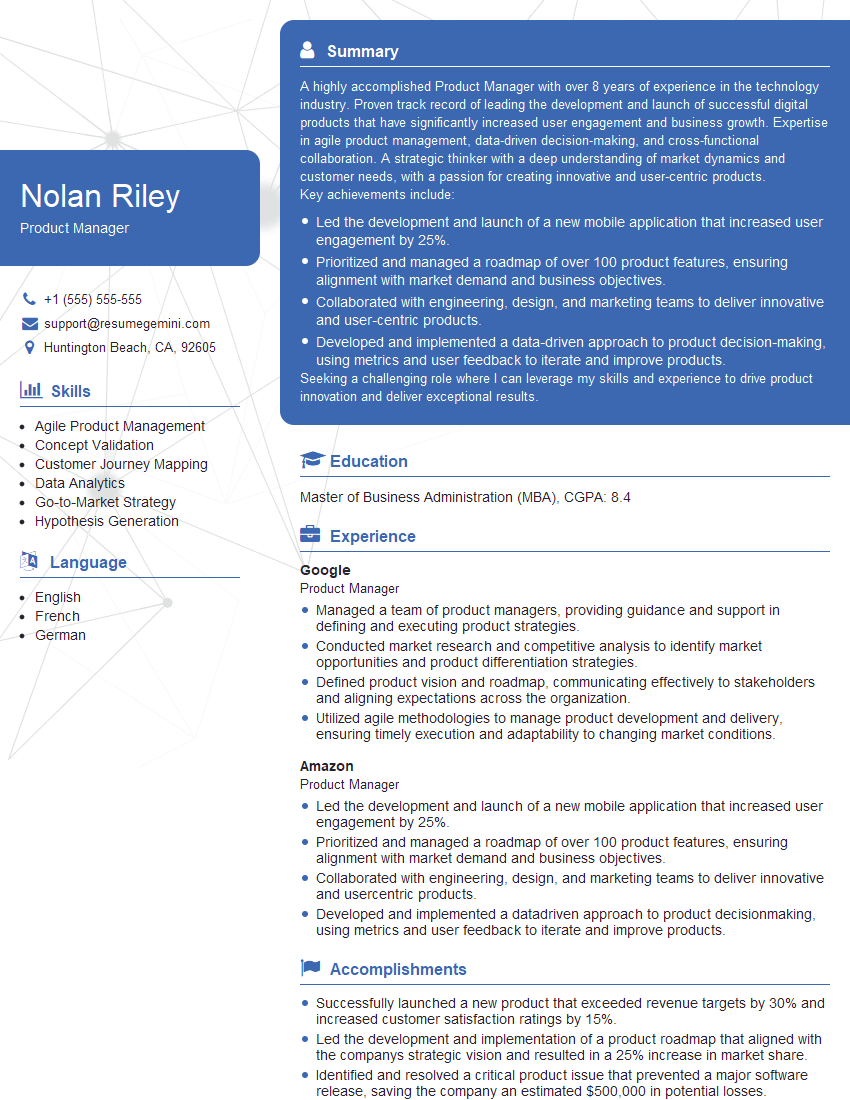
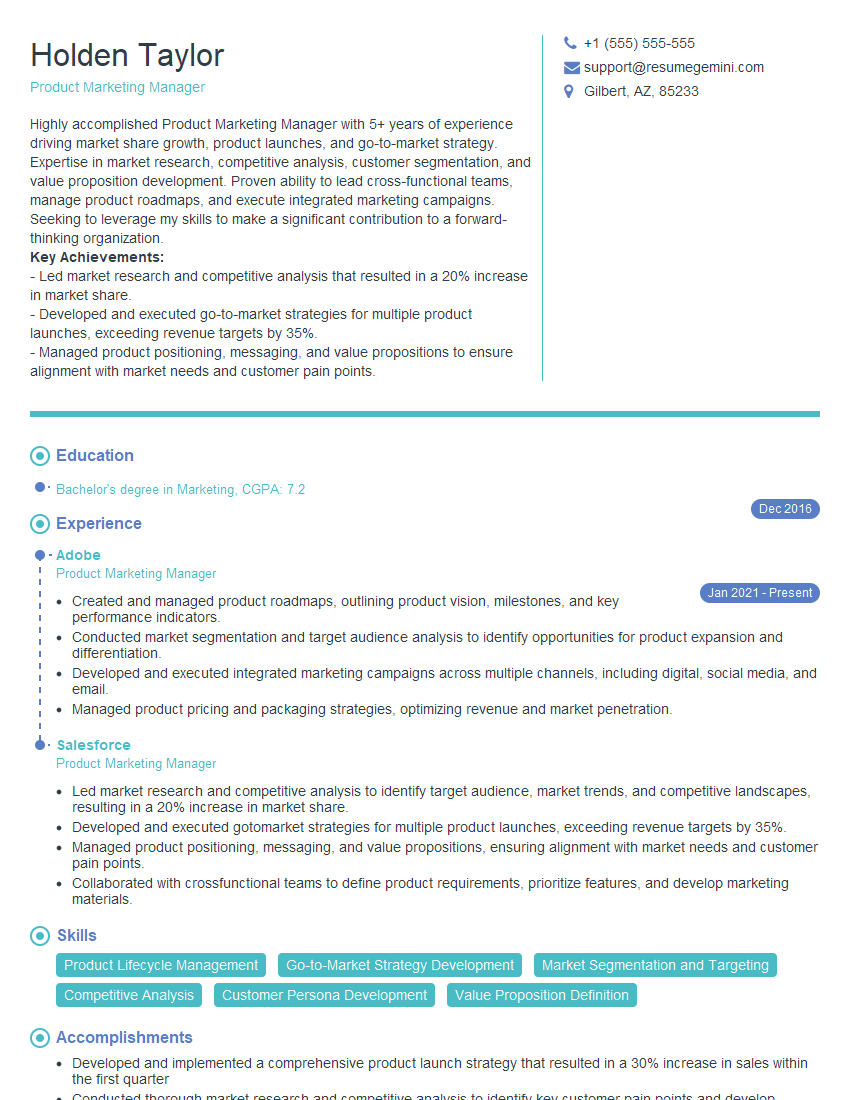
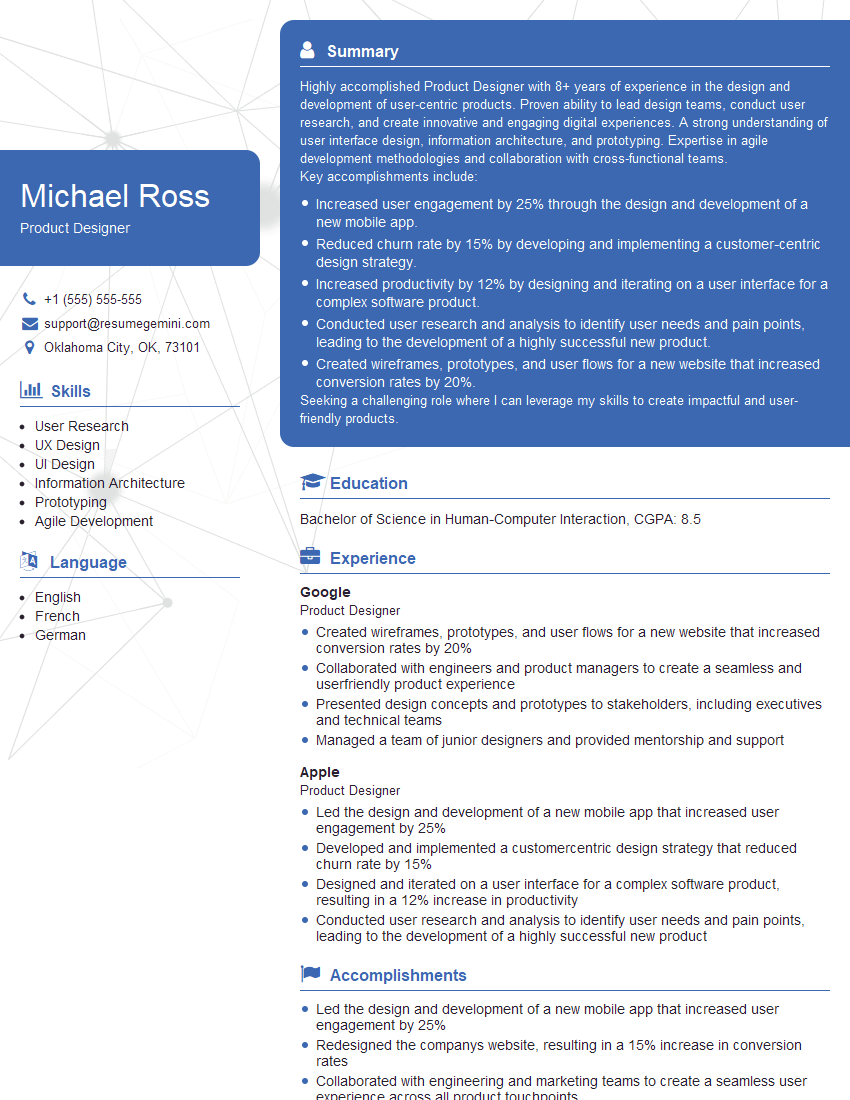
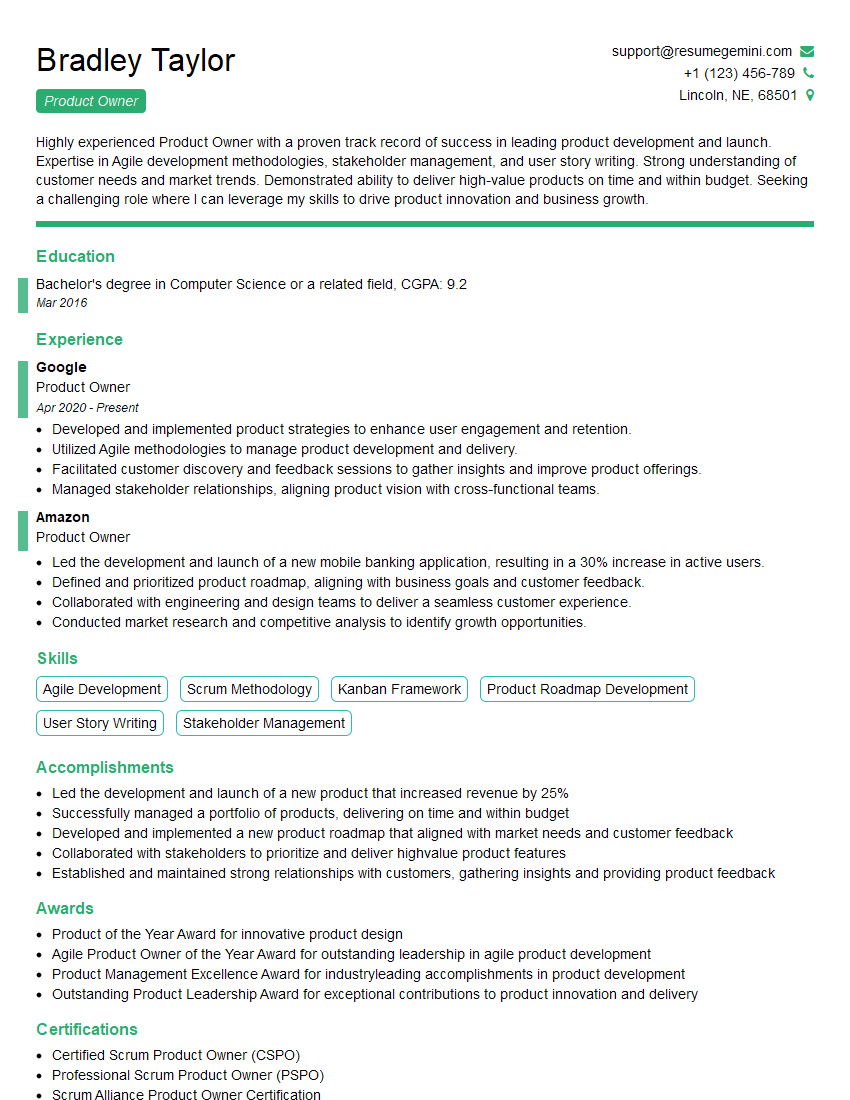
Mastering knowledge of product development is crucial for career advancement in today’s competitive market. A strong understanding of these core principles will significantly improve your interview performance and open doors to exciting opportunities. To maximize your chances of landing your dream role, creating an ATS-friendly resume is essential. ResumeGemini is a trusted resource to help you build a professional and impactful resume that highlights your skills and experience. We provide examples of resumes tailored to Knowledge of Product Development to guide you through the process. Invest time in crafting a compelling resume – it’s your first impression on potential employers.

Explore more articles
Users Rating of Our Blogs
Share Your Experience
We value your feedback! Please rate our content and share your thoughts (optional).
What Readers Say About Our Blog
Really detailed insights and content, thank you for writing this detailed article.
IT gave me an insight and words to use and be able to think of examples