Interviews are more than just a Q&A session—they’re a chance to prove your worth. This blog dives into essential Laser Research and Development interview questions and expert tips to help you align your answers with what hiring managers are looking for. Start preparing to shine!
Questions Asked in Laser Research and Development Interview
Q 1. Explain the principle of laser operation, including population inversion and stimulated emission.
Laser operation hinges on a phenomenon called stimulated emission, where an excited atom releases a photon identical to one that triggered the emission. To achieve a significant number of these identical photons – laser light – we need population inversion. This is a crucial step where more atoms are in a higher energy state than in a lower one, defying the usual thermal equilibrium.
Imagine a crowded stadium. Normally, most people are seated (ground state). Population inversion is like suddenly having most people standing on their seats (excited state). A single excited person (incident photon) jumping down might cause a cascade effect, with everyone else jumping down (stimulated emission) in unison, creating a synchronized wave of energy (laser beam).
This population inversion is achieved through various methods like optical pumping (using external light source), electrical discharge (using electricity), or chemical reactions, depending on the laser type.
Q 2. Describe different types of lasers (e.g., gas, solid-state, semiconductor) and their applications.
Lasers are categorized based on their gain medium:
- Gas Lasers: Utilize a gas mixture as the gain medium. Helium-Neon (He-Ne) lasers, known for their red light, are classic examples used in barcode scanners and laser pointers. Carbon Dioxide (CO2) lasers, emitting infrared light, are powerful lasers used in industrial cutting and welding.
- Solid-State Lasers: Employ a solid crystal or glass doped with specific ions as the gain medium. Ruby lasers, historically significant, were the first working laser. Neodymium-YAG (Nd:YAG) lasers are widely used in medical procedures and material processing, offering high power and versatility.
- Semiconductor Lasers (Diode Lasers): These are compact, energy-efficient lasers based on semiconductor junctions. They are ubiquitous in CD players, laser printers, fiber optic communication, and laser pointers. Their small size and efficiency make them ideal for portable applications.
Applications are diverse, spanning scientific research, medicine (lasersurgery, ophthalmology), manufacturing (cutting, welding, marking), telecommunications (fiber optics), and consumer electronics (barcode scanning, laser pointers).
Q 3. What are the key differences between He-Ne and CO2 lasers?
He-Ne and CO2 lasers, though both gas lasers, differ significantly:
- Wavelength: He-Ne lasers typically emit visible red light (around 633 nm), while CO2 lasers emit infrared light (around 10.6 μm).
- Power Output: He-Ne lasers generally produce lower power (milliwatts), suitable for applications like alignment and interferometry. CO2 lasers can deliver much higher power (kilowatts), ideal for material processing.
- Efficiency: He-Ne lasers are relatively inefficient, while CO2 lasers can have higher efficiency.
- Applications: He-Ne lasers are used in alignment tools, scientific instruments, and laser pointers. CO2 lasers are preferred for cutting, welding, and marking various materials.
Q 4. Explain the concept of laser beam divergence and its impact on applications.
Laser beam divergence refers to the widening of the beam as it propagates. It’s expressed as the angle of divergence, typically in milliradians (mrad). A lower divergence indicates a more collimated (parallel) beam, while a higher divergence indicates a faster spreading beam.
Imagine shining a flashlight – its beam spreads out. Similarly, a laser beam diverges, though typically much more slowly. The divergence is influenced by the laser’s design, particularly the size of its output aperture and the beam quality.
Divergence impacts applications significantly. For long-distance applications like laser ranging or free-space optical communication, low divergence is crucial. In contrast, a larger divergence might be desirable for some material processing techniques where a wider beam is needed to cover a larger area.
Q 5. How do you measure laser beam quality (M² factor)?
Beam quality, represented by the M² factor (beam propagation ratio), quantifies how close a laser beam is to an ideal Gaussian beam. An M² value of 1 indicates an ideal Gaussian beam with minimal divergence. Higher M² values indicate a beam with larger divergence and a less uniform intensity profile.
Measuring M² typically involves using a beam profiler, a device that measures the beam’s intensity profile at different distances from the laser output. By analyzing the beam’s spatial characteristics, the divergence can be calculated, and subsequently, the M² factor is determined using specific mathematical formulas. Specialized software often automates this process.
Q 6. Describe different techniques for laser beam shaping and control.
Techniques for laser beam shaping and control are vital for many applications. These techniques manipulate the beam’s spatial profile, intensity distribution, and polarization:
- Spatial Light Modulators (SLMs): These devices manipulate the phase or amplitude of the beam, enabling dynamic shaping of the beam profile, creating arbitrary shapes and patterns.
- Diffractive Optical Elements (DOEs): These are optical components that use diffraction to reshape the beam, creating specific intensity distributions like uniform illumination or Bessel beams.
- Axicons: These conical lenses generate a non-diffracting Bessel beam, known for its self-reconstructive properties, making it useful for various applications.
- Optical Fibers: These can be used to guide and deliver laser beams over long distances, offering flexibility and control.
- Telescopes and Lenses: Simple lenses and telescopes can be used to expand or collimate the beam, controlling its divergence.
Q 7. Explain the concept of laser safety and the relevant safety regulations.
Laser safety is paramount, and regulations vary depending on the laser’s power and wavelength. Exposure to laser radiation can cause severe eye damage or skin burns. Safety measures include:
- Appropriate Eye Protection: Using laser safety eyewear with optical density (OD) ratings suitable for the specific laser wavelength and power level.
- Enclosure and Beam Containment: Enclosing the laser beam path to prevent accidental exposure.
- Warning Signage: Posting clear warning signs to alert individuals to the presence of laser radiation.
- Controlled Access: Restricting access to laser areas to trained personnel.
- Emergency Procedures: Establishing procedures for handling accidents or emergencies.
International standards like IEC 60825 provide guidelines for laser safety classification and regulations. Adhering to these guidelines and implementing appropriate safety protocols is essential to mitigate potential hazards.
Q 8. What are the common laser safety hazards and how can they be mitigated?
Laser safety is paramount in any laser research and development environment. The primary hazards stem from the intense, focused energy of laser beams. These hazards can be broadly categorized into:
- Eye Damage: Direct or even reflected laser beams can cause severe retinal burns, leading to blindness. The damage is particularly insidious because it’s often painless initially.
- Skin Burns: High-powered lasers can cause immediate burns and skin damage, similar to a severe sunburn but often much deeper and more damaging.
- Fire Hazards: Lasers can ignite flammable materials, posing a significant fire risk, especially in labs with organic solvents or other combustible materials.
- Electrical Hazards: Many laser systems involve high-voltage components, creating risks of electric shock.
Mitigation strategies are crucial and involve a multi-layered approach:
- Engineering Controls: Enclosing the laser beam path, using beam stops, and implementing interlocks to prevent accidental exposure are key. Proper laser class labeling and signage is vital.
- Administrative Controls: Establishing standard operating procedures (SOPs), providing comprehensive safety training to all personnel, and designating a Laser Safety Officer (LSO) to oversee the program are essential.
- Personal Protective Equipment (PPE): Appropriate eyewear designed for the specific laser wavelength and power is crucial. In addition, protective clothing like lab coats and gloves may be needed depending on the system.
- Environmental Controls: Maintaining a clean and organized workspace reduces the risk of accidents and fire hazards. Proper ventilation is essential to remove any potentially harmful byproducts from laser interactions.
For example, in my previous role, we implemented a comprehensive laser safety program, including mandatory annual training, regular safety inspections, and an emergency response plan, dramatically reducing the potential for accidents.
Q 9. Describe your experience with laser alignment and optical setup.
Laser alignment and optical setup are fundamental to any successful laser system. My experience spans several laser types, from low-power diode lasers to high-power solid-state lasers. This involves meticulous attention to detail and a thorough understanding of optical components.
The process typically begins with a mechanical alignment, ensuring that all optical components are physically positioned correctly. This often uses precision translation stages and rotation mounts. Then, I use various alignment tools and techniques, including:
- Autocollimators: For precise angular alignment of mirrors and other optical elements.
- Power meters and beam profilers: To monitor beam characteristics and ensure optimal beam quality.
- Spatial filters: To improve beam quality by cleaning up higher-order modes.
Optical setups often require iterative adjustment. For instance, during the alignment of a complex laser cavity, I may use a combination of autocollimation and power measurements to fine-tune the mirror positions until the output power and beam quality are optimized. I’m proficient in using both manual and automated alignment techniques, depending on the complexity of the system. A recent project involved aligning a multi-pass amplifier system, requiring several days of careful alignment and optimization to achieve the desired output power and beam quality.
Q 10. How do you troubleshoot laser system malfunctions?
Troubleshooting laser system malfunctions requires a systematic approach. My strategy typically involves:
- Safety First: Ensure the system is properly shut down and de-energized before initiating any troubleshooting.
- Gather Information: Document the symptoms of the malfunction. Note when the problem started, what actions preceded the failure, and any error messages.
- Visual Inspection: Carefully examine the system for any obvious problems, such as loose connections, damaged components, or misalignments.
- Check Interlocks and Safety Features: Verify that safety interlocks and other safety mechanisms are functioning correctly.
- Systematic Testing: Use diagnostic tools, such as oscilloscopes, power meters, and spectrum analyzers, to pinpoint the source of the malfunction. I may start by testing individual components to isolate the faulty element.
- Consult Documentation and Specifications: Refer to the system’s technical manuals, schematics, and specifications to understand the expected performance and to identify potential failure modes.
- Replacement and Repair: Once the faulty component is identified, I replace or repair it, following appropriate safety procedures.
- Re-alignment and Testing: After repairs, the system must be realigned and thoroughly tested to ensure proper operation and safety.
For example, I once encountered a situation where a laser system’s output power inexplicably dropped. By systematically checking each component, I discovered a loose connection within the power supply, which was easily fixed, restoring the system to full functionality.
Q 11. Explain the principle of laser spectroscopy and its applications.
Laser spectroscopy leverages the interaction of laser light with matter to analyze the composition and properties of a sample. The principle relies on the fact that atoms and molecules absorb and emit light at specific wavelengths, which are unique to their structure. A laser provides a highly monochromatic and coherent light source, ideal for precise spectroscopic measurements.
Various techniques exist, including:
- Absorption Spectroscopy: Measures the amount of light absorbed by a sample at different wavelengths. This reveals the presence and concentration of specific molecules.
- Emission Spectroscopy: Analyzes the light emitted by a sample after excitation by a laser. This technique is useful for identifying elements and molecules based on their unique emission spectra.
- Raman Spectroscopy: Detects the inelastic scattering of light from molecules, providing information about their vibrational modes and chemical structure.
Applications are widespread, spanning:
- Environmental Monitoring: Detecting pollutants in air and water.
- Medical Diagnostics: Analyzing blood samples, detecting cancer cells.
- Material Science: Characterizing material composition and structure.
- Chemical Analysis: Identifying and quantifying compounds in complex mixtures.
For example, in one project, I used Raman spectroscopy to analyze the composition of thin-film coatings, providing crucial data for optimizing their properties.
Q 12. Describe different types of laser-based material processing techniques.
Laser-based material processing offers highly precise and controlled methods for manipulating materials. Techniques include:
- Laser Ablation: Removing material by vaporization or melting using a high-intensity laser pulse. (Detailed in the next answer.)
- Laser Cutting: Precisely cutting through materials by melting and vaporizing the material along a defined path.
- Laser Drilling: Creating small, precise holes in materials, useful for microelectronics and other applications.
- Laser Marking: Creating marks or engravings on materials by altering their surface properties.
- Laser Welding: Joining materials by melting and fusing them together with a focused laser beam. (More details in answer 7.)
- Laser Surface Treatment: Modifying the surface properties of materials, such as hardness or roughness, using lasers.
The choice of technique depends on factors like the material properties, desired outcome, and required precision. For example, laser cutting is often preferred for sheet metal processing, while laser drilling is ideal for creating micro-scale features.
Q 13. Explain the concept of laser ablation and its applications.
Laser ablation involves removing material from a surface using a high-intensity laser pulse. The laser energy is absorbed by the material, leading to rapid heating and either vaporization or melting of the material. The resulting material is ejected from the surface as a plume of vapor and debris.
The key parameters influencing ablation are laser wavelength, pulse duration, pulse energy, and spot size. Different materials exhibit different ablation thresholds, meaning the amount of energy needed to initiate ablation varies depending on the material’s optical and thermal properties.
Applications of laser ablation are extensive and include:
- Thin-Film Deposition: Creating thin films by ablating material from a target and depositing the ablated material onto a substrate.
- Micromachining: Fabricating micro-scale features, such as microfluidic channels or MEMS components.
- Surface Cleaning: Removing contaminants from surfaces.
- Medical Applications: Laser surgery, such as laser eye surgery (LASIK) and laser skin resurfacing.
- Material Analysis: Laser-induced breakdown spectroscopy (LIBS) for elemental analysis.
For example, in one project, we used laser ablation to create precisely controlled micro-channels in a polymer substrate for use in microfluidics applications.
Q 14. Describe your experience with laser micromachining or laser welding.
I have extensive experience with both laser micromachining and laser welding. Laser micromachining uses tightly focused laser beams to create very small features on materials with high precision. The process is highly versatile, enabling the fabrication of intricate three-dimensional structures.
My experience with laser micromachining includes using various laser sources (e.g., femtosecond lasers, nanosecond lasers) and processing techniques to machine a wide range of materials, from polymers and ceramics to metals.
Laser welding, on the other hand, utilizes laser energy to join materials together. This technique can achieve high weld strength and precision, especially useful for delicate components or dissimilar materials. My work in laser welding has focused on optimizing weld parameters to achieve desired mechanical properties and minimizing heat-affected zones. I have experience with various welding techniques, including keyhole welding and conduction welding, and the selection of an appropriate method depends on factors like material thickness and the required weld quality.
In a recent project, I used femtosecond laser micromachining to create complex micro-optical components. In another project, I optimized the laser welding parameters for joining dissimilar metals to create a robust and lightweight structure.
Q 15. How do you choose the appropriate laser for a specific application?
Selecting the right laser for a specific application is crucial and depends on several key parameters. It’s like choosing the right tool for a job – a hammer won’t work for screwing in a screw.
- Wavelength: Different wavelengths interact differently with materials. UV lasers are excellent for photolithography due to their ability to break chemical bonds, while infrared lasers are used in fiber optics due to their low attenuation in silica.
- Power Output: The required power depends on the application. Low-power lasers are suitable for barcode scanners, while high-power lasers are needed for laser cutting or material processing.
- Beam Quality (M2): This parameter describes the divergence of the laser beam. A lower M2 indicates a more tightly focused beam, ideal for applications requiring high precision, like laser surgery.
- Pulse Duration and Repetition Rate: For pulsed lasers, the pulse duration and repetition rate are critical. Short pulses are used in laser ablation, while high repetition rates are preferred for material processing where speed is paramount.
- Beam Size and Shape: The required beam size and shape depend on the application. A circular beam might be suitable for general purpose, while a rectangular beam is preferred for certain types of material processing.
- Cost and Maintenance: The cost of the laser and its ongoing maintenance should also be considered.
For example, choosing a laser for marking a metal part would involve considering factors like the material’s absorption characteristics at different wavelengths, the required marking depth, and the production rate. A high-power pulsed Nd:YAG laser might be ideal for deep engraving, while a fiber laser would be suitable for surface marking due to its high precision and efficiency.
Career Expert Tips:
- Ace those interviews! Prepare effectively by reviewing the Top 50 Most Common Interview Questions on ResumeGemini.
- Navigate your job search with confidence! Explore a wide range of Career Tips on ResumeGemini. Learn about common challenges and recommendations to overcome them.
- Craft the perfect resume! Master the Art of Resume Writing with ResumeGemini’s guide. Showcase your unique qualifications and achievements effectively.
- Don’t miss out on holiday savings! Build your dream resume with ResumeGemini’s ATS optimized templates.
Q 16. What are the advantages and disadvantages of different laser scanning techniques?
Laser scanning techniques offer various advantages and disadvantages depending on the application. Think of it like choosing between different types of cameras – each has strengths and weaknesses.
- Raster Scanning: This is the most common technique, similar to how a television screen displays images, where the laser beam scans across the target in a grid-like pattern.
- Advantages: Simple implementation, high speed for large areas.
- Disadvantages: Can be less precise for very small features, susceptible to distortions if the scan speed is not uniform.
- Vector Scanning: The laser beam follows a predefined path, often used in laser cutting or marking applications.
- Advantages: High precision, efficient use of laser energy, ideal for intricate designs.
- Disadvantages: Slower than raster scanning for large areas, requires more complex control systems.
- Spiral Scanning: The laser beam scans in a spiral pattern, useful for scanning circular or cylindrical objects.
- Advantages: Efficient for scanning cylindrical objects.
- Disadvantages: Not as commonly used, might not be suitable for all applications.
The choice depends heavily on the application’s specific requirements. For example, raster scanning is suitable for large-area imaging, while vector scanning is ideal for cutting precise shapes in sheet metal.
Q 17. Explain the concept of laser-induced breakdown spectroscopy (LIBS).
Laser-Induced Breakdown Spectroscopy (LIBS) is an analytical technique that uses a pulsed laser to ablate a small amount of material from a sample. Imagine it as a tiny, controlled explosion that vaporizes a portion of the material. The resulting plasma emits light at wavelengths characteristic of the elements present in the sample.
The emitted light is then analyzed using a spectrometer to determine the elemental composition of the sample. It’s like a fingerprint for the material – each element has a unique spectral signature. This allows for rapid, real-time, and non-destructive (with suitable laser parameters) analysis of diverse materials. This makes LIBS valuable for applications ranging from environmental monitoring to material identification and even historical artifact analysis.
For example, LIBS is used in geological surveys to determine the elemental composition of rocks and minerals in situ, eliminating the need for sample collection and laboratory analysis. The key advantage is its ability to provide rapid and near real-time data directly on the spot.
Q 18. Describe your experience with designing and implementing laser-based measurement systems.
I have extensive experience in designing and implementing laser-based measurement systems, particularly in the field of optical metrology. One project involved developing a system for high-precision 3D surface profiling using a confocal laser scanning microscope. This system employed a low-power HeNe laser and a highly sensitive photomultiplier tube detector. The software I developed allowed for real-time 3D image reconstruction and analysis.
Another project focused on the development of a laser-based particle size analyzer. This system used a laser scattering technique to measure the size distribution of particles in a liquid suspension. The challenge was designing optical components and algorithms to accurately compensate for multiple scattering effects.
Throughout my career, I’ve encountered a range of challenges, from optimizing optical alignment to developing sophisticated signal processing algorithms for noise reduction and data analysis. My experience encompasses laser safety protocols, optical design software (Zemax), and programming languages such as LabVIEW and MATLAB.
Q 19. How familiar are you with different types of optical detectors and their limitations?
My familiarity with optical detectors is extensive. Different detectors have distinct advantages and limitations, much like different cameras serve different purposes. Choosing the right detector is crucial for optimal performance.
- Photodiodes: These are widely used for their simplicity, fast response times, and wide spectral range. They are limited by their lower sensitivity compared to other detectors.
- Photomultiplier Tubes (PMTs): PMTs offer very high sensitivity, making them ideal for low-light applications. However, they are more complex, fragile, and require high voltage operation.
- Charge-Coupled Devices (CCDs): CCDs are excellent for imaging applications due to their high resolution and sensitivity. However, they have slower readout speeds compared to photodiodes.
- Avalanche Photodiodes (APDs): APDs offer high sensitivity and fast response times, making them suitable for applications requiring both high sensitivity and speed. However they can be more expensive than other options.
The choice of detector depends heavily on the application’s specific requirements, such as sensitivity, speed, spectral range, and cost considerations. For example, in high-speed optical communication systems, fast photodiodes are used, while in astronomy, PMTs are preferred for detecting faint signals.
Q 20. Explain the principles of optical fiber communications and laser use in this field.
Optical fiber communications rely on lasers to transmit data as light pulses through optical fibers. It’s like a super-fast highway for information, where light acts as the vehicles.
The principles involve converting electrical signals into light signals using a laser diode or semiconductor laser, transmitting the signals through the optical fiber, and then converting them back into electrical signals at the receiving end using a photodetector. The selection of the laser wavelength is critical; commonly used wavelengths are around 1310 nm and 1550 nm due to their low attenuation in silica optical fibers.
Lasers are crucial because they provide a coherent and monochromatic light source that enables high bandwidth and long-distance transmission. Different modulation techniques, such as amplitude modulation and phase modulation, are used to encode information onto the laser light pulses. The choice of laser depends on several factors including the required bandwidth, transmission distance, and cost considerations.
Q 21. Describe your experience with laser-based medical applications.
My experience with laser-based medical applications includes working on projects related to laser surgery and laser diagnostics. I’ve been involved in developing systems for laser-assisted cataract surgery, where precise control over the laser beam is essential to minimize collateral damage. The system involved a sophisticated beam delivery system coupled with image-guided control.
Another project involved the development of a laser-based diagnostic tool for early cancer detection. This system utilizes optical coherence tomography (OCT) technology to image tissue structure with high resolution. This allowed for the detection of subtle changes in tissue morphology that indicate the presence of cancerous cells.
In both projects, safety was paramount. I’ve worked extensively with laser safety protocols and ensured that the systems were designed and implemented in compliance with relevant safety regulations. In medical applications, safety and precision are crucial for achieving successful outcomes and minimizing potential risks.
Q 22. What are the challenges and opportunities in developing high-power lasers?
Developing high-power lasers presents exciting opportunities but also significant challenges. The primary goal is always to increase power while maintaining beam quality and efficiency. Think of it like trying to build a bigger, brighter lightbulb – you want more lumens, but you don’t want it to burn out immediately or create uneven light.
- Thermal Management: High power lasers generate immense heat. Efficient cooling systems, often involving liquid cooling or advanced heat sinks, are crucial to prevent damage to the laser components and maintain performance. This is a major engineering hurdle, particularly at the kilowatt and megawatt levels.
- Optical Damage: Intense laser light can damage optical components like mirrors and lenses. The choice of materials, surface coatings, and even the design of the optical path needs careful consideration to prevent damage and ensure long-term stability.
- Beam Quality: Maintaining a high-quality beam (low divergence, smooth profile) at high power is difficult. Aberrations, which are imperfections in the beam shape, can significantly reduce the effectiveness of the laser for applications requiring precision. Advanced beam shaping techniques become critical here.
- Cost and Complexity: High-power lasers are inherently complex and expensive to build. This includes the cost of the laser medium, the precision manufacturing required for the components, and the sophisticated control systems needed for operation.
- Opportunities: On the flip side, the development of high-power lasers unlocks numerous possibilities in various fields such as materials processing (cutting, welding, surface treatment), laser-induced breakdown spectroscopy (LIBS), and directed energy weapons.
For example, advancements in high-power fiber lasers have revolutionized industrial laser cutting, enabling faster and more precise processes. Similarly, research into high-power solid-state lasers is driving innovation in laser fusion research.
Q 23. Explain your experience with designing and building laser systems.
My experience spans the entire laser system design and building process, from conceptual design and component selection to assembly, testing, and characterization. I’ve been involved in various projects, including the development of a high-power Nd:YAG laser system for material processing and a pulsed laser system for biomedical imaging.
For the Nd:YAG project, my responsibilities encompassed:
- Optical Design: Using optical modeling software (like Zemax or Code V) to design the resonator cavity, ensuring optimal beam quality and power output.
- Mechanical Design: Collaborating with engineers to design the laser housing, cooling system, and mounting structures.
- Control System Integration: Implementing a robust control system to regulate laser parameters like power, pulse duration, and repetition rate.
- Testing and Characterization: Performing thorough testing to measure the laser’s performance parameters (power, beam quality, stability) and optimizing its performance.
In the biomedical imaging project, the focus shifted towards precise pulse shaping and timing, requiring a deeper understanding of electro-optic modulators and ultrafast laser technologies. This experience allowed me to develop proficiency in areas like high-speed data acquisition and signal processing.
Q 24. How do you perform laser power and beam profile measurements?
Measuring laser power and beam profile is crucial for characterizing laser performance. These measurements provide vital information for optimizing system parameters and ensuring the laser operates within specifications.
- Power Measurement: Power measurements are typically conducted using power meters, which employ sensors that absorb the laser light and convert the absorbed energy into a measurable electrical signal. These meters can be calibrated to provide an accurate measurement of the laser’s power in units like Watts or milliWatts. Different types of power meters are available for various wavelengths and power levels.
- Beam Profile Measurement: The beam profile reveals the spatial distribution of the laser’s intensity. This is commonly measured using a beam profiler, which can be a camera-based system or a scanning device that measures the intensity across the beam cross-section. The resulting data often is used to calculate beam parameters like beam diameter (often at 1/e2 intensity), beam divergence, and M2 (beam quality factor).
For example, in characterizing a high-power laser diode array, we might use a calibrated thermopile power meter to measure the total output power and a camera-based beam profiler to assess the uniformity of the beam across the array. Any significant deviations from the expected profile could indicate issues with the diode array or its associated optics.
Q 25. Explain your experience working with different laser wavelengths.
My work has encompassed a broad range of laser wavelengths, from the ultraviolet (UV) to the infrared (IR) regions of the electromagnetic spectrum. Each wavelength presents unique challenges and opportunities.
- UV Lasers: UV lasers are well-suited for applications such as micromachining and photolithography due to their high photon energy, but they often require specialized optics and can be more challenging to generate with high efficiency.
- Visible Lasers: Visible lasers find applications in holography, displays, and optical sensing, and the availability of various solid-state and gas lasers makes this region quite versatile.
- Infrared Lasers: IR lasers, such as CO2 and fiber lasers, are commonly used for material processing (cutting, welding) and remote sensing due to their high power and efficient generation.
For instance, while working on a laser-induced breakdown spectroscopy (LIBS) system, we used a pulsed Nd:YAG laser (operating at 1064 nm) to generate the plasma. The choice of wavelength was driven by the need for sufficient photon energy to ablate the sample material and the availability of high-energy pulsed laser sources at that wavelength.
Q 26. Describe your proficiency in laser simulation software (e.g., COMSOL, Lumerical).
I’m proficient in several laser simulation softwares, most notably COMSOL and Lumerical. These tools are invaluable for designing and optimizing laser systems before physical construction, reducing development time and cost.
In COMSOL, I frequently use the RF module for modeling laser resonators and the heat transfer module for analyzing thermal effects within the laser system. For example, I used COMSOL to simulate the thermal distribution within a high-power fiber laser, enabling the optimization of the cooling system design and prediction of potential thermal lensing effects.
Lumerical, on the other hand, excels in modeling photonic components and integrated circuits. I’ve employed it to simulate the behavior of photonic crystal waveguides and gratings used in laser sources and sensors, allowing for the prediction of optical mode profiles, transmission characteristics, and other relevant parameters. For example, I used it to design a custom grating coupler for integrating a laser diode into a silicon photonic chip.
Q 27. How familiar are you with different laser modulation techniques?
Laser modulation techniques are essential for controlling the output characteristics of a laser, such as intensity, frequency, and polarization. My experience encompasses various methods:
- Amplitude Modulation (AM): This technique varies the intensity of the laser beam. It’s commonly used in optical communication and laser scanning systems. Electro-optic modulators (EOMs) or acousto-optic modulators (AOMs) are often employed.
- Frequency Modulation (FM): FM changes the frequency of the laser beam. It’s frequently employed in laser spectroscopy and optical coherence tomography (OCT).
- Phase Modulation (PM): This alters the phase of the laser light, often affecting the polarization state. This finds applications in interferometry and optical communication.
- Pulse Modulation: This involves controlling the temporal profile of the laser output, generating pulses of varying duration and repetition rate. Q-switching and mode-locking are examples of pulse modulation techniques, widely used in various applications such as material processing and laser ranging.
The choice of modulation technique depends on the specific application and the desired characteristics of the modulated laser beam. For instance, in a laser-based communication system, amplitude modulation is widely used because of its relative simplicity and efficient implementation.
Q 28. Discuss your experience with the characterization of laser-material interactions.
Characterizing laser-material interactions is vital for optimizing laser processing techniques and understanding the underlying physical mechanisms. My work has involved both experimental and theoretical investigations into this area.
Experimentally, techniques I’ve employed include:
- Laser Ablation: Measuring the mass removed from a material as a function of laser parameters (power, fluence, wavelength, pulse duration).
- Laser-Induced Damage Threshold (LIDT) Measurements: Determining the maximum laser fluence a material can withstand before damage occurs.
- Optical Microscopy and Spectroscopy: Analyzing the morphology and composition of the laser-treated material.
Theoretically, I’ve utilized models to simulate laser-material interactions, taking into account factors such as heat transfer, phase transitions, and plasma formation. This often involves sophisticated numerical methods to solve the coupled equations governing the interaction. The goal is to understand the energy transfer mechanisms at play and how material properties influence the interaction process.
For example, I worked on a project characterizing the laser ablation of polymers using a femtosecond laser, aiming to optimize the process for micro-fabrication applications. We combined experimental measurements with numerical simulations to understand how laser parameters influenced the ablation rate and surface quality.
Key Topics to Learn for Laser Research and Development Interview
- Laser Fundamentals: Understanding laser principles, including stimulated emission, population inversion, and different laser types (e.g., gas, solid-state, semiconductor).
- Optical Design and Components: Familiarity with optical resonators, lenses, mirrors, beam shaping techniques, and optical fiber applications in laser systems.
- Laser Spectroscopy and Diagnostics: Knowledge of techniques used to characterize laser output, such as power measurements, beam profiling, and spectral analysis.
- Nonlinear Optics: Understanding phenomena like second-harmonic generation and frequency mixing and their applications in laser technology.
- Laser Applications: Exploring practical uses of lasers across various fields, including materials processing, medical applications (e.g., laser surgery), communications, and sensing.
- Laser Safety and Regulations: Awareness of safety protocols and regulations pertaining to laser operation and maintenance.
- Problem-Solving and Experimental Design: Demonstrating the ability to troubleshoot laser systems, design experiments, and analyze data effectively.
- Advanced Laser Techniques: Exploring specialized areas like ultrafast lasers, laser cooling, or adaptive optics, depending on the specific job description.
Next Steps
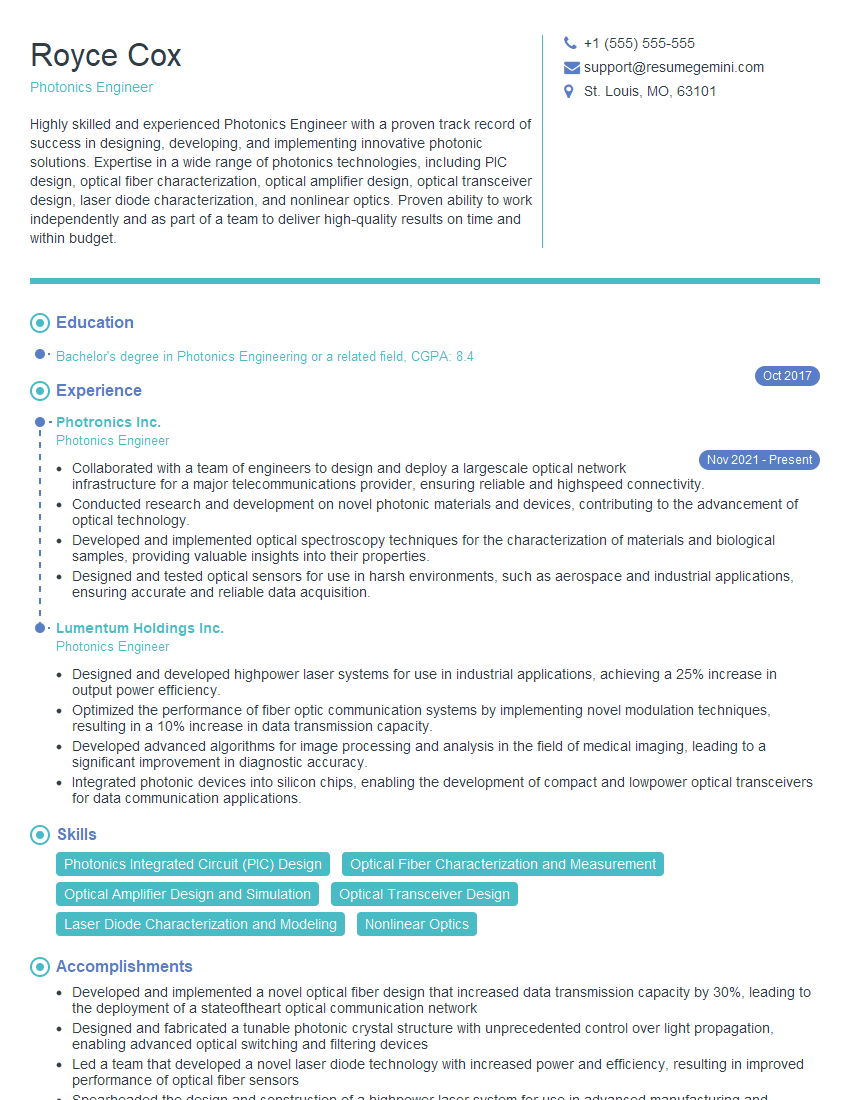
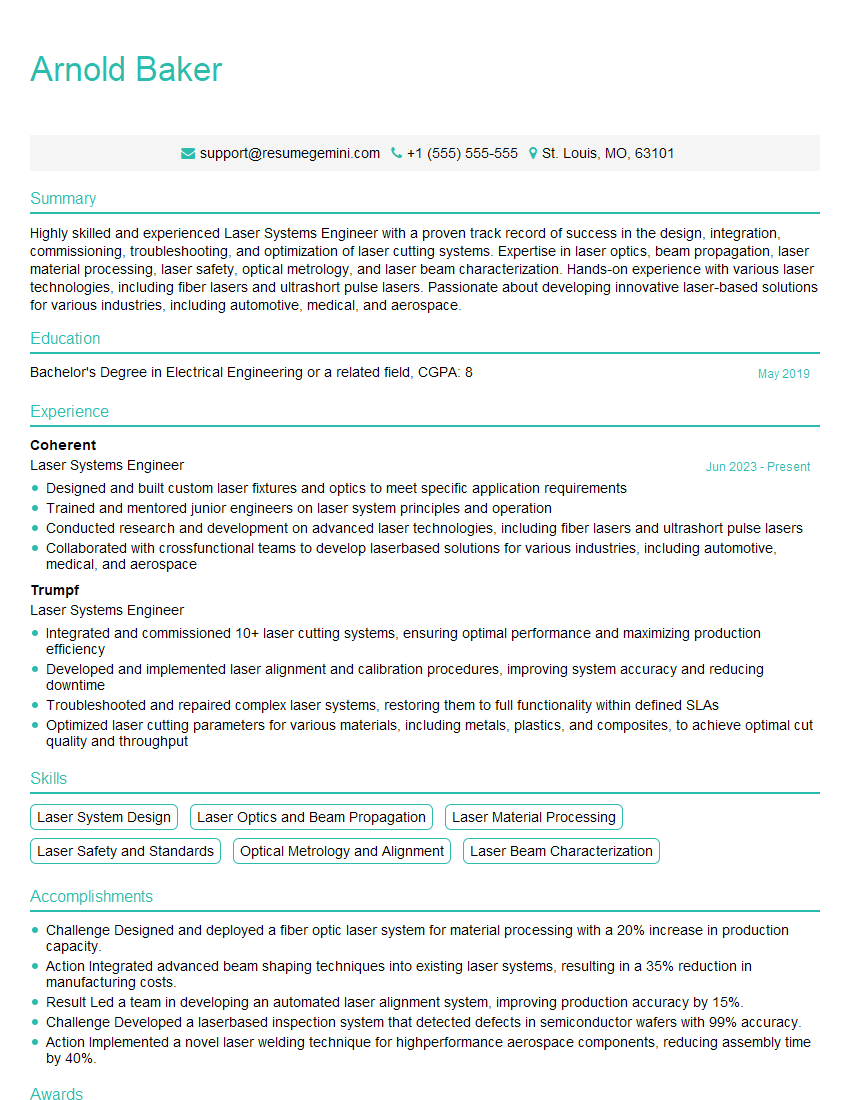
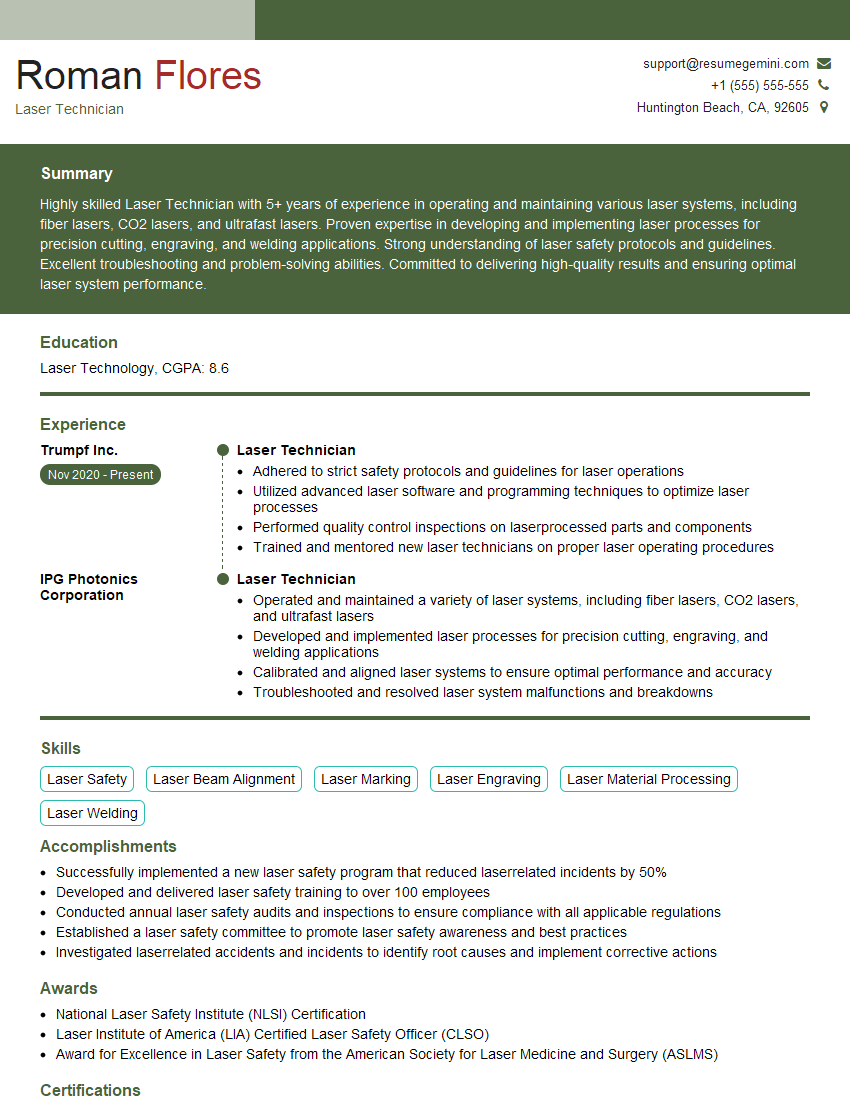
Mastering Laser Research and Development opens doors to exciting and innovative career paths, offering opportunities for significant contributions to cutting-edge technologies. To maximize your job prospects, crafting a strong, ATS-friendly resume is crucial. ResumeGemini is a trusted resource that can help you build a professional and impactful resume tailored to highlight your skills and experience in this competitive field. Examples of resumes specifically designed for Laser Research and Development roles are available to guide you through the process. Invest time in crafting a compelling resume – it’s your first impression with potential employers.

Explore more articles
Users Rating of Our Blogs
Share Your Experience
We value your feedback! Please rate our content and share your thoughts (optional).
What Readers Say About Our Blog
Really detailed insights and content, thank you for writing this detailed article.
IT gave me an insight and words to use and be able to think of examples