The thought of an interview can be nerve-wracking, but the right preparation can make all the difference. Explore this comprehensive guide to Laser System Maintenance interview questions and gain the confidence you need to showcase your abilities and secure the role.
Questions Asked in Laser System Maintenance Interview
Q 1. Describe your experience with laser safety protocols and regulations.
Laser safety is paramount. My experience encompasses a deep understanding of ANSI Z136.1, the primary standard governing laser safety in the US, along with other relevant international regulations. This includes knowing the classifications of lasers (Class 1 through 4), the associated hazards of each class, and implementing appropriate control measures. I’ve worked extensively with laser safety officers to develop and implement comprehensive safety programs, including risk assessments, safe operating procedures (SOPs), and emergency response plans. For example, during my work on a high-power fiber laser system, we established a controlled access zone, implemented interlocks to prevent accidental activation, and mandated the use of appropriate laser safety eyewear tailored to the specific wavelength and power of the laser. We also conducted regular safety training for all personnel involved in the laser’s operation and maintenance.
Beyond formal regulations, I’ve developed a strong intuition for laser safety. I always prioritize a layered approach, implementing multiple safety measures, so that if one fails, others are in place to prevent accidents. This includes environmental controls like beam enclosures and warning signage in addition to personal protective equipment.
Q 2. Explain the process of aligning a laser system.
Aligning a laser system involves precisely directing the laser beam to its intended target or optical path. The process varies significantly based on the laser type and application, but the general principles remain consistent. It often begins with a careful examination of the optical components, making sure lenses, mirrors, and other elements are clean and correctly positioned. We then use precision adjustment mechanisms, often micrometer-based, to iteratively fine-tune the alignment. This frequently involves the use of alignment tools such as beam profilers, power meters, and auto-collimators.
For instance, when aligning a laser cutting system, I begin by using a visible alignment laser to trace the path of the main laser beam, adjusting mirrors to ensure it accurately follows the intended trajectory. Then, I employ a beam profiler to measure the beam’s profile and ensure it’s focused correctly at the cutting head. A power meter helps monitor the power at various points in the beam path to identify any significant power loss due to misalignment. The entire process is iterative, with each adjustment verified using the diagnostic tools. Finally, the alignment is documented and validated to ensure consistent and safe operation.
Q 3. How do you troubleshoot common laser system malfunctions?
Troubleshooting laser system malfunctions requires a systematic approach. I start with a thorough visual inspection, checking for obvious issues like loose connections, damaged optics, or unusual signs of wear and tear. Then, I consult the system’s error logs and diagnostic reports, searching for specific error codes or unusual readings. This is followed by a series of tests designed to isolate the problem.
For example, if a laser fails to reach its intended power output, I would systematically check the power supply, the laser diode’s operating parameters, and the cooling system. If there’s an issue with beam quality, I’d investigate the optics for damage or misalignment. Throughout this process, I rely on my understanding of the laser’s operational principles and the interconnectedness of its components. A flowchart or decision tree can be extremely useful for streamlining this process. It’s all about pinpointing the root cause, not just treating the symptoms.
Q 4. What are the different types of lasers and their applications?
Lasers are categorized by their gain medium, wavelength, and operational characteristics. Common types include:
- Gas lasers (HeNe, CO2): HeNe lasers produce visible red light and are used in barcode scanners and alignment tools. CO2 lasers emit infrared light and are powerful tools for material processing like cutting and welding.
- Solid-state lasers (Nd:YAG, fiber lasers): Nd:YAG lasers operate in the near-infrared region and find use in medical procedures and laser marking. Fiber lasers, highly efficient and compact, are used extensively in material processing applications and telecommunications.
- Diode lasers: These are semiconductor-based and are ubiquitous, powering everything from laser pointers to CD/DVD players. They are compact and energy-efficient.
- Excimer lasers: These lasers utilize noble gases and halogens to create ultraviolet light, useful in lithography and eye surgery.
The application of each laser type depends on its specific properties, such as wavelength, power, beam quality, and coherence. Choosing the right laser for a particular task is critical for efficiency and safety.
Q 5. What safety precautions do you take when working with high-power lasers?
Working with high-power lasers demands extreme caution. The primary safety measure is always appropriate eye protection. This includes selecting eyewear specifically designed for the laser’s wavelength and power level. Never look directly into the beam, even with protective eyewear on. Additional precautions include the use of appropriate beam enclosures, interlocks to prevent accidental activation, and controlled access to the laser area. Proper training and safety protocols are absolutely essential.
In addition to these measures, I always ensure the laser’s operating parameters are within safe limits. This includes monitoring power levels, beam divergence, and environmental conditions. Regular system checks are also necessary, and a detailed safety protocol is always followed, including the use of appropriate signs and warning signals.
Q 6. Describe your experience with laser beam diagnostics.
Laser beam diagnostics involve the characterization of the laser beam’s properties, including its power, beam profile, beam divergence, and wavelength. My experience includes using a variety of diagnostic tools, such as power meters, beam profilers, wavemeters, and auto-collimators. I’ve used these tools to optimize laser performance, ensure beam quality, and troubleshoot system malfunctions.
For instance, when characterizing a high-power fiber laser for a manufacturing process, I would use a power meter to measure its output power, a beam profiler to analyze its spatial distribution, and a wavemeter to verify its wavelength stability. By analyzing the data collected from these tools, I can assess the laser’s performance, identify potential problems, and ensure it is operating as intended. This information is crucial for maintaining optimal laser operation and preventing unexpected issues.
Q 7. How do you perform preventative maintenance on a laser system?
Preventative maintenance is crucial for ensuring the long-term reliability and safety of a laser system. My routine includes regular cleaning of optical components, checking for alignment, inspecting cooling systems, and verifying the functionality of safety interlocks. This also includes checking and replacing parts according to the manufacturer’s recommendations.
I keep detailed records of all maintenance activities, including dates, procedures, and any issues encountered. This allows me to track the laser’s performance and identify potential problems before they become significant. For example, I might develop a monthly schedule for cleaning optics and a quarterly schedule for more in-depth inspections, adjustments, and preventative replacements. This proactive approach minimizes downtime and ensures consistent, safe performance.
Q 8. Explain the concept of laser beam quality (M²).
Beam quality, often represented by the M² factor (pronounced ‘M-squared’), describes how close a laser beam’s divergence is to the theoretical minimum for a given wavelength and diameter. A perfect Gaussian beam, the ideal, has an M² of 1. Higher M² values indicate a beam that spreads out faster than an ideal beam, impacting its ability to focus to a tight spot. Think of it like throwing a ball: a low M² is like a perfectly thrown spiral that travels far with minimal spread, while a high M² is like a wobbly throw that quickly loses its direction and spreads out.
In practical terms, M² affects applications like laser cutting, where a tightly focused beam is crucial for precision. A high M² beam will lead to a wider cut and potentially lower quality. Measuring M² involves analyzing the beam’s spatial profile at different distances using techniques like beam profiling cameras. This allows for accurate characterization of the beam’s propagation and identification of aberrations.
Q 9. How do you calibrate a laser system for optimal performance?
Calibrating a laser system for optimal performance is a multi-step process that depends heavily on the specific laser type and application. Generally, it involves:
- Power Calibration: Using a calibrated power meter, the output power is measured and adjusted to the desired level through control mechanisms in the laser system. This often involves adjusting mirrors, lenses, or the laser’s internal settings.
- Beam Alignment: Precise alignment of optical components (mirrors, lenses, etc.) is vital. This involves ensuring the beam travels along the desired path and minimizes losses. HeNe lasers are often used for initial alignment due to their visible beam.
- Beam Profile Optimization: Analyzing the beam profile using a beam profiler helps identify aberrations like astigmatism or higher-order modes. Adjustments to the laser cavity or optics are made to achieve a near-Gaussian profile (minimizing M²).
- Wavelength Calibration (where applicable): For tunable lasers, accurate wavelength calibration using a wavemeter is essential to ensure the laser operates at the correct wavelength for the application.
- Timing and Synchronization Calibration (where applicable): For pulsed lasers or systems requiring synchronized operation, precise timing control is crucial. This often necessitates using oscilloscopes and timing electronics for precise adjustments.
Regular calibration is crucial to maintain performance and consistency. A deviation from calibrated settings can lead to reduced efficiency, lower precision, or even system damage.
Q 10. What are the common causes of laser beam instability?
Laser beam instability can stem from several sources, broadly categorized as mechanical, thermal, and electrical:
- Mechanical Instabilities: Vibrations, misalignments of optical components due to movement or environmental factors (temperature changes, building vibrations), and loose connections in the optical path can all lead to beam wander or fluctuation.
- Thermal Instabilities: Temperature fluctuations affect the refractive index of optical components, leading to beam steering or distortion. Heat generated by the laser itself or external sources can also contribute to this instability. Proper cooling systems are critical here.
- Electrical Instabilities: Power supply fluctuations, noise in control electronics, or faulty components can directly influence the laser’s output power, resulting in unstable beam intensity. This is especially true for lasers requiring precise current control.
- Environmental Factors: External factors such as air currents, dust, or acoustic noise can also induce beam instability. These disturbances can cause perturbations in the laser’s optical path.
Troubleshooting often involves isolating these potential sources through systematic checks, employing vibration isolation tables, temperature stabilization, and ensuring a clean and stable power supply.
Q 11. Describe your experience with laser power measurement techniques.
My experience with laser power measurement techniques is extensive. I’ve used various methods depending on the laser’s power level and characteristics:
- Power Meters: For most applications, calibrated power meters with appropriate detectors (thermal, photodiodes) are the standard. Choosing the right detector is vital; exceeding its maximum power can damage the sensor. I’ve worked with power meters from various manufacturers, ensuring traceability to national standards.
- Pyroelectric Detectors: These are ideal for high-energy pulsed lasers, measuring energy per pulse rather than average power. I’ve used these in high-power laser labs for safety and performance evaluation.
- Calorimeters: These provide highly accurate power measurements, especially for high-power lasers, by measuring the heat generated when the beam is absorbed. They’re often used for laser calibration and quality assurance.
- Beam Profiling Cameras: While primarily for beam quality, these cameras can also provide power measurements by integrating the power distribution across the beam profile. This is particularly useful for characterizing the spatial uniformity of the beam.
Accurate power measurement is critical for safety, performance optimization, and ensuring the laser is operating within its specified parameters. Any discrepancies need thorough investigation.
Q 12. How do you handle laser system emergencies?
Handling laser system emergencies requires a calm and methodical approach prioritizing safety. My response protocol typically involves:
- Immediate Shutdown: The first step is to safely shut down the laser system according to its emergency shutdown procedures. This may involve activating emergency stop buttons or following specific power-down sequences.
- Assess the Situation: Evaluate the nature of the emergency: Is there a fire? Is there a beam hazard? Is there equipment damage? This assessment guides the subsequent steps.
- Ensure Safety: Evacuate the immediate area and ensure no one is exposed to the laser beam or any hazardous materials released during the emergency.
- Call for Assistance: Contact emergency services (fire department, medical personnel) if needed and inform relevant personnel (lab manager, safety officer) about the situation. Many labs maintain well-defined emergency response procedures.
- Document the Incident: Following the resolution, document the incident thoroughly, including the cause (if known), corrective actions taken, and any injuries or damage. This documentation is crucial for future safety improvements and incident analysis.
Regular safety training and drills are essential to prepare for these unexpected events and minimize potential risks.
Q 13. What are the different types of laser cooling systems?
Laser cooling systems are crucial for maintaining stable operation, preventing thermal runaway, and extending the laser’s lifespan. The choice depends on the laser’s power and type:
- Air Cooling: Simple and cost-effective, suitable for low-power lasers. Fans circulate air around the laser to remove heat.
- Water Cooling: More efficient than air cooling, used for medium to high-power lasers. A continuous flow of water absorbs heat generated by the laser. A cooling unit is often required to maintain the water temperature.
- Thermoelectric Cooling (TEC): Uses the Peltier effect to transfer heat from one side of a device to another. Provides precise temperature control, often used for stabilizing laser diodes.
- Cryogenic Cooling: Used for specialized lasers requiring extremely low temperatures for operation, often utilizing liquid nitrogen or helium.
The selection of a cooling system considers factors like laser power, operating temperature, efficiency, and cost. Inadequate cooling can lead to decreased performance, reduced laser lifetime, and even catastrophic failure.
Q 14. Explain the importance of regular laser system cleaning and maintenance.
Regular cleaning and maintenance are paramount for optimal performance, safety, and longevity of a laser system. Neglecting this can lead to reduced efficiency, beam instability, and even damage to the system.
Cleaning procedures typically involve:
- Optical Component Cleaning: Careful cleaning of mirrors, lenses, and other optical components using appropriate cleaning solutions and techniques is essential. Dust, fingerprints, or other contaminants can scatter or absorb the laser beam, reducing efficiency and potentially damaging the optics.
- Internal Component Inspection: Regular inspection of internal components for dust, debris, or signs of damage is crucial. This may involve opening the laser enclosure (under controlled conditions and after proper shutdown) for visual inspection.
- Cooling System Maintenance: Maintaining the laser’s cooling system (e.g., replacing filters in air-cooled systems, checking coolant levels and purity in water-cooled systems) prevents overheating and ensures optimal performance.
- Alignment Checks: Periodic alignment checks and adjustments are necessary to maintain optimal beam quality and power output.
A well-defined maintenance schedule, adhering to the manufacturer’s recommendations, minimizes downtime and ensures the laser system operates at peak efficiency and safety.
Q 15. How do you identify and resolve issues with laser optics?
Identifying and resolving issues with laser optics requires a systematic approach combining visual inspection with sophisticated diagnostic tools. First, a visual inspection is crucial. We look for signs of contamination like dust, fingerprints, or scratches on the optical surfaces. Damage can manifest as pitting, coatings degradation, or even physical cracks. A simple cleaning with appropriate optical wipes and isopropyl alcohol might resolve minor contamination. However, more significant damage requires replacing the optical component.
For more in-depth analysis, we utilize tools like interferometers to measure surface quality and wavefront distortions. Scatterometers assess surface roughness and scattering losses. These tools give quantitative data, pinpointing the exact location and nature of the optical problem. For instance, if an interferogram shows significant wavefront aberrations, it might indicate a misalignment or damage to a lens or mirror, necessitating adjustment or replacement.
In one instance, I diagnosed a power loss in a laser system by identifying subtle scratches on the output coupler using a microscope. Replacing the coupler immediately resolved the issue, restoring the system’s full power output. The key is a careful, methodical approach combining visual checks with precision instrumentation.
Career Expert Tips:
- Ace those interviews! Prepare effectively by reviewing the Top 50 Most Common Interview Questions on ResumeGemini.
- Navigate your job search with confidence! Explore a wide range of Career Tips on ResumeGemini. Learn about common challenges and recommendations to overcome them.
- Craft the perfect resume! Master the Art of Resume Writing with ResumeGemini’s guide. Showcase your unique qualifications and achievements effectively.
- Don’t miss out on holiday savings! Build your dream resume with ResumeGemini’s ATS optimized templates.
Q 16. Describe your experience with different types of laser control systems.
My experience encompasses a wide range of laser control systems, from simple analog controllers to sophisticated digital systems utilizing programmable logic controllers (PLCs) and embedded systems. I’ve worked extensively with analog control loops for regulating laser power and temperature. This often involves using PID (Proportional-Integral-Derivative) controllers to maintain stability and accuracy. These systems are relatively straightforward but require careful tuning to avoid oscillations or instability.
In more complex systems, I have experience with digital control systems involving PLCs. These offer greater flexibility and control capabilities, including advanced features like automated safety shutdowns, precise timing control, and data logging. For instance, I’ve worked on a system integrating a PLC with a high-speed camera to monitor and dynamically adjust the laser beam parameters in real-time. This was vital for a precision micromachining application requiring exceptional repeatability.
Furthermore, I’m proficient in using software interfaces for system control and data acquisition. This often involves software such as LabVIEW or custom-developed software for specific applications. Understanding the underlying software and hardware interaction is key to troubleshooting and optimizing laser performance.
Q 17. What are the common causes of laser system damage?
Laser system damage can stem from various causes, often interlinked. One major culprit is excessive power. Operating a laser beyond its specified parameters can lead to component overheating, causing optical damage, or even catastrophic failure. Contamination is another significant threat. Dust particles or fingerprints on optical surfaces can scatter or absorb laser energy, leading to localized heating and damage. This is particularly true for high-power lasers.
Improper alignment is a common cause. Misaligned optics can create hotspots, resulting in thermal stress and eventual damage to components. Environmental factors such as extreme temperatures or humidity can also affect the longevity and performance of laser systems. For instance, high humidity can lead to condensation on optical surfaces, causing significant scattering and power loss. Finally, inadequate cooling can also cause overheating and subsequent damage.
In one project, a high-power CO2 laser suffered damage due to a combination of improper cooling and dust accumulation. The inadequate cooling caused localized heating which, combined with dust acting as an absorber, led to a catastrophic failure of the laser tube. Regular maintenance, including meticulous cleaning and adequate cooling, is essential to prevent such incidents.
Q 18. How do you interpret laser system diagnostic data?
Interpreting laser system diagnostic data involves understanding the various parameters and their interrelationships. This often includes analyzing power measurements, beam profile data, temperature readings, and diagnostic messages from the control system. Understanding the normal operating parameters for a specific system is crucial for identifying deviations indicating potential problems. For instance, an unexpected drop in laser power might indicate a problem with the gain medium, a damaged optical component, or a misalignment. Examining the beam profile can reveal aberrations or mode instabilities. A temperature sensor reading exceeding the specified limit immediately raises concerns about overheating.
Data analysis often involves using software tools to visualize and process the collected data. Trends and patterns can help identify the root cause of the problem. For example, a gradual decline in power over time might point towards a slowly degrading component, whereas a sudden drop indicates a more immediate issue. Correlation between multiple data points—for example, a simultaneous drop in power and increase in temperature—can provide valuable insights into the cause of the malfunction.
In one instance, analyzing temperature data from multiple sensors within a high-power laser system revealed a localized overheating problem in a specific section of the cooling system. This led to identifying a blockage in the cooling line that was promptly fixed, preventing further damage and downtime.
Q 19. Explain the process of replacing laser components.
Replacing laser components requires careful planning and execution to ensure safety and prevent further damage. The process typically begins with a thorough risk assessment to identify potential hazards associated with the specific laser system and the component being replaced. Safety measures, including laser safety eyewear and appropriate handling procedures, are paramount. The system must be properly shut down and the power disconnected before any work begins. Anti-static precautions are usually implemented, particularly with sensitive electronic components.
The next step involves carefully removing the faulty component, taking note of its orientation and any critical alignment features. This often includes using specialized tools and following the manufacturer’s instructions. New components should be handled with care to prevent damage to their surfaces or internal structures. Installation typically involves carefully aligning the new component in the correct position and securing it according to the manufacturer’s specifications.
After installation, the system should be carefully reassembled and tested to ensure proper functionality. This may involve realignment procedures and performance verification using appropriate diagnostic tools. Thorough documentation of the entire process, including any adjustments made, is vital for future reference and maintenance.
Q 20. How do you ensure the accuracy and precision of laser measurements?
Ensuring the accuracy and precision of laser measurements requires a multi-faceted approach. Calibration of measurement equipment is crucial. This includes regular calibration of power meters, beam profilers, and other diagnostic tools against traceable standards. Regular calibration ensures that the measurements are accurate and reliable. The environmental conditions can also affect measurement accuracy. Factors such as temperature, humidity, and air pressure should be considered and controlled to minimize environmental influences on the measurements. In many applications, the thermal stability of the laser itself affects accuracy.
Precise alignment of the optical components within the laser system and in the measurement setup is crucial for accurate beam profiling and power measurements. Proper alignment minimizes aberrations and ensures the stability of the laser beam. Furthermore, appropriate data acquisition and analysis techniques are needed. This includes using suitable algorithms to process raw data from sensors and correcting for systematic errors.
For example, in a precision material processing application, I implemented a feedback control system that automatically corrected for slight beam wander during the process. This ensured consistently high accuracy in the material cutting process. Careful attention to detail and a combination of preventative and corrective measures are key to achieving reliable and accurate results.
Q 21. What are the different types of laser beam delivery systems?
Laser beam delivery systems transport the laser beam from the laser source to the target area. The choice of delivery system depends on the application and the specific requirements of the laser beam. Common types include free-space propagation, where the beam travels directly through air or vacuum, suitable for many applications, including laser surgery or laser scanning. However, it is sensitive to air turbulence and beam wander.
Fiber optic delivery systems use optical fibers to guide the laser beam. This is advantageous because the fibers are flexible, allowing for easy manipulation and access to confined spaces. This is commonly used in medical lasers or industrial laser cutting. However, fiber-optic systems can introduce losses and limitations on the beam quality.
Scanning systems use mirrors or other optical components to deflect the laser beam, enabling precise control of the beam’s path. This is crucial for applications like laser marking, laser engraving, and laser microscopy. These systems can offer high precision but often involve complex control mechanisms. Finally, beam shaping systems modify the spatial characteristics of the laser beam—for instance, converting a Gaussian profile to a uniform top-hat profile for better material processing.
Selecting the optimal delivery system often involves a trade-off between flexibility, efficiency, cost, and beam quality, always prioritizing safety and the specific needs of the application.
Q 22. Describe your experience with laser system integration.
Laser system integration involves seamlessly incorporating a laser into a larger system, ensuring optimal performance and safety. This requires a deep understanding of both the laser’s operational parameters and the needs of the host system. My experience spans various applications, from integrating high-power fiber lasers into industrial cutting systems to incorporating low-power diode lasers into medical imaging devices.
For example, in one project involving a high-power fiber laser for metal cutting, I was responsible for integrating the laser with a CNC (Computer Numerical Control) machine. This involved careful consideration of beam delivery optics, safety interlocks, and software control protocols. We had to ensure precise alignment of the laser beam with the cutting head, implement safety measures to prevent accidental exposure, and develop custom software routines for controlling the laser’s power and pulse parameters based on the CNC commands. Successful integration resulted in significantly improved cutting speed and precision compared to the previous system.
Another project focused on integrating a low-power diode laser into a compact medical imaging device. Here, the challenges revolved around miniaturization, thermal management, and ensuring biocompatibility. We utilized custom-designed optical mounts and heat sinks to keep the laser within its operational temperature range and worked closely with biomedical engineers to meet the required safety and regulatory standards.
Q 23. How do you document maintenance procedures and findings?
Meticulous documentation is crucial for ensuring consistent and reliable laser system maintenance. I utilize a comprehensive system combining both digital and physical records. This includes detailed maintenance logs, schematics, and procedure manuals.
For digital records, I use a dedicated database system that allows me to track all maintenance activities, including date, time, technician, tasks performed, parts replaced, and any observations or findings. The system generates automated reports, making it easy to monitor trends and anticipate potential problems. For example, tracking the replacement frequency of specific components helps us predict future needs and proactively order parts.
Physical documentation includes detailed schematics and wiring diagrams, as well as step-by-step maintenance procedures with clear instructions and safety precautions. These documents are kept securely stored, both digitally and in printed form, to ensure accessibility in case of digital system failure.
All findings, whether positive or negative, are meticulously documented. This includes any anomalies detected, troubleshooting steps taken, and the resolution of issues. This detailed record ensures consistent and traceable maintenance, which is critical for regulatory compliance and identifying potential long-term issues.
Q 24. What software are you proficient in for laser system operation and control?
My proficiency in laser system operation and control encompasses several software packages. These include specialized laser control software (e.g., LaserCAD, LLP) for setting parameters like power, pulse duration, and beam shaping, as well as general-purpose software like LabVIEW for data acquisition and custom control systems. I am also proficient in using industrial automation software (e.g., PLC programming software) for integrating laser systems into automated production lines.
For instance, in a recent project involving a high-power fiber laser, we used LaserCAD to precisely control the laser’s beam profile and power output, ensuring consistent processing quality. Meanwhile, LabVIEW was employed to collect real-time data on the laser’s performance and the workpiece, allowing for adaptive control and process optimization. The integration of all these elements was paramount in ensuring operational efficiency.
Q 25. Explain your experience with laser system upgrades and modifications.
My experience with laser system upgrades and modifications involves a structured approach, starting with a thorough assessment of the existing system and its limitations, followed by careful planning and execution of the upgrade. This involves close collaboration with engineers and stakeholders to determine the optimal solution.
One example involved upgrading an older CO2 laser system with a newer, more efficient fiber laser. This involved not only replacing the laser source but also upgrading the optical delivery system, control electronics, and safety features. The project required careful planning to ensure minimal downtime and seamless integration with the existing production line. The upgrade resulted in a significant improvement in cutting speed, precision, and overall system efficiency.
Another project involved modifying a laser system to incorporate new beam shaping techniques for improved material processing quality. This included adding new optical components and developing customized control software. Rigorous testing was conducted to validate the effectiveness of the modifications and ensure the system’s safety.
Q 26. How do you maintain accurate records of laser system performance?
Maintaining accurate records of laser system performance is crucial for ensuring optimal operation and identifying potential problems early on. I rely on a combination of automated data acquisition and manual logging to maintain these records.
Automated data acquisition systems collect real-time data on key performance parameters such as laser power output, beam quality, and system temperatures. This data is stored digitally, allowing for easy analysis and trend identification. For example, consistent monitoring of laser power output allows for early detection of potential degradation in the laser source.
Manual logging supplements the automated data, documenting observations made during routine maintenance or any unusual events. This approach provides a comprehensive picture of the system’s performance over time, facilitating proactive maintenance and preventing unexpected downtime.
Q 27. What is your experience with different laser types (e.g., CO2, fiber, diode)?
My experience encompasses various laser types, including CO2, fiber, and diode lasers, each with its own unique characteristics and maintenance requirements. CO2 lasers, known for their high power output in the infrared region, demand regular cleaning and alignment of optics. Fiber lasers, renowned for their efficiency and compact size, require attention to the integrity of the fiber and monitoring of the pump diode. Diode lasers, often used in low-power applications, require careful thermal management to prevent damage.
For instance, in the case of a CO2 laser, regular cleaning of the mirrors and the resonator is critical to maintain beam quality and prevent power loss. Any misalignment of the optics can lead to a significant decrease in output power. With fiber lasers, maintaining the integrity of the fiber cable is paramount to prevent signal loss or damage to the laser source. Regular inspection for any cracks, kinks, or contamination is crucial.
For diode lasers, maintaining an appropriate operating temperature is important due to their susceptibility to thermal degradation. The use of heat sinks and efficient cooling systems is essential to extend the lifespan of these lasers.
Q 28. Describe a challenging laser system maintenance situation you faced and how you resolved it.
One of the most challenging situations I faced involved a high-power fiber laser used in a high-volume manufacturing setting. The laser suddenly started experiencing unstable output power, resulting in inconsistent processing quality and significant production downtime.
Initial troubleshooting focused on the laser itself, including checking power supplies, cooling systems, and optical components. However, we found no immediate problems. We then expanded the investigation to the entire system, considering factors beyond the laser itself. We discovered that the problem stemmed from a subtle vibration in the laser’s mounting platform, induced by the high-speed operation of the production line. The vibration was causing minute misalignments in the optical path, leading to unstable output power.
The resolution involved a multi-faceted approach. We first implemented vibration damping measures on the laser’s mounting platform, using specialized dampening materials. Second, we adjusted the control software to compensate for minor fluctuations in output power. Third, we conducted extensive testing and monitoring of the system’s vibration levels, ensuring the modifications were effective. This multi-pronged approach resolved the issue, restoring consistent laser performance and preventing future occurrences.
Key Topics to Learn for Laser System Maintenance Interview
- Laser Safety and Regulations: Understanding laser classifications, safety protocols, and relevant regulations (e.g., ANSI, IEC) is crucial for ensuring a safe working environment and preventing accidents.
- Optical Alignment and Adjustment: Mastering the techniques for aligning optical components, troubleshooting misalignments, and optimizing laser beam quality is a core practical skill.
- Laser Diagnostics and Troubleshooting: Learn to identify and diagnose common laser system malfunctions, utilizing various diagnostic tools and techniques. This includes understanding error messages and logs.
- Laser System Components and Functionality: Develop a comprehensive understanding of the various components within a laser system (e.g., laser source, optical elements, power supplies, cooling systems) and how they interact.
- Preventative Maintenance Procedures: Familiarize yourself with routine maintenance tasks, including cleaning, calibration, and component replacement, to ensure optimal system performance and longevity.
- Laser Beam Characteristics and Control: Understand concepts like beam profile, power stability, and wavelength, and how these parameters affect the system’s performance and application.
- Data Acquisition and Analysis: Learn to collect and analyze data from laser systems to monitor performance, identify trends, and optimize operational parameters.
- Troubleshooting Complex System Failures: Develop problem-solving skills to effectively diagnose and resolve complex malfunctions, involving systematic approaches and fault-finding techniques.
Next Steps
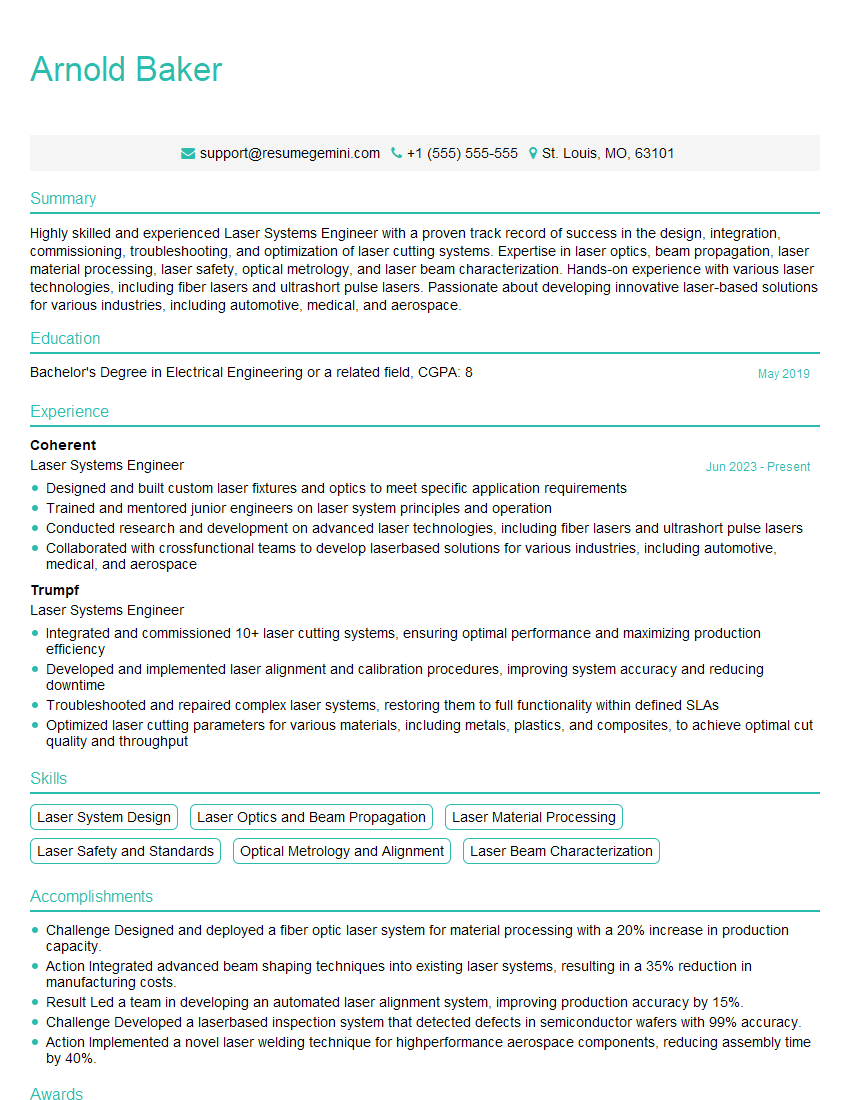
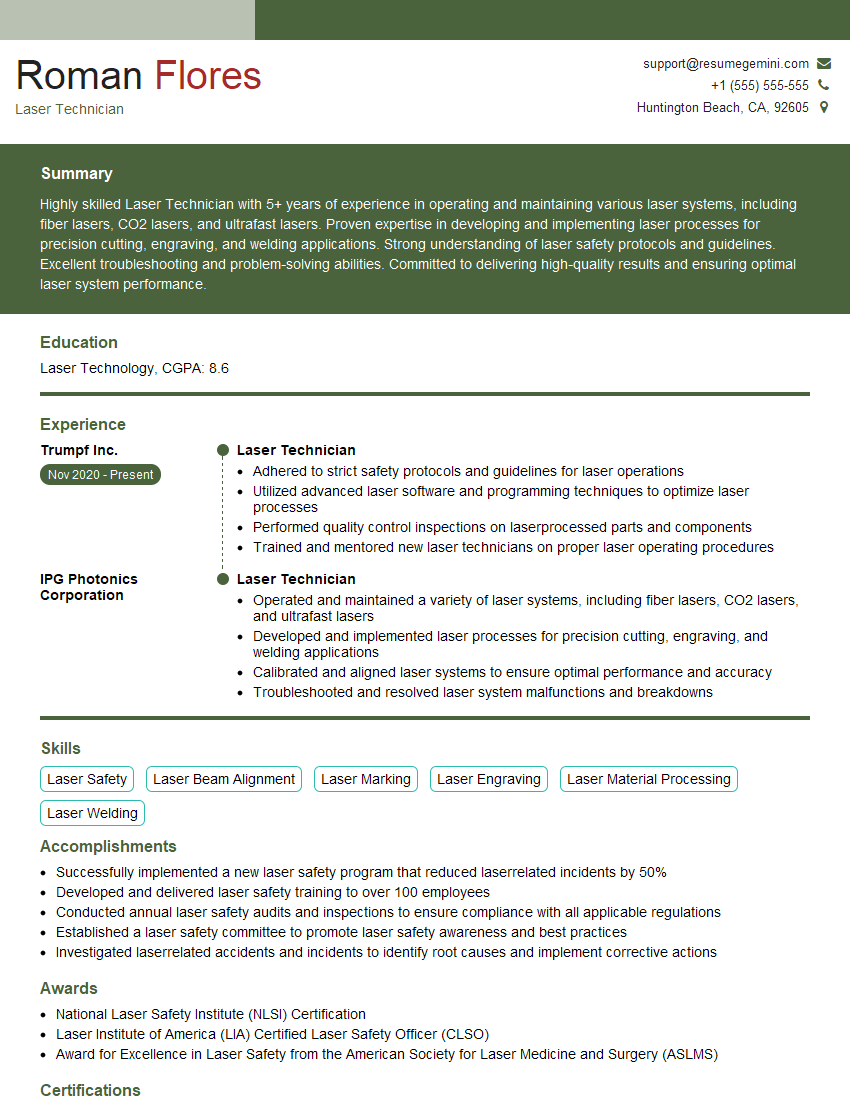
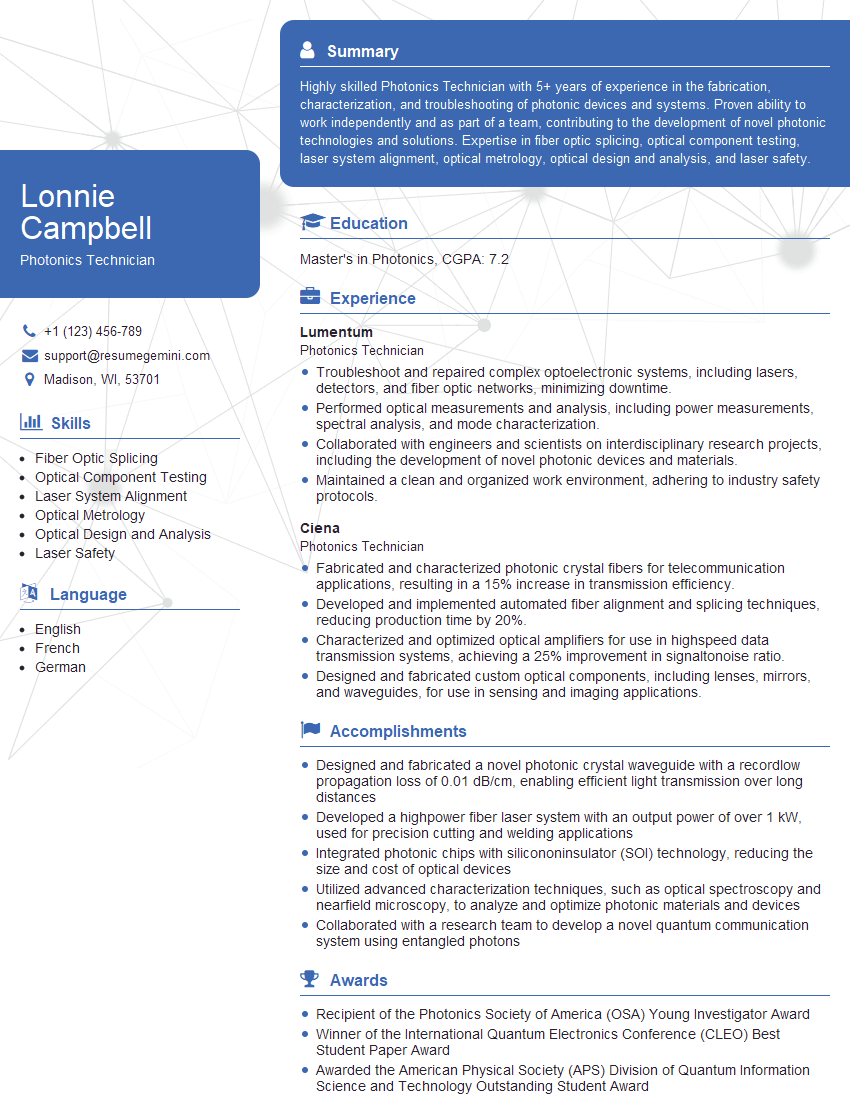
Mastering Laser System Maintenance opens doors to exciting career opportunities in a rapidly growing field, offering high demand and excellent earning potential. To maximize your chances of securing your dream role, a strong, ATS-friendly resume is essential. ResumeGemini can help you craft a compelling and effective resume that showcases your skills and experience. ResumeGemini provides examples of resumes tailored to Laser System Maintenance, guiding you in presenting your qualifications persuasively. Invest the time in crafting a professional resume—it’s a critical step in your career advancement.
Explore more articles
Users Rating of Our Blogs
Share Your Experience
We value your feedback! Please rate our content and share your thoughts (optional).
What Readers Say About Our Blog
Really detailed insights and content, thank you for writing this detailed article.
IT gave me an insight and words to use and be able to think of examples