Interviews are opportunities to demonstrate your expertise, and this guide is here to help you shine. Explore the essential LiDAR and InSAR Data Analysis interview questions that employers frequently ask, paired with strategies for crafting responses that set you apart from the competition.
Questions Asked in LiDAR and InSAR Data Analysis Interview
Q 1. Explain the principles of LiDAR data acquisition.
LiDAR, or Light Detection and Ranging, acquires data by emitting laser pulses and measuring the time it takes for the light to reflect back to the sensor. This time-of-flight measurement is used to calculate the distance to the target, providing highly accurate three-dimensional (3D) spatial information. Imagine it like a highly sophisticated, extremely fast rangefinder. Different LiDAR systems employ various techniques:
Airborne LiDAR: Mounted on aircraft, it provides large-scale coverage, ideal for mapping vast areas like forests or cities. The laser pulses are emitted from a scanning unit, creating a swath of data as the aircraft moves.
Terrestrial LiDAR: Stationary or mobile ground-based systems used for smaller-scale, high-detail surveys. These are often used in construction, archaeology, and accident investigations because of their centimeter-level accuracy.
Mobile LiDAR: Mounted on vehicles, offering a blend of large-scale coverage and high-resolution detail. This is increasingly popular for mapping road networks and urban areas efficiently.
In all cases, the reflected laser signals provide intensity information along with range, which helps distinguish different surface materials. GPS and IMU (Inertial Measurement Unit) data are integrated to georeference the point cloud, positioning each point accurately on the Earth’s surface.
Q 2. Describe different LiDAR point cloud classification methods.
LiDAR point cloud classification is the process of assigning meaningful labels to individual points, grouping them into categories representing different features like ground, buildings, vegetation, etc. This is crucial for creating useful 3D models and extracting meaningful information. Several methods exist:
Manual Classification: This labor-intensive method involves visually inspecting the point cloud and manually assigning classes. It’s accurate but slow and not scalable for large datasets.
Automated Classification: Algorithms use point attributes (e.g., intensity, elevation, neighborhood characteristics) to automatically classify points. Common algorithms include k-Nearest Neighbors (k-NN), support vector machines (SVM), and machine learning techniques like random forests. These methods offer speed and scalability but may require training data and careful parameter tuning.
Hybrid Classification: A combined approach leveraging both manual and automated methods. This often involves automating the classification of simpler features and then manually refining complex or ambiguous areas.
The choice of method depends on factors such as the project’s scale, required accuracy, and available resources. For instance, a large-scale forestry project might benefit from an automated approach, while a high-precision archaeological survey may necessitate manual refinement.
Q 3. What are the advantages and disadvantages of LiDAR compared to InSAR?
LiDAR and InSAR are both powerful remote sensing techniques, but they have different strengths and weaknesses:
| Feature | LiDAR | InSAR |
|---|---|---|
| Data Acquisition | Active sensing (emits its own signal) | Passive sensing (relies on reflected signals from a satellite) |
| Spatial Resolution | Very high (cm-level) | Moderate to high (depending on wavelength and processing) |
| Temporal Resolution | Relatively low (data acquisition is often time-consuming) | Relatively high (frequent satellite revisits) |
| Penetration | Limited penetration through dense vegetation or water | Can penetrate some vegetation, but limited penetration in dense areas |
| Cost | Generally higher, especially for large areas | Generally lower, particularly for large areas, due to satellite-based data acquisition |
| Weather Dependence | Highly weather-dependent (clouds and rain interfere with signal) | Highly weather-dependent (clouds completely inhibit data acquisition) |
In short, LiDAR excels in high-resolution 3D mapping, while InSAR is better suited for large-scale monitoring of surface deformation over time. Often, combining both datasets provides complementary information for a more comprehensive understanding.
Q 4. Explain the concept of InSAR interferometry.
InSAR interferometry measures the phase difference between two radar images of the same area acquired at different times. This phase difference is directly related to the change in distance between the satellite and the Earth’s surface between the two acquisitions. If the ground has moved (e.g., due to an earthquake or landslide), this change in distance will manifest as a change in the phase. This phase difference is then converted into a displacement map, showing the magnitude and direction of ground movement.
Imagine holding two slightly different photos of the same object – the differences highlight the changes. Similarly, InSAR uses the slight differences in phase between two radar images to detect ground deformation. The technique relies on the coherence between the two images; high coherence indicates stable areas, while low coherence indicates areas of significant change or noise.
Q 5. How do you handle noise and outliers in LiDAR point clouds?
Noise and outliers in LiDAR point clouds can significantly affect the accuracy of analysis. Several techniques are used to handle these issues:
Filtering: Various filters remove noise by smoothing the point cloud or identifying and removing points that deviate significantly from their neighbors. Examples include median filters, moving average filters, and statistical outlier removal.
Segmentation and Classification: Classifying points into different classes (ground, vegetation, buildings) allows for the identification and removal of outliers that don’t belong to any meaningful category.
Data Editing: In cases of gross errors, manual editing tools can be used to remove or correct individual points or clusters of points. This is often necessary in areas of high noise or complex topography.
The choice of method depends on the nature and extent of the noise and outliers. For instance, a median filter is effective for removing random noise, while segmentation is better suited for removing outliers associated with specific features. A common workflow may involve multiple filtering steps, followed by manual inspection and correction if needed.
Q 6. Describe different InSAR processing techniques.
InSAR processing involves several steps to obtain meaningful results from raw radar data. The key techniques include:
Preprocessing: This involves correcting for various geometric and radiometric distortions in the raw radar data, such as terrain effects and atmospheric influences.
Interferogram Generation: Two radar images of the same area are co-registered (aligned) and then subtracted to generate an interferogram, representing the phase difference between the images.
Phase Unwrapping: The interferogram phase is often wrapped (values between -π and π), requiring phase unwrapping to obtain continuous phase values, representing the actual displacement.
Geocoding: The unwrapped phase is then geocoded, converting it to a geographically referenced displacement map.
Atmospheric Correction: Removing atmospheric effects from the phase data improves the accuracy of deformation measurements.
InSAR Time Series Analysis: Processing multiple interferograms acquired over time to monitor temporal changes in deformation.
These steps typically involve specialized software and a strong understanding of radar signal processing. Different techniques are used depending on the type of application and the characteristics of the data. For example, advanced techniques like Persistent Scatterer Interferometry (PSI) are used to analyze deformation in urban areas, while Small Baseline Subset (SBAS) is better suited for monitoring large-scale movements.
Q 7. What are the common applications of LiDAR data?
LiDAR data finds applications in a wide range of fields:
Mapping and Surveying: Creating highly accurate digital elevation models (DEMs), 3D city models, and terrain maps.
Forestry: Measuring tree height, density, and biomass, aiding in forest inventory and management.
Agriculture: Monitoring crop health, yield estimation, and precision agriculture.
Civil Engineering and Construction: As-built modeling, volume calculations, and monitoring of infrastructure.
Archaeology: Detecting buried features and creating 3D models of archaeological sites.
Environmental Monitoring: Monitoring coastal erosion, landslides, and other environmental hazards.
Autonomous Driving: Creating high-resolution 3D maps for self-driving vehicles.
The versatility and high accuracy of LiDAR data make it an invaluable tool for a variety of applications, constantly evolving with advancements in sensor technology and data processing techniques.
Q 8. What are the common applications of InSAR data?
Interferometric Synthetic Aperture Radar (InSAR) is a powerful remote sensing technique that uses radar signals to measure ground deformation with incredible precision. Its common applications span various fields:
- Geotechnical Engineering: Monitoring landslides, subsidence, and other ground movements crucial for infrastructure safety and risk assessment. Imagine using InSAR to track a slow-moving landslide, allowing for timely evacuation and preventative measures.
- Volcanology: Detecting subtle ground swelling preceding volcanic eruptions, providing invaluable early warning systems. This is like having a ‘pulse’ on the volcano, enabling scientists to predict potential eruptions.
- Glaciology: Measuring ice sheet flow and melt rates, contributing to our understanding of climate change and its impact on sea levels. We can visualize ice movement and thinning patterns with remarkable detail.
- Earthquake Monitoring: Mapping ground deformation caused by earthquakes, helping to understand fault rupture processes and assess seismic hazards. This allows for better post-earthquake damage assessment and improved building codes.
- Precision Agriculture: Monitoring ground displacement and soil moisture for optimized irrigation and crop management. This allows farmers to tailor their practices for better yields.
In essence, InSAR provides a unique window into subtle Earth surface changes that are often invisible to the naked eye, making it a critical tool in numerous applications.
Q 9. Explain the concept of digital elevation models (DEMs) derived from LiDAR.
Digital Elevation Models (DEMs) derived from LiDAR data represent the Earth’s surface topography as a grid of elevation values. LiDAR, or Light Detection and Ranging, uses laser pulses to measure distances to the ground. By recording the time it takes for these pulses to return, and knowing the speed of light, we get incredibly precise point cloud data.
This point cloud is then processed using sophisticated algorithms to create a DEM. Think of it like this: imagine dropping a fine mesh grid over a landscape. The DEM notes the height of the mesh at each intersection, creating a digital replica of the terrain. Different interpolation methods (like nearest neighbor, bilinear, or kriging) are used to estimate elevations between the LiDAR points, generating a continuous surface. The resulting DEM can show everything from subtle slopes to steep cliffs with high accuracy.
These DEMs have numerous applications, including:
- Civil Engineering: Designing roads, bridges, and other infrastructure projects.
- Flood Modeling: Predicting flood inundation areas.
- Forestry: Estimating forest biomass and canopy height.
- Geographic Information Systems (GIS): Creating detailed maps and spatial analyses.
Q 10. How do you generate orthorectified imagery from LiDAR data?
Orthorectification is the process of geometrically correcting LiDAR-derived imagery to remove distortions caused by terrain relief and sensor geometry. It creates an image where all features are positioned in their true map coordinates, as if viewed from directly above.
The process typically involves several steps:
- Obtain accurate georeferencing information: This often involves using ground control points (GCPs) with known coordinates. Think of these as fixed points on the ground used for calibration.
- Generate a DEM: As discussed previously, a high-resolution DEM is crucial for correcting the elevation variations.
- Apply geometric corrections: Using the DEM and GCPs, specialized software calculates and corrects the distortions in the imagery. This involves removing the effects of perspective, relief displacement, and sensor orientation.
- Resampling the image: The corrected image is then resampled to create a final orthorectified image with a consistent pixel size and map projection.
The result is an orthomosaic, a highly accurate and georeferenced image suitable for various mapping and analysis applications. Imagine creating a perfectly aligned map of a city where buildings don’t appear skewed due to their height and all features are correctly positioned for precise measurement and analysis.
Q 11. Explain the concept of coherence in InSAR.
Coherence in InSAR refers to the similarity of the radar signal backscattered from the same location on the ground at two different times. A high coherence value indicates that the surface hasn’t changed significantly between acquisitions, resulting in a strong interference pattern. Low coherence suggests changes in the surface, such as vegetation growth, ground movement, or atmospheric effects.
Think of it like this: imagine you take two photos of the same scene. High coherence means the two photos look almost identical, while low coherence means there are significant differences. The coherence value is a crucial parameter in InSAR processing, because it determines the reliability of the displacement measurements. Areas with low coherence are often masked out as they are unreliable for deformation analysis. Factors like surface roughness, temporal decorrelation (changes over time), and atmospheric effects all influence coherence.
Understanding coherence is fundamental in interpreting InSAR results. High coherence provides confidence in the measurements, while low coherence highlights areas requiring further investigation or potentially indicating significant surface changes.
Q 12. How do you address atmospheric effects in InSAR data processing?
Atmospheric effects, such as variations in water vapor content and atmospheric pressure, can significantly impact InSAR measurements, introducing errors in displacement calculations. These effects can mimic ground deformation, leading to inaccurate results.
Several techniques are used to mitigate these effects:
- Atmospheric Phase Screen (APS) correction: This technique utilizes meteorological data (e.g., GPS-based water vapor measurements) or ancillary data from other sensors to model and remove the atmospheric phase delay from the InSAR interferogram. It’s like subtracting a background noise to reveal the true signal.
- Permanent Scatterer (PS) InSAR: This technique focuses on stable features (like buildings or infrastructure) with high coherence over time. Their stability helps to remove atmospheric artifacts by averaging multiple acquisitions. It’s akin to identifying the unchanging elements to isolate the moving parts.
- Small Baseline Subset (SBAS) InSAR: This method selects interferograms with short temporal and spatial baselines to minimize the atmospheric influence. The smaller the baseline, the less time and area differences are influencing the result.
The choice of technique depends on the specific application, data quality, and available resources. Careful consideration of atmospheric effects is crucial for obtaining reliable and accurate InSAR results.
Q 13. Describe different types of LiDAR sensors and their applications.
LiDAR sensors come in various types, categorized primarily by their scanning method and the type of laser used:
- Airborne LiDAR: Mounted on aircraft, these systems provide large-scale data acquisition. They include:
- Discrete-return LiDAR: Records the first return pulse, suitable for mapping terrain.
- Full-waveform LiDAR: Records the entire waveform of the return pulse, providing information about vegetation density and structure.
- Terrestrial LiDAR (TLS): Ground-based systems ideal for detailed scans of smaller areas. They are frequently used for precision measurements of buildings or archaeological sites.
- Mobile LiDAR: Mounted on vehicles, they provide high-resolution data for road mapping and infrastructure inspection.
- Bathymetric LiDAR: Uses specific wavelengths to penetrate water, enabling the mapping of underwater topography.
Applications vary widely depending on the sensor type. Airborne LiDAR is frequently used for mapping large areas, while TLS is employed for detailed 3D modeling. Mobile LiDAR is ideal for mapping infrastructure, and bathymetric LiDAR is crucial for coastal and marine studies. The choice of LiDAR system hinges on the specific application requirements and desired level of detail.
Q 14. What are the limitations of LiDAR and InSAR data?
While LiDAR and InSAR are powerful tools, they have limitations:
- LiDAR Limitations:
- Cost and data processing: LiDAR data acquisition and processing can be expensive and time-consuming.
- Penetration limitations: Dense vegetation can significantly affect data quality. It’s like trying to see through a thick forest.
- Data volume: LiDAR generates large datasets requiring substantial storage and processing power.
- InSAR Limitations:
- Temporal decorrelation: Changes in the surface between acquisitions reduce coherence and data reliability. This limits its capability in areas with high temporal dynamics.
- Atmospheric effects: As discussed earlier, these can significantly bias measurements.
- Geometric distortions: Terrain relief and sensor geometry need careful correction.
- Coverage limitations: Data acquisition requires clear line-of-sight to the target.
It is important to be aware of these limitations when planning projects and interpreting data. Often, integrating LiDAR and InSAR data can overcome some of these limitations. For instance, LiDAR can help improve InSAR processing in vegetated areas.
Q 15. How do you assess the accuracy and quality of LiDAR and InSAR data?
Assessing LiDAR and InSAR data quality involves a multi-faceted approach, focusing on both geometric and radiometric accuracy. For LiDAR, we examine point cloud density, accuracy of individual point coordinates (often assessed through comparison with ground control points or GCPs), and the presence of noise or outliers. Tools like root mean square error (RMSE) calculations help quantify positional accuracy. We also look at the completeness of the data; are there significant gaps or areas with insufficient point density? For example, a low density point cloud in a forested area might hinder accurate tree height estimation. For InSAR, quality assessment involves examining the coherence values, which indicate the similarity of radar backscatter between acquisitions. Low coherence can arise from temporal decorrelation (changes in the scene between acquisitions) or spatial decorrelation (e.g., due to rough surfaces). We also analyze the interferogram for noise and artifacts, including atmospheric effects. The accuracy of the derived displacement maps is often checked against independent measurements, such as GPS data or field observations. A good quality InSAR dataset will show high coherence in stable areas and meaningful changes in areas of interest.
Career Expert Tips:
- Ace those interviews! Prepare effectively by reviewing the Top 50 Most Common Interview Questions on ResumeGemini.
- Navigate your job search with confidence! Explore a wide range of Career Tips on ResumeGemini. Learn about common challenges and recommendations to overcome them.
- Craft the perfect resume! Master the Art of Resume Writing with ResumeGemini’s guide. Showcase your unique qualifications and achievements effectively.
- Don’t miss out on holiday savings! Build your dream resume with ResumeGemini’s ATS optimized templates.
Q 16. Explain the difference between single- and multi-temporal InSAR.
The key difference between single- and multi-temporal InSAR lies in the number of SAR acquisitions used. Single-temporal InSAR uses a single pair of SAR images to generate a single interferogram representing the displacement between the two acquisition times. Think of it like taking a before-and-after picture; it reveals displacement over a specific time interval. Multi-temporal InSAR, on the other hand, uses multiple SAR images acquired over a longer period. By processing multiple interferograms from various image pairs, we can create a time series of displacements, revealing the rate and pattern of ground deformation over time. This is analogous to creating a stop-motion animation of ground movement. Multi-temporal InSAR is invaluable for studying phenomena like glacier flow or slow-moving landslides where the rate of change is gradual.
Q 17. How do you perform change detection using InSAR data?
Change detection using InSAR data typically involves comparing interferograms generated from different time periods. One common method is to subtract one interferogram from another (differential InSAR). Areas with significant differences in displacement between the two time periods will appear as distinct features in the resulting difference image. These differences can be interpreted as changes in ground elevation due to various factors like subsidence, uplift, or surface deformation. Thresholding techniques are often applied to identify pixels exceeding a pre-defined level of displacement change, automatically highlighting regions of interest. For instance, we might set a threshold to detect areas where ground displacement exceeds 1 cm, automatically identifying locations affected by significant ground movement. Further analysis, potentially incorporating ancillary data such as geological maps, helps identify the cause of the detected changes.
Q 18. Describe the process of registering LiDAR point clouds to a reference coordinate system.
Registering LiDAR point clouds to a reference coordinate system, typically a geodetic datum like WGS84, is crucial for accurate spatial analysis. The process generally involves three steps: 1. Control Point Identification: We need ground control points (GCPs) with known coordinates in the reference system. These points are usually surveyed using GPS or total stations and are identifiable within the LiDAR point cloud. 2. Transformation Parameter Estimation: We use software to align the LiDAR point cloud to the GCPs. Common transformation methods include 3D affine transformation or polynomial transformations. This involves estimating parameters (translation, rotation, scaling) that minimize the distance between the LiDAR points and their corresponding GCPs. The best transformation depends on the accuracy requirements and the distribution of GCPs. 3. Transformation Application: Once the transformation parameters are calculated, they are applied to all points in the LiDAR point cloud to accurately situate them within the chosen coordinate system. Software packages handle these transformations, using algorithms like least-squares adjustment to optimize accuracy. This process ensures that the LiDAR data integrates seamlessly with other geospatial data in the same coordinate system.
Q 19. Explain the concept of ground filtering in LiDAR data processing.
Ground filtering in LiDAR data processing is the process of separating ground points from non-ground points (e.g., vegetation, buildings). This is a critical step as it creates a Digital Terrain Model (DTM) representing the bare-earth surface. Several algorithms exist; some common ones include progressive morphological filtering, cloth simulation filtering, and kriging. These algorithms use different approaches to identify and classify points. For example, progressive morphological filtering iteratively removes high points until a smooth ground surface is obtained. The choice of algorithm depends on the terrain characteristics and the desired level of detail. The outcome of a successful ground filtering is a clean DTM, which is fundamental for applications like hydrological modeling, terrain analysis, and volume calculations. Imagine trying to measure the volume of a quarry; ground filtering is necessary to remove the influence of equipment and rock piles, providing an accurate assessment of the excavated material volume.
Q 20. How do you handle geometric distortions in LiDAR and InSAR data?
Geometric distortions in LiDAR and InSAR data stem from various sources. In LiDAR, atmospheric refraction and platform motion can cause positional errors. These are mitigated through atmospheric correction models (accounting for variations in atmospheric density) and precise point positioning (PPP) techniques using GNSS data for accurate platform location. In InSAR, geometric distortions arise from the limitations of radar geometry, atmospheric effects (ionospheric and tropospheric delays), and topographic effects. Techniques like orbital refinement (precisely estimating the satellite’s position) and atmospheric correction models are crucial to minimize positional and phase errors. Furthermore, sophisticated processing approaches like range-Doppler terrain correction account for the effect of terrain elevation on the radar signal. Careful pre-processing steps, including orthorectification, help to remove distortions and create geo-referenced products ready for analysis. Ignoring these distortions can lead to inaccurate measurements and misinterpretations of the data.
Q 21. Describe your experience with different LiDAR and InSAR processing software.
My experience encompasses a range of LiDAR and InSAR processing software. For LiDAR, I’m proficient in LAStools (for point cloud filtering and manipulation), PDAL (for versatile point cloud data processing), and Global Mapper (for visualization and basic analysis). These tools provide the ability to handle large point clouds efficiently and to perform various processing tasks, from filtering to classification. For InSAR, I have extensive experience using SARscape (an ENVI extension) and GAMMA. These platforms offer robust tools for interferogram generation, atmospheric correction, and deformation mapping. I’m comfortable with the command-line interface of GAMMA and the user-friendly graphical interface of SARscape, choosing the most appropriate tool depending on the complexity of the project and specific needs. My experience also includes using open-source tools like isce2, highlighting my capacity to adapt to various software environments. I’m confident in integrating diverse software to achieve the best results for any given project.
Q 22. How do you handle large LiDAR and InSAR datasets?
Handling massive LiDAR and InSAR datasets requires a multi-pronged approach focusing on efficient data storage, processing, and analysis. Think of it like organizing a massive library – you can’t just throw all the books in a pile and expect to find anything!
- Data Storage: Cloud-based solutions like AWS or Google Cloud are crucial. They offer scalable storage and allow for parallel processing, significantly reducing processing time. I also utilize efficient data formats like LAS for LiDAR and GeoTIFF for InSAR data, minimizing storage space.
- Data Processing: I leverage parallel processing techniques and distributed computing frameworks such as Apache Spark or Hadoop. This allows me to break down the massive datasets into smaller, manageable chunks processed simultaneously across multiple processors. Imagine many librarians working together to catalog the books simultaneously.
- Data Analysis: I employ techniques like tiling and region-of-interest (ROI) processing. This involves dividing the area into smaller tiles and analyzing them individually. This strategy is particularly helpful when dealing with terabytes or even petabytes of data. Once the analysis is complete on the tiles, they are mosaicked together.
- Data Compression: Lossless compression techniques, specific to the data type, are applied to minimize storage needs while maintaining data integrity. Choosing the right compression algorithm is critical for maintaining a balance between storage savings and processing speed.
For example, in a recent project involving a national-scale LiDAR dataset, we used a combination of cloud storage, parallel processing on a Hadoop cluster, and tiling to process and analyze the data efficiently within a reasonable timeframe. The ROI processing approach allowed us to prioritize areas of interest for more detailed analysis, saving processing time and resources.
Q 23. Explain your experience with data visualization techniques for LiDAR and InSAR data.
Data visualization is paramount in LiDAR and InSAR analysis; it’s how we translate raw data into actionable insights. Think of it as giving your data a voice. I utilize a variety of tools and techniques, depending on the specific needs of the project.
- Software: I’m proficient in using ArcGIS Pro, QGIS, ENVI, and specialized LiDAR processing software like TerraScan. These tools allow me to create various visualizations, from simple 3D point clouds to complex terrain models and change detection maps.
- Visualization Types: For LiDAR, I commonly use point cloud visualizations, digital elevation models (DEMs), digital surface models (DSMs), and orthomosaics. For InSAR, I work with interferograms, deformation maps, and time-series analysis plots. These visuals help detect changes over time in elevation, surface displacement, or ground motion.
- Color Schemes and Symbology: The selection of appropriate color schemes and symbology is crucial to effectively highlight significant features or patterns within the data. A well-chosen color scale enhances the visualization’s clarity and ease of interpretation. For instance, I might use a diverging color scale to highlight areas of uplift and subsidence in an InSAR deformation map.
In a recent landslide study, I used 3D point cloud visualization of LiDAR data to model the topography and identify potential failure zones. I then overlayed an InSAR deformation map to pinpoint areas of active movement. The combination of these visualizations significantly improved the accuracy and effectiveness of the landslide risk assessment.
Q 24. Describe a project where you used LiDAR or InSAR data to solve a real-world problem.
In a project assessing coastal erosion, I used a combination of LiDAR and InSAR data to create a comprehensive, high-resolution model of shoreline change over several years. This project demonstrated the synergistic power of these technologies.
The LiDAR data provided a high-resolution digital elevation model (DEM) and orthomosaic, accurately mapping the coastal topography and vegetation at a specific point in time. InSAR data, obtained through multiple satellite passes, captured subtle surface changes over time, particularly critical in tracking coastal erosion.
By processing and analyzing both datasets, we could accurately quantify the rate of coastal erosion at different locations along the shoreline. The combination enabled us to identify hotspots of rapid erosion, providing crucial data for coastal management and planning. We were able to create detailed maps showing the spatial extent and severity of erosion, directly supporting decision-making for coastal protection strategies.
Q 25. What are the ethical considerations related to using LiDAR and InSAR data?
Ethical considerations in using LiDAR and InSAR data are crucial and often overlooked. They revolve around privacy, data security, and responsible application of the technology. Similar to using any powerful tool, you need to know how and when to use it properly.
- Privacy: LiDAR data, especially high-resolution data, can potentially capture very detailed images of private property, raising concerns about individual privacy. Anonymization and data aggregation techniques are necessary to mitigate these risks. Careful consideration of data resolution and area of coverage is imperative.
- Data Security: LiDAR and InSAR datasets are valuable resources and must be protected against unauthorized access and misuse. Appropriate security measures, including encryption and access control, must be implemented throughout the data lifecycle.
- Responsible Application: The data should only be used for legitimate and ethical purposes. Avoiding misuse for surveillance or activities that could compromise public safety or privacy is critical. Transparency in data use and clear communication about the project’s goals are essential.
- Informed Consent: Where appropriate, obtaining informed consent from individuals or communities whose data is being collected is important, especially when the data has direct impacts on their lives. In public spaces, however, this becomes more difficult to manage.
For example, in a project involving urban infrastructure analysis, I took care to ensure that the processed data was anonymized and that no personally identifiable information was disclosed in the final reports or visualizations. This approach ensured responsible data handling and respected individual privacy.
Q 26. How do you stay updated with the latest advancements in LiDAR and InSAR technology?
Staying updated in the rapidly evolving fields of LiDAR and InSAR technology is essential for maintaining professional competence. I use a multi-faceted approach to achieve this.
- Professional Conferences and Workshops: Attending conferences like ISPRS (International Society for Photogrammetry and Remote Sensing) and ASPRS (American Society for Photogrammetry and Remote Sensing) keeps me informed about the latest research and technological advancements.
- Scientific Journals and Publications: I regularly read peer-reviewed journals, such as IEEE Transactions on Geoscience and Remote Sensing and Remote Sensing of Environment, to stay abreast of cutting-edge research.
- Online Courses and Webinars: Platforms like Coursera, edX, and various vendor-specific training programs provide opportunities for continuous learning and skill enhancement.
- Professional Networks: Engaging with the wider professional community through online forums, LinkedIn groups, and collaborations with colleagues is an excellent way to learn about new developments and share best practices.
For example, I recently completed a webinar on the application of deep learning techniques in LiDAR point cloud classification which provided significant insight into new ways to process and analyze the data. This is always complemented with testing and implementing these advancements in real-world projects to ensure that the practical benefits align with the theoretical promise.
Q 27. What are your strengths and weaknesses in LiDAR and InSAR data analysis?
My strengths lie in my robust understanding of LiDAR and InSAR data acquisition, processing, and analysis. I’m highly proficient in various software packages and possess extensive experience in solving real-world problems using these technologies. I’m a strong problem-solver and work effectively both independently and collaboratively.
However, like any specialist, I am always striving to improve. While my knowledge of airborne LiDAR is extensive, my experience with underwater LiDAR applications is limited, an area I am actively looking to expand upon. Staying up-to-date with rapidly evolving algorithms and software is an ongoing process that always presents a new learning curve.
Q 28. Describe your experience with quality control and quality assurance in LiDAR and InSAR projects.
Quality control (QC) and quality assurance (QA) are paramount in LiDAR and InSAR projects. Inaccurate data can lead to flawed conclusions and costly mistakes. My approach to QC/QA is rigorous and comprehensive.
- Data Acquisition QC: This begins during the acquisition phase, checking sensor calibration, flight parameters (for LiDAR), and satellite geometry (for InSAR). Flagged data is reviewed, and decisions made on how to proceed with processing.
- Data Processing QC: I employ automated checks and visual inspection at every stage of processing. For LiDAR, this involves examining point cloud density, noise levels, and classification accuracy. For InSAR, I check for phase unwrapping errors, atmospheric effects, and geometric distortions.
- Data Validation: I validate the processed data by comparing it with ground truth data (e.g., GPS measurements, field surveys) to ensure accuracy and consistency. Statistical analysis such as calculating root mean square error (RMSE) helps quantify the accuracy of my results.
- Documentation: Meticulous documentation is maintained at every stage, including data acquisition parameters, processing steps, and quality control checks. This ensures traceability and reproducibility of the results. A clear and comprehensive record allows for easy auditing and validation.
In a recent project, we identified a significant error in the LiDAR data during the QC phase – an issue with the sensor alignment. This error was only apparent through a rigorous QC process involving comparing our elevation model with a high-accuracy reference DEM. Early detection of this prevented significant time and resources being wasted on further processing, and ultimately led to higher quality results.
Key Topics to Learn for LiDAR and InSAR Data Analysis Interview
- LiDAR Data Acquisition and Processing: Understanding different LiDAR sensor types (e.g., airborne, terrestrial), data formats (e.g., LAS, LAZ), and preprocessing techniques (e.g., noise removal, point cloud classification).
- LiDAR Data Applications: Explore practical applications like digital terrain modeling (DTM), digital surface modeling (DSM) creation, change detection analysis, and vegetation analysis. Consider projects where you’ve utilized LiDAR data for specific tasks.
- InSAR Principles and Techniques: Grasp the fundamental concepts of interferometry, including phase unwrapping, atmospheric correction, and coherence estimation. Familiarize yourself with different InSAR techniques (e.g., DInSAR, PSInSAR).
- InSAR Data Applications: Understand how InSAR is used in applications such as deformation monitoring (e.g., landslides, subsidence), glacier movement analysis, and earthquake studies. Prepare examples demonstrating your understanding of practical applications.
- Data Integration and Fusion: Explore the techniques and benefits of integrating LiDAR and InSAR data for enhanced geospatial analysis and improved accuracy. This demonstrates a holistic understanding of remote sensing techniques.
- Geospatial Data Analysis Tools: Become proficient in using relevant software packages such as ArcGIS, QGIS, ENVI, or specialized LiDAR/InSAR processing software. Be ready to discuss your experience with these tools.
- Error Analysis and Uncertainty Quantification: Understand the sources of error in LiDAR and InSAR data and techniques for assessing and mitigating these errors. This showcases a critical and analytical approach.
- Problem-Solving and Algorithm Development: Be prepared to discuss your approach to solving real-world problems using LiDAR and InSAR data. Highlight any experience with algorithm development or modification.
Next Steps
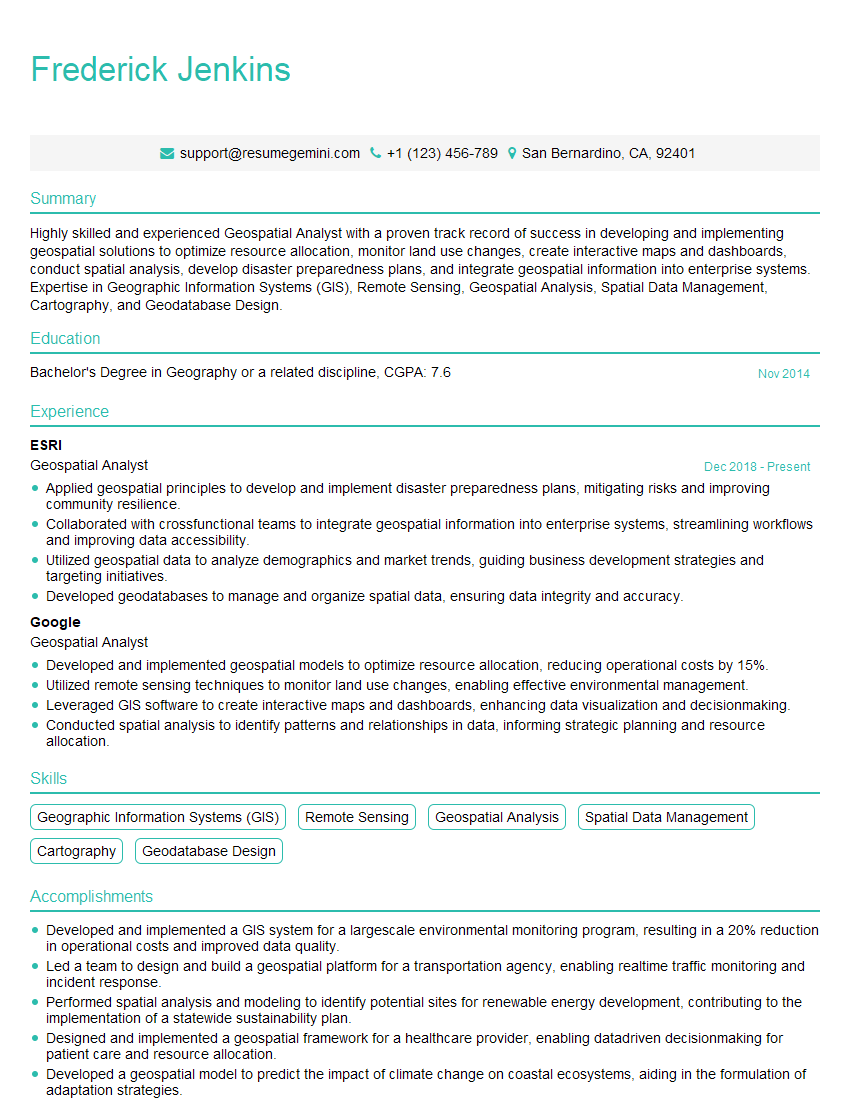
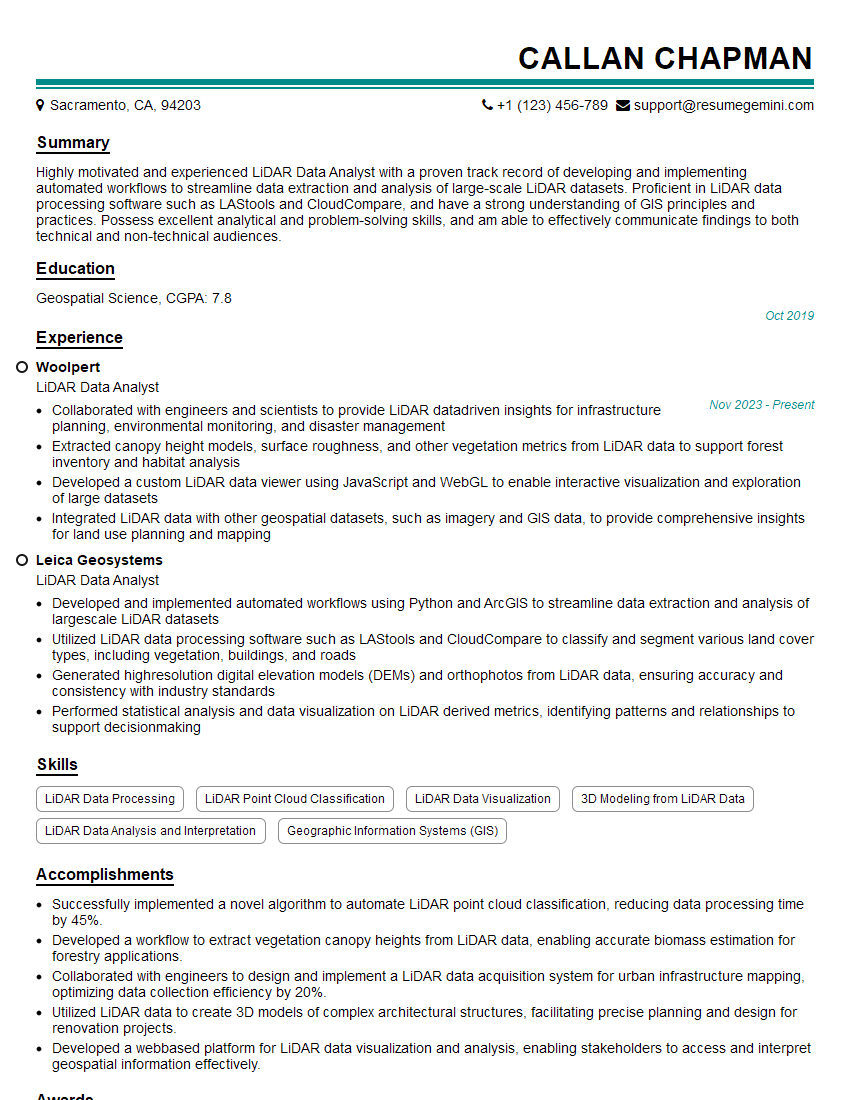
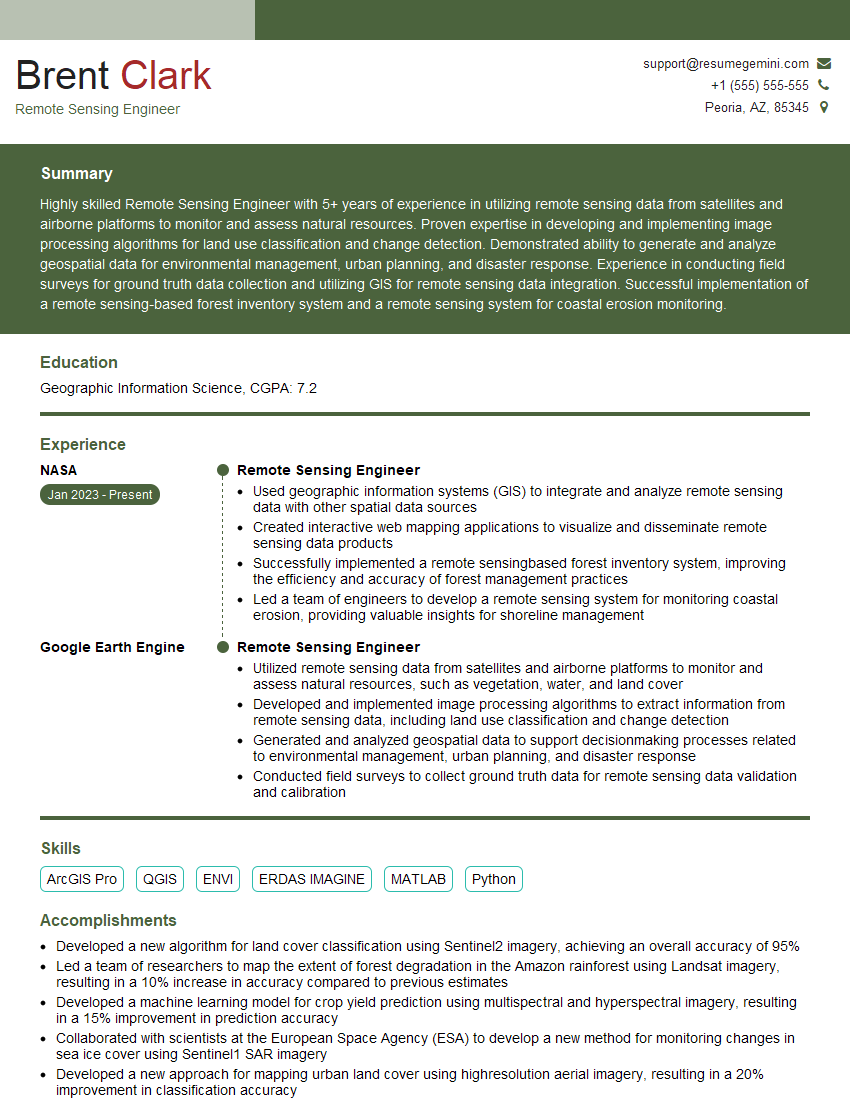
Mastering LiDAR and InSAR data analysis significantly boosts your career prospects in fields like geomatics, environmental science, and civil engineering. These skills are highly sought after, leading to rewarding and challenging opportunities. To maximize your job search success, focus on creating an ATS-friendly resume that effectively highlights your skills and experience. ResumeGemini is a trusted resource to help you build a professional and impactful resume. Examples of resumes tailored to LiDAR and InSAR Data Analysis professionals are available to guide you. Take this opportunity to showcase your capabilities and land your dream job!

Explore more articles
Users Rating of Our Blogs
Share Your Experience
We value your feedback! Please rate our content and share your thoughts (optional).
What Readers Say About Our Blog
Really detailed insights and content, thank you for writing this detailed article.
IT gave me an insight and words to use and be able to think of examples