The right preparation can turn an interview into an opportunity to showcase your expertise. This guide to Loads and Stress Analysis interview questions is your ultimate resource, providing key insights and tips to help you ace your responses and stand out as a top candidate.
Questions Asked in Loads and Stress Analysis Interview
Q 1. Explain the difference between stress and strain.
Stress and strain are fundamental concepts in mechanics that describe how a material responds to an applied force. Think of it like this: stress is the cause, and strain is the effect.
Stress is the internal force per unit area within a material caused by an external load. It’s measured in Pascals (Pa) or pounds per square inch (psi). Imagine stretching a rubber band – the force you apply is distributed across the band’s cross-sectional area, creating internal stress.
Strain is the deformation of a material in response to stress. It’s the change in length or shape relative to the original dimensions. Strain is dimensionless, often expressed as a percentage or a ratio. Continuing the rubber band example, the stretching you observe is the strain – the change in the band’s length divided by its original length.
In simpler terms: stress is what you do to the material (apply force), and strain is what the material does (deforms).
Q 2. Describe various types of stress (tensile, compressive, shear).
There are three primary types of stress:
- Tensile Stress: This occurs when a material is pulled or stretched, causing it to elongate. Think of a rope being pulled taut – it experiences tensile stress. The stress is positive and acts to pull the material apart.
- Compressive Stress: This happens when a material is compressed or squeezed, causing it to shorten. Imagine a column supporting a heavy load; the column is under compressive stress which tends to crush the material. The stress is negative, pushing the material together.
- Shear Stress: This type of stress occurs when forces act parallel to a surface, causing the material to deform by sliding. Think about cutting paper with scissors – the paper experiences shear stress along the cutting edge. Shear stress acts to slide portions of the material over each other.
It’s important to note that these stress types can often occur together in real-world scenarios.
Q 3. What are the different failure theories?
Failure theories predict when a material will fail under combined stresses. Different theories are used depending on the material’s properties and the type of loading. Some common failure theories include:
- Maximum Shear Stress Theory (Tresca): This theory states that failure occurs when the maximum shear stress in a material reaches the shear strength of the material. It is relatively simple to apply but can be conservative.
- Maximum Distortion Energy Theory (von Mises): This theory predicts failure based on the distortion energy in the material. It is generally more accurate than the Tresca theory, particularly for ductile materials.
- Maximum Principal Stress Theory (Rankine): This theory suggests that failure occurs when the maximum principal stress reaches the tensile strength of the material. This is suitable for brittle materials.
- Mohr-Coulomb Failure Criterion: This is used for materials like soils and rocks, accounting for both normal and shear stresses and considering material cohesion and friction angle.
The choice of failure theory depends on the specific application and the material’s behavior.
Q 4. Explain the concept of fatigue and fatigue life.
Fatigue is a phenomenon where a material fails under cyclic loading, even if the maximum stress is below the material’s ultimate tensile strength. Imagine bending a paper clip back and forth repeatedly – eventually, it will break, even though you never applied a force strong enough to break it immediately.
Fatigue life is the number of cycles of loading a material can withstand before failure occurs. This is crucial in designing components subjected to repeated loading, such as aircraft wings or car axles. Fatigue life is influenced by several factors: stress amplitude, mean stress, material properties, surface finish, and temperature.
Fatigue failure is often initiated by microscopic cracks that propagate under cyclic loading, eventually leading to catastrophic failure. Careful design considerations are crucial to mitigate fatigue failure in engineering components.
Q 5. What is Finite Element Analysis (FEA) and its applications?
Finite Element Analysis (FEA) is a powerful computational technique used to predict the behavior of structures and components under various loading conditions. It involves dividing a complex structure into smaller, simpler elements (finite elements), analyzing each element individually, and then assembling the results to obtain the overall response of the structure. This allows engineers to predict stress, strain, displacement, and other important characteristics.
Applications of FEA are widespread across various engineering disciplines:
- Automotive Industry: Crash simulation, structural optimization of car bodies.
- Aerospace Industry: Analyzing stress and strain in aircraft wings and fuselages.
- Biomedical Engineering: Simulating the biomechanics of bones, implants, and tissues.
- Civil Engineering: Analyzing the structural integrity of bridges, buildings, and dams.
FEA is a valuable tool for optimizing designs, reducing material usage, improving safety, and avoiding costly prototyping and testing.
Q 6. What are the different types of FEA elements?
Different FEA elements are used to model different types of structures and behaviors. Some common types include:
- 1D Elements (Truss, Beam): Used to model structures like rods, beams, and cables. Trusses represent axial members, while beams consider bending and shear.
- 2D Elements (Plane Stress, Plane Strain, Axisymmetric): Used to model planar structures under in-plane loading. Plane stress assumes stress is negligible in one direction, while plane strain assumes strain is negligible. Axisymmetric elements are useful for rotational symmetrical structures.
- 3D Elements (Tetrahedral, Hexahedral): Used to model complex 3D geometries where 2D elements are insufficient. Tetrahedral elements are simpler to mesh but less accurate, while hexahedral elements are more accurate but harder to generate.
The selection of appropriate elements depends on the geometry of the structure, the type of loading, and the desired accuracy.
Q 7. How do you choose appropriate mesh density in FEA?
Choosing the appropriate mesh density in FEA is crucial for obtaining accurate results without excessive computational cost. A finer mesh (higher density) provides more accuracy but increases the computation time and resources needed. A coarser mesh is faster but can be less accurate, potentially missing important details.
Strategies for Mesh Density Selection:
- Refinement in Critical Regions: Focus on finer mesh density in areas expected to have high stress gradients or complex geometry (e.g., stress concentrations, corners, fillets).
- Mesh Convergence Studies: Perform analyses with progressively finer meshes. When the results no longer change significantly with further refinement, the mesh is considered converged. This ensures the accuracy of the solution.
- Element Size vs. Feature Size: Ensure that the element size is significantly smaller than the smallest geometric feature or area of interest to avoid inaccuracies.
- Experience and Engineering Judgment: Rely on prior experience and engineering judgment to guide the initial mesh design. This becomes particularly critical for challenging geometries or load conditions.
The right balance between accuracy and computational cost depends on the specific problem. Experienced engineers use a combination of these techniques to optimize the mesh density for their FEA simulations.
Q 8. Explain the concept of boundary conditions in FEA.
Boundary conditions in Finite Element Analysis (FEA) define how a structure interacts with its surroundings. They essentially tell the software what’s happening at the edges of your model. Think of it like setting the stage for a play – you need to define the limits and constraints before the action can begin. Without them, your FEA model would be indeterminate, leading to inaccurate or unstable results.
There are several types of boundary conditions, including:
- Fixed Support: This restricts all degrees of freedom (translation and rotation) at a specific point or surface. Imagine welding a beam to a wall – it can’t move at all. In FEA, this would be represented as zero displacement in all directions.
- Pinned Support: This allows rotation but prevents translation. Picture a hinge – it can rotate freely but can’t move sideways or upwards.
- Roller Support: This allows translation in one direction but prevents translation in other directions and rotation. Think of a wheel resting on a rail – it can roll along the rail but can’t lift off or move sideways.
- Symmetric/Antisymmetric Boundary Conditions: These exploit symmetry in the geometry and loading to reduce the computational cost by analyzing only a portion of the structure. This is frequently used for structures with reflective symmetry.
- Pressure Boundary Condition: Simulates the effect of fluid pressure acting on a surface.
Incorrectly defining boundary conditions is a common source of error in FEA. For example, if you model a cantilever beam but forget to constrain the fixed end, the model will be unstable and provide nonsensical results.
Q 9. What are the different types of loading conditions?
Loading conditions represent the forces and moments acting on a structure. Accurate representation is crucial for obtaining reliable results. Different types of loads include:
- Point Loads: Concentrated forces acting at a single point. Think of a person standing on a bridge.
- Distributed Loads: Loads spread over a surface or length. For instance, the weight of a road acting uniformly on a bridge.
- Pressure Loads: Forces applied uniformly or non-uniformly over an area. Examples include internal pressure in a pipe or wind load on a building.
- Thermal Loads: Temperature changes can induce stresses and strains. This is important when analyzing components exposed to significant temperature variations.
- Gravity Loads: The weight of the structure itself. Often modeled using body force (acceleration).
- Inertia Loads: Forces arising from dynamic events like accelerations or vibrations.
It’s important to carefully consider the type and magnitude of loads to accurately reflect the real-world conditions the structure will face. An incorrect load application can lead to significant errors in stress and deformation prediction.
Q 10. How do you validate FEA results?
Validating FEA results is critical to ensuring their accuracy and reliability. It involves comparing the FEA predictions with experimental data or analytical solutions. Several methods exist:
- Experimental Validation: This involves conducting physical tests on a prototype or actual structure. Measurements of strain, displacement, or natural frequencies are then compared to the FEA results.
- Analytical Solution Comparison: For simple geometries and loading conditions, analytical solutions might exist. Comparing the FEA results with these solutions can provide a good check.
- Mesh Convergence Study: Refining the mesh (increasing the number of elements) and observing the effect on the results. If the results remain consistent with mesh refinement, it suggests that the solution has converged.
- Independent Model Verification: Having another engineer review the model and the results to identify potential errors or inconsistencies.
A significant discrepancy between the FEA results and the validation data warrants a thorough investigation. This might involve reviewing the model geometry, boundary conditions, material properties, mesh quality, or loading conditions. The validation process ensures confidence in the reliability of the FEA results for decision-making.
Q 11. What is stress concentration and how is it addressed?
Stress concentration refers to the localized increase in stress around geometric discontinuities such as holes, notches, fillets, or sudden changes in cross-section. These discontinuities act as stress raisers, leading to significantly higher stresses than predicted by basic stress analysis calculations. This can initiate crack propagation and lead to premature failure.
Addressing stress concentration involves several strategies:
- Design Modifications: Altering the geometry to eliminate or reduce the discontinuities. For example, using larger fillets or avoiding sharp corners.
- Material Selection: Using materials with higher yield strength or better toughness can help mitigate the effect of stress concentration.
- Finite Element Analysis (FEA): Performing detailed FEA to accurately assess the stress levels at the critical locations. This allows for a more precise understanding of the stress concentration and enables informed design decisions.
- Stress-Relief Measures: Employing techniques such as shot peening or other surface treatments to introduce compressive stresses that counteract tensile stresses caused by stress concentration.
A classic example is a plate with a hole. The stress around the hole is significantly higher than the average stress in the plate. By increasing the hole’s diameter, adding a fillet to the hole, or using a stronger material, this concentration can be reduced.
Q 12. Explain the concept of factor of safety.
The factor of safety (FOS) is a crucial concept in engineering design. It’s a ratio that represents how much stronger a component is designed to be than the expected maximum load. It acts as a buffer, ensuring that the component can withstand unexpected loads or uncertainties in material properties or manufacturing processes. The formula is simply:
FOS = Ultimate Strength / Allowable Stress
or
FOS = Allowable Load / Expected Load
For example, if a component has an ultimate tensile strength of 100 MPa and the allowable stress is determined to be 20 MPa, then the factor of safety is 5. This means the component can withstand five times the expected load before failure. The chosen FOS depends on several factors, including the consequences of failure, the uncertainty in loading, and material variability. A higher FOS suggests a greater margin of safety but often comes at the cost of increased weight and cost.
Q 13. Describe different methods for stress analysis (analytical, numerical).
Stress analysis involves determining the internal forces and deformations within a structure under loading. Two primary methods exist:
- Analytical Methods: These are based on mathematical equations and formulas derived from fundamental principles of mechanics. They are generally applicable to simple geometries and loading conditions. Examples include calculating bending stress in a beam using the flexure formula or torsion in a shaft using the torsion formula. Analytical methods provide valuable insights but might be difficult or impossible to apply to complex geometries.
- Numerical Methods (FEA): These use numerical techniques to approximate the solution to the governing equations of mechanics. FEA is particularly powerful for analyzing complex geometries, material properties, and loading conditions. Software like ANSYS, Abaqus, and Nastran are used for this purpose. FEA discretizes the structure into smaller elements, solves the equations for each element, and assembles the results to obtain an overall solution.
The choice between analytical and numerical methods depends on the complexity of the problem. Simple geometries and loading conditions often lend themselves to analytical solutions, while complex structures necessitate FEA. Often, a combination of both approaches is used to validate the results.
Q 14. What is modal analysis and its significance?
Modal analysis is a technique used to determine the natural frequencies and mode shapes of a structure. Natural frequencies are the frequencies at which a structure will vibrate freely without external excitation. Mode shapes describe the pattern of deformation associated with each natural frequency. Think of it like plucking a guitar string – it vibrates at specific frequencies (natural frequencies) with a specific pattern of movement (mode shape).
The significance of modal analysis lies in avoiding resonance. If an external force excites the structure at or near one of its natural frequencies, the amplitude of vibration can become dangerously high, potentially leading to fatigue failure or other catastrophic consequences. Modal analysis helps identify these natural frequencies and design the structure to avoid resonance. This is especially critical in applications like bridges, aircraft, and tall buildings, which are susceptible to dynamic loads from wind, earthquakes, or machinery.
Modal analysis is often performed using FEA software. The results provide crucial information for designing safe and robust structures.
Q 15. Explain the concept of buckling and critical load.
Buckling is a sudden sideways failure of a structural member under compressive load. Imagine a perfectly straight, slender column. If you apply a small compressive force, it remains straight. However, if you increase the force beyond a certain point – the critical load – the column will suddenly buckle, bending significantly and potentially failing. This critical load depends on the column’s geometry (length, cross-sectional shape), material properties (Young’s Modulus), and end conditions (fixed, pinned, etc.).
The critical load is the maximum compressive load a column can withstand before buckling occurs. It’s calculated using Euler’s formula, which considers the aforementioned factors. For example, a long, slender column will buckle at a much lower load than a short, stocky one. Understanding the critical load is crucial for safe structural design, ensuring that columns and other structural members don’t fail unexpectedly.
Imagine a tall, thin skyscraper. Engineers must carefully calculate the critical load for each column to ensure they can withstand the building’s weight and wind loads without buckling. This involves considering material properties, column dimensions, and the overall structural design to prevent catastrophic failure.
Career Expert Tips:
- Ace those interviews! Prepare effectively by reviewing the Top 50 Most Common Interview Questions on ResumeGemini.
- Navigate your job search with confidence! Explore a wide range of Career Tips on ResumeGemini. Learn about common challenges and recommendations to overcome them.
- Craft the perfect resume! Master the Art of Resume Writing with ResumeGemini’s guide. Showcase your unique qualifications and achievements effectively.
- Don’t miss out on holiday savings! Build your dream resume with ResumeGemini’s ATS optimized templates.
Q 16. What are the common software packages used for stress analysis?
Several powerful software packages are widely used for stress analysis, each with its strengths and weaknesses. Popular choices include:
- ANSYS: A comprehensive, industry-standard FEA software capable of handling complex simulations, including non-linear and dynamic analyses.
- Abaqus: Another leading FEA software known for its strength in handling non-linear materials and complex contact problems.
- Nastran: A widely used FEA solver, often integrated into other CAD software packages. It excels in linear static and dynamic analysis.
- Autodesk Simulation: Integrated with Autodesk Inventor and AutoCAD, it provides a user-friendly interface for stress analysis, suitable for various applications.
- COMSOL Multiphysics: Powerful software that excels in coupling different physics domains, enabling multiphysics simulations crucial for some advanced engineering problems.
The choice of software depends on the specific needs of the project, the complexity of the analysis, and the user’s familiarity with the software.
Q 17. How do you handle non-linearity in FEA?
Non-linearity in Finite Element Analysis (FEA) arises from various sources, including material non-linearity (plasticity, hyperelasticity), geometric non-linearity (large deformations), and contact non-linearity. Handling non-linearity requires specialized techniques because linear solutions are no longer valid.
Common approaches include:
- Incremental loading: The load is applied in small increments, solving the linear problem at each step and updating the stiffness matrix based on the previous step’s results. This is an iterative process that accounts for changing geometry and material properties.
- Newton-Raphson method: An iterative method used to solve the non-linear equations. It uses the tangent stiffness matrix to improve the solution at each iteration until convergence is achieved.
- Arc-length method: This method controls the solution path and prevents divergence in cases of instability, such as snap-through buckling.
The choice of method depends on the nature and severity of the non-linearity. For instance, large deformation problems might require the arc-length method, while material plasticity might be handled efficiently using incremental loading with an appropriate constitutive model.
Q 18. What is the difference between static and dynamic analysis?
Static analysis assumes that loads are applied slowly and steadily, and the system remains in equilibrium at all times. There’s no significant acceleration or inertia involved. Think of a bridge under its own weight and the weight of cars – the loads are relatively constant.
Dynamic analysis, on the other hand, considers the effects of time-varying loads and inertia. This means that accelerations and changes in momentum are important. Examples include analyzing the response of a structure to an earthquake or the vibration of a turbine blade. Dynamic analysis is often more complex than static analysis and requires more computational resources. The response of a structure to a dynamic load is affected by its natural frequencies and damping characteristics.
Q 19. Explain the concept of creep and its impact on structural design.
Creep is the time-dependent deformation of a material under constant stress. Imagine a metal component held at a high temperature and under constant load – it will gradually deform over time, even if the stress level remains unchanged. This is creep. The rate of creep increases with temperature and stress.
Creep significantly impacts structural design, especially in high-temperature applications like gas turbines or nuclear reactors. Engineers must account for creep deformation to ensure components maintain their functionality and structural integrity throughout their lifespan. Design considerations include using creep-resistant materials, selecting appropriate safety factors, and performing creep analysis to predict long-term deformation and failure.
For example, designing a turbine blade requires careful consideration of creep. High operating temperatures cause the blades to creep over time, potentially leading to failure. Engineers use creep analysis to predict the blade’s lifespan and ensure it can withstand the expected creep deformation without exceeding allowable limits.
Q 20. How do you account for material properties in FEA?
Material properties are crucial inputs in FEA. They define how a material behaves under stress. The properties used in FEA include:
- Young’s Modulus (E): Measures the stiffness of the material; the higher the value, the stiffer the material.
- Poisson’s Ratio (ν): Represents the ratio of lateral strain to axial strain.
- Yield Strength (σy): The stress at which the material begins to deform plastically.
- Ultimate Tensile Strength (σu): The maximum stress the material can withstand before failure.
- Density (ρ): Mass per unit volume.
These properties are usually obtained from material testing or from material databases. In FEA software, these properties are assigned to each element in the model, ensuring an accurate representation of the material behavior. For complex materials, constitutive models might be used to describe non-linear material behavior (e.g., plasticity, viscoelasticity).
Q 21. What are the limitations of FEA?
While FEA is a powerful tool, it has limitations:
- Mesh dependency: The accuracy of the results depends on the quality of the mesh. A coarse mesh might lead to inaccurate results, while a very fine mesh can be computationally expensive.
- Material model accuracy: The accuracy of the results depends on the accuracy of the material models used. Simplified models might not capture all aspects of material behavior.
- Boundary conditions: The accuracy of the results is highly sensitive to the applied boundary conditions. Improper boundary conditions can lead to significant errors.
- Computational cost: Complex simulations can require significant computational resources and time.
- Assumptions and simplifications: FEA involves assumptions and simplifications (e.g., linear material behavior, small deformations). These simplifications might not always be valid.
It’s crucial to be aware of these limitations and to validate the FEA results using experimental data or other analytical methods whenever possible.
Q 22. Describe your experience with experimental stress analysis techniques.
My experience with experimental stress analysis techniques is extensive, encompassing both static and dynamic loading scenarios. I’m proficient in various methods, including strain gauge measurements, photoelasticity, and digital image correlation (DIC). Strain gauges, for instance, are small electrical resistance sensors that are bonded to the surface of a component. When the component is loaded, the strain gauge deforms, altering its resistance. This resistance change is then measured and calibrated to determine the strain, which, in turn, can be used to calculate stress. Photoelasticity, on the other hand, utilizes birefringent materials that exhibit different refractive indices when stressed. This allows us to visualize stress patterns using polarized light, offering a qualitative and visual understanding of stress distribution. Finally, DIC is a powerful non-contact optical method that provides full-field strain measurements, offering a high-resolution visualization of deformation throughout a structure. I’ve utilized all these methods across a wide range of projects, including the analysis of pressure vessels, aerospace components, and automotive parts.
For example, in one project involving a pressure vessel, we employed strain gauges at critical locations to monitor stress levels during a hydrostatic pressure test. The data obtained allowed us to validate our finite element analysis (FEA) model and to confirm the vessel’s structural integrity. In another project concerning a complex automotive component, we used DIC to capture the strain field during a fatigue test, providing crucial insights into crack initiation and propagation.
Q 23. How do you interpret stress analysis results?
Interpreting stress analysis results is a critical step that involves carefully examining the data to understand the stress and strain distribution within a component or structure. This goes beyond simply looking at maximum stress values. We need to consider the type of stress (tensile, compressive, shear), the location and magnitude of stresses, and the material properties to assess the risk of failure. This involves comparing the calculated stresses to the material’s yield strength, ultimate tensile strength, and fatigue limit, depending on the loading conditions. We look for stress concentrations, which are localized areas of high stress, usually around holes, corners, or abrupt changes in geometry. These areas often initiate failure. Furthermore, the type of failure needs to be considered: brittle fracture, ductile yielding, or fatigue.
Software like ANSYS or Abaqus often provides graphical representations like contour plots, showing the stress distribution over the component. These visualizations are crucial for identifying critical areas. It’s important to not only focus on the maximum stress but also to evaluate the stress distribution throughout the entire component to get a comprehensive understanding of the structural behavior. For instance, a high stress concentration in a small area might not be as critical as a more evenly distributed stress at lower magnitude across a larger area. A thorough understanding of the loading conditions and material behavior is essential for accurate interpretation.
Q 24. How do you communicate technical information to non-technical audiences?
Communicating technical information to non-technical audiences requires a different approach than communicating with fellow engineers. The key is to simplify complex concepts without sacrificing accuracy. I often use analogies, visual aids, and avoid jargon. For example, instead of saying ‘von Mises stress exceeded the yield strength,’ I might say, ‘the component was stressed beyond its capacity, like bending a paperclip too far until it breaks.’
Visuals, such as charts and simplified diagrams, are invaluable tools. I focus on the key takeaways and implications of the analysis, highlighting the risks and recommendations clearly. I often frame the findings within the context of the overall project goals, emphasizing how the analysis contributes to the overall success. For example, if presenting to project managers, I would focus on potential delays, cost overruns, and safety implications based on the stress analysis findings. The objective is always clear, concise communication that allows non-technical stakeholders to make informed decisions.
Q 25. Describe your experience with different types of materials and their behavior under stress.
My experience spans a wide range of materials, including metals (steel, aluminum, titanium), polymers (plastics, composites), and ceramics. Understanding the behavior of each material under stress is critical. Metals generally exhibit ductile behavior, meaning they deform plastically before fracture. Steel, for example, has high strength and stiffness, making it ideal for load-bearing structures. Aluminum alloys offer a good strength-to-weight ratio, making them suitable for aerospace applications. However, aluminum is more susceptible to fatigue failure compared to steel. Polymers are typically more flexible and exhibit viscoelastic behavior, meaning their response to stress depends on time and temperature. Composites combine the advantages of different materials; for instance, carbon fiber reinforced polymers (CFRP) exhibit high strength and stiffness while being lightweight. Ceramics are brittle and prone to fracture under tensile stress, but they possess high compressive strength and are often used in high-temperature applications.
In my work, I use material property data, often from experimental testing, to create accurate FEA models. The choice of material significantly impacts the stress distribution and the overall structural integrity. For instance, replacing a steel component with an aluminum one may reduce weight but might require redesign to accommodate the lower strength and stiffness of the aluminum. The selection process involves considering multiple criteria, including strength, weight, cost, and environmental factors.
Q 26. Explain your experience in optimizing designs to reduce stress.
Optimizing designs to reduce stress is a core aspect of my work. Strategies range from modifying geometry to selecting appropriate materials. Geometric modifications often involve smoothing sharp corners and fillets, reducing stress concentrations. Adding reinforcements like ribs or stiffeners to thin-walled structures can significantly enhance their load-bearing capacity and reduce stress. Finite element analysis (FEA) plays a crucial role here. By running simulations with different design iterations, we can identify the most effective changes to minimize stress while satisfying functional requirements.
For example, in one project, we reduced stress concentrations in a critical part by adding small fillets at the junction of two parts, effectively increasing the fatigue life of the component. In another, we optimized the geometry of a bracket using topology optimization, resulting in a lighter and stronger component with reduced stress levels. The iterative process of design modification, FEA simulation, and result evaluation is essential for achieving optimal designs.
Q 27. Describe a challenging stress analysis project you worked on and how you overcame the challenges.
One challenging project involved analyzing the stress distribution in a complex composite structure for an aerospace application. The structure featured numerous cutouts and complex geometry, making accurate modeling difficult. The challenge was compounded by the anisotropic nature of the composite material, meaning its properties varied depending on the direction of the applied load. Initially, we faced convergence issues in our FEA model due to the complexity of the geometry and material properties. To overcome this, we refined the mesh in critical areas, employed advanced element types suited for composite materials, and validated our model using experimental data obtained from strain gauge measurements on a prototype.
After addressing the modeling issues, we discovered high stress concentrations around the cutouts. To mitigate this, we employed topology optimization techniques to identify areas where material could be added or removed to reduce stress without significantly compromising the structural integrity. This iterative process allowed us to optimize the design, achieving a significant reduction in stress levels and improving the structural performance. The successful completion of this project demonstrated the importance of thorough modeling, rigorous validation, and creative problem-solving in handling complex stress analysis tasks.
Key Topics to Learn for Loads and Stress Analysis Interview
- Static and Dynamic Loading: Understanding the differences between static and dynamic loads and their impact on structural analysis. Practical application: Analyzing the stress on a bridge under both vehicle weight (static) and wind gusts (dynamic).
- Stress Concentration and Failure Theories: Identifying areas of high stress concentration and applying appropriate failure theories (e.g., von Mises, Tresca) to predict component failure. Practical application: Designing a component to withstand expected stresses while minimizing weight.
- Finite Element Analysis (FEA): Understanding the fundamentals of FEA, meshing techniques, and interpreting results. Practical application: Using FEA software to simulate real-world scenarios and optimize designs.
- Material Properties and Constitutive Models: Knowledge of different material properties (e.g., Young’s modulus, Poisson’s ratio) and selecting appropriate constitutive models for accurate analysis. Practical application: Choosing the right material for a specific application based on its strength and stiffness under anticipated loads.
- Fatigue and Creep Analysis: Understanding the effects of cyclic loading (fatigue) and high-temperature deformation (creep) on material behavior. Practical application: Designing components for long-term durability in demanding environments.
- Experimental Stress Analysis: Familiarity with experimental techniques like strain gauges and photoelasticity for verifying analytical predictions. Practical application: Validating FEA results through physical testing.
- Buckling Analysis: Understanding the principles of buckling and methods for preventing structural instability. Practical application: Designing slender columns or beams to prevent collapse under compressive loads.
Next Steps
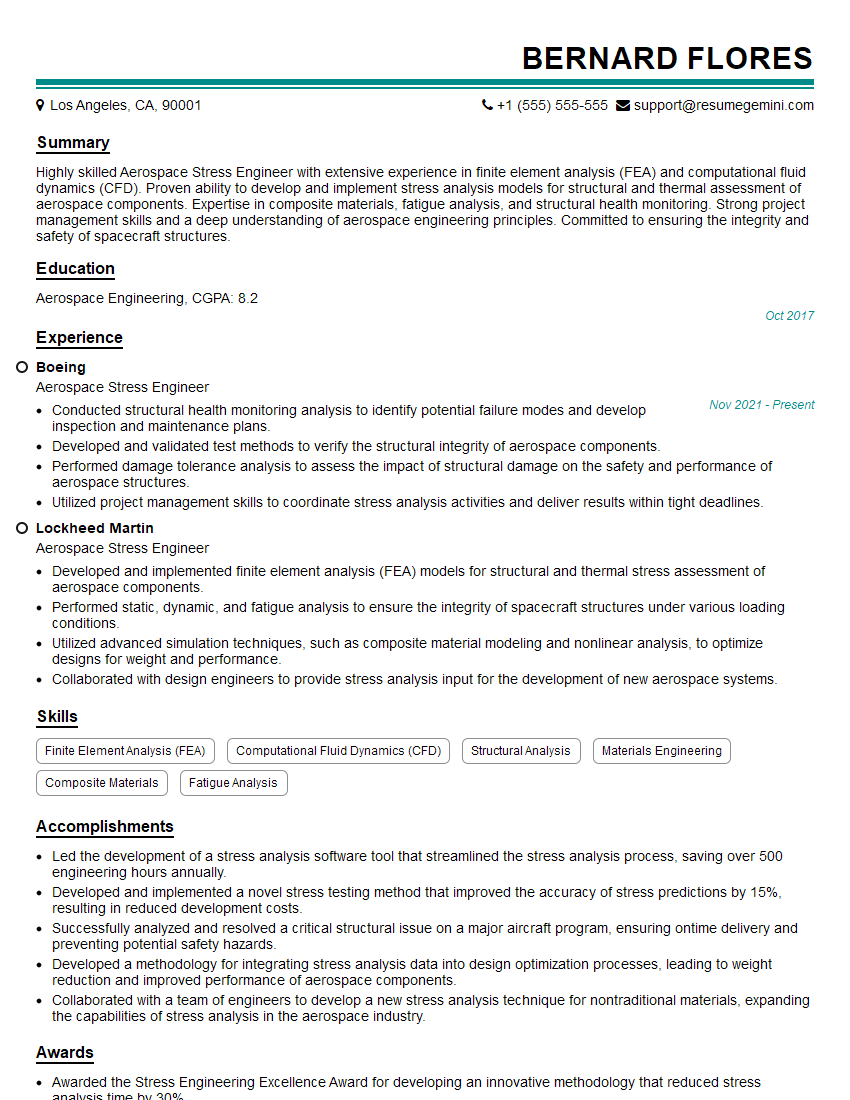
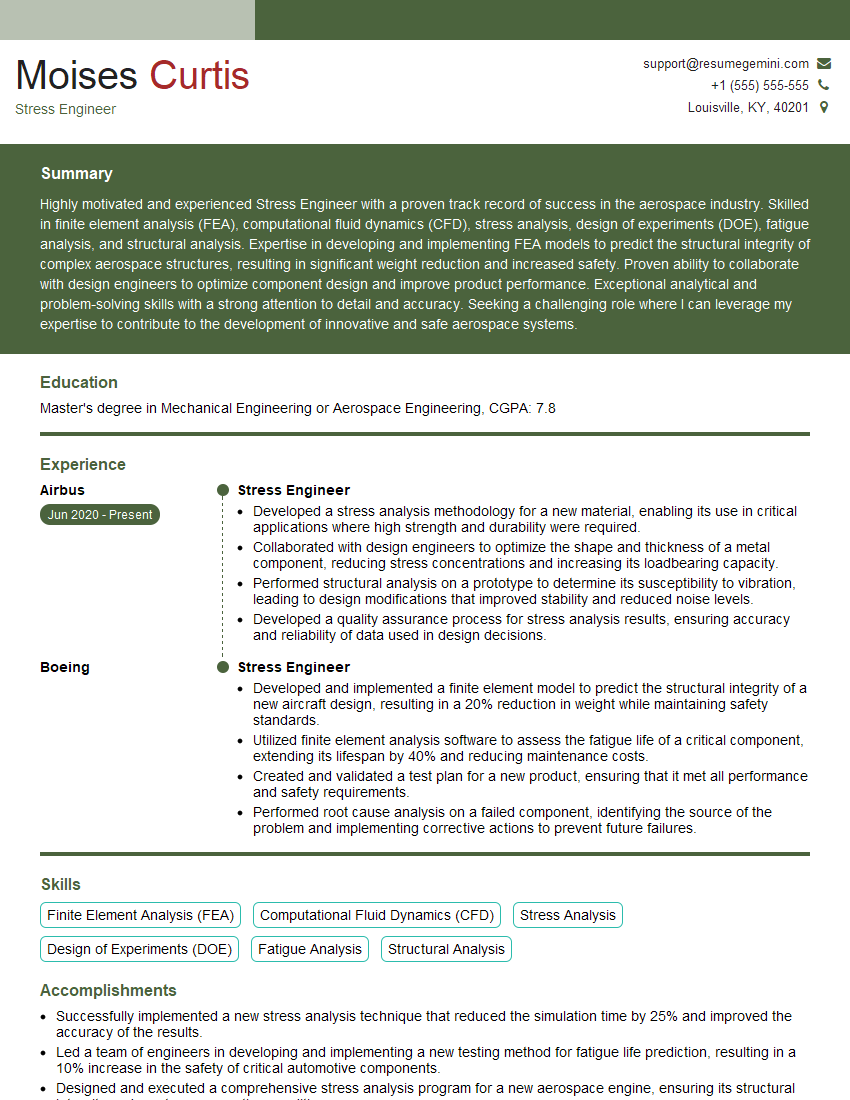
Mastering Loads and Stress Analysis is crucial for a successful career in engineering, opening doors to exciting opportunities in design, research, and development. A well-crafted resume is your first impression on potential employers. To significantly enhance your job prospects, create an ATS-friendly resume that highlights your skills and experience effectively. ResumeGemini is a trusted resource to help you build a professional and impactful resume that stands out. We offer examples of resumes tailored specifically to Loads and Stress Analysis to guide you. Invest in your future – build a compelling resume today!
Explore more articles
Users Rating of Our Blogs
Share Your Experience
We value your feedback! Please rate our content and share your thoughts (optional).
What Readers Say About Our Blog
Really detailed insights and content, thank you for writing this detailed article.
IT gave me an insight and words to use and be able to think of examples