Unlock your full potential by mastering the most common Low-speed aerodynamics interview questions. This blog offers a deep dive into the critical topics, ensuring you’re not only prepared to answer but to excel. With these insights, you’ll approach your interview with clarity and confidence.
Questions Asked in Low-speed aerodynamics Interview
Q 1. Explain the difference between laminar and turbulent flow in low-speed aerodynamics.
In low-speed aerodynamics, the flow of air around an object can be broadly classified into two regimes: laminar and turbulent. Laminar flow is characterized by smooth, parallel streamlines where the fluid particles move in orderly layers. Think of it like a perfectly stacked deck of cards sliding smoothly. Turbulent flow, on the other hand, is chaotic and characterized by swirling, irregular motion and eddies. Imagine dropping a handful of marbles into water – the water’s movement becomes disordered and unpredictable. The transition from laminar to turbulent flow depends on several factors including the Reynolds number (a dimensionless quantity relating inertial and viscous forces), surface roughness, and the shape of the object. In low-speed applications, understanding this transition is crucial for predicting drag and lift forces accurately. A laminar flow generally results in lower drag, but is more susceptible to separation leading to increased drag in certain conditions.
Q 2. Describe the boundary layer and its significance in low-speed aerodynamics.
The boundary layer is a thin layer of fluid immediately adjacent to a surface over which the flow is occurring. Within this layer, the fluid velocity gradually changes from zero at the surface (no-slip condition) to the free-stream velocity outside the boundary layer. The significance of the boundary layer in low-speed aerodynamics is immense. It’s within the boundary layer that viscous effects, ignored in simplified potential flow models, are dominant. The boundary layer thickness, its transition from laminar to turbulent flow, and whether it separates from the surface significantly impact the aerodynamic forces, including pressure distribution and frictional drag on the surface. For example, boundary layer separation on an airfoil can lead to a drastic reduction in lift and an increase in drag. Hence, understanding and controlling the boundary layer is vital for optimizing aerodynamic performance.
Q 3. What are the key assumptions of potential flow theory, and when is it applicable?
Potential flow theory is a simplified approach to fluid mechanics that assumes the flow is inviscid (no viscosity), incompressible (density remains constant), and irrotational (no vorticity). These assumptions allow us to represent the flow field using a velocity potential, which simplifies mathematical analysis considerably. However, this model neglects the vital effects of viscosity, making it inaccurate near solid surfaces where the boundary layer resides. Potential flow is applicable when viscous effects are negligible, such as in predicting the overall pressure distribution on slender bodies at low angles of attack. It forms a valuable foundation for more complex calculations and provides a good first approximation, but the results must be interpreted cautiously, particularly for situations with significant boundary layer effects such as high angles of attack or bluff bodies.
Q 4. How do you account for viscous effects in low-speed aerodynamic simulations?
Viscous effects are accounted for in low-speed aerodynamic simulations primarily through two approaches: boundary layer theory and Computational Fluid Dynamics (CFD). Boundary layer theory uses simplified equations to approximate the flow within the boundary layer, allowing for estimation of frictional drag and boundary layer separation. However, this method has limitations, particularly for complex geometries or turbulent flows. CFD, on the other hand, solves the full Navier-Stokes equations (which account for viscosity) numerically, providing a detailed, albeit computationally intensive, representation of the flow field, including viscous effects throughout the entire domain. Advanced CFD solvers also employ turbulence models (e.g., k-ε, k-ω SST) to simulate the effects of turbulence, which are critical for accurate predictions in many low-speed applications.
Q 5. Explain the concept of lift and drag, and how they are affected by angle of attack.
Lift is the aerodynamic force that acts perpendicular to the direction of the airflow and keeps an object airborne. Drag is the aerodynamic force that opposes the motion of an object through the air. Both lift and drag are significantly influenced by the angle of attack (α), which is the angle between the airfoil’s chord line and the oncoming airflow. Increasing the angle of attack initially increases lift, as it increases the pressure difference between the upper and lower surfaces of the airfoil. However, beyond a critical angle of attack, the flow separates from the upper surface leading to a significant reduction in lift and a dramatic increase in drag. This stall condition is undesirable and needs careful consideration in aircraft design and operation. Think of a paper airplane – a slight upward tilt (angle of attack) will make it fly (lift), while too steep an angle will make it lose lift and plummet.
Q 6. Describe different types of wind tunnel testing techniques used for low-speed applications.
Various wind tunnel testing techniques are employed for low-speed aerodynamic applications. Closed-circuit wind tunnels provide a more uniform and controlled flow environment compared to open-circuit tunnels. Low-speed wind tunnels are designed to cover the range of speeds relevant to many applications like aircraft at low altitude or automobiles. Smoke visualization helps visualize the flow patterns, revealing boundary layer separation and wake structures. Pressure measurements on the surface of the model provide data on pressure distribution, which is crucial for calculating lift and drag. Force balance measurements directly measure the lift and drag forces acting on the model. More sophisticated techniques include particle image velocimetry (PIV), which gives a detailed map of the velocity field, and hot-wire anemometry, which measures local velocity fluctuations within the flow. The choice of techniques depends on the specific requirements and the complexity of the problem.
Q 7. What are the advantages and limitations of using computational fluid dynamics (CFD) for low-speed aerodynamic analysis?
Computational Fluid Dynamics (CFD) offers several advantages for low-speed aerodynamic analysis. It’s cost-effective compared to extensive wind tunnel testing, especially for early design stages where multiple design iterations are needed. CFD can provide detailed flow field information, including pressure and velocity distributions, that might be difficult to obtain experimentally. It’s versatile, capable of handling complex geometries and flow conditions. However, CFD has limitations too. The accuracy of the results heavily relies on the chosen turbulence model, mesh quality, and boundary conditions. Detailed and high-quality mesh generation can be time-consuming. CFD also requires expertise in setting up the simulation, interpreting the results, and validating them against experimental data. Therefore, it’s vital to understand the limitations of CFD and use it judiciously, supplementing it with experimental validation wherever possible.
Q 8. How do you validate CFD results against experimental data?
Validating CFD (Computational Fluid Dynamics) results against experimental data is crucial for ensuring the accuracy and reliability of our simulations. This process, often called verification and validation, involves a multi-step approach. First, we verify the CFD model itself – ensuring the code is solving the governing equations correctly and the mesh is sufficiently refined. This often involves comparing the results of simple test cases to known analytical solutions or other validated CFD codes.
Next, we move to validation, comparing the CFD predictions to experimental data obtained from wind tunnel tests or other relevant experiments. This involves careful consideration of experimental uncertainties and potential sources of error in both the CFD and experimental methods. We typically quantify the agreement using metrics like the root-mean-square (RMS) error or comparing pressure coefficients at various points on the surface of the aerodynamic body. Discrepancies might indicate inaccuracies in the CFD model setup (e.g., incorrect boundary conditions, turbulence modeling), experimental errors, or limitations of the CFD approach itself. A systematic investigation of the differences is then crucial to pinpoint the root cause. For instance, a discrepancy might suggest the need for a more refined mesh or a more appropriate turbulence model. The ultimate goal is to establish a level of confidence in the CFD results, understanding their limitations and range of validity. For example, in designing an aircraft wing, matching the CFD-predicted lift and drag coefficients with wind tunnel data builds trust in the CFD’s ability to predict performance.
Q 9. Explain the concept of Reynolds number and its significance in low-speed aerodynamics.
The Reynolds number (Re) is a dimensionless quantity that represents the ratio of inertial forces to viscous forces within a fluid. In low-speed aerodynamics, it’s defined as Re = ρVL/μ, where ρ is the fluid density, V is the flow velocity, L is a characteristic length (e.g., airfoil chord), and μ is the dynamic viscosity. Its significance stems from its ability to predict the flow regime – laminar or turbulent.
At low Reynolds numbers (typically less than a few thousand), viscous forces dominate, resulting in smooth, laminar flow. As the Reynolds number increases, inertial forces become more prominent, eventually leading to the transition to turbulent flow, characterized by chaotic fluctuations and increased drag. This transition significantly impacts aerodynamic performance. In low-speed aerodynamics, we often deal with Reynolds numbers ranging from hundreds to millions, depending on the scale and speed of the object in question. For example, a small insect flying might have a Re in the hundreds, whereas a large aircraft might operate at a Re in the millions. Understanding the appropriate Re for a given application is vital to selecting the right CFD simulation settings and interpreting experimental results. Different turbulence models in CFD are optimized for different Re ranges, with limitations on accuracy in extrapolating beyond their validation ranges.
Q 10. What are the common methods used to reduce drag in low-speed aerodynamics?
Reducing drag is a primary objective in low-speed aerodynamics. Several methods are employed, focusing on minimizing both pressure and skin-friction drag.
- Streamlining: Shaping the body to minimize flow separation and promote smooth, attached flow. Think of the teardrop shape – the classic example of a streamlined body.
- Boundary Layer Control: Techniques to manipulate the boundary layer (the thin layer of fluid near the surface) to delay or prevent flow separation. Examples include suction or blowing near the surface, and the addition of vortex generators.
- Surface Roughness Reduction: Minimizing surface roughness reduces skin-friction drag. This can involve polishing or applying specialized coatings.
- Use of Fairings: Covering sharp edges and discontinuities with smooth curves helps to reduce drag caused by flow separation and turbulence.
- Passive Drag Devices: Adding aerodynamic appendages, like spoilers, for specific control or stability purposes, but with the intention of minimizing net drag.
For example, the design of modern aircraft incorporates many of these methods. Their sleek shapes and the use of advanced materials contribute to efficient aerodynamic performance and reduced fuel consumption.
Q 11. Describe different types of airfoils and their characteristics.
Airfoils are the cross-sectional shapes of wings and blades. Different airfoils have varying characteristics, suited to different applications. Some common types include:
- NACA airfoils: A widely used family of airfoils defined by a four or five-digit series of numbers (e.g., NACA 2412). These numbers indicate the airfoil’s camber, maximum thickness, and location of maximum camber. NACA airfoils provide a good balance of lift and drag characteristics across a range of angles of attack.
- Symmetrical airfoils: Have a zero camber line (i.e., the top and bottom surfaces are symmetrical). These generate little lift at zero angle of attack, but are commonly used in applications where low drag at low angles of attack is critical, such as control surfaces.
- High-lift airfoils: Designed to generate high lift at lower speeds. These often have significant camber and may incorporate features like slots or flaps to control boundary layer separation. Such airfoils are common in aircraft wings for take-off and landing.
- Supercritical airfoils: Designed for high-speed applications, minimizing wave drag, which becomes increasingly significant at higher speeds (though still low compared to supersonic flow). They often have a relatively flat upper surface to delay shock wave formation.
The choice of airfoil depends strongly on the specific application. An aircraft wing requires a high-lift airfoil for take-off, but might benefit from a slightly different airfoil in cruise to maximize efficiency.
Q 12. Explain how vortex shedding affects the aerodynamic performance of a body.
Vortex shedding is the periodic detachment of vortices (rotating masses of fluid) from a body immersed in a flow. This phenomenon typically occurs when the flow separates from the body, creating alternating vortices on either side of the body. It creates an oscillating wake behind the body, generating fluctuating forces on the body itself.
The frequency of vortex shedding is determined by the Strouhal number (St), a dimensionless parameter related to the flow velocity, body size, and vortex shedding frequency. The effect of vortex shedding on aerodynamic performance is usually detrimental, as it induces fluctuating lift and drag. This can cause vibrations, noise, and even structural damage in certain cases. For example, vortex shedding can cause the catastrophic failure of bridges and power lines (think Tacoma Narrows Bridge). Methods to mitigate vortex shedding often include altering the body shape to suppress separation, adding turbulence generators, or changing the surface roughness.
Q 13. What is the effect of surface roughness on drag?
Surface roughness increases drag, primarily by increasing skin-friction drag. A rough surface disrupts the smooth flow of fluid near the surface, increasing the shear stress and thus the frictional drag. It also promotes earlier boundary layer transition from laminar to turbulent flow, increasing the overall drag. The effect of roughness is more pronounced at higher Reynolds numbers where the boundary layer is turbulent.
The increase in drag due to roughness can be significant, especially in applications where drag reduction is critical, such as in aircraft design. Minimizing surface roughness is therefore a key consideration in aerodynamic design, often involving meticulous surface finishing techniques, selecting smooth materials, and using specialized coatings to minimize drag in applications like aircraft design.
Q 14. Explain the concept of separation and its consequences in low-speed aerodynamics.
Flow separation occurs when the boundary layer detaches from the surface of a body, creating a region of recirculating flow behind the body. This is a significant phenomenon in low-speed aerodynamics because it dramatically increases drag and reduces lift.
Separation occurs when the adverse pressure gradient (an increase in pressure in the flow direction) becomes too strong for the boundary layer to overcome. This is commonly observed near the trailing edge of airfoils at high angles of attack. The consequences of separation include a large increase in pressure drag due to the formation of a large wake behind the body. The reduced pressure difference between the top and bottom surfaces of an airfoil also causes a significant decrease in lift. Strategies to delay or prevent flow separation include streamlining the body shape, manipulating the boundary layer through active or passive flow control methods (boundary layer suction, vortex generators), and selecting airfoils specifically designed to minimize separation.
Q 15. Describe methods for controlling flow separation.
Flow separation, where the boundary layer detaches from a surface, is a significant challenge in low-speed aerodynamics, leading to increased drag and loss of lift. Controlling it is crucial for efficient designs. Several methods exist, broadly categorized into passive and active control techniques.
- Passive Control: These methods alter the geometry or surface properties to manipulate the flow. Examples include:
- Streamlining: Shaping the body to minimize abrupt changes in curvature, promoting smoother flow attachment. Think of the teardrop shape – highly effective in reducing separation.
- Vortex Generators (VGs): Small, strategically placed devices that create vortices, re-energizing the boundary layer and delaying separation. You often see these on aircraft wings to improve high-lift characteristics.
- Surface Roughness: Introducing controlled surface roughness can trip the boundary layer into turbulence earlier, delaying transition to separation. This technique is commonly used in golf balls.
- Trailing Edge Flaps/Slats: These increase the camber of the airfoil at low speeds, keeping the flow attached at higher angles of attack.
- Active Control: These methods use external energy to influence the flow. Examples include:
- Boundary Layer Suction: Removing low-energy fluid near the surface, preventing separation. This is technologically complex and mainly used in specialized applications.
- Blowing: Injecting high-energy air into the boundary layer, similarly preventing separation. This is used in some aircraft control surfaces.
- Plasma actuators: These use electrical discharges to generate body forces that control the boundary layer, offering a relatively lightweight and responsive option.
The choice of method depends on factors like the application, design constraints, and cost. For instance, streamlining might be the most cost-effective for a car, while VGs could be preferred for an aircraft wing.
Career Expert Tips:
- Ace those interviews! Prepare effectively by reviewing the Top 50 Most Common Interview Questions on ResumeGemini.
- Navigate your job search with confidence! Explore a wide range of Career Tips on ResumeGemini. Learn about common challenges and recommendations to overcome them.
- Craft the perfect resume! Master the Art of Resume Writing with ResumeGemini’s guide. Showcase your unique qualifications and achievements effectively.
- Don’t miss out on holiday savings! Build your dream resume with ResumeGemini’s ATS optimized templates.
Q 16. How do you analyze and interpret wind tunnel data?
Analyzing wind tunnel data involves a systematic approach, starting with data acquisition and quality control, followed by processing and interpretation.
- Data Acquisition: This involves ensuring proper calibration of instruments (pressure transducers, force balances, etc.), monitoring environmental conditions (temperature, pressure, humidity), and recording raw data accurately.
- Data Processing: Raw data often contains noise and requires corrections. Typical steps include correcting for tunnel blockage effects, applying calibration factors, and potentially removing spurious data points. Software tools are used extensively in this stage.
- Data Interpretation: This involves using the processed data to understand the aerodynamic characteristics. For example, force balance data might be used to calculate lift and drag coefficients (Cl and Cd) as a function of angle of attack. Pressure distributions on the model surface can reveal areas of high pressure and separation. Flow visualization techniques (such as oil flow or tufts) can offer valuable qualitative insights. This stage often involves using data visualization software to create plots and charts and to help understand trends in the data.
For example, a plot of Cl vs. angle of attack helps determine the maximum lift coefficient and stall angle. Similarly, a plot of Cd vs. Reynolds number helps understand the drag characteristics at different flow conditions. A thorough analysis always includes an assessment of uncertainties and limitations of the measurements.
Q 17. What are the key parameters that affect the accuracy of wind tunnel measurements?
Several parameters significantly affect the accuracy of wind tunnel measurements. These can be broadly categorized into model related, tunnel related and environmental factors.
- Model Related: Model quality (surface finish, accurate representation of geometry), model support interference (the effect of the support structure on the flow), and blockage effects (the model size relative to the tunnel size).
- Tunnel Related: Tunnel turbulence level (affects boundary layer transition), tunnel wall interference (the effect of the tunnel walls on the flow), and calibration accuracy of instrumentation.
- Environmental Factors: Temperature fluctuations, pressure variations, and humidity can all affect the density and viscosity of the air, influencing the measurements.
Minimizing these errors involves careful experimental design, meticulous model construction, proper calibration procedures, and accounting for corrections in the data analysis. For instance, advanced techniques like wall correction methods can reduce the effects of tunnel wall interference. Similarly, appropriate model support design can minimize interference effects. Paying close attention to all these details is crucial for achieving high-accuracy results.
Q 18. Explain different turbulence modeling techniques used in low-speed CFD.
Turbulence modeling in low-speed CFD is crucial because resolving all turbulent scales directly (Direct Numerical Simulation or DNS) is computationally prohibitive for most engineering applications. Instead, we employ turbulence models that approximate the effect of turbulence on the mean flow.
- Reynolds-Averaged Navier-Stokes (RANS) Models: These are the most widely used approach. The equations are time-averaged, introducing Reynolds stresses that need modeling. Common RANS models include:
- k-ε model: This two-equation model solves for the turbulent kinetic energy (k) and its dissipation rate (ε). It’s relatively simple but can be inaccurate near walls.
- k-ω SST model: A blend of k-ε and k-ω models, offering better accuracy near walls and for separated flows. It’s a popular choice for many low-speed applications.
- Large Eddy Simulation (LES): LES resolves the large-scale turbulent structures directly while modeling the smaller scales. It is computationally more expensive than RANS but offers greater accuracy, especially for complex flows.
- Detached Eddy Simulation (DES): DES is a hybrid approach combining RANS and LES. It uses RANS in regions of attached flow and switches to LES in regions of separated flow. It aims to achieve a balance between accuracy and computational cost.
The choice of turbulence model depends on the specific application and computational resources. For simple flows, a k-ε model might suffice. For more complex flows with separation, the k-ω SST or LES might be necessary, despite the higher computational demands. Model selection often involves a trade-off between accuracy and computational cost.
Q 19. How do you handle complex geometries in CFD simulations?
Handling complex geometries in CFD simulations requires careful mesh generation and appropriate numerical techniques. The mesh, a discretized representation of the geometry, directly impacts the accuracy and efficiency of the simulation.
- Structured Meshes: These consist of regularly ordered cells, typically easier to generate for simple geometries. However, they struggle with complex shapes, requiring excessive refinement in some areas.
- Unstructured Meshes: These employ cells of various shapes and sizes, adapting to complex geometries more effectively. They allow for refinement in specific regions, enhancing accuracy where needed. This is the preferred approach for most complex geometries.
- Hybrid Meshes: Combine features of both structured and unstructured meshes, balancing flexibility and efficiency. They might use structured meshes in regions with smooth surfaces and unstructured meshes in complex parts.
- Mesh Refinement: This is crucial for accuracy, particularly in regions of high gradients, such as boundary layers or wake regions. Adaptive mesh refinement (AMR) automatically refines the mesh based on solution characteristics during the simulation, ensuring high accuracy with optimal computational efficiency.
In practice, pre-processing software is extensively used to create the mesh. Experience in mesh quality assessment (checking for skewed cells, aspect ratios, etc.) is critical to ensure simulation reliability. For instance, a poorly generated mesh can lead to inaccurate results or even simulation failure.
Q 20. Describe your experience with mesh generation and refinement in CFD.
Mesh generation and refinement are critical steps in CFD, directly influencing the accuracy and efficiency of the simulation. My experience encompasses both manual and automated meshing techniques, using various software packages.
- Mesh Generation: I am proficient in generating both structured and unstructured meshes for various geometries, using software such as ANSYS ICEM CFD, Pointwise, and OpenFOAM. The process involves defining the geometry, selecting the appropriate mesh type, specifying mesh density, and ensuring mesh quality.
- Mesh Refinement: I employ both local and global mesh refinement techniques. Local refinement focuses on critical regions like boundary layers or areas of high gradients, increasing accuracy without excessive computational cost. Global refinement increases the overall mesh density, simplifying the implementation but potentially increasing computational demand unnecessarily. I frequently use adaptive mesh refinement (AMR) techniques to dynamically adjust the mesh during the simulation, focusing refinement where needed.
- Mesh Quality Assessment: A significant aspect of my experience is assessing mesh quality. This involves analyzing various metrics such as aspect ratio, skewness, and orthogonality to identify and correct potential issues that could lead to inaccurate results or numerical instability. I often use built-in mesh quality checks in the mesh generation software and visual inspection to ensure a high-quality mesh.
For example, in simulating flow around an aircraft wing, I would focus mesh refinement in the boundary layer to capture the details of the flow separation and transition. Similarly, in simulating flow through a complex duct, I would use unstructured meshes to accurately resolve the complex geometry.
Q 21. What software and tools are you familiar with for low-speed aerodynamic analysis?
My experience encompasses a range of software and tools commonly used in low-speed aerodynamic analysis. This includes both commercial and open-source options.
- Commercial Software: ANSYS Fluent and Star-CCM+ are extensively used for RANS simulations, offering powerful meshing tools, solvers, and post-processing capabilities. I have experience with pre- and post-processing using ANSYS ICEM CFD and Tecplot.
- Open-Source Software: I’m proficient in using OpenFOAM, a versatile platform offering a wide range of solvers and meshing capabilities. This experience gives me flexibility and cost-effectiveness when dealing with specific problems.
- Data Analysis Tools: I regularly use MATLAB and Python for data processing, analysis, and visualization. These allow me to develop custom scripts for data manipulation and generating figures for reports and presentations. I am proficient with tools like NumPy, SciPy, and Matplotlib for this purpose.
My familiarity with this range of tools enables me to select the most suitable software for a given task, taking into account factors such as the complexity of the problem, computational resources, and the desired level of accuracy. The choice is often a trade-off between ease of use and advanced features.
Q 22. Explain the concept of pressure coefficient and its use in aerodynamic analysis.
The pressure coefficient (Cp) is a dimensionless number that represents the difference between the local static pressure at a point on a body and the freestream static pressure, normalized by the freestream dynamic pressure. It’s a crucial tool in aerodynamic analysis because it directly relates to the pressure forces acting on an airfoil or any body moving through a fluid.
Mathematically, it’s defined as: Cp = (P - P∞) / (0.5 * ρ * V∞²), where P is the local static pressure, P∞ is the freestream static pressure, ρ is the fluid density, and V∞ is the freestream velocity.
A positive Cp indicates a region of higher pressure than the freestream, while a negative Cp indicates a region of lower pressure. By analyzing the Cp distribution over a body’s surface, we can understand the pressure forces, predict lift and drag, and identify regions of high pressure gradients that might cause flow separation. For example, a high Cp on the leading edge of an airfoil indicates the stagnation point, where the flow momentarily stops, while negative Cp regions on the upper surface contribute to lift generation. We use this data to refine airfoil design and optimize aerodynamic performance.
Q 23. Describe how you would approach the aerodynamic design of a low-speed airfoil.
Designing a low-speed airfoil involves a multifaceted approach combining theoretical understanding with computational and experimental methods. It starts with defining the desired performance characteristics, such as lift, drag, and stall behavior, within the operational speed range.
- Shape Optimization: I would begin by selecting an initial airfoil shape based on existing profiles, like NACA airfoils, modifying their geometry iteratively using computational fluid dynamics (CFD) simulations. This involves manipulating camber (curvature), thickness, and leading and trailing edge shapes to achieve the targeted aerodynamic goals.
- CFD Analysis: CFD plays a vital role in predicting the flow field around the airfoil, calculating pressure distribution (Cp), lift, drag coefficients, and moment coefficients at various angles of attack. This allows me to assess the airfoil’s performance and fine-tune its geometry.
- Experimental Validation: Wind tunnel testing is essential to validate the CFD predictions. This involves fabricating a model of the airfoil and subjecting it to controlled airflow in a wind tunnel, measuring forces and moments using load cells. This gives vital insights for comparing with CFD results and refining the design.
- Iteration and Refinement: The design process is iterative. The results from CFD and wind tunnel testing provide feedback for further shape modifications and analysis until the desired performance characteristics are met. This is crucial because achieving an optimal balance between lift and drag requires several iterations of analysis and fine-tuning.
For example, if we need a high-lift airfoil, we might increase the camber to enhance pressure differences between the upper and lower surfaces. However, too much camber can increase drag and lead to early stall. The goal is to find the optimum balance.
Q 24. What are the challenges associated with accurately predicting the aerodynamic performance of bluff bodies?
Accurately predicting the aerodynamic performance of bluff bodies, unlike streamlined bodies like airfoils, poses significant challenges because of their complex flow characteristics.
- Flow Separation: Bluff bodies readily lead to large-scale flow separation, creating significant wake regions with unsteady and turbulent flow. Predicting the size and location of these separation zones is computationally demanding and requires advanced turbulence models.
- Vortex Shedding: Bluff bodies often experience vortex shedding – the periodic creation and detachment of vortices from the body. These vortices generate fluctuating forces and moments, making accurate predictions challenging. The Strouhal number, a dimensionless parameter that characterizes vortex shedding frequency, needs to be accurately predicted.
- Turbulence Modeling: Accurate representation of turbulence is critical for bluff bodies. Reynolds-Averaged Navier-Stokes (RANS) equations, commonly used in CFD, can struggle to capture the intricate details of unsteady separated flows. Large Eddy Simulation (LES) or Detached Eddy Simulation (DES) offer improved accuracy, but they are computationally expensive.
- Three-dimensionality: While some simplification can occur through two-dimensional modelling, true bluff body flows are inherently three-dimensional, adding complexity to both experimental and computational approaches.
For instance, accurately predicting the drag on a square cylinder is a classic challenge due to the substantial separation and vortex shedding. The accuracy of the prediction heavily depends on the sophistication of the turbulence modeling employed.
Q 25. Explain the concept of downwash and its effect on aircraft performance.
Downwash is the downward deflection of the airflow behind a lifting surface, like a wing or airfoil. It’s caused by the trailing vortices that are generated as a consequence of lift generation. These vortices carry away some of the air momentum, resulting in the downward flow.
Downwash has several effects on aircraft performance:
- Induced Drag: Downwash induces drag, known as induced drag, because the wing must work against this downward flow to maintain its lift. Induced drag is especially significant at lower speeds and higher angles of attack.
- Wingtip Vortices: The trailing vortices are concentrated at the wingtips, forming wingtip vortices that increase drag and create turbulence. The intensity of these vortices depends on the aspect ratio of the wing.
- Effect on Following Aircraft: Downwash from a preceding aircraft can affect the lift and control of a following aircraft, particularly if they are close together. This is a serious consideration for air traffic management.
Imagine a spinning top: The rotating top creates a downward air flow (similar to downwash), and this downward flow is crucial to its stability. The force combating this downwash is similar to the induced drag experienced by an aircraft wing.
Q 26. How would you determine the center of pressure of an airfoil?
The center of pressure (CP) of an airfoil is the point where the total aerodynamic force can be considered to act. Determining the CP requires understanding the pressure distribution over the airfoil.
There are two main methods:
- Analytical Methods: For simple airfoil shapes and specific flow conditions, analytical methods can be used. This involves integrating the pressure distribution over the airfoil surface to find the resultant force and its moment arm, determining the CP’s location.
- Experimental Measurement: The most accurate method involves wind tunnel testing. A model airfoil is placed in the wind tunnel, and the forces and moments acting on it are measured using load cells. Using these measurements, the CP can be calculated using moment equilibrium about a reference point.
In practice, the CP location on an airfoil varies with angle of attack. Typically, it moves backward along the chord line as the angle of attack increases up to a certain limit before the stall occurs, following which, it can move forward.
Q 27. Describe your experience with experimental techniques for measuring aerodynamic forces and moments.
I have extensive experience with experimental techniques for measuring aerodynamic forces and moments, primarily using wind tunnels. This includes both low-speed and subsonic wind tunnels.
My experience encompasses:
- Force and Moment Measurements: I’ve used six-component balances to measure lift, drag, side force, pitching moment, rolling moment, and yawing moment acting on models of airfoils, wings, and complete aircraft configurations. These balances utilize strain gauges to detect minute deformations under load, which are then translated into forces and moments.
- Pressure Measurements: I have utilized pressure taps and pressure scanners to measure the pressure distribution on model surfaces. This data is crucial for determining the pressure coefficient (Cp) distribution, understanding flow separation, and calculating aerodynamic forces.
- Flow Visualization: I’ve used various flow visualization techniques, such as oil flow visualization, tufts, and smoke injection, to qualitatively assess the flow field around models and identify flow separation regions. This provides qualitative insights and is useful for validation with other techniques.
- Data Acquisition and Analysis: I’m proficient in using data acquisition systems and software for collecting and processing aerodynamic data. This includes data reduction, uncertainty analysis, and creating reports to understand the aerodynamic characteristics.
For example, in one project involving the design of a novel airfoil, we utilized a low-speed wind tunnel with a six-component balance and pressure scanning system. This allowed us to achieve accurate aerodynamic data which informed and optimized our design.
Q 28. Explain the significance of aspect ratio in the design of airfoils and wings.
Aspect ratio (AR) is the ratio of the wingspan to the average chord length of an airfoil or wing. It’s a crucial parameter that significantly influences aerodynamic performance, particularly for lifting surfaces.
A higher aspect ratio (longer, narrower wing) generally results in:
- Lower Induced Drag: Higher aspect ratio wings generate weaker trailing vortices and hence lower induced drag. This improves the efficiency of the wing.
- Higher Lift-to-Drag Ratio (L/D): The lower induced drag leads to a higher L/D ratio, making the wing more efficient in generating lift with less drag.
- Improved Efficiency at Higher Speeds: This is particularly relevant for cruising flight, where minimizing induced drag is beneficial.
Conversely, a lower aspect ratio (shorter, broader wing) generally results in:
- Higher Induced Drag: Shorter, broader wings produce stronger trailing vortices and higher induced drag.
- Lower L/D Ratio: This leads to reduced aerodynamic efficiency.
- Increased Maneuverability: Lower aspect ratio wings offer better maneuverability, a key benefit for aircraft requiring high agility.
The optimal aspect ratio is a compromise between these factors. High-speed aircraft tend to have higher aspect ratios for improved efficiency, while fighter jets often have lower aspect ratios for better maneuverability. The choice of aspect ratio must align with the design goals of the aircraft.
Key Topics to Learn for Low-speed Aerodynamics Interview
- Fundamental Principles: Understanding concepts like lift, drag, pressure distribution, and boundary layers in low-speed flows. This includes knowing the differences between laminar and turbulent flow.
- Airfoil Theory: Deep dive into airfoil characteristics (lift coefficient, drag coefficient, moment coefficient), effects of angle of attack, and understanding different airfoil shapes and their applications (e.g., symmetrical vs. cambered airfoils).
- Experimental Techniques: Familiarity with wind tunnel testing methodologies, data acquisition, and analysis. Understanding the limitations and uncertainties associated with experimental measurements is crucial.
- Computational Fluid Dynamics (CFD): Basic understanding of CFD principles and their application to low-speed aerodynamics problems. Knowing how to interpret CFD results and validate them against experimental data.
- Aircraft Design Considerations: How low-speed aerodynamics principles impact aircraft design decisions, including wing design, high-lift devices (slats, flaps), and overall aircraft performance.
- Problem-Solving Approaches: Ability to apply fundamental principles to solve practical problems, such as calculating lift and drag forces, understanding the effects of different design parameters, and analyzing flow patterns.
- Dimensional Analysis & Similarity: Applying Buckingham Pi theorem and understanding the concept of Reynolds number and its implications for scaling experimental results.
Next Steps
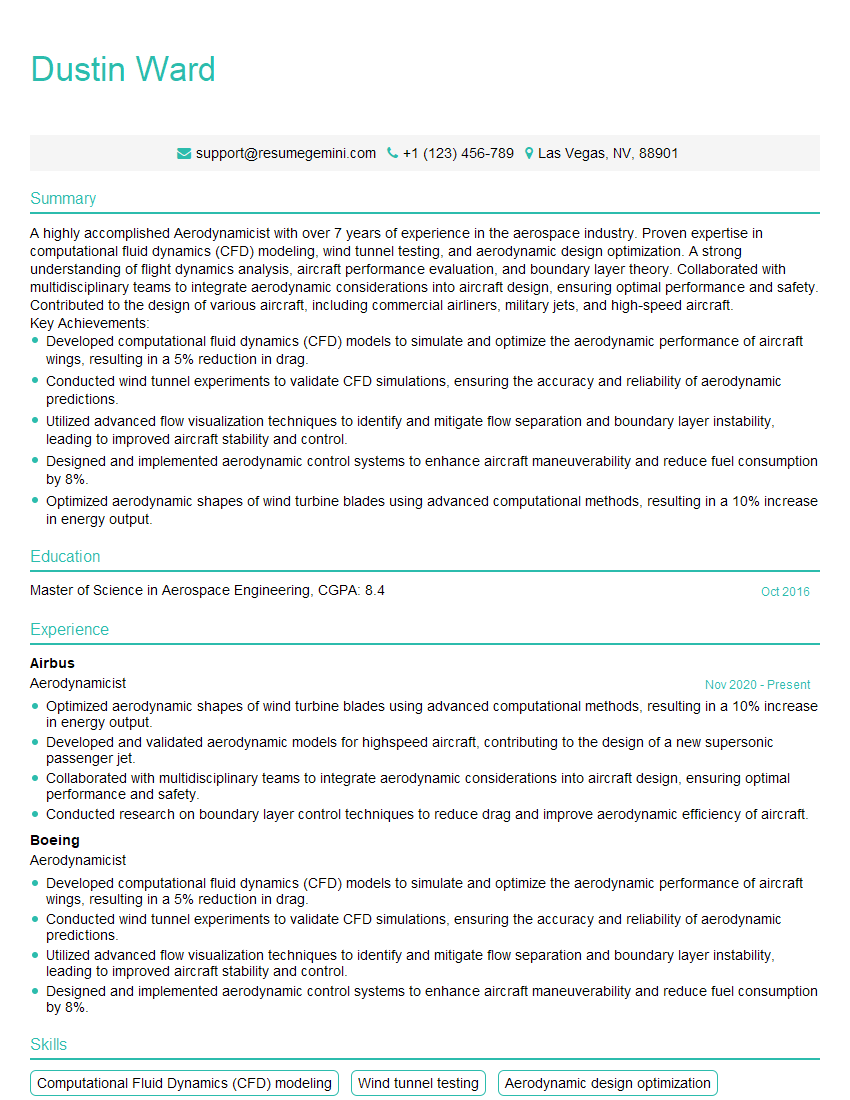
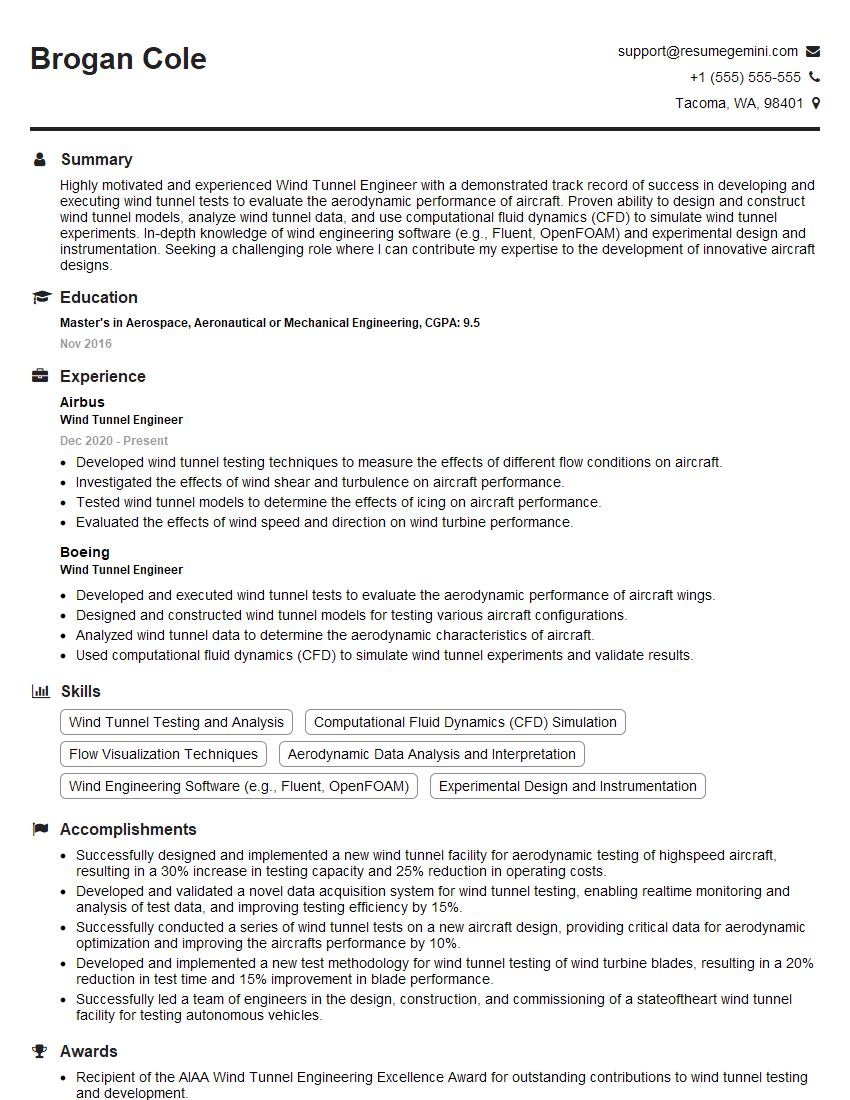
Mastering low-speed aerodynamics is essential for a successful career in aerospace engineering, opening doors to exciting opportunities in aircraft design, research, and development. To significantly enhance your job prospects, creating a compelling and ATS-friendly resume is paramount. ResumeGemini can help you build a professional, impactful resume that highlights your skills and experience effectively. We offer examples of resumes tailored specifically to low-speed aerodynamics professionals to help guide your own creation. Take the next step towards your dream career—build a resume that stands out!
Explore more articles
Users Rating of Our Blogs
Share Your Experience
We value your feedback! Please rate our content and share your thoughts (optional).
What Readers Say About Our Blog
Really detailed insights and content, thank you for writing this detailed article.
IT gave me an insight and words to use and be able to think of examples