The right preparation can turn an interview into an opportunity to showcase your expertise. This guide to Maintenance of Marine Outboards interview questions is your ultimate resource, providing key insights and tips to help you ace your responses and stand out as a top candidate.
Questions Asked in Maintenance of Marine Outboards Interview
Q 1. Describe the process of winterizing a marine outboard engine.
Winterizing your outboard is crucial to prevent damage from freezing temperatures. Think of it as putting your engine to bed for the winter, protecting it from the harsh conditions. The process involves removing water from the engine’s cooling system and fuel system to prevent cracking and corrosion.
- Flush the cooling system: Use a flushing device or a garden hose to run fresh water through the engine for several minutes to remove all traces of saltwater or antifreeze.
- Drain the lower unit: Locate the drain plug on the lower unit (the lower part of the outboard) and drain the gearcase oil. This is essential as water can mix with the oil and cause damage.
- Fog the cylinders: This involves spraying a fogging oil into the cylinders through the carburetor or throttle body. This coats the internal components, preventing corrosion.
- Drain the fuel tank and fuel lines: To prevent the fuel from going stale and gumming up your system, remove all fuel from the tank and run the engine for a short time to use any remaining fuel in the lines.
- Add fuel stabilizer to your remaining fuel: If you’re unable to completely drain fuel, use a fuel stabilizer to prevent the fuel from going bad over the winter.
- Protect your outboard: Cover your outboard motor with a suitable protective cover to keep it shielded from the elements.
For example, failing to winterize can result in cracked engine blocks, damaged seals, and costly repairs in the spring. Always consult your owner’s manual for specific instructions for your outboard model.
Q 2. Explain the function of a carburetor in an outboard engine.
The carburetor is the heart of the fuel delivery system in older outboard engines (many modern outboards use fuel injection). It’s responsible for mixing the correct ratio of fuel and air for combustion. Imagine it as a precise chef, carefully measuring the ingredients for a perfect recipe.
It does this by using a series of jets and valves to atomize (turn into a fine spray) the fuel and draw in air using the engine’s vacuum. This mixture is then delivered to the engine’s cylinders where it’s ignited by the spark plug. The carburetor’s job is to ensure the fuel-air mixture is at the optimal ratio for efficient operation, based on the engine’s speed and load. A malfunctioning carburetor can lead to poor performance, stalling, or difficulty starting.
Q 3. How do you troubleshoot a no-start condition on an outboard motor?
Troubleshooting a no-start condition requires a systematic approach. Think of it like a detective solving a mystery, eliminating possibilities one by one.
- Check the battery: Use a voltmeter to check the battery voltage. A weak battery is a common culprit.
- Verify fuel supply: Check that the fuel tank is full, the fuel line is clear, and the fuel pump is functioning correctly. You might need to check for clogged fuel filters or restricted fuel lines.
- Inspect the spark plugs: Remove the spark plugs and inspect them for wear, fouling, or damage. Replace them if necessary.
- Test the ignition system: Use a spark tester to check if the spark plugs are receiving a strong spark. Issues with the ignition coil, starter motor or other components can be the cause.
- Check the fuel-air mixture: If the engine is equipped with a carburetor, ensure that the fuel-air mixture is correctly adjusted. If fuel injected, inspect for leaks or blockages.
- Examine the starter motor: Listen for the sound of the starter engaging. A clicking sound can indicate a low battery or a faulty starter solenoid.
For example, if you find a weak spark, you might need to replace the spark plug wires or the ignition coil. If you find a clogged fuel filter, you’ll need to replace it. This systematic approach helps quickly pinpoint the issue.
Q 4. What are the common causes of overheating in an outboard engine?
Overheating in an outboard can lead to serious damage. Think of it like a fever in a person – it’s a sign something’s wrong. Common causes include:
- Insufficient water flow: This could be due to clogged water intakes, a faulty impeller (a pump that circulates water through the engine), or seaweed obstructing the cooling system.
- Thermostat issues: A malfunctioning thermostat might prevent the engine from cooling down properly.
- Low water level: Operating the engine with insufficient water in the cooling system will cause overheating.
- Faulty water pump: A failing water pump won’t circulate water efficiently.
- Corrosion or blockage in the cooling passages: Buildup of scale or other debris can restrict water flow.
For example, a clogged water intake can be easily cleaned, while a faulty impeller usually needs replacement. Regular maintenance, such as inspecting and cleaning the water intakes, prevents most overheating problems.
Q 5. Describe the steps involved in performing a lower unit oil change.
Changing the lower unit oil is vital for the longevity of your outboard’s gears. Think of it like changing the oil in your car; it keeps the gears lubricated and prevents wear.
- Gather your supplies: You will need the correct type and quantity of lower unit oil (specified in your owner’s manual), a drain pan, a pump to extract the oil and a torque wrench.
- Drain the old oil: Remove the drain plug at the bottom of the lower unit and let the old oil drain completely into the drain pan.
- Remove the fill plug: Remove the fill plug, which is usually located higher on the lower unit.
- Pump in new oil: Use a pump to add the correct amount of new lower unit oil, as per your owner’s manual.
- Replace the fill plug: Securely tighten the fill plug using a torque wrench, to avoid over-tightening and stripping the threads.
- Check for leaks: Inspect for any leaks around the drain and fill plugs.
Using the wrong type of oil can damage the gears. Always consult your owner’s manual for the specified oil type and quantity for your outboard. Using a torque wrench ensures you don’t overtighten the plugs, damaging the lower unit.
Q 6. How do you diagnose and repair a faulty fuel pump?
A faulty fuel pump can prevent your outboard from starting or running smoothly. Think of it as the heart of the fuel delivery system; it’s essential for getting fuel to the engine.
Diagnosis: You can listen for the pump’s whine during cranking or use a fuel pressure gauge to check fuel pressure at the carburetor or fuel rail. Low or no pressure indicates a faulty pump. You can also check the fuel lines for blockages or kinks.
Repair: Repairing often involves replacing the fuel pump. This is usually a relatively straightforward process involving removing the old pump and installing a new one, following the manufacturer’s instructions carefully. Always ensure you get the correct replacement part for your outboard model.
Q 7. Explain the importance of regular spark plug maintenance.
Regular spark plug maintenance is crucial for engine performance and longevity. Think of spark plugs as the tiny but powerful igniters in your engine; they generate the spark that ignites the fuel-air mixture.
- Regular inspection: Inspect your spark plugs regularly for wear, fouling (carbon buildup), or damage.
- Cleaning or replacement: Clean the spark plugs or replace them according to the manufacturer’s recommendations. Fouled plugs can lead to misfires and poor engine performance.
- Proper gap setting: The gap between the spark plug electrodes needs to be precisely set as specified by the manufacturer. An incorrect gap can prevent the spark plug from firing properly.
- Torque specification: Tighten the spark plugs to the manufacturer’s specified torque. Over-tightening can damage the spark plug or the cylinder head.
Ignoring spark plug maintenance can lead to misfires, poor fuel economy, reduced engine power and even engine damage. Maintaining them properly keeps your engine running smoothly and efficiently.
Q 8. What are the signs of a worn water pump impeller?
A worn water pump impeller is crucial to identify because it can lead to catastrophic engine overheating. Several signs indicate this:
- Overheating engine: The most obvious sign. Your engine will overheat quickly, especially under load. The temperature gauge will climb rapidly. Think of it like your car’s radiator – if the coolant isn’t circulating, things get hot fast.
- Reduced water flow from the telltale: The telltale is a small outlet that shows water flow from the impeller. A weak or absent stream indicates insufficient water flow, a telltale sign of a failing impeller.
- White exhaust smoke: If the engine is not getting enough cooling water, it will start running hotter, potentially leading to white exhaust smoke (steam) as water gets into the combustion chamber.
- Impeller pieces in the cooling system: If the impeller has completely disintegrated, you might find rubber pieces in the cooling system passages. You can find them when servicing the pump itself or even in the exhaust outlet.
- Rough running engine: In some cases, a partially worn impeller might not immediately cause overheating but will lead to inconsistent cooling, which results in a rough running engine.
Regular impeller inspections, ideally every 100-200 hours of operation or annually, depending on the usage, are vital to preventing catastrophic failure.
Q 9. How do you troubleshoot a problem with the outboard engine’s steering system?
Troubleshooting outboard steering problems requires a systematic approach. Start by visually inspecting the steering cable for any kinks, bends, or fraying. Then:
- Check the steering cable connections: Ensure that the cable is securely connected at both the helm and the steering mechanism on the outboard motor. Loose connections can cause slack or binding.
- Test the steering mechanism: Disconnect the steering cable from the outboard and manually move the steering mechanism. If it moves freely, the problem is likely in the cable; if it’s stiff, the issue is within the steering mechanism. This might involve checking for seized parts or low hydraulic fluid in some systems.
- Inspect the hydraulic ram (if applicable): If your outboard uses a hydraulic steering system, check the fluid level and inspect for leaks. Low fluid or leaks can compromise the steering’s ability to respond correctly.
- Check for binding or friction points: Look for anything that might be causing the steering cable to bind. This could be a debris buildup around the cable or an issue with the cable’s routing.
If the problem persists after these checks, you might need specialized tools to test cable tension or hydraulic pressure, making professional assistance worthwhile. Remember safety first—always secure your boat when conducting these checks.
Q 10. Describe the process of adjusting the timing on an outboard engine.
Adjusting the timing on an outboard engine is a complex procedure that should only be attempted by experienced mechanics with the right tools and a service manual specific to the outboard model. Incorrect timing can severely damage the engine. It’s usually not something you would do as part of routine maintenance.
The process generally involves:
- Using a timing light: A timing light is essential to accurately identify and adjust the timing marks. This tool flashes at the engine’s firing rate, allowing you to see where the engine is firing relative to the specified timing marks on the flywheel.
- Accessing the flywheel: Usually this requires removing parts such as the engine cover and other components. Specific procedures vary greatly based on engine design.
- Locating the timing marks: Carefully identify the marks on the flywheel and the corresponding marks on the engine block or other components.
- Adjusting the timing: This involves loosening and then turning a timing adjustment mechanism (such as a distributor or ignition module) to match the marks. The service manual will specify the correct timing setting.
- Retorquing parts: Re-tighten and secure everything once the timing is adjusted.
Improper timing adjustments can lead to reduced performance, poor fuel economy, and even engine damage. If you are not experienced, consult a professional outboard mechanic.
Q 11. What safety precautions should be taken when working on a marine outboard?
Safety is paramount when working on marine outboards. Always follow these precautions:
- Disconnect the battery: This prevents accidental electrical shocks and prevents the engine from starting unexpectedly. Always disconnect the negative terminal first.
- Work in a well-ventilated area: Outboard engines produce fumes that can be harmful. Work in an open area or use appropriate ventilation.
- Use proper personal protective equipment (PPE): Wear safety glasses, gloves, and closed-toe shoes. Consider a respirator if working in dusty or dirty conditions.
- Use jack stands: If you are working under the engine, always support it securely using jack stands. Never work under an engine supported only by a jack.
- Follow the service manual: Always consult the service manual specific to your outboard model. This manual provides detailed instructions and safety precautions.
- Dispose of fluids properly: Follow local regulations for the proper disposal of engine oil, fuel, and other fluids.
- Use fire extinguisher: Keep a fire extinguisher nearby in case of a fire.
- Be aware of moving parts: Never place your hands near moving parts while the engine is running.
Remember, if you are unsure about any procedure, consult a professional marine mechanic.
Q 12. Explain the difference between two-stroke and four-stroke outboard engines.
Two-stroke and four-stroke outboard engines differ significantly in their combustion cycles and design:
- Two-stroke engines: In a two-stroke engine, the piston completes a power stroke every revolution of the crankshaft. They are simpler, lighter, and generally more compact. However, they are less fuel-efficient and produce more emissions than four-stroke engines. They mix oil and fuel in a single reservoir.
- Four-stroke engines: In a four-stroke engine, the piston completes a power stroke every two revolutions of the crankshaft. They are more fuel-efficient and produce fewer emissions. Four-stroke outboards usually require separate oil and fuel. They are typically heavier and more complex than two-strokes.
Think of it like this: a two-stroke is like a simpler, more basic bicycle, while a four-stroke is like a more complex, efficient motorbike.
In summary:
| Feature | Two-Stroke | Four-Stroke |
|---|---|---|
| Power Stroke per Crankshaft Revolution | One | Two |
| Fuel Efficiency | Lower | Higher |
| Emissions | Higher | Lower |
| Maintenance | Generally simpler | Generally more complex |
| Weight | Lighter | Heavier |
Q 13. How do you test the compression in an outboard engine cylinder?
Testing compression in an outboard cylinder is done using a compression tester. This tool measures the pressure within the cylinder when the piston is compressed. Low compression indicates problems like worn piston rings, leaking valves, or a blown head gasket.
The procedure generally involves:
- Preparing the engine: Ensure the engine is at operating temperature. A cold engine can give a false low compression reading.
- Removing the spark plug: Remove the spark plug from the cylinder you are testing.
- Attaching the compression tester: Screw the compression tester into the spark plug hole. Ensure a good seal.
- Cranking the engine: Crank the engine over several times until the gauge stops increasing. You’ll likely need an assistant to crank the engine while you monitor the gauge.
- Recording the reading: Note the reading on the compression tester. The service manual will specify the acceptable range for your specific engine model. Compare the compression reading across all cylinders for a consistent assessment.
- Repeat the process: Repeat the steps for each cylinder.
The compression test values give an indication of the overall health of the internal components of your engine. Consult your engine’s service manual to interpret the results based on the specified pressure ranges.
Q 14. What are the common causes of excessive engine smoke?
Excessive engine smoke, whether white, blue, or black, indicates a problem. The color of the smoke offers clues:
- White smoke: Often indicates a coolant leak into the combustion chamber. This could be caused by a cracked cylinder head, a blown head gasket, or a faulty thermostat.
- Blue smoke: Usually points to burning oil. This can be caused by worn piston rings, valve stem seals, or oil leaking past the cylinder walls. Think of it like the engine itself is getting a little ‘sweaty’.
- Black smoke: Typically signals a rich fuel mixture. This could be due to problems with the carburetor (if applicable), fuel injectors, or the air-fuel ratio sensor. It is a sign that the engine is getting too much fuel compared to the air intake, resulting in incomplete combustion.
Addressing excessive smoke requires proper diagnosis. Simply replacing parts without pinpointing the cause can be wasteful and ineffective. It’s best to bring it to a trained mechanic for diagnosis.
Q 15. How do you diagnose and repair a faulty alternator?
Diagnosing a faulty alternator starts with understanding its function: it charges the battery. A failing alternator will lead to a low battery charge, eventually resulting in a no-start condition. The diagnostic process involves several steps:
- Visual Inspection: Check the alternator’s belt for wear or slippage. A loose or worn belt can prevent the alternator from spinning properly. Look for any obvious damage to the alternator itself.
- Voltage Test: With the engine running, measure the voltage at the battery terminals using a multimeter. A healthy alternator should produce around 13.5-14.5 volts. Lower voltage indicates a problem.
- Alternator Output Test: Disconnect the alternator’s output wire and use a multimeter to measure the voltage directly from the alternator’s output terminal. This isolates the alternator from other electrical components. Again, you should see 13.5-14.5 volts.
- Load Test: This is a more rigorous test, often requiring specialized equipment. It simulates the electrical load on the alternator to see if it can maintain the voltage output under stress.
Repairing a faulty alternator often involves replacing the entire unit, as internal repairs are typically not cost-effective. However, if the problem is a simple belt issue or loose connection, this is easily fixed. Remember safety first: always disconnect the battery’s negative terminal before working on the electrical system.
Example: I once worked on a boat where the alternator wasn’t charging. A simple voltage test revealed the issue. It turned out to be a corroded connection on the output wire, which we cleaned, and that solved the problem.
Career Expert Tips:
- Ace those interviews! Prepare effectively by reviewing the Top 50 Most Common Interview Questions on ResumeGemini.
- Navigate your job search with confidence! Explore a wide range of Career Tips on ResumeGemini. Learn about common challenges and recommendations to overcome them.
- Craft the perfect resume! Master the Art of Resume Writing with ResumeGemini’s guide. Showcase your unique qualifications and achievements effectively.
- Don’t miss out on holiday savings! Build your dream resume with ResumeGemini’s ATS optimized templates.
Q 16. Describe the procedure for replacing a fuel filter.
Replacing a fuel filter is a crucial maintenance task for preventing engine problems caused by contaminated fuel. The procedure is relatively straightforward but requires attention to detail to avoid spills and contamination. Here’s a step-by-step guide:
- Safety First: Always work in a well-ventilated area, and wear appropriate safety glasses.
- Locate the Fuel Filter: This varies depending on the outboard model. Consult your owner’s manual for the exact location.
- Prepare Containers: Have a clean container ready to catch the old fuel.
- Disconnect Fuel Lines: Carefully loosen the clamps holding the fuel lines to the filter and disconnect the lines. Have rags ready to absorb any spilled fuel.
- Remove the Filter: Unscrew the old filter and allow the remaining fuel to drain into your container.
- Install the New Filter: Carefully lubricate the new filter’s gasket with clean fuel, then screw it in firmly until it’s snug but don’t overtighten.
- Reconnect Fuel Lines: Attach the fuel lines to the new filter and secure them with clamps.
- Check for Leaks: Carefully inspect the connections for any leaks.
- Prime the System (If Necessary): Some systems require you to prime the fuel system after a filter change by cranking the engine until it starts.
Important Note: Always use the correct type of fuel filter specified for your outboard motor.
Q 17. Explain the function of the lower unit on an outboard motor.
The lower unit of an outboard motor is the submerged portion that houses the gearcase and propeller. Its primary function is to transfer power from the engine to the propeller, allowing the boat to move through the water. Think of it as the transmission and final drive of the outboard. It contains:
- Gearcase: Contains gears that reduce the high engine speed into slower propeller rotation for efficient propulsion. The ratio of reduction varies depending on the application.
- Propeller Shaft: Transmits power from the gearcase to the propeller.
- Propeller: Creates thrust to propel the boat.
- Water Pump: Crucially, the lower unit houses the water pump, which circulates cooling water through the engine to prevent overheating. This is vital for the engine’s longevity.
Regular maintenance of the lower unit, including lubricating the gears and inspecting the water pump, is crucial for preventing damage and ensuring efficient operation.
Analogy: Imagine a bicycle. The lower unit is similar to the chain and rear gears – it takes the power from the pedals (engine) and converts it into forward motion (boat movement).
Q 18. How do you troubleshoot a problem with the outboard engine’s trim system?
Troubleshooting an outboard’s trim system, which controls the angle of the engine, involves systematic checks to pinpoint the cause of malfunction. Common problems include hydraulic leaks, electrical issues, or mechanical failures within the trim unit itself.
- Visual Inspection: Check for hydraulic fluid leaks around the trim cylinders and fittings. Look for any damage to the hydraulic lines or components.
- Electrical Checks: Test the trim motor’s power supply using a multimeter, ensuring there is power at the motor terminals when the trim switch is activated.
- Hydraulic System Test: Observe the trim operation to determine if the motor is operating but the trim doesn’t move or the motion is sluggish. This points to a hydraulic issue (leak or low fluid levels).
- Fuse Check: Check the trim system fuse in the electrical panel. A blown fuse suggests a short circuit or overload within the system.
- Trim Switch Test: The trim switch itself can sometimes fail. If you suspect this, replace it.
- Mechanical Inspection: In some instances, there may be a mechanical problem within the trim cylinders themselves. This usually requires a more in-depth assessment by a technician.
Example: On one occasion, a client’s outboard trim wouldn’t operate. After checking the electrical system and fuses, we discovered a small leak in one of the hydraulic lines. Replacing the line restored the functionality.
Q 19. What are the common causes of corrosion in an outboard engine?
Corrosion is a significant problem for outboard engines, especially those frequently exposed to saltwater. Several factors contribute:
- Saltwater Exposure: Saltwater is highly corrosive, accelerating the deterioration of metal components.
- Lack of Regular Cleaning: Salt deposits left on the engine surface attract moisture and accelerate corrosion.
- Electrolytic Corrosion: Different metals in the engine can create galvanic cells, leading to accelerated corrosion of one metal at the expense of the other.
- Poor Maintenance: Neglecting regular maintenance, such as lubrication and flushing the engine after saltwater use, promotes corrosion.
Preventing corrosion requires diligent maintenance. Thorough rinsing with fresh water after each saltwater use is paramount. Regular waxing and the use of corrosion inhibitors can also help. Addressing any damaged or deteriorated parts promptly is important to halt further corrosion.
Q 20. Describe the process of synchronizing carburetors on a multi-cylinder outboard.
Synchronizing carburetors on a multi-cylinder outboard ensures that each cylinder receives the same fuel/air mixture for optimal performance and fuel efficiency. The process is complex and requires specialized tools and knowledge. Generally, a professional mechanic should handle this.
The procedure typically involves:
- Checking for Vacuum Leaks: Inspect the intake manifold and carburetor linkages for vacuum leaks which can severely affect the balance between cylinders.
- Initial Adjustment: Adjust the idle mixture screws on each carburetor to a starting point, using a vacuum gauge to monitor the vacuum pressure in each cylinder.
- Fine Tuning: Carefully adjust the mixture screws, while observing changes in engine RPM. The goal is to get the smoothest possible idle with the highest RPM achievable.
- Verification: Verify synchronization by using a tachometer and throttle synchronizer tool.
Warning: Incorrect carburetor synchronization can damage the engine. It is best left to trained professionals with the proper tools and experience.
Q 21. How do you identify and repair a damaged propeller shaft?
Identifying and repairing a damaged propeller shaft requires careful inspection and often specialized tools. Damage can range from minor bending to severe cracking or fracture.
- Visual Inspection: Carefully inspect the shaft for any visible signs of damage such as bending, cracks, or pitting.
- Measurement: Measure the shaft’s diameter and straightness using appropriate tools to determine if it’s bent beyond acceptable tolerances.
- Non-Destructive Testing (NDT): For subtle damage not visible to the naked eye, NDT methods such as dye penetrant testing can be employed.
- Repair Options: Minor bends might be corrected through careful straightening. However, any significant damage such as cracks requires replacing the propeller shaft. This often requires removing the lower unit and replacing the shaft or the entire lower unit, depending on the damage.
Important Note: A damaged propeller shaft can cause significant engine problems, such as vibrations and reduced performance. Repair or replacement is crucial for safe and reliable operation.
Q 22. Explain the function of the thermostat in an outboard cooling system.
The thermostat in an outboard cooling system acts like a valve controlling the flow of coolant. Its primary function is to regulate the engine’s operating temperature. Think of it as a temperature control for your car’s engine; it ensures the engine doesn’t overheat or run too cold. When the engine is cold, the thermostat remains closed, restricting coolant flow through the engine block until the optimal temperature is reached. Once the engine reaches its operating temperature (usually around 160-180°F or 71-82°C for many outboards), the thermostat opens, allowing coolant to circulate through the engine block, the heat exchanger, and finally back to the water pump to be cooled by the water jacket.
A faulty thermostat can lead to overheating (if stuck closed) or poor engine performance (if stuck open), potentially causing significant damage to the engine. Regular inspection and replacement (as recommended by the manufacturer) is crucial for preventing such problems.
Q 23. What are the common types of outboard engine lubricants and their applications?
Outboard engines typically use two main types of lubricants: two-stroke oil and four-stroke oil. The choice depends entirely on the engine type.
- Two-stroke oil: This oil is mixed with the gasoline before entering the engine. It lubricates the engine’s moving parts and acts as a fuel. Two-stroke oils are specially formulated to burn cleanly and efficiently without leaving excessive residue. Common types include TC-W3 oils specifically designed for marine applications, ensuring protection against corrosion and water contamination. Using the incorrect oil can lead to severe engine damage.
- Four-stroke oil: Four-stroke engines have a separate lubrication system. The oil is stored in a sump and circulated through the engine using a pump. Four-stroke oils are typically SAE-graded, indicating their viscosity at different temperatures (e.g., SAE 10W-30, SAE 20W-40). Again, using the proper oil grade as specified by the manufacturer is crucial for engine longevity and performance. Using the incorrect viscosity oil could cause inadequate lubrication, wear and tear, and even engine failure.
Incorrect oil selection can lead to reduced engine performance, increased wear, and ultimately, costly repairs. Always consult your engine’s manual for specific recommendations.
Q 24. Describe the proper procedure for disconnecting and reconnecting a battery.
Disconnecting and reconnecting a marine battery requires careful attention to safety to prevent sparks that could ignite flammable fumes.
- Disconnecting: Always disconnect the negative (-) terminal first. Use a wrench or socket to loosen the nut and carefully remove the cable. This prevents accidental short-circuiting. Then, disconnect the positive (+) terminal.
- Reconnecting: When reconnecting, reverse the process. Connect the positive (+) terminal first, followed by the negative (-) terminal. Ensure all connections are clean, tight, and free from corrosion.
It’s crucial to wear appropriate safety glasses when handling batteries, as acid can splash during disconnection and reconnection. Also, keep away from any open flames or sparks. Before working on the battery, ensure the engine is switched off and the ignition key is removed. Never touch the terminals while the engine is running.
Q 25. Explain the difference between direct and indirect fuel injection systems in outboards.
The difference between direct and indirect fuel injection in outboards lies in how the fuel is delivered to the combustion chamber.
- Indirect fuel injection: In this system, fuel is injected into the intake manifold before entering the combustion chamber. It mixes with air before entering the cylinder, offering simpler design and lower initial cost. However, it may result in less efficient combustion compared to direct injection.
- Direct fuel injection: This more advanced system injects fuel directly into the combustion chamber, maximizing combustion efficiency. This leads to improved fuel economy, better power output, and reduced emissions. However, it is generally more complex and expensive.
Think of it like this: indirect injection is like sprinkling water on a plant – it’s easier, but some water might be lost. Direct injection is like using a watering can – targeted and efficient.
Q 26. How do you diagnose and repair problems with the outboard’s electrical starting system?
Diagnosing starting system problems involves a systematic approach:
- Check the battery: Test the battery voltage with a multimeter. A reading below 12.6V indicates a weak or dead battery requiring charging or replacement. Check for corrosion on the terminals.
- Inspect cables: Examine the battery cables for damage, loose connections, or corrosion. Clean or replace as needed.
- Test the starter motor: Use a multimeter to check the starter motor’s power supply. A lack of voltage indicates a problem with the wiring or the solenoid. A weak or clicking sound suggests a faulty starter motor.
- Verify the ignition switch: Check if the ignition switch is working correctly. Test for power at the switch in the ‘start’ position.
- Inspect the solenoid: Test the solenoid for proper engagement. A malfunctioning solenoid prevents the starter motor from engaging.
Repair generally involves replacing faulty components like the battery, cables, starter motor, solenoid, or ignition switch. Often, cleaning corroded terminals solves many issues. Always consult a wiring diagram to trace the system properly. Safety precautions including wearing safety glasses and ensuring the engine is off are mandatory.
Q 27. How familiar are you with different outboard engine control systems (e.g., cable, electronic)?
I’m highly familiar with various outboard engine control systems. The two main types are cable and electronic control systems.
- Cable control systems: These utilize a system of cables and levers to mechanically link the throttle and shift levers to the engine. They’re simpler, more robust, and less expensive to repair, but can become less precise over time due to wear and tear on the cables.
- Electronic control systems: These employ electronic sensors, actuators, and control modules to manage throttle and shifting. They offer smoother operation, precise control, and advanced features like electronic shifting and synchronization. However, diagnosis and repair can be more complex due to the involvement of electronics and the need for specialized diagnostic tools.
My experience includes troubleshooting and repairing both types, ranging from simple cable adjustments and replacements to complex electronic module diagnoses using specialized diagnostic equipment.
Q 28. Describe your experience with diagnosing and repairing problems with outboard engine sensors and electronic control modules.
I have extensive experience diagnosing and repairing problems with outboard engine sensors and electronic control modules (ECMs). This often requires a combination of practical skills and the use of diagnostic tools.
My approach involves:
- Understanding the symptom: Carefully observe and record the engine’s performance issues, which help pinpoint the malfunctioning sensor or module. This could include rough running, poor fuel efficiency, overheating, or complete engine failure.
- Using diagnostic equipment: Employing a diagnostic scanner or multimeter to read sensor outputs and check for error codes stored within the ECM. This step allows for isolating the malfunctioning sensor or module.
- Visual inspection: Examining the wiring harness for damage, loose connections, or corrosion. This is also important in locating damaged sensors.
- Testing sensors individually: Testing suspected sensors using a multimeter to verify their output signal is within the manufacturer’s specifications.
- Replacing faulty components: Replacing sensors or the ECM once the faulty component has been identified. This involves soldering, crimping, or other repair techniques.
I’ve worked on a wide range of sensor types, including temperature sensors, throttle position sensors, crankshaft position sensors, and oxygen sensors. My proficiency in using diagnostic software enables me to effectively identify and resolve problems, minimizing downtime and ensuring safe engine operation.
Key Topics to Learn for a Marine Outboard Maintenance Interview
- Engine Fundamentals: Understanding two-stroke and four-stroke engine operation, including fuel systems, ignition systems, and lubrication systems. Be prepared to discuss the differences and their respective maintenance needs.
- Preventative Maintenance: Explain the importance of regular maintenance schedules, including oil changes, filter replacements, and winterization procedures. Discuss practical applications like checking fluid levels and identifying potential issues through visual inspection.
- Troubleshooting and Diagnostics: Describe your approach to diagnosing common engine problems, such as starting issues, overheating, and poor performance. Discuss the use of diagnostic tools and your problem-solving methodology.
- Fuel Systems: Detail your understanding of fuel injection systems, carburetors, and fuel filters. Explain how to identify and address fuel-related problems, including fuel contamination and clogged injectors.
- Electrical Systems: Discuss the marine electrical system, including batteries, alternators, and starting systems. Be prepared to troubleshoot electrical faults and explain safety procedures related to electrical work.
- Lower Unit Maintenance: Explain the importance of lower unit maintenance, including lubrication and gearcase servicing. Discuss the signs of lower unit problems and how to address them.
- Safety Procedures: Highlight your understanding of safety regulations and best practices for working with marine engines, including personal protective equipment (PPE) and handling hazardous materials.
- Specific Outboard Brands and Models (if applicable): If you have experience with specific brands like Mercury, Yamaha, or Evinrude, be prepared to discuss your expertise with those systems.
Next Steps
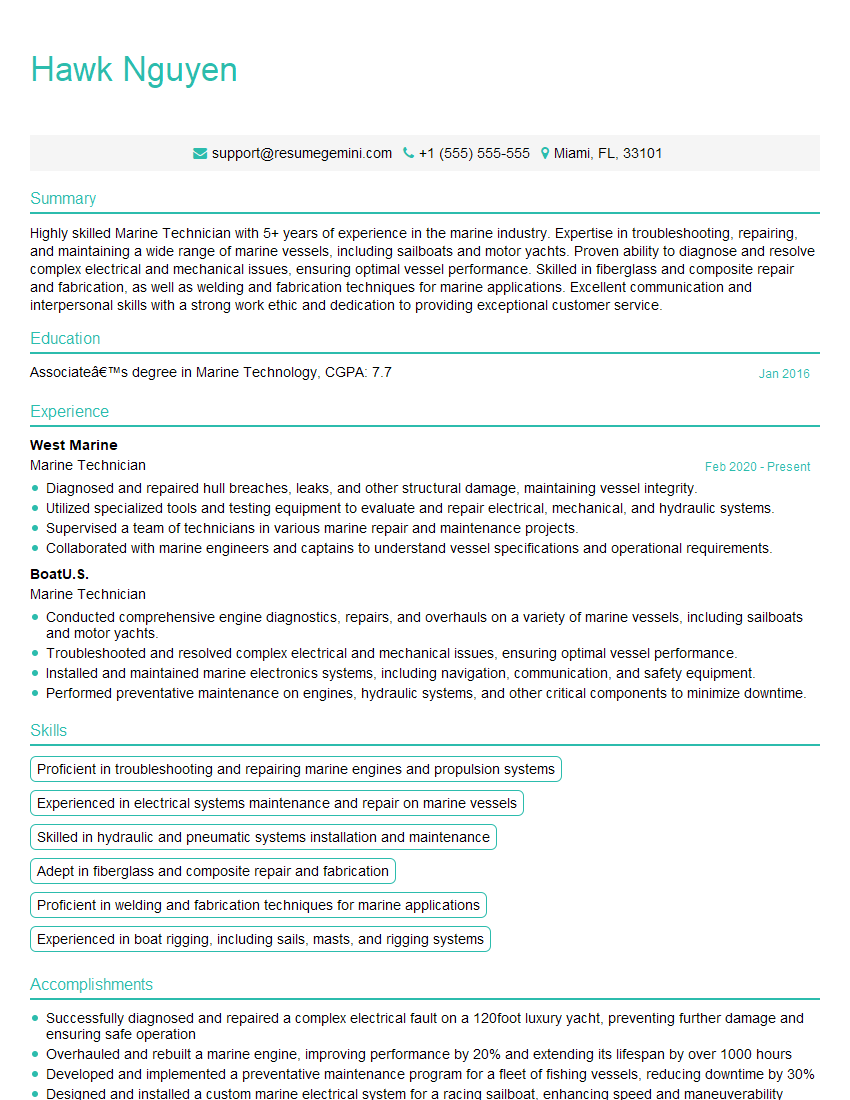
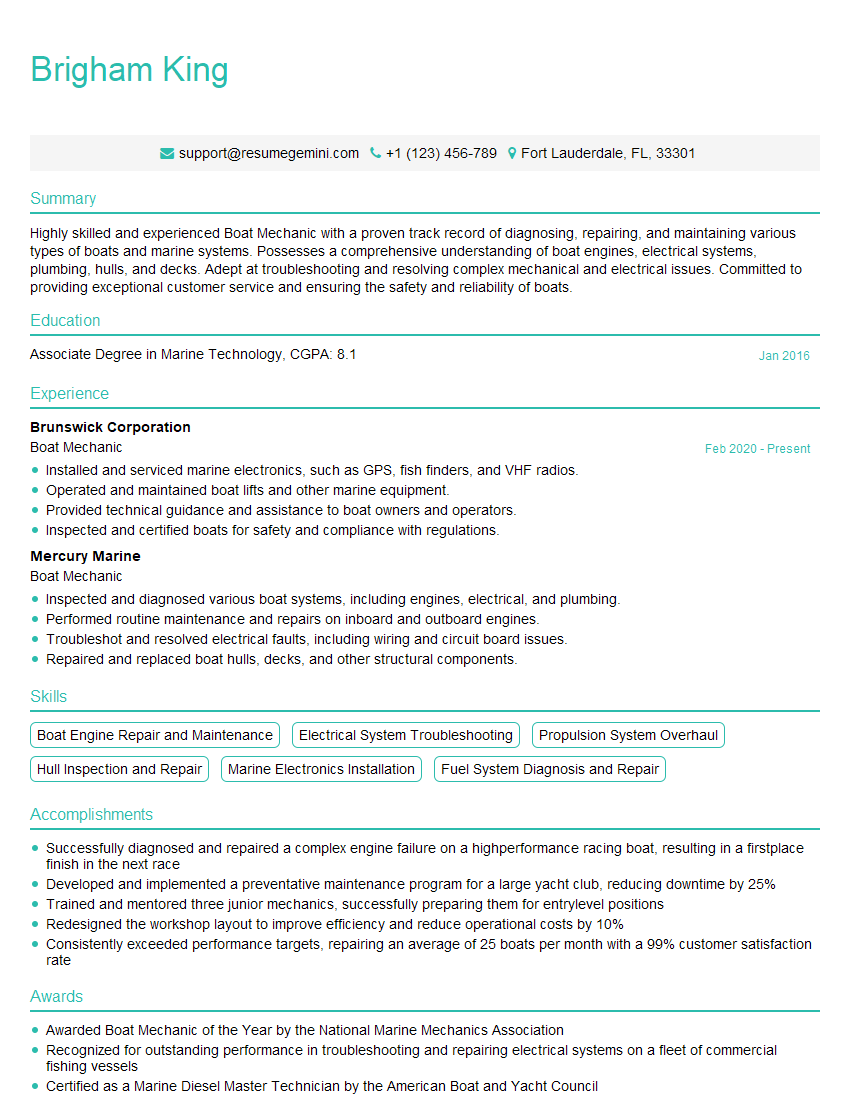
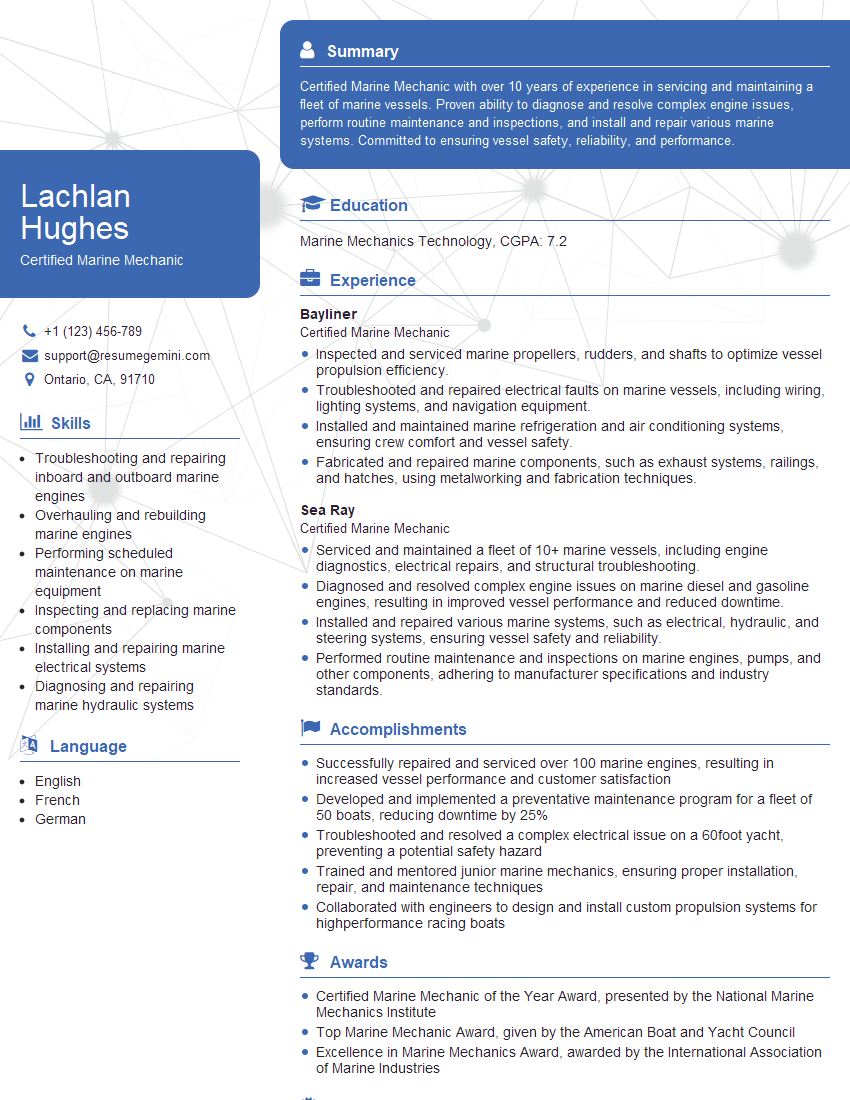
Mastering marine outboard maintenance opens doors to exciting career opportunities in the marine industry, offering diverse roles with excellent growth potential. A strong resume is crucial for landing your dream job. Creating an ATS-friendly resume significantly increases your chances of getting noticed by recruiters. To build a professional and impactful resume that highlights your skills and experience, we strongly recommend using ResumeGemini. ResumeGemini provides a user-friendly platform and offers examples of resumes tailored to Maintenance of Marine Outboards, ensuring your application stands out from the competition.
Explore more articles
Users Rating of Our Blogs
Share Your Experience
We value your feedback! Please rate our content and share your thoughts (optional).
What Readers Say About Our Blog
Really detailed insights and content, thank you for writing this detailed article.
IT gave me an insight and words to use and be able to think of examples