Cracking a skill-specific interview, like one for Music Performance and Education, requires understanding the nuances of the role. In this blog, we present the questions you’re most likely to encounter, along with insights into how to answer them effectively. Let’s ensure you’re ready to make a strong impression.
Questions Asked in Music Performance and Education Interview
Q 1. Describe your teaching philosophy regarding music education.
My teaching philosophy centers on fostering a love for music and empowering students to become confident, expressive musicians. I believe music education should be holistic, nurturing not only technical skills but also creativity, critical thinking, and collaboration. It’s about understanding the ‘why’ behind the music, connecting with its emotional depth, and developing a lifelong appreciation for the art form. I strive to create a supportive and encouraging classroom environment where students feel safe to experiment, take risks, and learn from their mistakes. My approach is student-centered, adapting to individual needs and learning styles to maximize each student’s potential. I believe in building strong relationships with students based on mutual respect and trust, creating a positive learning environment where they feel challenged and inspired.
Q 2. What methods do you employ to assess student progress in music performance?
Assessing student progress in music performance is a multifaceted process that goes beyond simple grades. I utilize a variety of methods to gain a comprehensive understanding of each student’s development. This includes:
- Formal Performances: Recitals, concerts, and class performances provide opportunities to evaluate technical proficiency, musicality, stage presence, and interpretive skills.
- Informal Assessments: Regular classroom observations, listening to practice sessions, and providing feedback during individual lessons offer ongoing insight into the student’s progress and areas for improvement.
- Rubrics and Checklists: I use detailed rubrics that outline specific criteria for evaluating performance skills (e.g., intonation, rhythm, articulation) which allows for objective evaluation. Checklists help track the acquisition of specific musical skills and concepts.
- Self and Peer Assessment: Encouraging students to self-assess their performance and provide constructive feedback to their peers fosters self-awareness, critical thinking, and collaboration.
- Portfolio Development: Students maintain portfolios that showcase their work, including recordings, written analyses, and reflections on their musical journey. This offers a longitudinal perspective of their growth.
By combining these methods, I get a holistic picture of student progress, allowing me to tailor my instruction to address individual needs and celebrate achievements.
Q 3. How do you adapt your teaching approach to diverse learning styles and needs?
Recognizing that students learn in diverse ways is crucial. I adapt my teaching to cater to various learning styles through:
- Visual Learners: I incorporate charts, diagrams, videos, and demonstrations to illustrate musical concepts. For example, I might use color-coded diagrams to show chord progressions or visual aids to explain musical notation.
- Auditory Learners: I emphasize listening skills, incorporate aural exercises, and use recorded examples to illustrate musical ideas. I might use ear training exercises or play examples of different musical styles to help them analyze and understand the music.
- Kinesthetic Learners: I incorporate hands-on activities, movement exercises, and collaborative projects to engage students physically. I might use games or body percussion to reinforce rhythmic concepts or have students conduct an excerpt to develop their understanding of musical phrasing.
- Differentiated Instruction: I provide varied levels of challenge and support to meet individual needs. Some students might be ready for advanced material, while others might need extra support with fundamental concepts. This might involve assigning different tasks or providing individual guidance.
Adapting my instruction ensures all students feel challenged and supported, maximizing their learning and engagement.
Q 4. Explain your experience with different music teaching methodologies (e.g., Kodály, Dalcroze).
My experience encompasses various music teaching methodologies. I’ve found that integrating elements from different approaches enhances the learning experience.
- Kodály Method: I utilize its emphasis on singing, solfège, and folk music to build a strong foundation in musical literacy and understanding of musical structure. For example, teaching pentatonic scales through folk songs helps students internalize musical patterns naturally.
- Dalcroze Eurythmics: I incorporate its focus on movement and improvisation to improve musical understanding through physical expression. Students learn to embody rhythm, dynamics, and phrasing through movement exercises, enhancing their musical sensitivity and creativity.
- Orff Approach: I incorporate elements of Orff’s approach, using instruments like xylophones and metallophones to introduce musical concepts in a playful and engaging way. It’s excellent for early childhood music education.
I believe these methods, when integrated thoughtfully, create a rich and well-rounded music education.
Q 5. How do you integrate technology into your music instruction?
Technology plays a vital role in my music instruction. I utilize various tools to enhance learning and engagement:
- Digital Audio Workstations (DAWs): Software like GarageBand or Logic Pro allows students to compose, arrange, and record their own music, fostering creativity and technical skills.
- Music Notation Software: Finale or Sibelius facilitate composing, editing, and sharing musical scores, enhancing literacy and composition skills.
- Interactive Music Learning Platforms: Websites and apps offer engaging exercises and games for practicing music theory, ear training, and performance skills.
- Video Conferencing and Online Resources: Tools like Zoom enable remote instruction and access to a wider range of musical resources, especially helpful for individual lessons or small group sessions.
Technology complements traditional teaching methods, making learning more accessible and stimulating. However, it’s important to maintain a balance and ensure technology enhances, rather than replaces, the human interaction crucial in music education.
Q 6. Describe your experience conducting ensembles (choir, band, orchestra).
I have extensive experience conducting various ensembles, including choirs, bands, and orchestras. My approach focuses on building a strong ensemble identity, fostering collaboration, and achieving a high level of musical excellence. I emphasize:
- Individualized Attention: Providing tailored feedback to individual students within the context of the ensemble.
- Balanced Section Rehearsals: Ensuring each section receives adequate attention, addressing technical challenges and fostering a collaborative spirit within sections.
- Full Ensemble Rehearsals: Bringing together all sections to achieve a unified sound and musical interpretation.
- Performance Opportunities: Providing regular opportunities to perform for audiences, promoting musicianship and developing confidence.
- Repertoire Selection: Carefully selecting repertoire that is challenging yet attainable, appropriate for the skill level and musical interests of the ensemble.
Through careful planning, constructive feedback, and collaborative effort, I strive to guide ensembles towards achieving their full artistic potential.
Q 7. How do you manage classroom discipline and maintain student engagement?
Maintaining a positive and productive classroom environment is crucial. My approach to classroom discipline and engagement is proactive and focuses on building a respectful learning community.
- Clear Expectations and Consistent Rules: Establishing clear expectations for behavior and consistently enforcing rules promotes a sense of order and respect.
- Positive Reinforcement: Acknowledging and rewarding positive behavior through verbal praise, small rewards, or highlighting student achievements.
- Engaging Activities: Utilizing a variety of teaching methods, incorporating games, and hands-on activities to keep students actively involved and motivated.
- Individualized Attention: Providing individualized support and addressing any behavioral concerns promptly and privately, showing empathy and understanding.
- Building Relationships: Fostering strong relationships with students based on mutual respect and trust is essential. Showing genuine interest in their musical development and creating a supportive community.
By creating a positive, respectful environment, I encourage student participation, self-discipline, and a love for music that extends beyond the classroom.
Q 8. What strategies do you use to foster creativity and self-expression in your students?
Fostering creativity and self-expression in music students is paramount. My approach involves a multi-faceted strategy focusing on exploration, improvisation, and personalized expression.
Exploration: I encourage students to explore different genres, styles, and compositional techniques. This might involve listening to diverse musical examples, experimenting with different instruments, or even incorporating elements from other art forms into their musical expression. For example, I might ask a student to compose a piece inspired by a painting or a poem.
Improvisation: Improvisation exercises are invaluable for developing spontaneity and creative thinking. We begin with simple melodic or rhythmic improvisations and gradually increase the complexity, incorporating harmonic elements and stylistic choices. This helps students develop their musical language and find their unique voice.
Personalized Expression: I believe that each student has a unique musical voice. I guide them in identifying their strengths and interests and tailor their learning experiences to their individual preferences. This might involve choosing repertoire that resonates with them personally or exploring composition in styles that align with their musical tastes. For instance, a student passionate about jazz might be encouraged to arrange a favorite tune or compose an original jazz piece.
The goal is not just to teach technique but to empower students to discover and express their own unique musical identity.
Q 9. Explain your approach to developing students’ music theory understanding.
Developing a strong foundation in music theory is crucial for any musician. My approach is to integrate theory learning with practical application, making it relevant and engaging for students.
Hands-on Approach: Instead of rote memorization, we explore theoretical concepts through practical exercises. For instance, when learning about scales, we’ll play them on the instrument, compose short melodies using those scales, and analyze existing pieces to identify their use.
Contextual Learning: I present theoretical concepts within the context of actual musical pieces, showing students how these concepts function in real-world musical scenarios. This makes theory learning relevant and less abstract. For example, while studying harmony, we might analyze the chord progressions in a Beatles song to understand how they create a certain emotional effect.
Gradual Progression: I believe in a gradual and layered approach to theory education. We start with fundamental concepts and gradually build upon them, ensuring that each student has a solid grasp of the basics before moving on to more advanced topics. This prevents information overload and promotes deeper understanding.
Regular assessments, both formal and informal, help me gauge their understanding and provide targeted feedback. The goal is to equip them with the tools they need to analyze, understand, and create music effectively.
Q 10. How do you encourage students to practice effectively and consistently?
Effective and consistent practice is vital for musical progress. I encourage students to develop efficient and mindful practice habits.
Goal Setting: We collaboratively set realistic and achievable practice goals. These goals might focus on specific technical skills, musical interpretation, or memorization. For example, a goal might be to master a difficult passage in a piece or learn a new chord progression.
Structured Practice: I encourage structured practice sessions, incorporating a variety of activities such as scales, exercises, and repertoire work. This approach prevents monotony and ensures that all aspects of musicianship are addressed.
Mindful Practice: I emphasize the importance of focused and attentive practice. This means minimizing distractions and actively listening to oneself while playing. Regular breaks are crucial to avoid fatigue and maintain focus.
Practice Journals: Keeping a practice journal allows students to track their progress, identify areas needing improvement, and reflect on their practice sessions. This promotes self-awareness and accountability.
Regular check-ins and feedback sessions help ensure that students are on track and address any challenges they face.
Q 11. What resources do you utilize to enhance your music instruction?
Utilizing a diverse range of resources is key to enriching my music instruction.
Sheet Music & Scores: Access to a comprehensive library of sheet music and scores is essential for providing students with a wide variety of repertoire choices that cater to different skill levels and musical tastes.
Technology & Software: Music notation software (e.g., Sibelius, Finale) allows for creating customized exercises, arranging music, and providing students with visual aids. Online resources, educational websites, and music apps offer supplementary learning materials and engaging activities.
Workshops & Conferences: Attending workshops and conferences keeps me up-to-date with the latest pedagogical approaches, techniques, and trends in music education. These events also provide opportunities for professional development and networking.
Collaboration with Colleagues: Sharing ideas and experiences with other music educators through discussions, observations, and collaborations allows for a richer and more dynamic teaching environment.
By leveraging these diverse resources, I strive to create a stimulating and effective learning environment for my students.
Q 12. Describe your experience working with students of varying skill levels.
My experience working with students of varying skill levels is extensive. I adapt my teaching methods to meet the specific needs and learning styles of each student.
Beginner Students: For beginners, the focus is on building a solid foundation in basic musical skills, such as posture, hand position, note reading, and rhythmic understanding. I use simplified materials and engaging activities to make learning enjoyable and accessible.
Intermediate Students: With intermediate students, we delve deeper into technical skills, musical theory, and performance techniques. We explore more challenging repertoire and focus on developing musicality and expressiveness.
Advanced Students: Advanced students are challenged to explore complex musical concepts, develop their own artistic voice, and prepare for advanced performance opportunities like competitions and recitals. I provide individualized guidance and support, encouraging independent learning and creative exploration.
Differentiation is key. I use varied teaching strategies, materials, and assessments to cater to each student’s unique strengths, weaknesses, and learning preferences. This ensures that each student is challenged and supported appropriately.
Q 13. How do you address challenges related to student motivation and performance anxiety?
Addressing student motivation and performance anxiety is a crucial aspect of music education. My strategies focus on building confidence, fostering a positive learning environment, and providing support.
Positive Reinforcement: I focus on positive reinforcement, celebrating successes, no matter how small. This builds confidence and encourages perseverance.
Goal Setting & Achievement: Collaborative goal setting helps students feel a sense of ownership and accomplishment. Breaking down large tasks into smaller, manageable steps reduces feelings of overwhelm.
Performance Opportunities: Providing opportunities for students to perform in low-pressure settings, such as informal recitals or classroom performances, allows them to gain experience and build confidence gradually.
Relaxation Techniques: I introduce students to relaxation and breathing techniques to manage performance anxiety. This might involve deep breathing exercises or mindfulness practices.
Open Communication: Creating an open and supportive environment where students feel comfortable discussing their concerns and anxieties is critical. Empathetic listening and understanding are essential.
Ultimately, the goal is to create a nurturing environment where students feel safe to take risks, express themselves, and enjoy the process of learning and performing music.
Q 14. Describe your experience with music performance assessment (e.g., juries, recitals).
My experience with music performance assessment, including juries and recitals, has been extensive and multifaceted. I believe assessment should be a supportive process that helps students grow and develop.
Preparation: I work closely with students to prepare them for performance assessments. This includes choosing appropriate repertoire, developing performance strategies, and addressing technical challenges. We also practice performing under simulated conditions to reduce anxiety.
Feedback & Guidance: I provide constructive feedback after each performance, focusing on both strengths and areas for improvement. This feedback is tailored to each student’s individual needs and goals.
Holistic Approach: My assessment goes beyond mere technical proficiency. I consider musicality, interpretation, expression, and stage presence. The goal is to provide a comprehensive evaluation of the student’s overall performance.
Positive Environment: I strive to create a positive and supportive environment for performances, emphasizing the importance of artistic expression and personal growth rather than solely focusing on achieving a perfect score.
I believe that performance assessments, when approached thoughtfully, can be a valuable tool for learning and development, fostering artistic growth and building self-confidence.
Q 15. What are your strategies for creating a positive and inclusive learning environment?
Creating a positive and inclusive learning environment in music education is paramount. It’s about fostering a sense of belonging where every student feels safe, respected, and valued, regardless of their skill level, background, or musical preferences. My strategy involves several key components:
- Building Rapport: I begin by getting to know each student individually, understanding their musical aspirations and potential anxieties. This involves informal chats, listening to their musical tastes, and acknowledging their unique experiences.
- Differentiated Instruction: Recognizing that students learn at different paces and have varying learning styles, I implement differentiated instruction. This means adapting my teaching methods and materials to cater to individual needs. For example, some students might benefit from visual aids, while others thrive through kinesthetic learning (hands-on activities).
- Collaborative Learning: I encourage group work and peer-to-peer learning. Students learn from each other’s strengths, build teamwork skills, and develop a sense of community. This could involve ensemble playing, composing collaborative pieces, or peer assessment activities.
- Celebrating Diversity: I actively incorporate diverse musical genres and styles into the curriculum, exposing students to various cultural expressions and musical traditions. This helps broaden their horizons and fosters appreciation for different musical perspectives. Discussions about the cultural context of music also contribute to inclusivity.
- Growth Mindset Emphasis: I cultivate a growth mindset, encouraging students to view challenges as opportunities for learning and improvement, rather than focusing on perfection. I praise effort and persistence, emphasizing progress over outcome.
For instance, in one class, I had a student who initially struggled with rhythm. Instead of focusing on their mistakes, I introduced rhythm games and activities that made learning fun and engaging. Through patient encouragement and personalized support, this student significantly improved their rhythmic skills, boosting their confidence and participation in class.
Career Expert Tips:
- Ace those interviews! Prepare effectively by reviewing the Top 50 Most Common Interview Questions on ResumeGemini.
- Navigate your job search with confidence! Explore a wide range of Career Tips on ResumeGemini. Learn about common challenges and recommendations to overcome them.
- Craft the perfect resume! Master the Art of Resume Writing with ResumeGemini’s guide. Showcase your unique qualifications and achievements effectively.
- Don’t miss out on holiday savings! Build your dream resume with ResumeGemini’s ATS optimized templates.
Q 16. How do you collaborate with colleagues and parents to support student learning?
Collaboration is key to supporting student learning. I regularly communicate with colleagues to share best practices, discuss student progress, and ensure consistency in teaching approaches. For instance, I often meet with the classroom teacher to understand the student’s overall academic performance and identify any potential learning challenges that might affect their music studies. This holistic approach allows us to provide more effective and tailored support.
Parent involvement is equally crucial. I maintain open communication with parents through regular updates, concerts, informal meetings, and parent-teacher conferences. I share student progress reports, highlighting their strengths and areas for improvement. I also seek parental feedback to understand the student’s learning environment at home and incorporate this understanding into my teaching strategies. For instance, if a student is struggling with practice time at home, I might collaborate with the parents to create a realistic and achievable practice schedule, perhaps incorporating incentives or family participation.
I firmly believe that a strong partnership between teachers, students, and parents creates a powerful synergy that significantly enhances student learning and overall well-being.
Q 17. How do you develop and implement engaging music curriculum?
Developing an engaging music curriculum requires a balanced approach that incorporates theoretical knowledge, practical skills, and creative exploration. I start by identifying the learning objectives, aligning them with national or state curriculum standards, and considering the students’ age and musical background.
- Thematic Units: I structure the curriculum around thematic units, such as exploring different musical eras, cultures, or composers. This provides a cohesive and enriching learning experience.
- Variety of Activities: My curriculum integrates a range of activities, including listening exercises, music theory instruction, instrumental practice (if applicable), sight-reading, composition, improvisation, and performance opportunities. This ensures a varied and engaging learning journey.
- Technology Integration: I leverage technology to enhance learning, incorporating music software, online resources, and interactive apps. This makes learning more interactive and caters to different learning styles.
- Student Choice & Agency: I incorporate elements of student choice, allowing students to select certain pieces to perform or explore musical styles that interest them. This increases their engagement and motivation.
- Assessment: Assessment is integrated throughout the curriculum, not just at the end. It includes both formal assessments (e.g., tests, performances) and informal assessments (e.g., observations, discussions). This provides ongoing feedback and helps track student progress.
For example, a unit on the Baroque period might include listening to Bach’s works, studying Baroque musical forms, learning basic counterpoint techniques, and culminating in a student performance of a Baroque piece.
Q 18. What is your experience with different musical genres and styles?
My musical experience spans a wide range of genres and styles, encompassing classical, jazz, pop, rock, folk, and world music. This broad exposure allows me to effectively teach diverse musical styles and relate them to students’ own musical preferences. I’m proficient in several instruments, including piano, guitar, and percussion, which further enhances my ability to teach and demonstrate various musical techniques. My background also includes performing in various settings, from orchestras to jazz ensembles to smaller acoustic groups. This experience allows me to bring real-world musical contexts to the classroom and provide students with valuable insight into different musical performance styles.
This extensive knowledge ensures that my curriculum is not only comprehensive but also relevant and relatable to students from diverse musical backgrounds. I often use examples from different genres to illustrate music theory concepts, ensuring deeper understanding and engagement.
Q 19. Describe your experience in preparing students for music competitions or auditions.
Preparing students for music competitions and auditions is a crucial aspect of my work. My approach involves a multi-faceted strategy:
- Skill Development: We focus on honing the student’s technical skills, musicality, and interpretation of the chosen piece. This involves intensive practice, addressing technical challenges, and developing expressive performance techniques.
- Repertoire Selection: Choosing the right repertoire is essential. We collaborate to select pieces that suit the student’s skill level, personality, and the specific requirements of the competition or audition. We consider the piece’s difficulty, length, and its suitability for the student’s strengths.
- Performance Practice: We conduct regular mock auditions and performances to simulate the competition environment, helping students manage performance anxiety and develop stage presence. This involves feedback and refinement of the performance.
- Mental Preparation: Addressing performance anxiety is crucial. I guide students in relaxation techniques, visualization exercises, and positive self-talk to improve their composure and confidence during the performance.
- Post-Performance Analysis: After the competition or audition, we reflect on the performance, identifying areas of success and areas for improvement. This is an invaluable learning experience and helps prepare them for future events.
For example, I once worked with a student who was extremely nervous before a major competition. We incorporated mindfulness techniques into our practice sessions and worked on building their self-confidence. They went on to perform exceptionally well, surpassing even their own expectations.
Q 20. How do you maintain your own musical skills and knowledge?
Maintaining my musical skills and knowledge is a continuous process. I actively engage in my own musical pursuits, both as a performer and a lifelong learner. I regularly practice my instruments, attend workshops and masterclasses, and participate in performance opportunities. This keeps my skills sharp and allows me to stay connected to the vibrant world of music.
I also dedicate time to continuous professional development. I regularly read music journals, attend conferences, participate in online courses, and explore new musical technologies. Staying updated on the latest pedagogical approaches and musical trends is vital in providing students with the most effective and relevant instruction.
Furthermore, I find inspiration and learning opportunities in collaborating with other musicians and educators. I believe that lifelong learning is essential for any music educator.
Q 21. What software or technology are you proficient with in the context of music education?
I’m proficient with a variety of software and technologies relevant to music education. This includes:
- Digital Audio Workstations (DAWs): I use DAWs such as GarageBand, Ableton Live, and Logic Pro X for composing, recording, and editing music. These are invaluable tools for composing original music with students, creating backing tracks for performances, and enabling students to experiment with different sounds and musical ideas.
- Music Notation Software: I’m proficient with Sibelius and Finale for creating and editing musical scores, providing students with accurate and professional-looking sheet music. This software also allows me to create customized exercises and arrangements to meet student’s individual needs.
- Music Theory Software: I utilize music theory software for creating interactive exercises, quizzes, and visual aids to help students understand complex musical concepts. This makes learning more interactive and engaging.
- Online Music Resources: I am familiar with and utilize various online platforms offering music theory lessons, interactive ear training exercises, and vast libraries of musical scores. These online resources are especially useful in complementing classroom learning and fostering independent study.
- Presentation Software: I proficiently use presentation software like PowerPoint and Google Slides to create engaging presentations, incorporating visuals, audio, and video elements to enhance learning. This is essential in presenting music history, musical analysis, and for visually demonstrating musical concepts.
The integration of technology in my teaching makes learning more dynamic and accessible, helping me to cater to the diverse learning styles of my students.
Q 22. Explain your experience creating and implementing lesson plans.
Creating effective lesson plans in music performance and education requires a multifaceted approach. It’s not just about choosing pieces; it’s about crafting a learning journey. I begin by identifying the learning objectives – what specific skills or knowledge should students gain? This might be mastering a particular technique, understanding a composer’s style, or improving ensemble playing. Then, I consider the students’ current skill levels and tailor the plan accordingly.
For instance, a lesson plan for beginners on the violin might focus on basic posture and bow hold, progressing to simple scales and arpeggios. For advanced students, a lesson plan could involve analyzing a complex sonata, working on interpretive nuances, and preparing for a performance. The plan outlines activities, like individual practice, group rehearsals, and performance opportunities. I always incorporate assessment methods to track progress, such as listening tests, performance evaluations, or written assignments on musical theory. Finally, the plan is flexible enough to adapt to the students’ responses and needs during the learning process.
- Example: A lesson plan on improvisation in jazz would include listening examples, guided improvisation exercises, and a final jam session where students apply their newly learned skills.
- Example: A lesson plan on Baroque music would incorporate listening to representative pieces, discussion of the historical context, and analysis of the music’s formal structure.
Q 23. Describe your experience with differentiated instruction in music education.
Differentiated instruction is crucial in music education because students learn at different paces and possess varying levels of musical aptitude and experience. My approach involves providing varied learning materials and activities to cater to individual needs. This might involve offering different levels of difficulty within the same musical piece, providing alternative assignments that allow students to demonstrate understanding in different ways (e.g., composing, performing, writing an analysis), or adjusting the pacing of instruction.
For example, in a class working on a challenging orchestral piece, I’d provide a simplified version for less experienced players while challenging more advanced students with added ornamentation or solo passages. I’d also offer different assessment methods: a performance for some, a written analysis for others, and a creative composition based on the piece’s themes for a third group. Regular formative assessments help me track individual progress and adjust my teaching strategies accordingly. I believe that catering to individual differences not only improves learning outcomes but also fosters a more inclusive and engaging learning environment.
Q 24. How do you handle situations where students demonstrate significant learning difficulties?
When a student struggles significantly, my first step is to identify the root cause. This often involves collaboration with parents, specialists, and the student themselves. It could stem from a learning disability, a lack of prior musical experience, or even emotional or social factors impacting their learning. Once identified, I develop individualized support strategies. This might involve adjusting the learning pace, breaking down complex tasks into smaller, manageable steps, providing alternative learning materials (e.g., visual aids, adapted scores), or employing assistive technologies.
I also focus on building a positive learning environment by emphasizing encouragement and celebrating small successes. For example, if a student struggles with rhythm, I might use games and body percussion to build their rhythmic understanding before introducing more complex rhythmic patterns on their instrument. Collaboration with specialists, like music therapists or special education teachers, is crucial in these cases. I find that patience, understanding, and a flexible approach are key to helping students overcome their learning difficulties and experience success.
Q 25. What is your familiarity with copyright laws and music licensing?
Copyright law and music licensing are critical aspects of music education. I understand that using copyrighted music without proper permission is illegal. My familiarity with these laws extends to understanding the differences between fair use (limited use for educational purposes), obtaining performance licenses (for public performances of copyrighted music), and securing mechanical licenses (for reproducing or distributing copyrighted music).
In my teaching, I prioritize using materials that are in the public domain or for which I have secured the necessary permissions. I also teach my students about copyright and encourage ethical practices regarding music use. Resources like the Harry Fox Agency and ASCAP provide information on obtaining necessary licenses for various situations. For example, if we’re performing a copyrighted piece in a public concert, I’d ensure we have the appropriate performance rights license. Understanding and adhering to these laws is essential for responsible music teaching.
Q 26. Describe your approach to integrating music history and theory into performance instruction.
Integrating music history and theory into performance instruction is essential for developing well-rounded musicians. I don’t treat these elements as separate entities but rather interwoven aspects of the learning process. For example, while learning a Beethoven sonata, we’d explore the historical context of the Classical period, discussing Beethoven’s life, his influences, and the social and political climate of his time.
This contextual understanding enhances their interpretive abilities. Simultaneously, we’d analyze the sonata’s formal structure (sonata form), harmonic progressions, and melodic development – strengthening their theoretical understanding. This approach makes learning more meaningful. Instead of memorizing facts in isolation, students connect historical and theoretical concepts to their practical performance, deepening their understanding and appreciation for the music. For instance, understanding the historical context of a blues song would directly inform a student’s phrasing and stylistic choices when performing it.
Q 27. How would you address a conflict between a student and parent?
Addressing conflicts between students and parents requires a calm, professional, and empathetic approach. My first step would be to listen carefully to each party’s perspective, avoiding judgment and ensuring both feel heard. It’s important to understand the root of the conflict, which might involve differences in learning styles, expectations, practice habits, or performance goals.
Once I grasp the issue, I facilitate a dialogue aimed at finding a mutually acceptable solution. This might involve adjusting practice schedules, clarifying expectations, or implementing a structured feedback mechanism. Collaboration is key – I work with both the student and parent to develop strategies that address the concerns and support the student’s progress. If the conflict persists, I might involve school administration or other relevant professionals to mediate the situation. The goal is to create a supportive learning environment where both the student and parent feel respected and understood.
Q 28. Describe your experience working with students with disabilities.
My experience working with students with disabilities is built on the principles of inclusion and individualized instruction. I adapt my teaching methods and materials to meet each student’s unique needs. This might involve adjusting the physical environment, utilizing assistive technologies, modifying musical tasks, or employing alternative communication methods. For example, a student with visual impairments might benefit from Braille scores or audio recordings, while a student with a physical disability might require adapted instruments or alternative ways to engage with music.
Collaboration with specialists, such as occupational therapists or special education teachers, is crucial. I’ve learned to appreciate the diverse ways students can engage with and express themselves through music, regardless of their abilities. I celebrate their achievements and create a supportive learning environment where every student feels valued and respected. My focus is always on maximizing each student’s potential, adapting my approach to help them achieve their personal musical goals.
Key Topics to Learn for Music Performance and Education Interview
- Pedagogical Approaches: Understanding various teaching methodologies (e.g., Suzuki, Kodály, Dalcroze) and their application to different age groups and learning styles. Consider how you would adapt your teaching to diverse learners.
- Curriculum Development: Demonstrate knowledge of creating engaging and effective lesson plans, incorporating theory, technique, and performance. Be prepared to discuss your approach to assessing student progress.
- Instrumental/Vocal Technique: Showcase your mastery of your instrument or vocal technique. Be ready to discuss specific exercises and techniques you use to improve your own skills and how you would teach them to others.
- Music Theory and History: Display a solid understanding of music theory (harmony, counterpoint, form) and music history, including relevant composers and styles. Explain how this knowledge informs your teaching and performance.
- Classroom Management and Communication: Articulate your approach to classroom management, emphasizing strategies for creating a positive and productive learning environment. Highlight your communication skills and ability to connect with students.
- Performance Practice and Interpretation: Discuss your approach to interpreting musical scores and conveying musical meaning to an audience. Share examples of your performance experiences and how they’ve shaped your understanding of music.
- Technology Integration in Music Education: Discuss your familiarity with music software, notation programs, and other technologies used in music education. Be prepared to share how you incorporate technology into your teaching.
- Adaptive Teaching Strategies: Demonstrate your ability to adapt your teaching to meet the needs of students with diverse learning styles and abilities, including students with disabilities.
Next Steps
Mastering Music Performance and Education opens doors to fulfilling and impactful careers, from teaching in schools and universities to working in community music programs or private studios. A strong resume is crucial for showcasing your skills and experience to potential employers. Creating an ATS-friendly resume significantly increases your chances of getting your application noticed. We highly recommend using ResumeGemini to build a professional and effective resume. ResumeGemini offers helpful tools and resources, including examples of resumes tailored to Music Performance and Education, to help you present yourself in the best possible light.
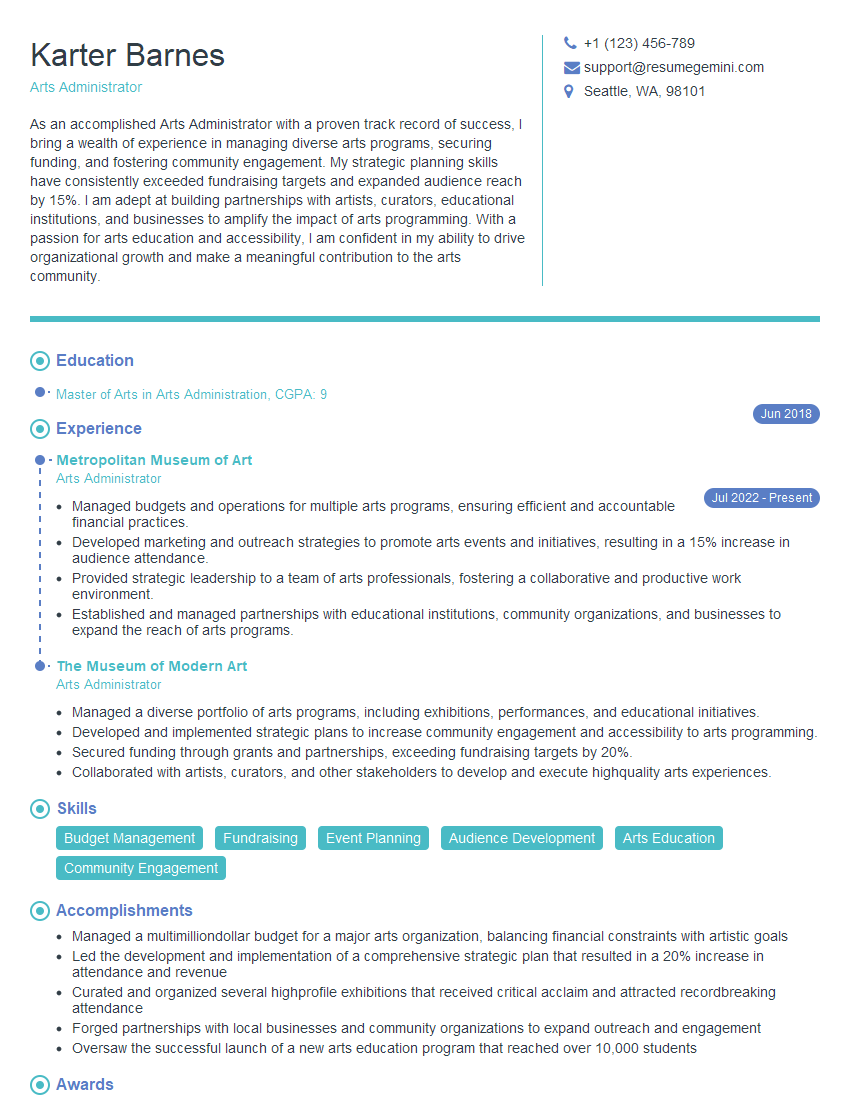
Arts Administrator Resume Sample
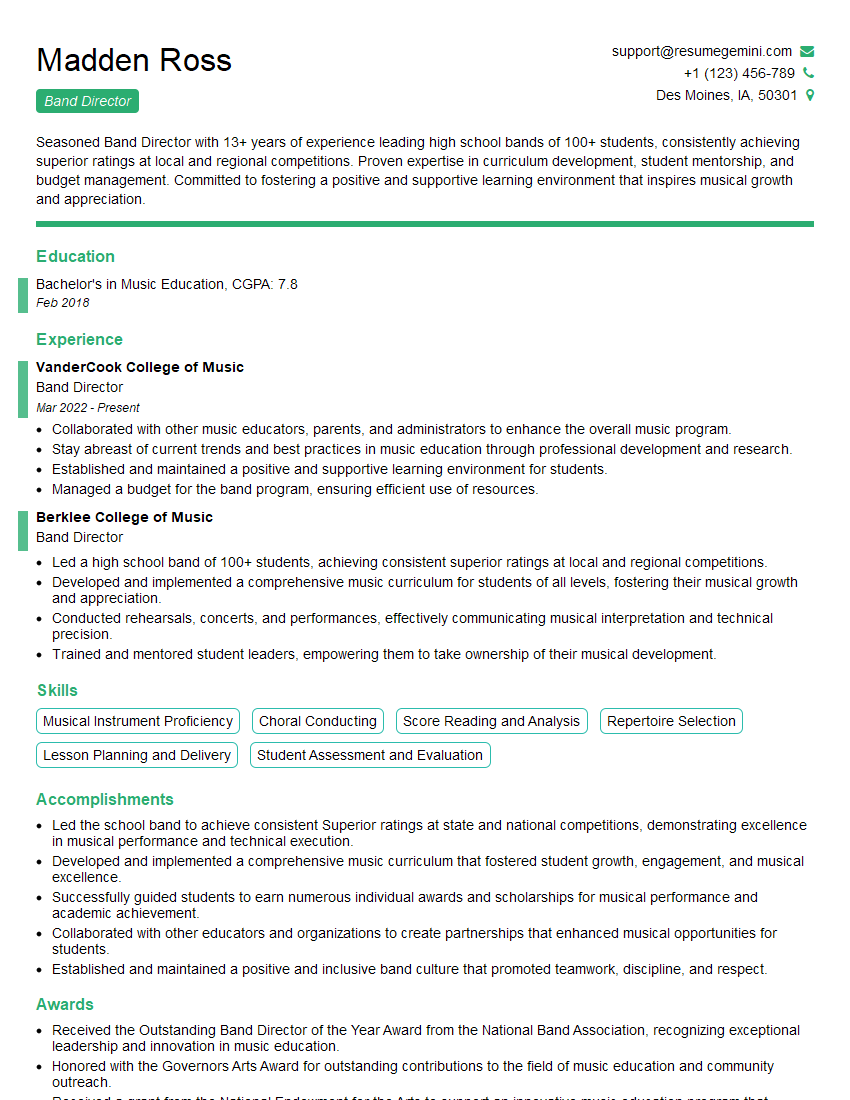
Band Director Resume Sample
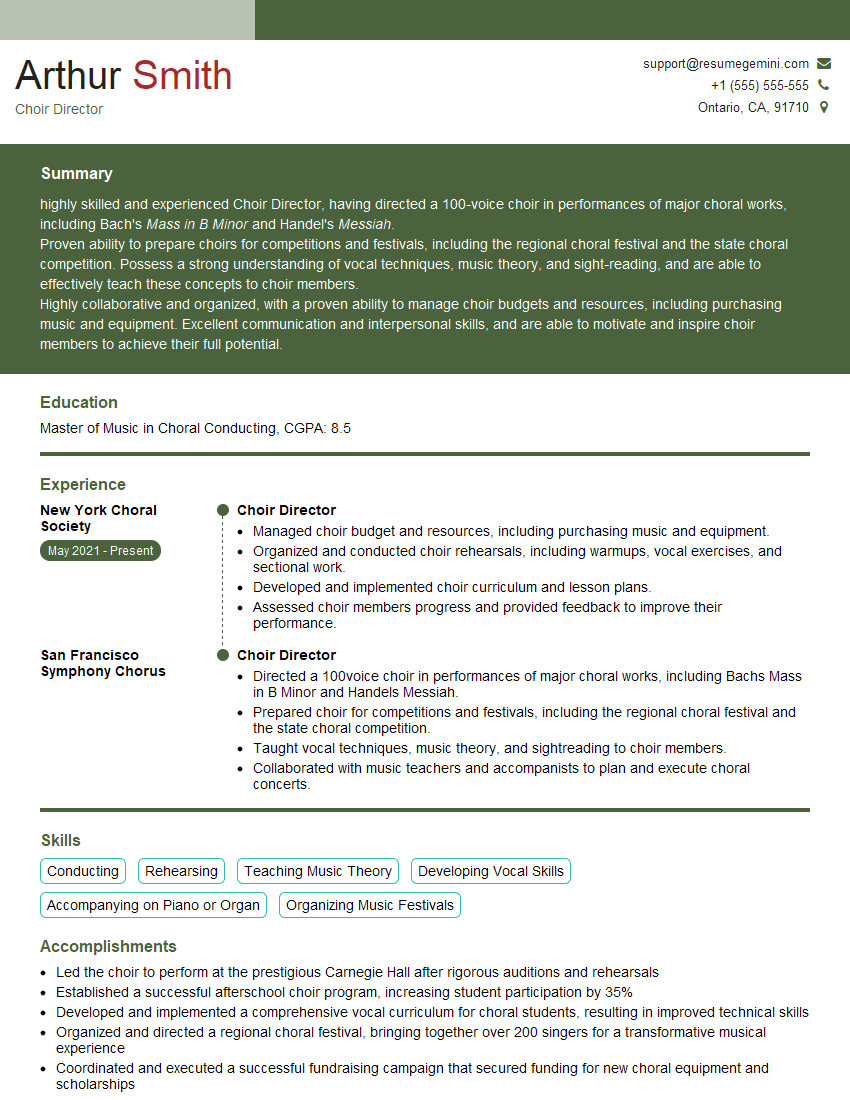
Choir Director Resume Sample
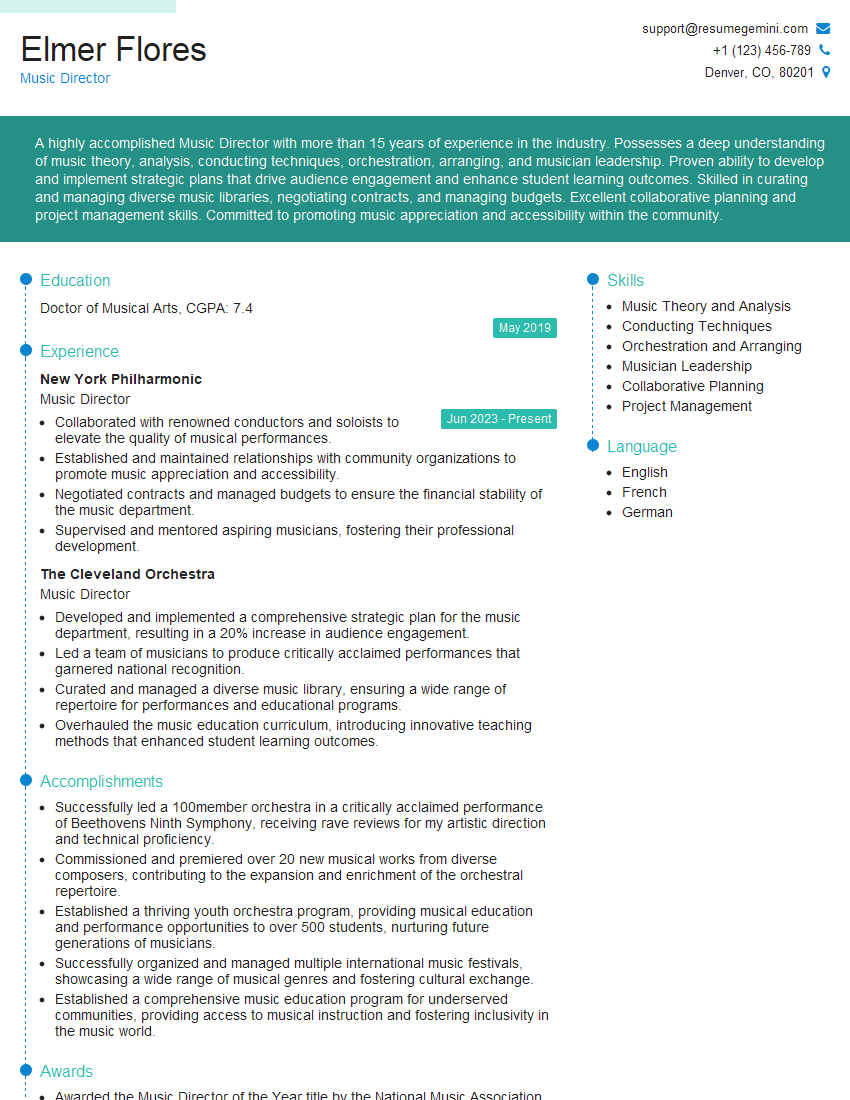
Music Director Resume Sample
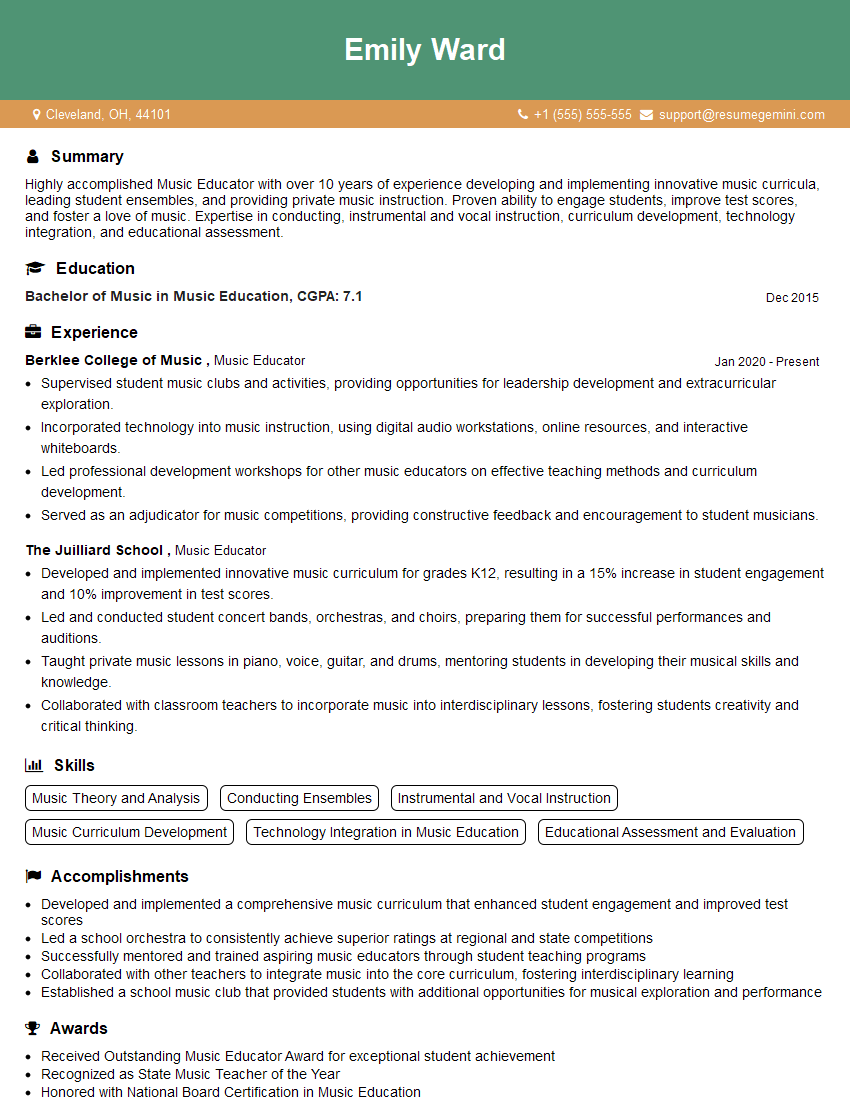
Music Educator Resume Sample
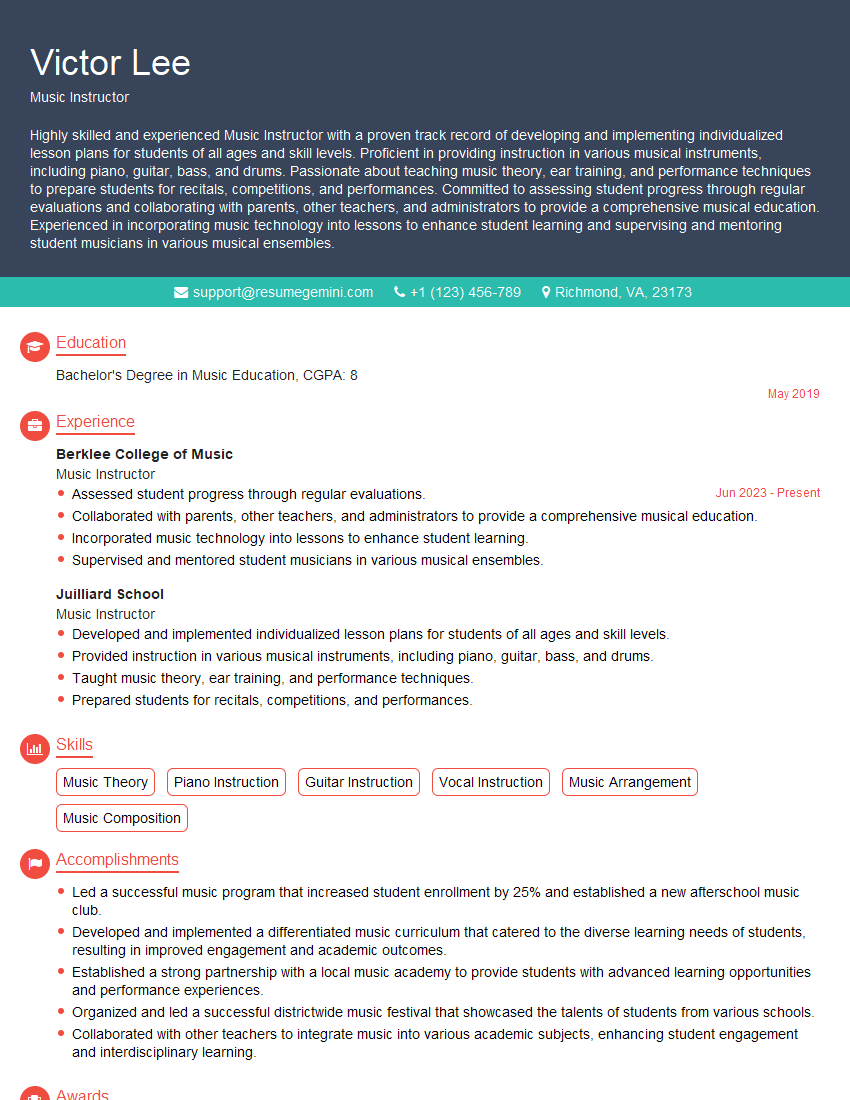
Music Instructor Resume Sample
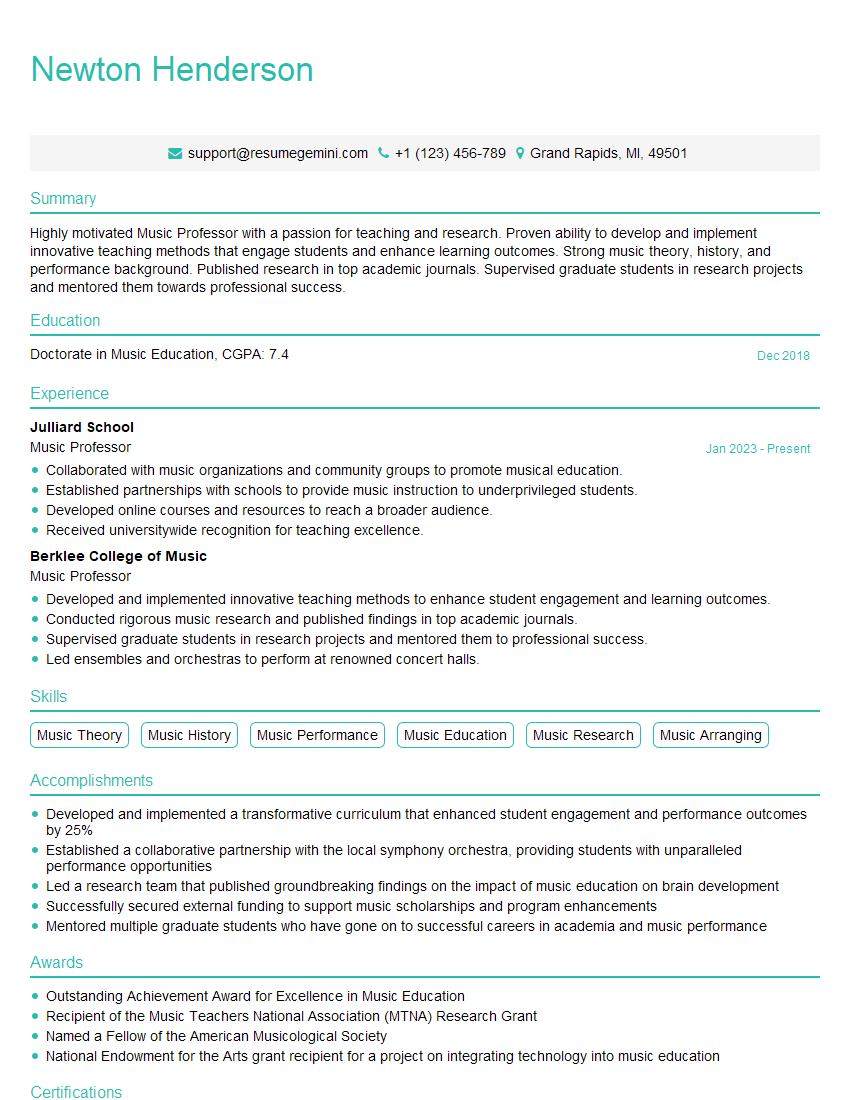
Music Professor Resume Sample
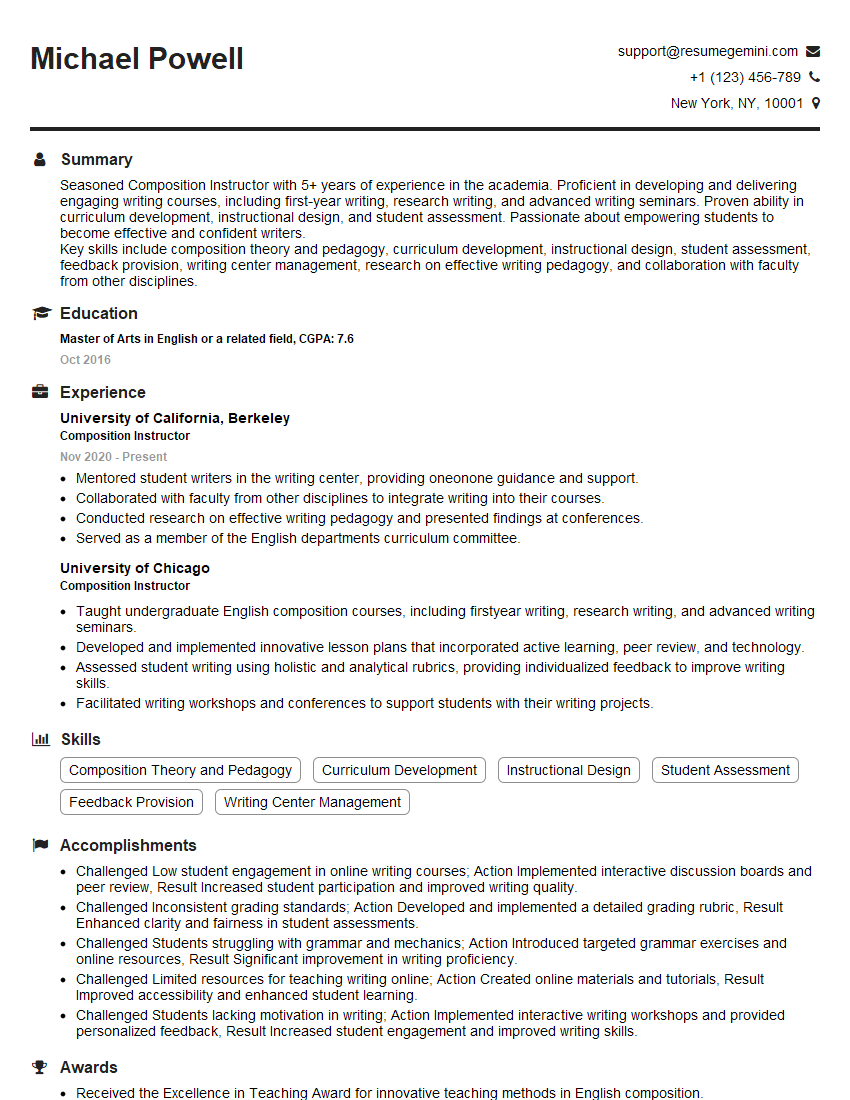
Composition Instructor Resume Sample
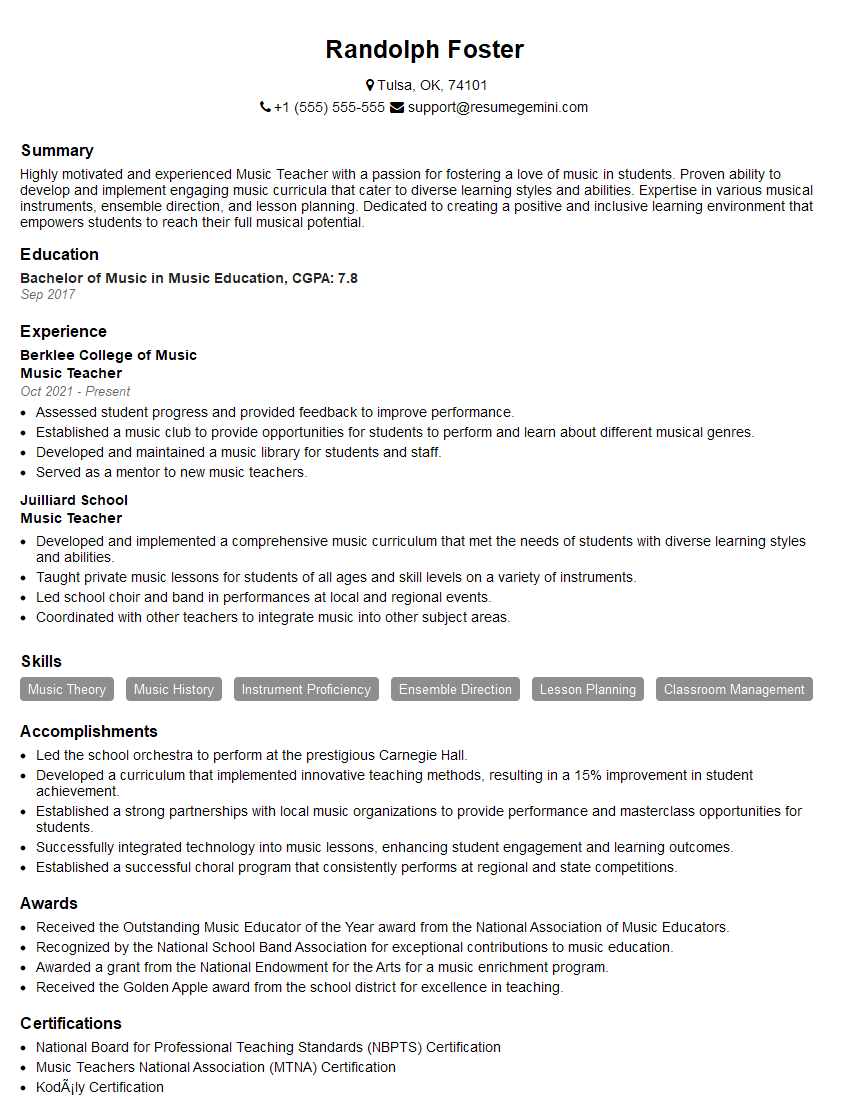
Music Teacher Resume Sample
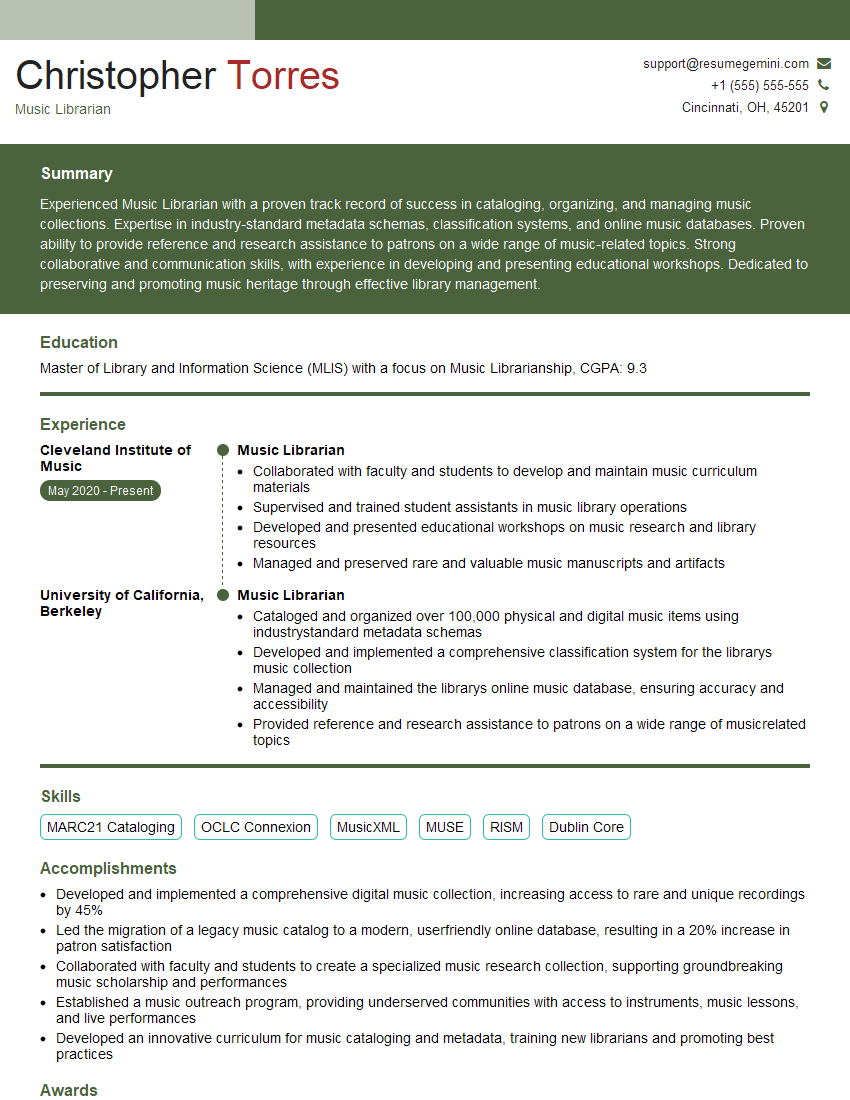
Music Librarian Resume Sample
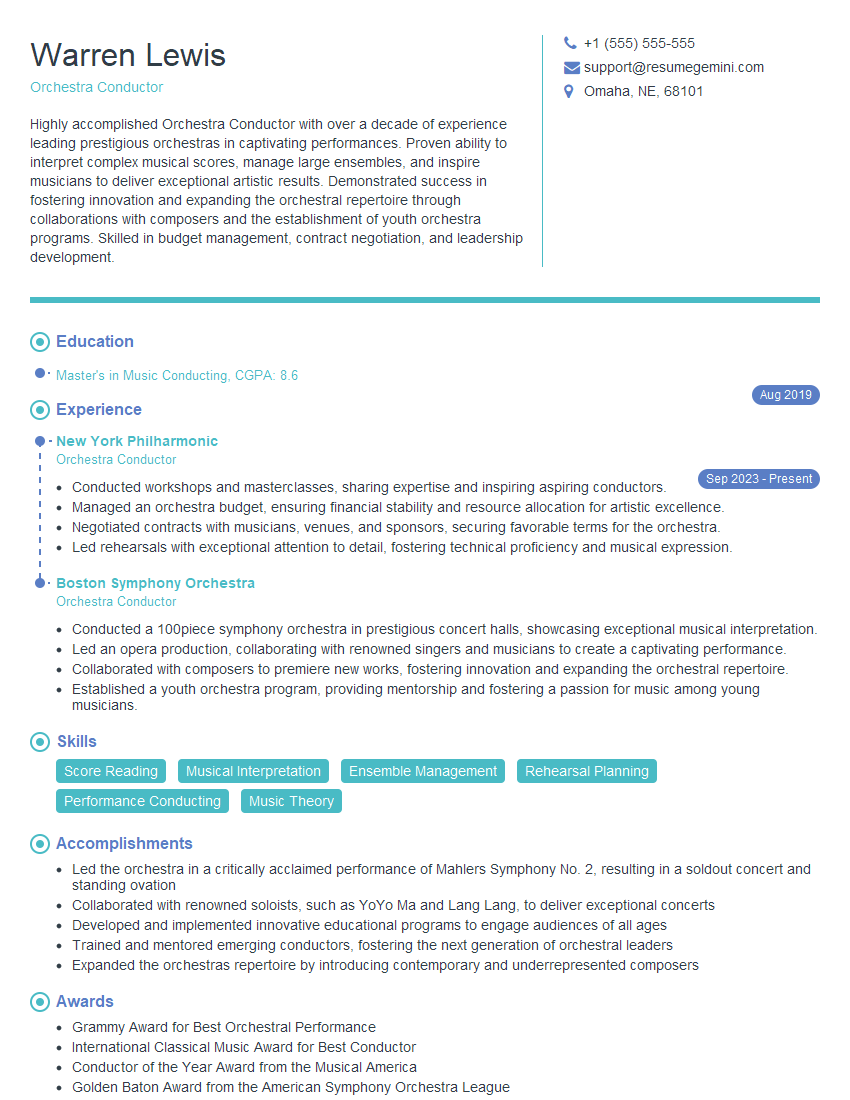
Orchestra Conductor Resume Sample
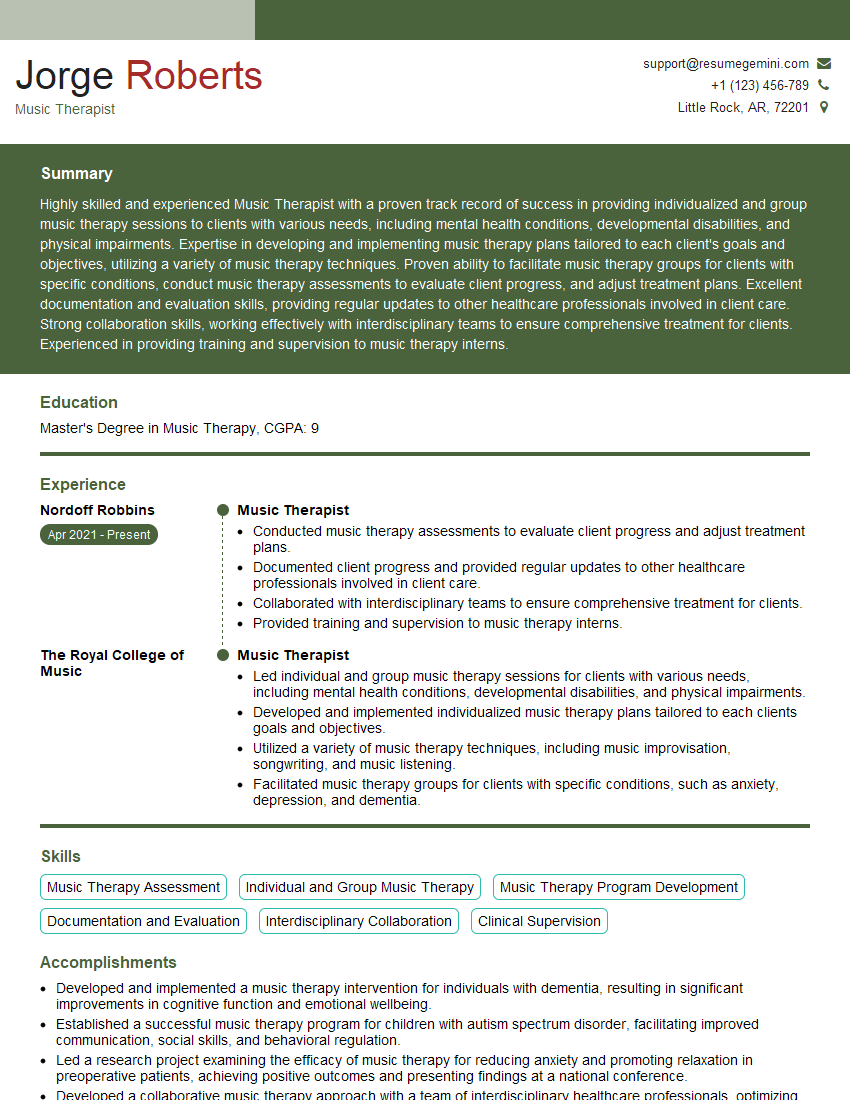
Music Therapist Resume Sample
Explore more articles
Users Rating of Our Blogs
Share Your Experience
We value your feedback! Please rate our content and share your thoughts (optional).
What Readers Say About Our Blog
Really detailed insights and content, thank you for writing this detailed article.
IT gave me an insight and words to use and be able to think of examples