Unlock your full potential by mastering the most common Music Theory and Harmony Knowledge interview questions. This blog offers a deep dive into the critical topics, ensuring you’re not only prepared to answer but to excel. With these insights, you’ll approach your interview with clarity and confidence.
Questions Asked in Music Theory and Harmony Knowledge Interview
Q 1. Explain the difference between major and minor scales.
Major and minor scales are the two most fundamental types of scales in Western music, distinguished primarily by the intervals between their notes. Think of it like this: major scales sound bright and happy, while minor scales sound darker and more serious.
A major scale is built using the formula: whole, whole, half, whole, whole, whole, half step intervals between consecutive notes (W-W-H-W-W-W-H). The key of C major, for instance, is C-D-E-F-G-A-B-C.
A natural minor scale uses a slightly different formula: whole, half, whole, whole, half, whole, whole (W-H-W-W-H-W-W). The key of A minor is A-B-C-D-E-F-G. Notice the difference in the placement of the half steps. This subtle shift dramatically alters the overall mood and feel.
Beyond the natural minor, we also have harmonic minor and melodic minor, which modify the 7th degree to create different harmonic implications. This is a deeper dive into the intricacies of minor keys, often employed for adding tension and resolution in musical pieces.
Q 2. Describe the characteristics of a dominant seventh chord.
A dominant seventh chord is a quintessential chord in Western harmony, known for its strong tendency to resolve to the tonic chord (the I chord in a given key). It’s characterized by a major triad plus a minor seventh interval built on the 5th degree of a major scale. Think of it as a chord that inherently creates a sense of anticipation and yearning for resolution.
For example, in the key of C major, the dominant seventh chord is G7, built from G-B-D-F. The interval between the root (G) and the seventh (F) is a minor seventh. This minor seventh is what gives the dominant seventh chord its characteristic tension.
The G7 chord powerfully pulls towards the C major chord (the tonic). Composers exploit this inherent drive to resolution to create dramatic and satisfying musical moments. This is a cornerstone of many musical styles, from classical to jazz.
Q 3. What are the different types of cadences?
Cadences are the resting points in a musical phrase, marking the end of a musical thought or section. They are essentially the punctuation marks of music, creating a sense of closure and direction. There are several types:
- Perfect Authentic Cadence (PAC): This is the strongest and most conclusive cadence, consisting of a dominant chord resolving to a tonic chord (V-I). Example: G7 to C major in C major key. This is the quintessential ‘home’ feeling in music.
- Imperfect Authentic Cadence (IAC): Similar to PAC but the dominant chord is not a seventh chord, it’s just a dominant triad. It’s still conclusive but less strong than a PAC.
- Plagal Cadence (Amen Cadence): This is a weaker cadence consisting of the subdominant chord (IV) resolving to the tonic chord (I). Often sounds peaceful and reflective; think of the ‘Amen’ cadence in hymns.
- Deceptive Cadence: This creates a surprising and unexpected turn by moving from a dominant chord to a chord other than the tonic. This often leads to a continuation of the musical idea, avoiding resolution for dramatic effect.
- Half Cadence: This cadence ends on the dominant chord (V) and leaves a sense of incompleteness, requiring a further resolution.
Q 4. Explain the concept of voice leading.
Voice leading is the art of smoothly and effectively connecting the notes in different melodic lines (voices) within a harmonic progression. It’s about ensuring that the melodic movement between chords is graceful and avoids awkward leaps or parallel fifths/octaves. Efficient voice leading creates a sense of clarity and flow in music.
Good voice leading involves keeping melodic lines relatively close together in terms of pitch. Large leaps or parallel motion of voices can create a dissonant or jarring effect. Composers strive for smooth, stepwise motion wherever possible, making the harmonic shifts sound natural.
Imagine a group of singers. Good voice leading ensures that their individual parts create a harmonious whole without clashing or sounding chaotic. Effective voice leading is essential for creating a pleasing and understandable musical texture.
Q 5. How do you analyze a chord progression?
Analyzing a chord progression involves understanding the function and relationships between each chord within a given key. This involves several steps:
- Identify the Key: Determine the overall tonal center (key) of the progression. This is usually evident from the most frequently used chords and the overall harmonic direction.
- Identify the Chords: Name each chord (e.g., I, ii, iii, IV, V, vi, vii°) using Roman numerals, referencing the key. This establishes their functional roles.
- Analyze Chord Functions: Determine each chord’s function: tonic (I), subdominant (IV), dominant (V), etc. Understanding this clarifies the harmonic movement and direction.
- Examine the Progressions: Look at the relationships between consecutive chords, noting any characteristic progressions like I-IV-V-I, ii-V-I, etc. These are common and recognizable patterns.
- Consider the Context: Examine the melody, rhythm, and overall musical structure to understand the harmonic role within the larger work. The emotional impact of the chords will often be influenced by these other elements.
This systematic approach will reveal the structure and harmonic intent behind the progression.
Q 6. What are common chord progressions in pop music?
Pop music frequently utilizes a variety of common chord progressions that have become almost clichés due to their effectiveness. Many of these are variations on the major and minor I-IV-V-I progressions.
- I-IV-V-I: This is a fundamental progression in many styles, providing a strong sense of resolution (e.g., C-F-G-C in C major). It’s simple, catchy, and satisfying.
- ii-V-I: This is another very common progression used to create a sense of movement towards the tonic (e.g., Dm-G7-C in C major). It’s a very widely used progression in jazz and pop.
- vi-IV-I-V: This progression adds a touch of melancholy or introspection before resolving to the tonic.
- Variations on these progressions: Many pop songs utilize variations by adding seventh chords, substitutions, or alterations to create more nuanced and interesting harmonic movements.
Many pop songs cleverly build upon and subtly modify these progressions to add their unique flavour while still maintaining the core structures that resonate with listeners.
Q 7. Explain the difference between parallel and relative major/minor keys.
Parallel and relative major/minor keys are closely related but distinct concepts. The difference lies in their relationship to the same tonic note:
Parallel Keys: These share the same tonic note but have different modes (major or minor). For example, C major and C minor are parallel keys. They share the same root, but the intervals that construct the scale are different, leading to distinctly different sounds and moods.
Relative Keys: These are major and minor keys that share the same key signature. A relative major and its relative minor share the same notes but begin on different notes. The relative minor of C major is A minor, and the relative major of A minor is C major. Notice that they both have no sharps or flats. This relationship is a very powerful tool used extensively in music composition and analysis.
In essence, parallel keys share the tonic, while relative keys share the key signature. They offer composers a way to modulate (shift keys) between closely related tonalities, creating interesting harmonic color and dramatic effect.
Q 8. Describe the function of secondary dominants.
Secondary dominants are chords that function as dominant chords, but to a chord other than the tonic. Think of them as a temporary ‘dominant’ leading to a chord that isn’t the home chord (tonic). They add a powerful sense of harmonic direction and color to a piece, creating a richer, more complex sound than simply moving directly to the target chord.
Imagine you’re walking a direct route from your home to a friend’s house. A secondary dominant is like taking a slightly longer, more interesting detour – it still gets you to your friend’s house, but with a more scenic route.
For example, if the target chord is G major (V in C major), a secondary dominant would be D7 (V/V in C major). The D7 resolves to G major, creating a smooth and satisfying progression. The same principle works with other chords; a secondary dominant of any chord is simply a dominant seventh chord built on the fifth degree of that chord.
Q 9. What are augmented sixth chords and their resolutions?
Augmented sixth chords are complex chords with a characteristically dissonant sound. They’re identified by their unique intervallic structure, which invariably includes an augmented sixth interval. Their name implies six notes, but that is not necessarily always the case, with many containing only four notes in practice.
There are several types of augmented sixth chords (Italian, French, German, and Austrian), each with its own characteristic resolution. The resolution typically involves resolving the augmented sixth interval to a perfect fifth or octave, smoothing out the dissonance and leading to a strong sense of resolution.
For example, the German augmented sixth chord (with a root of A) typically resolves to a D major chord. The leading tone (C#) resolves up to D, and the raised sixth (F#) resolves down to E, creating a powerful resolution.
Think of them as a puzzle; their initial dissonance creates tension, and the resolution provides a satisfying release. Composers used them strategically to create surprise, color, and harmonic interest.
Q 10. Explain the concept of modulation.
Modulation is the process of changing from one key to another during a piece of music. It’s like changing scenery in a play—it provides a fresh perspective and can add drama, variety, or emotional depth.
Modulations are achieved through a series of carefully chosen chords that create a smooth transition between keys. Common techniques involve using pivot chords (chords that belong to both the original key and the new key) or passing through closely related keys.
For instance, modulating from C major to G major might involve using a G major chord (which is both the tonic of G major and the dominant of C major) as a pivot point. This allows for a natural progression from one key to the other.
Understanding modulation is crucial for composers and arrangers. Effective modulation can significantly enhance a piece’s emotional impact and structural integrity. Improper modulations can sound jarring and disorienting, like abruptly changing the subject of a conversation without warning.
Q 11. How do you identify different melodic intervals?
Melodic intervals are measured from the lower note to the higher note, regardless of their position in the melody. Think of them as steps on a staircase.
We identify them by counting the number of scale steps between the notes, including the notes themselves. A major second is two scale steps (e.g., C to D), a perfect fifth is five scale steps (C to G), and so on. The quality of the interval (major, minor, perfect, augmented, diminished) is also considered, which depends on the specific notes involved.
For example, the interval between C and E is a major third (three scale degrees: C-D-E). The interval from C to Eb is a minor third. Accurate interval recognition is fundamental to sight-reading, composing, and analyzing music.
Q 12. How do you analyze a melody for its contour and phrasing?
Analyzing melody involves considering its contour (the shape of the melody) and phrasing (the grouping of notes into meaningful units).
Contour refers to the overall direction of the melody – is it mostly ascending, descending, stepwise, or does it have large leaps? Imagine a roller coaster; a mostly ascending melody has a steep climb, while a descending one shows a descent.
Phrasing involves identifying musical sentences or ideas. Phrases often end with a cadence (a resting point), indicating the end of a thought. Think of it as punctuation in a sentence; commas and periods indicate pauses and endings.
Analyzing contour and phrasing is essential for understanding a melody’s character and emotional impact. A soaring, ascending contour might evoke feelings of joy or triumph, while a descending contour could suggest sadness or resolution.
Q 13. Describe different types of rhythmic notation.
Rhythmic notation describes the duration and timing of notes. There are various ways to represent rhythm, depending on the complexity of the music and the notational system used.
Basic rhythmic notation uses note values (whole, half, quarter, eighth, sixteenth, etc.) to indicate note duration. These are combined with rests (silence) to create rhythmic patterns.
More advanced notations might include:
- Tuplets: groups of notes that occupy the time of a different note value (e.g., a triplet of eighth notes occupies the time of a quarter note).
- Syncopation: accenting notes on weak beats or off-beats, creating a rhythmic surprise.
- Complex meters: time signatures with unusual groupings of beats (e.g., 5/4, 7/8).
Understanding rhythmic notation is vital for musicians to accurately perform and interpret music.
Q 14. Explain the concept of counterpoint.
Counterpoint is the art of combining two or more independent melodic lines that sound pleasing together. Think of it as a conversation between two or more musical voices.
Different types of counterpoint exist, ranging from simple two-part counterpoint to complex polyphonic textures involving many voices. Rules govern counterpoint, including avoiding parallel fifths or octaves (two voices moving in the same direction at the interval of a fifth or octave), maintaining melodic independence, and resolving dissonances smoothly.
In simpler forms, one voice might act as a cantus firmus (a fixed melody) while another voice provides a countermelody. In more complex forms, multiple voices are equally important and interwoven. Mastering counterpoint requires a deep understanding of harmony, rhythm, and melodic construction. It’s a cornerstone of classical music and is still used by many composers today.
Q 15. What are some common compositional techniques?
Compositional techniques are the methods composers use to craft musical pieces. These techniques manipulate various musical elements to create specific effects and convey emotions. Some common ones include:
- Melody: Composers use melodic sequences, motifs (short, memorable melodies), and thematic development (transforming a motif throughout the piece) to build musical interest.
- Harmony: Techniques such as chord progressions (sequences of chords), modulation (changing keys), and voice leading (smooth movement of individual melodic lines) create harmonic richness and direction.
- Rhythm: Composers utilize rhythmic patterns, syncopation (accents on unexpected beats), and rhythmic variation to add energy and dynamism.
- Form: Structuring the piece using established forms like sonata form or rondo form provides a framework for presenting and developing musical ideas.
- Texture: Manipulating the interplay of melodic lines creates different textures, such as homophonic (one main melody with accompaniment) or polyphonic (multiple independent melodic lines).
- Dynamics and Articulation: Varying volume (dynamics) and note articulation (e.g., legato, staccato) adds expressive nuance and emotional impact.
- Instrumentation/Timbre: The choice of instruments and how they are used significantly affects the overall sound and character of a piece. Consider the contrasting timbres of strings and brass in a symphony.
Think of it like a painter using different brushstrokes, colors, and techniques to create a masterpiece. Each compositional technique is a tool that contributes to the overall artistic expression.
Career Expert Tips:
- Ace those interviews! Prepare effectively by reviewing the Top 50 Most Common Interview Questions on ResumeGemini.
- Navigate your job search with confidence! Explore a wide range of Career Tips on ResumeGemini. Learn about common challenges and recommendations to overcome them.
- Craft the perfect resume! Master the Art of Resume Writing with ResumeGemini’s guide. Showcase your unique qualifications and achievements effectively.
- Don’t miss out on holiday savings! Build your dream resume with ResumeGemini’s ATS optimized templates.
Q 16. Explain the difference between homophonic and polyphonic textures.
The difference between homophonic and polyphonic textures lies in the relationship between melodic lines.
Homophonic texture features a single, prominent melody supported by chords or accompaniment. Think of a simple pop song where the vocals are the melody and the instruments provide harmonic backing. It’s like a soloist with a backing band.
Polyphonic texture involves two or more independent melodic lines that are equally important and sound simultaneously. A fugue, a common Baroque form, is a prime example of polyphonic texture, where a single theme is presented in different voices. It’s like a conversation between multiple independent melodic voices.
A helpful analogy is to consider a choir: a homophonic texture would be everyone singing the same melody together, while a polyphonic texture would be several different melodic lines being sung simultaneously, each with its own character.
Q 17. How do you analyze a piece of music for its form?
Analyzing a piece’s form involves identifying recurring sections and understanding how they are organized. It’s like finding the chapters and sub-chapters of a book.
Here’s a step-by-step approach:
- Listen repeatedly: Become familiar with the piece’s overall sound and structure.
- Identify repeated sections: Look for melodic, harmonic, or rhythmic patterns that reappear. These are likely to represent distinct sections.
- Label the sections: Common labels include A, B, C, etc., for contrasting sections, and A, A’, A” for variations of a single theme.
- Analyze the relationships between sections: Note how sections are related (e.g., a repetition of A, or a contrast between A and B). How do they transition?
- Identify larger structures: See if smaller sections combine to form larger structural units, such as a verse-chorus structure in a pop song, or a ternary (ABA) form.
- Consider formal conventions: Recognize established musical forms like sonata form, rondo form, theme and variations, etc., and see if the piece conforms to these patterns.
For example, a simple song might follow an AABA structure (verse, verse, bridge, verse). More complex pieces may have multiple sections, repeats, and variations. The form helps understand the composer’s plan for presenting musical ideas.
Q 18. Describe the different periods of Western music history.
Western music history is broadly divided into several periods, each characterized by distinct stylistic features:
- Medieval Period (c. 450-1400): Music was primarily monophonic (single melodic line), with the development of Gregorian chant. The use of modes (scales) differed from our modern major and minor systems.
- Renaissance Period (c. 1400-1600): Polyphony became dominant, with composers like Josquin des Prez writing complex interwoven melodies. There was a greater emphasis on consonance and balance.
- Baroque Period (c. 1600-1750): Characterized by elaborate ornamentation, basso continuo (a continuous bass line supporting the harmony), and the rise of opera and the concerto. Composers like Bach and Handel exemplified this era’s grandeur and complexity.
- Classical Period (c. 1730-1820): Emphasized clarity, balance, and structure. The sonata form became a cornerstone, and composers like Haydn, Mozart, and Beethoven created masterpieces of elegance and precision.
- Romantic Period (c. 1820-1900): A focus on emotional expression, individualism, and larger orchestral forces. Composers like Schubert, Chopin, Brahms, and Wagner pushed boundaries of harmony, form, and orchestration.
- 20th and 21st Centuries: A period of radical experimentation, with atonal music (music without a tonal center), serialism (using pre-defined series of notes), and diverse styles blending elements from different traditions. Think of composers like Stravinsky, Schoenberg, and countless contemporary composers.
Each period builds upon its predecessors, but each has unique aesthetic and technical characteristics.
Q 19. What are some common musical forms?
Musical forms provide frameworks for organizing musical ideas. Some common forms include:
- Binary Form (AB): A two-part structure with contrasting sections. Often, the second section (B) may modulate (change key).
- Ternary Form (ABA): A three-part structure where the first section (A) is repeated after a contrasting middle section (B). Think of many folk songs.
- Rondo Form (ABACA): A form where a main theme (A) alternates with contrasting episodes (B, C, etc.).
- Sonata Form (Exposition-Development-Recapitulation): A complex form commonly used in sonatas, symphonies, and concertos. It involves presenting themes, developing them, and returning to them in a modified form.
- Theme and Variations: A form where a main theme is repeated with various modifications in harmony, rhythm, or melody.
- Fugue: A contrapuntal form featuring a main theme (subject) presented in different voices.
The choice of form significantly impacts the overall structure and narrative of a piece.
Q 20. Explain the concept of tonality.
Tonality refers to the organization of pitches around a central tone, or tonic. This creates a sense of gravitational pull, where the listener feels a ‘home’ note that other notes relate to. Think of it like a magnetic force in music.
In Western music, tonality is most often expressed through major and minor keys. Each key has a specific tonic, and the chords and scales within that key create a characteristic sound. The tonic provides a sense of resolution and stability, while other notes create tension that resolves back to the tonic. Modulation, a shift from one key to another, can create dramatic effects.
The concept of tonality has been fundamental to Western music for centuries, although it has been challenged and redefined in the 20th and 21st centuries with the rise of atonal and other experimental styles.
Q 21. What is a chromatic scale and how is it used?
A chromatic scale is a sequence of all twelve notes within an octave, without any skip or omission. Unlike diatonic scales (like major and minor scales), which have a specific pattern of whole and half steps, the chromatic scale uses only half steps. This means each note is a half step away from the next.
Here’s an example in C:
C - C#/Db - D - D#/Eb - E - F - F#/Gb - G - G#/Ab - A - A#/Bb - B - CChromatic scales are used for a variety of expressive purposes:
- Adding color and tension: Chromatic notes outside the key create a sense of dissonance and drama, leading to resolution within the key.
- Creating chromatic passing tones: These notes are used to connect notes within a melody and add smooth transitions.
- Modulation: Chromatic notes can be used to smoothly transition between different keys.
- Developing themes: Composers can use chromaticism to build intensity and create variation within a melody.
Think of chromaticism as a spice that adds color and complexity to the musical dish. Used effectively, it can significantly enhance the emotional impact of a piece.
Q 22. How do you notate a diminished chord?
A diminished chord is a triad (three-note chord) where all three notes are a minor third apart. This creates a characteristically unstable and dissonant sound. Because a diminished triad is built entirely of minor thirds, it is symmetrical; meaning it can be spelled in two ways. For example, a C diminished chord can be notated as C-Eb-Gb or C-Eb-Gb.
In notation, a diminished chord is usually indicated by a lowercase ‘o’ after the root note. For example, a C diminished chord would be written as C°. Alternatively, you could spell out the individual notes, but this is less common for diminished chords and usually reserved for other less common chords.
The characteristic sound of a diminished chord makes it a powerful tool in creating tension and resolution within a musical piece. Imagine it as the dramatic pause before a satisfying climax.
Q 23. Explain the concept of inversion in chords.
Inversion in chords refers to changing the bass note of a chord without altering the other notes within the chord. This process creates different voicings of the same chord, influencing its overall sound and function. Each voicing will have a unique character.
Consider a C major chord (C-E-G). Its first inversion (also called the ‘6/3’ chord) places the E as the bass note: E-G-C. The second inversion (also called the ‘6/4’ chord), places the G as the bass note: G-C-E. The fundamental bass note changes the harmonic effect of the chord, even though the notes remain the same. Think of it like rearranging furniture in a room; the furniture is the same, but the overall effect of the space is changed.
Inversions are essential for creating smooth voice leading in chord progressions and avoiding parallel fifths or octaves which can be dissonant.
Q 24. Describe the difference between perfect, major and minor intervals.
The difference between perfect, major, and minor intervals lies in the number of half steps between the two notes. Intervals are measured from the root (lowest) note to the upper note.
- Perfect intervals: These are typically consonant intervals, implying stability. A perfect interval contains a specific number of whole and half steps; a perfect unison (0 half steps), a perfect fourth (5 half steps), a perfect fifth (7 half steps), and a perfect octave (12 half steps).
- Major intervals: Major intervals are also generally considered consonant, though can also be dissonant depending on context, and are characterized by a slightly wider interval than their minor counterparts. A major second is 2 half steps, major third is 4 half steps, major sixth is 9 half steps, major seventh is 11 half steps.
- Minor intervals: Minor intervals are often more dissonant, or at least less consonant, than their major counterparts, and they have a narrower interval than the major versions. A minor second is 1 half step, a minor third is 3 half steps, a minor sixth is 8 half steps, and a minor seventh is 10 half steps.
Understanding these distinctions is crucial for identifying and constructing melodies, harmonies, and analyzing musical pieces effectively.
Q 25. How do you analyze a piece of music for its harmonic rhythm?
Analyzing a piece of music for its harmonic rhythm involves identifying how frequently the harmony changes. This is often measured in beats or measures. A slow harmonic rhythm implies a more stable harmonic progression, where chords are held longer, resulting in a more tranquil or lyrical feel.
To analyze harmonic rhythm, one would look at the score and identify each chord change. Count the number of beats or measures each chord is held. A fast harmonic rhythm will have frequent chord changes, creating a sense of energy and excitement. A piece that uses rhythmic changes in the harmony can create significant variation in texture and feel.
For example, a simple hymn might have a slow harmonic rhythm, whereas a complex jazz solo might have a very fast harmonic rhythm.
This analysis is critical for understanding the piece’s emotional impact and compositional techniques.
Q 26. What are some common harmonic devices?
Common harmonic devices are techniques used to add interest and complexity to a musical piece. Some popular ones include:
- Secondary Dominants: A dominant chord built on a scale degree other than the V chord that prepares a chord other than the tonic.
- Neapolitan Sixth: A minor chord built on the lowered second degree of the scale, adding a chromatic flavor and often resolving to the dominant chord.
- Augmented Sixth Chords: These create significant tension due to their dissonant nature and typically resolve to a dominant or tonic chord.
- Passing Chords: Non-essential chords that connect two more essential chords.
- Deceptive Cadences: These avoid the expected resolution to the tonic chord, creating surprise and intrigue.
These devices, when used effectively, add richness, depth, and surprise to the harmonic progression, making the music more engaging for the listener.
Q 27. Explain your understanding of musical analysis software.
Musical analysis software provides valuable tools for analyzing musical pieces. These tools automate processes such as pitch detection, chord recognition, key detection, and harmonic analysis. I have experience using several software packages, including (examples might include specific software names like Sibelius, Finale, Antares Auto-Tune, or Melodyne). These programs help in a variety of tasks such as:
- Transcription: Converting audio into musical notation.
- Chord Identification: Accurately identifying chords in audio files.
- Harmonic Analysis: Analyzing the harmonic progression and identifying harmonic devices and key changes.
These tools significantly enhance the speed and accuracy of musical analysis, freeing up time for deeper interpretive work.
Q 28. Describe your experience with ear training exercises.
Ear training is fundamental to my musicianship. My experience encompasses a range of exercises including interval recognition, chord recognition, melody dictation, and rhythm dictation. I’ve used a variety of methods, including:
- Interval Training: Identifying intervals played on an instrument or sung.
- Chord Recognition: Identifying triads, seventh chords, and other chord types.
- Melody Dictation: Writing down a melody heard only once.
- Rhythmic Dictation: Writing down a rhythmic pattern heard only once.
Consistent practice with these exercises has significantly improved my ability to perceive and analyze music aurally. This skill is invaluable for composition, performance, arranging, and teaching.
Key Topics to Learn for Music Theory and Harmony Knowledge Interview
- Scales and Modes: Understand major, minor, and modal scales; their construction, characteristics, and application in different musical contexts. Practice identifying them aurally and visually.
- Chord Progressions and Voicings: Master common chord progressions (e.g., I-IV-V-I, ii-V-I) and explore various voicings for each chord. Be prepared to analyze and create chord progressions in different styles.
- Harmonic Analysis: Develop proficiency in analyzing musical scores, identifying chord functions (tonic, dominant, subdominant), and understanding the relationships between chords within a piece.
- Counterpoint: Familiarize yourself with the principles of two-part and multi-part counterpoint, including species counterpoint and its application in composition.
- Form and Structure: Understand common musical forms (e.g., sonata form, rondo form, theme and variations) and how harmonic progressions contribute to the overall structure of a piece.
- Cadences and Harmonic Resolutions: Learn to identify different types of cadences (perfect authentic, imperfect authentic, plagal, etc.) and how they create a sense of closure or continuation.
- Intervallic Relationships: Develop a strong understanding of intervals and their harmonic functions. Be able to identify intervals both aurally and visually.
- Non-Functional Harmony: Be prepared to discuss and analyze examples of chromaticism, altered chords, and other elements that move beyond traditional functional harmony.
- Practical Application: Prepare to discuss how your theoretical knowledge has informed your practical musical experiences, such as composition, performance, or analysis.
Next Steps
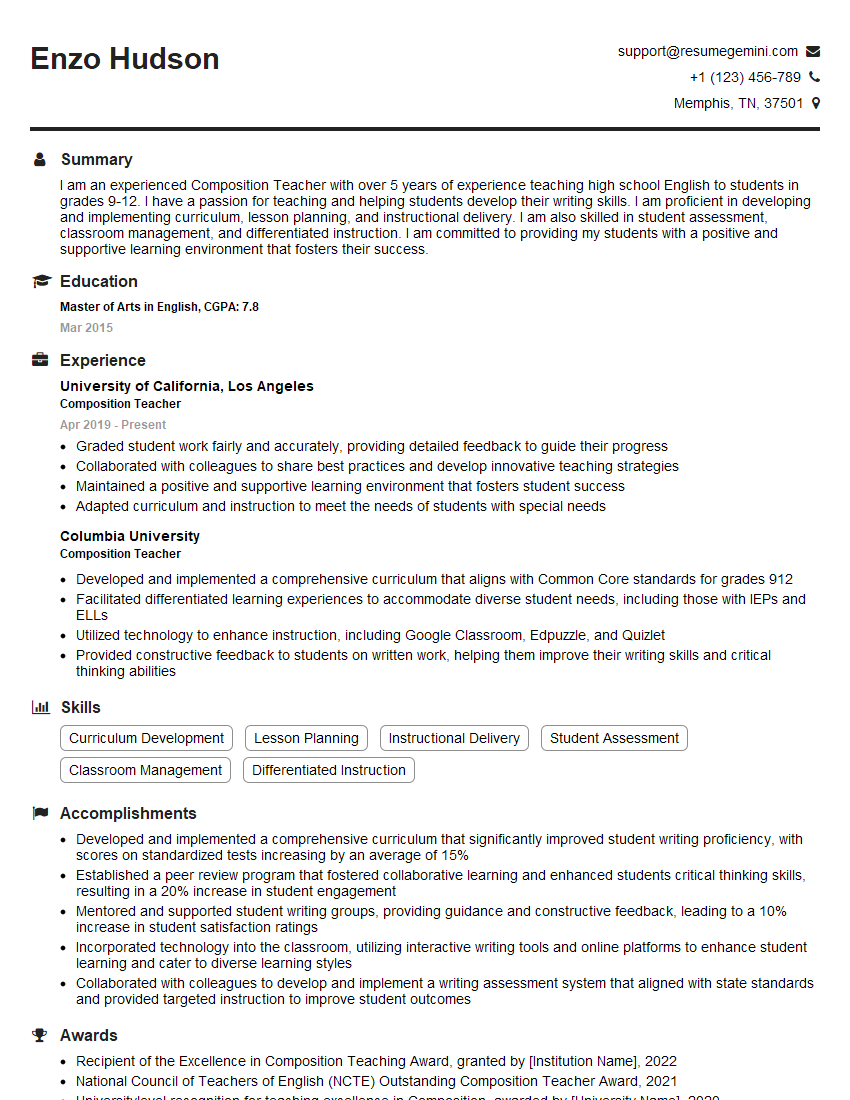
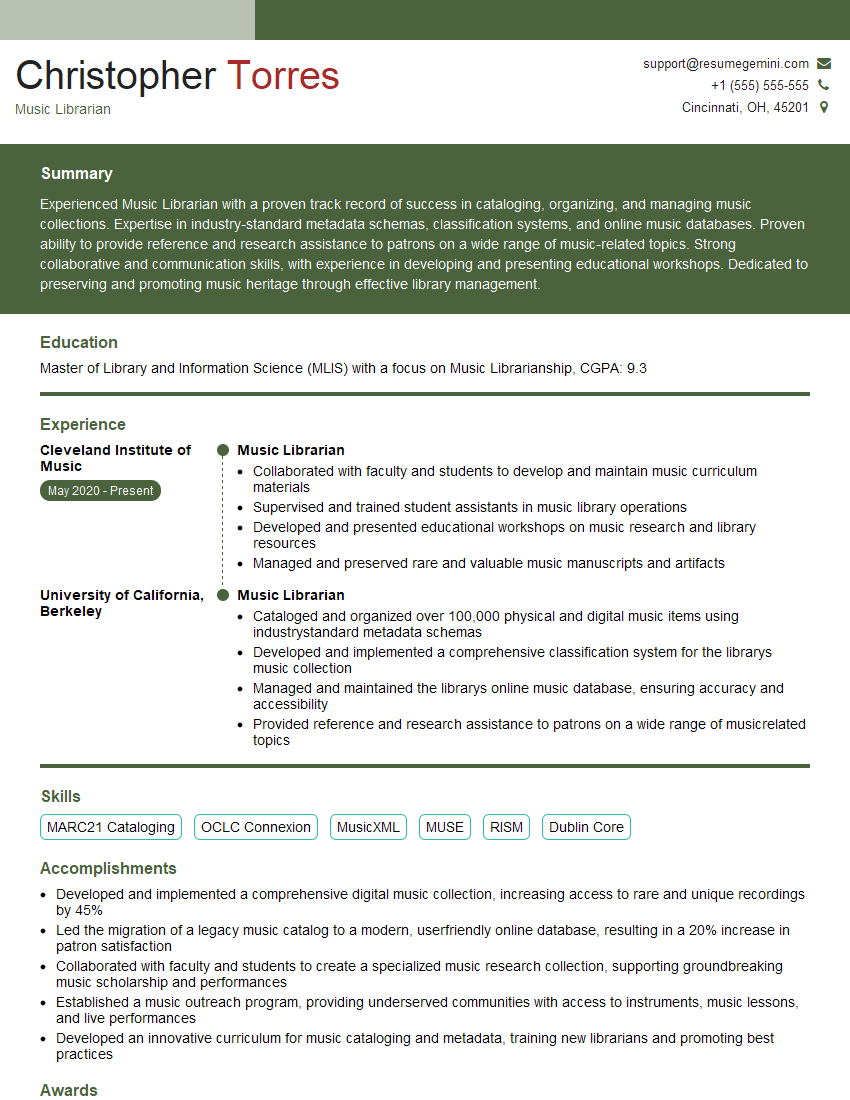
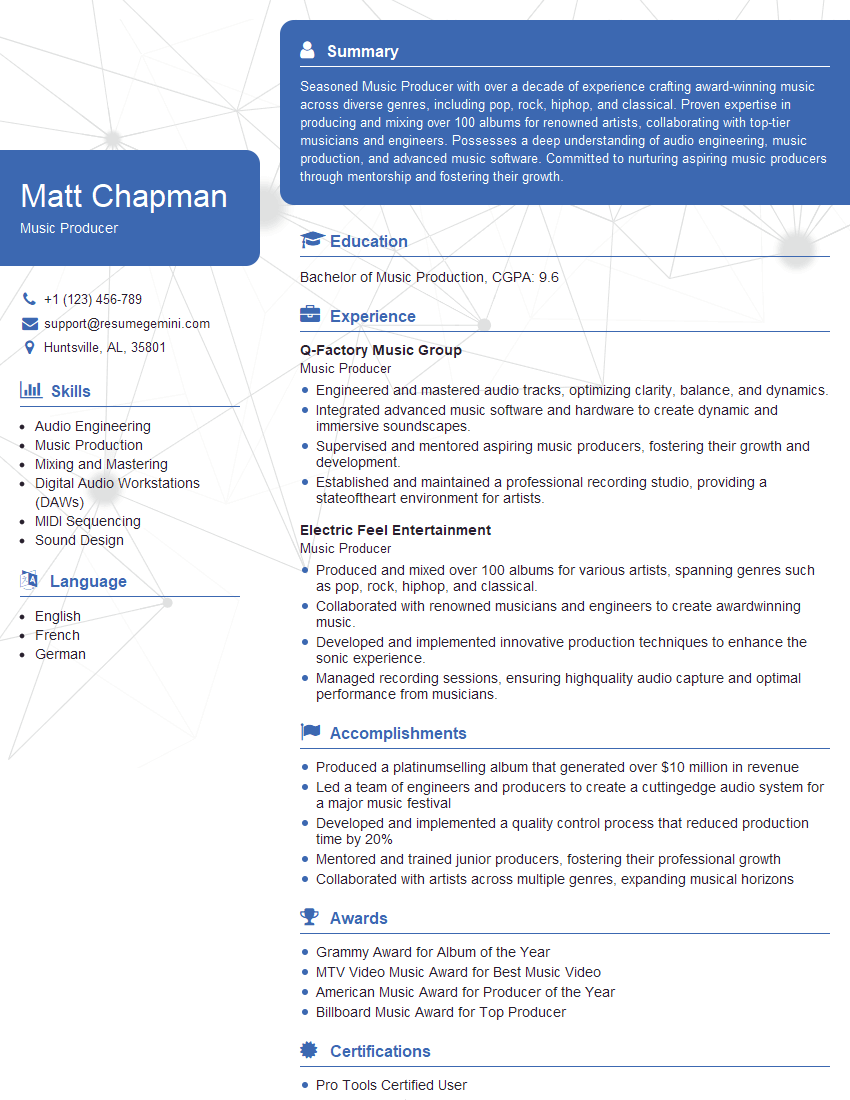
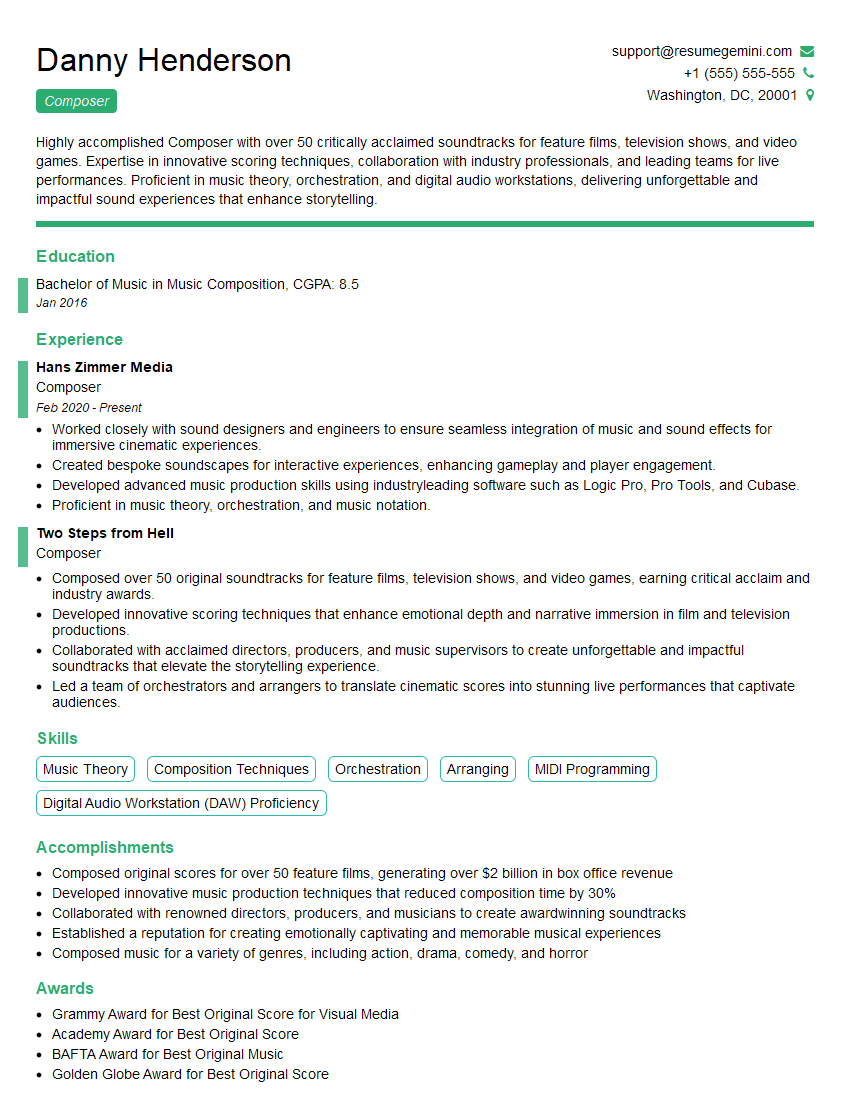
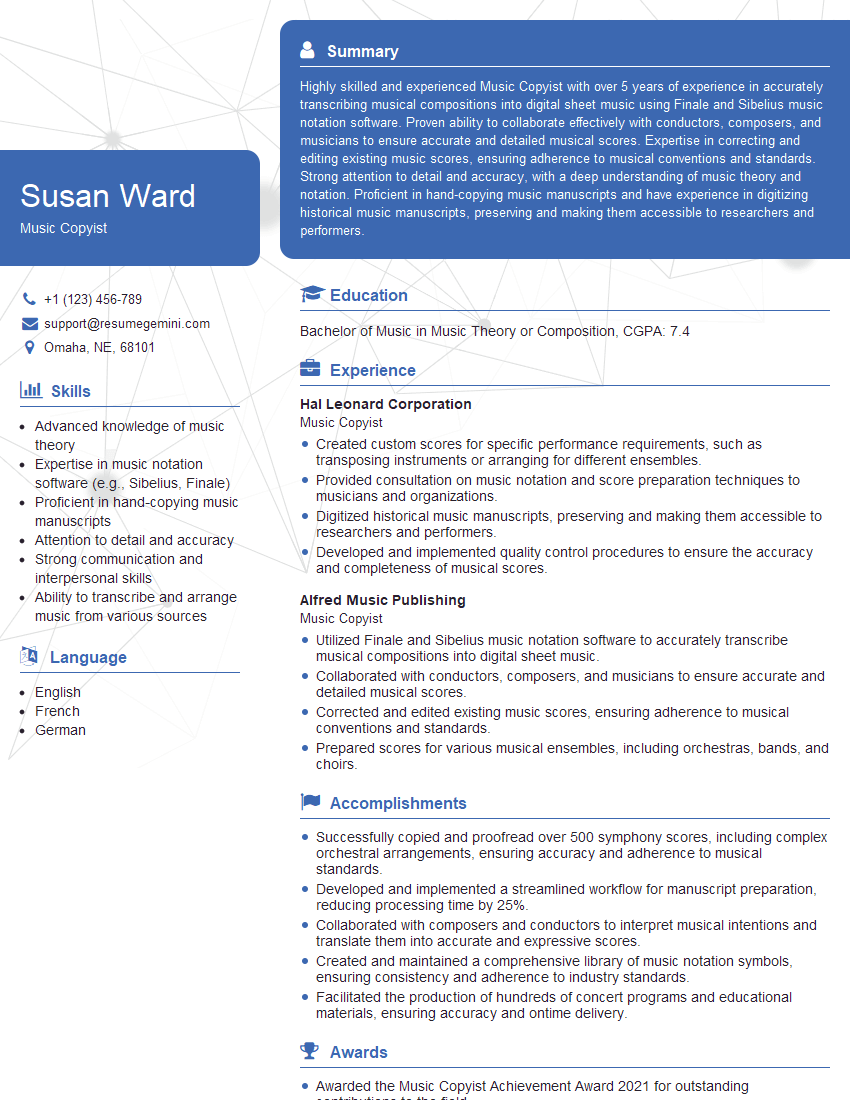
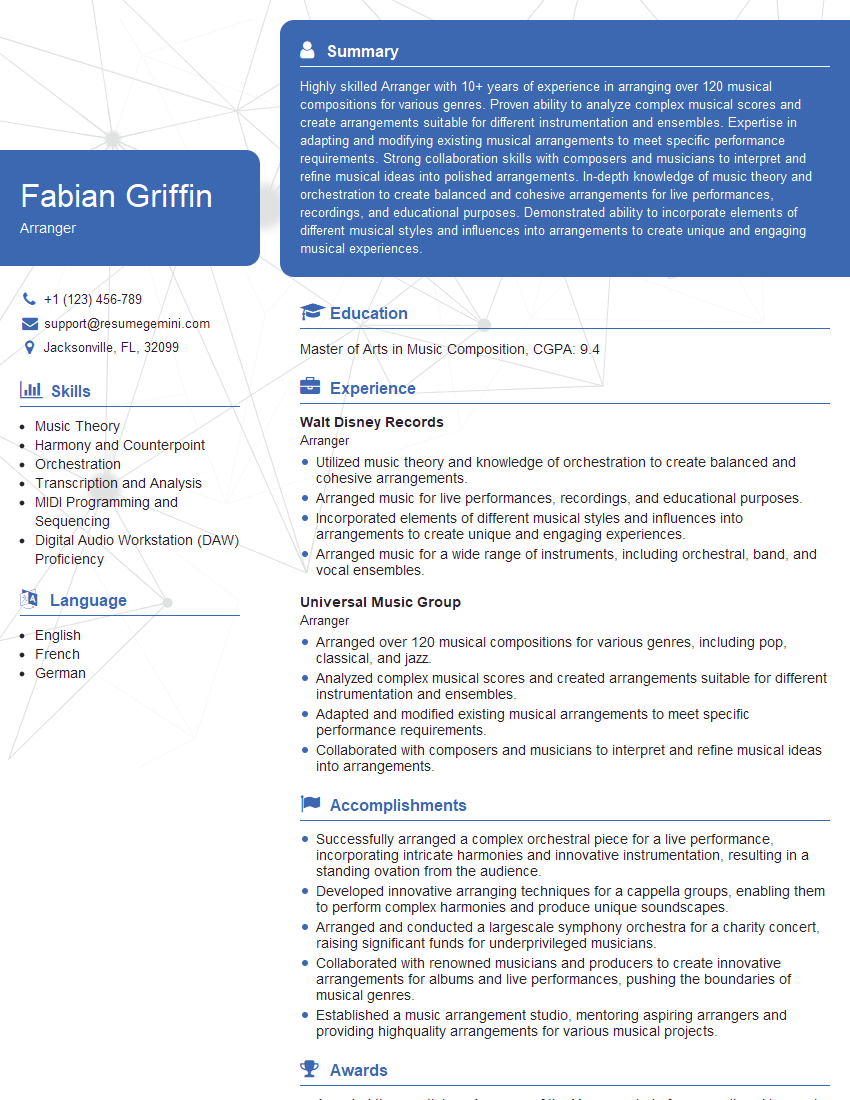
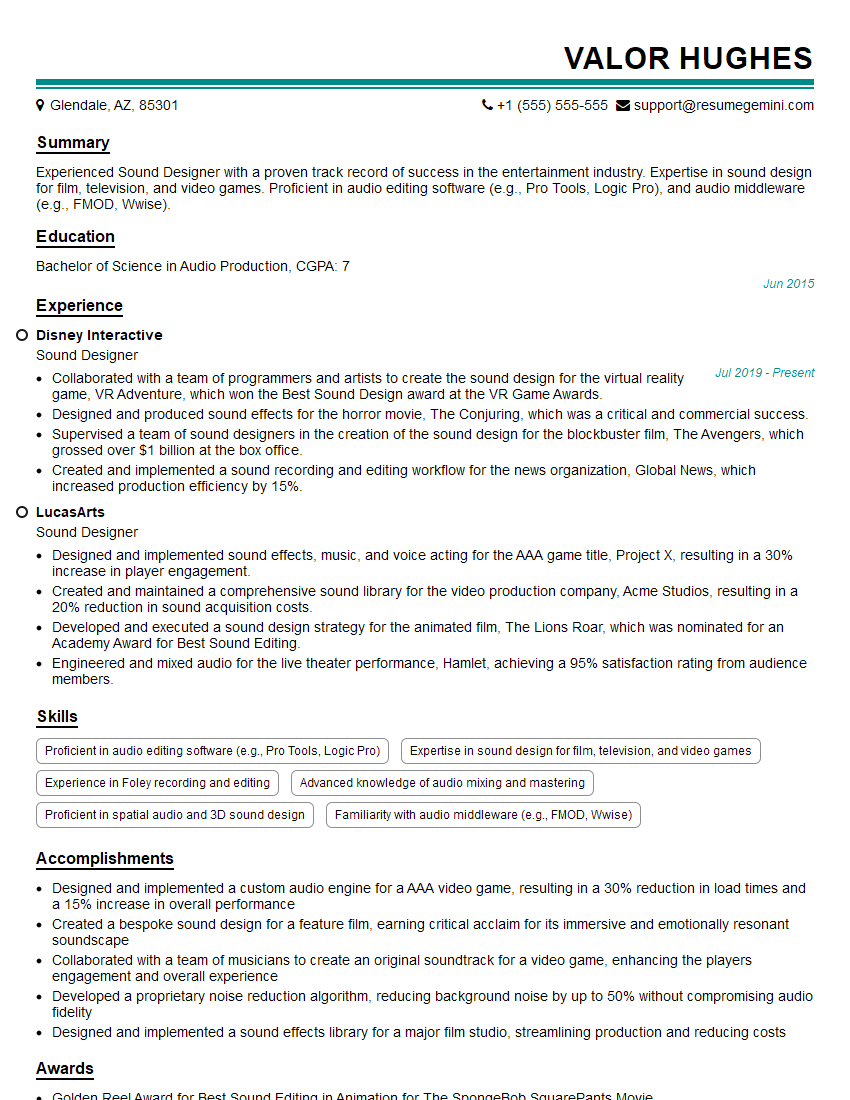
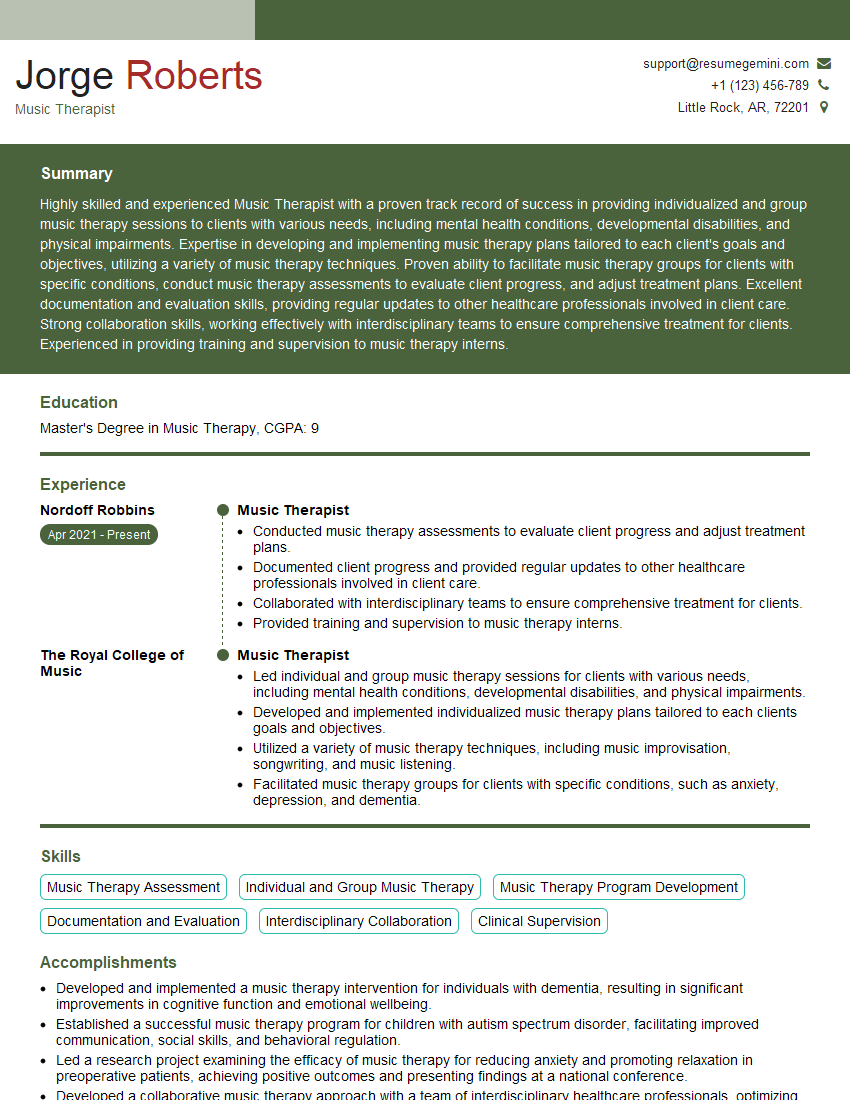
Mastering Music Theory and Harmony Knowledge is crucial for career advancement in various music-related fields. A strong theoretical foundation opens doors to diverse opportunities, from composition and arranging to music education and analysis. To maximize your job prospects, create an ATS-friendly resume that highlights your skills and accomplishments effectively. ResumeGemini is a trusted resource to help you build a professional and impactful resume that showcases your expertise. Examples of resumes tailored to Music Theory and Harmony Knowledge are available to guide you through the process.

Explore more articles
Users Rating of Our Blogs
Share Your Experience
We value your feedback! Please rate our content and share your thoughts (optional).
What Readers Say About Our Blog
Really detailed insights and content, thank you for writing this detailed article.
IT gave me an insight and words to use and be able to think of examples