Every successful interview starts with knowing what to expect. In this blog, we’ll take you through the top Orchestral and Chamber Music Instrumentation interview questions, breaking them down with expert tips to help you deliver impactful answers. Step into your next interview fully prepared and ready to succeed.
Questions Asked in Orchestral and Chamber Music Instrumentation Interview
Q 1. Explain the difference between scoring for a string quartet and a full orchestra.
Scoring for a string quartet versus a full orchestra is a stark contrast in terms of texture, range, and expressive possibilities. A string quartet, with its intimate ensemble of two violins, viola, and cello, demands a more tightly woven texture, relying heavily on counterpoint and interplay between the individual instruments. The dynamic range is inherently limited, focusing on nuanced shifts rather than massive orchestral swells.
In contrast, a full orchestra boasts a vast palette of timbres and dynamic capabilities. The composer has access to woodwinds, brass, percussion, and the larger string section, allowing for a far broader range of textures, from delicate whispers to powerful fortissimos. Orchestral scoring involves carefully balancing the various instrumental families to achieve a desired sonic effect, something impossible within the constraints of a string quartet.
Imagine trying to depict a raging storm: A string quartet might achieve this through furious bowing and dramatic leaps in pitch, whereas an orchestra could use a full-blown tutti passage with crashing cymbals, low brass, and driving strings for a much grander, more visceral effect.
Q 2. Describe your experience with Sibelius or Finale for orchestral scoring.
I’ve been using Sibelius extensively for over fifteen years now for all my orchestral and chamber scoring projects. Its intuitive interface and powerful notation capabilities are invaluable. I find the ability to easily manipulate individual instrument parts, adjust articulations, and experiment with different orchestral combinations to be essential. While I’m familiar with Finale, Sibelius’s workflow feels more natural and efficient to me, especially when dealing with the complexities of large orchestral scores. For example, Sibelius’s implementation of playback and its various sound libraries have proven extremely helpful for refining the balance and clarity of my scores before they are rehearsed. I frequently use its advanced features for creating custom articulations and instrument libraries to ensure an accurate representation of my intentions.
Q 3. How do you approach balancing the timbres of various orchestral instrument families?
Balancing orchestral timbres is a crucial aspect of scoring. It’s not simply a matter of making each section equally loud; it’s about creating a harmonious blend where each family contributes meaningfully to the overall texture without overshadowing others. My approach involves considering several factors:
- Frequency Range: Instruments have distinct ranges. I avoid overlapping too much in the middle frequencies, as this can lead to muddiness. For example, I might utilize the higher registers of the cellos to avoid clashing with the lower violas.
- Instrumental Character: Each family possesses a unique sonic character. I try to utilize these characteristics to add color and depth. A solo oboe might provide a plaintive melody while the brass section creates a powerful counterpoint.
- Dynamic Contrast: I use dynamic markings to control the balance. A soft passage from the woodwinds can stand out against a more moderately loud string section.
- Iterative Refinement: Balancing is an iterative process. I usually listen to playback repeatedly, adjusting levels and voicings as needed until I achieve the desired effect.
Think of it as a painter carefully choosing colors on a canvas – too much of one color can overwhelm the others, but a skillful blend creates a rich and vibrant picture.
Q 4. What are the common challenges in arranging for chamber ensembles?
Arranging for chamber ensembles presents unique challenges compared to orchestral scoring. The reduced number of players necessitates careful consideration of each part’s role and avoids overwriting.
- Part Writing: Chamber music often relies on sophisticated counterpoint and independent lines, requiring careful attention to voice leading and avoiding clashes.
- Range Limitations: The limited number of players means that the composer can not simply add more instruments to fill gaps in the texture, requiring careful consideration of each instrument’s limitations and capabilities.
- Balance: Achieving balance can be tricky, especially between contrasting instrumental families. The dynamic range will be less than in a full orchestra and any one instrument part could easily overpower the other parts if not carefully balanced.
- Texture: The texture must be transparent, allowing each individual voice to be clearly heard. Overly dense textures will result in muddiness.
A skilled chamber music arranger will cleverly distribute melodic and harmonic material across the ensemble, ensuring each instrument has a prominent role, while maintaining a transparent and engaging texture.
Q 5. Discuss the considerations for writing for specific orchestral instruments, e.g., the oboe or trombone.
Writing for specific instruments demands understanding their unique capabilities and limitations. The oboe, for example, excels in expressive melodies and its delicate tone, but its range is limited and it needs careful consideration of its dynamic capabilities. I often use the oboe’s distinctive timbre to add a touch of melancholy or nostalgia to a composition.
Conversely, the trombone’s powerful, rich tone and wide range lend itself to weighty countermelodies or bold statements within the score. I might use the trombone’s lower register to add a sense of gravity or weight to a passage or its higher range to add a brighter more assertive tone.
The key is to exploit the strengths of each instrument while avoiding their weaknesses. This demands extensive knowledge of each instrument’s technical capabilities, fingering, and common performance practices.
Q 6. How do you handle potential range limitations when scoring for different instruments?
Range limitations are a constant concern in scoring. My approach involves several strategies:
- Careful Part Writing: I meticulously plan each instrument’s part to stay within its comfortable range. I avoid writing extended passages in extreme registers unless it’s a deliberate expressive choice.
- Transposition: In some cases, I might transpose a melody or harmony to suit a particular instrument’s range.
- Strategic Doubling: Occasionally, I’ll double a melody or harmony in different instruments to enhance its impact while minimizing strain on any particular instrument.
- Octave Displacement: Using octaves judiciously allows both a low and high voicing of the same passage, allowing the composer to balance the dynamics while also maintaining the impact of the passage.
Ultimately, it’s about finding creative solutions while respecting the instruments’ physical capabilities. It’s a delicate balance between artistic expression and practical considerations.
Q 7. Explain your process for creating a balanced and effective orchestral texture.
Creating a balanced and effective orchestral texture is a multi-faceted process involving careful consideration of several elements:
- Layering: I carefully layer instrumental groups to create depth and interest, avoiding excessive density in the middle frequencies. This creates a sense of depth and dimension.
- Contrast: I incorporate a variety of textures, from solo passages to full tutti sections, to maintain interest and avoid monotony. This dynamic approach adds richness and keeps the listening experience engaging.
- Homophony vs. Polyphony: I strategically use homophonic (chordal) and polyphonic (independent lines) textures, blending them to create an engaging and varied sonic landscape.
- Instrumental Color: I use the unique color and character of each instrument family to paint a musical picture. This allows for a full sonic palette and gives the composer an array of textures to work with.
- Dynamic Variation: Careful dynamic markings are crucial in balancing the texture. I use a full range of dynamics to create excitement and provide a range of expressive capabilities.
The process is highly iterative. I constantly listen to playback, adjusting levels, voicings, and dynamics until I’m satisfied with the balance and overall effect. It’s a process of careful listening and subtle adjustments, like a sculptor refining a masterpiece.
Q 8. Describe your familiarity with different orchestral scoring styles (e.g., Romantic, Classical, Modern).
My familiarity with orchestral scoring styles spans across various historical periods. The Classical period (roughly 1730-1820), exemplified by composers like Haydn and Mozart, is characterized by a clear, balanced texture, often featuring homophonic passages and a relatively smaller orchestra. The Romantic period (roughly 1820-1900), on the other hand, saw a dramatic expansion of orchestral forces, with composers like Mahler and Wagner employing massive instrumental combinations to create lush, expressive soundscapes. Modern and contemporary styles (20th and 21st centuries) show an incredible diversity, ranging from the atonal and dissonant works of Schoenberg and Stravinsky to the minimalist compositions of Philip Glass. I’m adept at recognizing and emulating the idiomatic writing styles of each period, understanding how composers of different eras utilized the orchestra’s resources to achieve specific sonic and expressive effects. For instance, I understand the subtle differences in string writing between the Classical emphasis on elegance and the Romantic focus on powerful swells and expressive vibrato.
Understanding these stylistic differences goes beyond mere technical proficiency. It involves grasping the historical context, the evolving musical language, and the composers’ individual aesthetics. This informs my approach to both analyzing existing scores and composing new ones, ensuring authenticity and stylistic coherence.
Q 9. How do you ensure clarity and legibility in your orchestral scores?
Clarity and legibility in orchestral scores are paramount. My approach focuses on several key aspects. First, I use a clear, consistent system of notation, adhering to established conventions and avoiding ambiguity. This includes meticulous spacing and clear articulation markings. Second, I employ a logical layout, ensuring that individual parts are well-organized and easy to follow, avoiding cluttered pages. I use appropriate levels of stem direction and beaming, so the eye can easily follow the lines. Third, I utilize color-coding sparingly, but effectively, to differentiate instrumental sections, especially helpful for complex passages.
For instance, in particularly dense textures, I might use a slightly lighter ink for less prominent melodic lines, guiding the performer’s eye toward the more essential elements. I frequently use software such as Sibelius or Dorico, which provide tools to check for potential notational problems and optimize the layout automatically. Ultimately, a legible score enhances the performance by reducing potential errors and confusion, enabling musicians to focus on the music’s interpretation and expression rather than deciphering the notation.
Q 10. How do you choose instrumentation to achieve a specific emotional effect?
Choosing instrumentation to evoke specific emotions is a crucial aspect of orchestral composition. Different instruments possess inherent timbral qualities that lend themselves to particular emotional expressions. For example, the soaring lines of the violins can suggest romance or yearning, while the somber tones of the trombones might convey gravity or tragedy. The bright, piercing sounds of trumpets can represent triumph or fanfare, whilst the melancholic tones of the oboe might suggest sadness or introspection.
To achieve a specific emotional effect, I consider not only the individual instrumental colors but also their interaction. A quiet passage played by solo strings might create a sense of intimacy, while a powerful tutti passage involving the full orchestra could convey grandeur or excitement. The dynamic range, texture, and rhythmic patterns also play significant roles in shaping the overall emotional impact. For instance, a gradual crescendo in the strings, leading to a powerful climax with brass, might build toward a feeling of triumph or overwhelming joy. Conversely, a gradual diminuendo in the woodwinds could convey a sense of fading hope or a quiet ending.
Q 11. What are some common pitfalls to avoid when arranging for chamber music?
Arranging for chamber music presents unique challenges. One common pitfall is neglecting the inherent balance between instruments. Unlike the larger orchestra, the chamber ensemble lacks the sheer volume to mask imbalances. It’s crucial to carefully consider the individual strengths and weaknesses of each instrument in the ensemble. A common mistake is overloading one instrument part while leaving another practically silent. Over-writing textures, where parts clash or interfere with each other’s audibility is also a serious issue in chamber music arrangements.
Another pitfall is ignoring the specific technical limitations of each instrument. For example, a passage that is easily playable for a full orchestra might be incredibly demanding or even impossible for a string quartet. Careful consideration of range, tessitura, and articulation is vital. Finally, neglecting the unique character and interplay between the instruments in a chamber group can result in an arrangement that sounds uninspired or even disjointed. Successful chamber music arrangements emphasize the individual instrumental voices while crafting a cohesive and balanced whole.
Q 12. How do you approach transcribing orchestral music?
Transcribing orchestral music is a meticulous process that demands both musical understanding and technical precision. My approach involves several key steps. First, I carefully listen to the recording multiple times to gain a thorough grasp of the musical structure, phrasing, and nuances. This might include identifying individual instrumental parts to understand the harmonic and melodic structure, and to identify any subtleties in the recording. Then, I begin the transcription process, using notation software to create a clean and accurate representation of the musical material. This is often an iterative process of refinement, checking and re-checking for errors.
A crucial aspect is dealing with ambiguities in the recording. Sometimes, it’s impossible to definitively hear certain details, requiring informed decisions based on musical context and stylistic conventions. The final stage involves meticulous editing and proofreading, ensuring that the transcription is accurate, readable, and stylistically appropriate. While technology can aid in the process, careful listening and musical judgement are indispensable to create a high-quality transcription that faithfully captures the original performance.
Q 13. Explain your experience with music engraving software and techniques.
I’m proficient in various music engraving software, including Sibelius and Finale, and have extensive experience with music notation techniques. My expertise extends to utilizing the software’s advanced features for creating professional-quality scores, including sophisticated layout design, advanced formatting features, and the creation of custom templates. I use these tools for effective spacing, optimal page turns, and clear articulation markings, crucial for effective communication with performers.
Beyond technical proficiency, I understand the importance of stylistic appropriateness in engraving. The notation style should complement the music’s character and historical context. For example, a Romantic-era score might require a slightly more ornate style of engraving compared to a Classical or contemporary piece. This includes selecting appropriate fonts, spacing, and slurs to maintain an accurate reflection of the musical style.
Q 14. Describe your knowledge of standard orchestral instrumentation.
My knowledge of standard orchestral instrumentation is comprehensive. A typical orchestra includes the string section (violins I & II, violas, cellos, double basses), the woodwind section (flutes, oboes, clarinets, bassoons), the brass section (horns, trumpets, trombones, tuba), and the percussion section (a wide variety of instruments). Beyond this core instrumentation, many orchestral works also include harp, piano, and sometimes other less common instruments.
Understanding the capabilities and limitations of each instrument family is key. For example, I know the range of each instrument, the typical articulations they use and their unique timbral qualities. This allows me to write idiomatically, creating scores that are both playable and musically effective. My familiarity extends to the various configurations found in different orchestras, as well as the nuances in instrumentation across different periods of musical history. This knowledge ensures I can create accurate and stylistically appropriate scores that honor the conventions of orchestral writing.
Q 15. How do you prioritize different instruments to maintain clarity in dense textures?
Maintaining clarity in dense orchestral textures is crucial. It’s like a skilled chef balancing complex flavors – each ingredient (instrument) needs its space to shine without overwhelming the others. Prioritization involves several strategies.
- Timbral Contrast: Instruments with vastly different timbres (e.g., oboe and tuba) are naturally easier to distinguish, even when playing simultaneously. I often leverage this by assigning important melodic lines to instruments with unique sonic characteristics.
- Register Separation: Placing instrumental parts in different registers (high, middle, low) creates natural separation. For instance, a high flute melody will stand out against a low cello accompaniment.
- Dynamic Shaping: Carefully considered dynamics are vital. Subtle dynamic variations can highlight a solo line even within a dense texture. A sudden pianissimo in one section can make a following fortissimo even more impactful.
- Textural Layering: Rather than a single, impenetrable wall of sound, I often build textures in layers. A simple bass line, a chordal accompaniment, and then the melody, each with its own dynamic and rhythmic character. This creates a sense of depth and avoids muddiness.
- Instrumentation Choice: The very selection of instruments influences clarity. Certain combinations are inherently clearer than others. For instance, a string quartet has a natural balance, while adding a full brass section requires much more careful consideration.
For example, in a passage featuring a complex string texture, I might assign the main melody to the violins I, using a slightly higher dynamic level and a cleaner articulation than the accompanying viola and cello parts, which could be playing a more sustained, slightly softer countermelody.
Career Expert Tips:
- Ace those interviews! Prepare effectively by reviewing the Top 50 Most Common Interview Questions on ResumeGemini.
- Navigate your job search with confidence! Explore a wide range of Career Tips on ResumeGemini. Learn about common challenges and recommendations to overcome them.
- Craft the perfect resume! Master the Art of Resume Writing with ResumeGemini’s guide. Showcase your unique qualifications and achievements effectively.
- Don’t miss out on holiday savings! Build your dream resume with ResumeGemini’s ATS optimized templates.
Q 16. How do you manage the challenges of writing for a large orchestra?
Writing for a large orchestra presents unique challenges, akin to conducting a large, complex project. The key is meticulous organization and a deep understanding of each instrument’s capabilities and limitations.
- Careful Scoring: I start by clearly defining the roles of each section. Will the brass section be primarily harmonic, melodic, or rhythmic? This ensures each section contributes meaningfully without unnecessary duplication.
- Range Awareness: Knowing each instrument’s comfortable range is crucial. Writing for an instrument outside its comfortable range can lead to poor tone quality and intonation issues.
- Balance and Blend: Large orchestras require attention to instrumental balance. The louder sections (brass and percussion) need to be balanced carefully against the quieter sections (woodwinds and strings) to avoid one overpowering the other.
- Orchestral Color: I exploit the diverse timbres of the orchestra to create a rich soundscape. However, I strive for a cohesive sound, ensuring transitions between different timbres are smooth and natural.
- Section Doubling: I occasionally use section doubling (multiple instruments playing the same part) to reinforce crucial melodic lines or to create a powerful, unified effect. But overuse can lead to muddy textures.
- Effective Use of Mutes: Mutes are powerful tools for shaping the orchestra’s sound. They add another layer of texture and subtle variation.
For instance, I might use a muted trumpet solo to create a more intimate, introspective mood contrasted with a powerful, full brass tutti passage later.
Q 17. Discuss your experience with preparing orchestral scores for performance.
Preparing orchestral scores for performance involves more than just writing the notes. It’s a detailed process requiring meticulous attention to detail, akin to preparing for a major production.
- Part Preparation: Creating clean and accurate individual parts for each musician is essential. This includes carefully checking for inconsistencies, errors, and potential performance difficulties.
- Full Score Review: I conduct a thorough review of the full score, checking for potential balance issues, awkward leaps, or any other potential problems that could affect performance.
- Cue Sheets: Creating cue sheets is crucial for the conductor. These sheets provide a visual overview of the score, highlighting entrances and important changes in texture and dynamics.
- Rehearsal Considerations: I consider the practical aspects of rehearsals. Are there passages that are particularly challenging for specific sections? I might annotate the score with suggestions for rehearsal strategies.
- Collaboration with Performers: The input of experienced musicians is invaluable. Consulting with performers allows me to make informed adjustments, ensuring the score is both playable and musically effective.
- Revisions and Corrections: I’m prepared to make necessary revisions and corrections after receiving feedback from performers or the conductor, iteratively refining the score until it’s ready for performance.
A memorable experience involved collaborating with a string quartet on a piece. Their insightful feedback helped me refine certain passages, resulting in a much more natural and expressive interpretation during the performance.
Q 18. Explain your understanding of orchestral dynamics and their impact on the sound.
Orchestral dynamics are the lifeblood of a composition, shaping the emotional trajectory and narrative. Think of them as the volume controls for each instrument and the entire ensemble.
- Dynamic Range: The spectrum of dynamics, from pianissimo (pp) to fortissimo (ff), and all the nuances in between, creates emotional depth. A sudden shift from ppp to fff is far more impactful than a sustained mf.
- Gradual Changes: crescendo and diminuendo are not just about volume; they represent emotional growth or decay. A slowly building crescendo can create suspense, while a gradual diminuendo can convey a sense of fading memory.
- Dynamic Contrast: The juxtaposition of loud and soft passages creates dramatic interest. This contrast adds energy and keeps the audience engaged.
- Instrument-Specific Dynamics: Even within a single dynamic marking (e.g., mf), subtle dynamic differences between instruments add richness and depth. Certain instruments lend themselves naturally to quieter passages (e.g., flutes) while others excel at loud ones (e.g., trombones).
- Dynamic Patterning: Intricate rhythmic patterns in dynamics can have surprising effects. A repeated crescendo-diminuendo can create a feeling of breath or pulse.
In one of my compositions, I used a long, gradual crescendo in the strings to build tension before a dramatic climax in the brass section. The controlled dynamic build-up heightened the impact of the final fortissimo.
Q 19. How do you ensure proper balance between melodic and harmonic elements in your arrangements?
Balancing melody and harmony is a fundamental aspect of composition, akin to the balance between a story’s narrative (melody) and its underlying themes and emotions (harmony).
- Melodic Emphasis: I use instrumentation and dynamics to prioritize the melodic line. The main melody is often placed in a prominent register or assigned to instruments with strong carrying power, like solo violins or oboes.
- Harmonic Support: The harmony must support and enhance the melody without overpowering it. Rich harmonies can add depth, but overly complex harmonies can obscure the melody.
- Texture Management: The texture – the interplay of melodic and harmonic elements – must be carefully managed. A simple, transparent texture allows the melody to shine, while a more complex texture can provide a richer backdrop.
- Counterpoint: Using counterpoint, which is the art of combining independent melodic lines, adds complexity and interest without sacrificing melodic clarity.
- Voice Leading: Smooth voice leading, or the movement of individual melodic lines within the harmony, is crucial for creating a coherent and satisfying musical experience.
For example, in a piece I wrote, the main melody was carried by the solo cello, while the supporting harmony was provided by the strings. The melody stood out because of its prominent role, yet was supported by the harmonic texture created by the other instruments. This balance allowed listeners to appreciate both the melody and harmony equally without feeling either overwhelmed by the other.
Q 20. What are the key elements of a successful orchestral arrangement?
A successful orchestral arrangement blends musicality with practicality. It’s about creating a powerful, emotionally resonant experience while keeping the needs of the performers in mind.
- Clarity: Every instrumental part should be clear and easily readable, avoiding ambiguities or excessively difficult passages.
- Balance: The arrangement must achieve a good balance between different instrumental sections. No single section should overpower the others.
- Color: The arrangement should make good use of the orchestra’s unique timbral palette, employing different instrument combinations to create a variety of colors and textures.
- Musicality: The arrangement should be musically satisfying, with a clear melodic line, engaging harmonies, and a sense of overall coherence.
- Playability: The arrangement should be playable within the technical capabilities of professional orchestral players. Unrealistic demands or awkward passages can lead to difficulties in performance.
- Style and Context: The arrangement should be sensitive to the composer’s style and the overall context of the piece. A romantic arrangement will differ significantly from a minimalist one.
A successful orchestral arrangement is like a well-crafted tapestry, where each thread (instrumental part) contributes to a larger, beautiful, and cohesive whole. Each thread must be strong enough on its own, but it is the interplay of all threads that truly creates the artistry.
Q 21. How familiar are you with the various types of orchestral conducting gestures and their impact on musical interpretation?
My familiarity with orchestral conducting gestures is extensive, as they are integral to the interpretation of a piece. They’re not just random movements; they’re a form of visual communication between conductor and orchestra, acting as a bridge between the written score and the final performance.
- Beat Patterns: Understanding basic beat patterns is fundamental. The conductor’s baton or hand movements clearly articulate the tempo and rhythmic structure.
- Dynamic Gestures: Specific gestures convey dynamic instructions: a widening arc for crescendo, a narrowing arc for diminuendo, a precise downward movement for a sudden forte.
- Phrasing and Articulation: The conductor’s gestures guide phrasing, shaping musical lines with sweeping movements for legato and precise, sharp gestures for staccato.
- Tempo Variations: Subtle changes in tempo (rubato) are often communicated through slight adjustments in the conductor’s tempo.
- Balance and Blend: The conductor uses gestures to guide balance between sections, ensuring clarity and tonal blending. A subtle gesture towards a section might indicate the need for a softer or more prominent sound.
- Style and Interpretation: Different conductors have different styles. Some are more demonstrative, while others are more subtle. The style of conducting affects the overall interpretation of the piece.
I’ve observed numerous conductors, each with their unique approach, and I’ve studied their scores and recordings to understand how their conducting style translates into the music’s interpretation. This understanding is crucial for composing works that are both playable and conducive to various expressive interpretations.
Q 22. How do you approach the task of adapting existing music for different instrumental forces?
Adapting music for different instrumental forces requires a deep understanding of both the original score and the capabilities of the new ensemble. It’s not simply a matter of swapping instruments; it’s about preserving the essence of the composition while accommodating the unique timbral and technical characteristics of the new instrumentation.
My approach involves several key steps: First, I thoroughly analyze the original score, identifying the melodic, harmonic, and rhythmic elements crucial to the piece’s character. Then, I consider the strengths and limitations of the target ensemble. For example, adapting a string quartet piece for a brass quintet necessitates careful consideration of the range and tone color of brass instruments. The delicate textures of strings might require denser harmonies or different melodic lines in the brass arrangement to maintain a similar expressive quality. This often involves re-voicing melodic lines, creating new countermelodies, and adjusting the dynamic range to suit the new instrumentation.
A practical example: Adapting a piano piece for a string quartet might involve assigning the bass line to the cello, the main melody to the violin, and inner voices to the viola and second violin. The harmonic richness of the piano might need to be subtly adjusted to be effectively realised by the string quartet’s more transparent texture. Careful attention must be given to creating a balanced and cohesive sound for the new ensemble.
Q 23. Describe your familiarity with different types of orchestral percussion instruments and their uses.
My familiarity with orchestral percussion is extensive, encompassing a wide range of instruments and their varied applications. I understand the subtle nuances of tone and texture each instrument provides, from the precise articulation of timpani to the shimmering resonance of cymbals and the earthy thud of the bass drum.
- Timpani: The backbone of many orchestral percussion sections, capable of both dramatic rolls and precise, tuned notes. I understand how to write for them effectively, utilizing both their pitch capabilities and rhythmic flexibility.
- Cymbals (various types): From suspended cymbals’ sustained washes to crash cymbals’ explosive punctuations, I’m adept at using their dynamic and textural potential to create specific emotional effects. Knowing the difference between a ride cymbal, crash cymbal, and china cymbal is crucial for effective scoring.
- Snare Drum and Bass Drum: Fundamental instruments for rhythmic drive and low-frequency impact. I understand their interaction with other percussion and the orchestra as a whole, and how to write for various techniques (e.g., rolls, flams, ruffs).
- Auxiliary Percussion: This broad category encompasses a vast array of instruments like xylophone, marimba, vibraphone, glockenspiel, tam-tam, triangle, wood blocks, etc., each with unique sonic characteristics requiring careful consideration for effective integration into the orchestral texture.
Choosing the right percussion instrument is crucial. For instance, a shimmering effect might call for a vibraphone instead of a xylophone, depending on the desired tone. The placement of percussion instruments within the orchestra also influences the overall balance and effect. For example, placing auxiliary percussion further away from the other sections might add a sense of mysteriousness.
Q 24. How would you assess the quality of an orchestral arrangement?
Assessing the quality of an orchestral arrangement involves a multifaceted evaluation process. I consider several key aspects:
- Balance and Blend: A well-arranged piece achieves a harmonious blend of instrumental colors, ensuring that no single instrument or section overpowers the others. This requires a nuanced understanding of instrumental ranges, dynamics, and timbral characteristics.
- Clarity and Readability: The arrangement should be clear and easy to read for the musicians, with parts well-spaced and appropriately notated. Ambiguity in notation can lead to performance errors.
- Orchestral Color and Texture: A superior arrangement leverages the unique timbral capabilities of each instrument to enhance the musical expression. The arranger should demonstrate mastery of orchestral texture and color, creating varied and interesting sonic landscapes.
- Fidelity to the Original (if applicable): When adapting or arranging existing music, the arrangement should maintain the essence and character of the original composition while adapting effectively to the new instrumentation.
- Structural Integrity: The arrangement shouldn’t compromise the overall structure and coherence of the original work. Musical phrases should flow logically and effectively across different instrumental sections.
For example, a poorly arranged piece might feature excessive doubling of instrumental lines, resulting in a muddy and unclear texture. Conversely, a skilled arranger would use doubling strategically to reinforce melodic lines or add richness to the harmonic texture without compromising clarity.
Q 25. What strategies do you employ to address potential tonal clashes in orchestral writing?
Tonal clashes in orchestral writing are a common challenge, often arising from the interaction of different instrumental families. Addressing them effectively requires a combination of strategic techniques:
- Careful Voicing: Precisely arranging the notes within chords to avoid harsh dissonances and ensure smooth transitions between harmonies. This requires an intimate understanding of intervallic relationships and harmonic progressions.
- Instrument Selection: Choosing instruments whose timbral qualities complement each other rather than clash. For instance, using muted brass alongside strings might help soften any harshness.
- Dynamic Control: Subtle shifts in dynamics can mask or soften minor dissonances. A slightly softer dynamic on a potentially clashing instrument can improve overall balance.
- Strategic Doubling: Carefully doubling certain notes or chords can reinforce desired harmonies and diminish the impact of unwanted dissonances. However, overuse can lead to a muddy sound.
- Re-voicing: Sometimes, the most effective solution is to re-voice the harmonies completely, changing the arrangement to eliminate the offending dissonance.
For example, if a brass passage clashes with a string passage, I might adjust the brass dynamics, mute the brass, or change the string voicing to create a more harmonious result. The specific solution depends on the nature of the clash and the desired musical effect.
Q 26. Explain your understanding of orchestral voicing and its impact on the overall sound.
Orchestral voicing is the art of distributing musical lines across different instruments within an ensemble to achieve a balanced, clear, and aesthetically pleasing sonic result. It’s far more than simply assigning notes to instruments; it involves considering a myriad of factors.
Understanding instrumental ranges, timbral qualities, and inherent strengths of each section is paramount. A skilled arranger will use voicing to create a variety of textures, ranging from transparent and delicate to rich and full-bodied. For example, a high-register melody might be voiced predominantly in violins and flutes for a bright and airy effect, whereas a low register melody might be carried by cellos and bassoons for a darker, more somber tone. Voicing also directly affects the balance of the orchestra, ensuring no instrument section overwhelms the others. Improper voicing leads to muddy textures, uneven balances, and a less-than-ideal musical outcome. Careful consideration of the listener’s perception of the sound is essential for effective voicing.
My work involves experimenting with different voicing techniques to highlight specific musical ideas and create a diverse soundscape. The impact on the overall sound is profound, determining the mood, clarity, and ultimately, the success of the performance.
Q 27. Discuss your experience in working with conductors and musicians to ensure successful performance.
Collaboration with conductors and musicians is integral to a successful orchestral performance. My experience involves establishing clear communication channels, understanding their perspectives and providing adequate support to achieve a unified artistic vision.
Before a performance, I often meet with the conductor to discuss their interpretation of the piece and any specific concerns or suggestions they might have. This ensures we’re on the same page regarding tempo, dynamics, phrasing, and articulation. I’m also happy to provide clarifications or answer any questions the musicians may have about their individual parts. This might include addressing technically challenging passages or helping them understand the broader musical context of their roles within the orchestral texture. My goal is to empower the musicians to perform the piece confidently and expressively.
I’ve found that active listening and a willingness to adapt are critical for effective collaboration. Sometimes, a musician might suggest a slight alteration to a passage that enhances its clarity or expressive power. I value these contributions, recognising that their practical experience can offer invaluable insights. Ultimately, successful performances rely on mutual respect, clear communication, and a shared dedication to achieving artistic excellence.
Q 28. Describe your familiarity with copyright and licensing issues related to orchestral music.
Copyright and licensing issues are of paramount importance in the world of orchestral music. I have a thorough understanding of copyright law and the various licensing options available. My approach prioritizes ethical practices and strict adherence to legal requirements.
Before undertaking any arrangement or adaptation, I meticulously research the copyright status of the original composition. This involves verifying whether the work is still under copyright protection and, if so, identifying the copyright holder. Then, I determine the appropriate licensing procedure, which can vary depending on the intended use of the arrangement (e.g., commercial performance, educational use, broadcast). I always secure the necessary permissions and licenses before commencing work and carefully document all agreements. Understanding the nuances of ‘fair use’ is crucial, particularly when working with excerpts or creating derivative works. Failing to obtain proper permissions can have severe legal and financial consequences. Transparency and legal compliance are core tenets of my professional practice.
My understanding extends to the different types of licenses, such as mechanical licenses for recordings and synchronization licenses for film or video use. I can advise clients on the appropriate license type for their specific project, ensuring compliance and avoiding any potential infringements.
Key Topics to Learn for Orchestral and Chamber Music Instrumentation Interview
- Instrument Families: A deep understanding of the characteristics, ranges, and timbral possibilities of the string, woodwind, brass, and percussion families. Consider comparing and contrasting instruments within each family.
- Orchestral Texture and Scoring: Analyze how different instruments contribute to the overall texture of an orchestral piece. Explore techniques like doubling, layering, and contrasting timbres to create specific effects. Practical application: Analyze a score and discuss the composer’s choices in instrumentation.
- Chamber Music Ensemble Dynamics: Understand the unique challenges and opportunities presented by smaller ensembles. Explore balancing techniques, blend considerations, and the impact of different instrument combinations on the overall sound.
- Historical Context: Familiarity with the evolution of orchestral and chamber music instrumentation throughout history, including key periods and stylistic changes. This demonstrates a broader understanding of the art form.
- Practical Applications: Be prepared to discuss your experience playing in orchestral or chamber music settings. Highlight your ability to adapt to different musical situations and collaborate effectively with other musicians.
- Transcription and Arrangement: Explore the principles of transcribing music for different ensembles and discuss the considerations involved in arranging pieces for specific instrumental combinations.
- Score Reading and Analysis: Demonstrate proficiency in reading and analyzing orchestral and chamber music scores, identifying instrumental parts, and understanding the composer’s intentions.
Next Steps
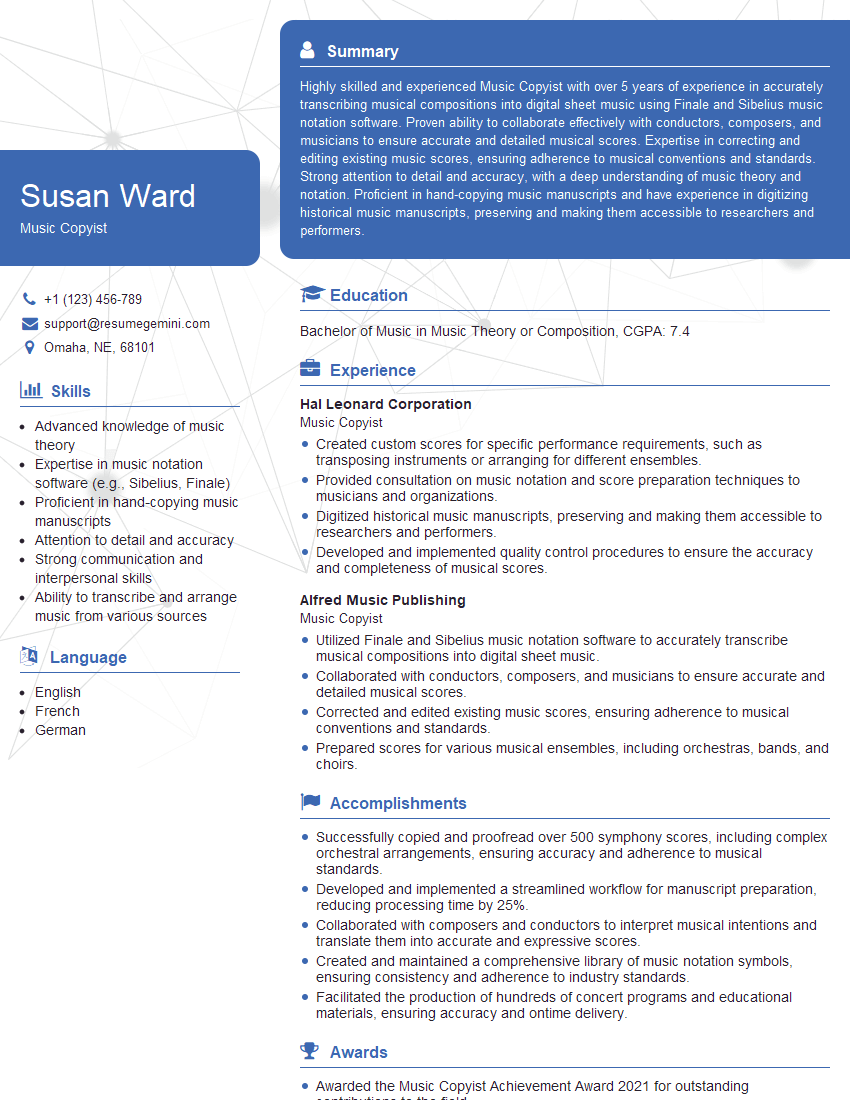
Mastering Orchestral and Chamber Music Instrumentation is crucial for career advancement in the music industry. A strong understanding of instrumentation opens doors to diverse roles, from performing and teaching to composing, arranging, and music librarianship. To maximize your job prospects, crafting an ATS-friendly resume is essential. This ensures your application is effectively screened by applicant tracking systems. ResumeGemini is a trusted resource to help you build a professional and impactful resume. We provide examples of resumes specifically tailored to Orchestral and Chamber Music Instrumentation to help you get started. Invest the time to create a compelling resume that showcases your skills and experience effectively—it’s your first impression on potential employers.
Explore more articles
Users Rating of Our Blogs
Share Your Experience
We value your feedback! Please rate our content and share your thoughts (optional).
What Readers Say About Our Blog
Really detailed insights and content, thank you for writing this detailed article.
IT gave me an insight and words to use and be able to think of examples