The thought of an interview can be nerve-wracking, but the right preparation can make all the difference. Explore this comprehensive guide to Passenger Management and Safety interview questions and gain the confidence you need to showcase your abilities and secure the role.
Questions Asked in Passenger Management and Safety Interview
Q 1. Describe your experience in developing and implementing passenger safety procedures.
Developing and implementing passenger safety procedures requires a multi-faceted approach, focusing on risk assessment, procedure creation, training, and continuous improvement. My experience spans various transportation modes, including aviation and maritime. For instance, in the aviation sector, I was instrumental in revising our emergency response plan to incorporate the latest safety recommendations from the FAA. This involved a thorough review of existing procedures, identifying potential vulnerabilities, and developing new protocols for handling emergencies like engine failures or in-flight medical events. The implementation process included comprehensive training sessions for flight attendants and pilots, utilizing scenario-based simulations to ensure proficiency in emergency situations. For maritime operations, I helped develop and implement security protocols aligning with the ISPS Code (International Ship and Port Facility Security Code), which included enhanced security measures for passenger embarkation and disembarkation, along with stricter baggage screening procedures.
Following implementation, we regularly review the effectiveness of these procedures through data analysis, feedback mechanisms, and post-incident reviews. This iterative process allows us to refine our approach, ensuring our safety protocols remain effective and adaptable to evolving threats and industry best practices.
Q 2. Explain your understanding of emergency evacuation procedures in your field.
Emergency evacuation procedures are paramount in ensuring passenger safety in case of unforeseen circumstances. My understanding encompasses a comprehensive knowledge of evacuation plans tailored to specific transportation modes, encompassing both theoretical and practical application. For example, in aviation, this includes understanding the use of emergency exits, life rafts, and other safety equipment. Regular drills and training sessions simulate various emergency scenarios, ensuring that both crew and passengers are well-versed in the procedures. The goal is to ensure a swift and orderly evacuation, minimizing injuries and fatalities. In maritime settings, evacuation plans take into account the specific characteristics of the vessel and the surrounding environment, including lifeboat drills and deployment procedures. These plans must also address potential hazards, like fire or flooding, and ensure the safe transfer of passengers to lifeboats or other rescue vessels.
Crucially, a well-designed evacuation procedure always includes pre-trip briefings to familiarize passengers with the location of exits, safety equipment, and emergency protocols. Clear communication and effective leadership during the evacuation are also key components of a successful evacuation.
Q 3. How would you handle a passenger medical emergency onboard a transportation vehicle?
Handling a passenger medical emergency requires a swift and well-coordinated response. My approach follows a standardized protocol, prioritizing immediate assessment and action. First, I would assess the situation, determining the nature and severity of the medical issue. This involves gathering information from the passenger and any accompanying individuals. Then, I’d immediately contact emergency medical services (EMS), providing them with a detailed account of the situation including the location, nature of the emergency, and the passenger’s condition. Simultaneously, I’d initiate onboard first aid if required, with trained personnel providing assistance based on their expertise and the availability of onboard medical supplies.
Depending on the severity of the emergency and the availability of medical resources, I might need to initiate emergency diversions, such as landing the aircraft or stopping the train at the nearest station to allow for more advanced medical care. Throughout the process, maintaining calm and reassuring both the affected passenger and other passengers is critical, minimizing panic and promoting cooperation. Post-incident, comprehensive documentation is vital for review, investigation, and continuous improvement of emergency response protocols.
Q 4. Detail your experience in managing passenger complaints and resolving conflicts.
Managing passenger complaints and resolving conflicts requires patience, empathy, and a structured approach. My experience demonstrates a capability to effectively address various complaints, ranging from minor inconveniences to more serious issues. I begin by actively listening to the passenger’s concern, showing empathy and understanding. This ensures the passenger feels heard and valued. Next, I carefully analyze the situation, gathering all relevant information to determine the root cause of the complaint. Depending on the nature of the issue, I may offer a sincere apology, explain the circumstances that led to the problem, or offer a suitable resolution, such as a refund, compensation, or an upgrade.
For complex conflicts, a mediation approach may be necessary. This involves facilitating a dialogue between the involved parties, helping them find common ground and reach a mutually acceptable solution. Maintaining professionalism and neutrality throughout the process is paramount. Following resolution, I follow up with the passenger to ensure their satisfaction and to gather feedback, which can inform future service improvements. In certain cases, escalating the complaint to senior management might be necessary for addressing critical issues or complaints that require additional attention or disciplinary action.
Q 5. What are the key regulations and compliance requirements relevant to passenger safety in your industry?
Passenger safety regulations and compliance vary considerably across industries and geographical locations. In aviation, adherence to regulations established by bodies like the FAA (Federal Aviation Administration) and ICAO (International Civil Aviation Organization) is mandatory. These regulations encompass various aspects, including aircraft maintenance, crew training, emergency procedures, and security protocols. Similarly, in maritime transportation, the International Maritime Organization (IMO) sets international standards for passenger safety, covering issues like ship design, safety equipment, crew certification, and emergency response plans. In other modes of transport such as railways and buses, regulations are governed by national and regional bodies, often focusing on vehicle maintenance, safety features, driver training, and passenger information.
Compliance entails regular inspections, audits, and adherence to safety standards. Failure to comply can result in significant penalties, operational disruptions, and reputational damage. Therefore, continuous monitoring of regulatory updates, implementation of robust safety management systems (SMS), and staff training on safety regulations are vital.
Q 6. How do you ensure the safety and security of passenger baggage?
Ensuring the safety and security of passenger baggage is a critical aspect of passenger management. My experience involves implementing and overseeing procedures that minimize the risk of loss, damage, or security breaches. This includes establishing clear baggage handling protocols, from check-in to arrival, with emphasis on proper labeling, scanning, and tracking of luggage. Moreover, security protocols involve strict baggage screening to prevent the transportation of prohibited items or explosives. This often involves the use of X-ray machines and other security technologies. Regular training of baggage handling personnel is crucial to ensure they are aware of the appropriate procedures and safety guidelines. Also, robust systems for handling lost or damaged baggage are needed, with clear communication channels and processes for reporting and resolving such incidents.
Liability management is another key aspect. Clear terms and conditions, insurance policies, and efficient complaint handling processes are essential in managing risks associated with baggage handling.
Q 7. Describe your experience with passenger screening and security protocols.
Passenger screening and security protocols are vital for preventing threats to passenger safety and security. My experience encompasses a deep understanding of various screening techniques, ranging from basic visual inspections to advanced technologies like metal detectors and X-ray machines. In airports, for instance, I’ve worked with Transportation Security Administration (TSA) guidelines, managing passenger flow through security checkpoints while ensuring the efficient and thorough screening of passengers and their carry-on luggage. I understand the importance of balancing security with the passenger experience, striving to minimize wait times and inconvenience while maintaining the highest security standards.
Training personnel on proper screening procedures and protocols is crucial to ensure consistency and effectiveness. Regular reviews of screening processes are necessary to adapt to evolving threats and security challenges. Moreover, collaborating with law enforcement and security agencies is essential for addressing any security concerns and ensuring a coordinated response in emergencies.
Q 8. What is your approach to passenger communication during disruptions or emergencies?
My approach to passenger communication during disruptions or emergencies centers around a clear, calm, and consistent message delivered through multiple channels. Think of it like a layered communication system. The first layer involves immediate, concise announcements using readily available technology like public address systems or onboard displays. These should clearly state the situation, its impact on passengers, and immediate next steps. For example, during a flight delay, an initial announcement might simply state: “Ladies and gentlemen, due to unforeseen circumstances, we anticipate a delay in departure. We will provide updates every 30 minutes.”
The second layer involves more detailed information, perhaps through printed updates, app notifications, or dedicated staff interactions. This allows for providing more context and addressing specific passenger concerns. For instance, the delay might be attributed to weather, and this layer would offer details about anticipated departure times and alternative options. The third layer would tackle ongoing communication and feedback mechanisms – channels for passengers to voice concerns, ask questions, and receive reassurance.
Finally, ensuring multilingual communication options and accessibility for passengers with disabilities is crucial. Think of providing announcements in multiple languages, using visual aids for announcements, and having staff members trained to assist passengers with diverse needs. A consistent, multi-layered approach ensures that every passenger receives the information they need, when they need it, in a way they understand.
Q 9. How do you identify and mitigate potential safety risks related to passenger movement?
Identifying and mitigating safety risks related to passenger movement requires a proactive, multi-faceted approach. It starts with a thorough risk assessment, identifying potential hazards at each stage of the passenger journey – from arrival to departure. This might include analyzing passenger flow in terminals, identifying potential congestion points, assessing the accessibility of facilities for people with disabilities, and evaluating emergency exit routes.
Mitigating these risks involves implementing controls, such as clear signage, well-defined passenger lanes, sufficient staffing to manage crowds, regular maintenance checks of equipment, and the provision of adequate assistance for passengers with mobility issues. For example, at an airport, we might use queuing systems to manage passenger flow, install additional seating areas to prevent fatigue and congestion, and ensure that walkways are well-lit and free of obstacles. Regular audits and inspections are key to ensuring the effectiveness of these controls and to identify any emerging risks. In high-traffic situations, deploying additional staff to manage passenger flow and provide assistance can make a significant difference in preventing accidents and ensuring safety.
Q 10. Explain your experience in conducting safety audits and inspections.
My experience in conducting safety audits and inspections is extensive. I’ve been involved in numerous audits across various transportation modes, including aviation, rail, and maritime. My approach follows a structured methodology, adhering to relevant industry standards and regulations. The process typically begins with a review of existing safety documentation, including risk assessments, emergency plans, and maintenance records.
Then, I proceed with on-site inspections, meticulously evaluating facilities, equipment, and procedures against established safety standards. This includes checking for proper functioning of safety systems, compliance with emergency procedures, and assessing the overall safety culture of the organisation. I document all findings with detailed reports, highlighting areas of compliance and non-compliance, recommending corrective actions, and providing recommendations for improvement. For example, during a recent airport inspection, I identified a deficiency in the emergency lighting system in one of the terminals. My report detailed the problem, the potential risks, and suggested immediate remediation, including repair and replacement of faulty components.
Q 11. How would you train staff on passenger safety and emergency procedures?
Training staff on passenger safety and emergency procedures is paramount. My approach involves a blended learning methodology incorporating various training methods for effective knowledge transfer and retention. This includes classroom-based training sessions supplemented by interactive simulations, hands-on exercises, and scenario-based drills.
The training curriculum covers topics like passenger assistance, emergency response procedures, safety equipment usage (e.g., fire extinguishers, first aid kits), communication protocols, and crisis management. For example, during a simulation, staff would practice evacuation procedures in a realistic environment, replicating different emergency scenarios like a fire or a security threat. Regular refresher training and competency assessments are essential to ensure staff stay up-to-date with best practices and procedures. The use of technology like e-learning modules and interactive platforms can further enhance the training experience and make it more engaging.
Q 12. How familiar are you with different types of passenger transportation safety systems?
I am very familiar with various passenger transportation safety systems. My knowledge encompasses a wide range of technologies and procedures used to enhance passenger safety across different modes of transportation. This includes:
- Aviation: Collision avoidance systems (TCAS), ground proximity warning systems (GPWS), flight data recorders (FDR), and emergency locator transmitters (ELT).
- Rail: Positive train control (PTC), automatic train protection (ATP), CCTV surveillance systems, and emergency communication systems.
- Maritime: Global Maritime Distress and Safety System (GMDSS), automatic identification systems (AIS), electronic charting systems, and emergency life-saving appliances.
- Road: Vehicle safety features such as airbags, anti-lock braking systems (ABS), electronic stability control (ESC), and advanced driver-assistance systems (ADAS).
Understanding the capabilities and limitations of these systems is crucial for effective risk management and emergency preparedness.
Q 13. Describe your proficiency in using passenger safety management software or systems.
My proficiency in using passenger safety management software and systems is high. I am comfortable working with various software applications designed for risk assessment, incident reporting, emergency response management, and training administration. For instance, I have experience with systems that allow for real-time monitoring of passenger flow, early detection of potential safety issues, and efficient dissemination of information during emergencies.
Furthermore, I am adept at using data analytics tools to identify trends and patterns in passenger safety incidents, allowing for proactive interventions and preventative measures. For example, analyzing data from incident reports can reveal recurring safety issues, enabling targeted interventions to address those specific risks and improve safety performance. My skills in data analysis also allow me to present safety findings clearly and concisely, using both textual and visual reports.
Q 14. How do you assess and manage passenger safety risks in high-volume transportation environments?
Assessing and managing passenger safety risks in high-volume transportation environments necessitates a structured approach. It starts with identifying potential hazards through a thorough risk assessment, considering factors like passenger density, infrastructure limitations, and potential points of congestion. For instance, during peak hours at a major transit station, the risk of overcrowding and potential stampedes is significantly higher.
Managing these risks requires the implementation of comprehensive strategies, including optimized passenger flow management using queuing systems, clear signage, and sufficient staff to provide assistance. Regular maintenance checks and timely repairs of equipment and infrastructure are crucial. The effective use of technology such as CCTV surveillance and passenger counting systems can also assist in monitoring passenger movements and identifying potential problems. Having robust emergency response plans and regularly conducting emergency drills is also vital. A comprehensive approach that integrates proactive risk assessment, effective control measures, and a well-rehearsed emergency response plan is essential for ensuring passenger safety in high-volume transportation settings.
Q 15. What is your approach to ensuring passenger data privacy and security?
Passenger data privacy and security is paramount. My approach is multifaceted and centers around adhering to strict regulations like GDPR and CCPA, while also implementing robust technical and procedural safeguards.
- Data Minimization: We collect only the necessary passenger data, strictly adhering to a ‘need-to-know’ basis. This reduces the potential impact of a breach.
- Encryption: All passenger data, both in transit and at rest, is encrypted using industry-standard encryption protocols like AES-256. This renders the data unintelligible even if intercepted.
- Access Control: Access to passenger data is strictly controlled through role-based access control (RBAC). Only authorized personnel with a legitimate business need have access, and their activities are meticulously logged and audited.
- Regular Security Audits and Penetration Testing: We conduct regular security audits and penetration testing to identify and address vulnerabilities before they can be exploited. This proactive approach helps maintain a strong security posture.
- Employee Training: All employees handling passenger data undergo regular training on data privacy and security best practices. This includes awareness of phishing scams, social engineering tactics, and secure password management.
For example, during the development of a new passenger check-in system, we prioritized data minimization by only including fields absolutely essential for the process, eliminating any unnecessary data collection.
Career Expert Tips:
- Ace those interviews! Prepare effectively by reviewing the Top 50 Most Common Interview Questions on ResumeGemini.
- Navigate your job search with confidence! Explore a wide range of Career Tips on ResumeGemini. Learn about common challenges and recommendations to overcome them.
- Craft the perfect resume! Master the Art of Resume Writing with ResumeGemini’s guide. Showcase your unique qualifications and achievements effectively.
- Don’t miss out on holiday savings! Build your dream resume with ResumeGemini’s ATS optimized templates.
Q 16. How do you maintain a high level of passenger satisfaction while prioritizing safety?
Balancing high passenger satisfaction with unwavering safety requires a holistic approach focusing on proactive measures and responsive service.
- Proactive Communication: Clear, consistent, and timely communication regarding flight schedules, potential delays, and safety procedures significantly enhances passenger satisfaction. This reduces anxiety and builds trust.
- Efficient Processes: Streamlined check-in, boarding, and baggage handling processes minimize passenger wait times and frustration, contributing to a positive experience.
- Personalized Service: Attentive and empathetic staff who are readily available to address passenger concerns and provide assistance go a long way in fostering positive interactions.
- Safety Demonstrations & Information: Clear and engaging safety demonstrations, readily available safety information, and accessible crew members ensure passenger understanding and confidence in safety protocols. This is crucial even for seasoned travelers.
- Feedback Mechanisms: Implementing robust feedback mechanisms (surveys, comment cards, online platforms) allows for continuous improvement based on passenger experiences and helps identify areas for enhancement in both safety and service.
For instance, we implemented a real-time flight status app that provides passengers with updates on their flight, allowing them to proactively manage their travel plans, reducing stress and improving satisfaction.
Q 17. Describe your experience in developing and managing safety budgets and resources.
Developing and managing safety budgets requires a strategic and data-driven approach. It begins with a thorough risk assessment to identify potential hazards and prioritize mitigation strategies.
- Risk Assessment & Prioritization: We utilize a formal risk assessment methodology (e.g., FMEA – Failure Mode and Effects Analysis) to identify potential hazards and assign risk levels based on likelihood and severity. This informs budget allocation.
- Budget Allocation: Based on the risk assessment, budget is allocated to various safety initiatives, such as equipment upgrades, staff training, emergency response planning, and security enhancements. Cost-benefit analysis is crucial here.
- Resource Management: We utilize project management techniques to effectively allocate resources (personnel, equipment, time) to safety initiatives, ensuring timely completion and optimal utilization of funds.
- Regular Monitoring & Reporting: We continuously monitor budget expenditures and track progress against planned activities, generating regular reports to stakeholders. This transparency ensures accountability and allows for course correction if necessary.
- Continuous Improvement: Post-incident analysis informs future budget allocations, enabling us to adapt and improve our safety programs based on real-world experiences.
In a past role, I successfully secured additional funding for upgrading our emergency response systems by presenting a compelling case based on a thorough risk assessment demonstrating potential cost savings through reduced incident response times and improved passenger safety.
Q 18. What metrics do you use to measure the effectiveness of passenger safety programs?
Measuring the effectiveness of passenger safety programs requires a combination of quantitative and qualitative metrics. Key metrics include:
- Incident Rates: Tracking the number and severity of safety incidents (e.g., accidents, near misses, injuries) provides a clear indication of program effectiveness. A decreasing trend demonstrates improvement.
- Compliance Rates: Measuring compliance with safety regulations and internal procedures helps assess the effectiveness of training programs and safety protocols.
- Passenger Feedback: Gathering passenger feedback on their perception of safety and security, through surveys and other channels, provides valuable qualitative insights.
- Emergency Response Times: Tracking the response time to incidents and the efficiency of emergency procedures helps evaluate the preparedness and effectiveness of emergency response plans.
- Employee Safety Training Completion Rates: Measuring the completion rates of safety training programs ensures that all employees are adequately prepared to handle safety-related situations.
For example, a reduction in the number of reported near misses, coupled with positive passenger feedback on safety procedures, would strongly indicate the effectiveness of a safety training program.
Q 19. How would you respond to a security threat involving passengers?
Responding to a security threat involving passengers requires a calm, decisive, and coordinated approach. My response would follow these steps:
- Immediate Assessment: Quickly assess the nature and severity of the threat, identifying the potential risk to passengers and staff.
- Alert & Notification: Alert relevant personnel (security, law enforcement, emergency services) and initiate emergency protocols as per the established plan.
- Evacuation/Containment: Depending on the nature of the threat, initiate an evacuation or containment strategy to protect passengers and staff. This may include securing the area, diverting the flow of passengers, or implementing lockdowns.
- Communication: Maintain clear and calm communication with passengers, providing regular updates and instructions. This minimizes panic and helps ensure cooperation.
- Collaboration: Closely collaborate with security personnel, law enforcement, and emergency services to manage the situation efficiently and effectively. This might involve providing crucial information or assisting with the evacuation process.
- Post-Incident Review: Conduct a thorough post-incident review to identify lessons learned and make improvements to security protocols and emergency procedures.
For example, during a bomb threat scenario, I would coordinate the evacuation of the affected area with security personnel and local authorities, providing clear and consistent instructions to passengers while ensuring their safety and well-being.
Q 20. Explain your knowledge of incident reporting and investigation procedures.
Incident reporting and investigation procedures are crucial for continuous improvement in passenger safety. My knowledge encompasses:
- Incident Reporting System: Experience with implementing and managing a comprehensive incident reporting system that captures all relevant details (date, time, location, nature of incident, witnesses, etc.). This often involves using specialized software.
- Investigation Protocols: Thorough understanding of formal investigation protocols including gathering evidence, interviewing witnesses, analyzing data, and documenting findings. This involves following established procedures and guidelines.
- Root Cause Analysis: Proficiency in root cause analysis techniques (e.g., 5 Whys, Fishbone diagrams) to identify the underlying causes of incidents, going beyond simply addressing symptoms.
- Corrective Actions: Experience in developing and implementing corrective actions to prevent similar incidents from occurring in the future. This might involve policy changes, procedural improvements, or equipment upgrades.
- Documentation & Reporting: Comprehensive documentation of the investigation process, including findings, recommendations, and implemented corrective actions. Generating clear and concise reports for stakeholders is essential.
In a previous role, I implemented a new incident reporting system which reduced reporting time by 40%, allowing for quicker identification of trends and proactive mitigation of potential hazards.
Q 21. Describe your experience in collaborating with emergency services and other stakeholders during incidents.
Collaborating with emergency services and other stakeholders during incidents is critical for effective response and passenger safety. My experience highlights:
- Pre-Incident Planning: Experience in developing and maintaining strong relationships with emergency services (fire, police, ambulance) and other key stakeholders, including pre-planned emergency response protocols, emergency contact lists, and regular joint exercises.
- Clear Communication Channels: Establishing and utilizing clear and efficient communication channels during incidents, ensuring seamless information flow between all involved parties. This often involves dedicated communication lines and protocols.
- Coordination & Collaboration: Proficiency in coordinating the response efforts of various teams, including security personnel, medical teams, and emergency services, ensuring a cohesive and effective response.
- Information Sharing: Efficiently sharing relevant information with emergency services and stakeholders, providing them with crucial data to facilitate their response and aid decision-making.
- Post-Incident Debriefing: Participating in post-incident debriefings with all involved parties to evaluate the effectiveness of the response, identify areas for improvement, and document lessons learned for future incidents.
During a major airport incident, I coordinated the efforts of multiple emergency services, ensuring effective communication and a swift response that minimized passenger impact and ensured the safety of all involved.
Q 22. How do you stay updated on the latest passenger safety regulations and best practices?
Staying current on passenger safety regulations and best practices is paramount. I employ a multi-faceted approach. This includes regularly reviewing updates from organizations like the International Civil Aviation Organization (ICAO), the Federal Aviation Administration (FAA) – or equivalent national aviation authorities, and relevant industry associations. I actively participate in professional development seminars and conferences, networking with other experts and learning about the latest advancements in safety technologies and procedures. Subscription to industry-specific journals and newsletters keeps me informed about emerging trends and research findings. Finally, I maintain a close relationship with regulatory bodies, ensuring our practices always comply with and, ideally, exceed, the minimum requirements.
- Regular Regulatory Updates: I check for updates on the FAA website and equivalent international sources at least quarterly.
- Industry Conferences and Seminars: Attending at least two relevant conferences annually provides exposure to best practices and emerging challenges.
- Professional Networking: Engaging in discussions with colleagues and experts ensures a continuous exchange of information and insights.
Q 23. Describe a time you had to make a difficult decision related to passenger safety.
During a severe weather event, a flight was significantly delayed. Passengers became increasingly agitated, with some exhibiting aggressive behavior. We faced a dilemma: proceed with a potentially hazardous flight or risk further delays and passenger unrest. After consulting with the captain and meteorologists, assessing the risk level, and evaluating the passenger’s emotional states, we made the decision to delay the flight until weather conditions improved. While the delay caused significant inconvenience, prioritizing passenger safety was non-negotiable. Post-incident, we reviewed our crisis communication protocols to enhance our ability to manage passenger expectations during such events. We also implemented additional training for crew members on de-escalation techniques. This situation highlighted the importance of clear communication, risk assessment, and having robust contingency plans in place.
Q 24. How do you manage passengers with disabilities or special needs?
Managing passengers with disabilities or special needs requires a proactive and compassionate approach. We begin by identifying their specific needs during booking and check-in. This involves careful review of passenger manifests and communication with passengers or their caregivers. We ensure appropriate accommodations are made – this could include wheelchair assistance, priority boarding, seating adjustments, and provision of any necessary medical equipment. Our staff receive extensive training on sensitivity, recognizing that each individual’s needs are unique and require careful consideration. We adhere strictly to accessibility regulations and aim to create a comfortable and respectful travel experience for all.
- Pre-flight Communication: We encourage passengers to contact us in advance to detail their specific needs.
- Specialized Training: Staff receive training on handling various disabilities and medical conditions.
- Onboard Assistance: Dedicated personnel are available to provide support throughout the journey.
Q 25. How do you handle situations where passenger behavior compromises safety?
When passenger behavior compromises safety, a structured approach is vital. The initial response focuses on de-escalation. Trained staff engage the passenger calmly and attempt to understand the cause of the disruptive behavior. If de-escalation fails, we follow established procedures: This might involve separating the passenger from others, contacting airport security or law enforcement if necessary, and potentially rerouting the passenger if the situation requires it. Documentation of the incident is crucial, including witness statements and any injuries sustained. The situation is reviewed afterward to identify areas for improvement in preventing similar incidents.
- De-escalation Training: Staff are trained in techniques to manage disruptive behavior peacefully.
- Emergency Protocols: Clear procedures for involving security or law enforcement are in place.
- Post-Incident Review: A thorough analysis helps prevent future occurrences.
Q 26. Explain your understanding of different passenger profiling techniques and their relevance to safety and security.
Passenger profiling, while controversial, can be a tool to enhance security when used responsibly and ethically. It involves analyzing passenger data to identify individuals who may pose a higher risk. This data can include travel history, booking patterns, and even social media activity. However, it’s crucial to understand that profiling must be used without discrimination and in compliance with privacy regulations. Over-reliance on any single factor is dangerous, leading to false positives. A balanced approach combines profiling with other security measures like enhanced screening and improved intelligence gathering to create a layered defense system. Ethical considerations, data privacy, and the potential for bias must be carefully addressed when implementing any profiling techniques.
Example: Analyzing passenger booking patterns to identify potential anomalies, such as one-way tickets purchased at the last minute to high-risk destinations. This would raise a flag for further review but would not automatically deny the passenger travel.
Q 27. How do you use technology to enhance passenger safety and security?
Technology plays a vital role in enhancing passenger safety and security. This includes advanced screening technologies at airports, such as millimeter-wave scanners and explosive detection systems. Biometric identification can streamline boarding procedures while improving security. Real-time data analysis systems can track passenger movements and identify potential threats. In-flight entertainment systems can now deliver important safety information directly to passengers, and connectivity allows for quicker responses to emergencies. Furthermore, data analytics can help predict potential problems based on historical patterns, allowing proactive measures to be taken.
- Biometric Systems: Faster, more secure boarding processes.
- Advanced Screening: Improved detection of threats.
- Data Analytics: Predictive modeling to identify potential risks.
Q 28. What are your strategies for proactively identifying and preventing passenger safety incidents?
Proactive incident prevention relies on a comprehensive strategy. Regular safety audits and risk assessments are essential. This involves analyzing historical data to pinpoint areas of vulnerability. We implement rigorous training programs to equip staff to handle various scenarios. Effective communication channels – ensuring smooth communication between ground and air crew, and between staff and passengers – are maintained. Open reporting systems empower staff to flag potential safety concerns. Finally, continuous monitoring of both technological systems and passenger flow patterns enables us to respond to emerging threats and adjust our strategies accordingly. A strong safety culture, where proactive hazard identification is encouraged, is fundamentally important.
- Regular Safety Audits: Identify and mitigate potential hazards.
- Staff Training: Prepare staff to handle various safety scenarios.
- Open Communication: Ensure swift response to issues.
- Continuous Monitoring: Adapt to emerging risks.
Key Topics to Learn for Passenger Management and Safety Interview
- Passenger Flow and Control: Understanding principles of efficient passenger movement through various stages of travel (check-in, security, boarding, disembarkation). Consider practical applications like optimizing gate assignments or managing queues during peak times.
- Emergency Procedures and Response: Thorough knowledge of emergency protocols, evacuation plans, and safety regulations. Think about how you would apply this knowledge in a real-world scenario, such as a medical emergency or security threat.
- Communication and Customer Service: Effective communication strategies for handling diverse passenger needs and concerns, especially during stressful situations. Consider scenarios requiring conflict resolution or providing clear instructions under pressure.
- Security and Threat Management: Understanding security procedures, passenger screening protocols, and recognizing potential security threats. Explore how to balance security needs with passenger experience and efficient processing.
- Safety Regulations and Compliance: Familiarity with relevant national and international safety regulations and industry best practices. Think about how you would ensure compliance and maintain a safe environment for passengers and staff.
- Risk Assessment and Mitigation: Identifying and evaluating potential risks associated with passenger management and safety, and developing strategies to mitigate those risks. Consider examples of how you’ve proactively identified and addressed potential safety hazards.
- Technology and Passenger Management Systems: Understanding the role of technology in enhancing passenger safety and management (e.g., passenger information systems, boarding pass scanners, security systems). Explore how these technologies improve efficiency and safety.
Next Steps
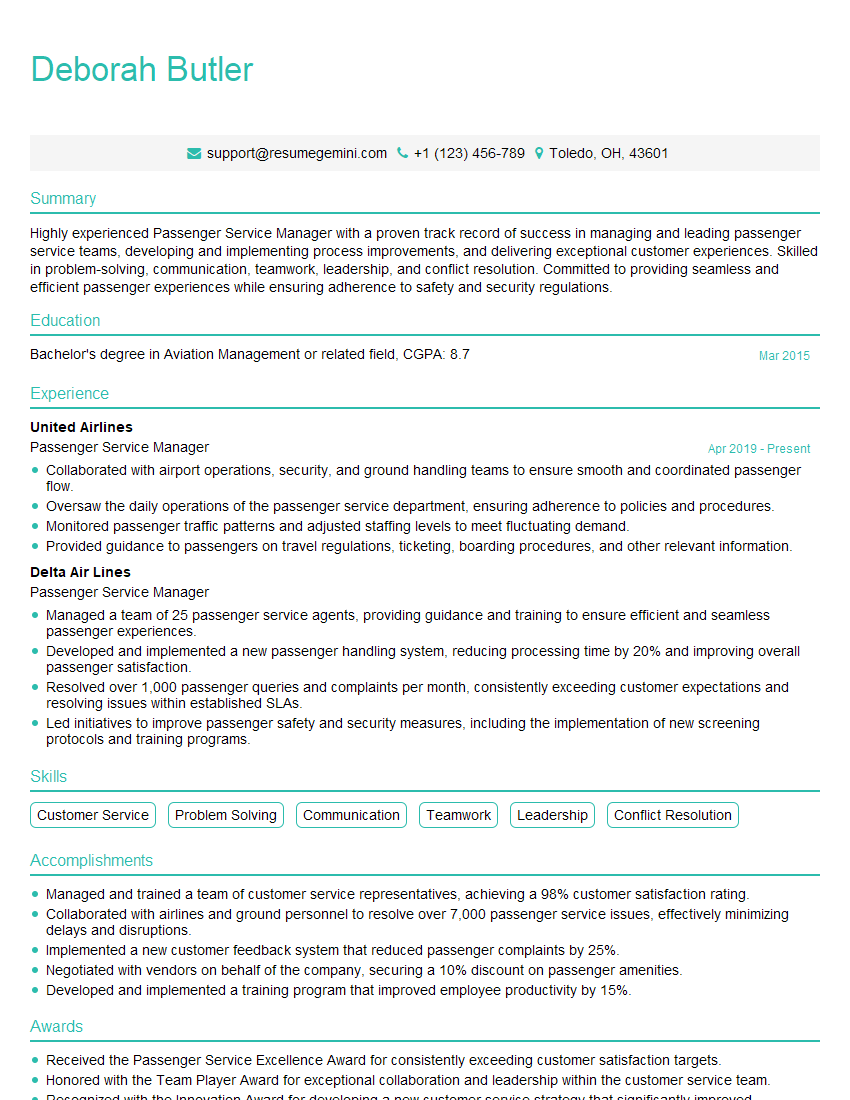
Mastering Passenger Management and Safety is crucial for career advancement in this dynamic field. It demonstrates your commitment to safety, efficiency, and providing exceptional passenger experiences. To significantly increase your job prospects, focus on crafting an ATS-friendly resume that highlights your skills and experience effectively. ResumeGemini is a trusted resource to help you build a professional and impactful resume. We provide examples of resumes tailored to Passenger Management and Safety to guide you through the process. Invest in your future—create a resume that showcases your expertise and opens doors to exciting opportunities.
Explore more articles
Users Rating of Our Blogs
Share Your Experience
We value your feedback! Please rate our content and share your thoughts (optional).
What Readers Say About Our Blog
Really detailed insights and content, thank you for writing this detailed article.
IT gave me an insight and words to use and be able to think of examples