The thought of an interview can be nerve-wracking, but the right preparation can make all the difference. Explore this comprehensive guide to Pencil Sketching interview questions and gain the confidence you need to showcase your abilities and secure the role.
Questions Asked in Pencil Sketching Interview
Q 1. Explain your preferred pencil grades and their applications.
My preferred pencil grades are a versatile selection, chosen to achieve a range of values and effects. I primarily use H pencils for light sketching and details, with 2H and 4H for very light lines and initial layouts. For mid-tones and shading, I rely on HB and B pencils. The B grades, such as 2B, 4B, and even 6B for very dark areas, are essential for deep shadows and rich darks. Think of it like this: H pencils are like a whisper, HB is a normal speaking voice, and B pencils are a shout. The higher the number, the harder (H) or softer (B) the lead, influencing line weight and darkness.
- 2H/4H: Light guidelines, initial sketches, delicate details.
- HB: General sketching, mid-tones, blending.
- 2B/4B/6B: Dark shading, strong contrasts, defining shadows.
Q 2. Describe your process for creating a detailed pencil sketch.
My process for a detailed pencil sketch is methodical, involving several key stages. First, I begin with a light initial sketch using a 2H or 4H pencil, focusing on the overall composition and proportions. I lightly sketch the outline, ensuring the basic structure is correct. Next, I gradually build up the mid-tones using an HB pencil. This step defines the form and volume, focusing on light and shadow. Then, I add darker values with 2B, 4B, and even 6B pencils, focusing on areas of deep shadow and contrast. Finally, I refine the details using an eraser to lift out highlights and sharpen edges. This creates depth and realism. Throughout this process, I constantly step back to assess the balance and values of the sketch.
For example, when sketching a portrait, I start with the basic shape of the head and then work my way to the details of the eyes, nose, and mouth. It’s a process of continuous refinement and observation.
Q 3. How do you achieve different values and tones using only pencils?
Achieving different values and tones with only pencils relies on manipulating the pressure applied, the pencil grade, and layering techniques. Light pressure with a hard pencil (like 2H) creates light tones, while heavy pressure with a soft pencil (like 6B) yields dark tones. Varying the pressure within a single stroke creates subtle gradations. Layering involves applying multiple strokes to build up darkness gradually, allowing for smooth transitions between values. Smudging or blending with a tortillon (a blending stump) helps soften harsh lines and create smoother transitions between light and dark. Think of it like painting with light and shadow instead of color.
For example, to create a gradual shadow, I’d start with light strokes from a 2B pencil, gradually increasing pressure and adding layers of darker tones with a 4B or 6B, allowing for a natural-looking shadow.
Q 4. What techniques do you use to create texture in your pencil sketches?
Creating texture in pencil sketches is achieved through various techniques focusing on line quality, stroke direction, and pressure. For example, short, rapid strokes can create a fuzzy or textured appearance, mimicking fur or fabric. Long, parallel lines suggest smooth surfaces like wood or metal. Cross-hatching (overlapping lines at different angles) creates a sense of depth and texture, particularly useful for depicting rough surfaces like stone or bark. Varying the pressure creates depth and definition within the texture. A light touch suggests softness, while hard pressure defines ridges or bumps. Finally, using an eraser to lift highlights from a textured area can bring additional texture and realism.
Imagine sketching a weathered wooden fence: short, broken lines would portray the cracks, while long, parallel lines would capture the smooth grain of the wood.
Q 5. Discuss your approach to composition and perspective in pencil sketching.
Composition and perspective are fundamental to any successful sketch. I start by considering the rule of thirds, arranging my subject matter to create visual interest and balance. I then establish a vanishing point for perspective, using converging lines to create depth and dimension. The placement of the horizon line, the relative sizes of objects, and the arrangement of elements all contribute to the overall feeling and impact of the sketch. Before starting, I often make thumbnail sketches to experiment with different compositional arrangements, ensuring the best presentation of the subject matter.
For example, when drawing a landscape, I’ll place the main subject (like a tree or house) off-center, using the rule of thirds, and I’ll employ one-point perspective to create depth, making distant objects smaller than closer ones.
Q 6. How do you handle mistakes or errors during the sketching process?
Mistakes are inevitable in sketching, and I approach them as opportunities for learning and refinement, rather than setbacks. For light mistakes, a kneaded eraser is invaluable, allowing for precision removal of unwanted marks. For heavier mistakes, a vinyl eraser can be used, but it’s important to be gentle to avoid damaging the paper. In some cases, I might simply work around a mistake, integrating it into the overall composition. Sometimes, completely starting over is the best approach, especially if a fundamental aspect of the composition is flawed. The key is not to get discouraged but to adapt and learn from the process.
For instance, if I misplace an eye in a portrait, I might carefully erase the offending area and adjust my lines, learning from the error to place subsequent features more accurately.
Q 7. Explain your understanding of light and shadow in pencil sketching.
Understanding light and shadow is paramount in pencil sketching. Light creates highlights, mid-tones, and shadows, giving form and depth to the subject. I observe how light falls on the subject, identifying the light source’s direction and intensity. This helps determine the placement and intensity of highlights, mid-tones, and shadows. The interplay of light and shadow creates the illusion of volume and three-dimensionality. The darkest areas (core shadows) are typically opposite the light source, while cast shadows are projected onto surfaces surrounding the subject. Mastering this interaction of light and shadow is key to creating realistic and engaging pencil sketches.
Imagine drawing a sphere: a strong light source will create a small highlight, a gently diminishing mid-tone, and a dark shadow on the opposite side, providing the illusion of roundness.
Q 8. Describe your process for creating a portrait using pencils.
My portrait sketching process is meticulous and iterative. It begins with a thorough observation of the subject, focusing on the underlying structure—the skull, musculature, and proportions. I then lightly sketch the basic shapes and proportions using a light-value pencil, such as a 2H or HB, to establish the foundation. This initial sketch serves as a roadmap, allowing for adjustments before adding detail. Next, I gradually build up the values using progressively darker pencils, from 2B to 6B or even higher, depending on the desired level of contrast. I focus on refining features, adding subtle variations in tone to create depth and form, paying close attention to light and shadow. I often use blending techniques like stumping or tortillions to smooth transitions between values and soften harsh lines. The final stage involves adding finer details like individual strands of hair or the texture of skin, making sure to maintain a sense of realism and life. Throughout the entire process, I continuously refine and adjust, comparing my sketch to the subject to maintain accuracy. I’m always evaluating the overall composition and balance to ensure a visually pleasing outcome.
Q 9. How do you ensure accuracy and detail in your pencil work?
Accuracy and detail in pencil sketching are achieved through a combination of careful observation, precise techniques, and patience. Starting with accurate proportions is crucial; I often use guidelines and construction lines to ensure the features are correctly positioned. Employing a gradual build-up of values, starting light and progressively darkening, allows for refinement at every stage. I regularly step back from my work to assess the overall composition and identify areas needing attention. This distance provides a fresh perspective, helping me notice subtle inaccuracies or areas requiring more detail. Utilizing techniques like hatching, cross-hatching, and blending allows for control and precision, helping to represent form and texture accurately. Finally, constant comparison with the subject matter is critical to identifying and correcting any deviations from reality. For instance, if I’m sketching an eye, I’ll repeatedly check the shape, size, and placement of the pupil, iris, and highlight to maintain fidelity.
Q 10. What are your preferred paper types and why?
My preferred paper types depend on the project, but I generally gravitate towards smooth, high-quality drawing papers. For detailed portraits, I often use Bristol board, which offers a smooth surface that allows for fine lines and subtle gradations of tone. Its thickness prevents bleed-through, especially when using darker pencils and layering. For more textured effects, I might choose a slightly textured paper like Stonehenge or Saunders Waterford. The texture helps create a natural grain that can add depth and interest to the finished sketch. The tooth of the paper – its texture – influences the blending and the overall appearance. A smooth surface lets you create very fine lines and subtle shading, while a slightly textured surface can allow for more expressive markings. The weight of the paper is also crucial, as a heavier paper will withstand more layering and erasing without buckling.
Q 11. Discuss your knowledge of different pencil techniques (e.g., hatching, cross-hatching).
Pencil techniques are fundamental to creating depth, texture, and form in a sketch.
- Hatching: This involves drawing a series of parallel lines to create shading. The closer the lines, the darker the value.
- Cross-hatching: This builds upon hatching by layering intersecting lines, creating a richer, more complex value. The density and angle of the lines dictate the tonal value.
- Blending: Using a blending stump, tortillon, or even a finger, you can smooth out the lines to create soft transitions between values. This is particularly effective for depicting skin tones or soft textures.
- Stippling: This technique uses small dots to create shading. The closer the dots, the darker the tone. This allows for fine control and creates a distinct textured appearance.
Q 12. How do you develop your artistic style in pencil sketching?
Developing an artistic style is a continuous process of experimentation and refinement. I constantly seek inspiration from various sources, including other artists, photography, and even nature. I experiment with different techniques, subject matter, and pencil grades, pushing my creative boundaries and challenging my established methods. Continuous practice and self-criticism are vital. I regularly review my past work, noting both successes and areas for improvement. This self-reflection helps me refine my techniques and develop a consistent visual language. Participating in workshops and critique sessions helps me receive feedback and learn from other artists. Ultimately, my style evolves organically through this continuous process of exploration and refinement. For instance, I initially focused on hyperrealism but over time, through experimentation with looser techniques and different subject matter, my style has evolved to incorporate elements of expressionism, maintaining attention to detail but embracing a more emotive approach.
Q 13. Explain how you would approach sketching a complex object or scene.
Sketching a complex object or scene requires a systematic approach. I start by simplifying the subject into basic shapes—cylinders, spheres, cubes—to understand the underlying structure. This helps establish accurate proportions and spatial relationships. Next, I create a light outline, focusing on major forms and features. Then, I gradually add more detail, paying close attention to light, shadow, and perspective. Working on individual sections helps to manage complexity and avoid overwhelming detail. I might focus on one area—say, a specific building in a cityscape—before moving on to the next. This layered approach allows for a progressive refinement of form and texture. I frequently step back from my work to evaluate the overall composition and make necessary adjustments. Reference photos or even 3D models can aid in the understanding of complex perspectives and relationships. For example, when sketching a bustling street scene, I’d start by outlining the main buildings and streets before focusing on individual figures and vehicles, ensuring the perspective lines converge correctly.
Q 14. Describe your experience working with different sketching mediums (e.g., charcoal, graphite).
My experience extends beyond graphite pencils. I frequently work with charcoal, appreciating its rich, dark tones and its ability to create dramatic effects. Charcoal allows for broader strokes and more expressive marks than graphite. It’s excellent for capturing textures and creating atmospheric effects. However, it requires a different approach; the smudging and blending can be more challenging than graphite. I also use graphite pencils of different grades, ranging from very hard (like 9H) to very soft (like 8B or higher). The choice of pencil influences line weight, value, and the overall texture of the finished sketch. Each medium offers unique properties and advantages, and selecting the right one depends heavily on the intended outcome. For instance, while graphite allows for precise detail, charcoal is best suited for capturing the rough texture of a rock or creating an expressive portrait that values mood over photorealism. Experimenting with different media allows for greater versatility and artistic expression.
Q 15. How do you maintain a consistent quality in your pencil sketches?
Maintaining consistent quality in pencil sketching relies on a combination of technique, practice, and mindful preparation. It’s not about achieving perfect uniformity, but rather establishing a recognizable style and level of skill throughout a piece.
- Consistent Materials: Using the same brand and grade of pencils throughout a project ensures predictable results. Different pencils have varying hardness and pigmentation, affecting your line weight and shading.
- Controlled Pressure: Learning to vary pressure subtly—from light strokes for delicate details to firm pressure for darker areas—is crucial for creating depth and texture without harsh transitions. Think of it like controlling the volume of your voice – you wouldn’t shout the entire time.
- Regular Practice: Consistent practice builds muscle memory and allows you to refine your technique. Daily sketching, even for short periods, significantly improves control and consistency.
- Reference Images: Using high-quality reference images helps maintain accuracy and detail throughout the piece, preventing inconsistencies that arise from memory or imagination alone.
For example, I always start a project by testing my pencils on scrap paper to calibrate my understanding of their properties, ensuring a unified feel across the final piece.
Career Expert Tips:
- Ace those interviews! Prepare effectively by reviewing the Top 50 Most Common Interview Questions on ResumeGemini.
- Navigate your job search with confidence! Explore a wide range of Career Tips on ResumeGemini. Learn about common challenges and recommendations to overcome them.
- Craft the perfect resume! Master the Art of Resume Writing with ResumeGemini’s guide. Showcase your unique qualifications and achievements effectively.
- Don’t miss out on holiday savings! Build your dream resume with ResumeGemini’s ATS optimized templates.
Q 16. How do you prepare for a large-scale pencil drawing project?
Preparing for a large-scale pencil drawing project demands meticulous planning and preparation to ensure a successful outcome. Think of it as building a house – a strong foundation is essential.
- Thorough Research: Extensive research on the subject matter is vital. This might involve studying photographs, visiting the location, or researching historical documents, depending on the project.
- Detailed Sketches: Creating smaller-scale preliminary sketches helps refine composition, proportions, and details before committing to the larger format. These act as blueprints.
- Material Selection: Choosing the right paper size and quality is critical. Large-scale drawings often require heavyweight paper to avoid buckling or damage. I also select pencils ranging from hard to soft, to allow for a wide range of tonal values.
- Workspace Setup: A well-organized workspace with adequate lighting, comfortable seating, and ample space for the large drawing is essential for sustained productivity. Having everything readily accessible saves time and keeps you focused.
- Planning Time Allocation: Large projects require realistic time allocation. Break the project into manageable stages, setting realistic goals for each phase. This helps to prevent burnout and maintain a steady pace.
For a recent large-scale portrait, I spent weeks researching the subject, creating multiple thumbnail sketches, and meticulously planning the layout before even touching the large drawing sheet. This groundwork significantly improved the quality and efficiency of the final piece.
Q 17. Discuss your understanding of anatomical proportions and their application in sketching.
Understanding anatomical proportions is paramount for creating believable figures. It’s about more than just getting the measurements right; it’s about capturing the essence of human form. Think of it as the grammar of the body language.
- Head as a Unit of Measurement: The head’s height serves as a foundational unit for measuring other body parts. For example, the average adult is roughly seven to eight heads tall.
- Proportional Relationships: Understanding the relative sizes and relationships between different body parts (e.g., shoulder width, limb length) is vital. Slight deviations create realistic variation instead of robotic sameness.
- Muscle Structure: Knowing the underlying muscle structure helps in rendering realistic forms, even when clothed. This influences the flow of lines and the distribution of shadows.
- Perspective and Foreshortening: Mastering perspective is essential for depicting figures realistically in different poses and viewpoints. Foreshortening, the technique of shortening limbs or objects to create a sense of depth, is particularly challenging but crucial for realism.
I use anatomical reference books and skeletal diagrams regularly to verify my observations when sketching figures. Even seemingly minor inaccuracies can make a figure appear unnatural.
Q 18. How do you create believable textures like fur, skin, or metal in pencil?
Creating believable textures relies on understanding how light interacts with surfaces and translating that understanding into pencil strokes. It’s about mimicking the natural irregularities, not creating perfect uniformity.
- Fur: Short, directional strokes create the overall direction of fur. Varying stroke length and pressure suggests depth and density. Adding darker areas of shadow between tufts creates volume.
- Skin: Subtle variations in tone create the appearance of skin texture. Small, irregular hatching or cross-hatching can suggest pores or wrinkles. The use of blending stumps to soften transitions is crucial.
- Metal: Sharp, precise lines define metallic surfaces. Use highlights to showcase reflective properties. Subtle variations in value can suggest scratches or wear, adding realism.
For example, when sketching animal fur, I observe how the fur lies, paying close attention to the direction of the hair and changes in density, and I use that to replicate it. I don’t try to draw each hair; I suggest the flow and texture with controlled strokes.
Q 19. Explain your process for creating realistic shading and highlights.
Realistic shading and highlights are fundamental to creating depth and form in a pencil sketch. It’s about capturing the light’s interaction with the subject’s surface.
- Light Source Identification: First, identify the main light source. This determines where highlights and shadows will fall.
- Value Range: Use a range of values from light to dark to create depth. Don’t be afraid to use the full range of your pencils.
- Gradation: Gradually transition between values using techniques like blending, layering, and feathering to avoid harsh lines.
- Highlight Placement: Highlights define the brightest areas where light directly hits the object, and their placement is crucial to shaping the form.
- Shadow Creation: Shadows define the darker areas, creating depth and volume. Consider cast shadows (shadows created by the object blocking light) and form shadows (shadows within the object itself).
I often use a combination of techniques like hatching, cross-hatching, and blending to achieve a smooth gradation from light to dark. The key is to create believable transitions, avoiding abrupt changes in tone.
Q 20. Describe your experience with creating sketches from observation.
Sketching from observation is fundamental to my process. It’s a direct engagement with the subject, forcing me to critically analyze form, light, and shadow. Think of it like a conversation with the subject.
My process typically begins with a general assessment of the subject’s overall composition and proportions. I’ll then break down the form into simpler shapes, establishing a basic structure before adding details. I prioritize capturing the essence of the subject through accurate observations of light and shadow, texture, and form. I also utilize various techniques, such as blind contour drawing and gesture drawing, to improve my observational skills.
Over the years, I’ve observed that sketching from observation improves my ability to interpret and translate what I see into a drawing, fostering accuracy and a more meaningful connection to the subject. Regular practice hones this skill and enhances my ability to translate three-dimensional forms onto a two-dimensional surface.
Q 21. How do you handle feedback on your pencil sketches?
Feedback is invaluable to my growth as an artist. I approach criticism constructively, prioritizing objective evaluations over subjective opinions.
- Objective vs. Subjective: I differentiate between objective feedback (e.g., ‘The proportions of the arm are slightly off’) and subjective feedback (e.g., ‘I don’t like the style’). Objective feedback is actionable; subjective feedback is helpful but less directly applicable.
- Specific Feedback: I seek specific feedback that points to areas for improvement. Vague comments are less useful.
- Reflection and Implementation: I reflect on the feedback, analyzing how to address the identified shortcomings. I then incorporate the constructive elements into my practice.
- Open Mind: I maintain an open mind and view criticism as an opportunity to learn and improve. Not every suggestion will be relevant, but even dissenting opinions can illuminate blind spots.
For instance, feedback on a recent portrait highlighted an issue with the lighting on the subject’s nose. This led to a deeper study of how light interacts with curved surfaces, ultimately refining my shading techniques.
Q 22. How do you balance detail and overall composition in your work?
Balancing detail and composition in pencil sketching is a delicate act, akin to composing a musical piece. Too much detail can overwhelm the viewer and obscure the overall message, while too little can make the piece feel flat and uninteresting. My approach involves a phased process.
Firstly, I establish a strong composition using light, quick sketches, focusing on the ‘big picture’ – the arrangement of elements, the leading lines, and the overall flow. I think of it like creating a skeleton for my artwork. I might use simple shapes to represent objects, focusing on their negative space as much as their positive forms. This helps me avoid getting bogged down in detail too early.
Once the composition feels solid, I begin adding detail gradually, concentrating on areas that are crucial to the narrative or emotional impact. This might involve focusing on specific textures, expressions, or highlights. I carefully choose where to add detail, leaving areas relatively unworked to provide visual breathing room. For example, if I’m sketching a portrait, I might focus intently on the eyes and hands while leaving the background more suggestive.
Regularly stepping back from my work is key. I change my viewing distance to assess the balance of detail and overall composition objectively. This ensures that the details enrich the overall piece rather than detracting from it. It’s a continuous process of refinement, constantly adjusting the relationship between specific elements and the broader scene.
Q 23. What software do you use to enhance or edit your pencil sketches (if any)?
While I believe the beauty of pencil sketching lies in its directness, I occasionally use digital tools for subtle enhancements. My preferred software is Photoshop. I use it sparingly, primarily for:
- Minor adjustments to contrast and tone: This can help to bring out details that were subtly rendered in pencil or to unify the overall tonality.
- Careful sharpening or blurring: I might selectively sharpen specific areas to bring out fine details or subtly blur others to create a sense of depth or atmosphere. This is never done heavily, respecting the original texture and intention of the pencil work.
- Minimal colorization: In rare cases, I might add a subtle wash of color to a piece, perhaps to evoke a mood or to suggest light. This is always done in a way that complements the original pencil work and doesn’t overwhelm it.
The key is to use these tools very carefully and thoughtfully, as the intention is not to transform the pencil sketch into a digital painting, but rather to subtly enhance its inherent qualities.
Q 24. How do you ensure the longevity of your pencil sketches?
Ensuring the longevity of pencil sketches involves careful handling and storage. The paper itself is crucial; archival-quality paper made from acid-free materials significantly extends the lifespan of the artwork. I always use such paper for my important pieces.
Protecting the sketches from light is also essential. Ultraviolet (UV) rays can fade the graphite over time, causing discoloration and weakening the paper. I store my finished sketches in acid-free portfolios or archival-quality sleeves, away from direct sunlight. Additionally, I avoid handling the artwork excessively, as oils from the skin can contribute to deterioration.
In some cases, I’ll apply a fixative spray designed specifically for pencil drawings. This creates a protective barrier, helping to prevent smudging and to stabilize the graphite. However, I’m mindful that even archival fixatives can subtly alter the original texture, so I only use this method selectively, for artworks intended for display or long-term storage.
Q 25. Describe your experience working under pressure or deadlines.
Working under pressure is an inherent part of freelance work. I’ve learned to manage deadlines effectively by breaking down large projects into smaller, manageable tasks. I create detailed timelines and meticulously track my progress, utilizing project management tools to stay organized.
Prioritization is key. I focus on the most crucial aspects first, ensuring that the core elements of the piece are completed even if some minor details need to be addressed later. Clear communication with clients is also critical – proactively addressing any potential delays or challenges helps to mitigate stress and maintain a positive working relationship.
I remember one project where I had to deliver a series of detailed architectural sketches within a very tight deadline. I organized my time meticulously, dedicating specific time slots to particular tasks and using a pomodoro technique to maintain focus. It was challenging, but by staying organized and prioritizing, I was able to successfully deliver the project on time and to the client’s satisfaction.
Q 26. Explain how you would adapt your sketching style to meet specific client requirements.
Adapting my sketching style to meet specific client requirements is essential. This involves carefully considering various factors including:
- Style: If a client prefers a highly realistic style, I’ll focus on precise details and rendering techniques. If they prefer a looser, more expressive approach, I’ll embrace gestural lines and less detailed shading.
- Subject Matter: My approach to sketching a technical blueprint differs significantly from sketching a whimsical character design. Each subject demands a specific approach, whether that be a precise rendering of architectural details or a loose and expressive interpretation of a figure.
- Level of Detail: Clients might specify the desired level of detail, ranging from highly detailed photorealistic representations to quick gestural sketches. Clear communication is paramount to understanding these requirements and delivering the appropriate level of detail.
I always engage in a thorough discussion with the client before commencing a project. This enables a clear understanding of their vision and allows me to adapt my technique and style accordingly. I value collaboration, providing sketches and feedback throughout the process to ensure that the final product aligns perfectly with their requirements.
Q 27. How do you approach creating a cohesive series of pencil sketches?
Creating a cohesive series of pencil sketches requires careful planning and consistent execution. The key is establishing a unifying theme or concept that links all the pieces. This could be a consistent style, a shared color palette (even within the limitations of graphite), a recurring motif, or a continuous narrative.
For example, if I were creating a series about a specific landscape, I might use consistent lighting and viewpoint across all sketches, maintaining a similar level of detail and creating a visual flow between them. I might also explore variations in composition and subject matter within the overarching theme, ensuring a balance between repetition and diversity. Similarly, if creating a character series, I’d ensure consistent stylistic elements, perhaps a signature line style or shading techniques, while still permitting individual personality to shine through in each portrait.
Consistent paper, graphite grades, and even the overall framing of the sketches can contribute significantly to cohesion. It’s almost like creating a small visual symphony; each piece stands alone but contributes to the overall harmony and power of the entire collection.
Q 28. What are your career aspirations in the field of pencil sketching?
My career aspirations are multifaceted. I aim to continue honing my skills and exploring new techniques within the realm of pencil sketching. I’m particularly interested in pushing the boundaries of what can be achieved with graphite, experimenting with different textures, shading styles, and composition techniques.
Beyond personal growth, I aspire to expand my portfolio and build a strong reputation within the art community. I’d love to participate in exhibitions and potentially offer workshops to share my knowledge and passion for pencil sketching. Ultimately, I hope to use my skills to contribute to a wider appreciation of traditional art forms in a world increasingly dominated by digital media. I envision a career where I can combine artistic expression with teaching and collaboration.
Key Topics to Learn for Pencil Sketching Interview
- Fundamentals of Line and Value: Mastering line weight, hatching, cross-hatching, and value scales to create depth and form in your sketches.
- Understanding Perspective and Proportion: Applying one-point, two-point, and three-point perspective techniques to accurately represent objects in space; accurately rendering proportions of subjects.
- Form and Volume: Using shading and light to create the illusion of three-dimensionality; understanding how light interacts with different surfaces and forms.
- Texture and Surface Quality: Representing various textures (rough, smooth, etc.) through sketching techniques; conveying the feel and appearance of different materials.
- Composition and Layout: Understanding the principles of design, including rule of thirds, leading lines, and negative space, to create visually appealing and balanced compositions.
- Different Pencil Grades and Techniques: Demonstrating proficiency in using various pencil grades (e.g., H, B) to achieve different effects; showcasing knowledge of techniques like blending, smudging, and erasing.
- Sketching from Observation: Accurately capturing the essence of a subject through direct observation, paying attention to details and proportions.
- Exploring Different Styles and Approaches: Demonstrating familiarity with various sketching styles (e.g., realistic, impressionistic, abstract) and techniques (e.g., contour drawing, gesture drawing).
- Problem-Solving and Adaptability: Discussing your approach to tackling challenging aspects of a sketch, such as complex forms or difficult lighting conditions; showing your ability to adapt your techniques as needed.
Next Steps
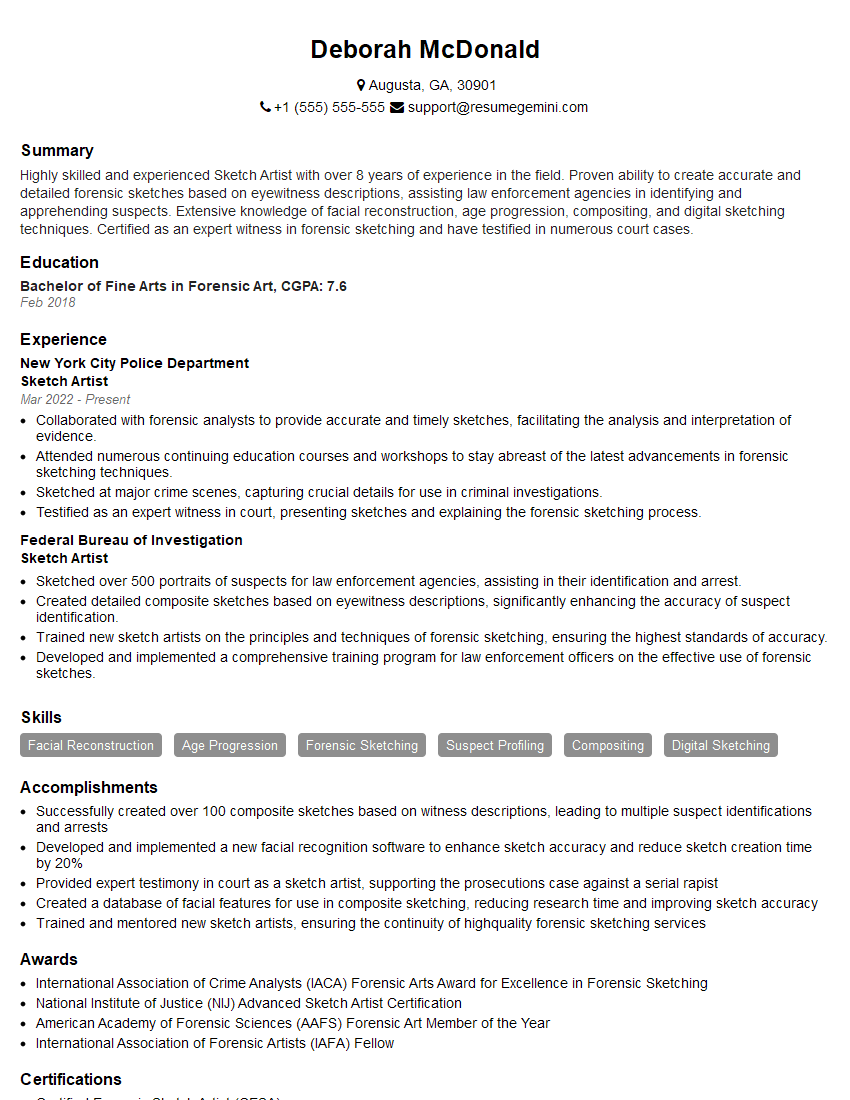
Mastering pencil sketching is a valuable skill that opens doors to numerous creative careers and significantly enhances your visual communication abilities. To maximize your job prospects, crafting a strong, ATS-friendly resume is crucial. ResumeGemini is a trusted resource that can help you build a professional and impactful resume tailored to the specifics of your pencil sketching skills and experience. Examples of resumes specifically designed for Pencil Sketching professionals are available to guide you. Invest the time in building a compelling resume – it’s your first impression and a key factor in landing your dream job.

Explore more articles
Users Rating of Our Blogs
Share Your Experience
We value your feedback! Please rate our content and share your thoughts (optional).
What Readers Say About Our Blog
Really detailed insights and content, thank you for writing this detailed article.
IT gave me an insight and words to use and be able to think of examples