Interviews are opportunities to demonstrate your expertise, and this guide is here to help you shine. Explore the essential Political Cartooning interview questions that employers frequently ask, paired with strategies for crafting responses that set you apart from the competition.
Questions Asked in Political Cartooning Interview
Q 1. Explain your understanding of the role of satire in political cartooning.
Satire is the cornerstone of effective political cartooning. It uses humor, irony, exaggeration, and other literary devices to expose and critique societal flaws, particularly within the political landscape. A good political cartoon uses satire not just to entertain, but to provoke thought and even inspire action. Think of it like a witty punchline to a very serious joke about power, corruption, or injustice. It’s a powerful tool because it can reach a broad audience in a way that lengthy articles or speeches might not.
For example, a cartoon might depict a politician with comically oversized pockets overflowing with money, satirizing their perceived corruption. The humor makes the point memorable, while the underlying message remains clear: this politician is potentially corrupt.
Q 2. Describe your process for developing a political cartoon from concept to completion.
My process is iterative and involves several key stages. It begins with idea generation, fueled by current events, news analysis, and personal observations. I’ll brainstorm various approaches, sketching rough ideas until a strong concept emerges. This often involves keyword research, looking for the core message I want to convey.
Next is sketching. I experiment with different compositions and character designs. I’ll try various approaches to caricature the main figures. This stage is about finding the visual narrative that best supports the satirical message.
Then comes refinement. I choose the best sketch and digitally refine it, paying close attention to detail, line weight, and expression. The goal is to create a visually engaging image that effectively communicates the core message. I might use different software such as Photoshop or Clip Studio Paint depending on my preference.
Finally, there’s review and revision. I step away from the work for a while before giving it a fresh look. I often seek feedback from colleagues to ensure clarity and impact before finalizing the cartoon.
Q 3. How do you ensure your cartoons are both impactful and accessible to a broad audience?
Creating impactful yet accessible cartoons requires a delicate balance. Impact comes from a strong satirical message, clever visual metaphors, and a clear narrative. Accessibility, on the other hand, requires simplicity. The cartoon should be immediately understandable, even to those unfamiliar with the specific political context.
I achieve this by using universal symbols and visual cues, avoiding overly complex imagery or inside jokes. Clear lines, strong contrasts, and easily recognizable characters contribute to broad appeal. For instance, instead of relying on obscure political jargon, I might use universally understood symbols like a scales of justice to represent fairness or a crown for power.
Humor is also key. Witty and relatable humor bridges the gap between the informed and the uninformed, making the message more palatable and memorable.
Q 4. What techniques do you employ to create compelling caricatures of political figures?
Creating compelling caricatures involves exaggerating specific features to emphasize personality and create a memorable image. It’s not just about making someone look funny; it’s about capturing their essence. I start by studying photographs and videos of the political figure, noting their distinctive features – their facial shape, hairstyle, posture, even their expressions.
I then exaggerate these features selectively. Perhaps a politician’s prominent nose becomes even more prominent, or a characteristic frown is deepened. The goal is to highlight features that are already present, creating a recognizable yet stylized representation. Sometimes a single exaggerated feature is enough to create a powerful caricature. The key is to maintain likeness while amplifying the personality traits the caricature aims to highlight.
For example, a politician known for their stern demeanor might be portrayed with even more angular features and a perpetually furrowed brow.
Q 5. How do you balance humor and social commentary in your work?
The balance between humor and social commentary is crucial. Humor acts as a vehicle to deliver a serious message, making it more palatable and memorable. If the cartoon is too heavy-handed, it might alienate the audience. If it’s too light, the satirical message might get lost.
I strive to find a middle ground. I utilize irony, juxtaposition, and subtle exaggeration to create humor that doesn’t overshadow the core commentary. The humor should enhance, not detract, from the critical message. A good political cartoon should make you laugh, but it should also make you think, prompting reflection on the underlying social or political issue.
For instance, I might use slapstick humor to portray a politician’s blunder, but the underlying commentary will be on the consequences of that blunder for the public.
Q 6. Discuss your experience with different cartooning styles and techniques (e.g., pen and ink, digital).
My experience spans both traditional and digital techniques. I began with pen and ink, honing my skills in line work, shading, and composition. The control and immediacy of pen and ink are invaluable for capturing spontaneous ideas and developing a unique style. The texture and subtle variations achievable with ink on paper offer a certain charm.
Digital tools have expanded my creative possibilities significantly. Software such as Photoshop and Illustrator allow for greater flexibility in color, texture, and detail. Digital techniques enable experimentation and the easy correction of mistakes. The ability to refine and manipulate elements digitally offers unparalleled precision.
Ultimately, the choice of technique depends on the specific cartoon and the desired effect. Sometimes, the traditional feel of pen and ink perfectly complements the message, while other times, the flexibility of digital tools is necessary for a more complex or stylized outcome.
Q 7. How do you research and gather information for your political cartoons?
Research is paramount. I rely heavily on reputable news sources, academic journals, and official government documents to ensure accuracy and avoid misrepresentation. I also follow social media discussions and public opinion polls to understand the public’s perspective on relevant issues. It is critical to stay informed and to fact-check thoroughly.
Moreover, I engage in active listening. I pay attention to conversations, interviews, and speeches related to my chosen topic. This allows me to capture the nuances of political discourse and identify potential satirical angles. Understanding the context and motivations behind political actions is key to crafting effective and impactful cartoons.
Thorough research guarantees the accuracy and integrity of my cartoons, avoiding unintentional misrepresentations or the spread of misinformation. It’s a crucial aspect of responsible political cartooning.
Q 8. Explain your approach to incorporating visual metaphors and symbolism into your cartoons.
Visual metaphors and symbolism are the lifeblood of political cartooning. My approach involves first identifying the core message I want to convey. Then, I brainstorm a range of visual metaphors that can represent that message in a concise and impactful way. This often involves considering the audience’s existing knowledge and cultural context. For example, if I’m commenting on a political leader’s questionable actions, I might depict them as a puppet controlled by unseen forces, or perhaps as a character from a fable known for deceit, like a fox.
The process is iterative. I sketch multiple options, experimenting with different symbols and their arrangements. I consider the connotations of each image, ensuring it aligns with the intended meaning and avoids unintended interpretations. A simple image like a donkey might represent one party, but the way I draw it – its expression, its posture – dramatically alters its meaning and impact. I might use a scale to represent balance of power, or a tightrope to depict precarious situations. Careful selection and arrangement are critical in effectively utilizing visual language.
Finally, I always prioritize clarity. The visual metaphor must be instantly understandable, avoiding ambiguity that could weaken or even distort the message. It’s about creating a powerful, memorable image that resonates with the viewer on an emotional and intellectual level.
Q 9. How do you handle criticism or negative feedback on your work?
Criticism is an inevitable part of being a political cartoonist. It’s a field where strong opinions clash, and my work inevitably evokes strong reactions. I approach criticism with a combination of professionalism and self-reflection. I always read feedback carefully, considering whether it points to genuine flaws in my work – a lack of clarity, a missed nuance, a factual inaccuracy. Constructive criticism helps me improve my technique and refine my message.
However, I also learn to distinguish between genuine feedback and personal attacks. Not all criticism is valid or valuable. Maintaining a professional distance is crucial. I focus on the objective aspects of the critique, rather than taking personally attacks on my style or viewpoint. Ultimately, a cartoonist needs a thick skin. It’s important to learn from what’s valid and to move on from unproductive criticism.
Q 10. How do you ensure your cartoons are factually accurate while still maintaining artistic license?
Balancing factual accuracy and artistic license is a tightrope walk. While cartoons are inherently expressive and satirical, they should not be deliberately misleading. I meticulously research the subject matter before beginning a cartoon. I rely on reputable news sources and verify facts with multiple sources whenever possible. For example, before depicting a specific event, I ensure the portrayal accurately reflects the timeline and key players involved.
Artistic license comes into play in the interpretation and presentation of those facts. I might use hyperbole or caricature to emphasize a particular aspect of the story, but this exaggeration should not fundamentally alter the factual basis. For instance, I might depict a politician with exaggerated features, but I wouldn’t fabricate a scandalous event to fit the cartoon’s narrative. It’s about finding a balance – using creative techniques to amplify the message without distorting the truth.
Q 11. Describe your experience working under deadlines and time constraints.
Deadlines are the backbone of my profession. The news cycle is relentless, and political cartooning demands quick turnaround times. My experience working under pressure has honed my time-management skills. I’ve learned to prioritize tasks, break down complex projects into smaller, manageable steps, and work efficiently without sacrificing quality. I use sketching to quickly generate ideas, then refine the chosen concepts quickly.
A typical workflow under deadline involves: research, initial sketches, selection of the best sketch, refinement of chosen sketch, inking, coloring, and finally, preparation for publication. I’ve developed a system to track my progress across multiple projects and anticipate potential delays. It’s about maintaining focus, staying organized, and embracing a flexible approach. Some days, a great concept comes quickly, other days, I may find myself iterating several times before hitting the right approach. Adaptability is key.
Q 12. How familiar are you with relevant legal considerations (e.g., libel, copyright)?
Understanding libel and copyright laws is essential. Libel involves publishing false statements that damage someone’s reputation. In my work, I need to ensure that any criticism I make is based on verifiable facts and avoids defamatory statements. I carefully avoid making unsubstantiated claims and aim for responsible satire rather than malicious attacks.
Copyright law protects the intellectual property of artists. I am mindful of using existing images or characters in a way that respects copyright. For example, I would not reproduce copyrighted images without permission. I’m also aware of the fair use doctrine, but understanding its limitations requires careful consideration. In short, I practice ethical creation and understand my obligations.
Q 13. Describe your process for selecting appropriate visual elements to convey a message.
Selecting visual elements begins with understanding the target audience and the message itself. What symbols will resonate with them? What visual shorthand will they immediately grasp? The selection process is driven by simplicity and impact. I avoid visual clutter, focusing on a few key elements that work together to convey the core message. I might use visual cues like facial expressions, body language, or specific objects to strengthen the narrative.
For example, if I’m commenting on a political debate, I might use visual metaphors representing the different viewpoints. I might portray one candidate as a strong, confident figure, while another is shown as hesitant or unsure. The choice of colors, composition, and style will also influence how effectively the message is communicated. The overall visual presentation is important to create coherence and a strong impact.
Q 14. How do you adapt your style to different publications or platforms?
Adapting my style to different publications and platforms requires understanding their unique audiences and stylistic preferences. A newspaper might favor a more traditional, classic style while an online platform might welcome a more modern, dynamic approach. I might adjust the level of detail, the color palette, or the overall composition depending on the context. A cartoon for a children’s publication will be very different than one intended for adults.
I analyze the publication’s existing artwork and editorial style to understand their expectations. I also consider the technical limitations of the platform. A cartoon meant for a print publication needs to consider the limitations of print resolution and color reproduction, while a digital publication allows for a wider range of color palettes and effects. Adaptability is a vital skill, as is the ability to quickly understand and match diverse editorial requirements.
Q 15. What are your preferred software and tools for creating political cartoons?
My workflow relies on a blend of digital and traditional techniques. For sketching and initial ideas, I prefer a good quality sketchbook and pen. This allows for spontaneity and fluidity. Then, I move to digital tools for refinement and final rendering. My primary software is Adobe Photoshop, its versatility allows for precise line work, detailed coloring, and easy manipulation of elements. I also utilize Adobe Illustrator for vector-based illustrations, especially when dealing with text and logos that need to be scalable without losing quality. Finally, I use a graphics tablet – a Wacom Intuos – for a natural and intuitive drawing experience, bridging the gap between traditional sketching and digital precision. This combination of tools allows me to experiment and ultimately deliver polished, high-resolution cartoons.
Career Expert Tips:
- Ace those interviews! Prepare effectively by reviewing the Top 50 Most Common Interview Questions on ResumeGemini.
- Navigate your job search with confidence! Explore a wide range of Career Tips on ResumeGemini. Learn about common challenges and recommendations to overcome them.
- Craft the perfect resume! Master the Art of Resume Writing with ResumeGemini’s guide. Showcase your unique qualifications and achievements effectively.
- Don’t miss out on holiday savings! Build your dream resume with ResumeGemini’s ATS optimized templates.
Q 16. Discuss your familiarity with current political events and their significance.
Staying abreast of current political events is paramount. I subscribe to a range of reputable news sources – both domestic and international – and actively follow social media discussions, of course, always critically assessing the information. For instance, the ongoing debates surrounding climate change, the implications of artificial intelligence, and shifts in global power dynamics are all fertile ground for commentary. Understanding the nuances of these events, recognizing the underlying power plays, and identifying the key players is crucial in crafting impactful and relevant cartoons. I believe in contextualizing these events within a broader historical and political framework to provide a deeper understanding for my audience. A recent example is the cartoon I created about the impact of rising inflation on everyday families, visually portraying the struggle with the rising costs of living and connecting it with relevant economic policies.
Q 17. How do you use visual humor to critique power structures?
Visual humor is my weapon of choice to critique power structures. I often employ satire, exaggeration, and irony to expose hypocrisy, incompetence, or abuse of power. For example, portraying a powerful figure as a child throwing a tantrum to illustrate their irrational behavior is a far more effective method of commentary than a lengthy editorial. Similarly, using symbolism – such as a wolf in sheep’s clothing to represent a deceptive leader – allows viewers to immediately understand the message without explicit explanation. Clever use of visual metaphors, juxtaposition, and caricature can disarm and engage the audience while subtly conveying critical messages, making complex issues easily digestible. The goal isn’t to preach but to provoke thought and encourage critical engagement.
Q 18. How do you respond to criticism of your work for being biased or one-sided?
Criticism is inevitable in political cartooning. My response depends on the nature of the critique. If it’s constructive, I appreciate it. However, accusations of bias are often unavoidable because the very nature of political cartoons implies a viewpoint. My approach is transparency. I acknowledge my perspectives, clearly labeling the satire as opinion, and ensuring that my work is grounded in factual information, avoiding deliberate misinformation. I welcome dialogues with critics and offer explanations when necessary, striving for clarity and avoiding inflammatory language. The goal is not to win over everyone but to promote understanding and discourse.
Q 19. Describe your experience collaborating with editors or art directors.
Collaboration is a vital aspect of my work. I’ve had extensive experience working with editors and art directors in various publications. This typically involves initial concept discussions, where I present ideas and explore the feasibility of their visual representation. Editors provide valuable feedback regarding the message’s clarity, relevance, and potential impact. Art directors guide on technical aspects, ensuring the cartoon aligns with publication standards, such as size, style, and color palette. The feedback loop is essential, ensuring a refined and cohesive final product. A recent collaboration involved refining a cartoon about international relations based on an editor’s feedback on the clarity of the symbolism.
Q 20. How do you balance creative freedom with editorial guidelines?
Balancing creative freedom with editorial guidelines is a constant negotiation. While creative freedom is essential for impactful work, editorial guidelines often exist to maintain consistency, accuracy, and avoid legal issues. My approach is to discuss constraints early in the process, allowing me to work creatively within those parameters. I find that a collaborative spirit is key, where I demonstrate my ability to meet the guidelines while still delivering a visually compelling and thought-provoking piece. Sometimes, negotiation is required, where I explain why a particular artistic choice is crucial to the message’s efficacy. The overall aim is mutual respect and a shared commitment to producing high-quality work that effectively communicates the intended message while upholding ethical standards.
Q 21. Explain your understanding of the ethical implications of political cartooning.
Ethical implications are central to political cartooning. Accuracy is paramount; avoiding misinformation or deliberately misleading the audience is crucial. It’s important to acknowledge biases, and avoid perpetuating harmful stereotypes or inciting hatred. My personal guiding principle is to use satire for constructive criticism, not to spread harmful propaganda or engage in personal attacks. This means ensuring that my cartoons are supported by factual information, that my humor is thoughtful and not insensitive, and that my message is primarily one of social commentary or political analysis rather than an outright personal assault. Responsible cartooning necessitates a critical self-awareness of one’s own potential biases and a commitment to responsible storytelling.
Q 22. How do you use color and composition to enhance the impact of your cartoons?
Color and composition are fundamental to the impact of a political cartoon. Think of them as the paint and brushstrokes that bring a satirical narrative to life. Color, for instance, evokes emotion: fiery reds for anger, cool blues for calm, or sickly greens for sickness or decay – all impacting the viewer’s subconscious understanding of the subject. A politician depicted in harsh, unflattering yellows might instantly convey a sense of dishonesty, while the same figure in calming blues could suggest a more peaceful or conciliatory nature.
Composition plays a vital role in guiding the viewer’s eye and emphasizing key elements. For example, a powerful visual metaphor might be placed centrally, drawing immediate attention, while smaller details contributing to the overall message are subtly positioned in the background. I often use leading lines – implied or actual lines that draw the viewer’s gaze to a focal point – to subtly direct their interpretation of the cartoon. Consider the use of visual hierarchy, where the size and placement of characters or objects reflect their importance within the narrative, further enhancing the cartoon’s impact.
For example, in a cartoon criticizing environmental inaction, I might use dark, muted colors to depict a polluted landscape, contrasting sharply with bright, vibrant colors representing the untouched nature being destroyed, effectively highlighting the issue’s severity. The placement of a tiny, overwhelmed figure representing humanity in the foreground emphasizes their vulnerability in the face of environmental destruction.
Q 23. How do you maintain a consistent style while also experimenting with new ideas?
Maintaining a consistent style while experimenting with new ideas is a constant balancing act. My core style is rooted in clear, bold lines and a slightly exaggerated, almost caricature-like representation of figures. This provides immediate recognizability and a consistent visual language for my audience. However, I constantly challenge myself by incorporating new techniques and approaches. This could involve experimenting with different color palettes, incorporating new visual metaphors or symbolic elements, or even playing with the overall panel layout.
Think of it like a musician who keeps their core sound while still experimenting with different instruments or genres. The core elements remain the same – recognizable melodies or rhythmic structures – but new approaches bring fresh perspectives. For me, I might maintain my characteristic bold lines, yet experiment with a more painterly style for backgrounds or the use of texture. A recent series of cartoons saw me incorporate elements of collage, while still maintaining my signature bold lines and slightly exaggerated figures.
Q 24. Describe your approach to creating visually engaging yet simple cartoons.
The key to visually engaging yet simple cartoons lies in understanding the power of suggestion. Overly detailed drawings can often distract from the core message. My approach focuses on conveying complex ideas through minimal visual elements. I use strong silhouettes, clear lines, and symbolic imagery to communicate the satire. Think of it like telling a story with just a few carefully chosen words – every element has to contribute meaningfully.
I strive for clarity and directness; the message should be immediately apparent. Facial expressions are exaggerated to highlight emotions; body language is used to convey attitudes; and the composition is carefully planned to guide the viewer’s eye and enhance the overall impact. For example, a single, powerful visual metaphor can often convey more than a lengthy, detailed illustration. A politician shown as a puppet controlled by unseen strings requires no lengthy explanation to convey its message.
Q 25. How do you stay updated on current trends and techniques in political cartooning?
Staying updated is crucial in this rapidly evolving field. I regularly browse international political cartoon websites and magazines, attending online and in-person workshops and conferences when possible. I also actively engage with the online community of cartoonists through social media and online forums, exchanging ideas and learning about new techniques. Furthermore, I actively consume news from diverse sources to gain a broad understanding of current events and different perspectives. This ensures my work reflects a current and nuanced understanding of the political landscape.
Observing the works of master cartoonists from different eras and styles, both past and present, is invaluable. Analyzing their techniques and approaches provides valuable insights and inspiration. Learning from their strengths and identifying potential areas for growth is a continuous process. I see it as both a professional obligation and a personal passion to stay abreast of current trends and techniques.
Q 26. How do you ensure your cartoons resonate with your target audience?
Resonating with the target audience requires understanding their sensibilities and cultural context. This means being aware of the prevailing political climate, understanding the nuances of humor and satire within that context, and tailoring the message accordingly. It’s not simply about expressing my opinion but about connecting with the audience on an intellectual and emotional level. This involves knowing the limits of acceptable satire; pushing boundaries while avoiding offensive stereotypes or insensitive portrayals.
Feedback plays a vital role. I actively seek feedback on my work from various sources, including both supporters and critics. This helps me gauge the impact of my cartoons and understand which approaches resonate most strongly. Online discussions and social media are also invaluable in gathering audience feedback and understanding their response to my work. The constant dialogue between the creator and the audience is a crucial part of ensuring the cartoon’s effectiveness.
Q 27. Describe your experience presenting your work to clients or audiences.
Presenting my work to clients or audiences involves more than just showing the finished product; it’s about conveying the creative process and the thought behind each piece. Whether it’s a formal presentation to an editorial board or an informal gathering at an art exhibition, I emphasize the conceptual development, outlining the ideas and references that informed the cartoon. This process often includes showing preliminary sketches and iterations, showcasing my creative evolution.
I use strong visuals – often including a slideshow or projected images of my artwork – to convey the impact of my cartoons and showcase the visual storytelling techniques employed. Explaining the choice of specific visual metaphors, color schemes, and compositional elements is crucial. Engaging directly with the audience, answering questions, and encouraging discussion helps create a meaningful experience that goes beyond simply displaying the art. For example, I remember a presentation where demonstrating the evolution of a cartoon, showing several discarded sketches before the final piece, sparked a lively conversation about the creative challenges encountered.
Q 28. What are your career goals and aspirations in the field of political cartooning?
My career goals involve continuing to refine my skills and expanding my reach. This includes broadening my audience, exhibiting my work internationally, and exploring opportunities to collaborate with other artists and organizations. I am also interested in teaching and mentoring aspiring political cartoonists, sharing my knowledge and experience to nurture the next generation of visual satirists. Furthermore, I am committed to using my art to encourage critical thinking and informed discussion about important political issues.
Ultimately, I aspire to create a legacy of impactful and insightful political cartoons that not only entertain but also challenge perceptions and contribute to constructive dialogue. I hope to see my work contribute to a more informed and engaged citizenry and inspire others to use their creative talents to engage in important societal conversations.
Key Topics to Learn for Political Cartooning Interview
- Visual Communication & Satire: Understanding the principles of visual storytelling and the effective use of satire to convey political messages.
- Symbolism & Allegory: Mastering the art of using symbolic imagery and allegorical representations to create impactful cartoons.
- Character Design & Caricature: Developing distinct and memorable character designs, utilizing caricature techniques to emphasize key features and personality traits of political figures.
- Composition & Layout: Understanding the principles of visual composition and page layout to create clear, engaging, and impactful cartoons.
- Style & Technique: Exploring various drawing styles and techniques (e.g., pen and ink, digital painting) and adapting them to the specific requirements of political cartooning.
- News & Current Events: Demonstrating a deep understanding of current political events and the ability to translate complex issues into visually compelling narratives.
- Ethical Considerations: Understanding the ethical implications of political cartooning, including issues of bias, fairness, and responsible representation.
- Software Proficiency (if applicable): Demonstrating proficiency in relevant software (e.g., Adobe Photoshop, Illustrator, Clip Studio Paint) and digital workflow.
- Portfolio Development & Presentation: Crafting a strong portfolio showcasing your skills, style, and ability to effectively communicate political messages.
- Problem-Solving & Adaptability: Demonstrating the ability to creatively solve visual problems, adapt to feedback, and meet deadlines under pressure.
Next Steps
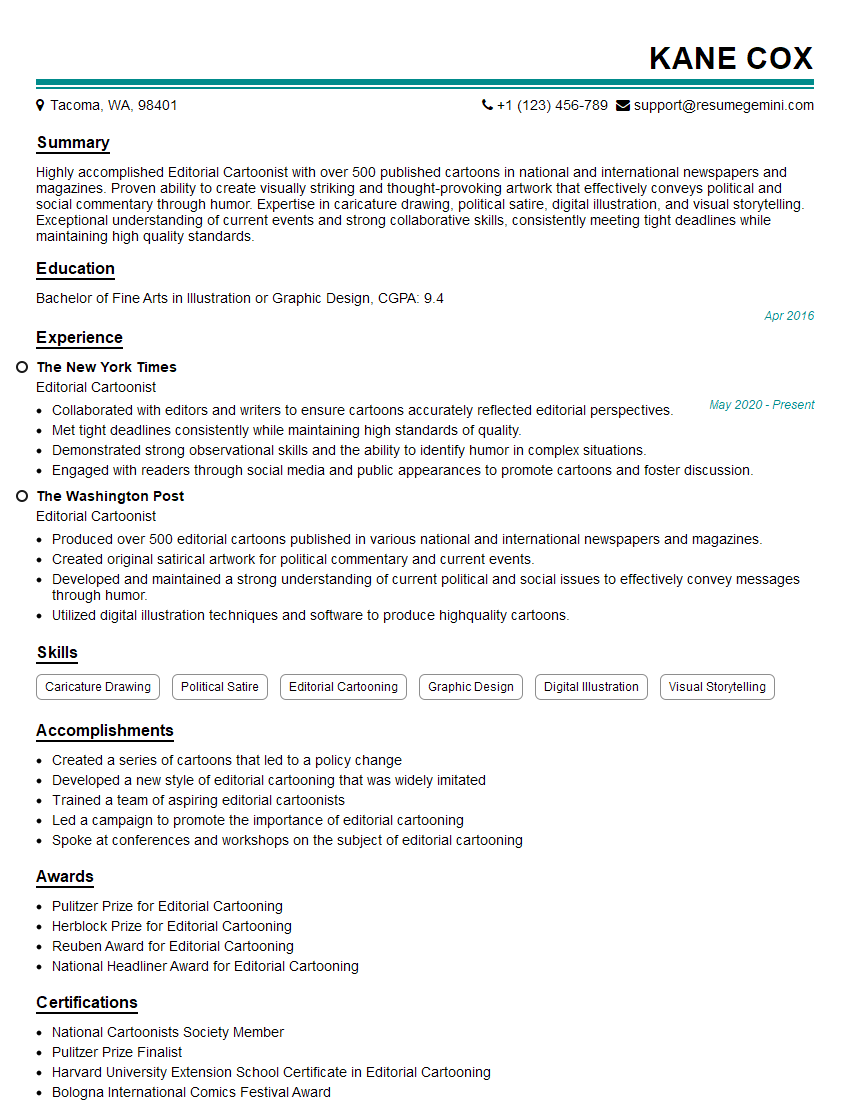
Mastering political cartooning opens doors to exciting careers in media, journalism, and political commentary. A strong portfolio is crucial, but so is a compelling resume that highlights your unique skills and experience. Creating an ATS-friendly resume is key to getting your application noticed by potential employers. To significantly boost your job prospects, we recommend using ResumeGemini, a trusted resource that helps you build professional and effective resumes. Examples of resumes tailored specifically to Political Cartooning are available to help you get started.
Explore more articles
Users Rating of Our Blogs
Share Your Experience
We value your feedback! Please rate our content and share your thoughts (optional).
What Readers Say About Our Blog
Really detailed insights and content, thank you for writing this detailed article.
IT gave me an insight and words to use and be able to think of examples