Interviews are more than just a Q&A session—they’re a chance to prove your worth. This blog dives into essential Pressing and Ironing interview questions and expert tips to help you align your answers with what hiring managers are looking for. Start preparing to shine!
Questions Asked in Pressing and Ironing Interview
Q 1. What are the different types of irons used in professional pressing?
Professional pressing utilizes a variety of irons, each tailored to specific needs. The most common types include:
- Steam Irons: These are versatile workhorses, ideal for most fabrics. Their steam function helps to relax fibers and remove wrinkles efficiently. Features like temperature control and variable steam output are crucial for optimal results.
- Dry Irons: Primarily used for delicate fabrics or when steam is undesirable, dry irons offer precise control and prevent potential damage from excessive moisture.
- Industrial Steam Presses: These heavy-duty machines offer superior pressing power and even heat distribution, perfect for large volumes or heavy fabrics like denim. They often feature a heated pressing surface and a powerful steam system.
- Professional-Grade Steam Generators: These separate the boiler from the iron, providing a consistent and powerful steam supply. This prevents inconsistent steam output and allows for faster, more effective pressing.
The choice of iron depends on the garment type, fabric, and volume of work. For instance, a steam generator is ideal for a busy tailor shop, while a steam iron suffices for home use or smaller-scale projects.
Q 2. Explain the importance of pre-pressing garments.
Pre-pressing is a critical initial step that prepares the garment for final pressing and significantly impacts the final result. It involves lightly pressing the garment before sewing or after cutting to remove wrinkles, set seams, and ensure the fabric is smooth and even.
Its importance lies in:
- Improved Seam Appearance: Pre-pressing helps to create crisp, flat seams that look professionally finished. Without it, seams can appear puckered or uneven.
- Easier Sewing: Working with a wrinkle-free fabric makes sewing smoother and reduces the risk of puckers or distorted seams.
- Better Final Press: Pre-pressing removes initial wrinkles, making the final press more efficient and yielding a flawless finish. Imagine trying to iron a deeply wrinkled shirt – the result will never be as crisp as if you started with a pre-pressed piece.
- Consistent Fabric Handling: Pre-pressing helps to unify the fabric’s texture, especially with blends or multi-directional weaves, leading to a uniform outcome after the final pressing.
Q 3. How do you identify different fabric types and their appropriate pressing techniques?
Fabric identification is paramount. Different fabrics react differently to heat and moisture. I assess fabric type using a combination of techniques:
- Visual Inspection: Examining the texture, weave, and drape helps in making initial assumptions. For instance, a loosely woven fabric might be linen, while a tightly woven one might be cotton poplin.
- Burn Test (with caution): A small, inconspicuous sample can be burned to determine the fiber content (though this should be done with great care and understanding).
- Touch Test: Feeling the fabric’s texture gives clues. Is it smooth, rough, soft, or stiff?
- Label Information: Care labels offer crucial details on fiber content and care instructions.
Pressing techniques vary greatly: delicate fabrics like silk or lace need low heat and pressing cloths, while durable materials like cotton can handle higher temperatures and direct ironing. Synthetics may require a lower temperature to avoid melting or scorching. I always test an inconspicuous area first to confirm my chosen technique.
Q 4. Describe your experience with various pressing equipment (e.g., steam presses, ironing boards).
My experience encompasses a wide range of pressing equipment. I’ve worked extensively with industrial steam presses, finding them indispensable for large-scale projects and achieving a consistent, professional finish. The even heat distribution minimizes the risk of scorching or shine marks, unlike smaller irons. I am also proficient with various steam irons, prioritizing those with adjustable temperature and steam settings.
Regarding ironing boards, I’ve used both standard and professional-grade boards. Professional boards often have a larger surface area, padded surface for more even pressure, and a built-in sleeve board, improving ergonomics and efficiency. The quality of the board’s padding is crucial; insufficient padding can result in uneven pressing and creases.
Q 5. How do you handle delicate fabrics like silk or lace during pressing?
Delicate fabrics demand a gentle approach. For silk and lace, I always use a low heat setting and a pressing cloth – a thin, clean cotton fabric placed between the iron and the garment. This protects the fabric from direct heat and prevents shine or damage. I also avoid pressing directly on embellishments or delicate seams. Instead, I often press from the reverse side to achieve a clean finish without harming the surface details. Steam should be used sparingly or avoided altogether, depending on the fabric’s sensitivity. Testing on an inconspicuous area first is essential.
For heavily embellished laces, I might use a tailor’s ham or a specialized pressing tool to support the fabric and prevent stretching or distortion. The process involves carefully lifting the iron and moving it slowly to avoid harsh contact.
Q 6. What are the common pressing problems you have encountered and how did you resolve them?
Common pressing problems I’ve encountered include:
- Shine Marks: These result from using too much heat or pressure, particularly on synthetic or delicate fabrics. I resolve this by using a lower temperature and a pressing cloth, or by pressing from the wrong side.
- Scorch Marks: Caused by excessively high heat. Prevention is key, using lower temperatures and always testing first. While sometimes minor scorch marks can be lightly brushed away, severe ones are irreversible.
- Uneven Pressing: This arises from inconsistent heat or pressure, poor ironing board quality, or insufficient pre-pressing. I address this by ensuring even pressure, using a quality board, and performing thorough pre-pressing.
- Water Spots: These occur when using too much moisture, especially on dark fabrics. Using less steam and allowing the fabric to dry thoroughly solves this.
Careful fabric identification, appropriate temperature settings, and the right technique are crucial to prevent these issues. Professionalism involves recognizing and correcting problems quickly.
Q 7. Explain the process of pressing a shirt, including proper techniques and order.
Pressing a shirt involves a systematic approach. The order is important to achieve a crisp, professional finish. Here’s a step-by-step process:
- Pre-press: Lightly press the entire shirt before starting, paying attention to seams and wrinkles.
- Collar: Press the collar, starting from the underside and moving to the outer surface. Use the point of the iron to press into the collar points.
- Yoke: Press the yoke (the area between the collar and shoulders).
- Sleeves: Press the sleeves, working from the cuffs towards the shoulders, keeping the sleeves flat on the ironing board. Use the sleeve board for optimal results.
- Body: Press the shirt body, working from the placket (front opening) outwards. Avoid pressing directly onto buttons.
- Placket and Cuffs: Carefully press the placket and cuffs, ensuring sharp creases and a neat appearance.
- Final Press: Give the shirt a final light press to ensure the entire shirt is crisp and flawless.
Throughout the process, maintain proper temperature settings according to the fabric, use a pressing cloth if necessary, and always avoid harsh pressure or rapid movements. For intricate areas, consider using a tailor’s ham for support.
Q 8. How do you prevent scorching or shine marks on fabrics?
Preventing scorching or shine marks on fabrics during pressing and ironing hinges on understanding fabric types and adjusting your technique accordingly. Scorching happens when the iron’s heat exceeds the fabric’s tolerance, while shine marks, or glazing, occur when the heat and pressure cause the fibers to flatten and lose their texture.
- Use the correct temperature setting: Always refer to the garment’s care label for recommended iron temperature. Think of it like cooking – you wouldn’t cook a delicate fish at the same temperature as a steak!
- Employ a pressing cloth: A pressing cloth acts as a barrier between the iron and the fabric, diffusing the heat and preventing direct contact that can cause scorching or shine. Think of it as a heat shield for your clothes. Different fabrics require different cloth types (e.g., a thin cotton cloth for delicate silks, a slightly heavier one for heavier fabrics like wool).
- Test on an inconspicuous area: Before pressing the entire garment, always test the iron’s temperature on a hidden seam or area to ensure the setting is appropriate and won’t cause damage.
- Lift and press: Instead of dragging the iron across the fabric, lift and press it in short, controlled bursts. This prevents prolonged heat exposure in one spot.
- Use steam judiciously: While steam is beneficial for many fabrics, excessive steam on delicate materials can lead to shine. For sensitive fabrics, consider using a lower steam setting or even pressing dry.
- Properly clean your iron: Residue and starch buildup on the iron’s soleplate can cause scorching. Regular cleaning keeps the heat distribution even.
For instance, when pressing a silk scarf, I always use a low temperature setting and a thin cotton pressing cloth, lifting and pressing gently. On the other hand, a linen shirt might tolerate a higher temperature with a heavier pressing cloth and a more assertive pressing action.
Q 9. What safety precautions do you take when operating pressing equipment?
Safety is paramount when working with pressing equipment. My approach prioritizes both personal safety and the preservation of the equipment itself.
- Always unplug the iron when not in use: This prevents accidental burns and electrical shocks. It’s a simple step, but a critical one.
- Keep cords out of walkways: To avoid tripping hazards, I always keep the power cord neatly positioned away from traffic areas.
- Never leave a hot iron unattended: A unattended hot iron presents a significant fire risk.
- Use caution when handling hot surfaces: Always allow the iron to cool down completely before storing it or cleaning it. Never touch hot metal parts directly. I often use heat-resistant gloves for added protection.
- Regularly inspect the iron’s cord and plug: Damaged cords or plugs can be dangerous and should be replaced immediately.
- Follow manufacturer instructions: Each piece of pressing equipment has its own safety guidelines; always follow the manufacturer’s recommendations.
In my experience, I’ve seen incidents stemming from negligence. For example, forgetting to unplug an iron after use can lead to a fire hazard. Therefore, safety is never an afterthought. It’s an integral part of my workflow.
Q 10. How do you maintain and clean pressing equipment to ensure optimal performance?
Maintaining and cleaning pressing equipment ensures longevity and optimal performance. Regular maintenance directly impacts the quality of the pressed garments.
- Clean the soleplate regularly: Use a damp cloth to wipe away any starch, fabric residue, or scorch marks. For stubborn residue, a specialized iron cleaner can be helpful.
- Descale the iron (if applicable): Depending on the type of iron, regular descaling is crucial to prevent mineral buildup that can affect steam production and even damage the iron.
- Clean the steam vents: Blocked steam vents reduce the efficiency of steam functionality. Use a pin or a cleaning tool to carefully unclog any blockages.
- Inspect the power cord and plug: Check for any damage and replace the cord or plug if necessary.
- Store the iron properly: When not in use, store the iron upright and allow it to cool completely. This prevents damage and ensures it’s ready for the next use.
- Regularly service professional equipment: Industrial pressing equipment may require periodic professional servicing to ensure proper functionality and safety.
I usually clean my iron after each use, and I perform a more thorough cleaning and descaling once a month. This proactive approach has extended the life of my equipment and ensured consistent performance.
Q 11. Describe your experience with different types of starch and their applications.
Different types of starch offer varying levels of stiffness and finish to fabrics. Choosing the right starch depends on the fabric and the desired outcome.
- Liquid starch: This is a common and convenient option, suitable for most fabrics. It provides a moderate level of stiffness and is easy to apply. This is my go-to for everyday use.
- Spray starch: Offers good control and even distribution, perfect for delicate fabrics or items that require a lighter finish. I typically use this for blouses and dresses that need just a touch of crispness.
- Powder starch: Provides the stiffest finish and is often used for items requiring a very crisp look, like collars and cuffs. I will often use this for shirts and formal wear that needs maximum stiffness.
The application method slightly differs for each type, with liquid starch applied directly to the fabric, spray starch sprayed evenly from a distance, and powder starch mixed with water before application. Understanding these nuances helps achieve the desired result.
For example, I would use liquid starch for everyday shirts and use spray starch for a silk blouse, preferring a lighter finish to maintain the fabric’s drape.
Q 12. How do you determine the appropriate temperature setting for various fabrics?
Determining the appropriate temperature setting for various fabrics is crucial to prevent damage. Incorrect settings can lead to scorching, shrinking, or shine marks.
- Check the care label: The care label provides the most accurate temperature recommendation for the specific fabric. This is always my first step.
- Use the iron’s settings: Most irons have fabric settings (e.g., cotton, linen, silk, wool) with corresponding temperature indications. These settings offer a good guideline.
- Start with a low temperature: When unsure, start with the lowest temperature setting and gradually increase until you achieve the desired results. Always test on an inconspicuous area first.
- Understand fabric types: Different fabrics have different heat tolerances. Delicate fabrics like silk and rayon require low temperatures, while more durable fabrics like cotton and linen can handle higher temperatures.
For instance, if I’m pressing a wool suit, I’d opt for a low to medium temperature setting and use a pressing cloth to avoid shine. Conversely, a cotton shirt might allow for a higher heat, possibly even without a pressing cloth, depending on the desired crispness.
Q 13. What are the differences between pressing and ironing?
Pressing and ironing, while both involve using heat to smooth fabric, differ significantly in technique and outcome.
- Pressing: Uses a controlled, downward pressure on the fabric, often with a pressing cloth, to smooth wrinkles and create crisp lines. It’s used to create sharp creases and folds, and the goal is a precise, tailored look. Pressing is ideal for seams, darts, and pleats. This technique requires more precision.
- Ironing: Involves moving the iron back and forth across the fabric to smooth out wrinkles. It’s a more generalized approach aiming to make the garment look smooth and neat. Ironing is often suitable for larger areas and simpler garments. Ironing is faster but less precise than pressing.
Imagine making a shirt. You’d use pressing to create crisp creases on the seams and collar, while ironing would smooth the larger panels of the shirt. Both are necessary for a professional finish.
Q 14. Explain the importance of using a pressing cloth.
A pressing cloth is essential for protecting fabrics from direct heat damage, preventing scorching and shine. It also allows for even heat distribution and helps to create a crisper finish.
- Protection: The pressing cloth acts as a buffer between the hot iron and the fabric, preventing direct contact that can lead to scorching, especially with delicate materials.
- Heat Distribution: It helps to distribute the heat evenly across the fabric surface, preventing hot spots and uneven pressing.
- Improved Finish: It gives a smoother and crisper finish, reducing the risk of shine marks that can occur with direct iron contact. This is especially true for fabrics prone to glazing.
- Moisture Control: For fabrics that require steam, a pressing cloth helps maintain moisture and prevent the fabric from becoming over-saturated.
I consider a pressing cloth as indispensable, just like a chef relies on their knives. It’s a crucial tool to achieve professional results. For instance, when pressing silk or wool, using a pressing cloth is absolutely essential to avoid damage.
Q 15. How do you handle wrinkles on different types of fabrics?
Handling wrinkles effectively depends entirely on the fabric type. Think of it like this: each fabric has a unique personality, and you need to treat it accordingly.
- Delicate fabrics like silk or lace: These require a gentle approach. I use low heat and a pressing cloth (a thin cotton fabric placed between the iron and the garment) to prevent scorching or shine. Steam is your friend here, but use it sparingly to avoid over-wetting. I often press these fabrics on the wrong side to minimize damage.
- Sturdy fabrics like cotton or linen: These can withstand higher heat and more direct pressure. I might use a higher temperature setting and press directly onto the fabric. For stubborn wrinkles, I’ll use a damp cloth and a hot iron, ensuring to move the iron constantly to avoid creases.
- Synthetic fabrics like polyester or nylon: These fabrics are prone to melting under high heat. I always use a low temperature setting and a pressing cloth, focusing on gentle pressing and steam rather than direct heat.
- Wools and blends: Wool is sensitive to heat and can become permanently damaged if over-pressed. It requires a lower temperature setting, a pressing cloth, and careful ironing, ideally pressing the fabric in the direction of the nap (the way the fabric’s fibers naturally lay).
For example, I recently pressed a delicate silk blouse. I used a low heat setting, a pressing cloth, and light pressure. The result was a beautifully pressed garment without any damage. Contrast this with pressing a heavy linen tablecloth, where I could use a higher temperature and direct pressure to get crisp, sharp folds.
Career Expert Tips:
- Ace those interviews! Prepare effectively by reviewing the Top 50 Most Common Interview Questions on ResumeGemini.
- Navigate your job search with confidence! Explore a wide range of Career Tips on ResumeGemini. Learn about common challenges and recommendations to overcome them.
- Craft the perfect resume! Master the Art of Resume Writing with ResumeGemini’s guide. Showcase your unique qualifications and achievements effectively.
- Don’t miss out on holiday savings! Build your dream resume with ResumeGemini’s ATS optimized templates.
Q 16. How do you ensure consistency in pressing quality?
Consistency in pressing quality is paramount. It’s all about establishing a reliable system and sticking to it. This involves several key aspects:
- Proper iron temperature: I always check the fabric care label and adjust the iron’s temperature accordingly. A consistent temperature ensures even pressing and avoids scorching or shiny patches.
- Consistent pressure: This is crucial for even results. I always maintain an even pressure across the fabric surface, avoiding unnecessary pressure in some areas and light pressure in others. It’s about feeling the fabric and finding the right balance.
- Use of pressing cloths: Using pressing cloths protects delicate fabrics and helps prevent shine. I use them regularly, ensuring they are clean and free of any wrinkles.
- Regular maintenance: I regularly clean my iron and ensure its soleplate is smooth to prevent uneven heat distribution. This also avoids transferring dirt or residue to the garments.
- Standard operating procedures (SOPs): Following a standardized approach ensures the process is consistent, regardless of who presses the garment. For example, I might have a SOP that outlines the correct settings for each fabric type.
Imagine baking a cake: if you don’t maintain the same temperature and baking time, you won’t get consistent results every time. Pressing is very similar – consistency in technique and equipment is key to a consistent final product.
Q 17. What are your methods for efficiently pressing large quantities of garments?
Pressing large quantities efficiently requires strategic planning and effective techniques:
- Organization: I sort garments by fabric type and required pressing techniques. This allows for efficient use of the iron’s heat settings and reduces the need for adjustments.
- Batch processing: I process garments in batches based on fabric type. This is particularly useful for high-volume operations. For example, all the cotton shirts are pressed together, then all the linen trousers, and so on.
- Efficient ironing techniques: I employ techniques like pressing several layers of fabric simultaneously where appropriate (such as shirtsleeves) and using a tailors’ ham or sleeve roll for precise shaping.
- Specialized equipment: Depending on the volume, commercial-grade pressing equipment such as a professional steam press or industrial iron is necessary for increased speed and efficiency. These machines help to minimize wasted time and effort.
- Teamwork: In team environments, division of labor and specialized roles greatly improve throughput. One person might focus on pretreatment, another on pressing, and a third on finishing.
For example, when I had to press hundreds of shirts for a large event, I sorted them by color and fabric weight, set my industrial iron to the correct temperature, and used a sleeve board to efficiently press both sleeves simultaneously. This approach ensured a high volume of shirts were pressed to a consistent quality in a timely manner.
Q 18. Describe your experience working in a fast-paced environment.
I thrive in fast-paced environments. My experience in a busy dry cleaning facility honed my skills in prioritizing tasks, working efficiently under pressure, and maintaining high-quality results even when dealing with many garments within tight deadlines.
I’ve learned to remain calm and focused under pressure, utilizing effective time management techniques and maintaining organization to minimize stress and ensure all garments are handled with the necessary care. Multitasking is a key skill I have developed – I can be pressing garments while simultaneously monitoring the progress of other tasks, and anticipating needs before problems arise.
One example: During peak season, we once had a significant backlog of garments due to an unexpected rush. I quickly organized the items based on urgency, and by carefully coordinating with my colleagues we were able to clear the backlog and meet all deadlines without compromising quality. This demonstrates my ability to handle pressure, problem-solve proactively, and efficiently manage my time in high-pressure situations.
Q 19. How do you adapt your pressing techniques to meet the specific requirements of different garments?
Adaptability is crucial in pressing. Different garments require tailored techniques. For example, a crisp business shirt needs sharp creases and a perfectly flat front, while a delicate evening gown requires gentle handling and minimal pressure.
- Understanding garment construction: I assess the garment’s construction, fabric type, and intended style before beginning. This allows me to select the right techniques and tools.
- Using specialized tools: A tailor’s ham, sleeve board, and point presser are essential for shaping and pressing specific garment areas like collars, sleeves, and darts.
- Adjusting pressure and heat: I adjust the iron’s temperature and pressure based on fabric type and garment style. Delicate fabrics require low heat and light pressure, while sturdier fabrics can tolerate higher heat and more pressure.
- Following specific instructions: If provided with specific instructions, I carefully follow those to ensure the garment is pressed to the client’s exact specifications.
Consider a tailored suit jacket: The shoulder pads require specific pressing techniques to maintain their shape, while the lapels need to be pressed sharply to provide a clean, professional look. This differs vastly from pressing a simple t-shirt, which requires a much simpler and quicker approach. My experience allows me to seamlessly adapt to these varying demands.
Q 20. What are the common challenges you face in a professional pressing environment?
Challenges in professional pressing are common and often require quick problem-solving:
- Fabric damage: Scorching, shiny patches, or unwanted creases can occur due to incorrect temperature settings or improper handling. This requires careful attention to detail and adherence to the fabric care instructions.
- Stubborn wrinkles: Some fabrics are notoriously difficult to press. Techniques like using steam, damp cloths, and pressing in the direction of the nap are essential for overcoming this.
- Time constraints: Meeting deadlines while maintaining quality can be challenging. Efficient organization and prioritization techniques are key to managing time effectively.
- Equipment malfunctions: Iron malfunctions can cause significant delays. Regular maintenance and having a backup plan is essential.
- Difficult garment shapes and details: Intricate garment designs, like pleats or gathers, often require specialized techniques and careful handling to avoid distortion.
For instance, I once encountered a garment made from a very delicate and unusual fabric blend. It required a lot of experimentation to find the right temperature and pressing method to avoid damaging the fabric. This highlighted the need for patience, resourcefulness, and a willingness to adapt my techniques to resolve unique challenges.
Q 21. How do you prioritize tasks and manage your time effectively?
Prioritizing tasks and managing time efficiently in a pressing environment requires a structured approach.
- Assessing urgency: I evaluate each garment based on its deadline and complexity, prioritizing rush orders and delicate fabrics accordingly.
- Batching similar tasks: I group similar tasks together – for example, pressing all shirts, then all trousers – to optimize workflow and minimize the need to change equipment settings.
- Time blocking: I allocate specific time blocks for particular tasks to ensure even distribution of my time throughout the day.
- Utilizing technology: Technology such as garment tracking systems can assist with managing orders and deadlines effectively.
- Continuous improvement: I constantly analyze my workflow to identify areas for improvement in efficiency and productivity.
Think of it like a chef preparing a multi-course meal: they wouldn’t start preparing the dessert first, would they? They carefully plan, prioritize, and time their actions to ensure all dishes are ready at the appropriate time. I apply a similar approach to ensure all garments are processed efficiently and on time.
Q 22. Describe your experience with quality control measures in a pressing environment.
Quality control in pressing is paramount for delivering a consistently high-quality product. My approach involves a multi-stage process, beginning with a thorough inspection of the garment before pressing. I check for any pre-existing damage, stains, or special care instructions. During the pressing process itself, I pay close attention to detail, ensuring even heat distribution and avoiding scorching or shine. Specific checks include examining seams for crispness, checking for wrinkles or creases, and verifying that the garment maintains its original shape. Finally, a post-pressing inspection is crucial. This includes a final visual check for any imperfections and a careful assessment of the overall finish. Think of it like baking a cake – you check the ingredients, monitor the baking process, and then finally do a quality check before serving. I’ve implemented a system of checklists and regularly review my work against industry best practices. For example, I’ve recently adopted a system where I use a color-coded tag system to indicate the level of care required by a garment. This helps me ensure that the appropriate techniques are used consistently.
Q 23. How do you handle customer complaints or concerns regarding pressing services?
Handling customer complaints is about understanding their perspective and finding a solution. I start by actively listening to the concern, acknowledging their frustration, and thanking them for bringing the issue to my attention. I then carefully examine the garment to identify the problem. Sometimes, it’s a minor issue easily resolved with a quick re-press. Other times, it might involve a more significant flaw requiring additional work or even a full replacement. Transparency is key; I explain the process involved in resolving the issue, setting realistic expectations for turnaround time. I offer sincere apologies for any inconvenience and document the entire interaction. For instance, a customer once complained about inconsistent ironing on a delicate silk blouse. After careful inspection, I found that the issue stemmed from uneven moisture distribution during the initial pressing. I reprocessed the garment using a slightly different method, ensuring even steam penetration, and the customer was completely satisfied with the improved result. This experience taught me the importance of careful moisture control on delicate fabrics.
Q 24. What are your methods for identifying and repairing pressing errors?
Identifying and repairing pressing errors requires a systematic approach. First, I carefully analyze the garment to pinpoint the exact nature of the error. Is it a scorch mark? A crease? Uneven pressing? Once the problem is identified, I determine the root cause. Was it incorrect temperature setting? Insufficient moisture? Improper handling of the fabric? The repair method depends on the error. For minor wrinkles, a quick re-press might suffice. For more significant issues like scorch marks, the repair might involve specialized techniques or even the use of stain removers, if appropriate. If the damage is irreparable, the customer needs to be informed, and a solution offered, such as remaking or providing a credit. For example, a recent error involved a slightly scorched area on a cotton shirt. I carefully applied a steam-based treatment to help lift the fibers and reduce the scorch mark’s visibility. In another case, an improperly folded garment resulted in a crease. This required a full repressing of the garment to smooth out the crease completely.
Q 25. How do you maintain a clean and organized workspace?
Maintaining a clean and organized workspace is essential for efficiency and safety. My approach focuses on consistent cleaning and organization. I regularly clean the ironing board cover, replacing it when necessary. I keep my iron clean, descaling it routinely to prevent mineral build-up and ensure optimal performance. All pressing equipment is stored in designated areas when not in use. The workspace is decluttered after each pressing session, with garments sorted and neatly stacked. Regularly cleaning and sanitizing the work surface prevents the spread of dirt and microorganisms. To avoid unnecessary clutter, I use a color-coded system to separate items needing different levels of care. This helps streamline the workflow and prevents mix-ups. Think of it as a chef keeping their kitchen spotless. A clean and organized environment is crucial to avoid accidents and create an efficient workflow.
Q 26. What are your strengths and weaknesses regarding pressing and ironing?
My strengths lie in my meticulous attention to detail, adaptability to different fabrics and garments, and my ability to consistently deliver high-quality results under pressure. I’m adept at identifying and repairing pressing errors quickly and efficiently. I’m also a quick learner and enjoy experimenting with different pressing techniques to achieve optimal results. However, like everyone, I have areas for improvement. I sometimes struggle with managing large volumes of work during peak seasons, and could benefit from better time management strategies. I’m actively working on this by implementing better organizational systems and prioritizing tasks effectively. This constant self-assessment allows me to continually refine my skills and adapt to challenges.
Q 27. What are your salary expectations for this position?
My salary expectations are in line with the industry standard for a professional with my experience and skill set. I am flexible and open to discussing a competitive compensation package based on the specifics of this position and the benefits offered.
Q 28. Where do you see yourself in five years?
In five years, I see myself as a highly skilled and respected professional in the pressing and ironing field. I envision myself continuing to enhance my expertise through advanced training and possibly mentoring junior staff. My goal is to contribute to a team environment, sharing my knowledge and helping to maintain a consistently high level of quality and service. I am also keen to explore opportunities for leadership and management roles within the industry.
Key Topics to Learn for Pressing and Ironing Interview
- Fabric Identification and Care: Understanding different fabric types (cotton, linen, silk, wool, synthetics), their properties, and appropriate pressing techniques to avoid damage.
- Pressing Equipment & Techniques: Proficiency with irons (steam, dry), pressing boards, steam generators, and specialized equipment; mastering techniques like pressing seams, pleats, collars, and cuffs.
- Stain Removal and Pre-Treatment: Identifying common stains and applying appropriate pre-treatment methods before pressing to prevent setting stains.
- Understanding Garment Construction: Knowledge of basic garment construction to effectively press and maintain garment shape and integrity. This includes understanding seam allowances and construction details.
- Quality Control and Finishing: Developing a keen eye for detail to ensure a high standard of finish – wrinkle-free, crisp, and professionally pressed garments.
- Efficiency and Productivity: Strategies for efficient workflow and time management to meet production demands while maintaining quality.
- Safety Procedures and Ergonomics: Safe handling of pressing equipment, maintaining a clean and organized workspace, and practicing proper ergonomics to prevent injuries.
- Troubleshooting and Problem-Solving: Identifying and resolving common pressing issues such as scorch marks, wrinkles, and shine.
Next Steps
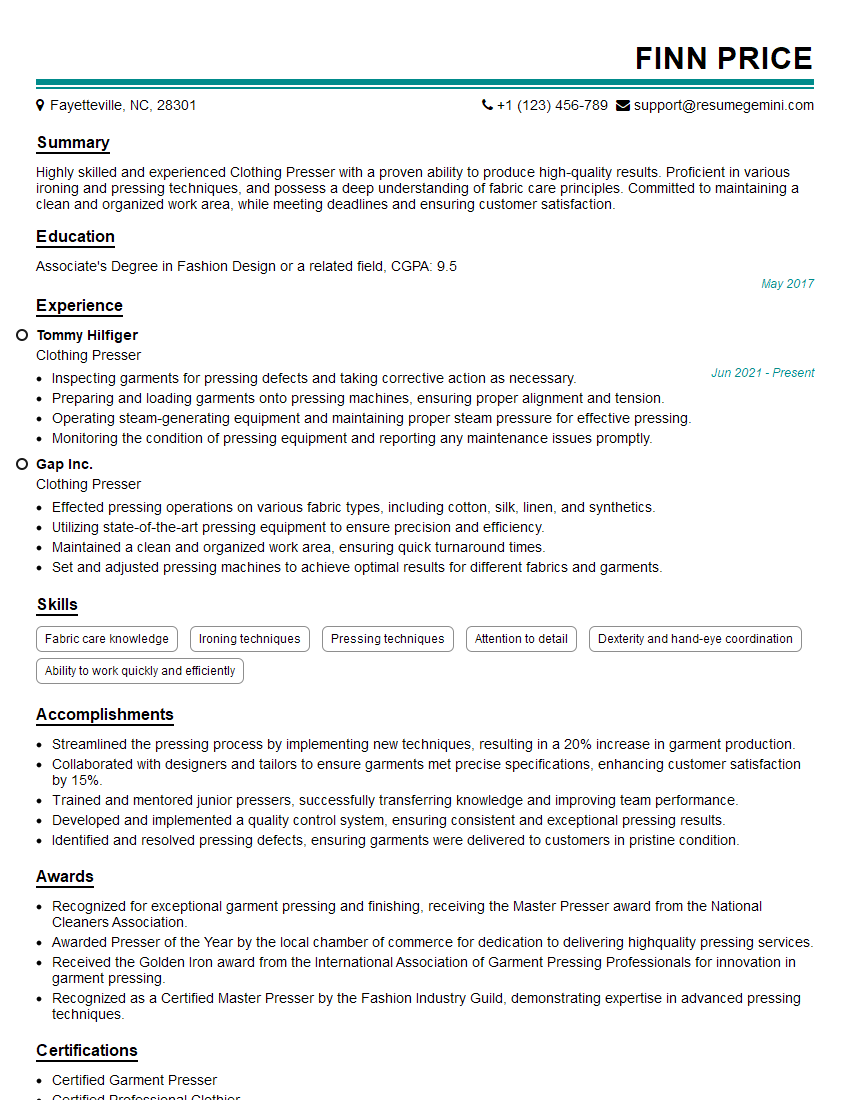
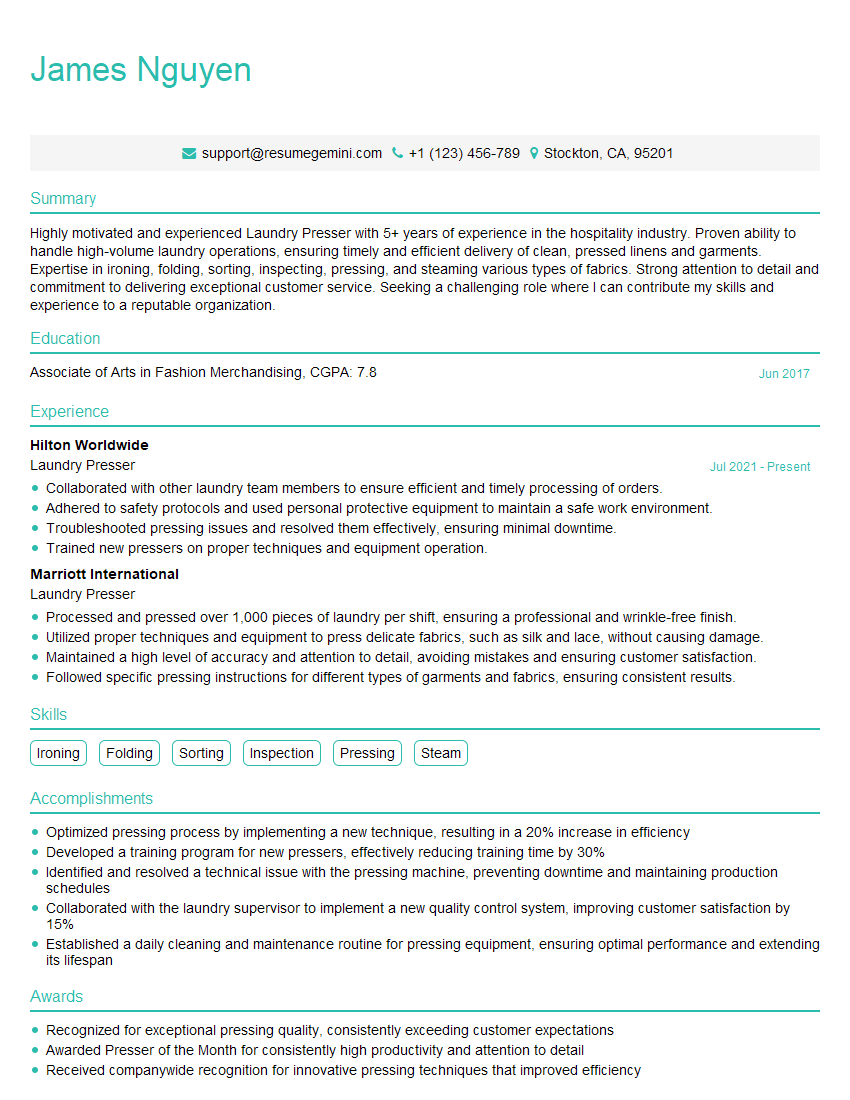
Mastering pressing and ironing is crucial for career advancement in the fashion and textile industries. A strong skillset in this area demonstrates attention to detail, technical proficiency, and a commitment to quality – highly valued attributes by employers. To significantly boost your job prospects, it’s essential to create an ATS-friendly resume that highlights your abilities effectively. ResumeGemini is a trusted resource that can help you craft a professional and impactful resume, ensuring your application stands out. Examples of resumes tailored to Pressing and Ironing positions are available to guide you.
Explore more articles
Users Rating of Our Blogs
Share Your Experience
We value your feedback! Please rate our content and share your thoughts (optional).
What Readers Say About Our Blog
Really detailed insights and content, thank you for writing this detailed article.
IT gave me an insight and words to use and be able to think of examples