Preparation is the key to success in any interview. In this post, we’ll explore crucial Produce Industry Knowledge interview questions and equip you with strategies to craft impactful answers. Whether you’re a beginner or a pro, these tips will elevate your preparation.
Questions Asked in Produce Industry Knowledge Interview
Q 1. Explain the difference between conventional and organic produce.
The primary difference between conventional and organic produce lies in farming practices. Conventional farming typically utilizes synthetic pesticides, herbicides, and fertilizers to maximize yield and control pests and weeds. Genetically modified organisms (GMOs) are also often used. In contrast, organic farming employs natural methods to achieve these goals. This includes using natural pest control (like beneficial insects), crop rotation, and organic fertilizers (like compost). Organic farms also prohibit the use of GMOs. Think of it like this: conventional farming is like using a powerful chemical weed killer, while organic farming is more like carefully weeding by hand, utilizing natural methods to promote healthy plant growth.
The key distinction impacts the environment, human health, and the final product. Organic produce is often seen as having fewer chemical residues, although this is not always the case and rigorous testing is required to obtain organic certification. However, the environmental impact of organic farming can be different, often requiring more land and resources. The choice between conventional and organic is ultimately a personal one, based on individual values and priorities.
Q 2. Describe the process of produce ripening and its impact on quality.
Produce ripening is a complex process involving biochemical changes that transform a fruit or vegetable from its immature state to a mature, edible one. These changes involve enzymatic activity, affecting texture, color, flavor, and aroma. For example, the conversion of starches to sugars contributes to sweetness, while the breakdown of chlorophyll leads to color changes.
The impact of ripening on quality is significant. Proper ripening enhances palatability and nutritional value. However, over-ripening can lead to spoilage, marked by increased respiration rate, softening, and susceptibility to microbial growth. Imagine a perfectly ripe banana – sweet, flavorful, and easy to digest. Compare that to a bruised, overripe banana – mushy, brown, and potentially unfit for consumption. Understanding and managing the ripening process is critical for maintaining quality and minimizing waste.
Q 3. What are the key factors affecting produce pricing?
Produce pricing is influenced by a multitude of interconnected factors. Supply and demand are fundamental – a shortage of a particular fruit due to a poor harvest will drive prices up, while an overabundance will lower them. Production costs, including labor, land, water, fertilizer, and transportation, directly impact pricing. Seasonality plays a crucial role; prices for strawberries are higher in winter due to limited availability. Market conditions such as consumer preferences, economic factors, and trade agreements all contribute. For example, a sudden increase in consumer demand for a specific type of apple can lead to a temporary price hike. Finally, packaging and transportation costs add to the final price the consumer pays.
Think of it as a complex equation where each factor interacts with the others to determine the final cost.
Q 4. How do you ensure the food safety and quality of produce throughout the supply chain?
Ensuring food safety and quality of produce throughout the supply chain requires a multifaceted approach that integrates Good Agricultural Practices (GAPs), Good Handling Practices (GHPs), and Hazard Analysis and Critical Control Points (HACCP) principles. GAPs focus on safe growing practices, minimizing contamination risks from the field. GHPs extend this focus to post-harvest handling, storage, and transportation. HACCP is a preventative system that identifies potential hazards and establishes control points to mitigate risks. This can include things like temperature control, proper sanitation, and employee training.
Traceability systems are also vital; being able to track produce from farm to table allows for swift identification and recall of contaminated products. Regular testing for pathogens, pesticide residues, and heavy metals ensures adherence to quality and safety standards. Ultimately, collaboration throughout the supply chain, from growers to retailers, is crucial for effective food safety management.
Q 5. What are the common postharvest handling techniques for produce?
Postharvest handling techniques are critical for preserving the quality and extending the shelf life of produce. These techniques begin immediately after harvest. Cooling is essential to slow down respiration and enzymatic activity, thus reducing spoilage. This can involve hydrocooling (immersion in cold water) or air cooling. Proper storage in controlled environments with specific temperature and humidity levels is key. Modified Atmosphere Packaging (MAP) modifies the gaseous environment surrounding the produce (reducing oxygen and increasing carbon dioxide) to slow respiration and extend shelf life. Pre-cooling is crucial to rapidly lower the produce temperature before packaging and transport. Cleaning and sanitization steps remove dirt and pathogens. The choice of technique depends on the type of produce and desired shelf life.
Q 6. Explain the role of traceability in the produce industry.
Traceability in the produce industry refers to the ability to track the movement of produce throughout the supply chain. This involves identifying and documenting the origin, handling, processing, and distribution of the product. It’s like creating a detailed passport for each piece of produce, showing its journey from farm to consumer. This is critical for several reasons:
- Food safety: In case of a contamination outbreak, traceability enables swift identification of the source and rapid recall of affected products, minimizing health risks.
- Quality control: Traceability helps identify sources of quality issues, allowing for corrective actions and preventing future problems.
- Supply chain management: It improves efficiency and transparency, optimizing logistics and inventory management.
- Brand protection: Traceability enhances consumer trust and safeguards brand reputation.
Technologies like blockchain and barcode systems are increasingly used to enhance traceability systems.
Q 7. How do you manage inventory to minimize waste and spoilage?
Managing inventory to minimize waste and spoilage requires a sophisticated approach that combines forecasting, efficient storage, and effective communication. Accurate demand forecasting is crucial. This involves analyzing historical sales data, considering seasonal variations, and taking into account factors like promotions and marketing campaigns. First-in, first-out (FIFO) inventory management ensures that older products are used or sold before newer ones. Effective storage conditions, as discussed earlier, are essential to prevent spoilage. Regular inventory checks help identify slow-moving or expiring items, allowing for adjustments to ordering and pricing strategies. Collaboration with suppliers is key for optimizing inventory levels and preventing overstocking.
Finally, donation or repurposing of surplus produce reduces waste and can support local food banks or composting initiatives. A well-managed inventory system is the cornerstone of a profitable and sustainable produce operation.
Q 8. Describe your experience with various produce storage methods (e.g., refrigeration, controlled atmosphere storage).
Produce storage is crucial for maintaining quality and extending shelf life. My experience encompasses a range of methods, each tailored to specific produce characteristics. Refrigeration is the most common, slowing down respiration and enzymatic activity. Different produce requires different temperature settings; for example, leafy greens thrive around 34°F (1°C), while tropical fruits often need warmer temperatures.
Controlled Atmosphere (CA) storage is a more sophisticated approach, precisely managing oxygen, carbon dioxide, and nitrogen levels within the storage environment. This significantly slows down ripening and reduces spoilage, extending shelf life considerably. I’ve worked with CA storage for apples, pears, and avocados, achieving substantial improvements in quality and marketability. For example, I oversaw a project where implementing CA storage for Granny Smith apples increased their shelf life by over 50%.
Finally, I’ve also worked with modified atmosphere packaging (MAP), where the packaging itself is modified to create a protective atmosphere around the product, delaying spoilage and extending shelf life. This is particularly useful for extending the shelf life of ready-to-eat salads and cut fruits.
Q 9. What are the common pests and diseases affecting produce, and how are they controlled?
Pests and diseases are major threats to produce quality and yield. Common pests include aphids, spider mites, and various fruit flies. Diseases vary widely depending on the crop, but common examples include fungal diseases like Botrytis (gray mold) on grapes and strawberries, bacterial diseases like Erwinia on carrots, and viral diseases like citrus tristeza virus.
Pest and disease control involves a multi-pronged approach. This includes preventative measures such as crop rotation, sanitation, and using disease-resistant varieties. Integrated Pest Management (IPM) is key—a holistic approach that combines biological control (introducing beneficial insects), cultural practices (proper irrigation and fertilization), and only using chemical pesticides as a last resort, minimizing environmental impact and potential for pesticide resistance. Regular monitoring and early detection are crucial; early intervention is much more effective than dealing with widespread infestations or infections.
Q 10. Explain different produce grading systems and their significance.
Produce grading systems standardize quality assessment, ensuring consistent quality and facilitating fair trade. These systems typically consider factors like size, shape, color, maturity, and absence of defects. Grading standards vary by commodity and often involve visual inspection and sometimes measurement.
For example, apples might be graded based on size (extra large, large, medium, etc.), color (uniformity and intensity), and the presence of blemishes. Similarly, bananas are graded on factors such as color, size, and shape, with different grades fetching different prices. These grading systems ensure customers receive produce of a consistent quality and help prevent market confusion. Furthermore, standardized grading simplifies logistics and facilitates international trade.
Q 11. How do you identify and handle produce spoilage?
Identifying and handling produce spoilage is critical for minimizing losses and maintaining consumer safety. Spoilage indicators vary greatly depending on the product. Signs can include discoloration (browning, wilting), off-odors, slimy textures, and the presence of mold or rot.
My approach involves regular visual inspection and sometimes sensory evaluation (smell and touch). Quick detection is crucial. Once spoilage is identified, prompt action is needed to prevent further contamination. This might involve removing spoiled items, cleaning affected areas, and potentially adjusting storage conditions to prevent further degradation. In cases of significant spoilage, traceability is crucial to identify the source and implement corrective actions, preventing recurrence.
Q 12. What are the key challenges in maintaining a consistent supply of fresh produce?
Maintaining a consistent fresh produce supply faces many challenges. Weather conditions are a major factor, with droughts, floods, and extreme temperatures impacting crop yields and quality. Unexpected events like pest outbreaks and diseases can severely disrupt supply chains. Furthermore, fluctuating demand and seasonal variations make planning complex.
Global supply chains are vulnerable to disruptions, with geopolitical instability, transportation issues, and even labor shortages posing significant hurdles. Managing these challenges requires robust risk management strategies, diversification of sourcing, and close collaboration with growers and logistics partners. Investing in technologies like predictive analytics can improve forecasting accuracy and aid in proactive management of potential supply chain interruptions.
Q 13. How do you manage relationships with suppliers and growers?
Strong relationships with suppliers and growers are fundamental to a successful produce business. I prioritize open communication, transparency, and mutual trust. This includes regular meetings, sharing market information, and working collaboratively on quality control and sustainability initiatives.
Fair pricing, timely payments, and consistent order fulfillment are essential for building strong partnerships. I also actively participate in industry events and networks to foster relationships and stay updated on industry best practices. By consistently prioritizing ethical and sustainable practices, I aim to create long-term, mutually beneficial relationships that ensure reliable access to high-quality produce.
Q 14. Describe your experience with different types of produce transportation.
My experience encompasses various transportation modes, each with its own advantages and limitations. Refrigerated trucks are the most common method for short- to medium-distance transport, ensuring produce stays at optimal temperatures. For longer distances, especially internationally, sea freight is common, but requires careful temperature and humidity control to prevent spoilage during transit.
Air freight is the fastest but also most expensive option, used mainly for high-value, perishable goods needing rapid delivery. I’ve also worked with rail transportation for certain produce types and routes, offering a balance between cost and speed. The choice of transportation mode depends on factors such as distance, perishability of the product, cost considerations, and urgency.
Q 15. How do you ensure compliance with food safety regulations (e.g., FDA, USDA)?
Ensuring food safety compliance in the produce industry is paramount. It’s not just about meeting regulations; it’s about safeguarding public health and maintaining consumer trust. We adhere strictly to guidelines set by the FDA (Food and Drug Administration) and USDA (United States Department of Agriculture), which encompass everything from farm to table.
- Good Agricultural Practices (GAPs): We implement rigorous GAPs throughout the supply chain, focusing on proper sanitation, hygiene, and pest control in the fields. This includes regular water testing and employee training on safe handling procedures. For example, we meticulously track the source of our produce, ensuring traceability in case of a contamination issue.
- Hazard Analysis and Critical Control Points (HACCP): HACCP is a preventative system that identifies potential hazards and establishes critical control points to minimize risks. We have a documented HACCP plan that addresses potential biological, chemical, and physical hazards, with regular monitoring and documentation.
- Traceability Systems: We utilize sophisticated traceability systems, often involving barcodes and RFID tags, to track produce from origin to retail shelves. This allows for quick identification and removal of potentially contaminated products, limiting the scope of any outbreak.
- Regular Audits and Inspections: We welcome regular audits and inspections by regulatory bodies to ensure ongoing compliance. These audits provide valuable feedback and identify areas for improvement.
- Employee Training: All our employees receive comprehensive training on food safety regulations, hygiene practices, and proper handling procedures. We conduct regular refresher courses to ensure everyone is up-to-date.
By implementing these measures, we not only meet legal requirements but also foster a culture of food safety within our organization, prioritizing the health and well-being of our consumers.
Career Expert Tips:
- Ace those interviews! Prepare effectively by reviewing the Top 50 Most Common Interview Questions on ResumeGemini.
- Navigate your job search with confidence! Explore a wide range of Career Tips on ResumeGemini. Learn about common challenges and recommendations to overcome them.
- Craft the perfect resume! Master the Art of Resume Writing with ResumeGemini’s guide. Showcase your unique qualifications and achievements effectively.
- Don’t miss out on holiday savings! Build your dream resume with ResumeGemini’s ATS optimized templates.
Q 16. What is your experience with produce labeling and regulations?
Produce labeling is crucial for providing consumers with accurate and essential information. Regulations dictate what must be included on labels, including the product name, net weight, country of origin, and any relevant allergen information. My experience encompasses all aspects of this, from ensuring accurate weight declarations to managing nutritional labeling and complying with labeling regulations specific to organic produce (USDA Organic seal).
- Accuracy and Legibility: We ensure all labels are accurate, legible, and clearly displayed in accordance with FDA guidelines. Any discrepancies can lead to recalls and significant financial losses.
- Country of Origin Labeling (COOL): We strictly adhere to COOL regulations, accurately indicating the origin of our produce. Transparency builds trust with consumers and is essential for responsible sourcing.
- Organic Certification Labeling: If we handle organic produce, we ensure appropriate USDA Organic certification seals and labeling are present and meet all requirements for organic claims.
- Allergen Information: We’re meticulous about allergen labeling, clearly indicating the presence of any potential allergens (e.g., nuts, soy) to protect consumers with allergies.
Regular internal audits and collaborations with our labeling suppliers ensure that we stay updated on evolving regulations and industry best practices.
Q 17. How do you manage produce waste and implement sustainable practices?
Minimizing produce waste is an ethical and economic imperative. We use a multi-pronged approach to tackle this challenge, focusing on both preventing waste and finding innovative solutions for unavoidable losses.
- Improved Forecasting and Inventory Management: We leverage data analytics and forecasting tools to accurately predict demand, reducing overstocking and subsequent spoilage. This includes analyzing historical sales data and taking into account seasonal fluctuations.
- Strategic Partnerships: We collaborate with food banks and composting facilities to divert unsold or imperfect produce, minimizing landfill waste and supporting community needs. For example, we donate slightly bruised but still edible fruits to local food banks.
- Optimized Storage and Handling: Proper temperature control, humidity management, and careful handling are crucial to preserving produce quality and extending shelf life. We invest in modern refrigeration technology and train employees in best practices.
- Innovative Processing: We explore opportunities to process excess or imperfect produce into value-added products like jams, juices, or sauces, thereby extending its shelf life and creating new revenue streams.
- Data-Driven Waste Audits: We regularly conduct waste audits to identify the sources of waste within our operation and pinpoint areas for improvement. This data allows us to target our waste reduction efforts effectively.
Sustainable practices aren’t just a trend; they are integral to our long-term viability and commitment to environmental responsibility.
Q 18. Describe your experience with using technology to improve produce operations (e.g., inventory management software).
Technology plays a vital role in modern produce operations. We utilize several technologies to streamline processes, improve efficiency, and enhance decision-making.
- Inventory Management Software: We use sophisticated inventory management software to track produce from the moment it arrives to when it’s sold. This provides real-time visibility into stock levels, helping to optimize ordering and prevent spoilage.
- Supply Chain Management Systems: We leverage supply chain management systems to track produce through the entire supply chain, from farm to retail. This ensures traceability, enhances efficiency, and minimizes disruptions.
- Data Analytics and Forecasting: We use data analytics tools to analyze sales data, weather patterns, and other factors to forecast demand more accurately. This allows us to optimize purchasing and minimize waste.
- Automated Harvesting and Sorting Technologies: In some areas, we utilize automated harvesting and sorting technologies to improve efficiency and reduce labor costs. These technologies can also improve the quality of the produce by identifying and sorting out damaged or imperfect items.
- Temperature Monitoring Systems: Real-time temperature monitoring systems ensure optimal storage conditions are maintained throughout the supply chain, preserving produce quality and extending shelf life.
Technology adoption is an ongoing process, and we continuously explore and implement new technologies to improve our operations and enhance our competitiveness.
Q 19. How do you handle customer complaints related to produce quality or freshness?
Handling customer complaints is crucial for maintaining reputation and customer loyalty. Our approach is centered on prompt response, thorough investigation, and fair resolution.
- Prompt Acknowledgement: We acknowledge all complaints promptly, assuring customers that their concerns are valued. A quick response goes a long way in mitigating dissatisfaction.
- Thorough Investigation: We conduct a thorough investigation into each complaint, examining factors such as the date of purchase, storage conditions, and handling practices. This might involve checking our inventory records, reviewing supplier information, and examining the specific produce item (if possible).
- Fair Resolution: We strive to offer fair and equitable resolutions, whether it’s a replacement, refund, or other appropriate compensation. Our goal is to regain customer trust and prevent future similar issues.
- Feedback Collection: We use customer feedback as a valuable opportunity to identify areas for improvement in our operations and quality control measures.
- Documentation: We meticulously document all complaints, investigations, and resolutions, creating a database that helps us track recurring issues and identify patterns.
A positive resolution to a complaint can turn a negative experience into an opportunity to strengthen customer relationships and enhance our brand reputation.
Q 20. Explain your understanding of different produce marketing strategies.
Produce marketing strategies must be tailored to the specific product, target market, and overall business goals. Several key approaches exist:
- Branding and Storytelling: Developing a strong brand identity that resonates with consumers and tells a compelling story about the origin and quality of the produce is crucial. This could involve highlighting sustainable practices or emphasizing the unique characteristics of a specific region.
- Direct-to-Consumer Marketing: Selling produce directly to consumers through farmers’ markets, CSAs (Community Supported Agriculture), or online platforms allows for greater control over pricing and branding and fosters stronger customer relationships.
- Wholesale Partnerships: Building strong relationships with wholesalers and retailers expands market reach and provides access to a wider customer base. This requires negotiating favorable terms and ensuring consistent supply.
- Marketing Campaigns: Employing targeted marketing campaigns through social media, email marketing, or print advertising can raise brand awareness and drive sales. These campaigns should highlight the unique selling points of the produce.
- Strategic Partnerships: Collaborating with chefs, food bloggers, or influencers can enhance brand exposure and credibility. For example, partnering with a local chef to feature your produce in their restaurant menu could generate significant buzz.
A successful produce marketing strategy requires a deep understanding of the market, a strong brand identity, and a commitment to providing high-quality products.
Q 21. Describe your experience with forecasting demand for various produce items.
Accurately forecasting demand for produce is essential for efficient operations and minimizing waste. We utilize a combination of quantitative and qualitative methods:
- Historical Sales Data Analysis: We analyze past sales data to identify trends and seasonal variations in demand for different produce items. This provides a baseline for our forecasts.
- Market Research: We conduct market research to understand consumer preferences, emerging trends, and potential changes in demand. This might involve surveys, focus groups, or analyzing competitor activities.
- Weather Data and Crop Reports: We incorporate weather data and crop reports to anticipate potential impacts on supply and adjust our forecasts accordingly. Unforeseen weather events can significantly affect crop yields and pricing.
- Promotional Planning: We consider the impact of planned promotional activities on demand. A large promotional campaign could significantly increase demand for a specific item.
- Statistical Forecasting Models: We employ statistical forecasting models (like ARIMA or exponential smoothing) to generate more accurate predictions, taking into account various factors like seasonality and trends.
Forecasting is an iterative process, and we continuously refine our methods and incorporate new data to improve the accuracy of our predictions. This enables us to make informed decisions about purchasing, inventory management, and resource allocation.
Q 22. How do you deal with unexpected disruptions in the produce supply chain?
Unexpected disruptions in the produce supply chain are a constant challenge. My approach is multifaceted, focusing on proactive risk management and reactive agility. Firstly, I diversify sourcing. Instead of relying on a single supplier, I establish relationships with multiple growers in different geographical regions. This mitigates the impact of localized issues like weather events or labor shortages. Secondly, I maintain strong relationships with logistics providers. Open communication ensures I’m informed of potential delays and allows for prompt adjustments to shipping routes or transportation methods. For example, during a recent trucking strike, we seamlessly shifted a significant portion of our transportation to rail, minimizing disruption. Thirdly, I implement robust inventory management systems that track produce from farm to market, providing real-time visibility into potential bottlenecks. This enables predictive analytics, allowing us to anticipate shortages and adjust our ordering and marketing strategies accordingly. Finally, I maintain contingency plans to address specific risks, such as having alternative storage facilities available in case of refrigeration failures.
Q 23. What are your strategies for managing peak seasons and fluctuating demand?
Managing peak seasons and fluctuating demand requires a strategic approach combining forecasting, inventory management, and flexible operational strategies. Accurate forecasting, using historical data and market trend analysis, is crucial. This helps us anticipate demand spikes and plan production accordingly. For example, during the peak season for strawberries, we leverage advanced forecasting models to predict daily demand at various retail outlets. We also implement efficient inventory control systems, such as just-in-time inventory management, which minimizes waste and storage costs. This involves close collaboration with our growers to adjust production based on real-time sales data. We build robust cold storage and distribution networks to handle larger volumes during peak times. We also employ flexible pricing strategies, potentially offering discounts during periods of oversupply and premium pricing during peak demand. Finally, we cultivate strong relationships with our retail partners to manage expectations and ensure smooth supply during peak times. Adapting these strategies based on seasonal changes and historical data allows us to meet fluctuating demands efficiently.
Q 24. Describe your experience with import/export regulations and procedures.
My experience with import/export regulations and procedures is extensive. I’m well-versed in navigating the complex web of documentation, tariffs, and phytosanitary regulations governing international produce trade. This includes understanding country-specific requirements, such as labeling standards and food safety certifications. I’ve personally handled all aspects of the process, from obtaining necessary permits and licenses to ensuring compliance with customs regulations. I’m proficient in using electronic documentation systems to manage import/export records. For instance, I successfully navigated the complexities of exporting organic avocados to the EU, meeting stringent EU standards for organic certification and phytosanitary compliance. This involved extensive documentation, regular inspections, and consistent communication with relevant authorities. Successfully exporting and importing produce requires meticulous attention to detail, proactive risk management, and a deep understanding of the ever-evolving international regulatory landscape.
Q 25. What metrics do you use to measure the success of produce operations?
Measuring the success of produce operations requires a multi-faceted approach encompassing financial, operational, and quality metrics. Key financial indicators include profitability, revenue growth, and return on investment. Operational metrics focus on efficiency, such as yield per acre, harvest time, and inventory turnover. We track spoilage rates as a critical measure of our supply chain’s effectiveness. We also closely monitor order fulfillment rates and customer satisfaction. Quality metrics include fruit firmness, appearance, and flavor scores, and the number of quality-related complaints. We also measure our sustainability performance by tracking things like water usage, energy consumption, and waste reduction. By tracking all these metrics, we gain a comprehensive understanding of our performance and identify areas for improvement. For example, a consistently high spoilage rate might indicate a need for improvements in our cold chain management or packaging techniques.
Q 26. How do you stay updated on current trends and best practices in the produce industry?
Staying updated on industry trends is crucial for success in the dynamic produce industry. I actively participate in industry conferences and trade shows, such as the PMA Fresh Summit and Fruit Logistica, which provide valuable insights into emerging technologies, consumer preferences, and regulatory changes. I subscribe to leading industry publications and online resources, keeping abreast of the latest research and innovations. I also network extensively with other professionals in the industry, exchanging knowledge and best practices. Further, I regularly analyze market research reports to understand trends in consumer demand and supply chain dynamics. This allows me to anticipate shifts in the market and make informed business decisions. For example, by closely following trends in plant-based diets, we have been able to adjust our product offerings to meet the growing consumer demand for plant-based proteins and organic produce.
Q 27. Describe your experience with implementing new technologies or processes to improve efficiency in produce handling.
I have extensive experience implementing new technologies to improve efficiency in produce handling. One significant example involves the adoption of blockchain technology for enhanced traceability. This has improved transparency throughout the supply chain, allowing us to track produce from origin to consumer, enhancing food safety and quality control. We’ve also implemented advanced sensor technologies in our cold storage facilities to monitor temperature and humidity levels in real-time. This minimizes spoilage and improves the shelf life of our produce. Furthermore, we’ve invested in automated sorting and packing systems which significantly increased the efficiency of our processing operations, reducing labor costs and improving accuracy. We also employ sophisticated data analytics tools to analyze sales data, consumer preferences, and market trends, which enables more informed decision-making. Finally, we are exploring the use of robotics for tasks such as harvesting and packing, which promises further gains in efficiency and cost reduction. The integration of these technologies has resulted in improved operational efficiency, reduced waste, and enhanced customer satisfaction.
Key Topics to Learn for Produce Industry Knowledge Interview
- Supply Chain Management: Understanding the entire journey of produce, from farm to table, including harvesting, transportation, storage, and distribution. Practical application: Analyzing potential bottlenecks and proposing solutions for improved efficiency.
- Quality Control and Food Safety: Implementing and adhering to rigorous quality standards and food safety regulations (e.g., GAP, GMP). Practical application: Developing strategies to minimize food waste and maintain product freshness.
- Seasonality and Market Trends: Knowledge of seasonal availability of different produce items and understanding market fluctuations in demand and pricing. Practical application: Forecasting demand and optimizing inventory management.
- Post-Harvest Handling and Technology: Understanding techniques for extending the shelf life of produce, including proper handling, storage, and the use of advanced technologies (e.g., modified atmosphere packaging). Practical application: Evaluating and implementing new technologies to improve product quality and reduce waste.
- Pricing and Profitability: Analyzing production costs, market prices, and profit margins to ensure the viability of different produce items. Practical application: Developing pricing strategies that are both competitive and profitable.
- Sustainability and Ethical Sourcing: Understanding the environmental and social impacts of produce production and the importance of sustainable practices and ethical sourcing. Practical application: Implementing sustainable farming practices and sourcing produce from responsible suppliers.
- Sales and Marketing: Understanding consumer preferences and effective strategies for promoting and selling produce. Practical application: Developing marketing campaigns that target specific customer segments.
Next Steps
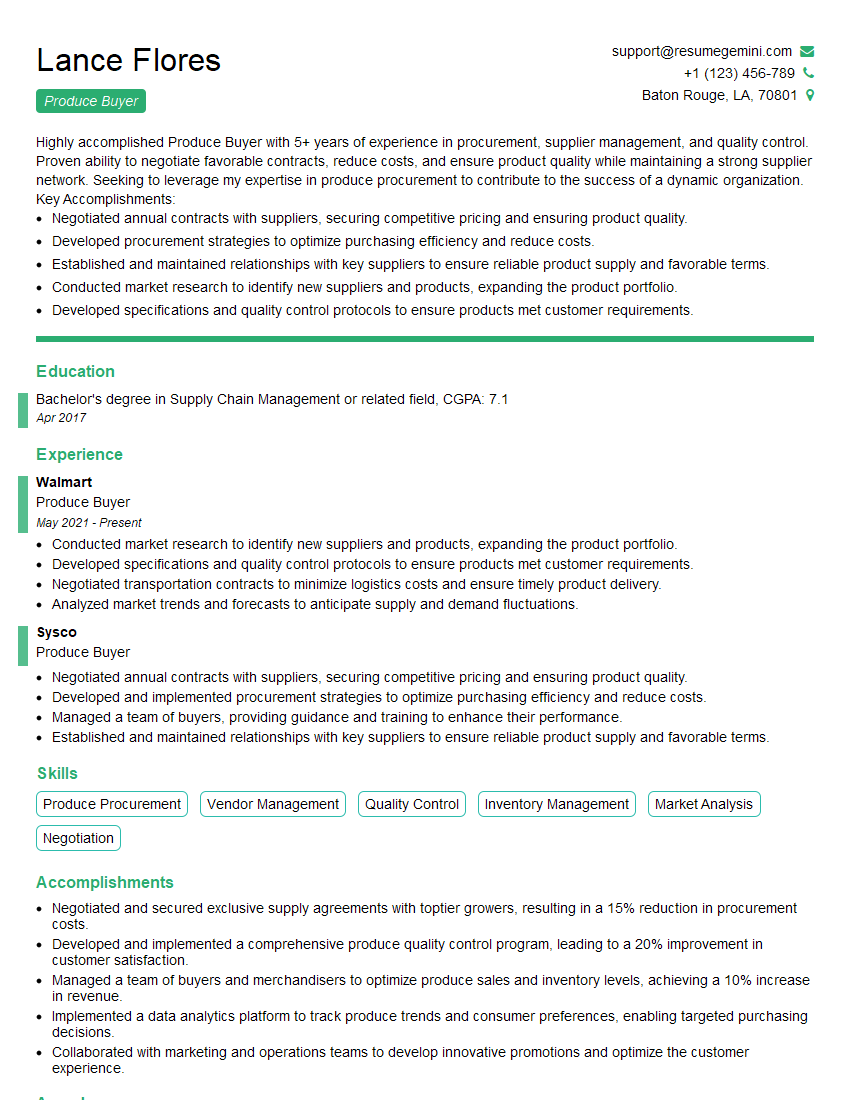
Mastering Produce Industry Knowledge is crucial for career advancement, opening doors to leadership roles and higher earning potential. A strong, ATS-friendly resume is essential for showcasing your expertise and getting noticed by recruiters. To create a resume that truly highlights your skills and experience in this dynamic industry, we encourage you to use ResumeGemini. ResumeGemini provides a powerful platform to build professional, impactful resumes. Examples of resumes tailored to showcase Produce Industry Knowledge are available within the ResumeGemini platform.
Explore more articles
Users Rating of Our Blogs
Share Your Experience
We value your feedback! Please rate our content and share your thoughts (optional).
What Readers Say About Our Blog
Really detailed insights and content, thank you for writing this detailed article.
IT gave me an insight and words to use and be able to think of examples