Interviews are more than just a Q&A session—they’re a chance to prove your worth. This blog dives into essential Proficient in Marine Electrical Systems interview questions and expert tips to help you align your answers with what hiring managers are looking for. Start preparing to shine!
Questions Asked in Proficient in Marine Electrical Systems Interview
Q 1. Explain the difference between AC and DC electrical systems in marine applications.
Marine vessels utilize both Alternating Current (AC) and Direct Current (DC) electrical systems, each serving distinct purposes. DC systems are primarily used for essential services like starting engines, powering navigation equipment, and supplying power to smaller appliances. They’re generally safer at lower voltages and are well-suited for battery operation. AC systems, on the other hand, are typically used for higher-power applications such as air conditioning, larger appliances, and shore power connections. They offer advantages in terms of power transmission over longer distances with less voltage drop compared to DC systems of the same power level.
Think of it like this: DC is like a smooth, constant flow of water from a hose, perfect for smaller tasks. AC is like a wave, powerful and effective for larger jobs, but requiring more careful management.
The key difference lies in the nature of the current: DC flows consistently in one direction, while AC periodically reverses direction. This difference impacts the types of equipment that can be used and how the systems are designed and protected.
Q 2. Describe the function of a marine battery charging system.
A marine battery charging system’s primary function is to replenish the energy consumed from the batteries, ensuring they’re ready for use. This involves converting AC power from the ship’s alternator or shore power into DC power suitable for charging the batteries. The system typically includes a battery charger (often an alternator or a dedicated charger), voltage regulators to prevent overcharging, and various safety mechanisms like circuit breakers and fuses.
The process is crucial for maintaining battery health and preventing premature failure. Overcharging can lead to battery damage, while undercharging reduces their lifespan and capacity. A well-designed system will carefully monitor battery voltage and current, adjusting charging rates as needed to optimize battery performance and longevity. This often involves multi-stage charging profiles to ensure efficient and safe charging, particularly for more sensitive battery chemistries like lithium-ion.
Q 3. What are the safety precautions when working with high-voltage marine electrical systems?
Safety is paramount when working with high-voltage marine electrical systems. Always follow these precautions:
- Lockout/Tagout Procedures: Before any work, completely isolate the power source using proper lockout/tagout procedures to prevent accidental energization.
- Personal Protective Equipment (PPE): Wear appropriate PPE, including insulated gloves, eye protection, and non-conductive footwear. Never work alone.
- Voltage Testing: Always verify that the circuit is de-energized using a reliable voltage tester before commencing any work. Never trust visual inspections alone.
- Grounding and Bonding: Ensure proper grounding and bonding to prevent stray currents and electrical shocks.
- Emergency Procedures: Be aware of emergency procedures and have access to appropriate safety equipment, including a first-aid kit and emergency shut-off switches.
- Training and Certification: Obtain proper training and certification before working on high-voltage systems.
Ignoring these precautions can lead to serious injury or even death. Treating every high-voltage system as potentially lethal is the only safe approach.
Q 4. How do you troubleshoot a faulty marine electrical circuit?
Troubleshooting a faulty marine electrical circuit involves a systematic approach:
- Visual Inspection: Begin with a visual inspection for obvious problems such as loose connections, broken wires, or corrosion.
- Voltage Testing: Use a multimeter to check voltage at various points in the circuit, comparing readings to expected values. This helps identify the location of the fault.
- Continuity Testing: Test for continuity in wires and components to identify breaks or shorts. A short circuit is a connection where current takes an unintended path, often leading to a blown fuse or circuit breaker.
- Component Testing: If necessary, test individual components such as switches, circuit breakers, and loads to identify faulty parts.
- Wiring Diagrams: Consult wiring diagrams to trace the circuit and identify the correct path of the current. These diagrams are essential for understanding complex marine electrical systems.
- Process of Elimination: Systematically check each component and connection in the circuit, eliminating possibilities until the fault is found.
For instance, if a light doesn’t work, you might first check the bulb, then the switch, the wiring, and finally the circuit breaker or fuse.
Q 5. What is the purpose of a marine electrical distribution panel?
A marine electrical distribution panel acts as the central hub for distributing power throughout the vessel. It contains circuit breakers or fuses to protect individual circuits, providing a means to switch circuits on or off and to isolate faulty circuits in case of problems. It also usually provides a visual indicator of the status of each circuit (e.g., whether it’s on or off, or if a circuit breaker has tripped).
Think of it as the main electrical control center for your boat. It ensures that power is efficiently and safely distributed to various components of the vessel, allowing for organized management of the electrical system and easy troubleshooting. Panels typically have clear labeling indicating the purpose of each circuit, which is vital for easy identification and maintenance.
Q 6. Explain the principles of grounding and bonding in marine electrical systems.
Grounding and bonding are critical safety measures in marine electrical systems. Grounding provides a low-resistance path to the earth for fault currents, protecting people from electric shock. Bonding connects metallic parts of the hull and other equipment to create a common electrical potential, preventing voltage differences that could cause corrosion or electric shock.
Imagine the hull of the boat as the earth. Grounding ensures that any stray current caused by a fault flows directly to the hull, preventing it from passing through a person. Bonding connects all metallic parts so that they are at the same potential, minimizing the chance of a voltage difference that could cause a shock or electrolytic corrosion. The system works together to keep everything at a safe electrical potential.
Proper grounding and bonding are essential for safety and longevity of the electrical system. They are typically mandated by regulatory bodies to ensure electrical safety aboard vessels.
Q 7. Describe different types of marine electrical wiring and their applications.
Various types of marine electrical wiring are used, each suited for specific applications:
- Tinned copper wire: A common choice due to its corrosion resistance and flexibility. Used extensively in most marine applications.
- PVC-insulated wire: Commonly used for interior wiring due to its durability and resistance to moisture. However, it’s less flexible than other options.
- Thermoplastic elastomer (TPE) insulated wire: Offers superior flexibility and abrasion resistance compared to PVC, making it suitable for moving parts.
- High-temperature wire: Used in high-temperature environments, like engine compartments. It’s designed to withstand higher temperatures than standard wiring.
- Multi-conductor cables: Contain multiple wires within a single jacket, used to bundle several circuits together.
- Shielded cables: Provide electromagnetic interference (EMI) protection for sensitive equipment.
The choice of wiring depends on the voltage, current, environmental conditions, and the specific application. Using the wrong type of wiring can lead to system failures, safety hazards, or costly repairs.
Q 8. What are the common causes of electrical fires on vessels?
Electrical fires on vessels are a serious concern, often stemming from a combination of factors. Think of it like a house fire – several conditions need to be met for ignition and propagation.
- Overheating: Faulty wiring, loose connections, or overloaded circuits generate excessive heat, potentially igniting nearby flammable materials. Imagine a frayed wire constantly sparking – that’s a recipe for disaster.
- Short Circuits: These occur when the electrical current takes an unintended path, often resulting in arcing and intense heat. This is like a sudden, uncontrolled surge of electricity – it can quickly overheat wires and components.
- Corrosion: Saltwater environments accelerate corrosion in wiring and terminals, leading to increased resistance and heat buildup. Think of rust slowly eating away at the insulation, making the wire vulnerable.
- Poor Maintenance: Neglecting regular checks and preventative maintenance increases the risk of all the above. Regular inspections are crucial, much like regular servicing of your car.
- Improper Installation: Incorrectly installed wiring or improperly sized components can lead to overheating and fires. This is like building a house with faulty electrical work; it’s a safety hazard.
Addressing these issues through proper design, installation, regular maintenance, and the use of high-quality materials is paramount to preventing electrical fires on board.
Q 9. How do you perform a preventative maintenance check on a marine generator?
Preventative maintenance on a marine generator is crucial for reliability and safety. Think of it as a comprehensive health check.
- Visual Inspection: Check for any signs of damage, corrosion, or loose connections on all components, including wiring, belts, and fuel lines. Look for any leaks or signs of wear and tear.
- Fluid Levels: Inspect and top off engine oil, coolant, and fuel as needed. Low fluid levels can lead to overheating and damage.
- Belt Tension: Ensure proper belt tension. Loose belts can slip and cause damage to the generator and reduce efficiency.
- Battery Check: Check battery voltage and electrolyte levels. Weak batteries can lead to starting issues and other problems.
- Exhaust System: Inspect the exhaust system for leaks, blockages, or corrosion. A blocked exhaust can cause dangerous carbon monoxide buildup.
- Testing Under Load: Run the generator under load for a period to monitor its performance and identify any issues. This is like a stress test for the engine.
- Logbook Entry: After each maintenance check, meticulously record all findings and actions in the generator logbook. A well-maintained logbook will help you track performance over time.
Regular, documented preventative maintenance minimizes the risk of unexpected breakdowns and extends the life of the generator significantly.
Q 10. Explain the operation of a marine switchboard.
The marine switchboard is the central distribution point for electrical power on a vessel. Think of it as the brain of the electrical system, controlling power flow to various circuits.
It houses circuit breakers, switches, and metering devices that allow for safe and controlled distribution of power. Each circuit breaker protects a specific circuit from overloads and short circuits. Switches allow operators to turn circuits on and off. Meters display voltage, current, and other relevant parameters, allowing for monitoring and troubleshooting.
Operation involves selectively switching on or off circuits as needed, monitoring power consumption, and responding to any circuit breaker trips. A well-organized and clearly labeled switchboard is essential for efficient and safe operation of the vessel’s electrical system.
For example, to power the navigation lights, the operator would simply switch on the relevant circuit on the switchboard. If an overload occurs, the relevant circuit breaker will trip, isolating the faulty circuit and preventing further damage.
Q 11. What are the regulations and standards for marine electrical installations?
Marine electrical installations are governed by strict regulations and standards to ensure safety and reliability. These standards vary slightly by country and classification society but generally follow international guidelines such as those from the International Electrotechnical Commission (IEC).
- IEC 60945 (IEC 60092-500): This standard, along with its relevant parts, covers the design, installation, and testing of electrical equipment on ships. It’s a very comprehensive document specifying requirements for everything from wiring to switchgear.
- National and Classification Society Standards: Each maritime administration, such as the US Coast Guard or the UK Maritime and Coastguard Agency, will also have its own specific regulations and requirements. Similarly, classification societies, like ABS, DNV, or Lloyd’s Register, impose further requirements during the certification process.
- SOLAS Convention: The International Convention for the Safety of Life at Sea (SOLAS) indirectly influences marine electrical installations by setting overall safety standards for ships.
Compliance with these regulations is mandatory for safe operation and certification of vessels. Non-compliance can result in serious consequences, including fines, delays, or even legal action.
Q 12. Describe your experience with marine electrical diagnostic tools.
My experience encompasses a wide range of marine electrical diagnostic tools. I am proficient in using multimeters, clamp meters, insulation resistance testers, and specialized diagnostic software for marine systems. These are the essential tools of the trade, akin to a doctor’s medical kit.
- Multimeters: Used for measuring voltage, current, and resistance, they are essential for basic troubleshooting.
- Clamp Meters: Allow for non-contact current measurement, invaluable for identifying overloaded circuits without disconnecting wires.
- Insulation Resistance Testers (Meggers): Used to test the insulation resistance of cables and equipment, detecting potential faults before they cause problems.
- Specialized Software: Many modern marine systems use diagnostic software for more advanced troubleshooting and data logging. This is like having a detailed patient history readily available.
I’m experienced in interpreting the data obtained from these tools to accurately diagnose and rectify electrical faults. My experience includes troubleshooting complex issues on various vessel types, from small yachts to large commercial ships.
Q 13. How do you interpret marine electrical schematics and diagrams?
Interpreting marine electrical schematics and diagrams is a fundamental skill. These diagrams are like maps, guiding us through the vessel’s complex electrical network. They use standardized symbols to represent components and their interconnections.
My approach involves systematically analyzing the diagrams, starting with the power source and tracing the path of the current to the various loads. I understand the different symbols used, such as those representing switches, breakers, motors, and other components. I can trace circuits, identify potential points of failure, and understand how various components interact.
For example, a schematic might show the path of power from the generator, through the switchboard, to the navigation lights. By carefully examining the diagram, one can determine the correct circuit breaker to isolate the navigation lights if a problem arises. My experience ensures I can quickly and accurately interpret even the most complex diagrams.
Q 14. What is your experience with marine propulsion systems?
My experience with marine propulsion systems is extensive, focusing on the electrical aspects of these systems. This includes both conventional propulsion systems and more modern, electrically driven systems. It’s crucial to understand that the propulsion system is often the most power-hungry part of the ship.
- Conventional Propulsion: I’ve worked extensively with the electrical systems supporting diesel engines, including starting systems, generator sets, and control systems. This ranges from routine maintenance and fault diagnosis to major overhauls.
- Electric Propulsion: I have experience with the electrical aspects of modern electric propulsion systems, including electric motors, motor controllers, and power distribution systems. These systems are highly complex and require specialized knowledge.
- Hybrid Systems: I’m familiar with the challenges and intricacies of hybrid propulsion systems, combining diesel engines and electric motors for improved efficiency and reduced emissions.
My expertise encompasses troubleshooting electrical issues, performing preventative maintenance, and working with various types of propulsion control systems. I’m comfortable working with high-voltage systems and understand the safety protocols required for these systems.
Q 15. Explain your knowledge of various types of marine lighting systems.
Marine lighting systems are crucial for navigation, safety, and operational efficiency. They range from simple incandescent bulbs to sophisticated LED systems, each with its own advantages and disadvantages.
- Incandescent Lighting: Traditional bulbs, simple and inexpensive, but inefficient and short-lived. They generate significant heat, making them unsuitable for certain applications.
- Fluorescent Lighting: More energy-efficient than incandescent, offering longer lifespan. However, they can be fragile and contain mercury, posing environmental concerns during disposal.
- LED Lighting: The most modern and widely adopted type. They are energy-efficient, long-lasting, durable, and available in various colors and intensities. They are also resistant to vibrations, a key feature in marine environments.
- Navigation Lights: These are specifically designed to comply with international regulations (COLREGs), indicating the vessel’s position and intentions to other vessels. They come in various types, such as masthead, side, stern, and anchor lights, each with specific characteristics (color, intensity, and placement).
For example, I once worked on a refit project where we replaced the entire lighting system on a yacht with LED lights. This resulted in a significant reduction in energy consumption and maintenance costs, improving overall efficiency. The improved brightness also enhanced safety and visibility.
Career Expert Tips:
- Ace those interviews! Prepare effectively by reviewing the Top 50 Most Common Interview Questions on ResumeGemini.
- Navigate your job search with confidence! Explore a wide range of Career Tips on ResumeGemini. Learn about common challenges and recommendations to overcome them.
- Craft the perfect resume! Master the Art of Resume Writing with ResumeGemini’s guide. Showcase your unique qualifications and achievements effectively.
- Don’t miss out on holiday savings! Build your dream resume with ResumeGemini’s ATS optimized templates.
Q 16. Describe your experience with marine automation and control systems.
My experience with marine automation and control systems encompasses a wide range of technologies, from simple switchboards to sophisticated integrated systems. I’m proficient in PLC (Programmable Logic Controller) programming, using systems like Siemens, Allen-Bradley, and Schneider Electric, and familiar with SCADA (Supervisory Control and Data Acquisition) systems.
I’ve worked on projects involving automated engine room monitoring, tank level control, ballast water management, and integrated navigation systems. This includes designing, installing, commissioning, and troubleshooting these systems. For example, I recently implemented a system that automatically adjusts the ballast water pumps based on real-time data from various sensors, significantly improving stability and fuel efficiency.
My expertise extends to the networking aspects of these systems, including understanding and utilizing various communication protocols like NMEA 2000 and Ethernet. A recent project required troubleshooting a communication issue between the vessel’s autopilot and the GPS receiver, which I successfully resolved by identifying a faulty network cable.
Q 17. How do you ensure the safety of crew during electrical maintenance?
Safety is paramount during any electrical maintenance. My approach always follows a strict protocol emphasizing lockout/tagout procedures, ensuring that power is completely isolated before any work commences. This involves visually verifying the isolation, testing for residual voltage, and utilizing appropriate personal protective equipment (PPE), including insulated gloves, safety glasses, and arc flash suits where necessary.
Before starting any work, I conduct a thorough risk assessment, identifying potential hazards and implementing control measures. This often involves briefing the crew on the planned work, establishing clear communication channels, and assigning specific roles and responsibilities. For example, during a high-voltage cable replacement, I ensured a dedicated safety observer was present throughout the process.
Regular training and competency assessments are critical. The crew should receive regular updates on safety procedures and be competent in the use of PPE. I always ensure that anyone involved in electrical work on board is adequately trained and certified.
Q 18. What is your experience with troubleshooting navigation and communication systems?
Troubleshooting navigation and communication systems requires a systematic approach. It begins with a thorough understanding of the system’s architecture and functionality, identifying potential points of failure. I am proficient in using diagnostic tools and interpreting error codes.
My experience includes working with various types of GPS systems, radar systems, autopilots, VHF radios, satellite communication systems (Inmarsat, Iridium), and AIS (Automatic Identification System). For example, I resolved an issue where a vessel’s GPS was showing incorrect position data by identifying a faulty antenna cable and replacing it. Another instance involved diagnosing a communication breakdown on the VHF radio by checking the antenna, power supply, and radio itself. I also have experience troubleshooting network issues within integrated navigation systems.
A systematic troubleshooting process is key; starting with the simplest checks (power supply, connections, fuses) before moving to more complex components. Documentation and record-keeping are vital for future reference.
Q 19. Explain your knowledge of emergency power systems on vessels.
Emergency power systems are critical for safety and emergency situations. These systems typically include emergency generators, batteries, and emergency lighting. They must be designed to provide power to essential services in the event of a main power failure.
My experience involves working with various types of emergency generators, ranging from diesel to gas-powered units. I’m familiar with their maintenance, testing, and regulatory compliance (SOLAS, IMO). I understand the importance of regular testing and maintenance of these systems. For instance, I’ve been involved in the regular load testing and fuel servicing of emergency generators ensuring their readiness for emergencies.
I also have experience in designing emergency power distribution systems ensuring sufficient capacity and redundancy to provide power to essential equipment like emergency lighting, communication systems, fire pumps, and bilge pumps. I emphasize the importance of proper documentation and clear labeling of emergency power circuits.
Q 20. Describe your experience working with different types of marine motors.
My experience encompasses various types of marine motors, including diesel engines, electric motors, and hybrid systems. I understand their operating principles, maintenance requirements, and safety protocols.
I am familiar with the electrical aspects of diesel engines, including starting systems, alternator systems, and control systems. I have experience troubleshooting electrical faults in these systems, for example, identifying and repairing a faulty alternator that was causing insufficient power generation. With electric motors, I am familiar with their different types (AC, DC), control systems (VFDs, motor starters), and maintenance requirements.
Working with hybrid systems presents a unique set of challenges and opportunities. These systems combine the efficiency of electric motors with the power of diesel engines, requiring a deep understanding of both electrical and mechanical systems. I have experience working on such systems, understanding the power management and integration of the two systems.
Q 21. How do you handle a situation with unexpected electrical faults at sea?
Handling unexpected electrical faults at sea requires a calm, systematic approach. Safety is the top priority; isolating the affected circuit and ensuring the safety of the crew is the first step.
The troubleshooting process begins with a thorough assessment of the situation, identifying the nature of the fault and its potential impact on the vessel’s operation. This often involves checking circuit breakers, fuses, and other protective devices. I would use diagnostic equipment like multimeters and insulation testers to identify the source of the problem. My approach involves systematically checking each component, starting from the power source and tracing the circuit to pinpoint the fault. I would then repair or replace the faulty component, ensuring all safety measures are in place.
Documentation is critical. Thorough record-keeping of the fault, troubleshooting steps, and repairs will aid future maintenance and provide valuable information in case of recurring issues. In case the problem is beyond my expertise, I would immediately contact shore support or a qualified specialist.
Q 22. What is your experience with marine electrical system upgrades and retrofits?
Marine electrical system upgrades and retrofits are a significant part of my expertise. I’ve worked on numerous projects, ranging from small sailboat upgrades to complex refits on large yachts. My approach always begins with a thorough assessment of the existing system, identifying its limitations and the client’s needs. This includes evaluating the existing wiring, switchgear, and components to determine their condition and compatibility with the proposed upgrades. For example, I recently upgraded a 40-foot sailboat’s electrical system, replacing its aging battery bank with a new lithium-ion system, upgrading the charging system, and adding a sophisticated monitoring system. The project involved careful planning to ensure minimal disruption to the vessel’s operation. I also consider future expansion needs during the design phase, ensuring the system can accommodate additional loads in the future.
Another significant project involved retrofitting a classic yacht with a modern electrical system, complying with the latest safety standards while maintaining the vessel’s historical integrity. This often requires creative solutions, such as discreetly integrating new components within the existing structure. My experience encompasses working with various system architectures, including 12V, 24V, and even higher voltage systems, and adapting to the specific challenges of each vessel.
Q 23. Describe your proficiency with different types of marine electrical connectors.
Proficiency with marine electrical connectors is crucial for safe and reliable installations. I’m experienced with a wide variety of connectors, including Anderson Powerpole, Deutsch connectors, and various types of waterproof circular connectors. The choice of connector depends heavily on the application and current requirements. For example, Anderson Powerpole connectors are ideal for high-current applications like battery banks, offering both high current capacity and ease of connection. Deutsch connectors are often preferred for their robust sealing and resistance to vibration, making them suitable for demanding environments. I understand the importance of selecting connectors with the correct amperage rating and ensuring proper crimping and sealing techniques are followed to maintain watertight integrity.
My experience also covers working with older, less common connectors, requiring careful evaluation for proper replacement or repair. I often need to troubleshoot issues arising from corroded or damaged connectors, necessitating careful cleaning, repair, or replacement with compatible alternatives. A key aspect of my work is selecting connectors that meet or exceed the appropriate industry standards, ensuring long-term reliability and safety.
Q 24. Explain your knowledge of marine electrical cable sizing and selection.
Marine electrical cable sizing and selection is governed by several factors, including the current carrying capacity, voltage drop, and environmental conditions. I utilize industry-standard tables and calculation methods to determine the appropriate cable size for a given application. This involves considering the length of the cable run, the type of cable (e.g., tinned copper, marine-grade PVC), and the anticipated load current. For instance, a longer cable run requires a larger gauge cable to minimize voltage drop and maintain system efficiency. Using an undersized cable can lead to overheating, voltage drop, and potential fire hazards.
I frequently use online calculators and reference materials to ensure accuracy, especially when dealing with complex systems. I always account for safety factors, selecting a cable size with a higher current-carrying capacity than theoretically needed. The choice of cable type is also critical. Marine-grade cables are specifically designed to withstand the harsh marine environment, including moisture, salt spray, and UV radiation. Improper cable selection can lead to premature cable failure and potentially dangerous situations.
Q 25. How do you ensure compliance with environmental regulations during electrical work?
Compliance with environmental regulations is paramount in my work. I am familiar with regulations concerning the disposal of hazardous materials, such as batteries and oils. I always ensure that all waste is disposed of properly through licensed facilities. This includes ensuring that used batteries are recycled responsibly and not discarded improperly, which could contaminate the environment. When working on vessels, I am conscious of minimizing any potential pollution during the work process, avoiding spills or accidental discharge of materials into the water.
I also understand and adhere to regulations concerning the use of environmentally friendly materials, such as low-VOC paints and coatings. Selecting environmentally responsible products is a part of my commitment to sustainable practices. Throughout my projects, I actively strive to minimize the environmental impact of my work, ensuring compliance with all applicable regulations.
Q 26. Describe your experience with electrical testing and inspection procedures.
Electrical testing and inspection procedures are an integral part of my work. I regularly perform tests such as continuity tests, insulation resistance tests, and ground fault tests to ensure system integrity and safety. I utilize specialized marine-grade multimeters and other testing equipment to accurately assess the condition of the electrical system. For instance, I’d use a megger to test the insulation resistance of cables and wiring to identify potential issues before they become major problems.
My inspection procedures are thorough and documented. I create detailed reports outlining the testing performed, the results obtained, and any necessary remedial actions. This ensures that any issues are addressed promptly and efficiently. I’m proficient in interpreting test results and identifying potential hazards, ensuring that the electrical system is safe and meets the required standards. This attention to detail is critical for ensuring the long-term safety and reliability of the marine electrical systems I work on.
Q 27. What is your experience with the installation and maintenance of marine solar panels?
I have extensive experience with the installation and maintenance of marine solar panels. This includes selecting appropriate panels based on the vessel’s power requirements and available space. I’m familiar with various panel types and their characteristics, including monocrystalline, polycrystalline, and flexible solar panels. The selection process involves considering factors such as efficiency, durability, and cost-effectiveness. Proper mounting is crucial, ensuring secure and watertight installation using appropriate mounting hardware and sealant.
Installation also involves careful consideration of the wiring and charge controller configuration. I’m experienced in working with various charge controllers, MPPT and PWM, ensuring that the system efficiently charges the batteries. I regularly perform maintenance checks on solar panel systems, including cleaning the panels and inspecting the wiring and connections. This helps to ensure maximum power output and extends the lifespan of the system. Addressing any issues early helps prevent larger, more expensive problems down the line.
Q 28. Explain your understanding of fault current protection in marine electrical systems.
Fault current protection is critical in marine electrical systems to prevent damage to equipment and, most importantly, to ensure the safety of personnel. The systems typically rely on circuit breakers, fuses, and ground fault circuit interrupters (GFCIs) to protect against overloads, short circuits, and ground faults. I’m proficient in selecting appropriate protective devices based on the system’s requirements, considering factors such as current rating, voltage, and the type of load. Oversized protection devices can allow for dangerous conditions, while undersized ones can trip too easily or fail to protect the circuit.
I understand the importance of proper grounding and bonding to mitigate the risks of electric shock. Ground fault protection is especially crucial in marine environments due to the presence of moisture and potential for corrosion. I always ensure that the system’s earthing is properly installed and maintained, and I regularly inspect and test the protective devices to ensure that they’re functioning correctly. Proper installation and maintenance of these devices are crucial for safe and reliable operation of the marine electrical systems.
Key Topics to Learn for Proficient in Marine Electrical Systems Interview
- DC & AC Systems: Understanding the principles of direct current (DC) and alternating current (AC) systems, including their generation, distribution, and applications in marine environments. Be prepared to discuss voltage regulation and power distribution strategies.
- Wiring Diagrams & Schematics: Interpreting and understanding complex marine electrical wiring diagrams. Practice tracing circuits and identifying potential faults. Discuss different schematic notations and symbols.
- Electrical Safety Regulations & Practices: Demonstrate a strong understanding of safety regulations and best practices related to marine electrical systems, including isolation, grounding, and lockout/tagout procedures. This includes knowledge of relevant IEC and IMO standards.
- Troubleshooting & Diagnostics: Explain your approach to troubleshooting common electrical problems onboard a vessel, including the use of diagnostic tools and techniques. Be prepared to discuss examples of successful troubleshooting experiences.
- Marine Electrical Equipment: Demonstrate familiarity with various marine electrical equipment such as generators, switchboards, motor controllers, navigation systems, and lighting systems. Discuss their operation, maintenance, and troubleshooting.
- Battery Systems & Charging: Explain the principles of marine battery systems, including different battery types, charging methods, and monitoring techniques. Discuss battery management and maintenance procedures.
- Instrumentation & Monitoring: Discuss various instrumentation used to monitor electrical parameters such as voltage, current, and power. Explain the importance of accurate monitoring and data interpretation.
- Automation & Control Systems: If applicable to your experience, discuss your understanding of automated control systems used in modern marine vessels, including programmable logic controllers (PLCs).
Next Steps
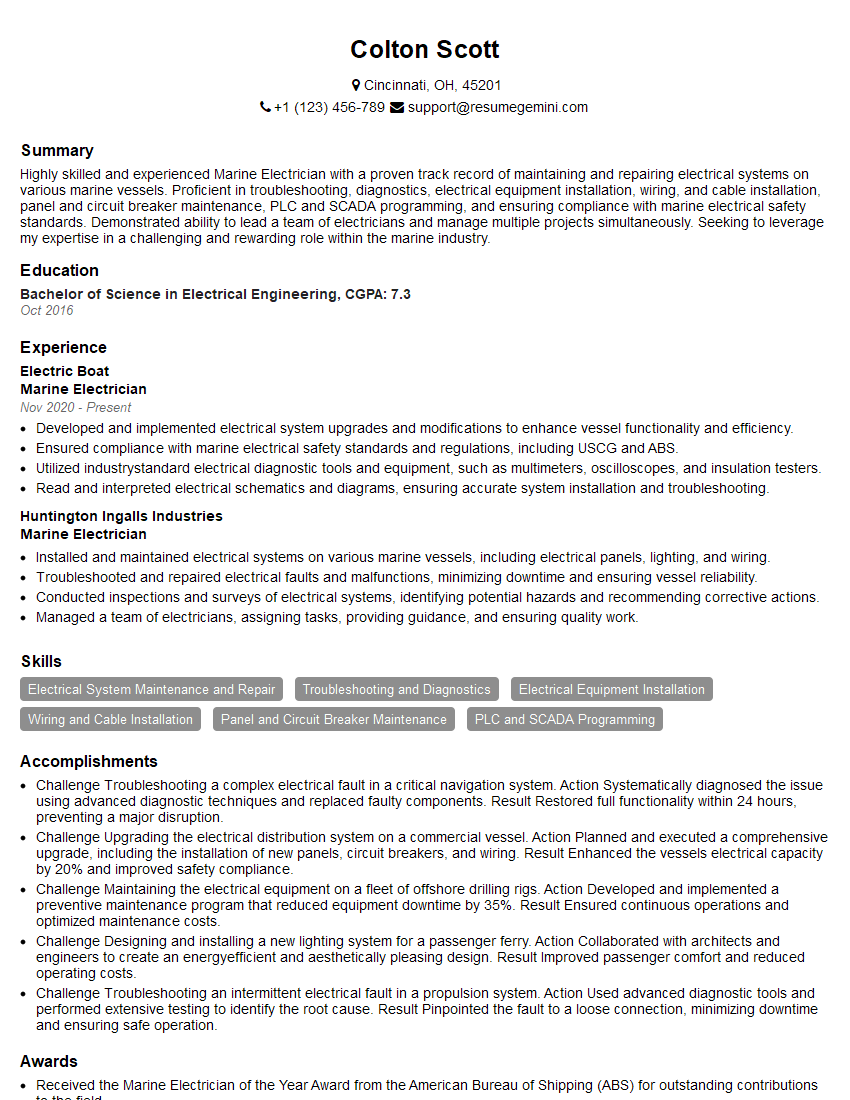
Mastering Proficient in Marine Electrical Systems is crucial for advancement in your marine career, opening doors to higher-paying roles and increased responsibility. A strong resume is your first impression – make it count! Crafting an ATS-friendly resume that highlights your skills and experience is essential for getting noticed by recruiters. ResumeGemini is a trusted resource to help you build a professional, impactful resume that showcases your expertise in marine electrical systems. Examples of resumes tailored to this specific field are available to help guide your creation process. Take the next step toward your dream job today!
Explore more articles
Users Rating of Our Blogs
Share Your Experience
We value your feedback! Please rate our content and share your thoughts (optional).
What Readers Say About Our Blog
I Redesigned Spongebob Squarepants and his main characters of my artwork.
https://www.deviantart.com/reimaginesponge/art/Redesigned-Spongebob-characters-1223583608
IT gave me an insight and words to use and be able to think of examples
Hi, I’m Jay, we have a few potential clients that are interested in your services, thought you might be a good fit. I’d love to talk about the details, when do you have time to talk?
Best,
Jay
Founder | CEO